Home Blog Page 1988

Subsidy gulped N8.94tn in ten years, as petrol scarcity looms over tanker drivers strike

0

DATA from the Petroleum Products Pricing Regulatory Agency (PPPRA) revealed that over a 10-year period, the Federal Government consistently spent N8.94 trillion in subsidising Premium Motor Spirit, (PMS) also called petrol.

Between 2006 and 2010, the Federal Government had spent N257.36 billion, N271.51 billion, N630.57 billion, N469.31 billion and N667.08 billion, according to records released by the PPPRA.

Also from 2011 to 2015, the government paid N2.104 trillion, N1.354tn, N1.315tn, N1.217tn and N653.51 billion respectively on petrol subsidy.

The PPPRA had in March this year commenced the deregulation of the downstream oil sector in a bid to stop the continued payment on petrol subsidy by setting a market-based pricing regime for petrol in accordance with the market realities.

Petrol prices in Nigeria have increased for three months consecutively, rising slightly from N121  per litre in June to N143 in July, N150 in August, and N162 in September.

The Nigerian National Petroleum Corporation (NNPC) which was the sole importer of petrol into the country had been recording under-recoveries as a result of its subsidy spending on petrol.

In another development, the Nigerian Association of Road Transport Owners (NARTO) on Tuesday ordered tanker drivers across the country to halt operations to protest the Federal Government’s ban on petroleum trucks above 45,000 litres from plying Nigerian roads.

NARTO is the umbrella organisation of all commercial vehicles owners in Nigeria engaged in the haulage of petroleum products, general cargoes, and movement of goods and passengers within the country and the West-African sub-region.

Speaking at a press briefing in Abuja, Yusuf Othman, NARTO’s National President, said members of the association would have to park their trucks on Tuesday and Wednesday as a warning to government against the abrupt ban.

“NARTO received with grave shock the recent government decision to place an immediate ban on all petroleum trucks above 45,000 litres capacity from plying Nigeria roads,” he said.

Othman said the sudden ban was insensitive and unappreciative of the efforts of NARTO members in the distribution and supply chain of petroleum products across the country.

He said none of the major transport companies across the country could continue any form of operations with the policy within the short timeframe, adding that if the ban was not lifted, the association would begin a full-blown industrial action.

“In view of the above, we are therefore constrained to allow the decision of all our members to park their trucks as from tomorrow, 22nd to 23rd September 2020, to prevail as a warning,” he said.

“And furthermore, issue 10-day ultimatum with effect from 24th September 2020, for a full-blown withdrawal of service. If such scenarios occur, we earnestly plead with those who will lose employment, income and the general public that will be negatively affected by this avoidable situation.”

The association argued that it was distressing and discouraging for the government to impose the new policy abruptly without giving the operators time to gradually phase out the affected trucks.

“The leadership of NARTO is not in any way against the decision of the Federal Government to ban the use of trucks with more than 45,000 litres capacity in the conveyance of petroleum products considering the dilapidated state of Nigerian roads,” he said.

Othman said the association was particularly concerned about the sudden and prompt nature of the ban, which according to him was considered as highly insensitive to the huge investments the owners of the trucks have made and debts they incurred in executing the mandate given by previous administration.

Police in Benue arrest 96 robbery, cultism suspects

0

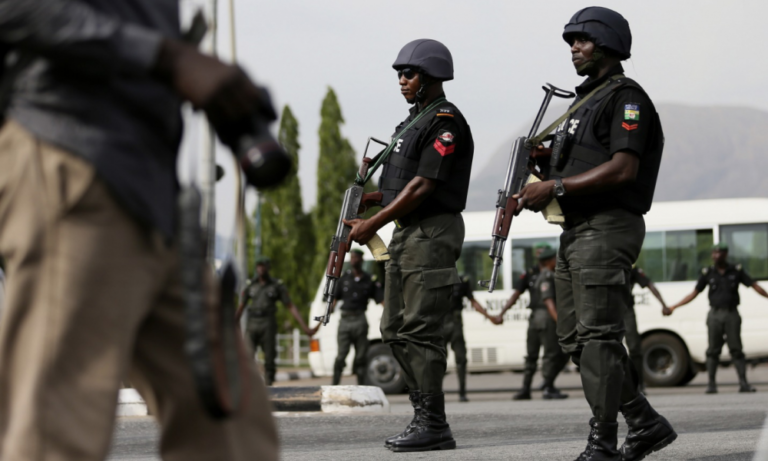
THE Benue State Police Command says it has arrested 96 persons in 23 days over an alleged connection with armed robbery and cultism in Makurdi, the state capital.

Catherine Anene, the Benue Police Public Relations Officer (PPRO), made this known in a statement, adding that the arrest of the suspects followed several complaints by residents of Makurdi.

Anene said the complaints to the State Police Command mostly came from residents of Welfare Quarters, Yarkiyo, Wadata, Ankpa Quarters, NUJ and North-Bank areas in Makurdi.

She added that the suspects were arrested in an operation that spanned between August 24 and September 15.

The Police spokesperson noted that part of items recovered from the arrested suspects include two locally-made pistols, one dane gun, two live cartridges.

She added that one canister of 38mm, tear gas cartridge, one military camouflage cap, three black berets, four red berets, and military jungle hat were also recovered from the suspects.

“Other items were two pairs of military uniforms, one Ipad, two desert boots, one animal horn, cutlasses, knives and assorted charms, and wraps of herbs suspected to be Indian Hemp,” Anene said.

She charged members of the public to support the command’s resolve to rid the state of criminal activities by providing useful information.

CDC retracts coronavirus airborne transmission guidance, says it was posted in error

0

The United States (US) Center for Disease Control and Prevention (CDC) has retracted its earlier published COVID-19 guideline in which it claimed that coronavirus commonly spreads “through droplets and airborne particles.”

The CDC had on Monday issued a correction on its website, stating that it had posted a draft version which was titled ‘updated guideline’ in error.

“A draft version of proposed changes to these recommendations was posted in error to the agency’s official website,” CDC said in an update shared on its website  Monday evening.

“CDC is currently updating its recommendations regarding airborne transmission of SARS-CoV-2 (the virus that causes COVID-19). Once this process has been completed, the updated language will be posted.”

While the update is silent on the airborne aspect of the virus, the new message on the page now says the virus is “thought to spread mainly from person-to-person” from close contact and “respiratory droplets produced when an infected person coughs, sneezes, or talks.”

It also warned that COVID-19 may be spread by people who are not showing symptoms, adding that the virus is spreading more efficiently than influenza.

However, public health experts and scientists have argued about the possibility of COVID-19 to be airborne.

“When it comes to COVID-19, the evidence overwhelmingly supports aerosol transmission, and there are no strong arguments against it,” says Jose-Luis Jimenez, a Professor of Chemistry and a fellow of the Cooperative Institute for Research in Environmental Sciences at the University of Colorado-Boulder.

Identified as a third potential pathway of transmission, it has been submitted that COVID-19 can spread through aerosols, also known as airborne.


North East Elders group asks Buhari to sack Service Chiefs over escalating insecurity

0

THE North East Elders for Peace and Development (CNEEPD) has asked President Muhammadu Buhari to remove the Service Chiefs and bring in new hands to effectively confront the secu­rity challenges facing the country.

“There is no denying the fact that at this moment, the entire nation is distressed by the incessant mind­less killing of our citizens and pillaging of defenseless com­munities by insurgents, ban­dits and kidnappers,” the group said in a statement issued by Zana Goni, its chairman on Monday.

“There is no denying the fact also that these have resulted in indescribable agony, anguish and torment to the Nigerian citizens.”

The North East Elders’ group noted that excuses being tendered by the Service Chiefs were no longer tenable adding that the worsening security situation in the country was further reinforcing the urgent need to inject new hands with fresh ideas to han­dle the nation’s security archi­tecture.

“We have seen that the security situation under the current Service Chiefs has reached an unbearable state,” it said.

“And following these mentioned above, we, the Coalition of North East Elders for Peace and Development, in the strongest terms, restate the call to Pres­ident Muhammadu Buhari to honor the resolution of the National Assembly and positions of majority of Nigerians to im­mediately remove the Service Chiefs and bring in new hands to effectively confront the secu­rity challenges starring us in our face as a nation.”

On Monday, the Nigerian Army announced that Dahiru Chiroma Bako, a Colonel and its Commander of 25 Task Force Brigade of Operation Lafiya Dole in Borno State, died of injuries sustained during a shootout between Troops and some elements of West Africa Islamic Province (ISWAP) on Sunday.

Ado Isa, a Colonel and Deputy Director Army Public Relations 7 Division said the late Commander led a patrol to clear Boko Haram terrorists from Sabon Gari-Wajiroko axis near Damboa when his patrol team entered an ambush at about 10 am on Sunday.

The nation’s Service Chiefs were appointed by President Buhari when he assumed office in 2015.

Several calls by the National Assembly and by Nigerians to sack and replace them have been rebuffed by the presidency.

Femi Adesina, Special Adviser on Media and Publicity to the President, in a statement in July to respond to call by the National Assembly asking for the removal of the Service Chiefs said the prerogative to appoint and fire Service Chiefs solely lies on his boss adding that Buhari would always do what is the best of the nation.

“The Senate Tuesday adopted a resolution calling on the Service Chiefs to resign or be sacked due to the multi-pronged security challenges in the country.

“The Presidency notes the resolution, and reiterates that appointment or sack of Service Chiefs is a Presidential prerogative, and President Muhammadu Buhari, in his capacity as Commander-in-Chief of the Armed Forces, will do what is in the best interest of the country at all times,” Adesina said. 

Registration portal for MSMEs survival funds unavailable hours after it was scheduled to open

0

By Abiodun JAMIU


THE registration portal for the Federal Government’s post-COVID-19 stimulus packages for Micros, Small, and Medium Enterprises (MSMEs) is still inaccessible hours after it was scheduled to be opened by the Ministry of Industry, Trade and Investment, a check by The ICIR has revealed.

In a series of tweets earlier on Monday, the Federal Government had disclosed that the registration portal for the MSME Survival Fund would open at 10 pm, Monday, September 21, 2020

It announced that when the portal opens at 10 pm, it will have educational institutions as the first category of beneficiaries to register.

At 10pm on Monday, the portal was also not available when The ICIR checked.

“As the portal for registration of prospective beneficiaries of #SurvivalFundNG opens today, interested Nigerians in the Payroll Support scheme are to note that the site will be open from 10 pm Monday, September 21, 2020,” the tweet read.

“REGISTRATION SCHEDULE: Registration for #PayrollSupport will start with educational institutions at 10 pm on Monday, Sept 21, 2020, and will be followed by businesses in the hospitality industry on Friday, September 25 beginning from 12 am.”

The portal will also be open to other categories of small businesses from 12 am, on Mon Sept 28, 2020. Note that the scheduling of registration for prospective beneficiaries is to ensure that the process is seamless & hitch-free. The Portal: http://survivalfund.ng.”

But when The ICIR visited the website at exactly 2:05 am, Tuesday, September, four hours after the scheduled opening, the registration portal was yet to be opened for Nigerians to apply for the package.

A popped up message asked the reporter to check back on Monday September, 21, 2020 at 10:00 pm

The website was unavailable

“UNAVAILABLE Registration opens Monday 21st September 2020 at 10:00 pm” the statement reads.

The scheme, according to Mariam Karahun, Minister of State, Industry, Trade and Investment, in an introductory video on the website, is a product of the Economic Sustainability Committee Plan which was chaired by the Vice President  Yemi Osinbajo, to develop a plan to respond to the challenges posed by the Covid-19 pandemic.

To prevent businesses, especially MSMEs, from collapsing, the Committee recommended survival funds for business owners to support and sustain local production from the economic shock of the Coronavirus pandemic.

The scheme which will be implemented over an initial period of three months targets 1.7 million entities and individuals across the country, of which 45 per cent of the beneficiary would be female-owned enterprises, 5 per cent for businesses owned by people living with disabilities.

According to information on its website, the scheme is divided into three categories; payroll support, formalisation support and general grant. The payroll support is to support 500,000 vulnerable MSMEs in “meeting with payroll obligations of between #30,000 to 50,000 per employee over 3months”

Also, formalisation support is lined to provide free CAC business name registration for 250,000 new business, while General grant is to support the “survival of 100,000 businesses most affected by the COVID-19 pandemic with #50,000 each.

Six months after Abule Ado explosion, new evidence shows NNPC’s claim as incorrect

0

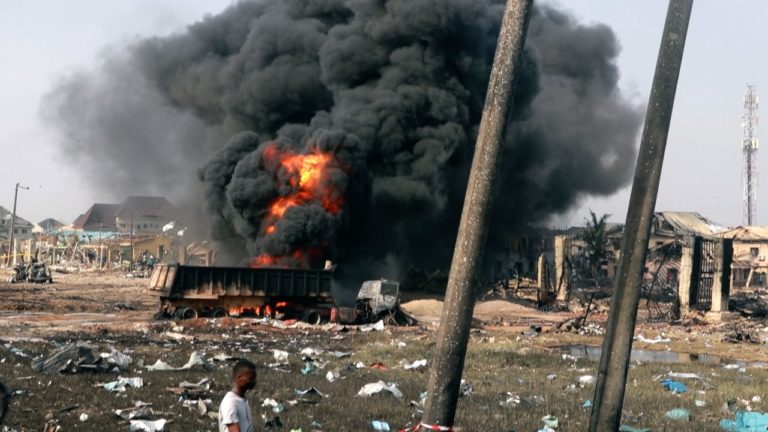
SIX months after a deadly explosion at Abule-Ado area around Festac town in Amuwo Odofin Local Government area of Lagos State left over 20 persons dead and many others injured, a new report by the BBC Africa Eye says government explanation for the accident was incorrect

The Sunday, March 15 explosion according to the Nigerian National Petroleum Corporation (NNPC) was caused when a truck rammed into gas cylinders stacked in a gas processing plant near a vandalised petroleum gas pipeline.

The incident killed 23 people, including students and principal of Bethlehem Girls’ College, Henrietta Alokha, who died  killed while trying to save her students from the inferno at the school. About 50 houses and several vehicles were damaged on the day, National Emergency Management Agency (NEMA) said.

But in the report released on Monday, the BBC Africa Eye said the explanation given by the NNPC, Nigeria’s oil firm that the explosion occurred as a result of  a collision by a truck and gas plants was not supported by evidence and incorrect.

According to the report, new video evidence filmed at the explosion site, five minutes before the blast, shows a catastrophic leak of vaporised liquid at the exact location where the NNPC high-pressure petroleum pipeline runs beneath the ground through that area.

It said that the BBC found there was no gas processing plant at the explosion’s epicentre, adding that analysis of gas cylinders found at the site after the blast indicates they could not have been at the centre of the explosion when it happened.

“The evidence the BBC has uncovered indicates the heavily laden truck stopped on an eroded, unsurfaced road that had been softened by rainwater. This could have pressured the pipeline to breaking point, releasing a cloud of vaporised flammable petroleum product that ignited,” the report said.

The report maintained that no evidence supported claim by the NNPC on the cause of the explosion, noting that experts in LPG and petroleum pipeline safety and in explosions analysis who watched the video footage confirmed the huge leak of vaporised liquid could not have come from gas cylinders.

“None of them mentioned gas cylinders or saw a collision. But four of them independently said the leak was coming out of the ground beside the heavily laden truck.”

Ambisisi Ambituuni, a petroleum pipeline safety expert told the BBC the System 2B pipeline network has: “been in existence for way over the lifespan of the pipeline”. He asked: “How is it so difficult for the operator to maintain the safety of those pipelines?”

The BBC contacted the NNPC which denied any negligence on its part. The report disclosed that NNPC reaffirmed their explanation for the explosion’s cause, and said there was no leakage prior to the explosion.

They also said: “NNPC pipelines comply with safety and regulatory guidelines” and that they: “worked closely with the Lagos State Government in providing a N2billion relief fund for the victims of the explosion.”

According Nairametrics, the NNPC, in the past 18 years, has recorded at least 45,347 explosion incidents across Nigeria, resulting in loss of lives and properties.

It could be recalled that in a series of tweet, former governor of Lagos state, Bola Tinubu pointed fingers when he condemned the explosion and outrightly accused unknown persons for having a hand in the explosion that claimed over a dozen lives and left many injured and others displaced.

“All those who had a hand in this explosion, including those who acted in ways to put lives at risk and hard-earned possessions in jeopardy, must be punished, no matter how highly-placed they may be,” his tweet read in part.

In Edo election, the ‘Oshiomhole factor’ pushed critical issues to the sidelines

0

EDO State governor, Godwin Obaseki, might have actualised one of the declarations he made during the campaigns – to protect the interests of the majority of the people and bring an end to godfatherism, which he said is a threat to the growth and development of the state – but he will have a lot on his plate in his quest to truly Make Edo Great Again.

Obaseki had centred his campaign message around the acronym ‘M-E-G-A’, which stands for ‘Making Edo Great Again’ but while the governor and his supporters bask in the euphoria of  a narrowly-won second term in office, they will soon realise that ‘critical developmental issues’ concerning the real ‘dividends of democracy’, were relegated to the sidelines in the pre-election campaign.

Rather the campaign was characterized by fury and sound causing anticipation of violence and bloodshed which eventually did not materialize.

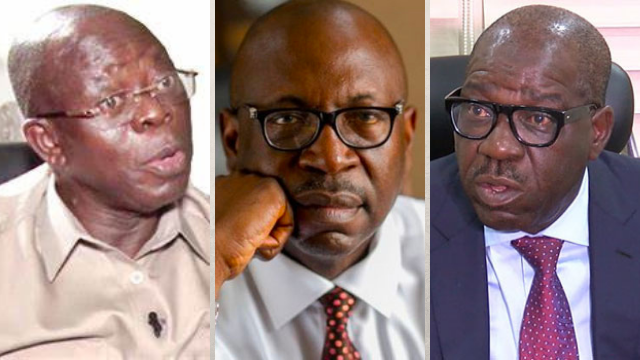
As it turned out, the election was more of a contest between Obaseki and his former ‘godfather’, Comrade Adams Oshiomhole, a former governor ‎of Edo State who had picked Obaseki to succeed him in 2016.

Back then, Oshiomhole and Obaseki were in the All Progressives Congress but by the time both men fell out four years later, the incumbent governor, Obaseki, was forced to leave the party for the Peoples Democratic Party, following his disqualification from the APC governorship primaries. Interestingly, in his role as the godfather of Edo politics, Oshiomhole, who was the national chairman of the APC, had turned to Pastor Osagie Ize-Iyamu, the man he had  worked against in 2016, as the man best qualified to become the governor of Edo State in 2020.

Back in 2016, Ize-Iyamu was the PDP governorship candidate while Obaseki flew the flag of the APC but as a result of the Oshiomhole factor, both men swapped teams in 2020.

The development meant that Oshiomhole became the major focus of the election, despite the fact that he was not a candidate.

Even his eventual removal as the national chairman – a consequence of the ‘war’ with Obaseki – ‎did not in any way diminish his central position in the Edo governorship poll.

As it were, Oshiomhole had, while campaigning for Obaseki against Ize-Iyamu in 2016, made some unsavoury comments about the latter’s character while also highlighting the sterling qualities of the former.

Although, questions have often been raised about moral principles of the Nigerian politicians, it was never going to be easy for anyone to get away with the type of volte face that Oshiomhole had to make in the choice of the candidate of the APC in Edo State.

As a result, attention was focused on Oshiomhole’s role as the godfather of Edo State politics more than the performance of Obaseki in the first tenure.

Parallels were drawn with Lagos State, where a former governor, Asiwaju Bola Ahmed Tinubu, a national leader of the APC, has been deciding who becomes the governor since 2007 when he left the office.

It also did not help matters that Oshiomhole had, himself, declared that he has ended ‘godfatherism’ in Edo politics after he emerged governor, despite opposition from political stalwarts like the late Chief Tony Anenih, a former chairman of the Board of Trustees of the PDP, and the Esama of Benin, Chief Gabriel Igbinedion.

With benefit of hindsight, it now appears that the umbrella body of APC state governors, the Progressive Governors Forum, saw the danger the party is facing in Edo State due to the ‘Oshiomhole factor’ when, in August 2020, it cautioned the former national chairman over his involvement in the governorship campaign.

Director General of the PGF, Salihu Lukman, had, in a statement, urged Oshiomhole to ‘calm down’, noting that Ize-Iyamu should be allowed to lead his own campaign.

“As opposed to reconciliation, it is loud drums of war that has taken over ‎the airwaves in Edo State. Comrade Oshiomhole has relocated to Edo State and taken over the APC campaign. The APC campaign is personalised around Comrade Oshiomhole and the candidate of the party,

“Pastor Osagie Ize-Iyamu, is an onlooker. We need to appeal to Comrade Oshiomhole to ‘calm down’. This campaign is not about his person,” parts of the statement signed by Lukman read.

The PGF director general also went ahead to add, “If‎ the Edo State APC campaign is to go ahead this way, when APC wins the election who will run the affairs of the state as Governor? Is it Comrade Oshiomhole or Pastor Ize-Iyamu? If our party wants Edo people to vote for our candidate, Pastor Ize-Iyamu must be very visible and seen as the face of the campaign.”

While the points raised by the Progressive Governors Forum‎ concerning Oshiomhole’s involvement in the campaign proved very apt, Tinubu’s role as the ‘godfather’ in Lagos, as also highlighted in the statement, was also another key point that contributed in shaping the views of the Edo electorate. Advising Oshiomhole on how best to go about his role as the kingmaker, the statement added, “Comrade Oshiomhole should take a backseat and play the facilitatory role our leaders play in all similar circumstances.

Lagos State governorship election since 2007 present a good model. Without any doubt, our leader, Asiwaju Bola Ahmed Tinubu, may be argued to be very influential in the emergence of candidates, from Babatunde Raji Fashola, Akinwumi Ambode to our current governor, Babajide Sanwo-Olu.”

It was not surprising that the claim, ‘Edo is not Lagos‎’, started trending across various social media platforms as Obaseki’s group pushed ahead with their ‘end to godfatherism’ message.
‎‎
So, while Obaseki might have performed well, or not performed well, in his first four years in office, it happened that, rather than having to concentrate on defending his scorecard, and outlining plans for the next term, his campaign got to score cheap political points by focusing on what Oshiomhole said about Ize-Iyamu in the past.

The Obaseki campaign, again, did not mind taking pot shots at Abdullahi Ganduje, the Kano State governor believed to have unresolved corruption issues who was appointed leader of the APC Campaign Council for the Edo State governorship election.

Ize-Iyamu had built his campaign message around his ‘SIMPLE’ agenda‎, which encapsulated areas his administration would focus on if he was elected governor. SIMPLE is an acronym which stands for Security, Infrastructure Development, Manpower Development, Public/Private Partnership, Leadership by example and Employment creation.

During a debate held before the elections, Ize-Iyamu had attempted to question Obaseki‎’s performance in office, particularly in the area of job creation – a key aspect of the governor’s M-E-G-A agenda. The governor claims that he promised 200,000 jobs when he assumed office in 2016, and has so far created 157,000 jobs.

But Ize-Iyamu disputed the claim, saying the employment figures bandied by Obaseki was bogus. The APC candidate had also alleged that hospitals and schools in Edo were without doctors and teachers.

The governor’s opponents had also drawn attention to the reported high rate of poverty in the state, as well as relatively low level of internal revenue generation and failure to diversify the state’s economy.

A PDP governorship aspirant, Mr. Kenneth Imasuagbon, had claimed that Obaseki did not deliver on his promises.

“He promised 200,000 jobs but he has no been able deliver them. Schools and hospitals are dilapidated. There are security concerns everywhere. The roads are still bad…”, Imasuagbon said shortly after Obaseki left the APC for the PDP.

While Imasuagbon’s comments could be seen as ‘political’, questions have been raised from other quarters over the Obaseki administration’s performance in job creation, as well as the health and education sectors, and infrastructure development.

However, Obaseki had defended his claims, particularly those concerning job creation.

According to him, the figures he brandished were based on a survey conducted by the National Bureau of Statistics and are therefore verifiable. “You can’t just come to a debate and roll out figures, forgetting that everything you say can be googled. When you talk in general terms, understand that people can just google and find out the facts,” he said.

Be that as it may, the governor and his team will do well to understand that the Oshiomhole factor helped to sideline critical developmentmental issues that would have required more detailed explanation. And this is a symptom of the malaise that affects governance in the country, with personalities taking precedence over issues. ‎

Commenting on the development, a developmental economist, Mr Odilim Enwegbara, noted that Nigerian politics is mostly based on personalities, rather than issues.

Enwegbara further observed that the electorate is not so much bothered about issues in campaign messages because they don’t expect campaign promises to be fulfilled.

“Politics in Nigeria is all about personalities, issues are not valued so it is not surprising. Besides the voters themselves are not bothered because even when politicians make promises, they don’t expect those promises to be fulfilled,” Enwegbara said.

CSOs to unveil most transparent public institutions in Nigeria at FOI ranking launch

0

AS part of activities to commemorate this year’s second edition of the International Day for Universal Access to Information (IDUAI), a coalition of Civil Societies Organization is set to unveil the most transparent public institutions in Nigeria over the last one year.

The event which is scheduled to hold in Abuja on September 28 , will also unveil the least open and responsive organisation to FOI requests in the country.

Abubakar Malami,  Attorney-General of the Federation and Minister of Justice, who also has oversight over all public institutions in Nigeria in the implementation of the FOI Act, is expected to be Special Guest of Honour at the event, which is co-organised by six civil society organisations, namely Basic Rights Watch (BRW), BudgIT, International Centre for Investigative Reporting (ICIR), Media Rights Agenda (MRA), Public and Private Development Centre (PPDC), and Right to Know (R2K).

Nkemdilim Ilo, PPDC’s Chief Executive Officer and Incoming Co-Chair of the Open Government Partnership (OGP) in Nigeria, explained that the FOI Ranking initiative is aimed at promoting the effective implementation of the FOI Act in order to entrench a culture of transparency and accountability in public institutions in the country.

“The annual FOI Ranking assesses the level of compliance by public institutions with the FOI Act in terms of how responsive they are to requests for information from members of the public as well as the extent to which they are fulfilling their duties under the Act, including their proactive disclosure obligations,” Ilo said.

“The objective of the ranking exercise is to encourage and motivate public institutions across various sectors to improve their compliance practices by showcasing the institutions’ compliance levels for each year in accordance with the requirements of the Act.”

She explained that a total of 213 public institutions, including some from the security sector, the Legislature and the Judiciary, were assessed based on a number of parameters which include their proactive disclosure practices, the speed with which they respond to requests for information, the level of disclosure, the provision of FOI training for their officials; whether they have designated and proactively published the contact details of  their FOI Desk Officers as well as their submission and disclosure of annual FOI implementation reports.

Besides Malami, other speakers expected at this year’s ranking include Cornelius N. Nnaji, Chairman of the House or Representatives Committee on FOI,  and Edetaen Ojo, MRA’s Executive Director.

The 2020 edition of the International Day for Universal Access to Information will be the first international commemoration of the Day since its proclamation by the UN General Assembly at its 74th Session in New York last October.

Prior to the proclamation, the General Conference of the United Nations Educational Scientific and Cultural Organization (UNESCO) had also adopted a resolution in November 2015 designating September 28 of every year as IDUAI.

CDD rates Edo election ‘relative credible’, laments poor voters’ turnout

0

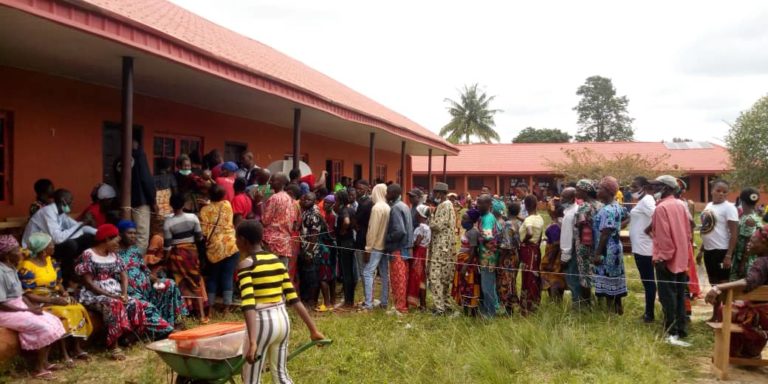
THE Centre for Democracy and Development (CDD), a pro-democracy advocate, has rated the conduct and outcome of the just-concluded September 19 governorship election in Edo State as relatively credible, despite the challenges and infractions, which dogged the process.

The Centre noted that from reports it gathered from 250 of its observers whom it deployed to monitor the polls, the election was relatively peaceful when compared to other polls recently conducted by the Independent National Electoral Commission (INEC).

It commended a vast array of stakeholders involved in the process, which it praised for working tirelessly to ensure the tense atmosphere in the build-up to the election did not result in violence on a large scale as envisaged. 

Idayat Hassan, Country Director of CDD and  Adele Jinadu, Head, Election Analysis Centre (EAC), said in a statement jointly issued in Abuja on Monday that the general peaceful conduct of the election was a refreshing development.

“It (the peaceful conduct) points the way away from the “degeneration” that has historically been the country’s sad experience with electoral outcomes, and towards outcomes that significantly reflect the mandate of the electorate,” it said.

“In this respect the election potentially augurs well for the future of democracy and development in the country, particularly in view of the determination shown by the electorate to protect their mandate and ensure that it counted in the critical penultimate months to the election day.”

The Centre further noted that the credible outcome of the election was due to the activities of various strategic stakeholders, particularly the INEC, and the peace-keeping efforts the Oba of Benin and the Abdulsalam Abubakar led National Peace Committee, who worked and intervened firmly under a very dire pre-election context that portended violent election conflicts which helped to turn electoral “swords” into “plowshares.”

However, CDD warned that there remained certain anomalies in the process, which if left unaddressed could turn the current euphoria into a mirage that could lead to a reversal to the status quo ante of the country’s experience of seriously flawed electoral outcomes.

It pointed out the decline in voters’ turnout as a trend which would not augur well for robust participation of the electorate including marginalized groups.

Backing its assertions with figures, the CDD noted that in 2003, voters’ turnout stood at 78 percent of 1,432,891 registered voters.

In 2020 however, only 25.2 per cent of voters turned out to cast their ballot out of a registered number of 2,210,534, it said.

The CDD figures also showed a consistent decline in voters’ turnout from 78 per cent in 2003 to 40.5per cent in 2012, and further down to 32.3 per cent in 2016.

It expressed worries that the further decline in voters’ turnout in 2020, which came down to a low of 25.2 per cent could be read as a steady loss of faith in the electoral process, as well the entire democratic system of governance.

Speaking on other critical issues in the electoral process, the Centre identified the controversial modality used for selecting the governorship candidates of the two major political parties as a major cause of tension during the electioneering.

“The acrimony that resulted from it created serious intra-party fissures that cast an ominous pall over the peaceful conduct of the election,” it said.

“Another process issue was the political culture of a zero-sum approach to a competitive electoral process that tends to precipitate violent electoral conflict and to encourage the abuse of the power of incumbency for partisan party political advantage.

“A third factor was the general poverty in the state and the high unemployment rate, particularly among the youth, that provided a pool from which political parties and their candidates drew to corrupt the electoral process and to steal the people’s mandate.

A fourth issue is the competent and effective administration and management of the election by INEC to generate trust in the conduct of the election. A final issue is the conduct of the election during the COVID-19 pandemic, in view of the conduct implications for public health.”

It also drew attention to the use of unethical non-conventional campaign strategies, which it noted helped to shape perception, de-legitimise the process and actors.


Buhari calls for unity in Kaduna, says no development without peace 

0

PRESIDENT Muhammadu Buhari has called for unity among residents of Kaduna to allow for development across the state.

President Buhari made the call on Monday in a virtual speech he gave at the commencement of the fifth edition of KADINVEST, Kaduna State’s annual economic and investment forum.

While urging all indigenes of the state to cooperate with the State Government and security agencies to secure a lasting “peace and harmony in the state,” the President added that there is no development anywhere in the absence of peace.

“We must live together as brothers and sisters because, without peace, development cannot take place,” Buhari said.

The Southern Kaduna area of the state has been a spot for an age-long communal crisis between farmers and herders which has led many people to their untimely death and several persons displaced.

In a 2020 report, Amnesty International in its report, “Nigeria Government failings leave rural communities at the mercy of gunmen”, said it interviewed civilians in Kaduna, Katsina, Niger, Plateau, Sokoto, Taraba and Zamfara states, who said they live in fear of attacks and abductions as insecurity escalates in rural areas. 

It stated that villages in the Southern Kaduna area were worst affected by these attacks, where armed men killed at least 366 people in multiple attacks between January and July 2020.  

Osai Ojigho, Director of Amnesty International Nigeria, said the ongoing failure of security forces to take sufficient steps to protect villagers from these predictable attacks is utterly shameful. 

“In addition to the security forces’ failure to heed warnings or respond in time to save lives, the fact that no perpetrators have been brought to justice leaves rural communities feeling completely exposed,” Ojigho said.

“The President claims he has repeatedly tasked security agencies to end the killing so that Nigerians can go to bed with their eyes closed, but clearly nothing has changed,” she said.

However, Governor Nasir El-Rufai, has said that his administration was committed to ending the 40 year-old Southern Kaduna crisis, as various groups and communities have recently signed peaceful pacts that would engender peace in their various communities.

Earlier this month, the Kaduna State chapter of Miyetti Allah Cattle Breeders Association of Nigeria (MACBAN), said it was ready to live in peace with its neighbors in the ongoing efforts to restore peace in the troubled and crisis-torn area of Southern Kaduna.

In a communique jointly signed by Hassan Tugga, MACBAN State chairman, Abdulhamid Musa, Southern Kaduna Zonal Chairman, Shuaibu Usman, the Zonal Secretary and Ibrahim Zango, the Director of Media and Publicity, the herders appealed to farmers to allow their cattle to graze on government-approved routes.

It also called on its members to prevent children from rearing cattle in the area in order to prevent the destruction of farm produce.

“The summit after all the deliberations it has reached the following resolutions: That we have agreed to reverse our olden days relationship with our neighbouring communities in the area,” the communique read.