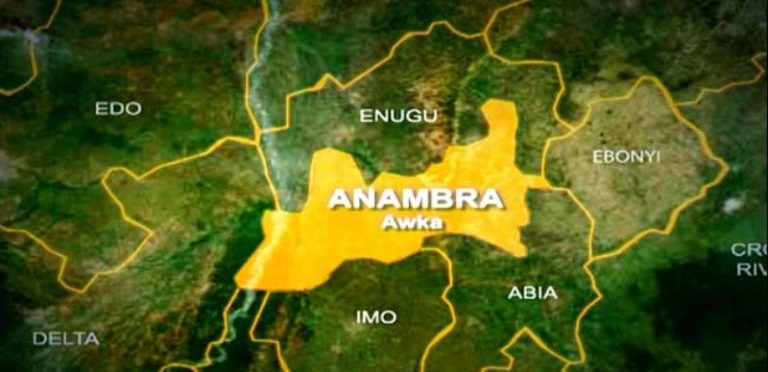
THE Anambra State Government has confirmed the arrest and detention of security operatives who were captured in a viral video assaulting a female National Youth Service Corps (NYSC) member, Jennifer Edema Elohor.
The operatives, who were members of the Agbunechemba Vigilante Group under the state’s Homeland Security outfit, were filmed beating the corps member at her lodge.
The assault, captured in a viral video shared by Haven 360 Foundation on Facebook on Monday, August 18, showed how the corps member was being dragged and stripped by armed members of the state security officers.
The incident, which occurred at her residence, immediately provoked outrage on social media, with many Nigerians condemning the treatment of the young woman serving the nation.
Speaking on Tuesday, August 19, during an interview on Channels Television, the state Governor Chukwuma Soludo’s Special Adviser on Community Security, Ken Emeakayi, described the conduct of the operatives as unfortunate.
Emeakayi explained that although the officers were on a joint security operation codenamed Operation Udo Gatchi when the incident occurred, their actions went beyond the scope of their lawful duties.
According to him, the joint operation involved the Police, Army, Department of State Services, Nigeria Security and Civil Defence Corps, and the state’s security outfit.
“The operatives in the exercise of their duties and conformity with their power in section 5 of the Anambra Communal Security Law pursued them into the compounds. When they got to the compound, some people ran into different rooms within than compound. So, they went to those places and brought those people out.
“While trying to screen and identify them, we do not rule out this issue of human error, because this is human endeavor. So that unfortunate incident happened.”
He stressed that the operatives were immediately arrested and placed on detention following the incident, adding that disciplinary actions had been taken against them.
“Immediately that happened and we got the report, the first step we took was to arrest the operatives involved in that act, then detain them because our practices is that when an incident involves our own operatives, what we do is that we arrest them, carry out our own preliminary investigations – get the complainant or the victim involved, interviewed them alongside our own operatives in order to determine the level of what action to take whether is something we can handle by internal disciplinary measures or it’s something that we need to prosecute.
“In this case, we arrested our people, then invited the victims. The victim came to my office accompanied by the LG NYSC coordinator, and we brought everybody together to hear them out. In the end, our view was that our men who went on that assignment, though they went on a legitimate assignment, but the actions they carried out there was unacceptable,” he added.
He further noted that the government was prepared to prosecute the operatives found guilty of harassing the corps member, but said the victims of the harassment were not readily prepared to press charges.
UKRAINIAN President Volodymyr Zelensky has said he is prepared to meet directly with his Russian counterpart to help end the war between the two countries, following talks with United States President Donald Trump and several European leaders at the White House late Monday.
A face-to-face meeting between Zelensky and Putin would mark their first encounter since Russia’s invasion more than three and a half years ago.
French President Emmanuel Macron, during the meeting in Washington on Monday with European officials, announced that France and Britain would convene a meeting on Tuesday with about 30 of Kyiv’s allies for discussions on long-term security guarantees for Ukraine.
Macron said the virtual meeting of the so-called “coalition of the willing” would serve to “keep them informed of the decisions made. Immediately afterward, we’ll begin concrete work with the Americans.”
Macron and British Prime Minister Keir Starmer are co-hosting the meeting to “discuss next steps” for Ukraine, a UK government spokesperson told journalists, as Kyiv looks to secure allies’ support in enforcing any potential peace deal.
Macron proposed Geneva as a possible venue for peace talks but emphasised that it was “up to Ukraine” to decide on any territorial concessions, including areas of the eastern Donbas region still under its control.
He described Putin as “a predator, an ogre at our gates,”, adding that the Russian leader “has constantly been a force for destabilisation. He has sought to redraw borders to increase his power.”
He argued further that Putin rarely honoured his commitments.”
United States President Donald Trump who said he had also spoken by phone with his Russian counterpart, assured President Volodymyr Zelensky that the US would help guarantee Ukraine’s security in any agreement to end the war, during a meeting in Washington on Monday.
“When it comes to security, there’s going to be a lot of help. They are a first line of defence because they’re there, but we’ll help them out” Trump told reporters, adding that European countries would be involved.
Zelenskiy described the promise as “a major step forward,” noting that the guarantees would be “formalised on paper within the next week to 10 days” also revealing that Ukraine offered to buy about $90 billion worth of US weapons.
The ICIR reports that Zelensky handled Monday’s meeting more effectively than his February Oval Office encounter, which was cut short after Trump and Vance publicly rebuked him for what they saw as a lack of gratitude.
When asked what his message was to the people of Ukraine, Trump replied, “We love them.” Zelensky expressed his thanks, and Trump placed a hand on his back in a gesture of warmth before the two headed into the Oval Office.
Recall that Trump, who met with Putin in Alaska last week, wrote on his Truth Social platform after Monday’s meetings that “everyone is very happy about the possibility of PEACE for Russia/Ukraine.”
“After the meetings, I called President Putin, and began the arrangements for a meeting, at a location to be determined, between President Putin and President Zelensky,” he added.
Trump announced plans to host a three-way summit with the leaders of Ukraine and Russia.
The ICIR reported that the war which has claimed tens of thousands of lives, has reached a near stalemate despite some recent Russian gains, resisting Trump’s efforts to bring it to an end.
Although the Kremlin has not formally confirmed its participation, a senior US administration official said the Putin-Zelensky meeting could be held in Hungary.
The most recent direct talks between Russia and Ukraine were held in Turkey in June, where Putin rejected Zelensky’s public call for a face-to-face meeting and instead dispatched a low-level delegation.
Meanwhile, European leaders, who were at Washington to support Zelensky, pushed Trump to demand that Putin agree to a ceasefire in the three-and-a-half-year war before any negotiations could move forward.
Trump had earlier supported that proposal but shifted his stance after meeting with Putin on Friday, aligning with Moscow’s view that any peace deal should be comprehensive.
Speaking with reporters in the Oval Office, he said he supported the idea of a ceasefire but believed negotiations toward a peace agreement could continue even as fighting persisted.
Before the White House meeting, Trump had pressed Ukraine to relinquish Crimea and drop its bid to join NATO, two of Putin’s central demands.
Zelensky emphasised that in his one-on-one meeting with Trump in the Oval Office, he was able to give the US president a clearer picture of the battlefront.
THE Federal Capital Territory Administration (FCTA) said it had impounded more than 700 vehicles for offences, including the use of fake number plates and illegal tinted glass.
Some of the vehicles were also seized for other traffic violations.
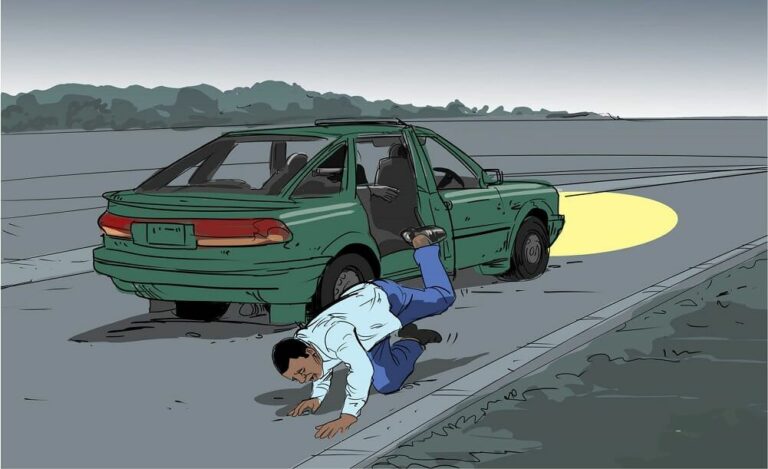
The Director of the FCTA Department of Security Services, Adamu Gwary, explained that the action formed part of the administration’s renewed efforts to crack down on motorists with criminal inclinations in Abuja, particularly one-chance robbers.
Gwary, represented by the Secretary of the Command and Control Centre, Peter Olumuji, disclosed this during a late-night stop-and-search operation on Monday, August 18, at Apo-Wassa junction and the Karu axis of the Federal Capital Territory (FCT).
Gwary said the operation was the second phase of Operation Sweep Abuja Clean, a multi-agency initiative aimed at curbing one-chance robberies and recovering stolen vehicles.
He said over 700 vehicles were impounded from both the first and second phases.
“The operation has drastically reduced the incidence of one chance to the barest minimum.
“Our stop-and-search exercise has made it clear to criminals that no matter where they are in the FCT, the team will always reach them,” he told Punch.
He clarified that intelligence gathered from victims showed that most vehicles used in “one-chance” robberies were illegally tinted, unregistered, or bore fake number plates.
Gwary warned motorists, particularly commercial drivers, against using tinted glasses, stressing that criminals exploited them to conceal their activities.
He noted that his team saw people who used tinted glass for lawful businesses, but added that most of the victims of one-chance robberies interrogated reported that the vehicles they boarded had tinted glasses.
He disclosed that the task force recovered seven stolen vehicles in just a week. He appealed to residents to endure the temporary inconveniences caused by the stop-and-search operations.
Also speaking, Head of Operations at the Directorate of Road Traffic Services at the FCTA, Deborah Osho, said the joint task force had stepped up efforts to rid Abuja of unregistered and unpainted taxis often linked to criminal activities.
She added that several vehicles had been impounded for various traffic offences, including driving against traffic and using unauthorised number plates.
She stated that most of the vehicles used for one-chance robberies either had fake number plates that were not traceable to the actual vehicles or operated as unpainted taxis, making identification difficult.
“Today in Karu, you can see the huge number of vehicles apprehended. This is sending a clear message that Abuja is too hot for criminals,” Osho said.
Recall that in July, the FCT Minister, Nyesom Wike, directed that the nation’s capital be completely rid of street beggars, traders, ‘one chance’ syndicates, scavengers, and other social nuisances as part of efforts to improve security in the city..
The ICIR reported on Monday that the FCTA also announced plans to pull down all illegal settlements, particularly shanties that harbour criminals and hinder development projects in the nation’s capital.
THE Federal Government, through the Revenue Mobilisation Allocation and Fiscal Commission (RMAFC), has indicated plans to review the salaries of political office holders.
Speaking at a press briefing in Abuja on Monday, August 18, RMAFC Chairman, Mohammed Shehu, described the current earnings of top government officials as inadequate and outdated given their responsibilities and the economic realities of the country.
According to him, President Bola Tinubu currently earns ₦1.5 million monthly, while ministers take home less than ₦1 million.
He said these figures had not been adjusted since 2008.
“You are paying the President of the Federal Republic of Nigeria N1.5m a month, with a population of over 200 million people. Everybody believes that it is a joke,” Shehu said.
He argued that some heads of government agencies currently earn ten to twenty times more than ministers or even the president, a disparity he described as unfair and demoralising.
He added, “You cannot pay a minister less than N1m per month since 2008 and expect him to put in his best without necessarily being involved in some other things. You pay either a CBN governor or the DG ten times more than you pay the President. That is just not right. Or you pay him [the head of an agency] twenty times higher than the Attorney-General of the Federation. That is absolutely not right.”
Clarifying the commission’s role, Shehu stressed that RMAFC was constitutionally empowered only to determine the salaries of political, judicial, and legislative office holders, not the minimum wage for civil servants.
“We are strictly restricted to political office holders, governors, senators, legislators, ministers, DGs, and other people,” he added.
He said this in response to the challenge by the Nigeria Labour Congress, who argued that the proposal ignored the country’s worsening inequality and the hidden perks that already inflated earnings in government.
While public outrage often surrounds politicians’ pay, official records show that Nigeria’s political office holders have not had their basic salaries adjusted in over 15 years.
For instance, a recent fact-check by The Fact-CheckHub confirmed that Vice President Kashim Shettima officially earns about ₦12.1 million annually (roughly ₦1 million monthly) in salary and allowances, according to documents obtained from the RMAFC through a Freedom of Information (FoI) request.
The report noted that the review of salary structures for political and public office holders had been attempted several times since the 2008 Amendment Act, but no new framework has been formally approved.
According to the report, in 2000, the RMAFC proposed a new remuneration package that was later formalised through the Certain Political, Public and Judicial Office Holders (Salaries and Allowances) Act, 2002. A further review in 2007 resulted in the Amendment Act of 2008, which still serves as the legal framework governing official salaries.
However, in 2009 and 2015, multiple attempts were made to review the remuneration packages for political and public officer holders.
In 2009, a downward review was proposed due to declining national earnings, but it was not passed into law. Similarly, the 2015 review was not endorsed by the Presidency or National Assembly.
In June 2023, RMAFC proposed a 114 per cent salary increase for the president, vice president, governors, lawmakers, and judicial officers, effective from January 1, 2023, but it was never endorsed by the National Assembly or signed into law.
Revenue-sharing formula under review – Shehu
In a similar development, Shehu announced that RMAFC had commenced a review of Nigeria’s revenue allocation formula, which determines how funds from the federation account are shared among federal, state, and local governments.
According to him, the current formula, introduced in 1992, allocates 52.68 per cent to the Federal Government, 26.72 per cent to states, and 20.60 per cent to local governments.
He also noted that an additional 4.18 per cent is set aside for special funds, including one per cent each for the Federal Capital Territory and ecological fund, 1.68 per cent for the natural resources development fund, and 0.5 per cent for stabilisation.
Shehu said the review was necessary to reflect new socio-economic realities and the expanded responsibilities of state governments following recent constitutional amendments.
“In line with this constitutional responsibility and in response to the evolving socio-economic, political and fiscal realities of our nation, the commission has resolved to initiate the process of reviewing the revenue allocation formula to reflect emerging socio-economic realities,” Shehu said.
THE Joint Admissions and Matriculation Board (JAMB) has directed all public universities in Nigeria to conclude their 2025 admission processes by October 31, 2025.
This was disclosed in the board’s weekly bulletin released on Monday, August 18.
It also ordered private universities to complete their admissions by November 30, 2025, while all tertiary institutions in Nigeria, both public and private, are expected to conclude the process by the end of the year.
“Following the directives issued at the 2025 Policy Meeting chaired by the Honourable Minister of Education, all tertiary institutions have been instructed to conclude their admission processes by the end of 2025.
“Public universities to complete admissions by 31st October, 2025. Private universities to complete admissions by 30th November, 2025. All other institutions (public and private) to complete admissions by 31st December 2025,” the circular stated.
The ICIRreported in July that JAMB set 150 as the minimum cut-off mark for admissions into Nigerian universities for the 2024/2025 academic session.
The body set 100 as the minimum cut-off mark for admissions into polytechnics and colleges of education, with a minimum cut-off mark for colleges of nursing sciences was set at 140.
The JAMB urged all institutions to conclude admissions before the stipulated deadlines, noting that even if any institution is not prepared to begin a new academic session, it should process and archive its admissions.
“Consequently, institutions conducting post-UTME screenings are expected to conclude those exercises in good time to comply with the 2025 admissions schedule,” JAMB said.
The ICIR reported that after the resit UTME results were released on May 25, JAMB noted that 1,365,479 (70.7 per cent) out of 1.9 million candidates scored below 200..
In the initial results released by JAMB on May 9, 2025, JAMB said over 1.5 million candidates out of 1.9 million candidates who took the exam scored below 200 out of the total 400 marks.
This development led to outrage with many Nigerians calling for a probe into the mass failure.
The Board registrar, Ishaq Oloyede, apologised for the trauma caused, admitting to errors in handling the examination, after an investigation.
THE Federal Capital Territory Administration (FCTA) has announced plans to pull down all illegal settlements, particularly shanties that harbour criminals and hinder development projects in the nation’s capital.
The FCTA, in a statement released on Monday, August 18, by Lere Olayinka, the Senior Special Assistant on Public Communications and Social Media to the FCT minister, Nyesom Wike, said the onslaught on criminal hideouts in Abuja will continue.
The FCTA described as worrisome, security threats from parts of Durumi District, particularly Area 1 in Garki District, saying, “High-level criminal activities such as robbery, carjacking, drug peddling and other heinous crimes with its attendant security implications to law-abiding FCT residents cannot be allowed to continue.”
According to the statement, in his bid to ensure a safer FCT, Wike set up a Stakeholders Committee, comprising heads of security agencies, FCTA officials, Civil Society Organisations, Nigeria Union of Journalists (NUJ), and others, to work with the government for residents’ safety.
It said the committee found out that apart from preventing land allottees from making use of their lands and the government from carrying out developmental projects, the shanties in Area 1, Durumi, had become an operational base for criminals, especially kidnappers, drug peddlers, and one-chance operators.
“Three months ago, when security agencies carried out an operation in Area 1, Durumi, over 120 miscreants were arrested. Among those arrested in the operation that lasted over three hours were drug peddlers, one-chance operators, carjackers and armed robbers.
“Seven stolen vehicles and 79 stolen motorcycles were recovered, while 155 ATM cards were recovered. These ATM cards were those snatched from victims of one-chance operators, using the settlement as their base,” the FCTA stated.
The government lamented that despite the earlier demolition of some shanties in the Durumi area, the structures had been rebuilt, and the criminals had regrouped, rendering the area uninhabitable for law-abiding citizens.
It added that the land, allocated over 20 years ago, was being occupied by illegal settlers and criminals, preventing the rightful allottees from utilising their properties.
In addition to private land allottees, the FCTA said government agencies were facing challenges in using their land in the area.
The ICIR reported in 2022 that the FCTA demolished an Internally Displaced Persons (IDPs) camp in the Durumi area.
During the exercise, the former Executive Secretary, Federal Capital Development Authority (FCDA), Shehu Samad, said the camp was located on the site of a dual road carriage corridor with a rail modal.
He noted that some residents of the area were not genuine IDPs.
Durumi IDP camp was established in 2014, after attacks on villages in the North-East by insurgents.
The camp accommodates nearly 2,000 people.
In 2021, The ICIR reported how the camp raised some promising children who stood little chance to beat the odds against them.
COMFORT Emmanson, an Ibom Air passenger, who was recently detained on a court order and released from Kirikiri Correctional Centre in Lagos State, after her altercation with the airline’s crew and airport security staff said she was not a nuisance, and her reaction was out of frustration.
Emmanson also said she had been ashamed to go out since he was released from prison after the incident.
She lamented that her picture in which the upper part of her body was revealed during the airport incident was being used by some Nigerians as stickers and had been widely shared.
In an Instagram post at the weekend, Emmanson said she could no longer go out due to viral videos showing the upper region of her body when was being forced out of the Ibom Aircraft at the Murtala Mohammed International Airport, Lagos.
“People already know that this is the person; they know me. I cannot even goout again. I’m ashamed to go out because my body is out there.
“Some people have even turned it into stickers. I can’t even go out again because people already know me. Imagine me trying to sell a house, and clients have seen that video. How do I face them?” she asked.
According to her, she is not a troublemaker but was provoked to react.
“I’m not a nuisance. People who know me in real life know the kind of person I am. I just never expected that offering to switch off my phone would escalate like this,” she stated.
She added that although she has been released, she remained in pain from the experience.
The ICIR reported that the incident between Emmanson and the Ibom Air crew occurred on August 10, 2025, when she was involved in a confrontation with a flight attendant who asked Emmanson to switch off her phone.
According to her, the attendant dragged her by her hairpiece (frontal wig), tore her clothes, and pulled off her necklace, leading to her poking the attendant in anger.
She said the incident began shortly after boarding a flight from Uyo to Lagos. A flight attendant, identified as Juliana, allegedly confronted her and told her to switch off her phone.
Emmanson clarified that while one of her phones was faulty, with a damaged power button, she finally received help from a fellow passenger to switch it off.
She explained that upon landing in Lagos, the same attendant stopped her from leaving the aircraft, gazed at her “with a bad eye,” and blocked her from disembarking.
“She dragged my frontal, my gold chain, and in the process, my phone fell and broke. The pain of having my frontal yanked off was unbearable. That was when I poked her out of anger,” Emmanson narrated.
She recalled being forcibly removed from the aircraft by staff while passengers filmed the scene.
She stated that her clothes were torn, leaving her humiliated, vulnerable, and exposed while being dragged out.
She expressed gratitude to her supporters for the prayers, love, and support she received during her predicament.
The ICIR reported that an Ikeja Magistrate’s Court struck out the five-count charge against the passenger after the police prosecution team withdrew its case.
Emmanson’s trial sparked heated debates among Nigerians, with many comparing her case with that of a popular musician Wasiu Ayinde, also known as KWAM 1.
KWAM 1 had attempted to physically prevent a ValueJet plane from taking off at the Nnamdi Azikiwe International Airport, Abuja, and was reported to have assaulted the captain by pouring alcohol on her.
While Emmanson was sued and detained in prison within 24 hours, KWAM 1 walked freely on the street, despite the Federal Government’s vow to investigate him.
He is widely believed to be well-connected to the Presidency.
Reacting to the cases on Wednesday, August 13, the Minister of Aviation and Aerospace Development, Festus Keyamo, said he had engaged Ibom Air’s management, the police, and the AON, leading to an agreement to withdraw the complaint and lift the lifetime ban.
While Emmanson was freed from detention, the government also reduced the six-month flight ban it imposed on KWAM 1 to one month.
BETWEEN December 1, 2024, and January 28, 2025, the Zion City community in Degema Local Government Area (LGA) of Rivers State experienced an unprecedented disaster that stemmed from a crude oil and gas spill. Unchecked for weeks, the spill triggered a blaze that ripped through the village. The inferno lasted for 28 days and consumed everything on its path, turning a blossoming community into a pile of ashes.
Following the refusal of the Nigerian National Petroleum Company Limited – the owner of the oil well responsible for the tragedy – to remediate the crisis six months after the fire, and the company’s persistent contempt for the National Assembly’s directives on the crisis, The ICIR visited the LGA in June.
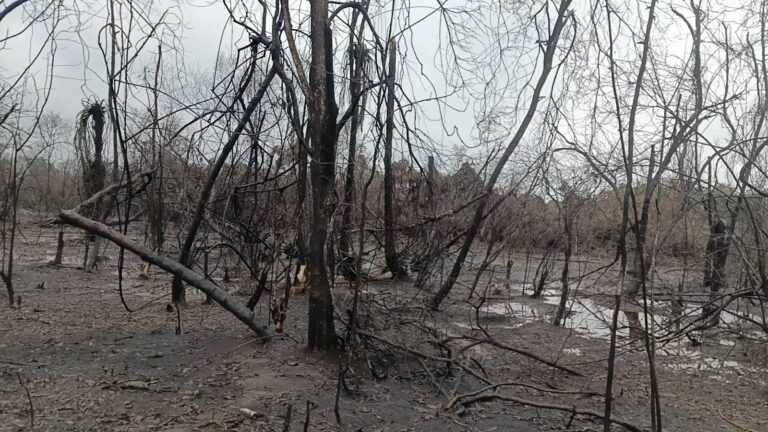
Pools of burnt oil sludge litter swathes of land in Zion City, as hundreds of charred trees stand hopelessly within the surroundings. The fire reduced cassava and other farms located several metres away from the oil well, to ash, with stalks of crops left blackened and brittle.
Burnt crude and water litter the ground in the Zion City neighbourhood. PC: Marcus Fatunmole
No grass has grown on several hectares of land in the community. The acrid smell of the ecosystem swallowed by the inferno, the pile of ash, oyster valves, crab carapaces, blackened coil of burnt snakes, and viscous residue of crude oil on the ground are glaring proof of the magnitude of the blaze.
While no life was lost to the disaster, residents have since been displaced and lost their livelihoods. Crude oil continues to float on the creeks, spreading into waters across several settlements.
The pollution worsens access to safe water and threatens residents’ health. Many people in the area complain of having difficulty breathing after inhaling much gas from the well, in what was a re-enactment of the general crisis facing Nigeria’s oil-rich Niger-Delta region.
Dozens of reports by The ICIR show how the Niger Delta region, which contributes a chunk of the Nigerian economy, has been ravaged by environmental crisis due to the activities of local and international oil and gas companies, including the NNPCL. Despite the fact that these actions conflict with the Petroleum Industry Act and other relevant laws in the sector, the unwholesome practices have persisted.
OML 18, Well-8 disaster
In the middle of Zion City’s creek lies OML 18, Well 8, which caused the disaster. The oil well hissed scarily as it did from its wellbore while the spillage lasted before exploding into fireballs. Concerns remain heightened among residents that there could be another round of spills because the oil well continues with the same noise that heralded the first tragedy.
OML 18, Well 8 sitting on the creek at Zion City. PC: Marcus Fatunmole
Many residents, including MacDonald Beresibo, who escaped the explosion, reported seeing plumes of smoke and thunderous firestorms several kilometres away in neighbouring communities, namely Bukuma, Okpurata, Christ Liberty, Daily Bread, and Ambiama, while the inferno lasted.
“A community once occupied by hundreds of fishermen and farmers has been wiped off. You can see that most of the places are deserted. Everywhere is in ruins, and there is no hope of the community returning to its previous state, except that the NNPCL does full remediation work,” Beresibo added.
Another resident, the chairman of the Zion City Development Committee, Fredrick Amagboruju, described how the community had thrived for decades. He had his childhood life in Zion City with his siblings and parents. His father, Fred James Amagboruju, a retired school administrator and former councillor, founded the village in the 1970s. Zion City is one of the communities under Bukuma (Agum), the headquarters of Degema Local Government.
Fredrick said his father planted the economic trees lost to the fire to conserve the environment and serve as a source of revenue when felled for domestic and industrial uses.
Charred trees at Zion City six months after the inferno. PC: Marcus Fatunmole
Recounting his childhood days in the community, he said, “My early childhood in Zion City was one of fun and adventure. We formally relocated to the community under the leadership of my dad in 1977. Construction of houses for accommodation commenced. On the 20th January, 1978, my dad died and was buried in Zion City. I continued my schooling in Bukuma. The children of many church members who relocated with us trekked a distance of three to four miles daily to Bukuma for our education. It was fun moving as a group to and from school.”
He added, “Living in Zion City was one of the best moments of my life. Life was so peaceful, varieties of food, unparalleled recreational activities, bountiful farm produce, bush meats in abundance, robust commercial activities with neighbouring communities, etc.”
He noted further that the crude spill was massive. “As of December 24, it was everywhere. The waterways of Bukuma and other communities, including Iwofe and Agbonima Wharf, were littered with crude, and the waterways were all contaminated, he stated.
Several videos and pictures of the spill he made available to The ICIR show how the Zion City creek, homes and surrounding bushes were drenched with gas and crude oil for days before the conflagration.
“Look behind me, massive farmland destroyed, people’s houses consumed, family lives in crisis. People don’t live here anymore. That is the mess NNPCL has caused. This is something that ought not to have happened,” he said.
Chairman of the Zion City Development Committee, Fredrick Amagboruju. PC: Marcus Fatunmole/ICIR
How the spill happened
On December 1, 2024, Zion City residents noticed gas and oil leakages from OML 18, Well 8, operated by the NNPC Eighteen Operating Limited (NEOL) near its creek and alerted the authorities.
The authorities include the NNPCL, the National Oil Spill Detection and Response Agency (NOSDRA), and the National Upstream Petroleum Regulatory Commission (NUPRC).
One of the documents obtained by The ICIR showed that Zion City, through its chairman of the development committee, in a letter dated December 26, 2024, and addressed to the Zonal Director, NOSDRA, in Port Harcourt, called on the organisation to urgently work with relevant institutions to avert what the community described as a ‘disaster’.
“I, the undersigned, for myself and the above-named community hereby URGENTLY call for your attention and that of other relevant agencies of government for a stoppage of this dangerous spillage and leakage,” part of the letter reads.
The oil well, originally drilled and owned by Shell Petroleum Development Company (SPDC) in the late 1960s, was acquired by a local firm, Eroton Exploration and Production Company, before the NNPCL eventually took over the asset. NNPC Eighteen Operating Limited (NEOL) replaced Eroton as the operator of OML 18 in 2023.
Crude oil on the creek accommodating OML 18, Well 8 at Zion City. PC: Marcus Fatunmole/ICIR
Despite the prompt alarm, residents say the concerned institutions, especially the NNPCL, failed to show up and stop the spill, which continued to flow into the community and pollute all waters in the neighbourhood for a month.
On December 21, 2024, “a violent spill of volcanic proportions burst out forcefully from the wellhead, and saturated several parts of the village,” the community development committee chairman said.
The spill led to a huge fire explosion on January 12, 2025, while the NNPCL’s (henceforth referred to as NEOL) contractors were working to stop the leakage. The fire immediately spread to adjoining bushes. It was eventually quelled one month later, on February 12.
A section of makeshift buildings burnt in Zion City. PC: Marcus Fatunmole/ICIR
NOSDRA blames disaster on NEOL
NOSDRA variously accused NEOL of negligence, irresponsibility and failing to curb the spill. It also dismissed several claims by NEOL, including that the Bukuma community denied its officials access to the well during the spillage.
Through its Establishment Act (2006), NOSDRA is the lead agency on all matters related to oil spills in Nigeria.
In a document detailing its response to NEOL’s letter on the Well 8 gas and crude spill, referenced NEOL/2.05/MD.HS/25.077, and dated February 11, 2025, NOSDRA said it “observed delays and ineffective response on the operator’s part in managing the incident. This concern prompted the agency to point out the observed compliance concerns to NEOL and gave specific directives with timelines to address them.”
The Agency said NEOL failed to carry out an immediate repair of the wellhead to prevent escalation of the initial gas leak and oil spill, aswas directed on December 6, 2024, after the Joint Investigation Visit (JIV) to the area.
Crude oil is still visible on the rooftops of buildings in Zion City six months after the spills and fire. PC: Marcus Fatunmole/ICIR
It also faulted NEOL’s claim that crude oil theft was responsible for the spill.
Rubbishing NEOL’s position that the Bukuma community stopped its officials from accessing the well, NOSDRA said, “NEOL’s claim that the Bukuma community denied it access for repair is not tenable, as this claim was not reported to the agency at the time. Furthermore, the communities could not have denied access to an incident that ravaged their farmlands and water bodies.”
It added, “And even if the claim of denial of access by communities was true, the failure by NEOL to address the impasse at the time and fulfil its obligations suggests a lack of robust engagement with the communities and regulators.
“The agency insists that NEOL’s failure to respond promptly to control and secure Well 8, as well as ineffective surveillance measures, if any, led to the escalation of the incident.”
The agency asserted that NEOL failed to provide a detailed plan for clean-up, remediation, and post-spill impact assessment as directed.
The crude oil and gas spills polluted the creeks and other sources of water in neighbouring communities, including Christ Liberty. PC: Marcus Fatunmole/ICIR
Besides, the agency claimed it appointed two of its officials to support NEOL to block the spill, but NEOL failed to contact them.
“The agency directed for immediate provision of alternative sources of potable water for the communities. This directive is yet to be fulfilled. The boreholes are yet to be dug as stated by NEOL.”
Despite NOSDRA’s threat to compel NEOL to comply with all relevant environmental and oil spill response obligations, the firm has left the communities in ruins.
As of the time The ICIR visited the communities in June, no cleanup had been done by NEOL, despite pledging to do so in its letter to NOSDRA.
Joint Investigation Report
The ICIR obtained the Joint Investigation Report for the oil and gas spillage on the well. The report, done on the NNPCL’s letterhead, has spill incident number 2024/NEOL/BUKC/024, and contains allegations that the communities denied.
Part of the allegations include, “Illegal connection was seen on the 2 Arms of the wellhead as at the time of JIV,” “Third party tampering with valve setting flange,” “Well head tampering,” “Third party interference and crude oil theft,” and ‘sabotage.’
A picture showing the lush of Christ Liberty. PC: Marcus Fatunmole/ICIR
Though the report claimed no properties were found within the area that oil and gas covered, The ICIRsaw several makeshift houses razed by the fire. The spill was also seen on rooftops and buildings in Zion City.
What appears as the biggest falsehood in the report is the claim that no crops or economic trees were affected by the blaze. Dozens of of economic trees and several farms were razed by the inferno.
The report said the spill did not affect fish, nets and ponds. This is also untrue. Six months after the fire, the communities have been unable to fish. It is also worth noting that aquatic life, including fish, oyster, crab and periwinkle, has become very scarce in the area.
The report captured the total area impacted by the fire as 17,100 square metres.
According to the report, the host community, NUPRC, NOSDRA, the River State Ministry of Environment, andNEOL agreed with the findings.
Some of the economic trees that escaped the inferno at Zion City. PC: Marcus Fatunmole/ICIR
Three wells managed by NEOL experienced oilspill, fire in 2024
In addition to the OML 18, Well 8 in Zion City, two other wells managed by NEOL spilt oil and caught fire in 2024.
Another document obtained by this organisation, with reference number NUPRC/HQ/HSE.1/0.3C00014/25/8, and dated February 10, 2025, detailed the number of oil wells managed by NEOL that have experienced spills and blazes in the past years.
The document, from NUPRC, was addressed to the Chairman, House of Representatives Committee on Environment.
It is titled, “Interim Report on the NNPC Eighteen Operating Limited (NEOL) OML 18 Buguma Well 8, Alakiri Well 9T and Akaso Well 4 Oil Spill and Fire Incident in River State.”
“The purpose of this memorandum is to brief the Honourable Chairman on the status of wellhead fires and oil spill incidents at the above three (3) wells operated by NEOL,” the document said.
Alakiri Well 9T: NEOL reported a spill incident from this well, which resulted in a wellhead fire on February 23, 2024. Fire was still raging on the well as of the time NUPRC prepared the document. “The fire was initially extinguished on 22nd December, 2024; however, it reignited again at 5:20 am on 24th December, 2024,” part of the document read.
Akaso Well 4: Akaso Well 4 wellhead reportedly occurred on August 2, 2024. The fire was successfully quenched on January 1, 2025.
Fish in this picture can sell as high as N15,000 in the area. Residents said the fish in the creeks have died. PC: Marcus Fatunmole/ICIR
NNPCL persistent contempt for the National Assembly
Meanwhile, the NNPCL has repeatedly shunned the House of Representatives’ public hearing on the fire at Zion City.
The House Committee on Environment convened a hearing for February 18 in Abuja. Leaders from the Bukuma communities and other invited stakeholders were in attendance. The NNPCL was absent. The hearing was adjourned to March 5 to enable the organisation to appear. The firm was again absent on the adjourned date.
The hearing was moved to March 26. All parties were present, except the NNPCL.
The House consequently ordered the NNPCL to provide essential support, including palliative care, to the communities, pending the outcome of the hearing. The Bukuma leaders said the NNPCL ignored the directives.
An address presented by the Bukuma communities during one of the House of Representatives hearings on the crisis in Abuja called for an urgent post-impact assessment, clean-up, remediation, full restoration, compensation, and social rehabilitation of the communities. It also detailed the depth of the devastation caused by the calamity.
Okpuruta Community in Bukuma (Agum) has been deserted following the disaster. PC: Marcus Fatunmole/ICIR
The spokesperson of the Bukuma community, Igbarima Alex Fubara, a doctoral holder, presented the address. He highlighted key concerns and immediate threats to the people, including environmental degradation, loss of livelihood, public health crisis and social and economic disruptions.
Among others, the community demanded comprehensive environmental cleanup, environmental remediation and restoration, social rehabilitation programme, adequate compensation, preventive measures, facility audit, and community participation in the remediation efforts.
The ICIR reports that NNPCL’s refusal to honour the National Assembly’s invitations adds to the company’s smeared image before Nigerians and the global community. Among others, the NNPCL was recently accused of failing to account for N210 trillion in its audited accounts from 2017 – 2023. However, it blamed several accusations of sleaze and other infractions against it on saboteurs.
More infractions by OML 18, Well 8 operators
Document obtained by The ICIR shows that Eroton, which previously managed OML 18, with 11 oil and gas fields, did not get approval for Environmental Impact Assessment (EIA) of its facilities.
The Federal Ministry of Environment said in the document that the spillage and explosion were an infringement on the EIA Act Cap E12 LFN 2004.
Meanwhile, The ICIRnotes a development capable of compromising standards and engendering conflict of interest in a letter by the NUPRC to NEOL, dated December 19, 2024. The letter is titled “2025 HSE Audit/Facilities Inspection and Oil Spill Contingency Plan (OSCP) Activation Exercise – Notification.
The letter said in line with Regulations 23, 29, 30 & 34 of the Minerals Oil (Safety) Regulations (MOSR) 1997 and the provisions of Part VIII. Section 85.2 of the Environmental Guidelines and Standards for the Petroleum Industry in Nigeria (EGASPIN) 2018, NEOL was scheduled for the year 2025 exercise between April 14 and 18.
While the NUPRC designated five officials to conduct the audit in Abuja, Eket, Port Harcourt and Yenagoa, it said, “Please note that your company is responsible for providing adequate logistics (transportation and accommodation) for the nominated NUPRC representatives.
A borehole, the only source of potable water at Christ Liberty, hasn’t worked for years. PC: Marcus Fatunmole/ICIR
Leaders of Bukuma communities, others react
The king of Bukuma, Steven Jeremiah Tobis, said the NNPCL and other relevant agencies failed to respond to the spill despite being notified on time.
He said NOEL left the facilities for years and didn’t care about them.
“So, the gas took off, and along the line, it turned into heavy fire. The fire consumed many houses. Up till now, the people are homeless in my communities, especially Zion City. Many houses were burnt. The flames were so intense that they covered all 18 communities in the neighbourhood.
“The smokes caused a lot of havoc. The sound of the fire was so loud that it affected other communities like Bukuma and some other LGAs in my area. The spillage was so much. It covered the three local governments of Asaga, Akuku-Toru, and Degema. But we are the most impacted people.“
He said some of the victims were dying, having been left without food or a home.
Paramount ruler of the Bukuma (Agum) Kingdom, King Jeremiah Tobins Akee. PC: Marcus Fatunmole/ICIR
At the Okpuruta village, the Community Development Chairman, Godukoye Natebou, said life had been good for the residents until the spill contaminated the water in the area and polluted the air.
“Since the spill occurred, life has been difficult for us. Fishing is no longer possible. We had to leave the environment and look for ways to survive elsewhere. You can see the place is scanty with people because there is no fish and business. The place has been deserted; nobody wants to stay there.”
Another resident, Alali Aworiabo, said the community had always been lively with many people fishing and farming. “Since the disaster occurred, most of the people who do business and farm in the community have run away,” he stated.
A Zion City resident, MacDonald Beresibo, said crude oil drenched trees and homes before the fire erupted. “The crude covered hectares of land away from the oil well, and it was like rain on our trees and buildings. The crude was everywhere, and there was nobody on the ground to stop it,” he stated.
He said 17 communities were affected by the crisis. They are Bukuma ancient town, Okpurata, Daily Bread, Christ Liberty, Zion City, Anongolo, Tobinsco Ama, Oida Rueben, Otana, Ukele, Etubo, Ambiama, Isangboh, Obida, Olokulo, and Lulu.
Macdonald Beresibo. PC: Marcus Fatunmole/ICIR
The ICIR met Simon Alex at Christ Liberty. He said his community had flourished until the spill.
He said all sources of water had been polluted since the spill occurred. He demanded compensation from the NNPCL for the impacts of the crude spill on the communities.
Alex ruled out possible sabotage by residents of the communities. “We are a peace-loving people. We can’t tamper with oil facilities,” he posited.
He revealed there were no schools and health facilities in all 17 communities, except Bukuma. All schoolchildren and people who need medical attention are transported to Bukuma from their respective communities.
Another resident, Boma Francis, also shared the same thoughts. The spillage severely affected Francis’ fishing business, and he has since found it difficult to cater to his family’s needs.
“The farm can no longer produce the way it used to. If you go to our well where we drink water, you will see the sign of the crude oil. We cannot drink our water. We are suffering here. My wife and children have left this place because of the condition of the community. Look at the mangrove, everything has been destroyed.
“Because of the situation of this place, nobody lives here again except a few of us who are managing here.”
Boma Francis, a fisherman at Christ Liberty. PC: Marcus Fatunmole/ICIR
Businesses in distant communities, including Iwofe, where one of the jetties is located, are not spared in the crisis.
Shedrach Anania, a speedboat operator at Iwofe, said before the spillage, there used to be a lot of people travelling on the creeks.
“There were many people in the communities, and businesses were doing fine. When the spillage and fire occurred, everything went down. There was no longer a population. Everybody was crying. As it is now, everything is very bad. Businesses are no longer moving. Before now, I used to make between N60,000 and N70,000 daily, now I cannot boast of N15,000.”
A resident and fisherman who has lived in Zion City for over a decade, Awajikawuuk Lot, lamented that he had been rendered jobless and his family was finding life very difficult as their source of livelihood had been taken away.
Dozens of Lot’s fishing nets lay on a rope in the village. “You can see our nets, on the rooftops, you see, everywhere dirty because of the crude oil. The thing has polluted the whole environment.”
Nets contaminated by the oil spill. PC: Marcus Fatunmole/ICIR
Meme Ephraim, a septuagenarian, risks losing fishing, the job he has done all his life. He said the fire was the biggest disaster he had ever seen.
“All our things were damaged in the fire because we had to run out of the community. You can see my eyes, the gas has damaged them.”
Similarly, Mercy Endurance grew in the community and worked as both a crop farmer and a fisherwoman. She decried the impact of the spill on her children and her health. “I had not been a sick person since my mother gave birth to me, but the spill has since been affecting my chest.”
Endurance said she lost N3 million worth of goods to the blaze.
Another woman, Glory Goodnews, born and bred in Zion City, narrated how crude pervaded the whole community and turned everything dark. Besides, the crude destroyed the goods kept in homes in the village and on farms, she said.
“I had many farms in this community. Everything is now gone,” she said, sobbing. According to her, at least one thousand people lived in the community before the fire outbreak.
Glory Goodnews. PC: Marcus Fatunmole/ICIR
The ICIR also met one of the leaders of the Daily Bread community, Kofi Raymond. He said there had been nowhere to get drinking water, and the fishing business, through which the majority of residents fed, had stopped.
“The condition of children and other people in our community has been terrible. No light, no water, and the crops are affected. We’re living in great poverty now, and till this moment, there has beenno assistance for us to return to our former state.”
The woman leader of the Bukuma communities, Tuomora Amagboruju, a doctoral holder and an indigene of Zion City, explained how the NOSDRA Zonal Office in Port Harcourt joined NNPCL to ignore calls to stop the spill when it started.
“I consider what happened here as a total negligence from NNPCL. The location of the oil well isso porous.It’s right by the sea. Anybody can go there. If they say it’s sabotage, as they are claiming. You see my house, you see where the oil well is. Should my family or community go and man an oil well in the middle of the night for NNPCL?
“Is that what they are trying to say? There was no surveillance, and it’s not that the surveillance issue hadn’t been raised in times past. They were just nonchalant. They didn’t care. They would say, after all, it’s a community where the people are not well known. So if anything goes wrong, nobody probably will even know. The government will probably not care.
“With what I’ve seen on the internet recently, a company that could drill trillions from its employer, the Federal Government, and they think nothing will happen, they also believe that this is a small community, nothing will happen.”
Women leader of Bukuma communities, Tuomora Amagboruju, a doctoral degree holder. PC: Marcus Fatunmole/ICIR
She said the communities had suffered neglect for decades and did not expect their challenges would be compounded by the spill and fire that consumed Zion City.
“Our homes are condemned. The fire razed down the houses. There’s hardly anybody here again. We came in here today from Port Harcourt because we have a burial here today. We come here and leave the same day. We can’t sleep in our houses because environmental experts said we shouldn’t sleep here because the environment is carcinogenic.”
She said there seemed to be no option left for the communities other than a protest.
“We have appealed to these people. TheNational Assembly has appealed to the conscience of these people. NOSDRA is still talking to them. Who are these people? They can steal money, but they can’t do their job. Why do they go to the office? To steal. You need to have seen the amount of crude that was wasted from this well. It will shock you that Nigeria lost billions from this spill. These people have been nonchalant.”
She called on President Bola Tinubu to prevail on the NNPCL to respond to the crisis.
According to her, the NNPCL had only supported the community with twenty 50KG bags of rice, three 100KG bags of beans, three 100 KG bags of garri, 20 cartons of indomie, sanitary towels, baby diapers, vegetable oil, six cartons of Lazeez, mosquito nets, andfabrics.
She said she made 30 plots of cassava farm yearly in Zion City, which she harvested between December and January. She said she had lost everything to the blaze.
Reps committee, NNPCL fails to react
The ICIR contacted the House of Representatives Committee on Environment whose directives the NNPCL failed to implement.
The committee chairman, Julius Pondi, and his deputy, Terseer Ugbor, did not respond to calls to their telephone numbers when contacted on Thursday, August 14.
They also did not respond to WhatsApp messages sent to their lines.
On July 21, The ICIR contacted NOSDRA to know if anything had changed in its observations against the NNPCL. This organisation also contacted the NNPCL through a letter same day to get its reaction to the report.
None of the organisations responded to the letters two weeks before this report was published.
WEEK three in the Big Brother Naija “10/10” house proved that if weeks one and two were appetizers, this was the main course. A heady mix of shocking evictions, messy feuds, rulebook strikes, and scandalous confessions kept both housemates and viewers on edge.
The week ended on a dramatic note as Otega became the third housemate to be evicted, following in the footsteps of Ibifubara and Danboskid, who bowed out earlier during Sunday night’s live show hosted by Ebuka Obi-Uchendu.
Adding to the heartbreak, Sabrina also made an unexpected exit on medical grounds, leaving the competition wide open and the race for the ₦150 million prize even tighter.
However, Sabrina later claimed she was not allowed to return to the show after doctor confirmed her fit.
Cigarettes, strikes, Biggie’s big stick
A storeroom squabble turned into one of the ugliest clashes yet when Faith hid the communal lighter, sparking outrage from smokers. Kuture nearly lost his cool, threatening violence, while Bright Morgan shoved Faith in the heat of the moment.
Biggie wasted no time handing out punishments: Morgan bagged two strikes, Kuture got a final warning, and Sultana, whose drunken antics saw her urinate in Dede’s box earned a week-long alcohol ban.
Love triangles, betrayals, public rejections
A “no-dodging” Q&A game turned playful banter into brutal honesty. Victory embarrassed Gigi by bluntly declaring she wasn’t his ‘spec,’ while Sultana denied being romantically involved with him.
The real bombshell came when Victory exposed Jason Jae and Kola’s alleged bet on Dede, leaving her humiliated but also drawing Joanna to her side.
Rooboy confessed his crush on Thelma, Ivatar surprised the group by naming Kaybobo as her interest, and by the end of the night, friendships were strained, alliances shifted, and secrets spilled, all in the space of one game.
Thelma vs Isabella: Feud Reloaded
If week three had a headline rivalry, it was without doubt Thelma vs Isabella. What started as a poolside celebration quickly spiraled into one of the most explosive confrontations of the season so far.
The two have been circling each other since week two, when Thelma, picked Kayikunmi (Isabella’s romantic interest) as her guest, a decision Isabella never forgave. By week three, the tension boiled over.
At the pool party, sharp words turned into all-out shade: Isabella hurled a transphobic slur at Thelma, while Thelma clapped back by mocking Isabella’s taste in younger men.
Housemates scrambled to diffuse the fight, but the damage was done, the entire house felt the fallout, with whispers of divided loyalties spreading into the next day.
The altercation quickly lit up social media, with hashtags around the feud trending well into the night. Fans called Isabella out for crossing the line, while others applauded Thelma’s quick tongue.
Commentators outside the house also noted how the fight highlighted the simmering fractures in female alliances, with Isabella and Thelma now looking like sworn rivals instead of casual frenemies.
Victory’s Misstep Sparks Backlash
As if house drama wasn’t enough, Victory landed himself in hot water with viewers after mocking Thelma’s motherhood during an argument. His comment, widely slammed as misogynistic and disrespectful, trended online and put him in the firing line of public opinion. Whether this will hurt his game remains to be seen.
Tasks, Circus Fun, and Immunity Power Plays
Team Soft Life secured victory in the Lupark Butter-sponsored task, while the Circus Extravaganza wager brought comic relief as housemates donned clown costumes for Biggie’s entertainment.
Immunity also reshaped the game. Tracy, as the new Head of House, saved Kuture from possible eviction. Rooboy continued to enjoy his “Most Influential Player” perk, and Otega discovered a hidden immunity card, ironically saving him for just one week before Sunday night sealed his fate.
The Verdict
Week three of BBNaija Season 10 was the flare no one saw coming: three exits in two days, alliances crumbling, strikes flying, and romance storylines that blurred the line between strategy and emotion.
With tensions at an all-time high and the house already three contestants lighter, one thing is clear, if this was only week three, the real storm is still ahead.
A RENOWNED economist, Muda Yusuf, has said the outlook for Nigeria’s July inflation figures calls for urgency in addressing the enabling business environment in Nigeria.
The report also calls for cautious optimism and the need for the government to focus on prudent management and application of resources in developmental areas.
He further called on the fiscal and monetary authorities to prioritise key policy areas.
Yusuf, who is the Chief Executive Officer (CEO) of the Centre for the Promotion of Private Enterprise (CPPE), said this in a statement on Sunday, August 17.
He said the inflation figures present a mixed outlook for the Nigerian economy, with notable improvements in key indicators but lingering risks that inhibit businesses that demand policy attention.
This, he said, would have policy implications for the authorities, urging them to prioritise key economic parameters.
He noted the key areas to include maintaining calm in the foreign exchange market to anchor inflation expectations, as well as addressing constraints such as high logistics and import costs, insecurity, climate risks, and port inefficiencies that elevate costs and sustain inflation.
Yusuf also recommended prioritising fiscal discipline to ensure prudent government spending and managing liquidity injections effectively to prevent fueling inflationary pressures.
He urged the apex bank to move beyond conventional tightening of the monetary policy tool – the cash reserve ratio (CRR) and financial policy rate (MPR) – toward more creative measures to manage liquidity in the economy, given that the lending rate in the economy had risen above 30 per cent for most businesses.
“The July 2025 inflation report provides a basis for cautious optimism. While progress has been made in moderating headline and core inflation, the persistence of food and month-on-month price increases highlights unresolved structural weaknesses.
“A coordinated mix of monetary, fiscal, and structural interventions will be required to consolidate recent gains and steer the economy toward sustained stability,” Yusuf said.
The ICIRreported that the National Bureau of Statistics (NBS) released the July inflation figures on Friday, August 15, stating that headline inflation dropped to 21.88 per cent.
Highlighting the positive trends, Yusuf noted that headline inflation declined for the fourth consecutive month, easing from 22.22 per cent in June to 21.88 per cent in July, a deceleration of 0.34 per cent.
On a month-on-month basis, food inflation moderated, falling from 3.25 per cent in June to 3.12 per cent in July, while core inflation posted marginal declines on a year-on-year basis at -0.03 per cent and a sharp slowdown on a month-on-month basis, from 3.46 per cent to 0.97 per cent.
These developments reflect a gradually stabilising macroeconomic environment, supported by exchange rate stability, improved investor confidence, and the lingering impact of import duty waivers on key staples such as rice, maize, and sorghum.
“The base effect, given the high inflationary conditions in 2022, has also been a strong factor in the recent downward trend,” Yusuf stated.
He expressed, however, that despite the gains, emerging concerns are that pressures persist.
“Month-on-month headline inflation rose from 1.68 per cent in June to 1.99 per cent in July, while year-on-year food inflation increased from 21.97 per cent to 22.74 per cent.
“These movements underscore the continuing vulnerability of the economy to supply-side shocks,” he added.