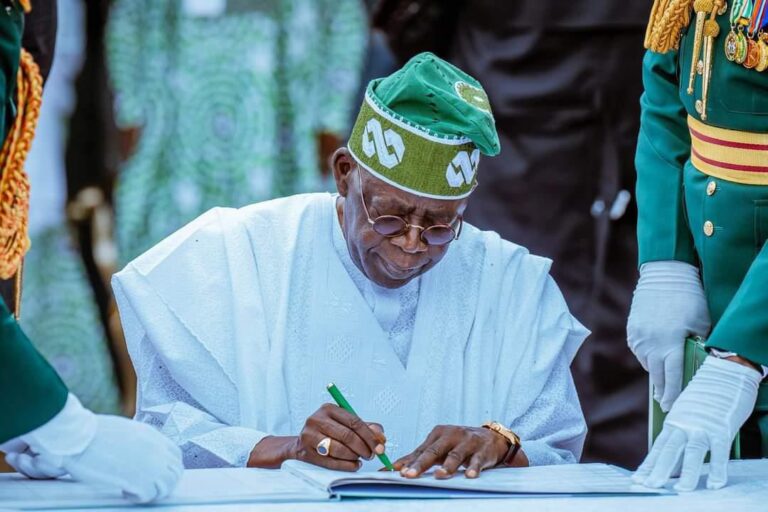
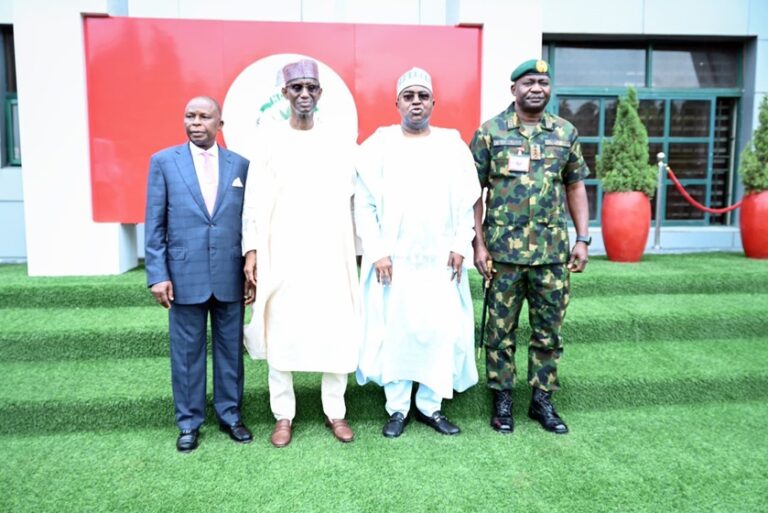
THE Director-General of the World Trade Organisation (WTO), Ngozi Okonjo-Iweala, has urged the Federal Government to establish social safety nets for poor Nigerians affected by President Bola Tinubu’s economic reforms.
Okonjo-Iweala made the call on Thursday, August 14, after a meeting with President Bola Tinubu at the Aso Villa in Abuja.
The Nigerian former Minister of Finance and Coordinating Minister of the Economy, however, noted that the president’s reforms were necessary but stressed that the government must put social safety nets in place for poor citizens to cope with the economic hardship occasioned by the reforms.
The ICIR reports that Tinubu had made petrol subsidy removal and the unification of the foreign exchange rates unification as some of the key policies of his administration.
Despite being vital, these policies have pushed more Nigerians below the poverty line.
Tinubu, who launched a string of economic reforms when he assumed office in May 2023, has come under heavy criticism for over two years, as many Nigerians attribute soaring food inflation and the skyrocketing cost of living to his removal of petrol subsidy and the unification of foreign exchange windows.
Consequently, Nigerians have faced over 200 per cent surge in fuel prices, with inflation hitting an all-time high and household spending rising astronomically.
Transportation and food costs have also skyrocketed, leaving millions struggling to make ends meet.
Commenting further on the government’s reforms, Okonjo-Iweala said, “We think that the president and his team have worked hard to stabilise the economy. You cannot improve an economy unless it is stable. So, he has to be given the credit for the stability of the economy. The reforms have been in the right direction.
“What is needed next is growth; we now need to grow the economy, and we need to put in social safety nets so that people who are feeling the pinch of the reforms can also have some support to weather the hardship. That’s the next step.”
Tinubu’s meeting with Okonjo-Iweala came two weeks before the expiration of her first term as WTO boss on August 31, and the commencement of her second term on September 1.
The renowned economist and global finance expert made history in 2021 as the first African and first woman to lead the 164-nation-member WTO.
The WTO boss, who was in the company of Trade Minister, Jumoke Oduwole, also briefed the president on the progress made on the Women’s Exporters’ Fund for the digital economy.
Okonjo-Iweala said, “We came to brief him about something very joyful that we did today with the help of the First Lady.
“We launched a Women’s Exporters’ Fund for the digital economy. This is a fund that is jointly managed by the World Trade Organisation and the International Trade Centre (ITC) and supports women to weather the storms of the economy and create jobs for themselves.
“It is part of the thinking of the social safety net and what we can do to support Nigerian women to contribute more to the economy and themselves.
“Nigeria competed and won, one of four countries that won globally to be part of this initiative.
“We have 67,000 Nigerian women who applied for this, and 146 of them won, and they are going to have money disbursed directly to them.
The ICIR reports that 16 beneficiaries won the “Booster Track” targeted at those who already have businesses. Their businesses would be scaled up. They would receive technical and business support from the WTO and the ITC for 18 months.
“Another 100 would get $5,000 each to start and strengthen their businesses, with 12-month reforms,”she added.
FANS all over the world are excited as the English Premier League is set to kick off on Friday, August 15, with a thrilling match between Liverpool and AFC Bournemouth at the Anfield Stadium.
Liverpool, the defending champion, will look to continue their dominance of the tournament, while Bournemouth will aim to cause an upset.
The Reds were in top form last season, and it will be interesting to see how they fare against a Bournemouth side who will be looking to make a statement.
The opening weekend fixtures promise to deliver some exciting matches. On Friday, August 15, Liverpool takes on Bournemouth at 8 PM Nigerian time.
The following day will feature a number of high-profile matches, including Tottenham vs. Burnley, Brighton vs. Fulham, Nottingham Forest vs. Brentford, Aston Villa vs. Newcastle, Sunderland vs. West Ham, and Wolverhampton Wanderers vs. Manchester City.
The match between Wolves and Manchester City is expected to be a thrilling encounter, with both teams boasting talented squads.
Despite losing one of their key players, Kevin De Bruyne, Manchester City will still be a strong contender for the title.
Meanwhile, Arsenal will be looking to break their jinx and finally win the title after finishing second for three years in a row.
On Sunday, August 17, Chelsea, who just won the FIFA Club World Cup, will take on Crystal Palace, the Community Shield holders, while Manchester United will host Arsenal in a highly anticipated match.
The final match of the opening weekend will feature Leeds vs. Everton on Monday, August 18.
According to pundits, top teams likely to win the Premier League title this season include Liverpool, Arsenal, Manchester City, and Chelsea.
These teams are considered strong contenders due to their squad strength, recent performances, and managerial expertise.
Other teams that might challenge for top spots include Manchester United, Newcastle United, Aston Villa, and Tottenham, although they are considered less likely to win.
The Premier League 2025/26 season will run until May 24, 2026.
The period will also experience international breaks, domestic cup competitions like the FA Cup and Carabao Cup, and other events.
As the season kicks off, teams will be looking to make a strong start and set the tone for the rest of the campaign.
With talented teams and players competing for the top spot, the Premier League promises to deliver an exciting season.
The global appeal of the Premier League is undeniable, with millions of fans worldwide tuning in to watch the matches weekly.
The league’s massive following is a testament to its enduring popularity and the excitement it generates.
As the teams take to the pitch tomorrow, fans will be eagerly anticipating the start of a new season of thrilling matches, dramatic twists, and unforgettable moments.
With the Premier League’s reputation for unpredictability and excitement, there’s no doubt that this season will be just as captivating as the last.
The stage is set, the teams are ready, and the fans are eagerly waiting. The 2025/26 Premier League season is shaping up to be an exciting one, and it all starts tomorrow.
SUPER Falcons captain and forward, Rasheedat Ajibade, has said her teammates had yet to receive the $100,000 and other gifts promised to the team by President Bola Tinubu.
Ajibade voiced her frustration in a snippet of the forthcoming episode of ‘With Chude’ hosted by popular on-air personality, Chude Jideonwo, released on Thursday.
“People are begging. We have not received it. When they pay it, you will see. Even our match bonuses and everything… everything is still a work in progress,” she lamented.
The ICIRreported in July that Tinubu rewarded the Super Falcons with national awards, cash gifts, and houses, following their thrilling victory at the 2025 Women’s Africa Cup of Nations (WAFCON) in Morocco.
At a reception held at the Presidential Villa in Abuja, Tinubu conferred the national honour of Officer of the Order of the Niger (OON) on all 24 players and 11 technical crew members.
Each player also received a cash prize of the naira equivalent of $100,000, while the technical team members were awarded $50,000 each.
In addition, the president directed the allocation of three-bedroom apartments to all recipients in the Federal Government’s Renewed Hope Housing Estate.
However, Ajibade added that the players had been informed the money had already been allocated, expressing frustration over the prolonged delay in the payment.
“We have not received our money oo. Please, they have not paid. All the promises you heard back and forth, we have not received anything,” she said.
The 24-year-old called on the authorities to honor their promises, noting that the delay was taking a toll on the players.
Ajibade also highlighted her experience playing for FC Robo Queens in the Nigeria Women’s Football League for 10 years without receiving a salary, until she moved to Avaldsnes IL in Norway at the age of 17.
She then joined Atletico Madrid Feminino in 2021.
Recall that Tinubu also awarded national honours on Nigeria’s women’s basketball team, D’Tigress, following the team’s triumph at the 2025 FIBA Women’s AfroBasket tournament a week after Super Falcons award.
Each player also received a cash prize of $100,000 at a reception held at the Presidential Villa in Abuja, where the president conferred the national honour of Member of the Order of the Niger (OON) on all 12 players of the victorious squad.
He also announced the allocation of flat to the team.
The coaching crew members will also receive $50,000 each in recognition of their accomplishments.
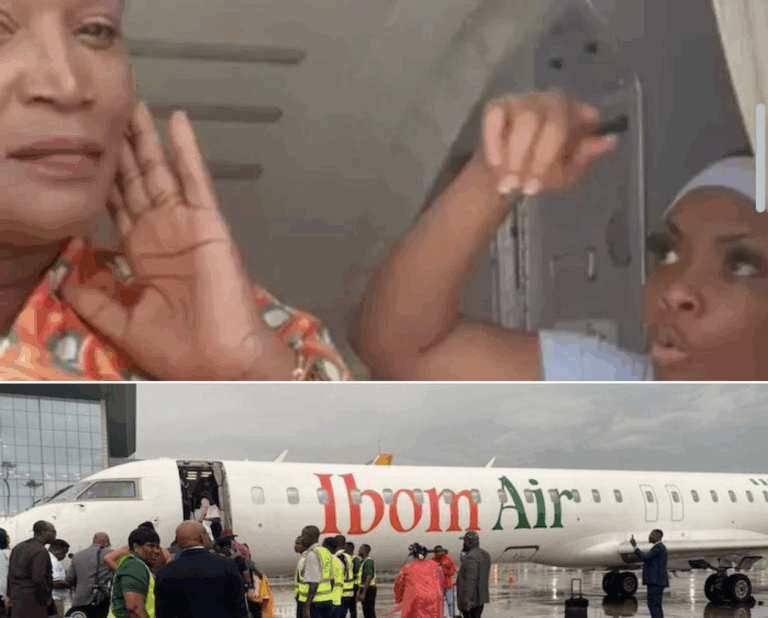
A LAWYER, David Ogede, who witnessed the altercation between an air hostess with Ibom Air and Comfort Emmanson, a passenger on the airline’s flight from Uyo to Lagos on Sunday, August 10, has spoken out about the crisis.
Ogede, who sat close to Emmanson on the plane, described the events leading up to the confrontation as not well handled by the parties.
According to the lawyer, who spoke on the Channels TV Morning Show on Thursday, the first air hostess clearly instructed passengers to switch off their phones before takeoff.
However, when the second air hostess approached Emmanson, who was struggling to switch off her iPhone, the tone of the interactions between them turned sour.
The lawyer said the situation became tense when the air hostess told Emmanson, “If you say another word, I will deal with you.”
“That was when Miss Emmanson flared up and started cursing. I cannot say the things that she was actually saying,” Ogede said, stressing they were unprintable.
Further recounting what transpired, Ogede explained that she explained to the air hostess that the buttons on her phone weren’t working, and the air hostess responded dismissively, saying, “I don’t have time for your nonsense.”
“I felt humiliated myself just looking at the way the lady was being spoken to. The air hostess didn’t even acknowledge me or the gentleman sitting on my left when we tried to intervene,” Ogede stated.
He described how a fellow passenger eventually helped Emmanson switch off her phone, but not before the situation escalated and Emmanson began cursing the air hostess throughout the flight.
Ogede noticed that Emmanson was visibly upset throughout the journey and continued to mutter in anger.
Ogede opined the situation could have been handled more professionally by the airline.
“The air hostess could have taken a more understanding approach, especially given Emmanson’s apparent struggles with her phone,” Ogede said.
Recall that Emmanson was accused of engaging in disruptive conduct during the trip.
Viral videos on social media show how she was forced out of the aircraft and her upper was fully open after her clothes appeared torn as she was being dragged from the aircraft to the tarmac by men in vests bearing Ibom Air.
While many who saw the initial viral videos where she assaulted the airline crew condemned her action, subsequent videos show how she was blocked by the crew from alighting from the flight in what appears to be a bid to hand her over to security officials.
However, on August 10, after her arrest, she was charged in court.
In addition to her prosecution, the Airline Operators of Nigeria (AON) imposed a lifetime ban on her from flying on any Nigerian carrier.
Emmanson was arraigned before the court on Monday and granted bail in the sum of N500,000 with two sureties in like sum.
She was remanded at the Kirikiri Correctional Centre for failing to meet the bail conditions.
Although she was later released from prison and acquitted of all charges after intervention from the Minister of Aviation, Festus Keyamo, hercase sparked heated debates among Nigerians, with many comparing her case with that of a popular musician, Wasiu Ayinde, also known as KWAM.
This report examines concerns raised by health and human rights advocates that Nigeria’s punitive approach exposes people who use drugs to hardship and hinders their access to support.
Joshua Samson grew up in a small community in Kaduna State, where drug abuse among young people was common. Substances like codeine, tramadol, and rohypnol were easily accessible and widely abused.
As a teenager who loved rap music and enjoyed writing, he was drawn to the lifestyle due to the constant pressure to feel among. The older boys in the area often gathered to smoke and portrayed drug use as a source of creative inspiration. Many young people like him came to believe in this.
Joshua tried marijuana after junior secondary school. From there, he progressed to weed mixed with codeine, then cigarettes, and soon, pills like Rochi, Blue Boy, and Bonninga Pi. Music videos glorifying drug use fueled the illusion. To Joshua, it felt like he was unlocking a better version of himself. In reality, he was spiralling into drug dependence.
When he gained admission into university, he thought he had a chance to start over. Tired of being the embarrassment he encountered as a drug user, he gave it up. But in its place came Tramadol.
At first, it seemed like a safer alternative. But Tramadol tightened its grip on him fast. Even as he advanced through school and finished National Youth Service Corp (NYSC), he couldn’t function without it. Skipping a dose brought on migraines, cold sweats, and intense itching. “My body would start to shut down,” he said.
Salvation Mathew grew up in a Christian home in Mararaba, Nasarawa State. His father is a pastor. In 2007, during his time in boarding school, Salvation was first introduced to substances. It started with palm wine, given to him by a senior. Soon, he found himself in the company of boys who smoked weed and experimented with drugs like Tramadol.
Salvation recalled how they would sneak into the bush after school hours to take these substances. One of his earliest influences was a student nicknamed Black Shadow. What began as occasional use quickly became a habit. His friends distanced themselves. His family, heartbroken and confused, began to treat him like an outcast. The trust was gone.
Salvation in 2012 when he was still engrossed in drugs
“I couldn’t even ask my dad for money,” he said. “He would rather go do it himself.”
As his dependence on the drugs deepened, things worsened during his Higher National Diploma (HND) in Lafia. There, he said he met another student from Cameroon who introduced him to heavier use. Salvation said he became fully dependent, unable to do anything without drugs.
One day, while preparing for lectures, he took Tramadol and blacked out in the classroom. He woke up to bruises on his body and laughter from classmates who had recorded the incident. That video eventually reached home through a cousin, prompting threats from his father to send him back to the village.
“That moment hit me hard,” Salvation said. “I knew I had to change.”
The journeys of Joshua and Salvation underscore how easily young people can slip into the world of substance use, often lured in by peer pressure, social influence, and a lack of guidance. What begins as occasional experimentation, often out of a desire to fit in or escape, quickly snowballs into full-blown dependence.
By the time they recognise the damage, the dependence has already tightened its grip. Attempts to quit are rarely easy; they come with withdrawal pains, emotional isolation, and in many cases, deep-seated stigma.
Treated like criminals
Even before he entered university, Joshua had already had his first devastating encounter with law enforcement.
As a teenager in Kaduna, Joshua said he and some friends were hanging out at their usual spot getting high when police raided the area. In the chaos, he, a friend, and a girl fell into stagnant water. Joshua swam out, but lost his phone, money, and shoe. The girl didn’t make it. “One of the girls who was with us got arrested. We had to raise money to bail her out,” he recalled. That day left a mark on him.
But it wouldn’t be his last encounter.
In December 2018, just after his youth service, Joshua said he was heading home late with colleagues when plainclothes officers stopped them.
“They told us to come down. One of them dropped something in the car and accused us of being armed robbers,” Joshua said. “They beat us mercilessly.”
He said the officers dragged them to a secluded area, took their phones, cleared their bank accounts, and even stole snacks and a wristwatch. “They slapped me, hit me with a gun, and left us like animals,” he said.
“I’ll never forget that date—December 23rd, 2018,” he said. “They had someone ready to receive the money from our accounts. It was all planned.”
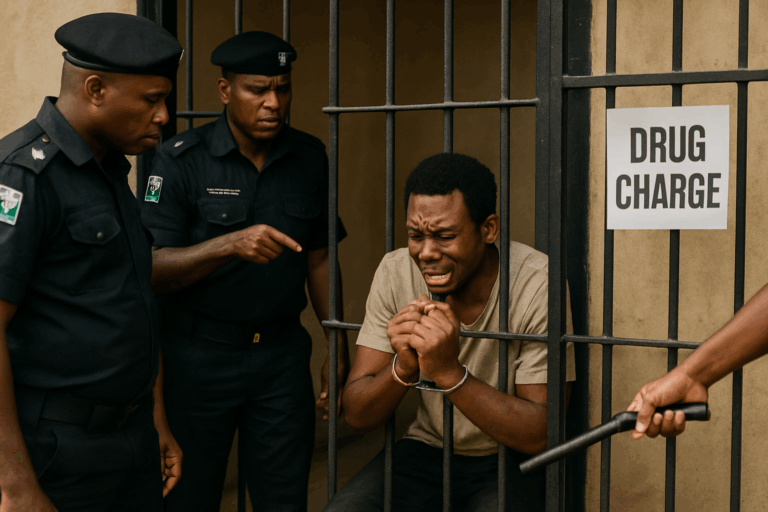
AI generated picture of a person who uses drug after being arrest by law enforcement agents
Two years later, it happened again.
In 2020, after leaving a shopping mall in Abuja, Joshua recalled one of the girls in his group lit a cigarette while they waited for a ride. That was all it took. Black-clad officers swooped in.
“They didn’t ask questions. Just started shouting and bundled us into a truck,” he said.
According to Joshua, a girl was slapped for asking about her wig inside the vehicle. Another had her phone smashed by a boot. They were taken to Life Camp Police Station. This time, they got lucky. A senior officer listened.
“He asked them, ‘What did these people do?’ They couldn’t even answer. That’s how we were released.”
But the trauma stuck with him. Being treated like a criminal again and again left deep scars.
Salvation also had his share of experience. During one incident, a group of boys were arrested after a neighbourhood fight. His father came to the station to bail him, but turned away in disappointment after learning he had smoked before the fight. “He left me there,” Salvation recalled. “That broke me.”
He spent three nights in a crowded police cell—21 boys in a space meant for a few, filled with mosquitoes and more drugs.
His mother, desperate to save him, eventually called a relative who paid for his release. But the damage was done. His father, a respected teacher and pastor, said he no longer wanted anything to do with him.
Criminalisation of drug use in Nigeria
Nigeria is one of the countries that criminalise personal drug use and possession, treating it primarily as a criminal justice issue rather than a public health concern.
Under the country’s current legal framework, especially the National Drug Law Enforcement Agency (NDLEA) Act and related penal laws, individuals found in possession of illicit drugs, even in small amounts meant for personal use, are often arrested, prosecuted, and jailed.
Drug users, particularly those from marginalised communities, are frequently subjected to arbitrary arrests, prolonged pre-trial detentions, and overcrowded prison conditions. There have been documented cases of torture, extortion, and degrading treatment during arrest and detention. Worse still, people who use drugs (PWUD) are often denied access to healthcare, education, housing, and employment due to stigma and discrimination.
A person who uses drug arrested by law enforcement agents/ created by AI
For instance, a YouthRISE Nigeria report examining the impact of Nigerian drug laws on the rights of people who use drugs (PWUD) highlighted frequent police abuses. These include arbitrary arrests and detention, extortion, physical and sexual assault, and neglect, all of which amount to human rights violations.
The National Drug Law Enforcement Agency (NDLEA) was established under the 1989 NDLEA Act, which was amended in 2004. The agency is responsible for combating the cultivation, manufacture, sale, and trafficking of hard drugs. The Act criminalises drug possession and use, with penalties ranging from 15 to 25 years in prison.
Although the law allows for diversion to treatment or rehabilitation in place of imprisonment, this is mostly inplemented in appliication to minors. Offences such as trafficking and production, which were previously punishable by death, now attract life imprisonment.
Experts have said this criminal justice approach has failed to reduce drug use or address its root causes. Instead, it has driven drug use underground, making it harder for individuals to seek help or access health and social services. They said criminalisation also contributes to the cycle of poverty and marginalisation, particularly when former detainees return to society with a criminal record and no support system.
Journey to recovery
In 2017, Joshua reconnected with an NGO he had encountered back in his third year. He started volunteering there and attending group therapy sessions. “But the therapists didn’t have the answers I needed,” Joshua said. “They’d say things like, ‘Try exercise,’ but I needed more than that.”
He tried to fight back in his own way. He buried himself in online courses, hoping productivity would push the cravings away. But the withdrawal symptoms were brutal. “Sometimes, I’d hear my bones cracking. I’d feel like there is a hole inside my bones,” he said. “If I resisted the urge, I’d get a migraine so bad, no drug could stop it—except Tramadol.”
Seeing his struggle, one therapist invited Joshua to live with him. The man’s family lived in Kwara, so there was space. Joshua hoped it would help. But even there, he found ways to sneak out and buy the pills. “I’d lie. Sometimes I’d have the drugs in my pocket while talking to him.”
Joshua Samson has now wrapped up his master’s programme in Non-profit Leadership Management
Eventually, the lockdown in 2020 gave him the pause he needed. Life slowed down. He noticed he didn’t need as much Tramadol anymore—his body wasn’t as active. “That’s when I started cutting down. One or two pills were enough. Then I realised I could try to stop completely.”
He began focusing on self-development and reconnected with advocates in the drug harm reduction space. He volunteered at IDP camps and schools, telling his story.
“I knew I had to stop. I read up on the dangers, such as infertility, heart failure, and sexual dysfunction. Tramadol wasn’t giving me life. It was taking it,” he said, “I tell young people the truth: it doesn’t make you strong. It kills you slowly. There’s nothing glamorous about drug dependence. I’ve lived it.”
For salvation, reality hit him in 2020 when he lost his father. As the first son in a family of four children, with only his mother left, he was suddenly the man of the house. But how could he lead when he was battling his own demons? Worse still was the stigma. Even when he started trying to change, the whispers never stopped.
“Anytime I go back to my old area, some people still say, ‘Hope you no dey do that thing again?’” he said. “I just laugh. But it hurts.”
The turnaround didn’t come overnight. He began attending counselling sessions at YouthRISE Nigeria, where he was introduced to healthier coping mechanisms.
Salvation after recovery
One of the most impactful steps he took was physically moving out of his old environment. The influence, the accessibility of drugs, the peer pressure—all of it was tied to the streets he once called home. “Relocating changed everything for me,” he said. “Now, going back there takes effort, and I don’t do it often. It helped me cut off those triggers.”
Today, he works in furniture-making alongside his best friend in a Furniture Market in Abuja. Together, they’re running their work like a proper business, growing steadily.
“I haven’t touched drugs in four years,” he said proudly. “Even beer, I barely touch. Maybe once in a month, and I don’t even finish the bottle.”
Though the stigma hasn’t completely vanished, he has regained respect, especially from those who once saw him as the “bad egg.”
“It takes the grace of God to leave that life. And it takes surrounding yourself with the right people. The environment matters a lot. The people around you matter even more, he concluded.
Experts advocate for decriminalisation, harm reduction
Experts say there is a need for Nigeria to embrace a harm reduction approach, which offers a more humane, evidence-based alternative. Harm reduction policies focus on minimising the negative health, social, and legal impacts of drug use.
The country launched the fourth iteration of the National Drug Control Master Plan for the period 2021-2025 on December 06, 2021. Harm reduction has for the first time been specifically mentioned in this latest version. As strategy C of Pillar 2, under the title of “Harm Reduction Priorities”, the policy seeks to: implement a full package of harm reduction services, develop a drug overdose management programme, and strengthen data management systems.
Facets of harm reduction/ Source : Amsterdam.nl
Harm reduction has only recently been introduced in the country’s official drug policy document: The National Drug Control Master Plan 2021-2025. As such, resources for people who use drugs in Nigeria are extremely limited and difficult to access.
The Master Plan outlines in detail harm reduction services that need to be implemented includes 1Needle and Syringe Programmes (NSP), Medically Assisted Therapy (MAT) and other evidence-based drug dependence treatment, HIV Testing Services (HTS); Antiretroviral Therapy (ART), Prevention and treatment of sexually transmitted infections (STIs), Condom distribution programmes for people who inject drugs and their sexual partners and Targeted information, education and communication (IEC) for people who inject drugs and their sexual partners.
Speaking with The ICIR, David Olofu, a decriminalisation advocate, criticised the country’s punitive drug laws, arguing they obstruct the delivery of harm reduction services and fuel stigma against those trying to help people who use drugs.
“Criminalisation actually hinders effective harm reduction services because sometimes we have a situation where the officers at the higher echelon have received training… but the officers at the lower rank still have not understood fully what harm reduction is all about,” he said. “So, they tend to interpret it as promoting the issue of drug use.”
He explained that outreach workers involved in the needle and syringe programme often get arrested, extorted, or have their health supplies confiscated by law enforcement agents, despite official backing from the Federal Ministry of Health. This discourages many from entering high-risk areas.
“Anytime a community outreach worker goes out there… we still have cases of arrests. They still get arrested. They still get extorted. Their commodities still get confiscated,” he said.
Beyond security agencies, public perception is also a major obstacle. Olofu noted that many communities oppose harm reduction efforts such as condom distribution, fearing they promote drug use or immorality.
“Over time [criminalisation] has built a perception… that people who are offering harm reduction services are encouraging people to continue to do drugs,” he said. “We see a situation where people say you are promoting promiscuity, or you are encouraging young people to go into prostitution.”
Although the Federal Ministry of Health has endorsed services like medication-assisted treatment, which uses methadone to treat opioid dependency, Olofu said these programmes remain vulnerable without proper legislation.
“There is no legal backing or legal framework that fully energises and supports harm reduction service provision,” he said.
Olofu cited Gombe State as a positive example, where the government, with support from health professionals and advocacy groups, has embraced harm reduction. The state has implemented the needle and syringe programme, medication-assisted treatment, and disease screening for people who inject drugs.
According to Olofu, these outcomes show that harm reduction is not a foreign concept, but a necessary, rights-based approach tailored to Nigeria’s public health needs. He called on policymakers to stop treating drug use as a criminal offence and instead see it as a health and human rights issue.
He added, “Drug use is not about someone outside. It could be somebody very close to you… But because of the way we present the issue and demonise the issue, people tend to just run away from coming out to say this is the problem I’m facing.”
This story is supported by YouthRISE Nigeria, a leading advocacy and service delivery organisation on drug policy and programme reform to ensure vulnerable populations such as PWUDs receive care rather than stigma, criminalisation or extortion by law enforcement agents.
THE Nigerian National Petroleum Company Limited (NNPCL) said it has been spared a N5 billion financial payout.
The state-owned oil company said in a statement on Wednesday, August 13.
According to the NNPCL, on August 8, 2025, the Court of Appeal, Abuja Division, upheld its appeal against the Federal High Court’s April 2023 judgment that annulled Ifeanyi Araraume’s removal as non-executive Chairman of the NNPC Board and awarded him N5 billion in damages.
“The Court of Appeal’s judgement spares NNPC Ltd a massive financial payout and removes a legal risk that could have invalidated all decisions of the Board since 2021,” NNPCL stated.
It explained that the Appeal Court agreed to its position that the Federal High Court’s earlier decision was delivered in error, noting, amongst others, that the claim was statute-barred.
According to a law dictionary, a statute-barred claim, agreement, or right cannot be the subject of any legal action because it is too late after the statute of limitations has expired.
“This decision of the Court of Appeal secures governance stability for NNPC Ltd., sets a corporate governance precedent in Nigerian law, and upholds the validity of Board resolutions critical to the oil and gas industry’s investment and policy direction,” the NNPCL added.
The ICIR reports that on Tuesday, April 18, 2023, the Federal High Court, Abuja, restored Ararume as the non-executive chairman of the NNPC and awarded him N5 billion in damages.
He had prayed the court to declare his removal as the NNPCL chief illegal, unlawful, and unconstitutional, and that it was a total breach of the Companies and Allied Matters Act (CAMA) law under which the NNPCL was incorporated.
THE Nigerian Independent System Operator (NISO) has intervened to resolve the Enugu State Electricity Regulatory Commission (ESERC) tariff disruption and ensure sector market stability.
The Managing Director and Chief Executive Officer of NISO, Abdu Bello Mohammed, said this while declaring open a stakeholder engagement on tariff adjustment by the EERC on Wednesday, August 13, in Abuja.
He said the meeting was prompted by recent action by the EERC in revising the electricity tariff within its state.
He noted that the action, though within the state-level regulatory authority under the Electricity Act 2023, had drawn attention nationwide.
As such, the NISO boss urged respective states’ electricity regulatory commissions and distribution companies (DisCos) in various franchise areas to ensure their actions do not disrupt the Nigerian electricity industry.
He believes that the intention of the Enugu Electricity Distribution Company (EEDC) to curtail power supply to the state by up to 50 per cent in reaction to the tariff adjustment, if allowed to come into effect, would have serious operational implications.
“Such a measure, if implemented, could have serious operational implications, particularly at the TCN–DisCo interfaces where power transfer capacity Service Level Agreements (SLA) are managed.
“We believe that fair electricity prices, sustainable business operations, and a stable electricity market are not mutually exclusive goals — they are interdependent. Achieving all three requires dialogue, transparency, and coordination among all relevant institutions,” the NISO boss said.
The ICIRreported that Enugu State has been experiencing a lingering power outage that has left parts of the state in darkness.
The challenges started when, on July 21, the EERC reduced Band A electricity tariff to N160/kWh from N209, which raised concern among electricity distribution companies (DisCos) and electricity generation companies (GenCos).
It had led the EERC to summon MainPower Electricity, the successor to the EEDC, to address the vending challenges faced by customers.
The ICIR had also reported that the Nigerian Electricity Regulatory Commission (NERC) had said EERC has no regulatory power to fix the electricity price when the power is generated and transmitted from the national grid.
At the meeting on Wednesday, the NISO boss said he believes that achieving electricity market stability requires coordination and cooperation among stakeholders in the value chain.
“In simple terms, NISO is responsible for both commercial balance in the market and also for ensuring technical stability and operational compliance — both of which may be affected by the current situation.
“Hence, this intervention meeting is to ensure that no action disrupts the Nigerian electricity market stability, the integrity of contracts, or operational obligations that guarantee reliable supply to Nigerians,” Mohammed explained.
He noted NISO’s role in convening the meeting was based on market administration as well as system operations mandates through the instrumentalities of the Electricity Act 2023, the market rules, and the grid code.
According to him, the code empowers the market operator to administer the wholesale electricity market, ensure compliance with market rules, and uphold contractual obligations.
It also mandates NISO to safeguard the financial integrity and orderly operation of the market and requires it to convene consultations when any matter arises that could materially affect market operation or settlement.
Mohammed added that the code also assigns NISO responsibility for monitoring participants’ compliance with operational obligations, including dispatch instructions, system reliability, and service level agreements on power transfer capacity at TCN–DisCo interfaces.
THE Federal Executive Council (FEC), chaired by President Bola Tinubu on Wednesday, August 13, approved a seven-year moratorium on the establishment of new federal tertiary institutions across Nigeria.
The ban, which applies to universities, polytechnics, and colleges of education, is aimed at addressing what the government described as growing number of tertiary institutions in the country.
Minister of Education, Tunji Alausa, said the challenge facing Nigeria’s education system was no longer access to federal tertiary education but the deterioration of infrastructure and manpower due to the unchecked proliferation of the schools.
He said, “Several federal universities operate far below capacity, with some having fewer than 2,000 students. In one northern university, there are 1,200 staff serving fewer than 800 students. This is a waste of government resources.’
The minister added, ”
However, there are concerns about the legality of the order as many have pointed out that the power to enact laws, also relating to public university education (including their establishment) rests solely with the National Assembly, not the executive branch.
The ICIR reports that the decision to halt establishment of new institutions came just months after the federal government approved provisional licences for 11 new private universities, bringing the total number of private universities in the country to 160.
The ICIRreported that the approval expanded private universities in the South-West, South-East, and South-South regions, which already had the highest number of private institutions in the country, according to data on the number of private universities from the National Universities Commission (NUC).
Over the years, states in the South-West, namely Lagos, Ogun, and Oyo, have hosted more private universities than other regions in Nigeria.
The region hosts institutions such as Covenant University, Babcock University, Afe Babalola University, Landmark University, and Redeemer’s University.
Similarly, the South East and South South regions have notable private institutions like Madonna University, Benson Idahosa University, Igbinedion University, and Rhema University.
However, northern Nigeria has fewer private universities compared to other regions, with institutions such as Skyline University (North-West), Baze University, Nile University (North-Central) and American University of Nigeria (North-East) making the top list in the region.
THE Chairman/Chief Executive of the National Drug Law Enforcement Agency (NDLEA), Buba Marwa said the agency arrested 40,887 drug offenders and 45 barons in the past two years.
Besides, the agency seized 5.5 million kilogrammes of illicit substances within the same period.
Marwa stated this in his opening remarks at the commissioning of 46 new vehicles distributed to strategic commands and formations of the NDLEA at the agency’s national headquarters in Abuja, on Wednesday, August 13.
He said 704.445 hectares of cannabis farms, hidden deep in forests, were also destroyed by the agency, adding that the NDLEA had equally secured the conviction of 8,682 traffickers and kingpins, and ensured their assets were forfeited to the Federal Government.
Marwa explained that 24,173 drug users were treated and rehabilitated in its 30 rehab centres across the country.
He said the new vehicles were symbolic of the continuous effort to reposition the agency as a modern, efficient, and respected organisation as well as a reflection of the sustained commitment of President Bola Tinubu’s administration to equipping institutions that stand on the front line of the country’s national security and public health.
“To that extent, today’s event is a milestone, as NDLEA is now counted among a distinguished group of security and drug law enforcement agencies around the world that are not only visible in their operations but equally respected and making impacts”, Marwa noted.
He commended the Tinubu administration for its unwavering and strategic support for the agency.
“The procurement of these vehicles was made possible by the fiscal backing of this administration, which continues to demonstrate strong resolve in addressing the root causes of insecurity and social dislocation. Under the Renewed Hope Agenda, the President has prioritised national stability, institutional reform, and the safety of every Nigerian life. That trust motivates us to deliver even more,” he stated.
While explaining the importance of the fight against substance abuse and illicit drug trafficking to national security, Marwa emphasised that drug abuse and trafficking were central to many security challenges in the country, fueling issues like kidnapping, armed robbery, insurgency, and cult violence.
In his address at the occasion, the National Security Adviser (NSA), Nuhu Ribadu, said the Tinubu government would continue to strengthen the NDLEA because of its strategic importance to the success of the country’s national security architecture.
The NSA also commended Marwa and his team for their sustained commitment, discipline and zeal in transforming the NDLEA into a result-oriented force against illicit drugs.
“This event is not just about commissioning vehicles; without the mobility to swiftly reach danger points, intercept traffickers, and move resources where they are most needed, our fight is severely constrained.
“The link between drug trafficking and insecurity is systemic. Criminal gangs thrive on drug profits, and insurgents and armed groups fund their activities with it. Countless young Nigerians fall victim to addiction, with devastating consequences for families and communities,” Ribadu stated.
He said the agency would continue to receive full support from his office.
In his remarks, the Attorney General of the Federation (AGF) and Minister of Justice, Lateef Fagbemi, a senior advocate, commended Tinubu for making the achievements recorded by the leadership at the NDLEA in the past two years possible.
Also speaking at the occasion, the Chief of Defence Staff (CDS), Christopher Musa, a general, lauded the NDLEA for its bravery and professionalism in fighting drug trafficking.
He said the new vehicles would boost the agency’s effectiveness.
The Director General of the Bureau of Public Procurement (BPP), Adebowale Adedokun, who was also present at the event, commended the NDLEA for following due process in procuring the vehicles and setting an example for other agencies.
The ceremony included distributing 38 SUVs and 10 sedans to various commands and directorates, as well as promoting 15 officers to a higher rank.
THE Ikeja Magistrate Court in Ogba, Lagos State, has discharged Comfort Emmanson, an Ibom Air passenger accused of assaulting crew members and airport officials at the Murtala Mohammed International Airport, Lagos, from prison and acquitted her of all charges.
The ICIR reported that Emmanson was accused of engaging in disruptive conduct during an Ibom Air flight from Uyo, Akwa Ibom State capital to the Murtala Mohammed International Airport, Lagos State, on August 10, leading to her arrest, prosecution and remand in Kirikiri Prison.
In addition to her prosecution, the Airline Operators of Nigeria (AON) imposed a lifetime ban on her from flying on any Nigerian carrier.
Emmanson was arraigned before the court on Monday and granted bail in the sum of N500,000 with two sureties in like sum.
However, she was remanded at the Kirikiri Correctional Centre for failing to meet the bail conditions.
Her case sparked heated debates among Nigerians, with many comparing her case with that of a popular musician Wasiu Ayinde, also known as KWAM 1.
KWAM 1 had attempted to physically prevent a ValueJet plane from taking off at the Nnamdi Azikiwe International Airport, Abuja, and was reported to have assaulted the captain by pouring alcohol on her.
While Emmanson was sued and detained in prison within 24 hours, KWAM 1 walked freely on the street, despite the Federal Government’s vow to investigate him.
He is widely believed to be well-connected to the Presidency.
Reacting to the cases Wednesday morning, the Minister of Aviation and Aerospace Development, Festus Keyamo, said he had engaged Ibom Air’s management, the police, and the AON, leading to an agreement to withdraw the complaint and lift the lifetime ban.
The minister said that the resolutions were reached after reviewing the incidents, considering appeals from individuals, noting that Ibom Air had agreed to withdraw its complaint against Emmanson.
But many Nigerians have faulted these decisions, accusing the government of protecting KWAM 1 from facing a similar fate as Emmanson.
The ICIR reported how the Nigerian government announced plans to make the musician “an “Ambassador for Proper Airport Security Protocol,” a decision many Nigerians described as a way to promote lawlessness in the nation’s aviation sector, and the Presidency’s deliberate interference with the mandates of the NCAA, the Federal Airport Authority of Nigeria (FAAN) and other relevant institutions in the sector.
On Tuesday, August 12, the Inspector General of Police, Kayode Egbetokun, had ordered a through probe of the globe-trotting musician, after receiving a petition from the Nigeria Civil Aviation Authority (NCAA)
At the resumed hearing of Emmanson’s case Wednesday, the prosecutor, Oluwabunmi Adeitan, tendered application to court for the withdrawal of the case, which was admitted by the court.
Magistrate Olanrewaju Salami dismissed the case against the lady after the police withdrew the five charges preferred against her.
The ICIRreported that Ibom Air accused Emmanson of assaulting the lead flight attendant and airport officials, leading to a violent confrontation and her forceful removal from the plane.
During the process, her cloth was torn, exposing her full upper body.
Viral videos on social media show her upper body naked as she was being dragged from the aircraft to the tarmac by men with vest bearing Ibom Air.
While many who the initial viral videos where she assaulted the airline crew condemned her action, subsequent videos show how she was blocked by the crew from alighting from the fight, in what appears a bid to hand her over to security officials.
Meanwhile, rights advocates have urged her to file a lawsuit against the airline as the Nigeria Bar Association expressed its willing to offer her a pro bono service.