Home Blog Page 2092

Court awards N10.5m as damages in favour of Audu Maikori, against Kaduna State govt for unlawful detention

THE Court of Appeal in Abuja on Friday ruled in favour of Audu Maikori, president of Chocolate City Group against Kaduna State Government for his unlawful arrest and detention.

The court also the state government to pay him the sum of N10.5 million as damages.

Maikori was arrested by security operatives in Lagos on February 17, 2017 over his social media post about killing in Southern Kaduna which was believed to be false.

But the three-person panel of the Court of Appeal in a judgment unanimously upheld the findings of fact and conclusions of the Federal High Court, holding that the actions of the Kaduna State Government were both unlawful and unconstitutional.

The Court, however, reduced the damages awarded from N40 million to N10.5 million

Before his arrest and detention, Maikori, a lawyer and entrepreneur from Southern Kaduna had written about the killing of some secondary school students in Southern Kaduna by gunmen suspected to be Fulani herdsmen.

He was taken from Lagos to the Force Headquarters in Abuja after his arrest in Lagos.

According to him, he had relied on the information provided by his driver identified as Simon Joseph, but the claim was later found to be false.

In his social media post, he said that his driver’s brother and five other students of College of Education, Gidan Waya were allegedly attacked and killed by herdsmen in Southern Kaduna.

The Government of Kaduna State dismissed the claims as inaccurate.

The school Maikori identified later debunked the claim in a statement. Maikori also apologised for the wrong information.

He was granted bail the following day and released. However, he was re-arrested on  March 10 and transferred to Kaduna.

The lawyer was detained for four days in Kaduna where he was prosecuted but released “on liberal terms” on March 13.

But in May, 2017, Maikori through his lawyers sued Governor Nasir El-Rufai of Kaduna State,  the Inspector General of Police and the Kaduna State Commissioner of Police for human rights violation.

On October 27, the Federal High Court in Abuja awarded N40 million in Maikori’s favour but Kaduna State Government challenged the judgement at a superior court.

Responding to the judgment,  Gloria  Ballason, his lead counsel, said the ruling was important for the protection of all persons in Nigeria.

“By today’s judgment, the Court of Appeal reaffirms the sanctity of the rights of citizens against abuse by the designs of temporal power and makes clear that politicians in government using security agencies at their disposal cannot pick and choose what parts of the constitution to obey or observe,” Ballason said.
 

Protesters storm Police Headquarters, demand justice for rape victims

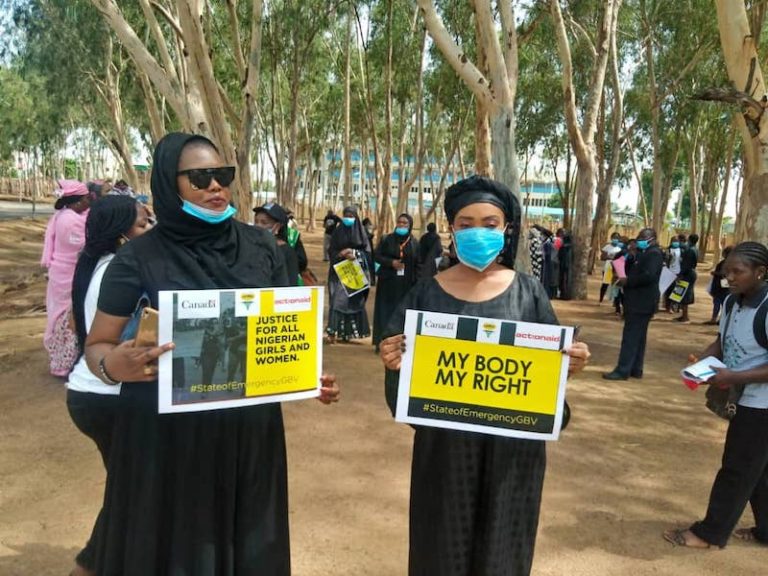
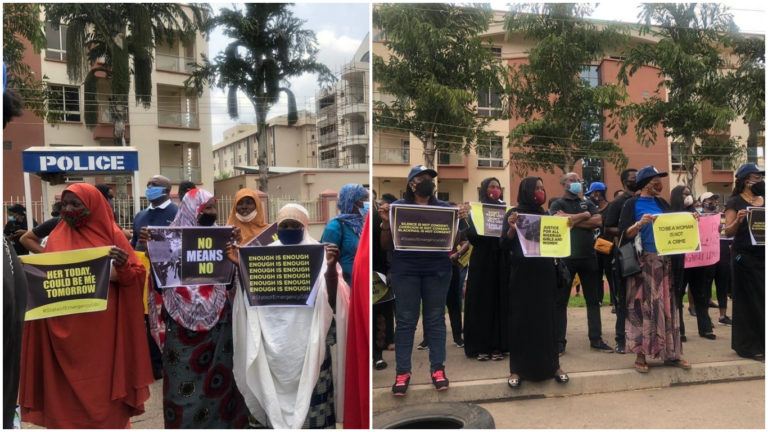
A GROUP of Civil Society Organisations (CSOs) Friday morning led protesters to the Nigerian Police headquarters, Abuja demanding justice for rape and sexual violence victims.

The protesters who displayed banners with various inscriptions calling for justice for sexual violence also asked the government to declare a state of emergency on Sexual and Gender-based Violence (SGBV) issues in the country.

Among the CSOs that attended the protest were TechHerNG, Girl Child Africa, Connected Development, Enough is Enough Nigeria, Stand To End Rape, SilverChipFox, Yiaga Africa, Dorothy Njemanze Foundation, and Education as a Vaccine.

During the protest at the Louis Edet House headquarters of the Nigeria Police , the protesters raised hands in solidarity in order to force a systemic action against SGBV in Nigeria.

Part of their demands was that the leadership of the Nigeria Police should ensure prompt investigation and conclusion of rape and all SGBV cases across the country.

Chioma Agwuegbo, founder TechHerNG, read out 100 cases of SGBV that have occurred between January – June 2020, lamenting that sexual violence has become a scourge.

She added that several other cases have gone unreported for fear of stigmatisation.

“When a child is raped, it is a crime against the state and not their family. Even when parents are pressured to withdraw cases, the state must say no,” Agwuegbo said.

“The state must always take up such cases, this is why we are here,” she added.

The protest followed a recent rape and murder of a 22-year-old Uwa Omozuwa, an undergraduate student of University of Benin, by unknown persons.

She was raped and murdered in building of a Redeemed Christian Church of God (RCCG) parish in, Benin City, Edo State.

Many Nigerians have since been calling for justice for Omozuwa whose assailants are yet to be apprehended.

Among those calling for justice were some female members of the ninth Senate who have also demanded stiffer penalty for abusers.

During plenary on TuesdaySandy Onor, senator representing Cross River Central Senatorial District asked that the Senate should condemn the spike in rape cases across the country

However, Muhammed Adamu, the Inspector General of Police,  in a statement released on Monday, said he has deployed forensic support to the Edo State Police Command to complement and quicken actions in the ongoing investigation into the crime.


Nigeria receives ICT equipment from ECOWAS

THE Commission of the Economic Community of West African States (ECOWAS) has handed over Information and Communication Technology (ICT) equipment and related software to the Nigerian government through its Ministry of Humanitarian Affairs and Social Development on Friday.

The equipment, made up of eight desktop computers, UPS and printers each, one heavy-duty photocopying machine as well as two projectors, were purchased under a signed grant agreement between the World Bank Global Facility for Disaster Risk Reduction (GFDRR) and the ECOWAS Commission.

Financed by the European Union (EU), the set of equipment is said to have been provided for the benefit of the Nigerian National Emergency Management Agency (NEMA) in aid of greater monitoring, detection and amelioration of disasters in the country.

Handing over the equipment at a ceremony which took place at the Nigerian Army Resource Centre, Abuja, the ECOWAS Commission’s Commissioner for Social Affairs and Gender Dr. Siga Fatima Jagne said the delivery of the equipment is part of the ECOWAS capacity building and institutional strengthening support of the national disaster management and civil protection agencies in the ECOWAS region.

She disclosed that sourcing of the equipment arose out of the need expressed by the ECOWAS Member States to further strengthen data collection capacity and emergency operations especially because of the growing impacts of climate change where evidence-based data and information are essential and necessary for the enhancement of decision making while responding to complex climate-related hazards including the ongoing global COVID-19 and post-pandemic recovery.

The Permanent Secretary, Ministry of Humanitarian Affairs, Disaster Management and Social Development, representing Minister  Jalal Arabi lauded the collaboration between the government of Nigeria and ECOWAS adding that the regional organisation has been facilitating sustainable integration by creating safer and resilient communities.

“The equipment will help to build our national platforms on disaster reduction management,” Jalal added.

Also speaking, the Director-General, NEMA Air Vice Marshal M. A Mohammed Rtd, while expressing gratitude for the donation, noted that the equipment will give an additional boost to the response capacities to disasters.

The ECOWAS Commission and the World Bank Global Facility for Disaster Risk Reduction (GFDRR) entered into a four-year grant agreement, spanning 2016-2019, to support ECOWAS in the development and implementation of programmes for the strengthening of Disaster Risk Reduction (DRR) coordination, planning and policy advisory in West Africa.

CSOs march against sexual, gender based violence in Bauchi, urge govt  to declare state of emergency

By Haruna Mohammed Salisu


A COALITION of  Non-Governmental and Civil Society Organisations in  Bauchi State has on Friday protested against what the group described as persistent gender-based violence against women in different parts of the country.

Addressing journalist after the rally on behalf of the organizations, Mrs. Comfort Attah, the Executive Director of Attah Sisters’ Helping Hands Foundation ASHH, called on the federal and state lawmakers across the country to push for reforms that could address the recurrent violence against women in Nigeria.

Attah who expressed concern over the escalating reports of violence against women and girls in Bauchi state and Nigerian in general said declaring a state of emergency on rape cases was necessary to reduce the rate.

Since the outbreak of the COVID-19 pandemic, the number of calls from service providers on violence against women and girls has been on the increase in Bauchi state, she said, adding that the service providers could not assist the victims because they were trapped in their houses with their abusers because of lack of access to phones or transportation.

“In the past one week alone, a 16-year-old girl was abducted and gang-raped in Bauchi state. Again, Uwa was raped and killed in a church in Benin state while Tina was shot dead in Lagos state. Another 12-year-old girl was raped in Jigawa state. Barakat was raped and stabbed to death, and these are the only few reported in the news. We need justice and a declaration of a state of emergency”, Attah stressed.

She said one in four girls in Nigeria is sexually assaulted before she reaches the age of 18, but only 65 rape convictions were successfully completed between 1973 and 2019.

“In many cases, the security settles the cases at household or family levels.”

Attah noted that before the COVID 19 crisis, the national data from 2018 showed an increase in the percentage of women who experienced physical violence since the age of 18, from 11 per cent in 2013 to 14 per cent in 2018, adding that there is a continuous increase in the number of cases due to lack of access to medical services and justice.

Also speaking, Fauziya Idriss, programme officer at Federation of Muslims Women Association of Nigeria, FOMWAN said concerted efforts need to be put in place to curtail persistent violence against women and girls in the country.

She said her organisation in partnership with other CSOs in the country is poised to ensure that pragmatic steps are taken to rid girls of such problems.

Responding, Barrister Yakubu Bello Kirfi, the Bauchi State Commissioner for Justice said his ministry was in consultation with relevant stakeholders, including CSOs to arrest the situation.

“Already the Bauchi State government is taking some measures including holding the perpetrators accountable.

“In partnership with CSOs like yours, we shall address these problems and bring the perpetrators to book,” he said.


National Geographic launches emergency fund for journalists during COVID-19 season

THE NATIONAL Geographic Society is launching an emergency fund for journalists all over the world who wish to cover Coronavirus disease (COVID-19) pandemic within their own communities.

According to the organisation, the fund will place particular emphasis on delivering news to underserved populations, particularly where there is a dearth of evidence-based information getting to those who need it.

“As COVID-19 continues to evolve and impact communities around the globe, journalism can play several roles in supporting communities, disseminate critical information to keep people safe and informed, it can illuminate stories that bring us hope and remind us of our shared human experience, and it can help us find and share solutions to wicked problems,” the organisation said.

The fund is designed to quickly deliver support so that both individual stories and longer series of content may be created.

The organisation said the fund will distribute support ranging from $1,000–8,000 USD for local coverage of the preparation, response, and impact of this global pandemic as seen through evidence-based reporting.

Beyond reporting on medical and physical health related to COVID-19, the organisation encourages reporting that covers social, emotional, economic, and equity issues.

It stated that narratives around the pandemic necessarily include facts and numbers, but ultimately, must also go deeper—telling the stories of inequities that COVID-19 has brought to light.

The application seeks writers, photographers, videographers, audio journalists, cartographers, filmmakers, and data visualization experts to apply for this funding.

It said journalists should seek placement of this work within their local media ecosystems and must attribute their support to the National Geographic Society’s Emergency Fund for Journalists.

However, they do not need to submit any formal commitments of publication or letters of support from editors or publishers. National Geographic Society or National Geographic Partners may also choose to publish some of this work as part of its global coverage.

To apply, click here

11 men serially raped 12-year-old girl in Jigawa, lured her with N30 – Police

JIGAWA State Command of the Nigerian Police Force said 11 men who allegedly serially raped a 12-year-old girl in the state for two months usually lure her with N30 or N50.

“She opened up that the 11 people have been having affairs with her since and they were giving her N30 or N50,” Jinjiri Abdu, the state Police Public Relations Officer disclosed this to The ICIR in a phone interview.

Abdu stated that the 11 men accused of rape were apprehended by the police in Dutse Local Government Area after the girl listed their names and addresses.

“When our people took over and started interrogation, the girl opened up that this is not the first time. She said there are many people that have been having affairs with her,” he said.

“We now went after the list she gave us and the address.”

He stated that those arrested are being investigated adding that some of them have made  confessional statements.

However, the police spokesperson clarified that it was the arrest of a 57-year-old man who had attempted to rape the same girl that led to the arrest of 11 others that are being currently interrogated by the police.

According to him, the arrest was made after the police received a complaint that one Alh Zuwai, 57 -year- old of Ma’ai village in Dutse Local Government was seen at Limawa market trying to lure a 12 year old girl of the same address to a hidden place, to have intercourse with her.

He further explained that the said Alhaji Zuwai did not defile the victim but only lured her to an uncompleted building with an intent when he was caught by traders.

Abdu stated that in Northern part of the country, the issue of rape is far beyond consent.

According to him, having intercourse with a girl below age 14, even with her consent is still considered rape.

There have been calls by women and civil society organisations in the country for stiffer penalties against rape after a 22-year-old Uwavera Omozuwa, an undergraduate who was raped and murdered in a church building where she had gone to read.

According to the Sokoto State Hisbah, 606 cases of rape were also reported in 22 local governments of the state in 2019.

To check the trend, some individuals had also called for capital punishment or a life sentence as a sanction for the crime.

In July, 2019, the Senate passed a resolution to ensure a more stringent punishment is awarded for rape cases.

The advocated the need for State Governments to domesticate the Child Rights Act and Prohibition Act 2015.


Fiji declares self free of COVID-19, first nation to do so

FIJI has declared itself free of the Coronavirus disease (COVID-19) pandemic after all 18 people who tested positive for the virus have recovered.

Frank Bainimarama, Prime Minister of the South Pacific country, said on Friday that it had just cleared the last of its active patients.

He wrote on Twitter: “And even with our testing numbers climbing by the day, it’s now been 45 days since we recorded our last case. With no deaths, our recovery rate is 100%,” Bainimarama wrote on Twitter.

“Answered prayers, hard work, and affirmation of science!”

Fiji, which has a population of 900,000, imposed a lockdown in certain areas in April and put in place ongoing border restrictions.

How does a country certify it is free of the COVID-19 pandemic ?

The World Health Organisation (WHO) declares a country free from a virus when there hasn’t been a confirmed case after twice the maximum incubation period, which is the time of first exposure to an infection and the onset of symptoms.

In the case of the novel coronavirus, the WHO has said the maximum incubation period is 14 days

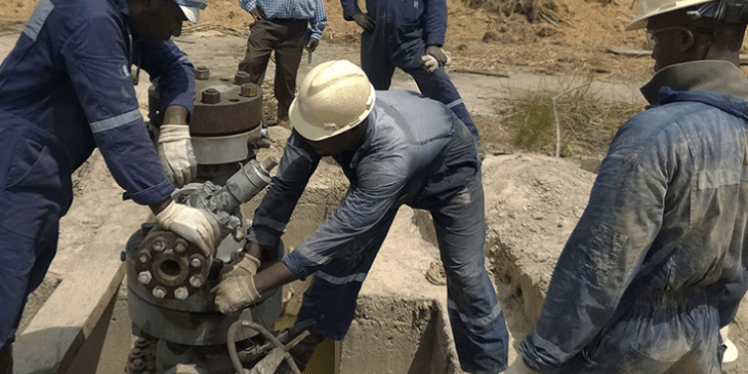
DPR, Nigerian petroluem regulator bars debtors from bidding for marginal oil fields

OIL firms indebted to the Nigerian Government will not be allowed to participate in the newly launched bid round for marginal oilfields as oil firms, the Department of Petroleum Resources, (DPR) has revealed.

Sarki Auwalu, Director of the DPR, in a statement, said that the 57 oil fields which are listed for bidding were small oil fields that major oil companies considered unprofitable and auctioned to indigenous companies under a competitive bidding round.

“We are so impressed by the responses so far. For so long the industry has been stagnant to increase its reserves and one of the strategies to increase our reserves is through this exercise,” he said.


Read Also:

A marginal field is an oil field that has been discovered and has been left unattended for a period of not less than 10 years, from the date of first discovery or such field as the President determines.

The fields on offer are located on land, swamp and shallow offshore terrains while the present bid rounds are expected to last for 10 weeks. The DPS said  the process would be conducted electronically.

The last marginal bid rounds were undertaken in 2003.

“Pre-qualification will be opened to all indigenous companies that are duly registered to carry out petroleum exploration and production operations in Nigeria,” Auwalu stated.

“Companies, including their promoters, that are indebted to the government will not be pre-qualified. Also, companies and their promoters that currently have assets that are not being operated in a business-like manner will not be pre-qualified,” he added.

The applicable fees per field are N500,000 for registration,  N2 million for application, N3 million for the bid processing, $15,000 for data prying, $25,000 for data leasing, $50,000 for competent persons’ report, and $25,000 for a field-specific report.

From the expected bid round, the DPR is likely to generate N3.17 billion from the payment of fees for the 57 marginal fields on offer, according to a report.

The regulatory agency said the pre-qualification exercise would be done on objective criteria, guided by rules of general application.

In another development, the DPR’s efforts to commercialise the gas that is currently burned at its wells as waste so that it can be exported or used for power production has been delayed by at least six weeks due to COVID-19 outbreak.

Nigeria’s gas flare commercialisation programme was approved in 2016, and the DPR held bidding round for companies wanting to bid on the opportunity to commercialise 96 flare points in February.

“What is holding the programme is COVID-19,” Auwalu said, as he disclosed that the bidders need access to the flare points…, “they have to go and see it physically.”

“We had to officially extend the programme by six weeks,” he said.

Nigeria is one of the top ten gas-flaring countries in the world, it flared some 7.4 billion cubic feet in 2018, according to accounting firm PwC.

The country estimates that it loses $1 billion in revenue yearly due to flaring, which contributes to extreme environmental pollution in the Niger Delta region.

42 percent of Nigerians suffered job loss due to COVID-19 – NBS report

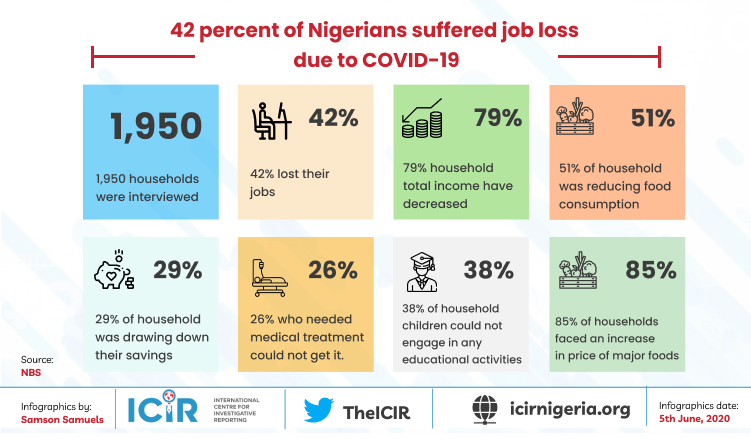
THE  National Bureau of Statistics (NBS) says its recent survey has revealed that 42 percent of Nigerians lost their job due to the Coronavirus disease (COVID-19) pandemic.

The NBS said the impact of COVID-19 on employment and income have been widespread.

The survey was conducted by the NBS to monitor the impact of COVID -19 to access the impact of the pandemic on the national economy.

“In order to track the impacts of the pandemic, the National Bureau of Statistics implemented the Nigeria COVID-19 National Longitudinal Phone Survey (COVID-19 NLPS) on a nationally representative sample of 1,950 households,” NBS said in the report, ” COVID-19 IMPACT MONITORING.”

It explained in the report that 42 percent of respondents who were working before the outbreak reported that they were not currently working due to COVID-19.

According to the NBS, the survey was conducted between April to May 2020, during the time when the index case was identified in the country.

It stated that the impact of COVID-19 has been most strongly felt in the commerce, service, and agriculture sectors.

Seventy-nine percent of households surveyed reported that their households’ total income have decreased since mid- March, the report said.

In the report, NBS said experience of economic shocks by Nigerians in the few months after the outbreak of coronavirus far exceeds shocks experienced between 2017 and 2019.

“The most widely reported shock experienced by households was an increase in prices of major food items faced by 85 percent of households since the outbreak compared to only 19 percent between January 2017 and January 2019,” the report noted.

The report indicated that the coping mechanism for 51 percent of households  interviewed was reducing food consumption between March – May 2020.

“Many households have struggled to cope with these widespread shocks with 51 percent of all households resorting to reducing food consumption.”

To further cope with the shocks, NBS’s survey said many households were also drawing down their savings, 29 percent of the households falls into this category.

Also, a total of 26 percentage of interviewed households who needed medical treatment reported
not being able to access treatment.

The survey further revealed that 38 percent of households with children who attended school prior to school closures due to the pandemic reported that their children did not engage in any learning or education activities.

Most of the households whose children did not engage in learning activities said between March to May, they did not have any contact with their children’s teachers.

African Fact-Checking Awards 2020 for journalistic excellence now open

THE African Fact-Checking is receiving entries for the seventh annual awards programme that honours journalism by Africa-based media in the expanding field of fact-checking.

In 2019, the organisation received a total of 153 entries from more than 20 countries from Ethiopia, Nigeria, Senegal, Egypt, South Africa, and Zimbabwe.

In the inaugural year 2014, it received entries from about 40 journalists across 10 countries.

Noko Makgato, the Executive Director at Africa Check  said, “With health-related decisions sometimes being a matter of life or death, good fact-checking journalism is vital – now more than ever. The quality of information disseminated in public can determine the life outcomes of many and so it is the responsibility of the media to refrain from being conduits of misinformation.

“Each year we are seeing growing interest in fact-checking as evidenced by the number of organisations that have emerged focusing their efforts on debunking harmful claims in different parts of the continent. This, we believe, strengthens the quality of public debate and, hopefully, improves the quality of life across the continent,” Makgato said.

As a result of the growing interest in fact-checking on the continent, Africa Check is expecting an increase in the quantity and quality of entries in 2020.

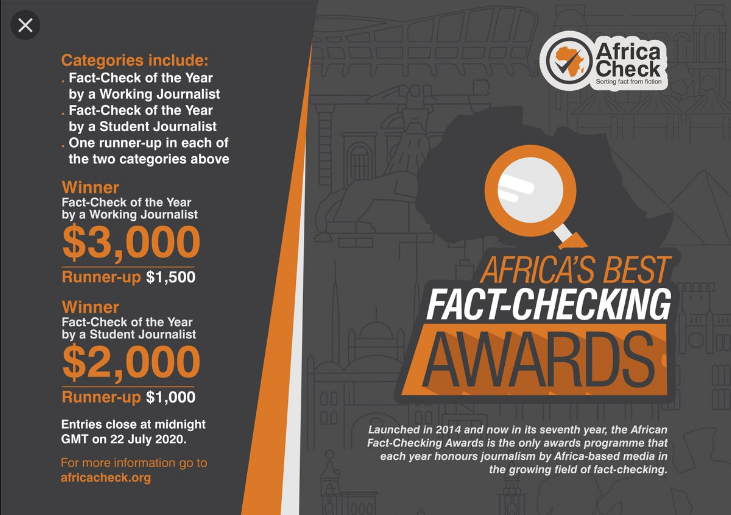
This year’s categories include:

  • Fact-Check of the Year by a Working Journalist
  • Fact-Check of the Year by a Student Journalist
  • One runner-up in each of the two categories above 

Entries must have been first published or broadcast on any date from 1 August 2019 to 22 July 2020. They should have exposed a claim on an important topic made by a public figure or institution in Africa as misleading or wrong.

The winner of the award for best fact-checking report by a working journalist will get a prize of $3,000, while the runner-up will be awarded $1,500. The winner of the award for best fact-checking report by a student journalist will get a prize of $2,000, and the runner-up $1,000.

Entries close at midnight GMT on 22 July 2020.

To apply, click here.