Home Blog Page 2093

African Fact-Checking Awards 2020 for journalistic excellence now open

THE African Fact-Checking is receiving entries for the seventh annual awards programme that honours journalism by Africa-based media in the expanding field of fact-checking.

In 2019, the organisation received a total of 153 entries from more than 20 countries from Ethiopia, Nigeria, Senegal, Egypt, South Africa, and Zimbabwe.

In the inaugural year 2014, it received entries from about 40 journalists across 10 countries.

Noko Makgato, the Executive Director at Africa Check  said, “With health-related decisions sometimes being a matter of life or death, good fact-checking journalism is vital – now more than ever. The quality of information disseminated in public can determine the life outcomes of many and so it is the responsibility of the media to refrain from being conduits of misinformation.

“Each year we are seeing growing interest in fact-checking as evidenced by the number of organisations that have emerged focusing their efforts on debunking harmful claims in different parts of the continent. This, we believe, strengthens the quality of public debate and, hopefully, improves the quality of life across the continent,” Makgato said.

As a result of the growing interest in fact-checking on the continent, Africa Check is expecting an increase in the quantity and quality of entries in 2020.

This year’s categories include:

  • Fact-Check of the Year by a Working Journalist
  • Fact-Check of the Year by a Student Journalist
  • One runner-up in each of the two categories above 

Entries must have been first published or broadcast on any date from 1 August 2019 to 22 July 2020. They should have exposed a claim on an important topic made by a public figure or institution in Africa as misleading or wrong.

The winner of the award for best fact-checking report by a working journalist will get a prize of $3,000, while the runner-up will be awarded $1,500. The winner of the award for best fact-checking report by a student journalist will get a prize of $2,000, and the runner-up $1,000.

Entries close at midnight GMT on 22 July 2020.

To apply, click here.


FCTA releases guidelines for reopening of worship centres

THE Federal Capital Territory Administration (FCTA) has released guidelines for the reopening and  operation of worship centres within the Federal Capital Territory (FCT), Abuja.

The Presidential Task Force on COVID-19 had announced the re-opening of worship centres as part of second phase of easing of the lockdown imposed to curb the spread of Coronavirus disease (COVID-19) pandemic.

Muhammad Bello, FCT Minister said in a press statement issued by Anthony Ogunleye, his Chief Press Secretary on Thursday that a committee established to come up with the modalities for the reopening has adopted the protocols outlined by the Presidential Task Force.

As part of efforts to effectively maintained proper reopening of worship centres, the presidential task force released elaborate protocols to be followed by worshippers during the partial reopening.

Read full text of the statement below:

  1. The FCT Minister Malam Muhammad Musa Bello, on Wednesday June 3 2020, chaired a meeting of the FCT Administration and leadership of the FCT Christian Association of Nigeria and League of FCT Imams Initiative to review the guidelines issued by the Presidential Task Force on COVID 19 particularly as they concern places of worship.

  2. While reviewing the guidelines, the meeting received briefings from the FCT COVID 19 Emergency Response Team on the situation of the pandemic in the FCT.

  3. The report of the Committee set up by the Honourable Minister on May 19 2020, to draw up protocols to be adopted for possible re-opening of places of worship, was equally received at the meeting.

  4. After extensive deliberations, the meeting agreed to adopt the Guidelines as released by the Presidential Task Force on COVID-19 with regards to the re-opening of places of worship in the FCT under the second phase of the ease of lockdown for the next four weeks.

  5. The Minister expressed the appreciation of the FCT Administration to the religious leaders for their cooperation and commitment towards a safe re-opening of places of worship in the Territory.

  6. He also urged residents to use the opportunity provided by the re-opening of Churches and Mosques to pray fervently for the early end to the Covid -19 pandemic.

  7. The religious leaders expressed their appreciation to the FCT Administration for always consulting and taking into consideration the opinions of the religious organisations on important societal issues like the COVID-19 pandemic.

  8. Following this consensus, between the FCT Administration and the religious leaders, the protocols guiding the re-opening of places of worship in the Territory are as follows:

A. All places of worship must sign up to full compliance with all aspects of non- pharmaceutical interventions required to protect the public from COVID-19, including but not limited to:

i. Ensuring the supply of running water and soap/alcohol sanitisers at entry and exit points and in all high-contact locations including bathrooms;

ii. Worshippers must sanitise their hands before entry;

iii. Provision of temperature checks before entry;

iv. Mandatory use of face masks;

v. Strongly discourage all close contact including shaking hands, hugging, kissing, handing out of materials and sharing of worship implements including prayer mats, musical organs, microphones etc;

vi. Churches and mosques within the FCT must limit the capacity of their facilities to allow for physical distancing of at least 2 meters between persons.

vii. Religious leaders are encouraged to consider the use of floor/surface markings to guide distancing and also encourage people from same household to stay together;

viii. Volunteers providing support at places of worship should be limited to exact numbers needed and none should have an underlying medical condition or be above the age of 55 years; and

ix. The leadership of the mosques/churches will be responsible for full compliance with these rules.

B. Limit congregational contact times, with places of worship only opening for regular church and mosque services;

i. Churches are to open from 5am and close by 8pm and each service shall be for a maximum of 1 hour with an interval of 30 mins in between services to allow time for disinfection;

ii. Mosques are to open 15 mins before Adhan and close 10 mins after prayers for the five prayers. Waiting period between Adhan and Iqamah should not be more than 10 minutes. Prayers are to be shortened to reduce duration of contact between congregations;

iii. For Friday prayers, mosques in the FCT are to open 20 minutes before prayers and close 20 minutes after prayers. Total time for Friday prayers including sermons should not exceed 1 hour;

iv. Islamiyah schools, All-Night Vigils, Sunday Schools and children activities are to remain suspended. For mosques, only the five daily prayers and Friday prayer services are allowed;

v. Mass gatherings that make compliance with physical distancing impossible are not allowed. Prayer sessions should be staggered if necessary, to encourage greater opportunity for physical distancing. Worshippers are encouraged to sign up for preferred service time and virtual worship option should be made available;

vi. Churches and mosques should make provisions for separate entry and exit points and measures should be taken to direct the flow of people to avoid crowding and breach of physical distancing rules;

vii. There should be no social gatherings either before or after worship; and

viii. Business outlets within the church or mosque premises should remain closed.

C. Vulnerable individuals such as those aged 55 years and above, those with impaired immune systems (e.g. HIV, cancer treatment) and underlying co-morbidities such as diabetes and heart disease are hereby advised to stay at home and consider remote participation or non-contact attendance such as drive-in services.

D. Improve environmental hygiene and avoid surface contamination;

i. Churches and mosques are advised to make their premises free of carpets to allow easy and regular disinfection of floors and furniture;

ii. All windows in churches and mosques should be kept open during services and the use of non-enclosed spaces/open air services are encouraged to be used as much as possible;

iii. High-touch surfaces, high traffic areas, common areas, and bathrooms should be frequently cleaned and disinfected and

iv. Those responsible for sanitation should use dilute bleach (1000ppm) to disinfect all surfaces after removal of visible dirt. infected persons should be kept out to reduce the risk of onward transmission

E. Public awareness campaign through effective messaging using conventional media and online outlets and placing of signages/notices at strategic locations. This should address common symptoms, risk of transmission, vulnerability to severe illness, etc;

ii. Worshippers should be encouraged not to attend in person if experiencing symptoms of COVID-19 including fever, cough, shortness of breath or have had close contact with an infected person in the last 14 days;

iii. All worshippers noted to have a temperature or are symptomatic on arrival at the place of worship should be excluded from participation;

iv. Up-to-date records of staffing including contact details and if possible, a full record of attendees at every service to enable contact tracing should be kept; and

v. Religious visits to homes by religious clerics are hereby discouraged

F. The FCT Administration has recognized the importance of places of worship in our social and cultural way of life. They have equally been proven to be major sources of easy spread of the disease. It is therefore imperative that all places of worship adhere very strictly to the guidelines enunciated above.

G. The meeting also acknowledged that the situation of COVID-19 in the FCT is still at a very critical stage and recognizes that there is the danger that if the established protocols are not adhered to, the cases of those infected and fatalities will increase. It is therefore essential that all residents of the FCT take personal responsibility in ensuring strict compliance.

Interstate travel to resume June 21 – FG

THE personal assistant to President Buhari on new media, Bashir Ahmad has announced the possibility of the interstate travel from June 21.

This was contained in a tweet made by Ahmad on his official Twitter page on Thursday , in which he disclosed the federal government’s plans to lift the ban on interstate travel.

“Interstate movement may resume on June 21, the National Coordinator of the Presidential Task Force on COVID-19, Dr. Sani Aliyu, gave the hint recently, as domestic flights expected to also resume on June 21,” Bashir Ahmad tweeted.

The ban on interstate travel which has lasted for over two months was put in place by the government to curb the spread of the COVID-19 pandemic.

Recall that on Monday, the presidential taskforce on COVID-19, while addressing the nation stated that the Federal government had no plans on lifting the ban till further notice.

However,- report from around the country shows that the ban has not been effective as security operatives deployed to different parts of the country compromise these efforts.

According to reports,  Ogun and Lagos states have both recorded about 40 percent of COVID-19 cases in Nigeria, many residents of both states have continued to commute in and out of the states with little or no restrictions.


Women farmers’ fear over food insecurity

This is not the first time fear over food insecurity has been expressed as a result of insurgency, banditry and the prevailing Coronavirus pandemic and the resultant lockdown which was aimed at curbing its spread. This time round, it is the turn of the smallholder women farmers in Shiroro Local Government Area of Niger State that lamented that food insecurity, fueled by banditry and lockdown are major challenges confronting farming this year, writes JUSTINA ASISHANA with input from the International Budget Partnership (IBP).


Insecurity and restriction of movement (lockdown) have become major challenges that smallholder women farmers in Shiroro Local Government Area of Niger State have to contend with.

Prior to the restriction of movement occasioned by the Coronavirus pandemic, the women farmers had insecurity to deal with. The imposition of the lockdown was somewhat akin to adding salt to an open sour.

“This year has not been easy for us. I don’t know how farmers will cope with the current situation in which this year’s farming period has a great deal of encumbrances. How are we going to engage in farm work amid insecurity, insurgency and government lockdown?” Aisha Garba, a small-scale rice farmer in Gusoko community in Shiroro Local Government Area lamented.


READ ALSO:

Aisha decried a situation in which acute shortage of food awaits not only people in Shiroro Local Government Area but also those in Niger State and Nigeria as a whole; even as she explained that the issue of insecurity has affected the community economically. She added that the lockdown has further made the situation worse for the farmers.

Shiroro Local Government Area can be likened to the basket of food produce in Niger state and the local government area is well known for production of yam, rice and cassava which is used for garri.

Nevertheless, in the past three years, Shiroro Local Government Area has become the epicentre of armed banditry, cattle rustling, kidnapping and wanton killings. A once-peaceful and prosperous local government has been reduced to a mere killing field.

The attacks, which began like child’s play around 2015 has metamorphosed into reoccurring tragedy, as women are raped, children forced to become orphans, able-bodied youths killed, villages sacked and destroyed, cattle rustled, farm produce destroyed, properties stolen and people kidnapped for ransom.

As at April 2020, over 97 communities in eight wards have experienced one or more bandits’ attacks.

For women farmers in the local government area, it is no longer easy to farm in a peaceful atmosphere, especially with the combination of insecurity and the lockdown, which is part of government’s measures to curb the spread of the Coronavirus, which has further worsened their economic situation and ability of women to go to their farms to cultivate their crops.

In Gusoko community, Aisha Garba, a small-scale rice farmer, explained that the situation of farming this year is terrible as a lot of women farmers can no longer go to their farms because of the apprehension of being attacked or raped by bandits.

“Farming this year will be terrible because our lives are not safe because of insecurity. Up till this moment, our people are still afraid to go back to their homes in order to farm in their communities because the bandits always come in their numbers to attack them.

“Engaging in farming this year is risky because not all our farmers are going back to their farms as their lives are at risk. We are all afraid. We even received a message from them (the bandits) that our people should go back and farm and that when they farm, they (the bandits) are still coming back next year. The source of this information is unknown. Our people are afraid to go back to till the land.

“So, for now, we do not know what will happen next year because not all people are going back to farm this year. Some of our people in these affected communities have left the communities entirely; some have left the state and have gone to another state to stay,” she said.

Aisha further lamented that they have lost most of their rice, soya beans and sorghum crops which were stored as seedlings for the next planting season that is supposed to begin this month, adding that the bandits have invaded their storage facilities and carted away everything while those they could not cart away were destroyed.

Aisha, who sells her farm produce directly to buyers at the Shiroro Market lamented that during the restriction of movement by government, she had to sell her produce at a very low price because she needed money to buy other essentials.

When the restriction of movement began in Niger State, two days were given as window period for people to move. However, it was then increased to three days.

She, nonetheless confessed that market business is low but the prices of the commodities are upbeat even though they are still not safe at the market as the unexpected could happen.

“The market business is low except for the commodity whose prices are going higher and higher. Some of the women have not been able to convey their products to the market because of insecurity and lockdown. Even if they are in the market, you will hear ‘they are coming’ and everybody will start running. It has affected a lot of our communities. It is affecting us seriously.

“People increase the small commodities that they were able to bring to the market, because they do not know when next they will come to the market to sell. A module of groundnut costs over N500 which have never happened before. The prices are rising steeply.

“Personally, my own produce was sold at a very low price because I took it to the market when I needed money during the lockdown period and the prices were low at that time. So, I sold it out at a giveaway price because I needed the money and there is nothing I could have done.”

While on the farm, you have to be extra vigilant observant – Mairo Nuhu

“In Shiroro Local Government Area, it is very difficult to farm this period because as one bends down to farm, and one hears a noise, one has to turn, one has to be extra vigilant about the happenings around one when one is farming,” said Mairo Nuhu, the Shiroro Coordinator for Small Scale Women Farmers’ Organisation of Nigeria (SWOFON).

Mairo, who is a rice, yam and sorghum farmer, said it is becoming increasingly difficult for women and men to farm in the area during this period, observing that “we are farming in insecure times.”

She revealed that many women, along with their husbands, had been attacked while farming, even as she noted that some of the women farmers have been raped, while others have been forcefully turned into wives of the bandits.

“They come in their numbers, on 50 or 40 motorcycles, and each carries three people fully armed. Sometimes they won’t touch the women, they will just kill the man, even if it is in the compound, they will follow the men and kill them and if they look around the women and see the one that fascinates them, the woman becomes their wife. So, all these are things that we are experiencing,” she said.

She said that these incessant attacks have greatly affected the output and sales of their farm produce as the bandits target the storage and take the farm produce they desire any time they attack villages.

“These attacks have affected our storage. If you store your food for the next farming season, the bandits will pick the best one and the rest. No seedlings, no food to eat, no place to farm, no place to sleep.

“We don’t know from where we will get help. Farming this period is very risky. ”

Mairo said the lockdown has further increased their sufferings as before now, they could go out to transact business and farm despite the fear of bandits but these days, there is no freedom to move anywhere until the window period approved by the government for people to go out and stock up their homes.”

‘We spend a lot feeding Internally Displaced Persons (IDPs)’

The women farmers also lamented that despite the fact that they cannot go to the farm nor do business, they spend more on food now than before; some of them expressed fear of not having enough seedlings to plant during the planting season because they have been eating some of the seedlings saved for planting.

Mairo said: “We still have Internally Displaced People in the town. They are in Kuta Primary School. If you see where they sleep and what they eat, you pity them. Some of them squat with relations and we spend more on food just to support these people. ”

One of the women farmers, Madam Habiba said: “Our village is filled with many displaced people. We now cook up to 20 modules because we have to feed those who have been homeless as a result of insecurity. ”

Aisha said: “Our own food security is threatened because we have to accommodate these IDPs. Some of our people who were affected by the insecurity have to be accommodated in our houses.”

Appeal for security

The women farmers have called on government at all levels to provide security for the local government council. They lamented that previous appeals seem to have fallen on deaf ears as they have not seen any improvement in the security situation in the council despite the promises and media hype that has been done about curtailing the activities of bandits.

“Government should come to our aid. If you sell your cattle or farm produce and they hear about you, they will waylay you and collect the money. If you prove stubborn, they will shoot you. The money is gone, the cow or produce is gone and one’s life is wasted,” Mairo said.

Aisha wants the government to fish out the informants and deal with them.

“For a long time, we have been calling on the government to come to our aid as a result of insecurity that has affected our economic situation.

“We have informants from within that feed the bandits who come to attack us with information.”

Informants are our problem in eradicating the bandits – Niger Government

On the plight of the people, Niger State Governor, Alhaji Abubakar Sani Bello, stated that security agencies have been trying to overrun the bandits but their efforts are being sabotaged by informants who divulge the strategies of the security agencies and their movement to the bandits.

The governor said the issue of banditry in Shiroro Local Government Area and the neighbouring councils is a source of concern for the state, especially as the areas are known for farm produce, which bring in revenue to the state.

“This is a very serious challenge to us because the bandits are working with some highly-placed members of the affected communities who give them vital information thereby aiding them from been tactically isolated and overrun.

“The state has been confronted with serial security threats in recent times and government will not be deterred by the unpatriotic activities of such saboteurs but will do everything possible to bring an end to crime and criminality in the state.”

Bello urged the people to support the government in the fight against the bandits by reporting people they suspect to be aiding the bandits and to also provide useful information to the security agencies in order to trace their movements and checkmate their nefarious activities.”


Nigeria cuts crude oil production by over 200,000 barrels daily, as oil price rises to $40 per barrel

OIL prices soared for the first time since March, as Nigeria’s crude oil equivalent Brent crude sold for $39.32 per barrel, despite calls by the Organisation of Petroleum Exporting Countries, OPEC, to extend the existing record crude oil output cuts by one month.

Nigeria’s crude benchmark, Brent crude traded at $39.32 on Thursday, while U.S. West Texas Intermediate, WTI, stood at $36.60, which is 1.1 per cent higher than its figures for May.

Timipre Sylva, Minister of State for Petroleum Resources in a statement revealed that Nigeria was set to join its OPEC counterparts to cut the global crude oil supply by 9.7 million barrels of crude daily after supplying 200,000 barrels per day above its cap resulting in a 52 per cent compliance rate.


READ ALSO:

“Nigeria has made concerted efforts to adhere to this commitment and will continue to do so unequivocally.

“Based on current NNPC data, Nigeria reduced its current production in May 2020 to 1.613kbd. The difference between its reference production of 1.829kbd with its May 2020 production figures is 216kbd,” he said.

Blaming Nigeria’s non-compliance to the crude oil production quota to the COVID-19 pandemic.

In May, OPEC listed Iraq, Nigeria, Angola and Kazakhstan as countries that need to cut down a combined 1.18 million barrels per day to become fully compliant to its agreement according to a Wall Street Journal report.

Sylva said the country’s current crude oil production had dipped, which was due to efforts in ensuring adequate compliance with the OPEC+ oil cut agreement.

“It is worthy to note that current daily crude oil production is well below the period commitment level of 1.412 million barrels per day and will translate to full compliance by the end of June 2020.

“Nigeria will continue to fully comply with the agreement and look forward to improving on its compliance levels for the lifespan of this historic intervention by OPEC+,” he stated.

Saudi Arabia and Russia have agreed to extend record oil-production cuts through July in an alliance that started in April in a bid to balance the global oil market and stabilise prices devastated by COVID-19 pandemic.

The April agreement anticipated the crude production cuts to 8 million barrels per day between July 1 and the end of the year would continue but in recent weeks de facto OPEC leader Saudi Arabia had been pushing for a deal that would keep the current restrictions for several months beyond July.

FG launches distribution of one million sanitary pads in Abuja for women and teenage girls

THE Federal Government through the Ministry of Women Affairs has launched a project to distribute about one million sanitary pads to women and teenage girls in the country in order to cushion the effect of COIVD-19.

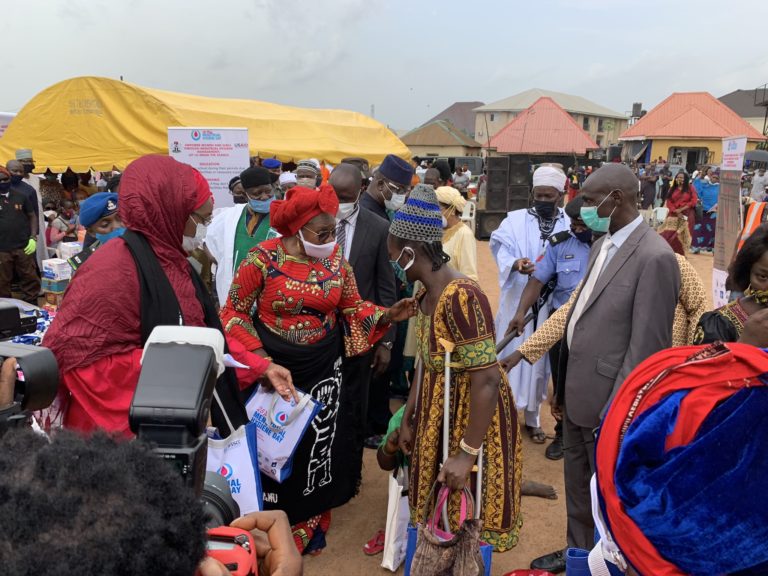
Dame Pauline Tallen,  Minister of Women Affairs, flagged off the distribution of the sanitary pads at Kado village, Abuja, in a ceremony organized by the ministry with support from Water Supply Sanitation and Collaborative Council (WSSCC) and other stakeholders to commemorate World Menstrual Hygiene Day.

Tallen lamented the lack of access to menstrual health and hygiene products, education and sanitation facilities by women and teenage girls.

She disclosed that each beneficiary would receive at least four packs of sanitary towels.

According to her, the project tagged, “One Million Pads Distribution Project” is aimed at adolescent girls in all states of the federation.

“This project is hinged on the fact that girls’ and women’s choices of menstrual hygiene materials are often limited by costs, availability and social norms. Therefore, providing access to feminine hygiene products will go a long way to solve the problem to a great extent,” the Minister said.

Tallen commended the private sector and development partners especially WSSCC for providing technical and financial support for the menstrual hygiene sector.

She also applauded the First Lady, Aisha Muhammadu Buhari for her benevolence in supporting Nigerian women and girls and thanked Procter and Gamble for providing 4000 sanitary towels to kick-off the first phase of the project.

While acknowledging that COVID-19 pandemic has further worsened access to menstrual management materials, Ms. Elizabeth Jeiyol, WSSCC National Coordinator for Nigeria urged all stakeholders to team up to change the negative social norms surrounding menstruation.

She said: “Poor knowledge and understanding of menstruation may lead to unsafe hygienic practices for women and girls. It is not a gender thing – but a basic human right issue – and together we can empower all women and girls to realize their full potentials everywhere in the world.

“There is no gainsaying the fact that effective menstrual hygiene has direct and indirect effects on the overall well-being of women and girls – in the context of education, empowerment and health.
However, women and girls face continuous mental, physical and health traumas during their periods – as a result of discriminatory social norms, cultural taboos, supernatural beliefs, gender inequality, and limited access to basic services such as WASH facilities in private and public spaces which leads to ‘Period Poverty’ for women and girls across the world – especially in developing countries like Nigeria.”
Chizoma Opara, acting Coordinator of the Clean Nigeria: Use the Toilet Campaign had earlier stressed the importance of institutionalizing menstrual health and hygiene management at all levels in Nigeria.

She added that this can be achieved by putting an end to open defecation in Nigeria through the provision of hygiene facilities for the populace particularly women and girls during their menstrual period.

FACT-CHECK: Did EFCC arrest former NDDC man, George Turnah? 

By Opeyemi Kehinde


A REPORT which claims that the South-South zonal head of Nigeria’s anti-graft agency, the Economic and Financial Crimes Commission (EFCC), Ishaq Salihu, addressed a group of protesters in its Port-Harcourt office, Rivers state recently over the trial of George Turnah has started spreading like wildfire on WhatsApp.

Turnah, a lawyer, is an aide to a former managing director of the Niger Delta Development Commission (NDDC), Bassey Dan-Abia.

The report, shared on WhatsApp on Tuesday, June 2, and published by a few online news platforms in Nigeria, was titled: “Youths in Niger Delta protest EFCC arrest but were shocked to hear…”

THE CLAIM

The report claimed that youths stormed EFCC’s South-South office in Port Harcourt, Rivers State, “describing Turnah’s arrest as an act of injustice, saying he is a good man with a good heart. They stayed there demanding his unconditional release. The EFCC South-South Zonal head, Ishaq Salihu, instead of pushing away the protesters, called them together and began to educate them.”

It added:  “If I tell you all how this young man has contributed to the underdevelopment of your region, you will be ashamed to be here…

“Next time, before you join this kind of protest, ask yourself what his source of income is as compared to his flamboyant life. I will leave your conscience to communicate with you.”

The report further noted that “Immediately the EFCC South-South head ended his speech, the protesters were all cold, they could not utter a word again, one by one, they started dropping their placards, and before you know it, even his close associates who were all there, were shocked at the revelations, they too threw away their placards, everybody went back home.”

THE CHECK

Verification of the claims by The ICIR shows that George Turnah was neither rearrested by the EFCC nor was there any recent protest by any Niger Delta youth group on his case with the anti-graft commission.

EFCC spokesman, Dele Oyewale, confirmed this in a text message to The ICIR Nigeria on Tuesday.

“We are still in court against George Turnah. His trial started in 2016. He was never re-arrested, please. Thanks,” Oyewale stated.

Also, several Google searches revealed that the claim is at least three years old as the exact content of the report was first posted online on Nairaland, a popular Nigerian blog, on June 1, 2017, and subsequently published word for word on several online websites including Thenigerialawyer.comEchonigeria.com and blogs such as Ajisamvoice.blogspot.com .

Facebook pages such as Daily Crime Reporters and InfotrackNaija had also shared the same report in the last four days. An online news platform, Observertimes.com, also posted the same report as an exclusive on its website on June 1, 2020.

Findings by The ICIR indicated that several protests were held between May and July 2017 regarding Mr. Turnah’s case, but no mainstream media reported that EFCC’s Salihu addressed any group of protesters during the period.

According to an EFCC release of May 26, 2017, some protesters, under the aegis of Niger Delta Volunteer Services Scheme, and Celtic Pride and Event Limited (employees of Turnah), visited EFCC office in Port Harcourt, on that day but they were not addressed by EFCC zonal head, Mr.Salihu.

Rather, the press release said that “the protesters were received by Mrs.Akpos Ekisowei of the Public Affairs Department on behalf of the EFCC, who promised to convey their message to the appropriate authorities.”

The Punch newspaper’s report of July 1, 2017, also confirmed another protest by youth groups “from nine states of the Niger Delta” who visited the zonal office of the EFCC in Port-Harcourt on Friday, June 30, 2017. However, the newspaper only reported that an unnamed “top officer of the EFCC, promised the protesters that the commission would ensure justice was made in the matter.”

Our findings also revealed that a picture of Mr. Turnah’s arrest which has been circulating online since about four days ago, especially on Twitter and Facebook, alongside the report, first emerged online early 2017 when he was first arrested by the EFCC. The same picture reposted on May 31, 2020 by one Twitter account user, @Gen_Buhari, had over 1,000 likes and over 1,100 retweets as at Wednesday noon.
A call to Mr. Turnah’s mobile phone number by The ICIR to verify if he was rearrested was not connecting as his line was unreachable at the time of filing this report.

The resurfacing of a 2017 post might be connected to a current controversy over financial mismanagement at the NDDC, which has led to an investigation by Nigeria’s National Assembly.

It will be recalled that the Interim Management Committee (IMC) of NDDC headed by its acting Managing Director, Kemebradikumo Pondei, and the Executive Director of Projects, Cairo Ojougboh, had recently engaged Nigerian lawmakers in a brawl of accusation and counter-accusation.

While the lawmakers accused the IMC of alleged financial misappropriation, the commission had accused members of the Nigerian parliament of allegedly padding the 2019 budget of the NDDC.

The Senate and House of Representatives had on May 5, 2020, resolved to investigate how the IMC of the NDDC allegedly squandered N40 billion within three months and thereafter set up an adhoc committee headed by Senator Olubunmi Adetunbi (APC, Ekiti North) to look into financial transactions carried out by the IMC on behalf of the commission within the period and present a report this June.

But the NDDC management, who has since denied the allegation, however, accused Senators and members of the House of Representatives of allegedly inserting over 500 projects into the 2019 budget of the commission and were arm-twisting the Interim Management Committee (IMC) from carrying out a forensic audit as directed by President Buhari. Mr Ojougboh also said the House of Representatives “vandalized and raped” the 2019 budget by adding ₦85 billion to the budget.

The ICIR reports that the forensic audit of the NDDC was ordered by President Muhammadu Buhari in October 2019, following alleged corruption by the interim management.

A statement by the Special Adviser (Media and Publicity) to President Buhari, Femi Adesina, said the president gave the directive after receiving governors of the states that make up the NCDC, led by Governor Seriake Dickson of Bayelsa State. The president had said what was presently on ground in the South-South region did not justify the huge resources that had been made available to the agency.


THE VERDICT

There is no evidence to support the claim that Mr. George Turnah was recently rearrested by the EFCC. Similarly, there was no recent protest by any Niger Delta youth group regarding his case with the anti-graft commission, which is already before the Federal High Court, Port Harcourt.

Kajuru council chairman confirms death of nine in fresh killings, sues for peace

CAFRA Caino, Chairman of Kajuru Local Government in Kaduna State, has confirmed the death of nine persons in an early morning attack on Wednesday against residents of Tudu village, Agwala Dutse Community in his council area.

“We have once again been set back in our confidence building effort and peace engagements after Tudu village in Agwala Dutse general area was attacked this morning. It is confirmed that nine lives were lost in the attack,” Caino affirmed in a statement, stressing that a detailed inventory of casualties would be prepared.

While sympathising with families of the casualties, he re-emphasised that all communities should abide by the law rather than engaging in killings and reprisals.

Reports of the gory incident surfaced on social media on Wednesday morning. The picture revealed bodies of the victims including that of a woman and a young girl.

Since it was reported on social media, the attack has generated reactions from the public asking the Kaduna State government to address the failing security situation in the state.

“The authorities need to step up and provide a lasting solution to this menace. We can’t fold our hand while people are being butchered like animals,” says a social media handler identified as Babatunde @berbzz_.

Dapo Oduwole, another social media user @dapo_oduwole queried the authorities for the continuous attacks.

“Where is the Governor, where is the Commissioner of Police, where is the Armed Forces. Where is love!”

While Victor Okorie @vickelokorie suggested that youths in the community should form a vigilante group to arrest the perpetrators and check the menace, Joshua Kalu @joshuakalu9 alleged Nasir El Rufai, the state governor might tag the people criminals once they resolve to self-protection.

On May 13, a similar attack on residents of Gonan Rogo Village in Kajuru was reported.

Seventeen people were reportedly killed while five others were allegedly murdered during the funeral for the deceased.

On  May 16, a group identified as Southern Kaduna Peoples Union (SOKAPU), however, faulted the Presidency for labelling the attacks a reprisal.

When contacted  to react to the reported incident, Muyiwa Adekeye, Special Adviser on Media to Governor Nasir El-Rufai, referred our reporter to the statement issued by the Kajuru council boss.

 Mohammed Jalige, the Spokesperson for the Kaduna Police Command was also contacted to confirm the incident but did not also respond to calls but later replied to the text message sent to his line.

“Afternoon, please I am in a meeting,” Jalige, an Assistant Superintendent of Police (ASP) stated.

He was asked when the reporter could call back via a text message but Jalige has not responded as of the time of this report.

Caino appealed to the residents to live in unity in order to end the  attacks.

“The council will not relent in its commitment to end the violence but success can only be achieved with the support of every peace-loving citizen,” Caino stated.

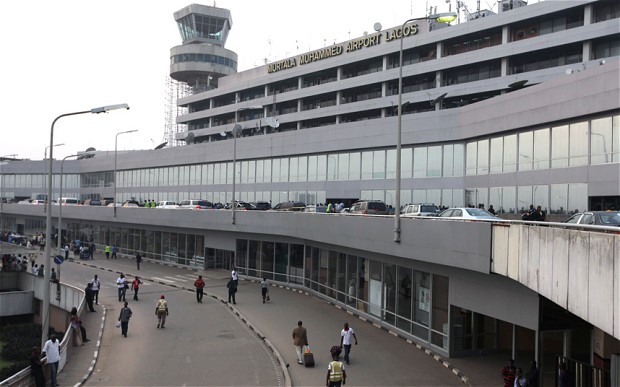
COVID-19: Lagos, Abuja, three other domestic airports to be reopened June 21

THE Nigerian Civil Aviation Authority (NCAA) said on Wednesday that five domestic airports will be reopened for business after three months of being barred from operating as a response to contain the spread of Coronavirus pandemic ( COVID-19).

This disclosure was contained in a memo directed to all Nigerian and foreign airline operators flying into the country and signed by Captain Musa Nuhu,  Director-General and Chief Executive Officer of NCAA.

Nuhu stated that the gradual start of the domestic flight operations in Nigeria would commence on Sunday, June 21, adding that all other airports are to remain closed for further assessment.

The domestic airports to be reopened include Omagwa International Airport, Port Harcourt, Nnamdi Azikwe International Airport, Abuja, Murtala Muhammed International Airport, Lagos, Sam Mbakwe Airport, Owerri and Mallam Aminu Kano International Airport, Kano.

“The closure of Nigerian airports to domestic flights has been extended to 2300Z on the 20th June 2020. The gradual start of domestic flight operations will commence on 21st June 2020 with Nnamdi Azikwe International Airport Abuja, Murtala Mohammed International Airport Lagos, Mallam Aminu Kano International Airport Kano, Omagwa International Airport, Port Harcourt and Sam Mbakwe Airport Owerri. Other airports will be gradually added to the network after a review and assessment,” part of the memo read.

He added that flights to any airport outside the five listed airports “shall comply with the existing COVID- 19 protocols for approvals” while emergency and essentials flights are exempted.

Nuhu further stated that closure of Nigerian airports to international flights would continue until a date of resumption is announced.

It will be recalled that the NCAA in a memo addressed to flight operators on the  March 21, announced the shut down of flight operations in the country.

Honourable mention for Nigeria’s Soyombo in 2020 Anthony Lewis Journalism prize

‘FISAYO Soyombo, an investigative journalist and former Editor of the International Centre for Investigative Reporting (ICIR), has received an honourable mention in this year’s Anthony Lewis Prize for Exceptional Rule of Law Journalism.

Announcing winners of the award in Washington, D.C. on Tuesday, the World Justice Project (WJP) listed Soyombo among three individual journalists and three reporting teams “in recognition of their extraordinary reporting on rule of law issues”.

They are Helgi Seljan, Aðalsteinn Kjartansson and Stefán Aðalsteinn Drengsson (based in Iceland, reporting on Namibia); ICIJ’s Luanda Leaks investigation (organization based in the United States, reporting on Angola); Laura Sánchez Ley (based in Mexico); NBC’s Justice for All (based in the United States); and Somesh Jha (based in India).

Soyombo earned the recognition with his three-part undercover investigation on Nigeria’s criminal justice system part-funded and published by The ICIR in October 2019.

He had spent two weeks in detention — five days in a police cell and eight as an inmate in Ikoyi Prison — beginning from the moment of arrest by the police to the point of release from prison. Adopting the pseudonym Ojo Olajumoke, Soyombo feigned an offence for which he was arrested and detained in police custody, arraigned in court and eventually remanded in prison.

Soyombo is currently a candidate for One World Media’s International Journalist of the Year award to be decided on June 18, as are Alex Crawford of Sky News and John Sudworth of BBC News.

The WJP named the trio of Slovak journalists Pavla Holcová, Arpád Soltész and Eva Kubániová winners of the 2020 Anthony Lewis Prize for their reporting on the murder of their friend and colleague, the 27-year-old journalist Ján Kuciak and his fiancée Martina Kušnírová.

The investigation, as detailed by the Organized Crime and Corruption Reporting Project (OCCRP), revealed a system of rampant corruption in Slovakia, the details of which were being investigated by their colleague at the time of his death.

In the process of investigating the murder, the team assembled nearly 60 terabytes of data, including eyewitness testimonies, CCTV footage, mobile phone data and more, ultimately building a library of evidence that they shared with other trusted journalists.

As the team catalogued, analyzed and reported on the data — and as other reporters used it to develop evidenced-based stories in multiple outlets — they exposed not only a deeply corrupted and blackmailed justice system but also unmasked the perpetrators.

As a result of the investigations and mounting public pressure, the former government of Robert Fico stepped down in 2018, a former general public prosecutor is currently being investigated, and 13 judges are charged with corruption and abuse of power.

The WJP Anthony Lewis Prize for Exceptional Rule of Law Journalism was created to “acknowledge and celebrate journalists from around the world who have contributed to increased awareness and understanding of the importance of the rule of law”.

It was named in honour of Anthony Lewis, a Pulitzer Prize-winning author and journalist who was a friend and inspiration to the World Justice Project. Lewis is widely credited with transforming legal journalism in the United States.