THE main opposition party, Peoples Democratic Party (PDP), has accused the Federal Government under the leadership of President Muhammadu Buhari of using Nigerian school children as cover to loot N679 million daily through the school feeding programme.
Kola Ologbondiyan, National Publicity Secretary of the party stated this in an interview published by The Punch.
Ologbondiyan noted that the PDP has always maintained that the school feeding programme by Muhammadu Buhari administration is a ‘monumental scam’.
“We have always said the whole school feeding programme as being carried out by this administration is a monumental scam,” he said.
According to him, the government and agencies handling the school feeding programme have refused to give adequate accounts about it.
Ologbondiyan argued that “it should beat anybody’s imagination that pupils are at home, in their parent’s houses, and the Minister of Humanitarian Affairs, Disaster Management and Social Development, Sadiya Faruq, is telling Nigerians that they are taking over the functions of parents by feeding school pupils right in their parents’ homes.”
“We are also being told that they are spending unbelievable sums of money on this programme.”
He added that the programme was designed by corrupt leaders in the All Progressive Congress (APC) to siphon public funds.
“The whole school feeding scam is a scheme designed by corrupt leaders of the APC in cahoots with some elements in the Presidency to siphon N13.5bn public funds to finance their wasteful lifestyles,” he added.
He noted that the government has failed to reveal to taxpayers how much is exactly being spent on the programme.
The PDP spokesperson wondered why the National Assembly has refused to ask relevant questions from the ministry concerning the programme.
“I do not understand why the National Assembly is not asking the relevant questions about claims that such humongous amount of money is being spent by a ministry on feeding children in their various constituencies without their inputs, I really can’t comprehend,” Ologbondiyan said.
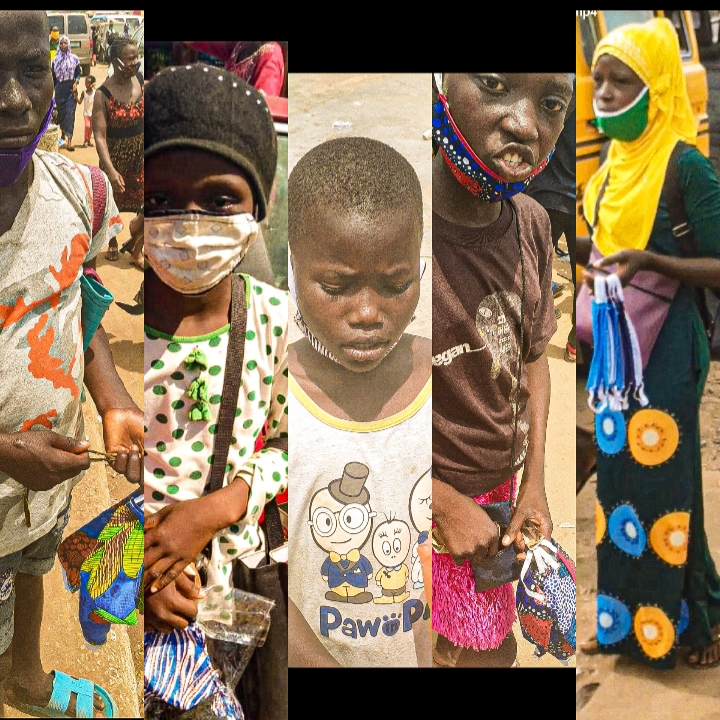
Though Lagos State government has ordered that schools should be closed down as a means of keeping schoolchildren safe from contracting COVID-19 virus, there are children who cannot afford to stay at home because they have to earn income for their parents, even during the lockdown. Many of these children could be seen on Lagos streets hawking facemasks. Lukman ABOLADE reports about some of those children he met.
ON Wednesday, May 27th, when the Children’s Day was being celebrated worldwide, Ramon, a nine-year-old boy and primary five pupil of Saviour Primary School, Lagos was seen at Igando market with a handful of facemasks made with local fabric, seeking customers for his goods.
While his mother and sister who are tailors produce the facemask, he hawks the products at major bus stops in Lagos to make income for the family. It is a kind of division of labour, said the boy.
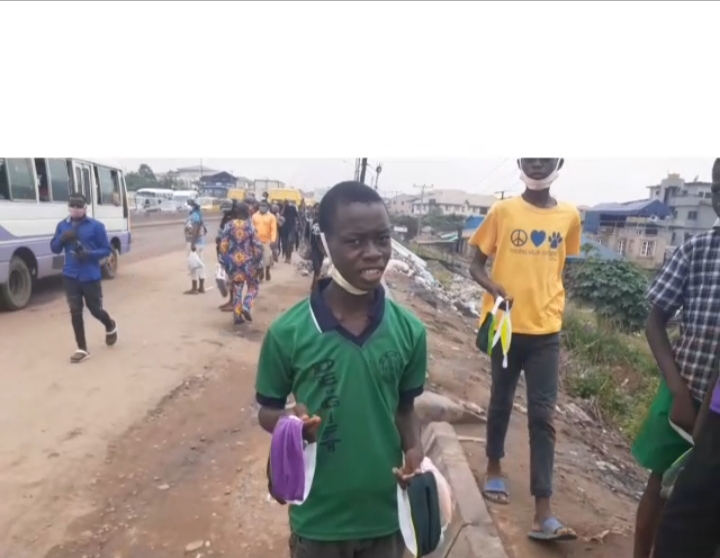
Ramon, a nine year old boy who hawks facemasks Lukman Abolade/The ICIR
Unlike Ramon whose mother and sister are tailors, Joseph Olayanju, a junior secondary school two (JSS2) student in Ajegunle sells facemasks produced by a company located in Ajegunle area in Lagos. He and his friend, Abraham Ishola, who attends the same school as Olayanju, purchase facemasks in bulk at the company at discounted prices .
“We buy 12 pieces at 1000, and sell each at N100,” said Abraham.
Abraham Ishola hawking facemasks Lukman Abolade/The ICIR
So from every dozen they sell, they each make a profit of N200.
In Lagos markets and on the major bus stops, it is common to see many children selling facemasks.
Apart from Ramon, Olanyaju and Ishola, The ICIR also met Rasheedat, Ayomikun, Adi and Stephen, all students of public schools, according to them.
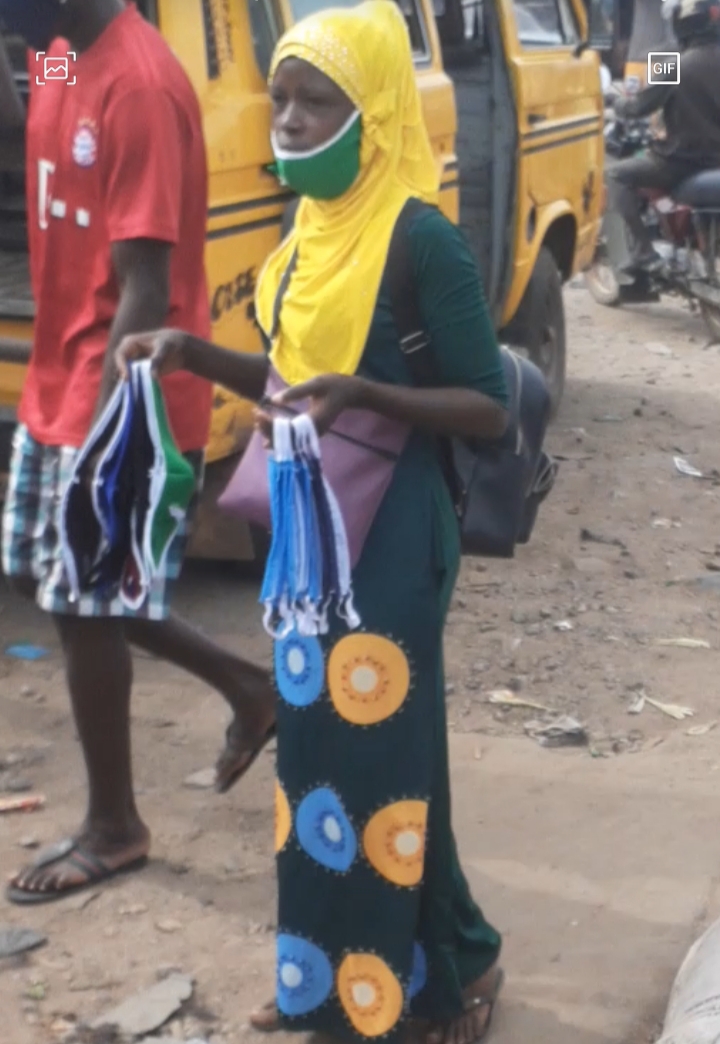
A young girl selling facemask in traffic
The ICIR attempted to speak to their parents, but they declined for the fear of being identified and sanctioned by the government authorities for violating child rights act. Not that they know about the law though, but speaking to the press could mean trouble. In fact, one of the women chastised her son for speaking to a stranger who is not a customer.
But Esther Ajewole, a tailor and mother of Ayomikun, a 14-year-old boy told The ICIR that asking her son to hawk facemasks is a matter of survival for the family. She said the child has been sitting at home idly for weeks before she finally decided to ask him to help.
Since there is no provision for an online class for children in public schools, there is no point keeping the boy at home doing nothing, she added.
There is also Damilola, mother of two, who sells facemasks with her children in the market. She said she had to bring them with her because the facemask market has become very competitive.
Esther Ajewole, a mother who gave facemasks to her son to sell Lukman Abolade/The ICIR
“We sell it together to make enough profit because people selling it are now too many,” she said.
She added that living has been hard for the family, and that is why she brings them to the market to hawk.
Although she is aware that some schools have made provisions for e-learning, she said her children attend public school and the school does not operate online classes.
An offence overlooked
The Lagos State government during the administration of Babatunde Raji Fashola adopted the Child Right Act on May 27, 2007, to protect the rights of children in the state.
The act, however, is hardly implemented since it has been adopted three years ago. For example, there is no taskforce charged with the responsibility of enforcing the law.
Damilola, a mother of two who hawks facemasks with her children
Children hawking facemasks are not only found in Lagos state, but there are also reports of a similar trend in Ogun, Oyo, Ekiti and Abuja.
Only a few attend digital classes in Nigeria
Though Nigeria ranks 6th among countries with most internet users in the world, the country lacks online infrastructure to provide quality education for children
According to the internet world statistics , as of the first quarter of 2020 (Q1,2020), Nigeria has an estimated population of 206,139, 689 out of which 126,078,999 are internet users.
Infographic on Internet users in Nigeria
This represents that 61 per cent of Nigerians are active internet users, but this is not reflected in the Nigerian students’ access to online education.
Out of 36 states in the country, only five states have been able to provide minimum digital learning for their citizens, according to report by the federal ministry of education. The states include Lagos, Ogun, Kaduna, Edo and Ondo state
The Federal Government has announced provision for e-learning by collaborating with privately-owned digital learning platforms including Mobile Classroom application and Schoolgate.ng, but checks by The ICIR revealed many inadequacies of the government to actualise the plan.
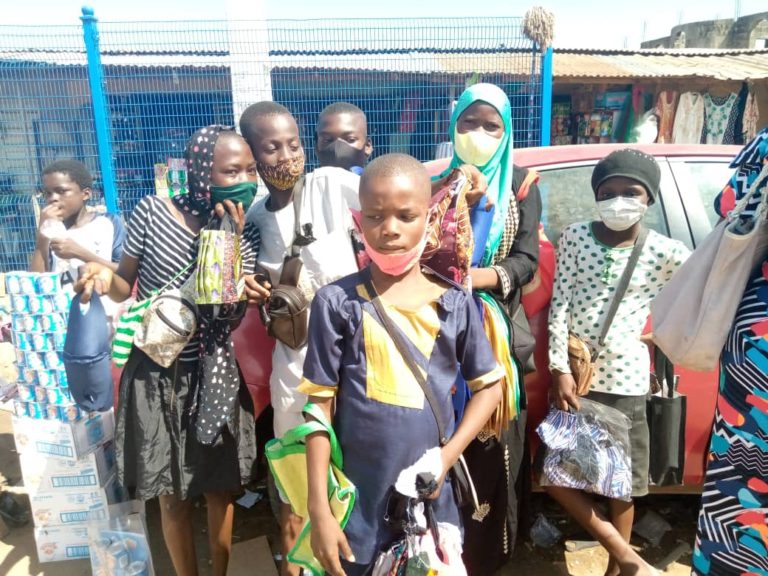
Picture collage of some children selling facemasks
During the announcement, Minister of State for Education, Chukwuemeka Nwajiuba said the website and applications are free for Airtel users while arrangements were being made to bring other network providers on board.
Speaking to the Chief Executive Officer of Mobile Classroom, Akeem Salami, one of the partners with the FG on online classes, he said although there has been an increase of about 45,000 new registrants on the Mobile Classroom platform. This is less than 1 per cent of the 41.9 million students enrolled in public and private schools across the nation.
Salami, however said students are unaware of the digital platforms, despite collaborating with the FG, hence there is still a long way to go.
He said before the pandemic he had approached the FG, Osun, and Lagos to key into the idea of online classes but did not get a buy in of the government.
“We approached some states including the FG at the inception of our platform but we received a letter of appreciation but it was not supported,” Salami said.
According to him, the government’s failure to embrace the idea of digital classes before COVID-19 is partly responsible for mass failure in Nigerian schools.
Salami urged the government to provide community e-library with internet access in collaboration with private sectors so that students in or out of school could easily learn.
This would give room for revision for learners as videos and tutorials are available at any time for them, unlike the conventional classroom setting, he said.
Ogunmola Makanju, the CEO of Schoolgate, another partner with the FG on digital classes, also told The ICIR that he had approached the FG before the pandemic but the idea was not embraced because of funding.
Apart from this, he noted there is no national policy on digital education in Nigeria.
In spite of the initial difficulty, the platform can be accessed by students in Nigeria without internet charges, and nearly 100,000 students already have registered.
According to UBEC, Nigeria has a figure of 31,236,624 students/pupils enrolled in public schools across the federation, but less than one per cent of these children are currently engaged in online education.
The country’s inability to have a workable national policy on digital learning triggered a call from the House of Representatives recently.
On Tuesday, May 19, a member of the Green Chamber, Aniekan Umanah representing Abak/Etim Ekpo/Ika Federal Constituency moved a motion that was eventually adopted by the house to urge the FG to urgently develop a national framework for schools at all level.
The Director of the press, Federal ministry of education, Ben Goong while responding to questions from The ICIR on Thursday, 4th May also acknowledged that the nation’s ministry of education does not have a national policy on digital education.
Until Nigeria provides opportunities for children to learn both in the physical and digital classrooms, parents of children like Rahmon, Joseph and Abraham will continue to find reason to send them to the streets to hawk facemasks during lockdown while other children stay safe at home.
ALTHOUGH the World Health Organisation (WHO) has advised against measures to quickly relax lockdown imposed by countries to contain the spread of Coronavirus disease (COVID-19), some African countries are already opening up their economies.
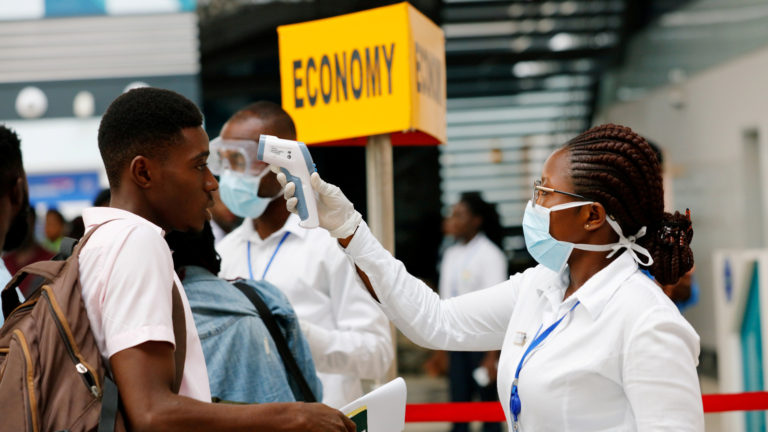
As of June 1, at least five African countries including Nigeria, South Africa, Ghana, Djibouti and Zimbabwe announced plans to ease lockdown restrictions by opening up worship centres, markets, business and offices, as well as resuming domestic flight operations.
The world health body warned that if measures are relaxed too quickly, COVID-19 cases could begin increasing rapidly.
“Many countries implemented lockdowns and key public health measures early and these appear to have helped slow down the spread of the disease. However, there are concerns that if these measures are relaxed too quickly, COVID-19 cases could start increasing rapidly,” WHO said in a report.
Thirteen countries in sub-Saharan Africa implemented lockdowns along with other public health and social measures nation-wide, while 10 more instigated partial lockdowns in hotspots.
With over 185,000 confirmed cases on the continent and a fragile health care system, there are fears that many more cases would be recorded when these economies fully open up.
In an analysis, the WHO, warned that COVID-19 could kill up to 190,000 people in Africa, adding that it could infect between 29 million and 44 million people — during the first year, if it is not contained.
Africa has recorded over 4,300 COVID-19 deaths, according to Worldometer,with countries like South Africa, Egypt and Nigeria recording the highest number of confirmed cases and deaths.
The ICIR in this report compiled a list of African countries that are already easing the restrictions earlier imposed to contain the spread of COVID-19.
Nigeria to resume domestic flight June 21
Currently, Nigeria has carried out over 69,000 tests and recorded over 10,80o cases of COVID-19 while it has also recorded 314 deaths according to Nigeria Centre for Disease Control (NCDC).
President Muhammadu Buhari imposed a 14-day lockdown on March 30 in Lagos, Ogun states and Abuja, the nation’s capital to contain the spread of the virus. He also imposed ban on interstate travels and prohibited gathering of people more than 20 including at places of worship.
At the time, Nigeria had just 111 confirmed cases with one reported death.
Amidst the outbreak of the pandemic, Saudi Arabia announced unexpected price discounts of $6 to $8 per barrel of crude oil to customers in Europe, Asia, and the United States.
The announcement triggered a free fall in oil prices and other consequences that day, with brent crude falling by 30 percent, the largest drop since the Gulf War caused a record oil prices crash at the global market.
This and the lockdown imposed stifled Nigeria’s economy which is crude oil dependent resulting into a fiscal crisis that saw the country cutting and reviewing its national budget.
“The drastic fall in the price of crude oil below the 2020 budget benchmark, which was triggered by the global COVID-19 pandemic has negatively impacted the Federal Government’s revenue projections,” Zainab Ahmed, Nigeria’s Minister of Finance said in a memo.
However, Nigeria is gradually opening up its economy with partial easing of lockdown in Lagos, Ogun states and Abuja. The president has recently approved the re-opening of places of worship. The government also announced that five domestic airlines would begin operations on June 21.
There are reports also that interstate travels would also resume on June 21.
While Nigeria imposed lockdown, recorded cases of COVID-19 and deaths increased- 12,233 cases as of June 7 and 342 deaths.
South Africa on level three of five-level approach to easing lockdown
Cyril Ramaphosa, South African President announced that the country was moving to “level three” of its five-level approach to easing the coronavirus lockdown from June 1.
Under level three, the night-time curfew will be lifted and regular activities resumed during the day with ‘strict health protocols’.
South Africa has recorded of over 35,000 cases of COVID-19, and over 755 deaths. With these figures, the country has registered more cases than any other African country. But it has joined other countries in easing lockdown restrictions.
Over 725,ooo people have been tested in Africa’s most industrialized economy and as concerns for the spread of the virus are being raised, the impact of a hibernated economy is also threatening.
Djibouti wants citizens to make a living and go to work
In Djibouti, easing the lockdown restrictions was a tough choice. Mahmoud Ali Youssouf, Djiboutian Foreign Minister explained that there was a big chance of a surge in COVID-19 cases, but the government was left with no other choice as “people need to make their living and go to work.”
With dire need to resurrect the economy, Djibouti, which has the highest number of COVID-19 cases in East Africa. Currently, the country has recorded over 3,700 cases and over 25 deaths.
With a population of fewer than one million people, the country has carried out 200 percent more tests than Nigeria, The Cable reports.
Ghana’s lockdown occasioned severe difficulties
With over 8,000 recorded cases of COVID-19, Ghana, ahead of other African countries, was the first to begin easing lockdown restrictions. After a 21-day lockdown, Nana Akufo-Addo, President of Ghana said the restrictions caused severe difficulties for his country.
“The decision to restrict movement has occasioned a number of severe difficulties for all of us across the country, especially for the poor and vulnerable,” Akufo-Addo said.
During the period of the lockdown, Ghana conducted more than 68,000 COVID-19 tests.
Zimbabwe faces worst economy in 10 years
Zimbabwe whas recorded over 270 cases of COVID-19 out of its over 14.8 million population and recorded four deaths.
The Southern African nation has carried out over 52,000 tests so far and has lockdown in place.
Its economy is currently facing challenges due to the lockdown restrictions announced since March 30.
Aljazeera reported that the country was already facing its worst economic crisis in nearly 10 years and the coronavirus lockdown measures are threatening the livelihoods of people. That was just two weeks after government imposed lockdown.
To revive its economy, like some other African countries, Zimbabwe is easing its lockdown restrictions and extending curfew periods to allow for some industries to carry on working activities
“Zimbabwe will continue on the level two lockdown for an indefinite period. The country needs to ease out of the lockdown in a strategic and gradual manner,” President Emmerson Mnangagwa said in a live broadcast sometime in May.
In that manner, while informal markets are to remain closed, businesses such as manufacturers, supermarkets and banks would be allowed to run for longer hours in level two of its lockdown plans.
In the realm of education, the government is still working to build plans on phased re-opening of schools, the president said.
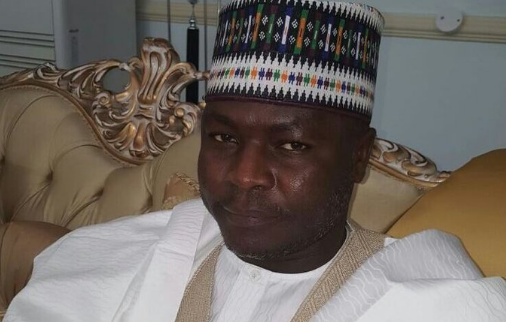
AHMED Jaha, a federal lawmaker representing Damboa/Gwoza/Chibok Federal constituency says he regrets his comment after saying women should learn to dress decently to avoid being raped.
Jaha was reported to have sent an email to Pulse news on Saturday concerning his comment.
During plenary on Thursday while members of House of Representatives were deliberating on the domestication of Violence Against Persons and Prohibition Act, Jaha after supporting the Act said women should dress well because ‘men are not wood.
“Women should cultivate the habit of dressing properly and decently to avoid unnecessary harassment and abuse by men, because men are not wood,” he had said.
But his comment incurred Nigerian’s rage who are grieving and condemning incessant recent rape cases in the country.
Faulting the lawmaker’s position, a Nigerian on social media who identified herself as Nkem said, ‘If girl’s/ ladies dressing is the only reason for rape as you said, what about the raping of kids ranging 3 months to 9 years? It’s all about d state of one’s mind. # WE SAY NO TO RAPE’.
Another user identified as Engees Onu, criticising Jaha’s comment said “I don’t even understand these people. Were they actually getting an excuse for rapist? What a country.”
However, Jaha in his apology pleaded with women, members in the Green Chamber and Nigerians for saying that ‘men are not wood’.
“I have made a mistake that has offended the sensibilities of fellow Nigerians and indeed fellow human beings, particularly women who are our mothers, wives, sisters and daughters,” he said.
Talking about his position on the proposed Act where he made his comment, Jaha said, ‘while I totally reaffirm my position that rapists should face death sentence, I regret the part that talks about the dressing of women’.
“I deeply apologise for this position, because as some had rightly argued, my comments could imply that women who are victims share the blame of being raped. This clearly, could not have been the intention of someone who suggested death penalty for rapists,” he added.
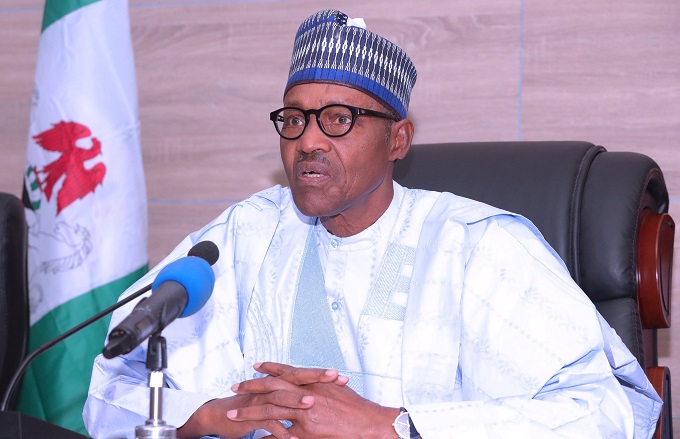
PRESIDENT Muhammadu Buhari has warned bandits terrorising Katsina Zamfara, Sokoto, Niger and Kaduna states to surrender their weapons, or face “disgraceful and violent ends.’
Garba Shehu, presidential spokesperson quoted President Buhari as issuing the warning on Thursday when he had a meeting with Aminu Masari, Governor of Katsina State at the Presidential Villa, Abuja.
According to Shehu, the president assured the people and government of Katsina State of renewed efforts, and review of operations, to improve the security of lives and property in the state, and other parts of the country.
The president said bandits who have committed crimes against innocent citizens in the state and across the country, would not be spared.
He further stated that more decisive military operations against bandits in Zamfara, Sokoto, Niger, Katsina and Kaduna States would be under taken.
The president commiserated with Masari over the loss of lives from attacks by bandits, which include Atiku Maidabino, District Head of Yantumaki and Abdulhamid Sani Duburawa, APC Chairman in Batsari Local Government Council.
The meeting between the president and Masari followed recent spike in attacks in the state by bandits.
On Thursday, it was reported that bandits killed two persons killed in an attack on Dagwarwa village in Kurfi Local Government Area of the state.
In April, precisely on the 18, bandits attacked communities in three local governments of Katsina State, killing 47 persons.
THE Federal Government of Nigeria is not doing enough for farmers to cater for its estimated 200 million population as small holders farmers struggle to cope with impacts of climate change, according to Oxfam, an international charity organisation.
Constant Tchona, Oxfam Country Director in Nigeria who stated this in a statement issued to mark the 2020 World Environmental Day said Nigeria is confronted with various environmental challenges including climatic change, oil pollution, drought and desertification, flooding, erosion, water pollution and solid waste that isn’t bio-degradable.
Tchona remarked that these challenges have resulted into food insecurity, loss of lives and property, destruction of means of livelihoods among other things.
He urged the government to put in efforts to grow four million trees every year which in turn would protect farmers from destructive erosion and help reduce gas emissions by ten percent yearly.
” Farmers as well as the environment would be protected from destructive erosion,” Tchona said.
He added that agro-forestry should also be encouraged in which trees of economic value should be planted noting that more shelter beds should be identified and trees be planted to serve as wind breaks
Nigeria National Determined Contribution (NDC) sectorial plan should, Oxfam said be endorsed and implemented while plans to reduce greenhouse emission by 20 percent unconditional to 45 percent conditional emission reduction below Business as Usual (BAU) by 2030 should be implemented.
According to him, Oxfam recommended the implementation and more funding for the Nigeria National Determined Contribution sectorial plan.
Checks by The ICIRconfirms that Nigeria had submitted NDC since 15 May, 2017
The charity group added that stringent measures should be taken by the government to avoid indiscriminate felling of trees, safeguard aquatic life, save our forests thus maintaining biodiversity and discourage bush burning.
APPLICATIONS is now opened for the The Fetisov Journalism 2020 Awards.
Russian philanthropist Gleb Fetisov, organised this competition with the aim to recognize journalists for their contribution to the promotion of universal human values and extraordinary heroism.
Journalism organizations and journalists are invited to nominate journalists for this award.
The contest is of four categories such as contribution to peace, contribution to civil rights, investigative reporting and environmental journalism.
Eligibility:
Works must have been published between June 1, 2019 and May 31, 2020. Entries in languages other than English must be accompanied by a translation into English.
The first, second and third place winners in each category will receive CHF100,000 (US$104,005), CHF20,000 (US$20,801) and CHF10,000 (US$10,400), respectively.
According to the organisation, self-nominations are also accepted.
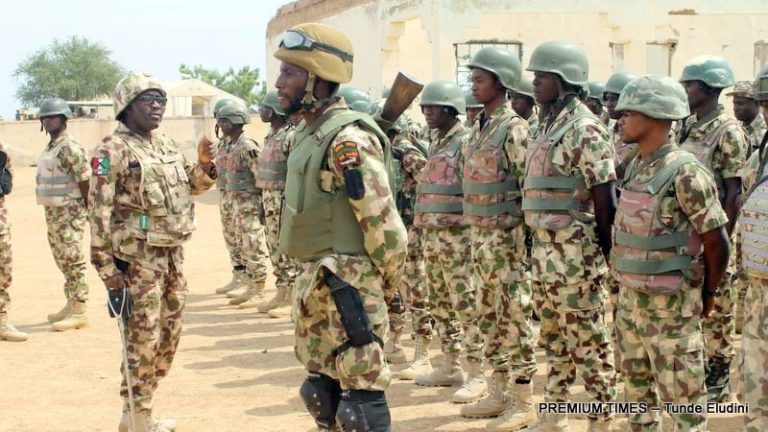
AT least 70 bandits and cattle rustlers were killed by during a combined ground and air offensive by troops of Operation Thunder Strike in Gidan Maikeri village in Chikun local government area of Kaduna State, the Defence Headquarters said in a statement.
John Enenche, the DHQ Media Coordinator who revealed this in a statement on Twitter said the sting operation was carried out under Operation Accord that has troops of 312 Artillery Regiment and Local Vigilantes.
According to him, the operation followed a timely and credible information on the bandits movement within the area adding that troops pursued the bandits through Gidan Maikeri village into the forest
“Troops pursued the bandits through Gidan Maikeri village in Chikun LGA into the forest their location was identified and consequently engaged by Nigerian Air Force helicopter gunships, ” said Enenche, a Major General,
“After the air attack, 70 bandits were confirmed killed by human intelligence while others escaped with injuries. The troops are exploiting the forest with details to follow as they unfold.”
He also hinted that the military was still carrying out ground mop-up operations to ensure bandits who escaped from the initial attack are arrested.
Attacks by armed groups from hideouts in forests is frequent in Kaduna State as they utilise a lack of security across the forest to launch attacks.
The military intensified operations in February to conduct a sweeping operation aimed at armed gangs in several North West states according to a report.
In another development, Enenche said troops of Operation Yaki in checking positions for Operation Accord at outskirts of Kankomi village arrested two logistics suppliers for armed bandits.
Items recovered from the suppliers include recharge cards, cigarettes, soft drinks and groceries.
The operations spokesman said the arrested suspects were currently in the custody of the military in Kankomi while troops maintain vigilance in the area to forestall the escalation of violence.
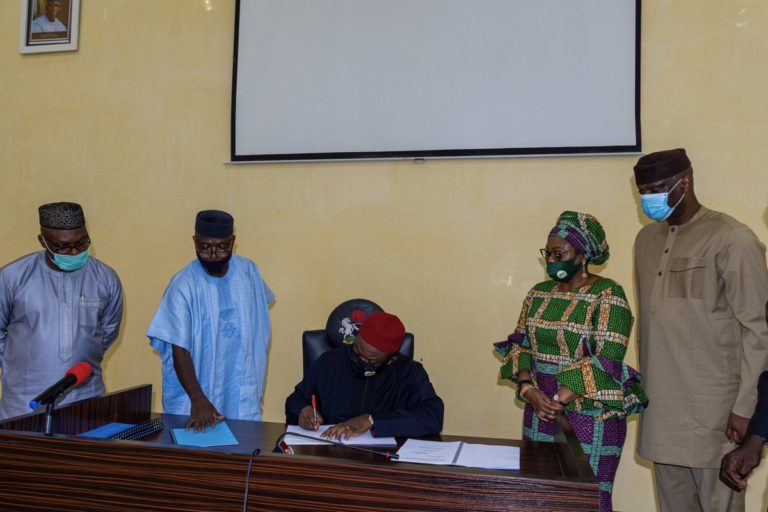
KAYODE Fayemi, Governor of Ekiti State, has signed the Sexual Violence Against Children (Compulsory Treatment And Care) Bill into law, reinforcing his administration’s commitment to prompt medical care for child victims of sexual violence.
The law would also facilitate effective prosecution of sex offenders.
The governor stated that the new law aims to provide victims of sexual violence rapid access to medical facilities that can administer emergency medical care, including treatment to prevent HIV and other sexually transmitted diseases as well as counseling.
Fayemi while assenting the law, lauded the Ekiti House of Assembly for passing the law and working in harmony to tackle sexual and gender-based violence issues, which has now become a scourge across the country.
According to the governor, “not a day passes without reported cases of rape and child defilement in Ekiti State.”
He submitted that it was imperative for his administration to work towards building policies that would prioritize victims and ensure justice is served swiftly against perpetrators.
Reaffirming his administration’s commitment to tackling cases of SGBV in the state, Fayemi highlighted some of the moves made during his first tenure to end the scourge which included enacting laws, policies and programmes that explicitly prohibit and punish sexual violence.
He added that state government also established a Register of Sex Offenders of all persons convicted of acts of sexual violence and adopted a policy of publicly naming and shaming convicted sex offenders.
However, he proposed that there was a need to do more to confront the issues that still so abound.
“We are going to overhaul and modernize our register of sex offenders to ensure it is effective in combating sexual violence,” the governor said.
Fayemi further stated that he has directed the Ministry of Justice to review existing laws to activate a process of ensuring harsher sentences for offences of rape and child defilement.
The governor also promised that the Ekiti’s Gender Based Violence Management Committee, tasked with providing rapid and comprehensive responses to all forms of violence against women and children, will be better empowered to monitor SGBV programs in the state.
Meanwhile, a group of Civil Society Organisations (CSOs) Friday morning led protesters to the Nigerian Police headquarters, Abuja demanding justice for rape and sexual violence victims.
The protesters who displayed banners with various inscriptions calling for justice for sexual violence also asked the government to declare a state of emergency on Sexual and Gender-based Violence (SGBV) issues in the country.
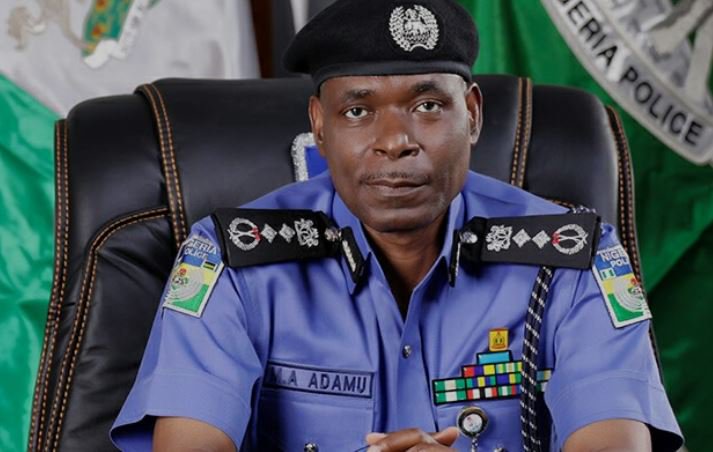
ADAMU Muhammed, Inspector General of Police, has deployed Special Police forces to Isanlu town in Kogi State where armed robbers invaded and killed police officers before robbing a commercial bank.
According to a statement on the force’s social media handle, Muhammed ordered that a team of crack detectives from the Intelligence Response Team (IRT), the Special Tactical Squad (STS) and Federal-SARS be deployed to Kogi State with immediate effect.
He said that the full force manhunt would be overseen by Yunana Babas, the Assistant Inspector General of Police (AIGP) in charge of the Zone-8 Police Headquarters, Lokoja,
Muhammad directed the AIG to immediately assess and review the security arrangement in the state to prevent future occurrence of the attack
He condoled with families of the police officers and other persons who lost their lives in the attack.
William Ovye Aya, spokesperson to the Kogi State Police Command, explained that about 4 pm on Thursday, a group of armed robbers numbering up to 25 attacked and killed police officers inside the police station.
He noted that eight police officers were killed, three of which were women officers while many other sustained serious injuries.
Aya added that the armed robbers simultaneously robbed a First Bank branch in the town using AK 47 rifles and dynamites to gain access into the bank.