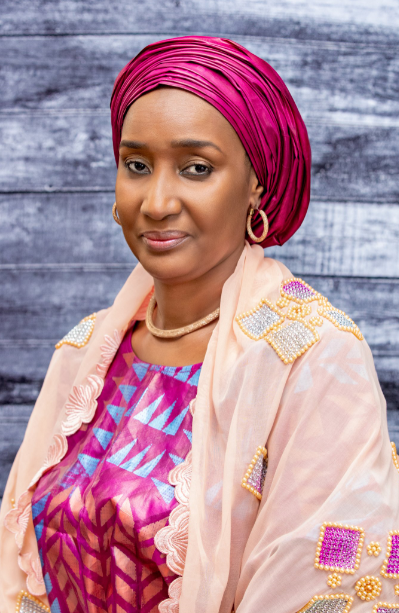
THE MINISTER of Humanitarian Affairs, Disaster Management, and Social Development, Sadiya Umar on Thursday expressed sympathy to the government and people of Adamawa State over the recent attack on Garkida town by the Boko Haram terrorists.
While condemning the terrorists for attacking the town which resulted in the loss of lives and properties, including places of worship, the minister commended the military for bravely fighting the terrorists and repelling the attack successfully.
“I regret the killings of innocent citizens and a gallant soldier by the Boko Haram in Garkida, and commiserate with the families who lost their loved ones during the attack,” Umar said.
She assured that agencies of the Ministry of the Humanitarian Affairs were working to provide relief support to those displaced from their homes burnt down during the attack.
Similarly, the North East Development Commission also revealed its plans to support victims of the deadly attack.
Governor Ahmadu Fintiri of Adamawa State sought for the support of the Commission, after an assessment visit to the scene of the carnage.
He wondered why the attackers would strike a community without a history of violent extremism, destroy critical infrastructure, and cut off people’s livelihood.
Governor Fintiri during the assessment visit
The Managing Director of the Commission, Mohammed Alkali, commended the government for its prompt response in meeting the dire needs of the affected communities.
He said the Commission would prioritize its response plan to include the immediate, short term and long term needs of the affected communities.
The town of Garkida in North-eastern Nigeria was attacked by Boko Haram, the night of February 21-22. A number of buildings were burned, including the church building for Ekklesiyar Yan’uwa Nigeria (EYN—the Church of the Brethren in Nigeria).
According to eyewitnesses, several houses, market, and three churches were burned by the terrorists who, also destroyed the rural health center and two ambulances.
During the attack, the insurgents took the other two ambulances, killed a soldier while a police station and barracks were burned.
According to a source within Garkida, the insurgents entered with nine trucks and more than 50 motorcycles.
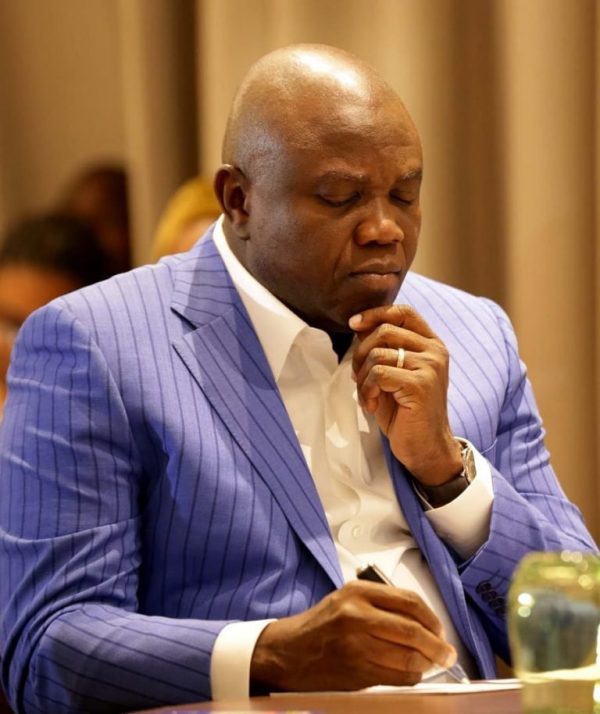
A STATE High Court sitting in Ikeja, Lagos state capital has struck out a suit filed by the immediate past governor of Lagos State, Akinwunmi Ambode against the Lagos State House of Assembly, Assembly Speaker, Mudashiru Obasa and others over probe on purchase of 820 buses during his administration.
The Lagos State Assembly set up an Ad-committee to look investigate the purchase of 820 buses by the former governor with claims that it was bought outside budgetary approval.
Ambode approached the court sometime in October 2019 to stop the Assembly from investigating the purchase claiming that the Assembly was ‘deliberately misrepresenting’ facts.
Upon his suit, the court ordered that status quo be maintained pending judgment on the claimant’s suit.
However, during the ruling on the case on Thursday, the sitting judge on the case, Justice Yetunde Adesanmi struck out Ambode’s suit on basis that it breaches the doctrine of separation of power.
The judge ruled that Ambode’s suit is an attempt to override the power conferred on the Assembly by Section 128 and 129 of the 1999 Constitution of the Federal Republic of Nigeria.
“I hereby find that the claimant’s action is an invitation to the court to cripple the legislative exercise of the statutory power of the Lagos State House of Assembly under Section 128 and 129 of the 1999 Constitution, that is not the function of the court, and no court of law should accede such invitation, the claimant’s suit is hereby struck out” the judge ruled.
Adesanmi added that the Ad-Hoc Committee was set up to investigate the purchase of the buses which is not an indictment on the claimant (Ambode).
According to the judge, the ad-hoc committee’s duty is to investigate and it is not an indictment or breach of Ambode’s fundamental human right.
“It is not set up to determine the civil rights and obligations of the claimant, in the same breath, an investigation is not an indictment, it precedes an indictment, the claimant, in this instance, has not been indicted by the House of Assembly neither has the committee indicted the claimant by a mere invitation by summons to appear before it,” she said.
The judge held that an invitation by the committee did not constitute a breach of the former governor’s fundamental right to fair hearing as contained in Section 36 of the 1999 Constitution.
Benin, Edo State Nigeria has been the hub of irregular migration since the 80s. People who plan to travel to Europe through the desert take off from Benin to Libya, and later to Spain or Italy. In this interview, Dr. Lugard Sadoh of Sociology and Anthropology Department, University of Benin (UNIBEN) traces the history of how Edo has assumed the unenviable status of irregular migration centre. He spoke with Ajibola AMZAT. Excerpt
The ICIR: Most migration data is pointing to Edo State, having the largest number of returnees among the 36 states. Why is this so?
Sadoh: Unfortunately, that is the reality on the ground. We also have tried to investigate: ‘Why Edo?’ In fact, there was a work we did with UNODC [United Nations Office on Drugs and Crime] which was spearheaded by UNIBEN observatory, a research team. The title of that work was Why Benin?.
And at the end of the work, we discovered that the reason we have more people travelling from Benin might not be unconnected to the fact that Benin has a history of travelling. In fact, history puts it that they were the first to meet with Europeans in Nigeria and in West Africa around the 12th century AD. History has it that they were the first to exchange ambassador with Portugal. While Portugal brought in an ambassador, we also sent an ambassador to Portugal.
In fact, the Benins were the first to experience western education. You can even see that in the dress sense of the Benin chiefs. The dressing is an importation of the Portuguese style. The way those chiefs dress in a skirt and a big blouse, that is how the Portuguese royalty also dress.
Benin also was the first in West Africa to have received the gospel. Just like you have Church of England, we have the Benin Church which is today referred to as “Holy Aruosa” situated at Akpakpava. It is a mixture of both Benin tradition and Christian doctrine. So, it is like a traditional church. It is only one church, and there is no other branch in Nigeria. And that is the church the Oba of Benin was attending because according to history, he could not join any other people because of his royalty and the tradition. He was assigned that place for worship. He chose the people who will worship with him, so it’s a royal church. If history is any to go back, Benin people are always travelling.
But that is not sufficient to show why Benin are more involved with irregular migration. Another reason we have also found is that Benin is a pure civil service city, Benin is in Edo State. it’s a pure civil service city. There are really no manufacturing industries in the city.
The implication of that is after school, if you are lucky to go to school, you are likely to either be a teacher, a nurse, or at most a doctor. But life is far beyond that. And besides the peanuts they are paid, a lot of young people, are not quite comfortable with it. And so they are eager, as it were, to make it on time. That is another motivation for Benin people to travel abroad. There is not enough to go round everyone in Benin, so people travel.
A lot of people who travel out actually do so with the intention of returning and establishing a business back here in Benin City.
Another reason we have found out especially from those returnees that came back early 2019 was that, though many returnees claimed Edo as the state of origin, some of them are not Edo state indigenes. We did further investigation only to find out that those people who claimed Edo State only do so because they were resident in Edo State as at the time of their transit from Nigeria. Some are Ibos, some are Yorubas, some are from the Middle Belts, some are Itshekiris, and of course, a good number of them were from Edo state – Benin, Esans, and the Afemines.
So it is not 100 per cent really true that the statistics given are all from Benin because some of those we interacted with who claimed to be Benin have names like Emeka Okechukwu (first and surname respectively). So we asked why do you claim you are from Edo state, the answer was that we always lived in Edo state or they asked me to come to Edo state and it was from here that we took off through Kano down to Niger; From Niger down to Mali, from Mali down to Libya.
Many returnees said it’s true that they want to travel out, and that one basic reason making migration attractive to them is lack of employment; that they don’t have jobs. And even the few ones that have jobs, they could barely pay their bills. So a good number of them who travel have skills, unlike the wrong assumption that most of them are skill-less or uneducated. No! a good number of illegal migrants were either hairdressers, barbers or artisans before they travelled. Some were even mechanics, some graduates: Polytechnics, colleges of education and universities graduates.
So the main reason, why it appears that Edo is the centre of human trafficking may not be unconnected to high level of poverty that exists in Edo state. Very importantly, what we have discovered in spite of all these suggestions provided, is that there is widespread poverty. But we do not think poverty is peculiar to Edo state. There is poverty in every part of Nigeria. There is unemployment in every part of the country.
And so we now decided to carry out an investigation and we discovered that the reason beneath the hub of human trafficking is that majority of the traffickers are from Benin. The traffickers, people who lure people to travel abroad, are from Edo state. it is, therefore, not surprising that their first sets of victims are people from Edo state: people who trust them, who know them, who believe that they mean well for them. And with that level of trust, they let go of their wards, their children.
Even family pay money to traffickers to help their children succeed abroad because they have travelled before, they have carried their children abroad and returned with a lot of remittances. And now, they have built superstructures: Good houses, established companies and in a spate of about three or four years, they have achieved what other people working for 25 years or 30 years have not been able to achieve. So the understanding is that ‘look, this hairdressing you are doing in Benin, if you do it in Europe in one year you will make it. This mechanics you are doing, if you do it in Europe you will make lots of money’ So these are what they present to them.
The reason why we have lots of victims, I call them victims in Benin is that they are deceived. There are lots of deceptions from the traffickers and of course, a lot of persuasion from the family members. Parents actually sell their houses to send their children abroad and begin to live as tenants; hoping that when the children survive and succeed, they will come back big.
Some parents take loans to send their children abroad. Edo State is notorious for irregular migration because over the years our minds have wandered away from regular means of succeeding in terms of economic productivity: going to school, getting a decent job, working and building your wealth over time. And most people in Edo state are not comfortable with that, they feel it’s too long. Coupled with a high level of unemployment that exists. So there is no motivation.
Dr. Sadoh Lugard
The question is why will I go to school? When Nosa has finished school since 10 years ago and has not gained any employment. Angela has graduated since 15 years ago and has no job or he is a graduate and teaching in a secondary school, where they pay him 7, 000 (15 euro). Meanwhile, Osarhon just came back from Spain after two years, look at his mansion, look at his cars. So, there is visible evidence. A lot of economic breakthroughs that people who travel abroad bring. Another aspect of it is that some people who travelled abroad and do not succeed are usually not advertised. So people who travelled abroad and failed hardly come home. They stay back in Lagos, other cities, pretending to be staying abroad still. They even call their parents with foreign numbers or hidden numbers with the pretence that they are still abroad. There they will work for some money with the intention of travelling abroad again.
There are those who returned with strange diseases and are hidden by their family members. So most people don’t know that there are more people that have failed. They believe everybody that has gone to Europe come back successfully. Unfortunately, it’s a misunderstanding. That’s why NAPTIP [The National Agency for the Prohibition of Trafficking in Persons ] and in particular, Edo State Taskforce against Human Trafficking has been carrying out an aggressive awareness campaign, using even the returnees as their resource person to be telling people that ‘look we have been to Libya, people die in the desert and in fact, bad things happen’.
Someone that we interviewed, the child she has is a result of rape. In fact, it was God that saved her and others because after abusing them, they kill them or sell them out as slaves. It depends on the level of wealth you have, I mean those Libyans. If you are a beautiful girl, they pay particular money on you. After a man abuses you, they give you to another person. When that one uses you and feel like there is nothing left in you again, he will sell you to another man until they feel there is nothing to do with you anymore then they kill you.
The harrowing experience they go through should be enough to discourage them, and frankly speaking, when we interview most of the returnees and ask them if they would love to go back abroad, a good number of them said yes they would love to but not through that route, they would love to go through a normal and legitimate means of travelling but they would want to travel again, their mind is made up even if government is trying to rehabilitate them, give them skills, actually, they are doing all these to see if they can gather more money to go back abroad because for them there is no hope in Edo state or there is even no hope in Nigeria.
These are some of the reasons. There is also a religious factor, the religious factor about it is that especially these spiritual churches, and then traditionalists or Pentecostals, they lay so much emphasis on travelling abroad. And ask the people to bring their passports and pray for them to get visas. The question is why are they going abroad? There is no person talking about that. Are they going abroad because they have gained admission into a school or they have employment abroad? No. So these religious organisations tend to provide protection for them, and they are confident that they have “divine protection” on the journey they are making irrespective of what they want to do. Those who are into prostitution get herbalist or native doctors to do charms for them so that they can get more patronage from white and get more money and return home rich.
Many family members are aware of this situation. There is an even worse situation where the husband will sponsor her wife abroad for prostitution. So, the motivation for travelling in Benin through regular or irregular migration is money. And once they put money in there, they are not scared of any risk. They feel like those who didn’t succeed were not smart enough. So they are smart and they will definitely succeed.
These are some of our findings why Benin is the hub of irregular migration. And again most people want to travel outside the country like I said most of the traffickers are from Edo state. They all gather here. Edo is the take-off point. So people come from Calabar, from Lagos, and from different parts of Nigeria. The take-off is Benin. They take a bus from Sabo and off they go. Their destination is Libya, believing that when they get to Libya, they will have the opportunity to cross to Europe. That is another problem because they do not cross the ocean with a normal sailing vehicle or ship. They use balloons. Not a speedboat, but a balloon. The reason they say they do that is to attract the sympathy of the foreign coastline guards so when they get to the middle of the sea where they know these people can see them, they put off the engine. And start raising alarm. So these people will come to their rescue. It is at the point that these people come that they drown because at that time they are not patient enough for each of them to go one after the other. So they use each other to climb. While doing that climb, they pushed each other down and of course, most of them don’t even know how to swim in a pool not to talk of an ocean. So they just drown. The guards are able to rescue only a few they can rescue. The few that are rescued are happy. They know that that’s what it’s going to happen. It’s either you die, or you make it. Their hearts are so crushed that is the scary part. They believe, once they see that ocean, they are already seeing Spain.
My passion for studying migration came when my only brother took that route, my immediate younger brother. So, I was worried. I had no idea until my dad called me that Charles is on his way to Italy through Libya. I screamed! ‘Libya?’ I said Why didn’t you tell me. He said he wasn’t aware. And I said no. He said he was not told, that he was already on his way before he told him. My heart left me. So I prayed and believed God for mercy. He didn’t call me until he fell into the hands of the Libyan terrorists who now demanded money to ferry him or they will keep him as a slave. So I asked him because I have always known about this balloon sail. So I asked him how much is the cost of normal ship. And he said about N250,000 (500 euros) to cross. And I said okay do not cross with balloon since you have refused to come back. The person sent his account and I sent money to that person. The network is so amazing. It was Zenith bank account the person sent. As soon as I paid the money he called me that he had received the money. But unfortunately for them, it was the balloon they used still. To cut the long story short, it was a nightmare for him. Their boats the two engines died in the middle of the sea. And according to him, he survived by mercy and grace. But over half of the people who entered that boat all perished. So I said it could have been him. And that’s how many families have lost their loved ones that are not accountable for because most of the parents think their children are in Spain, not knowing they are dead already. This happened in 2008.
So, where is your brother now?
Sadoh: He is in Germany now. He succeeded. He crossed into Italy. And from Italy, of course they came in as refugee and from there, he was able to put himself together and moved to Switzerland. From there, he moved to France. And he is in Germany now. He’s married and he has four children. They even came for Christmas visit last time. So, seeing him, most people will think that is very easy to succeed that way. But I’m quick in telling the younger ones that he went through a near-death experience, in fact, he died and came back to life. Let’s put it that way. He said it that way.
So, it is a no-go area. It’s something that should be discouraged. And government can’t solve this problem. The smallest unit of a society, which is the family, is the one that must be empowered to solve this problem. The role government must play is to develop the structure and the superstructures to engage people productively. But families must transmit cultural values and norms to the people and make them understand that we can collectively build our nation. There is nothing wrong with travelling so I encourage people to travel. One of the recommendations we gave Edo Taskforce gainst Humnab Trafficking (ETAHT) is that it should come up with an office in Edo state so that people who are willing to travel abroad for good reasons: education, economic reasons, for employments, should go there and the government will provide services for them. Services such as counselling, support for them, provide visa advice for them, passport acquisition advice and everything.
Those people that actually want to travel out genuinely, they don’t know how to. So they fall into wrong hands. So let ETAHT create an office in Benin City since we cant waive it away. Benin is the hub of migration, let me not say human trafficking in Nigeria. And if Benin is, therefore, the government must be seen helping the people, solve problems because while we do jingles these kingpins, these mercenaries, don’t do jingle on television. They go from house-to-house and tell family members this your daughter is beautiful why is she wasting away here? Is she not a hairdresser? They will now show you pictures of those that were hairdressers that were carried to Europe who have now bought Mercedes Benz for their parents, who have now built houses in Ikoyi and Maitama, who are now having houses in GRA. That is how they persuade parents to release their children.
Now the point you made about the traffickers being mostly from here. How did that happen?
Sadoh: From time immemorial, when other people travel out from Nigeria like Yorubas, they travel for education. The northerners too travel for education, the easterners I’m sure they travel for business. Only a few travels for education in Edo. Others travel to go and make money and bring it back in Edo state. During the time of Babangida, and the hard economic that followed, most people sought for alternatives. It was during that period that travelling became a major occupation in Edo State. The first set of persons who travelled as at that time, some, not all of them, became traffickers. They went to Europe and saw that there was money in Europe, especially through prostitution. Women who travelled there just felt like why are we idling away here. These girls all have boyfriends and they are sleeping with boys for free. Lets take them over to Europe where they make money. So they even tell the parents of the girls that time, saying ‘look, it’s prostitution you are going to do there’. And of course, a good number of them came with HIV, and the likes that followed and some of them died.
But a good number of them succeeded. These persons who went abroad and have exhausted their youths, and their capacity to work, but they needed to sustain their lifestyles. So the way to sustain their lifestyles is to now create a cartel where younger people will rather work for them and they will get their own commission or percentage from them. So it’s like creating an empire. To stop that empire is actually to make them redundant, and less business inclined. Naturally, these people became the traffickers. Some of them went and came and now got established in the in Benin City but had links over there in Europe where they bring young girls. They train them here on what they want them to do and they send them to Europe. Those people there receive the girls, keep them and if she is misbehaving, they go and warn her parents that she has not finished paying; that it was N1o million we used to carry her. And in the 80s and early 90s, that’s a lot of money. And she has to pay. So, those ones will work their ass and everything to pay. At the end of the day, some of them would be able to pay. They can’t run. And the reason they can’t run is because of the religious dimension I talked about. They made them swear oaths; very serious oaths: blood covenants, they take hair from their privates’ parts to swear to do several incantations for them so the people are afraid. They can’t even report to authority there. And so they now become the victims. But some of those victims too grow to become big and also become traffickers because they also realised that that’s how madam made it. And it’s great. They now also became part of a super network. So, it’s started increasing in scope and in size. They now started having tentacles in different countries. So some will become “Mama Italo”. The madam that is in control of Italy. Another one is called Mama Spain, the other one is called Mama Netherlands, just like that. Everyone has his/her domain. Even those in Italy will tell you that it is “Torino” this one has control. And they mention different cities where they are in control. Because they also get these Europeans, the police and all that involved in their crime who provides covers and protection for them. And in any case, who is patronising the black prostitutes, is it not the white?
Last year on CNN programme when the NAPTIP director-general was in New York and she told them at the meeting on human trafficking that ‘look you people keep signifying Nigeria that we are responsible for human trafficking, that’s not true, that Europe is the market for human trafficking. What if they stop buying, we will stop selling. And that’s the truth. I shared that position very well that you’re the one encouraging human trafficking because of their desire for sex from black people as the case may be.
The point you made about history, poverty, remittances, delayed gratification, the hidden failure that they don’t report and the religious dimension you listed, and I’m wondering with all these points on the ground, can EU funding help to stop all these roots causes?
Sadoh: Europe is making an effort on paper. Europe is not sincere in curbing irregular migration. I say this for the following reasons. One, Europe is making the acquisition of their visa very difficult. In fact, the UK just increased, for instance, their visa application fee just like the US did for theirs. That was even when the visa is issued at the point of collection you will pay addition N42,000 for the regular visa not to even talk of the other classic. So getting to travel legally is becoming really cumbersome. And naturally, as Robert K. Merton told us in the story of Anomie, he said there are two basic ways people adapt to society. The first one is by conforming when you have set both the goals and the means established by society. So you conform. When the goal is achievable and you have the required means to attain the goal you conform to the rules. But he said that a good number of persons are unable to conform and so they are categorised into four different groups. Those four groups he called them innovator- people innovate, people retreat and people rebel. The point I’m trying to make is that Europe is helping, by their policy, by their stance, they are encouraging irregular migration. Because people must travel. People must move. And across the world even in Europe, they were not always in the present location where they claim to be their countries. So if life began in Africa, and people now live in Asia, America, people live in Europe that means they migrated. They moved.
Migration is part of man. Man has always sought to move from one location to another. That’s how American was established. They migrated from Europe. They were not the owners of the land. The West Indies or native as they call them were the owners of the land. They have since taken the land over from them. And they are now been assimilated into those countries as if it is their motherland. Europe can’t just keep making it difficult for people to get into their country. In any case, Europeans in the past went into Africa without limitations. Nobody gave them visas, and they established themselves and traces of European presence are still found in some African states- Namibia, Zimbabwe, South Africa, Kenya. You’ll still find Europeans who are now domiciled there. If you ask them where the country of origin is, they will mention South Africa. Nobody drove them away even after the apartheid. They are still there. So Europe shouldn’t treat us like animals.
Yes, I believe every country must protect itself against external invaders. But I think that when people want to travel to any place as long as they don’t pose any threat, to that society, they should be allowed. As long as they meet the basic requirements, they should be let in. Every attempt to make it difficult will encourage innovation of irregular migration. Hence, you find people now who hide inside the plane and get locked up inside the box hoping that when they get to Europe they will get down not knowing that the temperature up there is freezing. And a good number of them fall down stone-dead at the point when the plane wants to land. That’s innovation. People put themselves inside boxes as luggage hoping that they will beat immigration and cross and be placed inside cargo area when they get abroad they will come down. That’s innovation. So people will keep innovating to get a better life. Basically, people travel either they want a better life, or they are running from something. Nigeria at the moment is a difficult place to leave. People want to escape from Nigeria. Even if they return, like they are returning now from Libya, South Africa, they are returning to regroup and take-off again. They are not coming to stay until Nigeria becomes stable. So in other words, what Europe is doing is not sustainable. Europe rather needs to create a working plan to help less developed countries to establish their homes, just like Rwanda is doing now. When established in their homes, they don’t think of travelling even though they travel abroad as you find in Japan. They just go there to acquire education like Harvard, Yale or Oxford and after that, they return home to go and develop their countries.
So that’s how you find out that whatever is in Europe now, you even have something better in Asia countries, in China, in Japan, in Indonesia, in Malaysia. These are little countries whose population is not up to Lagos, outside of China and Indonesia. But look at Japan. By 2050 we are told that the UK will hit 70 million. The UK has been in existence for centuries. They are trying to keep themselves and stop the inflows of foreigners that are trying to reside in their country, especially Africans because some other people come into their countries without a visa.
All you just need is a passport and you just need to stamp it as you’re entering. Europe has to make it easier. They have to loosing up a bit, make it flexible so that people find it easy to go into their country and return back into their home country. Any attempt to make it difficult, you will have a lot of people coming in undocumented and then you have lots of issues. Again, Europe is doing lip service. Europe should help develop Africa because they helped in underdeveloping Africa. It should develop Africa because Africa developed Europe. This one that they are insisting that Africans have no business in Europe. Who developed Europe? Who developed America? Was it not African labourers they used and they were never paid?
So, we can’t discuss migration in the absence of history. History must be told in a way and manner to help both Africans and Europeans to understand where we’re coming from. That at a point in time, Africa was the destination of Europeans, just like Europe is the destination now for Africans. Every country in Europe wanted a share of Africa. And of course, in 18854/1885 in Benin, they all sat down and shared Africa among themselves. So if at a point in time, Africa was their destination, now Europe was our destination, did we deport them? The answer is definitely no!
If for anything, we were glad that they came if not that they were forcefully invading us. There would have been no war between us and Europe. But it was the forceful invasion that led to the attack. Although, they dominated Africa with their superior weapons. But having said that, migration is part of man, it is as old as man. For time immemorial, from the very culture of man, was animal husbandry. And basically, we were moving from one place to another. So the way these Fulani herdsmen move about, we’re all like that across the world. We were hunters and gatherers. And we move about, hunting and gathering and we went to places where we felt we will survive better.
Journalismfund supported this report with a grant.
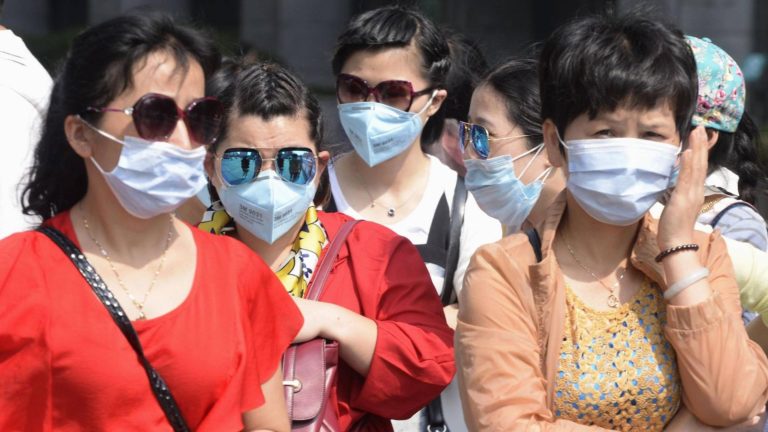
IN the last 48 hours, Coronavirus officially known as Covid19 has hit 11 new countries.
The countries with recorded first cases include; Brazil, Pakistan, North Macedonia, Greece, Georgia, Algeria, Norway, Romania, Switzerland, Denmark and Estonia
According to the World Health Organisation (WHO)’s Situation Report, Algeria, Austria, Croatia, and Switzerland have confirmed first cases of Covid19 and for the first time, there are more cases emanating from outside China than inside China, where the virus first originated in December 2019.
At the moment, 37 countries outside China have confirmed, multiple cases of the virus with 44 recorded deaths.
Given the statistics, WHO has ranked the global risk level of the virus high. It has also placed some 11 countries, Nigeria included, as high-risk countries due to relations and travels with China.
Meanwhile, In Lagos, a suspected case was identified recently.
But Akin Abayomi, Commissioner for Health of the State said that the suspected Chinese case tested negative to the virus.
It was gathered that the patient arrived Nigeria seven week ago from China and complained of having fever. After tests were carried out, the commissioner confirmed that the patient tested negative.
Globally, there are now over 81,000 cases of Covid19 in almost 40 countries in the world.
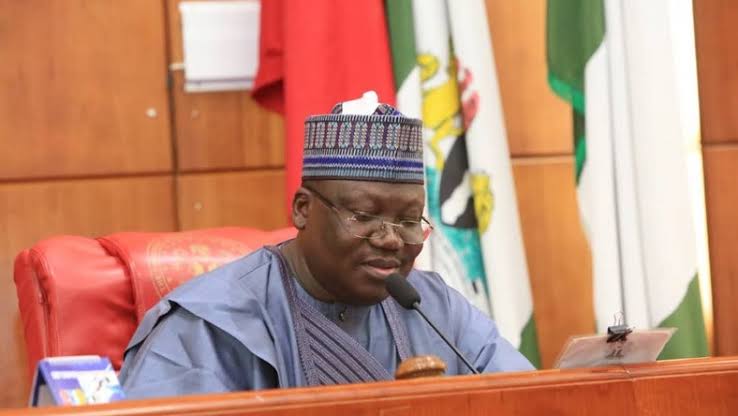
When Ahmad Lawan, president of the Senate, set up a 58-member team to propose amendments to the nation’s 1999 Constitution recently, not many Nigerians would wonder what was there to amend again.
In the almost 21 years since the return to civil rule, not a single cycle has passed without the National Assembly tinkering with the same Constitution. And in fact, the Executive under Presidents Olusegun Obasanjo and Goodluck Jonathan convened national conferences to x-ray the constitution. Alas, it has been a case of plenty motion without movement.
So, why has this document become the object of so much attention? Both experts and laymen see it as a fraud, a military imposition that has failed to meet the criteria of equity, justice and fairness for a large percentage of the nation’s 200 million people. In the words of Prof.
Chinweizu, the 1999 Constitution accounts for, “Many of the deadly problems plaguing Nigeria”. Those problems “are maintained by the provisions of the Constitution as well as the structures it has set up. Therefore tackling many of Nigeria’s problems would require a comprehensive critique and gutting of the Constitution in which they are rooted”.
Lawan referred to the challenges posed by this Constitution in the course of setting up the Senate Review Committee. According to him, “Though no Constitution can be faultless, mostly because social dynamics are unpredictable, but a good review can increase its functionality, and then decrease social agitations”. His deputy, Ovie Omo-Agege, who leads the Review Committee, recognises the onerous task his team has been saddled with.
The deputy senate president observed that, “These changing times have brought new challenges and, today in our country, we are faced with increased insecurity, slow economic growth, rising poverty, and a poor political structure, amongst others”. He is not in any doubt that these challenges will define the way Nigerians will co-exist in the 21st century.
Thus, the challenges “have continued to agitate the minds of our people. It is against this background that the need for constitutional reforms has once again become necessary”.
While Nigerians agree that the Constitution needs serious surgical operation, they have often times faulted the National Assembly for taking on this role. The Guardian quoted Prof. Akin Oyebode, constitutional lawyer, as saying that reviewing the Constitution is not the business of the National Assembly, “being a parliament set up to enact legislation for the peace, order and good government”.
Rather, Oyebode, who derided the Constitution as Decree 24 of 1999, because of its military origin, declared that, “the rightful body to discharge the duty of fashioning a new fundamental law is a duly convened constituent assembly, otherwise, it would amount to the tail wagging the dog”. He is not alone in this mindset. Tony Nnadi, Secretary-General of the Lower Niger Congress, is of the view that making a Constitution requires constituent powers that are vested in the people as an incident of their sovereignty.
Therefore, simply because legislators have been elected does not amount to a surrender of the people’s sovereignty to them. For the nation’s lawmakers to continue to pretend “that they are the new custodians of our sovereignty” amounts to “aiding and abetting the treason already committed by those who first hijacked our sovereignty by imposing the fraudulent 1999 Constitution”.
However, while this argument seems flawless, others argue that those asking for a constituent assembly when there is a parliament in place should perish the thought. Those Nigerians expecting elected legislators to hand over their mandate to an unelected constituent assembly are living in a fool’s paradise. Ernest Ojukwu, former deputy director-general of the Nigerian Law School, points out that the Nigerian nation now exists on the basis of the 1999 Constitution.
It is the grund norm that regulates our daily lives as a geo-polity. Therefore, the document cannot be simply wished away. Ojukwu advises Nigerians to “continue to advocate and pressure our representatives to successfully present our vision and dreams of the kind of structure we want”. He regards the proposed review of the Constitution as “another opportunity for positive steps towards restructuring which has no single definition or framework”.
And talking of restructuring, it’s a very emotive issue.
Any discussion on restructuring brings up thorny issues which aggregate to the national question to which Nigerians seek answers. Those answers have become elusive because they do not favour the current political strongholds. Because the federal structure, as currently constituted has become a heavy burden for constituent states, Nigerians are progressively drifting towards regionalism.
This scenario has evolved because of the seeming failure of government at the centre. There is a sense of foreboding because many people feel alienated, which is further compounded by economic stagnation, infrastructure gaps and pervasive insecurity in the land.
Against this backdrop, not a few elderly Nigerians remember the First Republic with nostalgia. They claim it was the golden era of the nation’s political life when there was healthy competition among the regions in providing the dividends of democracy for their people. Sadly, the military’s ignominious incursion into politics ended that era.
And the nation has never been the same again in spite of her tremendous human and material resources. And Nigeria once touted as the giant of Africa has become a laughing stock in the international community, with many predicting that time to arrest the drift into the abyss is running out.
As the Omo-Agege review committee undertakes their assignment, two documents come handy. The first is the 2014 Report of the National Conference, led by Justice Idris Kutigi, set up by President Jonathan; and the second is the 2018 Report of the All Progressive Congress, APC, on restructuring. Interestingly, the latter, then the opposition party, refused to participate in the 2014 conference.
The APC Committee was led by Governor Nasir El-Rufai of Kaduna State. Some of the thorny issues that rocked the 2014 conference are true federalism, resource control, land use act, national security and states’ creation.
On true federalism, the 2014 recommendation was, two tiers of government, federal and state. The local government was removed as a tier in a federal structure, and states were free to create as many local governments as they want.
The El-Rufai report of 2018 equally supported this recommendation. In pursuance of this, the latter report added that the section listing local governments and their headquarters in the Constitution should be expunged. In respect of finance and revenue allocation, the 2014 report recommended the following percentages, Federal government, 42.5%, State governments, 35%, local government, 22.5%.
While the El-Rufai committee did not recommend sharing percentages, it nonetheless asked for an amendment to Subsection Two of the Constitution to reduce the federal government share and give more revenue to the states. It did not recommend anything for local governments since they would no longer be a tier in a federal structure.
Against the grain of public opinion, the Kutigi report recommended the creation of 18 new states, thus bringing the total to 54, at a time majority of the 36 existing states would readily collapse without revenue allocation. The attraction for states’ creation, though, is the easy oil money which is shared in Abuja every month, thus deadening all initiatives by the nation’s leaders to seek new sources of revenue. Perhaps, recognising the vulnerability of many states, the El-Rufai report recommended possible merger of states to have an enduring polity in which dividends of democracy can flow to the people.
In order to reduce the cost of governance, which has become bloated, the 2014 report advised a modified presidential and parliamentary system, whereby the President picks his Vice President from the legislature. There would be only 18 ministers representing the six geo-political zones, as opposed to the present 42. And 70% of the ministers would be parliamentarians.
The most controversial recommendation was a bicameral legislature whose members would be part-time.
On resource control, derivation principle, and fiscal federalism, the Kutigi report asked government to set up a Technical Committee to determine appropriate percentages on these issues and advise government accordingly.
However, in its own report the El-Rufai committee called for amendments to the Petroleum Act, the Land Use Act, Nigeria Mineral and Mining Act and the Petroleum Profit Tax 2007 to ensure that minerals, mining and oil are vested in the states except offshore minerals.
Both the Kutigi report, on which the nation spent over seven billion naira in 2014, and the El-Rufai report, which cost is unknown since it was set up by ruling APC in 2018, have been gathering dust on the shelves were they have been dumped.
By the time of its submission in August 2014, President Jonathan claimed he could not do much because preparations for the 2015 general elections were already in high gear.
Subsequent pleas to his successor, President Muhammadu Buhari to take a look at the 600 recommendations fell on deaf ears. Interestingly, his own party inaugurated its own committee to embark on a similar mission four years later when the nation was preparing for another general election.
Shortly after the report was submitted to John Odigie-Oyegun, then APC chairman, Bolaji Abdullahi, the party’s spokesman, described the report as contentious, as opinion was divided on some issues. As usual, another committee was set up to “take a holistic look at it and report back to the National Executive Committee”.
It was an excited Abdullahi who declared, “From day one, we are the party that promised restructuring. It’s in our manifesto; you will agree with me that we have demonstrated passion and commitment to pushing it through”. And no less excited was Garba Shehu, presidential spokesman, “What I can assure you is that once the report is approved by the party, the President as a loyal party man will implement it. I am very sure of that”.
More than two years later, the nation is still waiting for the party to approve and the President to implement.
But trust Nigerians, who are forever hopeful in the face of daunting challenges. They are already looking forward to what the Ovie Omo-Agege committee will come up with, and whether Ahmad Lawan will be able to lead a groundswell of opinion to prevail on President Muhammadu Buhari to accept the package and put the nation on the path of real change in the 21st century.
*Ayodele Akinkuotu, former Editor-in-Chief, of TELL Magazine, now writes a weekly column for the International Centre for Investigative Reporting
THE Federal Government on Wednesday as part of its agenda to gradually diversify the Nigerian economyfrom oil dependence by uplifting other sectors in the country has approved $268 million in soft loans to support entrepreneurs and innovators.
Vice President Yemi Osinbajo said, “Nigeria approved disbursing $268 million in funding to support agricultural entrepreneurs and young technology innovators”.
The presidency in a statement disclosed that one tranche of the funding, worth 90 billion Naira ($248 million), will be dispensed by the central bank as “soft loans” for people building small-scale agricultural businesses.
Another $20 million will provide funding support young innovators in technology.
Recently, the National Bureau of Statistics’s (NBS) report on Micro, Small and Medium Enterprises (MSME) shows that 85 per cent of businesses could not have access to external financing within 2013 and 2017.
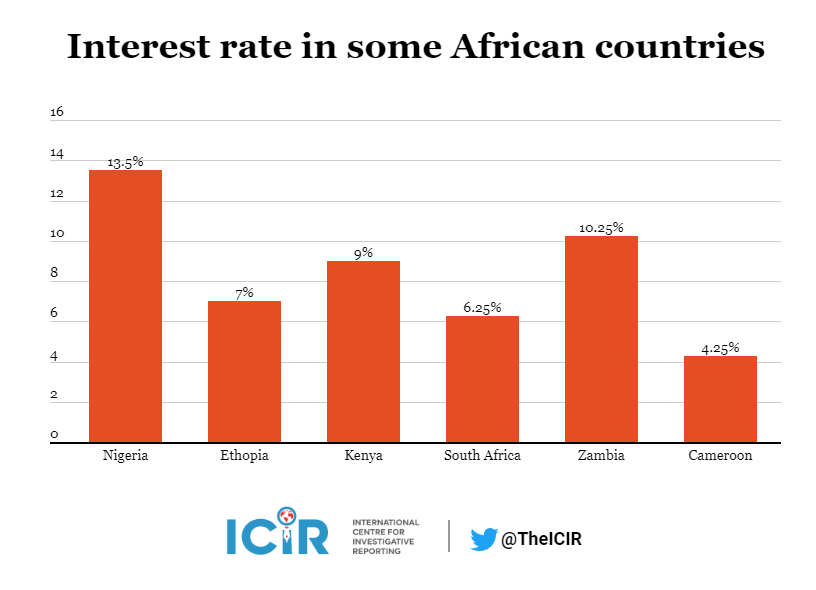
Nigeria’s benchmark interest rate is among the highest in Africa at 13.5 per cent. Ethiopia’s is 7 per cent; Kenya’s is 9 per cent; South Africa is 6.25 per cent; Zambia is 10.25 per cent, and Cameroon is 4.25 per cent.
A soft loan is a loan with no interest or a below-market rate of interest with lenient terms.
ON Wednesday, 26 February, the Supreme Court endorsed its decision on Bayelsa election which dismissed the applications for a review David Lyon as Governor-elect and reconfirmed Douye Diri as winner.
When the verdict on February 13, did not go down well with the All Progressive Congress, it applied that the Supreme Court should revisit the issue and reverse the judgement.
A seven-man panel of the Supreme Court led by Justice Sylvester Ngwuta described the applications filed by the APC and its governorship candidate as vexatious, frivolous, and constituted a gross abuse of court process.
According to Justice Amina Augie who read the judgment on Wednesday, the application lacked merit and the decisions of the court are final.
She added that the applicants failed to point out errors, stating that the judgment is final.
The apex court judge declared that the judgment is final and no court on earth can review it.
All parties involved were present as the seven-member panel headed by Sylvester Ngwuta pronounced the upholding of the court’s earlier verdict.
“There must be an end to litigation even if we review this judgment, every disaffected litigant will bring similar applications and the finality of Supreme Court judgments will be lost,” Amina said.
Governor Douye Diri of Bayelsa, Adams Oshiomhole, All Progressives Congress Chairman, supporters of the parties in the dispute and others were in court while Afe Babalola, a Senior Advocate of Nigeria, led the team of lawyers for Lyon and his deputy.
The party, in an application filed by its team of lawyers led by Wole Olanipekun (SAN) and Lateef Fagbemi (SAN), also requested that the apex court set aside the “wrong” interpretation given to its judgement of February 13, 2020 and its succeeding execution by the Independent National Electoral Commission (INEC).
“In this honourable court’s judgement of 13th February, 2020, the court erroneously and inadvertently stated that the trial High Court consequentially disqualified the applicant‘s governorship candidate even though the trial court made no such order and when the trial court indeed refused to grant the express orders sought by the plaintiffs therein for his disqualification,” APC claimed.
The APC argued that the Supreme Court acted without jurisdiction and denied the APC fair hearing when it proceeded to disqualify its governorship candidate even though the Federal High Court, in the judgement by Justice Inyang Ekwo, which the apex court affirmed, refused PDP’s prayer to disqualify Lyon.
The party also faulted the interpretation given to the apex court’s judgement by the INEC in deciding to issue the certificate of return to the candidate of the PDP.
Augie concluded with instructing that the counsels of the APC and Mr Lyon are to each pay Douye Diri, his deputy Mr Lawrence Ewhrudjakpo and the PDP the sum of N10 million.
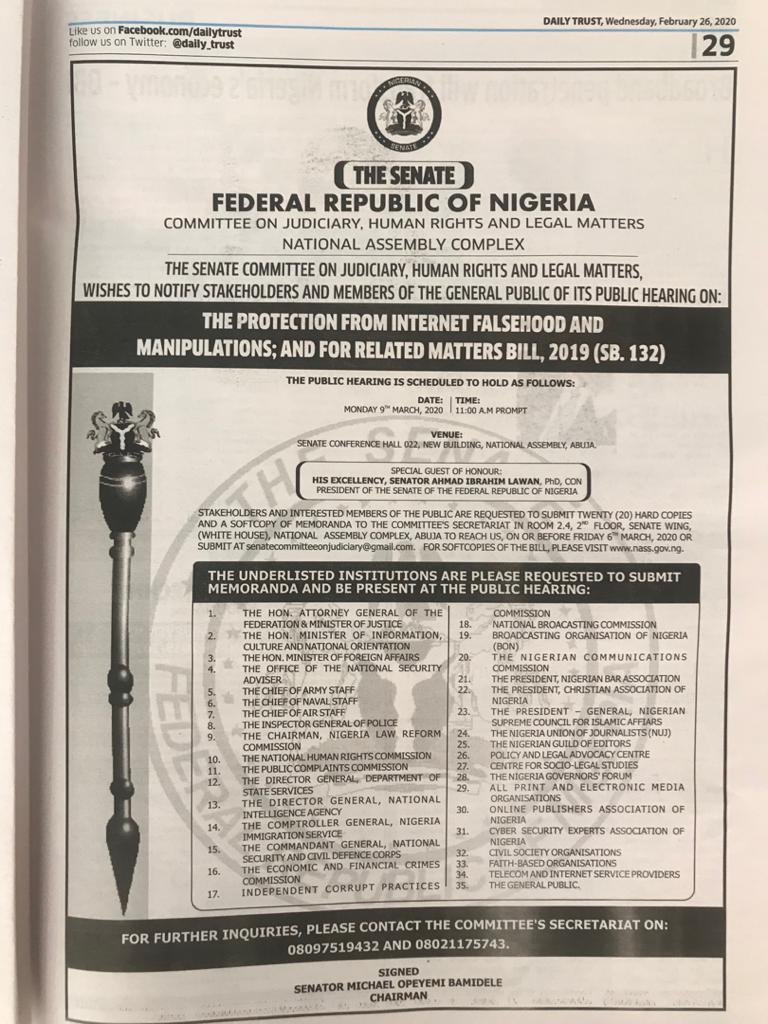
THE Nigerian Senate has fixed a date for the public hearing of the Social Media bill, despite public outcry over the bill believed to be an attempt aimed at stifling freedom of speech and expression in the country.
The chairman of the Senate Committee on Judiciary and Legal Matters, Opeyemi Bamidele, made the announcement in a published notice on Daily Trust newspaper, on Wednesday.
The details as published, declare that the hearing is scheduled to hold at Senate Conference Room 022, Senate New building, National Assembly, Abuja on March 9.
The general public as well as interested parties are invited to attend and submit suggestions and opinions on the bill.
Social Media bill public hearing published notice. Photo: Daily Trust.
The bill, titled; Protection from Internet Falsehood and Manipulations Bill, 2019,’ sponsored by Mohammed Musa, senator representing Niger East Senatorial District, was introduced in November 2019 and caused an uproar on social media.
However, Musa argued that the bill was to arrest the spread of false information rather than gag freedom of expression on social media.
The Social Media bill has passed first and second reading and is now set for public hearing after which the legislation will be considered and possibly passed into law.
Having made leaps in the 9th Assembly, the Social Media bill remains a mystery to the likes of Lai Mohammed, Minister for Information and Culture.
In an interview with Deutsche Welle (DW) in late January, the minister claimed he had no knowledge of the Social Media Bill which is now in the final stage before it is likely passed into law.
Responding to Tim Sebastian’s question on the draconian provisions outlined in the bill, Mohammed said that such a bill was not before the house.
“There is no such bill before the House. I can say that authoritatively. There is no such bill before the House,” the minister said in the presence of cameras.
THE Nigerian senate has noted with concern that billions of naira were being held by banks in Nigeria either in form of under remittance or non-remittance of withholding tax due to the government.
Nigerian banks, Central Securities Clearing System Plc (CSCS) which is the settling institution for financial organisations have been suspected by the Senate not to be remitting tax to the government.
On Tuesday, the Nigerian Senate directed its Committee on Banking, Insurance and other Financial Institutions to investigate the allegations.
The Senate gave the panel four weeks to ensure the recovery of all withholding tax revenues on both bank deposits and dividends, and report back.
The directive followed a motion by the upper chamber on the digitisation/automation of collection and remittance of withholding tax on bank deposits and dividend payments for enhanced state governments’ Internally Generated Revenue.
Financial Institutions in the likes of the Banks, Nigerian Stock Exchange (NSE) and Central Securities Clearing System Plc deduct tax from its customers on a periodical basis so it is expected that appropriate remittance is done to the government accordingly.
As for the NSE, every transaction executed on behalf of investors is taxed on stamp duty at a rate of 0.75 per cent of the value of transaction depending on if the investor is buying or selling.
Senator representing Anambra Central, Uche Ekwunife said: “Most state governments have been unable to pay salaries or meet their financial obligations as a result of poor and dwindling revenue.
“It had become imperative giving the dwindling revenue from the federation account which had left various state governments in Nigeria with the task of formulating strategies to improve the revenue base of their states,” she added.
Ekwunife stressed the need for states to increase their internally generated revenues in order to have enough financial resources to meet the expectations of the people.
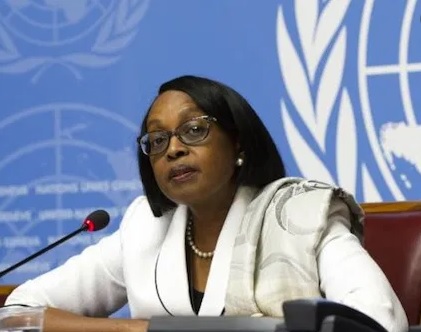
MATSHIDISO Moeti, World Health Organisation (WHO), Regional Director for Africa, has said that Africa’s window of opportunity to prepare for Coronavirus officially called Covid19 is closing, following the record of a second case in the continent.
In a tweet, Moeti advised that African countries brace up for the virus as it has now entered the continent. She announced that Algeria has recorded its first case of Covid-19 after an infected Italian man entered the country on February 17, and tested positive to the virus.
Algeria, one of the 47 countries in Africa, is the second to record a case of Covid-19.
A few weeks back, WHO, announced that Egypt had recorded its first case, making it the first African country to import the virus.
However, the North African country denied having any case of the virus, claiming that the test came out negative.
According to the Times of Egypt, Khaled Megahed, advisor to the Egyptian Health Minister on Media Affairs said the nation has deployed every strategy necessary to avoid an outbreak.
The virus which originated from Wuhan, China, in December 2019, has infected over 80,000, with over 2,700 confirmed dead.
While most of the cases are present in China, the virus has spread to more than two dozen countries including the United States.
Nigeria is yet to register any case of Covid-19 but the most populous black nation is currently suffering Lassa Fever epidemic in some states.
The ICIR also found that the country is not ready to combat Covid-19.
In a report, it showed that two major hospitals in the Federal Capital Territory are ill-equipped to fight Coronavirus or any other infectious disease.