Home Blog Page 2286

Nigeria, Niger, Chad, others not expected to meet health, education SDG targets ─Report

0

A NEW report that tracks progress in achieving the Sustainable Development Goals (SDGs) has classified Nigeria among countries not expected to meet the health and education targets, the major factors for human capital and economy developments.

The goalkeeper’s report  launched by the Bill and Melinda Gates Foundation on Tuesday, aimed to identify what was working and where countries were falling short in achieving the global goals by 2030.

The report featured new data showing that global inequality remains a major barrier to achieving the SDGs by 2030.

In the report, many African countries were projected to not achieving the education and health global targets by 2030. “Even though life is better, it is still bad,” the report said.

Some of the countries listed included Nigeria, Chad, Central African Republic, Niger, Burkina Faso, South Sudan, Sierra Leone, Guinea, Somalia, Burundi, Cote’diovoire and Guinea Bissau.

Though it stated health and education are improving in every country, very few developing countries, it noted were projected to meet the SDGs goals.

Gaps between countries, local government areas, boys and girls prove that the world’s investments in development were not reaching everyone, the report read.

“Where you’re born is still the biggest predictor of your future, and no matter where you’re born, life is harder if you’re a girl.

“Nearly two-thirds of the children in low- and low-middle income countries live in districts that, at their current rate of progress, won’t reach the SDG target for child mortality by 2030,” report partly read.

To show inequality in Nigeria, it juxtaposed two Local Government Areas in the country – Ado-Ekiti in Ekiti State and Garki in Jigawa State.

“The average person in Ado-Ekiti, in Ekiti State, has more than 12 years of education, whereas the average person in Garki, in Jigawa State, has five.”

According to a chart that noted the child-mortality rate and mean years of schooling in 2017 across 774 Local Government Areas in the country, most Northern local governments took the bottom area of the chart. That is, access to health and education in the areas were still poor.

Among the local governments listed at the bottom included Garki, Ringim, Buji in Jigawa State; Gabasawa, Tundunwada, Ajingi in Kano State.

The report stated that investments in human capital today help people increase their incomes tomorrow. “But without human capital—that is, for those who are unhealthy and uneducated—it is virtually impossible to escape poverty.”

On September 25, 2015, at the United Nations headquarters in New York, 193 world leaders, including Nigeria committed to the 17 SDGs which were a series of ambitious objectives and targets to achieve by 2030.

Some of the targets to achieve by 2030 on health include ending preventable deaths of newborns and children under 5 years of age, with all countries aiming to reduce neonatal mortality to at least as low as 12 per 1,000 live births and under-5 mortality to at least as low as 25 per 1,000 live births.

The latest UNICEF data estimated that in every 1000 live births, 100 of them will not reach age five in Nigeria.

Other targets on health include:

  • end the epidemics of AIDS, tuberculosis, malaria and neglected tropical diseases and combat hepatitis, water-borne diseases and other communicable diseases.
  • strengthen the prevention and treatment of substance abuse, including narcotic drug abuse and harmful use of alcohol.
  • achieve universal health coverage, including financial risk protection, access to quality essential health-care services and access to safe, effective, quality and affordable essential medicines and vaccines for all.

Nigeria is facing a high burden of AIDS, tuberculosis and malaria. According to the World Health Organisation (WHO) in 2019,  the country has the highest burden of malaria globally. It had claimed the second position among countries with a high prevalence of tuberculosis.

And the latest UNAIDS statistics estimated that Nigeria together with Cameroon and Côte d’Ivoire
account for close to 60 per cent of new HIV infections and 54 per cent of AIDS-related deaths every year.

Measles is also a vaccine-preventable disease affecting the country. Nigeria was ranked the fourth among countries with confirmed cases of measles in 2019 in the world.

And on education, some of the SDGs targets include to:

  • ensure that all girls and boys complete free, equitable and quality primary and secondary education leading to relevant and Goal-4 effective learning outcomes.
  • ensure that all girls and boys have access to quality early childhood development, care and preprimary education so that they are ready for primary education.
  • ensure equal access for all women and men to affordable and quality technical, vocational and tertiary education, including university.
  • substantially increase the number of youth and adults who have relevant skills, including technical and vocational skills, for employment, decent jobs and entrepreneurship.

To develop low and low-middle income countries, including Nigeria, the report urged the government to invest in primary health care where people would receive quality healthcare services near where they live and work.

“Governments should prioritize primary health care to deliver a health system that works for the poorest, digital governance to ensure that governments are responsive to their least-empowered citizens, and more support for farmers to help them adapt to climate change’s worst effects,” wrote Bill and Melinda Gates if countries were to address persistent inequality.
Again, Nigeria approaches World Bank for $2.5b loan to address power sector

0

THE Federal Government has opened talks with the World Bank for a $2.5 billion concessionary loan to boost its power sector.

Hafez Ghanem, World Bank’s vice-president for Africa, who disclosed this in Abuja said Nigeria had received in the previous year, $2.4 billion from the World Bank.

“We’re talking about a new set of programs of about the same amount, it should be around $2.5 billion,” Ghanem said.

Federal government had  in February 2018 taken a loan worth $486 million from the World Bank for the purpose of revamping the country’s electricity transmission substations and lines.

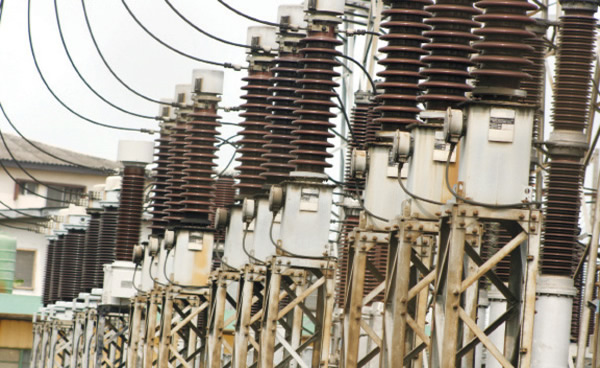
Nigeria has the capacity to generate as much as 12,522 megawatts (MW) but so far has only been able to generate about 4,000 megawatts (MW) despite $486 million loan from the World Bank in 2018.

Ghanem also stated that there is immediate need to resolve the power challenges of Nigeria to bring in investors and also the need to bring down the cost of power so as to foster a good competitive industry for development of one of the largest economies of West Africa.

He further explained that the World Bank is supporting digital transformation in Nigeria because of its potential ability to transform other areas of the economy including industry, agriculture and services and mentioned the comparative advantage of Nigerian economy because of the large amount of young citizens of the country.

According to reports, as of March 2019, Nigeria total external debt stood at N7.8 trillion ($25.6 billion) while internal debt was N17 trillion ($55.6 billion).

Despite the drastic increase in foreign debt,  Minister of Finance, Zainab Ahmed had earlier claimed that Nigeria does not have a debt problem but a problem of revenue and that Nigeria’s debt is not high.

One day after it took off, Reps ask CBN to suspend charges on deposits

0

THE House of Representatives on Thursday directed the Central Bank of Nigeria (CBN) to put on hold   the charges imposed on cash deposits in the implementation of its cashless policy.

The apex bank, had in a circular dated September 17, 2019 titled, Re: Implementation of the Cashless Policy, addressed to all Deposit Money Banks directed that as from September 18, lodgment of cash by individuals that is above N500,000 will attract 3 per cent processing fees for withdrawal and 2 per cent processing fees for lodgments.

For corporate bodies, it said, withdrawal or deposit above N3million will attract 5 percent processing fees or 3 per cent processing fees.

CBN said the directive will be effective in Lagos, Kano, Ogun, Abia, Anambra, Rivers and the Federal Capital Territory (FCT) while the full implementation of the cashless policy will become effective March 31, 2020, the document signed by Sam Okojere, Director, Payments System Management Department.

However, the House of Representatives while calling for the stoppage of the implementation of the policy, said the suspension would remain until CBN has carried out due consultations with all relevant stakeholders.

The call for the suspension of the cashless policy which has been greeted by criticism since Tuesday was contained in a motion unanimously adopted during Thursday’s plenary, which was moved by Chairman of the House Committee on Media and Public Affairs, Benjamin Kalu.

Kalu’s motion was titled: “Need to Suspend the Implementation of the Cashless Policy on Deposits by the Central Bank of Nigeria,” and was adopted by other lawmakers who all agreed that the CBN should “suspend the implementation of the cashless policy on deposits, until appropriate and extensive consultative process is concluded.

According to the PUNCH, the lawmaker said the House was against implementation of the policy as it would cause more hardships for Nigerians.

“The House is deeply worried that the implementation of cashless policy on withdrawals has negative impacts on micro, mini, small and medium scale enterprises, which are clearly the engine room for growth of the economy and employment generation, thereby throwing many of them out of business and sending more Nigerians into poverty. forcing more traders and micro investors to carry cash about with its attendant security challenges,” he said.

“The House is aggrieved that while the impact of the cashless policy on withdrawals is still staring us all in our faces as well as other numerous burdensome charges by Nigeria’s Money Deposit Banks heavily impacting on businesses, the CBN deemed it necessary to impose the implementation of cashless policy on depositors ,without due consultations with all shades of stakeholders who will be impacted by the policy.

“The House is concerned that this overbearing burden aimed at closing down majority of micro, mini, small and medium businesses in Nigeria, is also aimed at enriching Nigeria’s Money Deposit Banks owned by a privileged few without any known financial contribution to the Consolidated Revenue Fund of the Federation.”

According to him, the policy on cash-based transactions (withdrawals) in banks was aimed at reducing and not eliminating the amount of physical cash (coins and notes) circulating in the economy, and encouraging more electronic-based transactions, including payments for goods and services, and transfers.

The lawmaker explained that the cashless policy was introduced for a number of key reasons, including the need to drive development and modernisation of the country’s payment system, in line with Nigeria’s Vision 2020 goal of being amongst the top 20 economies by the year 2020.

The goal, according to Kalu, is to reduce the cost of banking services, including cost of credit, and drive financial inclusion by providing more efficient transaction options and greater reach.

In addition to the suspension of the policy, the lawmakers also charged the House Committee on Banking and Currency to interface with the CBN to “ascertain the propriety, relevance and the actual need for the implementation of that aspect of the cashless policy at this time, considering the prevailing economic situation of the country and to report back to the House within four weeks.”


25 LAUTECH students in EFCC net over internet fraud

0

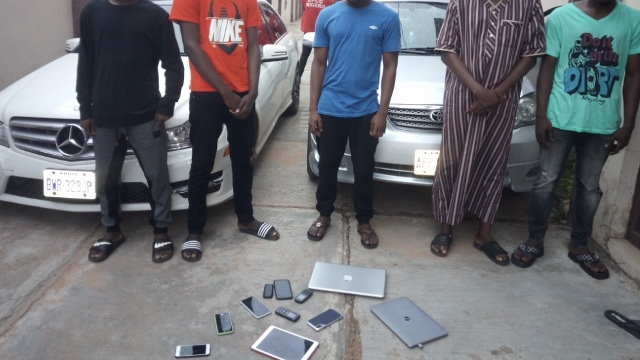
TWENTY FIVE students of Ladoke Akintola University of Technology (LAUTEC), Ogbomosho, Oyo State have been arrested by the Operatives of the Advance Fee Fraud Unit of the Economic and Financial Crimes Commission (EFCC) for their involvement in various forms of cyber crime including romance scam, love scam, possession of forged documents, and obtaining money by false pretence.

Wilson Uwujaren, Head Media and Publicity of EFCC made this known in a statement issued in Abuja on Thursday.

He said the students, aged between 18 and 29 years old, were arrested at their off-campus hostels, following a three-day raid carried out between September 16 and 19, 2019 by operatives of the commission.

According to him, the operatives, who acted on the intelligence reports, which was investigated using sophisticated equipment.

“The raid also followed months of surveillance and monitoring of their activities,” Uwujaren said.

The names of the students as contained in the statement include: “Pelumi Adigun, 18; Umaru Frederick, 21; Damilola Emmanuel, 22; Tomiwa Oyewole, 29; Adeleke Owolabi, 24; Oladosu Abdullahi, 23; Abdulmusaq Ismail, 25; Isajimi Joshua, 23; Olaniyan Tunde, 22, and Ebosele Francis, 28”.

“Others are: Oladejo Ibrahim, 26; Oluwadamilare Abimbola, 25; Orimoloye Joshua, 23; Alfred Samuel, 22; Bayewu Ishola, 23; Abiola Gbenga, 25;Alfred Daniel, 20; Agboola Solomon, 21; Arolewola Damilola, 25; Amoo Tunmise, 23; Akeem Taiwo, 25; Segun Ajibola, 25; Hassan Segun, 24; Onicha Joel, 23, and Tafa Bassit, 25.

“In the course of executing the search, Ismail, who confessed to being involved in internet fraud, took operatives round hostels, leading to the arrest of many of the culprits. Some of the suspects who jumped
over the fence to escape arrest, were nabbed in the process,” the statement read.

Some of the items recovered from them, believed to be the proceeds of their illegal activities online, include, “a 4matic  Benz, a Toyota Camry, a Toyota Corolla, two Macbook computers, two iPads, two iPhones and many other documents, which will be subjected to forensic analysis”.

The EFCC spokesperson said the suspected internet fraudsters, are currently in the custody of the commission and would soon be arraigned in court.

Court orders closure of P&ID operations in Nigeria, assets forfeiture

0

THE Federal High Court, Abuja has ordered the closure of operations of P&ID Ltd, Virgin Island, and its Nigerian affiliate, P&ID Nigeria Ltd, firms linked to the failed P&ID oil contract negotiations.

The court presided over by Justice Inyang Ekwo  also ordered the forfeiture of assets belonging to P&ID Nigeria Limited to the Federal Government of Nigeria.

The judge gave the ruling after the representatives of the companies pleaded guilty to the 11 charges brought against them by the anti-graft agency.

“An order is hereby made for the second convict to be wound up and its assets forfeited to the Federal Government,” Ekwo said.

The EFCC had initiated an investigation into the agreement following a British court ruling that Nigeria owed the Irish firm about $9 billion for violating terms of the contract.

It was revealed that the company had no license to sell petrol and that it did not comply with Nigeria’s tax requirements.

Both defendants admitted their guilt to the 11 counts charge read to them before Justice Ekwo and their role in fraudulently claiming to have acquired land from the Cross River State Government in 2010 for the gas supply project agreement which led to the $9.6bn judgment.

The presiding judge in his verdict identified the plea of guilty by the defendants and convicted them of the charges against them.

“I have reviewed the evidence tendered in this court. I have taken note of the plea of guilty and it is upon this premise that I find the first and second defendant guilty as charged.

“Both defendants are convicted in charge 1,2,3,4,5,6,7,8,9, and 10,” he ruled, while only the second defendant was convicted of ‘count 11’,” he said.

Delivering his judgement, Ekwo said, “I have listened to the parties in this case. Being that the entities involved are corporate entities, the punishments to be meted to them are enshrined in the law.”

He consequently ordered that the companies be wound up and their assets be “forfeited to the Federal Government of Nigeria”.

The contract for gas supply and processing, GSPA, was signed by the administration of late president Umaru Yar’Adua and P&ID.

The company was to build gas processing facilities around Calabar, Cross River State, and the government was to supply wet gas up to 400 million standard cubic feet per day.

Unfortunately, the project failed to deliver on the major terms of the agreement as key elements necessary for its success of the project were not delivered.

In a judgement delivered by Justice Butcher of The Hgh Court of Justice, Business and Property Courts of England and Wales, a three-member arbitration panel that examined the contract had ruled against Nigeria and ordered the government to pay the firm $6.6 billion as damages.

The money had accumulated with interest to about $9 billion which accounts for over one-third of Nigeria’s 2019 budget.


27 days after rejecting her resignation, Buhari removes Oyo-Ita as head of civil service

0

PRESIDENT Muhammadu Buhari has removed Winifred Ekanem Oyo-Ita from the position of head of Nigeria’s civil service and instructed her to proceed on an indefinite leave.

This was announced on Wednesday evening through a press statement issued by the Office of the Secretary to the Government of the Federation and signed by Willie Bassey, the office’s Director of Information.

Titled ‘Stabilisation of the Federal Civil Service’, the release also said Folashade Yemi-Esan will be taking over from Oyo-Ita in an acting capacity while investigations by the Economic and Financial Crimes Commission (EFCC) into allegations of financial fraud against the former head of service are concluded.

Yemi-Esan has been permanent secretary of the ministries of education and petroleum resources.

“The President has also approved the extension of the tenure of seven (7) retiring Permanent Secretaries for a period of one calendar year with effect from 1st October, 2019 to ensure stability in the Federal Civil Service and effective delivery on the nine priority areas of the administration as well as the mandates given to the new Ministers,” the statement continued.

The seven are Georgina Ehuriah of the Ministry of Interior, Ifeoma Anagbogu of the Ministry of Women Affairs, Grace Gekpe of the Ministry of Information and Culture, Umar Bello of the Ministry of Agriculture and Rural Development, Suleiman Mustapha Lawal of the Ministry of Foreign Affairs, Comfort Ekaro of the Ministry of Water Resources, and Olusegun Adekunle of the General Services Office, Office of the Secretary to the Government of the Federation.

“Similarly, Mr. President has directed the Office of the Head of the Civil Service of the Federation to commence the process for the selection of new Permanent Secretaries to replace all retiring Permanent Secretaries,” the release said.

“The decision of Government to extend the tenure of these Permanent Secretaries is premised on the need to ensure that the new Ministers are properly guided, briefed about their sectors and to ensure that a solid foundation is laid for the delivery on the Presidential Mandate which they jointly signed.

“The Permanent Secretaries will also help the Ministers to manage the process for the preparation of the 2020 Budget in line with the commitment of Government to return to the January-December budget circle and help develop various policies and programmes aimed at lifting 100million Nigerians out of poverty in the next 10 years.”

Oyo-Ita had a month earlier submitted her resignation, which was rejected by Buhari on August 22.

She is presently caught in a N3 billion bribery scandal, as the EFCC has probed her over allegations that she used proxy companies to secure contracts while still a permanent secretary.

Before her invitation by the commission, N600 million was traced to the account of one of her aides, who was interrogated by the EFCC and was afterwards released.

Oyo-Ita has refuted the allegation and said the money was rather meant for death benefits of staff.

CSOs protest serial murder of women in Port Harcourt

0

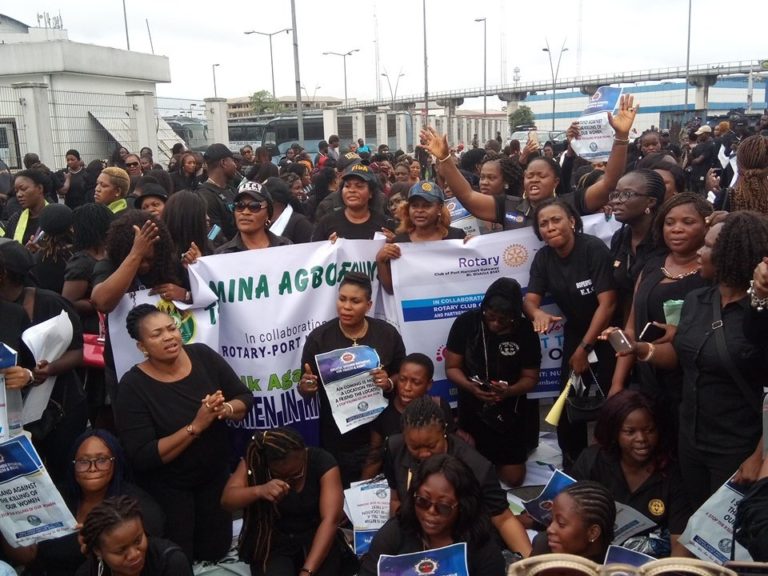
VARIOUS Civil Society Organisations, on Wednesday, demonstrated in Port Harcourt, Rivers State capital, in protest against recent incidents of femicide in the state.

The protest themed “Walk for Peace against the Serial Killings of Women,” was attended by members of Rotary Club of Port Harcourt Cosmopolitan, Women in Rotary Port Harcourt South, and Greater Women Initiative for Health and Right. They were joined by over a hundred other people in the protest march which took off at the NUJ Secretariat.

Residents of the state capital have been living in fear after about eight ladies were reported killed in different hotels in similar circumstances.

The protesters went to the Rivers State Government House and demanded adequate security of lives of women in the state as well as a statement from the state government.

According to BBC pidgin, Rivers State Police Public Relations Officer, Nnamdi Omoni, a Deputy Superintendent of Police (DSP) confirmed the death of a lady who was found dead in a hotel room on Friday morning.

He corroborated the likelihood of the incidents being a serial murder but added that investigations and profiling were still ongoing.

Omoni also told those who participated in an earlier protest on Friday that prostitution is to be “blamed” for the killings and advised that female residents in Port Harcourt to desist from the practice.

Speaking to The ICIR, President of Women in Rotary Port Harcourt South, Blessing Micheal, insisted that the police department was wrong to have referred to the victims as prostitutes and also that irrespective of what they do they deserved to be protected.

She also mentioned that they demand an immediate investigation into the killings by the supposed “serial killer”.

The Greater Women Initiative for Health and Right led by Aseme Josephine also expressed their grievances to the Commissioner of Police who subsequently apologised for referring to the victims as “prostitutes”, adding that he was misunderstood.

The protesters, however, lamented their frustration on the refusal of the Deputy Governor of Rivers State, Ipalibo Banigo, to attend to them despite being a woman.

Josephine told The ICIR that after much wait at the government house, they were addressed by the Secretary to the State Government, Tammy Danagogo, who assured them that the government will not relent until the perpetrators of the crime are apprehended.

Part of the protesters’ demands is the use of valid national ID cards at hotels and motels by guests and the mandatory implementation of Closed Circuit Television cameras for such establishments in the state.

Labour unions, CSOs move to stop import of ‘stolen’ natural resources from Morocco

0

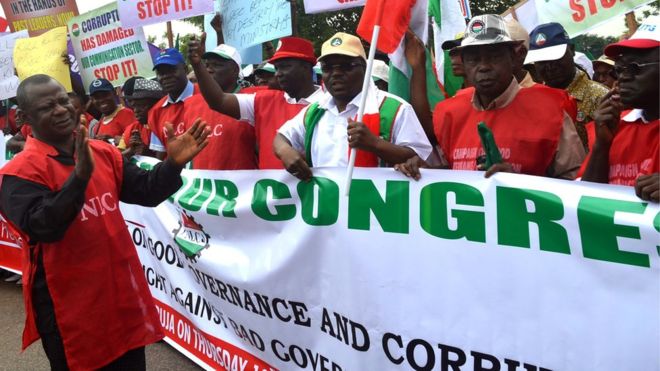
TRADE unions and advocates under the Nigerian Movement for the Liberation of Western Sahara (NMLWS) have demanded that Nigerian companies should put an end to “buying stolen phosphate, fertiliser, and fishes from Morocco”.

These items, the unions say, are unlawfully extracted from the Sahara Arab Democratic Republic (SADR) more commonly called Western Sahara.

The demand was made on Wednesday at a press conference held in Abuja. The NMLWS, chaired by former foreign affairs minister Ibrahim Gambari, is a coalition that comprises the Nigeria Labour Congress, Trade Union Congress, Academic Staff Union of Universities, as well as 17 Civil Society Organisations.

The NMLWS said it plans to bring to book all companies in Nigeria who profit from an “unholy theft” by receiving phosphate “stolen by the kingdom of Morocco from Western Sahara to produce fertiliser”.

“This movement supports the development of Nigeria, but not with stolen resources,” the press statement from the conference obtained by The ICIR said.

“We insist that although our country needs fertiliser, but not that produced with the blood of our brothers and sisters in Western Sahara.”

“About this, we are definite. This principle is planted in the Nigerian culture of non-exploitation of other peoples and defender of colonised peoples as we did in the struggle for the liberation of countries like Guinea Bissau, Mozambique, Angola, Zimbabwe,  Namibia and South Africa.

“Nigerians are freedom-loving peoples, not accomplices of leaders of a country like Morocco who against all known tenets of African brotherhood, religious obligations and social justice, would invade and occupy a member country of the African Union, dehumanise its people and plunder its resources which it sells to European Union (EU) countries and companies in Nigeria.”

The NMLWS recalled that in December 1984, Nigeria, then led by military ruler Muhammadu Buhari, had recognised Western Sahara as an independent African country.

“It is, therefore, inconceivable that thirty-five years later, under an elected President Muhammadu Buhari, Nigeria would tolerate the occupation of the same country by a sister African country and be receiving the natural resources of Western Sahara plundered by Morocco,” it observed.

The group also lamented human rights violations committed by Morocco’s occupying forces against the Saharawi.

Citing instances, it said, a lady was crushed to death by a police car after people from Western Sahara jubilated following Algeria’s victory at the African Nations Cup.

“As we speak, fifteen Saharawi youths are still in prison just for celebrating a football victory,” it noted.

Prepare to be sued and picketed

The NMLWS warned all companies receiving resources taken from Western Sahara to be ready for demonstrations at their offices and legal battles if they do not desist.

“After giving this notice to the Nigerian companies dealing in stolen Western Sahara resources, we will picket them across the country and bring them before our courts,” it said.

“This also includes supermarkets selling sardines and fishes from Morocco because 92 per cent of these fishes is stolen from the Western Sahara coast.

“It is in furtherance of this we have invited these lawyers to meet, exchange ideas, and plot our legal strategies and commence legal actions.”

The movement urged Nigeria to deal decisively with the problem and learn from South Africa, where a court in May 2017 ordered “the seizure of a 55,000-tonne cargo of phosphate illegally extracted and stolen by Morocco from Western  Sahara”.

AU, UN must act … and other demands

The Nigerian Movement for the Liberation of Western Sahara urged international organisations such as the African Union, United Nations, and European Union not to “remain silent in the face of atrocities perpetrated by Morocco in Western Sahara”.

It also made the following six demands; that:

  • The Moroccan monarchy and leadership be called to order and brought to book for gross human rights violations in Western Sahara.
  • The consent and permission of the Saharawi people through the SADR government be secured before the natural resources of the country is utilized or traded in any form.
  • The AU defends its member SADR by giving  Morocco a timeline to vacate Western Sahara and if it fails, to expel and impose stiff sanctions against it as we did to Apartheid in South Africa.
  • The UN expands the mandate of MINURSO to include human rights violations so its Mission can protect the Saharawi people.
  • Morocco vacates the parts of Western Sahara it is occupying and allows the Saharawi like other Africans and peoples of the world to freely govern themselves and develop their country without any interference.
  • All should be done to ensure that the Moroccan-Saharawi armed conflict is not re-ignited as renewed war can lead to an avoidable international conflagration.

The press conference on Wednesday had in attendance Gilles Devers, Western Sahara’s European Lawyer; Femi Falana, Senior Advocate of Nigeria (SAN) and Western Sahara’s lawyer in Africa; and Oubi Bachir, former Ambassador of Western Sahara to Nigeria and its current representative in France.

Premium Times editor under threat over report on arrested female journalist

FOLLOWING today’s release of Mary Ekere, a female journalist detained for two nights in Akwa Ibom, Cletus Ukpong, Regional Editor, South-South for the Premium Times, who broke the story of the reporter’s arrest, has been threatened with the same kind of treatment.

The threat was made  by Cristo Ekpoh, a strong loyalist of Udom Emmanuel Gabriel, the Akwa Ibom State Governor.

Ukpong had earlier written on the illegal arrest and detention of Ekere and shared the report on his timeline. But Ekpoh went on Premium Times Facebook timeline condemning the report. He tagged Ukpong in his reaction with claims that it was misleading.

“Misleading headline by Cletus Ukpong to tarnish the image of the governor. It should have been you that was thrown into prison,” Ekpoh stated.

When The ICIR called Ukpong on the tweet threat, he said that Ekpoh has been threatening him since he did a report on the poor condition public schools and travails of the school teachers in Akwa Ibom State.

The journalist added that Ekpoh also threatened to deal with him and members of his family, promising that he would be attacked anywhere he is found.

Ukpong in 2018 did a six part report which exposed the rot of public schools in Akwa Ibom State.

Speaking on the threat to its reporter, Premium Times Editor – in – Chief, Musikilu  Mojeed, said that the newspaper would not be intimidated by threats to any of its reporters, adding “whoever does anything unlawful to our reporter will be brought to book, if not by the Nigerian government by authorities in other places.”

Meanwhile, Ekere who was assigned to cover the Akwa Ibom State House of Assembly for the Post, a local newspaper in the state, was arrested and detained  for taking pictures of a task force set up by the state government to work with the state Environmental and Waste Management Agency.

Reports say she was remanded in Uyo prison after being held up in police detention.

Following the incident, the Nigerian Union of Journalists (NUJ), in a letter signed by Inimfon Silas, State Chairman of the NUJ Chapter and Anthony Udoh, his Secretary on Monday threatened to institute legal action and demanded her release.

Earlier today, the Nigeria Association of Women Journalists (NAWOJ) also condemned actions of the state officials for the arrest, stripped the journalist naked, and eventually made her pass two nights in detention while embarking on a journalistic duty.

“We will work with our parent body (NUJ) to ensure that we follow up with legal actions to stop any further harassment and intimidation of our members by any government or private agency. Enough is Enough,” the statement jointly signed by Uduak Ekong, NAWOJ State Chairperson and Esther Effiong, the Secretary read.

FACT CHECK: The many social media lies of Lauretta Onochie, President Buhari’s aide

Pictures can mislead in several ways: when they contain false information, are doctored to misinform or are employed in a false context. As part of a series scrutinising online posts by prominent social media users, The ICIR used publicly available tools to verify pictures shared on Twitter by Lauretta Onochie, Personal Assistant on Social Media to the Nigerian president.


DURING the first term of President Muhammadu Buhari, a good number of his aides restricted their social media posts to official releases and photographs. But some shared a lot more - including outright misinformation.

And, in the days, weeks and months leading to the last general elections in Nigeria, social media became, for presidential aides, as for many others, a tool for merely selling their principal. Social media platforms became a battleground, a turf for peddling propaganda and misinformation and a weapon to discredit and shoot down opponents’ reputations.

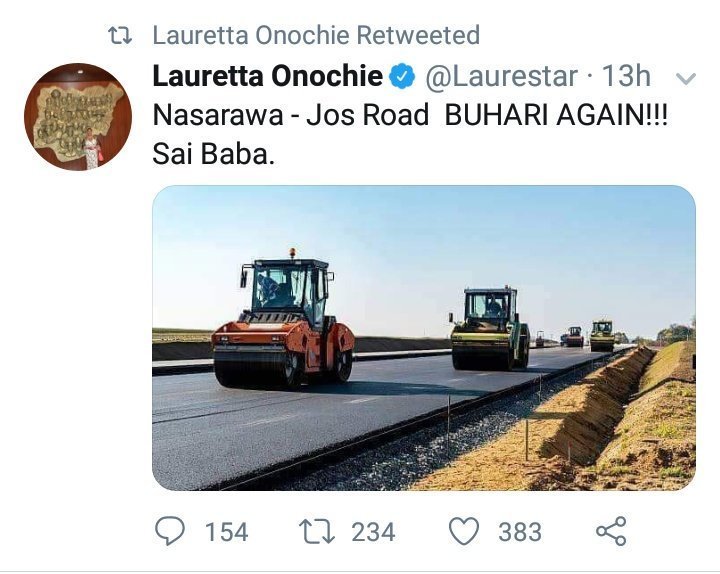
President Buhari’s Personal Assistant on Social Media, Lauretta Onochie, in September 2018, tweeted a picture of an asphalt road being constructed.  She captioned it “Nasarawa-Jos Road”, giving the impression that it was a road constructed by the government, but it is actually a stock photo uploaded to Getty Images in November 2015.

The inaccuracy triggered a wave of sarcastic tweets under the hashtag #TweetLikeLaurettaOnochie. She then pulled down the tweet and apologised for the “big mistake” saying “it won’t happen again”.

Onochie’s tweet wrongly crediting the federal govt. for a foreign road project

But, it has happened again and again as  many of Onochie’s other tweets since then have also included misinformation, such as one in December 2018 showing foodpacks bundled with N500 notes. She claimed Atiku Abubakar,  PDP presidential candidate in the 2019 election, had shared the money with voters. 

It turned out that the picture was not taken at an Atiku campaign rally but had actually been put out in February 2017 by a Lagos – based charity organisation during an outreach.

Though the President mentioned “fake news” as a security challenge in August 2019, he reappointed Onochie along with several other media aides shortly thereafter. Together the aides command a Twitter following of over 1.7 million, providing a considerable platform to any misleading information they might share.

How we conducted our research

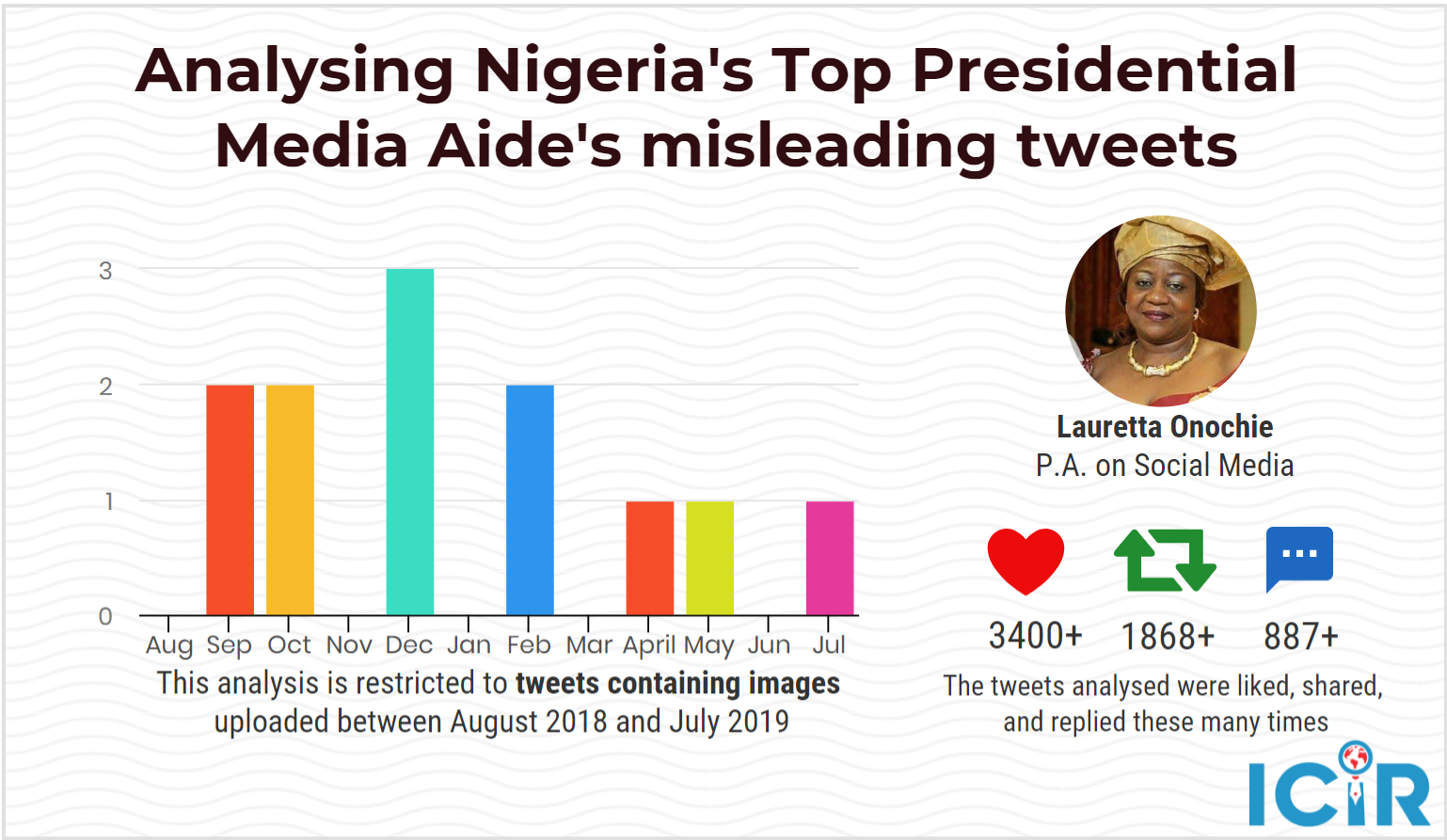
Using Twitter Media Downloader, a Google Chrome extension that downloads images in bulk from particular users, The ICIR studied 1,058 images uploaded by Onochie between August 1, 2018, and July  31, 2019.

In at least 12 cases, she had used inaccurate pictures. This was determined mainly by scouring the internet for instances where the pictures had been used before in an attempt to locate the original source. (Note: Learn how to conduct a reverse image search here.)  

After the search, the findings were brought to Onochie’s attention through a phone interview, but she declined to comment on them, choosing rather to insult the reporter.

“You must be very stupid,” the presidential aide replied curtly, before ending the call.

“I think you need to take your 419 [fraud] somewhere else; the FBI will soon be on your case,” she added minutes later during a second conversation.

Misleading pictures

Mishmash of housing photos

Four pictures appeared on Onochie’s timeline in September 2018 showing what was suggested as low-cost housing projects in the Federal Capital Territory, FCT, funded by the Federal Government.

But one picture was first uploaded in April 2014 by the Lagos State Home Ownership Mortgage Scheme. The houses were built as part of the state government’s Rent-to-Own Programme that supports first-time buyer residents. (Note: Here is another picture of the structures under construction.) 

Another picture is actually of a bungalow at the Sir Michael Otedola Housing Estate in  Odoragushin, Lagos. Former Lagos State governor Akinwunmi Ambode was photographed inspecting the estate in November 2016.

A third picture dates back to at least 2016 and has been used in articles about housing projects in Malaysia, Guyana and Kenya. The ICIR traced the last picture, to affordable housing that was planned for Revelstoke in British Columbia, Canada.

None of the four pictures, therefore, show housing projects in the Federal Capital Territory, Abuja.

Borno solar panel manufacturing plant or…

In April 2019, Onochie shared a picture with her followers in which she praised then Borno State governor Kashim Shettima for launching “Africa’s biggest Automated Solar Panel manufacturing plant”.

The tweet was liked 1,309 times and shared by 587 users of the social media platform.

Checks, however, show the picture that is credited to senior airman Larry E. Reid Jr (staff sergeant at the US Air Force), is over 11 years old and depicts a solar power plant in Las Vegas in the US. 

‘Clashes’ actually fuel subsidy removal protest

Misleading picture purportedly of communal clashes in Cross River

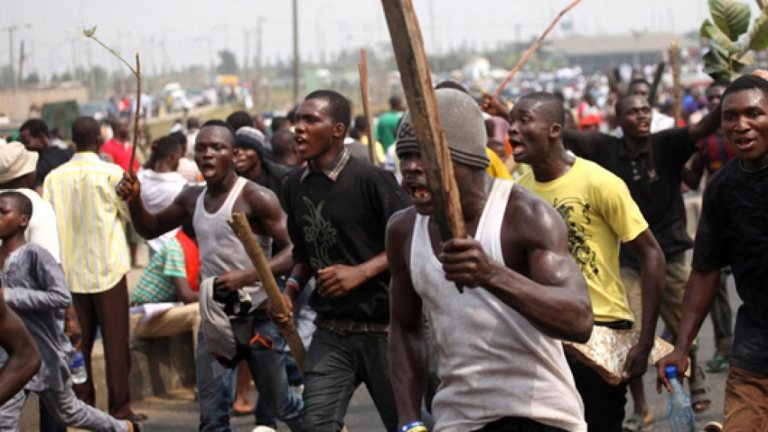
In July 2019, Onochie uploaded a picture with a caption lamenting the loss of lives to inter-communal clashes in Cross River State.

However, the picture was taken in January 2012 by Reuters photographer Akintunde Akinleye. It shows protesters chanting slogans “as they march through Ikorodu road during a protest against a fuel subsidy removal in Lagos”.

Doctored image

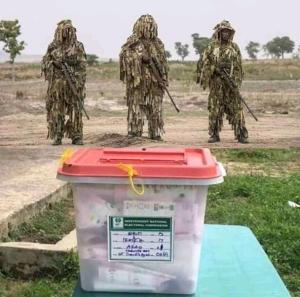
Two days before the presidential election in February 2019, Onochie shared a picture on Twitter which seemed to show three soldiers dressed in heavy camouflage guarding a ballot box.

“Self-explanatory,” said her caption, “God bless Nigeria.”

The tweet came after Buhari had instructed the security agencies to deal with anyone who attempted to disrupt the election and said whoever tried snatching ballot boxes did so “at the expense of his life”.

Scrutinising the picture reveals that it is a combination of two photos.

The photo of the soldiers in ghillie suits dates back to April 2018 when it was taken by AFP freelance photographer Stefan Heunis at a military demonstration held in Abuja. It was joined to a picture of a ballot box used at St. David’s Anglican Primary School, Afao, during the 2018 gubernatorial elections in Ekiti. This was uploaded by TheCable in July 2018 to its liveblog of the collation process.

The misleading combination went viral, with a number of blogs sharing it as though it were genuine. 

Obasanjo misattributions

Onochie twice shared quotes supposedly from My Watch, the three-volume memoir of former president Olusegun Obasanjo that was published in 2014.

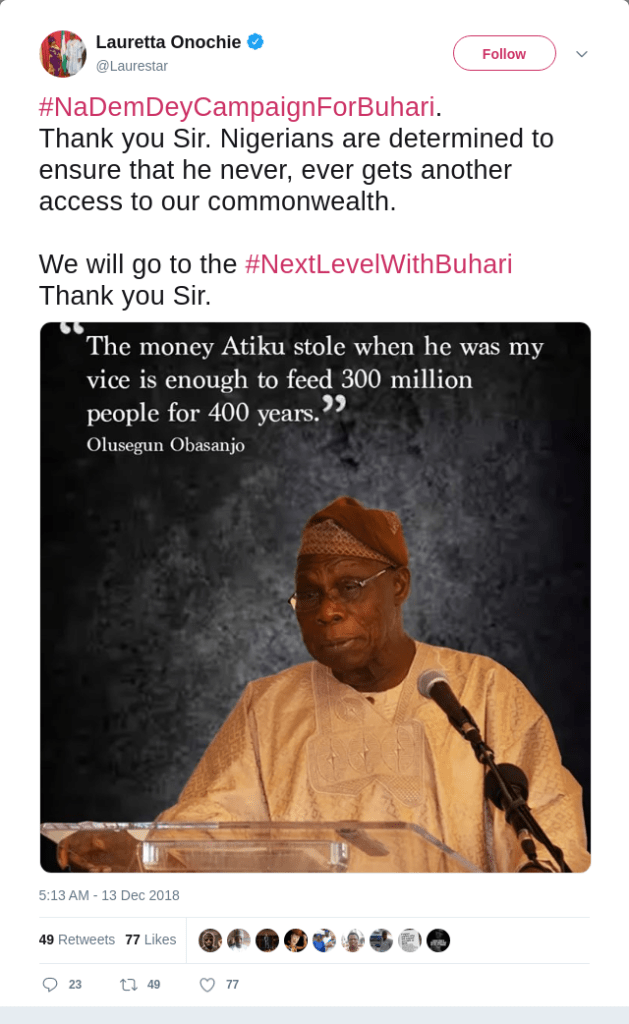
In December 2018, she shared an image of Obasanjo with a quote credited to him: “The money Atiku stole when he was my vice is enough to feed 300 million for 400 years.” (Note: Though the source of the quote was not mentioned, several other posts claimed it is from pages 31 to 32 of My Watch, Volume 2.)

Again, in February 2019, she uploaded a Facebook status screenshot that said “‘Atiku becoming president is like hearing that a former armed robber is now your bank manager’ – OBJ (My Watch, page 49)”.

The ICIR reviewed the pages cited, which didn’t contain anything close to the quotes tweeted. Pages 31 and 32 narrate how Obasanjo settled on Abubakar as his running mate and the regrets he later had. It contains some unpleasant remarks about Abubakar -mentioning a “somewhat shadowy” parental background, propensity to corruption and poor judgment – but does not indict him for large-scale stealing during his time in power.

Pages 49 of all three volumes make no mention of Abubakar or his likeness to an armed robber. 

Other excerpts published from the book about Abubakar also do not contain the two quotes shared by Onochie. The quotes are, thus, misattributed.