The Benue State Police Command says 24 persons have been arrested and 19 of them are already in court following the New Year’s Day massacre by suspected herdsmen.
Fatai Owoseni, Commissioner of Police in the state, made this known during a phone interview on Channels Television’s Sunrise Daily on Thursday.
Owoseni said that there was relative peace in almost all the parts of the state as a result of the collaborative efforts of the various security agencies.
“A total number of 24 suspects have been arrested in connection with some of these cases, which border on culpable homicide, grievous hurt, and mischief by fire; the total number is 24. The number that have been arraigned in court are 19 while five of the cases are still being investigated,” Owoseni said.
“At the moment, we are witnessing relative calm and all efforts have been put in place, structures have been put in place, to enforcing the curfew. And secondly, partnering and interacting with the different segments of the society to let everybody know that criminality is criminality, crimes are crimes, criminals are criminals, and they cannot be ‘colourated’ in any manner, either religiously, politically and ethnically.
“We all have a duty to face criminal elements and not to ‘colourate’ whatever they do and whoever they are.
“We are working assiduously to put all the bits and pieces of information and evidences we are gathering from our interrogation together, with a view to really ascertaining what could have led to that incident and the motive behind the incident, and as well promptly round up these criminals who committed the dastardly act, and ensure that they are brought to justice.”
Owoseni, who was former commissioner of Police in Lagos State, was posted to Benue State Police Command after the New Year’s Day attacks, to help calm things down.
He worked briefly with the head of the Force Criminal Intelligence and Investigation Department at the Police headquarters, Abuja.
I have never been a fan of legislative hearing in Nigeria. And this is not because such hearings are useless. Far from it; legislative hearings are actually good in exposing corruption and official wrong-doings, and could help a patriotic legislature draft bills to enhance good governance.
One recalls the hearing organized last year by a senate adhoc committee to investigate use of funds for the rebuilding of the North East. The committee, chaired by Shehu Sani, unearthed how a company owned by the former Secretary to the Federal Government, Babachir Lawal, was awarded contracts by a federal government committee of which he was a key member. The public hearing eventually forced the presidency to suspend, and later sack, him.
I also recall a public hearing organized by a committee in the sixth senate to probe the privatization of public assets by the administration of former President Olusegun Obasanjo. The committee led by Ahmed Lawan (now majority leader) took over the front papers of the national dailies for weeks. The committee exposed how government officials willfully mismanaged the privatization process for personal benefits.
One can make reference to one or two more instances since 1999 when a national assembly committee conducted investigative hearings that exposed official corruption.
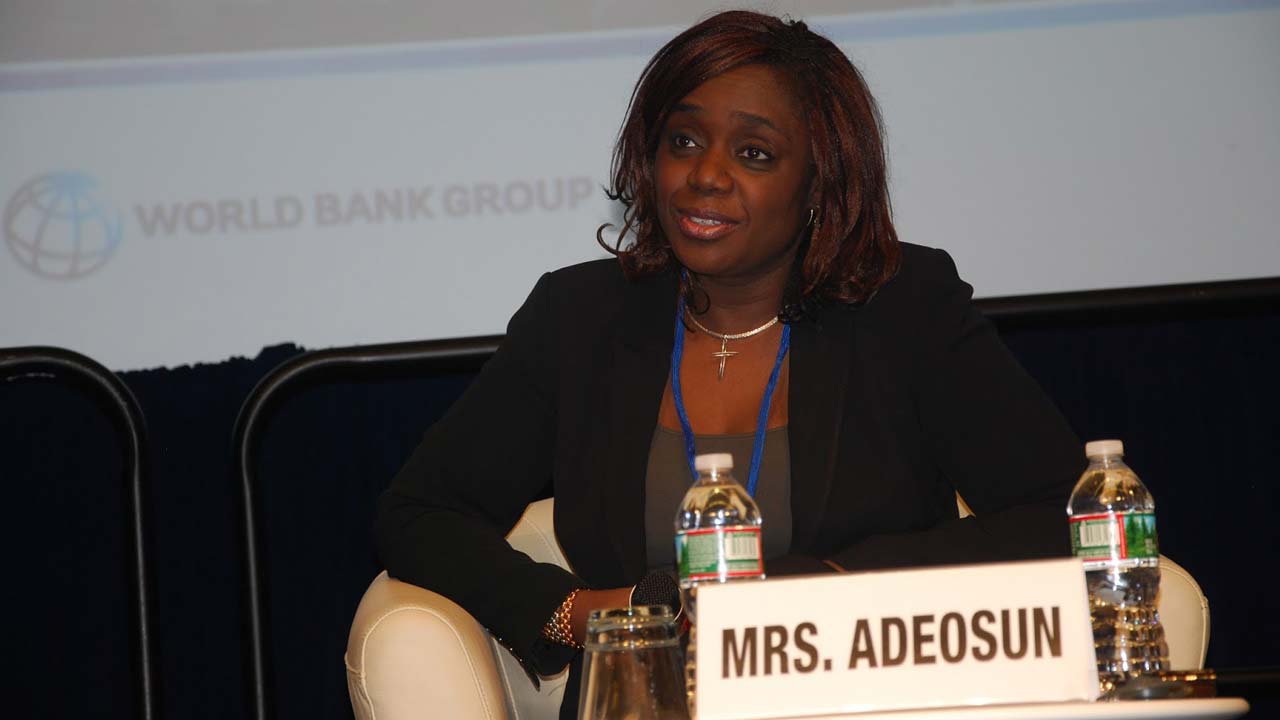
But the public hearing being conducted by the House of Representatives on the suspension of Mounir Gwarzo as Director General of the Security and Exchange Commission (SEC) by the Minister of Finance, Kemi Adeosun, is far from the class of committee hearings that can be described as patriotic or even in the line of legislative duty. I watched in shock as members of the Capital Market and Institutions Committee of the House grilled the minister and senior staff of SEC on live television on the legality of the suspension of Gwarzo last Tuesday.
The hearing followed the suspension of Gwarzo as DG of SEC and his claim that he was victimized by Adeosun because he took disciplinary actions on some companies linked to her.
The hearing that was on live television on Tuesday was to say the least, appalling. For an administration that came to power on the promise to fight corruption, it is unfathomable that a legislature it controls is questioning a minister for suspending a government appointee after documentary evidence appeared to link him with abuse of office.
Anyone who watched the hearing and listened to the legislators ‘interrogate’ the minister and the Director of Legal Services of SEC on the legality of Gwarzo’s sack must come to the conclusion that the legislators had a premeditated agenda. It was clear from the tone and contents of the questions asked that the committee had sided with Gwarzo, and that the intention of the hearing was to intimidate the minister into reversing the suspension and preventing Gwarzo’s sack.
First, if Gwarzo thinks his suspension was illegal- and he is not a lawyer- he should have gone to court. More shocking is the fact that the members of the committee did not appear to have done any research or sought expert advice before conducting the hearing. They did not ask questions based on any position of knowledge. They looked and sounded as ignorant as any layman on the issues they were probing. And that was why when the Director of Legal Services of SEC, Christopher Gabriel, justified the minister’s actions, the members didn’t have any coherent response.
Adeosun’s explanations for her action ought to have embarrassed the legislators because from all she said, the suspension was the most reasonable option to take. Adeosun stated that Gwarzo remained a director of a company and was still signing cheques on behalf of the company as DG of SEC against public service rules! Not only that, Gwarzo also allegedly gave contracts to his wife’s company!
Even though Gwarzo claimed that he had resigned as director of the company, Adeosun said documents from Corporate Affairs Commission (CAC) and banks put a lie to his claim.
It is shameful that instead of Gwarzo, it was Adeosun and other SEC top officials that were put on the spot by the legislators; they were the ones being pressured to justify their action. Members of the committee led by its chairman, Tajudeen Yusuf, behaved as if they were commissioned to protect Gwarzo.
How can the House of Representatives, which claims to be supporting the Muhammadu Buhari administration in its fight against corruption, waste public funds by allowing this kind of hearing in a sector that is hyper-sensitive to corruption? Do legislators ever know where to draw the line? Do they have any understanding of governance issues?
This was the suggestion of Adeosun when she said in her introductory remarks that it was unfortunate that the matter was brought for public legislative hearing. If the legislators meant well for the capital market and the country, and they genuinely wanted a positive intervention, they could have done this quietly without the drama of a public hearing.
The attempt by the legislators to link Gwarzo’s suspension to his action against a company Adeosun owns some shares is pathetic and cheap. It portrays some of our legislators as intellectually shallow and unpatriotic. The reasons for Gwarzo’s suspension were stated in the letter he got. Neither Gwarzo nor the legislators brought out any information that disputes the reasons for his suspension.
So what is more important for the legislators is the suspension of Gwarzo and not the integrity of the capital market regulator? Is there a law or an act of parliament that forbids a serving minister from owning shares in a company? What is the purpose of asking the minister during the hearing to name the companies where she had friends or own shares if not to find other reasons for Gwarzo’s suspension that could nail the minister?
The chairman of the committee also had a prick of conscience when he said at the close of hearing that they were not on witch-hunt. But this was exactly the impression members of the committee gave of their mission. More than this, they also gave the impression that the national assembly had become a roadblock for anti-corruption.
Of the estimated 27 million victims of human trafficking around the world, about 875,500 are in Nigeria.
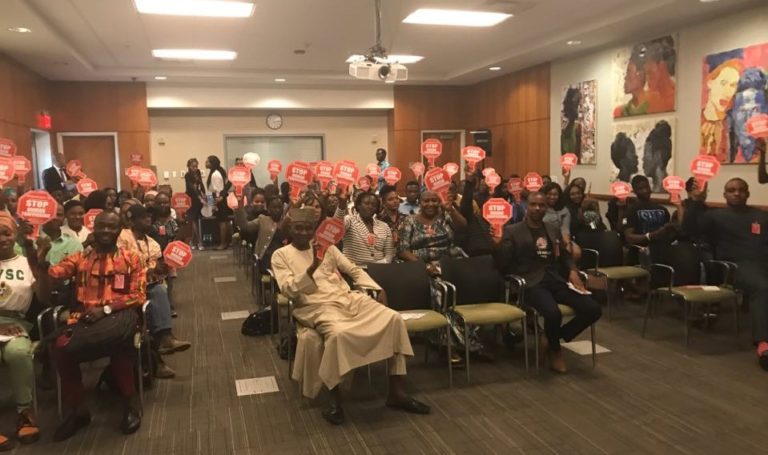
This was revealed on Tuesday at a one-day interactive discussion to commemorate the 2018 US National Human Trafficking Awareness Month organised by Devatop Centre for Africa Development in partnership with the US Embassy.
The event, themed ‘Fostering action against human trafficking and irregular migration’, was targeted at civil society organisations, youth, educators, religious leaders, law enforcement agencies and interested individuals.
Joseph Osuigwe, Executive Director of the group, stressed how thousands of Nigerian youth die as a result of irregular migration and smuggling while crossing the Mediterranean sea, desert or dangerous roads in search of greener pasture.
He noted that over 27 million women, girls, men, and boys are currently victims of human trafficking across the globe.
“They are bought and forced into prostitution, labour exploitation and child pornography,” Osuigwe said.
“For years, human trafficking has continued to thrive in the shadow and silence of others. Eighty percent of the victims are young people between the ages of six and 24.
“Nigeria is a source, transit route and destination of people trafficked for sexual and labour exploitation. Millions of Nigerian young people are vulnerable to human trafficking as a result of insurgency, community crises, poverty, maltreatment at home, family crises and unemployment.”
Orakwue Arinze, Director of Public Enlightenment, National Agency for the Prohibition of Trafficking in Persons (NAPTIP), who was a discussant at the event, said the urge to ‘hustle’ and ‘hammer’ amidst other factors like poverty, collapse of social infrastructure, denial of social amenities, neglect of moral and cultural standards force the youth to do anything it takes to get them out of the country in the erroneous belief that everything is fine abroad.
Despite efforts to curb human trafficking and illegal migration, the problem still persists. Kolawole Olatosimi, North Central Coordinator, Network Of Civil Society Organisations Against Child Trafficking, Abuse and Labour (NACTAL), blamed this on lack of a social safety net backed by the law.
He noted that the Federal Government’s social intervention programme of giving unemployed youth N5,000 and feeding primary school children are not backed by law and can be thrown away by any incoming government.
Ikenga Ngozi, a legal practitioner who is also the Chairperson of International Federation of Women Lawyers, Abuja branch, spoke on the legal aspects of the anti-human trafficking campaign. She described human trafficking as a violation of human rights.
Similarly, Imaobong Ladipo-Sanusi, Exeecutive Director, Women Trafficking and Child Labour Eradication Foundation (WOTCLEF), spoke about the foundation’s contributions to the fight against human trafficking.
The United States Senate designated January as Human Trafficking Awareness Month, dedicated towards raising awareness on the need to bring the menace to an end.
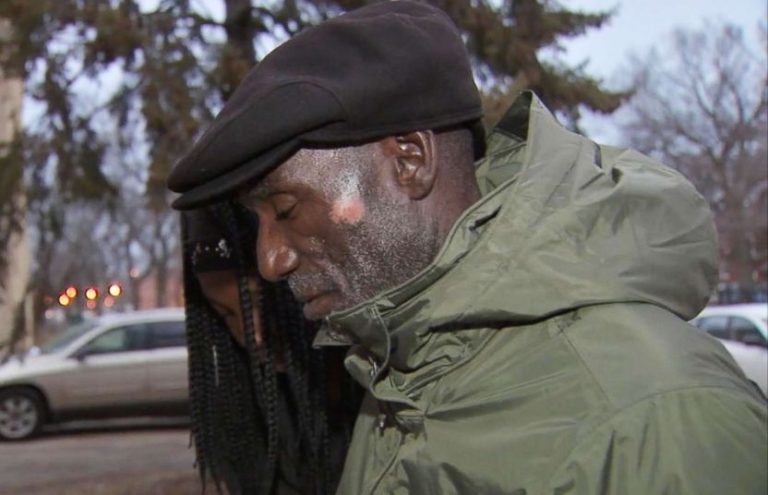
David Ukesone, a 71-year- old Nigerian, has narrated how Emirates Airline flight crew punched and taped his mouth while aboard a flight from Dubai to Chicago to reunite with his family.
According to Howard Schaffner, his lawyer, the septuagenarian had just received a visa to enter the US and was travelling to join his wife, who had immigrated four months earlier. His adult son and daughter had also immigrated.
According to ABC news, Ukesone, a retired police officer in Nigeria who had never been in a flight in the last 35 years, was brutalized by flight attendants because he sat in a wrong seat.
The incident happened on January 23 after the victim left Nigeria en route Dubai for the US.
He was eight hours away from landing at Chicago’s O’Hare International Airport when a dispute with flight attendants turned hostile.
“He apparently sits in the wrong seat and was told to change seat by a flight attendant,” Schaffner said. “He didn’t think he was in the wrong seat and there was an argument and, at some point, he was hit.”
Though Emirates Airlines released a statement confirming an incident did occur, it said a passenger had to be restrained by cabin crew due to unruly behaviour during the flight.
“Emirates can confirm that a passenger on flight EK235 from Dubai to Chicago on 23 January had to be restrained by cabin crew due to unruly behaviour during the flight,” it said.
“The passenger was handed over to the authorities on arrival in Chicago. The safety of our passengers and crew is of the utmost importance and will not be compromised.
“We would like to take this opportunity to thank the other passengers on the flight for their understanding, in particular the individuals who had assisted our crew during the flight.”
But Schaffner said Ukesone first flew from Nigeria to Dubai “with no incident at all”.
After a layover on January 23, Ukesone received a boarding pass to sit in seat 35D on Emirates flight EK 235, which departed at 9:45 p.m. for Chicago.
The dispute began when he abandoned his seat to use the bathroom at the rear of the plane. When he returned, Schaffner said, he miscalculated and sat in a seat that wasn’t 35D.
Ukesone sat down in a seat that was “very close” to 35D, Schaffner continued, but did not attempt to upgrade himself to first class or occupy a seat meant for the crew.
An exchange between Ukesone and a flight attendant, he added, left him confused.
“He was asked to move and he wants to take his bag in the overhead compartment with him,” the attorney said.
He also believed he was “in the right” and didn’t understand why they wanted him to move.
“They told him he was in the wrong seat and they laid hands on him to move him and that’s when everything escalated,” Schaffner said.
Ukesone, he said, speaks and understands English, but “he has some difficulty understanding” it when it’s spoken by someone who isn’t Nigerian.
The argument intensified and, Schaffner said, a member of the flight crew allegedly struck him “at least once”, leaving a “large welt on his face”.
Ukesone also had “significant wounds on his wrists and ankles” that Schaffner believes were caused by a hemp rope allegedly used to restrain him from his ankles to his head.
Schaffner said Ukesone claims his “mouth was taped” and the flight crew allegedly left him alone to ride out the rest of flight “without any food or water”.
Once the plane arrived, the Nigerian man’s family waited in the international terminal for hours.
“He’s waiting for hours and he starts to check and asks people about his dad,” Schaffner said, adding that he ultimately was told that his father was pulled off the plane and admitted to the hospital.
When the plane arrived at Chicago O’Hare International Airport, Schaffner said Ukesone was wheeled out on a stretcher and taken to the University of Chicago Medical Centre, where he was allegedly treated for lacerations and bruising, and where he remained for several days.
The man was disoriented after being hospitalized, Schaffner said.
Until last week’s two international flights, Schaffner said it had been 35 years since Ukesone, a retired police officer, flew on an airplane.
He added that his client wasn’t on any medication, hadn’t drunk alcohol and has no history of mental illness.
“The man did nothing more than sit in the wrong seat,” his attorney said. “Even if he’s in the wrong seat you don’t have to beat the guy.”
Despite the airline’s statement that the passenger in question was turned over to local authorities, the victim’s attorney is unaware of any criminality.
Ukesone has not been charged with a crime, Schaffner said, and no police report or other paperwork claiming criminal behaviour has been produced.
His lawyer is planning to take legal action.
“There’s no question we’re going to file a lawsuit,” he said, expressing hopes that other passengers who flew with Ukesone that day would be bold enoguh to come forward.
Mounir Gwarzo, the suspended Director General of the Securities and Exchange Commission (SEC), on Tuesday insisted that Kemi Adeosun, Minister of Finance, has no power to remove him from office.
Gwarzo stated this during the House of Representatives hearing into the circumstances leading to his suspension.
“On whether the Minister can suspend me from office, the answer is no,” Gwarzo said when Tajudeen Yusuf, Chairman of the probe panel, gave him the opportunity to make his final comments.
However, Adeosun maintains that she, as the Minister of Finance, has powers to suspend Gwarzo, adding that she would be making recommendations to President Muhammadu Buhari based on the matter.
“Mr Mounir is not removed, he has been suspended and he is not the first DG of SEC to be suspended. In the absence of a board, the Minister does have powers to suspend,” Adeosun said.
WHAT THE INVESTMENTS AND SECURITIES ACT SAYS
A screen-grab of the relevant section of the Investment and Securities Act 2007
Section 8 (1) of the Investments and Securities Act 2007 provides how a Director General or any member of the SEC board could be removed: “A member of the Board shall cease to hold office if he (a) becomes of unsound mind; (b) becomes bankrupt or makes a compromise with creditors; (c) is convicted of a felony or any offence involving dishonesty; (d) is guilty of serious misconduct in relation to his duties; or (e) is a person who has a professional qualification, and is disqualified or suspended (other than at his own request) from practicing his profession in any part of Nigeria by the order of any competent authority made in respect of him personally.
“The President may at any time and upon the recommendation of the Minister remove a person to whom subsection (1) of this section applies: Provided no full-time member of the Board of the Commission shall be removed from office without the approval of the Senate.”
The Investments and Securities Act 2007, however, is silent on whether a Minister can suspend a serving SEC DG, pending investigation. In fact the Act did not make any provision for the suspension of a serving DG or commissioner.
On Adeosun’s remarks that “in the absence of a board, the Minister does have powers to suspend”, nothing in the Act supports this.
WHAT THE PUBLIC SERVICE RULES SAYS
A screen-grab of the relevant sections of the Public Service Rules
During Tuesday’s investigative hearing at the National Assembly, Gwarzo pointed out that the letter of suspension issued to him stated as follows: “This suspension is in line with the Public Service Rule 03405 and public service rule 03406 pending the conclusion of the investigation.”
He, however claimed that “this public service rule that she quoted does not exist in the Public Service Rule. Her intention is to make reference to 030405 rather than 03405. That 030405 does not give the Honourable Minister the power to suspend the DG of SEC”.
Gwarzo
ICIR found Gwarzo’s claim to be true. There are no rules 03405 and 03406 in the Public Service Rules, and rules 030405 and 030406 do not confer on the minister the express authority to suspend a DG.
According to Rule 030304 of the PSR, “(a) It shall be the duty of every officer to report any case of misconduct that comes to his/her notice to an officer superior to the officer involved.
(b) When an officer’s misconduct is brought to the notice of his/her superior officer, it shall be the duty of that superior officer to report it to the Permanent Secretary/Head of Extra Ministerial Office without delay. If he/she considers it necessary that the officer should be interdicted, such recommendations shall be made in the report.
(c) On receiving the report, the Permanent Secretary/Head of Extra Ministerial Office shall take action in accordance with Rule 030302-030306 as appropriate and, if necessary, shall interdict the officer.
(d) At the appropriate point in the investigation, the officer may be suspended in accordance with Rule 030405.”
Rule 030405 states: “(a) An officer who is under interdiction or suspension shall notify his/her Permanent Secretary/Head of Extra Ministerial Office of his/her intention to leave his/her station. He/she shall however not leave the country without the specific approval of the Head of the Civil Service of the Federation.
(b) An officer under interdiction is also responsible for keeping his/her Ministry/Extra-Ministerial office informed of the address at which instructions to him/her can be delivered.
(c) If he/she fails to comply with the instructions delivered to him/her at such address within seven days of such delivery, he/she will be regarded as absent from duty without leave.”
Rule 030406: Suspension should not be used as a synonym for interdiction. It shall apply where a prima facie case, the nature of which is serious, has been established against an officer and it is considered
necessary in the public interest that he/she should forthwith be prohibited from carrying on his duties.
Pending investigation into the misconduct, the Federal Civil Service Commission or the Permanent Secretary/Head of Extra Ministerial Office (if within his/her delegated powers) shall forthwith suspend
him/her from the exercise of the powers and functions of his/her office and from the enjoyment of
his/her emolument.
Gwarzo also argued that the Public Service Rules cannot be used to suspend him since SEC has its own separate rules and regulations, as contained in the Investments and Securities Act. He quoted PSR 160103 to support his claims.
“If you look at the Public Service Rule, which is 160103, it clearly states that, for an institution that already has their own policies, they should be guided by that. My letter of appointment clearly states that my appointment will be governed by the provisions of the Investment and Securities Act. So, the question is, what instrument did the honourable Minister use or rely on in my suspension?” Gwarzo said.
Now, PSR 160103 states: “Parastatals are to retain and improve existing rules, procedures and practices in their establishments and ensure that there are no deviations from the general principles contained in the Public Service Rules. For example variations in probationary periods and maturity periods for promotion only reflect organizational peculiarities and not inconsistencies with the Public Service Rules. However in the absence of internal rules and regulations on any matter, the relevant provisions of the Public Service Rules shall apply.”
CONCLUSION
Going by the above rules, and by Adeosun’s narrative during the hearing, a prima facie case was established against Gwarzo after it was proven (through documents from the Corporate Affairs Commission as well as bank mandates) that he remained a director and shareholder in two separate companies while still DG of SEC. One of the companies, Outbound investments, had, in fact, transacted business with SEC by supplying diesel to the organisation.
Adeosun had also stated that a thorough investigation into the matter could not be carried out with Gwarzo still at the helm of affairs, and that there were information (not supported by evidence, though) that he was already moving documents away from his office, hence the need for him to be suspended.
It is also safe to say that since the Securities and Investments Act (cited above) is not clear on the suspension of the SEC DG, the ministry of finance was right to have relied on the Public Service Rules to suspend Gwarzo.
However, it appears Gwarzo has a valid point since his letter of suspension was signed by Kemi Adeosun, not the Federal Civil Service Commission or the Permanent Secretary of the finance ministry.
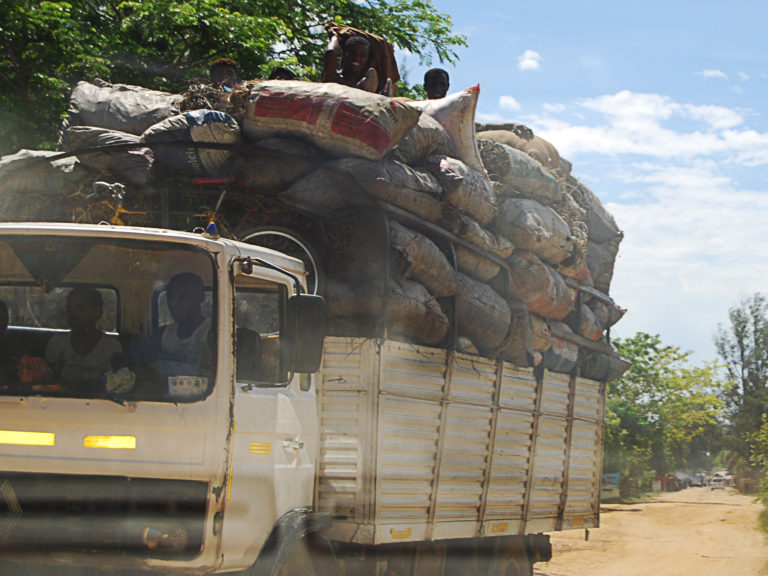
For the urban poor, charcoal provides an affordable source of energy for cooking. As rural farmers turn to charcoal production to meet urban demand, this seemingly lucrative business is depleting Nigeria’s forest resources, with far-reaching consequences that range from soil degradation, desertification to climate change.
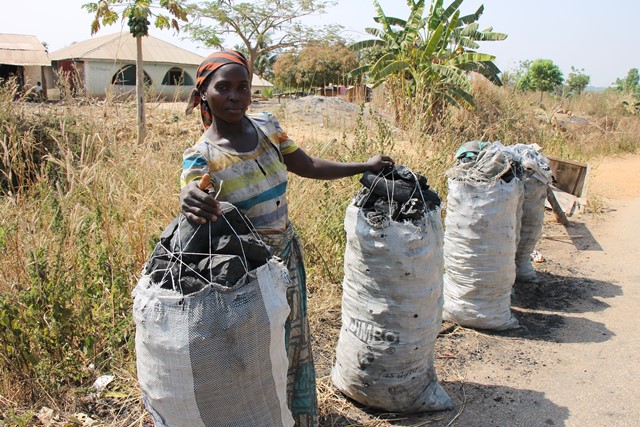
From the vantage point of her home, Esther Iliya darts towards a van that pulls up at Kampani Mailaba, a village along the Keffi-Akwanga Road in Kokona Local Government Area of Nasarawa State. The vehicle is parked where plenty bags of charcoal are displayed by the roadsides.
Iliya, a mother of five, produces charcoal, which she sells by the roadside. She has five bags on this day and makes N1,300 for each. The charcoal is a charred material she makes from cutting down trees and burning the woods through a local technique.
“Jesus gets the trees,” says Iliya when the ICIR asked her who owned the trees that she felled for the production of the charcoal.
In her community, production of charcoal is causing rapid deforestation – men and women alike having become charcoal entrepreneurs. But there are more women, she adds. “It gives more money than farming.”
FAMILY BUSINESS
The agrarian community has embraced a flourishing business of charcoal production. Almost every household in Kampani Mailaba produces the commodity. It gives a regular income than farming because it is produced all year round. Farming, meanwhile, is seasonal and takes longer time for the farmers to earn income from it.
“We make more money from charcoal but the money doesn’t last,” explains Dorcas Daniel, who joined Iliya in rushing to make a sale to the driver of the van that made a stop where they displayed their goods.
“This money I have now,” says Daniel as she opens her palm to show the N2,600 she made from selling two bags, “if I take it to the market to buy things, I won’t come back with N1. We’re still doing our farming but we’re making charcoal to get quick cash.”
When charcoal production started in the community more than a decade ago, it was done by men. Now, women and their children have outnumbered the men in the production of charcoal.
“We use the money we make from charcoal to buy foods, pay schools and help our children,” says Tina Barau. Her household farms groundnut, yam, and rice, which are cultivated during rainy season. This dry season, she is busy with the production of charcoal, along with her children who are on school holiday.
The farmers are turning to charcoal production to meet a growing demand for affordable energy in urban areas. For many urban poor, charcoal provides a convenient, reliable, and accessible source of energy for cooking.
CHEAPER THAN GAS
Iliya poses by her charcoal
About 25 years ago, Abacha stove was invented in response to the scarcity of kerosene during the early years of the administration of Sani Abacha, the late military dictator. The local cooking stove uses charcoal. Since this invention, charcoal has become the main source of domestic fuel among poor people in urban areas.
Gas and electricity are the most recommended clean energy sources for cooking but the poor can neither afford these energy resources nor buy the devices to use them. Poor households in urban settlements resort to kerosene and charcoal. But since kerosene has become expensive with a litre costing N210, charcoal offers a cheaper option.
“Charcoals last more than gas,” argues Faith Jato, a charcoal retailer at Mpape, one of the biggest slums in Abuja. She buys a bag of charcoal at N2,000 from the dealers and sells it in smaller quantities of N50 and N100. From this retail, she makes a profit of N300 to N500 per bag.
“This N50 iron charcoal will cook a pot of rice,” she adds, pointing to a stack of charcoal wrapped in black polythene bags and displayed on a table in front of her shop. In addition to charcoal, she sells Abacha stove for N2,000.
Charcoal is one of the main types of wood fuel. While most people in rural areas use firewood, people in urban areas prefer charcoal because it is more convenient and less smoky. But charcoal, just like firewood, produces indoor air pollution, a leading cause of deaths in the country. According to the World Health Organization (WHO), 95,300 Nigerians die annually from indoor air pollution.
“When you are burning charcoal, it smokes; and the smokes come with different types of dangerous gases,” says Emmanuel Unaegbu, an environmental activist. “They are poisonous gases that cause different kinds of problems when you inhale, such as respiratory disease, heart disease, and cancer.”
Unaegbu adds that apart from the diseases, charcoal has an unpleasant odour. “The smell from it disrupts ambiance air quality.”
A study based on evidence from the National Demographic and Health Survey (NDHS 2013) shows that approximately 0.8% of neonatal deaths, 42.9% of post-neonatal deaths, and 36.3% of child deaths could be attributed to the use of solid fuels (charcoal, firewood, crop wastes, sawdust, coal, and dung).
The inefficient use of solid fuels for cooking is responsible for the deaths of 4.3 million people annually in the world, according to WHO. And about 3 billion people globally still depend on these dirty energy sources for cooking and heating their homes.
LOGGING FOR CHARCOAL
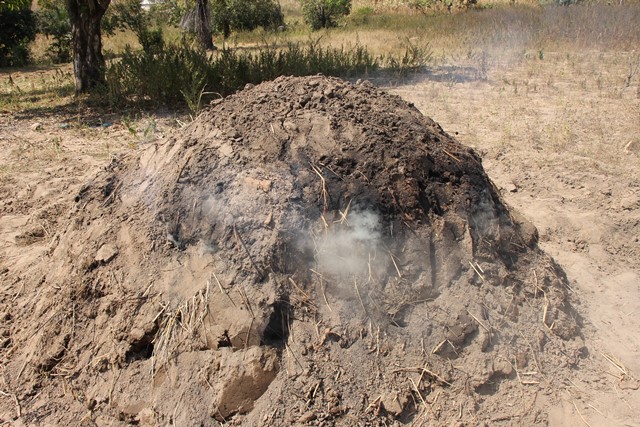
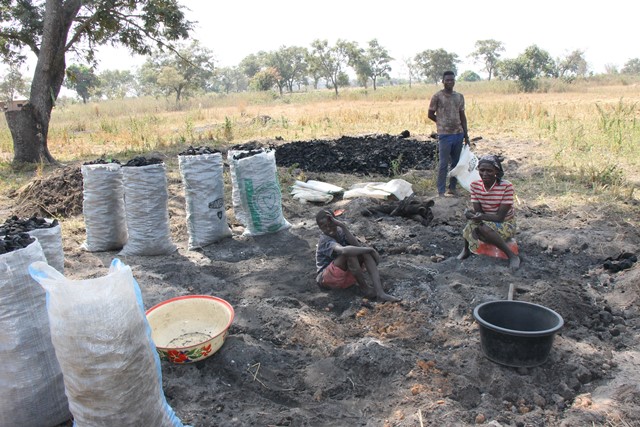
Two heaps of wood covered with sand and one uncovered for charcoal production
Unchecked felling of trees without replanting is causing alarming deforestation in Mandara, Mararaba Angwan Itache and Kompani in Nasarawa State and Ogbe in Kogi State, which the ICIR visited. These are just a few of the locations in the country where charcoal is produced in commercial quantities.
For each production cycle, Ankali Joseph says she cuts down between 20 and 30 trees but makes less than 70 bags of charcoal. If the trees are in another person’s farmland, she pays about N200 for each tree. Thereafter, she pays a chainsaw operator N3,500 to fell the trees and cut the trunks into sizes of about three metres long.
With the help of her five children, the logs of wood are gathered in groups and arranged into rectangular heaps. She allows the woods to dry for at least a month before burning them for charcoal, but sometimes she makes charcoal from the fresh woods. All she needs is to have access to water, grass and moist soil.
Like other producers, Joseph uses earth mound kiln to control the intake of air during the burning of the woods. The woods are stacked in heaps. The piles are covered with a layer of dry grass and wet soil. About two or three holes are made in the covered heap to ensure smooth burning. This method enables her to control air intake to ensure incomplete burning, otherwise the woods will burn to ashes if they are exposed.
“If they are dry woods they will burn in four days, but fresh woods take up to one week,” says Joseph. She explains that when the burning duration is completed, she uses water to extinguish the fire. The resulting charcoal is harvested and bagged.
BAD RECORD FOR NIGERIA
Earth mound kiln
Joseph and other charcoal producers are ignorant of the negative impact of their activities on the environment. However, the forest guards, who are employed by the government to protect the forests, collect money from the charcoal producers and never check indiscriminate felling of trees.
The number of trees wasted for the production of charcoal is extremely high. The producers told the ICIR that no single tree yields up to four bags of charcoal and these hardwood trees take decades to grow.
Nigeria is one of the leading countries with the highest rates of deforestation. As of 2005, Nigeria had the highest rate of deforestation in the world, according to Food and Agriculture Organization (FAO). The rate of deforestation in Nigeria is estimated at 400,000 hectares annually.
DAMAGE HERE, IMPACT ELSEWHERE
Joseph bagging charcoal with her children in the bush
Charcoal production has far-reaching consequences, including soil degradation, desertification, and climate change.
This is why Oluwatosin Kolawole, President of Climate Aid/Initiative, is unhappy that people are felling trees to make income from charcoal without considering the long-term negative effects on the environment.
“The consequences are beyond the indoor air pollution from burning charcoal,” says Kolawole. “The problem is the forests they are destroying to get the charcoal. Some of the trees have been in existent for 50 to 100 years before they can give you the quality you need. Now we are cutting down trees but we are not planting. Even if we are planting, we will not get the benefit until 20 to 30 years.
“When people go the forest to cut down trees, they are reducing the ability of Earth to maintain its own temperature and that is why we have global warming and its attendant effect of climate change. One of the effects of whatever evil we do to the environment is that sometimes the impact is not localised. You cut down the forest here; people feel the impact in another place.
“We can’t live without the services that the trees provide. They are our support system. The trees give us oxygen. In order words, they take carbon dioxide and give us clean air. They give us beauty and shade from the sun.
“Trees are like shade to the soil such that the intensity of the heat is not hitting directly on the soil. When the intensity of the heat is directly in the soil, it dries up moisture in the soil and when there is no moisture, nothing can grow.”
David Terugwa, founder of Global Initiative for Food Security and EcoSystem Preservation, told the ICIR that the problem is ignorance. He laments that logging for charcoal is causing soil infertility in places where the commodity is being produced.
“The same local people who left farming because it is no longer productive as a result of climate change are now going to fell trees to use for charcoal production,” says Terugwa. “They earn some money but go back again to use that money to buy food at an expensive rate.”
GOVERNMENT’S INACTION
A retail charcoal shop that also sells Abacha stove at Mpape, Abuja
Government’s indifference to reduction of charcoal production shows lack of commitment to the achievement of Sustainable Development Goals (SDGs). SDG 15 stresses the urgency to sustainably manage forests, combat desertification, halt and reverse land degradation, halt biodiversity loss while SDG 13 also demands urgent action on climate change and its impact.
Ogadinma Iroka, a development practitioner and consultant, says Nigeria is not taking decisive actions in combating climate change.
“One would wonder why many people, in a country like Nigeria with all the abundant sources of decent and much better environment-friendly cooking energy, have over the years been resorting to cutting down trees for cooking fuel,” Iroka says.
The previous administration of Goodluck Jonathan initiated the national clean cooking scheme to stop the use of firewood and charcoal for cooking and prevent the depletion of forest resources through indiscriminate felling of trees. Through this scheme, the government aimed to distribute over 20 million clean cook stoves across the country by 2020.
In November 2014, the Federal Executive Council approved N9 billion for the purchase of 750, 000 clean cook stoves and 18,000 wonder bags to rural women. Unfortunately, more than three years after, the clean cook stoves have not been distributed.
The contract for the supply of clean stove was given to Integral Renewable Energy Services Limited but the Ministry of Environment later cancelled the contract in June 2015. The ministry said that the contractor failed to deliver the required quantity despite receiving a mobilisation fee of N1.3 billion. Following the cancellation, the contractor sued the Ministry of Environment for violation of the contract.
The contractor already imported a certain quantity of the clean cook stoves before the contract was terminated. Follow the Money, a non-governmental organisation, confirmed that the contractor imported only 45,000 clean cook stoves, which were kept at the Velodrome of the National Stadium, Abuja.
“Corruption killed the clean cook stoves initiative just the same way corruption kills good things in this country,” says Terugwa.
He argues that the clean cook stove initiative is the still the best means of preventing excessive felling of trees for charcoal production, adding that people resort to charcoal because they do not have alternative sources of energy for cooking.
“Sometimes you still don’t blame them,” he says. “They must cook and eat.”
Smart Amaefula, President of Climate Transformation and Energy Remediation Society, urges the Federal Government to revive the clean cook stove scheme to prevent further depletion of forest resources.
“We have to start introducing alternatives,” he says. “If government distributes the clean cook stoves freely, people will begin to appreciate these alternative sources of energy. It will lead to awareness and mass production of clean cook stoves in the country.”
A total of 168 Nigerians were killed in clashes between herdsmen and farmers in Adamawa, Benue, Taraba, Ondo and Kaduna states in January 2018 alone, the Amnesty International has said.
In a report released on Tuesday, the international rights organisation described Nigeria government’s response to the killings as “totally inadequate, too slow and ineffective, and in some cases unlawful.”
“The government must totally overturn its response to these deadly clashes to avoid this crisis getting out of control. They need to investigate and bring suspects to justice,” said Osai Ojigho, Director Amnesty International, Nigeria.
“Hundreds of people lost their lives last year, and the government is still not doing enough to protect communities from these violent clashes. Worse, the killers are getting away with murder.
“In some cases where the Nigerian security agencies did respond to communal violence, they used excessive or unlawful force, resulting in even more deaths and destruction.”
On 4 December 2017, Nigeria’s air force sent fighter jets to fire rockets at villages as a “warning” to deter spiraling communal violence, as hundreds of herdsmen attacked at least five villages in Adamawa State to avenge the massacre of up to 51 members of their community, mostly children, the previous month in Kikan.
Ojigho said an Amnesty International team visited the villages in the aftermath of the air raids and gathered witness testimony from residents, who described how they were attacked by a fighter jet and a military helicopter as they attempted to flee.
“Launching air raids is not a legitimate law enforcement method by anyone’s standard,” he said. “Such reckless use of deadly force is unlawful, outrageous and lays bare the Nigerian military’s shocking disregard for the lives of those it supposedly exists to protect.”
He said Amnesty International was calling on the Nigerian Air Force, which has received intensive training from the UK and US militaries in recent years, to hand over the footage of the incident and all relevant information to the authorities, including the Attorney-General of the Federation and Minister of Justice for investigation.
“This is unlawful and excessive force on a catastrophic scale. It is yet another tragic example where Nigeria’s armed forces are found applying deadly military tactics to law enforcement situations,” he said.
“The Nigerian authorities must investigate these attacks and, where these investigations indicate criminal responsibility, prosecute those responsible and bring them to justice.”
He further revealed that the air raids occurred in the villages of Lawaru, Dong, Kodomti, Shafaron and Nzuruwei, where Amnesty International interviewed a total of 15 witnesses.
Locals in each village also provided Amnesty International with lists of the dead, which totalled 86 names.
Ojigho added that clashes between nomadic herdsmen and local farmers in 2017 resulted in at least 549 deaths, while thousands were displaced across Enugu, Benue, Taraba, Zamfara, Kaduna, Plateau, Nasarawa, Niger, Plateau, Cross Rivers, Adamawa, Katsina, Delta and Ekiti states.
He lamented that the violence had spiraled further since the beginning of 2018, with attacks and reprisals killing 168 people in Adamawa, Benue, Taraba, Ondoand Kaduna states.
Kemi Adeosun, Minister of Finance, says the suspension of Mounir Gwarzo, former Director-General of the Securities and Exchange Commission (SEC), has nothing to do with the ongoing forensic probe of Oando Plc as alleged.
Speaking while appearing before a House of Representatives’ investigative panel set up to examine the circumstances of Gwarzo’s removal, Adeosun said Gwarzo was not the first SEC DG to be suspended, adding that the action was to restore the confidence of investors in the Nigerian stock market.
Gwarzo had alleged that his suspension was due to his refusal to yield to Adeosun’s directives that he should drop the forensic audit of Oando plc, but Adeosun said this is not the case.
“Oando is a completely separate situation to (the suspension of) Mounir Gwarzo. Totally and completely separate,” Adeosun said.
“The allegation that I gave an instruction that the forensic audit should stop is laughable and I’m sure you saw the SEC team laughing because they know that that work is ongoing [on that] even as we speak. So it is not true. It is mischievous to even suggest that that was the case.”
Adeosun maintained that Gwarzo was suspended because there were evidences to prove that he serially violated public service rules.
For instance, she said Gwarzo is a director and a shareholder in two private companies, contrary to the rules of public service prohibiting such.
“On the 27th of October, 2017, we received a bundle of documents delivered to our whistle-blowing unit, making allegations, not only against Mr Gwarzo, but also against two other officers of the SEC,” Adeosun narrated to the legislators.
“On that basis I asked the head of the whistle-blower unit to investigate. We did not immediately suspended Mr Gwarzo because every allegation must be subject to some scrutiny.
“Due to the seniority of Mr Gwarzo and the potential impact of the matter, I asked them to go straight to level two (of investigation), which is: ‘you either prove the case or we throw this out’.
“They came back with evidence that suggested that there was a very real need to issue a query to Mr Gwarzo, which is the procedure. Mr Gwarzo was then queried, he responded.
“Unfortunately, his responses contradicted the evidence that we had at hand. For example, Mr Gwarzo claimed that he had resigned from the company, but the evidence we had from CAC (Corporate Affairs Commission) showed him to still be a director and shareholder.
“So, on that basis, we felt there was a need to do more work. I sent the team back again, and this explains the delay between his response and his eventual suspension. He attested that he had resigned in 2012, meanwhile CAC was still showing him to be both a director and shareholder, so we needed to get other evidence.
“So we then went to bank records and we found that Mr Mounir remained a signatory to that account. And we obtained evidence of banking transactions where he signed as a director. That, then, for me, became conclusive evidence that the position he had maintained in his memo was incorrect, or at least, unreliable.
“And on that basis, we had an internal meeting where we looked at all the evidence. At the same time, we were receiving information from the staff of SEC that documents were being removed, and we knew that we needed to do a thorough investigation, of course that investigation could not be done with Mr Mounir still at the helm of affairs in SEC, and that was when we took the decision to suspend Mr Mounir.”
Adeosun said that after the suspension, she set up an administrative panel of inquiry to further look into Gwarzo’s case, and that the panel had submitted a detailed report that she would transmit to the President for further action.
“Mr Mounir is not removed, he has been suspended, and he is not the first DG of SEC to be suspended. In the absence of a board, the minister does have powers to suspend,” she said.
Also, there had been allegations that Gwarzo, who was a commissioner in SEC before his appointment as DG, paid himself a severance package of N104 million before assuming his new appointment even when the commission’s Director of legal advised him against it.
“On the issue of the severance pay that he collected, we have investigated it. He made some positions that a similar thing was done in the Central Bank; we have gone to Central Bank, that was not the case,” Adeosun said.
“As far as we are concerned, the over-ruling of the recommendation of the Director, Legal, was improper. And if there was any contention, it should have been referred to the ministry to adjudicate. You cannot judge in your own case and then pay yourself. It’s never done. And there is no history of somebody collecting N104 million one day, and resuming on another desk, in the same organisation the next day.”
However, Gwarzo insisted that the Minister has no power to suspend him. He also stated that it was not his job to ensure that the CAC updates its database to reflect the fact that he had resigned as a director of the said companies as far back as 2012.
On the issue of his severance package, he maintained that he was statutorily entitled to it, having spent the required number of years as a permanent commissioner in SEC.
Gwarzo said that according to the regulation, any permanent commissioner who spends up to two years in office is entitled to a severance package. He noted that he was appointed Permanent Commissioner in January 2013, and spent over two years before his appointment as DG in May 2015, hence the legality of the severance package.
The hearing was adjourned to a later date for continuation.
Two years after the Federal Government handed over Delta Steel Company (DSC) to Premium Steel and Mines Company Limited — a consortium of private investors — to revive it and start production of steel for local and export purposes, the multibillion-naira outfit is yet to take off. YEKEEN AKINWALE, who visited the company situated at Owvian, Aladja town, Delta State, finds out that the company is still grappling with a financial crisis that looks intractable.
“Warri no dey carry last, na wetin we dey always talk, but for this Delta Steel Company matter, we don carry last,” quips Justice Iyasere, who looks towards the massive structure of the steel company with disappointment clearly etched on his face.
Although Iyasere, a community leader and local government chairman aspirant in Udu Local Government, is not one to give in to pessimism, he admits that it will take more actions than precepts to get the company running again — especially in the face of unending crises ranging from war by ex-workers, to huge debts to suppliers and threats from other interest groups.
Years of politicking, mismanagement and lack of interest by the Federal Government, he says, led to the collapse of what was once the pride of Delta State. If it were alive and running, Nigeria’s reliance on imported steel and aluminum products ought to have significantly reduced.
Its sales to Premium Steel and Mines Limited under the Federal Government’s privatisation programme, besides being opaque, is already a subject of litigation — communities hosting the company in Udu have instituted a law suit against Federal Government and Premium Steel and Mines Limited, to contest the sale.
At the moment, Nigeria spends N887 billion (about $4.5 billion) annually to import 25million tons of steel and aluminum products. This is not going to end soon except steel plants such as DSC start producing steel locally.
In 1980, when the plant was established and commissioned under the leadership of Fred Aghogho Brume, pioneer General Manager, it was designed to produce 1 million tons of liquid steel per year. It never attained this maximum production output. Its best performance was in 1983, when it produced 500,000 tons. Since then, the plant has been aground.
“In 1985, the highest steel production a day was 23 heat in the whole of Africa and in that year, Delta Steel was producing 21,” says Sam Agberhiere, one of its pioneer staff.
“If government is actually serious about steel making, by now we should have been one of the leading countries in the business. But the reverse is the case.”
From conception, DSC was designed to place Nigeria in the comity of manufacturing countries, particularly giving it an edge in the automobile sector. The foundery section, which earlier manufactured brake discs, drums and other parts for Peugeot Automobile Nigeria (PAN), Kaduna, has long been shut down.
“PAN in Kaduna was making order in 2002, 2003 and 2004 from here. we made brakes drums, engine blocks, and other accessories in good quality,” said a former staff of the company who did not want to be named because of a running battle with the new management over unpaid entitlements.
The Phase II of the plant, designed to manufacture flat sheets for production of car bodies such as bonnets, car doors, roofs and booths, never took off. The natives who donated the land to government for the company to build the Phase II have reclaimed it.
“In one word, I’d say what killed DSCL is politics. They played politics with the plant. That’s why we have found ourselves where we are today. Warri don carry last here.” Iyasere says.
Robinson Akpodovhan, retired Manager, Shipping and Logistics at the plant, would also not spare government of blame. He says government did not effectively monitor the company.
“You cannot rule out the hands of government from the failure of the company,” he says. “Ajaokuta is over 40 years now and still grappling with construction, and it is also owned by the government.”
Truly, a desolate edifice of the company sandwiched by bush says much about its years of misfortune. Before now, the company supplied billets to Jos Steel Rolling Mill, Katsina Rolling and Oshogbo Rolling Mill. All three rolling mills are also dead.
HAUNTED BY EX-WORKERS, HEAVY DEBTS, UNSEEN FORCES…THE FACE OF A DESERTED PLANT
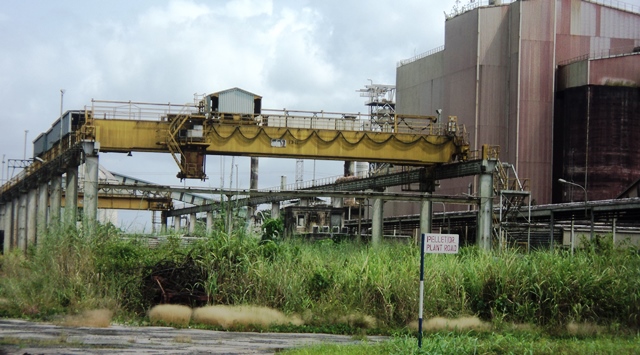
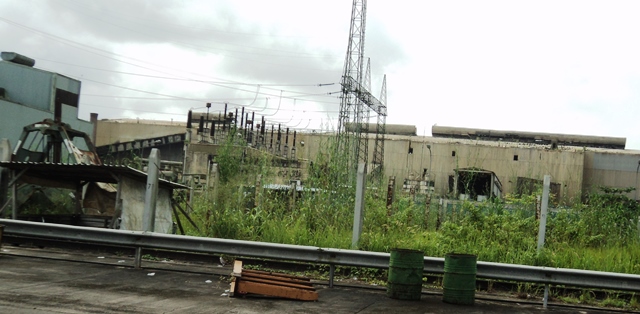
Grasses have taken over almost all the components within the plant- still waiting for the promised facelift by the new investors
With a gun-wielding soldier and other private security guards manning the gate, a visitor without prior appointment will not have his way in. “Gaining access to the plant is not an easy task; you have to come back in two weeks’ time,” a security guard tells this journalist.
An insider says, the new management of the company is haunted by aggrieved ex-workers who have vowed never to allow operation in the plant except their entitlements are paid. So, the main gate is under tight security against any unforeseen invasion by ex-workers. But its former owners, Global Infrastructure Holding Limited, is also laying claim to the company and indeed pressing to take it over.
Save for a few employees working on an excavation across the main gate of the company, there is actually no movement of heavy duty trucks that could suggest any activity going on in the company. No deafening sounds of iron casting coming from the plant or the razzmatazz that characterize a steel company.
It wears an old look, all the welcome signposts along the dual carriageway erected by the new management notwithstanding. Keen visitors get the impression of a company not working right from the corridor of the same express road.
The express road was constructed purposely to connect the steel plant to the Warri Port, in order to enhance easy evacuation of finished iron products. But the road is not only deserted but also dilapidated.
A trailer park some kilometers away from the main entrance of the company that once served as the assembly point for heavy duty trucks taking finished products is long gone; it has been taken over by bushes; no ancillary business along the road is visible. Business life of the area apparently died with the steel plant.
“As an A–level student of Federal Government Warri, we were taken to DSCL on excursion; the noise there was deafening — noise of steel production and heavy presence of heavy-duty trucks waiting to evacuate iron products such as iron rods, billets and other products were sights to behold,” recounts Onwuka John, a resident of Owvian.
“In those days, oil workers, were resigning. I saw them join the steel sector. Many resigned from Shell to join Delta Steel because everything about the company was too attractive for anyone not to eye its workforce; housing estate, schools, football team and even hospital were owned by the company.
“No company impacted the lives of the Deltans than the steel company, but all that is history now,” he adds.
“It was operating three shifts and you need to see staff buses conveying workers from Steel Town for their shifts to the company. But now, the plant is just like a ghost town.”
The units within — harbour, Direct Reduction (DR) plant and the pellet plant, Lime Plant, Rolling Mill, Electric Air Furnace, and the Continuous Caster — are littered with wreckage and waste, while other auxiliary units of the plant such as the foundery, electrical and mechanical maintenance workshops and water supply system, have all been overtaken by elephant grasses.
Electricity supply to the plant was disconnected by Benin Electricity Distribution Company (BEDC) due to huge unpaid bills
Creating an impression of work in progress, however, are a few workers here and there strapping their safety helmets and putting on dusty factory boots. But there’s arguably no steel processing going on in the company.
Waiting for the promised facelift by the new owners, Premium Steel and Mines Limited, the brownish rusty bodies of the equipment and the broken-down or abandoned machines all over the place are relics of a dead giant.
In March 2017, a group of investors from the United States of America and Morocco were reported to have visited the plant, proposing N600 billion investment to help revamp it — an indication that the new owners too might be in need of financial muscle to run the plant, like their predecessor, Global Infrastructure, which failed to turn it around.
But Victor German, General Manager, Government and Community Affairs at the company, denies any such proposal from any investor. He says the Indian investors have both financial and technical abilities to operate the company.
This claim is already being contested. Ebhaleme Pius, a former staff of the company who worked there when it was sold to Global Infrastructure Holding Limited, says the Management of Premium Steel and Mines, under the leadership of Prasanta Mishra, lacks not only the technical knowhow and financial muscle to run it successfully but also has no record of steel making.
“Those are not steel makers,” says Pius. “That’s why they are yet to manufacture a pin for the past two years. They cannot manufacture anything there because they don’t have experience in steel making.?
When it’s new owners took over in 2015, they promised to revive the comatose steel plant with N370 billion. Back then, with an established elaborate plan for the company’s revival with N70 billion in new investments in the first phase and N300 billion in the further phases, it looked like the company was going to have a new lease of life.
German, he says the new management is trying to re-engage the former workers of the plant
German admits that Delta Steel Company, as it is still called by the locals despite change of ownership and nomenclature, is still haunted by many known fears from disenchanted ex-workers who have vowed never to allow new investors take over the company until the N3.2 billion due to them is paid.
The workers are insisting that all industrial issues be settled, especially backlog of salaries and allowances, before the company can operate. German also confirms that the plant has been bogged down by demands of the ex-workers. “We met some rigid situations,” he says.
He says the basic reason the company has not resumed operations is the delay in bringing the ex-workers on board.
“These ex-workers are waiting, but these issues of liabilities are also there. We have about 100 of them working with us now,” he says.
“What we have been doing is trying to meet the demands of the ex-workers; those who worked with Global Infrastructure. You don’t just come and start work. They are demanding for the payment of debts owed the workers.”
According to German, who is also a gas engineer, the management of the company is almost done with the resuscitation of its rolling mill, after which other sectors such as Steel Melting Shop (SMS) would be revamped. But there are arguably no signs that the mill will start work anytime soon.
“We are resuscitating the rolling mill, we are going to buy billets or get them from outside the country,” he adds.
Pius says the steel plant management will not succeed by revamping the rolling mill first because “Delta Steel Company is an integrated plant”.
“You can’t revive the rolling mill that ought to come last in the line production first. It must be the last stage after they might have revived units like SMS and others. They can’t operate that plant; it is not a rolling mill.”
He alleges that the Indian investors have different plans for the plant. “They want to convert the building to a rice depot or a hotel,” he says. “You know they are Vaswani Brothers and we know their history in this country. They converted Volkwagen to rice depot.”
The payments of some debts by the Asset Management Corporation of Nigeria (AMCON) in April was needed for the management of Premium Steel to gain access to the plant and commence its resuscitation.
“We started that this year April and we have gone far. We are almost through with the rolling mill. One hundred and sixty workers are going to be employed for the rolling mills when it is operational.”
Despite all these commitments, the management of the company still has a lot of bridges to cover. A case before a Federal High Court, Warri Judicial Division, by Udu community, might be a major huddle to cross.
The host community says the details of the transaction between PSML and Bureau of Public Enterprise (BPE), which gave the company to the new investors, was not made open.
“We do not know the extent of purchase; we do not know what AMCON sold and what they didn’t,” says Sam Odibo, (Otota), Prime Minister of Udu Kingdom.
The communities claim they are stakeholders, having been allotted 22 million ordinary shares in the company, representing 10 percent of its total shares at its privatisation.
Part of their complaint, according to Odibe, is that the Federal Government has continued to shut them out in the privatisation process while dealing with the assets of Delta Steel.
“When BPE concessioned the company some years back, the community did not even know that they had some percentage to be paid because the Indian company, Global, ran the place solo,” he says.
“We say no; we want to know what they sold to you because AMCON sold what was used to borrow money from the bank. Did they reserve anything for the community or is it that they sold everything in spite of huge expanse of land the Federal Government took from us in the name of national interest. But we believe that the Federal Government would not be stupid to sell everything off.”
Before heading for court, the host communities said their efforts to get both the BPE and the AGF to account for the privatisation process were shrugged off. Now, they want the court to declare that they are entitled to 22,000,000 ordinary shares, representing 10 percent of the total shares of Delta Steel Company, and that both the BPE and the AGF have no right, power or authority whatsoever to sell or transfer to Premium Steel either directly or through any of the agents of the Federal Government of Nigeria, more than 80 percent of the shares of Delta Steel.
The court, they argue, should also declare any purported sale and/or transfer of more than 80 percent of the shares of Delta Steel to Premium Steel by the Federal Government, null and void.
“AMCON is done on the matter; they are not talking to us, same way nobody talked to us in the previous deal that allowed those Indians to run the place aground,” says Odibe.
“When that place was flourishing, they said it was federal character; northerners were there, southerners were there, but when it was ran aground, people accused us of folding our arms and being naive. We say no, before people accuse us again.”
The case is still ongoing. The communities want the court to issue an order restraining Premium Steel from continuing to take over the assets of Delta Steel without a valid sale and/or transfer of the company.
SHORTCHANGED BY AMCON AND PREMIUM STEEL AND MINES MANAGEMENT
Oputu, labour leader at the plant insists AMCON has questions to answer on the amount of money paid to former workers as entitlement after sale to Premium Steel and Mines Company
Former workers who worked at the plant between 2005 and 2012 when Global Infrastructures Company unsuccessfully managed it are demanding the payment of their entitlements. The new investors will know no peace, they have vowed, until their debts are defrayed.
At the time the new investors took over from AMCON in April 2015, the company had a backlog of seven-year unpaid salaries, which the workers say was calculated to be N3.2billion — but AMCON says the amount is far less: N2.1billion.
Other liabilities, according to findings, are indebtedness to contractors put at N2.5billion, indebtedness to foreign suppliers placed at $4.4billion and liabilities to statutory bodies and corporate creditors such as Federal Inland Revenue Service (FIRS), which alone make up N12billion.
AMCON, it was gathered, has settled some of these liabilities, particularly debts owed the Benin Electricity Distribution Company (BEDC), which recently restored electricity to the plant after seven years of darkness.
The workers argue that the difference of N1.1billion was due to the omission of some names and figures in the report submitted by the consultant hired to compute their entitlements. They accuse AMCON of shortchanging them despite their years of sacrifice at the company.
Peace Oputu, Chairman of Iron and Steel Senior Staff Association of Nigeria, (ISSSAN), reveals that efforts to make AMCON adjust the figure to N3.2billion were fruitless.
“We [the workers] gathered ourselves and met with AMCON. We talked but the meeting was fruitless because they didn’t agree to our terms,” says Oputu, disappointed in how workers have been treated by the Federal Government after the collapse of the steel company.
“They calculated certain amount, N2.1billlion as what is owed DSC workers, but we have EDP that takes care of all expenditure and all the money that comes in for the company.
“When we met with the committee set up by Delta State government, we made it very clear to them that our money is much more than that.
“Then we calculated the money with the EDP, and came out with N3.2billion. This was what we took to AMCON in Lagos. AMCON said their own was just to acquire; they had paid the debts owed by the company and as a result, they did’t have any other thing to give us.
“They were just going to part with N600million, representing 22.5 percent of the N3.2billion. So, the meeting was deadlocked because we were not happy.”
While waiting for their entitlement, ICIR gathered that about 500 retired staff of the steel company died in the 13 years that followed, that is 2005 till date. This explains why, when AMCON came to disburse the N600million in March 2017, those still alive ignored the directive of Oputu-led ISSSAN and Steel and Engineering Workers Union of Nigeria (SEWUN) not to collect the money.
Though it was obvious that they had been underpaid, the workers, who were dying of hunger and sundry illnesses, could not resist the temptation of the AMCON payment.
“Hunger is there, you cannot tell anybody not to collect the money. We the union came out and instructed them that nobody should go out to receive it but the next day people went out. You can imagine the level of poverty among our people,” laments Oputu.
But ISSSAN and SEWUN are insisting on the payment of 100 percent allegedly agreed by the unions and AMCON, through its Receiver/Manager. They allege that AMCON acted without consulting them in the calculation and payment of “25 percent of their total entitlements”.
Adewale Okeshola, General Secretary of ISSSAN, laments that AMCON reneged on the agreements reached at the meeting with its receiver/manager.
“We later gathered that AMCON through the receiver/manager was holding meetings with some disgruntled elements within the workforce in DSC who paraded themselves as seeking the interest of the workers who have suffered delay in the payment of their salaries for over five years now,” he says.
“These groups, we gathered, entered into an unholy alliance with the management to short-change the workers in the payment of their terminal benefits. After a protracted wait, we were shocked that the workers had been paid 25 percent of their entitlements as final payment.
“This is not only a far cry from the agreement reached between the two unions and the receiver/manager appointed by AMCOM, but also unacceptable. We want to say that SEWUN and ISSSAN were not carried along in this decision. We have made several entreaties through correspondences to the concerned authorities to rescind this dehumanizing decision and honour every agreement both parties reached for the interest of peace and harmony. Up till now, our efforts have fallen on deaf ears, thereby creating tension and restiveness by workers.”
Efforts by the state government to intervene have yielded only little result, at least not in assuaging the worries of the aggrieved ex-workers.
A committee on Delta Steel Company Affairs set up by Ifeanyi Okowa, the Governor, and headed by Moses Odibo, wrote to President Muhammadu Buhari requesting a N5billion bailout for AMCON to offset the salaries and other indebtedness so that the company’s new owners could resume production in November 2016.
The amount requested was not released. Rather, the President, it was learnt, referred the letter to AMCON to defray the debt since that is its statutory responsibility.
A breakdown of the sought N5billion is as follows: N3.2billion for staff salaries, N1billion as part payment of N7.5billion indebtedness to PHCN/BEDC, N198.7million owed Nigerian Gas, N500million for general supplies and N58million to offset scrap supplies.
Despite these calculations, particularly the debt to workers, AMCON paid only 25 percent of N2.1billion that it said was the workers’ entitlement. The workers argue that from the time when the Federal Government took over the company from Global Infrastructure Company till date, no letter was given to any staff regarding disengagement, retirement or any related matter.
“Invariably, the government is not coming closer to us and we don’t know what is happening with this company for now,” laments Oputu.
“My members are working there because what gets to your mouth gets to your stomach. My people are dying in the township there. We lost minimum of three people every day. When the new investors came in, they made several publications that they were going to turn Delta Steel Company around, promising to spend billions of dollars.
“But today, that is not what we are seeing. If they don’t live on the account of the school they don’t survive. The proceeds from the schools are what they use to run the plant and one of the schools, school II, is grounded.
“We were over 5,000 when the company was working well, but we were reduced to almost 2,000 when Global Steel came in. Several people have died, more than 700 since 2011.”
Jude Nwauzor, Manager Corporate Affairs of AMCON, did not respond to questions on the allegation of short-changing the ex-workers. While he promised to get back, he referred the journalist to Joseph Nwobike, AMCON Receiver/Manager for the company.
In an SMS, Nwobike, a Senior Advocate of Nigeria (SAN), said he would not respond to gossips and unfounded allegations.
“Thank you for contacting me. I really do not respond to gossips and unfounded allegations. The records are there for all to see,” he simply said.
But when he was further asked to make the record available by this journalist, he went mum.
AMCON, though, says it ensured that all verified ex-workers who were eligible and also participated in the agency’s verification exercise were fully paid directly.
Following their inability to liquidate the debts they owed several banks, AMCON took over the assets and undertakings of Delta Steel Company Plc (DSC)/Global Infrastructure Nigeria Limited (GINL) and appointed a Senior Advocate of Nigeria (SAN), Ajibola Aribisala as the Receiver/Manager of the company.
However, in 2015, AMCON replaced Aribisala with Nwobike, who subsequently engaged the services of an audit firm to carry out a verification of the ex-staff.
“At the exercise, only those who were staff of DSC/GINL at the time of the take-over by AMCON were audited,” AMCOn said in the report. “At the conclusion of the exercise, Nwobike engaged the representatives of the staff — an engagement that led to an agreement to accept as full and final settlement of their outstanding salaries and gratuity, a percentage of the verified sums.”
It was however gathered that although the percentage agreed to be paid was below the staff’s expectation, AMCON said the arrangement was the best in the circumstance, seeing that DSC/GINL was insolvent.
According to AMCON, over 1,600 staff were screened and paid in the exercise, which lasted between March 13 and 31, 2017.
HUNGER, SICKNESS, DEATHS…THE PLIGHTS OF EX-WORKERS
After 25 years as a plumber at Delta Steel Company, Agbonkaro lives in abject poverty
“My wife dey house now, to eat dey hard us; na so so quarrel. I don’t know where to start from and I get seven children.”
That is the lamentation of Francis Agbonkaro, who worked at the plant as a plumber for 25 years.
With three university graduates and four undergraduates and a wife to cater to, life has not been easy for him since his retirement in 2005 from the company without the payment of his benefits.
The whole family, he reveals, lives on the petty trade run by his wife in the Steel Camp — the residential quarters constructed for staff of the company.
“Na my wife just dey do small small thing wey we take dey survive. I get seven children. Three graduate, four no graduate, dem don already finish secondary school because no money to sponsor them. I no fit calculate how much dem owe me,” he says.
But he is happy despite his poor condition of living because several of his colleagues who worked at the plant have died of hunger and treatable ailments.
“Population wey don die, dem no dey fit talk that one. I even fit say the population wey die dem plenty pass people wey dey alive. Some house dey here, the husband die, the wife die,” Agbonkaro continues in Pidgin, apparent signs of poverty all over him.
Still, he can be said to be lucky. His colleagues, Salami Omokha and Osifo Mathew, are already cursing the day they joined the steel company — they have lost their sights due to years of exposure to high temperature without protective gears as con-casters at the plant.
Omokha, a Germany trained melter at the plant says ‘the situation after retirement is hopeless’
Omokha, who also retired from the company in 2005, was a melter of iron ore. “Melting has to do with converting iron ore, which has been reduced to direct iron, and then you convert them to liquid steel, you convert them to any grade of steel you want,” he explains.
Before iron ore can be converted, the melter must attain the temperature of about 1740 degree centigrade. That, Omokha says, was usually done by him and others in that section “and not that you have the safety devices to look at those things”.
“Those are the things we looked at and today now we are having the adverse effects; we cannot see.”
Trained in Germany and Italy for iron ore melting, he says 90 percent of those that worked there “have this problem I’m having now; the problem of sight”.
“I went to Germany and Italy in 1980 and 1981 where I was trained as an electro handler, melter, and caster. I trained many people on the job when I returned, and many of them today are happy to identify with us now that we gave them good training.”
Life after retirement has not been rosy, as according to him, “the situation after retirement is hopeless”.
“We are surviving through charity, particularly from friends who are better placed. My children are not grown up yet; even the ones that have graduated have no jobs. Our wives are the ones jumping from places to stones converting whatever they have to money. We are also hoping for a better tomorrow whether the Federal Government will remember us.
“We are not getting our retirement benefits. I’m in my condition now, the plant is also in its own condition; we don’t know who to speak for who. Whether the plant is to speak for me, because the plant is also in the same condition in which I am now; the plant is sick.
“I wish the Federal Government can have a little rethink and come back to that place to see exactly what they have there. They should not allow it go fallow the way it is now. People are there now but nothing meaningful is coming out of there. It is like the government is not taking the issue of Delta Steel Company serious.”
When reminded that the plant had been handed over to a private investor, he said: “How can you give the company to a private investor without following up, without knowing its profile and without know what they are doing there.
“The government is weak in this area. There are so many of their projects that are abandoned. Come to where we are residing in Township, schools have been abandoned, taken over by weeds. It is a nonchalant attitude by the government.”
On whether the Premium Steel and Mines Limited has the capacity to transform the moribund plant, Salami retorts: “Those are not steel makers, they are not steel makers. If they are steel makers we will know. The same government that allowed them in is the same government that owes us.
“My health challenges are numerous; one, I cannot see far objects. Doctors told me that there are cataracts in my eyes and these are the manifestations of areas where we worked. Again, the pains are there all over. Many of the people that worked with us have long died.
“Government should live up to its responsibility and pay us our money, our entitlements, so that we can also straighten our heads and maybe we can live longer. With better treatment, nobody will know that you are sick. Meaning that there is a solution to your problem. We have problems and the solution is there; only that we cannot afford it.
Of the trio, Osifo Mathew is the worst hit; he has been suffering from stroke and has lost his sight.
I want government to pay my money so that I can treat myself, pleads, Osifo who has lost his sights after retirement
With his eyes wide opened though laced with mucous to suggest there are problems with them, Mathew could not recognize his friends. Twenty-five years of exposure to high temperature as a con-caster at the steel company is responsible for his battle with glaucoma.
With such debilitating health condition, he is also not paid his entitlement after retirement from the company.
Looking straight at this reporter as if he could actually see him, he says, “I worked at con-cast. We started the steel company and I was retired in 2005. But up till now, I have not collected my entitlement. I have problem with my eyes. In fact, when the eye problem started, I was first affected by stroke.
“The eyes have been bad for the past four years. They said they cannot operate it because it is glaucoma.
“They recommended drugs and eye drop. I can see just faintly. The last eye drop I bought was N9,000 and used it for two weeks.”
Osifo makes one final plea to the journalist: “I want government to pay my money so that I can treat myself. As you are talking to me now, I’m just looking at you like a film. I’m not seeing you; I can’t describe the shirt you are wearing.”
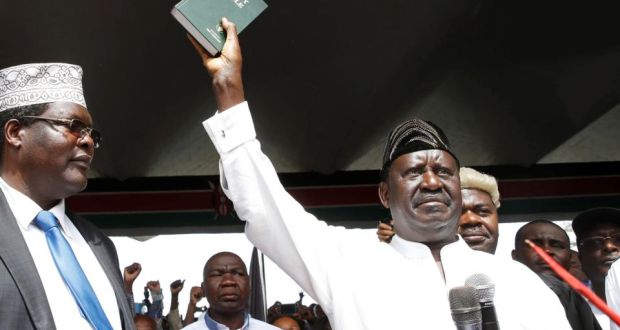
Raila Odinga, Kenya’s opposition candidate in the last year presidential election, says he is answering a higher call to assume the office of the people’s President of the Republic of Kenya.
Odinga stated this in front of a mammoth crowd of supporters on Tuesday, as he was sworn in as a parallel President of the country with a copy of Holy Bible in his hand at Uhuru Park, Nairobi.
Donning a white caftan and black cap at the event, which has been released to Youtube after Kenyan authorities banned the transmission on state television channels, Odinga spoke local dialect.
“I wish to thank the people of Kenya for the mandate they have given us and for their steadfast confidence in us. You came from all corners of the republic to witness my inauguration and it was good to see you out in millions,” he said.
“Most of all I thank the good Lord, my family and all those who have undertaken this journey with us. We have arrived in Canaan; thank you for staying the course with us. Asanteni sana.”
He told crowd that the people had had enough of election rigging and the event was a step towards establishing a proper democracy in the East African state.
He was part of the August 2017 disputed and later cancelled election, which gave victory to Uhuru Kenyatta.
Kenya’s Supreme Court described the election as neither transparent nor verifiable before annulling it.
Kenyatta was officially re-elected with 98 percent of the vote on October 26, but just under 39 percent of voters turned out. He was inaugurated in November.
Odinga argued that Kenyatta was elected by a small section of the country, maintaining that he did not recognize his opponent’s victory.
He urged his supporters to shun the re-election, because “no reforms had been made to the electoral commission”.
President Kenyatta, who was sworn in for a second term last November, warned the media not to cover the swearing-in ceremony, while the country’s Attorney General said holding such a ceremony amounted to treason.