The management of the Obafemi Awolowo University (OAU), Ile-Ife, has approved the suspension of Richard Akindele, a Professor of Management and Accounting who demanded to have sex five times with his student before passing her.
According to a statement released on Thursday by Eyitope Ogunbodede a Professor and Vice-Chancellor of the institution, the panel investigating the matter had established Akindele to be the lecturer in the sex-for-marks audio that went viral on April 9.
The suspension is pending the final determination of the disciplinary case against the Professor.
“The Vice-Chancellor of Obafemi Awolowo University, Ile-Ife, has received and considered the interim report of the Committee set up to investigate the allegation of sexual harassment revealed in a recent audio recording,” read the statement.
“In the interim report submitted to the Vice Chancellor, Professor Eyitope Ogunbodede, Professor Richard I. Akindele, of the Department of Management and Accounting, is now established to be the lecturer in the controversial ‘marks for sex’ audio recording. The female voice has also been identified as that of Miss Monica Osetobe OSAGIE, a Postgraduate Student on the Master of Business Administration Regular programme.
“Although the Investigative Committee had invited both Professor Richard I. Akindele and Miss Osagie, only Professor Akindele had appeared before the Committee, while Miss Osagie is yet to appear or make any representation. The report indicated that many other witnesses appeared before the Committee and gave useful evidence. The University is making efforts to ensure that Miss Osagie appears before the investigative committee so that it can hear her side of the case and promptly submit its final report.
“The Committee observed that a prima facie case of inappropriate relationship with the female student had been established against Professor Richard I. Akindele. The Vice-Chancellor, having carefully and dispassionately considered the report, also came to the conclusion that a prima facie case of serious misconduct had been established.
“Having regard to the gravity of the offence for which Professor Richard I. Akindele is found to be prima facie liable, the Vice-Chancellor, in line with the Code of Conduct for the University Community and acting under all the laws and regulations of the University enabling him in that regard, has directed that Professor Richard I. Akindele be suspended forthwith from the University, pending the final determination of the disciplinary case against him.
“Under the provisions of the relevant Statute of the University, an academic staff can only be dismissed from service or have his or her appointment terminated only when the matter on which consideration is being given has been investigated by a Joint Council and Senate Committee, and the staff has appeared before the committee with his or her counsel, if so desired. This procedure is the minimum requirement of the law and regulations of the University. It should therefore be noted that the suspension of Professor Richard I. Akindele is on the basis of the findings of the Investigative Committee that he is prima facie liable, and this decision will abide, pending the final determination of the case by the Council of the University.
“We will like to reiterate that OAU will continue to do everything legally and morally acceptable in pursuance of its avowed commitment to zero tolerance for sexual harassment, intimidation and, or coercion.”
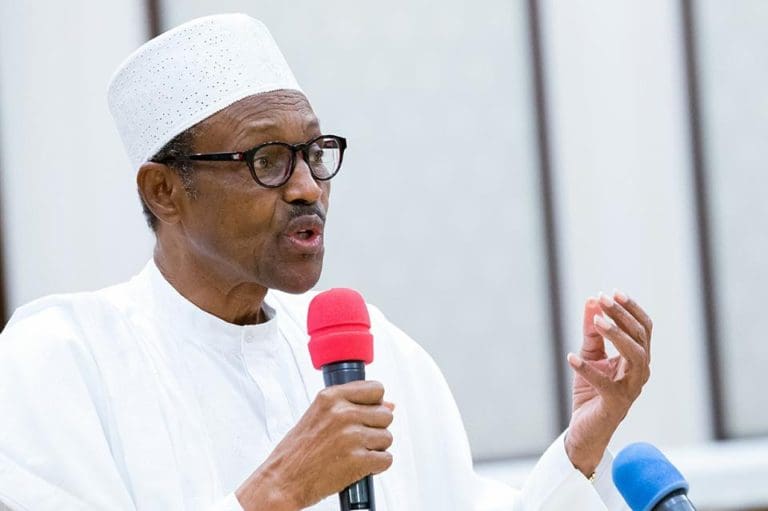
President Muhammadu Buhari has always been known as a man of few words ― especially at home. It is not clear if this has anything to do with his extensive military career. Back in 2015, most of his campaign speeches were strikingly short. But not only is the President terse when he speaks, he has also become infamous for not speaking often ― even when thought necessary by many.
However, Buhari has complemented for this limitation with his penchant for overseas speeches and interviews. The only problem is his record has not been free from controversy and what some would classify as embarrassing remarks, ranging from shades of tribalism and anti-patriotism to even sexism.
Here are the prominent ones:
THE 5% CONSTITUENCY WITH A 5% CUT
On July 22, 2015, not long after he was sworn in as President, Buhari was at the United States Institute of Peace (USIP) to deliver a speech.
One of the questions after his brief talk came from Pauline Baker: “I wonder if you would tell us how you intend to approach it [the Niger Delta challenge] with particular reference to the amnesty, bunkering and inclusive development.”
After seeking clarification from the moderator on what she said or meant by “inclusive development”, Buhari asked Baker if she had a copy of the election results.
“Constituencies that gave me 97% cannot in all honesty be treated, on some issues, with constituencies that gave me 5%,” he said. “I think this is our political reality.”
He further said those who put in effort to vote for his party “must feel that the government has appreciated the effort they put in putting the government in place”.
‘NIGERIANS HAVE A CRIMINAL REPUTATION’
Fast forward to February, 2016, Buhari was on another official visit, this time to the United Kingdom. During his stay, he granted an interview to The Telegraph newspaper that caused a sandstorm back in Nigeria, with many taking to the hashtags #IAmANigerianNotACriminal and #NigeriansAreNotCriminals to vent their anger.
When the interviewer, Colin Freeman, asked if Nigerians were justified to seek asylum due to Boko Haram activities, Buhari said some Nigerians had “made it difficult for Europeans and Americans to accept them because of the number of Nigerians in different prisons all over the world accused of drug trafficking or human trafficking”.
“I don’t think Nigerians have anybody to blame,” he said. “They can remain at home. Their services are required to rebuild the country. If their countrymen misbehaved, the best thing for them is to stay at home and encourage the credibility of the nation.”
YES, NIGERIANS ARE ‘FANTASTICALLY CORRUPT’
A day after British Prime Minister David Cameron was caught on camera describing Nigeria and Afghanistan as “fantastically corrupt”, Buhari was presented an opportunity to rebut this claim ― or at least shed light on what the true picture is.
It was in May 2016. Dominic Waghorn, Sky News’ Diplomatic Editor, had asked, after his speech, if he would like an apology from the British Minister. “No,” he said. “No, not at all.”
“Are you embarrassed by what he said,” Waghorn asked. “No, I’m not,” he replied.
But, “is Nigeria fantastically corrupt?”
“Yes,” came the short, shocking response. Nigeria’s President had just casually admitted that his country ― not a fraction of his countrymen ― is corrupt. While he had supporters back home who said he was only being candid, many thought that was no way to speak as the country’s ambassador.
‘MY WIFE BELONGS TO MY KITCHEN AND THE OTHER ROOM’
Not to forget the other statement about the other room, one that has kindled the flame of a new slang still dancing on the tongues of countless Nigerians. Since Aisha Buhari had taken to BBC to express her reservations with his administration, he equally decided to publicly put her in her place ― or rather, where he thought she belonged.
In October 2016, during a joint press briefing with German Chancellor Angela Merkel in her country, he was asked for his reaction to the First Lady’s comments.
First he laughed, then he said: “I don’t know which party my wife belongs to, but she belongs to my kitchen and my living room and the other room.”
It didn’t take time before Nigerians figured out where the President meant as “the other room”. They not only questioned why such statement was at all uttered, they also wondered why it was made in Germany, one of the few countries in the world ruled by a woman.
‘BLAME GADAFFI FOR FARMERS/HERDSMEN CRISIS’
On Wednesday, April 11, while meeting with his friend, Archbishop Justin Welby, in London, Buhari said no one but late Muammar Gaddafi should be blamed for the herdsmen crisis. This statement took many by surprise, leaving Nigerians wondering what was the connection between a dictator who died seven years ago and violence in a place 2,000 kilometres away.
Buhari had said the problem of killings “is even older than us” and “has always been there”, but has now worsened with “the influx of armed gunmen from the Sahel region into different parts of the West African sub-region”.
“These gunmen were trained and armed by Muammar Gaddafi of Libya. When he was killed, the gunmen escaped with their arms. We encountered some of them fighting with Boko Haram,” he added.
‘NIGERIAN YOUTH WANT FREE THINGS WITHOUT WORKING’
And the latest, uttered also during the ongoing state visit to London, is this gaffe: a lot of Nigerian youth have not been to school but want to sit at home and enjoy freebies such as education and healthcare ― simply because their country is oil-rich.
Speaking at the Commonwealth Business Forum in Westminster on Wednesday, Buhari said: “More than 60 percent of the population is below 30, a lot of them haven’t been to school and they are claiming that Nigeria is an oil-producing country, therefore they should sit and do nothing, and get housing, healthcare, education free.”
It is not clear where the President got his facts from, as no known poll has been conducted to measure the attitude of Nigerian youth in to work and to oil wealth.
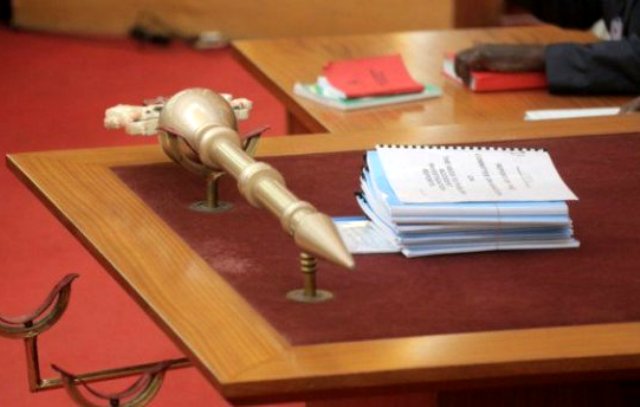
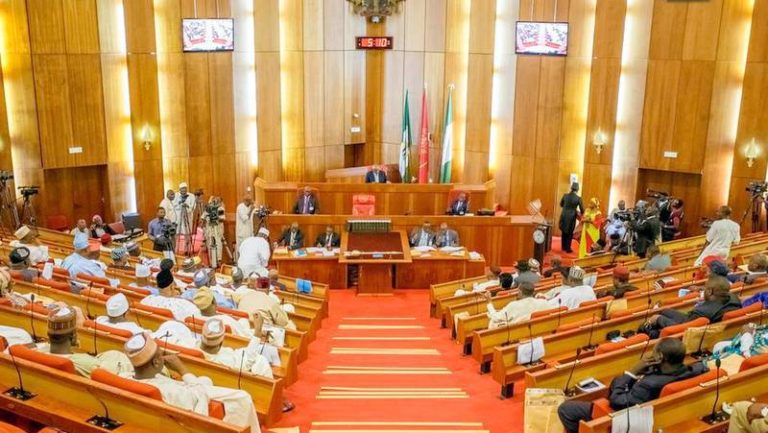
The invasion of the Senate chambers on Wednesday by thugs believed to have been smuggled in by Ovie Omo-Agege, suspended Delta State senator, and the successful whisking away of the mace – the Senate’s symbol of authority – has left many Nigerians in awe.
The major source of bewilderment is how a senator, who ordinarily should not have gained entrance into the senate chambers, managed to smuggle in thugs who successfully fought off the Senate’s sergeant-at-arms and took the mace away.
Many who reacted to the development on Twitter said the incident had proven that Nigeria’s security system is a huge joke, while others called for Omo-Agege to be banned from the Senate for life.
Some others said, albeit jokingly, that Omo-Agege’s actions shows that he is truly a Warri man, and according to a popular line in Nigeria, Warri no dey carry last.
But many others tried to link Wednesday’s incident to the $462 million approved by the Executive for the procurement of helicopters without the consent of the Senate.
During Tuesday’s plenary, the Senate had summoned Kemi Adeosun, Minister of Finance, and Godwin Emefiele, Governor of the Central Bank of Nigeria (CBN) to appear before it and explain the controversial procurement.
Scenes from the "operation" during which thugs loyal to Sen Ovie Omo-Agege (Delta Central, APC) snatched the Mace of the Senate from the Sergeant at Arms & made away with it.
Omo Agege (Leader of PMB 2019 senate group) storm the senate with hoodlum to steal the mace & cause commotion in relation to Senate investigation of Adeosun, Dan Ali, Emiefele for spending an unauthorized $462m to buy helicopters from a fake company.
Senator Omo Agege and some other senators stormed the senate and took away the mace. I’m sure EFCC customer Abdulahi Adamu will be amongst the vagabonds.
We warned you in 2015 that PDP may not be perfect but APC should never be an option.
Despite today’s wahala in the Senate, for me the Rivers State House of Assembly still tops the all-time ‘Stealing the Mace’ league standings… https://t.co/d0N4mF7RFv
1. APC is an embarrassment to our democracy.
2. Sen. Agege should be BANNED from the SENATE for life.
3. Go and get your PVC so we can salvage our democracy from APC. https://t.co/V3qE6ha3dh
It is as illegal for Omo Agege to seize the mace as it is illegal for him to be suspended from the Senate. Two wrongs don't make a right, but let's not pretend that one is perfectly normal but the other isn't…
The Mace,the symbol of authority of the Senate, the totem to the power of the people was "kidnapped" today from the chamber of @NGRSenate , in the Three Arm Zone, within the FCT.
Let the imperative of this brazen act wake all of us up to the reality of the season.@segalink
Festus Keyamo, a Senior Advocate of Nigeria (SAN), says he accepted to serve as Director, Strategic Communications, President Muhammadu Buhari Campaign Organisation for the 2019 election because Gani Fawehinmi, his late former boss and widely respected human rights activist, supported Buhari as well in his lifetime.
Keyamo said his participation in partisan politics should not be a surprise to anybody because Fawehinmi also supported Buhari.
“In doing this, I take a cue from my revered late boss, Chief Gani Fawehinmi, SAN who mentored me,” he said in a press statement.
“Throughout his career, he also consistently and fiercely engaged every government in Nigeria and suffered as a result. Guess what? THE ONLY GOVERNMENT HE FULLY SUPPORTED THROUGHOUT HIS LIFETIME was that led by General Muhammdu Buhari in 1984 – 1985; and that was to the chagrin of some of his professional colleagues and fellow ‘radicals’.
“However, he saw what they did not see at that time, because when that government was overthrown by General Babangida, what followed was the worst era in our history in terms of institutionalizing corruption and political chicanery in Nigeria. In the 2007 Presidential election, my late boss again endorsed General Buhari.”
Keyamo argued that the ultimate aim of every struggle is not really to enthrone a flawless system but rather to have a government that is focused and ready to protect the interest of the masses.
He said no government in the history of Nigeria had recovered so much looted funds as that of President Muhammadu, which is one of the many reasons he had become bold about his support for the President’s re-election bid.
He also defended Buhari’s handling of the economy, arguing that the President inherited economy that was already in bad shape before 2015.
“I am persuaded that the Buhari Government took the right measures to halt a bigger disaster awaiting our economy had it been otherwise. Those who are persuaded otherwise are within their legitimate right to do so.
“We are all patriots, trying to find the right answers to our problems as a nation. However, if you are persuaded otherwise, kindly state in details what exactly should have been done to run the economy better, given the crash in oil prices and production that dropped to around 700,000 barrels per day. Surely, discerning Nigerians would no longer buy the fable of ‘Buhari destroyed our economy’”
In defence of his partisan politics while claiming to be a human rights activist, he said it was to ensure that Nigerians have the best because “Buhari is one of the very last of the upright Mohicans in Nigeria available to help reclaim public integrity before he takes his bow in 2023″.
“That is why I have made my choice for 2019 and I will publicly stand by it. That choice is President Muhammadu Buhari. For those who are persuaded otherwise, I challenge them to also name their choices because you cannot criticise my choice of a candidate without naming your own choice,” he said.
“After all, the President would not be running against ghosts or against a vacuum. Therefore, this is not a time to hide behind a blanket criticism of any candidate. Each candidate should be assessed in comparative terms with other candidates.”
He dismissed criticisms of Buhari’s age and health, arguing that age is inconsequential in leadership and it is God who gives good health.
The police have arrested Ovie Omo-Agege, suspended Delta State senator, for allegedly leading armed thugs into the senate chambers to steal the mace, the Senate’s symbol of authority.
Omo-Agege was arrested Wednesday afternoon, shortly after the uproar caused by the whisking away of the mace. He was taken away in a black Toyota Hilux vehicle, while the Senate continued its plenary with a ‘spare’ mace.
Sabi Abdullahi, spokesperson of the senate, had declared Wednesday’s incident “an act of treason”, and “an attempt to overthrow a branch of the Federal Government of Nigeria by force”.
“This action is also an affront on the legislature, and the leadership of the House has come to express their support against this action,” Abdullahi’s statement read.
“All security agencies must stand on the side of due process and immediately mobilise their personnel to retrieve the mace and apprehend the mastermind and the perpetrators of this act.”
Omo-Agege was suspended for 90 legislative-days for claiming that the Electoral Act amendment by the Senate was targeted at President Muhammadu Buhari.
Ordinarily, a suspended lawmaker cannot gain entry into the senate chambers, raising questions as to how Omo-Agege managed to enter the chambers with thugs and successfully moved the mace.
Wednesday’s plenary was presided over by Ike Ekweremadu, Deputy Senate President, as Bukola Saraki is currently in Washington DC attending the spring meeting by the World Bank and International Monetary Fund (IMF).
“E can’t work, e no fit work,” he said repeatedly, almost reflexively. “I hear it, e can’t work,” he added, again in pidgin English.
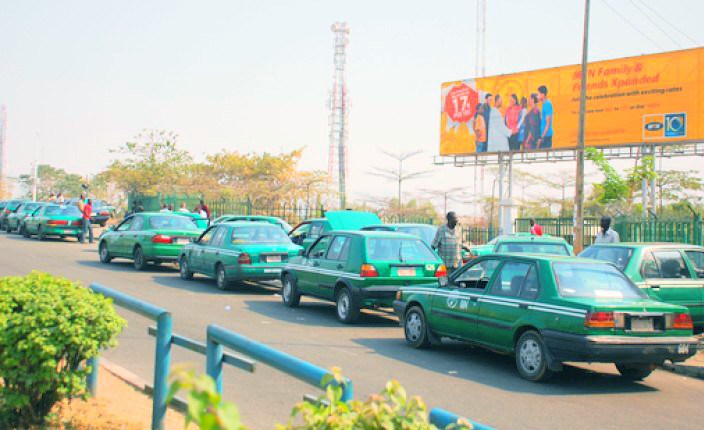
Those were the words of Idowu Agunbiade, a local taxi driver in the Federal Capital Territory (FCT, after he was asked about the recent directive by the Federal Capital Territory Administration (FCTA) that all commercial vehicles in the city must be air-conditioned by October.
Making the announcement, Kayode Opeifa, FCTA’s Executive Secretary for Transportation, had said the vehicles “must be registered in Abuja and must carry FCT number plate”.
The ICIR took to the streets of Abuja to find out what the taxi drivers think of the plan.
‘THEY ARE ONLY INTERESTED IN MAKING MONEY FROM US’
As soon as Idowu Agunbiade, a taxi driver, was told about new policy, he cut in that “it cannot work” — because “not every taxi enters estates, banks and ministries, where passengers can afford to pay more”.
“The only way it can work is if they provide more vehicles and give them to drivers at subsidised prices and then they pay in installments,” he said. “But this one they are proposing cannot work. Many governments have done it and failed.”
Asked the last time such demands were made, he said it was during the Nasir El-Rufai administration under the Olusegun Obasanjo presidency. “That’s when they introduced all these buses they now call ‘El-Rufai buses.'”
On the compulsory registration of number plates in Abuja, Idowu again said: “e no fit work”, more emphatically this time.
“The reason is that many of vehicles used here in Abuja are bought from other states, and the dealers buy them in bulk. If the dealer buys like 12 vehicles or six, he will just register them in the state, bring to Abuja and sell to the people.
“Do you expect people who have registered in other states to register again for FCT numbers, spending all over again?”
“Look at this number,” he said, pointing at a passing vehicle. “You see it was registered in Epe. Do you expect someone who obtained this number in Lagos to remove it and get another one here in Abuja? It can’t work! They’ve done more than that. They just want to chop our money again. I’m telling you the reality … for someone like me, it is nonsense. Na lie, it can’t work.”
‘IT MAKES NO SENSE’
Just before the entrance of the expansive premises housing the Ministry of Agriculture and Rural Development and the FCDA is the FCDA Park overseeing Area 1, 10, and 11, Wuse.
“Of course, we’ve heard it,” Fisayo Arojojoye, Secretary of the park association, said. “I don’t think it can be possible because we are not equal. I even heard they said the number plate must be Abuja colour. It can’t be possible. It means all these transporters coming from other states to Abuja with their plate numbers will have to change their plate numbers.
“It can’t be possible. We’re just suffering ourselves in the country. There are some people who are organising to spoil the work of the transporters; that is it. Even the situation we are facing in the county is not okay. Most of us are graduates doing transport work. Does it make sense? It doesn’t make sense at all.”
He also said some couples had divorced because of the insufficiency of income from commercial driving.
“Many Nigerians are now into kabukabu because of the situation,” he lamented. “You cannot afford it again. How can a family man come outside without making any money? Some families have now separated. It’s not done. We cannot be suffering like this, you know, without making anything. It’s unfair.”
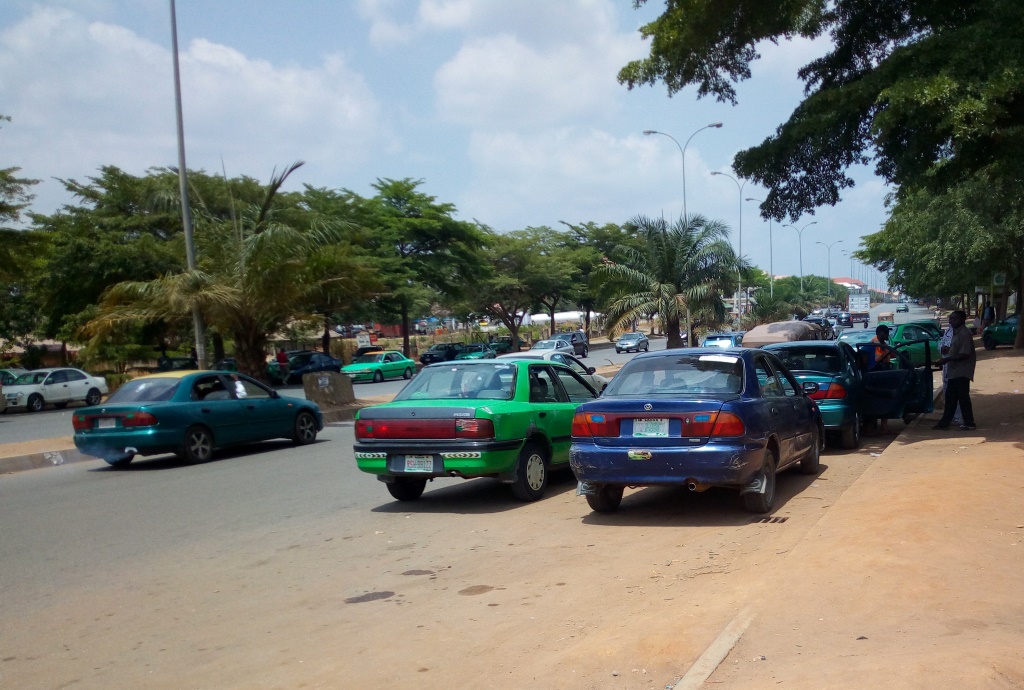
A makeshift car park at Jabi, Abuja
‘LET THE GOVERNMENT LEAD BY EXAMPLE’
Joseph Adoyi, who has worked as a driver in Abuja for more than 12 years, gave one basic advice to the government: ‘lead by example’. He said since his arrival, the government had introduced SURE-P, 306 operated by the Abuja Leasing Company and many other taxi schemes.
“Many of those taxis that the government has brought themselves, they didn’t work. They usually got damaged before six months. The car o, not to talk of the AC o!
“That’s why I said they should first lead by example. If they can operate any taxi scheme for at least two years and the AC remains intact, then we can follow suit. You shouldn’t be telling others to do what you cannot pull off. It’s not going to work. They should be realistic.”
When asked about the policy on number plates, he said that it is understandable “because a person cannot be working at Berger and be collecting salary at Dantata”. “It is a way of generating revenue,” he added. But his colleagues soon rose against his opinion.
“With a licensed vehicle plate, you can work anywhere as far as Nigeria is concerned,” an older driver who approached the gathering from behind said passionately.
“They can make their policy,” Joseph insisted. But the older driver maintained that “there are policies that cannot work”.
“No company is producing these plates. It is still the same Federal Government that is giving them out through Road Safety [FRSC],” another driver chipped in. “Okay, if I want to travel to another state, will I go and look for another number?” he asked.
“And all those Abuja AC, is it everybody that can afford to pay the money?” the same driver throws a second question. “Only common N150, people said they cannot pay. They complained and that is why we started carrying four passengers in the back seat. It used to be three. If you add AC to the cars, who can afford it? How much are they even paying the government workers who board our motors?”
“This government is fk up government o. Fk up government. F**k up government,” a driver who sat at the rear left said, the handwriting of frustration legibly gracing his face. “They themselves, can they maintain AC taxis for more than three months?”
“El-Rufai tried it between 2003 and 2006, he failed. London taxi, it didn’t work,” recounted the elderly driver. “Abuja leasing taxi, the 306, it didn’t work. Then, what do they call it, Hyundai, another government scheme, it didn’t work. Remember there was tata, it didn’t work. Then Chevrolet, it didn’t work. What is all this? The thing is that if they want to make policies regarding transport, they should go to people on the streets.”
“People dey hunger, you say AC motor. Na AC remain?” another driver interjected while others laughed ― apparently at the government not the questioner. “Excuse me, people dey hunger, dey die on the road. Even for private cars, how many of them are using AC?”
“Even if it’s working, how many of them put them on? Those government staff bus, in how many of them are the ACs working?” someone added. “If you want to pursue us, then we’ll go. We’ll go back to our villages. They even want me to come back, so I don get opportunity. I’ll find my level.”
“My brother, tell them to order food,” one driver said, with strong emphasis on the last word. “We need food. Food! Let them bring food; you see the way Nigerian people have got very lean and haggard. Is it AC cars that’ll solve Nigeria’s problems? Go and build factories. Use the money to open companies and employ people.”
“Last week, I carried one woman,” one of them narrated. “She said she is a nurse. It’s been more than 15 years now that she’s been looking for job. You say nah AC car nah hin remain. Fifteen years! She’s been carrying files, walking up and down. Tell them, the money they’ll use to order all those yeye motor, let them go and open factories with it.”
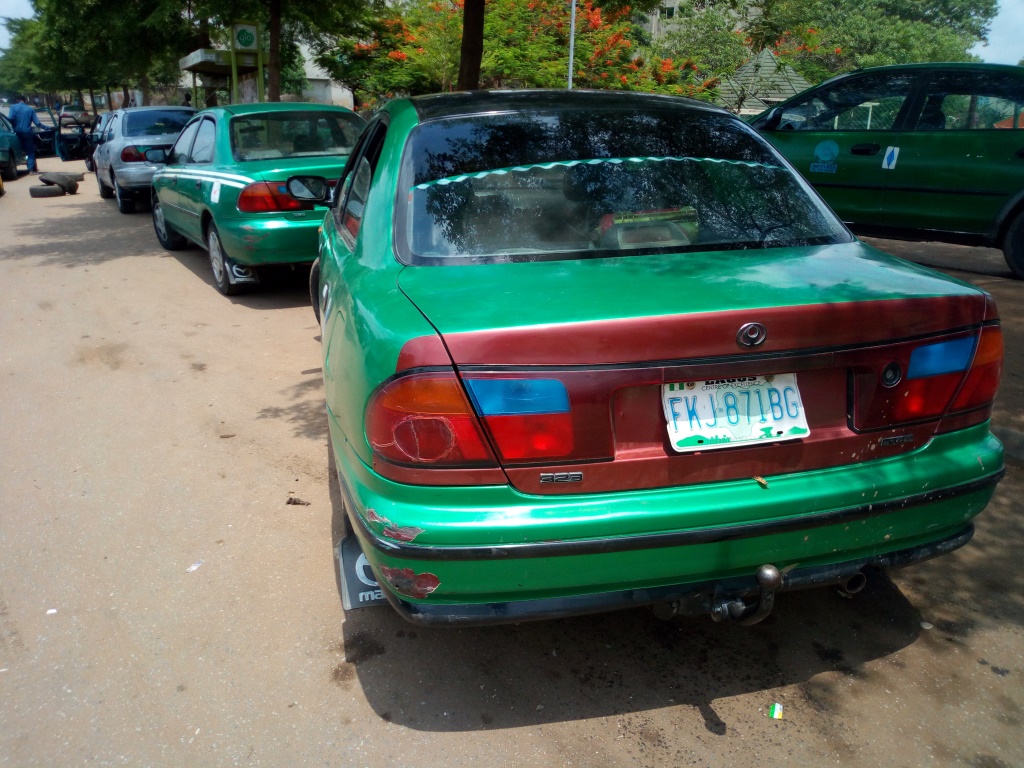
An Abuja taxi with a number plate registered in Lagos
‘TAXI DRIVERS ARE TREATED LIKE SMUGGLERS; WE ARE NOT SAFE’
At Wuse Park, the reporter met Ifeanyi Eze who has been in the Abuja transport business since 1998. Ifeanyi also thinks the plan is not possible. “Nobody likes to suffer,” he admitted. “But all hands are not equal.” He also recounted a recent incident of police brutality involving his brother, a fellow taxi driver.
“For taxi drivers, they do not even allow us to have designated parks. Whenever you stop to carry passengers, the same people formed the Joint Task Force to arrest drivers. Is it not inevitable for drivers to stop to get a passenger? And when he wants to alight, you will also have to stop. But they do not give us this freedom.
“Sometimes they ambush drivers at one-ways. Sometimes they remove their uniforms and disguise as passengers, just to bill drivers. They will ask you to pay N5,000. For the VIO, it is more than N8,000. So all these do not allow us to concentrate as drivers. If not that I have nothing else to do, I would have left this business of taxi driving.
“Sometimes, before you know it, the police will hit their guns on your car and damage it. All these dents you are seeing are as a result of gun damage. Other times, they will scatter the glass. The last incident around here, the person whose head they damaged with a gun was my brother, Odoh Dennis. They used 2×2 to scatter his head and all the glasses on his car. He later managed to survive. Everybody knows about this case. They even detained his car, and he still had to look for money to bail it.
“As we are now, we are not safe. We have to be very cautious, as if we are smuggling contraband goods. We have not even satisfied our stomachs. Don’t you know it is someone who has money that can say he wants to open bank account and be saving money? The money to get that thing is not small, and things are very hard now. Some of these cars do not even have AC at all. How are people expected to raise money to buy another car?”
‘THERE IS A LOT OF INJUSTICE IN ABUJA’
Benjamin Adewale, who hails from Osun State, explained that the car he was driving is not even his; he only borrows to use it in the day while the owner uses it at night. The car’s AC was removed, he said, because it was too expensive to maintain.
“We are all looking for what to eat; some of us even borrow our cars,” he lamented in Yoruba. “Now you are saying we should go and look for air-conditioned cars; where do you want us to find those? Maybe you should just send us back to our hometowns; there is nothing we can do again.”
“Just this morning, as I left my home with no money in my pockets, a policeman broke my glass after a lot of pleading, for a car that is not mine,” he narrated. “It was because I did not give him N100 for stopping to get a passenger. Even me had not seen N1 to eat. He even hit my left arm with his baton; I just thought to myself that God will be his judge. I still do not know how to explain to the owner or get the glass fixed. The money I’m supposed to be gathering gradually for my two children to eat will now go into getting a new glass.”
True to his words, glass smithereens could be seen beneath and in between the front seats. He said the incident happened around Npape. Asked what street the policeman was, he pleaded not to divulge.
“Brother, it was on the street. Please, don’t make me put myself into trouble. This is my only source of income; there is nothing I can do about it again…. There is a lot injustice in this Abuja; they treat us unfairly too much.”
How much do the number plates cost? “They are very expensive,” replied Adewale. “Sometimes, at least N30,000 … God have mercy.”
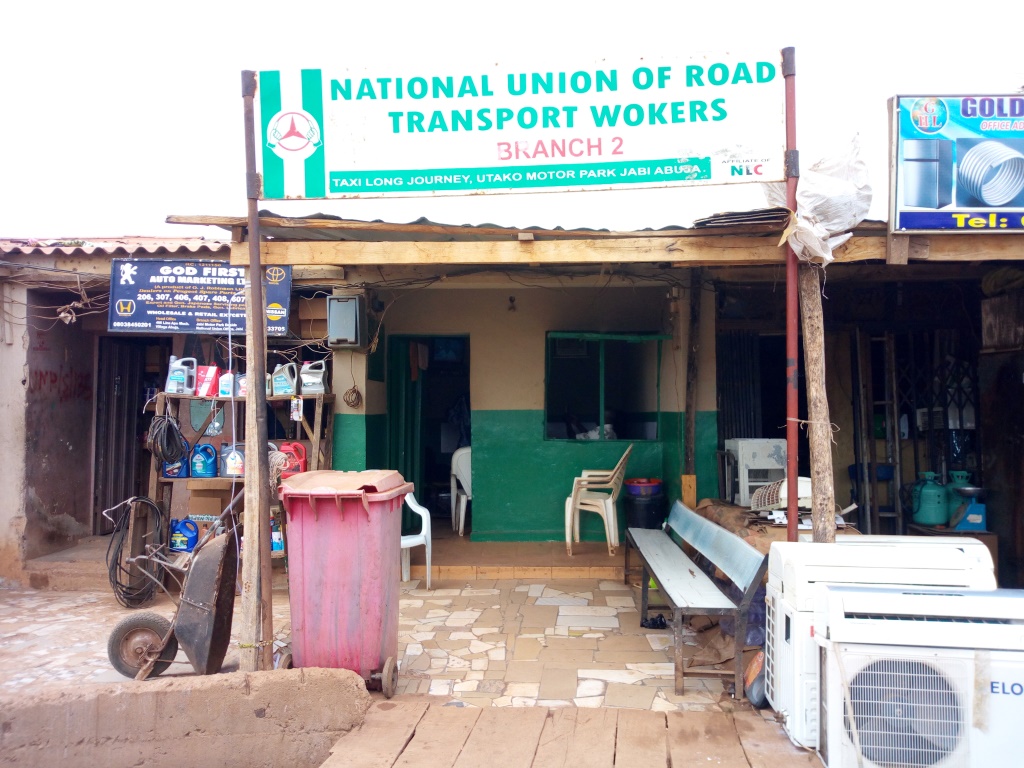
NURTW Branch 2 Office at Utako Motor Park, Jabi
‘GOOD DEVELOPMENT BUT THE POOR MASSES WILL CRY’
Ibrahim Gajide, Deputy Sate Chairman of the National Union of road Transport Workers (NURTW), revealed that that the policy on number plates is already in force in Lagos.
“We cannot drag with the government,” he submitted. “The only thing is maybe we’ll now look for an adjustment of the time so that we can purchase the vehicles. If the government can assist us, then most of our members will dispose their cars without AC and get new ones at the government price, so they’ll be working and paying. That is what we finalised with the members and we’ll be proposing this to the Transport Secretary.”
Asked if transport fares will remain the same with the proposed arrangement, he replied in the negative.
“No, you know, the charges for a vehicle with AC will not be the same as a vehicle that does not have,” he said. “Charges will be different because the consumption of fuel for a vehicle using AC will not be the same as the one that does not have the AC on. So, automatically, the system will be good, but the poor masses will cry.”
SILENCE FROM THE TRANSPORT SECRETARIAT
When Ifeanyi Ughamadu, PRO of the Transport Secretariat at FCDA secretariat was called, the phone was not answered. A text message requesting a physical appointment was also ignored. When the ICIR visited his office, a request to see the Transport Secretary, Kayode Opeifa, was declined on the grounds of “due process”.
Ovi Omo-Agege, a senator from Delta State who is currently on suspension, on Wednesday led some thugs to seize the mace at the upper chamber.
On 90-legislative-day suspension for daring to say the Electoral Act amendment by the Senate was targeted at President Muhammadu Buhari, the Delta Central senator should ordinarily be unable to gain access to the Senate.
However, he and his men managed to breach the National Assembly security and make away with the brace, sparking confusion in the premises.
Following the development, there was tension as senators went into a closed-door session.
Since the Senate sits for 180 or 181 days in a calendar year, Omo-Agege’s 90-legislative-day suspension translates to six months of shutout from the legislature.
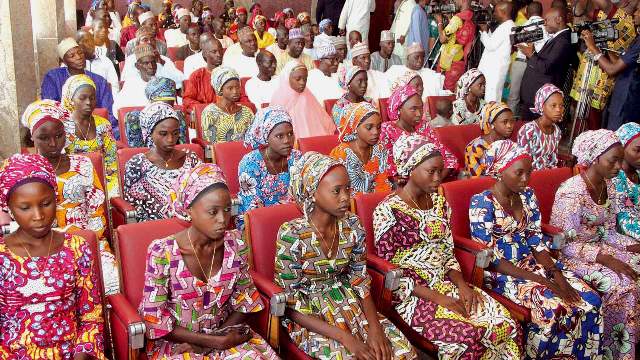
At least 15 more Chibok girls than originally thought are alive, as Boko Haram has “confirmed” to Ahmad Salkida, a journalist who has vast knowledge of the insurgency, that the 15 are being held in cells manned a faction of the group.
This brings the total number of surviving Chibok girls to 30 — 15 more than the number originally reported by Salkida on Saturday, the fourth anniversary of the abduction.
Updating his former report, Salkida said that a Boko Haram leader confirmed his report that 15 of the girls were alive and married, but added that another set of 10 and five respectively, are also alive but are being held by factional cells.
“A leading member of the Jama’atu Ahlis-Sunna Lidda’Awati Wal-Jihad or BH (Boko Haram) has now clarified the earlier information about 15 girls. Indeed, the 15 Chibok girls are available, but known to a particular cell that spoke to me emphatically days leading to the 4th anniversary,” he tweeted on Tuesday.
“However, two other cells within the larger group has brought additional information, clarifying the earlier information, that there is another 10 girls available to another cell. Outside of the 15 and 10, another 5 amongst the girls are also alive as at early hours of today.
“But the set of 5, according to the group today, have apparently become permanently embedded in the doctrines and teaching programs of the Sect and have asked not to be considered amongst those likely be included in any release in the future, if there would be any.
“In BH, you do not know what you don’t have access to because of the segmentation of authority. It’s part of the ethos of criminality to restrict access of lieutenants to critical information. You only know what obtains in the cell you control.”
5/ However, two other cells within the larger group has brought additional information, clarifying the earlier information, that there is another 10 girls available to another cell. Outside of the 15 and 10, another 5 amongst the girls are also alive as at early hours of today.
Salkida reiterated that the terms for a possible release of the girls – “for those that want to be released” – will depend solely on their husbands’ willingness to let them go.
He also expressed disappointment that “the government in its might and given the machinery available to it, peremptorily declared to the public that it lacks institutional memory regarding the processes of the Chibok girls”.
9/ Back to the response of the presidency, it is most disappointing that the government in its might and given the machinery available to it, peremptorily declared to the public that it lacks institutional memory regarding the processes of the #Chibokgirls. pic.twitter.com/BbqoxvVWLK
“Eighty-two girls were killed” amongst hundreds of other hostages that are unheard of, mainly in crossfires and bombardments; “some died long ago, some more recently”; a few are single or ‘widowed’ and it’s unbearable to publish their names here. This is the story of the Chibok girls,” Salkida concluded.
Uche Secondus, National Chairman of the Peoples Democratic Party (PDP), received a total of N250 million in cash in two installments from Sambo Dasuki, former National Security Adviser, in 2015, according to a report by the EFCC.
This is in response to Secondus’ denial that has received any money from Dasuki, neither did he direct anybody to receive money on his behalf.
Secondus’ name featured in the ‘looters list’ released by Lai Mohammed, Minister of Information and Culture, but he has since taken the matter to court, accusing the Federal Government of libel.
But, according to the EFCC report sighted by Punch, “Uche Secondus received N200m in cash from the ONSA (Office of the National Security Adviser) with voucher 0244.
“His Special Adviser, one Chukwurah, signed for the money on his behalf on February 2, 2015. Earlier, he had collected N50m which was personally received by him on November 7, 2014.
“The funds were approved by Col. Sambo Dasuki (retd.) for unknown reasons but were merely referred to as ‘special duties.’”
Also the report said the trio of Secondus, Adamu Mu’azu, former PDP National Chairman and Bassey Akpan, a PDP senator, received cars worth N1.1 billion from Babajide Omokore, an oil billionaire who is also currently standing corruption trial.
Secondus’ share of the car ‘gifts’ included a Range Rover Biography SUV worth N50 million, a Benz G63 worth N36 million, 15 Toyota Hiace mid-roof buses worth N120 million, 10 Toyota Hiace buses worth N90 million, and two Toyota Hilux vehicles worth N14 million.
In all, Secondus received vehicles worth N310 million from Omokore between June 2013 and November 2014.
Mu’azu allegedly took delivery of vehicles worth a total of N504.5 million between May and August 2014, while Akpan received vehicles worth N303 million during his time as Commissioner for Finance in Akwa Ibom State, and later Chairman of the Inter-ministerial Direct Labour Coordinating Committee.
Among the vehicles collected by Akpan were: “a BMW X5 BP worth N50 million; an Infinity QX56BP worth N45 million; a Range Rover worth N40 million; three Toyota Hiace buses worth N27 million; two Toyota Hiace High-roof buses worth N16 million, six Toyota Hilux D cabin vehicles worth N42 million, as well as other vehicles worth N83 million”.
“He (Akpan) has been invited on several occasions but he has refused to show up. He was supposed to come to the EFCC office on Monday (yesterday) but he refused to come,” an unnamed EFCC told reporters.
When contacted, Ike Abonyi, media aide to Secondus, said the matter was already in court and that the Federal Government should present its evidence in court if it has any.
“There’s no need to be talking about a case pending in court in the newspapers,” he said. “If the government has anything to say, they should file it before the court as demanded.”
Social networking platform Twitter experienced intermittent spells of downtime on Tuesday, with users unable to log in for some 45 minutes.
Attempts to access the networking service only led to a page with a waiting notification: “Something is technically wrong.”
The error message further thanked the internet user for “noticing”, with a promise to “fix it up and have things back to normal soon”.
This incident occurred roughly between the hours of 2:50pm and 03:35pm West African Time (WAT).
The website went offline at around 2.50pm, came back online at 2.58pm, then went back offline at 3.01pm. It again came back up at around 3.35pm and has been stable since then.
When the problem was resolved, Twitter itself tweeted about it, saying: “Some users may have experienced problems sending and viewing Tweets earlier today. This issue is now resolved.”
Some users may have experienced problems sending and viewing Tweets earlier today. This issue is now resolved.