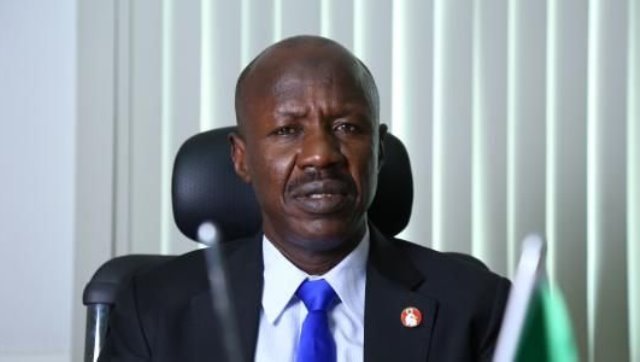
Ibrahim Magu, acting Chairman of Economic and Financial Crimes Commission (EFCC), has been promoted by the Police Service Commission (PSC) to the rank of a Commissioner from Deputy Police Commissioner.
A statement issued by Ikechukwu Ani, Head, Press and Public Relations at the Police Service Commission, said Magu was promoted alongside 17 others.
The EFCC Chairman is yet to be confirmed as the substantive Chairman of the anti-corruption agency by the National Assembly despite repeated nominations by the Presidency.
He was appointed by President Muhammadu Buhari in 2015 to lead his administration’s anti-corruption efforts.
The Statement in full
The Police Service Commission has approved the promotion of eighteen senior Police Officers. The promotions are one of the high points of the Commission’s 27thPlenary Meeting which ended in Abuja today, Friday, April 20th, 2018. The Meeting was presided over by the Commission’s Chairman Sir. Dr. Mike Mbama Okiro, a retired Inspector General of the Police.
The Commission approved the promotion of AIG Agbola Oshodi-Glover in charge of Zone 11, Osogbo, to the next rank of a Deputy Inspector General of Police.
CP Ghazzali Mohammed, Commissioner of Police, Administration, DLS, Force Headquarters and CP Peace Ibekwe Abdallah, former Commissioner of Police, Ebonyi State Command and currently , CP, Force Intelligence Bureau, Force Headquarters were promoted to Assistant Inspector General of Police.
The acting Chairman of the Economic and Financial Crimes Commission, EFCC, DCP Ibrahim Mustapha Magu, DCP Ebere C. Onyeagoro, DCP Administration, Kaduna State Command and DCP Moshood O. Gbolarumi, DCP Maritime, Lagos, were promoted to the next rank of Commissioner of Police.
Other promotions approved by the Commission include; one Assistant Commissioner of Police to Deputy Commissioner of Police, Nine Chief Superintendents of Police to assistant Commissioners of Police, one Deputy Superintendent of Police to Superintendent of Police, one assistant Superintendent of Police to Deputy Superintendent of Police and one Inspector to assistant Superintendent of Police.
Chairman of the Commission, Dr. Okiro congratulated the newly promoted officers and urged them to rededicate themselves to the service of their fatherland. He assured them that the Commission will continue to pay attention to their basic entitlements which include regular promotions.
Attempts to cover up years of graft in Akanu Ibiam Federal Polytechnic, Unwana in Afikpo, Ebonyi State have failed, resulting in a strike, extortion of students and a harrowing learning environment.
The Akanu Ibiam Federal Polytechnic, Unwana, has been enmeshed in financial distress since 2016, following the implementation of Treasury Single Account (TSA). It started with the Government Integrated Financial Management Information System (GIFMIS), a component of the TSA that strives to make government budgeting and revenue collection more transparent and efficient.
Before the new financial measures, Akanu Ibiam Polytechnic – just like other federal institutions – used to receive a monetary allocation of personnel costs into its bank accounts. This gave the management of the polytechnic the leeway to inflate personnel costs and enjoy a huge leftover of money after payment of salaries. The slush funds were spent at the discretion of the institution’s managers.
The GIFMIS was the game changer in the graft that was sustained for years. Now, the polytechnic still prepares its payroll but the money does not come into the institution’s accounts anymore. It uploads the payroll into the GIFMIS platform with which the Central Bank of Nigeria (CBN) disburses the money directly to the individual accounts of polytechnic staff.
‘MIRACULOUS’ JOB OFFERS WITHOUT INTERVIEWS
Shortly before the implementation of GIFMIS, Akanu Ibiam Polytechnic embarked on a secret recruitment of staff to shore up the huge personnel costs allocation it had been receiving over the years. The ICIR gathered that between 400 and 520 workers were secretly recruited.
The jobs were not advertised and those who got the jobs were never interviewed. In fact, the new employees received their letters of employment and confirmation of appointment the same day, an indication that the positions were backdated to cover up “ghost workers”. In civil service, confirmation of appointment comes after two years of the offer of employment.
Many of those who got the jobs are relatives of senior staff of the polytechnic. One of the new employees told the ICIR that she was watching a movie when she received a phone call from an uncle.
“It was a miracle,” she says. “I got a job without interview, without even applying for it.”
Inya Ibiam, Deputy Rector of Administration, admitted that the secret employment was carried out but insisted that the school did not do any wrong thing.
“We have been investigated by the Federal Character Commission and given a clean slate of operation,” Ibiam told the ICIR. “Yes, there was employment but not up to the number you stated. The school has not defaulted in its employment no matter how they look at it.”
A senior management staff lamented that the story of the secret employment would now be public, adding that the slot was shared and the beneficiaries included those from the Federal Character Commission and the staff currently campaigning to remove the Rector, Ogbonnia Ibe-Enwo, who has been recommended for reappointment by the Governing Council of the polytechnic.
He said the two wives of Marcellus Eze, the then Chairman of Academic Staff Union of Polytechnic (ASUP) in the school, were among the beneficiaries of the job bonanza. Regrettably, he said, Eze is now the arrowhead of those castigating the Rector and working against his reappointment for a second term.
He said the school was not the only institution involved in the so-called “padding of budget”; every other federal tertiary institution was involved too.
While the secret recruitment shielded Akanu Ibiam Polytechnic from being exposed on its huge number of ghost workers, the cessation of the slush funds has created an unprecedented crisis in the institution.
DEDUCTIONS FROM STAFF SALARIES
With GIFMIS in full swing by 2016, the staff of the Akanu Abiam began to notice unusual deductions from their salaries. A pay slip of a senior lecturer seen by the ICIR showed he received N273, 250 as net salary in May 2016 but it had reduced to N238, 338 by June.
The management of the institution had explained to the staff that there was a substantial drop in personnel costs allocated to the institution by the Federal Government and the polytechnic could not settle the allowances of the staff as previously done.
A check by the ICIR actually showed that the monthly allocation to the polytechnic for personnel costs dipped from 261 million to 241 million in 2016. The full allocation, however, was restored in 2017. With the restoration of full allocation, the staff began to receive their peculiar academic allowance which was suspended in 2016. The allowance is 7.2 percent of their basic salary for teaching staff and 5.2 percent for non-academic staff.
Despite the restoration of full personnel costs allocation and the resumption of payment of the peculiar allowance, members of the staff were still noticing unusual deductions from their salaries. Simply put, their salaries were still below what they were receiving before June 2016. The management had publicly explained to the staff that the deductions were caused by a shortfall in the monetary allocation to the polytechnic.
Following the agitation by the staff, the Rector had summoned leaders of the three staff unions in the school to disclose the real reason for the unusual deductions – it had realised that it was overpaying the staff when the institution still had access to slush funds made from ghost workers or inflated personnel costs. For this reason, the management has begun to deduct contributory pension from the gross earnings of the staff in June 2016 which accounted for the decrease in their net salaries.
PENSION DEDUCTIONS EXPLAINED
The 2004 Pension Reform Act mandated employees and employers to contribute to the employees’ retirement savings. In this regard, 7.5 percent of employees’ consolidated salary will be deducted for the contributory pension scheme. The employer equally contributes 7.5 percent towards the scheme.
When the Federal Government realised that many of the institutions were not remitting their employees’ pension contributions to the employees’ retirement savings accounts maintained by their pension administrators, it decided to start deducting the employees’ contributions at the source. The Federal Government subsequently centralised employer and employees’ contributions and deducted at source by the Budget Office of the Federation. Personnel costs are released to federal ministries, departments and agencies net of the deductions.
In a December 2012 circular to departments and agencies of the Federal Government, Ngozi Okonjo-Iweala, former Minister of Finance, explained that the deduction at source was necessary to ensure timely remittance to the National Pension Commission for onward transmission to the appropriate staff pension manager.
She said the amount deducted at source should only appear on the employee’s monthly pay slips as a proof of their contributions and to show that they did not receive less than the government approved salary.
According to Okonjo-Iweala, the reflection or showing the amount of the staff contribution to the scheme in their pay slips does not in any way constitute double deductions as was being speculated then in some government’s institutions.
Despite the fact that the Federal Government started deducting pension contribution at source as far back as 2007, Akanu Ibiam Polytechnic continued to pay its staff 100 percent, instead of 92.5 percent of their gross earnings as the government had already deducted 7.5 percent at the source for a pension. In essence, the polytechnic was paying its staff 107.5 percent. This was possible because even when the government had deducted pension contributions from the personnel emolument, the polytechnic was still able to pay the staff 100 percent because of the huge leftover from inflated personnel costs. The surplus payment continued until 2016 when GIFMIS became the mode of payroll.
LECTURERS EMBARK ON CONTROVERSIAL STRIKE
Lecturers stopped working to protest the new deductions from their salaries on March 1 and called off the strike on April 19 after realising that management had been overpaying them for years
To convince the leaders of the staff unions that the new pension deduction being reflected on the staff’s pay slips was not double deductions, the management of Akanu Ibiam Polytechnic offered to sponsor them on a trip to investigate it.The leaders of the two non-teaching staff unions accepted the money from the management to embark on the investigation while the leaders of teaching staff declined management’s sponsorship for the trip.
Innocent Agha, Chairman of Senior Staff Association of Nigeria Polytechnic, Unwana chapter, told the ICIR that his union did not join the strike because there was no justification for it. He said when they investigated the pension deduction by visiting relevant agencies in Abuja, they realised that the explanation given by the management was true.
“If you bring what was taken at source, it will give you your salary,” Agha said. “When you multiply it by 12, it gives you the per annum. If you go to your letter of employment or letter of promotion, you will see that what is stated there is reflecting what is being given to you now.”
ASUP, however, submitted a report that the pension deduction amounted to double deductions. ASUP also accused the leaders of other unions of accepting a bribe from the management to keep quiet about the deduction.
Amidst this controversy, Marcellus Eze, ASUP Chairman, was suspended by the National Executive Council (NEC), following a petition that was allegedly written by the management of Akanu Ibiam Polytechnic. Eze had been putting the members’ dues into his personal account and tampering with the money without remitting to the national body. With Eze’s suspension, his vice, Carl Nworu, became Acting Chairman.
At the ASUP’s congress on March 1, 2018 in Unwana, a motion to embark on strike was moved since the management had failed to restore their full pay prior to June 2016 after an ultimatum had elapsed. The motion was supported by 189 members against 51, while six votes were voided. Instead of declaring the strike, Nworu pleaded with the members to give him until March 8 to obtain approval to embark on strike from NEC.
Members resisted his plea and the session became rowdy. Nworu eventually left the venue without declaring the strike. In the absence of the chairman, the secretary took over and made the declaration.
The intention of the members was to begin the strike before the students start their semester examination on March 9, which they believed would hit the management the hardest.
“As long as the union is concerned, we are not on strike,” Nworu told the ICIR before the strike was called off. He said since the NEC did not approve the strike and he did not declare it, the strike was invalid.
In an interview: Eze, the suspended Chairman; Osibe Jonathan, former Chairman; and Madubuike Chibuike, the current Publicity Secretary of the union told the ICIR that they did not do anything wrong in embarking on the strike.
“As at the time that I was a member of NEC, there was a blanket approval that any chapter that has problems with its management and can sustain the fight, they can go ahead with strike but notify NEC,” Eze explained. He said they would have gone on strike over the issue of deduction in 2017 when he was still the Chairman but he pleaded with the members to shelve the strike.
However, a resolution of the 90th meeting of NEC expressed disappointment at the level of impunity in the Akanu Ibiam Polytechnic chapter with respect to disobedience to the union’s constitution.
A copy of the letter dated March 9 and addressed to the Chairman of ASUP in the school, the NEC declined any form of approval for the already declared strike as due process was not followed in taking the action.
NEC also condemned the level of disrespect to constituted authority in the union, including the office of the Chairman of the chapter resolving to address the issue administratively with the culpable officers.
A copy of ASUP constitution obtained by the ICIR clearly stated that chapters must obtain approval from NEC before embarking on a strike.
To resolve the impasse over pension deduction claims, a joint committee of ASUP and Governing Council of the polytechnic went on fact-finding mission to other institutions. A report by the committee that the pension deduction did not amount to double deductions led to the suspension of the strike on April 19 – seven weeks after it was declared.
STUDENTS THE VICTIMS OF IMPUNITY
Few students loitered on campus as the semester examination was put on hold due to the strike
As the GIFMIS blocked the slush funds of Akanu Ibiam Polytechnic, students are now being extorted.
Realising that the polytechnic, which was established in 1979 and effectively took off in 1981, did not have an active alumni association, Grace Ibe-Enwo, wife of the Rector, installed herself as President of the association in 2016. She was first employed as administrative staff in the school but she worked her way to become a senior lecturer. Along with another senior staff of the polytechnic who is the Secretary of the alumni association, they imposed outrageous levies on all the students.
Since 2016, all the students in the polytechnic, including freshmen in ND and HND, have been paying N5,000 annually for alumni levies, making it the first tertiary institution in the country to charge first-year students alumni levies.
The imposition of the alumni levies on all the students is an ingenious means to make money in a school with a student population of just over 5,000. The Rector’s wife actually took a cue from the management that charges students N5,000 in addition to their school fees for entrepreneurship courses that they must take every session.
Meanwhile, the effect of GIFMIS is not only evident in the unjustified fees imposed on the students but also in the depreciating quality of learning and services.
Unwana hardly has electricity from the national grid; the polytechnic depends heavily on the generator. The state of financial distress of the polytechnic means that purchasing diesel for the generator has become a struggle. The diesel-powered generator is often switched on from 10 am to 2 pm. With this short period of power supply, students are not able to make use of laboratories for their practice and assignment.
The Akanu Ibiam Polytechnic has also slashed the duration of its part-time programme from three years to two years in an effort to attract candidates who do not meet the entry requirements for regular programme into the ND and HND programmes. The part-time programme is now run as regular but the only difference is that the students on part-time pay higher fees.
The polytechnic has concluded arrangements to make all examinations in the school computer-based, in order to reduce the cost of printing question papers. But the teaching staff has argued that the measures will make all examination questions objective, which are ineffective for testing students’ knowledge in a technical school.
MORE TROUBLE FOR THE POLYTECHNIC
While slush funds have sustained the polytechnic for years, it has come to its wit end. In January, the management announced to the staff that it could no longer pay the peculiar allowance because its internally generated revenue is very poor.
Now that the academic staff have finally agreed that the pension deduction is not double deductions, the management of the institution will still have to convince them to forgo their peculiar academic allowance, which is 7.2 percent of their basic salaries.
“Our internally generated revenue is zero,” Inya Ibiam, the Deputy Rector of Administration, told the ICIR. He said the only source of internally generated revenue is the part-time programme but due to the location of the school, it does not attract enough part-time students. Part-time students pay N68,000 per session while regular students pay 37, 000 depending on the faculty.
“What we have is service fees, not school fees,” Ibiam argued. For example, he explains that what makes up some of the so-called school fees are N1,,500 for an identity card, N4,500 for examination scripts, N5,000 for medical, and N3,000 for ICT.
The termination of the slush funds did not only affect the staff and students of the Akanu Ibiam Federal Polytechnic but also the outsourced security and cleaning services in the institution. Cleaners and guards are victims, too, their monthly pay slashed from N25,000 to N10,000.
Nigeria’s readiness for air emergency is suspect — the air ambulance, and search and rescue (SAR) helicopter belonging to the National Emergency Management Agency (NEMA) are currently grounded, the ICIR can report.
The certificates of airworthiness and insurance for the two aircraft have expired, so they are parked at the hanger of Nigerian Police Air Wing of the Nnamdi Azikiwe International Airport, Abuja.
The NEMA Air Ambulance Service, a 12-passenger aircraft, is marked 5N−EMS, while the helicopter painted in orange colour is marked NEMA rescue with 5N−NEM as its registration number. Launched on February 13, 2015, the air ambulance is meant to deliver emergency healthcare and quick transportation of patients with emergency cases.
NEMA was established in 1999 to manage disasters in Nigeria, with a mission to “coordinate resource towards efficient and effective disaster prevention, preparation, mitigation and response in Nigeria”.
But the ICIR can authoritatively report that the agency is nowhere close to being prepared to prevent or respond to any disaster in any part of the country when the need arises. This is in spite of huge budgetary allocations to the agency in 2016 and 2017: N1.66 billion and N1.41 billion respectively.
NEVER BEEN USED BEFORE
The search-and-rescue helicopter – acquired in 2014 – has never been used for any rescue operation, yet its airworthiness certificate and insurance have expired, the ICIR gathered.
“The air ambulance has never been used before − except for a simulation exercise sometimes in 2015 when it was flown to the NEMA headquarters and the trauma center at the National Hospital. That is all; it has never been used to any rescue,” disclosed an official of the agency, who did not want to be named because he was not authorized to speak to the press.
NEMA Rescue helicopter: Never used before, grounded and wasting away
“I am speaking to you authoritatively that the helicopter has never been put to use. It has never been put to actual use for any reason at all. You know that there is a publication early in the week that the pilot commercialized the helicopter.
“The air ambulance was put to use between 2014 and 2017… Aircraft is unlike a car where you can insert a key and move it. Once an aircraft is grounded for more than six months, it is not permitted to fly again until it is put through a compulsory maintenance. As it is now, our aircraft have been grounded for more than a year.
MISSED OPPORTUNITIES FOR EKWUEME, SULE
When the late Alex Ekweume, former Vice President, needed to be flown abroad in November 2017, after suffering from chest infection, the Federal Government, put NEMA on standby to prepare the air ambulance to airlift him to London for medical treatment.
But the Second Republic Vice President was flown abroad in a chattered white air ambulance with Registration Number N605AJ because the NEMA air ambulance’s airworthiness and certificate of insurance expired.
Earlier in July 2017, elder statesman Maitama Sule also missed the opportunity of being airlifted by the NEMA air ambulance to Egypt for medical treatment − simply because the aircraft was grounded for the same reasons. He later died in an undisclosed hospital in Cairo, 24 hours after he was admitted.
GROUNDED FOR OVER A YEAR
A crew member of the air ambulance who also spoke anonymously because he could be sanctioned for talking to the press confirmed that the aircraft had been grounded for over a year over issues relating to “air worthiness and insurance renewal”.
He told the ICIR that the aircraft’s quarterly insurance certificates had expired, while they had also not been serviced or maintained over a period of time. According to him, it costs about N20 million and N17 million to renew the insurance for the air ambulance and the helicopter.
“If you don’t have insurance you cannot fly,” he said, adding, “they also need servicing or maintenance because they have not been put to use over long period of time.”
In accordance with Nigerian Civil Aviation Authority (NCAA) Standards and Procedures, aircraft must be serviceable and must undergo a periodic maintenance and test flight carried out before procedure of renewal of certificate of airworthiness can commence.
“They are due for annual maintenance, and if we leave them like that, they will become a waste. It might warrant us to drop the engine, call the manufacturers,” he said.
“We have to ship them out for total overhaul and what that means is that it will be like we are buying another one. If the insurance is paid today, the ambulance will just be moved out of the country for maintenance.”
SEARCH-AND-RESCUE HELICOPTER? NOT TRUE!
On its official website, NEMA claims to have in place a helicopter for search and rescue.
“The helicopter is stationed in Abuja and manned by officers of the Nigerian Air Force. Necessary arrangements are being concluded to acquire additional helicopters which we hope that with time there would be one for each of the six geo-political zones,” reads information posted on February 16, 2014.
However, findings by the ICIR, reveal that the Mi−17 helicopter whose certificate of airworthiness and insurance also expired on February 11, 2011 and on December 31, 2010 respectively has since been given out to the Nigerian Air Force.
This was confirmed by a NEMA official who declined to be mentioned.
“Before the acquisition of the helicopter we are using now, we had one helicopter that was acquired much earlier. The popular helicopter you see on NEMA website is the old one, they called it Mi-17.
“It’s a military helicopter acquired from Ukraine or Russia; it was grounded for a long time; it was not put to use but that helicopter has been handed to the Nigerian Air Force because it is rugged and being used for military operation. The Air Force has changed the colour from that orange colour of NEMA and has painted it with the military camouflage colour.”
When contacted for comments, Sani Datti, spokesperson of NEMA, said he was not in a position to respond to questions relating to the Air Wing Operations of NEMA.
While stressing that a letter could have been written in respect of such questions to the NEMA headquarters by the ICIR, Datti said Mustapha Maihaja, Director General of NEMA, is in the best position to answer the question.
He, however, added that this journalist should attend the public hearing on NEMA by the House of Representatives on Thursday, April 19, 2018, where, according to him, answers to the questions would be provided.
“When you are doing such kind of investigation, you need to write to the agency or you come and meet the right person. Like this thing you are asking me, I can’t say anything because I don’t know anything,” he said.
“The right person for you to meet is the Director-General for you to get the answer except if you are going to the National Assembly because this matter you are asking is already at the National Assembly. National Assembly is already investigating this matter. I think it is good for the National Assembly tomorrow. Anything you are asking me about Air Wing I don’t know; I don’t know.”
NEMA under Maihaja has been enmeshed in different crises, including financial scam allegation against him, which the National Assembly is currently investigating.
Since the start of his second term, Rochas Okorocha, Governor Imo State, has embarked on an audacious urban renewal drive. On paper, it looks laudable: expand the roads, widen the drainage systems, de-congest clustered city locations. But the project has been splotched by failure to compensate lawful land owners, pulling down of buildings without rebuilding them, demolition of markets without relocating the traders, and demolition of estates and reallocation to the super-rich, all combining to portray the project as an aggressive land-grabbing mission rather than the urban renewal it was meant to be, writes ‘FISAYO SOYOMBO, who spent seven days crisscrossing the state’s numerous demolition sites.
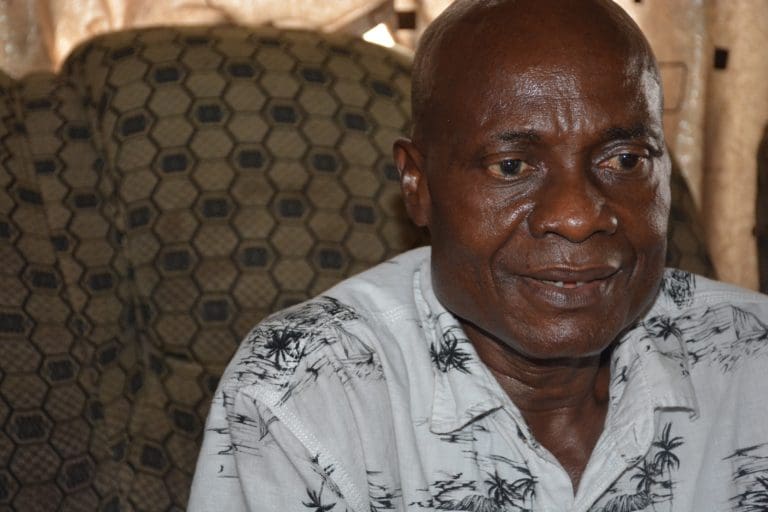
When Isaiah Nname Ibeanusi, 48, is asked what he remembers the most about his only son, whose death the Imo State government tried to hush, he goes silent. For roughly five minutes, he utters no word. His other three kids are silent, too. Apparently, there was some kind of telepathy with their dad that conditioned them to the silence of the moment. The journalist and the photographer join in as No 23 Oguamanam Street, Owerri, suddenly morphs into a graveyard, where silence is standard. There were five minutes of silence in honour of the slain boy — only that no officiating minister ordered it. Had a pin dropped, the sound would have been deafening. But everyone was saved the experiment, the silence eventually broken by no one other than the grieving trader himself.
“I remember how I carried the boy on Thursday to school to register him and prepare for everything,” he says in a slow, dreary tone. “Then this incident happened on Sunday. In fact, let’s just forget about all those things.”
No, we will not forget it. Can his 10-year-old boy Somtochukwu ever be forgotten? No matter the magnificence of the shopping edifice that springs up in place of the folkloric Eke-Ukwu Market, it will forever be splotched by the innocent blood of Somto, by his nascent life cut short by the bullets of the “Governor’s boys” sent that fateful August 26, 2017 to level that market at all costs in the name of urban renewal of the city. This particular demolition is one steeped in raw history.
EXPLAINED: THE IMO STATE ‘URBAN RENEWAL PROGRAMME’
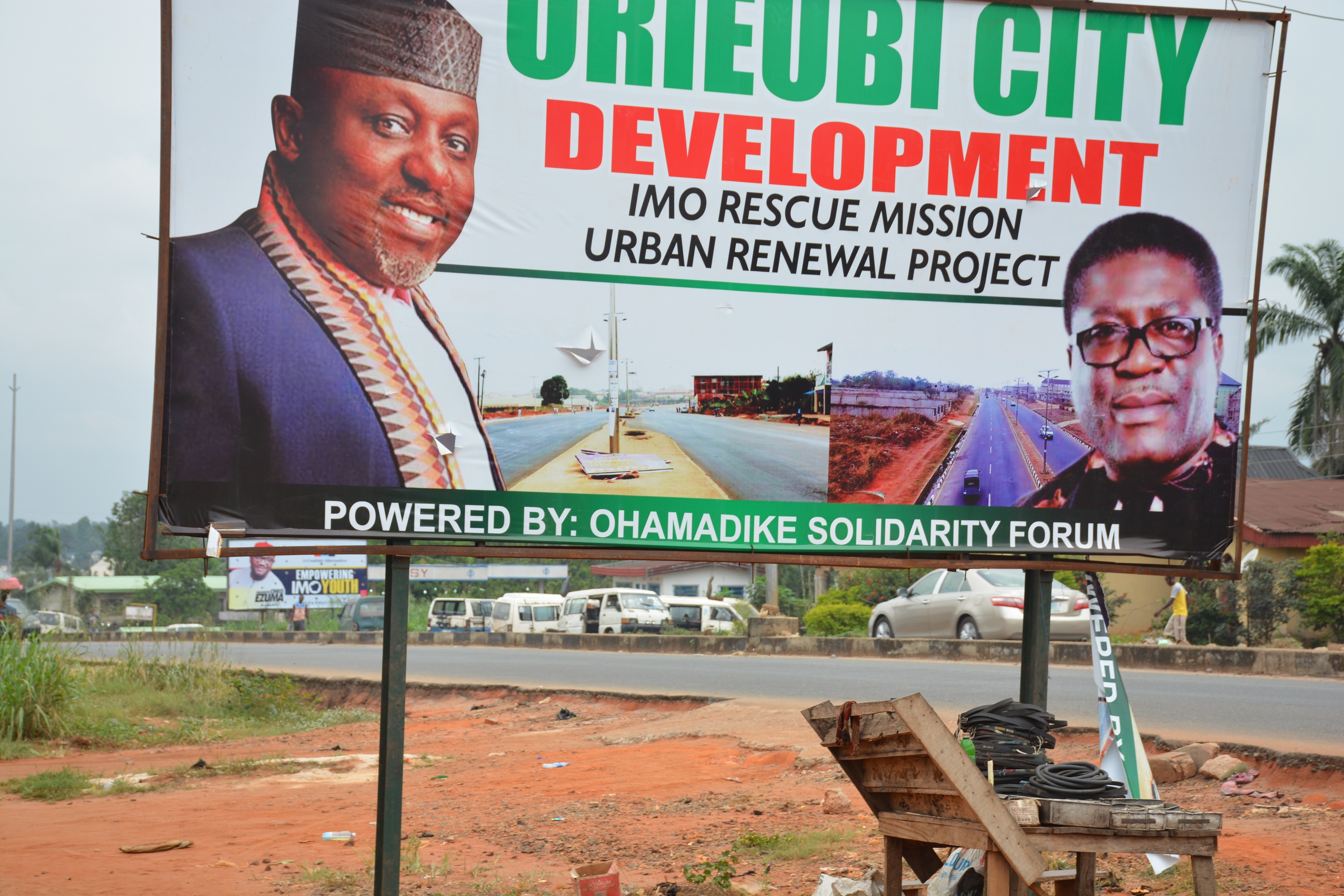
Since embarking on a raging Urban Renewal Programme at the start of his second term, Rochas Okorocha, Governor of Imo State, has overseen the demolition of structures in more than 20 public spaces, notably markets, institutions of learning and other monuments.
By Okorocha’s explanation, the programme, tagged ‘Imo My Pride’, is aimed at attracting investors and enhancing Owerri, capital of the state, as a tourist destination. To make this happen, his vow was that his administration would continue “widening the roads, distilling the gutters, relocating markets and making sure that tricycle operators are no longer on the streets of Owerri city”.
He has also repeatedly said — particularly with regards to demolition of markets — that the demolitions would reduce the spate of criminal activities in the state.
NAME
LOCAL GOVERNMENT
YEAR OF DEMOLITION
Ama JK Recreation Park
Owerri Municipal
2015
Alvan Ikoku University of Education Staff Quarters
Owerri Municipal
2016
Eke-Ukwu Market
Owerri municipal
2017
Imo State Library
Owerri North LGA
2014
Old Stadium Lane Market
Owerri Municipal
2017
New Owerri Market
Owerri Municipal LGA
2017
Nwaorieubi Market
Mbaitolu LGA
2017
Isinweke Market
Ihitte Uboma LGA
2018
Nkwo-Orji Market
Owerri North LGA
2018
Amaraku Market
Isiala Mbano LGA
2017
Alvan Ikoku Bridge
Owerri Municipal
2016
Mbari Cultural Centre, Ikenegbu Owerri
Owerri North
2016
“In decent societies, markets of that nature must be placed at a proper place and not right in the centre of the city where it does not only constitute nuisance but also promotes criminal activities,” he once said in one of his numerous interactions with the media on Eke-Ukwu.
Looking back after three years, it would seem, on the surface, that the Governor has been urbanising the city, but a scrutiny of the pattern of demolition suggests land-grabbing — the terrifying use of power to take land from the poor and reallocate to the rich — while a physical survey of the city’s demolition sites exposes haphazard pulling down of buildings without a clear-cut plan for rebuilding.
A HISTORIC MARKET GONE DOWN THE DRAIN
The traders at Eke-Ukwu did everything in their powers to stop the government from demolishing the market. They pleaded with him, their representatives granted interviews, they even instituted legal action against the state government. The market was not just a location for buying and selling, it was a part of the traders’ mortalities; it represented a piece of their history as a people.
This is because the Eke-Ukwu Market had been in existence for more than two centuries. In pre-colonial Nigeria, buyers and sellers convened at the market every four days to trade on ‘Eke’ market day — ‘Eke’ meaning ‘market day’ and ‘Ukwu’ meaning ‘big’. Eke-Ukwu, therefore, was the big market that traded on Eke day.
The market shares boundaries with Umuonyeche Village in the North of Owerri, Amawom village in the East, Umuoronjo Village in the South and Umuodu/Umuoyima Village in the West. It predates the present geographical space called ‘Imo State’. Centrally located, it started from a few stalls but then went on to expand to a total of 3,336 stalls used for daily trading and the supply of various goods and services. Until its eventual demolition, Eke-Ukwu was the biggest market in Owerri Council Development Area (OCDA).
It is a rugged market, too. In 1987, it was destroyed by fire; that was during the 1986-1989 tenure of Amadi Ikwechegh, an Air Commodore, as Military Governor of the state. Traders were advised to relocate to the then alternative ‘Relief Market’, situated at Egbu Road — a government purpose-built market smaller in size to the one gutted by fire. Although some traders relocated from Eke-Ukwu to Relief, the government failed it its attempt at permanent relocation. Rather than relocate, the traders rebuilt Eke-Ukwu — and it would later witness further expansion in trading activities.
SACRIFICED TO THE GODS OF DEMOLITION
The street just before the one where Somto was killed
This rich history was part of what the traders sought to protect when they resisted Okorocha’s demolition schedule. But on August 26, 2017 — the day the market eventually came crashing despite a pending court case on the matter — all of Eke-Ukwu’s history was consigned to the bin. No trader was so cold-hearted to be talking history when there was bloodshed. Somtochukwu Ibeanusi, an innocent boy, was felled by the bullets of the men sent by Okorocha to level the market.
Ibeanusi remembers Somtochukwu’s last days as though his death occurred yesterday. “It was on August 26, a Sunday,” he says, a thick sweat overrunning his face to accentuate his bald, shiny head.
“I woke up in the morning. Then I called the boy to join me where I was packing some goods. I carried him and his senior sister to the place, just very close to this house. I told them to stay there. Then, my wife and I went straight to the plaza.
“The Governor’s team started demolishing the place. Around 9:30am, people rushed in, and called me. They said I should forget everything else, that something was happening. When I asked what had happened, they said someone had been killed and it was my son. They said he was shot. When I got there, there was blood everywhere.”
Silence.
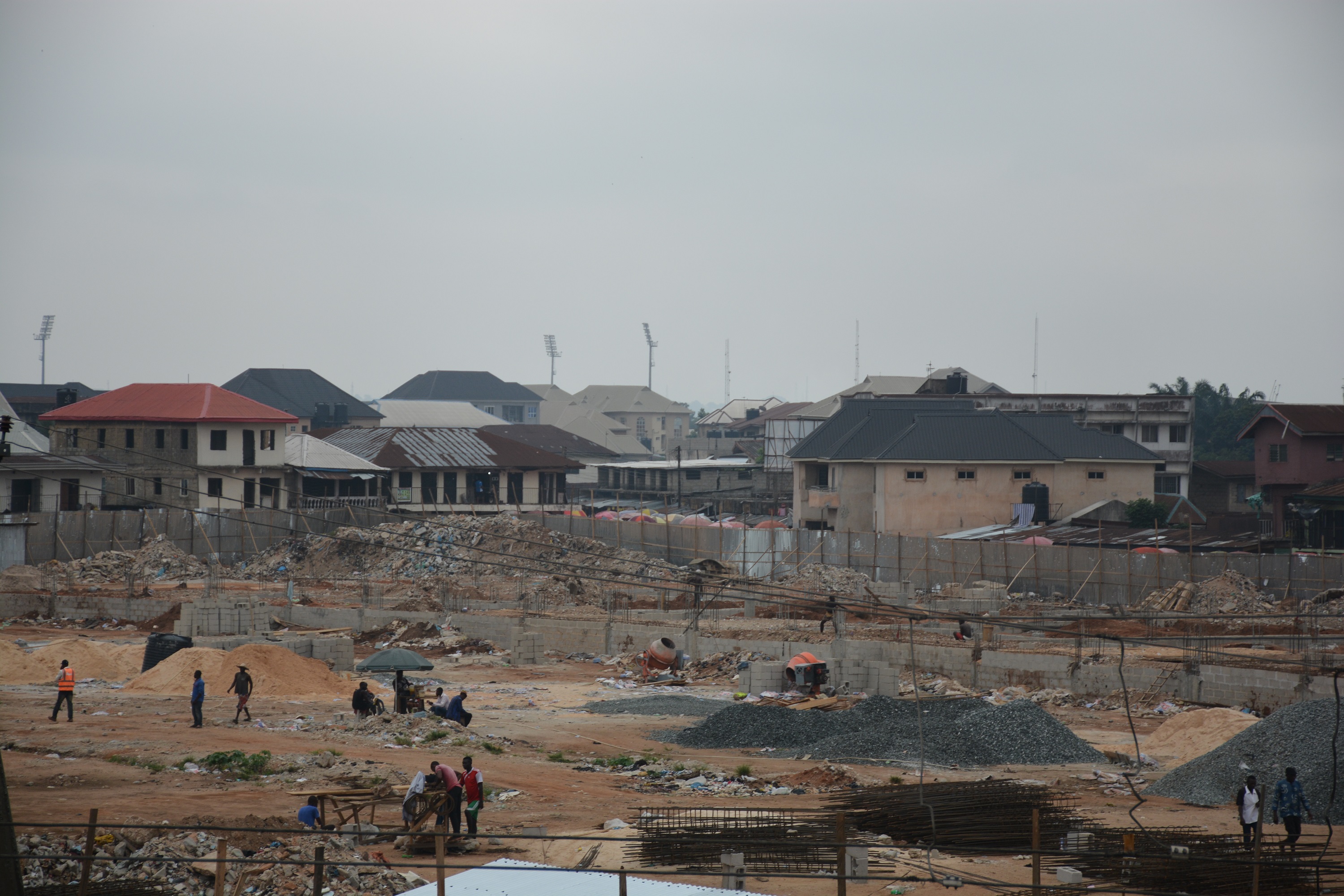
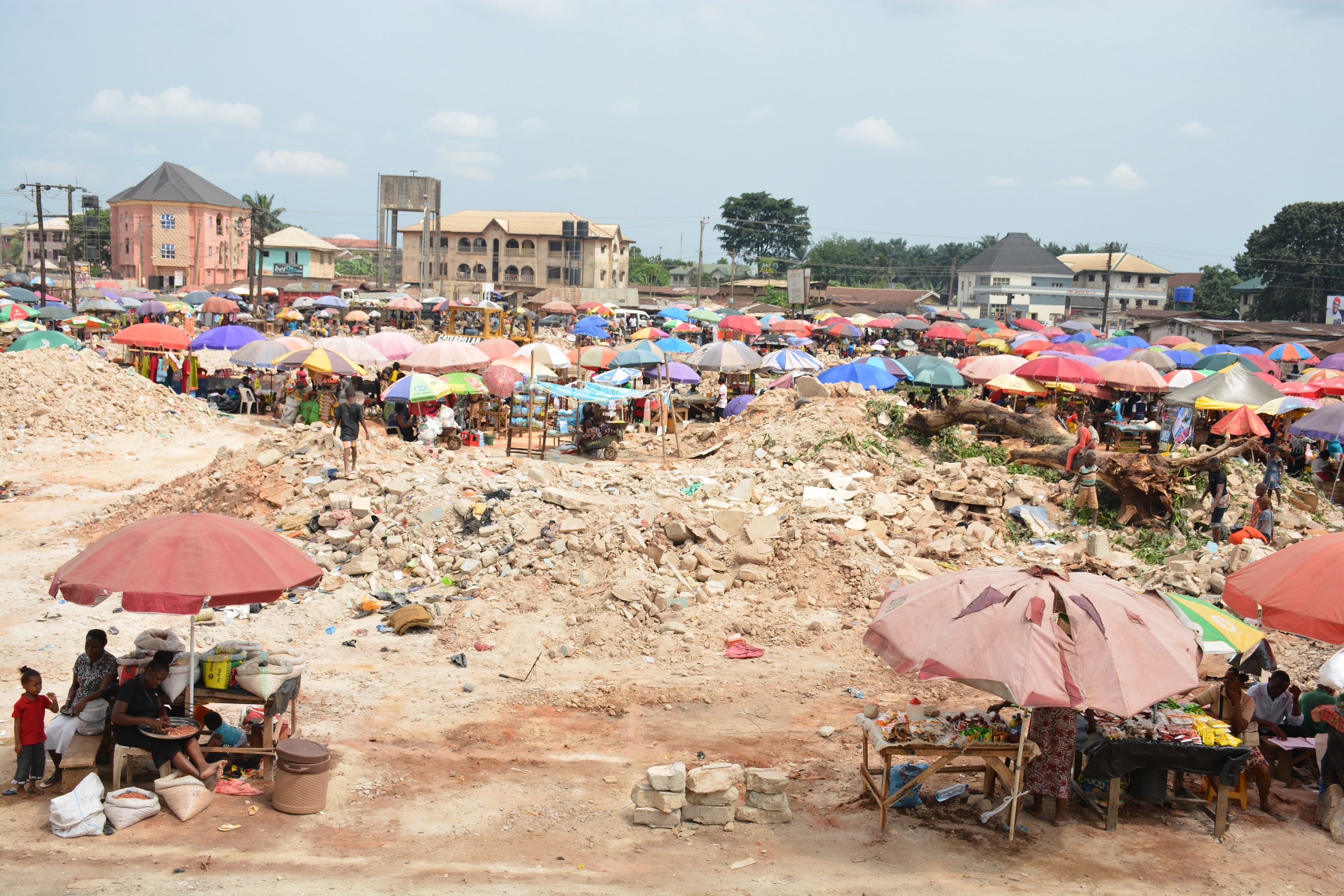
Rubbles… the leftover of a market that predates Imo State
Over the following 10 minutes, the phone accessories dealer would bow his head, uttering no further word, his pain and emotion requiring no artificial transmission; everyone in the room could feel it. At times, it felt like one could even touch it.
Was Somto still alive when he rushed to the location where he lay, his forehead bloodied?
“No,” Ibeanusi replies. “From what I saw, he was not alive. The shot was close-range; the bullet entered from the front and came out from the back.”
N2MILLION THE WORTH OF HUMAN LIFE?
Chased out of Eke-Ukwu without being given an alternative, traders are stuck on the outskirts of the demolished market
As word went round the state that an innocent boy had been murdered by the Governor’s demolition thugs, the state government quickly moved to exonerate itself. A few days after the incident, two State Security Service (SSS) officials believed to be acting on the Governor’s orders arrived at Ibeanusi’s house with an unbelievable message.
“They said I should not tell anyone that my son was killed in Imo, that I should instead tell anyone who asked me that the incident occurred in Rivers State,” he exclaims, his agony snowballing into anger.
“They promised to do heaven and earth for me if I complied, but I shouted at them ‘over my dead body’. I told them I wouldn’t do it even if they offered me N10 million. The two of them came again the next day, around 4pm. I walked them out and told them I never wanted to set my eyes on them again!”
Somto’s body was at the morgue of the Federal Medical Centre (FMC) for two months before it was taken to his native Anambra State for burial. Okorocha’s men were in attendance, too, to offer him a compensation of N2million cash. But he rejected it. “I sent the money back and in addition I sent them two cartons of malt!” he quips.
A MALL AFTER SLAIN SOMTO
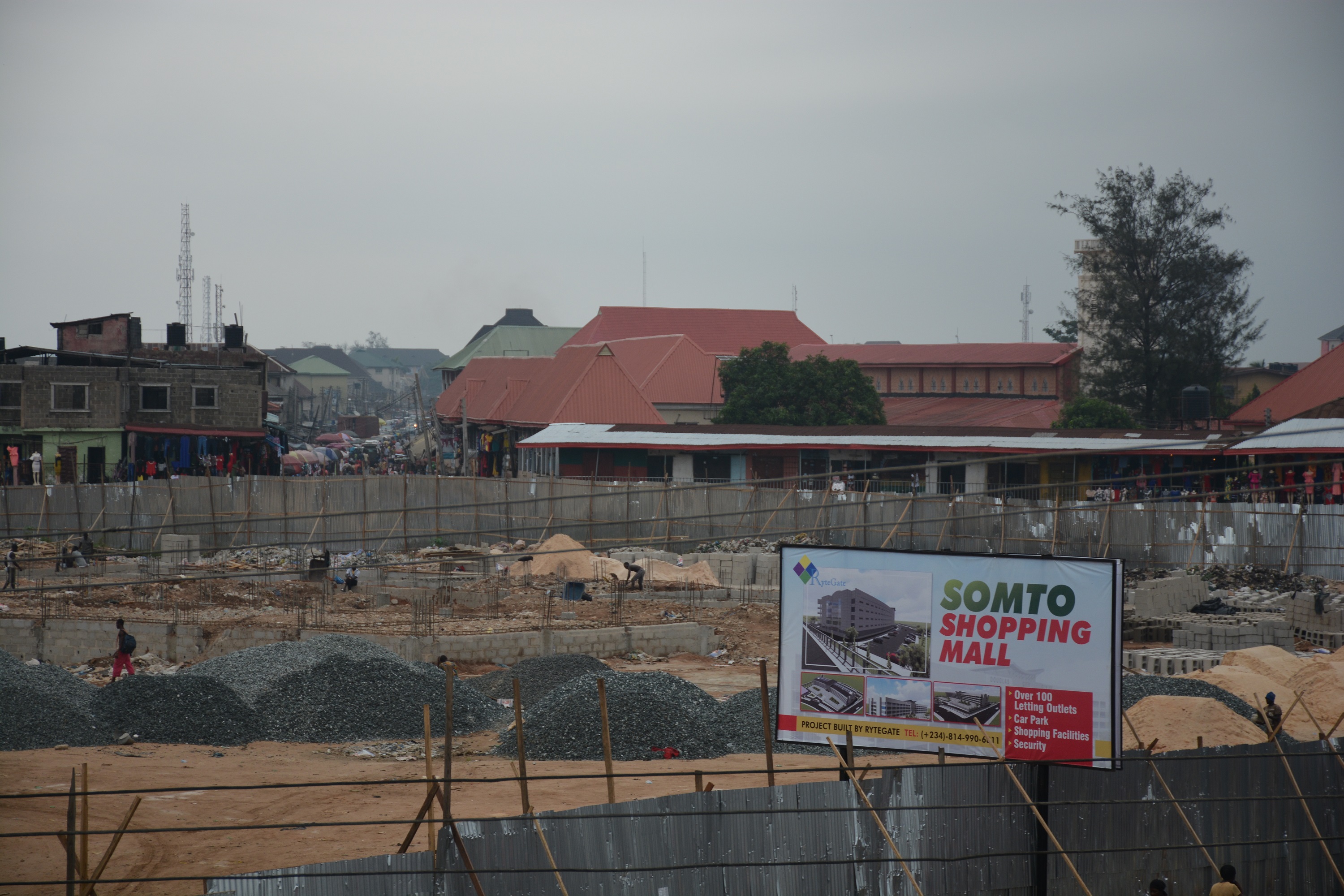
Still desperate to placate Ibeanusi, the state government renamed a part of the under-reconstruction market in honour of his slain son. But it makes no meaning to him, still.
“I saw it last week; they put it there: Somto Shopping Mall,” he says, shaking his head vigorously. “I found it disturbing; I just left the place. You know, it’s just as if this tragedy happened two days ago; I remember it but I don’t like to.”
‘I LEAVE THEM TO GOD’
Ibeanusi: I just have to leave this type of thing to God
In addition to the loss of his only son, Ibeanusi claims he lost goods worth over N130 million to the demolition. “I am not joking, but I’m just telling you,” he says. “That time, I took a loan of almost N80 million from the bank, because my order had just arrived from China. And shortly after, the demolition happened. This is why I was desperate to pack the goods until I learnt my boy had been shot.”
So, what can be done to appease him? What would he demand if the government asked him to name his wish? He stares blankly into space for some seconds, before saying: “What are you going to ask for? If they gave you N2million, that would be nothing compared to a life that you lost. Even compared to all the goods you lost, it is nothing.
“I think I just have to leave this type of thing to God. I can’t just start saying this is what I want, you understand me? I lost my son, I lost many things. I just don’t know what would make the Governor say he must demolish this place.”
A NARROW ESCAPE
Focus: the contoured spot on the forehead where Oparaku was shot
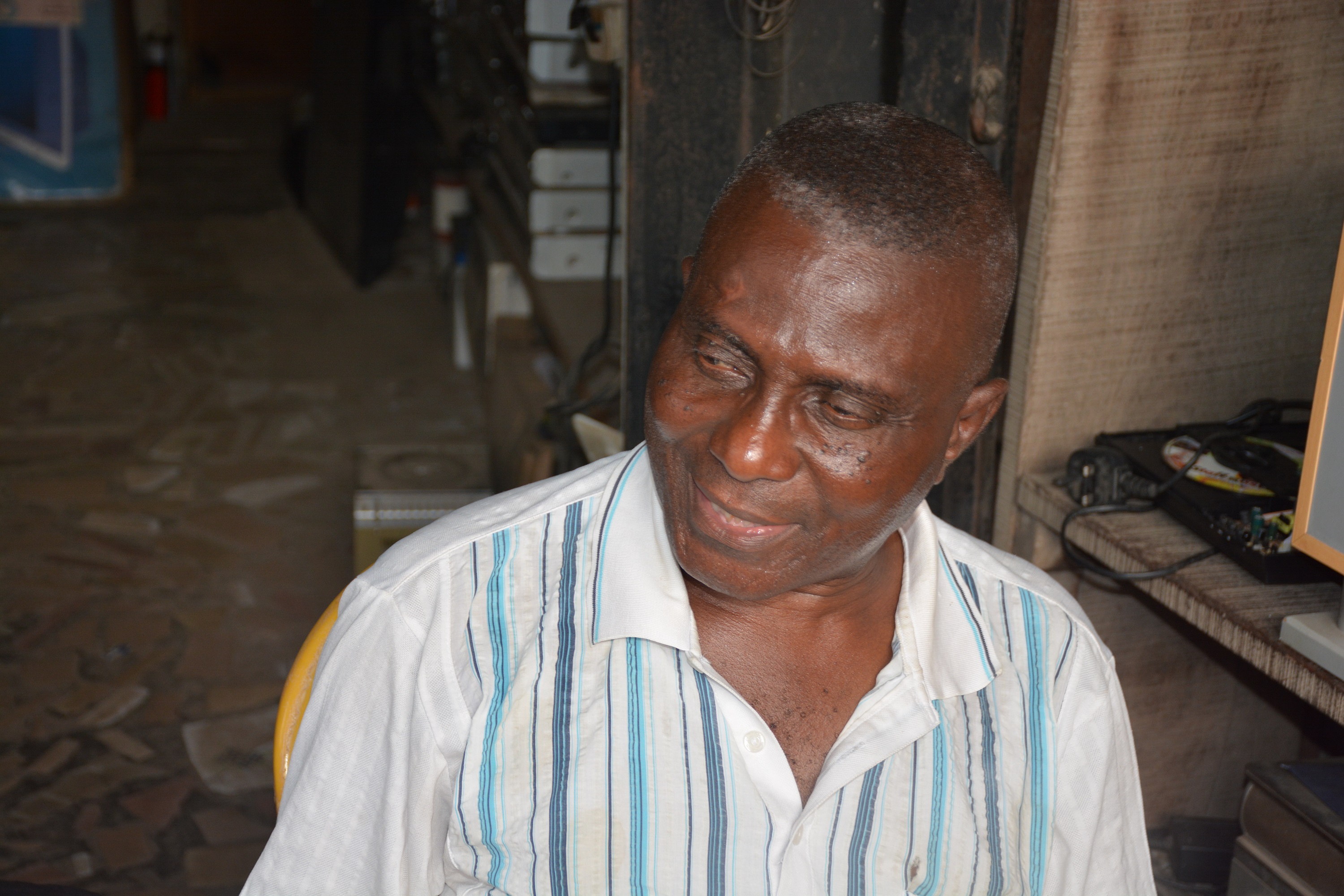
Sixty-year-old Sebastine Oparaku can count himself lucky as far as counting personal losses from Eke-Ukwu Market demolition go. Not that his son could have been killed, like Somto. Were he not lucky, the electronic gadgets repairer himself would have been the victim, the story of the tragedy told by his son.
“When the Governor’s boys were demolishing the market, it wasn’t my concern because I am not a kid or that type of exuberant youth that’ll begin to go and watch the molestation of citizens by policemen or the demolishers,” he says.
“I was in my house looking through the window there. They were passing by, the police and some soldiers. At a point, a group of boys were coming along the road there, but one of the soldiers asked them to back off.”
The boys retreated but not without pelting the soldiers and policemen, in annoyance. In response, the police opened fire at them. They fired the initial shots in the air; even that was risky as they were in the heart of the town, populated by homes and hotels. But as the boys continued pelting them, the police/soldiers upped the fire: An Armoured Personnel Carrier stationed at the edge of the market fired shots indiscriminately towards the boys. It was one of those bullets that pierced through the window of Oparaku’s house and hit him just atop his right eye, somewhere between the right side of his forehead and temple. He fell instantly. Ironically, none of the angry boys — the original targets of the bullet spray — was hit.
“I fell down unconscious immediately, but I remember hearing the screams of my wife,” he recalls. “My son and his friend brought me down from upstairs and put me into a tricycle. They took me to the Federal Medical Centre (FMC), Owerri. That was how I found myself at the hospital.”
NO TIME TO WASTE ON ‘THIS GOVERNMENT’
Oparaku ‘won’t waste a minute’ on ‘this government’
For the six weeks that he and two other injured persons spent at the hospital, no official of the state government showed up. Oparaku spent more than a N100,000 on brain scans and drugs procured from outside the hospital. But the in-hospital bills were funded by Ifeanyi Ararume, a former Senator that represented Okigwe Senatorial District at the National Assembly.
Did the government ever pay him any form of compensation? “No, no, no; nothing at all. Even the government never accepted it that one person was shot, except that boy [Somto] who died instantly,” he says.
“In fact, nobody from government has ever come to ask me anything like you’re doing now. Nobody has ever come from government, either from August 26 till first week of October when I was hospitalized, or from then till date.”
Asked what his plea to government would be if he had the chance to make one, considering the losses he and business suffered, he replied: “Which government? This one? I do not have one minute to spend on this government.
“This is our market. I am indigene of this place. This market is ours. We’ve said about the market that it should not be demolished. They should restructure it, either by fencing it or by prohibiting trading on the streets or by demarcating the market from the main road. It was unnecessary to demolish it but they did. Well… our community and the government are still in court because of the issue; it has not been resolved.”
ALVAN IKOKU — NO VICTOR, NO VANQUISHED
The entrance of Shell Camp Quarters
Before Okorocha stepped in, there was a three-way battle for the control of the official quarters of Alvan Ikoku College of Education (now Alvan Ikoku University of Education). Retired staff of Alvan, as the institution is fondly called, wanted to buy off the residential spaces they were occupying, redevelop them, and continue occupying them despite having completed their service to the institution.
The school was also laying claim to the place, known for ages as the Alvan Ikoku Shell Camp Quarters. A third group, the Orji/Uratta Aborigines, wanted it as well. Their claim is that they leased the place to the Shell Oil Company for a 50-year period that elapsed in 2015.
Then Okorocha joined the fray, further complicating matters by claiming the land belonged to the state; Alvan’s claim to ownership was that the Federal Government takeover of the school in 2007 had nullified the state’s claim to ownership, but the state is insisting that the school — not the quarters — was transferred to the Federal Government. The turnout of events would seem to confirm that the Aborigines had the strongest claim to the land.
For years, Alvan and Okorocha played cat and mouse. Okorocha would send his foot soldiers to the quarters to forcefully eject Alvan staff; Alvan management would mobilise its security officials to mount up a resistance. Elsewhere, the Orji Community sued the state government, Federal Government and Alvan; the matter still hadn’t been determined in June 2017 when Okorocha’s men laid siege to the quarters, breaking doors and removing roofs, consequently forcing Alvan staff and retirees out of their residences.
The state government claims to have negotiated with the Orji Community and paid them compensation for the land, but Amanze Njoku, a Chief and Administrator General of Orji Aborigines Congress, has since denied, wondering: “Please ask them to tell you whom they settled because the land in question is owned by individual families and not a communal land. The matter is still in court and if they have settled us as they claimed, why are we still in court? It is the same people that they claimed to have settled that are the litigants who are from Orji/Uratta in Owerri North.”
So, as it stands, it’s no victor no vanquished. The Alvan retirees have no place of their own to live; Alvan itself, as an institution, no longer has an official quarters; the Orji Community, at the moment, has no land. All the actors of the initial three-way hustle for the land have lost out. Instead, it now belongs to the state and has been rechristened ‘New GRA Owerri’.
ACADEMIC STAFF OUT, MONEYBAGS IN
The ilIustrious sons and daughters’ have taken over
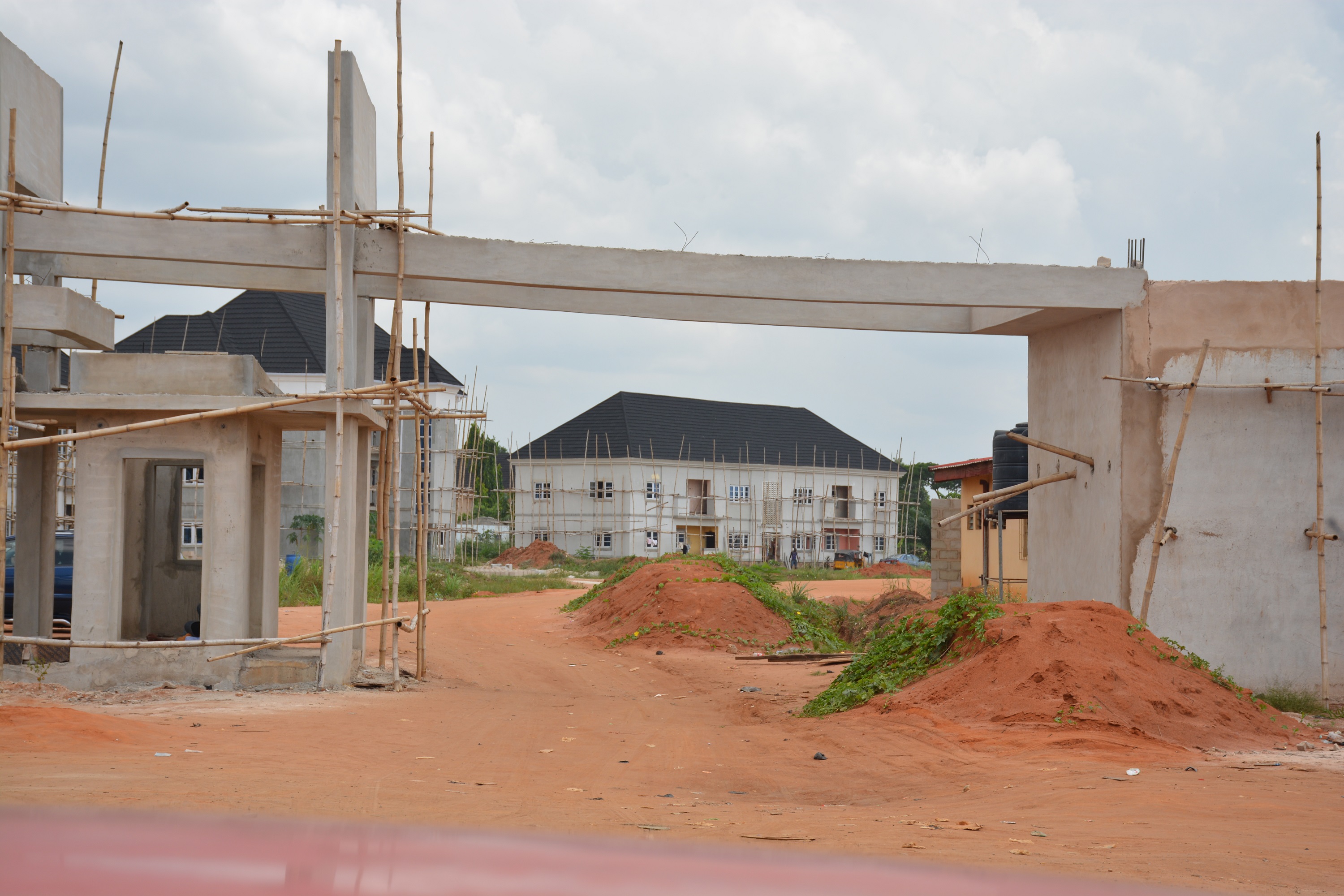
With the state now well and truly in control of the quarters for almost one year, there ordinarily should have been signs of its much-vaunted Urban Renewal Programme. But, what has happened, instead? By the admission of Leonard Okoro, Principal Aide to the Governor on Recovery of State Government Property, the state government has been “reallocating the lands to illustrious sons and daughters of the state… for N25 million per parcel of land”.
“Majority of them are politicians — these so-called illustrious sons and daughters,” says a senior staff of Alvan, who asked not to be named for fear of losing his job. “Not only that, former occupants trying to buy back their spaces at government’s new rate are having a hard time due to huge demands for bribes and kickbacks by state officials.”
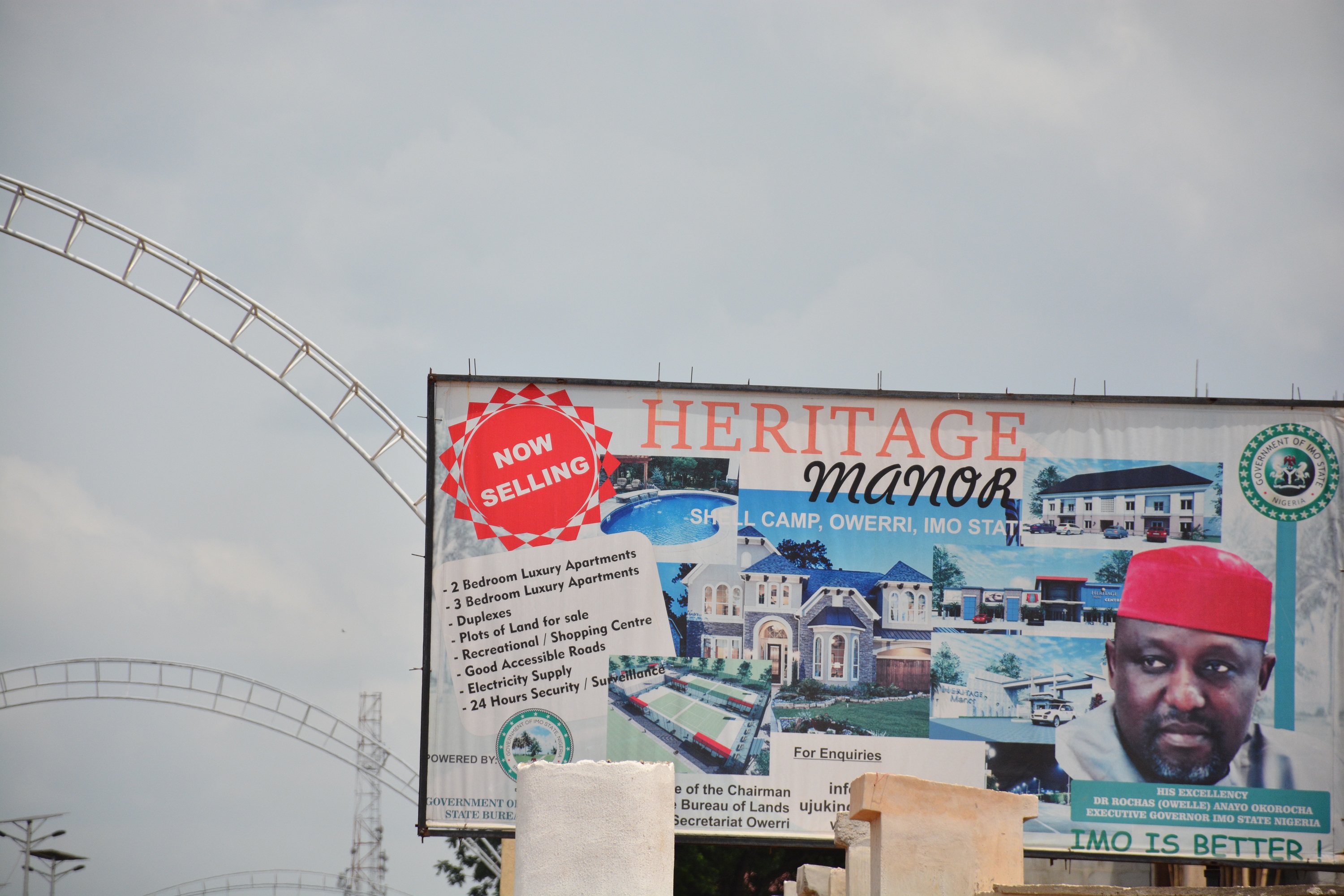
According to a giant billboard at the entrance of the quarters itemizing the government’s plans, apart from the plots of land for sale, the redeveloped estate, when ready, will contain “two-bedroom luxury apartments, three-bedroom luxury apartments, duplexes, recreational and shopping centres, good accessible roads, electricity supply and 24-hour security/surveillance”.
MONEY HAS BEEN CHANGING HANDS
Narrating his experience, he said: “I reached out to the Governor and requested that I should be allowed to buy my space back since I’ve noticed that people were buying them. I asked if he could grant me lease of the land, then I’ll be able to build since they said they are coming to build a housing estate. I might not be able to raise the kind of money I was hearing about, but if I’m given lease of the land, I will gradually build it according to the plan of the area.
“On my application, I wrote something on it, and forwarded to the person in charge and the Deputy Chief of Staff. We have been going out for series of negotiations. And you know your politicians, everybody is doing their own thing; I won’t say money has not been changing hands, depending on the individual involved at each level. Eventually, they were making unnecessary complaints about the whole thing. Right now, the position we’re in, I still have to see the Governor.”
He still cannot understand why government would chase Alvan staff out of the place without compensating them. “I think they should maybe try and pay compensation to the staff and to Alvan if they want to,” he says, “because it’s a win-win or lose-lose situation. At the end of the day, Alvan still belongs to the government.”
ROBBING PETER TO PAY PAUL
Down but not out! In the absence of an alternative, traders hang around the demolished Old Stadium Lane Market
Ada Obiaku was still a spinster when she purchased her shop at Old Stadium Lane Market, Tetlow Road, Owerri, for N500,000. Several years later, and following the fall of Old Stadium to Okorocha’s Urban Renewal Programe, she is now shop-less — and so she will be unless she can miraculously raise a sum of N3million, the going rate of shops at a new market the Governor directed Old Stadium evictees to.
This is pretty much the story of traders whose markets have been demolished: you lose your shop, you’re offered no compensation, you’re told to look for space in a distant market where shops cost six to 10 times the old rate.
“I have been in this market for a long time — since when I was still a spinster. The demolition started in August 2017 and as you can see, we are all stranded,” she says.
“The Governor said we should relocate to Egbeada, which has not been built. He gave us a 48-hour notice to leave this market. I was on a trip out of town when I got a call from my daughter about the Governor’s announcement of demolition plans.”
Obiaku abandoned her trip in a bid to salvage her goods but she was only partly successful. “We lost some goods in the process,” she laments. “We are just relying on God to help us.”
Actually, Obiaku’s primary worry is not even the lost goods but the exact handling of the relocation exercise.
“My view is that the Governor didn’t do this the proper way, and I am not happy about it all,” she says. “The place at Egbeada where we were asked to relocate to is handled by some contractors. If you have your money, you pay and they build for you; if not, you wait and rent from those who built it. A shop there costs about N3million. Tell me, where am I supposed to get that kind of money from?
“What the Governor should have done is to ask for our allocation documents so he can reallocate fresh spaces to us instead of handing it over to contractors. Alternatively, after relocating the place to new contractors, he could have compensated us by making us pay a new allocation fee to the government rather than to contractors. We were paying a monthly allocation fee of N1,800 to the local government, so it’s not like government doesn’t know we owned those shops. As it stands, the contractors and other wealthy people are the beneficiaries of land taken away from poor people like us; it’s like robbing Peter to pay Paul.”
TEARS AND SORROW
Old Stadium… a market that was
On the day the Governor’s thugs came to demolish Old Stadium Lane Market, there was a lot of weeping. So says Patricia Maduforo, 48, who had owned a shop at the market for more than 18 years prior to the demolition.
“For all these 18 years, nobody disturbed us here. This problem all started last year around August. There were rumours that it was going to be demolished, but we took it as a joke,” she recalls.
“The day he started this demolition at a shopping complex around Douglas area, so many traders’ goods were destroyed, especially those who deal in handsets, eyeglasses, wears and so on. We all felt sympathy for them because that was the entrance and that was where it started from. That fateful day, we wept but we had to console ourselves. Some of us lost our goods to miscreants in the confusion of the entire incident that was going on.
“What he did was to create a group of young boys who come into the market to chase us out; if they got anywhere close to your goods, they set them ablaze. Sometimes, I had to stop my kids from going to school so they could help me pack the goods when they started chasing us. This was what we passed through.”
After the demolition, the shop owners were expecting to be called by the government to present their allocation documents so that they could be allocated land afresh. How wrong they were!
“He never did,” she says. “What we heard is that we should go to Naze, that if the landlords of the shops asked for rent, he would know how to settle them. I have been trying to get a shop since but all to no avail.
“The Governor said he would replace this market with a school, that we should all be going to school and we should leave the market, that he’s not going to allow us trade here and that we should go where he has asked us to relocate to. He gave us a two-week quit notice but he didn’t even wait for up to 2weeks before demolishing the market.”
More than six months after the demolition, Maduforo is still at a loss how a government can in good conscience take land from its owners without compensating them.
“I had one shop before the demolition where I sold food seasonings; I bought it from the original owner. I have all my documents and I also paid an allocation fee of N1,800 monthly at the local government office,” she says.
“I am not happy about this whole ugly incident. What I expected was for the Governor to provide a place that has been built for us before the demolition. I am so confused and devastated but I have to brace up and continue my hustle to make ends meet.”
GOVERNANCE BY INTIMIDATION… ‘WITHOUT CONSCIENCE’
Anywhere you brought up the subject of demolitions across Imo State, the people were always reticent — timid, in fact — to talk. The traders were the most fearful of the Governor, one telling the journalist: “Please I don’t want to talk; I don’t want Okorocha’s problem.”
It is understandable. Their livelihoods revolve around their goods and the markets where they’re traded. The demolition of these markets left them vulnerable, naked even; it’s an assault on their essence by the very government that promised to serve the people. Their thinking, therefore, is that should they speak against the government, they may be faced with such sanctions that may permanently strip them of their livelihood. So, the majority of traders encountered in Imo refused to talk; those who did usually asked to remain anonymous, while only the smallest percentage spoke without hiding their identities. Of those who spoke anonymously, one was particularly scathing in his assessment of Okorocha: A “Governor without conscience”.
“In 2016, the Governor told us that he was coming to demolish the market, that we should relocate to Egbeada — close to Akwakuma. No date was given for the demolition,” recalls the middle-aged man, who sold odds and ends at Eke-Ukwu Market.
“Then last year, he came to the market to make an announcement. We were prepared to go to Egbeada. So, around August, he called for a meeting with all traders. This meeting held at the Imo International Conference Centre (IICC), Owerri, on a Friday. Surprisingly, on Saturday, which was a cleanup day, next thing we saw was a caterpillar that started bulldozing the buildings. I travelled to buy my goods that same Friday, so I was still away when he started this demolition. I lost my goods, because I wasn’t expecting the demolition to be that soon.”
Both he and his landlord, to whom he paid 10,000 monthly for a “half-shop”, have still not been compensated for the loss — in addition to floating at Eke-Ukwu without a permanent spot to sell his goods.
“He is supposed to have a conscience as a Governor that he is,” he adds. “Even the so-called Egbeada that he asked us to relocate to, he hasn’t finished it yet. Before you ask a person to leave a place, at least make a better provision for that person. I lost a shop and my goods. No form of compensation.”
‘HELP ME TELL THE GOVERNOR WE’RE NOT HAPPY’
At 70, Linus Iwu, a cobbler, is aged and experienced enough to know that governments come and go, and is therefore “not afraid to talk”. He is deeply hurt that his means of livelihood has been snatched away from him (as part of the wider demolition of Nwaorieubi Market in Mbaitolu Local Government, in January); but much more than that, he feels betrayed — betrayed by a man whose governorship ambition his people supported back in 2007.
“When Okorocha was campaigning to become Governor, we the Mbaitolu people supported him fully with hope that he was going to remember us for good in his reign,” says Pa Iwu. “As he has demolished our market we are not happy about the situation. Please help me tell the Governor that the people are hungry; he has sent so many back home as a result of this action. The government should please come to our aid.”
The demolished market was a gift to the Nwaorieubi community by the government and sold to the people “many, many years ago” at ridiculously cheap prices, a plot going for as low as N15,000. The individual buyers then built it to taste. Now managing at a tent at the same market, Iwu still cannot come to terms with the new reality.
“We have been trading here for a long time. I am from Umuanum here. I paid a yearly rent of N6,000. Lockup stores went for N30,000/year,” he says.
“I wasn’t at the market on the day of the demolition, therefore I lost all my work tools. I am really suffering a lot; I am not happy about this demolition. He comes and destroys and he has no plans of raising another structure for us? If he was building another one for us, it would have been beautiful.”
As it is now, once the rains begin, both the traders and their goods will be drenched from time to time.
“We’re trapped in deep suffering,” Iwu adds. “The worst part is that the umbrella with which we shelter ourselves and our goods, it gets blown away once it becomes windy, so we have to close it up and trade directly under the sun.”
‘THE GOVERNOR HAS COLONISED ALL THE LANDS’
Levelled… Amaraku Market
As far as Chidinma Anoruo is concerned, what is happening in Imo is “colonization of lands” by the government — not urban renewal. Before Amaraku Market, in Isiala Mbano LGA of the state was demolished, Anoruo paid a rent of N2,000/month (N24,000/year) to her landlord for her stall.
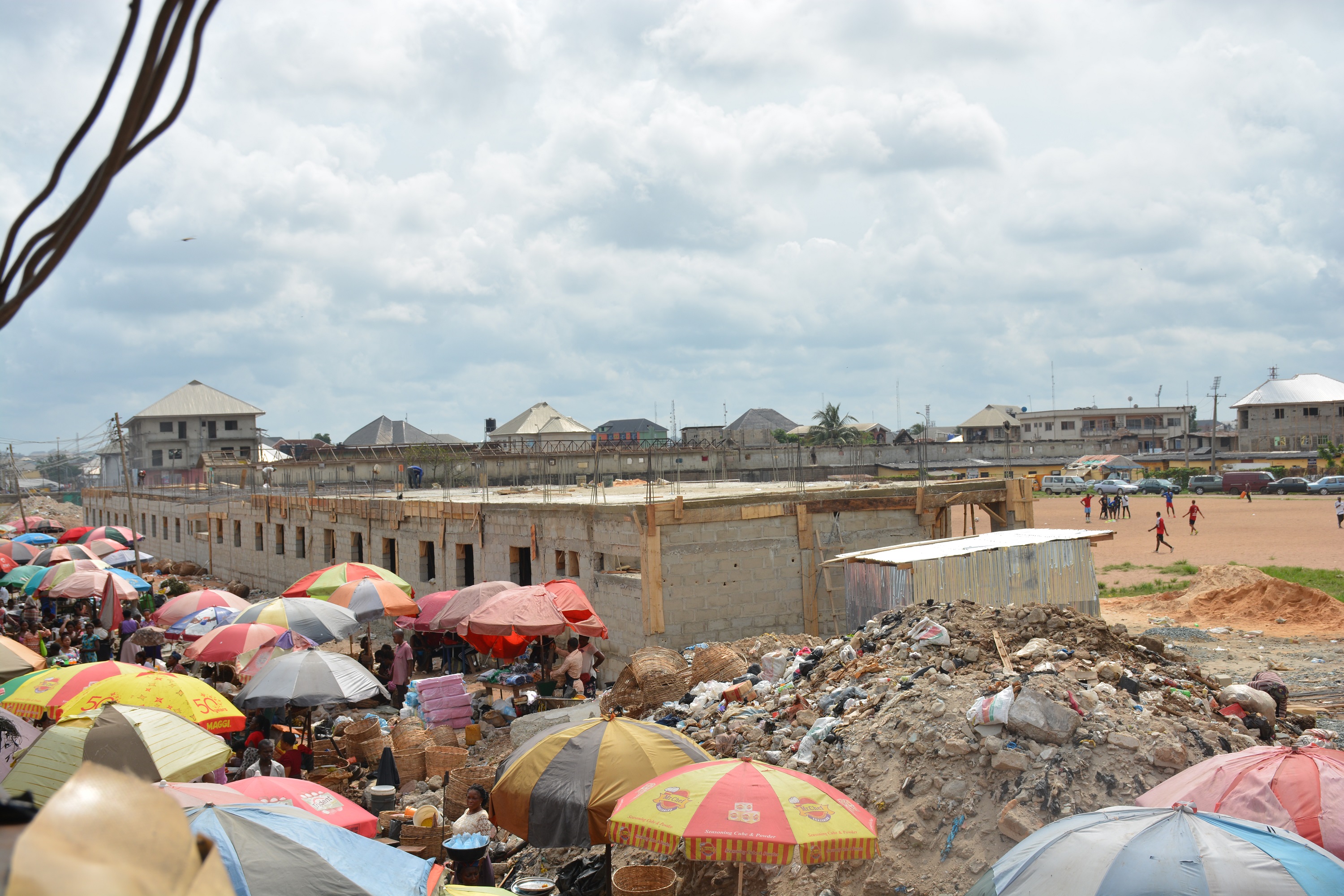
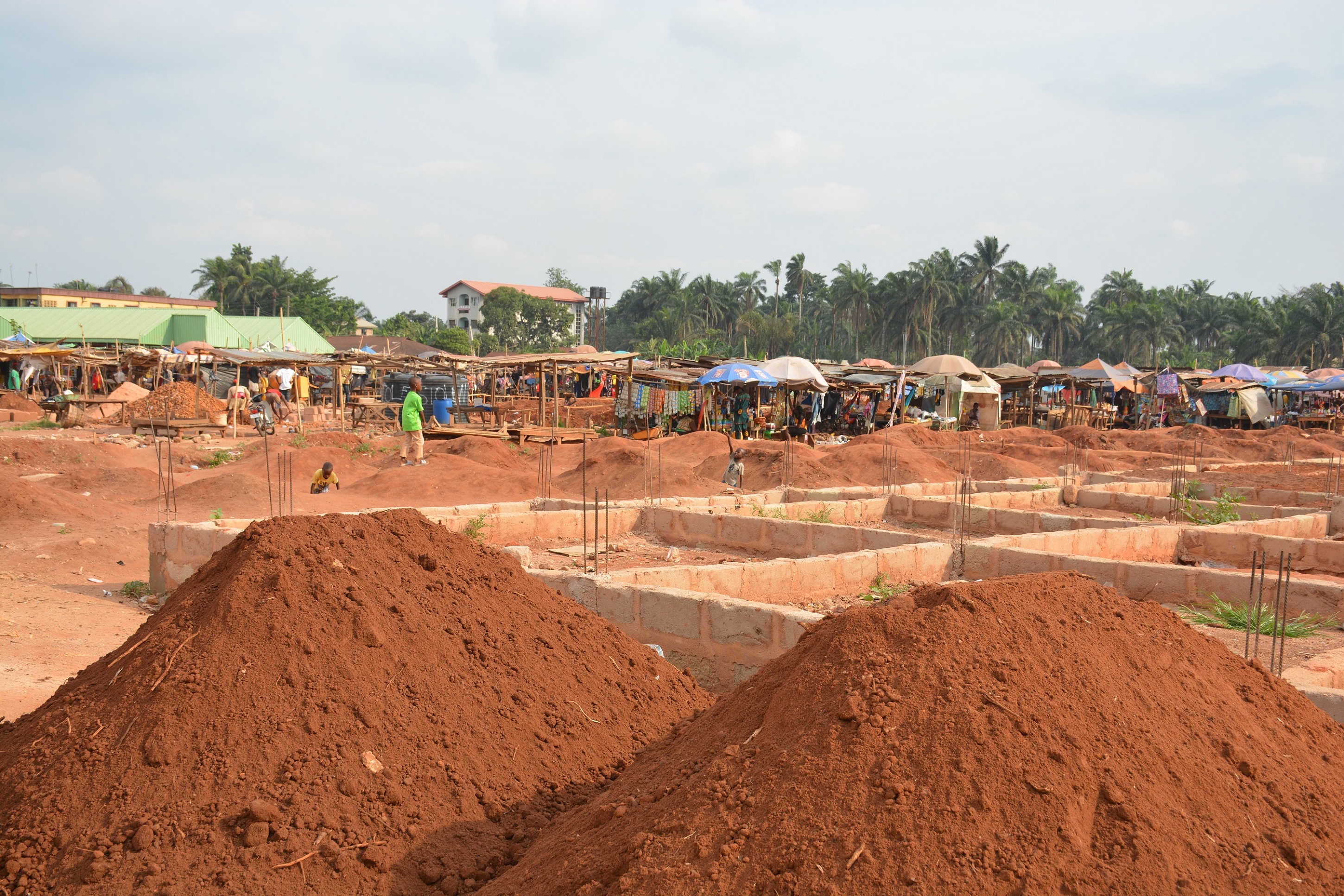
Now, she no longer has a shop — and she knows she will be unable to afford the rent for one when the under-construction market is finally rebuilt. While construction hasn’t commenced in many other demolished markets, Amaraku is work in progress — only that former tenants will be priced out of contention.
“They are still bargaining on the new rent that would be paid by anyone who wants a shop in the new market. But since government is still the one to determine the rent, we know we are in trouble,” she says. “Okorocha has colonised all the lands; this government has killed us. This exercise has rendered some youth jobless. If he was demolishing and rebuilding, it would have been better but he’s not even doing so.”
PEOPLE ARE SUFFERING
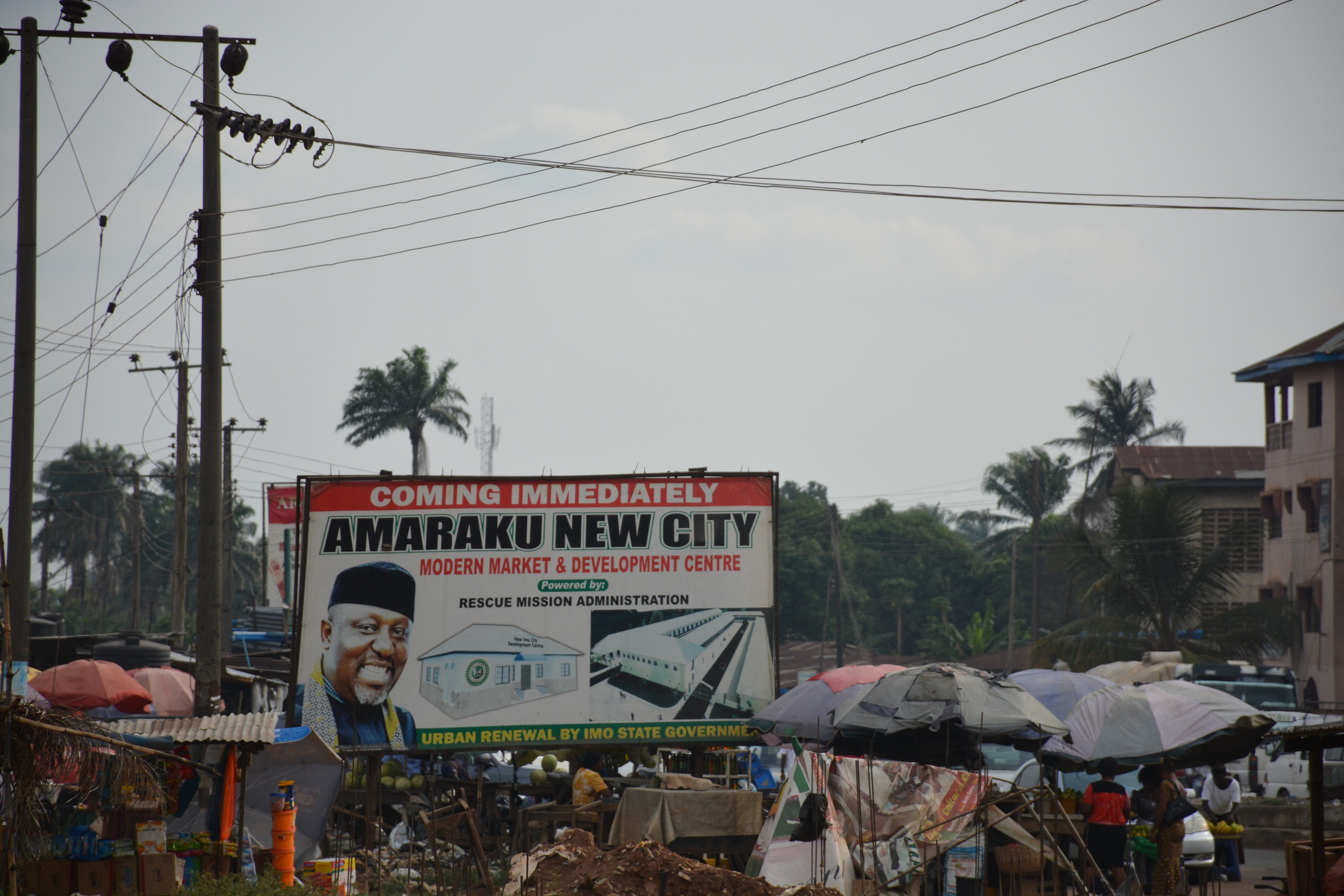
He said a new market was ‘coming immediately’. Seven months on, it still hasn’t come.
She says the post-demolition experience is hard already, but it will get worse at the onset of the rains.
“I still convey my goods from home. It is going to be drastic during the rainy season as we are still in an open space. For now, we do not know our fate. We heard the Governor said openly that it was the Hausas who voted him in, not Imolites, so for that reason he will do as he pleases.
“Things are hard these days. People are suffering. There used to be a widow whose only means of livelihood was the shop her husband left for her. But after the demolition, the woman was so disconsolate and withdrew into herself until she died. I strongly believe she would still be alive if this market wasn’t demolished.”
AN INVITATION TO DEATH
Alvan Ikoku University of Education offers one of the grimmest shortcomings of Okorocha’s stop-start renewal programme, typified by the uprooting of buildings without erecting their replacements.
The pedestrian bridge in front of Alvan was pulled down last year as the Governor sought to expand the road. Many months on, the demolished bridge hasn’t been rebuilt, consequently endangering the lives of students and visitors to the university, who now have to run across the road.
“It’s suicidal; an invitation to death,” says Ifeoma Okochu, a student of Alvan. “I don’t know if anyone has died yet but I’ve witnessed two close shaves already — two instances when a road user was one second away from being knocked down by an oncoming vehicle.”
URBAN RENEWAL WITHOUT DEMOLITION… IT’S POSSIBLE
‘Gone too soon’… the Nkwo Orji Market
An urban renewal project can be executed in a state without widespread demolitions. And if it must be demolition-centric, it must be done with a human face. So says Dr. Chukwuedozie Ajaero, a Senior Lecturer in the Department of Geography, University of Nigeria, Nsukka, in neighbouring Enugu State.
“There can be minimal demolition, in the sense that you can actually create a new layout from places that were not part of the major urban area. It can be done without demolition. But even if there has to be demolition, it should be minimal,” the Population Geography specialist says.
“Now, if you want to demolish markets, it is expected that you must have an alternative before demolishing the one in existence. You can’t just demolish without having an alternative; it will cause serious inconveniences, untold hardship, environmental degradation and pollution; and it may also cause conflict and unrest. It is not a problem to demolish, but make sure there is alternative and it is affordable to the people before – not after – the demolition.”
Ajaero says demolition should be a last resort, as there are no guarantees that pre-demolition promises will be kept. “How are we so sure that after the demolition, you are going to build what you say you were going to?” he asks.
While he is in no doubt that government has a right to land, he maintains that this right must be executed with a human face.
“Rightful owners of land deserve compensation after demolition, but this a function of litigation and a function of the goodwill of the Governor,” he explains.
“By the 1978 Land Use Act, all land belongs to the state, administered by the state government. Therefore, government can take it. But there must be human face in applying each law. Logically, they should be compensated – especially when those people have allocation from the government.
“For example, you want to build a market, and you asked the state government for allocation and you paid for it. Then definitely you should be able to compensate them. But if the Governor doesn’t do that and he says it’s for public interest, nobody can question him. Public interest can be anything. If the market being demolished has the approval of the government, if it has been there for years and government has been collecting taxes and rent from that place, then there should be compensation. If these things were never there, then the issue of compensation may not arise.”
In the case that the bases for compensation have been established, how is the settlement determined?
“As I said, it’s an issue of legal litigation. Some governors can decide a flat rate for compensation. But the normal thing is that you value the property before demolition, and use it as guide when it’s compensation time.”
OKOROCHA’S SPOKESMAN SAYS ‘THIS IS OLD STORY’
Okorochar (right) and his Chief Press Secretary, Onwuemeodo (left)
When contacted to respond on behalf of the state government to the travails of evictees, including claims that the Governor was taking land from the poor and reallocating to the rich and powerful, Sam Onwuemeodo, Okorocha’s spokesman, was visibly angry: “Which demolition? Markets?” he snapped. “Old story. We have passed that stage. This is old story!”
But for the people who have suffered grave physical, psychological, mental and financial losses — such as Isaiah Ibeanusi — the story is still new, forever fresh in their minds. The blood of the deceased — three in all — and the sweat and tears of thousands of displaced and abandoned traders will not dry up anytime soon even if the streets of Imo are paved with gold.
This investigation was done in partnership with Spaces4Change
Ibrahim Muhammed, a prosecution witness in the ongoing murder trial of Maryam Sanda, has narrated how he prevented the accused person from stabbing her husband, Bilyamin Bello, nephew of Haliru Bello, former National Chairman of the Peoples Democratic party (PDP), with a bottle of groundnut.
Sanda would eventually succeed in killing her husband later that same night after Muhammed had left, stabbing him in the neck, chest and genitals, according to preliminary police reports.
She is now being tried for murder, alongside Maimuna Aliyu, her mother; Aliyu Sanda, her brother; and Sadiya Aminu, her housemaid, who were charged with tampering with evidence.
Muhammed, who is the first witness to be called by James Idachaba, the prosecution counsel, said he was with the deceased Bello at his residence in Maitama, Abuja, on November 19, 2017, the night that he was murdered.
“We were together watching TV and taking Shisha in their sitting room up till 8 pm on the very day Bilyaminu died,” Muhammed told the court.
He said that as they were discussing in the sitting room, the deceased’s wife called him twice before he joined her upstairs.
“He went upstairs and didn’t return on time. I started hearing noise. Later on, Sadiya, came downstairs to tell me that Maryam will like to see me.
“I climbed up and I saw both of them holding each other’s clothes. Maryam told me she needed a divorce and that I should help her to tell the husband.”
According to Muhammed, Maryam refused to leave her husband, insisting that he must agree to the divorce.
“I used my hand to remove her hand from the husband’s clothes but the fight still continued,” Muhammed said.
He also said that there was a groundnut bottle in the room and that Maryam broke it and attempted to stab her husband but he prevented her.
The witness said Bello’s mobile phone got damaged during the scuffle and that he calmed him down, saying they would fix it or even get a new one the next day.
Eventually, as Muhammed was unable to settle the quarreling couple, he had to call in some of their relatives. It was one of them, Usmam Aliyu, who advised him to leave the house because it was not right to be too involved in a quarrel between husband and wife.
“Later on, one Abba-Bello, a brother to Bilyaminu, called me and told me that I should come to the Maitama Hospital that Bilyaminu had died,” Muhammed said.
“I went to the hospital to meet him lying down dead.”
Muhammed said he did not know the immediate causes of Bilyaminu’s death, as the deceased was still alive as of the time he left the house.
Having listened to the witness, the trial judge, Yusuf Halilu, adjourned the case to May 15 and 16 for continuation.
The Presidency says President Muhammadu did not refer to all Nigerian youth as lazy in a statement he made on Wednesday during the Commonwealth Business Forum in London.
Femi Adesina, Special Adviser to the President on Media and Publicity, said the President only made reference to “a lot of” Nigerian youths and not all of them. He argued that some people manipulated and twisted the statement.
He said Buhari had always applauded and celebrated Nigerian youths who excelled in different areas of endeavour, from sports, to academia, and other realms.
His words: “Typical of their stock in trade, manipulators and twisters of statements of Mr. President, who lie in wait to make mischief, interpreted the comment to mean that President Buhari had taken all Nigerian youths to the cleaners,” Adesina said on Thursday.
“But elementary English recognises a wide gulf between ‘a lot of’ and the word ‘all.’ How can ‘a lot of them,’ suddenly transmogrify to mean ‘all of them?’ Mischievous and unconscionable!
“There is no way President Buhari, father of the Nigerian nation in every sense of the word, who equally has biological children of his own in the youth age bracket, pass a vote of no confidence on all youths.
“It can only exist in the imagination of those who play what the President has described as ‘irresponsible politics’ with everything.”
He said the President would continue to value the youth, and knows that they are the fulcrum on which the future of the country rests.
“Indeed, every country has its share of idle population, and it is the bounden duty of government at all levels, to create an enabling environment for them to actualise their potential. That is what President Buhari is committed to doing,” he said.
The Nigeria Police Force says it has arrested six of the thugs that invaded the Senate chambers on Wednesday and made away with the mace.
The hoodlums were said to be working for Ovie Omo-Agege, a senator from Delta State who was suspended for 90 legislative days for claiming that the Senate’s amendment of the electoral act was targeted at President Muhammadu Buhari.
However, Omo-Agege, who was arrested by the police immediately after Wednesday’s plenary, has denied that the men were working for him.
“We are aware of several media reports suggesting that Senator Omo-Agege personally removed or encouraged anyone to remove the Mace of the Senate. This weighty allegation is not true at all,” read a statement issued by his office late Wednesday.
“Following media reports on the Mace issue, the Police decided to hear from Senator Omo-Agege. He has told them his perspective to help them carry out a proper investigation. He has since left the Police. He trusts them to thoroughly investigate this very serious matter.
“We are also aware of a statement allegedly issued by the Senate Spokesperson, Senator Abdullahi Sabi. Without any investigation, Senator Sabi willfully, deliberately and unfairly made very serious allegations against Senator Omo-Agege on the Mace incident.
“We are carefully studying Senator Sabi’s allegations to ascertain their full ramifications. Appropriate responses will follow, as may be necessary.”
Pictures of the arrested suspects were made available to the media on Thursday, with the police promising to charge them to court as soon as possible.
Items recovered from them include a piece of cloth that had cowries sewn unto it, believed to be protective charms, and a campaign poster of one Prince Osebeyo Rotimi Solomon, who is running for Councillor of Iyara ward, Ijumu LGA of Kogi State.
The stolen mace has since been recovered and returned to the Senate.
The Kaduna State government has sacked 4,562 out of the 15,897 teachers it newly recruited to replace the 22,000 unqualified teachers who were sacked in 2017.
Ja’afaru Sani, Kaduna State Commissioner of Education said the sacked teachers could not write a proper acceptance letter after they were offered their employment letters, which shows that their names were illegally included in the lists of candidates who had undergone thorough screening during the recruitment exercise.
“At the end, 4,562 incompetent ones, believed to have found their way into the final list illegally, were fished out, leaving 11,335 competent ones,” Sani said on Wednesday.
“We are hoping that between now and the end of next month, we will be concluding the recruitment process of the balance of 13,665 teachers.”
Sani added that the state government would eventually recruit enough competent teachers to fill the vacant positions created by the mass sack of 2017, adding that many of the successful teachers had been posted to more than 4,000 primary schools across the state.
Earlier this year, a Facebook post by one of the newly-appointed Kaduna teachers gave the Facebook user out as no better than the people he was employed to replace.
“I’ve been offer a teacher in subeb as a primary teacher, may Allah bless the work amin,” the recruited teacher, Usman Kabiru, wrote..
The post was subsequently taken down after a barrage of criticism.
As part of his sweeping education reforms, Nasir El-Rufai, Governor of Kaduna State, had announced a 27.5 percent increase in teachers salaries, adding that those teaching in remote villages would be given an additional five percent increase (making it 32.5 percent), a motorcycle for ease of movement and free accommodation.
The state government said that the increase in the salaries of teachers had placed them above other civil servants in the state, and was aimed at attracting the best hands to the teaching profession.
In the weeks leading up to the Jumia Mobile Week, a lot was said about the period that was expected to be one of great, uncommon deals. The week, fourth of its kind from the e-commerce company, came to a close on Sunday, March 25, 2018, recording thousands sales. Adverts were placed everywhere. Hardly could you surf the Internet without encountering flashy pictures of smart phones and accessories with one implied message: grab your copy now before it is too late!
We were told it was the biggest mobile event in Nigeria, with flash offers, special daily deals, discounts on over one million deals, low prices on tablets and accessories, and free delivery to select locations. We were told the week would not only feature discounted prices but the greatest deals you could get, better than what even Black Friday had to offer. We were told this was a rare opportunity to replace our boring devices or get our dream smart phones. But, motivated by these mouth-watering promises to surf generally through www.jumia.com.ng, it turned out certain things just didn’t seem right.
A N60,000-WORTH SCREEN PROTECTOR?
At first sight, it appears as though what is offered for sale is Samsung Galaxy S6. The product name reads ‘Generic Samsung Galaxy S6 G920F Nillkin PE+ Tempered Glass Screen Protector for Samsung Galaxy S6 G920F’, so maybe it is in fact a Samsung Galaxy S6 ‘+’ a tempered glass screen protector, because how else can the original price be N59,999? But no, what is really being sold is just a Nillkin PE+ screen protector that is custom-made for Samsung Galaxy S6.
Jumia claims the price to be N19,999, and that this is only after they deducted a whopping 67% from the actual price of N59,999. But the problem here is Nillkin screen protectors – and probably any kind of screen protectors – are really not that expensive. Exactly the same product is sold here for $21.08 (N7,600). AliExpress sells the same brand of glass screen protector but for LG G5, and it is $11.24 (N4,050) per piece. And on the website of Konga, another local company acquired by Zinox in February, what we have is N5,000 for Nillkin Tempered Full Cover Glass for Samsung Galaxy S7 Edge.
It therefore appears the suspect product description achieves two purposes – one, give the impression of a discount when in fact the discounted price is quadruple what is found elsewhere; and second, mislead buyers into thinking what they are buying is a phone, and not just a screen protector for the same brand of phone.
Mobile phones or simply screen protectors?
A GENERATOR AND REFRIGERATOR FOR HALF THE PRICE? NOT SO FAST
Sellers on Jumia appear to often be in a cheerful and charitable mood – except that they sometimes exaggerate the level of charity given. A good example is this Sumec Firman Generator ECO 1990S. “It is originally N70,000. But we are giving it out at a discount of 44%, so pick it up for N39,500,” they seem to be telling the potential buyer cruising through the attractive website. But the buyer who is sceptical enough to do a simple Google search should discover the same product on Konga’s website going for N54,500.
On sale also is a Hisense Side-By-Side Refrigerator that has its price slashed by 45% from N350,000 to N192,600. Whereas, on Konga, the same product goes for N215,000, with the original price stated as N275,000.
MOBILE WEEK DEALS
It is not only items outside the scope of the recent mobile week that have their discount percentages suspiciously bloated. One example is this Generic M26 Bluetooth Smartwatch. On Jumia’s store, this product, part of the mobile week deals, sells for N4,480, after a 70% discount from the original price of N15,000. Again on Konga’s website, the same wristwatch is sold for N8,000. There is still a price cut worth more than N3,000; but the value of the product has been inflated, leaving the customer to think he has hit a jackpot of 70% discount, when in fact it is only 44%.
Another striking example, still under mobile week deals, is the sale of one product with two conflicting prices though on the same page (same row, in fact) of the website. It is the Universal S530 Mini Wireless Bluetooth In-ear Earphone Headset. Here it says the product is N3,500 but is sold at a discounted price of N2,549. And here, the original price is N3000 while the promo price is N1500.
S530 wireless bluetooth earphone with conflicting prices
NOT A BLACK SHEEP AMONG WHITE ONES
Consumers prefer patronising online stores to physical ones. One of the big reasons for this is that e-commerce companies often give out huge discounts and coupons. But these “gifts” are generally for good business reasons, not just because of charity or corporate social responsibility – or most times, not even at all. The strategy is adopted when a vendor wants to push slow-moving products or plans to get more customers, merchants, advertisers and investors, thereby giving competitors a tough time. And so they partner with the manufacturers to provide price cuts, or even consider them a temporary loss and investment.
Fictitious pricing, as the practice is called, is the questionable version and is a strategy adopted by companies across the world. It is an advertising tactic where discounts are offered based on a prior-reference price, whereas the advertiser had never offered the product for sale at that reference price. It is understandable why companies are increasingly embracing this strategy. According to a study published by the Harvard Business School, “fake list prices have a strong influence on purchase outcomes, with a 1-dollar increase in the list price having the same positive effect on purchase likelihood as a 77-cent decrease in the actual selling price”. But they certainly can have their downsides too: public scandals and law suits, to start with.
In 2015, Flipkart, India’s biggest online store, was at the centre of an embarrassing scandal when one of its products, a pair of canvera wedges, were put up at the discounted price of Rs399 and the original price stated as Rs799. There was only one problem: if you zoomed in for a closer view, you found a message from the manufacturer boldly written on the strap: Rs399 only. A customer noticed this self-contradiction and posted a snapshot on the company’s Facebook page. The company eventually suspended and blacklisted sellers found guilty of arbitrarily hiking product prices before tagging with a generous discount.
Picture shared on Flipkarts Facebook page by Mani Sankar Sen
Even Amazon, the world’s biggest e-commerce company owned by the world’s richest man, Jeff Bezos, has not had a clean record. Last year, Consumer Watchdog, a non-profit organisation that advocates for consumer interests, petitioned the California Attorney General to investigate the company, claiming it had proof Amazon was inflating reference prices to make consumers think they were getting better deals than they really wre.
In Nigeria, Konga, which appears to be Jumia’s biggest competitor, is also not saintly. One amusing example found on their website is that of a Nokia 8 Android Phone. While most discounts have the effect of reducing the product’s original price, this product has refused to play by the rules and in fact runs against the one-way street of convention. The reference price is stated as N190,000, while the discounted price is surprisingly even more – N195,000!
Konga: Nokia 8 Android phone whose discounted price is above the list price
Beyond just petitions and suspensions, cases are increasingly being won based on this unethical practice and state legislations in some parts of the world, especially the United States of America. For instance, in December, fashion retailer Ann Taylor settled for a $6.1 million class action alleging that prices at its outlet stores were listed as “marked down” from prices that never applied to the items. Another company, Hobby Lobby, was slammed with a similar allegation last May. In what was a mini-victory to the complainants, the court, in February, determined not to dismiss the action as prayed for by the company. Similar actions have, however, not been heard of yet in Nigeria.
PAST CUSTOMERS VOICE OUT
The fact that there are no known legal actions in Nigeria bordering on this practice is not to be translated to mean it does not happen. It only means people do not have confidence in litigation as a remedy for their grievances. Kehinde Funso-Adu, a veterinary doctor who lives in Akure, Ondo state, shared his ordeal. It was the Black Friday of November 2015.
“I had a huge discount on a mini-sewing machine I ordered from Jumia, or let me say it was discounted to its original price.
“The discounted price was about N7,000. The first disappointment was that the image appeared like three times bigger than the actual product. I took it to a tailor who knows better about the price and he told me it shouldn’t be more than N5,000 or maybe N4,000. Luckily for me, it malfunctioned the next day, so I had to return it. One other thing I noticed about Jumia is that substandard products are more heavily discounted.”
Joseph Ogunmodede, Founder of The Legal Diary, told a similar story: “I needed to get a new battery for a Toshiba laptop that had been at home and underutilised because of battery issues. I tried getting from physical stores in my vicinity but they didn’t have the specs. I resorted to Jumia with the hope of getting the best, especially with the impression they gave me that it was at a discounted price.
“To my utmost dismay, it was a China Battery that was delivered and I later found out the ‘discounted price’ of the China battery was N500 higher than original’s. To my reddest shock, I was at Balogun market two weeks ago with a friend who wanted to buy a wristwatch and I found out what these people do is to go to the wholesale or retail sellers of these commodities, snap the commodities and post the pictures online. When people make an order, they go to these shops to get them, add their profit and still leave us under the delusion that we are getting a discount.”
Adekusibe Osasona, a graduate of Pure and Applied Mathematics from the University of Ibadan, bought a power bank at a discounted price of N7,000 and a wristwatch at a discounted price of N6,000, when both products were in fact N5,000 and N4,000 respectively. “After buying the power bank, I later saw the same somewhere else sold for N5,000,” he said. “Since then, I resolved not to buy anything from Jumia again he said bitterly.”
Another peculiar customer experience was Adams Abdulbasit’s. A Law student at University of Ilorin who hails from Ibadan, it happened during the Black Friday of 2017 that he had fallen in love with a slim PS4, and he added it to his cart, hoping the price (N98,000) was going to reduce during Black Friday. Well, it did not – at least, not really.
“I was surprised to discover that what they did on that Friday was slashing another price [the list price] and putting the same N98,000 as the discount price,” he said.
In another 2017 Black Friday incident, Ayodele Oluwatosin, who hails from Ilorin, recalled that Jumia only reduced the price of the commodity to the market price on the day of special offers. He said he had bought a lot from the platform, but a particularly interesting transaction is of one phone: Leeco S3 X626.
“I think I got it for N38,000,” he said. “It was formerly N56,000 and I thought I had hit a jackpot. Until I got online and saw through AliExpress that the original price is around the same I got it for.” Asked if AliExpress was offering a bonanza, he said: “Not at all. It’s still the same price last time I checked. And the last time I checked was this afternoon!”
‘NOT ONLY MISLEADING BUT UNLAWFUL’
Scanning through the provisions of the 1992 Consumer Protection Council Act, the law appears to outlaw this practice, considering Sections 11 and 12. The former provides, “Any person who issues or aids in issuing any wrong advertisement about a consumer item, is guilty of an offence and liable on conviction to a fine of N50,000 or to imprisonment of five years or to both such fine and imprisonment.”
Likewise, Section 12 says, “Any person who provides any service or proffers any information or advertisement thereby causing injury or loss to a consumer, is guilty of an offence under this Decree and liable on conviction to N50,000 fine or to five years imprisonment or to both such fine and imprisonment.”
What is however not clear from these provisions is if the term “wrong advertisement” and “loss” cover fictitious pricing and the financial loss that follows from it.
Babatunde Irukera, Director-General of the CPC, agreed that the practice of bloating discount prices is both misleading and against the law. Although he pointed at the council’s enabling instrument, the CPC Act of 1992, he explained that taking action based on Section 12 is “very tricky because it is difficult to characterise or establish it as harm. It is not subjective; it is an objective standard”.
However, according to him, Section 2(i) may prove more helpful as it empowers the council to “ensure that consumers’ interests receive due consideration at appropriate forum and to provide redress to obnoxious practices or unscrupulous exploitation of consumers by companies, firms, trade association or individual”.
“Absolutely,” he said, asked if this provision empowers the council to take legal actions.
“It is a specific function of the council. However, the way we do that is that we have to literally investigate, enquire and look into their intention, because it is an objective test. It is a totally different thing to say there is a manufacturer-suggested retail price. That’s just a suggestion. So we have to look at the market dynamics and all the surrounding facts to establish that the advert is unscrupulous.”
Irukera said no complaint had been filed with respect to deceptive pricing, but he admitted that the CPC’s role is “not only to respond to complaints but also to initiate actions”. He promised the council would take action “with this information that you have just provided”.
JUMIA INSISTS: ‘WE’RE NOT IN BUSINESS TO DUPE PEOPLE’
Kayode Kolawole, Jumia Nigeria’s Head of PR & Communications, explained that the fundamental problem is a general lack of public understanding of Jumia’s operations. Special promos should not be confused with ordinary sales, he said. For instance, during the mobile week, he said ‘S9 or S9+’ was sold for N2,850 with a first-come-first-serve model. The benefit went only to one person and should not be seen as the original pricing adopted for the product.
“It was just that one item,” he said. “It was a strategy on our part to drive people to the website and search for what they might find, and then we reward one lucky person. So maybe when we put out communications like that, people misunderstand them to mean Jumia is selling a phone for N2,850, ‘and when we get to their website, we find out it is a lie.'”
On the question of bloated discounts that give exaggerated impressions to buyers, he maintaine that Jumia does not manufacture goods and fix prices. Rather, it is only a platform for sellers and manufacturers to reach final consumers.
“We do not manufacture these items. We do not produce them. We are not a production company. We have only created a platform for people to come and sell,” he said emphatically.
“So if the seller of the product says it is available for N150, and we have negotiated that because a lot of people who are interested in this product, let’s give it to them at this amount and give them this discount so that we can go on volume, that is reduce the price so that more people can buy, how is that Jumia’s fault?”
On why there are products on the website with conflicting prices, he clarified that Jumia is just like any other market with various sellers. The platform allows many sellers to advertise so as to give the potential buyer several options to choose from, while guided by information provided, and it is the customer’s duty to get the best offer for himself.
“One of the things we have put in place to ensure that customers get value for money and are not cheated is that we have hundreds of competing sellers,” he said.
“If a person is selling pampers, we would not just have one seller of pampers. We have other merchants of pampers, offering different discounts. It is up to you to surf our website and look for the best rates. People need to understand how e-commerce works and they need to understand certain things on our website.
“You cannot just go online and buy because you see one item that you like. You have to keep searching. It’s like going offline from one market to the other. You have to keep looking for the best rate because you will always find the best rate there. And then look at the sellers’ ratings. How is this seller rated? How many of these items have been sold? All of those are things you need to know to be sure of the quality of product you are buying. That is what we have put in place. We are not in business to dupe people. We are in business to make happy customers, because if our customers are not happy, there is no way we’ll grow.”
CUSTOMER IS KING
A lot has been said about the difficulty of running an e-commerce company in Nigeria and, at large, the Third World. Analysts talk about the logistic problems and difficulty in transporting goods, influence of public markets, high costs of broadband, distrust arising from widespread online fraud and phishing, low literacy rates, and low profitability. But there is no emphasis on the implications of fictitious discounts, especially the negative effect it has on trust and return rate of customers, obvious from public perceptions and the sheer number of past customers with upsetting stories.
According to Rocket Internet’s public listing of 2014, Jumia had $28 million in net revenues, with $32 million in losses – and thus was at the time still not profitable. Similarly, Konga, which was founded in 2012 was not profitable until 2017, after sacking 60% of its workforce and killing PoD (Pay on Delivery) options. Despite these challenges, not many have asked if there is a link between fictitious pricing and these not-so-encouraging starts or performances.
Rochas Okorocha, Governor of Imo State, has approved a N3,000 levy on all “leviable adults” in the state — to be used for what the state government described as “autonomous community adult development levy”.
Similarly, all autonomous communities in the state have been levied N6 million each, for the same purpose.
The directive was contained in a statement issued to the communitieson April 3 by Louis Duru, Imo State Commissioner for Community Government, Culture and Traditional Affairs.
“To facilitate the payment, the State Government through the Ministry of CGC, since September 2016, has provided community adult registers for all autonomous communities in the state where the communities will enlist the names of at least 2000 leviable adults”, read the statement which has now gone viral on the social media.
“Consequently, His Excellency Owelle Anayo Rochas Okorocha has directed that all recognised autonomous communities in Imo State should pay the minimum adult development levy of N6,000,000 (Six million Naira only) without further delay.
“Any recognised autonomous community that fails to pay the development levy will be merged with sister autonomous community that had paid and the salaries/allowances of the traditional ruler ill be suspended.
“Government has concluded arrangements to embark on sensitisation meetings with traditional rulers at the local government areas to further emphasize His Excellency’s directives and monitor compliance.”
Okorocha has been accused of running Imo State like a private concern, appointing his family members and close associates into important positions.
Among them are Ogechi Ololo, Okorocha’s biological sister and Deputy Chief of Staff, who was also appointed Commissioner for Happiness and Purpose Fulfillment; Uche Nwosu, his son in-law who is currently his Chief of Staff and has been endorsed to succeed him as Governor; Eze Madumere, his long-term business associate and current deputy, who has also been endorsed to run for the Senate in 2019; Anthony Onwuka, his in-law whom, through the Governor’s nomination, is currently the Minister of State for Education.
Okorocha has also declared his interest to run for the Orlu Senatorial seat in the forthcoming general election, and subsequently for the presidency in 2023.