OPERATIVES of the Nigeria Police Force (NPF), on Monday, April 7, fired teargas canisters at protesters in Portharcourt and Abuja, disrupting a demonstration organised by the Take It Back Movement.
The protesters had converged at Isaac Boro Park in Port Harcourt, Rivers state, around 9 am to demand the repeal of the Cybercrime Act and call for responsible leadership, but were met by a heavy deployment of police officers who insisted the protest would not hold, according to a Channels Television report.
In Abuja, the Punch reported that the FCT police dispersed protesters, who had gathered peacefully to express their grievances, with tear gas in the Maitama area of the Capital city.
The ICIR reported that the crackdown came barely 24 hours after the Nigeria Police Force issued a statement urging the group to shelve the planned protest, describing it as ‘ill-timed and mischievous.’
The police said the protest coincided with National Police Day, a newly declared holiday set aside by the federal government to honour police officers.
Force Public Relations Officer, Assistant Commissioner of Police (ACP) Olumuyiwa Adejobi, in a statement issued on Sunday, April 6, had accused the organisers of attempting to “malign” the image of the police, warning that the demonstration could disrupt official activities attended by both local and international dignitaries.
The Police believed that holding protests on such a significant day could ‘malign the image of the Nigeria Police and the nation as a whole.’
“In line with best global practices adopted by nations in celebrating the achievements of their Police institution, the Nigerian government has taken the bull by the horns by declaring every April 7 as National Police Day.
“The rationale behind staging a nationwide protest on the same day is, however, questionable and perceived to be a deliberate attempt and unpatriotic act that is capable of rubbishing and maligning the image of the Nigeria Police and the nation as a whole,” the statement added.
However, members of the Take It Back Movement, on Monday, proceeded with the protest in parts of the country.
In Lagos, the demonstrators could be seen (archived here) raising placards and banners that read ‘any law that forbids us from speaking out truths against oppression in Nigeria is no longer a law but shackles of slavery.’
In Ibadan, Oyo State, protesters marched through the streets with banners calling for ‘good governance and the total repeal of the Cybercrime Act.’
In the locations, according to the pictures and videos shared by the Movement on its X page, the protests have been peaceful without threat from the security operatives. The Take It Back Movement, a civic group known for its vocal criticism of government policies, had announced mass protests across several states, including the Federal Capital Territory.
Screenshot of a video shared by the Take it backMovement on its X page.
The demonstration, according to the group, is aimed at drawing attention to the ‘bad governance’ and shrinking civic space in Nigeria. According to one of the organisation’s announcements on social media, the “Cybercrime Act creates an environment of fear and censorship. We must #RepealCyberCrimeAct for a free Nigeria!”
The protest is the latest in a string of demonstrations against the Cybercrime Act, which activists say is being used to clamp down on free speech and press freedom.
Many Nigerians have argued that the law has become a tool for silencing dissenting voices, especially online.
This is not the first time the police have attempted to prevent citizens from exercising their right to protest. Over the years, security agencies have repeatedly warned against peaceful demonstrations, often citing ‘security concerns.’
THE Kebbi State Police command has confirmed the death of 16 villagers following a deadly bandit attack on Tungan Taura and Tungan Ladan communities in Augie Local Government Area.
A statement by the Police Public Relations Officer (PRO), Nafiu Abubakar, on Monday, April 7, said the attack occurred around 6:00 p.m. on Saturday, April 6, 2025.
According to him, the assailants, suspected to be members of the notorious Lakurawa group, invaded the villages in large numbers, launching a violent assault.
“The attackers, who arrived in large numbers, rustled an unspecified number of cattle and engaged in a deadly confrontation with community members, which led to the tragic loss of sixteen lives,” the statement read.
Reacting to the incident, the statement added that the state Commissioner of Police, Bello Sani, condemned the killings and vowed that the perpetrators would be brought to justice.
He also announced the immediate deployment of additional tactical units comprising police operatives, military personnel, the Nigeria Security and Civil Defence Corps (NSCDC) and local vigilante groups to the affected areas.
“Our resolve to rid Kebbi State of banditry and other violent crimes remains firm. We are deploying all available resources to ensure that the perpetrators of this senseless act are brought to justice,” Sani stated.
The commissioner, while urging residents to remain calm and cooperate with security agencies, added that normalcy has since been restored in the communities.
The ICIR reports that Lakurawa is an emerging terrorist group operating between Sokoto and Kebbi states in Nigeria; they are known for carrying out attacks, cattle rustling, and other criminal activities.
They enforce zakkat payment, confiscating cattle from non-compliers. Similar to Boko Haram, they communicate in Azbinanci, Zabarmanci, Barbanci, and Hausa. Lakurawa recruits you
ths with ₦1,000,000, according to reports.
This incident followed past attacks by the group in Kebbi state.
On January 2, over 50 Lakurawa fighters attacked a checkpoint on the Augie-Kangiwa road, killing two policemen before raiding a ranch near Natsini village.
THE Federal Government said it is prepared to rejig the 2025 budget amid a slump in global oil prices and current tariffs imposed by the United States (U.S) President Donald Trump.
The Minister of Finance and the Coordinating Minister of the Economy, Wale Edun, hinted at this on Monday, April 7, in Abuja.
He gave information on the sidelines of the Ministry of Finance Incorporated (MOFI) governance scorecard meeting in Abuja, which was themed: ‘Ensuring Value Creation in State-Owned Enterprises Through Better Corporate Governance.’
Edun expressed worries that the government has to adjust, possibly, where necessary, its 2025 budget plans as a result of the global shift in Trump’s policies.
“We are monitoring developments globally, and we are adjusting accordingly. We’ll be speaking to the National Economic Council on this. It’s not our exclusive decision to make, however, we’ll make adjustments where necessary,” he said.
“Budget adjustment and prioritisation, where possible, as well as innovative non-debt financing strategies, would be embraced,” Edun said.
Adding that the government is planning adjustments in the budget to reflect the realities, the minister said, “We are also looking at opportunities and giving global companies opportunities to make more money, while they invest in Nigeria.This is why we are intensifying efforts to ensure our corporate governance structure is top-notch to attract more private capital into our infrastructure financing.
The ICIR reported that U.S. President Trump slapped a 14 per cent tariff on Nigerian exports, arguing that Nigeria had already imposed a 27 per cent tariff on U.S. exports to the country.
He, however, exempted oil and minerals-related exports from the new tariff.
Trump also imposed a 34 per cent tariff on China’s exports to the U.S.; the country is Nigeria, a major trading partner, and 31 per cent on South Africa, Nigeria’s economic rival in Africa.
The new tariffs announced on Wednesday, April 2, which came with immediate effect, affected over 50 countries, including major trade partners such as China, the European Union (EU), India, and Japan, along with developing economies across Asia, Africa, and Latin America.
Trade statistics
Nigeria-U.S. trade statistics have been in surplus in the last 3 years (2022-2024).
The minister noted that Nigeria’s exports to the U.S. were N1.8 trillion, N2.6 trillion, and N5.5 trillion in 2022, 2023, and 2024, respectively.
Fortunately, oil and mineral exports accounted for 92 per cent, implying that oil and minerals exports amounted to N5.08 trillion in value, while non-oil exports were just N0.44 trillion.
“Consequently, the tariff effect on exports is negligible if we sustain our oil and minerals export volume,” Edun said.
U.S. tariffs’ effect
According to Edun, the adverse effect of the new tariff on Nigeria will be through the oil price plunge.
On Friday, April 4, Brent crude oil price fell to $65.58 per barrel for the first time in four years.
This could be a setback for the Nigerian 2025 budget, which will most likely face implementation challenges with the consistent drop in crude oil price, The ICIRreported.
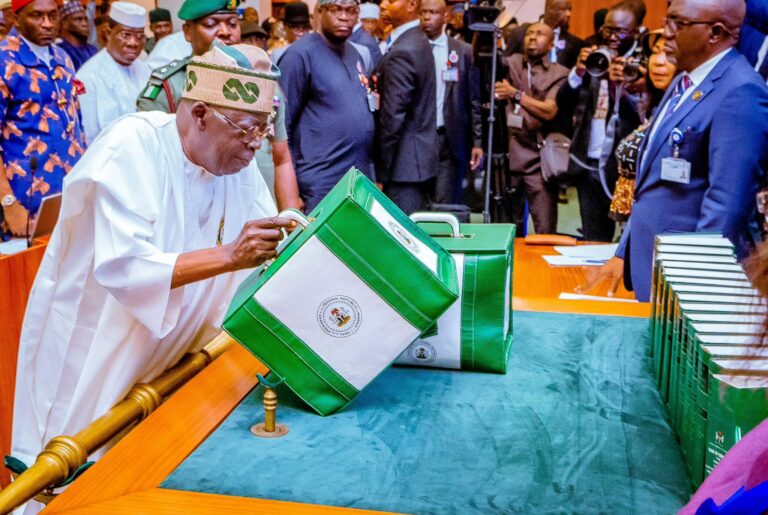
President Bola Tinubu had on February 28 signed the 2025 budget of N54.99 trillion, which shows a crude oil budgetary benchmark price of $75 per barrel, a 2.06 million barrels per day (bpd) production target at an exchange rate of N1,500 per dollar.
His lead administration is targeting N34.8 trillion in revenue to fund the budget, of which the bulk of the revenue will come from crude oil proceeds.
He projects that crude oil will bring in N19.6 trillion in revenue, while non-oil sources would come in at N15.22 trillion.
But with Nigeria far from meeting its crude oil output benchmark and falling price in crude oil prices, the proper implementation of the 2025 budget appears gloomy.
In his submission to these worries, Edun added, “We are intensifying efforts to ramp up crude oil production to curtail any price effect.
“We are also focusing on non-oil revenue mobilisation by FIRS and Customs.”
OVER one thousand protesters gathered in Washington D.C, joining a mass protests across all 50 states of the United States on Saturday, April 5, against President Donald Trump and his billionaire ally, Elon Musk.
The protest tagged “Hands Off!” was organised by a pro-democracy movement in response to what they describe as a “hostile takeover” and an attack on American rights and freedoms, the event was expected to be the largest single day of protest.
The ICIR that the protests took place at state capitols, federal buildings, congressional offices, the Social Security headquarters, as well as in parks and city halls across the country.
Hundreds of anti-Trump Americans living in Europe also gathered in cities like Berlin, Frankfurt, Paris, and London just hours before the protests began in the United States, to express their opposition to Trump’s sweeping overhaul of US foreign and domestic policies.
“We can make sure they hear us,” the organisers said. “Hands Off!” demands “an end to this billionaire power grab.”
Organisers told Reuters that over 20,000 people were expected to attend a rally at the National Mall. According to the event’s website, around 150 activist groups had signed on to participate, with protests planned across all 50 states, as well as in Canada and Mexico.
“Whether you are mobilised by the attacks on our democracy, the slashing of jobs, the invasion of privacy, or the assault on our services – this moment is for you,” the event flyers read.
“We are setting out to build a massive, visible, national rejection of this crisis.”
Organisers say they have three demands: “an end to the billionaire takeover and rampant corruption of the Trump administration; an end to slashing federal funds for Medicaid, Social Security, and other programs working people rely on; and an end to the attacks on immigrants, trans people, and other communities.”
“Our founders wrote a Constitution that does not begin with ‘We the dictators,’ the preamble says ‘We the people,’” Raskin said in front of a crowd of thousands gathered at the Washington Monument, holding signs condemning the administration. “No moral person wants an economy-crashing dictator who knows the price of everything and the value of nothing.”
A crowd was said to gather around the Washington Monument under gloomy skies and light rain, as some carried Ukrainian flags and others wore Palestinian keffiyeh scarves and carried “Free Palestine” signs, while Democrats from the United States, including the House of Representatives, blasted Trump’s policies on stage.
Terry Klein, a retired biomedical scientist from Princeton, New Jersey, was among those who gathered by the stage beneath the Washington Monument.
She said she drove down to attend the rally to protest Trump’s policies on “everything from immigration to the DOGE stuff to the tariffs this week, to education. I mean, our whole country is under attack, all of our institutions, all the things that make America what it is.”
The ICIR reported that Trump unsettled the global markets and sparked international concern this week by imposing a series of trade tariffs.
With Trump’s approval, Musk’s Department of Government Efficiency has slashed over 200,000 jobs from the 2.3 million-strong federal workforce. The downsizing has at times been chaotic, even leading to the recall of essential specialists.
On Friday, April 4, the Internal Revenue Service began laying off over 20,000 employees, amounting to roughly 25 per cent of its workforce.
Several hundred protesters gathered outside the Social Security Administration headquarters to oppose cuts to the agency, which provides benefits to the elderly and disabled.
Linda Falcao, who will turn 65 in two months, told the crowd she had been contributing to the Social Security fund since she was 16.
“I’m terrified, I’m angry, I’m pissed, I’m bewildered this could happen to the United States,” she said. “I do love America, and I’m heartbroken. I need my money. I want my money. I want my benefits!” The crowd chanted, “It’s our money!”
However, White House Assistant Press Secretary Liz Huston rejected the protesters’ claims, stating that President Trump does not intend to cut Social Security or Medicaid.
Most of Trump’s agenda has been challenged by lawsuits arguing that he has exceeded his authority in efforts to dismiss civil servants, deport immigrants, and roll back transgender rights.
The ICIR reports that Trump returned to office on January 20, issuing a list of executive orders and actions that critics have condemned.
THE Nigeria Police Force (NPF) has withdrawn its invitation for Emir of Kano, Muhammadu Sanusi II, to appear in Abuja for questioning over the violence that marred the Eid-el-Fitr celebrations in Kano.
The police instead opted to send investigators to obtain his statement in the state.
This development followed growing concerns from prominent Nigerians, including Chidi Odinkalu, a former Chairman of the National Human Rights Commission, and Kano residents that the invitation could further escalate political tensions in the ancient city, already simmering due to a heated Emirship dispute.
In a statement issued on Sunday, April 6, Force spokesperson Assistant Commissioner of Police (ACP) Olumuyiwa Adejobi said the Inspector-General of Police, Kayode Egbetokun, has directed operatives of the Force Intelligence Department (FID) to proceed to Kano for the interview.
The move, he said, is in line with efforts to ensure that police actions are not ‘politicised or misinterpreted.’
The ICIR reports that Sanusi had earlier been summoned via a letter dated April 4 to report to the FID headquarters in Abuja on April 8.
The letter, signed by CP Olajide Ibitoye on behalf of the Deputy Inspector-General (DIG) in charge of FID, sought his appearance over violence involving members of his entourage after the Eid prayers at Kofar Mata.
Sanusi presided over prayers attended by Governor Abba Yusuf and other officials. However, while returning to the palace, violence erupted when Sanusi mounted a horse, according to the police.
The altercation led to the death of one vigilante and injuries to others.
One of the victims, Surajo Rabiu, a local vigilante, was said to have been stabbed to death, while another, Aminu Suleman, sustained severe injuries among the Sanusi entourage.
According to reports, the vigilante members were attacked while they were providing a shield for Sanusi.
The Kano State Police command subsequently launched an investigation, setting up an eight-member panel to probe the incident.
The panel was tasked to unravel the immediate causes of the violence and “any defiance to the command’s overt ban on all forms of Durbar or horse riding throughout the Sallah celebration, based on security concerns in the state.”
Withdrawing the invitation to question Sanusi in Abuja on Sunday, the police stated, “The invitation was initially issued to enable Alhaji Sanusi to provide his account of the events that led to the breakdown of law and order in the state.
“However, following advice from respected stakeholders and in line with the Inspector-General of Police’s commitment to ensuring that policing actions are not politicised or misinterpreted, the IGP has directed that the invitation be withdrawn. Instead, operatives of the Force Intelligence Department (FID) have been mandated on the instructions of the IGP to proceed to Kano to obtain Alhaji Sanusi’s statement.
“The Force also wishes to reiterate that its actions are guided solely by the principles of justice, neutrality, and professionalism,” the statement added.
The police said it had warned all the parties involved in the Sallah celebrations about the risks of holding parallel ceremonies and viewed the incident as avoidable in the lead-up to the Eid celebration.
It noted that credible intelligence at the disposal of the NPF had indicated that the two ‘disputed Emirs’ in Kano State – Alhaji Ado Bayero and Alhaji Lamido Sanusi were planning to hold separate Durbar Festivals.
“To forestall possible violence, the Inspector-General of Police, IGP Kayode Adeolu Egbetokun, Ph.D., NPM, deployed the Coordinating DIG for the North West who also serves as the Deputy Inspector-General of Police in charge of the Force Criminal Investigation Department, DIG Abubakar Sadiq, mni, to engage in dialogue with the two disputed Emirs in kano and the Kano State Government.
”It was mutually agreed that no Durbar Festival would be held to preserve peace and public safety, and none of the disputed emirs would ride on horse on Sallah day,” the statement added.
This latest incident adds to the ongoing power struggle in Kano’s traditional institution, which has been fraught with controversy since Sanusi’s reinstatement in 2024.
The Supreme Court is set to deliver a judgment on the matter, which has been ongoing since Sanusi’s reinstatement was validated by a recent law repealing the Kano State Emirate Council Law 2024.
IN 2024 alone, seventeen markets in Lagos, once bustling hubs of activity, were reduced to ashes, leaving a trail of tears, losses, and hopelessness. A visit by The ICIR to some of the affected markets revealed that the sound of shattering glass, the smell of burning goods, and the cries of desperate traders still lingered.
For Chibuike Udeh, a spare part seller at Akere Market, Ajegunle, the nightmare began on the night of March 11, 2023, with a distressing phone call. He received the devastating news that his stall at the market was engulfed in flames, consuming goods worth nearly N15 million.
The phone call was like a punch to the gut, leaving him breathless and in disbelief. As he rushed to the scene, his mind raced with thoughts of his livelihood, his family, and his future. The sight that greeted him was one of utter destruction – his stall, his goods, and his dreams, all reduced to smouldering ruins.
Chibuike’s story is just one of many that have become all too familiar in Lagos. The constant fire outbreaks in the city’s markets have left many people hopeless, frustrated, and injured. The emotional toll is evident in their eyes, their voices, and their stories.
Recent fire outbreaks in Lagos markets
On September 11, 2024, the Itamaga Plank Market in Ikorodu was consumed by flames, reducing the once-thriving hub of activity to a blazing ruin. Both merchants and consumers stared in terror as their livelihoods were destroyed.
The Lagos State Emergency Management Agency (LASEMA) spokesperson, Nosa Okunbor, said the agency received distress calls and and immediately dispateched its Lion Squad to the scene. Upon arrival, they found a shop engulfed in flames, caused by a power surge.
On November 26, 2024, the Alayabiagba Boundary Market in Ajeromi Ifelodun experienced the same fate as its stalls and shops reduced to ashes. The fire seemed to have a mind of its own, striking without warning and leaving destruction in its wake.
LASEMA’s Permanent Secretary, Femi Oke-Osanyitolu, and Lagos Fire Service Director, Margaret Adeseye, confirmed that no lives were lost in the fire incident. However, at least 11 shops were destroyed, with millions of naira in property damage, after a leak from filled cylinders at a gas shop sparked the blaze.
The remains of Ebute Ero Market after the inferno that gutted it in November 2024. Photo Credit: Bankole Abe/ICIR 16/012025
Similarly, on December 23, 2024, the Oshodi Resettlement Market was the next to feel the wrath of the fire. Its traders and customers were forced to flee as the flames consumed the stalls.
LASEMA’s Oke-Osanyintolu confirmed the fire incident, stating that one shop was 50 per cent damaged, another slightly affected, with no reported casualties or injuries.
The Idumota area of Lagos State was not immune to the devastation either. On Friday, November 29, 2024, a fire outbreak at a spare parts market destroyed property worth millions of naira, leaving the owners and traders to pick up the pieces.
Reacting to the fire incident, Oke-Osanyintolu reported that multiple shops selling car parts were destroyed in the fire. Although the cause remains unknown, he confirmed that properties and goods worth hundreds of millions of naira were lost.
Visualisation of Lagos market fires in 2024.
On Thursday, November 7, a furniture market in the Ojota area of Lagos State was affected, with goods worth millions of naira destroyed.
Reacting, the Lasema boss stated that an afternoon fire at the market, sparked by an electrical surge from a nearby transformer, destroyed millions of naira worth of furniture in several shops.
Similarly, on Sunday, September 15, 2024, emergency workers battled to put out a fire at the Oko Baba Plank Market by Ibadan Street, Ebute Metta, Lagos.
LASEMA spokesman, Okunbor, said officials of the agency embarked on a search and rescue operation at the market after the incident. He said the immediate cause of the fire is unknown, adding that no life was lost or injuries sustained as a result of the incident.
As the source of income for many individuals is suddenly cut off, desperation sets in. The loss of livelihood can lead to a surge in crime rates. The implications of market fires go beyond the realm of physical security. The mental health of those affected is also a pressing concern.
A trader who claimed he lost millions in the fire disaster at Akere spare part market, Chibuike Udeh. Photo Credit: Bankole Abe ICIR 17/01/2025
Victims share their experiences
The vice chairman of the Alaba Rago Market Central committee, Mohammed Lawal, said the fire that engulfed the popular market in November 2024 caused significant damage. He claimed goods worth several millions were consumed by the fire, which was the second within two months.
Regarding the traders’ preparation to tackle fire incidents, Lawal said a modern market has been planned by the government that will boast the necessary facilities.
Mohammed Lawal, the vice chairman of the Alaba Rago market central committee. Photo Credit: Bankole Abe ICIR 16/01/2025
“There were two incidents in this market last year [2024]; one was in October, and this one was in November. It was very serious, but we thank the fire service for their quick response,” he said.
On the issue of Insurance for the traders at the market, Lawal said they have never been any discussion regarding that in the market.
On the way forward to prevent future fire incidents, Lawal said the modernisation of the market will be the best solution.
A petty trader at the Alaba Rago market, Shuaibu Sabo, confirmed that he lost goods worth N700,000 in the fire incident and pleaded for government assistance.
A burnt section of the Alaba Rago market. Photo Credit: Bankole Abe ICIR 16/01/2025
“Whatever government can do to assist me now will be appreciated,” he said, almost in tears.
At the Okobaba plank market in Ebutte Meta, a trader, Karim Aweda, alleged the fire that destroyed the market was an act of arson. According to him, some people who were accompanied by security agents set fire to the market.
Karim Aweda and Kelechi Edi, both victims of the Okobaba market fire. Photo Credit: Bankole Abe ICIR 17/01/2025
“It affected us seriously; this is where we are managing to survive,” Aweda, who said he had been barely surviving since the incident, stated.
He added that not long after the incident, the government intervened and declared that the land belonged to the government.
A signpost stationed at the Okobaba plank market after the fire incident indicating that the land belongs to the Lagos State government. Photo Credit: Bankole Abe ICIR 17/01/2025
At the Akere Spare parts market in the Ajegunle area of Lagos, a victim, Udeh, said he lost about N15 million naira in the fire incident.
“Life became very difficult. I had to manage with one of our members like that for months.
“We have to survive with the support we get from our close relatives and some individuals that came to support us at that moment.”
On whether there was government support to alleviate their suffering, Udeh said the financial assistance was too small to alleviate their plight.
“Actually, I got part of the support from the government but when somebody lost about N15 million and you gave him N600,000 it does not go anywhere.”
Traders at the Akere Spare part market, Ajegunle, Lagos, getting back on their feet after the fire disaster. Photo Credit: Bankole Abe ICIR 17/01/2025
On the cause of the fire at the Ajegunle spare part marker, traders like Udeh and others believe it was arson motivated by political influences.
“The APC people said we did not vote for Tinubu during the election, and we have received a lot of threats before that time,” Udeh stated.
He said some of his colleagues who suffered various losses in the incident have long relocated to their villages, and some even lost their lives due to shock from the incident.
Another trader at the market, Obinna Uzor, said he received a call that the market was on fire, but before he could reach his shop, the whole place had been destroyed.
“I lost about N10 million. It wasn’t easy at all. Others lost. Even eating became difficult at that time. The government came, they gave me N1 million, but it was not enough.
Obinna Uzor, a victim of the inferno at Akere Spare Parts market. Photo Credit: Bankole Abe ICIR 17/01/2025
At the Ebute Ero Market in Lagos Island, which was destroyed by fire on November 29, the chairman of the Progressive Auto and Article Dealers Association (PRAADA), Ajibola Okunowo, said property and goods worth billions of Naira were destroyed in the inferno.
He said that since then, members of his association have been expecting government intervention but to no avail.
When asked if PRAADA members and their properties are insured, Okunowo said some members are involved in ‘small’ insurance packages that cannot match the magnitude of loss they suffered in the inferno.
The chairman of the Progressive Auto and Article Dealers Association (PRAADA), Ajibola Okunowo.Photo Credit: Bankole Abe ICIR 17/01/2025
On the preparedness of the market to counter fire before the incident, Okunowo said, “We sell fire fighting equipment here, we deal with it, if you go round you will see it mounted everywhere. We tried our effort, all we need now is government intervention.
“We are all Nigerians, anyone that this kind of thing happened to, will feel the pain. As of now, all my marketers who are involved are reaching out so that we should please assist in any way we can. Some of them are about to pay their children’s school fees. Please we are seeking government assistance, come and help us out,” he pleaded.
Lagos market fires timeline.
80% of Lagos market fires caused by carelessness – State Fire Service
A peek into the Lagos State budget for 2024 shows that a total of N4.39 billion was earmarked for the state’s Fire Service, however, N5.19 billion was eventually approved.
According to the Lagos State budget performance report, N3.86 billion was disbursed, raising the question as to why such market fires were not curtailed despite the budgetary provision and releases.
According to the Public Relations Officer of the Lagos State Fire Service, Shakiru Amodu, in a chat with The ICIR on Monday, January 20, 2025, most of the fires were due to carelessness on the part of the traders.
According to him, the service has carried out sensitisation rallies to these markets as a preventive strategy to control fire disasters.
Amodu said the causes of fires can be categorised into four main types:
natural causes,
arson,
accidents,
and carelessness.
Director, Lagos State Fire and Rescue Service, Margaret Adeseye
He stated that natural causes, such as wildfires, are rare in Africa and that arson, a deliberate act of setting a fire, is not a common cause of market fires in Lagos.
He explained that accidents, which are events that occur despite the presence of safety measures and without human error or negligence, are also relatively rare.
However, he emphasised that carelessness, which includes human error and negligence, is the leading cause of fires, accounting for approximately 80 per cent of all fire incidents.
Amodu noted that carelessness can take many forms, including leaving a kitchen unattended, experiencing electrical surges due to underlying negligence, or using generators and gas cylinders improperly.
“When you leave your kitchen unattended, it results in fire. When you have electrical upsurge, there must be underlying negligence or the other,” the Lagos fire spokesperson stated.
He also highlighted the importance of investigating fires to determine their causes, saying, “If we don’t investigate, we won’t be giving you these statistics.”
Amodu emphasised that the response time of the fire service is affected by various factors, including the accuracy of the information provided by the caller and the accessibility of the location.
He noted that the Lagos State Government has made available emergency toll-free numbers since 2007, but many Nigerians are not aware of the numbers.
He boasted that the Lagos State Fire Service is well-equipped, with at least two fire engines and one backup utility vehicle at each fire station.
On the way forward, he emphasised that prevention is the best way to fight fires and that the fire service is working to educate the public on fire safety and prevention.
He also appealed to the market leaders to take responsibility for their protection and to work with the fire service to prevent fires.
Lagos State government reacts
The ICIR asked the Special Adviser to the Governor of Lagos State on Media and Publicity, Gboyega Akosile, What the government is doing to curtail fires in Lagos markets in 2025.
According to him, people should be aware of the kind of things they put in their shops.
“For example, don’t put generator sets on the first or second floor and electrical appliances. Make sure that you put them off when you’re closing your markets daily,” he stated.
He added that people should not use market spaces without the necessary approval from the appropriate authorities, the planning committee and different agencies that are responsible for the construction of the market.
“When there is a big fire, it’s also to let people know what to do and what not to do to prevent fire outbreaks.
“So, this year, going forward, we would expect fewer fire incidents in Lagos, that I can assure you,” he added.
On the claim of arson put forward by some victims of the market fire, Akosile said, “That is not true, how can the government put fire? You know, that’s criminal. How can someone accuse the government of putting fire in the market? For what reason?” he asked.
He said if any land is to be taken by the government to override public interest, the government will go ahead and take the land and give necessary compensation to the landowners. So the government does not need to take over the land.
THE Nigeria Police Force (NPF) has asked the ‘Take It Back Movement’ to shelve its planned nationwide protest because it coincides with the country’s first-ever National Police Day scheduled for Monday, April 7.
The Take It Back Movement, a civic group known for its vocal criticism of government policies, had announced mass protests across several states, including the Federal Capital Territory.
The demonstration, according to the group, is aimed at drawing attention to the ‘bad governance’ and shrinking civic space in Nigeria. According to one of the organisation’s announcements on social media, the “Cybercrime Act creates an environment of fear and censorship. We must #RepealCyberCrimeAct for a free Nigeria!”
It further asked citizens to “join the masses on April 7, at Iwo Road, Ibadan,”
But in a statement by the Force Public Relations Officer, Olumuyiwa Adejobi, on Sunday, April 6, the police described the protest as ‘ill-timed and mischievous,’ arguing that the date should be left to celebrate the sacrifices and achievements of police officers.
According to him, April 7 has been officially designated by the Federal Government as National Police Day.
He noted that the day will, for the first time, bring together dignitaries from within and outside Nigeria, including foreign Inspectors-General of Police and diplomats, to celebrate the achievements of the Nigeria Police Force.
The Police believed that holding protests on such a significant day could ‘malign the image of the Nigeria Police and the nation as a whole.’
“While not against the exercise of citizens’ right to peaceful assembly and association in Nigeria as enshrined in the Constitution, the Nigeria Police Force is deeply concerned about the motive behind such protest scheduled on the same day the contributions of the Nigeria Police Force to national security is to be celebrated, putting into consideration that such glamorous event would bring together dignitaries from all spheres of life internationally and within the country, including foreign Inspectors-General of Police and Diplomats.
“In line with best global practices adopted by nations in celebrating the achievements of their Police institution, the Nigerian government has taken the bull by the horns by declaring every April 7 as National Police Day.
“The rationale behind staging a nationwide protest on the same day is, however, questionable and perceived to be a deliberate attempt and unpatriotic act that is capable of rubbishing and maligning the image of the Nigeria Police and the nation as a whole,” the statement added.
The police further called on the organisers to reconsider their plans and opt for dialogue instead.
The ICIR reports that this attempt by the police has become a recurring response to civic mobilisations as they often ask or threaten citizens not to embark on planned
protest.
In recent times, the police have routinely cited ‘security concerns,’ among others, to discourage public demonstrations.
THE Federal Government of Nigeria has said that the recent tariff measures imposed by the United States President, Donald Trump, would adversely impact its oil and non-oil export businesses.
The Minister of Industry, Trade, and Investment, Jumoke Oduwole, in a statement on Sunday, April 6, said the new tariffs pose ‘destabilising challenges’ to Nigerian trade.
She said it could potentially disrupt trade relations and affect the competitiveness of Nigerian products in the US market, especially in sectors reliant on market access and price competitiveness.
She noted Nigeria’s exports to the US averaged $5 to $6 billion annually in the last two years.
“A significant portion (of Nigeria’s exports) — over 90 per cent — comprises crude petroleum, mineral fuels, oils, and gas products. The second-largest export category, accounting for approximately 2–3 per cent, includes fertilizers and urea, followed by lead, representing around 1 per cent of total exports (valued at approx $82 million).
“Nigeria also exports smaller quantities of agricultural products such as live plants, flour, and nuts, which account for less than 2 per cent of our total exports to the U.S,” Oduwole pointed out.
While oil has long dominated Nigeria’s exports to the US, non-oil products—many previously exempt under the African Growth and Opportunity Act (AGOA)—now face potential disruption, she said.
“A new 10 per cent tariff on key categories may impact the competitiveness of Nigerian goods in the US.
“For businesses in the non-oil sector, these measures present destabilising challenges to price competitiveness and market access, especially in emerging and value-added sectors vital to our diversification agenda,” Oduwole said.
The minister also pointed out that smaller businesses, particularly small and medium-sized enterprises (SMEs), that rely on the AGOA exemptions would feel the brunt of the new tariff.
The businesses are also feeling it because of the rising costs and uncertain buyer commitments that are likely to make market access even more difficult, she said.
“This development strengthens Nigeria’s resolve to boost its non-oil exports by strengthening quality assurance, control, and traceability in Nigerian exports to meet global standards and improve market acceptance in more economies across the globe,” Oduwole added.
The ICIR had reported that the new tariffs decision by the US president has been widely criticised by global trade organisations, including the International Monetary Fund (IMF) and the World Trade Organisation (WTO) criticised Trump’s tariff measures, asserting that they pose a significant risk to the global economy.
Trump’s position was that Nigeria’s 27 per cent tariff on US exports has been disadvantageous to American businesses, hence the imposition of the 14 per cent tariff on Nigeria’s exports as necessary to address the imbalance.
The imposition of the new tariffs, announced on April 2, came with immediate effect and would impact the economies of over 50 countries, including major trade partners such as China, the European Union (EU), India, and Japan, along with developing economies across Asia, Africa, and Latin America.
THE Crown Princess of Sweden, Victoria Désirée, will be coming to Nigeria for a state visit for both countries to expand their bilateral relationship, the Ministry of Foreign Affairs announced on Sunday, April 6.
The crown princess will be in Nigeria for a three-day official visit starting from Monday, April 7, to Wednesday, April 9, according to a statement signed by the acting spokesperson for the ministry, Kimiebi Ebienfa, on Sunday.
It said the Crown Princess would engage in high-level meetings with Nigerian officials to strengthen the diplomatic and economic ties between the two nations.
The ICIR can report that Sweden remains one of the notable trade partners out of over 170 countries Nigeria trades with.
According to the United Nations COMTRADE database on international trade, Nigeria’s exports to Sweden stood at $789.86 million in 2023.
Ebienfa stated that the crown princess, to be received by the Minister of Foreign Affairs, Yusuf Tuggar, is scheduled to hold discussions with Vice President Kashim Shettima, as well as the Governor of Lagos State, to discuss some trade matters.
“The Ministry of Foreign Affairs is pleased to announce the upcoming official visit of Her Royal Highness Victoria, Crown Princess of Sweden, to Nigeria, scheduled for Monday, 7th to Wednesday, 9th April 2025.
“The visiting royalty will be received by high-ranking Nigerian officials and also engage in a series of high-level discussions aimed at further strengthening diplomatic and economic ties between both nations,” Ebienfa said.
The visit is to strengthen the bilateral relationship between Nigeria and Sweden, with a focus on areas including trade, sustainable development, gender equality, and cultural exchange.
Marking her significant visit will be the unveiling of the Swedish Trade Office in Lagos.
“This visit underscores the strong and cordial bilateral relations between Nigeria and the Kingdom of Sweden, as well as our shared commitment to fostering cooperation in areas of trade, sustainable development, gender equality, and cultural exchange.
“Nigeria remains committed to deepening its relationship with Sweden, and we look forward to a fruitful engagement that will benefit both nations,” Ebienfa added.
A FORMER governor of Oyo State, Victor Olunloyo, has passed on just days before his 90th birthday.
His family confirmed his death in a statement on Sunday, April 5, expressing their sorrow.
The statement, which was signed by Oladapo Ogunwusi on behalf of the Olunloyo family, noted that Olunloyo’s record of service to the nation and humanity is a source of pride to his family.
Olunloyo, who held notable titles such as the Balogun of Oyo and Otun Bobasewa of Ife, had an illustrious career.
He was a former Rector of Ibadan Polytechnic and Kwara State Polytechnic, among other significant appointments.
“With a heavy heart but gratitude to the Almighty, we announce the passing into glory of isVictor Omololu Olunloyo, former governor of Oyo State, mathematician and engineer and renowned technocrat, a few days before his 90th birthday.
“The Balogun of Oyo and Otun Bobasewa of Ife, Olunloyo was first Rector, Ibadan Polytechnic and first Rector, Kwara State Polytechnic among other notable appointments.
“His long record of service to the nation and humanity is a source of pride to his family and associates even as we come to grip with this devastating event,” the statement issued by the family read in part.
Born on April 14, 1935, the deceased served as the governor of Oyo State for a brief period from October 1, 1983, to December 31, 1983. His tenure came to an abrupt end when the military regime of General Muhammadu Buhari took power.
Olunloyo ran for governor under the platform of the National Party of Nigeria (NPN) and won, defeating the incumbent, Bola Ige of the Unity Party of Nigeria (UPN).
Before then he was said to be appointed as the Commissioner for Economic Development for the Western Region in 1962 at the age of 27, in the cabinet of Dr. Moses Majekodunmi.
He was re-appointed when Colonel Adeyinka Adebayo was appointed military governor of Western State.
Other positions he served while alive included Commissioner for Community Development, Education, Special Duties, Local Government and Chieftaincy Affairs which includes crowning of two of Nigeria’s monarchs namely the Alaafin of Oyo, Oba Lamidi Adeyemi III and the Soun of Ogbomosho King Oyewunmi.