Home Blog Page 356

Regulatory failures, economic desperation fuel fatal tanker explosions in Nigeria

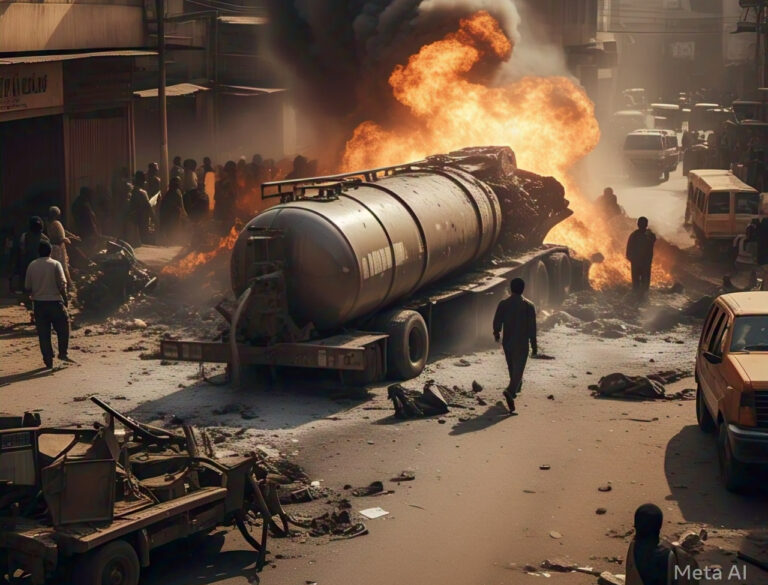
ON January 20, 2025, a gasoline tanker accident led to an explosion that claimed at least 86 lives near the Suleja area of Niger State. The tanker overturned, spilling its contents, and later exploded moments after people began scooping fuel.

According to the National Emergency Management Agency (NEMA), 52 other people suffered severe burns from the explosion, and 15 shops were destroyed.

Sector commander for Niger State with the Federal Road Safety Corps (FRSC), Kumar Tsukwam, said that people rushed to scoop the spilled petrol after the truck overturned. “The tanker burst into flames, engulfing another tanker,” he said in a statement.

Niger State Governor Mohammed Bago confirmed the incident in a statement, noting that many people perished in the massive fire caused by the explosion. He described the incident as “worrisome, heartbreaking, and unfortunate.”

A disturbing pattern

Such accidents have become common in Africa’s largest oil producing country, which is grappling with its worst cost-of-living crisis in a generation. In recent years, Nigeria has witnessed numerous fuel tanker explosions, each resulting in significant loss of life and property. Experts say the frequency of these incidents points to systemic regulatory failures.

Fuel prices have increased by more than 400 percent in the last 18 months following the economic policies by President Bola Tinubu, including the removal of long-standing fuel subsidies. The changes have pushed millions into poverty, forcing many to take desperate measures for survival.

Earlier in October 2024, a similar incident occurred in Majiya, Jigawa State. A fuel tanker overturned, and as residents rushed to fetch the spilling fuel—a practice driven by economic desperation—the tanker exploded, resulting in over 150 deaths. Many victims were burned beyond recognition, while about 100 others were injured. The victims were buried together in a mass funeral organised by authorities.

In September of the same year, another 59 people were killed in Niger State after a fuel tanker collided with a truck carrying passengers and cattle.

According to Nigeria’s Federal Road Safety Corps (FRSC), there were about 1,500 tanker accidents in 2020. Nigeria has an ageing 5,000-kilometre-long oil pipeline, but most of the 50 million litres of gasoline consumed daily are transported by road.

The Petrol Tanker Drivers Association blames the frequency of these crashes on poor road conditions and a lack of enforcement of road safety measures, including speed and load limits.

“I’m a tanker driver, I know how it is. The roads are bad,” Augustine Egbon, chairman of the Petrol Tanker Drivers Association, told VOA. “Secondly, my advice to everybody is that as soon as a tanker has an accident, nobody should go there because sometimes when a tanker falls, it will take almost two or three hours before catching fire, but when people start gathering, that’s when the fire starts.”

Speaking with The ICIR, a public affairs analyst, Ambali Abdulkabeer, explained that fuel tanker accidents stem from both human and infrastructural factors, adding that many tanker drivers are reckless, lack proper training, and are often ignorant of traffic regulations.

He pointed out that fuel tankers are not regularly maintained to ensure roadworthiness.

“Beyond these human factors, Nigerian roads are in poor condition and unfit for fuel tankers. The absence of designated routes for these vehicles worsens the situation, increasing the risk of accidents,” he said.

Beyond these human factors, Nigerian roads are in poor condition and unfit for fuel tankers. The absence of designated routes for these vehicles worsens the situation, increasing the risk of accidents

Abdulkabeer emphasised the need for the government to enforce stricter safety standards for fuel tanker operators and recommended consistent vehicle inspections and awareness campaigns on the dangers of tanker explosions.

“Drivers must be educated on the risks involved, and stringent traffic laws must be enforced to reduce recklessness on the roads,” he added.

On fuel scooping incidents, Abdulkabeer linked them to economic hardship, stating that while desperation may push people into risky behaviours, it does not justify endangering lives. “Nigerians have to take responsibility, too. Carelessness contributes to these avoidable deaths,” he noted.

He urged the government to address economic hardship, invest in road infrastructure, and create specific routes for fuel tankers to ensure safer movement. “It is unwise to allow fuel tankers to ply roads close to cities without restrictions,” he said.

Amid recurring fuel-related tragedies, Abdulkabeer stressed the need for proactive governance saying that such incidents expose failures in policy implementation, stakeholder collaboration, and leadership. “These avoidable deaths tell a disgusting story about poor management in the country. The government must wake up to its responsibilities,” he concluded.

What are the authorities doing?

After the fuel tanker fire in Enugu, Vice President Kashim Shettima stated that it was time to end avoidable tanker accidents and explosions. He emphasised that President Tinubu is seriously concerned about the frequency of these incidents and has directed relevant agencies to take decisive action.

Speaking with The ICIR, the Federal Road Safety Corps (FRSC) spokesperson, Segun Ogungbemide reiterated the agency’s commitment to curbing fuel tanker explosions while calling for a more structured approach to fuel transportation.

Ogungbemide acknowledged that while the FRSC has been working to manage the situation, the sheer volume of fuel-laden tankers on Nigerian roads poses a significant challenge.

“You will agree with me that 98 per cent of fuel movement is done on the road compared to other countries where pipelines or rail are used? We have about 6,000 tankers loaded with fuel moving across Nigeria daily. When a crash occurs, it becomes very loud because of the nature of the cargo, but when you compare it to the daily movement of tankers, you will see that the frequency of accidents is relatively low,” Ogungbemide said.

He emphasised that one of the FRSC’s primary strategies is public enlightenment. “We believe the major role we have to play is educating both the operators and the public. We engage tanker owners and drivers, ensuring they meet minimum safety standards before loading from depots,” he said.

Ogungbemide  pointed out that the absence of a structured training system for truck drivers contributes to the problem. “Imagine a company buying 500 tankers and looking for 500 drivers. Where are they getting these drivers from? We should be asking ourselves these questions,” he noted.

He called for a multi-stakeholder approach, urging road maintenance agencies, fuel regulators, and tanker integrity inspectors to play their part in ensuring safer transport conditions. “This is not something the FRSC alone can solve. It is a shared responsibility,” he stated.

On fuel scooping, he revealed that the FRSC has consistently launched awareness campaigns through traditional and social media. “We have released multiple jingles and advisories warning against scooping fuel from crashed tankers. Sadly, many explosions occur after people rush in to collect fuel,” he said.

Ogungbemide criticised Nigeria’s over-reliance on road transport for fuel distribution, which contradicts the original fuel distribution system design.

“Ideally, pipelines should transport fuel from refineries to depots, and tankers should only cover short distances. Unfortunately, we now see tankers moving from Lagos to Enugu or Kano, covering nearly 1,000 kilometres on bad roads, increasing the risk of accidents,” he explained.

He assured the public that the FRSC would continue implementing safety measures and advocating for safer transport alternatives. “We will keep educating the public, monitoring tanker conditions, and engaging stakeholders to ensure road safety,” he concluded.
Some Tinubu’s policies right but implemented by incompetent appointees – El-Rufai

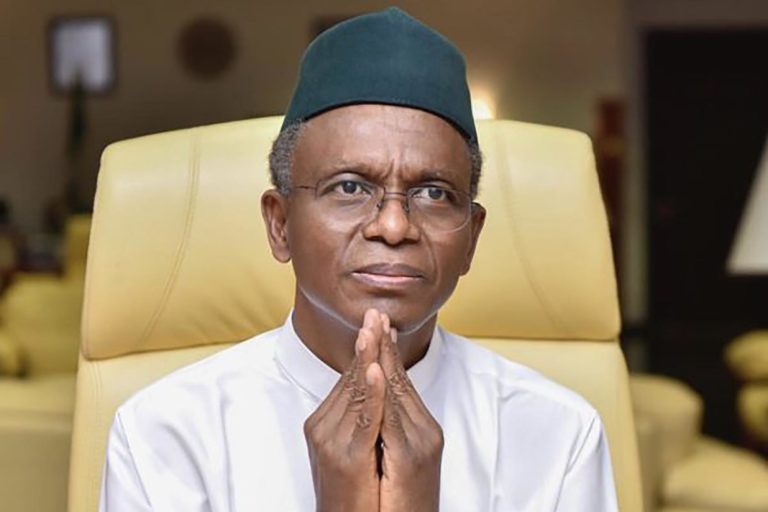
FORMER Kaduna State Governor, Nasir El-Rufai, has raised concerns over the implementation of President Bola Tinubu’s economic reforms, questioning the competence of those overseeing the policies.

While acknowledging that some of the policies are rooted in orthodox economic principles, El-Rufai argued that their implementation had been flawed.

Speaking during an interview on Arise TV, El-Rufai, on Monday, February 24, argued that the government’s approach to some of the policies was wrong.

Recall that El-Rufai, who was nominated by Tinubu for a ministerial position in 2023, was among those denied confirmation by the Senate.

The Senate had declined to confirm his nomination, alongside Stella Okotete (Delta) and Abubakar Danladi (Taraba), citing unresolved security reports.

But the former governor stated that the National Assembly had no role in his exclusion and that Tinubu personally decided against appointing him.

Meanwhile, speaking on Tinubu’s policies, the minister said “I don’t want to pass any judgment or make any opinion about the government because anything I say can be interpreted as a criticism. I supported some of the policies, most of the economic policies are the right orthodox policies but the sequencing is wrong, the quality of the people implementing the reforms is least much to be desired.”

El-Rufai further noted that some of the measures, particularly those aimed at curbing food inflation, could be counterproductive. 

 “I think some of the reforms are just wrong. You don’t address food inflation by destroying domestic agriculture through importation, for instance. Food prices may be going down but farmers are being impoverished because they are being made to compete with subsidised agricultural products from Europe and other countries. So I have issues with many of them,” El Rufai said.

The ICIR reports that since assuming office in May 2023, President Tinubu has embarked on a series of economic reforms aimed at stabilising the nation’s economy. 

These measures, which include the removal of fuel subsidies, exchange rate unification, and increased reliance on food importation to lower consumer prices, have been both lauded and criticised. 

While the government argues that these steps are necessary for long-term stability, their impacts have not yet been seen in the country as many Nigerians continue to face hardship.

Many Nigerians have also pointed out the immediate hardship they have caused, with inflation and food prices remaining high.

Tinubu, not NASS, thwarted my ministerial appointment – El-Rufai

FORMER Kaduna State Governor Nasir El-Rufai has disclosed that President Bola Tinubu deliberately excluded him from his cabinet, dismissing claims that his rejection during screening for a ministerial slot in 2023 was due to “security concerns” raised by the National Assembly.  

The Senate had declined to confirm El-Rufai’s nomination, alongside Stella Okotete (Delta) and Abubakar Danladi (Taraba), citing unresolved security reports.

However, in an interview with Arise TV, on Monday, February 24, the former governor stated that the National Assembly had no role in his exclusion and that Tinubu personally decided against appointing him.

El-Rufai stated that Tinubu had publicly appealed to him to join his administration despite his initial reluctance. 

He insisted that his decision to support Tinubu’s presidential bid was not motivated by personal gain.  

“Since I left office and the president begged me publicly to come and serve in his cabinet, I have my plans and I told President Tinubu from day one when he asked me to support him. I said I would but I don’t want anything because politics in Nigeria is always about what do I get for giving you support.”

Despite his reservations, El-Rufai said he eventually agreed to Tinubu’s request after two months of negotiations, but only under certain conditions. 

However, he alleged that Tinubu later changed his mind about including him in his government.  

“President publicly appealed to me to put my plans on hold. After two months of negotiations, we finally agreed that he would nominate me as minister and there were certain conditions I attached to that. I think along the line either the president changed his mind or something else because please don’t believe the story that the National Assembly rejected me.

“National Assembly had nothing to do with this, President Tinubu didn’t want me in his cabinet. He changed his mind whatever it is, frankly, I don’t care and I told him and I moved on.”

El-Rufai’s latest remarks aligns with his previous public statements in which he downplayed his exclusion and insisted that he never sought a position in Tinubu’s administration. 

El Rufai had on January 30, 2025, while responding to the president’s media aide, Daniel Bwala, on his X handle, stated that he was not interested in being a member of Tinubu’s cabinet.

“I was cabinet minister 22 years ago and was clear to Asiwaju that I was not interested in any position in his future government. The pathetic manner all of you latter-day converts to the Tinubu government make an issue of something that I never wanted in the first place is perhaps a reflection of the level of your moral flexibility,” he wrote on his X handle.

His remarks also came amid his recent criticism of the ruling All Progressives Congress (APC), which he co-founded, and his call for opposition parties to unite against the current administration.

His fallout with the Tinubu government has sparked reactions, with some political analysts interpreting his statements as a signal of deeper cracks within the APC.

Background of El-Rufai’s ministerial nomination

El-Rufai was initially nominated alongside 47 others as part of President Tinubu’s first ministerial list. 

However, during the Senate screening on August 7, 2023, Senator Sunday Karimi from Kogi West raised a petition against him, citing alleged security issues.

Following deliberations, the Senate declined to confirm El-Rufai, along with two other nominees – Stella Okotete from Delta State and Abubakar Danladi from Taraba State.

Tinubu later replaced El-Rufai with Balarabe Abbas, a former Secretary to the Kaduna State Government, who was assigned to the Ministry of Environment.


ECOWAS Media Excellence Awards 2025 seek entries

IN celebration of 50 years of regional integration and development, the Economic Community of West African States (ECOWAS) is seeking entries to its Media Excellence Awards 2025. 

The awards will celebrate outstanding journalists and media professionals whose work has significantly contributed to informing, educating, and shaping public awareness of ECOWAS’s achievements and impact in the region and globally.

The ECOWAS invites applicants to submit their work portfolio for the ECOWAS Media Excellence Awards 2025.

The award ceremony will recognise impact stories, news publications, video films and photography that highlight the achievements and milestones of the ECOWAS Commission.

Journalists and media professionals from the ECOWAS Member States with original, impactful and professionally produced content in English, French or Portuguese can apply.

The deadline for the application is March 20, 2025. Interested applicants can apply here.

IPMAN to embark on strike over N100bn bridging claim

0

THE Independent Petroleum Marketers Association of Nigeria (IPMAN) has issued a seven-day ultimatum to the Nigerian Midstream and Downstream Petroleum Regulatory Authority (NMDPRA) to pay bridging claims amounting to N100 billion.

The group threatened that should the agency fail to make the payment, it would embark on strike.

Bridging claims are payments made to transport fuel from depots to approved locations in Nigeria, to help ease the price burden on consumers.

Addressing journalists in Abuja on Monday, February 24, the chairman of the IPMAN depot chairmen forum, Yahaya Alhasan, said the seven-day ultimatum would take effect immediately.

“If NMDPRA doesn’t pay our money within seven days, we are going to withdraw our services across the nation.

“We are extremely frustrated that one year after our last demand as a forum, requesting the payment of over N100 billion owed to our members in bridging claims by the Nigerian Midstream Downstream Petroleum Regulatory Authority, the management of the NMDPRA has deliberately ignored our request, even after making clear promises to pay us,” Alhasan said.

The ICIR  reports that in April 2024, IPMAN raised concerns about the non-payment of over N200 billion bridging claims.

It noted that the debt had accrued since September 2022 and demanded the NMDPRA to offset the debt.

In his press briefing on Monday, Alhasan said NMDPRA’s failure to pay the debt had further crippled members’ businesses.

He stressed that the delay in paying the debt has led to a loss of lives, closure of businesses, staff retrenchment, and the takeover of business premises by commercial banks.

According to him, the association will withdraw its services if the amount is not paid before the deadline.

Their action followed the NMDPRA’s failure to clear the debt, despite earlier promises, Alhasan noted.

He recalled one of the promises made by the NMDPRA at the stakeholders’ meeting convened on the eve of the last strike action declared by the Nigerian Association of Road Transport Owners (NARTO).

Alhasan said depots in the North, including in Jos, Gusau, Minna, Suleja, Kaduna, Kano, Gombe, Yola, and Maiduguri, had become completely grounded due to the lingering debt.

He said IPMAN was concerned over other issues, including a five per cent levy imposed on its members by NMDPRA on the sale of petrol stations, describing it as unconstitutional and anti-developmental.

“Another worrisome development is the NMDPRA’s imposition of several abnormal levies on our members. Chief amongst them is the imposition of a five per cent commission accruable to them at the sale of any petrol station outlet in Nigeria. Tell me, when has the NMDPRA turned herself into a real estate agent, collecting a commission on sales of Retail Petrol Outlets? There is no gainsaying the truism that the downstream retail industry is an ever-evolving one,” Alhasan said.

He said IPMAN members have been having difficulties in maintaining and renovating their petrol outlets due to further excessive levies imposed by the NMDPRA.

“As IPMAN members, we go the extra mile to renovate our outlets occasionally, to meet with international best practices. However, the NMDPRA has also made this very difficult for us, as they have also subjected our members to paying bizarre levies whenever we deem it fit to renovate our petrol outlets. These are just a few of the many distressing levies they have forced on us; these are not only anti-developmental, they are also unconstitutional, and we are demanding their immediate suspension.

“As a forum of law-abiding Nigerians, we sincerely believe that we have given the NMDPRA enough time to pay us our monies in bulk and clear the bridging claims. But given their constant refusal, we have therefore decided to liaise with our sister organisations, the PTD and NART, to take collective action in due course. As members of IPMAN, it is important to state that we also own sizeable numbers of petroleum tankers driven by the PTD, and we may be forced to withdraw our tankers from loading petroleum products in a view to enforce the immediate payment of our bridging and NTA claims,” Alhasan stressed.

The association called on President Bola Tinubu to intervene in the disputes.

“We will not hesitate to immediately take action in due course if our demands are not met immediately, beginning from today Monday 24th February 2025,” he noted.

Awards honour excellence in financial journalism

SANLAM and Santam are accepting entries for the Sanlam Group Awards for Excellence in Financial Journalism.

The awards cover financial journalism that spotlights Africa’s economic challenges and progress.

Categories include business and companies, economy, financial markets, consumer financial education, the African growth story, and more.

Entries must have been published or broadcast between January 1, 2024 and December 31, 2024.

Business journalists in print, online, radio and TV, who are based in Africa, are eligible for awards.

The awards carry a total cash prize of approximately ZAR1 million.

The deadline for the submission of applications is March 31, 2025.

Interested applicants can apply here.

Aiyedatiwa kicks off own tenure as Ondo governor

0

ONDO State Governor Lucky Aiyedatiwa has been sworn in, effectively making him begin his four-year tenure as the state leader.

Aiyedatiwa, who assumed office on December 27, 2023, after the passing of his principal, the late Governor Rotimi Akeredolu, was elected on November 16, 2024.

Akeredolu died on December 27, 2023, at the age of 67, after a prolonged battle with prostate cancer. He was serving his second and final term.

Aiyedatiwa marked his swearing-in, which took place in Akure, the state capital, on Monday, February 24, with clemency, granting freedom and reducing sentences to 43 prisoners.  

He ordered the release of eight convicts, commuted 15 death sentences to prison terms, and reduced the sentences of 20 others serving life terms.    

The governor said that within the 14 months he had been in charge, his administration had made significant strides in agriculture, revenue generation, health, urban renewal, rural road construction, education, employment, and entrepreneurship.

“We have demonstrated commitment to the development and welfare of the people. Our dear Sunshine State has witnessed tremendous progress in infrastructural development, and provision of social amenities, while we have kept at the front burner the welfare of the people” he said.

The governor further assured the state of his commitment to work with interested investors and development partners in ensuring that the dream and vision of the founding fathers of the state become a reality.

“In the next four years, we will work with interested investors and our development partners to ensure that our Ondo becomes a reality. We will also facilitate investors to explore a large deposit of bitumen for local use and export purposes, thereby generating huge revenue for the state” he added.

He paid special tribute to his late boss – Akeredolu – for allowing him to serve as his deputy and for laying the foundation that paved the way for his emergence as governor.

While expressing gratitude to the people of the state and the Independent National Electoral Commission (INEC) for ensuring a peaceful electoral process that produced him as the governor, Aiyedatiwa pledged to prioritise the welfare of the state’s people.

The ICIR reported that INEC declared Aiyedatiwa the winner of the November 2024 governorship election.

He polled 366,781 votes to defeat his main contender, the Peoples Democratic Party (PDP) candidate, Agboola Ajayi, who garnered  117,845 votes.

Ajayi was deputy to the late Akeredolu between 2017 and 2021 before both leaders fell apart.

Stakeholders decry growing frivolous lawsuits against journalists, media outfits

0

MEDIA stakeholders have raised concerns over the growing use of frivolous lawsuits to silence critical voices and intimidate journalists and media organisations.     

They also proposed solutions to counter these legal threats and other forms of harassment aimed at suppressing press freedom.

The concerns were raised during a workshop organised by the Centre for Journalism Innovation and Development (CJID) on Monday, February 24.

The event, themed “Navigating Legal Challenges: Laws that Criminalize Journalism and Strategic Lawsuits Against Public Participation (SLAPP) in Newsrooms,” brought together key media professionals and  civil society organisations.

Speaking at the event, the Executive Director of the International Centre for Investigative Reporting (ICIR), Dayo Aiyetan, described SLAPP suits as “frivolous lawsuits filed by individuals and entities that journalists and activists hold to account.”

He explained that these legal actions often arose because many Nigerian newsrooms lacked the financial capacity to mount a strong legal defense.

“The frivolous lawsuits are meant to gag us(media), suppress us and waste our time,” he said.

Aiyetan, who recounted various cases of lawsuits faced by The ICIR and other media organisations in Nigeria, described frivolous lawsuits as existential threat to journalism in the country.

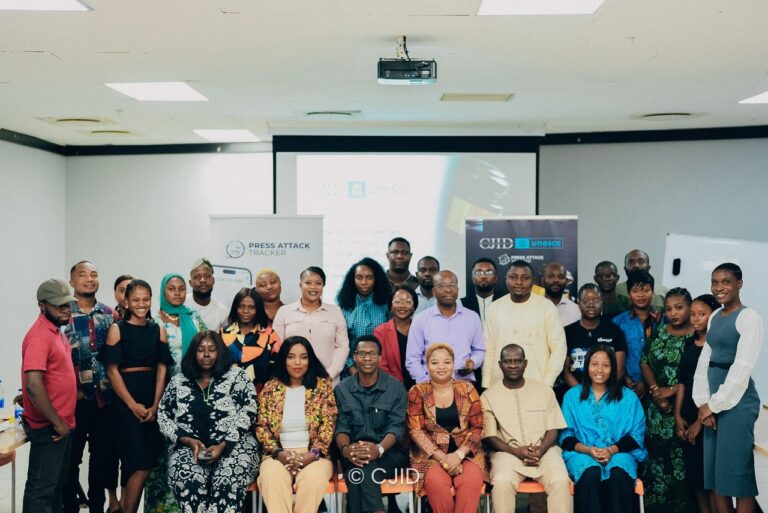
Media professionals and CSOs at CJID SLAPP programme

Editor-in-Chief of Premium Times and President of the International Press Institute, Musikilu Mojeed, acknowledged that while some lawsuits were filed to protect reputations, the increasing abuse of legal action against the media was alarming.

He attributed this trend to the lack of consequences for those who initiate baseless litigations.

“Because here in Nigeria, if you’ve made frivolous lawsuits, there’s no consequence. You can go to court because you have money and say this person has written against me, I don’t like it and I want to deal with him. You know you are not likely going to win the case but you want to torture him significantly. Even if you don’t want to win, there will be no consequences.”

Musikilu recalled how the Premium Times and other media outfits had spent thousands of dollars in defending themselves in courts for reporting the truth.

He urged the CJID and other media and civil society organisations to coordinate better coverage of suits against media platforms.

Similarly, the Managing Editor of Premium Times, Idris Akinbajo, raised concerns about corruption within the Nigerian judiciary and the biases some judges hold against the media.

Beyond financial losses, Akinbajo warned that the growing legal threats could discourage investigative journalism, leading media organisations to self-censor for fear of litigation.

The ICIR, in a survey conducted in 2023, found out that out of the 141 respondents, made up of media organisations, journalists and civic advocates, about 40 had been sued within a year.

Out of those sued, some had faced more than three lawsuits within the year while some had been sued for more than 12 times.

Some of them stated that the legal threats had a tremendous effect on their work.

[UPDATED] Natasha: Senate invites Brekete Family show host, Ahmed Isah

1

THE host of Brekete Family, a show on Human Rights Radio and Television, Ahmed Isah, popularly known as “Ordinary President,” has been invited to appear before the Nigeria Senate.   

Isah disclosed the Senate invitation during his programme on Monday, February 24.

He is expected to appear before the lawmakers, latest by February 27.

According to reports, the summons is reportedly linked to a recent broadcast of the Brekete Family radio show, in which a senator, Natasha Akpoti-Uduaghan, spoke about her grievances with Senate President Godwills Akpabio.

Isa had called the female senator and the Senate President on his live show on Friday, February 21.

While Akpoti-Uduaghan responded to the call and alleged that she was victimised by the Senate leadership, the number Isah called for Akpabio did not pick three times. It was however, later found out that the number Isah called on the live programme did not belong to Akpabio.

Isa’s work has garnered widespread recognition in the Federal Capital Territory (FCT), Kaduna and adjoining states. He has also built a strong following by intervening in public grievances, injustices and human rights abuses.

Many Nigerians regard the Brekete Family show as a voice for the common man, providing a platform for the underprivileged to seek redress on issues that could take them years to address elsewhere. 

However, despite his benevolence, Isa is often accused of arrogance, which he occasionally acknowledges.

The ICIR reported that Akpabio, on Thursday, February 20, barred Akpoti-Uduaghan, who represents Kogi Central in the Senate from participating in plenary over her seat that was changed without her consent.

The tension began during plenary when Akpoti-Uduaghan’s seat was relocated upon resumption of the session, leading to heated arguments between her and the Senate leadership.

Akpabio said the changes were necessary to adjust for shifts caused by some opposition members moving to the majority wing of the Senate chamber.

Refusing to back down, Akpoti-Uduaghan, a member of the Peoples Democratic Party (PDP), raised her voice in protest, directly confronting the Senate President.

Consequently, Akpabio ordered the sergeant-at-arms to walk her out, but after the intervention from fellow lawmakers, calm was restored.

Reacting to Akpabio’s action, a human rights lawyer, Inibehe Effiong, said Akpabio hated opposition and would never survive his action if he had displayed such a character in the South African Parliament.

The incident was not the first time that Akpabio would clash with Akpti-Uduaghan. During plenary In July 2024, Akpoti-Uduaghan commented on a motion without Akpabio’s consent.

In his attempt to correct her, he said the Senate was not a nightclub where anybody could talk anyhow.

Akpabio bowed to pressure as he apologised to Akpoti-Uduaghan two days later for comparing her conduct in the Senate to that of a nightclub.

The ICIR reported that the Senate President’s comment caused social media outrage as women groups criticised him for the action and described his attitudes towards female senators as not only insulting but a denigration of the female gender and an attempt to stifle female voices.

Updated: The report was updated to include that the number Isah called on the live show were not Akpabio’s.  

APC urges Tinubu’s government to suspend allocations to Osun LGs

0

THE All Progressives Congress (APC) has advised President Tinubu-led Federal Government to suspend local government allocations to Osun State until further notice.

The party urged the government to allocate funds to onlydemocratically electedandjudicially certifiedlocal government officials in the state.      

The APC said in a statement by its spokesperson, Felix Morka, that the local government election conducted by Governor Ademola Adeleke’s government on Saturday, February 22 was a “disgraceful sham, illegal and unconstitutional.

The APC spokesperson described the poll as awanton disregardfor the rule of law and a subsisting appeal court judgment.     

Morka said the APC respected the Federal High Court’s ruling, which favour Adeleke’s party – the Peoples Democratic Party (PDP). Consequently, the APC said it “exercised control, and diligently pursued an appeal against the court’s ruling.

The party questioned the governor’s alleged failure to comply with a valid court order reinstating the local government officials he removed.

The APC noted that Adeleke, having sworn to uphold the constitution, should adhere to the court’s decision.           

The ICIR reported that the PDP won all 30 LGAs and 332 wards in the controversial election held on Saturday.

Adeleke inaugurated the newly elected local government chairpersons and councillors in the state on Sunday, February 23.

Swearing in the officials in Osogbo, the state capital, on Sunday, Adeleke reflected on the path to the election, affirming that the Osun State Independent Electoral Commission had adhered to all legal processes for the poll.

While acknowledging the legal controversies surrounding the election, Adeleke claimed that his administration acted within the ambit of the law.

The ICIR reported that the Attorney General of the Federation (AGF) and Minister of Justice, Lateef Fagbemi, had warned the state governor against proceeding with the election.

The AGF told Adeleke to ask the Osun State Independent Electoral Commission (OSIEC) to suspend the election.

In a statement he signed on Thursday, February 20, he warned that conducting the poll would be invalid and unconstitutional.

This, according to him, is because the Court of Appeal, Akure Division, recently ruled that the tenure of the sacked council chairpersons and counsellors elected in 2022 (before Adeleke assumed power) was still running.

The AGF stated that his attention was drawn to Adeleke’s public outcry regarding the Court of Appeal’s judgment in Akure.

He said the judgment, delivered on February 10, 2025, in Appeal No. CA/AK/272/2022, nullified the Federal High Court’s judgment in Osogbo, which was delivered on November 25, 2022, against those elected in 2022.