Home Blog Page 376

Flushed: Ekiti communities convert EU-funded toilets into eateries, barbing salons

FOUR years after the European Union launched public toilets it constructed in 14 communities in Ekiti State to curb open defecation and improve access to safe water supply, many residents still prefer defecating in nearby bushes instead of using the toilets.     

They see public toilets as disgusting and unhygienic without a toilet in their homes.

Most people who defecate in the bush use leaves instead of water to clean their anus.

While a few dig the ground and cover their faeces with sand when they are done, others abandon the faeces for flies and domestic pets like dogs and pigs to feast on.

Apart from the bush being a host to dangerous pests and reptiles, including snakes and scorpions, open defecation is frowned upon by health experts, including the World Health Organization (WHO).

The United Nations defines open defecation as “when people defecate in the open – for example, in fields, forests, bushes, lakes and rivers – rather than using a toilet.”

The ICIR visited 14 communities with EU toilets in Ekiti State in the second week of November 2024 and discovered that only two of the communities use the toilets for the purpose they were built.   

Nine communities abandoned the facilities and three converted them for other purposes.

Ekiti communities convert EU-funded toilets into eateries, barbing salon, abandon others
The toilet was abandoned and overgrown with weeds in Imesi community

About the toilets

The EU funded the construction of the toilets between 2018 and 2020 under its Water Supply and Sanitation Reform Programme III and handed them over to the communities to manage.

Seven communities benefitted from the facilities each in Gbonyin and Ekiti West Local Government Areas (LGAs).

The communities are Ode, Egbe, Imesi, Agbado, Aisegba, Iluomoba, and Ijan in Gbonyin LGA and Aramoko, Erinjiyan, Ikogosi, Ido-Ile, Erio, Ipole-Iloro and Oke-Imesi in Ekiti West LGA.

They are in the southern and central senatorial districts of the state, respectively.

Each facility has two sections containing two flush toilets, urinals, a bathroom, and a washing tub.

It also has a solar-powered motorised borehole, a pumping machine, an overhead water tank, a car wash canopy that accommodates two cars, and outdoor water faucets providing water for the car wash and the public.

The frontage of each toilet is floored and each section of the facilities has a gate and key, preventing unauthorised access or abuse of use.

All the toilets are painted in the same colours – navy blue and yellow.

Dirty seat of the EU-funded public toilet in Ode-Ekiti
Dirty seat and walls of the EU-funded public toilet in Ode-Ekiti. PC: Marcus Fatunmole/The ICIR

Upon their completion in 2020, the EU and Bread of Life Development Foundation, a Nigerian-based non-government organisation that handled the construction, in collaboration with the Ekiti State Small Towns Water Supply and Sanitation Programme, handed the projects dubbed: Farewell to Open Defecation” over to the communities.

The ICIR’s findings showed that the state government objected to the communities being fully in charge of the facilities, but the funder’s plan for the communities to manage the toilets sailed through.

Toilets were built because of poor sanitation, water supply in state

Before the toilets were built, Ekiti State had safe sanitation coverage of 32 per cent in rural and small towns and 38 per cent in urban towns. Open defecation was 68 per cent in the state – the highest in the South-West, according to the state Water, Sanitation, and Hygiene policy. These data were contained in a statement issued by Babatope Babalobi, the team lead of the Bread of Life Development Foundation, on behalf of the EU and the state government when work began on the project in 2018.

The abandoned EU-funded public toilet in Ekiti State

The statement said the United Nations Children’s Fund (UNICEF) 2014 survey showed that 92 per cent of the communities in Gbonyin LGA were without public latrines, and in Ekiti West, 124 communities were found not to have any form of public latrines, quoting the Ekiti-West WASH Profile 2014 report.

As of the time the project was conceived, Ekiti State was among the 2.1 billion people globally who lacked access to safe water, and another 4.5 billion who lacked safely managed sanitation, according to the WHO.

The state’s children were also among the 361,000 under five years who died yearly due to diarrhoea occasioned by unsafe water.

The WHO links poor sanitation and contaminated water to transmission of diseases namely cholera, dysentery, hepatitis A, and typhoid.

As of September 2024, the Nigeria Centre for Disease Control and Prevention (NCDC) recorded 19 suspected cholera cases in Ekiti State.

Current state of EU toilets in Ekiti

Human faeces littered the toilet floors and surroundings in Imesi, Agbado, and Ipole-Iloro where they are abandoned by the communities.

This means that rather than the communities using them to prevent open defecation, the toilets are tools for promoting it.

The ICIR’s findings showed that each functional toilet has a manager. Users pay a token (approximately N50) to use the toilets, and the water is sold at a very cheap rate to attract users and keep the facility running. For instance, a 50-litre keg is sold for N50 in communities where the facilities are functional.

The toilet in Agbado is under lock and key and not used

A part of the revenue generated goes to the community while the remainder is used to maintain the building and support the facility manager.

Many residents interviewed said they were more comfortable defecating in the bush which envelopes their towns than using a public toilet. They said using a public toilet was the last option because of safety concerns.  

Others said they preferred other amenities, including schools, hospitals, and empowerment centres to public toilets.

A striking issue with The ICIR’s finding is that people in communities where the toilets were abandoned declined to speak with the reporter. Some residents of those communities were also averse and resisted check on the facilities.

However, residents of communities where the toilets were functional were welcoming and glad about the donation.

Governor’s town, neighbouring community convert toilets to restaurants

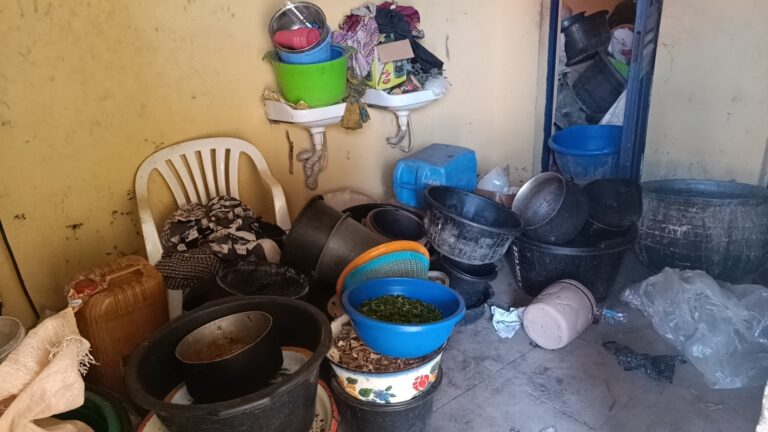
In Ikogosi, the home of the state governor, Biodun Oyebanji, a woman uses the toilet as a restaurant. She keeps all her foodstuff, pots, and other utensils in a section of the toilet. She also built a wooden kitchen and cafe as annexes to the facility.

Her restaurant attracted about a dozen customers within 30 minutes spent by the reporter at the building as she dished out different meals, including beans, rice, bread, assorted meat, and drinks to her customers. She was supported by a female cook.

Ekiti communities convert EU-funded toilets into eateries, barbing salon, abandon others
The state of the toilet in Ikogosi, Governor Biodun Oyebanji hometown, where a woman uses it as a restaurant. She keeps her pots and other utensils in one section of the toilet

Ikogosi is a leading tourism community in the state. It is expected to set the pace in sanitation and maintain available infrastructures for that purpose.

In 2022, The ICIR reported how the hometown of the former Senate President and presidential aspirant on the platform of the ruling All Progressives Congress (APC) in the 2023 general election, Ahmad Lawan, stank because of poor sanitation.

The case of the toilet misapplication was the same in Erijiyan, a community before Ikogosi, where another woman, Aduyemi Modupe, runs a big restaurant in front of the toilet.

“I’ve been here for about two years. Since I came here, the water has not run. We have also been unable to use the toilet. The pipes had been damaged before I got here. None of the things installed in the building is working.

“I urge the government to help us. I have just repaired the pumping machine and I spent so much money to repair it. The canopy provided outside the premises has been blown away by the wind. I appeal to the government if it can turn the toilet for other uses. If the government also wants us to keep using the facility as a toilet, I plead that it helps us to repair it.”

The woman said nobody had used the toilet since she started running her business there. “Nobody even asks about it or shows interest in using it. Even if there is water and everything is working fine, nobody uses it.”

Similarly, in Erio community, the toilet is used as a barbing salon. At least two people work at the salon, which attracts a good number of customers daily.

The ICIR saw one of the toilet rooms used for taking a nap by users.

A baby taking a nap inside a bathroom of the EU-funded toilet in Erio Ekiti. PC: Marcus Fatunmole/The ICIR

The facility manager, Tosin Bamigbade, said, “We only use the toilet once a year when a major pastor in the town organises a programme and many people come to his church. The church people are usually here for a week. That’s the only time we use it. Nobody asks about the toilet after that.

“We use a section of the toilet as a barbing salon so that the building will not just be there. We also use the other section for toilet.”

Aramoko, Ido-Ile communities use facilities

The ICIR observed that the toilets were partially used in two communities namely Aramoko and Ido-Ile.

In Aramoko, the facility manager is a retired director of environmental health, Olofintuyi Abiodun. He said, “Since I took over this place, I’ve been trying my best to maintain it because as a professional, I make sure the environment is tidy. One of the challenges we have is that people do not patronise this place. They will be saying they don’t have money.

“The people that handed it over to me said I should be collecting N50. Still, the people will say they don’t have money. Instead of patronising here, they enter the bush up there to do whatever they want to do.”

He said he made necessary repairs with the token he collected, adding that the facility never had any major problems.

He also said there had been an improvement in the number of houses with toilets in the community.

A barbing salon inside the EU-funded toilet at Erio-Ekiti. PC: Marcus Fatunmole/The ICIR

At Ido-Ile, one of the users, Ayeni Toyese told The ICIR, “This water is very useful to us in the town. We don’t have water in our street. This is the water that we drink, use for bathing, washing and cooking. We don’t want the facility to have any problem and we’re hoping that we will get another one like this to further support us.”

She said the water was always available.

Another user, Toyin Odewale, concurred with Toyese’s position. She appealed to the government and other well-meaning organisations to support the community with similar aid.

She said she had used the water for over four years, and it had always served her.

The manager, an elderly woman, Aduke Babatope, said many people come to fetch the water. She sells a big bowl for N20, three 25-litre kegs for N50, and a paint rubber for N10.

But she said people only use the toilet whenever there are events in the town and visitors come to the community. Bathing and excreting are both N50.

She’s managed the facility for three years. The woman said the water wasn’t selling well during the rainy season but would not be enough for those who need it during the dry season.

According to her, part of the money she generates goes to the community and she retains the remainder for herself and for the maintenance of the building.

The EU-funded toilet at Ido-Ile community is well-maintained and functional

Communities where toilets are partly in use  

Police officers use the toilet in Egbe community. It is built near the town’s market and police station. A section of the toilet was given to the police officers.

Two of the officers expressed delight with the toilet while speaking with The ICIR.

Ode community also claimed to be using the facility but the toilet seats were too dirty to make the claim valid.

Built close to the community’s market, the toilet is managed by Ifagbure Oluwasegun.

He claimed that up to 60 people use the toilet daily, but from the look of the facility, his claim is doubtful because the toilet seats and floors are too dirty. They appeared unused for months.

He said out of 100 houses, only about 30 have toilets in the town.

A food vendor near the toilet, Ebun Akinyemi, said the toilet would be useful to the community, especially market people, visitors and motorists if well managed. She was silent on whether the facility had been used recently.

State of the EU-funded toilet infrastructure in Imesi-Ekit

Communities where toilets are fully abandoned

The toilets are completely abandoned in the following communities:  Imesi, Agbado, Aisegba, Ilu-Omoba, Ijan, Ipole-Iloro and Oke-Imesi.. The facility manager at Ilu-Omoba, Joseph Micheal, said the toilet stopped working in 2023 because the pumping machine got damaged.

It would cost N250,000 to repair the machine and the community had yet to provide the money, he said.

A resident, Omolere Olamilekan, said people who used the toilet before it became bad had resorted to using the bush, while potable water had been a huge challenge for people of the area.

The ICIR reports that toilets in Agbado, Imesi, Aisegba, Ijan, Ipole-Iloro and Oke-Imesi are left in the bush.

In Oke-Imesi, the building’s ceiling and roof are falling off. Its walls are cracking.

Ayo Jolayemi, who runs a private clinic at a storey building near the toilet said, “I came in here around April 2021 and I met this facility. What I was told was that the town’s authority from the Oba’s place had a committee looking after it. I met it bad, and put in my money to renovate it. I was maintaining the place. Later, there was a major damage through the borehole.

Residents of Imesi community deficate on the toilet ground, meaning they use it to promote open defecation instead of using it to prevent the practice

“I called the authorities to see what was happening there. They came, and since then they have not been coming. That was November last year. I called other people I knew, but nobody responded.”

He said the borehole was the major problem with the facility.

He also told the reporter that people in the community faced difficulty in getting safe water, as according to him, such a problem could be ameliorated if the toilet functioned and its water ran.

Ekiti government reacts

Reacting to the findings, the permanent secretary of the Ministry of Infrastructure and Public Utilities in the state, Olumide Ajayi, said the EU’s concept of the projects was to hand them over to the communities, even though the state wasn’t happy with the decision, it allowed it to be.

Ajayi agreed with The ICIR’s findings on the state of the toilets, stressing that the state intended to appraise the use of the toilets after three years and make a comprehensive report to the EU.

The ICIR reports that the three years he claimed had since elapsed because the projects were launched in 2020.

The toilet is well-managed in Aramoko Ekiti

“We are not unaware of what you found there. But we have to respect the position of the people that designed that concept, that we should review its operations after three years, and that the communities should maintain it within those years. The state should respect that because it was donated to us.

“It was not donated for us to manage but to the communities to manage.”

He said the toilets should not have been handed over to the communities that abandoned or misapplied them.

“We are going to make a comprehensive report of this situation and share with the EU and share with the proponent of that concept to EU because we argued then that it shouldn’t have been fully handed over to the communities. An agreement was signed between the EU’s representatives and the communities before the EU handed over the projects to them.

Similarly, a senior official in the ministry, who was part of the state’s team that executed the project, Jide Olatilu, an engineer, confirmed The ICIR’s findings.

He said he was at Ikogosi in October and met the woman who converted the toilet into a restaurant, and she insulted him when he challenged her.

“I can tell you some communities are not using the toilets. I think the major issue is the payment of the user fee. We said they should engage a vendor to operate and maintain the toilet facilities. They cannot use it without making a payment.

“We will not be tired. We will continue with our sensitisation until they know how to use the toilet and pay. How much? N20 or N50,” he stated.

Canopy for car wash section of the abandoned public toilet in Aisegba Ekiti blown off by wind. PC: Marcus Fatunmole/The ICIR

EU, Bread of Life Foundation declines comments

The ICIR contacted the Bread of Life Development Foundation which executed the projects on its findings. Its leader, Babatope Babalobi, said he had nothing to say about the project.

He said his organisation no longer had anything to do with the toilets since it completed work on them, and they were delivered to the communities.

Similarly, the EU declined to comment on the toilets.

The ICIR sent a mail to the Nigerian office of the EU on November 15, 2024. The organisation failed to respond.

The EU’s head of communication in Nigeria, Modestu Chukwulaka, was also contacted. He requested details of the findings. They were sent to him by text message and email on November 20, 2024.

His efforts to get reactions to the findings from relevant departments in the EU yielded no fruits.

The ICIR further contacted the European Climate, Infrastructure and Environment Executive Agency through email on December 28, 2024.

Responding to the email on January 10, 2025, the agency referred this organisation to the European Commission’s central services: https://european-union.europa.eu/contact-eu_en.

A request sent to the platform was not replied to despite being acknowledged.
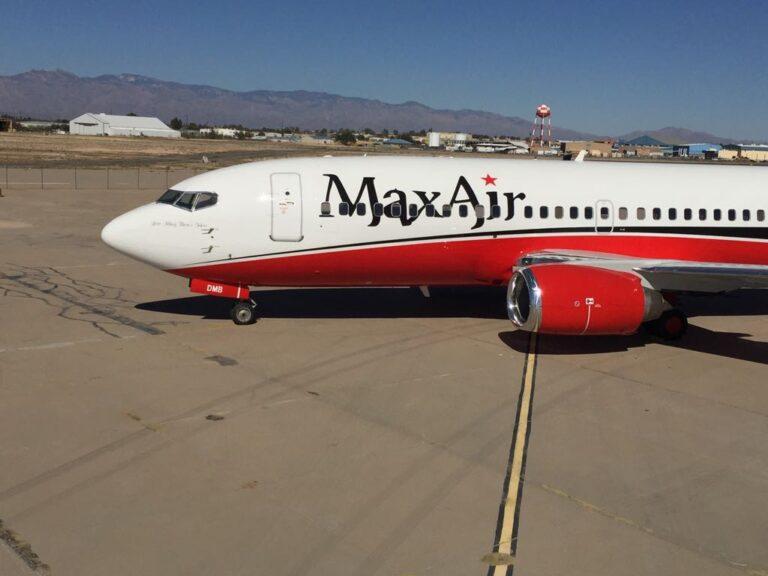
Nigerian government suspends Max Air

0

THE Nigeria Civil Aviation Authority (NCAA) has suspended Max Air Airlines for three months following an incident involving one of its aircraft at the Mallam Aminu Kano International Airport, Kano.

The authority disclosed this in a statement signed by its spokesman, Michael Achimugu, on Wednesday, January 29.

“As a result of this incident, Max Air is suspending its domestic flight operations for a period of three months with effect from midnight, 31st January, 2025, to allow for an internal appraisal of its operations by its management,” NCAA said.

A Max Air aircraft, B734, with registration 5N-MBD, on landing at the Kano Airport at about 10:51 pm, reportedly suffered a wheel landing gear collapse and a tyre burst while landing on the runway.

Six crew members and 53 passengers were onboard, but none suffered any major injuries during the incident.

The runway has since been cleared and flight operations have resumed at the airport, according to the Federal Airports Authority of Nigeria (FAAN).

The Nigerian Safety Investigation Bureau (NSIB) had further initiated an investigation into the incident.

In the statement on Wednesday, the NCAA said it would provide the required support to the NSIB on its investigation.

“It must be stated that the specific cause(s) of this incident can only be established after the NSIB has conducted its investigation,” it stated.

The NCAA said it had started organisational risk profiles for each scheduled operator, including Max Air, which is nearing its conclusion.

During the period, the NCAA said it would conduct a thorough safety and economic audit on Max Air.

“The safety audit will entail a re-inspection of Max Air’s organisation, procedures, personnel, and aircraft as specified by Part 1.3.3.3(b) of the Nigeria Civil Aviation Regulations, while the economic audit will critically examine the financial health of the airline to guarantee its capability to sustain safe flight operations.

“The resumption of Max Air’s domestic flight operations will be predicated on the satisfactory completion of this audit,” it said.

The NCAA added it was aware of the inconvenience its action might cause intending passengers of Max Air. However, it said the safety and well-being of passengers were paramount.

In July 2023, Max Air suffered a similar suspension over safety concerns on its Boeing 737 aircraft.

Hope for rural electrification as Nigeria secures $70 mn for mini-grid

PRESIDENT Bola Tinubu has secured $70 million from the International Finance Corporation (IFC) as funding for the mini-grid projects which target underserved Nigerians without access to electricity.

The President secured the fund at the Africa Energy Summit which ended on Tuesday, January 28, in Dar es Salam, Tanzania.

The fund is part of a $1 billion facility set up by the IFC through grants from the Rockefeller Foundation and the African Development Bank.

According to the Managing Director of the IFC, Makhtar Diop, Nigeria is the first country to benefit from the fund.

“Yesterday President Tinubu signed the first project using this facility, yesterday we signed for $70 million, Diop announced at a session during the summit.”

The ICIR reports that with recurrent national grid collapse, mini-grids fill an important gap between expensive grid extension projects and low-power solutions like solar home systems, with most Nigerian homes and institutions opting for alternative energy from weak national grid infrastructure.

Power sector watchers said Nigeria’s large population and strong economy make it an attractive place to build the sector; the vast but underdeveloped mini-grid market offers revenue potential.

“Establishment of independent mini-power grids would greatly minimise power failure in the country,” a power sector expert, Joseph Adedayo said.

Commenting on concerns of energy poverty in Nigeria, the country director, of Power for All, Ify Malo said, “Looking at the issues around electricity, it is actually a poverty issue, there is something we call the energy ladder, and if we don’t get people climbing that ladder from tier 1 to tier 5 using much more sophisticated methods of energy access, we are going to have a lot more people remaining in poverty.”

“Energy access is a problem majorly faced by rural inhabitants who don’t have access to electricity at all while unreliability is faced by urban dwellers, who are paying for electricity but are not getting enough or even getting at all to meet their energy needs,” she added.

Electricity is a scarce commodity in Nigeria. With just over 4,000 megawatts supplying nearly 220 million people, the electricity access deficit stands at about 40 per cent nationwide.

The picture looks even darker in rural areas. There, 73 per cent of the population is off the power grid.

The ICIR reports  that electrification is crucial to achieving Sustainable Development Goal 7: “access to affordable, reliable, sustainable and modern energy for all.”

The ICIR reported that the Rural Electrification Agency (REA) confirmed the electrification of 46,661 Micro, Small, and Medium Enterprises (MSMEs) will foster ease of doing business growth and provide opportunities for wealth creation.

The agency also said households and public facilities are also being electrified with a total of 103 mini-grids geared toward providing an enabling business and economic environment for them.

WHO urges Trump to exempt HIV treatment from US funding freeze

0

THE World Health Organization (WHO) has urged the United States government to introduce exemptions that would ensure uninterrupted delivery of lifesaving HIV treatment and care. 

This appeal followed President Donald Trump’s policy directing immediate funding pause for HIV programmes in low- and middle-income countries, putting millions of lives at risk.

The funding disruption, according to reports, has particularly affected the United States President’s Emergency Plan for AIDS Relief (PEPFAR), a global initiative that has been instrumental in combating HIV for over two decades. 

The ICIR reports that PEPFAR has been a lifeline for millions of people living with HIV, providing access to life-saving antiretroviral therapy (ART), with the medications not only keeping the virus in check but also preventing further transmission. 

The project, launched in 2003 under former President George W. Bush, has reportedly provided antiretroviral therapy (ART) for over 20.6 million people worldwide. Its interventions also help to prevent mother-to-child transmission of HIV and have saved an estimated 26 million lives. 

However, with the Trump administration halting U.S. foreign aid funding, Nigeria, among other countries now faces a critical shortage of these essential drugs.  

“A funding halt for HIV programmes can put people living with HIV at immediate increased risk of illness and death and undermine efforts to prevent transmission in communities and countries,” WHO said in a statement on Tuesday, January 28.

The global health body feared a return to the devastating conditions of the 1980s and 1990s when millions died from HIV-related illnesses globally.

Beyond the immediate impact on treatment access, WHO warned that the funding freeze could disrupt scientific advancements in HIV care, including innovative diagnostics, affordable medicines, and community-based healthcare models. 

“Such measures, if prolonged, could lead to rises in new infections and deaths, reversing decades of progress and potentially taking the world back to the 1980s and 1990s when millions died of HIV every year globally, including many in the United States of America.

“For the global community, this could result in significant setbacks to progress in partnerships and investments in scientific advances that have been the cornerstone of good public health programming, including innovative diagnostics, affordable medicines, and community delivery models of HIV care,” the statement added.

It, therefore, appealed to the US Government to enable exemptions to ensure the delivery of lifesaving HIV treatment and care.

Nigeria faces rising infections, strain on health system, experts warn

In a similar development, concerns have been raised by Nigerian public health experts, including medical advocate Egemba Fidelis, popularly known as Aproko Doctor.

Aproko Doctor warned that the decision could lead to a surge in infections, an increase in AIDS-related deaths, and further strain on Nigeria’s fragile healthcare system.

The public health expert, in a post on X, on Tuesday, January 28, while reacting to the funding cut, outlined the potential consequences if Nigeria failed to act. 

“If Nigeria doesn’t rise to the occasion and take charge, infections will rise, currently it’s close to 200,000 infections every year, people will die from AIDS, (and) drugs are not available. Our already burdened healthcare system will be burdened further which might be make or break,” he warned.  

He further noted that beyond HIV/AIDS, the funding pause would also affect programmes tackling tuberculosis and malaria. 

He warned that these diseases, which already pose significant public health challenges, could become more difficult to control, further overwhelming the country’s medical infrastructure.  

The ICIR reports that Nigeria has long relied on donor support to sustain its health programme, with the latest development leaving many vulnerable Nigerians in limbo.

According to reports, Nigeria bears the heaviest HIV burden in Sub-Saharan Africa, with about two million people living with HIV in the country. In 2020 alone, AIDS-related deaths in Nigeria were estimated at approximately 49,000 across all age groups.

While there is no cure for HIV infection, access to effective HIV prevention, diagnosis, treatment and care, including for opportunistic infections, has made HIV infection a manageable chronic health condition and enabled people living with HIV to live long and healthy lives.

Calling on the government to take ownership of its health system, another public health expert, Chioma Nwakanma-Akanno, noted that the “Time to step up was years ago, the second best time is now!”

“Awoof (free) funding is unsustainable. Lives will be lost if you don’t step up! People who have attained U=U with HIV could relapse. HIV can become AIDS, and that would be tragic,” Nwakanma-Akanno wrote on her X handle.

PDP headquarters in turmoil as Anyanwu, Ude-Okoye clash at BoT meeting

0

THERE was chaos at the Peoples Democratic Party (PDP) headquarters in Abuja on Wednesday, January 29,  as the party’s Board of Trustees (BoT) met to address some issues within the party.

The meeting presided over by acting national chairman, Umar Damagum, was attended by prominent party members, including national secretary, Samuel Anyanwu, Ben Obi, a former senator, former youth leader, Sunday Ude-Okoye, and BoT chairman, Adolphus Wabara.

However, tension soon enveloped the gathering as a crisis broke out between Anyanwu and Ude-Okoye, both contending for the party’s national secretary.

Trouble began when Ude-Okoye, who had arrived earlier, was asked to leave following the arrival of Anyanwu and Damagum.

Ude-Okoye declined, resulting in chaos.

Security operatives have taken over the party’s headquarters, and it’s unclear if the meeting continued as of the time of filing this report.

Background to crisis

In 2023, the party’s South-East zone nominated Sunday Ude-Okoye to replace Anyanwu, who was selected as the party’s candidate for the Imo State governorship election.

The zone argued that Anyanwu’s candidacy necessitated his resignation as national secretary. The matter has been the subject of litigation, with a High Court and an Appeal Court in Enugu ruling in favour of Ude-Okoye as the legitimate national secretary.

However, a subsequent ruling by the Court of Appeal in Abuja has introduced a new twist, issuing a restraining order that directs Anyanwu to remain in office pending the outcome of litigation over the matter at the Supreme Court.

The ICIR reports that the crisis highlights the ongoing power struggles within the party.

Trouble within the PDP began months before the 2023 general election. Former Vice President Atiku Abubakar and the incumbent minister of the Federal Capital Territory (FCT), Nyesom Wike, were the leading party members seeking to pick the party’s ticket for the presidential election held in February 2023.

Abubakar eventually picked the ticket while Wike and his block refused to support the former vice president’s candidacy.

Wike eventually became a prominent member of President Bola Tinubu’s cabinet and has since insisted that he is a member of the PDP.

Many party stalwarts, including Bauchi State Governor Bala Mohammed, have been angered by the minister’s stance.

Multiple reports have also linked Wike’s presence in Tinubu’s government to some of the crises in the PDP.

Rental income: How much does Buhari get in allowance as former president?

0

FORMER President Muhammadu Buhari recently revealed that he sustained himself financially through rental income from one of his two houses in Kaduna State.

It was not the first time the former leader would make statements alluding to living a modest life, different from his peers. Buhari had repeatedly said he had no personal businesses except a cattle farm in Daura.

However, such claims have been questioned by Nigerians, given the impunity and corruption that characterised his government.

One of his closest officials and former Governor of the Central Bank of Nigeria, Godwin Emefiele, has been tried and found guilty of corruptly enriching himself by acquiring assets worth billions under the administration of Buhari’s successor, President Bola Tinubu. The Nigerian court has ordered a final forfeiture of some of the assets.

Recently, another court ordered forfeiture of 753 mansions illegally acquired by an unnamed public official under Buhari. The former leader rode to power in 2015 on the mantra of ‘change’ which had the fight against corruption as one of its pillars.

What do former presidents get? 

The ICIR reports that Buhari could receive N4.2 million annual allowance from the proposed 2025 budget by the Tinubu administration.

Buhari and other former Nigerian leaders and their vice, including Yakubu Gowon, Ibrahim Babangida, Olusegun Obasanjo, and Goodluck Jonathan are to receive N2.3 billion in the proposed budget.

The ICIR’s check on the remuneration of former presidents and heads of state in Nigeria shows that all former presidents and heads of state in Nigeria are entitled to a monthly upkeep allowance of N350,000, which totals N4.2 million annually.

They also receive other benefits, including security personnel such as three to four armed policemen and a State Security Service officer as an aide-de-camp (ADC).

Additionally, they are provided with three vehicles that are replaced every four years, a diplomatic passport for life, and free medical treatment for themselves and their immediate family within Nigeria.

If needed, they can also receive medical treatment abroad at the Federal Government’s expense.

Other perks include a 30-day annual vacation, a well-furnished office, and a five-bedroom house in a location of their choice.

Addressing his audience in Hausa during an All Progressives Congress (APC) caucus meeting on Saturday, January 25, in Katsina State’s Government House, Buhari said he owned three houses: one in his hometown of Daura, Katsina State, and two in Kaduna State.

He explained that one of the Kaduna properties had been rented out, and he used its income for his daily living expenses.

He claimed he fought corruption while in office, and boasted that no one could accuse him of illicit enrichment.

Buhari highlighted the intricacies of governing Nigeria, noting that Nigerians often underestimated the challenges their leaders faced in leading them. 

“Nigeria is a difficult country to govern, but most Nigerians are unaware. You will not understand the complexities of leadership and the country itself until you find yourself in the administrative position of the country,Buhari remarked.

The ICIR reports thats a fact-checked done in 2019 in response to a claim by a former governor showed that Buhari owned properties Kano and Abuja with land in Port Harcourt.

While former presidents namely Obasanjo and Jonathan are often seen attending conferences, monitoring elections, and other high powered activities around the world, Buhari has returned to a full private life, similar to the life he lived after he was overthrown as a military leader in 1985. His public appearances are few and far between. 

Nearly 3,700 Nigerians face deportation from US

0

AT least 3,690 Nigerians have been scheduled for deportation from the United States, as President Donald Trump’s deportation of illegal immigrants in the country gets underway.   

The Trump administration has been carrying out raids and arrests in several cities, including Chicago, New York City, and Los Angeles, targeting illegal immigrants.

This latest development is part of a broader effort by the administration to tighten immigration laws, with thousands of people already detained and hundreds deported in recent days.

According to a report, the US has broken down the data by nationality and the number of people billed to be returned home.

The report detailed efforts of the Enforcement and Removal Operations of US Immigration and Customs Enforcement (ICE), an agency responsible for enforcing immigration laws within the US.

According to a recent document released by the ICE, Mexico and El Salvador top the list of countries with the most people facing deportation, with 252,044 and 203,822 citizens, respectively.

In a recent development, hundreds of migrants were arrested and deported on military aircraft, marking the commencement of President Donald Trump’s mass deportation operation.

The US government’s crackdown on illegal immigration has created a sense of apprehension among undocumented immigrants, including Nigerians, who are now living in fear of being deported.

Recall that Trump, on his inauguration day as the 47th President of the US on Monday, January 20, 2025, signed a series of executive orders aimed at tightening immigration policies, including the stoppage of citizenship by birth for children of illegal immigrants.

The ICIR reported that Trump signed more than 40 executive orders on his inauguration day, reversing several policies of his predecessor, Joe Biden.

Some of the orders include pulling out the US from the World Health Organisation (WHO), the  Paris Climate Agreement, ending birthright citizenship for children of illegal immigrants, and recognising only two genders – male and female.

The list includes defending women from gender ideology extremism, reinstating the ban on transgender military service, and renaming the Gulf of Mexico to the Gulf of America, among others.

ECOWAS retains trade, travel privileges for Burkina Faso, Mali, Niger

0

THE Economic Community of West African States (ECOWAS) has announced that citizens of Burkina Faso, Mali, and Niger would continue to enjoy free movement, trade, and investment benefits within the region despite their official withdrawal from the bloc.  

In a statement issued on Wednesday, January 29, ECOWAS reaffirmed that national passports and identity cards bearing the ECOWAS logo would remain valid for travel within the region until further notice. 

It also maintained that goods and services from the three countries would still be processed under the ECOWAS Trade Liberalization Scheme (ETLS).

The regional body emphasised that visa-free movement, residency, and business establishment rights for citizens of the withdrawing nations would remain in place. 

The statement also directed relevant authorities to cooperate with ECOWAS officials from Burkina Faso, Mali, and Niger during the transition period, which runs from January 29 to July 29, 2025.  

“All relevant authorities within and outside the ECOWAS member states are requested and required to: (a) recognise national passports and identity cards bearing ECOWAS logo held by the citizens of Burkina Faso, the Republic of Mali and the Republic of Niger, until further notice.

“(b) Continue to treat goods and services coming from the three countries in accordance with the ECOWAS Trade Liberalization Scheme (ETLS) and investment policy.

“c) Allow citizens of the three affected countries to continue to enjoy the right of visa-free movement, residence and establishment in accordance with the ECOWAS protocols until further notice.

“(d) Provide full support and cooperation to ECOWAS officials from the three countries in the course of their assignments for the Community,” the statement read.

ECOWAS clarified that these measures would stand until further deliberations determine the future relationship between the bloc and the three nations. 

The decision came about six weeks after ECOWAS’ approval of their withdrawal during its 66th Ordinary Session in Abuja on December 15, 2024, citing respect for their sovereignty under Article 91 of the revised ECOWAS treaty.  

The ICIR reported that the withdrawal followed months of diplomatic engagement led by Presidents Faure Gnassingbé and Bassirou Diomaye Faye of Togo and Senegal, respectively, as well as mediation efforts by Tinubu.

The authority, however, set a six-month transition period from January 29 to July 29, 2025, to allow for continued negotiations. 

During this time, ECOWAS said its doors remained open for the three countries to rejoin the bloc.

“Without prejudice, for the spirit of the opening, The authority directs the president of the commission to launch withdrawal formalities after the deadline of 29th January 2025 and to draw up a contingency plan covering various areas.”

The authority also directed the council of ministers to convene an extraordinary session during the second quarter of 2025 to consider and adopt both separation modalities and the contingency plan covering political and economic relations between ECOWAS and the three countries.

Forensic verification of $7bn FX backlogs show corruption – CBN

THE Governor of the Central Bank of Nigeria (CBN), Olayemi Cardoso, said that forensic verification of $7 billion foreign exchange (FX) backlogs which revealed corrupt practices is nearing completion and is in the final settlement process.

Cardoso disclosed this at the Nigeria Foreign Exchange (FX) Code launch in Abuja on Tuesday, January 28.

He said the process is to help restore transparency and trust in the market and uncover unethical and illegal practices in FX transactions.

“We must not forget where we are coming from. The era of multiple exchange rates, which created privileges for a select few at the expense of most Nigerians, severely undermined market integrity.

“As an example, the $7 billion of FX backlogs that have taken over 12 months to verify has led to the discovery of multiple unethical and even illegal practices that we should not be proud of as a nation. The forensic verification process is now near complete, and final settlements will be processed accordingly,” Cardoso said.

He stressed that the practice had negative impacts on inflation, currency depreciation, and the erosion of public confidence in the system.

Cardoso assured that such distortions would no longer be tolerated under the FX Code, which mandates strict adherence to ethical principles.

The apex bank boss noted that CBN had embarked on reforms including the unification of exchange rate windows and recalibration of monetary policy tools, aimed at addressing structural issues.

He reiterated that the CBN is now on the part of preventing a recurrence of market distortions.

The ICIR can report that the FX backlogs stem from legacy issues during the period of multiple exchange rates and systemic abuses that eroded public confidence.

In February 2024, the CBN revealed that about $2.4 billion foreign exchange backlog was not valid for settlement.

At the time Cardoso asserted that of the initially reported $7 billion FX liabilities on the Federal Government, about $2.4 billion were identified as invalid following a forensic audit by Deloitte Management Consultant.

The audit’s findings showed various infractions, including non-existent entities and unauthorised FX allocations, making these liabilities invalid.

Cardoso had committed to clearing the FX backlog for the aviation sector when international airlines threatened to halt their operations in Nigeria, The ICIR reported.

Nigerians investing with Risevest are exposed to high-fraud risk, SEC warns

0

THE Securities and Exchange Commission (SEC) has warned Nigerians sternly against investing with Risevest Technologies Limited, stressing its high-fraud risk status.

The firm is a digital dollar/fund manager in the Nigerian capital market.

In a public notice released by the Commission on Tuesday, January 28, the SEC declared that Risevest is not registered to operate in any capacity within the country’s regulated capital market.

The public notice read, “The attention of the Securities and Exchange Commission (“The Commission”) has been drawn to the activities of Risevest Technologies Limited, which holds itself out as a Digital Dollar/Fund Manager in the Nigerian Capital Market.

“The Commission hereby notifies the public that Risevest Technologies Limited is NOT Registered by it to operate in any capacity in the Nigerian Capital Market.

“Accordingly, the public is advised to refrain from engaging with Risevest Technologies Limited or any of its representatives in respect of any business pertaining or relating to the Nigerian capital market,” the notice stated.

The regulatory body noted that the firm’s activities pose significant risks to investors, as transacting with unregistered and unregulated entities increases the likelihood of fraud and financial losses.

The Commission, therefore, advised the public to exercise caution and verify the regulatory status of companies before making investment decisions.

The SEC emphasised that dealing with unapproved investment platforms could result in serious financial risks, reiterating that its role as the apex regulatory body in the capital market is to protect investors and ensure the credibility of investment platforms.

The Commission urged Nigerians to always confirm the regulatory status of investment firms via its dedicated portal (www.sec.gov.ng/cmos) before engaging in any financial transactions.

This verification process, the SEC insists, is crucial to safeguarding funds and avoiding fraudulent schemes disguised as legitimate investment opportunities.

“The Commission uses this medium to reiterate that transacting in the Nigerian Capital Market with unregistered and unregulated entities exposes investors to the risk of fraud and potential loss of investment.

“The investing public is therefore reminded about the need to confirm the status of companies and entities offering investment opportunities on the Commission’s dedicated portal – www.sec.gov.ng/cmos, before transacting with them,” SEC further warned.

The latest SEC advisory comes amidst growing concerns over online investment schemes promising high returns, with many unsuspecting Nigerians falling victim to fraudulent platforms that operate without regulatory oversight.

The ICIR reported that SEC has earlier blacklisted six e-commerce companies for operating without registration and for engaging in dubious financial services not authorised by the commission.

The unregulated online trading platforms SEC blacklisted are Prime Invest, FXBoxed and New Finance LLC & New Fx Limited.

The commission noted that unlisted firms were not registered by the SEC Nigeria, and the financial services offered by them are also not authorised.