Home Blog Page 392

EXPOSED: Immigration officers resort to black markets for ID cards despite multibillion naira technology centre

OFFICERS of the Nigeria Immigration Service (NIS) in Nigeria’s Federal Capital Territory (FCT) and other states are hardly issued official ID cards when they are employed. Consequently, they resort to self-help by obtaining them from the black markets where street vendors have become major producers of ID cards for NIS Staff. Beyond security implications, The ICIR’s investigation shows that this trend which has been ongoing for years has not abated even with the recent commissioning of the Bola Ahmed Tinubu Technology Innovation Centre, touted to be a “one of a kind” data and biometric hub in Africa.


On December 10, President Bola Tinubu commissioned the Nigerian Immigration Service (NIS) Technology Innovation Centre at the agency’s Abuja headquarters.

The President declared that with the launch of the technology facility,the Service is taking its rightful place as a security agency.” 

“The integration of this security project that would monitor our borders – air, land and sea – and give us prior information as to the identify of persons entering and leaving the country, amongst other things, is a fulfilment of our dream of a secure border,Tinubu said.

Despite spending billions on technology centre, Nigerian Immigration cannot produce ID cards for officers 
President Bola Tinubu flanked by Minister of Interior Olubunmi Ojo and the CG Of NIS Kemi Nandap at the commissioning of the Nigerian Immigration Service (NIS) Technology Innovation Centre at the agency’s Abuja headquarters.

Also speaking at the occasion, the Minister of Interior, Olubunmi Tunji–Ojo, said that the technology being deployed at the facility, named after President Tinubu, “is one of the best in Africa which is certified by the International Civil Aviation Organisation (ICAO)”.

On her part, the Comptroller General of the NIS, Kemi Nandap, described it as “the system we have put in place aims to protect our borders and ensure national security”, adding that, “it functions to detect suspicious travel patterns, pick out persons of interest, biometrics real time 24 hours surveillance, among others.” 

Unknown to President Tinubu and other guests who had come to celebrate the technology, a few metres from where they were seated, in the main administrative building, was the Service’s staff biometric centre, which had not yet produced identity cards for officials for at least three years. 

Unknown to  President Tinubu and other guests who had come to celebrate the technology, a few metres from where they were seated, in the main administrative building, was the Service’s staff biometric centre, which had not yet produced identity cards for officials for at least three years. 

Immigration officials who spoke with The ICIR in confidence confirmed that the biometric centre has not produced a single ID card for officials since 2021 and that they have had to get and pay for their identification cards from roadside vendors. 

The busy compound of the NIS national headquarters on the ever-busy Airport Road in Sauka, Abuja, the Federal Capital Territory, FCT, glowed as usual on that Monday afternoon in November 2024, just a couple of weeks before the commissioning of the new biometric centre.

The ICIR, however, observed  a strange occurrence.

Immigration officers, some in uniforms, some in mufti, entrusted with protecting the country’s borders among other very sensitive tasks, gathered around a shop at the busy Mammy Market at the NIS headquarters. They waited impatiently for their turns to collect official identity cards for as low as N1,500 to N2,000.  

Many of the operatives look confused because one of their most important tools comes from a street seller rather than the Service, as one might expect. 

It was an unbelievable sight that raised a basic question: why are immigration staff compelled to seek means of identification from street vendors, something that the service was supposed to issue them? This is more so as there is a biometric centre right inside the administrative building at the headquarters. 

Shock, disbelief

The issue of staff of NIS getting ID cards for themselves from the streets is alarming and unbelievable to the extent that some security experts contacted to speak on the matter expressed disbelief, shock and refused to comment on the matter.

“Their headquarters in Sauka Abuja has a full-fledged human resource department that does ID cards for them. Immigration is one of the oldest paramilitary services that has adequate funding and cannot be said not to be able to print ID cards for staff.

“My friend, it is not true, it can’t be true, this is difficult to believe,” one of them who chose to remain anonymous for security reasons told The ICIR.

Despite spending billions on technology centre, Nigerian Immigration cannot produce ID cards for officers 
NIS Technology Building at the National Headquarters, Abuja

An official of the NIS, who wouldn’t want to be named for fear of victimisation, said that the issue of staff of a sensitive paramilitary organisation like the NIS getting their identity cards from the street is a worrisome trend that most of them are frustrated about. 

According to the official, it has been like that since the tenure of the former Comptrollers-General Muhammed Babandede, who headed the service between 2016 – 2021, Isah Jere Idris, who was CG between 2021 – 2023, Caroline Wura-Ola Adepoju who held the position until February 2024 and has continued with the current CG, Kemi Nanna Nandap, who took over in March 2024. 

“ID card is not important to them. Anybody can walk in here or at the airport with a fake uniform and ID and claim to be an NIS officer. Imagine the risk involved,” the official stated. 

A stolen vehicle at the NIS headquarters 

The ICIR gathered that sometime in 2023, a man dressed in full uniforms bearing the rank of an Assistant Comptroller of Immigration, stole a car at the NIS headquarters and escaped with it but was later caught at the point of selling the car. This was confirmed by a source in NIS.

“Things like that and even worse can only happen when staff are not properly identified. You don’t know who is who,” the source stated.

An ID cards serves as a means of identification. It usually, contains the name, picture, and other pertinent information of the bearer.

It also serves to validate one’s identity and demonstrate who one is and more often, it gives one permission to access restricted and non-restricted places. Besides, for a security agency like the NIS, an ID card is also a security document that bears the biometric data of the holder. 

NIS ID cards for sale 

Apart from the Mammy Market at the Immigration headquarters, The ICIR reporter also visited a business centre in the heart of Gwagwalada town in the FCT. The trip was in the company of an Immigration officer. The purpose was to confirm how easy it is to procure an NIS ID card.

“We arrived at a two-storey building in the heart of Gwagwalada. There, a man sitting in front of an old computer welcomed us like a groom welcoming his new bride and right in the presence of other customers, the NIS officer approached the vendor, negotiated for an ID card, paid and was told to pick up the new identity card the following day. The transaction was quick, effortless and was like a well-rehearsed routine”, the reporter stated.  

“Na so we dey do am for here,the officer said in pidgin English.This one tey self, for the other place, na only 10 minutes,” the officer told the reporter on the way out. 

It’s a huge joke. Anyone can fake this card and pose as an immigration officer,” the officer said. 

Despite spending billions on technology centre, Nigerian Immigration cannot produce ID cards for officers 
NIS FCT Command, Gwagwalada

The reporter also visited the NIS FCT command at Gwagwalada. The journey took him to a small business shop using a big umbrella as a shade right in front of the FCT NIS command. The shop rests on the wall of the command. 

“How much for an ID card?the NIS officer asked the vendor.Oga na N2,000the vendor responded without asking any questions. 

Then the negotiation started, and at the end of it, it was agreed that the NIS official would pay N2,000 and the card would be ready within a few hours after payment.

The business stand where the Immigration ID card can be obtained beside the NIS FCT command in Gwagwalada 
A business stand where an Immigration ID card can be obtained beside the NIS FCT Command in Gwagwalada

Back at the popular Mammy Market at the NIS headquarters in Abuja, amid the buying and selling going on, getting an immigration ID card is like buying the popular akara (bean cake) on the street of Abuja. 

The ICIR reporter approached many vendors in the market asking to get an ID Card. 

At all the shops visited, the only requirement needed to get an ID is a service number, uniform to take a passport photograph, genotype, rank and money ranging from N1,500 to N2,000. 

Despite spending billions on technology centre, Nigerian Immigration cannot produce ID cards for officers 
Mammy Market at the NIS national headquarters in Abuja

In one of the shops visited, The ICIR reporter presented all the necessary information pretending to be a staff of the NIS in need of an Immigration ID card but didn’t go ahead with it when the vendor asked the reporter to take a photograph with NIS uniform. 

“I didn’t come with my uniform. I left it at home. Is there a way out?The ICIR reporter asked. 

“You need your uniform sir, if it is not here, you can collect it from any of your colleagues,the vendor advised. 

“No, I will come again another day,the reporter said. 

The ICIR reporter noticed that in all the places visited, the vendors did not ask any critical questions to verify if the customer was a genuine NIS official before producing an ID card. 

Although the source had stated that you do not need your uniform to get an ID card because the vendors have photos with uniform and rank on which they can match your portrait photo however the reporter noticed that most of the vendors contacted insisted on passport photograph taken with NIS uniform.

Other states not spared in the NIS ID card saga 

The ICIR gathered that the situation at the NIS headquarters prevails in other states. A staff of the NIS  based in Kano, North-West Nigeria who joined the paramilitary organisation in 2020 revealed that the Service has not issued them an ID card in the state command since joining. According to the staff, they are left with procuring identity card from the streets. 

The staff who sought identity protection said, “I was just promoted so I needed a new ID card and the easiest place to get it is in the Mammy Market. It will cost me just N2,000,he stated. 

Another NIS staff based in Kwara State in a chat with The ICIR confirmed getting the ID card from a staff of the commission who produces ID cards for officers in bulk at his business centre in town. 

A copy of an ID card produced by a vendor for an NIS staff. The barcode when scanned is not functional. 
A copy of an ID card produced by a vendor for an NIS staff. The barcode when scanned is not functional.

Don’t worry, I will introduce you to one of our officers here who normally gets it for us. It is N2,000 outside but he does his own for N1,500,” the officer told our reporter who presented as an NIS staff who needed an ID card. 

In Bayelsa, an NIS officer told The ICIR that the state command produces ID cards for them at N3,000 per person. This is contrary to what the Public Relations Officer of the NIS, Kenneth Udo, claimed in a telephone chat on Wednesday, December 18. 

According to Udo, service staff can obtain identity cards for free. “It is free, you can’t pay for an ID card. Not at all. It is free,the NIS PRO stated. 

In Akure, Ondo State, an immigration officer confirmed to The ICIR that senior officers from the command collect around N5,000 to issue them ID cards. 

In Minna, Niger State, according to an immigration officer, the Mammy Market at the state command is the easiest place to get an identity card for N2,000. 

In Maiduguri, the Borno State capital, an NIS officer told The ICIR that procuring an official ID card costs between N1,500 and N2,000, depending on your negotiating power.

A vendor showing ICIR reporter a NIS staff card he is working on at the Mammy Market, NIS Headquarters, Abuja

A newly recruited officer of the NIS based in Enugu said the only option for getting an ID card is from the streets because authorities do not issue them to anyone. 

“They didn’t give us any ID card, so we resorted to self-help which in my view is not the best,” the officer stated. 

Implications

If immigration officers pay street vendors out of their pocket for essential documents such as an ID card, the implications can only be imagined considering the importance and sensitive nature of the service. 

According to a security analyst, Emeka Okoro, some potential security implications of immigration officers procuring their ID cards from street vendors include the presence of fake immigration officers at the airport creating confusion which can lead officers to the danger of accepting phoney or counterfeit documents that could jeopardise national security and make them more susceptible to bribery and corruption thereby endangering border security. 

“There will be lack of accountability because it will be difficult to trace and keep an eye on officer’s activity in the absence of uniform ID cards provided by the NIS. Misconduct and security breaches may result from this lack of accountability,he opined.

Despite spending billions on technology centre, Nigerian Immigration cannot produce ID cards for officers 
A vendor attending to a customer who wants to obtain an NIS ID card in Gwagwalada, FCT

He added that Nigeria’s border security is greatly aided by immigration officers so there may be threats to national security, such as the possibility of criminals or terrorists infiltrating the nation if they are not adequately outfitted with standardised identification cards. 

Okoro said data breaches and lack of trust in the Service are other implications when immigration personnel procure their own ID cards themselves. 

He added that ID cards from street vendors can lead them to produce them using false or stolen identities, which can undermine the immigration system and the nation at large. 

He also observed that it can increase data compromise and loss of sensitive information because according to him, street vendors may not adhere to standard security protocols, as such it makes them vulnerable to security breaches.  

Commenting further on the implications, a public affairs and security analyst, Senator Iroegbu, said it is a security risk and a glimpse of the rot in the system if NIS officials resort to street vendors for ID cards. 

“This could also jeopardise the overall immigration processes and system including passport issuance and visa processing,he stated. 

NIS budget and the ID card unit 

A critical analysis of the funds allocated to the NIS in the budget from the year 2018 to 2024 indicates a total of N8.15 billion for items relating to the construction and furnishing of an immigration data processing centre. 

A visit to the section responsible for providing ID cards for staff at the administrative wing of the NIS technology building at the headquarters in Abuja in November 2024 shows that the place is just a mere ID card office in name. 

Despite spending billions on technology centre, Nigerian Immigration cannot produce ID cards for officers 
The entrance of the unit responsible for providing ID cards for NIS officers at the NIS Headquarters in Abuja

An officer who went into the biometric data centre to get an ID card came out to inform The ICIR reporter that the officers in charge told him to come back in two weeks. 

“They said I should come back in two weeks. That’s what they have been saying for months now. Of what use is the ICT office if they cannot produce an ordinary ID card for staff?the angry official asked as he walked away from the reporter. 

The NIS provides identity cards for its staff – Spokesperson

When The ICIR contacted the spokesperson of the Civil Defence, Correctional, Fire and Immigration Services Board (CDCFIB), Juliet Okeh, she directed The ICIR to call the PRO of the NIS, Kenneth Udo. 

“I don’t have authority to speak on that because it’s not under our purview. Ours is to recruit, promote and discipline erring officers. That one is their problem at the service. Reach out to the service PRO, she said. 

The NIS spokesperson claimed there is a provision for ID cards for staff at the NIS. 

The Spokesperson of Nigeria Immigration Service, Kenneth Udo

“We are a security organisation, so if you hear that our people are getting their ID cards outside, that should tell you that it is not trueWe have a system here that we churn out ID cards to our staff. How can you go and get an ID card outside? It makes no sense,he stated. 

According to him, there is an office responsible for providing identity cards for staff. 

“It is for them to make themselves available and have their ID cards. As a security officer, how can you go and get it outside? That is something unheard of. They get it here. ID card is centralised. What they do is from time to time, they visit commands, take their biometrics, produce and send to them,he said.  

NFF replaces Augustine Eguavoen with Mali’s Chelle

0

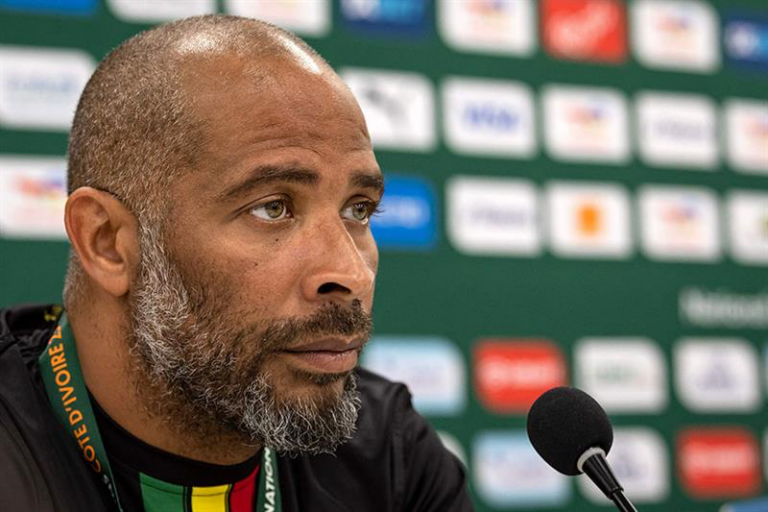
THE Nigeria Football Federation (NFF) has appointed a Malian, Eric Chelle, as the head coach of the Super Eagles.

Chelle takes over from the interim manager, Augustine Eguavoen.

The NFF announced Chelle’s appointment in a statement on Tuesday, January 7.

The appointment takes immediate effect as the new gaffer works to qualify Nigeria for the 2026 World Cup.

Chelle, 47, was recommended as the gaffer by the NFF technical and development sub-committee on January 2.

“The Executive Committee of the Nigeria Football Federation has endorsed the recommendation of its Technical and Development Sub-Committee for the appointment of Mr. Éric Sékou Chelle as head coach of Nigeria’s senior men’s national football team, Super Eagles.

“At its meeting held in Abuja on Thursday, January 2, 2025, the NFF Technical and Development Sub-Committee recommended the appointment of the former head coach of Mali’s senior men’s national team as the new head coach of the Super Eagles. This recommendation was endorsed by the NFF Executive Committee on Tuesday, January 7,” the NFF said in a statement.

The new Super Eagles coach is expected to manage the home-based Super Eagles at the 2024 African Nations Championship in Tanzania, Kenya, and Uganda, where Nigeria will compete with 17 other countries from February 1-28.

The Super Eagles B team has commenced training at the Remo Stars Stadium in Ikenne, with a strong technical crew at the helm. Led by Daniel Ogunmodede, Fidelis Ilechukwu, and experienced goalkeeper trainer Olatunji Baruwa, who played a key role in the team’s qualifying victories over Ghana, the team is intensifying preparations for the upcoming competition.

The new Super Eagles coach led Mail to a quarterfinal at the 2023 Africa Cup of Nations finals, where he lost to the hosts Ivory Coast on a 2-1 score in extra time.

Born in Cote d’Ivoire to a French father and Malian mother, Chelle was eligible to play for three countries namely France, Mali and Cote d’Ivoire; he chose Mali where he had five caps.

He had also coached clubs such as GS Consolat, FC Martigues, Boulogne, and MC Oran.

Chelle, beyond the upcoming 2024 African Nations Championship, has a challenge of getting Nigerian National team qualify for the 2026 World Cup.

The ICIR reports that Nigeria’s sluggish start to the qualification saw the team failing to win a game in four matches, as they seek to reverse the trend in the remaining six fixtures this year.

With a 2-1 defeat to Benin, draws with Lesotho, Zimbabwe and South Africa, Nigeria remains in fifth position and has just three points out of possible 12.

Rwanda, South Africa and Benin lead the group with seven points each while Lesotho trails with five points.

‘Crossing the line’ outburst: Atiku Abubakar backs Obi, attacks Tinubu, APC

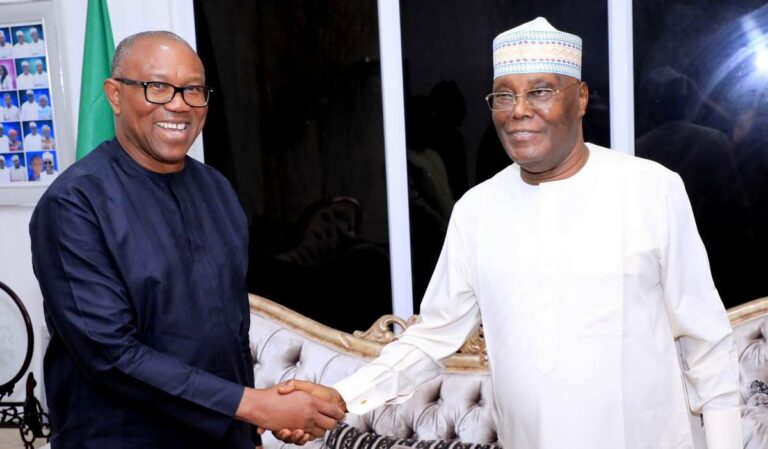
FORMER Vice President Atiku Abubakar has described recent remarks by the spokesperson of the All Progressives Congress (APC), Felix Morka, against the Labour Party presidential candidate in the 2023 election, Peter Obi, as disturbing.

Abubakar said rather than accuse Obi as a critic who had crossed the line over his constant position on the state of the nation, the President Bola Tinubu-led Federal Government was the one which deserved such an attribute.

Abubakar demanded an apology from Morka and the Tinubu’s administration which he described as authoritarian.

While featuring on Arise Television’s Sunday Interview on December 5, Morka claimed that Obi had “crossed the line” in his New Year Day criticism of President Bola Tinubu’s administration.

He accused Obi of desperately seeking to incite Nigerians into bringing down Tinubu’s government.

“Mr. Obi is shooting from the hip. He is not looking or taking an aim. He just shoots wildly like the Wild Wild West movies we used to see back in the day. He is not being rational. He’s absolutely irrational in his thinking and in his public commentaries.

“For a man who was governor for eight years and left nothing to remember in Anambra State by way of legacy or transformation. But all of a sudden, after serving as governor for eight years and not having the wisdom to change Anambra State or make Anambra the beacon or sample of governance in the country…

“I am not somebody to go on the offensive in that manner, but Mr Peter Obi has crossed the line so many times, and I think that at this point, it has come to him, whatever he gets, he needs to manage it.”

Reacting to Morka’s stance in a post on his X handle on Tuesday, January 7,  Abubakar said the APC chieftain’s response to Obi was ‘inflammatory.’

He described the comments on the TV show as a “disturbing emblem of the current administration’s unsettling strategy in addressing opposition figures.”.

Abubakar said the threat against Obi, coupled with the prolonged detention of a prominent dissent, Mahdi Shehu, and others signalled a worrisome shift towards an authoritarian governance model, where the rights of opposition voices were being suffocated.

He argued that the choice of words used by the APC’s spokesperson, “particularly the ominous suggestion that Obi has ‘crossed the line,’ reveals an alarming disdain for democratic principles.”

He added that such a language was rooted in hostility and had no place in a free society where civil discourse and engagement should reign supreme.

“A true democracy thrives on the healthy exchange of ideas, where the criticisms and contributions of opposition leaders, like Peter Obi, are seen as vital for the betterment of governance and the promotion of public accountability.

“It is not merely the right, but the solemn duty of a democratic government to listen attentively to the voices of its critics, to engage in meaningful dialogue, and to allow space for the articulation of alternative viewpoints.

“Instead, we are faced with a chilling threat that suggests Obi must ‘be ready for whatever comes his way.’ What, exactly, does Mr. Morka imply by this? It is imperative that the ruling party provides clarity on this disturbing  insinuation.” Abubakar remarked.

He further stated that the manner in which the APC spokesperson framed Obi’s calls for constructive engagement, as a “lawless Wild West scenario” was equally troubling and disparaging.

He said such “reckless and derogatory” expressions could not be tolerated. He called on the APC to issue a formal apology to Obi.

“If there is anyone who has truly ‘crossed the line,’ it is the Tinubu administration, whose continuous vilification of opposition figures as mere irritants to be crushed is a dangerous precedent,” he added.

The ICIR reports that Obi had reacted to Morka’s statements, saying he would not be silenced for speaking truth to power.

In a tweet on his official X handle, Obi asked if he crossed the line in his New Year message.

“While I have received all sorts of messages, one Mr Felix Morka has gone further to accuse me of “crossing the line” and has warned that I will face the consequences.

“I find it necessary to share this message again and urge everyone who has not seen it to watch. If I have truly crossed the line, I invite anyone to point it out, as I remain committed to upholding decorum. However, I will not be silenced in my resolve to speak truthfully, especially as our nation continues to drift toward undemocratic practices,” Obi tweeted.

He claimed the nation was increasingly transforming into an authoritarian and repressive regime, where freedom of expression was being systematically suppressed.

2024: Dangote, BUA, others earned 70% from N21.8 trn stock market gains

Disengaged staff sue CBN, demand N30bn compensation

DISENGAGED staff members of the Central Bank of Nigeria (CBN), who were laid off in a mass redundancy last year, are currently seeking redress at  the National Industrial Court of Nigeria in Abuja.

The aggrieved former staff members, in an originating summons filed on July 4, 2024, under the NICN Civil Procedure Rules 2017, raised several issues for the court to determine.

The ICIR in April last year reported the CBN commencement of gradual sack of some of its workers, which raised anxiety among its staff, as members where forcefully being exited without the mandatory 60 years retirement and violation of some its internal policies.

Recall, the apex bank had at the resumed investigative hearing on Friday, January 3, at the Federal House of Representatives said the 1,000 workers who left the bank were not forced out.

This is contrary to the latest development as the ex-staff are currently seeking legal redress following their ‘forceful’ exit.

Among other matters, the ex-CBN staff members are praying for the court to decide whether they were denied their constitutional right to a fair hearing before and after their appointments were terminated.

They claim that the CBN violated internal policies, Nigerian labour laws, and contractual rights.

The claimants—Stephen Gana, Kabiru Idris, Benedict Agbo, Peter Adeyemi, John Yisa, Eleanor Ihua, Stephen Ambore, Edom Obi, Dabo Chundung, Ekpe-Oko Roupa, Alabi Mubarak, Isa Yusuf, Quadru Ralph, Olasupo Adedokun, Dauda Yusuf, Ogidi Tolu, Levi David, Umar Kurba, Christopher Alfred, Gana Nma, Tanko Joel, Iyare Christian, Paul Iza, Alzebeokhai Esiemokhai, Pius Odunze, Isiuwe Uwadiahu, Vivienne Usoro, Imoh Francis, Ofili Lydia, Onunkwor Christopher, Adeshina Nurudeen, Bukar Ahmed, and Ajayi Omosolape—are all represented by Okwudili Abanum in a class action lawsuit.

They argue that the termination process carried out through letters titled “Reorganisational and Human Capital Restructuring” dated April 5, 2024, violated both the CBN human resources policies and procedures manual and Section 36 of the Nigerian Constitution. The claimants further argue that the process lacked the necessary consultation and fair hearing mandated by law.

They also contend that the termination letters, issued on the grounds of restructuring, were arbitrary, illegal, and unconstitutional.
In light of this, the claimants seek an order declaring their dismissal null and void.

Additionally, the claimants are requesting a restraining order to prevent the CBN from terminating their employment without following the proper procedures. They are also seeking a declaration for their immediate reinstatement and payment of salaries and benefits from the date of termination.

The suit references Article 16.4.1 of the HRPPM, which mandates consultation with the joint consultative council and adherence to fair procedures before employment actions adversely affect staff. The claimants contend that this provision was flagrantly disregarded, as they were given just three days to vacate their positions and hand over official property.

They are also seeking N30 billion in general damages for psychological distress, hardship, and reputational harm caused by the dismissal, as well as an additional N500 million to cover the cost of the suit.

During the first mention of the suit on November 20, 2024, the court urged the parties involved to attempt an amicable resolution of the matter. Justice O. A. Osaghae noted, “This is a new matter; it is mentioned for the first time. I have looked at the processes, and it is my view that parties should attempt an amicable resolution of this dispute. Accordingly, parties are encouraged, under section 20 of the NICA 2006, to attempt an amicable settlement.”

Meanwhile, the CBN, represented by a team of lawyers led by Inam Wilson (SAN), informed the court that they had filed a preliminary objection to the claimant’s suit, which was served to the claimants on November 4, 2024.

Following the defendant’s counsel’s submission, Justice Osaghae adjourned the case to January 29, 2025, for the hearing of the preliminary objection.

It is recalled that in 2024, the CBN terminated the appointments of about a thousand staff in four batches between March and May of that year.

Some laid-off staff claimed they received severance payments as low as N5,000, while others said their gratuities were absorbed entirely to offset outstanding loans.

Although the layoff was officially attributed to reorganisation and human capital restructuring, the affected staff argue that the process violated the CBN Act, which mandates board approval for significant employment decisions.

On December 4 last year, the CBN stated that its early exit package was entirely voluntary and without negative repercussions for eligible staff.

NCDC alerts Nigerians on global surge of Human Metapneumovirus cases, strengthens preparedness

THE Nigeria Centre for Disease Control and Prevention (NCDC) has warned Nigerians over a potential health threat posed by Human Metapneumovirus (HMPV), following a rise in cases of the virus in other parts of the world, including China, the United Kingdom, France, and Germany. 

The agency in a statement oon Monday, January 6, also dismissed rumours that the World Health Organization (WHO) had declared the virus a public health emergency of international concern.

The HMPV is a respiratory virus that can cause illnesses ranging from mild cold-like symptoms to severe respiratory infections, particularly in young children, older adults, and people with weakened immune systems, according to the NCDC.

The disease has also been said to trigger concerns globally due to its link to severe respiratory complications such as pneumonia and bronchitis. 

Symptoms include cough, fever, nasal congestion, and shortness of breath, with infections typically resolving within a week in healthy individuals. However, the virus can pose significant risks to vulnerable groups.  

While surveillance data from Nigeria’s National Influenza Sentinel Surveillance system has not shown an unusual rise in respiratory infections, the NCDC categorised the risk of HMPV as moderate.

The Centre added that although there was no specific antiviral treatment or vaccine for HMPV, supportive care, such as rest, hydration, and fever management, remained the primary approach to recovery.

“Nigeria operates a National Influenza Sentinel Surveillance (NISS) system, comprising sentinel sites distributed across the six geopolitical zones of the country. These sites, which include tertiary and secondary health facilities, monitor influenza-like illness (ILI) and severe acute respiratory infections (SARI). 

“As of January 6, 2025, data from this surveillance system does not indicate any unusual increase in respiratory infections, including those caused by Human Metapneumovirus (HMPV). 

“However, given the global trends in HMPV cases, the Nigeria Centre for Disease Control and Prevention (NCDC) is proactively implementing measures to strengthen the country’s preparedness and response capacity,” the statement added.

According to the Centre, laboratories in states with international airports are being equipped to diagnose HMPV, while isolation facilities are being readied to manage potential cases.  

It further noted that in Nigeria’s points of entry, authorities are conducting readiness assessments and deploying infection prevention materials to mitigate the risk of importation.

The NCDC, however, urged Nigerians to adopt preventive measures such as frequent hand washing, covering the mouth and nose while coughing or sneezing, avoiding overcrowded places, and disinfecting commonly touched surfaces. 

Vulnerable groups, including young children, older adults, and individuals with chronic illnesses, are also advised to seek prompt medical attention if symptoms arise.  

The director-general of the NCDC, Jide Idris, reassured the public of the agency’s commitment to safeguarding public health and urged everyone to remain vigilant while adhering to recommended preventive measures.

Healthcare workers were also urged to maintain strict infection prevention protocols, use PPE when attending to symptomatic patients, and report unusual increases in respiratory infections.

JAMB remits N6bn to FG out of nearly N23bn generated in 2024

0

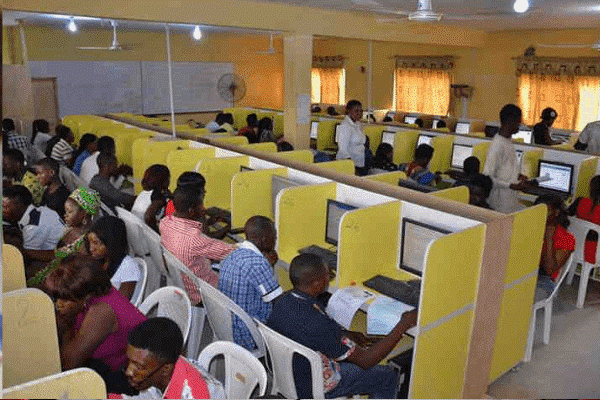
THE Joint Admissions and Matriculation Board (JAMB) remitted ₦6 billion to the Nigerian government’s treasury out of nearly N23 billion it generated in 2024. 

This was revealed in the Board’s weekly bulletin issued on Monday, January 6, by its spokesperson, Fabian Benjamin.

According to the statement, JAMB generated N22.9 billion (N22,996,653,265.25) in 2024. 

Out of this amount, it remitted N6 billion (N6,034,605,510.69) as operating surplus to the government.

In addition, the Board noted that the N1,500 reduction in the cost of the Unified Tertiary Matriculation Examination (UTME) form fees for candidates, multiplied by the number of beneficiaries, raised the total remittance value to N9,013,068,510.69.

JAMB credited the surplus to its efficient management and successful conduct of the 2024 UTME. 

The Board further noted that under the leadership of its registrar, Is-haq Oloyede, it had contributed over N50 billion to the nation’s treasury in the past seven years.

“As we reflect on 2024, it is essential to uphold our commitment to transparency by sharing our financial performance for the year. In 2024, the Board generated a total income of N22,996,653,265.25. 

“From this amount, It expended N18,198,739,362.68 towards conducting examinations (UTME), paid service providers, and covering essential expenses, including staff claims amounting to N2,119,571,022.88,” the bulletin read. 

It added that “In 2024, the Board remitted N6,034,605,510.69 to the government. When combined with the N1,500 reduction per form for candidates multiplied by the number of candidates that benefited in 2024, the total remittance by JAMB would amount to N9,013,068,510.69.”

The Board remitted N2 billion as its interim surplus for the 2023 operating year to the Federal Government.

Benjamin said in a statement that more would be remitted as its operations for the year are completed. 

The JAMB said it remitted N3.51 billion to the Federal Government as operating surplus for 2021.

 Benjamin noted in a statement that the remittance was in line with Oloyede’s commitment to prudent management of public resources.

This was as the JAMB Registrar in 2022 stated that the Board remitted no less than N50 billion to the Federal Government since 2016.

He explained that the N50 billion was the surplus remaining after covering the expenses of conducting the examination. 

He attributed the remittance to measures implemented for cost control, preventing financial leakages, and minimising corruption.

The registrar noted that the “humongous  returns” stood in contrast to the approximately N52 million which represented the Board’s total remittance over its previous 40 years.

Retiring military generals get $20,000 medical allowance, bulletproof SUVs, others

6

PRESIDENT Bola Tinubu has approved a retirement package that includes $20,000 for foreign medical treatment, bulletproof SUVs, and cooks, among other benefits, for service chiefs and generals.

The package is contained in the Harmonised Terms and Conditions of Service (HTACOS) signed by President Bola Tinubu.

The approval was announced on December 16, 2024 on social media by the Special Assistant to the President on Social Media, Dada Olusegun.

In line with the package, the vehicles will be replaced every four years and maintained by the military. They will also receive a Peugeot 508, or a similar backup vehicle.

Upon retirement, the generals will enjoy additional luxurious benefits, including domestic aides and residential guards. Retired lieutenant generals and their equivalents will also enjoy international and local medical treatment worth up to $20,000 annually as reported by Punch.

Besides, each retiring service chief will get five domestic aides, including two cooks, two stewards, and a civilian gardener, plus an aide-de-camp or security officer.

The HTCOS also includes the retention of all military uniforms and accoutrements to be worn for appropriate ceremonies.

Retiring generals will also have one aide-de-camp or security officer, one special assistant, who will be lieutenant, captain or equivalent or one personal assistant, who would be a warrant officer or equivalent.

They will each have a special assistant, three service drivers, and a service orderly, with escorts provided as needed.

They would also be allowed to retain their personal firearms, although these would be retrieved by the relevant service upon their demise.

The federal government also approved benefits for major generals and brigadier generals, including a Toyota Land Cruiser or equivalent vehicle, $15,000 for annual medical treatment, domestic staff, and residential guards.

Meanwhile, one-star officers will receive $10,000 annually for medical care, a Toyota Camry or equivalent vehicle, and have similar domestic and security arrangements.

Colonels and their equivalents would receive a Toyota Corolla or its equivalent, and free medical care within Nigeria.

Benefits for serving chief of defence staff and service chiefs are not specified, but it’s most likely they will receive significantly more.

However, this package has been criticised by the Nigerian Medical Association (NMA), the Medical and Dental Consultants Association of Nigeria (MDCAN), and the Nigerian Association of Resident Doctors (NARD).

According to Punch, the NMA president, Bala Audu, said retirement benefits given to government officials should be invested in Nigeria.

He said they should receive their medical treatment in Nigeria.

The MDCAN president, Muhammad Muhammad, called for a major overhaul of Nigeria’s healthcare system to better meet the needs of its citizens.

He said that the nation’s health system was not doing enough to provide quality care for those who needed it and that a transformation was necessary to improve health outcomes and ensure that everyone has access to the care they deserve.

According to him, the decision to provide foreign treatment for retired officers is shocking, as it implies that the local health sector may not be equipped to handle their medical needs.

Reacting, the NARD president, Tope Osundara, emphasised that medical tourism was a bane to the nation’s health sector and called for the need to address it immediately.

EFCC sacks 27 staff over fraud, misconduct

0

THE Economic and Financial Crimes Commission (EFCC) dismissed 27 of its officers in 2024 over fraudulent activities and professional misconduct.

In a statement issued on Monday by the agency’s spokesperson, Dele Oyewale, the commission disclosed that the dismissal followed recommendations from its staff disciplinary committee, which were approved by the executive chairman, Ola Olukoyede.

The statement emphasised the commission’s commitment to maintaining integrity within its ranks, with Olukoyede reaffirming the EFCC’s zero-tolerance policy for corruption.

He warned that no officer was above disciplinary measures and assured the public of thorough investigations into all allegations against EFCC personnel, including a recent claim involving $400,000 allegedly linked to a sectional head.

Olukoyede reiterated that the commission’s core values were non-negotiable and would always be upheld.

The EFCC also cautioned the public about impersonators and blackmailers exploiting the name of its executive chairman to extort money from high-profile individuals under investigation.

The statement highlighted a recent case involving two members of an alleged syndicate, Ojobo Joshua and Aliyu Hashim, who were arraigned before Jude Onwuebuzie, a judge of the Federal Capital Territory High Court in Abuja.

They were accused of contacting a former managing director of the Nigerian Ports Authority, Mohammed Bello-Koko, and demanding $1 million to secure a “soft landing” on a fabricated investigation.

The commission urged the public to remain vigilant and report such criminal elements.

The commission boasted that its chairman could not be compromised.

“Additionally, the EFCC is aware of moves being hatched in some quarters to blackmail officers of the commission through unwholesome means. Suspects being investigated for some economic and financial crimes who have failed to compromise their investigators would always clutch at any straw. Such blackmailers should not be accorded any form of attention,” part of the statement read.


Police name 50 suspected manhole thieves arrested in Abuja

0

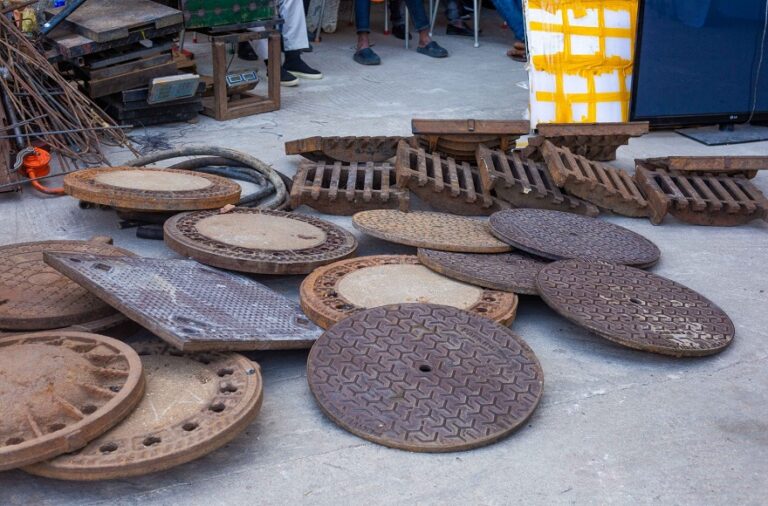
THE Federal Capital Territory (FCT) Police Command on Monday, January 6, said its officers arrested 50 suspected vandals in Abuja and recovered 25 manhole covers from them.

The police command in a statement by its spokesperson, Josephine Adeh, said operatives conducted a targeted operation, leading to the arrest of the suspects and recovery of the items.

Adeh said the police also recovered three vehicles, vandalised solar street lights, galvanised rods meant for the construction of flyovers, other tools used in vandalising these government installations, and several other exhibits.

According to the police, the exhibits were recovered at various ‘panteka’ hotpots (a place where scraps are traded) in Kabusa, Garki, Mabushi, and Wuse within the FCT.

The police said investigations revealed that the suspects operated as part of a larger network, selling stolen manhole covers to scrap dealers.

It added that this criminal activity endangered public lives by creating hazards on roads and walkways while undermining the integrity of public infrastructure.

The police said it would continue to ensure that all those responsible for criminal acts are brought to justice.

Meanwhile, the minister of the FCT, Nyesom Wike, has vowed that anyone arrested by the security agencies for alleged involvement in the removal of the manhole covers in Abuja would be made to face the full wrath of the law.

The minister also assured that the government would ensure that all buyers and users of the vandalised manhole covers and other public infrastructures would be apprehended and prosecuted for economic sabotage and putting the lives of Nigerians at risk.

The senior special assistant on public communications and new media to the minister, Lere Olayinka, disclosed this in a statement on Monday.

According to Wike, the arrest of no fewer than 50 suspects for vandalism and theft of manhole covers within the FCT and the recovery of 25 vandalized manhole covers was a demonstration of the FCT Administration’s (FCTA) zero tolerance for criminalities, particularly the vandalisation of public amenities.

The minister, who commended the security agencies for their prompt and decisive actions, described their collaborative efforts as ‘fantastic’ and a further assurance to the residents of the  FCT that their lives and properties were secured.

He also lauded Nigerians for showing patriotism in speaking against the vandalisation, adding that “safeguarding public amenities is first and foremost the duty of Nigerians, who are the owners and users of the amenities.”

Earlier today, The ICIR reported similar arrests of suspects allegedly stealing manhole covers by security agencies in the FCT.

Below is the list of 50 suspects arrested by the police

1. Bashir Usman

2. Shaibu Ibrahim

3. Sani Isah

4. Ibrahim Hassan

5. Mustapha Hassan6. Awal Nawan

7. Umar Aliyu

8. Auta Umar

9. Simon Clement

10. Datti Ibrahim

11. Mohammed Salim

12. Ibrahim Ibrahim

13. Ifeanyi-Chuckwu Emmanuel

14. Abba Ismail

15. Najib Abdul

16. Muhammed Lawal

17. Rabiu Ibrahim

18. Adamu Suleiman

19. Abdulkarim Abdullahi

20. Haruna Nasiru

21. Abdul Nai’ja

22. Josua Steven

23. Livinus Steven

24. Ismail Abdullahi

25. Munir Sada

26. Ibrahim Yahaya

27. Yahaya Musa

28. Dahiru Nasiru

29. Abdullahi Muhammed

30. Monday Barnabas

31. Hamisu Iman

32. Promise Abanonum

33. Ehieze Emeka

34. Ehieze Justice

35. Mohammed Inusa

36. Tijanni Suleiman

37. Promise James

38. Haruna Auwalu

39. Ayuba Danjuma

40. Suleiman Abu

41. Nafiu Ahmmed

42. Kamalu Junaidu

43. Zaradeen Yakubu

44. Abdulhadi Adam

45. Mohammed Ibrahim

46. Chukwu Emmanuel

47. Douglas Yahaya

48. Mohammed Lawal

49. Auwal Musa

50. Abubakar Kabiru