Home Blog Page 392

Disengaged staff sue CBN, demand N30bn compensation

DISENGAGED staff members of the Central Bank of Nigeria (CBN), who were laid off in a mass redundancy last year, are currently seeking redress at  the National Industrial Court of Nigeria in Abuja.

The aggrieved former staff members, in an originating summons filed on July 4, 2024, under the NICN Civil Procedure Rules 2017, raised several issues for the court to determine.

The ICIR in April last year reported the CBN commencement of gradual sack of some of its workers, which raised anxiety among its staff, as members where forcefully being exited without the mandatory 60 years retirement and violation of some its internal policies.

Recall, the apex bank had at the resumed investigative hearing on Friday, January 3, at the Federal House of Representatives said the 1,000 workers who left the bank were not forced out.

This is contrary to the latest development as the ex-staff are currently seeking legal redress following their ‘forceful’ exit.

Among other matters, the ex-CBN staff members are praying for the court to decide whether they were denied their constitutional right to a fair hearing before and after their appointments were terminated.

They claim that the CBN violated internal policies, Nigerian labour laws, and contractual rights.

The claimants—Stephen Gana, Kabiru Idris, Benedict Agbo, Peter Adeyemi, John Yisa, Eleanor Ihua, Stephen Ambore, Edom Obi, Dabo Chundung, Ekpe-Oko Roupa, Alabi Mubarak, Isa Yusuf, Quadru Ralph, Olasupo Adedokun, Dauda Yusuf, Ogidi Tolu, Levi David, Umar Kurba, Christopher Alfred, Gana Nma, Tanko Joel, Iyare Christian, Paul Iza, Alzebeokhai Esiemokhai, Pius Odunze, Isiuwe Uwadiahu, Vivienne Usoro, Imoh Francis, Ofili Lydia, Onunkwor Christopher, Adeshina Nurudeen, Bukar Ahmed, and Ajayi Omosolape—are all represented by Okwudili Abanum in a class action lawsuit.

They argue that the termination process carried out through letters titled “Reorganisational and Human Capital Restructuring” dated April 5, 2024, violated both the CBN human resources policies and procedures manual and Section 36 of the Nigerian Constitution. The claimants further argue that the process lacked the necessary consultation and fair hearing mandated by law.

They also contend that the termination letters, issued on the grounds of restructuring, were arbitrary, illegal, and unconstitutional.
In light of this, the claimants seek an order declaring their dismissal null and void.

Additionally, the claimants are requesting a restraining order to prevent the CBN from terminating their employment without following the proper procedures. They are also seeking a declaration for their immediate reinstatement and payment of salaries and benefits from the date of termination.

The suit references Article 16.4.1 of the HRPPM, which mandates consultation with the joint consultative council and adherence to fair procedures before employment actions adversely affect staff. The claimants contend that this provision was flagrantly disregarded, as they were given just three days to vacate their positions and hand over official property.

They are also seeking N30 billion in general damages for psychological distress, hardship, and reputational harm caused by the dismissal, as well as an additional N500 million to cover the cost of the suit.

During the first mention of the suit on November 20, 2024, the court urged the parties involved to attempt an amicable resolution of the matter. Justice O. A. Osaghae noted, “This is a new matter; it is mentioned for the first time. I have looked at the processes, and it is my view that parties should attempt an amicable resolution of this dispute. Accordingly, parties are encouraged, under section 20 of the NICA 2006, to attempt an amicable settlement.”

Meanwhile, the CBN, represented by a team of lawyers led by Inam Wilson (SAN), informed the court that they had filed a preliminary objection to the claimant’s suit, which was served to the claimants on November 4, 2024.

Following the defendant’s counsel’s submission, Justice Osaghae adjourned the case to January 29, 2025, for the hearing of the preliminary objection.

It is recalled that in 2024, the CBN terminated the appointments of about a thousand staff in four batches between March and May of that year.

Some laid-off staff claimed they received severance payments as low as N5,000, while others said their gratuities were absorbed entirely to offset outstanding loans.

Although the layoff was officially attributed to reorganisation and human capital restructuring, the affected staff argue that the process violated the CBN Act, which mandates board approval for significant employment decisions.

On December 4 last year, the CBN stated that its early exit package was entirely voluntary and without negative repercussions for eligible staff.

NCDC alerts Nigerians on global surge of Human Metapneumovirus cases, strengthens preparedness

THE Nigeria Centre for Disease Control and Prevention (NCDC) has warned Nigerians over a potential health threat posed by Human Metapneumovirus (HMPV), following a rise in cases of the virus in other parts of the world, including China, the United Kingdom, France, and Germany. 

The agency in a statement oon Monday, January 6, also dismissed rumours that the World Health Organization (WHO) had declared the virus a public health emergency of international concern.

The HMPV is a respiratory virus that can cause illnesses ranging from mild cold-like symptoms to severe respiratory infections, particularly in young children, older adults, and people with weakened immune systems, according to the NCDC.

The disease has also been said to trigger concerns globally due to its link to severe respiratory complications such as pneumonia and bronchitis. 

Symptoms include cough, fever, nasal congestion, and shortness of breath, with infections typically resolving within a week in healthy individuals. However, the virus can pose significant risks to vulnerable groups.  

While surveillance data from Nigeria’s National Influenza Sentinel Surveillance system has not shown an unusual rise in respiratory infections, the NCDC categorised the risk of HMPV as moderate.

The Centre added that although there was no specific antiviral treatment or vaccine for HMPV, supportive care, such as rest, hydration, and fever management, remained the primary approach to recovery.

“Nigeria operates a National Influenza Sentinel Surveillance (NISS) system, comprising sentinel sites distributed across the six geopolitical zones of the country. These sites, which include tertiary and secondary health facilities, monitor influenza-like illness (ILI) and severe acute respiratory infections (SARI). 

“As of January 6, 2025, data from this surveillance system does not indicate any unusual increase in respiratory infections, including those caused by Human Metapneumovirus (HMPV). 

“However, given the global trends in HMPV cases, the Nigeria Centre for Disease Control and Prevention (NCDC) is proactively implementing measures to strengthen the country’s preparedness and response capacity,” the statement added.

According to the Centre, laboratories in states with international airports are being equipped to diagnose HMPV, while isolation facilities are being readied to manage potential cases.  

It further noted that in Nigeria’s points of entry, authorities are conducting readiness assessments and deploying infection prevention materials to mitigate the risk of importation.

The NCDC, however, urged Nigerians to adopt preventive measures such as frequent hand washing, covering the mouth and nose while coughing or sneezing, avoiding overcrowded places, and disinfecting commonly touched surfaces. 

Vulnerable groups, including young children, older adults, and individuals with chronic illnesses, are also advised to seek prompt medical attention if symptoms arise.  

The director-general of the NCDC, Jide Idris, reassured the public of the agency’s commitment to safeguarding public health and urged everyone to remain vigilant while adhering to recommended preventive measures.

Healthcare workers were also urged to maintain strict infection prevention protocols, use PPE when attending to symptomatic patients, and report unusual increases in respiratory infections.

JAMB remits N6bn to FG out of nearly N23bn generated in 2024

0

THE Joint Admissions and Matriculation Board (JAMB) remitted ₦6 billion to the Nigerian government’s treasury out of nearly N23 billion it generated in 2024. 

This was revealed in the Board’s weekly bulletin issued on Monday, January 6, by its spokesperson, Fabian Benjamin.

According to the statement, JAMB generated N22.9 billion (N22,996,653,265.25) in 2024. 

Out of this amount, it remitted N6 billion (N6,034,605,510.69) as operating surplus to the government.

In addition, the Board noted that the N1,500 reduction in the cost of the Unified Tertiary Matriculation Examination (UTME) form fees for candidates, multiplied by the number of beneficiaries, raised the total remittance value to N9,013,068,510.69.

JAMB credited the surplus to its efficient management and successful conduct of the 2024 UTME. 

The Board further noted that under the leadership of its registrar, Is-haq Oloyede, it had contributed over N50 billion to the nation’s treasury in the past seven years.

“As we reflect on 2024, it is essential to uphold our commitment to transparency by sharing our financial performance for the year. In 2024, the Board generated a total income of N22,996,653,265.25. 

“From this amount, It expended N18,198,739,362.68 towards conducting examinations (UTME), paid service providers, and covering essential expenses, including staff claims amounting to N2,119,571,022.88,” the bulletin read. 

It added that “In 2024, the Board remitted N6,034,605,510.69 to the government. When combined with the N1,500 reduction per form for candidates multiplied by the number of candidates that benefited in 2024, the total remittance by JAMB would amount to N9,013,068,510.69.”

The Board remitted N2 billion as its interim surplus for the 2023 operating year to the Federal Government.

Benjamin said in a statement that more would be remitted as its operations for the year are completed. 

The JAMB said it remitted N3.51 billion to the Federal Government as operating surplus for 2021.

 Benjamin noted in a statement that the remittance was in line with Oloyede’s commitment to prudent management of public resources.

This was as the JAMB Registrar in 2022 stated that the Board remitted no less than N50 billion to the Federal Government since 2016.

He explained that the N50 billion was the surplus remaining after covering the expenses of conducting the examination. 

He attributed the remittance to measures implemented for cost control, preventing financial leakages, and minimising corruption.

The registrar noted that the “humongous  returns” stood in contrast to the approximately N52 million which represented the Board’s total remittance over its previous 40 years.

Retiring military generals get $20,000 medical allowance, bulletproof SUVs, others

6

PRESIDENT Bola Tinubu has approved a retirement package that includes $20,000 for foreign medical treatment, bulletproof SUVs, and cooks, among other benefits, for service chiefs and generals.

The package is contained in the Harmonised Terms and Conditions of Service (HTACOS) signed by President Bola Tinubu.

The approval was announced on December 16, 2024 on social media by the Special Assistant to the President on Social Media, Dada Olusegun.

In line with the package, the vehicles will be replaced every four years and maintained by the military. They will also receive a Peugeot 508, or a similar backup vehicle.

Upon retirement, the generals will enjoy additional luxurious benefits, including domestic aides and residential guards. Retired lieutenant generals and their equivalents will also enjoy international and local medical treatment worth up to $20,000 annually as reported by Punch.

Besides, each retiring service chief will get five domestic aides, including two cooks, two stewards, and a civilian gardener, plus an aide-de-camp or security officer.

The HTCOS also includes the retention of all military uniforms and accoutrements to be worn for appropriate ceremonies.

Retiring generals will also have one aide-de-camp or security officer, one special assistant, who will be lieutenant, captain or equivalent or one personal assistant, who would be a warrant officer or equivalent.

They will each have a special assistant, three service drivers, and a service orderly, with escorts provided as needed.

They would also be allowed to retain their personal firearms, although these would be retrieved by the relevant service upon their demise.

The federal government also approved benefits for major generals and brigadier generals, including a Toyota Land Cruiser or equivalent vehicle, $15,000 for annual medical treatment, domestic staff, and residential guards.

Meanwhile, one-star officers will receive $10,000 annually for medical care, a Toyota Camry or equivalent vehicle, and have similar domestic and security arrangements.

Colonels and their equivalents would receive a Toyota Corolla or its equivalent, and free medical care within Nigeria.

Benefits for serving chief of defence staff and service chiefs are not specified, but it’s most likely they will receive significantly more.

However, this package has been criticised by the Nigerian Medical Association (NMA), the Medical and Dental Consultants Association of Nigeria (MDCAN), and the Nigerian Association of Resident Doctors (NARD).

According to Punch, the NMA president, Bala Audu, said retirement benefits given to government officials should be invested in Nigeria.

He said they should receive their medical treatment in Nigeria.

The MDCAN president, Muhammad Muhammad, called for a major overhaul of Nigeria’s healthcare system to better meet the needs of its citizens.

He said that the nation’s health system was not doing enough to provide quality care for those who needed it and that a transformation was necessary to improve health outcomes and ensure that everyone has access to the care they deserve.

According to him, the decision to provide foreign treatment for retired officers is shocking, as it implies that the local health sector may not be equipped to handle their medical needs.

Reacting, the NARD president, Tope Osundara, emphasised that medical tourism was a bane to the nation’s health sector and called for the need to address it immediately.

EFCC sacks 27 staff over fraud, misconduct

0

THE Economic and Financial Crimes Commission (EFCC) dismissed 27 of its officers in 2024 over fraudulent activities and professional misconduct.

In a statement issued on Monday by the agency’s spokesperson, Dele Oyewale, the commission disclosed that the dismissal followed recommendations from its staff disciplinary committee, which were approved by the executive chairman, Ola Olukoyede.

The statement emphasised the commission’s commitment to maintaining integrity within its ranks, with Olukoyede reaffirming the EFCC’s zero-tolerance policy for corruption.

He warned that no officer was above disciplinary measures and assured the public of thorough investigations into all allegations against EFCC personnel, including a recent claim involving $400,000 allegedly linked to a sectional head.

Olukoyede reiterated that the commission’s core values were non-negotiable and would always be upheld.

The EFCC also cautioned the public about impersonators and blackmailers exploiting the name of its executive chairman to extort money from high-profile individuals under investigation.

The statement highlighted a recent case involving two members of an alleged syndicate, Ojobo Joshua and Aliyu Hashim, who were arraigned before Jude Onwuebuzie, a judge of the Federal Capital Territory High Court in Abuja.

They were accused of contacting a former managing director of the Nigerian Ports Authority, Mohammed Bello-Koko, and demanding $1 million to secure a “soft landing” on a fabricated investigation.

The commission urged the public to remain vigilant and report such criminal elements.

The commission boasted that its chairman could not be compromised.

“Additionally, the EFCC is aware of moves being hatched in some quarters to blackmail officers of the commission through unwholesome means. Suspects being investigated for some economic and financial crimes who have failed to compromise their investigators would always clutch at any straw. Such blackmailers should not be accorded any form of attention,” part of the statement read.


Police name 50 suspected manhole thieves arrested in Abuja

0

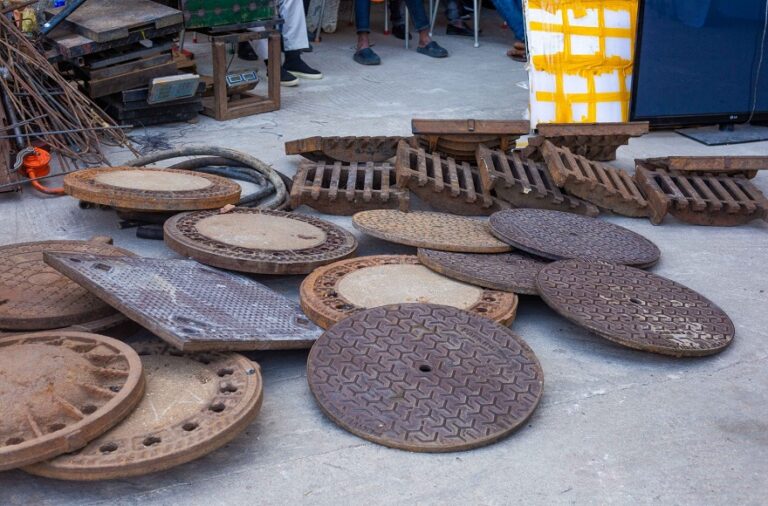
THE Federal Capital Territory (FCT) Police Command on Monday, January 6, said its officers arrested 50 suspected vandals in Abuja and recovered 25 manhole covers from them.

The police command in a statement by its spokesperson, Josephine Adeh, said operatives conducted a targeted operation, leading to the arrest of the suspects and recovery of the items.

Adeh said the police also recovered three vehicles, vandalised solar street lights, galvanised rods meant for the construction of flyovers, other tools used in vandalising these government installations, and several other exhibits.

According to the police, the exhibits were recovered at various ‘panteka’ hotpots (a place where scraps are traded) in Kabusa, Garki, Mabushi, and Wuse within the FCT.

The police said investigations revealed that the suspects operated as part of a larger network, selling stolen manhole covers to scrap dealers.

It added that this criminal activity endangered public lives by creating hazards on roads and walkways while undermining the integrity of public infrastructure.

The police said it would continue to ensure that all those responsible for criminal acts are brought to justice.

Meanwhile, the minister of the FCT, Nyesom Wike, has vowed that anyone arrested by the security agencies for alleged involvement in the removal of the manhole covers in Abuja would be made to face the full wrath of the law.

The minister also assured that the government would ensure that all buyers and users of the vandalised manhole covers and other public infrastructures would be apprehended and prosecuted for economic sabotage and putting the lives of Nigerians at risk.

The senior special assistant on public communications and new media to the minister, Lere Olayinka, disclosed this in a statement on Monday.

According to Wike, the arrest of no fewer than 50 suspects for vandalism and theft of manhole covers within the FCT and the recovery of 25 vandalized manhole covers was a demonstration of the FCT Administration’s (FCTA) zero tolerance for criminalities, particularly the vandalisation of public amenities.

The minister, who commended the security agencies for their prompt and decisive actions, described their collaborative efforts as ‘fantastic’ and a further assurance to the residents of the  FCT that their lives and properties were secured.

He also lauded Nigerians for showing patriotism in speaking against the vandalisation, adding that “safeguarding public amenities is first and foremost the duty of Nigerians, who are the owners and users of the amenities.”

Earlier today, The ICIR reported similar arrests of suspects allegedly stealing manhole covers by security agencies in the FCT.

Below is the list of 50 suspects arrested by the police

1. Bashir Usman

2. Shaibu Ibrahim

3. Sani Isah

4. Ibrahim Hassan

5. Mustapha Hassan6. Awal Nawan

7. Umar Aliyu

8. Auta Umar

9. Simon Clement

10. Datti Ibrahim

11. Mohammed Salim

12. Ibrahim Ibrahim

13. Ifeanyi-Chuckwu Emmanuel

14. Abba Ismail

15. Najib Abdul

16. Muhammed Lawal

17. Rabiu Ibrahim

18. Adamu Suleiman

19. Abdulkarim Abdullahi

20. Haruna Nasiru

21. Abdul Nai’ja

22. Josua Steven

23. Livinus Steven

24. Ismail Abdullahi

25. Munir Sada

26. Ibrahim Yahaya

27. Yahaya Musa

28. Dahiru Nasiru

29. Abdullahi Muhammed

30. Monday Barnabas

31. Hamisu Iman

32. Promise Abanonum

33. Ehieze Emeka

34. Ehieze Justice

35. Mohammed Inusa

36. Tijanni Suleiman

37. Promise James

38. Haruna Auwalu

39. Ayuba Danjuma

40. Suleiman Abu

41. Nafiu Ahmmed

42. Kamalu Junaidu

43. Zaradeen Yakubu

44. Abdulhadi Adam

45. Mohammed Ibrahim

46. Chukwu Emmanuel

47. Douglas Yahaya

48. Mohammed Lawal

49. Auwal Musa

50. Abubakar Kabiru

UPDATED: Police confirm Abuja school bomb explosion, 2 dead, 2 injured

0

THE Federal Capital Territory (FCT) Police Command has confirmed a bomb explosion at the Tsangagyar Sani Uthman Islamiyya School in Kuchibuyi village, Bwari Area Council, Abuja, which left two people dead and two others injured.

The explosion, which occurred on January 6, at approximately 11:00 am, involved an improvised explosive device (IED).

According to a statement by the FCT Police Command’s public relations officer, Josephine Adeh, three men from Katsina had visited the school’s proprietor, Adamu Ashimu.

She noted that the men were tampering with the device on the school veranda when it detonated, killing two of them instantly.

Adeh further stated that a female trader and a third visitor were critically injured and were receiving treatment under police guard.

“Preliminary investigations revealed that three men from Katsina had visited the owner of the Islamic school, Mallam Adamu Ashimu. The three visitors are suspected of having brought the explosive device with them. Tragically, two of the men died in the explosion while tampering with the improvised explosive device (IED), on the school veranda, while the third man and a female trader sustained severe injuries and are currently receiving treatment under police guard.”

“The FCT Bomb Squad has confirmed that it was an IED explosion, as remnants of the device have been recovered,” the statement read.

The command added that Ashimu has been taken into police custody for questioning, with investigations ongoing to determine the full circumstances surrounding the incident.

Earlier, The ICIR reported the explosion, noting initial accounts, according to a media report, that a student died and four others were injured in the explosion.

However, the police preliminary investigation revealed that the fatalities were among the visitors who brought the explosive device to the school.

The police noted that while responding to a distress call from the Sarki of Kuchibuyi, they deployed operatives, including the explosive ordnance disposal (EOD) team, to secure the area and commence investigations.

The school has since been cordoned off for safety purposes.

The FCT Commissioner of Police, Olatunji Disu, has called on residents to remain vigilant and report any suspicious activities or objects to the authorities. He also advised the public to avoid handling any items resembling explosive devices and to prioritise safety.

Watch out for these disinformation trends in 2025!

Disinformation has long plagued Nigeria’s information landscape, influencing public perception, deepening social divides, and undermining trust in both public and private institutions.

Its effects have been far-reaching, ranging from vaccine hesitancy fueled by vaccine hoaxes to election-related disinformation that erodes confidence in democracy among others. Over the years, state and non-state actors have deployed disinformation campaigns to exploit Nigeria’s vulnerabilities thus leading to low media literacy, heightening ethnic and religious tensions, and an increasing reliance on social media for news.

As we enter 2025, these challenges are set to intensify, with emerging trends threatening to exacerbate existing issues while introducing new complexities. From the weaponization of artificial intelligence (AI) to the rise of influence-for-hire campaigns, the stakes are higher than ever.

The following consists of disinformation trends that may likely shape Nigeria’s socio-political, economic, and cultural landscape this year.

1. Vaccine hesitancy and herbal remedies to health problems

In Nigeria, false claims about vaccines, cures, and diseases will likely persist. Fake narratives about diseases like cholera, Lassa fever, or new COVID-19 variants could thrive in rural areas. Vaccine hesitancy fueled by rumors, particularly among vulnerable populations, will hinder public health campaigns. Unverified herbal remedies promoted as “miracle cures” by influencers and traditional leaders will continue to challenge public health efforts.

2. Changing climate

Climate change is one of the greatest challenges facing our world today, resulting from long-term shifts in temperatures and weather patterns.

While these changes can occur naturally, such as through variations in solar activity or significant volcanic eruptions, the United Nations states that since the 1800s, human activities have been the primary driver of climate change. This is largely due to the burning of fossil fuels like coal, oil, and gas, as well as widespread deforestation.

According to the Intergovernmental Panel on Climate Change (IPCC), climate misinformation refers to the spread of inaccurate information about climate change that can arise from human error, while climate disinformation is driven by a deliberate intent to spread knowingly false information. Regardless of intent, “scientifically misleading information” can have “negative implications for climate policy”,

Recall that the 2024 Global Risks Report by the World Economic Forum (WEForum) ranked misinformation and disinformation (on all topics) as the biggest short-term risk to human society, and extreme weather events as the top long-term risk, which implies that obscuring the facts about climate change can be extremely harmful. This is compounded by false information being significantly more likely to be reshared than the truth on social media platforms.

3. Anambra governorship poll

The Anambra state gubernatorial election is expected to hold on November 8, 2025. Like what we observed in Edo and Ondo off-cycle governorship elections, false claims about voter suppression, rigged elections, or fabricated results will be a major trend in the election.

Social media may amplify fake announcements of results, confusing voters and undermining trust in the electoral process. This, among others, is part of the election-related disinformation that Nigerians may have to grapple with, as such spreads faster from online to offline during election period.

4. Economic-related disinformation

As economic hardship persists in Nigeria due to rising inflation, among others, narratives about government programmes such as grain distribution (including rice), fuel subsidy palliative, job creation schemes or other palliative initiatives may likely increase in 2025.

Scams disguised as official initiatives targeting unemployed youth or rural dwellers will exploit economic hardship, further eroding trust in government efforts at reducing the hardship and increasing the purchasing power of the populace.

5. Rise of AI-generated disinformation

AI tools will be increasingly used to create hyper-realistic deepfakes, manipulated images, and fake audio. For example, fake videos of political leaders making controversial statements could circulate widely, especially during election.

In a low-digital-literacy environment like Nigeria, people may find it difficult to distinguish real content from AI-generated visuals and audio, exacerbating mistrust and creating confusion.

6. Influence-for-hire campaigns

Paid influencers, bloggers and social media personalities might likely be lobbied and engaged to promote disinformation. Politicians, brands, and even foreign entities may hire these influencers to push propaganda, suppress dissent, or discredit opponents, as topical events unfold in the year.

For instance, in February 2024, The FactCheckHub published an analysis on a disinformation campaign orchestrated and launched online by some individuals aimed at pressurizing Nigerian authorities to reinstate the then suspended Humanitarian Affairs minister, Betta Edu. She was eventually sacked and replaced with Nentawe Yilwatda during a major cabinet reshuffle by President Bola Ahmed Tinubu in October 2024.

In Nigeria’s highly polarized political climate, these campaigns may deepen divisions and skew public opinion.

7. Foreign influence and information manipulation

Foreign state and non-state actors may exploit Nigeria’s vulnerabilities by spreading disinformation to destabilize the country or achieve geo-political goals.

Similarly, foreign actors might amplify divisive narratives around insecurity, ethnic or religious conflicts to manipulate public perception. For instance, the recent case where the Nigerien military leader, General Abdourahamane Tchiani, raised fresh terrorism allegations against the Nigerian government.

Tchiani, in an interview with Radio-Télévision du Niger, the country’s state media, had accused President Tinubu of conniving with France to destabilise Niger Republic. But the Nigerian government has countered the claims, saying they were baseless.

Other areas where foreign actors might target Nigerians with their false narratives include international aid, trade and bilateral agreements.

8. Silencing women and girl-child

Gendered disinformation is sometimes regarded as a subset of misogynistic abuse and violence against women that uses false or misleading gender and sex-based narratives, often with some degree of coordination, to deter women and girls from participating in public sphere.

In 2025, actors may strategically use gendered disinformation to silence women, discourage them from online political discourse, and shape public perceptions toward gender and the role of women in democracies.

They may also target girl-child of school age from accessing education or young women from getting some kind of white or blue-collar jobs citing some ethno-religious beliefs, among others.

9. Ethno-religious and communal hostilities

Targeted false narratives about attacks on religious or ethnic communities may likely rise, particularly in conflict-prone Nigerian states such as Plateau, Kaduna and Benue. Such disinformation campaigns could stoke communal and national tensions, incite violence, and derail peace-building efforts.

The FactCheckHub has over the years observed that foreign actors also get involved in spreading disinformation campaigns during hostilities either between farmers and herders, settlers and indigenes, and Hausa Vs Igbos or Yoruba etc.

10. Conflict-related coordinated campaigns

Nigeria is battling with various forms insecurity ranging from banditry, terrorism and kidnapping for ransom, among others. It is pertinent to note that these challenges have persisted over the years.

But this year, coordinated false campaigns about kidnappings, communal clashes, terrorist and separatist activities may continue to circulate, particularly online and offline in volatile regions like the Southeastern, Northeastern and Northwestern regions of Nigeria.

These exaggerated or false narratives could cause unnecessary fear, displacement, and even overburden the security agencies, as the Nigerian government vows to tackle these insecurities in 2025.

Kano governor accepts commissioner’s resignation days after rejigging cabinet

THE Kano State Governor Abba Kabir Yusuf has accepted the resignation of the commissioner for project monitoring and evaluation, Muhammad Diggol, with immediate effect.

This was disclosed in a statement issued by the governor’s spokesperson, Sanusi Bature Tofa, on Sunday, January 5.

Diggol was appointed as commissioner for transportation at the inception of Yusuf’s administration in 2023.

He was later reassigned to the Ministry of Project Monitoring and Evaluation, where he served until his resignation on Sunday.

The governor appreciated Diggol for his selfless service, unwavering commitment, dedication, and exemplary work ethic during his tenure as a member of the State Executive Council (SEC).

The governor also extended his best wishes to Diggol in his future endeavours. However, no reason was offered for Diggol’s resignation.

The ICIR reported that the governor, on Thursday, December 12, sacked the secretary to the state government (SSG), Abdullahi Baffa Bichi, and scrapped the Office of the Chief of Staff (COS), occupied by Shehu Wada Sagagi.

In a statement by the governor’s spokesperson, Dawakin-Tofa, the governor said the first major rejig of his cabinet took immediate effect, adding that the decision was to effect a pragmatic political realignment of his administration.

Five commissioners were sacked by the governor in the cabinet shake-up. They include the commissioner for finance, Ibrahim Jibril Fagge; culture and tourism; Ladidi Ibrahim Garko; information and internal affairs; Baba Halilu Dantiye; special duties; Shehu Aliyu Yammedi; and rural community development; Abbas Sani Abbas.

According to Dawakin Tofa, the governor also reassigned some commissioners “to enhance administrative performance and political retooling.”