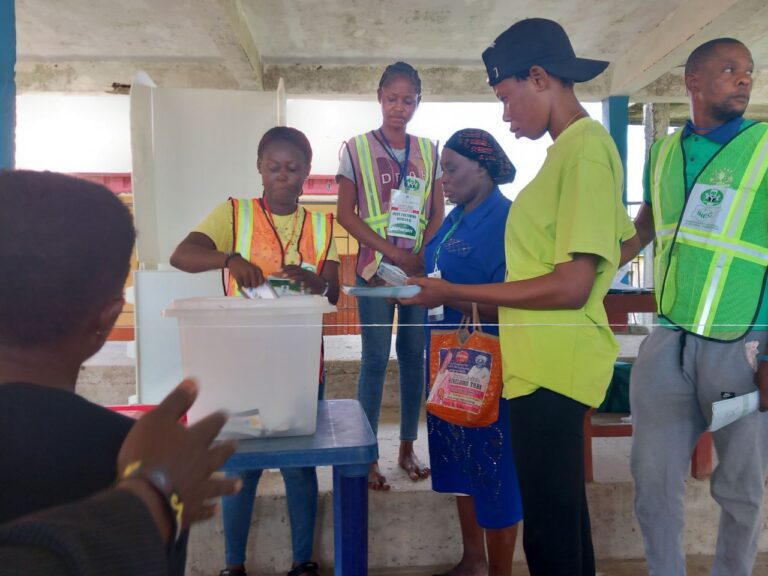
PRESIDENT Bola Tinubu has appealed to candidates dissatisfied with the outcome of the Ondo State governorship election to channel their grievances through the court.
This followed the declaration of the incumbent Governor Lucky Aiyedatiwa of the All Progressives Congress (APC) by the Independent National Electoral Commission (INEC) as the election winner.
In a statement on Sunday, November 17, Tinubu’s special adviser on information and strategy, Bayo Onanuga, said the poll which featured candidates from 17 political parties was competitive and urged all stakeholders to respect the democratic process.
“The President urges candidates dissatisfied with the outcome of the election to explore the opportunities provided by the judicial system to seek redress on areas of conflict,” part of the statement read.
Earlier today, The ICIR reported that INEC declared Aiyedatiwa the election winner.
Aiyedatiwa polled 366,781 votes to defeat his main contender, the Peoples Democratic Party (PDP) candidate, Agboola Ajayi, who garnered 117,845 votes.
He scored a landslide victory in all the 18 local government areas (LGAs).
Announcing the final result on Sunday at the INEC Collation Centre in Akure, the state capital, the state resident electoral commissioner, Oluwatoyin Babalola, declared that Aiyedatiwa was returned elected.
Reacting to Aiyedatiwa’s victory, Tinubu while praising the peaceful conduct of the election, attributed its success to the maturity demonstrated by political actors and the electorate.
He also commended INEC for its efficient organisation, particularly the timely upload of more than 98 per cent of election results on the same day.
According to him, the election has proven INEC’s capacity to conduct credible polls.
The President lauded the professionalism displayed by the Nigerian Police Force, National Civil Defence Corps, Federal Road Safety Corps, National Youth Service Corps, the military, and other security agencies in ensuring a secure voting environment.
“President Tinubu believes the Ondo State election was another litmus test of the capacity of the Independent National Electoral Commission, affirming that the electoral body justified the confidence of the people with early preparations, deployment of staff and materials, and handling of the electoral process.”
PRESIDENT Bola Tinubu will depart Nigeria for Rio de Janeiro, Brazil, later today Sunday, November 17, to attend the 19th G20 Leaders’ Summit.
The event, scheduled for November 18 and 19, will convene heads of state from the world’s 20 largest economies, alongside representatives from the African Union, European Union, and multilateral financial institutions.
According to a statement by the special adviser to the President on information and strategy, Bayo Onanuga, on Sunday, November 17, the Nigerian President’s attendance is at the invitation of Brazil’s President and current G20 Chair, Luiz Inácio Lula da Silva.
Accompanying the President are government officials, including foreign affairs minister, Yusuf Tuggar, minister of livestock development, Idi Mukhtar Maiha, minister of art, tourism, culture and creativity, Hannatu Musawa, minister of state for agriculture and food security, Aliyu Sabi Abdullahi, and the director-general of the National Intelligence Agency, Mohammed Mohammed.
Onanuga noted that the summit, themed *“Building a Just World and a Sustainable Planet,” will focus on pressing global challenges, including poverty alleviation, hunger eradication, institutional reform, sustainable development, and energy transition.
“Nigeria has always strongly advocated for a reform of the global governing institutions and often presented its impressive credentials as a strong contender for a permanent seat on the United Nations Security Council.
“President Tinubu is also expected to hold bilateral meetings on the sidelines of the summit in advancement of Nigeria’s socio-economic reforms,” the statement added.
The President’s latest trip is coming just a few days after he returned from the Kingdom of Saudi Arabia where he attended a Joint Arab-Islamic Summit.
The President, who returned on Tuesday 12, condemned the ongoing violence in the region and urged immediate action to alleviate the humanitarian crisis associated with the violence at the summit.
He also stressed that peaceful coexistence between Israelis and Palestinians was the only viable path forward.
Tinubu emphasised the need to prioritise civilian lives, urging all parties involved to respect the principles of proportionality and the protection of non-combatants in accordance with international humanitarian law.
THE Independent National Electoral Commission (INEC) has declared the All Progressives Congress (APC) Lucky Aiyedatiwa, the winner in the Saturday, November 16, Ondo State governorship poll.
Aiyedatiwa polled 366,781 votes to defeat his main contender, the Peoples Democratic Party (PDP) candidate, Agboola Ajayi, who garnered 117,845 votes.
He recorded a landslide victory in all the 18 local government areas (LGAs).
Announcing the final result on Sunday, November 17 at the INEC Collation Centre in Akure, Ondo State, the state Resident Electoral Commissioner, Oluwatoyin Babalola, declared that Aiyedatiwa was returned elected.
Aiyedatiwa currently occupies the Alagbaka House as incumbent governor following the death of his principal, Rotimi Akeredolu.
He took over in December 2023, and with his re-election, he will serve for the next four years.
Amid the landslide victory, however, voters’ turnout appeared low relative to the number of registered voters.
INEC’s data showed that 2,053,061 eligible voters registered for permanent voter cards (PVCs) but only 1,757,205 of those who registered collected the PVCs.
This means that 85.6 per cent of registered voters were eligible to participate in the election, conducted across 3,933 polling units in the state’s 18 LGAs.
The Saturday election was also marred by widespread reports of biometric voter accreditation system (BVAS) malfunctions and vote-buying in various polling units across the state.
The ICIR earlier reported that voters in several areas, including Okitipupa, and Ondo South, expressed frustration over delays caused by faulty BVAS.
In some polling units, the devices failed to accredit voters promptly, leading to long queues and complaints about disenfranchisement.
At Obe Nla in Ward 4, Ilaje LGA, Ondo South, The ICIR observed how BVAS malfunctions dampened the voting process.
In Ondo West LGA) voter inducement was captured in a video by The ICIR, showing individuals distributing money to voters at 18, Omolare Street, near Polling Units 06 and 05 in Ward 7.
The organisation gathered that voters were offered N5,000, though the political party involved could not be verified.
After casting his vote on Saturday, Aiyedatiwa expressed confidence in his victory, hinging it on the work he had done in the last 10 months since assuming office as the governor of the state.
“We traversed the entire 18 local governments; and visited communities all across,” he said.
Aiyedatiwa and the candidate of the People’s Democratic Party (PDP), Agboola Ajayi, are both from the southern senatorial region of the state.
The ICIR reports that Ajayi was deputy to late Governor Rotimi Akeredolu between 2017 and 2021.
Following an unresolved feud between him and Akeredolu, the late governor replaced him with Aiyedatiwa while recontesting for the governorship office in 2020.
Aiyedatiwa succeeded the late governor on December 27, 2023, after his principal passed on after a prolonged illness.
Meanwhile, Ajayi said INEC poorly conducted the election after he cast his vote on Saturday.
It remains unclear when filing this report if he will accept the election results.
Ajayi voted at Apoi Ward 11, unit 004, at RCM Idumado Quarters, Kiribo, in his hometown, in Ese-Odo LGA of the state.
He slammed INEC for ‘failing’ to properly organise the election.
He cited widespread complaints about the late arrival of election materials and malfunctioning biometric voter accreditation system (BVAS) machines.
He also claimed that the election process was intentionally being sabotaged.
“All of us here have seen what’s going on. A lot of complaints here and there. If INEC cannot successfully organise an election in just one state, then you must know that you’re running into trouble,” Ajayi stated.
He added, “Even I, contesting in the election, had to wait up to 10 minutes before I could be allowed to cast my vote. A lot of women will go back to their houses out of frustration.”
Ajayi further accused the INEC and the resident electoral commissioner in the state (Babalola) of deliberate attempts to disrupt the voting process.
“I think it’s deliberate on the part of INEC and REC. We have said severally that we don’t trust Oluwatoyin Babalola. This woman cannot be fair. I’ve made a series of calls today, and people are complaining about vote-buying, and BVAS machines are not working. Even if they were rigging tools for them, they’re not even working.”
THE postponement of the deadline for the enforcement of the European Union Deforestation Regulation (EUDR) came as a relief to Nigeria and other affected countries. However, not a few cocoa farmers in Nigeria are still in panic mode. Read the first part of this report HERE
State governments step up investments amid extension
Findings show that despite the threat, state governments and other stakeholders in the industry continue to invest in the sector. For instance, the Osun State government is putting together a funding scheme that will involve the Bank of Industry, among others, to assist cocoa farmers and project the contribution of the state to the sector.
In terms of investment in cocoa production, the Cross River State appears to stand out as one sub-national government that has taken bold steps in improving participation. Though not totally unmindful of the EUDR threat, the state government recently kick-started a process of establishing new cocoa estates.
On June 13, 2024, Johnson Ebokpo, the commissioner for agriculture and irrigation in Cross River State, hosted a meeting of stakeholders in the cocoa industry in Calabar, to brief them about the plan of the government to establish cocoa estates in six local government areas of the state.
The commissioner listed the areas earmarked for the proposed estates as: Akamkpa, Akpabuyo, Bekwara, Odukpani, Obubra, and Ikom local government areas. These, according to him, are places where land suitability tests, community engagements and other procedures had been done.
He said the government was anticipating a public-private partnership model, where government would collaborate with the communities and private sector investors to develop the proposed estates.
He said, the current administration in the state deserves commendation in this regard, as it is continuing with the programme started by those before it.
Hurdles
However, it appears the state government may also have to do more to encourage the farmers.
The administrative secretary of Cocoa Association of Nigeria (CAN) Egim Etta Tawo, said, “There are no roads leading into the farms. The government has about four cocoa estates in this place which it leases out. But there are some years that farms were abandoned because of inability to manage them.”
The fear is that if the challenges are not addressed holistically, whatever investment that is put in the sector may end up in the drain. The challenges of a dearth of government support and logistics would have been compounded by the rejection of the produce had the EU not extended the initial deadline.
Yet, the looming danger then did not discourage efforts for the increase of cocoa production and new converts into the trade, even as there appears to be healthy competition between Cross River and Ondo States over which of them is the highest producer of cocoa in the country. Cocoa farmers in Cross River claim that because the produce is taken out of the state to Ondo and Lagos for processing before being exported, Cross River loses its cocoa identity, and the production gets unfairly attributed to Ondo.
Their counterparts in Ondo State also claim that they had always been in the forefront in the production of the farm produce. Last December, Bassey Otu, the Cross River State governor, expressed the sentiment that the actual production status of the state was understated.
He was represented at the inauguration of a new executive of the CFAN, where the national president had said that Cross River was on its way to upstaging Ondo as the largest producer of cocoa.
The reason adduced by the CFAN president for his projection was that while Cross River had youths taking up cocoa farming in the state, those in Ondo were between the ages of 55 and 60 years.
Awolumate shared the fears of the CFAN president. He too is concerned about the age of farmers in Ondo State, and more by the fact that majority of them now adopt a method that cedes farming proper to a third party resulting in a sharing formula (one third to those managing the farm, and two-third to the owner) on what the farm manager declares.
He also said that the youths in the southwest geopolitical zone, having become largely urbanised, are too reluctant to take up farming. This is more so as cocoa takes time to yield results, and that in an era when young Nigerians are too focused on getting rich fast.
He lamented that some little efforts by focused political leaders in the zone also met with frustration because of the pervading state of insecurity in the country.
For instance, he said, the 10, 000 hectares of cocoa plantation set up by the administration of late Rotimi Akeredolu, at Jugbere in Owo Local government area of the state, had to be abandoned because of insecurity.
Unfortunately, the youth who were persuaded by the former governor to return to the farm had to run for their lives when bandits and kidnappers took over the forests in the state. Awolumate fears that it would be difficult to get them to return to the farm, notwithstanding the soaring prices of cocoa in the market.
In August last year, Akin Olotu, senior special adviser on agriculture and agribusiness to former Governor Akeredolu, expressed the concerns of the state government on this. Speaking on the importance of cocoa to the economy, for revenue and job creation, and canvassing for state police, he said, “If farmers are secured today, I can tell you that we will be self-sufficient in food in Ondo State. The security architecture of this country is not working at all, and the problem is from the national assembly.”
He said that the development of cocoa, among other crops, will bring “tremendous impact on the economy.”
So, who produces more cocoa, Ondo or Cross River state? The executive director and CEO, Cocoa Research Institute of Nigeria (CRIN), Patrick Olusanmi Adebola, whose institute should know the true position, said, “The rivalry is always there and luckily for us both states are in Nigeria. So, for us, as a research institute, we are not really bothered about which state produces more but we know that these two states are the ones at the forefront of cocoa production in the country, so it doesn’t really matter.”
Executive director and CEO, Cocoa Research Institute of Nigeria, Patrick Olusanmi Adebola.
The level of official commitment in Cross River indicates that even if Ondo is leading, it is getting fierce competition from the south-south state. That vigour is not visible in Akure, the capital of Ondo State.
The commissioner for agriculture, Olayato Aribo, could not be reached for comments on what the state is doing to respond to the EUDR issue. His Cross River State counterpart, Ebokpo, also did not respond to several efforts made by our reporterto speak with him on the issue.
The efforts included a letter requesting an interview, which officials of the ministry said had to be done. He did not return several calls made to his mobile telephone line. He only responded to a short message service saying he would not be at a designated place he was earlier scheduled to be where he could have given an interview to thereporter.
The commissioner did speak on the response of his government to the EUDR threat, during the meeting with stakeholders in June. He promised that the government initiative on the six cocoa estates would comply with the regulation, which emphasises traceability of the cocoa source, avoidance of the use of child, and forced labour and the preservation of the forest.
He also said steps will be taken to restore degraded areas through sustainable agro-forestry programmes “by inter-cropping such areas with shade trees to balance the ecosystem and preserve biodiversity, hence the ministry’s collaboration with the state forestry commission.”
Cross River may be following the example of Edo State in this regard. Ebokpo also disclosed that in the new estates, cocoa farms and allottees would be digitally enumerated, identified and deemed suitable, so that they can be traced and monitored to operate the farms.
By the time Ebokpo was addressing that meeting, the initial deadline was six months away, and aside from some uncoordinated individual or corporate efforts by exporters, there was virtually no strong movement from the government to address the challenge.
The extension may have given the government the opportunity to put its house in order and apply speed in what is being done to stave off the ban. For this to be realised the authorities must not relax now, believing that the extension allows much time to foot drag on what needs to be done.
In Delta State, the special adviser to the state governor on trade and investment, Love Shimite, said the government, upon learning about the EU threat, wrote to the stakeholders, who include the ministries of agriculture, environment, budget and planning, the CBN, Bank of Industry, Bank of Agriculture, Koko Free Trade Zone, National Agency for Food and Drug Administration and Control (NAFDAC); Nigerian Immigration Service, (NIS), Delta Chambers of Commerce, Industry, Mines and Agriculture, as well as the Nigerian Ports Authority (NPA).
She said, “They put together their positions on what has been done, what is being done and what their responses are. We are still waiting for a few other stakeholders to send in their papers, and we are compiling them. By September 30, 2024, our policy document would be ready, and we will take it to the EU.”
We could not confirm at press time if that submission was made, but observers say the state need not go to the EU to explain the level of preparation. Rather, it should collaborate with other stakeholders, at the federal and state levels, look at the EU document and get down to work on what should be done right.
The appeal by the national the cocoa management committee and the CFAN, whose leader, Adegoke, said Nigeria’s $770 million industry would be in jeopardy if the government fails to address the problem, may not have done the magic on the extension of deadline.
Awolumate said Nigeria’s contribution to cocoa production at the international level was not strong enough to persuade the EU to reconsider its decision. Rather, Nigeria is merely benefiting from the pressures mounted by countries like the United States and the moves by Russia to capitalise on the situation to hijack the West African cocoa market.
Besides that, corporate bodies in Europe who use cocoa for production of chocolate and other products were apprehensive that the decision by the EU may deny them the product for use in the factories. While there have been efforts to introduce alternatives to cocoa like carrots, it has been discovered that they would not get the same aroma that cocoa gives to chocolate.
Adegoke, however, said already there were training sessions organised for farmers and that the pressure on the government is now yielding good results.
That optimism is supported by the director of trade information at the NEPC, Joe Itah, who said the authorities are already addressing the issues, including tree planting and deliberate attempts at discouraging deforestation. In April this year, the NCMC and the International Finance Corporation had a hybrid round-table discussion involving over 100 stakeholders and value chain actors in the cocoa industry.
The takeaways from that discussion were debated at a meeting of the NCMC in Abuja in June. They include the urgent need for Nigeria to prepare for the EUDR assessment check. The EU representative at the meeting also pledged support for the assessment check, as done for Ghana, Cameroon and Ivory Coast. That meeting affirmed the need for the federal government to weigh in on the matter.
It also asked for a central cocoa database, comprising registration of all farms, farmers, processors, exporters, intermediation services providers and buying agents, as well as relevant MDAs across the 22 cocoa producing states.
This database will be necessary for ease of traceability/certification, forest maps, legality and due diligence. The meeting was told that the available limited traceability/certification is used by export and processing companies for their certification protocols.
The NCMC was mandated to facilitate the encouragement of private sector operators with the traceability/certification, deforestation-free and legality compliance records to pool them together for the country. It was disclosed that the mapping of cocoa small-scale holders may have reached 60 per cent.
While the meeting agreed on capacity building for staff of ministries, departments and agencies and research institutes and other relevant agencies, it also said that cocoa-specific protocol officers will have desks at the ministries, research institutes and other agencies.
The June meeting, the fourth by the NCMC, since it was set up in 2022, resolved that the committee will metamorphose into national cocoa board, as it is in Ghana and Ivory Coast. However, Nigeria’s cocoa board will undertake partial regulation aimed at ensuring quality control, transparency, traceability and sustainability.
These resolutions must have influenced the positive outlook espoused by Adebola, who incidentally was a signatory to the communique at the meeting.
“The national cocoa management committee has been saddled with the responsibilities to implement the Nigerian national cocoa development plan, which was put together and approved by the federal executive council (FEC). All these things are there and once the implementation starts, it includes a holistic approach to addressing all the problems across all the cocoa value chain,” Adebola stated.
Though it may have started late, some analysts point out that it is apparent that the government is no longer taking things for granted in efforts to save the cocoa industry from crisis.
On October 8, 2024, the minister, who will chair the task-force, told members, “We are facing a critical and urgent task. We must work to meet these (EUDR) standards and secure Nigeria’s position in the global market.”
It is certain that the country is not alone in the dilemma. Those who are in the same boat joined the federal government, on the eve of the release of the new EU document, to re-echo the plea for extension of deadline.
Ecuador, Argentina, Indonesia, Paraguay, Brazil, Honduras, Columbia and Peru added their voices to the call for extension of deadline, claiming, among other things, that the EU needed to provide clarity on some of the conditions specified in the EUDR document. Out of the eight countries, only Ecuador and Indonesia are leading Nigeria in the production of cocoa. Brazil, Peru and Columbia are trailing behind.
However, Indonesia, being world’s leader in oil palm production and the fourth highest exporter of coffee, has a stake, perhaps even more than Nigeria. What is important now is that the federal government, which has been accused of being slow on this issue, is currently taking steps to give the impression that it is lighting the way for solutions.
While the NCMC was spearheading efforts at addressing the demands of the EU, other agencies were also looking at the area of quality control for the agricultural products that would be packaged for export in Nigeria.
At a forum earlier this year in Lagos, NAFDAC met with the Cocoa Processors Association of Nigeria (CPAN), the Network of Practising Non-oil Exporters of Nigeria, Lagos Chamber of Commerce, Industry, Mines and Agriculture, on the NAFDAC Export Regulations 2024.
NAFDAC had posted a draft regulation on cocoa on its website, asking for comments from the public. That, sort of, put the processors on edge, necessitating the meeting. A professor and director-general of NAFDAC, Mojisola Adeyeye, told the stakeholders that the regulations were designed to ensure the standardisation of goods exported from Nigeria, so that we can minimise the occurrences of rejection of cocoa, as well as other products being exported to other countries.
She said, “As you are all aware, often our regulated products, which are packaged and, for most of the time, exported without NAFDAC certification, failed at the entry borders and reports have accumulated to put Nigeria at a disadvantage in international commerce.”
The investment by the states and federal government with the purpose of expanding production is a welcome development. However, there is one area that continues to suffer neglect. That is the area of value addition.
Adegoke, when asked what percentage of the cocoa beans is being used by processors in Nigeria, if farmers meet with rejection in Europe and there is no credible alternative to take the volume that the country produces, said, “Not up to 10 per cent of what we churn out.”
Rejection, therefore, will be a national disaster, as farmers who rushed into cocoa farming because of the increase in the price of cocoa will not only lose lots of investment, but also be too disappointed to return to the trade.
Moribund cocoa factories
Cocoa processing factories established before the oil boom have become moribund. The Ede cocoa processing plant, which was revamped during the administration of governor Rauf Aregbesola has become moribund once again. It was reported that the plant was attacked during the #EndSARS protest in 2020. Governor Ademola Adeleke promised recently that he would bring it back to operation.
The Ile Oluji cocoa processing plant in Ondo State, said to be the oldest, is also producing at low capacity. The late Governor Olusegun Agagu of Ondo State established a Cocoa processing factory in Idanre, but it is now comatose.
A similar one established by a professor Ben Ayade, former governor of Cross River State, is yet to take off. The current administration in the state may need to look at making it a reality, so that value addition to cocoa beans in Nigeria will ensure that there will be ready off takers for the crop at home.
That will reduce the heavy dependence on foreign buyers of this all-important agricultural produce and also promote local production of most of the consumable imports like chocolate, cocoa butter, cocoa cake and powder.
The collapse of these industries or lack of follow up supports the belief that it is not for dearth of policy decisions to pursue value addition that Nigeria is unable to develop its products before export. The president of CALCCIMA is of the opinion that the problem is that officials do not follow up policies.
“In terms of the policy using our value addition to drive industrialisation, government officials parrot it. But when you go to the issue of actual actions, you would find that a policy exists but who is implementing that policy?” With all these factories in comatose, and hardly any other to process cocoa beans, a blockade of the agricultural product on the international market will spell doom for both farmers and the government.
There will be losses, even likely loss of human lives, of revenue at the personal and national level, and the cocoa trade may never recover from that shock. What that means is that the government must do everything at its disposal to remedy the situation.
Had the EU not backed down on the deadline, what would have been the fate of the poor farmers, who even at four months to the initial deadline were ignorant of the EUDR and so were still working hard to prepare products for the international market at the end of the year?
Faseru, a pastor, said there would have been a way out. He said, “But just to also let you know that EU is not the only one buying our cocoa, the United State’s market is there for us, the Asian market is there for us, our cocoa goes to Malaysia, Indonesia and China, beyond EU, because Nigerian cocoa has the best aroma in the world.”
With the increased production of cocoa and the interest being shown by the youth these other markets should be additions, rather than alternatives, particularly for a country where little is in place to do value addition. Besides, the loss of Nigeria may be the gain of Ghana and Ivory Coast, the two countries that now produce over two million metric tonnes of cocoa respectively.
This report, the second and concluding part, is a collaboration between the International Centre for Investigative Reporting, ICIR and Bushlink. It was supported with funds from the National Endowment for Democracy.
FORMER President Olusegun Obasanjo has said Nigeria’s declining state under President Bola Tinubu’s leadership is a testament to the nation’s retrogression.
In a statement released by his media aide, Kehinde Akinyemi, on Saturday, November 16, Obasanjo was quoted as referring to President Tinubu as “Baba-go-slow” and “Emilokan” (It’s my turn) during his keynote address at the Chinua Achebe Leadership Forum at Yale University, New Haven, Connecticut, USA.
“As we can see and understand, Nigeria’s situation is bad. The more the immorality and corruption of a nation, the more the nation sinks into chaos, insecurity, conflict, discord, division, disunity, depression, youth restiveness, confusion, violence, and
underdevelopment.
“That’s the situation mostly in Nigeria in the reign of Baba-go-slow and Emilokan. The failing state status of Nigeria is confirmed and glaringly indicated and manifested for every honest person to see through the consequences of the level of our pervasive corruption, mediocrity, immorality, misconduct, mismanagement, perversion, injustice, incompetence and all other forms of iniquity. But yes, there is hope,” part of the statement read.
Obasanjo, referencing Chinua Achebe’s 1983 classic, The Trouble with Nigeria, acknowledged the assertion that Nigeria’s crises stem from leadership failure, not from any inherent flaws in its people, land, or resources.
He emphasised Achebe’s argument that the country’s problem lay in its leaders’ unwillingness or inability to embrace responsibility and set an example of true leadership.
Reflecting on this, Obasanjo described Achebe’s 41-year-old analysis as moderate and relevant to the country’s present state.
He contrasted it with the harsher views of U.S. intellectuals Robert Rotberg and John Campbell, the latter being a former U.S. ambassador to Nigeria, who described Nigeria as a failed state unable to ensure the safety of its citizens, posing critical geopolitical concerns with implications for Africa’s stability and global security.
Obasanjo, drawing on definitions from the World Bank and Transparency International, described state capture as a deeply entrenched form of corruption.
He further likened it to a scenario where influential individuals, institutions, companies, or groups—either domestic or foreign—manipulate a nation’s policies, legal framework, and economy through corrupt practices to serve their interests.
“What is happening in Nigeria – right before our eyes – is state capture: the purchase of National assets by political elites – and their family members – at bargain prices, the allocation of national resources – minerals, land, and even human resources – to local, regional, and international actors. It must be prohibited and prevented through local and international laws,” he said.
Obasanjo remarked that Chinua Achebe had been recognised for his contributions and values throughout Nigeria’s history, describing him as a great and distinguished Nigerian.
The ICIRreported that Obasanjo had previously described Nigeria as a burial ground for policies and had widely condemned the poor policies of presidents who led the nation after him, including Muhammadu Buhari and Tinubu.
THE candidate of the All Progressives Congress (APC) in the Ondo State governorship election conducted on Saturday, November 16, Lucky Aiyedatiwa, is leading with a wide margin in the votes collated so far.
Early results from the Independent National Electoral Commission (INEC) show Aiyedatiwa winning all 15 local government areas (LGAs) declared so far.
Aiyedatiwa has amassed a total of 301,113 votes, while his closest rival, the candidate of the Peoples Democratic Party (PDP), AGboola Ajayi, garnered 97,051 votes.
In Ile-Oluji Oke-Igbo, the state incumbent governor (Aiyedatiwa) polled an overwhelming 16,600 votes, far ahead of Ajayi, who secured 4,442 votes. In Idanre LGA, Aiyedatiwa secured 9,114 votes, narrowly edging out the PDP candidate, who garnered 8,940 votes.
The APC extended its lead to larger LGAs like Akure South, with Aiyedatiwa amassing 32,969 votes, dwarfing PDP’s 17,926 votes. In Owo, another large LGA, the APC candidate recorded 31,914 votes compared to the PDP’s 4,740 votes.
Other LGAs where results have so far been announced, with Aiyedatuwa leading are Ose, Akure North, Okitipupa, Akoko North-East, Ifedore, Akoko South-West, Akoko South-East, Akoko North-West, Ondo East, Ondo West, Irele.
The remaining three LGA areas that are yet to be announced, are Ilaje, Odigbo, and Ese-Odo.
Aiyedatiwa is from Ilaje LGA, while Ajayi is from Ese-Odo LGA.
However, despite the huge lead by Aiyedatiwa, voter turnout appeared low relative to the number of registered voters.
For example, in Akure South, only 54,670 voters were accredited out of 314,709 registered voters. A similar margin was observed in Ose, where just 21,661 voters participated, representing a fraction of the 78,307 registered voters.
Also in Akoko North-West Local Government, 84,908 voters registered for the election but only 31,263 were accredited during the election. This was also the same situation in Akoko South-East, where 41,978 votes were registered for the election but only 15,150 were accredited.
INEC’s data showed that 2,053,061 eligible voters registered for permanent voter cards (PVCs) but only 1,757,205 of those who registered collected the PVCs.
This means that 85.6 per cent of registered voters were eligible to participate in the election, conducted across 3,933 polling units in the state’s 18 local government areas.
The ICIR reported that Aiyedatiwa while speaking with journalists after casting his vote, expressed optimism that many of his supporters would turn out at the polls to cast their votes for his party.
The governor also stated that he was at an advantage to win the election having been in office since December 2023.
“With what we have done for the last 10 months, the populace, the voters, as I said, they know who they want,” the governor said.
“I believe I’m in an advantaged position to win this election because of the work that I have done in the last 10 months since I assumed office as the governor of the state. We traversed the entire 18 local governments; and visited communities all across,” he added.
Nigeria makes history at Miss Universe, emerges Top 5 out of over 120 contestants.
Nigeria’s representative, Chidimma Adetshina, finished as the first runner-up at the 73rd Miss Universe Competition held in Mexico.
The grand finale of the 2024 edition of the beauty pageant was held in Mexico City in the early hours of Sunday, November 17.
Victoria Kjaer Theilvig, who represented Denmark, clinched the Miss Universe crown, securing Denmark’s first-ever win at the competition.
Alongside Denmark and Nigeria, other contestants that made it to the Top 12 finalists were Bolivia, Mexico, Venezuela, Argentina, Puerto Rico, Russia, Chile, Thailand, Canada and Peru with Nigeria being the only country from the African continent.
As the show continued, Mexico, Thailand, Venezuela, Denmark, and Nigeria were in the top five. The winner and first runner-up were later announced.
Miss Universe, Victoria Kjaer Theilvig and the first runner-up, Chidimma Adetshina
The ICIR reported that despite participating in the pageant for 37 years, Nigeria has neither won the Miss Universe title nor emerged as a runner-up.
However, the country has succeeded in some categories including a top 10 finish in 2001, winner of the Miss Congeniality award in 2014, top 20 finish in 2019, and best national costume in 2021.
Adetshina’s victory is significant for Nigeria as she first made history as the first Nigerian to make it to the top 5 at the Miss Universe pageant and then emerging first runner-up.
A few hours before the finale, Adetshina in an Instagram post expressed gratitude and reflection on her journey, acknowledging the challenges and doubts she faced as many questioned her persistence despite the risks to her safety.
“Many wonder why I didn’t stop, many asked, ‘Why not let it be for now? Your life might be at risk.’ Some questioned, ‘Why isn’t she giving up? Does she crave the clout?’ I sat back, overwhelmed with so many unanswered questions as life moved faster than I could process. But do you know what? My dreams have kept me afloat.’
“To my dearest Nigerians, with open arms, you carried me on wheels made of the purest love and intentions. I still cannot fully comprehend the reasons, but what matters most is that you’ve given me a second chance at life. For a moment, my life flashed before my eyes, but in the next breath, Nigeria refuelled my purpose and my reason to live,” part of the post read.
She further expressed her gratitude to the Silverbird Group and the Miss Universe Nigeria Organisation for protecting her life and providing additional support to propel her journey forward.
The highest position Nigeria had attained at the Miss Universe beauty pageant competition was a top 10 finish when former Miss World, Agbani Darego participated at the competition in 2001.
It could be recalled that Adetshina faced a series of backlashes from South Africans after making it to the top 16 at the 2024 edition of the Miss South Africa pageant which made her withdraw from the pageant competition.
The ICIR reports that upon her withdrawal, she got invited by the Silverbird group to participate at the 2024 Miss Universe Nigeria pageant competition.
Consequently, Adetshina accepted the invitation, participated and emerged winner, clinching the Miss Universe Nigeria 2024 title.
CANDIDATES of the All Progressives Congress (APC) and the Peoples Democratic Party (PDP) in Ondo State have good outings in their respective polling units during the November 16 governorship election.
The incumbent governor Lucky Aiyedatiwa of the APC emerged victorious in Igbo Ward 4, Polling Unit 5, Ilaje Local Government Area where he secured 128 votes, far ahead of his PDP rival, who garnered only 3 votes at the polling unit.
On the other hand, Agboola Ajayi of the PDP recorded victory at his polling unit, Apoi Ward II, Unit 004 in Kiribo, Ese Odo Local Government Area where he polled 194 votes, outpacing Aiyedatiwa, who got only 3 votes.
The ICIR reported that sorting and counting began shortly after the final voters were accredited and cast their ballots in various polling units.
About1,757,205 registered voters with permanent voter cards (PVCs) were eligible to participate in the election, conducted across 3,933 polling units in the state’s 18 local government areas today, Saturday, November 16.
The Ondo governorship election was initially contested by 18 candidates, but three withdrew from the race.
However, the race is primarily seen as a fierce contest between the incumbent governor Aiyedatiwa and Ajayi. Both candidates hail from the southern senatorial district of the state.
Challenges mar voting process
The election process was marred by malfunctions of the Biometric Voter Accreditation System (BVAS) and allegations of vote-buying in multiple locations.
In areas such as Okitipupa and Ondo South, voters expressed frustration over delays caused by faulty BVAS devices, which struggled to accredit voters promptly. The resulting long queues led to complaints of disenfranchisement.
In Ondo West Local Government Area, incidents of voter inducement were observed by The ICIR reporter. The footage showed individuals distributing money to voters at 18, Omolare Street, near Polling Units 06 and 05 in Ward 7.
The ICIR gathered that voters were offered ₦5,000, though the political party involved could not be verified.
Recall that Ajayi critisised INEC for what he described as a poorly managed election. Ajayi, who cast his vote around 10:45 a.m., faced technical glitches with the BVAS for some minutes before being able to vote.
He slammed the national electoral body for ‘failing’ to properly organise the election.
Aiyedatiwa hopes for victory
Speaking with journalists after casting his vote, Aiyedatiwa expressed optimism that many of his supporters would turn out at the polls to cast their votes for his party, hoping that the ‘large turnout’ during the campaign would translate into votes.
Commenting on INEC’s conduct, Aiyedatiwa said election materials arrived early at his polling unit, adding that information available to him also indicated that election materials had reached other parts of the state.
The governor also stated that “With what we have done for the last 10 months, the populace, the voters, like I said, they know who they want,” the governor said.
“I believe I’m in an advantaged position to win this election because of the work that I have done in the last 10 months since I assumed office as the governor of the state. We traversed the entire 18 local governments; and visited communities all across.”
FORMER Nigeria’s President Olusegun Obasanjo is currently in Kano State for the wedding of the daughter of Rabiu Musa Kwankwaso, the national leader of the New Nigeria People’s Party (NNPP).
Kwankwaso is a former governor of Kano State. He led the state between 1999 and 2007.
The former president was seen wearing the ‘symbolic’ red cap – an insignia associated with Kwankwaso’s political loyalists and other followers – the Kwankwasiyya movement.
The cap prompted permutations from political watchers that it could signpost 2027 political calculations.
Obasanjo was received by Kwankwaso and Kano State Governor Abba Kabir Yusuf at the Mallam Aminu Kano International Airport, Kano.
Aisha Rabiu Musa Kwankwaso is tying the knot with her heartthrob, Fahad Dahiru Mangal.
Other dignitaries in attendance include: Vice President Kashim Shettima, former Vice President Atiku Abubakar, Governor Dikko Radda of Katsina and Senator Adamu Aliero.
Others are: the minister of defence, Badaru Abubakar; the minister of steel, Shuaibu Abubakar; former Senate President, Bukola Saraki; and former national chairman of the Peoples Democratic Party (PDP), Adamu Mu’azu.
Also in attendance are former governors Ahmed Makarfi of Kaduna, Mahmud Shinkafi (Zamfara) Isah Yuguda (Bauchi) Victor Attah (Akwa Ibom) and Lucky Igbinedion (Edo)
Other notable personalities and former senators in attendance are Abdul Ningi, Dino Melaye, and Rufai Hanga.
The wedding took place at the Emir’s Palace, Kano.
The wedding proceedings were conducted by the chief imam of Kano, Sani Zaharaddeen, a professor.
Shettima, who stood in for the groom, gave out the bride price of N1 million to Governor Abba Kabir Yusuf, who represented the bride at the occasion.
The event, which was also attended by prominent Islamic scholars and other well-wishers from across the country, witnessed a large turnout of residents.
SORTING and counting of votes for the Ondo State governorship election have commenced following the close of polls in some parts of the state.
The counting began shortly after the final voters were accredited and cast their ballots in various polling units.
The ICIR reports that 1,757,205 registered voters with permanent voter cards (PVCs) were eligible to participate in the election, conducted across 3,933 polling units in the state’s 18 local government areas today, Saturday, November 16.
The Ondo governorship election was initially contested by 18 candidates, but three withdrew from the race.
However, the race is primarily seen as a fierce contest between the incumbent Governor Lucky Aiyedatiwa of the All Progressives Congress (APC), and the Peoples’ Democratic Party (PDP) candidate, Agboola Ajayi. Both candidates hail from the southern senatorial district of the state.
At some polling units covered by The ICIR, election officials and party agents could be seen sorting the ballots into designated categories in the presence of observers, security officers and party agents.
For instance, at about 1:56 pm, sorting and counting commenced at polling unit 18, Ward 2, in Idanre Local Government Area (LGA).
At 2:58 pm, reports from Igbonla in Ilaje, Ondo South, confirmed the completion of voting and the beginning of vote counting. Election officials in the community were seen sorting and counting the ballots.
Akure South and Ondo West are among the LGAs expected to contribute significantly to the final outcome of the election due to their large voter population.



![Cocoa farmers in panic mode, despite shift in EU’s deforestation rule deadline [Part 2]](https://www.icirnigeria.org/wp-content/uploads/2024/11/martinique-4900895_1280-768x512.jpg "Cocoa farmers in panic mode, despite shift in EU’s deforestation rule deadline [Part 2]")