Home Blog Page 45

Congo‑Brazzaville election: boycotts, blackouts, growing dissent but Denis Sassou Nguesso returns for fifth consecutive term

0

By Ngodi Etanislas, Université Marien Ngouabi

The 2026 presidential election in Congo-Brazzaville (the Republic of the Congo) returned Denis Sassou Nguesso for a fifth consecutive term, with a definitive 94.90 per cent of the vote.

We asked Ngodi Etanislas, a political scientist who focuses on the central African country, to sum up what happened and why it matters, now that the dust has settled.


What political factors shaped the result?

Denis Sassou Nguesso’s huge victory is not the result of an open electoral race. It is, rather, the culmination of a political system built on decades of power consolidation since the end of the 1997 civil war. It was a “Soviet-style” outcome (overwhelming and predetermined) that can be explained by a few key political factors.

First, there is the political longevity of Nguesso, in power since 1979 (with an interruption from 1992 to 1997). This four-decade dominance gives him total control over the country’s political, institutional, and security apparatus. It makes political change not only difficult but structurally unlikely.

Furthermore, the rigged electoral process – especially through control of the state apparatus and election management bodies – contributed to this victory.

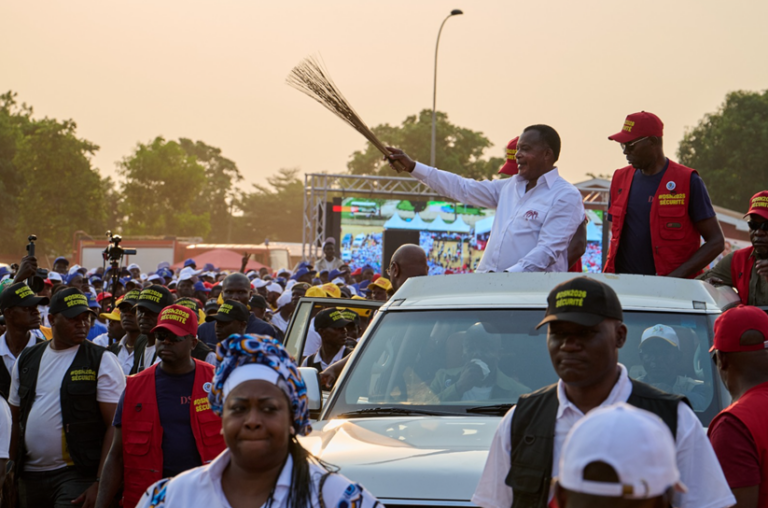
Electoral campaigning was also deeply unequal. Nguesso’s campaign looked like a “national tour”. It was built on a show of strength designed to project the image of a leader close to the people.

Did a divided opposition influence the result?

The fragmentation of the political opposition was arguably the most decisive factor behind the landslide. The opposition entered the election divided. They could not agree on a single candidate, which significantly reduced the chances of a democratic transition.

The election was marked by the absence of certain figures in Congolese politics. Some remain imprisoned (Jean-Marie Michel Mokoko and André Okombi Salissa). Others chose to boycott the poll, believing the conditions for a free and transparent election were not met. This stripped the contest of any real stakes. It helped secure a first-round victory for Nguesso. In 2016, he won 60.4 per cent of the vote against a strong opposition.

For many observers, the six candidates in the race were largely unknown or lacked any real political base. Some appeared to be using the election to gain some visibility, or better yet, political legitimacy ahead of future contests. They were no match for Nguesso. They lacked the financial resources to campaign nationwide and build local support to defend their platforms.

Finally, the digital blackout – including a countrywide shutdown of phone networks and internet on election day – added another layer of opacity of the process. It created an unprecedented information blackout.

This reduced the opposition’s ability to organise collectively and deploy its delegates. It also aimed to limit the spread, on social media, of rumours about ballot stuffing, vote buying, and other politically sensitive content. The president was clearly worried about low turnout figures leaking out.

What was the mood among voters?

Voting was marked by deep disaffection, fuelled by the opposition’s boycott and a sense among many young people that voting was pointless. It also took place in a climate of fear perpetuated by the repressive environment. This included operations carried out early in the year by the General Directorate of Presidential Security, as well as intimidation and crackdowns targeting activists and political opponents.

The issue of voter turnout lies at the heart of the controversy surrounding this election.

Two scenarios can be considered.

The first is turnout orchestrated by the government through political and patronage networks. The goal is to boost participation in order to legitimise the electoral process and bolster the credibility of the results.

The second scenario involves a boycott of the election encouraged by the opposition, aimed at achieving low turnout, which could spark challenges over the election’s legitimacy.

Reports highlight a clear gap between official figures and field observations, suggesting a more complex picture of voter turnout than is apparent. The official turnout rate reportedly jumped by nearly 17 per cent – from about 67.57 per cent in 2016, when there were more opposition figures, to 84.65 per cent in 2026, despite a widespread boycott. Yet polling stations across 6,620 booths in 4,011 centres appeared largely empty.

What challenges lie ahead?

To escape political and social stagnation, several democratic reforms are urgent:

  • Restoring electoral credibility and the independence of institutions is one of the most sensitive issues. The election exposed serious shortcomings in electoral governance – lack of transparency, inclusiveness and fairness.
  • The reliability of voter rolls, the impartiality of the Independent National Electoral Commission and unequal access to the media pose ongoing problems. All this happened without effective independent oversight. Without sweeping reforms of the electoral system, abstention and disengagement will continue to grow, particularly among young people.
  • Building a pluralistic political space and a viable opposition is essential for reshaping the Congolese political landscape. Releasing political prisoners and guaranteeing an effective right to opposition would be essential prerequisites for any national reconciliation.
  • Protecting fundamental freedoms and civic space. Human rights violations have been on the rise and there is no political dialogue between the government, the opposition, and civil society.
  • Succession and transition. The questions of what comes after Nguessou, whether power remains within the presidential majority, or ensuring continuity for a new term in 2031. This may include scenarios of dynastic succession within the presidential family.
  • Turning oil wealth into human development. Nearly half the population lives below the poverty line. The challenge is to convert oil revenues into public services (health, education) and opportunities for young people.
  • Reconnecting citizen participation, particularly young people, to politics. Young Congolese and civil society need to be brought back into the political process. Citizen participation remains crucial to the legitimacy of the electoral process.

What implications could the election have on political stability?

Stability rests on fragile foundations. A large part of the population sees the government as lacking legitimacy. Distrust in the electoral system runs deep.

Youth frustration is a particularly worrying indicator.
A 2024 survey indicates that young people have little confidence in the political system. Many feel that voting is pointless. Chronic unemployment and lack of economic prospects deepen their frustrations.

The internal struggle within the ruling party over who comes after Sassou Nguessou could become the main source of instability. The risk grows if no clear widely accepted successor emerges. Internal divisions seen during the party’s congress in 2025 show how central succession is. They also show ongoing shifts in power and elite positioning.

The March 2026 presidential election did not resolve any key issues.The Conversation

Ngodi Etanislas, enseignant-chercheur, Université Marien Ngouabi

This article is republished from The Conversation under a Creative Commons license. Read the original article.

NSCDC bust baby factory in Lagos, rescue 10 children, 18 pregnant women

0

OPERATIVES of the Nigeria Security and Civil Defence Corps (NSCDC), Lagos State Command, have uncovered an illegal baby factory in the Okuju area of Ilado, Badagry, Lagos.

The State Commandant, Adedotun Keshinro, disclosed this on Friday while victims aged between 18 and 30 were presented at the NSCDC office in Ibereko, Badagry. He noted that during an operation conducted from Wednesday night into the early hours of Thursday, officers rescued 18 pregnant women and 10 children, as two suspected operators of the facility, Joy Okeke and Raphael Agwu, were also arrested.

“Operatives swooped on the big flat containing many rooms that house the victims following actionable intelligence that lasted three weeks. Some of the pregnant women had come to the centre with children and infants for sale to willing buyers,” Keshinro said.

The victims were reportedly lured to the facility through an offer advertised on Facebook.

After giving birth, the women’s babies were sold, with the mothers receiving payments ranging from N500,000 to N1.8 million.

“The suspects entice the victims who are pregnant to come and negotiate with them that when they deliver the babies, they  will be taken from them and they’ll be paid off. The babies will then be taken from them to be sold to their customers, and the victims will be paid off.

“There are 18 victims who are fully pregnant, but one of them had a miscarriage. So, 17 of them are currently carrying pregnancies. There are other babies there who are grown, and they are also here on negotiation to be sold to interested buyers,” Keshinro added.

Describing the situation as a “grievous crime against humanity,” the NSCDC Commandant said the suspects would be handed over to the police for prosecution, while the victims would be transferred to the National Agency for the Prohibition of Trafficking in Persons for care and rehabilitation.

Items recovered from the facility included a pumping machine, generator, standing fans, gas cylinders, a burner, cooking pots, mobile phones, mats, toiletries, baby skincare products, tableware, and assorted food items.

“We will hand over the place to the state government. The state government may decide to demolish the place so that they will not be able to continue to use it for that activity,” he said.

Okeke, the alleged operator of the facility, said she relocated to the Badagry site from Ikorodu in January in search of a larger apartment.

She claimed her role was to help secure children for individuals who were unable to have any.

“We are adopting children to give to those who don’t have children. I have been doing this for some months. I moved here from Ikorodu in search of a bigger apartment. We were in Ikorodu before. We are two operating this place,” she said.

She refused to disclose how much the children were sold for or how they were brought to the facility, stating, “I can speak further when my lawyer is present. I don’t want to say anything more. If you are interrogating me, my lawyer should be present.”

Some of the victims said they were drawn to the centre after negotiating online with the operator, agreeing to hand over their babies after delivery in exchange for payment.

One of the women said she was to receive N1 million under the arrangement, while another claimed she had been promised N1.8 million.

Another victim identified as Joy said she chose the facility after becoming pregnant by what she described as an “irresponsible man,” noting that she has two children who were being cared for by her mum in the village.

The women said they were provided with regular meals, allowed to use their phones, and could request medical care when needed, but were not free to leave the facility at will.

One of them added that while they were permitted to leave before giving birth, doing so meant forfeiting any payment.

According to Raphael Agwu, who was arrested alongside the facility’s operator, the women arrived already pregnant and entered into agreements to deliver their babies, after which the children would be sold and the mothers paid.

Agwu claimed the centre provided an alternative for women considering terminating their pregnancies and also assisted couples who were unable to have children.

“There are agents on an online group who propose that instead of aborting it, you can come to us, and we will take care of you. And when you deliver the child, we’ll take the baby for ourselves. There are groups for adoption, abortion and unwanted pregnancies on Facebook. They are open groups. These people post that they want to give up their child for adoption, and negotiation begins.

“They were already pregnant on their own and decided to give birth for adoption. So, in order for us to be safe, because of that agreement, they gave their consent and everything,” he said.

Agwu, who described himself as a housekeeper, said the women were drawn to the facility by the promise of compensation of at least N1 million after giving birth and handing over their babies. 

“They came on their own. Some of them were referred to us by agents. Most of them came with their children. All those children you saw are people who came with their kids. Some childless couples come to us seeking to adopt children. I didn’t see it as a big crime because my thinking is they are helping some childless couples,” he said.

Video does NOT show renewed hope billboard inside INEC office

A VIRAL video circulating on social media claims that a “Renewed Hope” billboard associated with President Bola Ahmed Tinubu’s campaign is located inside an office of the Independent National Electoral Commission (INEC) in Rivers State.

The poster expressed concern that INEC, a body expected to remain neutral and unbiased, was hosting partisan campaign materials.

A verified x user, @AsakyGRN made the post on April 16, 2026. The audio in the video says:

“Inside INEC and you’re seeing renewed hope. This is INEC in River State with motors packed inside. ADC and PDP own no dey, only Tinubu own dey. What is this telling you?”

As of April 16, the post has garnered over 100,000 views, 3,000 likes and 2,000 reposts with comments doubting the integrity of INEC ahead of the presidential election.

CLAIM

video shows a “Renewed Hope” billboard inside an INEC office in Rivers State.

Screenshot of the viral post on X.

FINDINGS

Findings by The FactCheckHub show that the claim is FALSE.

The building featured in the video is not an INEC office. Instead, it is the Renewed Hope Ambassadors Secretariat located at 246 Aba Road, Port Harcourt.

Analysis by The FactCheckHub of public records and media archives confirms that this building was donated by the Minister of the Federal Capital Territory, Nyesom Wike, to serve as a campaign secretariat for President Tinubu’s renewed hope movement.

Channels Television documented the official commissioning of the secretariat in Port Harcourt by Wike on Friday, January 30, 2026. Months before this claim surfaced.

VERDICT

The claim that a renewed hope billboard is inside an INEC office is FALSE. The building shown in the video is the Renewed Hope Ambassadors Secretariat in Port Harcourt, which was donated by Nyesom Wike for campaign purposes and inaugurated on January 30, 2026.

This report is republished from the FactCheckHub. You can read the original here.

Video does NOT show federal lawmaker assaulted over defection in Zamfara

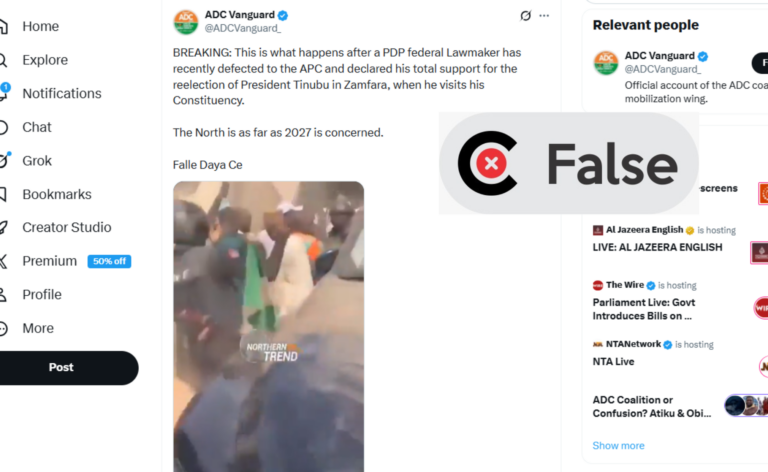
A video circulating on social media claims to show a federal lawmaker in Zamfara State being assaulted by a mob after defecting from the Peoples Democratic Party (PDP) to the All Progressives Congress (APC).

The 56-second clip shows a crowd physically attacking a man, with some dragging and beating him.

An X account, @ADCVanguard_, shared the video with the caption:

“BREAKING: This is what happens after a PDP federal Lawmaker has recently defected to the APC and declared his total support for the reelection of President Tinubu in Zamfara, when he visits his Constituency…”

As of the time of review, the post had generated over 53,000 views and more than 1,400 engagements.

CLAIM

The video shows a federal lawmaker being assaulted in Zamfara after defecting from PDP to APC.

THE FINDINGS

Findings by The FactCheckHub show that the claim is FALSE.

The claim surfaced amid ongoing political realignments and defections ahead of the 2027 elections, a period often marked by heightened tensions and misinformation online.

A reverse image search conducted on keyframes from the video shows that the footage is not recent. It was first shared online on December 17, 2025.

Reports from that period confirm that the incident involved Kabiru Mikailu, a member of the Zamfara State House of Assembly representing Maru South Constituency, not a federal lawmaker as claimed.

The incident occurred in Dansadau, Maru Local Government Area, where Mikailu was attacked by residents during a visit to his constituency. He was reportedly slapped, dragged, and manhandled before security operatives intervened.

Residents accused the lawmaker of poor performance, alleging that he had neglected the constituency, failed to engage with constituents, and delivered no visible development projects.

Further checks show that Mikailu remains a member of the PDP and was not among the lawmakers who defected from the party.

VERDICT

The claim that a federal lawmaker was assaulted in Zamfara for defecting from PDP to APC is FALSE. The video shows a December 2025 incident involving a state lawmaker who was attacked by constituents over alleged poor performance, not defection.

This report is republished from The FactCheckHub. You can read the original here

NMDPRA assures of aviation fuel sufficiency, counters domestic airlines’ price claim

0

THE Nigerian Midstream and Downstream Petroleum Regulatory Authority (NMDPRA) has countered the aviation airline price hike claim.

It affirmed that there is sufficient aviation fuel supply in the country, amid concerns over rising prices.

The regulatory authority’s position came on the heels of domestic airlines’ threat to suspend operations from April 20 over the rising cost of Jet A1, also known as aviation fuel.

The Airline Operators of Nigeria (AON) on April 15, had said the price of Jet A1 increased from N900 per litre as of February 28 to N3,300 per litre — representing a rise of over 300 per cent.

However, the Director of the Public Affairs Department at NMDPRA, George Ene-Ita, in a statement on Friday, April 17, said Nigeria had 74 days’ sufficiency of aviation fuel, comprising inland and refinery stocks.

“The NMDPRA wishes to assure the public that there is a robust supply of aviation fuel in the country with the inland stock sufficiency of 12 days, and the refinery stock sufficiency of 62 days — making a total of 74 days of national sufficiency.

“It is imperative to note that, like other petroleum products, aviation fuel has been fully deregulated, and the price is driven by market dynamics,” the oil industry regulator said.

According to NMDPRA, the ex-gantry price at the Dangote Petroleum Refinery and Petrochemical Company stood at N1,879 per litre as of April 16, slightly below the international indicative price of N1,900 per litre.

The regulator added that its nationwide survey showed retail prices ranged between N1,960 and N2,800 per litre.

“Therefore, the speculated N3,300 per litre price of aviation fuel being peddled in the media does not reflect current market reality,” the agency said.

NMDPRA said it would continue to monitor supply and pricing to prevent disruptions and profiteering across the country.

The authority also reaffirmed its commitment to ensuring energy security, while commending stakeholders in the aviation fuel supply chain for maintaining steady distribution of the product.


No, Tems and Justin Bieber were not hospitalised after Coachella 2026

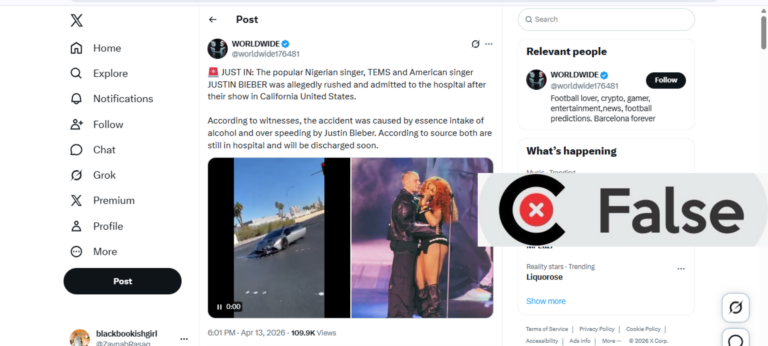
A VIRAL post circulating on social media claims that Temilade Openiyi, known professionally as Tems and American pop star Justin Bieber were rushed to the hospital following an accident after their performance at Coachella, a music festival in California.

The post alleges the accident was caused by excess intake of alcohol and over speeding by Bieber and claims both artists remain hospitalised.

A verified x user, @worldwide176481 made the post on April 13, 2026, with the caption:

JUST IN: The popular Nigerian singer, TEMS and American singer JUSTIN BIEBER were allegedly rushed and admitted to the hospital after their show in California, United States. 

According to witnesses, the accident was caused by an excessive intake of alcohol and over speeding by Justin Bieber. According to sources, both are still in hospital and will be discharged soon.”

As of April 15, the post has garnered over 110, 000 views, 700 likes and 60 reposts.

CLAIM

Tems and Justin Bieber were hospitalised in California following a car accident after their Coachella 2026 performance.

screenshot of the viral post on x

FINDINGS

Findings by The FactCheckHub show that the claim is FALSE.

There are no reports from any credible local or international media outlets regarding a car accident or the hospitalisation of either artist in April 2026. Typically, an incident involving high-profile global stars like Tems and Justin Bieber would receive immediate and widespread news coverage.

A reverse image search conducted by The FactCheckHub reveals that the video first surfaced online four years ago under the handle @Carhoots on Pinterest.

Furthermore, evidence from the artists’ official social media platforms contradicts the claim. Tems and Justin Bieber have remained active on their Instagram pages following their Coachella performance, sharing updates and interacting with fans, which would be unlikely if they were currently hospitalised for a serious accident.

Coachella is one of the world’s most famous annual music and arts festivals, held in California to showcase talent across various genres. In 2026, Justin Bieber invited Tems and Wizkid to perform their chart-topping song “Essence”.

VERDICT

The claim that Tems and Justin Bieber were hospitalised after an accident in California is FALSE. The video in circulation is old, and no credible news sources have reported such an event. The artists remain active on social media as of the time of filing this report.

This report is republished from the FactCHeckHub. You can read the original here.

Iran opens Strait of Hormuz

IRAN Foreign Minister Abbas Araqchi on Friday announced that the Strait of Hormuz had been reopened to commercial traffic under a temporary ceasefire arrangement linked to a broader diplomatic push.

In a post on X, Araqchi said the vital shipping corridor would remain accessible to all commercial vessels for the duration of US-brokered truce tied to a ceasefire agreement between Israel and Lebanon. 

He added that vessels must adhere to routes designated by Iran’s Ports and Maritime Organisation.

Meanwhile, US President Donald Trump while confirming that Iran had declared the Strait open, emphasised that a US naval blockade targeting vessels bound for Iranian ports remained in force.

“The blockade will continue until our transaction with Iran is 100 per cent complete,” Trump said, suggesting a broader agreement could be imminent, though no timeline has been confirmed.

The Strait’s reopening follows weeks of disruption caused by the ongoing US-Israeli confrontation with Iran, which began on February 28 and has since destabilised the Middle East, claiming thousands of lives. 

Diplomatic efforts appear active but unresolved as talks between US and Iranian officials expected to take place in Islamabad face logistical delays, while sources on both sides indicate that key disagreements persist, particularly over Iran’s nuclear programme.

Washington is reportedly pushing for a 20-year suspension of Iran’s nuclear activities, while Tehran has proposed a shorter freeze of three to five years. Iran is also demanding sanctions relief, while the US insists on the removal of highly enriched uranium from Iranian territory, a point both sides continue to publicly dispute.

Trump claimed Iran had agreed to relinquish sensitive nuclear material, a statement quickly rejected by Iranian state media, as a senior cleric Ahmad Khatami warned that negotiations would not proceed under pressure, reflecting domestic resistance to perceived concessions.

Meanwhile, Pakistan acting as a mediator reports incremental progress through backchannel diplomacy. Officials suggest a memorandum of understanding could be reached in the coming days, potentially paving the way for a comprehensive deal within two months.

Parallel developments in Lebanon are central to the broader diplomatic equation, as a US-backed ceasefire between Israel and Hezbollah appears largely intact, though Lebanese authorities have reported isolated violations by Israeli forces.

The ICIR reported that the closure of the Hormuz strait, through which 20 per cent of global oil and liquefied natural gas is transported, had resulted in severe global energy disruption.

For now, the reopening of the passage offers a temporary reprieve for global markets and energy supply chains. But with military posturing continuing alongside fragile negotiations, the path to a lasting resolution remains uncertain.

Tinubu signs N68.32tn 2026 budget, approves extension of 2025 implementation

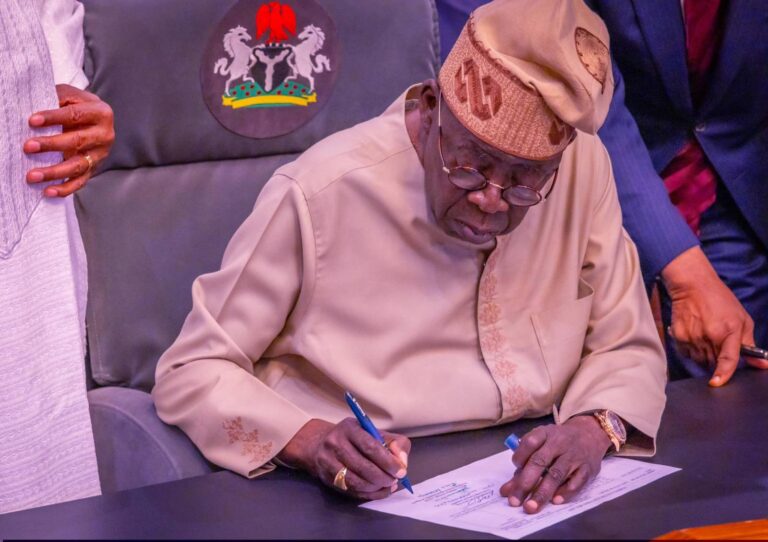
PRESIDENT Bola Tinubu has assented to the 2026 appropriation bill, which provides for an aggregate expenditure of ₦68.32 trillion.

This was revealed in a statement by Bayo Onanuga, the President’s Special Adviser on Information & Strategy, on Friday, April 17.

The president has also signed the bill extending the implementation period for the 2025 budget from March 31, 2026, to June 30, 2026.

The N68.32 trillion budget for this year earmarks N4.799 trillion for statutory transfers and N15.8 trillion for debt service.

It allocates N15.4 trillion to recurrent expenditure and N32.2 trillion to the Development Fund for Capital Expenditure.

“With capital expenditure accounting for about 50 per cent, the 2026 budget underscores the administration’s continued commitment to economic stability, national security, infrastructure development, and inclusive growth.

“The allocations reflect a strategic balance between statutory obligations, debt servicing, recurrent expenditure, and capital investments critical to driving productivity and improving the quality of life for Nigerians,” the statement stated.

Additionally, Tinubu assented to the Appropriation (Repeal and Enactment) (Amendment) Bill, 2026, which extends the implementation period of the capital component of the 2025 Appropriation Act from March 31, 2026, to June 30, 2026.

The extension, the statement said, would ensure the full and effective utilisation of appropriated funds, particularly for critical infrastructure and development projects that are at advanced stages of implementation across the country.

It will also enable ministries, departments, and agencies (MDAs) to consolidate ongoing works, enhance project completion rates, and maximise value for public expenditure.

With the 2026 Appropriation Act coming into force on April 1, the Federal Government will commence full implementation in line with the Renewed Hope Agenda.

President Tinubu directed MDAs to ensure disciplined, transparent, and efficient utilisation of allocated resources, with a strong emphasis on value for money and timely project delivery.

He lauded the leadership and members of the National Assembly for their diligence, cooperation, and patriotism in expeditiously considering and passing the budget.

The president reaffirmed the importance of sustained collaboration between the executive and legislative arms of government in advancing national development objectives.

He further assured Nigerians of his administration’s resolve to deepen fiscal reforms, enhance revenue generation, and prioritise investments that will stimulate economic growth, create jobs, and strengthen social protection mechanisms.

The journey before the presidential assent of the budget

Federal lawmakers on Tuesday,31 March, approved a 68.30 trillion-naira ($49.4 billion) budget ​for 2026, after Tinubu asked lawmakers to back ‌adjustments to increase a plan put forward in December.

He earlier presented ⁠a 58.47 trillion naira budget to the National Assembly on December ​19, saying it was aimed at consolidating economic reforms and accelerating growth.

Lawmakers, however, ​passed a higher figure after the president requested adjustments, the chairs of the Senate and House of Representatives Appropriation Committees said in a joint statement.

The higher figure, the president said, ​was meant to accommodate outstanding capital projects carried over ​from previous budget cycles and prevent unresolved obligations from weighing on the 2026 fiscal ‌programme.

Despite an oil windfall on average of $100, lawmakers ⁠also approved a $6 billion loan request sought by Tinubu to bolster the higher budget, covering outstanding capital spending from previous years, infrastructure projects, and debt servicing, with at least 40 per cent earmarked for capital projects in ​the 2025 and ​2026 budgets.

Faultlines on Tinubu’s budget 

The Lead Director, Centre for Social Justice and a public finance expert, Eze Onyekpere, has faulted Tinubu’s borrowing spree and poor revenue management despite the claims that revenue agencies make more money.

“The deficit is rising, which is a real problem. All is not well, and this is a pre-election year. How can the lawmakers be approving all the loans? Where are they going to get the funds for these debt servicing of over N15 trillion with humongous borrowing, which has led to an increase in total public debt to N159.28 trillion,” he added.


NRS unveils Rev360 to improve tax accountability, ease of business

THE Nigeria Revenue Service (NRS) has announced plans to launch a new digital tax payment platform targeted at improving efficient tax administration and sustaining the ease of doing business.

This was disclosed in an official statement by the revenue body via its official X account on Thursday, April 16.

The new digital payment platform called Rev360 focuses on a next-generation revenue administration platform that aims at enhancing efficiency, transparency, and the taxpayer experience across Nigeria. The platform has been scheduled to go live on Thursday, 30 April 2026.

According to the statement, the rollout of Rev360 will commence with the medium and emerging taxpayers as the first phase of implementation after a successful pilot.

“A structured, phased approach has been adopted to ensure stability and provide adequate support to users throughout the transition. Comprehensive communication, training, and stakeholder engagement initiatives are also being implemented to ensure readiness ahead of go-live,” the statement read.

The revenue service noted that Rev360 represented the next phase in the evolution of tax administration within the Service, adding that,” from the early era of fragmented processes, the NRS transitioned to a more digital and accessible system through platforms such as TaxPro Max, which enabled electronic filing, improved compliance, and reduced physical interactions.”

“Building on these gains, Rev360 introduces a more advanced, integrated, and intelligent ecosystem designed to meet the growing needs of taxpayers and the economy,” the statement added.

With Rev360, the revenue agency said it would also move towards tax administration 3.0, an era defined by end-to-end automation, real-time reporting, and embedded tax processes into taxpayers’ natural systems.

What NRS’s new initiative mean for taxpayers, ease of doing business

According to the revenue body, the introduction of Rev360 would birth a more advanced, integrated, and intelligent ecosystem designed to meet the growing needs of taxpayers and the economy.

This shift would also enable faster processing, improved decision-making, enhanced compliance, and a more seamless user experience. Taxpayers will benefit from more options in their overall interaction with the Service.

In context, there has been a surge in traffic on other eTax platforms due to Nigerians working toward meeting each state’s filing deadlines.

Recently, the Lagos State Internal Revenue Service (LIRS) extended the deadline for filing individual annual income tax returns for the second time, now giving taxpayers until April 21st, 2026, to complete their submissions.

The agency announced the extension, citing a surge in traffic on its eTax platform following the previous extension to April 14th.

The LIRS stated that the high volume of users attempting to file taxes reflected genuine compliance efforts and that the additional time was granted to ensure everyone has a fair opportunity to submit their information accurately.

This is part of the ongoing efforts of the federal government to simplify Nigeria’s tax system and improve compliance with tax payment.

With the new NRS digital platform, tax filing for individuals is expected to be easier and faster while streamlining tax collection and compliance for the government.


Lawyer threatens to sue FG for re-integrating 744 ex-terrorists

0

NIGERIAN lawyer, Maxwell Opara, has vowed to sue the Federal Government over its reintegration of 744 repentant terrorists into society.

Opara stated this on Friday, April 17, while featuring on Arise TV’s programme, “The Morning Show.”

“I shall be approaching the Federal High Court next week to stop this madness, we can’t continue like this, it has to stop,” he warned.

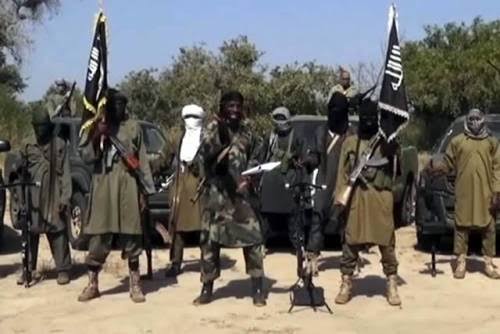
The Federal Government had on Thursday announced that 744 former terrorists and victims of violent extremism would be returned to the society after completing a de-radicalisation, rehabilitation and reintegration programme under Operation Safe Corridor.

Addressing the graduands and others at the graduation ceremony in Gombe, the Chief of Defence Staff, Olufemi Oluyede, a lieutenant general, said the programme was not to reward terrorism but to discourage people from engaging in it.

Oluyede, who was represented by the Director, Special Operations Forces at Defence Headquarters, Kabiru Tanimu, a rear admiral, said the initiative was to promote lasting peace.

The breakdown of the former terrorists is as follows: 597 from Borno, 15 from Kano, two from Abia State, 10 from Adamawa, one from Akwa Ibom, two from Anambra, 12 from Bauchi, , three from Ebonyi, one from Enugu, three from Katsina, and one from Kebbi.

Others are: five from Kogi, four from Nasarawa, two from Niger, two from Plateau, two from Sokoto, and 58 from Yobe. The list includes foreign nationals, comprising one from Burkina Faso, one from Cameroon, two from Chad, and four from Niger Republic.

Reports indicate that 733 of the beneficiaries are Muslims, while 11 are Christians.

Reacting further to the decision, Opara explained that Nigeria already had clear legal procedures for handling criminal offences and questioned the basis for the reintegration programme.

He noted that existing laws did not support such actions. According to him, most victims of terrorism have been displaced and are living at internally displaced persons’ camps. He wondered if the repentant terrorists would be returning to empty communities where they had killed and displaced residents.

He argued that the government should have rather focused on people affected by the conflict. Besides, he said the international treaties with which the government deradicalises the terrorists were not binding on Nigeria.

“Once a crime is committed, we have the constitution, we have the Administration of Criminal Justice Act, once you are charged to court, the only role the government has is through the attorney general to discontinue the matter.”

He maintained that after conviction, the only lawful relief available is through presidential pardon or amnesty under defined conditions, stressing that the current process does not fit either category.

“Once the person has faced trial and is convicted, the only option is to grant the person amnesty, that is presidential pardon, when the person meets the necessary criteria.”

He also considered the action fraudulent and called on the Economic and Financial Crimes Commission to probe the process.

The lawyer described the reintegration process as unrealistic, noting that many affected communities no longer exist due to displacement, while also raising concerns about selective application and lack of transparency across the programme nationwide.

He also rejected alleged coercion of the beneficiaries by insurgents as a justification for absolving suspects, insisting that a crime remains a crime regardless of the circumstances.