Home Blog Page 597

Journalist injured by metal debris not stray bullet inside government house – official

A journalist with Abubakar Rimi Television station (ARTV), Naziru Idris Ya’u, has sustained an injury within the premises of the Kano Government House.

Although he was reported to have been hit by a stray bullet in an incident that happened on Friday, May 3, the state government has denied the allegation.

Ya’u was said to have returned to the government residence after an assignment with Governor Abba Yusuf some minutes before the bullet struck his shoulder.


Read Also:

Press freedom: despite constitutional mandate, Nigerian laws fail to protect journalists

70% of environmental journalists report attacks, threats- UNESCO

Police arrest FIJ journalist over ‘cybercrime’ allegation


The reporter, who sustained a minor injury as a result, was rushed to the Government House Clinic, where he was treated and discharged.

However, the state government in a statement released on Saturday, May 4, by Sanusi Tofa, the director general of publicity and media, refuted the claim, noting that the journalist was hurt by metal shards from the current construction at the Kano State Government House

“The attention of Kano State Government has been drawn to a one-sided media report on social media revealing that a journalist, with the state Television station, attached to the Government house was hit by a stray bullet.

“The incident, which occurred amidst a flurry of misinformation, sparked widespread concern and speculation regarding the safety of journalists covering events at the government house.

“For clarity purposes, Naziru Yau, the reporter of the state television station was not hit by any stray bullet. Instead, he sustained injuries from the metal debris emanating from an ongoing construction at the Kano State Government House, an area that has been barricaded for caution.” The statement read in part.

He claimed that following examinations by medical staff affiliated with the government house, the incident’s real nature became known.

In addition to reiterating the government’s commitment to continuously examine and improve current safety procedures in order to prevent such incidents in the future, he advised journalists to always exercise caution and vigilance in the course of their duties.

The ICIR reports that the incident happened on Friday, May 3, a day set aside for the marking of the World Press Freedom Day.

It also coincided with the day the news of the abduction of Daniel Ojukwu, a journalist with the Foundation for Investigative Journalism (FIJ), was reported.

The ICIR reported that while many Nigerian journalists joined the rest of the world in advocating press freedom on World Press Freedom Day, Ojukwu languished in police detention over allegations of cybercrime.

Ojukwu was abducted by the Intelligence Response Team (IRT) of the Inspector-General of Police on Wednesday, May 1, but his abduction became known on Friday, coinciding with World Press Freedom Day.

According to a report by FIJ, he is currently being held at the State Criminal Investigation Department (SCID), Panti, in Lagos, and has been denied access to legal representation.

The attacks, which have continued to generate widespread condemnation from journalists and concerned Nigerians, was deemed a significant setback in the ongoing battle against impunity and harassment of media professionals in Nigeria.

Earlier on Friday, The ICIR reported how the latest data on the 2024 World Press Freedom Index by Reporters Without Borders (RSF) placed Nigeria as one of West Africa’s most dangerous and difficult countries for journalists.

This followed Nigeria’s placement at 112th out of 180 countries in terms of journalists being regularly monitored, attacked, and arbitrarily arrested.


One year in office: Is Tinubu keeping promise on gender-inclusive government?

Despite promises to prominently feature women in his government, females are again underrepresented in governance under the administration of Nigerian President Bola Tinubu, the ICIR reports as part of the series tagged, Tinubu’s one year in office. 


DURING his inauguration on Monday, May 29, 2023, one of the promises President Bola Tinubu made to the Nigerian people was to feature women “prominently” in his government.

May 29 was not the first time Tinubu had made that promise.

Running a gender-inclusive government was one of the campaign promises on which Tinubu rode to the presidency. While unveiling his manifesto, he promised to work with the National Assembly to enact a law guaranteeing the employment of women in all government offices.

In addition to this, Tinubu promised that there would be a minimum number of senior positions reserved for women in the Federal Executive Council, especially as his cabinet and senior advisers.

“The goal will be to increase women’s participation in government to at least 35 per cent of all governmental positions,” Tinubu said.

The president’s idea of having women in 35 per cent of all governmental positions is reflective of Nigeria’s goal, which led to the establishment of the National Gender Policy (NGP) of 2006.

In 2006, Nigeria established the NGP under the administration of former president Olusegun Obasanjo to enhance gender equality in political, economic and other areas of decision-making.

The policy recommends that women fill 35 per cent of appointive positions in the country for inclusion, but since its establishment, neither Obasanjo nor past presidents Muhammadu Buhari and Goodluck Johnathan, met the 35 per cent target even within their cabinets.

Although Jonathan’s government had the highest female representation since the establishment of the NGP, with 12 women making up 30 per cent of his 42-member-cabinet, the figure drastically declined upon Buhari’s election as president.

Under Buhari, only 16 per cent of his cabinet members were women.

Like his predecessors, when Tinubu announced his first list of ministerial nominees, women did not occupy up to 35 per cent of the available positions.

Out of 28 nominees initially appointed by Tinubu, seven were women, making up 25 per cent.

As time went on, Tinubu added 19 more names to the list of nominees, and with only two women included, the percentage of nominated females shrank to 19 per cent.

The senate confirmed the appointment of 46 ministers.

Of the nine female nominees, eight were confirmed, placing the percentage of women in Tinubu’s cabinet at 18.

In addition to this shortfall, not much has been said of the promised legislation to guarantee women’s occupation of 35 per cent of positions within the Nigerian government.

Most of Nigeria’s current lawmakers, whom Tinubu promised to work with, were part of the previous National Assembly that stepped down a bill seeking to provide 35 per cent affirmative action for women into all appointive positions in 2023.


Read Also:


18 years after NGP, Nigerian women remain underrepresented in government

Nigeria is one of the countries around the world that pledged to achieve 17 Sustainable Development Goals (SDGs) by 2030, one of which is the achievement of gender equality.

In the Executive Summary of the  NGP (2006), the document was described as a corrective response to gender inequalities and discrimination, a point that was reiterated by former Minister for Women Affairs Pauline Tallen in 2022, when the policy was revised.

Eighteen years after, not only is there inadequate female representation in appointive positions like Tinubu’s cabinet, the problem is even worse in elective positions, including Nigeria’s National Assembly, where there are only 19 elected women, out of 469 lawmakers.

To ensure compliance with the NGP, Nigerian women, represented by nine Civil Society Organisations (CSOs) sued the federal government.

Delivering judgment on the suit in 2022, a Federal High Court in Abuja ruled in favour of the women and ordered the government to implement the policy.

Ironically, the Nigerian government appealed the ruling that ordered an implementation of the policy, which was initially established by the government itself.

Women condemn poor representation

For decades, Nigerian women have consistently condemned the low representation in government positions.

The condemnation has continued following Tinubu’s ministerial appointments, described by co-founder of Womanifesto Abiola Akiyode-Afolabi as a “deliberate attempt to promote patriarchal character in governance.”

Other women who have condemned the underrepresentation include Chioma Agwuegbo, Executive Director, TechHer.

“19 per cent out of 47 ministers for a government that made a lot of comments about affirmative action, the inclusion of women in government, how they were going to do better, is very poor but it is also representative of the fact that politicians will say whatever they need to say to get into office and when they get into office, they will do then do what they originally want to do because there are no consequences,” she said.

The Nigeria Women Commission of the Trade Union Congress (TUC) also expressed disappointment over the underrepresentation in governmental positions during the 2024 International Women’s Day.

Although women make up 49 per cent of Nigeria’s population, the clamour for fair representation has remained ignored by successive governments, with chances of inclusion looking less likely under this administration.


UPDATE: 

The report was updated to reflect that the National Gender Policy (NGP) was signed in “2006 under Olusegun Obasanjo” and not “2006 under Goodluck Jonathan” as earlier written.

Actress, Shan George cries for help after being scammed

VETERAN Nollywood Actress, Shan George has issued a distress call to Nigerians, tearfully seeking help following the withdrawal of all funds from her bank account by a fraudster.

Taking to her official Instagram page on Saturday, May 4, the actress in a video post said tearfully that she had been ripped off all her money and has nothing left to feed her children, adding that the situation is worse because it is the weekend, and she cannot go to the bank to lay complaints.

“Nigerians please help me. Someone called Cecilia just cleared all the N3.6 million in my Zenith Bank account into her Opay. I’m now koboless. I have nothing to eat with my children, the worst part, is today, Saturday, I can’t go to the bank to complain, she said.


Read Also:


According to the actress, the fraudster, Cecilia Chisgoziem Okoro withdrew a total of N3.6 million from her Zenith bank account using an Opay account.

In a subsequent post, she expressed her distress while calling on her followers and notable media personalities to come to her aid.

“I need help cos I’m dying. This person has just cleared my account. Pls my people, everyone pls help. Pls Zenith Bank, reverse it. I can’t access my app. I’m Dead, Oga Jim Ovia.”

She also added a screenshot of the transaction details showing the breakdown of the withdrawals.

Actress, Shan George cries for help after being scammed
Screenshot of the transaction breakdown. Credit: Instagram

Coalition, SERAP condemn continued detention of FIJ journalist,demand immediate release

THE Coalition for Whistleblowers Protection and Press Freedom (CWPPF) has condemned the arrest and continued detention of Daniel Ojukwu, a journalist with the Foundation for Investigative Journalism (FIJ), for alleged violation of the 2015 Cybercrime Act by the Nigeria Police. 

This was contained in a statement released by the Deputy Director, CJID, Busola Ajibola, on Saturday, May 4.

This was as the Socio-Economic Rights and Accountability Project (SERAP) asked the President Bola Tinubu-led government to immediately release Ojukwu.


Read Also: 

Press freedom: despite constitutional mandate, Nigerian laws fail to protect journalists

Nigeria ranks 112th out of 180 countries on press freedom

Police arrest FIJ journalist over ‘cybercrime’ allegation


SERAP made this call in a post on its official X handle, arguing that no journalist should ever be detained for doing their job.

It also noted that it’s attempting to sue the Tinubu administration over the unlawful detention of FIJ journalists by the police for alleged violation of the Cybercrime Act.

The ICIR reported how Ojukwu was arrested and detained in Lagos over allegations of cybercrime.

Ojukwu was abducted by the Intelligence Response Team (IRT) of the Inspector-General of Police on Wednesday, May 1, but his abduction became known on Friday, coinciding with World Press Freedom Day.

According to a report by FIJ, he is currently being held at the State Criminal Investigation Department (SCID), Panti, in Lagos, and has been denied access to legal representation.

The attacks, which have continued to generate widespread condemnation from journalists and concerned Nigerians, were deemed a significant setback in the ongoing battle against impunity and harassment of media professionals in Nigeria.

Coalition calls for immediate release 

Reacting to the arrest, the Coalition stated that the Lagos state Police Public Relations Officer, Benjamin Hundeyin have confirmed that Ojukwu was arrested by men of the National Cybercrime Centre (NCCC) of the Nigerian Police and is detained at the facilities of the Lagos state Police Criminal Investigation Department (SCID), Panti.

The Coalition noted that the arbitrary arrest and detention of journalists remain unacceptable as it negates the basic principles of democracy.

“The arrest and continued detention of Mr Ojukwu is not only a violation of his fundamental human rights but also an assault on press freedom. 

“We call on the Nigerian police to immediately release Mr. Daniel Ojukwu and follow legal procedures to engage him. 

We also call on the Inspector General of Police to ensure that the Cybercrime act 2015 ceases to be a weapon used in the harassment and arbitrarily detainment of journalists and media workers. We make this call based on past instances where the Cybercrime law has been used to criminalise journalism, harass and detain them,” the statement added.

It further reiterated that such intimidation constitutes an attack on press freedom and the right of the people to information.

While noting that journalism plays a critical role in democracy, it added that the Nigerian Police must avoid using the Cybercrimes Act to suppress investigative journalism aimed at entrenching a transparent and accountable system.

TCN announces power cuts in parts of Benin, Delta

THE Transmission Company of Nigeria (TCN) on Saturday, May 4, said there will be a power outage in parts of Benin and Delta State.

The power outage commences from Saturday, May 4, to Friday, May 17, 2024.

A statement signed by the General Manager, of Public Affairs of TCN, Ndidi Mbah, noted that the plan was to enable it to erect two 132kV transmission towers at its Amukpe Substation and restring a portion of the Benin-Delta and Delta-Oghara 132kV double circuit transmission lines.

The company said Amukpe Substation would be out for the duration of the work.


Read Also:

Power outage looms as TCN shuts down 676mw Egbin plant

TCN confirms grid restoration after the sixth collapse in 2024

NERC unbundles TCN into two independent operators


The company said Amukpe Substation would be out for the duration of the work.

This was as the TCN announced that “bulk power supply to Benin DisCo through the following feeders: the ADEJE, INDUSTRIAL, WOODLAND, MOSOGAR, SAPELE (SAPELE) and ABRAKA feeders will be out of bulk power supply for the period”.

According to the statement, the outage was necessary to create a safe working environment for the contractor.

She also said the completion, of the projects would put in place N-1 redundancy that would enable TCN to supply bulk electricity to the substation from either the Benin or Ughelli transmission line.

“This means that when one transmission line is faulty, bulk electricity can still be received in the substation from the second line”, she explained.

She said that the projects would help ensure a more flexible and consistent bulk power supply through the Amukpe transmission substation when completed.


READ ALSO:


It would be noted that this wasn’t the first time the company would be announcing power interruptions in some parts of the country. Earlier this month, the company announced 6-hr power interruptions due to routine maintenance on its 132kV line 1 at both Gwagwalada and Apo transmission substations, Abuja.

In 2022, The ICIR reported that the frequent grid collapse was attributed to the delay in unbundling of the Transmission Company of Nigeria (TCN) by the Federal Government.

Fintech companies warns customers against crypto trading

NIGERIAN fintech firms have cautioned their clients against trading cryptocurrency or virtual currencies on their platforms, stating they will suspend any accounts discovered engaging in such transactions.

On Friday, May 3, 2024, at least four fintech companies, namely Opay, Moniepoint, PalmPay, and Paga, notified their customers about the development.

Recall, on Tuesday, April 30, 2024, the Central Bank of Nigerians (CBN) halted major fintech companies such as Kuda, Opay, PalmPay, and Moniepoint from onboarding new customers.


READ ALSO :


The CBN’s action was associated with an ongoing audit of the Know-Your-Customer (KYC) process of these fintech firms, which have faced increased scrutiny in recent months due to worries regarding money laundering and the financing of terrorism.

The KYC or KYC check is the mandatory process of identifying and verifying the client’s identity when opening an account and periodically over time. In other words, banks must ensure that their clients are genuinely who they claim to be

OPay, in a notice issued on Friday, May 3, 2024, stated that it would implement rigorous measures against customers who breach its policy, in line with the Central Bank of Nigeria’s position on cryptocurrency trading.

“In compliance with the CBN directive, please note that OPay prohibits any cryptocurrency and all virtual currency trading. Any account engaging in such activities will be closed, and customer information will be shared with regulatory authorities.” The statement read in part.

Similarly PalmPay and Paga also warned their customers of the development in a statement.

“As a Paga account holder, please ensure that your account is not used for crypto and virtual currency transactions. Paga accounts in violation of this regulation will be blocked.”

“We strongly advise against using your PalmPay account for transactions involving cryptocurrencies or any other virtual assets. Please be advised that failure to comply with these regulations may result in the suspension of your account.”

On Thursday, May 2, 2024 in Lagos, Tosin Eniolorunda, the founder and CEO of Moniepoint, advised participants in cryptocurrency peer-to-peer (P2P) transactions to stop their activities, citing the financial sector’s prohibition on such transactions

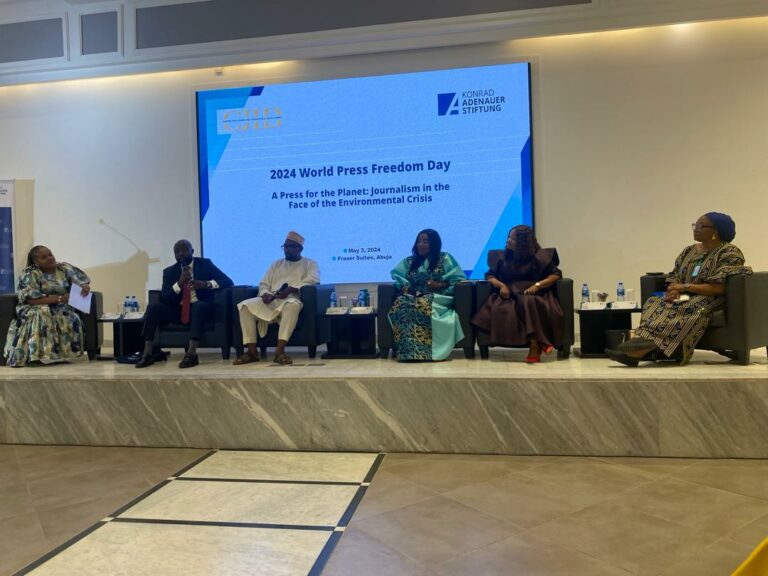
Press Freedom Day: Stakeholders seek autonomy for media regulators

STAKEHOLDERS within the Nigerian media sector have called for the autonomy of media regulators.

The autonomy of media regulation, they said, would create a balance between upholding press freedom and ensuring accountability in journalism practices.

This call was made during a panel session at the 2024 World Press Freedom Day event organised by the Centre for Journalism Innovation and Development (CJID) in partnership with the Konrad Adenauer Stiftung (KAS) Foundation in Abuja on Friday, May 3.


Read also:


During the panel session tagged “Navigating the Intersection of Media Regulations, Press Freedom Advocacy and Ethical Journalism in the Face of Environmental Crises”, the speakers stressed the importance of journalists adhering to the best journalistic ethical practices of truthfulness, accuracy, and verification while also urging media regulators to act independently and allow journalists to work without interference.

In response, the Secretary of the Nigerian Broadcasting Commission, Franca Aiyetan, who was among the panelists noted that NBC was established in order to have a strong Nigerian media.

“The NBC was not established as an attack dog for the government and, as such, would want the press to always work with it. If a detail about a truth will set two tribes against each other, then there is something wrong with that truth,” she said.

Also, another panelist, the Executive Director, Digicivic Initiative, Mojirayo Ogunlana said that laws protecting journalists in the course of their work are necessary, urging media professionals to exercise self-regulations so as to keep the government from taking advantage of any opening that would allow it to attack them.

“Threats to the lives of journalists should be declared as a state of emergency,” she added.

The panelists further highlighted some challenges faced by the Nigerian media including, political interference, inadequate funding, and limited capacity among others, noting that the media are often manipulated by politicians for their own interests leading to biased reporting.

Meanwhile, delivering the keynote address on “The Role of Nigerian Media in Reporting Environmental and Climate-Induced Conflict” at the event, the Chairman House Committee on Media and Public Affairs, Hon Akin Rotimi said the “constitutional role of the press is not just to be the mouthpiece or a public relations agent of the government but to critically hold the government to account.”

He went on to point out the importance of exceptional reporting and the accurate information that is disseminated, noting that these activities offer an opportunity to uphold the fundamental principles of press freedom, assess the state of press freedom around the world, safeguard the media from attacks, and remember journalists who have given their lives in the line of duty.

World Press Freedom Day is observed annually on May 3, with this year’s theme focusing on “A Press for the Planet: Journalism in the Face of Environmental Crisis.” This theme underscores the role journalism plays in increasing awareness of the worldwide environmental and climate challenges, emphasising how journalism promotes accountability in environmental and climate affairs, thereby safeguarding our democracy.

Again, FG threatens to expose, arrest fake degree holders

THE Federal Government has again vowed to expose Nigerians parading fake certificates.

The Minister of Education, Tahir Mamman, made this known while speaking in Abuja on Friday, May 3, when he received the report of an Inter-Ministerial Investigative Committee on Degree Certificate Milling from the Chairman of the committee, Jubrila Amin.

It was gathered that the minister of education inaugurated the committee on January 9 to examine the veracity of allegations of degree racketeering in both foreign and local.


Read Also: 


This latest development came a few months after the Ministry of Education had blacklisted 18 universities and also suspended the evaluation and accreditation for university degrees in the Republic of Benin and Togo.

The ICIR reports that the decisions followed a report by an online newspaper, Daily Nigerian, which exposed how a Cotonou-based university issued a degree certificate to an undercover journalist within six weeks.     

The online newspaper revealed how beneficiaries of these substandard certificates compete for jobs and other opportunities with hard-working graduates who undergo academic rigours for at least four years to obtain their degrees.   

It also reported that the requirements for the fake degree are O-level certificates – fake or genuine – and money, which vary depending on the course, urgency and class of degree.

Speaking on the findings of the committee, the minister said Nigeria can’t afford to have the integrity of its education swayed by a few people, adding that they are committed to flushing them out of the system.

“It is possible that some are carrying fake certificates in public and private organisations and need to be flushed out. This report is the product of a thorough investigation.

“It is sad that someone who should come out of a Nigerian institution with a 2:1 or 2:2 is now parading an international certificate of first class.

“The ministry is determined to take steps to sanitise the system,” he said.

Mamman, who expressed concern over what was uncovered during the investigations, pledged to take a decisive measure to ensure standards were enshrined in the system.

Presenting the report, the chairman of the Inter-ministerial Committee, Jubrila Amin, lamented the poor standards of education in those schools, saying that many of the schools awarding degree certificates were an eyesore.

Amin noted that addressing the current issues requires a swift intervention, proposing that all agencies within the sector should digitalize or automate their systems. 

He suggested that automating the entire education system was a viable solution, enabling individuals to monitor activities across all tertiary institutions from their offices.

 “In the course of our investigation, we realised that the present programme of accreditation and evaluation of results is inadequate,” he said

He further called for more universities in the country, saying that more universities training PhD holders would be much better than Nigerians going outside in search of certificates and ending up getting fake certificates.

He urged the National Universities Commission (NUC) to pay more attention to institutions offering part-time or sandwich programmes.

“People go and get fake degrees and we have been to those countries and we know what a proper degree looks like; we know what the fake one looks like.

“We have given it to the ministry to scrutinise anyone presenting a certificate from those institutions and anything else is fake.

“It is up to the ministry to find out people with fake certificates and deal with them in whatever way they deem fit,” he said.

This was not the first time the minister had vowed to catch fake certificate holders. In January, Mamman said security agents would go after Nigerians with fake certificates from foreign countries who were already using them to secure opportunities in the country.

Mamman had described such individuals as criminals and not victims. “I have no sympathy for such people. Instead, they are part of the criminal chain that should be arrested,” the minister had said.

NERC unbundles TCN into two independent operators

THE Nigerian Electricity Regulatory Commission (NERC), has officially unbundled the Transmission Company of Nigeria (TCN) into two entities –  the Nigerian Independent System Operator Nigeria Limited (NISO) and the Transmission Service Provider (TSP).

NERC communicated this in a circular dated April 30th 2024 jointly signed by the Chairman of NERC Sanusi Garba, and the Vice Chairman, Musiliu Oseni, which was made available to the newsmen on Friday, May 3, 2024.

According to the statement, TCN transfers all market and system operation responsibilities to the newly formed entity. Earlier, the commission had granted TCN transmission service provider (TSP) and system operations (SO) licenses by the Electric Power Sector Reform Act.


READ ALSO :


NERC stated that the Order will come into effect on May 1, 2024, and will remain valid until modified or annulled by a subsequent Order issued by the Commission.

The Transmission Company of Nigeria Plc (TCN) as a successor company was issued two separate licences to operate as the transmission service provider and system operator for the national grid system by the Commission.

“The repealed Electric Power Sector Reform Act 2005 (EPSRA or the Repealed Act) envisaged that TCN would transfer the function of system operation for the national grid to an Independent System Operator (ISO).

“The Electricity Act (the EA or Act) 2023 came into effect on 9 June 2023 and this piece of legislation went beyond the Repealed Act by providing clearer guidelines for the incorporation, governance structure, and licensing of the ISO, as well as the transfer of the assets and liabilities of the system operations portion of TCN to the ISO.” The statement read in part.

As a result, the commission mandated in the circular that the Bureau of Public Enterprises (BPE) incorporate a private company limited by shares under the Companies and Allied Matters Act (CAMA) on May 31 2024 without fail.

The statement noted that the corporation is expected to carry out the market and system operation functions stipulated in the Electricity Act and the terms and conditions of the system operation licence issued to TCN.

“The name of the company shall, subject to availability at Corporate Affairs Commission, be the Nigerian Independent System Operator of Nigeria Limited (NISO),” NERC stated.

The electricity regulator  added that the company will hold and manage all assets and liabilities pertaining to market and system operation on behalf of market participants and consumer groups or such stakeholders as the Commission may specify, citing the Electricity Act’s object clause in the NISO’s memorandum of association (MOU).

According to the commission, the new ISO would also be in charge of negotiating and signing contracts with licensees of successor generation and independent power producers for the acquisition of ancillary services.

Additionally, it will typically execute its licencing requirements and the Electricity Act’s market and system operations duties in the best interests of system users and market players.

In 2022, The ICIR reported that  the frequent grid collapse was attributed to the delay in unbundling of the Transmission Company of Nigeria (TCN) by the Federal Government.

Health Minister Pate reveals plans to combat Malaria

0

THE Coordinating Minister of Health and Social Welfare, Muhammad Pate, said the ministry, alongside global health leaders, has identified key action plans geared towards combating malaria in Nigeria.

Pate, on Friday night, May 3, noted that the Ministry arrived at the key decisions at the high-level global dialogue on accelerating malaria elimination with major health stakeholders in Abuja on Friday, May 3.

The dialogue, which involved panel discussions on various topics bordering on accelerating malaria treatment and elimination, captured the steps the country has taken over the years to combat the spread of malaria.


Read Also:

The panelists include Global Coordinator, PMI Lisa O’Hare; Global Fund Mark Edington; Bruno Moonen, BMGF,  Scott Gordon of Gavi, Samrita Sidhu, FCDO & Shubham Chaudhuri, World Bank Africa.

Caused by parasites transmitted to people through the bites of infected female Anopheles mosquitoes, malaria is a preventable and curable major public health issue affecting millions of Nigerians.

The disease, mostly found in tropical countries, can be life-threatening, with nearly half of the world and 97 per cent of Nigeria’s population at risk of the disease.

Nigeria (26.6 per cent), the Democratic Republic of the Congo (12.3 per cent), Uganda (5.1 per cent), Mozambique (4.1 per cent) and Angola (3.4 per cent) collectively represented half of the total malaria cases worldwide.

Also, Nigeria (31.3 per cent), the Democratic Republic of the Congo (12.6 per cent), Tanzania (4.1 per cent), and Niger (3.9 per cent) together accounted for slightly more than half of all malaria-related deaths worldwide.

Speaking on the burden of Malaria, Pate challenged world leaders and Nigerians to work together to eliminate malaria in the country.

“Yes, we have made progress in the elimination of Malaria, but we are not satisfied. Data data-driven approach is needed to accelerate progress, better financing, and better partnerships to eliminate malaria. Today I urged everyone of us to challenge and ourselves and work towards eliminating malaria in Nigeria,” the minister said.

He also questioned how Nigeria can be more effective, equitable, coordinated, and aligned to optimise impact with the right combination of tools in the right places, while monitoring progress. 

He suggested changing the malaria narrative, adding that the country can only shift this narrative and accelerate malaria elimination through a whole-of-society approach. We must all work together across different sectors.”

The identified key shifts and strategic actions to combat malaria in Nigeria, as quoted in a statement released by the minister, include:

  • Establishing an independent Advisory group on Malaria Elimination in Nigeria (#AMEN);
  • Developing a pragmatic, costed plan for malaria elimination making explicit the required trade offs;
  • Intensified malaria case management, including NHIA reforms, domesticated Affordable Medicines for malaria effort, expanding primary health and frontline workforce;
  • Mobilizing domestic and global funding for malaria;
  • Relentless focus on operational excellence to deploy and optimize existing tools for high coverage, including LLINs, SMC, IPT, IVM and phased introduction of safe, efficacious vaccines;
  • Enhancing community and leadership involvement in malaria elimination;
  • Strengthening data integrity and accountability;
  • Intensifying preparedness and response to climate change’s impacts on malaria;
  • Exploring bold innovations in service delivery and financing mechanisms.

Challenges with Malaria Interventions

However, The ICIR reported that some of the malaria interventions, such as the National Malaria Elimination Programme (NMEP), have been marred with corruption, misappropriation of funds, lack of state ownership, and poor budget allocation in the past.

The 2019 Malaria Programme Review (MPR), stated that the country was unable to accomplish the objectives outlined in the National Malaria Strategic Plan and attributed the failure to the government’s inadequate allocation of funds for combating the disease.

In 2022, the Global Fund, in its audit, accused the National Agency for Control of AIDS (NACA) and the Lagos State Government of misappropriating $19.6 million worth of COVID-19 procurement grants through shady contract awards.

That was also not the first time the Global Fund would accuse Nigeria of misusing its grants. In 2016, the Fund accused NACA and NMEP of misappropriating the grants they got. The Global Fund consequently suspended them as its grant recipients, and as of 2021, NACA was yet to clear itself of the 2016 indictment before the Nigerian government.