Home Blog Page 638

Kidnapped Edo PDP chairman regains freedom 11 days after

0

THE Edo State chairman of the Peoples Democratic Party (PDP), Tony Aziegbemi, has regained freedom from his kidnappers after 11 days.

Aziegbemi was abducted by armed men on Friday, March 15, at 11 p.m. after a meeting with the governor of Edo State, Godwin Obaseki. 

The kidnappers demanded a ransom of N500 million to free him.


Read Also:

A statement signed by Clem Aziegbemi, on behalf of the Aziegbemi family, appreciated Nigerians for the show of love and solidarity with the family throughout the period of the politician travails.

Meanwhile, Aziegbemi told PUNCH Online on Tuesday after his release that he was glad to be back home and reunited with his family. 

 He claimed that the kidnappers did not maltreat him and that kidnapping was part of “the terrain.” 

The ICIR reported that gunmen kidnapped Aziegbemon Friday, March 15.

The police authorities and the Edo State government confirmed the kidnap on Saturday, March 16.

Aziegbemi was said to have left a meeting at the Government House and was returning home in his vehicle when he was kidnapped in the presence of his driver, who was attempting to climb a speed breaker.

His abduction is one of many of such incidents in Nigeria.

The ICIR, in a report published on Saturday, March 16, revealed that 703 persons were abducted in eight days under President Bola Tinubu despite his promises to secure Nigerians.

 These are in addition to many other kidnappings and killings that have taken place since he took over power on May 29, 2023.


ONDO 2024: APC governorship aspirant dies days after alleging threat to life

AN aspirant for the 2024 gubernatorial election in Ondo state under the All Progressives Congress (APC), Paul Akintelure, is dead.

He died on Tuesday, March 26.

According to a report, Akintelure died early on Tuesday in a hospital in Lagos State.

His death came five days after he released a statement on Thursday, March 21, through his spokesperson, Oladapo Akintelure, alleging threats to his life.

In the statement, the deceased noted that though he had reported the direct and indirect threats to security agents, the incidents only escalated.

“It is with a heavy heart that I acknowledge recent unsettling events wherein there have been both direct and indirect attempts on my person. Initially, I hoped these incidents would dissipate over time, yet regrettably, they have escalated to pose a serious threat to my life.”

“The threats against me only strengthen my resolve to stand up for what is right and just. I will not allow fear to dictate our path forward,” the statement read in part.

Ondo State is set to hold governorship elections in November. Akintlure’s death also comes barely a month before the APC primaries scheduled for April 25.

The ICIR reported that at least 16 political parties indicated interest in participating in the governorship election.

On March 1, some APC governorship aspirants in the state had raised alarm over political violence.

They claimed that their supporters were being attacked by thugs sponsored by people in government.

The state is currently governed by Lucky Aiyedatiwa, a member of the APC and a strong contender for the party’s ticket.

“The thugs who carried out the orchestrated attacks were armed with all sorts of dangerous weapons. It is sad to note that many of our supporters with deep cuts are in the hospital receiving treatment at the moment.

“It is however surprising that no aspirant other than the governor was spared of the attacks,” a statement by former Finance Minister Wale Akinterinwa, who spoke on behalf of the aspirants, noted.

Investors lose N288.93bn as CBN commences March MPC meeting

TRADING activity in the Nigerian stock market closed in the red on Monday, March 25, as the All-Share Index declined by 0.49 per cent to 104,136.35 points and the market capitalisation by N288.93 billion to close at N58.88 trillion as CBN commences March MPC meeting

Analysts believe this was not unconnected to investors’ reaction to the two-day monetary policy committee (MPC) meeting that started on Monday.

The meeting is expected to end today, Tuesday, March 26, as the 12-member committee makes another decision to rein in inflation.

After its first MPC in February, the committee raised the benchmark interest rate by 400-basis-point to 22.75 per cent and tampered with other parameters.


Read Also:


Analysts had argued that the CBN committee’s decision would hurt the fragile economy already contending with numerous macroeconomic challenges. They also told The ICIR that the committee would likely raise the benchmark interest rate at its March meeting.

This seems evident as the country’s headline inflation has further jumped to 31.70 per cent as of February, which some analysts said had left the CBN committee with no choice but to tighten the benchmark rate and further impact investors’ confidence.

Monday’s trading activity reflected investors’ sentiment as total deals, volume, and value declined by 2.41 per cent, 39.27 per cent, and 20.04 per cent to 9,343, 306.82 million units, and N11.38 billion, respectively.

The banking and consumer goods indices also reflected the bearish sentiment, declining by 1.72 per cent to 992.84 points and 0.83 per cent to 1,613.01 points.

GTI research analysts attributed the negative sentiment to increased profit-taking observed in the market, adding, “It is projected, however, that the market will experience mixed sentiments for the remaining days of the week.”

The National President of New Dimension Shareholders, Patrick Ajudua, said investors were reacting to the negative sentiment of the MPC meeting that started on Monday.

He noted that since the resumption of the MPC under the current CBN governor, Olayemi Cardoso, an expected upward review of interest rates and other parameters had occurred.

“This results from inflationary pressures, which have seen inflation rise monthly. Therefore, a consistent upward review of these rates will continually attract negative sentiment, which could be more investor-friendly.

“These rates have further hampered the declaration of attractive dividends by banks, especially,” Ajudua told The ICIR.

He suggested that the committee hold on to existing rates while tackling the foreign exchange issues and other microeconomic challenges.

“This will improve investors’ confidence in better dividend payment and returns on investment,” Ajudua stated.

Sexual harassment bill stuck in National Assembly 8 years after

0

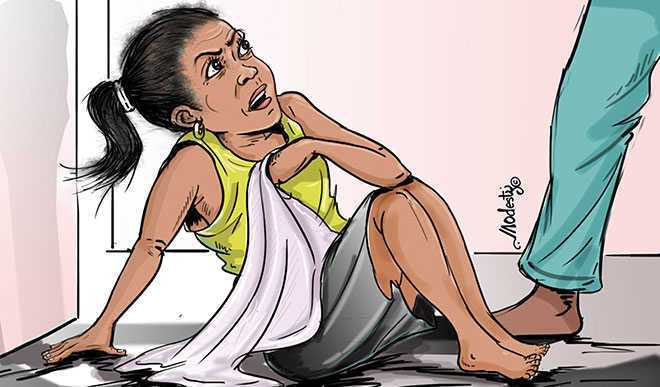
DESPITE the prevalence of sexual harassment in schools and other places in Nigeria, a bill seeking to criminalise the act from teachers against students, especially in tertiary institutions, is yet to get past the National Assembly eight years after it was first introduced.

October 2019 was the second time that former Deputy Senate President Ovie Omo-Agege would re-introduce a bill seeking to criminalise sexual harassment against students.

The bill, titled “Sexual Harassment in Tertiary Education Institution Prohibition Bill,” was first introduced in 2016, sponsored by Omo-Agege and 57 other senators in Nigeria’s Eighth National Assembly.

It proposed jail terms for educators, especially in tertiary institutions, found guilty of sexually harassing their students.

In 2017, the Senate passed the bill and transmitted it to the House of Representatives for concurrence.

However, it was rejected by lawmakers in the House of Representatives for not being comprehensive enough.

At the time, it was also opposed by the Academic Staff Union of Universities (ASUU) whose leadership said it would undermine the autonomy of tertiary institutions.

The then Speaker of the House of Representatives, Femi Gbajabiamila, now Chief of Staff to Nigerian President Bola Tinubu, had said other institutions, such as workplaces and religious organisations, should be captured in the bill. With the support of other lawmakers, the bill was stepped down.

Two years later, the British Broadcasting Corporation (BBC) released a documentary exposing two lecturers of the University of Lagos for sexual harassment, and shortly after, the bill was re-introduced by Ovie-Agege and 106 other senators.

It was passed again by the Senate in 2020 and eventually by the House of Representatives in 2022. By 2023, both chambers of the National Assembly jointly passed the bill.

However, a new Assembly was inaugurated about a week after, and for the current president, Tinubu, to grant assent, it has to be re-introduced and passed, like all other bills not assented to before the dissolution of a previous Assembly.

A prevalent menace in schools

Sexual harassment has remained a recurrent issue in Nigerian universities and other institutions such as workplaces, homes and even worship centres.

In August 2023, a lecturer at the University of Calabar (UNICAL), who was also the Dean of Law Faculty, Cyril Ndifon, was suspended by the institution following a protest by his students, alleging that he had subjected them to various forms of sexual harassment.

He had been suspended for similar reasons in 2015 after a final-year student accused him of raping her in his office.

He is currently being prosecuted by the Independent Corrupt Practices and Other Related Offences Commission (ICPC) before a Federal High Court in Abuja.

Following the protests that led to Ndifon’s arrest and prosecution, lecturers in other institutions have also been indicted for sexually harassing students.

In September 2023, a lecturer at the University of Lagos (UNILAG), Kadiri Akeem Babalola, was accused of raping a 20-year-old female student.

Although the Lagos State Police Command confirmed that he would be arraigned in court following the allegations, it has failed to provide an update on the case.

A survey carried out by the World Bank in 2018 showed that classmates and lecturers sexually harassed 70 per cent of Nigerian female graduates as students.

“The effects experienced by victims were depression and perceived insecurity on campus,” the report stated.

There have also been reported cases of sexual harassment in primary and secondary schools.

In 2022, a mother called out a secondary school in Lagos, Chrisland Schools, over the rape of her daughter, a student at the institution. She stated that Chrisland authorities deliberately kept the incident from her knowledge and instilled fear in her daughter to keep her from speaking up.

In 2021, a student of Premier Academy in Lugbe, Abuja, Keren-Happuch Akpagher, died from complications she suffered after a condom and dead spermatozoa were discovered in her vagina.

A diabetic patient since she was nine, the condom left in her vagina resulted in a septic infection that later claimed her life.

While her mother insisted that the deceased was raped while in school custody, authorities of Premier Academy refute the allegations.

According to a report, sexual harassment is forcing many Nigerian girls out of secondary schools, contributing to the already alarming figure of girls out of school.

CSOs advocate for timely passage of sexual harassment bill

Several CSOs, including the Centre for Journalism Innovation and Development (CJID) and Gender Mobile Initiative (GMI), have called on the President and National Assembly to facilitate the bill’s timely passage.

During a press briefing in November 2023, the Executive Director at GMI, Omowunmi Ogunrotimi, said the absence of a dedicated legal framework criminalising the act in educational institutions undermined collective efforts to address it.

Speaking with The ICIR on Monday, March 25, she stated that the delay in reintroducing the bill to the National Assembly had been a major setback.

She noted that there had been conversations with legislators in relevant National Assembly committees who assured that the bill would be reintroduced soon.

Naira sustains gains as CBN sells $10,000 To BDCs at N1,251/$

AS the naira sustains gain against the dollar after months of uncertainties, the Central Bank of Nigeria (CBN), on Monday,  March 25, announced the sales of $10,000 to each of the eligible Bureau De Change (BDC) operators in the country at the rate of N1,251/$1.

In a circular to the President of the Association of Bureau De Change Operators of Nigeria on Monday, the apex bank said the BDCs are to sell to eligible end users at a spread of not more than 1.5 per cent above the purchase price.

The circular was signed by the bank’s Director of Trade and Exchange Department, Hassan Mahmud.

Read Also:

The CBN warned that “any BDC that breaches the above terms shall be sanctioned appropriately, including outright suspension from further participation in the sale”.

The apex bank had, on March 1, 2024, revoked the licenses of 4,173 BDCs over compliance failures.

Nigeria is battling rising inflation, food inflation, forex crisis, economic hardship, and high cost of living occasioned by the removal of petrol subsidies, attracting protests in parts of the country.

The naira has dipped in the last nine months since President Bola Tinubu’s administration collapsed the foreign exchange window.

The naira experienced an all-time low, falling from about N700/$1 in May 2023 to about N2,000/$1 in February 2024 before its appreciation in March.

The authorities have since focused on cryptocurrency websites like Binance, accusing them of speculation and clamping down on them through telecommunication companies.

Industry analysts lauded the move by the government but urged the government to pay attention to exports to sustain long-term gains of the naira against the dollar.

They argued that if the government failed to apply long-term measures to the naira gains, it could risk depletion of the reserve.

“This is why the naira is gaining. The CBN is selling at N1,251, so no trader locks in large transactions above N1,251.In essence, the naira has floated, but the CBN is intervening to strengthen the naira by selling its FX reserves to BDCs at a price below the willing buyer/ willing seller price. Implementations? The naira will gain value, but FX reserves are paying for it,” an economist, Kalu Aja, said while reacting to the development.

He further argued that the intervention is a band-aid, adding,” The CBN is attempting to fix a problem it can’t fix without a huge war chest of FX reserves. The long-term fix is to export.”

The ICIR  reported the BDCs’ suggestions that the naira could only sustain gains against the dollar by sustaining liquidity in the foreign exchange market.

Kalu, however, insisted that foreign reserves could be depleted if Nigeria’s exports are not intense enough to sustain supply to the dollar market.

“If you want a strong naira, you export more,” he stressed.

A former Deputy Governor of the apex bank, Kingsley Moghalu, stressed the importance of exports to strengthen the naira.

He said, “The sooner we focus on the painstaking creation of a value-added manufacturing export economy that earns forex beyond oil in real and significant terms, the better. Key to this is the electricity conundrum in which we are at less than 4,000 megawatts of generation for a population of 200 million for decades now.”

On Thursday, March 21, the naira gained N18 to close at 1,382/$ at the official market, continuing its consistent upward trend against the US dollar.

The local currency saw significant gains at the official and unofficial foreign exchange exchanges the day before. On Wednesday, March 20, it closed at N1,400 per dollar at the black market.

FG invites Gumi for questioning, says ‘he’s not above law’

0

THE Federal Government has invited Kaduna-based Islamic cleric Ahmad Gumi for questioning over his comments on bandits activities in Nigeria.

While addressing journalists at the State House, Abuja, on Monday, March 25,  the Minister of Information and Orientation, Mohammed Idris,  said the government had deemed it necessary to invite him for questioning.

He noted that the controversial cleric was not above the law, adding that he would be reprimanded if the government saw his comments as reckless.

“The government will stop at nothing to get any kind of information that is required to solve our problems. The security agencies are up and doing.

“Sheikh Gumi and any other individual are not above the law; if he has suggestions that are good enough and that are constructive enough for the security agencies to take, they will take. But if they think that he is also making some statements that appear to be reckless, he will also be reprimanded.

“There is nobody above the law. Let me put it here. And I’m aware that he has also been a guest of security agencies to answer questions. When you make remarks, especially those that border on our national security, it is incumbent on our national security to think further, and they are doing just that. No one is above the law,” he added.

He, however, reiterated that no ransom was paid for the release of the abducted students in Kuriga LEA School in Chikun Local Government Area, Kaduna State.

The Federal Government’s invitation came a few days after Gumi appealed to the Federal Government to dialogue with the bandits who abducted schoolchildren as a way of rescuing them.

Gumi, in a statement on Monday, March 11, also urged Tinubu not to repeat the ‘mistake’ made by former President Muhammadu Buhari, who refused to dialogue with bandits during the many abductions that took place under his watch.

The ICIR, on Thursday, March 7, reported how the assailants invaded the schools and kidnapped over 100 children, alongside some staff of the school.

While the military confirmed that all the 137 abductees, comprising 76 females and 61 males, within eight and 15 years, had been rescued, there was growing concern as to whether the government paid ransom to the bandits.

Previously, Gumi has acted as a negotiator between the Nigerian government and terrorists whose hideouts he had visited in different states with the sacked Executive Secretary of the National Health Insurance Scheme (NHIS), now the National Health Insurance Authority (NHIA), Usman Yusuf, a professor.

Gumi had also called for dialogue with the terrorists on several occasions, saying that terrorists had taken up arms due to government neglect and injustice and that they did so in self-defence.


READ ALSO:


He predicted that the country would be peaceful if terrorists were granted free education and basic amenities. He also warned against using the military approach to address insecurity in the North, recommending that amnesty be granted to them.

A day after bandits were declared terrorists in Nigeria, Gumi had described the decision as an exercise in futility.

“The decision by the government will not have any practical value because even before the declaration, they had been fought and treated as terrorists. So it is just a nomenclature which I believe will not change the dynamics on the ground,” he had said.

NSA confirms escape of Binance executive from custody 

0

THE Office of the National Security Adviser (ONSA) has confirmed the escape of a Binance regional manager for Africa, Nadeem Anjarwalla, from custody.

In a statement signed by the head of strategic communication at the ONSA, Zakari Mijinyawa, the Office said a preliminary investigation showed that Anjarwalla fled Nigeria using “a smuggled passport”.

“The personnel responsible for the custody of the suspect have been arrested, and a thorough investigation is ongoing to unravel the circumstances that led to his escape from lawful detention,” the statement said.


Read Also:

According to a Premium Times report published on Monday, the Binance executive fled a guest house where he and his colleague were kept in Abuja on March 22.

Anjarwalla allegedly escaped after being brought by the on-duty guards to a nearby mosque for prayers in observance of the current Ramadan fast.

He reportedly took a Middle East aircraft out of Abuja. However, it is unclear how he left on an international flight, given that the Nigerian government had seized his only passport – the British passport on him when he was arrested.

The ONSA stated that in response, The NSA office moved quickly to capture the suspect, working with ministries, departments and agencies, other pertinent security authorities, and the international community.

“Until his escape, Nadeem Anjarwalla, who holds British and Kenyan nationalities and serving as Binance’s Africa regional manager, was being tried by Nigerian courts,” the statement added.

The office added that the suspect escaped while under a 14-day remand order by a court in Nigeria and was scheduled to appear before the court again on April 4 2024.

The NSA urged the Nigerian public and the international community to provide whatever information they have that could assist law enforcement agencies in apprehending the suspect.

Recall that the Nigerian government arrested two of Binance’s top executives on February 28. 

Anjarwalla, a 37-year-old British Kenyan who serves as Binance’s regional manager for Africa, and Tigran Gambaryan, a 39-year-old US citizen who oversees Binance’s financial crime compliance, were both employed by Binance.

The ONSA seized their passports after they were arrested.

The ICIR reported on Monday, March 25, that the Federal Government, through the Federal Inland Revenue Service (FIRS), filed criminal charges against Binance at the Federal High Court in Abuja.

The Special Adviser on Media to the Executive Chairman of the FIRS, Dare Adekambi, announced the lawsuit marked FHC/ABJ/CR/115/2024 on Monday, March 25.

The charges accused Binance of a four-count tax evasion.

FIRS stated that the action was intended to protect Nigeria’s economic integrity and maintain budgetary sustainability.

Anjarwalla, who has now escaped from custody and Gambaryan were joined in the suit as the second and third defendants.

Binance is facing charges related to not paying value-added tax (VAT) and company income tax, not filing tax filings, and assisting consumers in avoiding taxes by using its platform.

The ICIR reported on Monday, March 18, that a Federal High Court in Abuja ordered Binance to provide data on its Nigerian users to the EFCC.

The judge, Emeka Nwite, gave the interim order after ruling on the ex-parte motion moved by the EFCC’s lawyer, Ekele Iheanacho.

The application was filed on February 29.

An EFCC agent, Hamma Bello, stated in the affidavit supporting the motion that he was a member of the commission’s Special Investigation Team (SIT) based in the Office of the National Security Adviser (ONSA).

Bello argued that the information would help the panel complete its inquiry and that the issue was of public interest.

The ICIR reported on March 5 that Binance pulled its services out of Nigeria.

The platform asked Nigerians trading on it to remove all their naira assets, indicating that it was terminating its services in the country.

The Federal Government has been taking harsh measures against Binance management recently. 

In response to the severe actions taken against it by the Nigerian government, Binance, on Tuesday, March 5, deleted all assets linked to the naira.


British Council offers international collaboration grants for literature, others

THE British Council is accepting applications for International Collaboration Grants from organisations worldwide with a focus on film, literature or visual arts.

The grant programme supports UK and international organisations in working together on digital, face-to-face, and/or hybrid artistic projects.

With the grant, media artists make and develop creative artwork with their international peers and encourage new international partnerships and innovative ways of collaborating.

Read Also:

Applications must demonstrate genuine international collaboration and an explicit benefit to individual artists and international partners. Projects should address any theme, and applicants must share their approach to diversity, inclusion and environmental sustainability in the delivery of their projects.

The International Collaboration Grants encourage new bilateral and multilateral partnerships, providing funding to enable organisations to make and develop creative artwork with their international peers and help individual artists find innovative ways of collaborating.

Available grants range between £25,000 and £75,000.

The deadline for application is April 30,

Iinterested applicants can apply here.

Tax evasion: Nigerian Government files charges against Binance

THE Federal Government, through the  Federal Inland Revenue Service (FIRS), has filed criminal charges against a leading cryptocurrency exchange platform, Binance, at the Federal High Court in Abuja.

The Special Adviser on Media to the Executive Chairman of the FIRS, Dare Adekambi, announced the lawsuit marked FHC/ABJ/CR/115/2024 on Monday, March 25.

The charges accuse Binance of a four-count tax evasion.


Read Also:

FIRS stated that the action was intended to protect Nigeria’s economic integrity and maintain budgetary sustainability.

Two senior officials of Binance who are now in the custody of the Economic and Financial Crimes Commission (EFCC), Tigran Gambaryan and Nadeem Anjarwalla, were also joined in the suit as the second and third defendants.

Binance is facing charges related to not paying value-added tax (VAT) and company income tax, not filing tax filings, and assisting consumers in avoiding taxes by using its platform.

In the lawsuit, the Federal Government also charged Binance with breaking national tax laws and failing to register with FIRS for tax purposes.

The suit claims Binance failed to collate and remit different kinds of taxes to the federation, as required by Section 40 of the FIRS Establishment Act 2007 as modified.

The suit also lists specific instances in which Binance was alleged to have broken tax regulations, including neglecting to produce invoices for VAT reasons, which prevented subscribers from determining and paying their taxes.

Meanwhile, according to a media report, Nadeem Anjarwalla, one of the two Binance executives held in Nigeria on suspicion of tax evasion and other offences, has fled from detention.

The Federal Government took the two top Binance executives into custody in February.

A Premium Times report claims that Anjarwalla and his colleague were being held at a guest home in Abuja, where Anjarwalla managed to escape on Friday, March 22.

The ICIR reported on Monday, March 18, that a Federal High Court in Abuja ordered Binance to provide data on its Nigerian users to the EFCC.

The judge, Emeka Nwite, gave the interim order after ruling on the ex-parte motion moved by the EFCC’s lawyer, Ekele Iheanacho.

The application was filed on February 29.

An EFCC agent, Hamma Bello, stated in the affidavit supporting the motion that he was a member of the commission’s Special Investigation Team (SIT) based in the Office of the National Security Adviser (ONSA).

Bello said that the SIT was notified of the illicit activities (money laundering and financing of terrorism) of Binance after the ONSA established the Technical Committee on Currency Stability and Forex Manipulation.

Bello argued that the information would help the panel complete its inquiry and that the issue was of public interest.

The ICIR reported on March 5 that Binance pulled its services out of Nigeria.

The platform asked Nigerians trading on it to remove all their naira assets, indicating that it was terminating its services in the country.

The Federal Government has been taking harsh measures against Binance management recently. 

In response to the severe actions taken against it by the Nigerian government, Binance, on Tuesday, March 5, deleted all assets linked to the naira.


Nigeria hauls 121 medals at 13th African Games

0

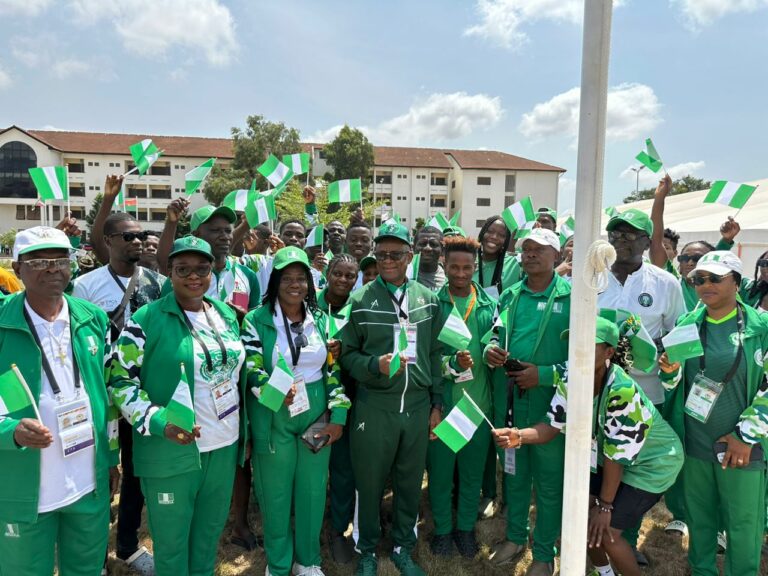
TEAM Nigeria recorded 121 medals to finish second on the medals table at the 13th African Games held in Ghana.

Compared with the previous edition in 2019, the awards were short of nine, that is, 130 medals won in the previous edition held in Rabat, Morocco in 2019, The ICIR check shows.

The continental multi-sports showpiece, which began on Friday, March 8 and ended on Saturday, March 23, saw a high-level display of skills among 45 countries that participated in the Games.


Read Also:

African Games: Tobi Amusan wins third consecutive gold medal in 100m hurdles 

African Games: Nigeria wins nine gold in weightlifting 

African Games: Nigeria U-20 suffer 1-2 defeat to Uganda


Results of the countries on the medals’ table showed Egypt’s continuous dominance of the Games as they won 102 gold, 47 silver and 42 bronze to top the table with 191 medals while Nigeria finished behind with 47 gold, 34 silver and 40 bronze to record 121 medals.

Team Nigeria participated in 23 sports at the edition, including arm-wrestling, badminton, athletics, basketball 3×3, beach volleyball, boxing and chess.

Others are cricket, cycling, football, handball, hockey, judo, karate, rugby, swimming, table tennis, taekwondo, tennis, triathlon, volleyball, weightlifting and wrestling.

The ICIR reports that Team Nigeria won medals in 18 out of the 23 sports it participated in.

Team Nigeria, with a total of 437 athletes won medals in arm wrestling (13), athletics (22), badminton (six), basketball (one), beach volley (one), boxing (10), chess (two), cricket (one), cycling (two), football (one), handball (one), hockey (one), Judo (one), swimming (one), table tennis (six), taekwondo (six), tennis (two), weightlifting (32), wrestling (11).

Meanwhile, Team Nigeria participated in 22 sports with 306 athletes to win 130 medals from 13 sports in 2019.

Finishing second has now become our target – Sports analyst

In an interview with The ICIR, a sports analyst, Lekan Okusan, described Team Nigeria’s performance in Ghana as below par, noting lack of adequate preparation as the reason for the country’s underperformance.

“In general, Nigeria did very well but we could have done better if our athletes had enough preparation coupled with motivation before the games. Finishing second has now become our target, whereas we should be aiming for the top spot considering our pedigree and our athletes’ quality.

“We are not improving but just accept our faith as second fiddle,” he said.