Home Blog Page 657

NDLEA intercepts ‘largest’ consignment of heroin at Lagos Airport

0

THE National Drug Law Enforcement Agency (NDLEA) said it had intercepted the single largest consignment of heroin at the Murtala Muhammed International Airport (MMIA) Ikeja, Lagos State.

The agency also said it arrested some members of the cartel who own the drugs.

According to the agency, the group specialises in trafficking heroin across Nigeria, South Africa, Mozambique, Europe and America.

The arrests were successfully carried out after a sting operation that lasted for 12 days.


Read Also:

The NDLEA Chairman, Buba Marwa, stated these in Lagos State on Tuesday, February 27, while briefing journalists.

He said, “The consignment was concealed in 15 cartons of 2300-watt metal cutting machines. Each carton was stocked with three blocks of high-grade heroin. In total, we recovered 45 blocks of the illicit substance with a total weight of 49.70kg.

“After the discovery, we were methodical and meticulous in our investigations. We started with the arrest of the freight agent named Olowolagba Wasiu Babatunde. It turned out that he was hired for clearing services by Mattpee Logistics, a company operated by one Mr. Kola, a resident of South Africa.

“Next, we conducted a follow-up operation at the company’s warehouse in the Shogunle area of Oshodi, Lagos, and arrested the warehouse manager, Ajayi Imole Moses,” Marwa stated.

He explained further that an ambush was carried out for the expected receiver of the consignment, who was arrested when he showed up for collection.

According to the chairman, the receiver, named Adinnu Felix Chinedu, confessed during interrogation that he was the leading distributor for a drug syndicate whose membership is spread across Nigeria.

“He admitted that he usually conveyed the consignment to a dedicated warehouse located in Ayobo. That place served as a workshop where he would dismantle the consignment and remove the drugs from the machines. Thereafter, he would wait for a list of various recipients to be forwarded to him from South Africa by the head of the criminal group,” Marwa added.

He said the NDLEA operatives did due diligence by conducting a thorough search of the warehouse, which led to the recovery of 56 similar cartons of the cutting machines that were used previously to conceal and move heroin into Nigeria.

“In the end, we were able to identify the kingpin of the syndicate here in Nigeria and his name is Reginald Peter Chidiebere. Our investigations showed that he owns the Golden Platinum Hotel and Suite, located at 16 Reginald Peter Chidiebere Street, Hope Estate, Ago Palace.”

The NDLEA boss said several days of surveillance on the hotel culminated in a raid operation on Monday, February 19, in which another drug lord, Igboanugo Chukwuebuka Thankgod, was found in possession of two parcels of 2.2kg heroin with codes similar to the ones found on the seized drug shipment, bringing the total seizure to 51.90 kilogrammes.

Protesters storm National Assembly over high cost of living

0

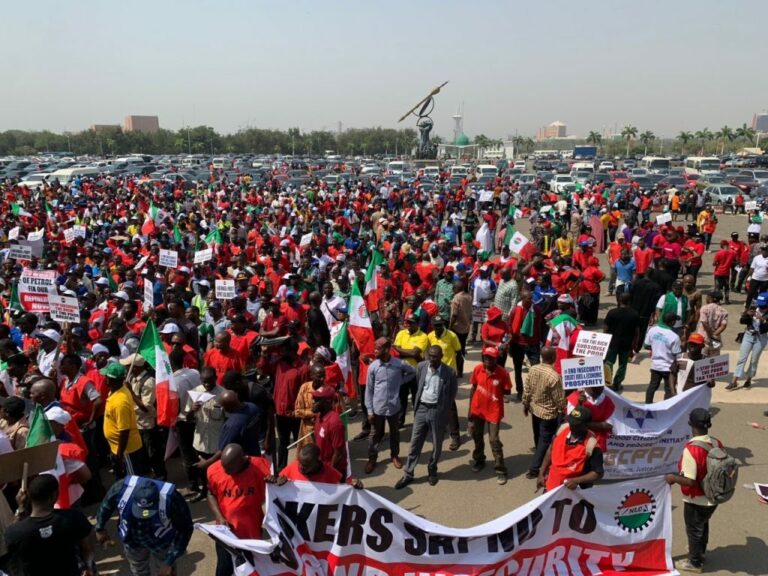
PROTESTERS under the aegis of the Nigeria Labour Congress (NLC) have stormed the National Assembly Complex in Abuja to express their discontent with economic hardship and the rising cost of living in Nigeria.

The protesters chanted and displayed different placards as they bemoaned the economic situation in the country.

Earlier today, The ICIR reported that the NLC members in Lagos, Kaduna and Kano states hit the streets to protest against the worsening economic crises in the country.

Protesters in other states and Abuja also bemoaned daily increases in the prices of goods and the cost of living. They urged the government to take actions to alleviate the pains the crisis inflict on citizens. 

While filing this report, the protesters in Abuja were yet to be addressed the Senate leadership.

Read Also: 

Hardship: NLC protest kicks off in Lagos, Kaduna, Kano

The nationwide protest was at the heels of the labour meeting with the Federal Government on Monday, February 26, which ended in a deadlock.

The NLC president, Joe Ajaero, after the meeting with the government representatives, said, “The rally goes on and it is part of their constitutional responsibility to ensure that the rally is peaceful.”

NLC protest is about hunger, not minimum wage – Ajaero 

Meanwhile, the President of the NLC Joe Ajaero, said the nationwide protest being held across the country was not about the pending minimum wage but ravaging hunger across the nation.

Ajaero stated this on Tuesday at the commencement of the protest in Abuja, Nigeria’s capital.

“There’s absolute hunger. You say we should not say we are hungry, so we should keep quiet and die. We say no; that’s why we’re coming out. 

“The UN said that the poorest man should be fed on $2.00 per day. That’s the poorest, and if you have a family of six people at $2.00 per day, multiplied by six is $12.00. In a month, you have $360.00, which translates to about 700,000 naira. Is that the minimum wage you are talking about? I’m not talking about transportation or medical,” Ajaero said. 

Ajaero said the workers had told the government what to do as a short-term solution to the hardship.

He also said there had been hunger in the country before the present administration took over but it was not as bad as currently witnessed across the nation.

Ajaero further accused the Federal Government of playing politics with issues affecting the vast majority of citizens and diverting money for cash transfers into private accounts.

NLC protest is about hunger, not minimum wage – Ajaero 

0

THE President of the Nigerian Labour Congress (NLC), Joe Ajaero, has said the nationwide protest being held across the country today Tuesday, February 27, and Wednesday, February 28, is not about the pending minimum wage but ravaging hunger across the nation.

Ajaero stated this on Tuesday at the commencement of the protest in Abuja, Nigeria’s capital.

“There’s absolute hunger. You say we should not say we are hungry, so we should keep quiet and die. We say no; that’s why we’re coming out. 


Read Also:

“The UN said that the poorest man should be fed on $2.00 per day. That’s the poorest, and if you have a family of six people at $2.00 per day, multiplied by six is $12.00. In a month, you have $360.00, which translates to about 700,000 naira. Is that the minimum wage you are talking about? I’m not talking about transportation or medical,” Ajaero said. 

Ajaero said the workers had told the government what to do as a short-term solution to the hardship. 

He said there had been hunger in the country before the present administration took over but it was not as bad as currently witnessed across the nation.

“There was hunger in the land, but it wasn’t this bad until deregulation. And then, after the deregulation, we proposed all that we needed to. If they had solved the problem of transportation immediately, they would have solved almost 50 per cent of the problem,” he argued.

He accused the Federal Government of playing politics with issues affecting the vast majority of citizens and diverting money for cash transfers into private accounts.

He claimed that no state government had paid wage awards. He also blamed food scarcity in the country on insecurity.

He said Nigeria could not attain sufficiency in food supply when farmers could not go to farms due to bandit attacks. 

The ICIR reported that the NLC declared a two-day nationwide mass protest for February 27 and 28 over the worsening hardship in the country.

Ajaero announced this at the Labour House headquarters in Abuja during an emergency press conference on Friday, February 16.

He said the decision to protest was made after the expiration of the 14-day ultimatum issued to the Federal Government over hardship across the country.

Meanwhile, the Federal Government failed to persuade the NLC to suspend its planned nationwide protest.

At a meeting on Monday night, the NLC, the Trade Union Congress (TUC), and other labour leaders met with the government’s team, led by the Secretary to the Government of the Federation.

After the meeting ended in a deadlock, Ajaero announced that the union would proceed with its planned nationwide protest.


Hardship: NLC protest kicks off in Lagos, Kaduna, Kano

0

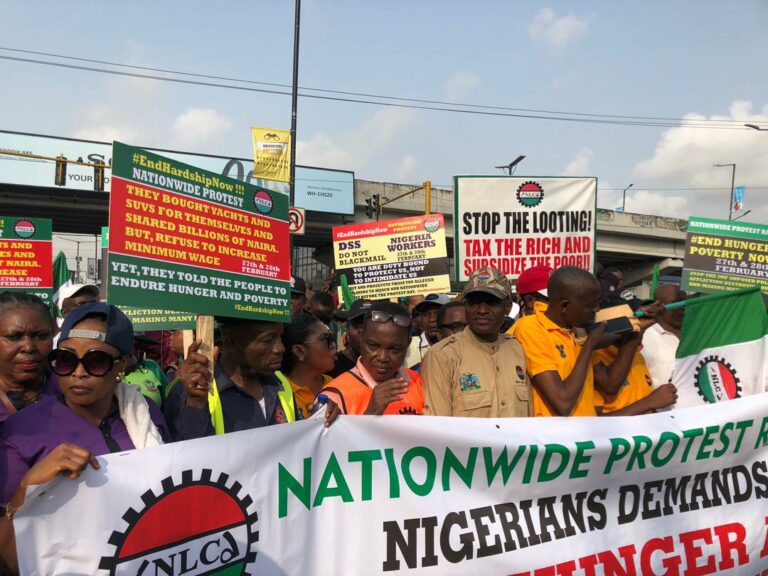
THE Nigerian Labour Congress (NLC) members in Lagos, Kaduna and Kano states have hit the streets to protest against the worsening economic crises in the country.

The protesters, who held placards with different inscriptions, bemoaned daily increases in prices of goods and the cost of living.

Some of the inscriptions on the placards read: “A bag of rice is more than our minimum wage. “We are dying,” “End Insecurity Now,” “Let the poor breathe,” and “Must we all die before you know the country is hard.”

The protesters called on the government to end hunger and poverty ravaging the nation.

They also urged President Bola Tinubu’s administration to stop the importation of petrol and fix the country’s refineries. 

Read Also: Groups protest against economic hardship in Lagos, Edo, Osun

In Kaduna State, labour union members proceeded from the NLC secretariat on a street protest, marching along the popular Independence Way in Kaduna, the state capital, according to the live update by Channels TV.

While calling on the government to urgently address the rising inflation, high cost of food and other items and insecurity, the protesters noted that not even a threat by the government could deter them from registering their displeasure over the poor economic situation in the country. 

Similarly, some women, alongside other NLC members, gathered at the Race Course in Kano to protest against hardship.

Displaying various placards, they tasked the government to “stop robbing the poor and tax the rich.”

They also disagreed with the student loan being implemented by the Tinubu administration and urged the government to offer free education to citizens.

Besides, they called on the government to “save the naira and stop the collapse of industries.”

In Lagos State, the NLC members were on a peaceful protest in Ikeja amid heavy security presence.

The protesters joined other Nigerians to condemn the country’s precarious economic situation and challenged the government to find a lasting solution to the crisis.

The nationwide protest was at the heels of the meeting the labour had with the Federal Government on Monday, February 26, which ended in a deadlock.

The NLC president, Joe Ajaero, after the meeting with the government representatives, said, “The rally goes on and it is part of their constitutional responsibility to ensure that the rally is peaceful.”

The meeting, which was hosted by the Secretary to the Government of the Federation, George Akume, had in attendance the Attorney General of the Federation, Lateef Fagbemi; Ministers of Labour, Agriculture, Finance, Budget & Planning and the Head of Service of the Federation.

[OPINION] Nigeria’s student loan: Taking off without a base?

0

By Zikora IBEH

SINCE late last year, the launch of the student loan initiative has experienced multiple deferrals, with state authorities announcing its commencement at no fewer than three different times,  with the most prospective date—as stated by its sponsor and Chief of Staff to the President, Femi Gbajabiamila—now being in a few weeks’ time.

In the interim, significant alterations have been made to the legislative framework of the scheme under the Students Loans (Access to Higher Education) Act, 2023. For instance, President Tinubu has gone ahead to instruct the Nigeria Education Loan Fund (NELFUND) management to broaden the scheme’s coverage to accommodate students interested in skill development programmes.    

The stringent eligibility criteria initially required by the Act for student loan applicants, which includes securing two guarantors of notable professional standing, and falling under a specific income threshold, have also been relaxed, according to media reports.


Read Also:


Previously, the Act mandated potential loan beneficiaries to supply at least two guarantors in the form of civil servants at or above grade 12, lawyers with a decade of post-call experience, judicial officers or justices of peace. This raised concerns about how the criterion may exclude many deserving indigent applicants due to their lack of extensive social networks or high-status connections. Now according to the statements by the NELFUND, these requirements have been reviewed such that the entirety of the process will be technologically driven with applicants only required to upload their details on a dedicated website.  

If nothing, these delays and adjustments underscore the complex task of melding the policy into a viable framework, amid considerable doubts expressed about its workability by stakeholders in the education sector. Regrettably, the process of the student loan policy amendment has been so far shrouded in secrecy with information regarding the specifics of the revised policy limited to sporadic media reports citing statements from legislators, the presidency, and the NELFUND management.  

For the record, it is imperative to note the House of Representatives’ (HOR) response to public criticism of the flawed student loan policy framework. Reactions to the legislation necessitated the HOR to set up an Ad-hoc Committee tasked with obtaining feedback from the public and making recommendations for strengthening the policy. The Committee’s engagement with stakeholders, on August 15, 2023, at a one-day legislative summit on the issue, laid bare the manifold shortcomings of the legislation, culminating in decisive recommendations for its repeal and re-enactment, aimed at harmonising and rectifying the identified discrepancies.  

Despite news reports suggesting that troubling provisions of the policy have been reviewed, the absence of a publicly accessible document delineating these modifications casts a shadow of uncertainty over the entire reform process. This opacity has left stakeholders adrift in a sea of conjecture, uncertain whether the legislation was repealed, amended, remains untouched in its problematic form or if the changes made may also not have introduced new issues that require scrutiny.

Against this backdrop, a pressing question arises: on what basis is the initiative set to launch, apparently circumventing essential democratic processes crucial for ensuring its legitimacy and the public participation that is critically important for its validation?  

Unresolved issues?  

Beyond the ambiguity that shrouds the amended or re-enacted student loan framework, a critical question remains unanswered: will the scheme effectively tackle deep-seated issues afflicting the educational sector, such as funding deficits, the mass exodus of teaching talents, the dearth of research facilities, frequent staff strikes, inadequate staff remuneration, and the dilapidation of learning and hostel facilities? These factors critically impact the quality of student learning experiences and are structural problems that cannot be wished away by the student loan.

Even so, the student loan framework conspicuously lacks mechanisms for grievances—vital for upholding students’ rights to obtain tangible value from their loans and for voicing concerns when educational outcomes do not meet expectations. As such, the scheme falls short of facilitating the holistic improvement of tertiary education in Nigeria, thereby undermining its potential to enhance students’ academic experiences and development.   

In the final analysis, what the Nigerian government must undertake is a fundamental recalibration— a return to the basics of adequately funding the educational sector to unlock its full potential. While interventionist initiatives like the student loan fund may present an appealing façade, they scarcely tackle the root causes that have perennially constrained the educational system. This systemic oversight elucidates one of the reasons why the Academic Staff Union of Universities (ASUU) has persistently rejected the loan scheme, and recently refused to seat on the management board governing the loan scheme.  

Despite the challenges existent in its tertiary sector, Nigeria has the potential to nurture world-class university centres if state authorities commit to a sustained investment in education. If the government has the capacity to allocate funds to the student loan scheme from its various national coffers—tax income and profits—it undoubtedly possesses the capability to enhance funding for the educational sector.  

Persistent underfunding has been identified as a critical barrier within the educational sector, with Nigeria continually failing to meet the global recommended funding benchmark of 26 per cent of the national budget to education.

In 2024, the sector’s allocation was a mere N2.18 trillion, representing only 7.9 per cent of the national budget. An upward review of the budgetary allocation to education is imperative for the radical transformation of the landscape. A substantial injection into the system will not only effectively address entrenched issues that have historically undermined the sector, but also foster academic environments where emphasis is placed on quality over quantity. Ultimately, this strategic approach will guarantee the production of well-rounded individuals equipped with the necessary skills to advance society, rather than merely churning out graduates who have attended school without benefitting from a transformative educational experience.   

Zikora Ibeh is a Policy & Research Officer at transparency watchdog Corporate Accountability and Public Participation Africa (CAPPA). 

UPDATED: FG releases MDAs to scrap as Tinubu orders Oronsanye report’s implementation

0

PRESIDENT Bola Tinubu has approved the implementation of the Stephen Oronsaye report, which recommended scrapping and merging Federal Government agencies.

The Minister of Information and National Orientation, Mohammed Idris, stated this while briefing State House correspondents after the Federal Executive Council meeting in Abuja on Monday, February 26.

One of the President’s media aides, Bayo Onanuga, also said in a post on X, shortly after the meeting that the directive aimed at a “leaner government.”

The directive came barely seven months after the President formed the biggest-ever cabinet in the country with 48 ministers and dozens of aides who are remunerated with the country’s lean resources.

The ICIR reports that fears had grown among workers because of possible job losses given the duplication of responsibilities by some Federal Government agencies since the Oronsaye team presented the report.

For instance, the Independent Corrupt Practices and Other Related Offences (ICPC) does almost the same jobs as the Economic and Financial Crimes Commission (EFCC). The two institutions have hundreds of workers.

The report recommended their merger.

Similarly, the report recommended that the Nigeria Television Authority (NTA), Federal Radio Corporation of Nigeria (FRCN), and the Voice of Nigeria (VON) should be merged. These are in addition to several other agencies of the Federal Government that will be scrapped or merged.

If implemented,  the Federal Government’s 263 statutory agencies as of 2012 could be reduced to 161, making 102 heads of those agencies lose their jobs.

The report, submitted to the Federal Government in 2012, caught the attention of the three presidents that have led the nation between 2012 and now. They are former presidents Goodluck Jonathan and Mohammadu Buhari, and the incumbent Tinubu.

Jonathan and Buhari had at different times considered its implementation but failed.

The former set up the committee in 2012 and named it “The Presidential Committee on the Rationalisation and Restructuring of Federal Government Parastatals, Commissions and Agencies”, with former Head of Service of the Federation, Steve Oronsaye heading it.

The Minister of Information and National Orientation, Mohammed Idris, while speaking to the State House correspondents said the decision by Tinubu to merge the MDAs was in the interest of Nigerians.

“So in a very bold move today, this administration, under the leadership of President Bola Ahmed Tinubu, consistent again with his courage to take very far-reaching decisions in the interest of Nigeria, has taken a decision to implement the so-called Oronsaye Report.⁣

“Now, what that means is that a number of agencies, commissions, and some departments have actually been scrapped. Some have been modified, and marked while others have been subsumed. Others, of course, have also been moved from some ministries to others where the government feels they will operate better,” Idris said.

Similarly, Onanuga noted that the President and the Federal Executive Council had decided to implement the report.

“Twelve years after the Steve Oronsaye panel submitted its report on restructuring and rationalising Federal Government parastatals and agencies and a white paper issued two years after, President Tinubu and the Federal Executive Council today decided to implement the report.

“Many agencies will be scrapped and many others will be merged, to pave the way to a leaner government,” he said.

The implementation involves merging, subsuming and scrapping agencies with similar functions.

According to Onanuga, an eight-man committee has a 12-week deadline to ensure that the necessary legislative amendments and administrative restructuring needed to implement the reforms are effected in an efficient manner.

The committee members include the Secretary to the Government of the Federation, Head of the Civil Service, Attorney General and Minister of Justice, Minister of Budget and Planning, Director-General Bureau of Public Service Reform, Special Adviser to the President on Policy Coordination, and Special Assistant to the President on National Assembly. 

The ICIR reports that the decision to implement the policy may not go down well with the Nigerian Labour Congress (NLC) and the Trade Union Congress (TUC) members who have scheduled two days of national protest for Tuesday and Wednesday, February 27 and 28 respectively to protest hardship in the country.

The workers are demanding better wages as the country’s minimum wage stands at N30,000.

Some MDAs listed for merger

Here are some of the recommendations released by the presidency Monday night.

  1. National Salaries, Income and Wages Commission to be subsumed under Revenue Mobilisation and Fiscal Commission. The National Assembly will need to amend the constitution as RMAFC was established by the Constitution.
  2. Infrastructure Concession and Regulatory Commission to be merged with the Bureau of Public Enterprise and be rechristened as `Public Enterprises and Infrastructural Concession Commission.
  3. National Human Rights Commission to accommodate Public Complaints Commission.
  4. The Pension Transitional Arrangement Directorate (PTAD) is to be scrapped and its functions are to be taken over by the Federal Ministry of Finance.
  5. National Emergency Management Agency (NEMA) and the National Commission for Refugees to be fused to become National Emergency and Refugee Management Commission.
  6. Border Communities Development Agency to become a department under National Boundary Commission.
  7. National Agency for the Control of AIDS (NACA) and the Nigeria Centre for Disease Control (NCDC) to be merged.
  8. SERVICOM to become a department under the Bureau for Public Service Reform(BPSR)
  9. NALDA to return to the Ministry of Agriculture and Food Security.
  10. Federal Ministry of Science to supervise a new agency that combines NCAM, NASENI and PRODA.
  1. National Commission for Museums and Monuments and National Gallery of Arts to become one entity that will be known as the National Commission for Museums, Monuments and Gallery of Arts.
  2. National Theatre to be merged with National Troupe.
  3. Directorate of Technical Cooperation in Africa and Directorate of Technical Aid Corp to be merged under the Ministry of Foreign Affairs.
  4. Nigerians in Diaspora Commission to become an agency under the Ministry of Foreign Affairs.
  5. Federal Radio Corporation and Voice of Nigeria to be one entity to be known as Federal Broadcasting Corporation of Nigeria.
  6. National Biotechnology Development Agency (NABDA) and National Centre for Genetic Resources and Biotechnology to be emerged into an agency to be known as National Biotechnology Research and Development Agency (NBRDA).
  7. National Institute for Leather Science Technology and National Institute for Chemical Technology to become one agency.
  8. Nigeria Natural Medicine Development Agency and National Institute of Pharmaceutical Research and Development to become one agency.
  9. The National Metallurgical Development Centre and National Metallurgical Training Institute will be merged.
  10. National Institute for Trypanosomiasis to be subsumed under the Institute of Veterinary Research in Vom, Jos.

 

CSO advocates hike of SSB tax from N10 to N130/litre

0

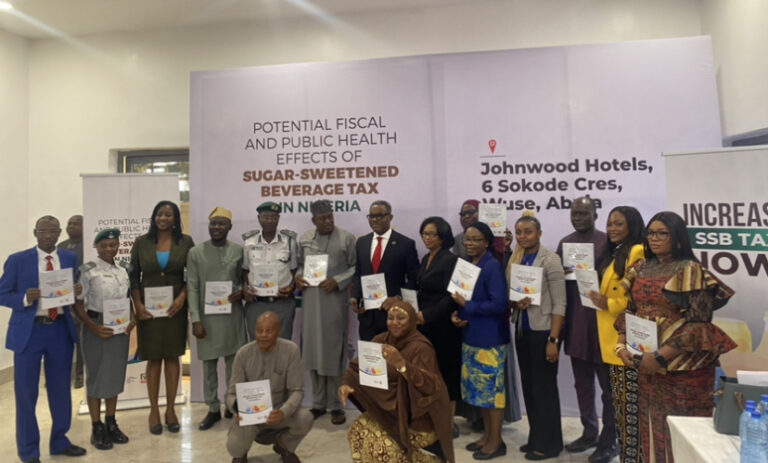
A CIVIL society organisation, Corporate Accountability and Public Participation Africa (CAPPA), has urged the Federal Government to fully implement and increase taxation on sugar-sweetened beverages (SSBs) to a minimum of N130/litre.

The organisation made the appeal at the public presentation of the simulation study of the “Potiential Fiscal and Public Health Effects of SSB tax in Nigeria,” on Monday, February 26, in Abuja.

SSB contains various forms of sugars, such as brown sugar, corn syrup, fructose, glucose, and honey and includes carbonated drinks, energy drinks, milk-based drinks, pre-sweetened teas, coffees and juice drinks. 

Speaking at the event, the Executive Director of CAPPA, Akinbode Oluwafemi, emphasised the need for a multisectoral, interdisciplinary, multiprong approach that combines policy engagement with public awareness, community mobilisation, and stakeholder consultation and engagement. 

While acknowledging the recent economic downturn in the country, the CAPPA boss noted that economists recommended that nations raise taxes on certain products that are considered not too critical during an economic crisis. 


Read Also:


Oluwafemi also explained that the increase in communicable disease cases in Nigeria correlated with the rise in consumption of SSBs, alcohol, tobacco, trans-fat, unhealthy levels of salt, and other non-nutritive diets that are injurious to the human body.

According to him, the burden of diseases in Nigeria has continued to impoverish Nigerians, noting that many spend the majority of their earnings on unhealthy diets.

He further stated that consuming unhealthy diets could lead to increased health costs.

“In a country with more than 80 per cent of her population paying for healthcare out-of-pocket, we must find a policy pathway that will effectively remove obstacles to good health and national productivity like modifiable risk factors of consumption-related diseases and other CDs (communicable diseases).

“The argument of the people who care more about their profit over public health on consumption needs does not outweigh the many benefits inherent in this tax. The damages done to families and loved ones who cater for the sick are enough motivation to see the public rally around the government in doing what is right for the general public,” he added.

Meanwhile, joined with other health stakeholders, CAPPA launched its extensive report on potential fiscal and public health on sugar-sweetened beverage tax in Nigeria.

The report was aimed at providing a comprehensive overview of SSB consumption patterns, their profound health implications, fiscal considerations, and policy recommendations to address the growing health and economic challenges stemming from SSB consumption in Nigeria.

Using a specialised survey administered by the Centre for the Study of the Economies of Africa (CSEA) in 2023 regarding the consumption of SSBs in Nigeria, the report commenced by analysing the trends in SSB consumption and uncovered significant disparities in gender and age.

Speaking on the report, Oluwafemi said the report was part of the organisation’s contributions in assisting the government to determine the most effective SSB tax rate in the country.

“Going by the current inflation rate, the N10 per litre imposed on SSBs in 2021 is today possibly worth less than four kobo because it was a fixed tax, not adjustable to inflation. In essence, the SSB tax needs to be increased significantly in the 2024 Fiscal Act, with a framework that is adjustable to inflation as we also begin the conversation about earmarking the tax or a sizeable portion of it for public health.

“While I will not preempt the discussion of the research team, the findings of this study have shown that at a minimum of N130/lite, we will see a significant drop in consumption and a decrease in Nigeria’s consumption-fueled diseases. I am further convinced that this document provides the government, including the executive and lawmakers, the much-needed data to pursue this policy pathway to a logical conclusion for the benefit of all,” he noted.

Supreme Court gets full complement as CJN swears in 11 justices

0

THE Supreme Court now has a full complement of 21 justices as the Chief Justice of Nigeria (CJN), Olukayode Ariwoola, has sworn in 11 new justices who add to the existing 10.

 At the judges’ swearing-in ceremony in Abuja on Monday, February 26, Ariwoola urged them not to allow their ambition to cloud their judgments.

He said it was impossible to please everyone, particularly litigants, adding that attempting to please everyone was the quickest path to failure in life. 


Read Also:

“The only deity you can fear is the Almighty God. Once your judgement is in consonance with what God expects from you and is also in accordance with the Constitution. You should consider yourself the happiest and freest person on earth,” he said.

Ariwoola told the new justices that their astuteness and dedication to hard work, which are the hallmarks of judicial excellence, were recognised by their promotion to the Supreme Court Bench.

With the swearing-in of the justices, the apex court now has its full complement of 21 justices as stipulated in the Constitution.

The new justices are Stephen Jonah Adah, Habeeb Adewale Abiru, Jamilu Yammama Tukur, Mohammed Baba Idris, Obande Festus Ogbuinya, and Abubakar Sadiq Umar.

Others are Jummai Hannatu Sankey, Moore Aseimo Adumein, Haruna Simon Tsammani, Chidiebere Nwaoma Uwa, and Chioma Egondu Nwosu-Iheme.

The ICIR reported that the Senate confirmed the appointment of 11 Supreme Court justices appointed by President Bola Tinubu on Thursday, December 21, 2023.

The confirmation followed the consideration and adoption of a report by the Senate Committee on Judiciary, Human Rights and Legal Matters at the plenary session.

On December 7, The ICIR reported that the National Judicial Council (NJC) recommended the appointment of the justices to Tinubu.

Tinubu subsequently asked the Senate to confirm the nominees whom the Council recommended to fill the vacant positions at the court.

While presenting his panel report, the committee chairman, Tahir Monguno, a senator representing Borno, said the nominees possessed the requisite qualifications and had the experience to occupy the position, adding that there was no petition against them.

During the confirmation, some senators raised concerns over the delay in appointing the justices.

Seriake Dickson, a senator representing Bayelsa, urged that provisions for immediate replacements should be made in the event of subsequent vacancies.

Also, the Senate Leader, Opeyemi Bamidele, emphasised the urgency of promptly screening and appointing those in line whenever vacancies arise in the apex court.

In October, The ICIR reported concerns over a drop in Nigerian Supreme Court justices, coming short of the court’s full complement of 21 judges as stipulated in the Constitution.


Judicial workers begin 5-day warning strike in Ogun

0

THE Judiciary Staff Union of Nigeria (JUSUN) in Ogun State has embarked on a five-day warning strike.

The strike, which began on Monday, February 26, is over non-payment of the workers’ 40 per cent peculiar allowance.

The workers shut the Magistrate and state High Courts in Isabo, Abeokuta, the state capital.


Read Also:

According to reports, judges were prevented from doing their jobs as there were no court staff to attend to them.

As the strike progressed, the state chairman of JUSUN, Olarenwaju Ajiboye, said that the workers were compelled to embark on strike because the state government refused to meet their demands.

Ajiboye said the union initiated the strike after the 21-day ultimatum given to the state government had been extended.

“After the warning strike, if the Ogun State government fails to do the needful, the union will proceed on indefinite strike come March 18 2024.

“In August 2023, the state government commenced the payment of non-peculiar allowance to the core civil servants. Immediately we became aware of this, we informed our national body, who wrote three letters – one to the Head of Service and two to the governor directly on the matter.

He said the Head of Service had convened a meeting with the union and other relevant parties to consider the next steps but that the union did not find the justifications offered to them for the government’s inability to pay the money to be credible.

The ICIR reported a similar strike by judiciary workers in Osun State, on Monday, November 20, 2023, over the non-payment of their wardrobe allowance since 2021.


Video of naked women protesting is NOT from Lagos

0

A claim that women in Lagos state are protesting naked over current economic hardship in Nigeria has been circulating on X.

The claim was accompanied by 30-second footage which was posted by an X user: @ejykmykel1.

In the footage, about five women were seen staging a protest naked with other people standing by while holding Nigerian flag alongside other banners in demonstration.


Read Also:


A Yoruba Fuji song could also be heard playing in the background blurring the audio from the scene.

The caption on the footage posted on X read:

Lagos Women protesting Naked, placing curse on Tunibu over hardship of the Nation.

The post has garnered over 750,000 views, more than 400 likes, over 400 reposts and more than 300 comments as of February 22, 2024.
The footage could also be seen here.
Screenshot of the Claim; Insert, Misleading Verdict

CLAIM

Video shows Lagos women protesting naked over economic hardship in Nigeria.

THE FINDINGS

Findings by The FactCheckHub revealed that the claim is MISLEADING!

A keyword search on the words ‘naked women protest’ on Google, provided results of different reports from November 2023.

From the search results displayed, an X post by The Nation Newspaper on November 22 2023, shows a photo of the banner held in the footage from the scene of the protest.

The caption on the post read:

Women protest naked against alleged killings, corruption in Anambra.
The same footage posted on X (formerly Twitter) could be seen here.
Further checks revealed that the video was from a protest in Anambra over cult killings in the state as reported by media platforms, including The Nation newspaper.
The Nation had reported that the protest took place on Wednesday, November 22, 2023 with over 1,000 indigenes of 20 villages in Awka community, Awka South local government area in Anambra state protesting against the incessant killings and attacks by cultists.
Few days after the protest, Daily Trust and Punch newspapers reported that the sponsor of the nude protest, Ozo Nweke, had been arrested as another group from the community accused Nweke, of land grabbing, intimidation, harassment, and rape.

THE VERDICT

The claim that the video shows Lagos women protesting naked over economic hardship in Nigeria is MISLEADING; the video was from a protest in Anambra State held in November 2023.

This is republished from The FactCheckHub.