THE Federal Capital Territory (FCT) Police Command has debunked rumours of a bomb blast in Maitama, Abuja, saying the explosion in the area resulted from an overheated refuse bin.
FCT Police public relations officer (PPRO) Josephine Adeh made this known in a statement on Wednesday, January 24, saying two people were injured as a result of the incident.
“The FCT Police Command hereby wishes to update the public on an alleged explosion on 24/01/2024 at about 11:45 hrs, near a refuse dump outside the Bureau of Public Enterprise premises in Maitama, Abuja.
“A rapid response team and members of the Explosive Ordnance Disposal Unit were deployed to assess the situation, and preliminary findings indicate that an overheated metal refuse container activated under intense heat exploded, thereby causing injury to two of the refuse evacuators, who are currently receiving medical attention in Maitama General Hospital,” she noted.
Adeh urged members of the public to avoid using metal refuse bins and recommended plastic bins, which are less likely to pose certain risks associated with metal containers.
Reports had circulated on social media suggesting that there was a bomb blast in the Maitama area of the FCT on Wednesday.
Many social media users, including Chinasa Awo, who posted via X, had alleged that a bomb blast claimed five lives.
“There are reports of a loud explosion in the Maitama area of Abuja. This is happening one week after the Ibadan explosion that claimed five lives. Details later,” Awo posted.
The report had stirred panic among social media users who are residents in Abuja.
THE Nigerian Super Eagles have participated eight times in the Africa Cup of Nations (AFCON) last ten tournaments but have topped the group stage table only twice.
However, the team has progressed to the knockout stages seven times and has been sent packing from the tournament’s first round only once.
The latest advancement the team has recorded was its qualification to the knock out stage Group A in the ongoing AFCON tournament in Cote d’Ivoire, finishing second on the log with seven points.
The seven points were drawn from a 1-1 draw in their opening match against Equatorial Guinea, plus slim 1-0 victories against Cote d’Ivoire and Guinea-Bissau, respectively.
According to the Cambridge Dictionary, group-stage matches in football and some other sports are the first part of a cup competition when teams are divided into groups, and the teams in each group play against each other.
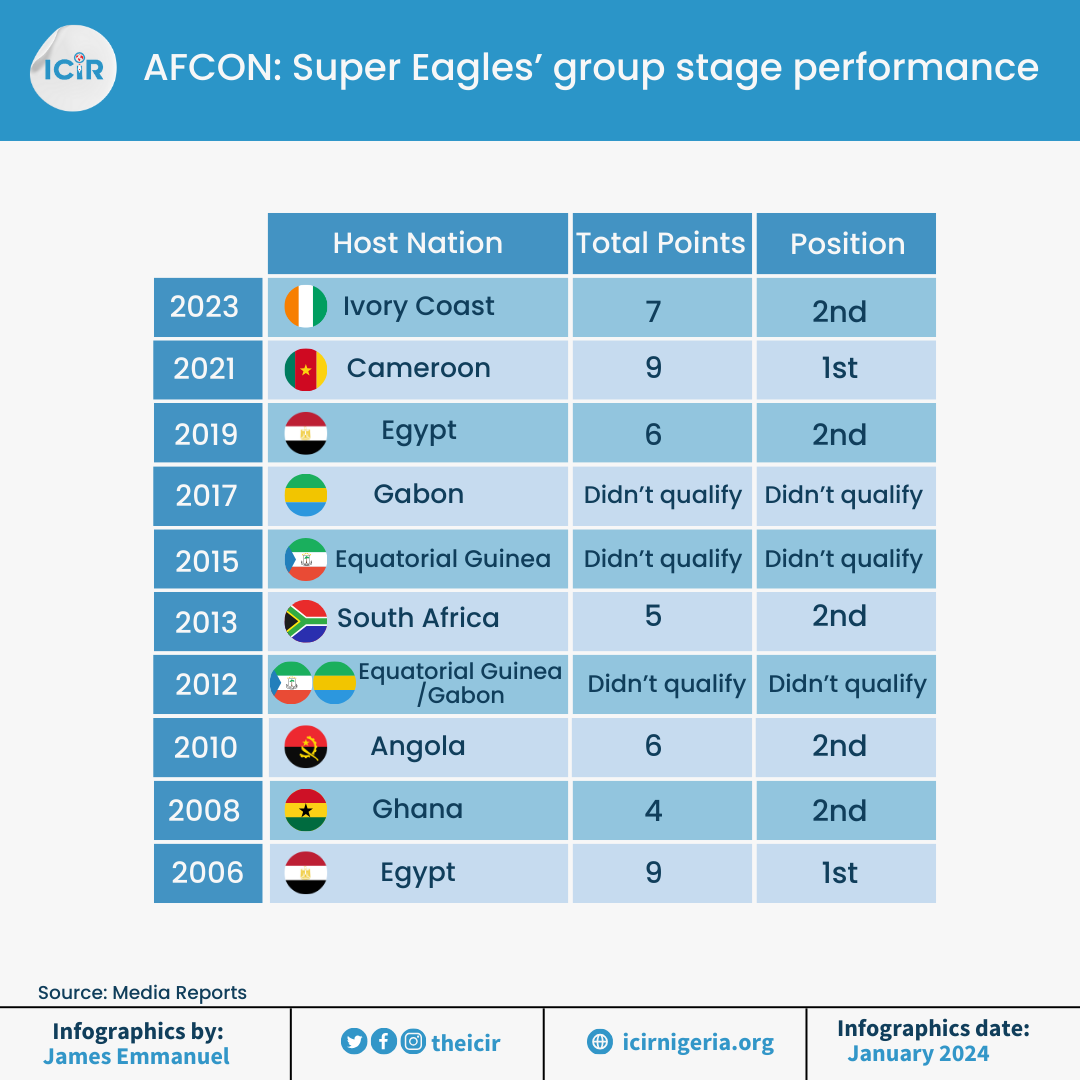
An inforgraphic detailing the Super Eagles group stage performance in the last ten AFCON tournaments.
The first and second on the group’s table then move to the next round of the competition.
In football, some competitions give room for the third position, described as the best losers to emerge to the next round based on the number of participating teams.
For instance, 24 countries are participating in the ongoing 2023 AFCON, and they grouped into six.
Expectedly, the top two from each group, making 12, will qualify for the next round in which 16 teams are required to play.
This allows four countries described as the best losers to participate.
In its eight appearances in the last ten AFCON tournaments, Nigeria has not experienced the ‘best loser’ option to qualify for the next round of the competition.
Rather, the country has always finished in the top two positions.
The ICIR discovered that the country finished in the first position in 2006 and 2021 while settling for the second position in 2008, 2010, 2013, 2019 and 2023.
It did not qualify for the 2015 and 2019 editions.
Also, Nigeria failed to progress from the group stage in 1982.
The country’s team, then known as the Green Eagles, returned home from the group stage in Group B with just two points, as Algeria and Zambia finished first and second, respectively.
Commenting on the Super Eagles’ series of qualifications from each AFCON tournament, a sports journalist, Rotimi Arabi, described the successive qualification as sheer luck, saying that the team mostly did not convincingly progress from the group stage.
“Yes, Nigeria has always qualified from the group stage. I will say it is luck. It was only in 1982 that we did not progress from the group stage. In other AFCON tournaments, we struggled to qualify except in 1994, we won all our matches.
“So far, I will say that Super Eagles have that penchant for struggling,” he said.
STATISTICS of human trafficking incidents in Anambra within the three years of the establishment of the National Agency for the Prohibition of Trafficking in Persons (NAPTIP) command in the area are troubling.
Lucy – lured by neigbhour, spent a year in traffickers den
Seventeen-year-old *Lucy lived with her parents in a ghetto settlement around Onitsha, the commercial nerve centre of Anambra. The place is notorious for its dirty nature and as a safe haven for criminal gangs, making it ripe for trafficking gangs.
In October 2021, Lucy, an SS2 student, suddenly disappeared from home in pursuit of a non-existent enticing offer by one of the supposed good neighbours.
The development threw her parents, siblings and relations into utter confusion. In their bewilderment, they reported the matter to the Police, which swung into action immediately with the arrest of the suspects.
“Aunty told me I would be fine if I agree to her plan to send me out of Nigeria for a good job,” Lucy recalled after returning to Nigeria. The trafficking took place at a time when she was desperately in search of freedom as a teenager growing into adulthood. The father was a disciplinarian who never anticipated what happened to his daughter.
The offer landed Lucy in Burkina Faso, where the supposed “good job” awaited her. Right from the first night, she was forced into prostitution as a sex slave. She lost her human dignity and rights. “My madam said I must raise the money she used to sponsor my journey away from home.
“I slept with as many men as possible. There was nothing like I am tired or sick. Once you are called upon, you must be ready,” she said, recounting how she was drugged to keep her active for each day’s work. After all, the money she makes goes to the madam.
“Life became unbearable for me, but there was no help in sight,” she recalled.
Back here in Nigeria, Lucy’s parents were fast slipping into hopelessness until one day, they received a terse message from a strange phone number which read, “I am your sister, Lucy. Call this number”.
“Our joy knew no bounds that day. At least we now know she is still alive,” said Lucy’s father. Yet, getting her to return home from Burkina Faso was a tall order.
Accusations and denials went on for weeks until the link between her and the woman who facilitated her migration was established. “My daughter told us to stop harassing the woman (neighbour) and other suspects,” the father said.
“I called my dad and mum to plead with them because I would bear the consequences if they do not stop maltreating her”, Lucy stated, corroborating her father’s statement.
The sexual exploitation went on until the ‘mistress’ was satisfied with the return she had gotten from her victim; coupled with a life-threatening disease, she was freed from sexual enslavement.
“I was released to go. My madam gave me some money to take care of myself, but the sickness got worse after I came back to Nigeria”, she explained.
“She came back with wounds all over her as a result of maltreatment by her madam,” her father recalled sobbing.
The NAPTIP, in collaboration with her parents, took her for medical tests and treatment. She was finally diagnosed with HIV.
“I was devastated” Lucy noted in reaction to the news, “I saw my entire world crashing.”
“We became confused, especially my wife. But we cannot disown her. We faced the treatment, and thank God she started responding to treatment,” the father also recalled.
The parents’ decision not to leave her to her ate paid a great deal. The NAPTIP Anambra State Command, commander Ibadin Judith-Chukwu, noted that “She sat for the West Africa Secondary School Certificate Examination, WASSCE and passed all the subjects”.
Lucy is getting close to her dream of becoming a nurse. “Next year, I will write UTME and seek admission into the University of Nigeria, Nsukka”, she said.
As lofty as the dream is, her lowly family background is a threat to its realisation.
“I am a *technician, and my wife is a *works without a certificate [lower cadre]. I have another son at *University at 200 level,” her father stated.
As she struggles to recover from the one-year life-threatening encounter, NAPTIP promises to bring all her tormentors to book. “We have two in our kitty right now. But it’s a chain. We must bring all of them down,” the state commander assured.
The numbers…
Since the NAPTIP Anambra State command became operational from 2021 to 2023, 127 victims of human trafficking have been rescued.
According to information sourced from the NAPTIP command in the state, 17 of the victims were rescued in 2021, while 69 were rescued in 2022 and 41 in 2023.
In 2023, a total of 25 human trafficking cases were reported, with 41 victims rescued. Seven of the cases were being prosecuted in court, 17 others are still under investigation and no conviction was secured in the year.
“This year (2023), we have received a lot of cases, most of which are external trafficking. The victims are still abroad. We have been able to bring back seven victims this year from Burkina Faso, Ghana and Mali.
“We are working to bring others back. Internally, we have been able to rescue a 4-year-old and 15-year-old child,” NAPTIP state commander in Anambra, Judith-Chukwu explained.
She added that some of the perpetrators under review period have been arrested.
In 2021, 31 suspects (16 males and 15 females) who hailed from the states of Anambra, Edo, and Ebonyi were arrested. In 2022, up to 80 of the criminals (44 male suspects and 36 female) were nabbed. They are from Anambra, Benue, Imo, Rivers, Ebonyi and Akwa Ibom states. In 2023, 18 suspected traffickers were arrested have been arrested with Akwa Ibom, Niger and Anambra as their states of origin, the state commander explained.
“I can say that in spite of everything we are doing, human trafficking is endemic in Anambra state. The number keeps increasing despite the sensitisation efforts. Traffickers are stubborn because of the huge money they are making in it,” the NAPTIP commander submitted.
The harder the campaigners try, the tougher the war against crime becomes. For this, Hope Okoye, the Executive Director of the Integrated Anti-Human Trafficking and Community Development Initiative (INTACOM-Africa) offers an explanation.
She said, “Human trafficking is the third most lucrative crime globally after arms and drug trafficking. It is a billion dollars lucrative. So, because of how much the criminals make from it, they cannot just give up.
They must put up a fight. So, the more you think you are closing up on them, the more they are evolving in their mode of operations, especially now that technology is aiding the crime. No part of the world is free – call it America, call it Europe. Many of the victims are being recruited these days on the internet”.
Okoye has said that human trafficking has been traced to several factors under two major broad categories – the Push and Pull factors. While the push factors deal with current realities which compel Nigerians to seek greener pastures elsewhere in the world, especially in Europe, the pull factors are the things that attract and lure them abroad.
Onyeka’s journey from abundance to poverty
As rehabilitation and reintegration processes continued for Lucy, the case of *Onyeka trafficked from Anambra with her children beckoned for attention.
Orphaned at six, Onyeka was sexually assaulted at 14 and became a single mother at 15. “My father died when I was six years old, and I did not know my mother. I’m their only child,” she recalled emotionally.
Onyeka said she grew up fighting against envy and hostility. “My father left many landed properties. His sister was in charge of them when I was tender.
“She did not treat me well. I stopped my education in Primary 5. The lawyer later transferred the ownership to me. My aunt never liked it,” she explained.
Onyeka found the love and protection she desperately needed in 2018. “I met *Folahan through my friend. He proposed to me and promised to help me fight those who were against me”.
Shortly afterwards, “He advised me to sell the property before my father’s sister would sell all of them. I sold the first property for N15 million”.
“After that, debit alert kept coming from Access Bank, but I didn’t think Folahan was responsible for it until I finally understood the meaning of debit and credit”.
Despite this, Onyeka entrusted her lover to build a house in her father’s compound. “But, whenever I asked for an account on the house, he would beat me with a belt, wire, and anything he found around. Then, the house was at the lintel level. We roofed some parts and fenced it.
“When I got another N5 million, I finished the roofing, fixed the doors and tiles and rented it out”.
After some time, Folahan successfully relocated her to Lagos state. But, the Lagos trip jeopardised her freedom. “In Lagos, we first stayed with his family. I was not permitted to go out. Still, I was feeding everybody, including his family.
When he finished the N5 million I gave him, he took me to [a neighbouring] state, where I bought land for N2.8 million”.
Even without knowing its location, Onyeka gave the lover another N4,000,000 to build and furnish the house in the neighbouring state. “After lavishing the whole money, he took me to the land in the [neigbhouring] state. Then, I discovered that he did not do anything tangible on it. But, any time I asked him for my money, he threatened to kill me”.
Onyeka, a multi-millionaire, ended in abject poverty. “I started begging before I could feed my children, and they were not going to school. I also did menial jobs. Each time I asked for the documents of the land, he kept dribbling me”.
“At a point, he came to ask me to run with him to Cotonou, but I refused, not knowing that he is from there. He told me he is a Nigerian”.
Eventually, the man who bought one of the lands in Anambra traced Onyeka. “I was detained in the police station because the man said he could not access the land he bought”.
On November 2, 2023, the police prevailed on the man to aid her return to Anambra state with her four children, two of whom she had for Folahan.
“Life has been so unfair to me and my children. Also, Folahan has been threatening that he would kill me for ritual,” she sobbed.
The tragic reality of homelessness and penury now stares her in the face. Her case is best described as a transition from prosperity to poverty. “I lost up to N32 million. But now, I don’t have a place of my own,” she said.
“I don’t pray for my children to pass through all I have passed through,” she concluded.
In an interview, NAPTIP said all the perpetrators would account for the crime. “The suspect is currently imprisoned for another criminal offence. But, we have secured approval of the Correctional Service to access him at any time”.
Poverty led me here – Gloria
Twenty-year-old *Gloria from Bayelsa state relocated to a community in Anambra, some years ago and later got admission into a higher institution.
However, she abandoned her academic pursuit at 200 level due to financial hardship. “My sponsor asked me for sex, and I refused. So, he stopped paying my tuition”.
“After that, I got a job in a hotel, but I couldn’t stay long there because they were not treating us fine. They don’t give us food”, she explained.
She was among the three girls rescued by vigilante operatives at Umunze, Orumba South LGA.
“After leaving the hotel work, a man I met through my friend’s mother promised to find a job for me in Onitsha or Lagos”, Gloria stated.
Unknown to her, the man had a sinister plan. “He asked me if I am truly pregnant. I said yes, and he promised to shelter me. He took me to a big compound with many residents”.
Like a ram being fed for the slaughter, he was feeding his newest catch three times a day. But, on September 19, 2023, the story changed.
“We were playing at home that morning,” Gloria said, pointing to another rescued victim. “He rushed in and said we should dress up quickly. We changed our clothes, and when we came out, we saw the vigilante men”.
The veil of ignorance fell off their faces. “At the local government secretariat, they queried us, and I explained what I know. I also took them to my friend’s mother”.
One of the three girls rescued from Umunze, Orumba South LGA of Anambra State
“They asked her if she knew the man is a child trafficker. She said no. That was when we knew that he would lure pregnant girls, take care of them and pay their hospital bills. After delivery, he takes the child for sale and gives the mothers some money”.
The suspect, Oruchukwu Okoroafor, from Arondizogu, who claimed to have started the business in 2021, revealed that he had gotten potential buyers who were ready to pay N300,000 for each of the unborn children.
He has since been handed over to the police for investigation and possible prosecution.
The push and pull factors
The Push and Pull factors associated with human trafficking. The push factors deal with negative realities pushing Nigerians to seek greener pastures outside the country, while the pull factors are the things attracting them to those countries.
“There is a total system failure, and Nigeria offers no hope to its citizens. People are desperate for a better life,” noted the Executive Director, INTACOM-Africa, Hope Okoye.
“Poverty, greed, natural disasters and conflicts are also the push factors. Anambra has suffered displacement by flood and erosion while insecurity (killings by unknown gunmen) forced many people, especially youths, to migrate from the state. Some of them become victims of human trafficking”, Okoye stated.
On the pull factors, Okoye said, “Some Nigerians call Nigeria hell on earth while Europe and America are like heaven. But, there is no gold on the street of Europe, and all that glitters is not gold”.
“However, their good system ensures prudent management of resources. Bad leadership has undermined the rich endowment of Nigeria,” she regretted.
Anambra’s Commissioner for Women Affairs and Social Development, Ify Obinabo, explained during the stakeholders’ forum that the location of the state is an attraction for traffickers.
“Anambra houses the largest market in West Africa. Everyone wants to partake in its supposed cash flow, legally and otherwise.
“The traffickers lure their victims, promising them solutions to their problems. The gullible ones, who are mostly not from the state, are trapped.
“Some of the victims graduate to become traffickers themselves, and they don’t have mercy on their victims,” the Commissioner said, even as she called for funding assistance for the successful prosecution of the war.
“Also, parents should educate their children about this problem. The church, traditional rulers, vigilantes and other stakeholders should join in the advocacy. If you see something, say something,” Obinabo advised.
Battle tough but on course – NAPTIP
“Within our three years of operation, I can tell you that the rate of trafficking is so high. But, as they change their trends, we are on top of the game. We train and retrain constantly for efficient and effective performance,” Judith-chukwu assured”.
However, some challenges undermined the efficient prosecution of the anti-trafficking war. “We have only one vehicle donated by a foreign agency. Our job demands movement, which we do at our own pace. If we rescue victims, we take them to our zonal office in Enugu or keep them in a private shelter because we don’t have a shelter here,” the commander regretted.
She appreciated the assistance so far rendered by the state government, including offsetting the rent of their current office. “But, we are still appealing that they help us address our logistics problems”.
With over eleven cases already running in courts, the NAPTIP commander still finds the grinding delay in the justice system worrisome. “Our cases are prosecuted at the federal and state high courts. At the federal high court, the judges handling our cases are often transferred, and when new judges come, the cases start afresh. It is a setback to proceedings and convictions.
“Just last month (October), we filed another three or four charges in court. Expectedly, we will soon begin to record convictions”.
The crime of human trafficking is thriving in Anambra state despite many local and international laws, conventions and instruments bringing their adequacy and efficacy into question.
All the stakeholders interviewed believed that there are still gaps to fill in the area of sensitisation and awareness creation to arm the citizenry with helpful information that can help them escape the tactful techniques of the traffickers.
“People must understand what the problem is, what to do, where to go and who to report to,” Okoye said.
NOTE: Names and words with asterisks were changed to protect the identity of the source.
THE Federation Account Allocation Committee (FAAC) has confirmed it shared N1.13 trillion among the three tiers of government in December 2023.
The allocation showed a 4. 63 per cent appreciation from the N1.08 trillion sum shared in November 2023.
The FAAC disclosed this in a communiqué issued at the end of its latest meeting, confirmed in a statement by the director of press and public relations, Office of Accountant General of the Federation, Bawa Mokwa, on Tuesday, January 23.
Also, the total figure shared for December represents an increase of N40 billion compared to the N1.08 trillion shared for November 2023.
The FAAC stated that from the N1.13 trillion total distributable revenue, the Federal Government received N383.87 billion, the State Government got N396.69 billion, and the Local Government Councils were allocated N288.93 billion.
It added, “A total sum of N57.915bn (13 per cent of mineral revenue) was shared to the benefiting states as derivation revenue.
“From the N363.19 billion distributable statutory revenue, the Federal Government received N173.729 billion, the State Governments received N88.12 billion, and the Local Government Councils received N67.94 billion. The sum of N33.41 billion (13 per cent of mineral revenue) was shared with the benefiting states as derivation revenue.
The communique added that the Federal Government received N68.79 billion, the State Governments received N229.31 billion, and the Local Government Councils received N160.528 billion from the N458.62 billion distributable value-added tax (VAT) revenue.
The total amount shared includes gross statutory revenue, VAT, Companies Income Tax (CIT), Augmentations from Forex and Non-oil Mineral Revenue, and electronic money transfer levy (EMTL).
THE Lagos State Government said it had investigated an alleged land scam involving Kayode Oladipo, client of RevolutionPlus Property Limited – a real estate company.
Oladipo had, in the viral video, accused RevolutionPlus of scamming him after he paid the company to acquire land on his behalf.
In the video, the man called on President Bola Tinubu and the Lagos state government to intervene in the case.
In Nigerian ppidgin English language, he said, “Tinubu, may you help me. I go commit suicide o. I go kill myself o. Lagos state, I go kill myself o. All the land wey I buy from RevolutionPlus, Emma Bamidele give me my property; see where I dey sleep; see where I dey sleep. You frustrate me; you frustrate my life…”
“Na una say make we dey abroad, make we work come home. I work all my money, I no get house for abroad; I work all my money come Nigeria, come Lagos, come buy property. Emma Bamidele scammed me. He scammed me all my life, all my money. Make una see where I dey sleep.”
In a nutshell, what he said was that President Bola Tinubu and the Lagos State government, through the governor, Babajide Sanwo-Olu, should intervene in the matter, or he would commit suicide.
He repeatedly called on RevolutionPlus’ boss to give him the property he paid for, as he lamented that the company had frustrated him that he now sleeps on the street after working for years abroad without owning a home outside the country.
He claimed he invested all his earnings in RevolutionPlus but was scammed by the firm.
One of the comments on the video reads: “Nigeria man based abroad cries out for help after he allegedly bought lands worth over N40 million from RevolutionPlus with no allocation.”
In a statement issued by the Lagos State Real Estate Regulatory Authority (LASRERA) and made available to The ICIR on Monday, January 22, the Lagos State Governor, Babajide Sanwo-Olu, directed LASRERA to investigate the matter.
Oladipo was allegedly scammed of about 20 plots of lands he supposedly bought in 2017 from RevolutionPlus without any physical allocation of the said plots.
The viral video prompted Sanwo-Olu to direct the Lagos State Commissioner for Housing, Moruf Akinderu-Fatai, his Special Adviser on Housing, Barakat Odunuga-Bakare, and Permanent Secretary, Lagos State Ministry of Housing, Gbolahan Toriola, to investigate the matter.
Odunuga-Bakare recalled that before the viral video, some concerns were raised by members of the public about the conduct of RevolutionPlus to some of its subscribers.
According to the statement, the LASRERA Law 2022 empowers the LASRERA to investigate petitions and complaints from members of the public to protect and promote sanity as well as boost further investors’ confidence both at home and foreign investments for the sector in Lagos State.
It stated that the RevolutionPlus Chief Executive Officer/Managing Director, Bamidele Onalaja, affirmed the client subscribed for 20 plots of land from the company at Dallas Court, Lekki and Royalty Gardens, Ajah, in Lagos state.
However, the client only paid for two out of the original 20 plots and the necessary documentation had been completed and handed over to him, adding that the company’s policy required relocating such subscribers to another site upon completion of payment or refund of the deposited sum less than 40 per cent.
Having defaulted in his payment pattern, RevolutionPlus relocated him to another land site at Amazon Estate, Epe, which he declined. At the same time, the client also rejected the option of refunding the sum advanced, Onalaja said.
The company also finalised the allocation of five plots to the client at Amazon Estate based on the payment made with necessary documents forwarded to him, the RevolutionPlus boss said, faulting the claim that the client paid N40 million to his company.
The client, however, maintained that he paid a deposit sum of N18.606 million to RevolutionPlus Property in 2017 and could not continue the payment as he initially agreed when he lost his job.
Before agreeing to the offer, he confirmed earlier declining the relocation option to Amazon Estate, Epe.
According to the Commissioner for Housing, the investigation will help find lasting solutions to frequent reports of fraudulent practices in the state’s real sector and thus protect the interest of investors in the real estate business transactions in Lagos State.
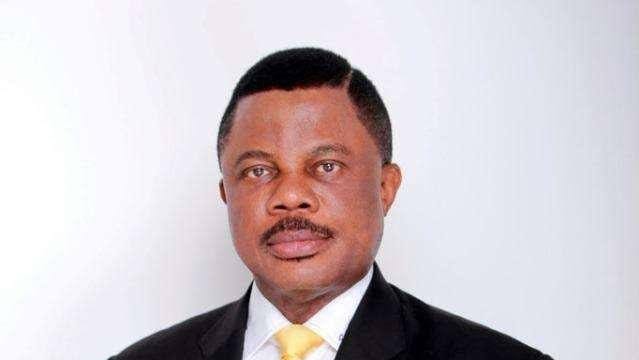
THE Federal High Court in Abuja has granted bail to the immediate past governor of Anambra State, Willie Obiano, who is standing trial over an alleged ₦4 billion fraud.
Obiano entered a not-guilty plea when a court official read the charge to him on Wednesday, January 23.
Following his plea, the prosecuting attorney, Sylvanus Tahir, a senior advocate, requested that the defendant be kept in detention until the start of the trial.
The defence lawyer, Onyechi Ikpeazu, also a senior advocate, attempted to move his client’s bail application, but the prosecutor responded that he had just received the application and needed more time to respond.
The judge, Inyang Ekwo, asked Tahir if the defendant had ever been given bail.
Tahir responded that Obiano was given conditional administrative bail by the prosecution office, the Economic and Financial Crimes Commission (EFCC).
In his ruling, Ekwo granted Obiano bail under the guidelines the EFCC had previously set.
He directed the EFCC to deliver to the court all documentation about the bail requirements within seven days,
Ekwo ordered Obiano not to travel outside his jurisdiction without the court’s permission and to deposit his travel documents with the court, following which the court will notify the Immigration Service about the restriction on his movement outside the jurisdiction.
Ekwo adjourned till March 4 for the commencement of trial.
Obiano was arrested by the EFCC hours after handing over to his successor, Chukwuma Soludo, on Thursday, March 17, 2022, at the Murtala Muhammed International Airport, Lagos, on his way to the United States.
He was subsequently transferred to the commission’s headquarters, where he was quizzed for days over alleged mismanagement of N5 billion Sure-P funds, N37 billion security votes withdrawn in cash and inflation of contracts.
On Wednesday, March 23, the EFCC released him on administrative bail.
Unable to meet some of the conditions, Obiano was held by the EFCC while his friends and associates tried to secure his release.
Obiano finally met the conditions and was released to his family members.
THESpecial Adviser on Information and Strategy to President Bola Tinubu, Bayo Onanuga, on Wednesday, January 24, said the President had no plan to move Nigeria’s capital to Lagos State.
He said those spreading information on the purported relocation were dishonest, attempting to gain attention to themselves as champions of their ethnicity or region.
He noted that those behind the “deceptive campaign” knew they were pitting the North against the South through risky tactics.
He argued that because the Constitution supports Abuja, the capital would remain the Federal Capital Territory (Abuja).
Claims of the capital moving to Lagos came after the Federal Government announced the relocation of the Federal Airport Authority of Nigeria (FAAN) headquarters and some departments of the Central Bank of Nigeria (CBN) to Lagos State.
Onanuga maintained that political influence should not be applied to administrative choices in his rebuttal of the Nigerian capital relocation claims.
“President Tinubu has no plan to move the Federal Capital to Lagos. The rumour first surfaced during the campaign last year by opponents looking for all manners of weapons to stop him. We trashed it,” Onanuga stated.
According to him, FAAN headquarters and CBN’s departments relocation to Lagos does not translate to relocation of Nigeria’s capital to Lagos.
“FAAN should be nowhere else but near the industry it regulates. FAAN will still maintain some presence in Abuja, as it is not a wholesale movement.
“Similarly, the movement of some departments of the CBN to Lagos should not trigger any hoopla. The departments concerned, including the bank supervision department, are those dealing with commercial banks, all with headquarters in Lagos. A regulator ought to be close to the businesses it regulates, ” Onanuga stated.
He said many parastatals were based outside Abuja, depending on their mandate.
“NIMASA is in Lagos. So is NPA. The National Inland Waterways Authority (NIWA) is in Lokoja, not Abuja. Will the people opposing the movement of FAAN and some CBN departments want those agencies to be in Abuja, where there is no single port and no maritime activity?” he asked.
He cautioned against politicisation of administrative decisions and spreading false information.
NO fewer than 15 people, mostly children and women, were killed by assailants in Kwahaslalek village, a community in the Mangu Local Government Area (LGA) of Plateau State, on Tuesday night, January 23.
The ICIR gathered that the victims were killed and burnt in their village in what seems like a reprisal attack to the killings of some Fulanis in some Muslim-dominated communities in the LGA.
Killings continue in the LGA despite a 24-hour curfew declared by the state government on the LGA following rising attacks that had led to the death of many residents.
According to a local source who spoke with The ICIR, before the curfew was declared on Tuesday, January 22, a community believed to be harbouring Fulanis was attacked by Christians retaliating against alleged earlier attacks by the Fulanis.
The incident further escalated, leading to indigenous Muslims from Mangabu allegedly resorting to burning the homes of Christians residing in the community in retaliation for the earlier violence.
“The killings are more of a reprisal attack because yesterday morning, there was an attack on a community that harboured Fulanis who are killing Christians in Mangu LGA by Christian people, saying that if they did not allow their people to live in the village, why should they (Fulani) come and live in the community?.
“Then Mangabu indigenes that are Muslims started burning Mangabu people that are Christians. It continued until after an hour or two that the curfew was declared. There was information that Fulanis were coming from Dengkon, in Bokkos LGA, to attack our communities in Mangu. Of course, they came. It was yesterday night that Kwaghalalek was attacked.
“It was more of a coordinated attack because they went to Sarbot, Mairana, but were unable to attack Mairana, and they went to Kinat,” the source said.
The source explained that as of the morning of Wednesday, January 24, over 15 people were killed and burnt inside their homes in Kwaghalalek on Tuesday night, adding that some houses in Kinat were also set ablaze.
“Based on the information we got, they killed and burnt about 15 people, but the number is still coming up. About 15 people were killed and burnt inside their homes. They attacked Kinat, which is under the Mangu area, as well. They were also able to set ablaze a house in the community and then burnt a Sharon vehicle too.”
The source accused the military of bias in the crisis and said the violence had ethno-religious undertone.
“This thing is becoming more of ethnic cleansing, and secondly, the one currently going on in Mangu has turned to religious conflict. Initially, it used to be Fulani and ethnic indigenous people, but the one that happened yesterday was more religious because churches and mosques were touched.”
Police keep mum on number of casualties
Meanwhile, when The ICIR contacted the state Police public relations officer, Alfred Alabo, he confirmed the Tuesday night attack on Kwahaslalek village and the other communities.
Alabo, however, disclosed that the Police were yet to ascertain the casualty figures and level of destruction, stressing that investigations were ongoing.
HOURS after sacking commissioners and aides appointed by his late principal, Rotimi Akeredolu, Ondo State Governor Lucky Aiyedatiwa has appointed Olaide Adelami as his deputy.
Adelami, a former Deputy Clerk of the National Assembly, is from Owo Local Government Area (LGA), the same LGA as Akeredolu.
A statement by the governor’s chief press secretary, Ebenezer Adeniyan, on Wednesday, January 24, said the new deputy governor’s name had been forwarded to the state House of Assembly for confirmation.
In April 2018, Adelami stepped down from his role as Deputy Clerk of the National Assembly.
He contested the Ondo State governorship election under the All Progressives Congress (APC) in 2020 but withdrew for Akeredolu.
Aiyedatiwa became governor in December 2023 after Akeredolu died of protracted prostate cancer.
Being Akeredolu’s deputy, Aiyedatiwa served in an acting capacity before his death and was sworn in as governor hours later.
Akeredolu’s long absence from Nigeria while attending to his health in Europe resulted in a feud between him and his deputy following the late governor’s insistence on retaining power despite being unable to function optimally.
Some Akeredolu’s aides tendered their resignation letters upon Aiyedatiwa’s assumption of office, with some citing loyalty to the late governor as the reason for their decision.
AT fourteen, Juwairiya Abubakar has had no formal education in her entire life; rather, she was forced by her parents to serve as the lead guide to a 60-years-old sight-impaired woman living in the neighbourhood at Balle town, the headquarters of Gudu Local Government Area (LGA) in Sokoto state.
Going by Juwairiya’s account, she was engaged daily in seeking alms on the streets of the community, which shares a border with Niger Republic. For eight years, this has been her occupation at an early stage of her life.
“I just grew up to realise myself leading the woman to solicit for alms as a street beggar. I have never been to any formal school in my entire life. I only worked for a blind beggar who usually gave me N100 or more in return, depending on what we got for the day,” she said.
Sokoto
The story of Safiya Isah is like that of Juwairiya. At 11, she has never been into the four walls of a classroom, despite having her food shed in front of the community’s only primary school.
When asked whether she was not going to school, with an innocent smile, Safiya narrates how her mother encouraged her to hawk cooked food at the community’ school gate to help improve the family’s finances.
“My mother only cooks food for me to come and sell here,” she said.
Investigations by Daily Times had shown that despite the enormous importance of education, Gudu Local Government Area still lags in the enrollment of girl-child like the duo of Juwairiya and Safiya, who are currently out of school.
Gudu, a deprived community?
Before now, Gudu, as a local government area, did not have a senior secondary school. The council also boasts one of the most unenviable statistics in education, and remained a factor pushing Sokoto state below the table of UNESCO report that over 20 million out-of-school and vulnerable children in Nigeria.
A survey conducted in 2013 by the State Ministry of Education showed that out of 1,890 students in junior secondary schools in the local Government, only one of them is a female.
According to findings, the council had contributed to the long-standing negative data of low girl-child education in the country, with Sokoto’s school-age children who are poor and out-of-school as one of the highest states with 66.4 per cent in non-enrollment. Since 2010, Nigeria has had a moderate female literacy rate of about 60.01 per cent.
With time, the rate eventually increased.
Mr. Taofik Adesina, an educationist in Sokoto believes that the gender disparities could be linked to the current insecurity challenges in the state. According to him, “In countries affected by conflict like Nigeria, girls are more than twice more likely to be out of school than girls living in non-affected countries.”
Despite N1 billion investment, Education eludes Gudu children
In 2016, Sokoto State Government, through its Executive Council, gave approval for the establishment of a model boarding secondary school in Balle, Gudu council headquarters.
The announcement led to wider jubilation among the populace. Musa Dan Magaji, a resident of the area, recounted how the news of the school project ignited celebration in the state.
“We heard it first on the state-owned radio, Rima Radio, and everyone was delighted. It was a good development for us. But since the project was completed, there is no official information on why they (government) have not been able to put it in use,” Magaji stated.
Abdulkadir Jeli Abubakar, the then Commissioner for Information, said N1 billion has been earmarked for the project while 30 per cent mobilisation fee has been approved for construction work to begin.
The contract, according to the investigation, was awarded to an indigenous construction company, Calder Construction Company Limited. The specifications of the contract include blocks of modern classrooms, laboratory, library, administration block and an assembly hall.
Others are school clinics, boarding hostels, sport complex, corps members’ lodge, staff quarters and landscaping, among others.
Residents believe the project could be a momentum of poor planning and alleged extravagant cost and procurement misappropriation on the part of the government.
The CAC portal showing the Cardel Construction company was registered a few months into the bidding period but later won the N1bn Gudu School Project. Credited: CAC Website Portal
“We have a junior secondary here in Balle Town and all we wanted is more classrooms to upgrade it to senior classes. That could have solved our problem.
“Now, we have a school worth a billion naira and are not functioning while our junior School can be upgraded to a full-grown secondary school to serve the community,” Taminu Adamu opined.
Many promises, many fails
The current situation of the Gudu model school has contradicted many promises made by the previous government who initiated the project.
Daily Times learnt that at the foundation laying ceremony in 2016, the then governor Aminu Waziri Tambuwal, who initiated the school project had promised the community that academic activities would begin in the school immediately after completion.
The erstwhile governor also promised to construct other new schools across the state to accommodate the 1.2 million new students expected to be enrolled in 2017 under the out-of-school enrollment projection.
Tambuwal also said his government would cater for its citizens already in schools and ensure that those out of school are admitted and given quality education without delay by constructing no fewer than 160 new primary and secondary schools across the state.
But in contrast, the school project was neither made available to the children roaming on the streets of Gudu community despite its timely completion nor did the government embark on the construction of new schools before the expiration of its tenure.
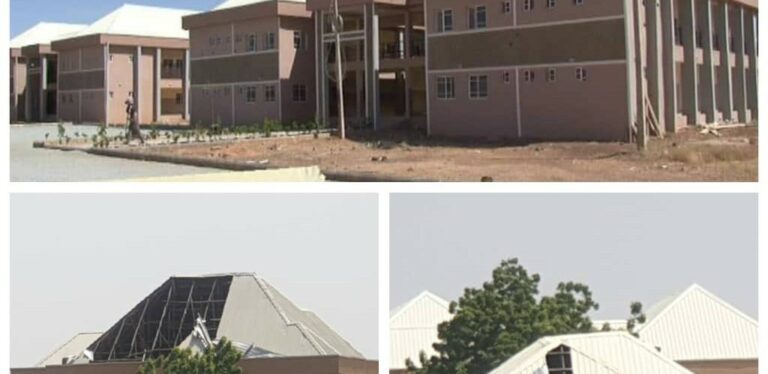
During a visit to the school in September this year, these gigantic buildings still lay in waste as they (now stand in the midst of growing weeds. Also, various blocks of classrooms were seen under heavy padlocks with no signs of pupils occupying them soon.
Kabiru Mahamuda Sarki, project manager at Calder Construction, the contracting firm that handled the construction, said the school project was completed according to the specifications and has since been handed over to the state government.
“The project was awarded in June 2016, while the work commenced in December the same year. That is all I can say.” Kabiru said.
He was unwilling to grant further interviews to Daily Trimes despite listening to many enquiries about the school project during a phone conversation.
Breaching procurement law
But investigations showed that the contract was issued to Calder Construction breached procurement laws as records from the Corporate Affairs Commission (CAC) indicated that the company was registered on August 11, 2015, just few months to the date the contract was awarded by the state government.
An informant at the State Ministry of Works, the implementing ministry who was privy to the contract bidding procedures, said the public bidding was announced in January 2026, five after the registration of Calder Construction, as a business entity in Nigeria.
This award of the contract thus contravenes the Bureau of Public Procurement Act 2007, which states that the minimum qualification for the awarding of any contract must have a Tax Clearance from the Federal Inland Revenue Service (FIRS) for at least three years.
Further scrutiny carried out on the CAC website showed that the firm’s registration status has not been validated by its promoters for a while and since remained INACTIVE, as an operational entity.
Further efforts were made to reach out to three nominal directors listed by CAC as Persons with Significant Control of the company, including Abdullahi Mohammed, Husaini Muazu, Nura Dan Hajiya and Usman Aliyu. A visit by THEWISTLE Calder Construction Company at No, 2 Abdullahi Fodio Road, Sokoto to enquire about the whereabouts of some of the Directors listed as company’s Board could not yield a positive result as it was under padlocks.
Government officials keep mum
For weeks, Daily Times had made several efforts to get government officials to provide valid information around the school project but without success.
The key officials include the state Commissioner in-charge of the Ministry of Basic and Secondary Education, Hon. Tukur Alkali, his predecessor, Hon. Bello Guiwa and Special Adviser to the governor on Special Projects, Ibrahim Hassan.
Guiwa simply responded that the school was completed but not put into use because of insecurity in the community.
“As a mother, will you allow your daughter to be taken to such a school? Guiwa said while ignoring further questions about the contract.
Also, Daily Times first tried reaching out to the lawmaker, Alkali on October 22, 2023, but the office secretary said he was not in town. A few weeks later, on October 4, Daily Times called the Commissioner to confirm his availability for a possible interview but did not respond. He also did not respond to text message reminders sent to his mobile number in sequent efforts to speak with him.
In pursuant to the provisions of the Freedom of Information Act (FOIA), THEWISTLE submitted a request for information to the State Commissioner for Basic and Secondary Education as a last resort.
The FOIA request was sent and delivered in person by our reporter at the Office of the Commissioner on November 5, 2023 and sought details of the contract award, record of progress or completion, needs assessment as well as amounts and timeline of release of funds to Celdar Construction Company.
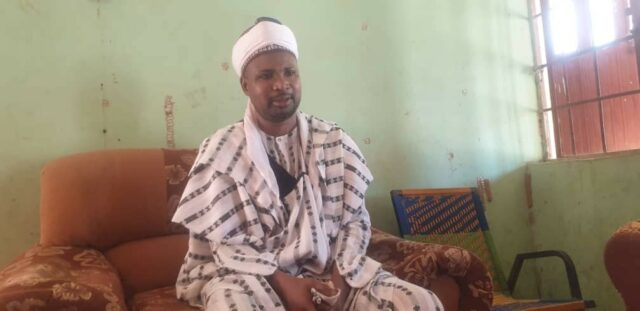
Community Traditional Head, Aminu Aliyu Balle urged the government to as a matter of urgency put the school into use.
The letter also requested the commissioner to spare time to answer questions on the state of abandonment of the school project, including the recent removal of some roofing sheets affected by winds and rainstorms and what his ministry planned to do to ensure that the project is put into proper use.
As at the time of filing this report, the commissioner neither responded nor signified interest in answering the questions raised in the letter.
The silence from the state authorities leaves critical questions and concerns unanswered.
However, a top official who pleaded on the condition of anonymity hinted that poor planning and alleged ulterior financial motives on the part of the previous government officials characterised the multi-billion school contract.
“I believe the present government is studying all projects abandoned by its predecessor and Gudu Model Secondary School is among the red flags, especially, the procurement process and why such huge monies were expended on a project located in a security-prone community like Gudu.
“It is also good that you are doing media investigations to further awaken the government on what to do, especially as it is now affecting the growing out-of-school children of girls in the community,” said the source while responding to THEWISTLE’s inquiries.
Who bears the brunt of government negligence?
Most indigent families within the Gudu who spoke to Daily Times said their out-of-school children now bear the brunt of lack of higher education in the community – as many could not go beyond basic and elementary schools.
Abdullahi Yusuf, a 38-year-old who heads the community’s only primary school, said the pupils from the primary sector have since moved on with their lives without pursuing further secondary education since it is not available to them.
Abdullahi Yusuf heads the community only Primary School.
“Most of the pupils who graduated from the primary school later abandoned their quest for higher education because there are no provisions for higher learning.
“So, they (pupils) rather sit at home to help their parents with farming or hawking wares on a daily basis. We want the government to either upgrade Junior Secondary School to senior classes since the model school has not been put into use now.”
When asked on the state of security within the community based on Hon Guiwa’s assertion, Abdullahi dismissed the concern.
“For a while, we have had security challenge in my community. However, this shouldn’t pose a threat to the learning quest of the children because other junior schools are not under locks like the Model Secondary School.”
Abdulrahman Nasiru, a JSS 3 student said he “doesn’t know where to go after my Junior Secondary Schools Examination (JSCE), adding his elder brother finished junior secondary school last year but he is still at home.
“I don’t want to stay at home like him, my dream is to become an engineer,” he said with a glint of hope in his eyes.
The community’s Traditional Head, Aminu Aliyu Balle, urged the government to as a matter of urgency put the school into use to check the rate of out-of-school children who are plying the streets of Gudu community.