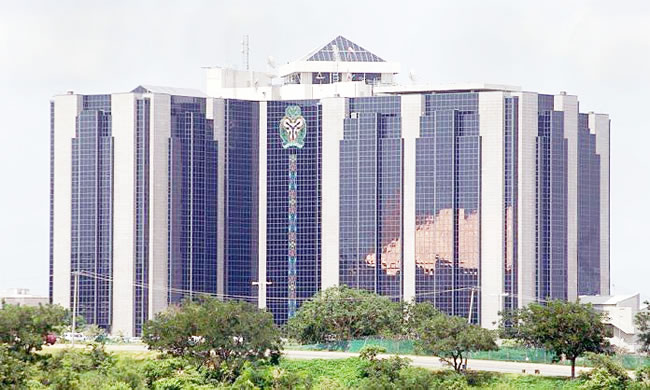
PZ Cussons (Holdings) Limited has proposed a N21 per share offer to the minority shareholders of PZ Cussons Nigeria Plc to be implemented under a scheme of arrangement.
Informed analysts say it is a strategic move by the company to prepare for a “smooth exit” from the Nigerian market amidst ongoing reforms of the government.
PZ Cussons Nigeria currently has 3,970,477,045 units of shares listed on the Nigerian Exchange Limited (NGX), The ICIR can report.
In a notification on Monday, September 4, to the investing public and signed by its acting company secretary, Olubukola Olonade-Agaga, PZ Cussons Nigeria said the core shareholder, PZ Cussons Group, had informed its board of directors of its intention to acquire the shares held by all the other shareholders of PZ Cussons Nigeria. However, media reports say the minority shareholders have rejected the offer.
The Nigeria subsidiary further disclosed that the proposed transaction would be subject to prevailing market conditions.
According to PZ Cussons Nigeria, the transaction became necessary to enable the company to simplify and strengthen operations in Nigeria.
“It is intended that the Proposed Transaction will be implemented under a Scheme of Arrangement in line with section 715 of the Companies and Allied Matters Act, No.3 of 2020 (as amended) and other applicable rules and regulations.
“This will require the company to convene a court-ordered meeting of its shareholders by the directive of the Federal High Court,” it added.
The proposed N21 per share could have been arrived at based on earnings to book valuation of the company, an investment and portfolio analyst, Abel Ezekiel, told The ICIR.
He noted that the company, for a while, has experienced a downward movement of its market price but started moving upward from last year on the improved financial report or earnings since last seen in the previous years.
“So arriving at N21 could depend on current performance and valuation of their asset vis-à-vis liability, dividends, etc., and the company cannot do better than what it has offered their investors,” Ezekiel said.
Checks by The ICIR showed that the share price of PZ Cussons Nigeria closed at N19.15 on Tuesday, September 5.
A smooth exit from the Nigerian market
The ICIR recently reported why two consumer goods and manufacturing companies exited the Nigerian market.
On August 4, GlaxoSmithKline (GSK), a British multinational pharmaceutical Group, notified of its exit after 51 years of operation.
On April 6, Unilever Nigeria Plc also announced to close its operations in Nigeria after about 100 years.
A manufacturing and distribution company in the business of personal care, home care and electrical products, PZ Cussons Nigeria, which has been in Nigeria since 1899, is seemingly taking the exit door.
“One can only guess that it may be connected to recent changes in the FX policy, which has sent many import-dependent multinationals into panic,” another analyst, David Adonri, shared his view with The ICIR.
He believes the “delisting” may be a strategic move by the company to prepare for a smooth exit from Nigeria if the ongoing reforms go against their interest.
The ICIR had in a report on August 1 showed that many companies, especially manufacturing companies, are faced with dollar-denominated obligations arising from the exchange rate unification.
“Multinational companies are in host countries to make a profit and to use them as a market for their parent companies. Any threat to these objectives is intolerable to the parent companies and can result in harsh decisions,” Adonri said.
Reasons companies delist from the exchange
Several reasons abound why companies delist from the exchange, Ezekiel stressed.
It includes stringent post-listing requirements like the quarterly release of financial reports and the attendant high cost of hosting annual general meetings (AGM) and extraordinary general meetings (EGM).
“Other reasons include difficulty in repatriation of dividends by most of these multinationals, massive devaluation of the domestic currency which impacts negatively on these organisations, challenges in sourcing their input materials which are not readily available locally, difficulty is sourcing forex, high cost of OPEX which erodes margins.
“High cost of listing always slam on these companies by the regulatory bodies, undue fines, exposure of your financial report to competitors, high taxes they are numerous so most avoid all these problems and the best way is to go out of our exchange and remained at a level where no one gives them undue hassles,” he said
Adonri added that it was vital to note that most of these multinationals did not list voluntarily.
He said, “They were compelled during the indigenisation exercises of the 1970s to do so. Perhaps they feel that this is the right time, after several years of liberalised foreign investment policy, to reclaim full ownership of their enterprises.
“It might be unnecessary to bemoan these exits from the Capital Market because as old companies exit for one reason or another, new quality companies also come in to enjoy the benefits of listing. The secondary market is booming right now, but the only challenge is how to form capital through the market for enterprises in the strategic sectors of the economy and get them listed afterwards.”
DESPITE the clog in the wheel of the naira-yuan swap deal, China continues to dominate Nigeria’s import trade transactions, checks by The ICIR have shown.
The East Asia country is one of the trading partners with Nigeria on import transactions.
Other countries include the United States (U.S.), Belgium, India, Netherlands, United Kingdom, Brazil and Russia.
Majorly, Nigeria imports motor spirit (petrol), used vehicles, gas oil, durum wheat and jet fuel.
A cursory look at five-year reports of the National Bureau of Statistics (NBS) on ‘Foreign Trade in Goods Statistics’ showed that China dominated Nigeria’s import trade while the U.S. followed.
However, many stakeholders are concerned about promoting Nigeria-China currency for transactions.
The Central Bank of Nigeria (CBN) and the People’s Bank of China (PBoC) had in May 2018 signed a currency swap deal.
The deal was designed to provide the Chinese and Nigerian currencies directly to industrialists and other businesses from both countries.
It is expected to improve the speed, convenience, and volume of transactions between the two countries.
But recently, a Senior Advocate of Nigeria (SAN), Femi Falana, pointed an accusing finger at the apex bank.
He said the CBN was frustrating the deal and promoting the dollarisation of the Nigerian economy.
He wrote to the apex bank in June, invoking the Freedom of Information (FOI) and requesting CBN to disclose the details of the currency swap agreement.
He accused the apex bank of promoting “the unwarranted dollarisation of the Nigerian economy.”
Falana argued that despite the currency swap agreement, the federal and state governments and business community have been prevented from transacting business in naira and yuan.
He stressed that the International Monetary Fund (IMF) and the World Bank, which superintend the CBN, colluded with the apex bank to frustrate the currency swap.
“The purpose of the economic sabotage is to promote the dominance of the United States Dollar in Nigeria. Hence, the federal government, state governments, and the business community have been prevented from transacting business in Naira and Yuan. Thus, by compelling Nigerians to pay dollars for goods imported from China, the Central Bank has continued to promote the unwarranted dollarisation of the Nigerian economy,” TheCable quoted Falana to have said.
The human rights lawyer, therefore, asked Nigerians to use naira as payment for goods imported from China.
In response to Falana’s request, the apex bank said the swap deal, which commenced in July 2018, was renewable every three years.
It said the agreement was renewed after it expired in April 2021.
The apex bank claimed that 15 billion Chinese yuan renminbi (CNY) was usable within the year.
According to CBN, since the renewal of the deal, nine billion yuan have been drawn and six billion yuan utilised, while the sum of three billion yuan is outstanding.
Of the six billion yuan utilised, 5.10 billion yuan had been repaid, while 2.10 billion yuan had not been used.
Be that as it may, experts are worried that the dollar has adversely impacted Nigeria’s economy for the past decades.
The effect is depreciation in the naira value, spike in inflation, reduction in investment, increase in debt burden, and decline in foreign reserves.
The IMF reportedly said that a 10 per cent appreciation in the dollar decreased economic output in emerging market economies, including Nigeria, by 1.9 per cent.
Findings by The ICIR on naira-dollar value over the years showed that the naira had depreciated against the dollar by over 141 per cent since 2018, worsening in value to N785.532 per $1 as of September 6, 2023.
At the same time, one yuan averaged N54.68 in 2018 and is currently equivalent to N106.097.
Nigeria’s total trade rise in Q2 2023
In its latest report, the NBS disclosed that Nigeria’s total trade stood at N12.741 trillion as total exports stood at N7.015 trillion and total imports at N5.726 trillion in the second quarter (Q2) of 2023.
Total exports increased by 8.15 per cent compared to the N6.487 trillion recorded in the first quarter (Q1) but declined by 5.20 per cent compared to the N7.400 trillion in the corresponding quarter in 2022.
Likewise, in the period under review, total imports increased by 2.99 per cent compared to N5.559 trillion in Q1 but declined by 10.37 per cent compared to the N6,388 trillion recorded in the corresponding quarter of 2022.
The report showed that while the Netherlands topped the list of Nigeria’s export destinations in Q2, China topped the list of partner countries’ origin of imports to Nigeria.
The Ibadan Circular Road project has been mired in controversy, with allegations of irregularities in the procurement process and the contractors’ qualifications. This investigation reveals the hidden truths behind the project, including secret connections between the parties involved and intricate layers of deception masquerading as truth. Enoch Oyedibu reports.
AS the sun dipped below the horizon, it cast a warm, golden glow across the sprawling expanse of the 32-kilometre East Wing of Ibadan Circular Road, nestled in the heart of Oyo State, Southwest Nigeria. The once bustling construction site, typically abuzz with activity, now lay enshrouded in an unsettling calmness as the hues of twilight enveloped it.
Renamed after former Governor Rashidi Adewolu Ladoja, who commenced the project, it is a key project that aims to not only ease traffic congestion but also boost urban development in the city of about 3.75 million people by 2022 estimates.
The actual construction took off during the tenure of late Governor Abiola Ajimobi with ENL Consortium Limited awarded a N67bn contract for the construction of a 32km section of the road, with high hopes for completion by 2019.
Since then, the trajectory of this crucial project has been fraught with controversies, delays, and conflicting contract pricing.
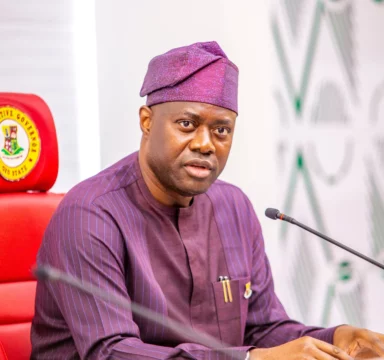
Governor Seyi Makinde.
A road of dreams and challenges
Although the contract awarded to ENL Consortium Ltd was almost cancelled at first due to the slow pace of work, Governor Seyi Makinde, who came into office in 2019, later extended the deadline to 2020 under the condition that the 32km stretch of the road must be completed.
Meanwhile, ENL continued to face consistent criticisms from the state government due to slow progress and disagreements about contract pricing. Makinde claimed that the consortium had initially quoted N14bn for the contract, but Ajimobi’s government eventually approved it for N67bn. Makinde also said that sum of N11bn was earmarked for bush clearing.
In his response, ENL Consortium Chairperson and former Deputy Governor in Osun state, Adesuyi Haastrup, refuted the accusations, emphasizing that N11bn was meant to cover “a combination of 10 items for bush clearing and all earthworks of the entire 32km”.
On June 4, 2021, the Oyo State government revealed that ENL Consortium had only completed a mere 5.5 per cent of the entire project, a disappointing outcome given the extended timeframe. The consortium attributed this sluggish progress to the governor’s failure to fulfil his promise of providing a “Letter of Assurance of Continuity” to support their work.
“He promised he would write us a Letter of Assurance of Continuity for the work. He later did not honour his words,” Haastruplamented, expressing his dismay at the broken commitment.
While ENL Consortium anxiously awaited the promised letter, the state government had already taken steps to consult with a new consortium, signalling the commencement of a new chapter in this evolving narrative.
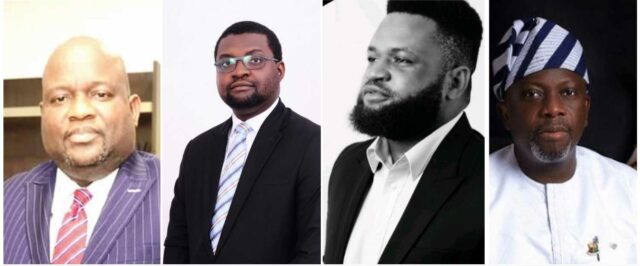
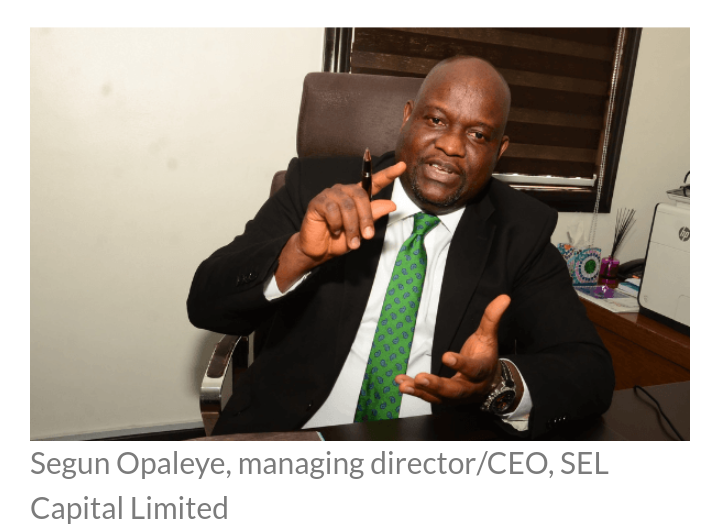
FL: Olusegun Opaleye of SEL, Michael Msughter Dugeri and Anthony Adedapo Makinde of Vydra Investments; the current Chief of Staff to the Oyo State Governor, Hon. Segun Ogunwuyi who was also the former Director General of OYSIPA—an agency of the State that procured Ibadan Circular road project when he was DG.
The controversial journey of the briefcase consortium
In a whirlwind of events, on July 5, 2021, the newly formed Bureau of Investment Promotion and Public Private Partnership (now Oyo State Investment and Public Private Partnership Agency—OYSIPA) re-awarded the entire stretch of the 110km Ibadan Circular Road to another company, SEL-VYDRA consortium for a staggering N138.2bn.
This was about 14 months before the project was eventually flagged off in September 2022, with assurance from the state government that 75km of the road project would be completed before the end of his tenure (first term) in June 2023. The government asserted that it had saved the state approximately N77bn compared to the previous contract granted to ENL, factoring in inflationary trends. However, questions began to emerge about the consortium’s credentials and the transparency of the award process.
The road project was established as a Public Private Partnership (PPP) under a Build Operate and Transfer model, between the state government and contractorSEL-Vydra, contributing a ratio of 20 to 80 percent respectively.
The first 32km phase of the 110km road project embodies a four-lane, dual-carriage motorway that links the Lagos-Ibadan expressway to the Ibadan-Ife highway, incorporating diverse features such as bridges, interchanges, streetlights, security posts, and other essential road infrastructures.
Amidst these aspirations, concerns emerge surrounding the precise financial commitment of the state government. SEL-Vydra’s involvement is anticipated to contribute N110.5bn, establishing an 80 percent ownership stake in the venture. Counterpart funding from the state government, however, is met with a degree of discrepancy.
Twenty per cent of the contract amount, N138.2 billion, logically equates to N27.64 billion, yet budgetary details and statements from Oyo’s commissioner for Works, Dahud Sangodoyin, reveal varying figures. The approved 2021 supplementary budget earmarks N25bn for counterpart funding. However, Prof. Sangodoyin later cited N35.97bn for the same item.
Professor Sangodoyin
Sangodoyin, said while addressing pressmen on March 4, 2023, that the counterpart funding the state is contributing is N35.97bn, and is channelled towards the execution of interchanges and bridges construction on the 32km Southeast segment of the 110km road.
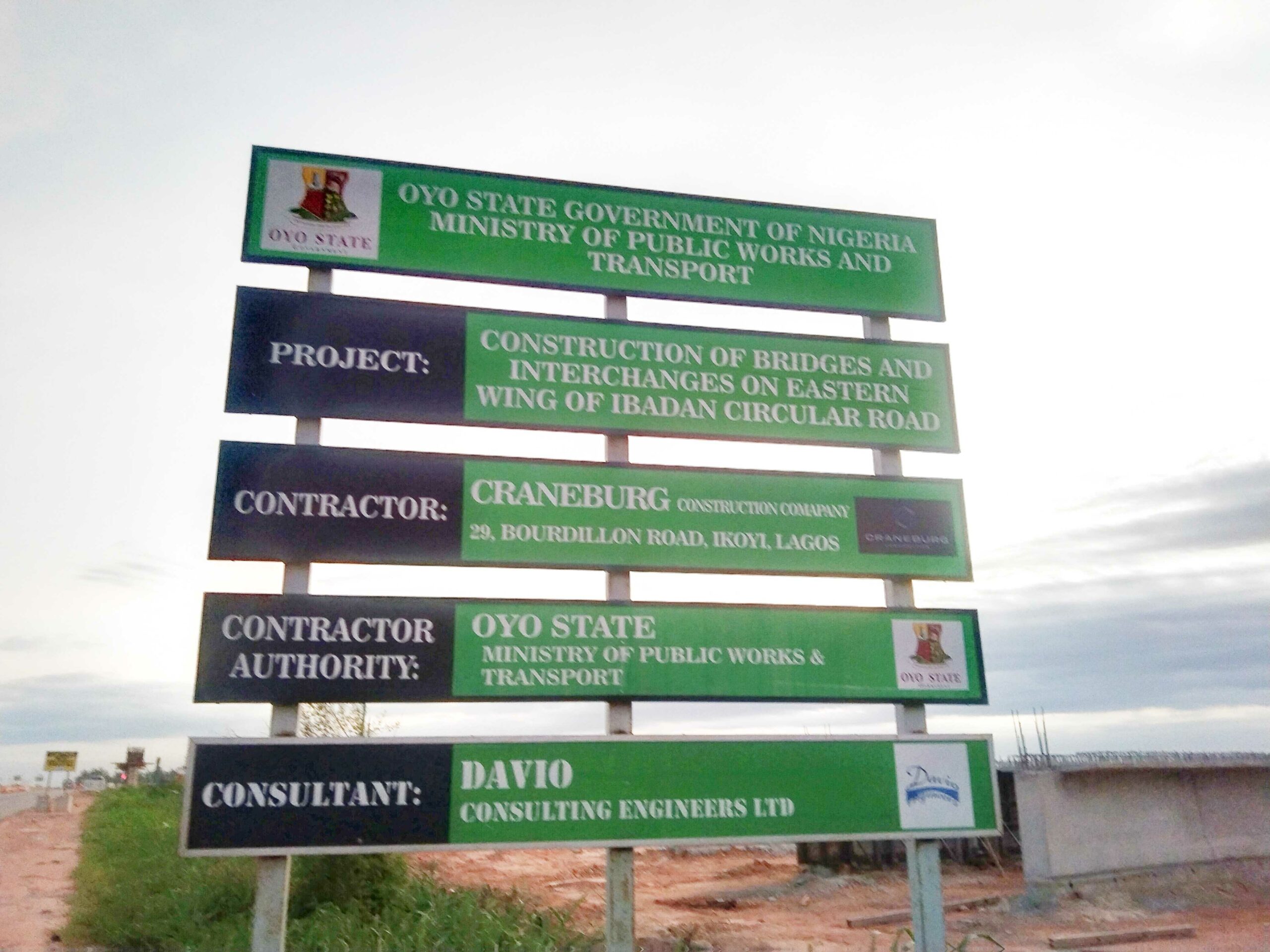
However, this was a separate contract awarded to Craneburg Construction Company on March 17, 2022, according to the Oyo State Procurement portal. The commissioner added that the bridges and interchanges would be finalised by June 2023.
A search shows that Craneburg was officially registered with the Corporate Affairs Commission, CAC, on April 15, 2013. Online business registry, NG-Check.com showed Gilbert Sassine and Larissa Okpala as directors.
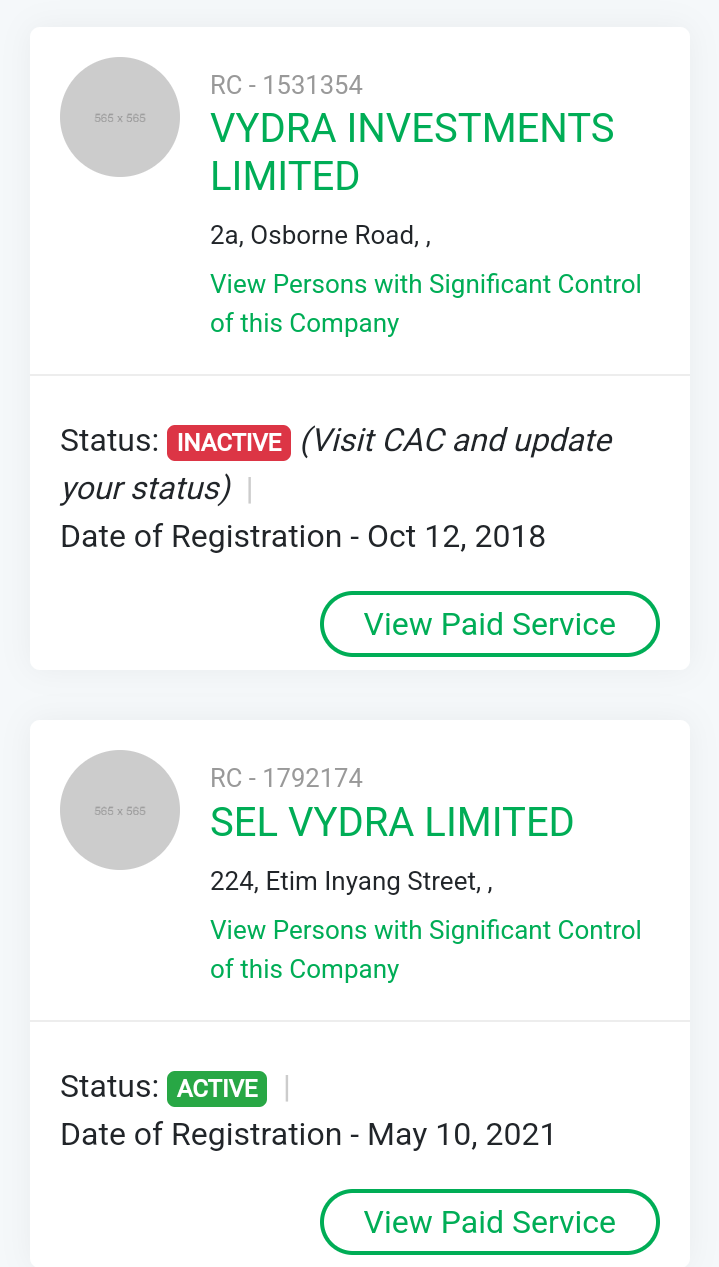
In the same fashion, investigations reveal that SEL-VYDRA was registered merely two months before it was granted the contract—specifically on May 10, 2021.
Alarmingly, neither of the two constituent companies within the consortium, namely Still Earth Capital Finance Limited and Vydra, possessed any prior road construction experience in managing a project of this magnitude and complexity.
Search entry of SEL-Vydra on Corporate Affairs Commission (CAC) portal.
This contravenes Part IV, Section 8 of the Oyo State Procurement Law (2010), which outlines several grounds for disqualifying a contractor’s bid or tender from a procurement process. Notably, subsection (b) of the aforementioned section stipulates that “a supplier, contractor, or consultant who, in the three years preceding the initiation of the relevant procurement proceedings, demonstrated inadequate performance or lack of due diligence in fulfilling any previous public procurement obligation” shall be ineligible to participate in the said procurement proceedings.
These rules were established as clear guidelines to dismiss any bids that did not comply. Despite the infractions, SEL-VYDRA was awarded a substantial N138bn project under the Build Operate and Transfer (BOT) model.
In the face of public scrutiny and questioning, the Oyo State government attempted to address concerns by providing explanations, asserting that it had not committed any wrongdoing. The government claimed that the usage of a Special Purpose Vehicle (SPV) to execute such projects was permitted under relevant laws of the state.
Notably, the Oyo State Public-Private Partnership (2013) Law serves as a practical guide for public-private partnership projects, within which a clause outlining the utilization of SPVs is included. Similarly, the Oyo State Investment, Public-Private Partnership (OYISPA) Law includes a provision concerning SPVs, which were later designated as private sector partners or concessionaires.
However, it is important to emphasize that no segment of the Oyo State Procurement Law (2010) contains explicit provision regarding the use of SPVs. While it is comprehensible that the Oyo State Public-Private Partnership Law (2013) permits the use of Special Purpose Vehicles (SPVs) for project execution, it is worth noting that the OYSIPA Law (2019), does not compromise on the principles of competence and transparency in the composition of these SPVs.
Section 30, subsection 9 of the law stipulates that “the agency (OYSIPA) shall ensure that the concessionaires or private sector partners for public private partnership projects shall be selected through a transparent, efficient and competitive procedure, adapted to the peculiarities of the different projects selected for the public private partnership arrangement.”
The Oyo State Procurement Law (2010) outlines a comprehensive set of prerequisites for contractors vying for bids or contract awards. These encompass a range of documents such as CAC Registration, Payment Receipts, Company’s Income Tax Clearance, Personal Income Tax Clearance, VAT Registration Certificate, Company Profile with Resumes, Government-issued IDs of Key Personnel, Memorandum & Articles of Association, Evidence of Past Projects, Bank Reference Letters, and a Company’s 3-Year Financial Summary.
These prerequisites are fundamental for contractors participating in the bidding process and being eligible for contract awards. However, in the case of SEL-Vydra, their registration occurred just two months before the contract was awarded in 2021, leaving insufficient time to amass the required documents, particularly the 3-year financial summary.
In contrast to well-established construction firms with substantial experience, SEL-Vydra’s limitations become evident, prompting significant questions about the decision to award the contract to a relatively new player in the construction sector.
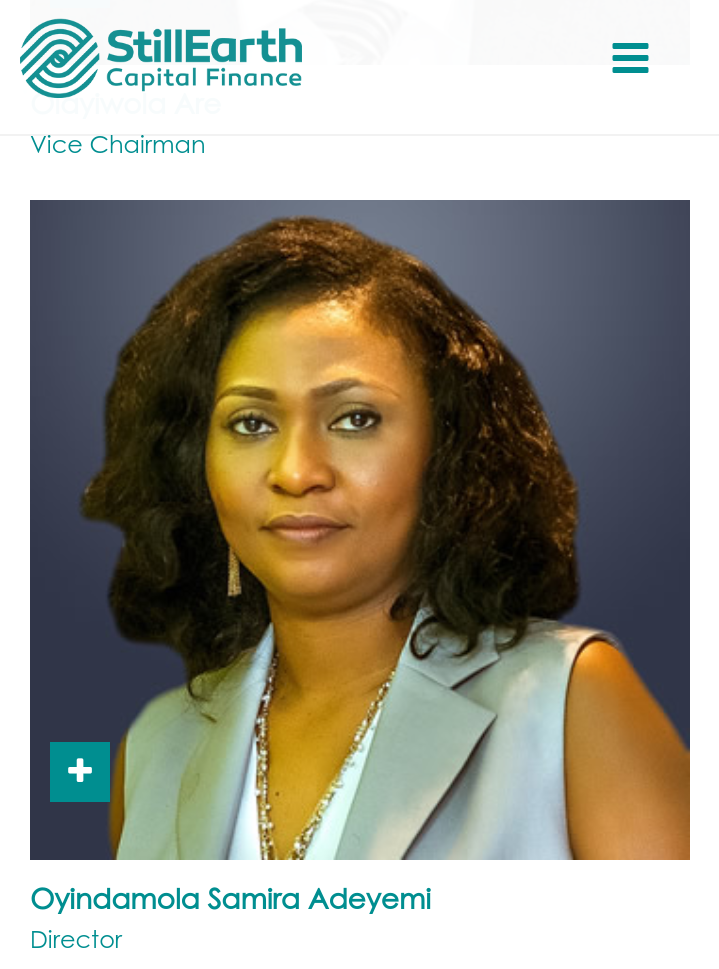
Oyindamola Samina Adeyemi
WHAT IS SEL?
Still Earth Capital Finance Limited, also known as SEL Capital is a “financial services” rendering company, with Mr. Olusegun Opaleye as its director. However, a representative from the company said that Opaleye left the company in 2022.
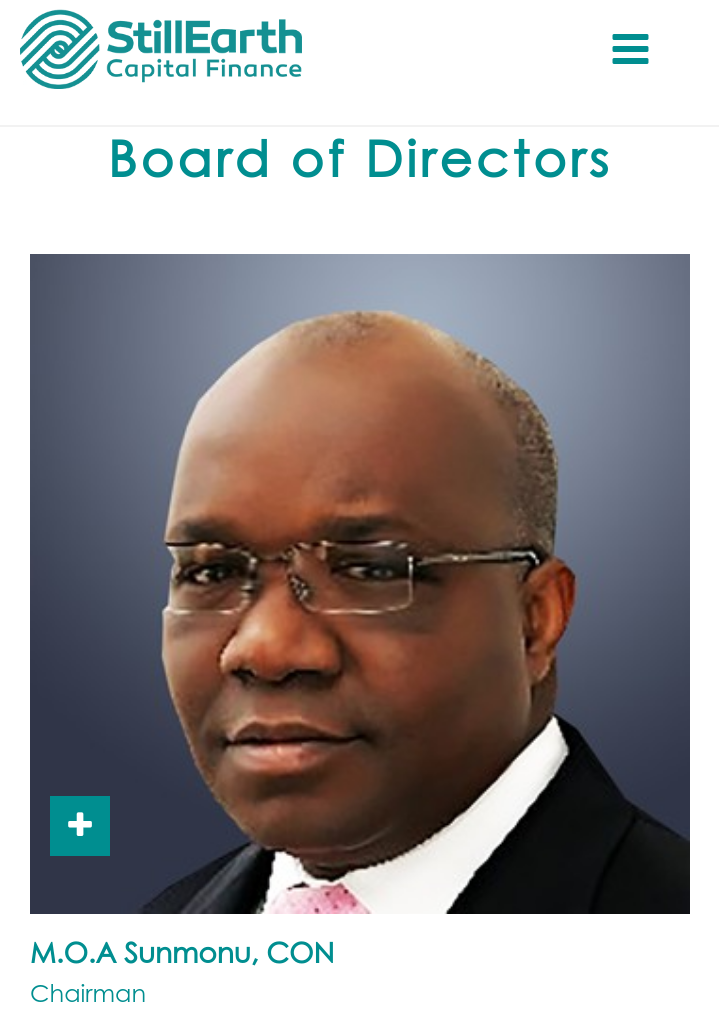
Findings showed that SEL is chaired by Mutiu Sunmonu CON, while the director is Oyindamola Samira Adeyemi. Both individuals seem to have ‘political’ connections to the current governor of the state, Seyi Makinde.
Sunmonu and Seyi Makinde are both former employees of Shell Petroleum Development Company of Nigeria (SPDC) while Adeyemi has affiliations with the People’s Democratic Party (PDP), the ruling party in the State. Segun Odegbami, a footballer turned politician and former captain of the national soccer team, Super Eagles, is also one of the shareholders of the company.
A few more eyebrow-raising revelations come to light. Sunmonu, who holds a significant role in the SEL-VYDRA consortium is also the chairman of Julius Berger. This raises questions, as Julius Berger, being a renowned construction company, has the capability to bid for the contract independently, without the need for the establishment of a new consortium. This suggests the possibility of personal interests at play.
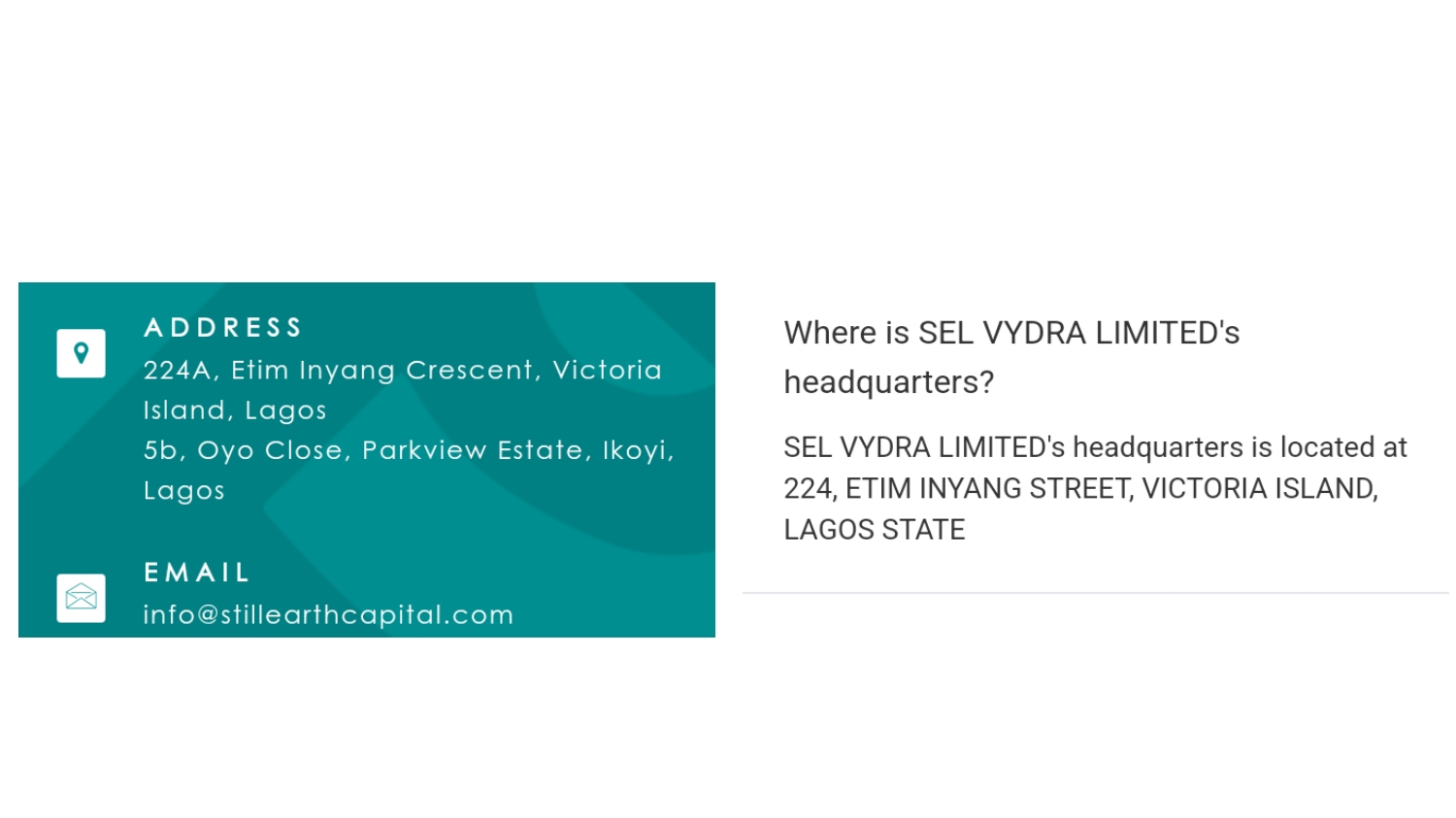
FL: Working Address of Still Earth Capital Finance Limited (SEL) and the working address of SEL-Vydra limited on Ngcheck, bearing resemblance. Subsequent companies registered in the name of Still Earth share either of the two addresses on the SEL Capital website.
A lady named Esther, who declined to provide her last name but identified herself as the legal advisor of the company, SEL Capital, stated that the company is a subsidiary of Still Earth Holdings.
Among the array of companies associated with Still Earth, Still Earth Construction and Realty stands as the solitary subsidiary exclusively focused on construction.
The rationale behind the decision to bid for the contract using SEL Capital instead of Still Earth Construction and Realty remains unclear.
WHAT IS VYDRA?
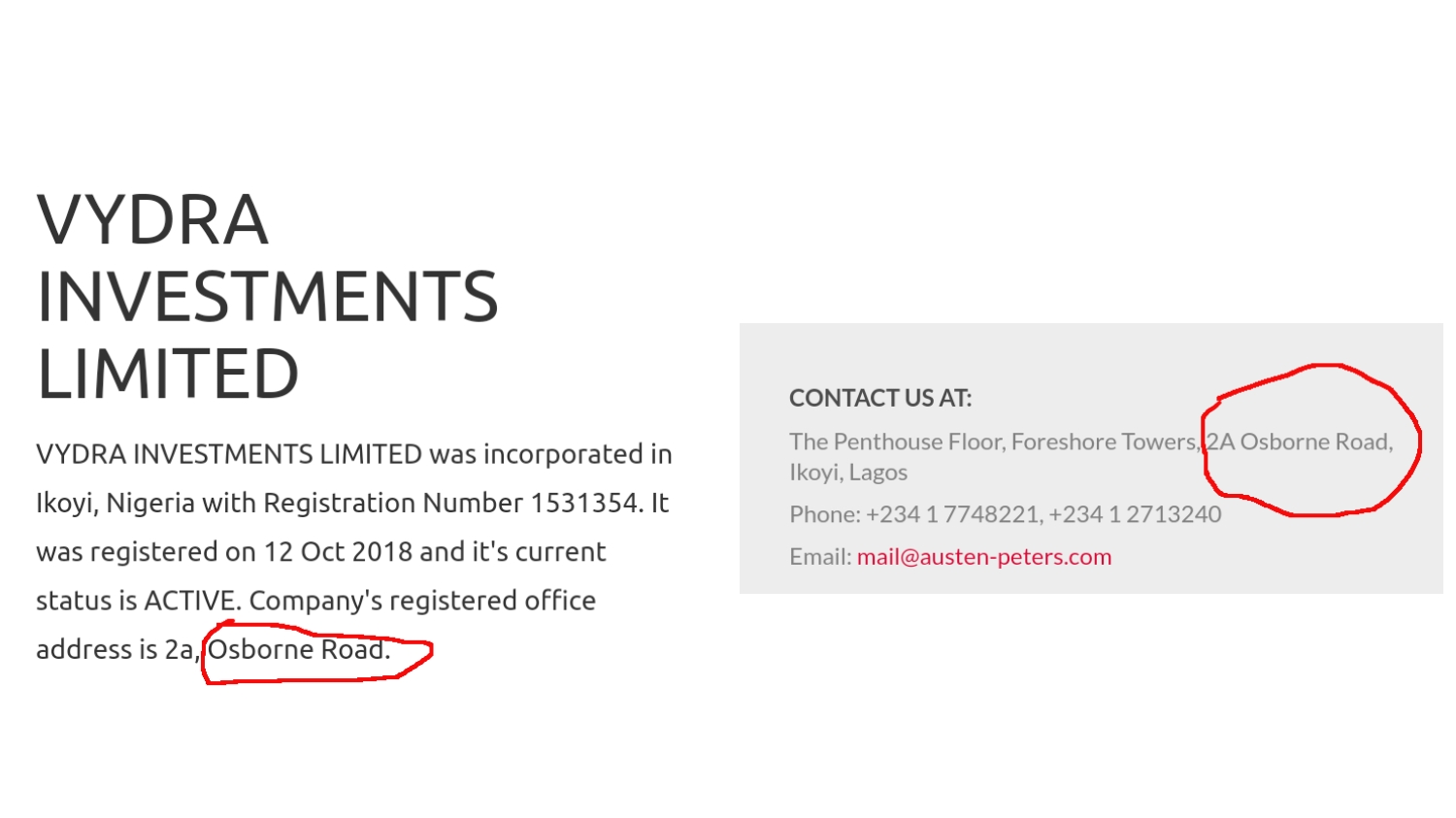
“They don’t exist,” said Jerome Kalu, a Lagos-based fixer who paid a visit to Vydra’s address at the 2A, Osborne, Ikoyi Lagos. “At Foreshore Towers, 2A Osborne Road, Ikoyi, Lagos, there’s nowhere or nothing like Vydra Investment, but just Austen-Peters and other…”
According to the online corporate registry ng-check.ng, VYDRA Investment was registered on October 12, 2018, with Michael Msughter Dugeri and Anthony Adedapo Makinde as its directors. Intriguingly, both individuals hold positions as Senior Associates at Austen-Peters & Co law firm, sharing the same address as Vydra.
FL: Vydra Investments address on Ngcheck and Austen-Peters & Co working address striking a convincing resemblance.
The connections surrounding Vydra, and its related entities raise concerns about potential beneficial ownership and the intricacies of their relationships.
One notable link is Anthony Adedapo MAKINDE, a director associated with the company. What draws attention is that the company (VYDRA) shares the same address as Austen-Peters & Co, whose principal partner is Timi Austen-Peters, a lawyer and chairman of Dorman Long Engineering Limited.
Adding a riveting twist, Dorman Long Engineering Limited boasts an extensive roster of 29 directors and shareholders, among whom is Mr. Godwin Obaseki, the Governor of Edo State and a prominent member of the People’s Democratic Party, the same political party as Governor Seyi Makinde.
Furthermore, Governor Makinde, an alumnus of UNILAG, graduated in 1991 alongside a fellow student bearing the name MAKINDE A. A. While confirmation of whether the “A. A.” signifies “Anthony Adedapo” remains elusive, it does raise the suspicion that one of the directors of Vydra may have a direct or indirect connection to the governor.
However, the Oyo State Procurement Law (2010) explicitly frowns upon any form of direct or indirect government personnel involvement in the procurement process.
Section 24 of the law states that, “Persons who have been engaged in preparing for a procurement or part of the proceedings thereof may neither bid for the procurement in question or any part thereof either as main contractor or sub-contractor nor may they cooperate in any manner with bidders in the course of preparing their tenders.”
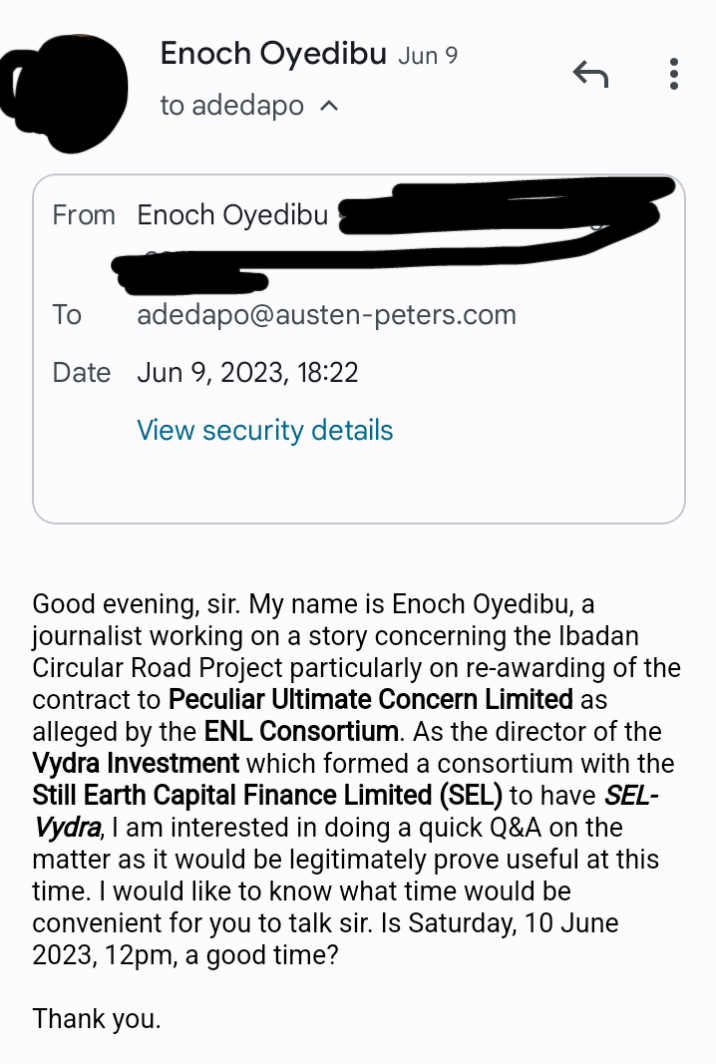
Attempts to schedule an in-person meeting with Anthony Adedapo Makinde at Austen-Peters’ office were unsuccessful. An email sent to Adedapo Makinde via Adedapo@austen-peters.com got no response leaving a trove of unanswered questions about the connections and vested interested surrounding SEL-Vydra. We might have to send someone from our Lagos office to speak with him.
The email sent to Anthony Adedapo Makinde since June 9 with no response, hitherto.
A Tale of confusion and intrigues
In response to the contract cancellation, the ENL Consortium filed a lawsuit against the state government and other contractors involved in the project. Their claim is straightforward: that the contract was re-awarded to SEL-Vydra in bad faith.
ENL Consortium further contends that the state government subsequently reassigned a segment of the contract – originally designated for SEL-Vydra – to other entities. Notable among these recipients are Craneburg Construction Company and Peculiar Ultimate Concern Limited.
Efforts to get comments from ENL Consortium through its lead counsel, Olaniwun Ajayi, LP, regarding the Ibadan Circular Road case proved abortive. Speaking with Mr. Joshua Ayanda, a lawyer at the firm also proved challenging, as he was uncooperative and evasive about his involvement in the case.
Contradicting the information provided by the client care agent of the law firm who initially facilitated the phone call to Ayanda, he denied any connection to the case, stating, “I cannot speak on the case. I am not the counsel on the case.”
When repeated calls were made by this reporter, his line was blocked. Subsequently, another client care agent, speaking over the phone, assured the reporter of facilitating a conversation with Opasanya Oluseye, SAN, the main counsel, but failed to do so as of the time of filing this report.
Amongst other issues, ENL Consortium accused SEL-Vydra Consortium of improperly re-awarding the Ibadan Circular Road contract to Peculiar Ultimate Concern Limited, a company headed by Mr. Abel Olanrewaju Adeleke.
Efforts to contact Peculiar Ultimate Concern Limited on three occasions yielded no success. Calls directed to the established company contact were abruptly terminated as soon as Mr. Michael, the individual who answered the call, knew who was on the line.
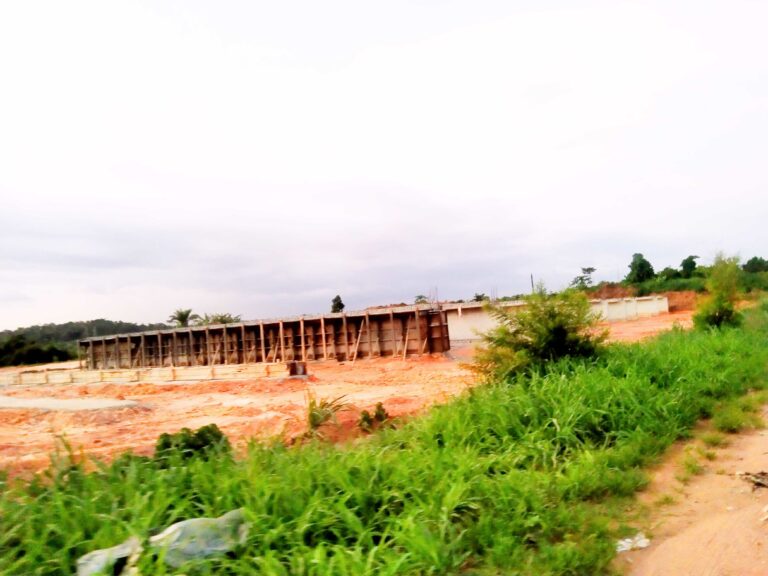
As of the time of visit to the project site, on May 28 and 29 of this year, 2023, construction on the road has not reached the promised 75km target set for June 2023. Notably, on-site observations indicated a conspicuous absence of SEL-Vydra, while the active involvement of Craneburg Construction Company in the project was evident.
Efforts to obtain information from the Oyo State Ministry of Works and OYSIPA regarding bid details, approved contract sums, durations, completion dates for contracts awarded to SEL-Vydra and Craneburg Construction Company, as well as releases made to contractors, proved abortive. Despite submitting Freedom of Information Act (FOIA) applications, both initial and reminder letters, on June 27 and July 12 respectively, got no response or acknowledgment.
Ilevbaoje Uadamen is a procurement fraud expert, and founder of Monitng, a civic technology platform that provides citizens with information to track the progress of public projects, access public data, and engage in civic advocacy. He said the idea behind awarding Ibadan Circular Road project to SEL-Vydra is questionable and a replica of what was done on the Lekki Toll Gate in Lagos.
“The way this thing works is that some governors want to remain financially relevant even after leaving office so they come up with these Public Private Partnership projects, forming consortium to build roads on Build, Operate and Transfer (BOT) model that will be tolled.”
A BOT contract model finances significant projects, especially infrastructure, in public-private partnerships. It involves a concession from a public entity to a private firm to construct and manage the project. After a fixed period, control returns to the public entity.
“The private entity will build the project by itself, own it for a period of 30 to 35 years, then transfer it to the public entity, which is the government. But most of these construction companies involved as consortium or private entities are directly or indirectly related to the government officials.
“So, at the end you’ll find out that a road built with public funds is used to enrich some private bodies. They want to leave the government and remain relevant. In the next 30 years when the road is tolled, they will be in their comfort zone and be cashing out. If such roads are being awarded to Julius Berger and the likes, do you think something like this will occur?” he said.
“The counterpart funding is just a way to launder the public funds. They make use of funds suitable enough to build the road as counterpart funding and lie that other entities own the biggest shares.”
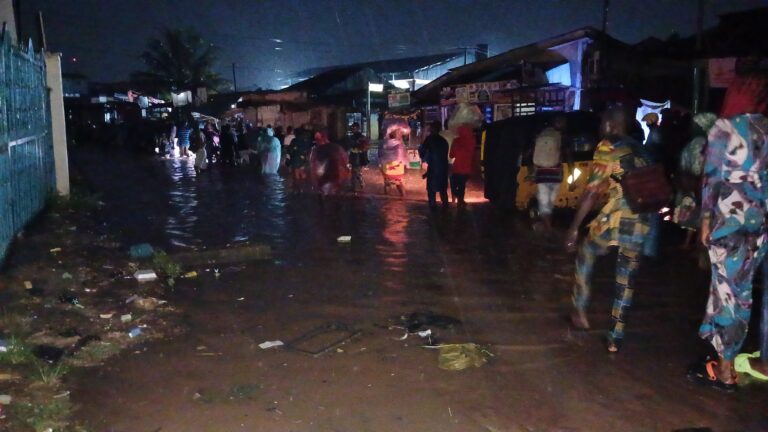
COMMUTERS and passers-by were stranded on Friday night after a heavy downpour led to flooding at the Akinola/Aboru drainage channel in Samson Street in Oke-Odo Local Council Development Area (LCDA) in Lagos state.
The flood made the street – which links the drainage channel – impassable for both human and vehicular movement, thereby leaving those returning from their respective places to their homes stranded for hours.
The ICIR observed that some people dared the flood while some had to re-route through Mosan Road in Abesan to get to their homes.
Recall that the Lagos state government announced the construction of the 9km Akinola/Aboru Drainage Channel in 2020.
According to the then state’s commissioner for the Environment and Water Resources, Tunji Bello, the construction would contribute to sustainable development and a quality living environment for all, and curb flooding had almost become intractable.
From the signpost erected beside the construction of the drainage, the state government awarded the contract to Trucete Solutions Limited, located at D55 Millenium Estate, Oniru, Victoria Island, Lagos state.
Also, it reads that the duration of the project was for 24 months.
Commuters who spoke to The ICIR called on the state government to come to their rescue.
Mohammedu Emmanuel, who resides on Raji Rasak Street in Aboru, said, “I have been leaving for about two years plus. My experience with flooding along this street is inconveniencing the residents of the community because when there is a heavy downpour in Lagos state, we experience a lot of floods, which affect the houses close to the canal here.
“Work has been going on, but I think it is very close. I believe if the government can actually work on it, it will be a good thing for the community”.
Motorists hike transport fare
Stephen John, a tricycle driver who resides on Victor Fagbemi Street in Aboru, said whenever there is a heavy downpour, the prices for transport fare increase.
“We increase the transport fare from N300-N500 for those who are going from Aboru to Agbeleke. I want the state government to help complete this drainage,” he said.
THE Ondo State Governor Rotimi Akeredolu is on his way to Nigeria from Germany after over 90 days spent on medical leave.
The governor’s wife Betty Anyanwu-Akeredolu disclosed this via her social media handle, X, on Thursday, September 7, when she posted a picture of him in an aircraft with the caption “Homebound.”
Akeredolu became noticeably ill some months after his mother’s death in September 2022.
There were speculations that the governor was battling a life-threatening ailment, and in January 2023, Akeredolu admitted to being ill.
He stated that he was in recuperation and the illness was not hindering him from carrying out his duties as governor.
“Since the Governor is not a superhuman and the immunity his office enjoys does not extend to physical wellness or otherwise, the health issue is therefore not an unusual one. However, contrary to speculations and insinuations making the round, the Governor, though frail, is discharging his official functions,” a statement by his Chief Press Secretary, Richard Olabode, read.
Despite assurances that he was getting better, Akeredolu applied for a three-week medical leave in June, and Deputy Governor Lucky Aiyedatiwa took over governance in his stead.
He, however, failed to return upon exhaustion of the 21 days, and a letter he addressed to people of the state disclosed that only his doctors could determine when he would be discharged.
Stakeholders in the state, including the Social Democratic Party (SDP) and the Peoples Democratic Party (PDP), expressed concerns over the governor’s health and called for his resignation.
A statement by the Publicity Secretary of the PDP in the state, Mr Kennedy Peretei, said the state should not be grounded because of the governor’s health conditions.
Akeredolu returns to the state to confront the huge task of governance and aspirations for the 2024 governorship poll in the state from his party members and those in the opposition parties.
The ICIR reports that the governor was sworn in for a second term of four years on February 24, 2021.
He is the 18th person to lead Ondo State since its creation in 1976 and the sixth elected governor of the state.
He has been the most vocal governor in Nigeria’s southern region against atrocities committed by non-state actors, including herders, kidnappers, insurgents and bandits, who killed many people during former president Muhammadu Buhari’s tenure.
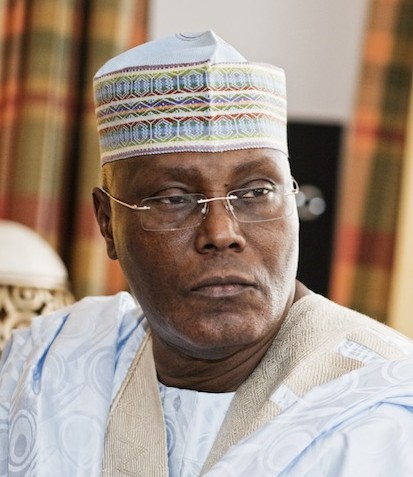
A FORMER Vice President of Nigeria, Atiku Abubakar, has rejected the Wednesday, September 6, Presidential Election Petitions Tribunal judgement that affirmed the victory of President Bola Tinubu.
Atiku was the candidate of the Peoples Democratic Party (PDP) in the February 25, 2023, presidential election.
Atiku said the tribunal judgement failed to restore confidence and is bereft of substantial justice,
Atiku said this via his X handle, formerly known as Twitter, after addressing a world press conference at the PDP headquarters in Abuja on Thursday, September 7.
“I take great pains to tell you that the decision of the court of first instance on this matter utterly falls far short of that expectation.
“I am therefore here to tell you that, though the judgment of the court yesterday is respected, it is a judgment that I refuse to accept.
“I refuse to accept the judgment because I believe that it is bereft of substantial justice. However, the disappointment in the “verdict of the court can never destroy my confidence in the judiciary,” Atiku stated.
Atiku said he has instructed his lawyer to take the legal battle to the Supreme Court.
He also promised to continue to explore the judiciary for respite.
“However, the disappointment in the verdict of the court can never destroy my confidence in the judiciary.
“Consequently, I have asked my lawyers to activate my constitutionally guaranteed rights of appeal to the higher court, which, in this instance, is the Supreme Court of Nigeria.”
“Consequently, I have asked my lawyers to activate my constitutionally guaranteed rights of appeal to the higher court, which, in this instance, is the Supreme Court.
“It is my conviction that the electoral process in Nigeria should be devoid of untidy manipulations and that the outcome of every election should be a perfect reflection of the wishes of the electorate,” Atiku added.
According to the former vice-president, whether he prevails at the Apex court in his quest or not, the record of his effort in ensuring an order of credible elections in Nigeria shall remain for future generations to evaluate.
The ICIR reported on Wednesday that the election tribunal affirmed the victory of President of the All Progressives Congress (APC) Tinubu and dismissed the case of Peter Obi of the Labour Party (LP) and Atiku of the PDP.
“Having concluded and decided that all three petitions are all devoid of merit, the petitions are hereby dismissed,” the panel announced while affirming Tinubu’s victory.
In his judgement, the court described Obi’s petition as ‘unmeritorious’ and threw out Atiku’s case.
The judgement was given by Haruna Tsammani, the tribunal’s chairman, with assistance from the other judges on the panel, Stephen Adah, Monsurat Bolaji-Yusuf, Moses Ugo, and Abba Mohammed.
THE federal government’s revenue and expenditure underperformed between January and May this year, negatively impacting economic development, the Central Bank of Nigeria (CBN) has said.
A member of the monetary policy committee (MPC) of the apex bank, Adeola Adenikinju, disclosed this in personal statements by the MPC members from the July 2023 meeting.
According to Adenikinju, the federal government’s retained revenue stood at N1,673.15 billion, lower than the pro-rata target of N1,968.12 billion.
“This was due to the underperformance of FAAC (Federal Account Allocation Committee) receipts, Gross independent revenue,” he explained.
The ICIR can report that the allocation committee, responsible for reviewing and adopting the allocation of funds to states of the federal government of Nigeria, had shared a total of N3.629 trillion to the tier of government between January and May.
FAAC shared N750.174 billion to the governments in January, N722.677 billion in February, N714.629 billion in March, N655.932 billion in April, and N786.161 billion in May, The ICIR had reported.
Of the total distributed revenue of N3.629 trillion in the review months, the federal government received N1.373 trillion.
In January, it received N277.334 billion; in February, N269.063 billion; in March, N276.141 billion; in April, N248.80 billion; and in May, N301.889 billion.
Similarly, Adenikinju hinted that the federal government’s total expenditure as of May 2023 was N4,769.26 billion, representing 27.8 per cent lower than the budget estimate of N6,606.02 billion.
“The shortfall came mainly from allocation for debt service, interest on Ways and Means, and capital expenditure,” he explained.
He further hinted that the overall budget deficit was reduced negatively by -18.15 per cent in the review period.
“The underperformance of the budget is especially felt in the capital expenditures, thus impacting negatively on economic development,” the MPC member said.
Highlights of the 2023 budget indicate a total revenue estimate of N10.49 trillion; aggregate expenditure, inclusive of gross operating expense and project-tied loans, projected to be N21.83 trillion; overall budget deficit of N11.34 trillion to be financed through domestic sources of N7.04 trillion, and foreign sources of N1.76 trillion; and debt service cost of about N6 trillion.
While the monetary and financial market indicators showed evidence of liquidity excess in the economy, annualised growth rates of Net Foreign Assets and Net Domestic Assets components also exceeded the provisional levels.
He said, “The rise in FAAC in July because of the petrol subsidy removal and narrowing of the FX market rates must be managed so as not to increase the liquidity in the economy.”
In July, FAAC reported a total gross revenue of N1.746 trillion, which indicated that more money came into the purse of the federal government.
In that same month, President Bola Tinubu said the federal government had saved N1 trillion in two months in funds from the fuel subsidy removal.
The immediate past administration had spent over N11 trillion on petrol subsidies, which many analysts had argued favoured the rich more than the poor masses.
Nigerian National Petroleum Corporation, now NNPC Limited, has been the sole supplier of petroleum products to the Nigerian market under which subsidies rained.
“The rise in FAAC overtime would help in managing the recourse of the FG and Subnational units on debts to finance government activities. This would also reduce Ways and Means finance and eventually reduce inflationary pressures from the monetary side.
“The FG and some states have also announced different packages of interventions to boost household incomes, expand agriculture output in the medium to long term, shift demand from petrol to other substitutes like CNG and support transportation costs. The FG has also announced other tax incentives to reduce costs of production for firms, several agricultural support initiatives, as well as several subsidised credits to different categories of firms, especially the MSMEs in the economy,” Adenikinju added.
RISING insecurity in Nigeria’s South-East region has led to the deaths of more than 1,700 people between January 2021 and June 2023, The ICIR analysis from two data agencies has shown.
By calculation, there are 913 days between January 2021 and June 2023. If the total number of deaths is divided by each day, at least two persons are killed daily in the region.
According to the data, the deaths occur from protests, armed clashes, abductions, mob violence, secessionist groups, riots, electoral violence, and other conflicts.
The affected states are Abia, Anambra, Ebonyi, Enugu and Imo.
The ICIR analysed data from the Nigeria Security Tracker (NST) and the Armed Conflict Location and Event Data Project (ACLED), two data agencies that collate data on insecurity crises in Nigeria.
State
2021
2022
May-2023
Abia
43
81
25
Anambra
221
248
97
Ebonyi
195
128
28
Enugu
57
156
33
Imo
242
166
41
Data gathered from ACLED by The ICIR
These two agencies gather their data by surveying Nigerian and international media reports.
According to NST data, between January 2021 and June 2023, 1,844 people were killed in the region. Breaking it down, in 2021, a total of 951 people were killed in 227 incidents that occurred in the region.
In the following year, 627 people were reported killed in 223 incidents; between January and June 2023, 266 died in 92 incidents.
Meanwhile, ACLED data analysed by The ICIR showed a total of 1,761 killed between January 2021 and May 2023.
The data showed that 758 and 779 were killed in 2021 and 2022, respectively. Meanwhile, between January and May 18, 2023, 224 people have been killed in various incidents.
Further analysis of both data by The ICIR revealed that Anambra state had the highest death rate recorded. It was followed by Imo and Ebonyi states, while Abia state reported the lowest death rate.
Further findings showed that Abia state has the lowest incidents reported despite being the hometown of leaders for proscribed groups.
STATE
2021
2022
Jun-23
ABIA
76
55
16
ANAMBRA
227
201
95
EBONYI
272
109
33
ENUGU
81
141
18
IMO
295
121
104
Data gathered from NST by The ICIR
Lingering attacks in the region
Agitation by the Igbo ethnic group to become an independent state (Republic of Biafra) separated from Nigeria started as far back as 1967 or even earlier. The declaration resulted in a prolonged civil war that claimed hundreds of lives.
Between 1967 and 1999, Nigeria experienced several military interregnums, but this did not stop the southeastern nationalism movement from gaining political and social relevance from the people up until the emergence of secessionist groups, including the Indigenous People of Biafra founded by Nnamdi Kanu in 2012.
IPOB has played a major role in the calls for Igbo secession from Nigeria, including engaging in actions considered by the Federal Government as treasonable, culminating in its proscription by the former President Muhammadu Buhari’s government in 2017.
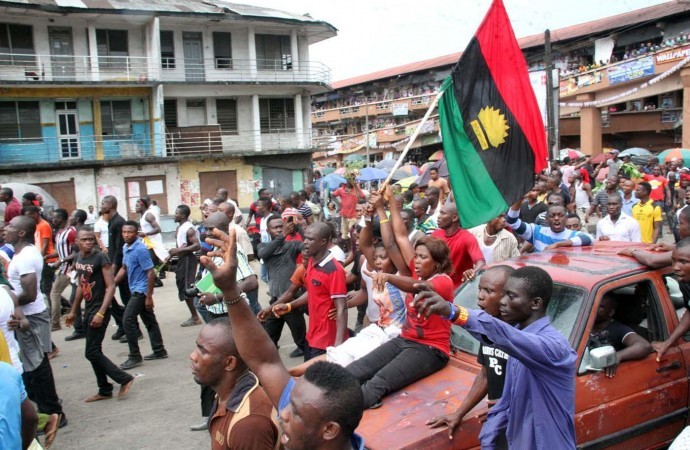
Despite the proscription, IPOB has remained undeterred, with its major action being the enforcement of the Monday sit-at-home directive.
A recent ranking by the Global Terrorism Index listed the group among the 20 deadliest terror groups in the world.
The group communicates with its members, both in the diaspora, via social media and other platforms. It also holds protests and lockdowns, some of which develop into riots and clashes with security operatives or counter-groups.
When Kanu was arrested in August 2021, the group, in solidarity, locked down the southeast region and continued a mandatory Monday sit-at-home order that suspended every economic activity in the affected state.
A two-part investigation by The ICIR (here and here) captured the implications of the sit-at-home order on businesses in the five states. There, however, have been efforts by the state governors to end the sit-at-home order, but this has not yielded much results.
The ICIR has also reported recent developments on residents protesting against the order and the security checks on transporters within the region. Some deaths captured in the data analyzed by The ICIR resulted from clashes by secessionist groups in the region.
‘A sad national reality’
A professor of political science at the University of Nigeria, Nsukka, Freedom Onuoha, told The ICIR that the conflict experiences within the region are not unconnected to failed policies from the government alongside militarized responses, which led to the emergence of separatist groups.
Onuoha said, “The case of the Southeast is a reflection of this sad national reality, but it is more a product of the way the past administration of Muhammadu Buhari deliberately or inadvertently mismanaged separatist agitation in the Southeast.
“The result was the rise and reign of roving armed criminal groups described as unknown gunmen. This group of criminal marauders are majorly behind the killings in the Southeast. Unmasking their true identity, whether state or non-state sponsored, is key to addressing bloodletting in the region.”
However, the professor noted that the emergence of a new administration at the federal and state levels opens a great prospect for resolving the crisis if strategic dialogue is made that would promote the interest of residents and agitators within the region.
“The administration of President Bola Ahmed Tinubu can leverage his political position to extract a negotiated settlement of the trial of Nnamdi Kanu in furtherance of national unity and cohesion while the state governors can close their ranks to effectively reign in the agitators towards the restoration of peace and economic vitality in the region,” he said.
CRIME is among the major challenges confronting Nigeria as a nation. The pervasiveness of crime has repeatedly called into question the effectiveness and efficiency of the Nigeria Police Force. This is despite their exclusive reliance on modern policing strategies and techniques.
Traditionally, crime-related matters have been handled through what’s known as “spiritual security”. This is a knowledge system that involves the use of amulets, charms, rituals and talismans for protection, power and clairvoyance.
As sociologists specialising in criminology, we were interested in what the Nigerian police personnel had to say about these mechanisms of protection.
We conducted a study of their perceptions and attitudes. Many told us that they believed criminals used spiritual security for power and protection. Some officers confirmed that they themselves used charms and the like to help in their jobs.
We conclude that this indigenous approach to crime fighting could prove useful to the police, particularly in intelligence gathering, crime investigation and crime control. Traditional belief systems could complement the country’s colonially based law enforcement and social control systems and improve their efficiency.
Traditional belief systems
Spiritual security is a traditional knowledge system that dates from precolonial times. It was a way that Nigerian people dealt with social issues. Not only for security, but also to settle disputes and for social control, conflict resolution, justice administration, peace engineering and social harmony.
The knowledge system of most African societies is generally predicated on a belief system that’s divided into the physical (visible and seen) and the spiritual (mysterious and unobservable). History tells us that African people gave high credence to this system of knowledge.
Although mystical, preternatural and esoteric powers are virtually inexplicable, many Nigerians believe that they know when they are being manipulated by those who have access to such powers.
The study
Our research was carried out among police officials serving at the Oyo State Police Command. We interviewed 35 police officers belonging to the State Criminal Investigation and Intelligence Department and the Special Anti-Robbery Squad.
We wanted to know to what extent the police were aware of criminals using spiritual security mechanisms. And we asked for their views on the police using them too. Should they be integrated into police operations?
Most police officers acknowledged that the system of spiritual security mechanisms was part of a cultural heritage which many Africans employed. They explained that people did so to protect themselves from their enemies’ spiritual attacks and to neutralise the impact of deadly weapons such as guns, machetes and knives.
Participants said that their professional experiences in the field showed that criminals routinely used spiritual security mechanisms. They did so to strengthen and protect themselves when perpetrating crime such as armed robbery, kidnapping, rape and homicide.
There was no clear consensus about whether the mechanisms were effective or not. But many officers said they believed that the criminals’ use of spiritual security was capable of compromising police operations. One police officer said:
Criminals, especially armed robbers, usually rely on it. Some time around 2003 … we arrested four armed robbers and handcuffed them. Can you believe that two of them who were handcuffed together disappeared? … What happened that day was like a miracle. It was only after making consultation from the people who are knowledgeable that we were told that one of them deployed egbe (a spiritual device for disappearance).
Our research also established that some police officers were secretly consulting custodians of the traditional knowledge system to enhance their performance and safety on the job.
Our respondents, however, expressed differing opinions about whether spiritual security mechanisms should be integrated into modern police work. Those who supported the idea believed it could improve crime fighting and help keep officers safe.
Others dismissed the idea. They stressed the value of modern policing strategies and technology. Some said their religion (both Christian and Muslim) expressly forbade them from associating with traditional charms. Some felt it went against police culture and codes.
Physical security and spiritual security
The work experiences of police officers, however, generally demonstrated the importance of a knowledge system that recognises a connection between physical security and spiritual security.
Modern policing strategies are not adequately dealing with Nigeria’s crime and insecurity crisis. Notorious criminals are combining the use of sophisticated weapons with spiritual charms.
We recommend that Nigeria’s police force should explore any potential advantages that the system of spiritual security mechanisms might offer. If well applied, this hybridisation could boost intelligence gathering capacity and crime control efforts.