Home Blog Page 814

Areas minister of sports needs to address in Nigeria sports

0

SPORTS in Nigeria is a sector that needs overhauling.

Former president Muhammad Buhari Administration saw two ministers during each four years tenure which generated both knocks and kudos.

The former ministers, Solomon Dalung and Sunday Dare, both steered the affairs of sports during the last eight years. Although the latter left indelible imprints with the introduction of some policies, the health of the industry is still looking pale, bordering on the paucity of sporting facilities, lack of sponsorship, poor welfare of athletes, among others.

Some of the initiatives during the last four years of the  Buhari administration were the National Sports Industry Policy (NSIP) which was aimed to increase private participation in sports development through investment and government incentives; the adopt initiative, which included: adopt-an-athlete, adopt-a-pitch, adopt-a-team and adopt-a-facility.

The adopt-a-facility witnessed the support to revamp the Moshood Abiola National Stadium in Abuja and the renovation of the National Stadium in Lagos.

Other include the 10-years football master plan towards rebuilding youth football and bringing to life the domestic national league.

President Bola Ahmed Tinubu administration appointed a former senator, John Owan Enoh (JOE), as the 36th Minister of Sports.

The ICIR spoke with stakeholders in the industry on their advice to this new administration.

John Owan Enoh
John Owan Enoh

Grassroot development

A sports journalist based in Lagos, Enitan Obadina, advised the new sports minister to develop sports at the grassroots level through policy formulation, saying that the Nigeria Sports Industry Policy (NSIP) introduced by the last administration is yet to come to life.

“It (NSIP) is still at the ministerial level and some discussion, it needs to pass fully into the law in a short space of time so that it will open up the sports industry for the private sector to get value and add value to the sports industry.”

According to him, the development of sports at the grassroots is the bedrock and catalyst to unearthing talents that will raise the flag on high in major sports competitions, both local and international.

But he lamented, “Most of the sports facilities and the places one can catch future stars or where coaches can train the future stars are dying.”

Building a multi-purpose sports hall

To enhance athletes’ performance in sports, Obadina said, “We need a world-class multi-purpose indoor sports hall that can host a major event. Maybe the administration can collaborate with private companies to help achieve that.”

He noted that some Nigerian athletes had failed doping tests, which caused national embarrassment, hence the need to build a doping lab.

Doping test facility

“Another area the new administration needs to spread its hands on is an area of doping. We need a doping lab. The last minister Sunday Dare talked about having a sport science in Abuja, that needs to come to life.

“If we have this centre, our athletes will be sharpened to be world-class right from Nigeria”.

Work on Infrastructure deficit

The spokesperson for Nigeria Scrabble Federation (NSF) Maxwell Kumoye said that the infrastructure deficit has been a major bane of Nigeria’s sports, saying that the country does not have enough sports infrastructure compared with other African countries.

“We do not have approved facilities that are of a high standard.

“So, the new minister will fight that infrastructural deficit and decay. We do not have enough, and the ones we have are in a sorry state, so when the minister comes in, let work begin on these facilities. Once these facilities get on the ground, then we can now talk about additional ones,” he said.

Coaches training

Kumoye stated that Nigeria has a comparative advantage over some African countries in sports like scrabble and weightlifting but needs modern training for their coaches.

“Our coaches, where do they stand compared with other African coaches in handball, volleyball, tennis, table tennis, scrabble, weightlifter? Yes, there are some sports we have a comparative advantage over in some African countries, both a lot of coaches are archaic, stone age,” he said.

Empowerment of technical official

The Scrabble federation spokesperson said the body managing sport in Nigeria should hold the various sporting federations responsible, get their calendar of events and look at their plans for managing and developing technical officials.

“For instance, in football, how many referees of Nigerian descent officiate at international competitions, whether at centre or assistant referee?

“In football, besides the immediate Nigeria Football Federation (NFF) president Amaju Pinnick, the rest are nowhere. In basketball, apart from Col. Sam Ahemdu, who is zone 3 FIBA Africa president, the rest are nowhere.

“So there must be a progressive plan towards getting Nigerians to international bodies, and they should not just go there and play second fiddle. They should be there to push so that Nigeria can be recognised. At the West African level Ghana is the one controlling WAFU”.

Athletes welfare

Kumoye added that there should be adequate training for athletes to prepare for local and international competitions.

“Most of these associations are near dormant; they do not have enough local competition and attending international competition, most do not. So how will they even qualify for the major Olympics?

“So the minister must work hard, getting funds for associations to compete on the continent even at the regional level.

“For years now, Scrabble has been recognised as an official sport but has hardly been funded by the sports ministry.”

Autonomy of sports association

He stressed the need for sports associations to be autonomous.

Sports federations in Nigeria include Amateur Bodylifting and Fitness Federation, Athletics Federation of Nigeria, Badminton Federation of Nigeria, Bobsled and Skeleton Federation of Nigeria, Cycling Federation of Nigeria, Handball Federation of Nigeria and Karate Federation of Nigeria.

Others are Ladies Golfers Association, Nigeria Acquatic Federation, Nigeria Archery Federation, Nigeria Autosport Federation, Nigeria Baseball and Softball Association, Nigeria Basketball Federation, Nigeria Chess Federation, Nigeria Cricket Federation, Nigeria Federation for Physically Disabled, Nigeria Football Federation, Nigeria Golf Federation, Nigeria Hockey Federation, Nigeria Judo Federation, Nigeria Olympics Committee, Nigeria Paralympic Committee, Nigeria Polo Sport Federation, Nigeria Rowing Canoe and Sailing Federation, Nigeria Rugby Federation and Nigeria Shooting Sport Federation.

Other are: Nigeria Table Tennis Federation, Nigeria Tenpin Bowling Federation, Nigeria Weightlifting Federation, Nigeria Wrestling Federation, Nigeria Fencing Federation, Sport Fishermen’s Association of Nigeria, Taekwondo Federation of Nigeria and the Nigeria Federation of Gymnastics 

World Athletics Championships 2023: Nigeria’s medal hopeful Amusan begins title defence today

0

NIGERIA’S world women’s 100m hurdle title holder, Tobi Amusan, will begin her title defence today -Tuesday – at the ongoing World Athletics Championships in Budapest.

Amusan is set to start her race by 6.12 p.m. today at the National Athletics Centre in Budapest.

The Nigerian was declared not guilty last Thursday after the Athletics Integrity Unit (AIU) freed her from a Whereabouts Failures charge, clearing her to compete in the Championship.

The world women’s record holder will run from lane four and seek to be one of the four automatic qualifiers for the semifinals.

At the last competition in Oregon, Amusan started her campaign with 12.40 seconds and completed with a historic gold medal in the final, running a wind-aided 12.06 seconds to become the first Nigerian world champion.

Since the commencement of the championship, Nigeria’s athletes are yet to have a podium finish.

Nigeria’s duo Usheoritse Itsekiri and Seye Ogunlewe ended at the men’s 100m semifinals.

Itsekiri finished 8th in heat 1 of the semifinals with a time of 10.19s while
Seye Ogunlewe placed 5th with a time of 10.12s.

They will return to the track much later for the men’s 4x100m relay.

Team Nigeria was near winning a medal on Day 2 as Ese Brume placed 4th with a season’s best of 6.84m after her name was in Bronze medal position until the last round of the competition where she dropped from the medal range position to Romania’s Alina Rotaru Kottmann.

Nigeria’s net reserves at $3.7bn ‘significantly’ lower than estimated – JP Morgan

NIGERIA’s net foreign exchange reserves are significantly lower than previously estimated, J.P. Morgan Asset Management said in a report.

The leading global financial services firm made the revelation while analysing the Central Bank of Nigeria (CBN) financial accounts.

Reading the tea leaves from the CBN’s audited financial accounts, JP Morgan said the lousy aspect of the record lies in the decline in the country’s net FX reserves.

“Net FX reserves are significantly lower than previously estimated. Based on partial information from the audited financial accounts, we estimate that CBN’s net FX reserves were around US$3.7bn at the end of last year, from US$14.0bn at end-2021,” it stated.

A look at JP Morgan’s analysis revealed that total external reserves, which is a summation of external reserves and the International Monetary Fund’s (IMF) special drawing rights (SDR), fell from $40.7 billion or N17.69 trillion in 2021 to $37.4 billion or N17.24 trillion in 2022.

From the figure, the SDR declined from $5.3 billion or N2.31 trillion to $5.0 or N2.31 trillion in the review period.

Contrarily, the CBN total liabilities, which comprise FX forward, securities lending, and currency swap, rose from $26.7 billion or N11.59 trillion in 2021 to $33.7 billion or N15.55 trillion in 2022.

It means that when the total liabilities are deducted from the total external reserves, Nigeria’s net FX reserves fell from $14.0 billion or N6.10 trillion in 2021 to $3.7 billion or N1.69 trillion in 2022.

According to JP Morgan, in arriving at the estimated sum, there are a few assumptions which, if incorrect, would substantially change the picture.

The first assumption is an addition of $5.0 billion in the SDR to external reserves in order to arrive at total gross FX reserves of $37.8 billion, broadly in line with the 30-day moving average of $37.08 billion previously published on the central bank’s website.

The second is in adjusting the gross external reserves with three key FX liability lines that include FX forwards ($6.84bn), securities lending ($5.5bn) and currency swaps ($21.3bn).

And the third is estimating currency swaps by backing out FX forwards and outstanding OTC Futures balances from an overall aggregate published in the financial accounts.

With Nigeria Eurobonds starting maturing in 2025 and continued maturities from 2027, high debt-servicing needs and a relatively lower net FX position make it imperative to continue on the reform path to attract FX flows.

JP Morgan suggested, “Nigeria would need foreign direct and other portfolio investments to attract FX inflows. Thus, in our view, continuing on the reform path would be imperative to allay concerns on the external side.”

The ICIR had, on August 11, reported that the apex bank released its seven years of Consolidated Financial Statements from 2016 to 2022.

The release had got many stakeholders in the financial corridor talking and querying the rationale behind the apex bank withholding its account for so long.

“What a country called Nigeria,” the chief executive officer/principal partner of Afrique Capital and Equity Funds Limited, Kazeem Bello, lamented, expressing that in the United States, the Federal Reserves Bank releases its quarterly and annual financial statements that must be submitted to Congress; otherwise, no single dime would be approved for government spending, nor would Congress approve the Credit Ceiling limit.

“If the CBN cannot produce or release its Financial statements in over seven years, I am wondering why anybody would compel the Commercial Banks and other financial institutions to publish their account or how will the CBN that does not have any published account be interested in the financial statement of the Bank published or not.

“We need serious house cleaning in Nigeria, and we need to get serious for the sake of the economy,” Bello, a development economist, said.

Meanwhile, the financial statements showed that apex bank owes JP Morgan and Goldman Sachs a combined sum of $7.5bn as of the financial year ended December 2022.

Included as part of its liabilities is another $6.3bn owned in foreign currency forwards.

It revealed that the group entered into a securities lending agreement with Goldman Sachs and J. P. Morgan, and as part of the agreement, the group pledged its holdings on foreign securities in return for cash. The cash received from Goldman Sachs is N0.23tn ($500m), 2021: N0.22tn ($500m), and JP Morgan N3.23tn ($7bn), 2021: N3.05tn ($7bn) is recognised in other foreign securities.

Buildings will go down, land ownership revoked, Wike warns FCT residents

0

NEWLY inaugurated Minister of the Federal Capital Territory (FCT) Nyesom Wike has, on his first day in office, threatened to demolish illegally built houses and revoke ownership of some pieces of land.

He disclosed this during his inaugural briefing after he was sworn in as Minister along with 44 others in Abuja on Monday, August 21.

“All those people who are distorting the master plan of Abuja, too bad. Too bad. If you know you have built where you are not supposed to build, it will go down. Be you minister of anywhere, be an ambassador; if you know you have developed where you are not supposed to develop, your house must go down. Those who have taken over the green areas to build, sorry,” he said.

He noted that lands which have not been developed for prolonged periods would be allocated to other residents who will sign contracts indicating that they would be put to use within a specified time.

“All these people who are doing land racketing, let me tell you, that period of land racketing is over. Those the government has given C of O allocated lands to them, they refuse to develop, and they are becoming land speculators; the land is gone. I’m going to revoke them,” Wike said.

Wike promised that insecurity in the FCT would be addressed and security agencies supported to carry out their duties during his administration.

He warned FCT residents that random situations of markets would no longer be tolerated.

“What we want is results, and that must be done. If we don’t safeguard this place, then we’re in problem. Look at people stealing manholes and this and that. Who is responsible? Where are the security people? So something must be done to curtail this. The issue of security is the aim for us. Mr President has told me, whatever is required, we must make sure Abuja is safe,” he said.

Demolition of structures has been commonplace within the FCT. Several residents have lost homes and businesses to the exercises, mostly due to the construction of buildings on illegally acquired land.

Nigeria retains market dominance as fintechs raise over $2.7bn in 2 years

MORE than $2.7 billion has flooded into the African financial technology (fintech) ecosystem in the last 24 months as Nigeria maintains Africa’s most fintech-populated country ahead of South Africa and Kenya.

The latest release of Disrupt Africa’s fourth edition of ‘Finnovating for Africa: Reimagining the African financial services landscape 2023’ has shown.

The report, released every two years, revealed that the Nigerian fintech space had added more than $1 billion to its total in the last two years, more than tripling its total figure and making up more than one-third of the staggering $2.7 billion invested in African fintech since July 2021.

It showed that Nigerian fintech companies grew to 217 in the review year, up 50.1 per cent on 144 in 2021, which had, in turn, been up from 101 in 2019 and 74 in 2017.

The country’s total market share rose to 32 per cent in 2023 from 25 per cent in 2021 and 20.6 per cent in 2019.

Nigeria has assumed a market-leading position when it comes to activity it has long held in the area of fintech investment. Of the about $3.64 billion in funding secured by African fintech ventures in the last 8.5 years, about $1.51 billion or 41.6 per cent went into Nigeria-based companies.

While Nigeria accounts for 32 per cent of Africa’s 678 fintech startups, South Africa holds 20.6 per cent, and Kenya, 15 per cent, fall into the second and third positions, respectively.

The “big three” markets maintained their share of fintech activity with 459 or 67.7 per cent of the 678 startups in the 2023 report, which barely differs from a 67.9 per cent share in 2021 and 65.2 per cent in 2019.

When moved up to the “big six” markets, adding Egypt, Ghana and Uganda to the equation, the countries account for 86.7 per cent of startups, up from 85.4 per cent in 2021 and 81.7 per cent in 2019.

A deep dive into the continent’s fintech startup ecosystem revealed that three new fintech markets – Burkina Faso, Lesotho and Namibia – emerged for the first time in the 2023 edition.

“The fintech space is by far and away the leader within the wider African startup ecosystem when it comes to both funding and exit activity.

“Since Disrupt Africa began tracking funding in the African tech startup space in 2015, 540 fintech startups from 25 countries have raised an extraordinary US$3,635,823,965, three times more than any other sector,” the report indicated.

Meanwhile, not only are African fintech startups more likely to raise funding than their peers, but they are also more likely to be acquired.

Between June 2021 and July 2023, about 26 fintech startups were acquired, compared to seven between 2019 and 2021, and accounted for over 60 per cent of the 43 such deals reported since 2011.

While fintech companies in Nigeria rose to 217, the report added that the number of ventures per country ranges from one in Algeria, Burkina Faso and Mali.

Fintech’s operations have, however, brought many concerns, including privacy concerns, data protection, cybersecurity and fraudulent transactions.

A report on Frauds and Forgeries in Nigeria Banks showed that the total amount of money lost to fraudulent activities surged by 207.9 per cent in the three months ending September 2022. It rose to N3.6 billion in the third quarter from N1.2 billion in the second quarter.

The ICIR has, in several reports, flagged fintech lending and loan apps over concerns of infringing on customers’ data privacy.

In recent reports by The ICIR, the federal government, under the auspices of the Federal Competition and Consumer Protection Commission (FCCPC), has been putting measures in place to prohibit fintech lending and loan apps from accessing customers’ contacts and images, and in conjunction with Google has clamped down on some loan shark apps assaulting their customers.

Persons with disabilities decry govt neglect, demand 5% of N5bn palliative

0

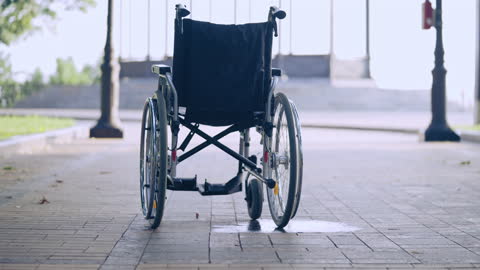
THE National Association of Persons with Physical Disabilities (NAPWPD) has demanded a five per cent share of the N5 billion palliative approved by the Federal government for states and the federal capital territory (FCT) to address the impact of the fuel subsidy removal already taking a toll on the lots of the masses.

Its national president, Rilwan Mohammed, requested this in a statement on Saturday, August 19, according to a report by the News Agency of Nigeria.

Mohammed asserted that persons with disabilities (PWDs) are neglected and not being carried along in the decision to support the states with relief funds.

The ICIR reported that the Federal government had on Thursday, August 17, approved an N5 billion palliative for the 36 federation states, including the FCT, which amounts to N185 billion.

President Bola Tinubu had, during his inauguration speech on May 29, said fuel subsidy was gone.

Since the declaration, the pump price of fuel has jumped from about N185 to over N600 per litre, increasing transport fares and costs of food items and throwing many households into severe hardship.

The NAPWPD president’s appeal indicates that N250 million of the fund be allocated to persons with disabilities across each state, which will invariably amount to N9.25 billion, including the FCT.

He said the demand was in tandem with the provisions of the Discrimination Against Persons with Disabilities (PWDs) Prohibition Act.

Section 25 of the Disability Law provides that in situations of risk or humanitarian emergencies, PWDs should be accorded preference and protection.

“The disability law provides for a sharing formula to accommodate PWDs, who are usually excluded when they are lumped with other people during the allocation of relief support.

“It is to address this problem that we are asking for five per cent to be allocated to PWDs in line with the provision of the law,” Mohammed said.

According to him, there is a need to provide a precise template or clarity on how marginalised groups like the PWDs would be accommodated in the utilisation of the N5 billion palliative.

Mohammed said the association is “extremely disturbed and sorely worried” over the suffering of its members due to the fuel subsidy removal.

“The impact of the removal has continued to have a debilitating impact on PWDs who are largely poor and vulnerable.

“The inability of PWDs to afford decent food, healthcare and necessities of life has been compounded and made worse with the recent situation in the country.

“Our members now find it difficult to access public transport as the transport system is largely inaccessible and unaffordable to members of the disability community,” he said.

He further decried the rapid multiplier effect of the fuel subsidy removal, which has shut the price of goods and services to the rooftop, adding that the development was making life unbearable for people experiencing poverty, particularly physically challenged persons.

Calling on the governments to tackle the challenges of public transportation, he said the public transport system should be made accessible to PWDs, demanding that buses and other means of transportation be fitted with adjustable ramps and handrails for wheelchair users.

“The vehicles should also be fitted with signage and electronic display for directions with audio announcements for the benefit of the deaf and the blind.

“All these are provided for in the disability law. Our demands, therefore, are not based on charity requests but consistent with legal provisions,” Mohammed added.

Global concern

According to the World Health Organisation, persons with disabilities face all kinds of inhumane treatment, including finding inaccessible and unaffordable transportation 15 times more difficult than those without disabilities.

As of 2020, there are reportedly over 27 million Nigerians with some form of disability.

Dataphyte, a media research and data analytics organisation, showed that about one in every eight Nigerians live with at least one form of disability. 

The most common of these disabilities are visual impairment, hearing impairment, physical impairment, intellectual impairment, and communication impairment.

The United Nations’ Sustainable Development Goal 10 aims to reduce inequality by empowering and promoting the social, economic and political inclusion of all, including persons with disabilities. At the same time, its Goal 11 would make cities and human settlements inclusive, safe, resilient and sustainable. 

However, social protection for disabled people in Nigeria is still relatively weak, Dataphyte stated.

Election tribunal outcome: Police ban protest across Kano

0

THE Kano State Police Command has banned all protests in the state with immediate effect.

The command, in a statement on Monday, August 21, signed by the Commissioner of Police (CP) Mohammad Usaini Gumel, said intelligence received by the command indicates that two dominant parties, the All Progressives Congress (APC) and the New Nigeria People’s Party (NNPP) have gathered a crowd to launch a protest.

The police vowed to thwart any attempts made by any group or individuals to incite disturbance in the State.

According to the CP, disobeying a security directive will be viewed as uncivil, illegal, and a threat to national security, and as such, will be dealt with according to the law.

“In consideration of the confirmatory intelligence products at the disposal of this Police Command, all forms of street protests are hereby banned across all parts of the State.

“Members of the Public should therefore note that it has come to our knowledge that both the APC and the NNPP members are currently mobilizing rented crowds in the guise of the Civil Society Coalition and without clearance from the leadership of the Nigeria Labour Congress and without prior approval from the security agencies in the state,” the CP stated.

The police added that information gathered indicated that some members of both political parties are pressuring Civil Society participants to make this choice purely out of concern for their safety and to get ahead of the election tribunal’s ruling.

The ICIR reported that the APC in Kano filed a petition to challenge the victory of Abba Yusuf of the New Nigeria NNPP in the governorship election.

However, the APC governorship candidate Nasiru Gawuna was exempted from the petition filed before the Governorship Election Petition Tribunal.

Gawuna, the former Deputy Governor of the state, was not joined as a party in the petition.

The parties involved in the petition are APC as the petitioner, versus the NNPP, Abba Yusuf and INEC as 1st, 2nd and 3rd respondents, respectively.

In the petition filed on Sunday, April 10, the APC alleged that Yusuf was not qualified to contest the election because his name was not on the list of members of the NNPP sent to INEC.

The petitioner further alleged that Yusuf didn’t win the election with the majority of lawful votes, arguing that some of the votes cast for the NNPP are invalid and, if removed from the scores, the APC will have the highest number of votes cast.

‘I will hold you to account,’ Tinubu warns newly inaugurated ministers

0

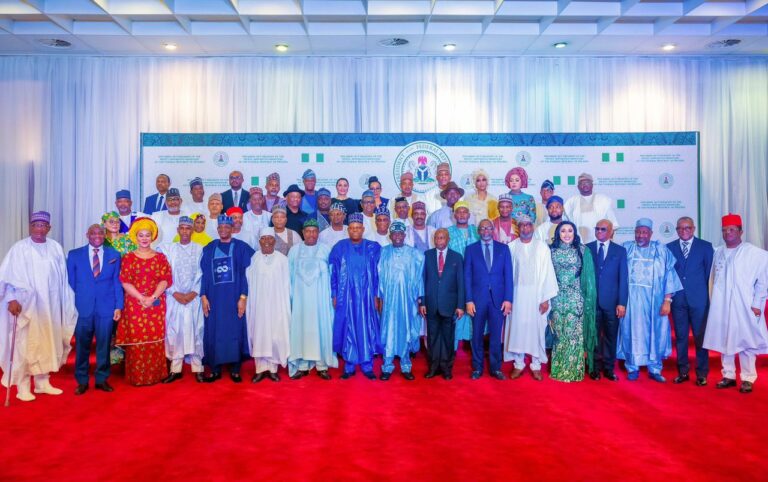
NIGERIA’s president, Bola Ahmed Tinubu, has sworn in 45 new ministers.

The ministers were sworn in on Monday, August 21, at Presidential Villa, Abuja.

President Bola Ahmed Tinubu presided over the inauguration, emphasizing the importance of this new cabinet in steering Nigeria towards prosperity and addressing its multifaceted challenges.

In his address, Tinubu stated that the newly inaugurated ministers were carefully selected and represented the diversity in the country.

“In line with the constitutional and obligations, the senate of the Federal Republic of Nigeria has screened and confirmed 45 ministers who will superintend over the ministry of the Federal Government in this administration of Renewed Hope.

“The Men and Women who have been sworn in have been carefully selected by me for their track record of excellence and achievement in public and private sectors reflected in the diversity of Nigeria and bring to their new roles an assortment of experience and expertise to help guide the nation.” 

He also said that the ministers were selected to transform the nation’s economy and ensure peace, safety and prosperity.

He added, “Minister of Federal public you are not a minister of a region or minister of a particular state.”

The President also warned the ministers to uphold their constitutional duties, stressing that they should restore people’s faith in governance. “The greatest number of Nigerians are highly expectant. They believe you will serve with integrity and deliver. I will hold you to account.’

The newly inaugurated ministers represent a wide range of sectors and portfolios, including finance, health, education, and foreign affairs and were selected across the six geo-political zones. 

The moderator of the event, Ajuri Ngelale who is a spokesperson to the president, read the citation of the ministers before their inauguration. The ministers-designate in a group of five, took turns to take an oath of their offices, pledging to uphold the constitution, serve diligently, and work tirelessly towards the betterment of Nigeria. 

The first set of the ministers designate to take their oath are the Attorney General of the Federation and Minister of Justice, Lateef Fagbemi; Minister of State for Labour and Employment, Nkiruka Onyejeocha; Minister of State Gas in the Ministry of Petroleum Resources, Ekperikpe Ekpo, Minister of Women Affairs, Uju Kennedy, and Minister of Education Tahir Maman.

The other 40 ministers subsequently took their oaths of office in batches after their citations were read by Ngelale.

Tinubu had, in different letters, conveyed the names of the ministerial nominees to the Senate, explaining that the confirmation request was in accordance with the provisions of Section 147 Subsection 2 of the 1999 Constitution of the Federal Republic of Nigeria, as amended.

On August 7, 2023, The ICIR, reports that the Senate confirmed 45 out of 48 ministers nominated by President Bola Ahmed Tinubu.

The confirmation was made despite controversies surrounding the certificates and forgery of some nominees.

However, three nominees, namely, Nasir El-Rufai, Abubakar Danladi and Stella Okotete, have not been confirmed due to security clearance,  according to the senate president.

The president subsequently assigned portfolios to the ministerial nominees who passed the screening process at the National Assembly.

The president named Bosun Tijani as Minister of Communications, Innovation and Digital Economy, Ishak Salako as Minister of State, Environment and Ecological Management; Wale Edun, Minister of Finance and Coordinating Minister of the Economy; Bunmi Tunji, Minister of Marine and Blue Economy; Adedayo Adelabu, Minister of Power and Tunji Alausa as Minister of State, Health and Social Welfare.

Others include Dele Alake as Minister of Solid Minerals Development; Lola Ade-John, Minister of Tourism; Adegboyega Oyetola, Minister of Transportation; Doris Anite, Minister of Industry, Trade and Investment; Uche Nnaji, Minister of Innovation Science and Technology; Nkiruka Onyejeocha, Minister of State, Labour and Employment and Uju Kennedy, Minister of Women Affairs.

DATA: What N218 million senators ‘holiday’ allowance can do for Nigerians

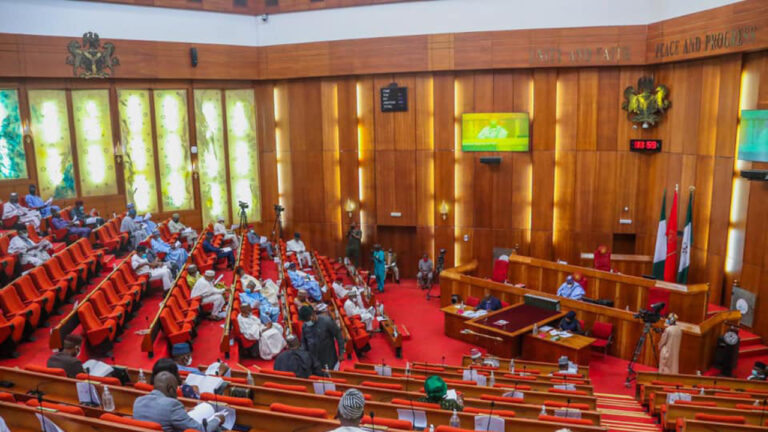
ON August 7, just after the screening and confirmation of all ministerial nominees, the Nigerian Senate President, Godswill Akpabio, announced the payment of a ‘vacation allowance’ to senators as they embarked on a seven-week recess.

In his words, “In order to enable all of us to enjoy our holidays, a token has been sent to our various accounts by the Clerk of the National Assembly.”

He, however, retracted the statement upon realising the session was being televised. 

He said, “I withdraw that statement. In order to allow you to enjoy your holiday, the senate president has sent prayers to your mailboxes to assist you to go on a safe journey and return.”

A report later disclosed that 109 senators received N2 million each, totalling N218 million shared. 

Since the announcement was made, despite the senators’ consent, several political actors, including civil organisations, have condemned the allowance by the upper chamber as this is coming at a time when Nigerians are battling with hardship due to the economic policies initiated by the president.

However, this is not the first time the Senate has announced palliative allocations for its members. The ICIR analysed how N110 billion was earmarked in July to improve the working conditions of lawmakers. 

The NASS approved  N70 billion from the N819.5 billion 2022 supplementary budget to support the working conditions of the new lawmakers. It earmarked an extra N40 billion for the acquisition of 465 Sports Utility Vehicles (SUVs), bulletproof cars for principal officials and members.

For this report, The ICIR looked through the 2023 fiscal budget to show how N218 million ‘holiday allowance’ can benefit Nigeria, assuming the money is redirected to solve other issues.

What the allowance can do

Using the 2023 budget as a benchmark to get the unit cost of projects, the holiday allowance can;

Health sector

Supply and install four ultra-modern and specialised diagnostic equipment at a unit cost of N50 million. It can also construct 21 radiology complexes at a unit cost of 10 million, construct 23 modular theatres at a unit cost of N9.4 million and construct four hospital wards, beds and accessories at a unit cost of N50 million.

What N218 million can do for Nigerians

Water sector

Construct 12 motorised boreholes at a unit cost of N18 million, construct 11 boreholes at a unit cost of N19.5 million, and construct 4 drainages and flood control at a unit cost of N50 million. It can also construct 50 drip irrigations at a unit cost of N4.3 million and construct 2 earth dams at a unit cost of N74 million.

What N218 million can do for Nigerians

Power sector

The allowance, The ICIR learnt, can construct 21 500kva/11/0.400kv with 11km line at a unit price of N10 million, provide the electrification and installation of 21 solar systems and street lights at a unit cost of N10 million and construct 21 solar power energy infrastructure at a unit cost of N10 million. Also, eight integrated solar street lights at a unit cost of N25 million and the provision and installation of eight street lights at a unit cost of N25 million can be provided. 

What N218 million can do for Nigerians

Education Sector

In the education sector, the allocation can construct seven blocks of student hostels at a unit cost of N30 million, construct and equip four Information, Centre and Technology centres at a unit cost of N50 million, provide four 32-seater buses at a unit cost of N52 million, construct and equip two classrooms with 11 blocks at a unit cost of N80.5 million and construct 10 computer technology laboratories at a unit cost of N20.73 million. 

What N218 million can do for Nigerians

Information Ministry flouts FG directive, issues counter circular on retirement

THE Federal Ministry of Information and Culture (FMIC) has flouted a Federal Government directive that all directors who have spent eight years or above should proceed on retirement in line with the revised Public Service Rules (PSR).

The directive was issued in a memo dated July 27 by the Head Of Civil Service of the Federation (HCSF), Folasade Yemi – Esan.

The revised PSR 020909 stipulates that “A director or its equivalent by whatever nomenclature it is described in MDAs shall compulsorily retire upon serving eight years on tenure policy on the post; and a permanent secretary shall hold office for a term of four years and renewable for a further term of four years, subject to satisfactory performance and no more.”

But rather than adhere to this directive, the Human Resources Manager (HRM) in the information ministry, Grace Okani, ostensibly on the instruction of the Permanent Secretary (PS), Ngozi Onwudiwe, issued a counter order giving additional three months to the affected directors before disengagement.

The revised Public Service Rules (PSR)

The Federal Government recently unveiled the new Public Service Rules (PSR) for immediate implementation.

The Federal Executive Council (FEC) approved the amendment of the Public Service Rules in 2021; however, the HCSF issued a circular for its implementation on July 27, 2023.

According to findings by The ICIR, some civil servants are opposed to the revised policy because they think it violates the mandatory retirement age of 60 years or 35 years in service.


Head of the Civil Service of the Federation, Folasade Yemi-Esan

Memo from the Office of the Head of Civil Service Of the Federation (HCSF)

The ICIR sighted the memo by the Head of Service addressed to all permanent secretaries, Accountant-General of the Federation, Auditor-General of the Federation and heads of extra-ministerial departments.

The memo directed full compliance with the newly revised PSR.


A Memo from the Head of Service Of the Federation directing all directors who have stayed up to 8 years in ministries to retire.

“Following the approval of the revised Public Service Rules by the Federal Executive Council on September 27, 2021, and its subsequent unveiling during the Public service lecture during the commemoration of the 2023 Civil Service Week, the PSR has become operational with effect from July 27, 2023. 

“You are, therefore, to ensure full compliance with all provisions of the Public Service Rules (PSR) 2021. 

“Please, ensure strict compliance with the contents of this circular,” the memo stated.

A Contrary directive

Following the commencement of the PSR, it was expected that all affected persons in the Federal Ministries would exit, but that was not the case in the FMIC, as Okani issued a counter directive through a circular dated August 8.

In the memo, she directed all the affected staff to use the next three months to prepare for their disengagement from service.

A counter Circular signed by the Human Resources Manager of the FMIC, Grace Okani.

“Accordingly, affected officers are hereby, in line with Rules 021210 of the Public Service Rules, given three months to prepare their disengagement from service effective 1st August 2023.

“Futhermore, all Resident Informations Officers (RIOs) affected by the Circular are directed to act accordingly in line with extant rule for disengagement from service,” the circular stated.

The new circular has, however, generated grumbling among the staff of the Ministry.

Some Ministries and MDAs complied with the PSR.

Checks by The ICIR show that some Directors in the Ministry of Finance have been eased out of the Civil service due to the new rules.

A staff at the Ministry who preferred to remain anonymous told The ICIR that Labour Unions in the Ministry led a protest that ensured all the directors followed the revised rules.

“Some unions in the Ministry ensured that all the affected directors did not enter their offices; they were asked to leave,” he said.

In a circular issued on August 3, 2023, signed by the Director, Administration, Ministry of Finance, Mariya Rufa’i, affected directors were encouraged to hand over their positions to the most senior official in their respective offices and start the paperwork process immediately.

It was also gathered that some directors in the National Gallery Of Art, a department under the FMIC, have also complied and retired in line with the new rule.

“National Gallery of Art directors who are affected have stopped coming,” our source stated.

Affected directors in the FMIC

According to a source in the Presidency, the affected directors who are due for retirement in the FMIC are the Director of Federal Government Press, Itu Itu, Director of Finance and Account (DFA), Kayode Musbau and Willie Bassey, Director of Information, Office of the Secretary to the Government of the Federation.

Pending procurement process

Our source said the extension of the retirement date of the directors in the FMIC, it was suspected, is to enable them to participate in the forthcoming procurement process, which is meant to commence soon.

“Now the HRM released a circular against the Presidency circular that says that all the directors should retire immediately, backdated to July 27th.

“So the circular that the HRM of Information and Culture now released gives them three months to work till they disengage, instead of immediately, contrary to the government position.

“We have some privileged information that the Ministry is going into the procurement process for 2023, which will start any moment from now, so because of that, the DFA has promised the Permanent Secretary some juicy jobs.

“The DFA has to strike a deal with the Permanent Secretary so he can finish the procurement process,” the source alleged.

Response to allegation of disobeying a government directive

In their various reactions to the issue, both the HRM, Okani and the Information Officer in the office of the SGF, Bassey, confirmed the existence of the two circulars.

Okani, in a telephone chat with The ICIR on Thursday, August 17, said she only obeyed a superior order to issue the counter circular.

“The Permanent Secretary told me there is an order from above that since they are the first set under the revised PSR, they should stay for another three months.

“I am not in Abuja presently; I will meet the Permanent Secretary to verify it when I come.

“Since they are the first, they should stay a little bit. I will rectify it when I come so they may avoid setting a precedent. This will be settled,” Okani said.

When asked about the officers affected by the PSR in her ministry, Okani said, “I have the director of Finance and Accounts and the director of the Federal Government Printer, Itu Itu. For others assigned to other offices, we have forwarded their names to the Head of Service,” she added.

In a chat with The ICIR on the same day, Bassey insisted that he did nothing wrong but only obeyed the instruction he received through a circular that asked affected officers to stay for additional three months.

“The Circular I received said I should stay till October. I have a circular from the Federal Ministry of Information and Culture and the Office of the SGF that all affected persons have been given three months to exit the service. They have given us till October,” he said. 

When asked about the circular, Bassey said, ” You can’t see it; I cannot circulate it. I am a civil servant. Please quote me that we have been given another circular. In the Civil service, you are given time; it is not like the military.”

On the PSR, he said it is new, hence the need for them to be given more time to exit the service.

All efforts to clarify these developments with the ministry’s Permanent Secretary, Onwudiwe, yielded no response. A request was made to her Personal Assistant, named Ifeanyi, to speak to her, but he declined.

On the second visit to her office, the PS directed The ICIR reporter to her Special Adviser, Isaac, who disclosed that another memo would soon be issued before the close of work on Thursday, August 17, to rectify the issue. He maintained that the initial circular from the Head of Service was not specific on the implementation date.

” The memo from the Head of Service was not too specific. Under normal circumstances in the Civil service, you are entitled to three months to prepare before retirement.

‘But there is another memo on the way. It will come out before the close of work today or tomorrow,” Isaac said.

Latest memo

On Thursday, August 17, after a visit to the PS office, the Ministry issued another Circular directing the affected officers to hand over to the most senior officer in their office and immediately proceed on what it termed “Pre-retirement training.”

“In furtherance to our earlier circular Ref. No. FMCT/PS/010/11/113 dated 10th August 2023 on the above subject and in compliance with PSR 021210, I am directed to request you to, as a matter of urgency, hand over to the next most senior officer in your office and proceed immediately on your pre-retirement training.

“You are hereby kindly requested to accord this matter the urgency it deserves,” the circular stated.

The latest circular was issued on August 17 and signed by the newly posted HRM from the Ministry of Petroleum, Emma Equere.

The latest circular was issued on August 17 after ICIR’s visit to the PS office.