THE Independent National Electoral Commission (INEC) on Monday, July 3, failed to open its defence against the petition filed by Labour Party (LP) candidate, Peter Obi, at the Presidential Election Petition Court.
The petition is challenging the outcome of the February 25 presidential election.
The Tribunal presided over by Haruna Tsammani, had previously ordered INEC to open its defense on July 3, subsequent to the conclusion of cases presented by the Allied Peoples Movement (APM), the LP, and the Peoples Democratic Party (PDP).
However, at resumption of hearing on Monday, INEC’s counsel, Abubakar Mahmoud, a Senior Advocate of Nigeria (SAN), informed the court that the the Commission’s first witness could not attend due to family issues.
He requested an adjournment until the following day to allow the witness to be present.
Following the development, the Tribunal adjourned the petition to Tuesday, July 4, for further hearing.
Speaking to journalists shortly after the adjournment, LP lawyer Levi Uzoukwu, a Senior Advocate of Nigeria (SAN), claimed that INEC was unprepared to defend its case before the tribunal.
He asserted that his camp had a strong case and was fully prepared to proceed, unlike INEC, which he said had displayed a consistent lack of preparedness.
“Given the contradictions and inconsistencies and what INEC has done; I’m sure they are not ready to defend this case,” he said.
“I stand to be proven wrong, but I would wish that they defend this matter so that the public will see more of what happened to this election.”
Uzoukwu emphasised that the decision to call witnesses rested with INEC, and he and his client, the LP, were ready to proceed at any time.
Obi had closed his case at the Tribunal after calling 13 witnesses to prove his allegation that the election was rigged.
He had proposed to call 50 witnesses but could only call 13 within the court allotted time. He also tendered tons of electoral documents.
INEC had declared Tinubu as the winner of the February 25 presidential election.
According to INEC, Tinubu secured 8,794,726 votes to come first, Atiku Abubakar of the Peoples Democratic Party (PDP) finished second with 6,984,520, while Obi polled 6,101,533 to come third.
Displeased with the results, Obi, and his party filed a petition at the court to challenge Tinubu’s victory.
In their petition, Obi and the LP argued that when Tinubu’s running mate, Kashim Shettima, became the vice presidential candidate, he was still nominated as the APC candidate for the Borno Central Senatorial election.
They also challenged Tinubu’s eligibility, alleging that he was previously indicted and fined $460,000.00 by a United States District Court for an offence involving dishonesty and drug trafficking.
Obi claimed that the election was invalid due to corrupt practices and non-compliance with the provisions of the Electoral Act, 2022.
He argued that INEC breached its regulations and guidelines by not prescribing and deploying technological devices for voter accreditation, verification, continuation, and authentication as required.
The petitioner sought a declaration from the court that Tinubu was not qualified to contest the election and that all votes recorded for him were wasted.
He also requested the court to determine that he received a majority of lawful votes and satisfied constitutional requirements to be declared the winner.
In the alternative, he called for the cancellation of the election and the conduct of a fresh election in which Tinubu, Shettima, and the APC would not participate.
THE trial of afrobeat musician Seun Kuti at the Yaba Magistrates’ Court was stalled on Monday, July 3 due to the absence of the trial judge.
The Chief Magistrate, Adeola Olatunbosun was said to be on her administrative leave when the case came up for hearing on Monday.
The case was as a result adjourned until September 27 by the court’s registrar for further hearing.
The musician, son of Afrobeat legend, Fela Anikulapo Kuti, was seen in a viral video in May, slapping a policeman in Lagos State.
The Inspector General of Police, IGP Alkali Baba Usman, according to a statement from police spokesman, Muyiwa Adejobi, thereafter ordered his arrest.
Kuti, on May 15, turned himself in at the Lagos State Police Command Headquarters, Ikeja, accompanied by his lawyers and family members.
The 40-year-old musician was subsequently arrested and moved to the State Criminal Investigation Department (CID) in Panti.
On May 16, he was arraigned before Adeola Olatunbosun of a Magistrate’s Court in the Yaba area of Lagos State on charges of assaulting a police officer, an action which violated Section 356 of the Nigerian Criminal Code Act.
The Afrobeat singer was, however, granted bail but according to his lawyer, the judge ordered that he is to be released in 48 hours after meeting his bail conditions.
The judge also ordered that Kuti’s file be duplicated and sent to the director of public prosecution (DPP) and subsequently adjourned to May 23.
But on May 18, his lawyers said the magistrate has extended the remand order by an additional four days to enable the police continue with its investigations.
He was eventually released on May 23 after spending eight days in police custody.
However, the magistrate, Olatunbosun, in a previous ruling on May 24, dismissed an application by the Nigeria Police Force (NPF) seeking to arraign the Afrobeat singer.
The Police counsel, Cyril Ejiofor, had sought the leave of court to arraign the singer, having preferred a charge against him.
RESIDENTS of Trademore Estate in the Lugbe area of the Federal Capital Territory (FCT) have protested against the planned demolition of the estate by the Federal Capital Development Authority (FCDA).
The residents staged a protest against the planned demolition on Monday, July 3.
The FCDA had announced that it will demolish structures on waterways in trademore and across the nation’s capital.
According to a statement by the FCDA executive director, Shehu Ahmed, the structures in communities such as Trademore Estate, disrupting the natural water flow, are responsible for flooding recorded in some parts of the city.
He explained that despite the Administration marking many buildings in the estate, the occupants refused to vacate.
The planned demolition followed the recent reportedly in the estate that claimed the lives of some residents on Friday, June 23.
Several houses, vehicles, shops and other properties were damaged by the flood, which also displaced scores of residents.
According to reports, it was the fifth flood incident in the estate since 2014.
Residents of the estate, said to be mostly civil servants who are still paying mortgage on their houses, have kicked against plans by the FCT authorities to demolish structures in the estate.
Speaking during the protest, chairman of the residents association, Adewale Adenaike, said the Trademore residents were the victims of the flood caused by a lot of water channels and tributaries diverted into the estate.
“Like I said earlier during the press briefing, the protest is a result of flooding in Trademore. Trademore residents are simply victims of the extended flooding situation in Lugbe.
“A lot of channels and tributaries have been diverted into Trademore and that is to give way to other estates and what we expected was that the government agencies would do the needful by ensuring that all those waters are diverted away from Trademore.”
Adenaike argued that the demolition planned by the FCTA was totally unnecessary as the estate is not sitting on a flood path.
“The demolition that they plan for Trademore is totally unnecessary because that’s not the reason. We are not sitting on the flood path, we are sitting like any other properties in Abuja.
“There’s no reason for demolition and we are asking through this medium, telling government agencies to come to our aid, let’s get together to find a lasting solution. We have experts on our side, they will come together with experts of the government side to come up with a lasting solution,” he added.
Adenaike further dismissed claims that the estate was not approved by the FCT authorities.
“Trademore Estate was assigned by the former minister of the FCT, Nasir El Rufai and it was approved by AMAC at the time. Over 2,000 houses were built in this estate, on airport road of the FCT. I don’t understand how that could be illegal.
“We also have a section of the estate commissioned by the then vice president of Nigeria. I don’t understand how the Vice President would commission illegality.”
A resident, simply identified as Olu said he used all his life savings to purchase his house in the estate.
“The government coming up to say that they want to destroy Trademore is an illegality because Trademore is not the problem, it’s a technical issue that can be handled. As a house owner, that’s almost 60 years, I used all my life savings to buy the house for my family and the government approved that land.”
He appealed to President Bola Tinubu to come to their aid and find a lasting solution to the crisis.
The ICIR had reported how over 100 families were affected by flooding in the estate on Friday, June 23, after an early morning rainfall.
Some residents who spoke to The ICIR narrated how water flooded their apartments and shops.
Abutu Nafisat, a 24-year-old salesperson at an electrical gadget store on Lugard Street, Phase 1, said she was alone and terrified when the flood came.
She also noted that the water got very close to the ceiling of her store.
“If one of estate security had not come to rescue me, I might have drowned in the water,” she said. “Because of the level of the water, there was nowhere I could go, nothing I could do. I was so terrified that, at some point, I started crying.
“We lost goods that cost millions as a result of the incident. It’s a devastating experience.”
Another resident, Jacob Sule, who lives in Phase 2, said he recently moved into the estate, and was not aware that the area was prone to flooding or had experienced flooding in the past.
He explained that his clothes, shoes, home appliances and gadgets were destroyed by the flooding. “I lost so much that I can’t count them all,” he said.
“I just learnt that this is a recurring crisis. The authorities need to contain this problem. It was a very nasty and bad experience. Psychologically, it is disturbing. I hope it never rains again.”
THE National Industrial Court (NIC) on Monday, July 3, ordered the Police Service Commission (PSC) to pay retired Assistant Inspector General of Police (AIG) Joseph Mbu the sum of N40 million as general damages.
The News Agency of Nigeria (NAN) reports that the presiding judge, Osatohanmwen Obaseki-Osaghae, imposed the payout in payback for Mbu’s forced resignation from the Police before reaching the legal retirement age of 60.
“I hold that the claimant’s (Mbu) premature retirement through a press release on July 2, 2016, is unlawful, unconstitutional, null and void and of no effect,” the judge ruled.
The court also annulled the alleged retirement and ruled that the claimant continued to serve as an NPF officer until May 10, 2018, when he turned 60 and became required to retire.
In addition, the court mandated the PSC to pay Mbu’s salary, allowances, and entitlements from July 2, 2016, when he was officially retired, to May 10, 2018, when he was legally entitled to retire at age 60.
The judge equally ordered that the sum of N750,000 be paid to the claimant as the cost of the suit, stating that failure of the defendant to comply with the court’s orders within 30 days would attract a 10 per cent interest per annum.
However, the court rejected the claimant’s request for restoration and advancement to the level of a DIG.
Mbu had attained the mandatory retirement age on May 10, 2018, while the lawsuit was still pending; the court explained, thus it could not be upheld.
Mbu hsd, filed a lawsuit against the Commission on July 2, 2016, when he was the Commandant of the Police Staff College, for his alleged forced retirement.
In his statement of facts, Mbu claimed that he was born on May 10, 1958, joined the police on December 11, 1985, and had yet to achieve the obligatory retirement age of 60. He also claimed that he had not worked for 35 years before retiring in 2016.
The claimant consequently asked the court to invalidate his resignation, which he said was accomplished through a press release because he was never given the required statutory notice of retirement, among other reliefs.
Additionally, he asked the court to issue an order telling the defendant to pay his wages, benefits, and other entitlements from July 2016 until 2018, when he was supposed to retire.
Additionally, he asked for N20 million in court costs, N500 million in general damages, and payment of his terminal benefits.
The defendant asserted in defence of itself that the claimant was genuinely dismissed from the force on a formal occasion rather than through a press release.
The defendant further argued that advancement within the force is not assured and that the claimant did not meet all requirements for promotion.
According to NAN, in the court’s ruling, even if the defendant gave up on the case by failing to appear in court to present a defence, the claimant was still required to provide evidence to support his claim.
The defendant was never present in court despite receiving multiple hearing notices, according to the judge, who argued that pleadings are not equivalent to evidence.
Obaseki-Osaghae said that because the claimant’s arguments were not disputed, the defendant was believed to have given up its case.
She added that the claimant was entitled to some of the reliefs he requested since he had established his case based on reliable evidence rather than relying on the defendant’s weak arguments.
Mbu, a former Commissioner of Police in the Federal Capital Territory (FCT), took the PSC to court over his alleged forced retirement on July 1, 2016.
In his Statement of Facts, he claimed that he was born on April 10, 1958, that he joined the Nigerian Police Force in 1985, that he had not yet turned 60, and that he had only worked for 35 years until retiring in 2016.
Mbu was the Commandant of the Police Staff College until his retirement in 2016.
THE New England First Amendment Coalition (NEFAC) is hosting its annual 30 Minute Skills webinar themed ‘Digging Deeper in Broadcast Journalism’.
The webinar will focus on how anyone involved in sourcing information for broadcast news can use investigative techniques in his or her daily work despite the constraints of busy newsrooms and deadline pressures.
Participants will learn how to incorporate data into stories, how to use public records to strengthen reporting, and how to find exclusives and pitch them to managers.
Broadcast journalists can register for a free webinar.
The webinar will be held on July 12, 2023. Interested individuals can apply here.
EXORBITANT fares charged by transporters has been identified as one of the reasons for the low key celebrations recorded during the recent Sallah festivities.
However, drivers who spoke to The ICIR have explained the reasons behind the ‘excessive’ fares they charged during the Sallah festivities, noting that it was not a case of extortion.
The Secretary of the Abuja-Kwara State Express in Jabi, Alfa Hamzat, explained that the increase in fuel pump price and high demand for buses were few of the contributing factors to the ‘excessive’ transport prices.
Hamzat disclosed that his park used to charge N9,000 before the removal of fuel subsidy for a seven seater Sienna bus for a journey to Ilorin but later increased it to N14,000 till a week before the Sallah.
“Fuel subsidy removal affected us systematically in such a way that the cost of maintaining the vehicles has somehow increased. This is aside from the fuel price. People mostly forget that cars use beyond fuel. Take for instance, if a car goes to Ilorin and comes back to Abuja, it can’t do that two times in a row without requiring some maintenance.
“Before the fuel subsidy removal, we spent N14,000 on fuel for the whole journey, but we now spend N49,000 since the development.”
Muslims in Nigeria joined their colleagues across the world to mark the Eid-al-Adha festival, on Wednesday, June 26, which involved the slaughtering of ram to commemorate Prophet Ibrahim’s readiness to sacrifice his son to God.
Eid-il-Adha (Eid-il Kabir) is the second Islamic festival in the Hijrah calendar and is believed among locals to be the ‘big’ Sallah, and most people travel down to their hometown to celebrate.
However, there were indications that most people couldn’t travel home, or even partake in the celebrations due to the ‘excessive’ hike in transport fare, which drivers have tied to the removal of fuel subsidy.
The ICIRreported that the removal of fuel subsidy led to an astronomical hike in the cost of basic goods and services.
On May 29, President Bola Tinubu, in his inaugural address, declared that subsidy has been removed. Few days later, the Nigeria National Petroleum Company Limited (NNPCLtd) officially increased the pump price of petrol by about 200 per cent.
The hike in fuel pump price, and the attendant rise in transport fares, resulted in many people giving up the hope of travelling to their hometown for Sallah celebrations.
In addition, Hamzat, the secretary of Kwara Express, disclosed that in the pre-Sallah period, the park charged N18,100, reflecting a significant increase of approximately N4,000 from the initial amount charged following the fuel price hike.
Transport fares increased during the Sallah period because most buses come down to Abuja with no, or few, passengers, according to Hamzat.
He added that the cost of fueling vehicles had risen by about 300 per cent since the removal of subsidy.
“There’s what we call the festive period, during that time, just like a week, we usually increase our prices. We are charging N14,000, but since a week ago we have started charging (N18,000). This is how they charged it everywhere, even Royal Riders on a normal day charged N17,000 and Kubwa charged N16,000.
“We increased the price not just because of the fuel price increase. On a normal day it’s two flows, meaning that they will bring passengers from Ilorin to Abuja and take passengers back to Ilorin but this time around many people are going back to Ilorin, so passengers are more than buses. And already most buses were in Ilorin, and would now come with empty buses.
“Like these buses (pointing to some of the vehicles), I was the one that sent N50,000 to them before they had to come to Abuja. And we will have to recover this money somewhere. Our commission is not different from how it was before, it’s just the fuel price and the cases of empty buses coming down to Abuja just to pack people home.”
Hamzat also revealed that number of passengers travelling for Sallah in his park reduced by almost 70 per cent when compared to the previous year.
Also speaking with The ICIR, a driver who simply gave his name as Shehu, blamed the exorbitant cost of transportation on the hike in fuel pump price.
“We are charging N5,500 per passenger for the 18-seater bus going to Kano. Before it used to be N3,000 but we don’t have options due to the amount we pay to purchase fuel now.
“For Jos, we are charging N6,000 now, and anybody going to Yola will pay N16,000. This is the price even before Sallah came.”
A driver of an 18-seater bus that plies the Oyo-Abuja route claimed that before he used budget N20,000 for fuel but now spends N61,000 on fuel for every trip.
Inside Jabi park where passengers board vehicles going to some South-West states. Photo: ICIR/June.
The ICIR checked the transport fare to some states in Jabi Park, Abuja.
Passengers going to Jos and Yola were charged N6,000 and N16,000, respectively, on an eight-seater vehicle.
For Gombe, most drivers said they charge N12,000 as transport fare, noting that it used to be N8,000 before the removal of fuel subsidy.
Also, passengers moving to Oyo State were charged N14,000 for an 18-seater bus and N18,000 for an seven-seater car.
Passengers groan over hike in transport fare
Drivers and park officials attending to passengers in Jabi Park. Photo: ICIR/June
Abdullah Musa looked pale and frustrated after visiting several parks in Abuja in search of a vehicle that would travel to Yola.
Musa, a youth corps member serving in the Federal Capital City, knew the cost of transport fare had surged but couldn’t believe it would cost him far more than his N10,000 budget. Before he used to journey down to his hometown at the rate of N7,000, that was before the earlier fuel price increase in 2022.
But now, he had to pay N16,000 to travel down to Yola to celebrate the Eid-Al-Adha with his family. The Muslim festival period was a big deal for him as his religion preached and he also saw it as an opportunity to be with his family members after being away from home for a while.
According to him, the round trip transport fare is now N32,000, about 96.9 per cent of his monthly NYSC salary. This is aside other expenses he would make throughout the period.
“I am going home to celebrate with my family. My family is in Yola and they all want me home. Besides, I have a wife and a daughter waiting for me,” he told The ICIR’s reporter at Jabi Park.
Just like Musa, Abdul Maruf was in Jabi park on June 24, to board a vehicle going to Kwara when he was told the transport fare was N18,000 for a seven-seater bus.
He explained that the price was different the previous week when he came to confirm the price for the journey.
“When I came here last week, they told me it was N14,000. I was even questioning them because it used to be either N9,000 or N10,000 before the removal of subsidy.”
We need urgent intervention from government — Drivers, passengers
Passengers and drivers who spoke to The ICIR urged the President Bola Tinubu administration to implement appropriate measures to alleviate the financial difficulties that followed the removal of fuel subsidy, especially the attendant hike in the cost of transportation.
Obama, a driver that operates the Kwara-Abuja route, called on the government to find urgent solutions to the problem as he now loses profits trying to pity some passengers.
“Anytime I tell passengers my price, they beg and price it down to their satisfaction. I don’t usually load in the garage where they have fixed prices. So it is easy for them to negotiate the price with me. And most times I suffered the brunt because if I don’t take them I may not see passengers again till I get to my destination.”
“I really hope this present administration will look into it as soon as possible and try to solve it. Some people said the removal will favour us, but we’re not yet seeing the positive result,” he added.
Abdulsamad Jenyo, a National Youth Service Corps (NYSC) member serving in Abuja, also appealed to the government and other employers to increase wages.
THE Centre for the Promotion of Private Enterprise (CPPE) has called on the Federal government to urgently institute measures to mitigate the soaring cost of living and escalating operating and production costs for businesses.
The CPPE made the call in its half-year economic review and outlook for the second quarter of 2023, issued on Sunday, July 2, by its director/chief executive execute officer (CEO), Muda Yusuf.
Yusuf, an economist, stressed the urgent need for the government to address the social outcomes of the reforms, especially the inflationary pressure induced by fuel subsidy removal.
He said, “Inflationary pressures may intensify in the near term, and the exchange rate may come under pressure in the short term as forex demand backlog exerts pressure on the official forex window.”
He, however, expected the pressure created by the exchange rate unification to ease before the end of the year.
“This would pave way for an equilibrium exchange rate, which would be more tolerable and sustainable,” he said, urging the Central Bank of Nigeria (CBN) to put in place a sustainable intervention framework to moderate the volatility in the forex market.
“With a better fiscal space, outlook for lower fiscal deficit, moderation in the growth of public debt, reduction in debt service burden, and an improvement in the macroeconomic stability are very positive. All of these would impact economic growth prospects in the second half of the year,” Yusuf explained.
Offering suggestions on interventions the Tinubu administration must “promptly” deploy to mitigate the consequences of its reforms, the CPPE chief said, “The interventions should be a mix of direct interventions: tax incentives for low-income employees and small businesses, reduction in import duty on some critical intermediate products for key sectors of the economy, and import duty concessions for the transportation, health, power and energy sectors.
“The improved fiscal space created by the reforms should make these mitigating measures feasible, and they have to be implemented urgently in order to give the current reforms a human face.”
Meanwhile, the Nigerian economy was negatively impacted in the first half of the year, majorly by the naira redesign policy of the central bank, persistent flaws in foreign exchange policy, political transition processes, weak oil production recovery, and the intractable challenge of insecurity in parts of the country, Yusuf stated.
As a result, the gross domestic product (GDP) growth remained weak and fragile as it slowed to 2.31 per cent, from 3.5 per cent in the fourth quarter of 2022.
Key contracted sectors included agriculture by 0.9 per cent; livestock subsector, 30.6 per cent; oil refining, 35.8 per cent; textiles, 3.7 per cent; rail transportation, 49 per cent; and insurance, eight per cent.
But manufacturing grew by 1.6 per cent; food and beverage, 3.9 per cent; chemical and pharmaceutical, 6.2 per cent; vehicle assembly, 5.4 per cent; road transport, 8.0 per cent; ICT, 11 per cent; financial institutions, 25 per cent; and real estate, 1.7 per cent.
… Parents, school, FCTA give conflicting accounts of incident
IN June, an online blog and a national newspaper reported how a teacher at the Government Science Girls Secondary School, Kuje, Abuja evaded arrest by the Police after allegedly beating a student into a coma with an iron rod. The ICIR’s Marcus FATUNMOLE and Theophilus ADEDOKUN investigated what transpired and presented their findings in this report.
CHRISTABEL Mimi Henry was preparing for her next West African Senior School Certificate Examination (WASSCE) paper on Friday, June 2, when one of her male teachers, David Yusuf, walked into the classroom she and her classmates used for prep.
The 16-year-old was boarding at the Government Science Girls Secondary School, Kuje, Abuja.
Yusuf entered the classroom at about 7:30 p.m. to charge his phone.
According to Christabel’s classmates interviewed by The ICIR, the teacher plugged his phone and left the class.
The following day was the school’s visiting day. The students said they were singing ‘No hunger strike,’ which meant they would have much food and other gifts from their parents when they visited.
The noise attracted Yusuf, and he dashed to the class. He ordered everyone to kneel, including Christabel.
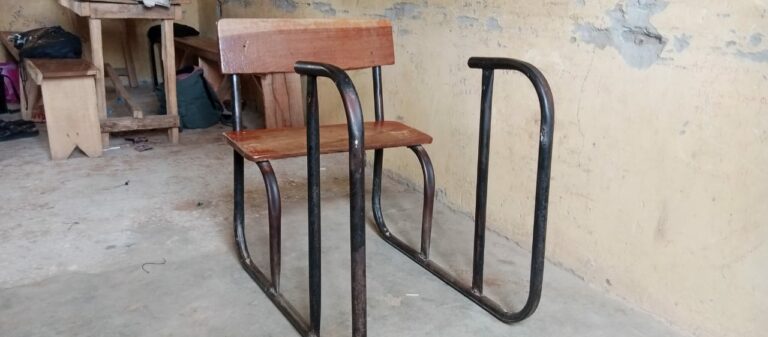
“He gave each of us a number and sent someone to bring a cane for him from outside. The person could not find a cane. He looked around and found one of the rods that broke from one of our iron chairs and used it to flog the first girl close to him.
“Christabel was sitting far from him; she sat close to a window. When Christabel saw our teacher using the rod to beat the student, she shouted, ‘Jesus!’
“It was the shout of Jesus that put Christabel in trouble, even though Mr Yusuf is a Christian,” one of the students told The ICIR reporters. She spoke on behalf of her colleagues in their class, pointing at a similar metal rod on a damaged chair used on the victim.
Government Girls Science Secondary School Kuje Photo credit: Marcus Fatunmole/The ICIR
Her classmates claimed the teacher moved towards Christabel and hit her repeatedly with the rod, causing her to faint and have a cut on her hand. The hand bled, they added.
The school rushed the girl to the Kuje General Hospital, where nurses and other workers on duty attended to her. The school also informed her parents of her condition that night.
Christabel’s father’s account and petition to Police Commissioner, others
Christabel’s father, Henry Terseer Iortim, reported the incident at the Kuje Police Station. He wanted Yusuf, who had worked in the school for 11 years, arrested and prosecuted.
The Police sent officers to the school to arrest the teacher, but the school principal, Sabina Agbuedu, shielded him, the father alleged.
Peeved by the Police’s inability to apprehend the teacher, Christabel’s father petitioned the Federal Capital Territory (FCT) Commissioner of Police.
In the petition, he claimed his daughter went into a coma and was revived by the Kuje General Hospital, where the school rushed her after her teacher ‘battered’ her ‘mercilessly’ with a rod.
He said the beating made her bleed profusely, adding that the teacher attempted to murder his daughter.
However, he wrote in the petition that the school principal told him his daughter provoked the teacher by slapping him.
He copied the National Human Rights Commission, Director-General, Department of State Services, Federal Ministry of Education, Minister of Women Affairs, the FCT Minister, and the Chairman of the Abuja-based human rights radio magazine programme, Brekete, with the petition.
Part of the petition reads, “Upon gaining consciousness, my daughter told me that Mr David Yusuf entered the class while they were reading during the evening preps. He made his way to a charging point and plugged his hair clipper. He suddenly turned and said a child talked about him, and others laughed.
“He then ordered them to kneel down. He reached out for an iron rod and hit the first victim. Because my daughter exclaimed by shouting Jesus Christ, the teacher rushed and hit her with the rod severally, slapped and beat her mercilessly and pushed her. She fell, landing her head on a wooden chair, and she did not know any other thing that happened until she noticed she was in the hospital. Sir, this is an attempt by Mr David Yusuf to murder my daughter without any cogent reason deliberately.”
The Kuje General Hospital, Abuja. Photo: Marcus Fatunmole/The ICIR
No picture to support Iortim’s claims
Iortim did not provide any picture to support his claims. Henry, a journalist, said he forgot to take photographs of his daughter at the hospital as his utmost priority at the period was his daughter’s safety.
He had withdrawn the girl from school but allowed her to come from home to continue her WASSCE examination, her school principal and classmates claimed.
The ICIR requested the girl’s medical record; Iortim said the Kuje General Hospital refused to release it, allegedly on the order of the Federal Capital Territory Department of Science and Technical and Innovation, which supervises all science secondary schools in the nation’s capital.
He claimed the hospital’s medical director, Osideko Olufemi, conspired with his daughter’s school and refused to release the record. The ICIR reports that Olufemi died a few days after Christabel was brought to the facility. He had been sick, workers at the hospital said.
Efforts by The ICIR reporters to see Christabel to enable her to tell her story failed. Her father refused to make her available but referred this reporter to the victim’s mother for further clarification.
This organisation reports that Iortim’s account of the incident tallies with what his wife said in a publication.
Father has no proof that his child was beaten – school principal
The ICIR reporters visited the school on Wednesday, June 21. It was another open day. Many students met were in a happy mood because they were able to see their parents or guardians.
Addressing the reporters in her office, the school principal said Christabel’s father had no evidence to substantiate his claim that any teacher in the school beat her daughter.
She challenged Iortim to provide proof that the teacher beat Christabel as he claimed.
“How can your child be beaten into a coma as a journalist that you won’t have a picture to back your allegation?
“Even if there is no wound, there will be swelling. If the place is healed, it will show a mark. There be must a scar.”
A section of the Government Science Secondary School Kuje Abuja. Photo: Marcus Fatunmole/The ICIR
She challenged the father to allow an independent check on the child by a competent authority to verify if his claims were genuine.
She said the father did not allow the school to conduct any investigation into the matter but chose to write to the Police Commissioner and other organisations “because he is a journalist.”
She alleged that the father gave a 2012 picture of another teacher and students in the school to a media house which reported the incident.
“One of the students in that picture is a teacher in this school today,” said the principal, adding, “What if the teacher in the picture goes ahead to sue him for libel?”
Besides, she said she knew nothing about how the hospital denied Iortim access to his child’s medical report.
The ICIR reporters urged the principal to allow them to speak to the teacher who hit Christabel; she declined and repeatedly said the father had agreed to peacefully resolve the case. When questioned further, she ordered the reporters out of her office.
Meanwhile, the father told the reporters that the school must meet two conditions before he would let go of the case. First, the school must write his family an apology letter. Second, the school must foot his daughter’s medical bill. The principal said the school had paid the bill.
Iortim later changed his mind and told The ICIR on Sunday, June 25, that the Police must charge the teacher in court.
Christabel insulted me, my directors in my office – FCT Education Chief
The Director of the Federal Capital Territory Department of Science and Technical and Innovation, Olobashola Kolawole, said: “Christabel slapped her teacher, which made the teacher beat her.”
He argued that he established from the school principal that Christabel left her seat, rushed towards the teacher, and attempted to grab the rod he used to beat another student.
Petition by Christabel’s father to the Commissioner of Police. FCT Command, others
He, however, said the teacher’s action contravened the education law, which makes it an offence for a male teacher to give a female student corporal punishment – caning or flogging.
He said when invited with her parents to his office, Christabel abused him and his five directors before her parents.
“You people conspired against me. Yes, you are conspiring against me,” he quoted the girl to have shouted at his team.
Kolawole said the FCT administration did not condole indiscipline from teachers and students.
According to him, the first thing he did was to establish that there were no sexual advances from the teacher to the girl.
He said because the teacher flogged the girl (against education law), he recommended to the FCT Permanent Secretary that the teacher’s salary be stopped pending when an investigation into the incident would complete.
The Director requested Christabel’s medical record from the hospital and said he confirmed that the beating caused no marks or damage to her body.
One of the directors in Kolawole’s office, allegedly insulted by Christabel, was a former Commissioner for Education in Nasarawa State, Ramotu Abu. She heads the Department of Science and Technology at the organisation.
Abu wondered why Christabel’s father did not allow the FCT education authority to thoroughly probe the issue before taking it to the media.
“I’ve been a teacher for 21 years. We handle these children like our children. Christabel jumped from where she sat to hold the rod in the teacher’s hand and slapped him. That is rudeness.”
According to her, the punishment for slapping a teacher is expulsion. What kind of impression are you giving the rest of the students? When the issue came here, we just said she should continue to write her exam.”
Why we refuse to release Christabel’s medical record – Kuje Hospital
The picture of the Medical Director (Osideko Olufemi) sat on a table at the hospital’s entrance, flanked by about a dozen candles with glowing lights.
Olufemi died on Friday, June 16.
His death brought gloom to many workers’ faces and patients who saw the picture of a doctor who could be less than 50 years!
The ICIR reporters sympathised with the workers in the MD’s office. They stated why they were at the facility – to ask why the hospital did not release Christabel’s medical record to her parents, given that she is a child at 16 and her parents have the right to such document.
The most senior official in the office, a man, said the hospital did not release it because “it is a Police case.”
The official declined to give his name and said only the Police could authorise the hospital to release the report.
He said had Christabel’s father not involved the Police, he would have had access to the report.
The second page of the petition written by Christabel’s-father
Police react
An officer at the Kuje Police Station, Adewale Oluwaseun, who declined to give his rank, said the parties had settled the matter.
He said the Iortim, the school principal and the Police met at the station on Tuesday, June 20, and resolved the matter through an ADR (alternative dispute resolution).
He promised to convince the girl’s father to let go of the incident.
“I will call him. If he has any challenges, he should tell me. We don’t want the girl to go into trauma. At her age, we don’t need to be exposing her. We should allow her to concentrate on her examination,” said the officer.
Experts reaction
A lawyer working with Tabitha Empowerment Centre, a non-governmental organisation working to combat violence against women and children, Gladys Emmanuel, shared her view on the case.
She argued that the lack of structures to checkmate the form of punishments meted out by teachers to students played a role in the incident.
She added that the failure to exercise emotional intelligence, understand people relations, and keep personal problems aside in a professional environment could also be a factor.
“It’s unfortunate that we have incidents of this nature in our educational institutions. Students being assaulted by teachers is not alien to schools, as we have teachers and staff abusing powers bestowed upon them by their positions.”
Emmanuel urged authorities in the education sector to regulate the punishments teachers mete out on students.
She frowned at Chritabel’s principal for allegedly shielding the teacher from arrest.
“The claim as to whether or not the female student slapped the teacher is yet to be verified. But if it occurred, it is wrong as the law frowns at any assault.”
She added: “There are punishments. For the student, the school or educational board would have internal structures to tackle cases of students who have erred. For the teacher, he wouldn’t be subject to internal measures as he would most likely be charged under the Violence Against Persons Prohibition Act (VAPP ) 2015, considering the series of events that led to the student going into a coma.”
Last page of the petition written by Christabel’s father
Founder and chief executive officer, Children’s Rights Advocate Foundation, Olayide Shonubi, said it was wrong for any student to slap a teacher if the allegation against Christabel was true.
“As a retired teacher, I don’t think a child has any right to slap a teacher. But the teacher should not have beaten her with an iron rod.
“I’m sure he did that out of anger. He shouldn’t have done that. I don’t know the relationship between the teacher and the student that will make the student slap the teacher.”
She said the student had a right to slap the teacher if he proposed a romantic relationship to her.
She argued that while NGOs like hers fight for the rights of children, they do some things that conflict with societal values.
“If parents don’t train these children at home, people will train them outside. It’s good to protect them, but we should not make them to be indisciplined. That is the problem we have today in Nigeria.
“We copy the West. When I travelled to the US, the youth on the bus would get up for me. In Nigeria, if I board BRT buses, the youth on the bus would not care whether I have a seat. When we want to copy the West, we copy the wrong things and will say they will not do that in America.”
Shonubi emphasised that children have their rights, but they should not misuse them.
She said she would not support any child that slapped a teacher, except if the teacher wanted a relationship with her. She also stressed that the government would not support the child for slapping her teacher.
DESPITE the rainy condition that enveloped the track and field event, Nigeria’s Tobi Amusan won the women’s 100-meter hurdles at the seventh leg of the Wanda Diamond League season in Stockholm finishing with an impressive time of 12.52 seconds.
She emerged on Sunday at the top among the eight contestants which had Sarah Lavin of Ireland who clocked a personal best of 12.73 seconds and Pia Skrzyszowska of Poland, 12.78 seconds, in second and third place, respectively.
The result of the 100-meter hurdles where Nigeria’s Tobi Amusan emerged as the winner.
At the Lausanne Diamond League on Friday, Amusan finished in second position in the 100 metres hurdles event behind Puerto Rico’s Jasmine Camacho-Quinn, who won the race with a time of 12.40 seconds.
She clocked a time of 12.47 seconds equaling her personal best for the season while the third position went to Tia Jones, who ran a time of 12.51 seconds.
Winners of the sporting event in Stockholm include Mondo Duplantis who won for the fifth time with 6.05m in a delayed pole vault competition at his home meeting.
THE Joint Admissions and Matriculation Board has said it would prosecute a candidate, Ejikeme Mmesoma, for manually faking her result and announcing herself as the top scorer in the 2023 Unified Tertiary Matriculation Examination (UTME).
A statement released on Sunday, July 2 by the Board said that Ejikeme used a manually inflated score to attract a sum of N3 million scholarship from Innoson Motors and was set to be honoured by the Anambra State government before she was exposed.
JAMB disclosed that Ejikeme scored 249 and not the 362 she claimed.
The statement reads, “The attention of the Joint Admissions and Matriculation Board has been drawn to several publications in both print and online media celebrating certain candidates for being high scorers in the 2023 UTME.
“The Board is constrained to set the records straight and wishes to state unequivocally that many of the results which many of these candidates are parading are fake. In many instances, some of these candidates had actually obtained far lower scores than they are claiming and had used some funny software packages to manipulate their results to deceive unsuspecting members of the public.
“The most pathetic of them all is the case of Miss Ejikeme Joy Mmesoma, who claimed to have scored 362 in the 2023 UTME and was awarded a N3m scholarship by Chief (Dr.) Innocent Chukwuma. She was even set to be honoured by the Anambra State Government when one of its top officials put a call through to JAMB to confirm her claim, only for the Board to reveal that Ejikeme Mmesoma had actually scored 249 and not the 362 she claimed. She had manipulated her UTME result to deceive the public to fraudulently obtain scholarships and other recognitions.”
JAMB further identified Atung Gerald as another fraudulent candidate who claimed to have scored a 380 aggregate score in the last UTME.
“A similar case was that of one Atung Gerald in Kaduna, who claimed to have scored 380. His ethnic group had taken the issue up, requesting that he be given special recognition, only for the Board to disappoint them with the incontestable fact that Atung never obtained the 2023 UTME application documents, not to talk of sitting the examination.”
Stressing that candidates can successfully manipulate results they are holding, JAMB urged the public to independently verify the authenticity of results from the Board honouring them with undeserving awards, as certain software had been created to fake different versions of results and defraud good-spirited Nigerians.
Noting that Ejikeme would be punished for her action, the Board stressed that it would also withdraw her result.
JAMB further commended the effort made by the Anambra State Ministry of Education to confirm the authentic of Ejikeme’s result from JAMB before rewarding her, adding Anambra will be celebrating criminality if the state had not verified.
“It is to be noted that Miss Mmesoma had sent a message to the Board’s platform to request her UTME result, after which she manually inflated her scores and pasted the same on the 2022 UTME result sheet. Unknown to her, the Board had changed the design of the 2023 UTME result sheet. Her original result remains 249, as nothing can change that. With this her ignoble act, Miss Mmesoma would be prosecuted and her original result withdrawn.
“This is not all, as the Board would, in due course, investigate all candidates laying claims to higher scores than they actually obtained. Once discovered, such candidates’ original results would be withdrawn forthwith, and they would be handed over to relevant security agencies for prosecution.”
Meanwhile, JAMB had declared Umeh Nkechinyere as the 2023 top scorer in the 2023 Unified Tertiary Matriculation Examinations according to The Punch.
The Board made the declaration during its 2023 policy meeting in Abuja on Saturday, June 24.
JAMB noted that Umeh became the top scorer with an aggregate score of 360.