Home Blog Page 956

Trending video of ‘NDLEA officers in minibus’ is an old skit — Agency

0

THE National Drug Law Enforcement Agency (NDLEA) has again dismissed a trending video showing its officers engaging in misconduct while on official duty.

In the 28 seconds video, which is currently trending across social media platforms, some men wearing NDLEA jackets were seen taking drugs inside a minibus.

In a statement on Tuesday, April 25, the spokesperson of the Agency, Femi Babafemi, said the video is an old skit and not real.


READ ALSO:

NDLEA intercepts drug consignments in body lotion at Lagos airport

NDLEA nabs 352 suspects, confiscates 2.1 tonnes of hard drugs in Kano

NDLEA, Customs sign MoU to combat drug trafficking

NDLEA declares prophetess, couple wanted over seized illicit drugs


“The National Drug Law Enforcement Agency, NDLEA, wishes to reiterate that a trending video of some persons wearing red jackets similar to the ones used by officers and men of the Agency for operational purposes, operating in a minibus, is an old skit, which the Agency had disclaimed a year old.

“The Agency had in a well-publicised statement released on Saturday, 21st May 2022, stated that it had established, following a series of Public enquiries, that the video with screenshot pictures attached to the statement is a skit produced by one Mathew C Eze, who lives in the Lekki area of Lagos.

“A year after, the video has returned to the social media space, a development that has led to several enquiries from concerned members of the Public on the authenticity of the content of the video,” the NDLEA stated.

The anti-drug agency emphasised that social media content creators must exercise restraint, responsibility, and decorum in using law enforcement officers’ equipment to avoid misunderstandings and insinuations.

The NDLEA noted that the video has confused the minds of members of the public.

The agency also reminded those who engage in such ‘mischief’, particularly while wearing one of its official coats, that doing so has repercussions.

In May 2022, the NDLEA disclaimed the same trending video of some persons wearing jackets similar to the ones used by its operatives as a skit.

NDLEA spokesperson Babafemi said the video was not real in a statement released at that time.

Otedola sparks interest in Transcorp, shakes Elumelu’s controlling power

FEMI Otedola has aroused shareholders’ interest in the shares of Transnational Corporation Plc (Transcorp) with his recent acquisition of shares in the company, to initiate what could be quite some competition with Tony Elumelu for controlling power in the conglomerate.

Otedola had acquired 5.52 per cent or 2.245 billion shares of the overall total market volume of Transcorp, a transaction the company confirmed on April 20.

The Ibadan-born businessman had in addition upped his interest in Transcorp to 6.3 per cent in two separate notifications.

With the acquisition, Otedola is now a substantial shareholder of the company, becoming the second largest shareholder of the company behind UBA Nominees, which own about 9.25 per cent.

Before now, Transcorp was controlled by Tony Elumelu who took over control of the company in 2012.

While there are no offers in the market for Transcorp shares, The ICIR gathered that UBA Nominee (Tony Elumelu) had bought over two billion units of Transcorp shares last week.

The ICIR further gathered that a total of 1,055,408,604 units of Transcorp shares were done as off-market trade at N1.85k in five deals.

The deals were said to have been negotiated with United Capital Securities Limited as buyer and Regency Assets Management Limited and Renaissance Capital as sellers.

Prior to the recent development, Elumelu owned about 273.1 million shares directly in Transcorp, 274 million indirectly through Heirs Holdings Limited, and 294 million through HH Capital Limited.

As at December 2022, about 1,695 investors owned about 89 per cent of the company’s shares.

The latest tussle to control the ownership interest in Transcorp, analysts said, have not only caused a significant stir in the Nigerian financial market but has also spurred a flurry of market activity.

The share price of Transcorp has risen by about 75 per cent to N2.45 as at April 20 to emerge as the most traded stock on the floor of the Nigerian Exchange Limited (NGX) in the previous week, from N1.4 as at April 12.

Worthy of mention is that before Otedola’s recent investment, investors had shown little to no interest in Transcorp’s shares.

Otedola has caused an explosion in Transcorp that could be giving Elumelu some concern, the Executive Vice Chairman of Highcap Securities Limited, David Adonri, asserted.

“Transcorp is pure gold, a hidden jewel that people have not seen,” Adonri asserted.

Why Transcorp is a goldmine

The Transnational Corporation Plc is a diversified conglomerate with investments in the power, hospitality and energy sectors.

Founded in 2004, the company was listed on the Nigerian Stock Exchange (NSE) in December 2006, and trades under the name, Transcorp.

At present, its total market capitalisation stands at N99.59 billion with outstanding shares of 40.65 billion.

According to Adonri, former President Olusegun Obasanjo had set up the company to make it take the shape of the Japanese zaibatsu conglomerates, like Mitsubishi and Nissan, and to make it trade in vital sectors of the country with the mandate to develop assets like oil, agriculture, entertainment, and telecommunications.

Obasanjo had gathered young and sound entrepreneurs like Elumelu and Otedola to  invest in the company.

But while some others divested, Elumelu stayed put, driving the business, while Otedola did not leave completely.

“Transcorp, which sits on an upstream oil business, was making losses, and was not doing well until about a year ago when it started making profits.

“The profits have started escalating. Elumelu was looming large, until Otedola decided to come in to intensify his participation in the Transcorp shares,” the Highcap boss said.

He argued that Otedola might be out to play a strategy where he could leverage Transcorp for synergy in the power business.

“Apparently, Otedola is also trying to diversify its portfolios in the power sector, and in the energy sector along the upstream, midstream and downstream value-chain,” Adonri explained.

With his control of Geregu Power Plc and his stake in Dangote Refinery, Otedola already has a footing in the downstream and midstream markets, and strategically taking position upstream with his acquisition in Transcorp.

“The way he is moving now becomes a threat to Elumelu’ ownership of Transcorp that Elumelu has to start running from pillar to post for survival to defend his position.

“Since Tuesday (April 18), Elumelu has started buying Transcorp shares to increase his ownership of the business.

“Transcorp shares are pure gold, that is what Elumelu is keeping close to his chest, and is right now moving in to mop up from everywhere the stock is hidden.

“With the way they are mopping up and buying Transcorp shares now, there is a struggle for ownership of the business. It has dovetailed into a merciless struggle for the business,” Adonri added.

An investment and portfolio analyst, Abel Ezekiel, told The ICIR that what is playing out now was expected, saying Transcorp was undervalued.

Ezekiel recalled that the Transcorp stock sold at about N7, moved towards an all-time high of about N15 before it plunged to below N1 after the capital market crash in 2008.

As a conglomerate, the Transcorp share ordinarily is supposed to be one of the highly capitalised stocks at the Exchange. However, the reverse is the case considering it is below the initial public offer of N7 traded over the last 10 years.

He pointed out that though Transcorp owns Ughelli and Afam power plants, the company’s share still trades at a miserable price of N2, compared to Geregu Power Plc listed within the last three years and currently trading at almost N400.

“As an astute observation/investor, he (Otedola) must have seen untapped gold mines in Transcorp, thereby throwing his weight into the acquisition of majority shares of the company.

“So, as you may have noticed, the existing majority shareholder of the company, Tony Elumelu, cannot fold his hand and watch his compatriot, Femi Otedola, take over (through majority shareholder), Ezekiel said.

He added that Elumelu has to step up his own buying appetite, which would trigger the massive mop-up, and which would naturally be followed by price appreciation witnessed at the market in the past couple of weeks, “because we are talking of people who have deep pockets involved in this exercise.”

The investment analyst also expressed the view that the recent development was a good omen for the market ecosystem and minority investors, and could boost local investors’ interest in the market over their foreign counterparts.

“These are some benefits currently unfolding. So, we expect more of such opportunities to continue in the local burse,” Ezekiel added.

Who are these billionaires?

Otedola is a Nigerian with businesses in oil and gas, hotels, real estates and investments with a net worth of $1.8 billion, according to Forbes’ report of 2016 – the last time the publication profiled him.

The 61-year old businessman is the current executive chairman of Geregu Power Plc. In January 2006, he was appointed as a non-executive director of Transcorp, where he served till February 2011.

Also a Nigerian, Elumelu has a net worth of $700 million, according to Forbes’ report of 2015 when the publication last profiled him. The 60-year old entrepreneur is an economist and philanthropist. He chairs Heirs Holdings, United Bank for Africa, Transcorp, and is the founder of the Tony Elumelu Foundation.

Delta State establishes team to enforce anti-open grazing law

THE Delta State Government has established a team of 45 Livestock Management Operatives to enforce the law against open grazing.

The inauguration of the team took place at a ceremony held at the Nigeria Security and Civil Defence Corps (NSCDC) headquarters in Asaba, the state capital, on Monday, April 24.

The operatives are expected to be directly supervised by their respective local government area special task forces and will be responsible for ensuring compliance with the anti-open grazing law.


READ ALSO:

Three herders arraigned for violating anti-open grazing law in Bayelsa

Our members will not obey anti-open grazing laws -Miyetti Allah

Stop governors from enacting anti-open grazing laws, Miyetti Allah tells NASS

Nigerian government directing Police to ignore anti-open grazing laws – Delta govt

Delta State Governor, Okowa, wife test positive for COVID-19


The Delta State Commissioner for Agriculture and Natural Resources and Chairman of the Delta State Livestock Management Committee, Godfrey Enita, who inaugurated the team, said the the operatives had undergone basic courses and were well-equipped to perform their duties.

Enita revealed that the committee had previously sensitized all critical stakeholders, including the Arewa community, Myetti Allah Cattle Breeders Association of Nigeria (MACBAN), cattle dealers and the resident Fulani herders, about the law.

“The law was basically enacted, to among others, stop open grazing of livestock, encourage sustainable humane breeding, production and husbandry and marketing of livestock,” he said.

“It was to prevent herders and farmers crisis with its attendant loss of lives and investments, which is a threat to the state’s drive for food security and to enhance safety and harmonious living among herders and farmers in the state.”

The NSCDC Head of Critical National Assets Infrastructure, John Ozowara, who represented the NSCDC state commandant, Suleiman Jimoh, at the inauguration ceremony, expressed confidence in the operatives.

He noted that they had been well-trained and were ready to carry out their duties as stipulated by the law.

The state anti-open grazing law, which was enacted in 2021, aims to prevent herders and farmers crisis, which has resulted in loss of lives, investments and threatens the state’s drive for food security.

It also encourages sustainable humane breeding, production and husbandry, and marketing of livestock to ensure the harmonious living of herders and farmers in the state.

The law is part of the state’s commitment towards an earlier agreement by the Southern Governors Forum in July 2021, to ban open grazing in the region.

Thirteen states, including Lagos Ondo, Ekiti, Oyo, Osun, Ogun, Rivers, Cross River, Bayelsa, Akwa Ibom, Ebonyi, Edo and Abia, have implemented the agreement.

Benue State became the first state in Nigeria to pass a law banning open grazing in 2017. The law has not, however, stopped the incessant killings and clashes among herders and farmers in the state since 2015.

The state government has put the total number of people killed by herdsmen in the state since 2015 at 5,138.

In September 2021, Delta State government accused the Muhammadu Buhari administration, which various social political groups have accused of pampering the murderous acts of herdsmen, of directing the Police not to implement the anti-open grazing laws in different states in the country.

Instead of embracing and encouraging herders to seek alternatives to open grazing as suggested by experts, the Federal Government in August 2021, moved to revive about 368 grazing routes in 25 states of the country.

The decision was vehemently rejected by the Middle Belt Forum, Benue state government and various groups in the Southern part of the country, including state governors from the region.

Nigeria has Africa’s highest malaria death rate – progress is being made, but it’s not enough

0

By Segun Isaac Oyedeji, Federal University, Oye Ekiti

Malaria is a major public health problem and can be life-threatening. The disease, mostly found in tropical countries, is transmitted to humans by the female Anopheles mosquito. Nearly half of the world’s population is at risk of the disease. In 2021, for instance, around 247 million cases of malaria were reported and about 619,000 people died. Four African countries accounted for just over half of all malaria deaths worldwide: Nigeria (31.3%), the Democratic Republic of the Congo (12.6%), Tanzania (4.1%) and Niger (3.9%).

Professor Olugbenga A. Mokuolu currently oversees all malaria work in Nigeria for Management Sciences for Health, a global health advisory organisation. He’s also the former technical director to the National Malaria Elimination Programme in Nigeria. Molecular parasitology Professor, Segun Isaac Oyedeji, spoke to him about Nigeria’s malaria burden.


Segun Oyedeji: Nigeria has a high malaria burden. How did it get here?

Olugbenga Mokuolu: It’s a combination of many things.

The existence of malaria anywhere is an interaction between the environment and the organism responsible for the disease, the mosquito. When you look at an environment, you’re looking at a variety of natural factors – such as temperature, humidity and rainfall – and man-made factors, such as drainage systems. This is because certain conditions allow mosquitoes to thrive – specifically moisture-rich environments. Mosquitoes breed by laying their eggs in stagnant water.

Nigeria’s environment is a favourable one in which mosquitoes – the malaria vector – can thrive.

In terms of environmental management, Nigeria leaves a lot to be desired. The country has open refuse sites, blocked drainage systems, and – because people lack piped water – they store water at home in containers. These all provide ideal sites for mosquitoes to breed.

In terms of humidity, Nigeria has vegetation that favours the reproductive stages of the parasite in the mosquito. Altitude also plays a role. And, in most of Nigeria, the altitude allows the mosquito to fly around without much difficulty. Only the Mambilla Plateau is considered relatively malaria free in Nigeria. It has an altitude that is above 5000 feet which makes it difficult for mosquitoes to inhabit.

In addition to this, Nigeria has a large population which makes malaria transmission much easier. Large populations mean more people tend to live closer together, which makes it easier for the mosquito vector to quickly find a contact for transmission of the malaria parasite. In addition, a large population puts more pressure on sanitation services, leading to more mosquito breeding sites.

That’s not to say no progress has been made. The country’s interventions have not been a failure altogether. My organisation is supporting Nigeria to provide preventive chemotherapy for malaria. We have reached over 25 million children under five in our intervention cycles. This is shown to have significant contribution to reduction in mortality. But we are not yet where we are supposed to be.

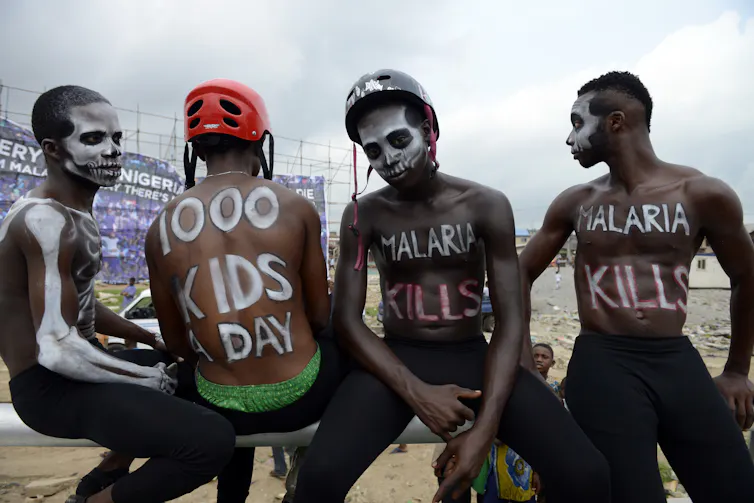
Lagos residents use art to draw attention to the gaps in the prevention and treatment of malaria. Pius Utomi Ekpei/AFP via Getty Images

Segun Oyedeji: Children are disproportionately affected. What can be done?

Olugbenga Mokuolu: The Nigerian government and its partners have singled out children as the focus of most interventions. In addition, we need health system strengthening to address the gaps in access particularly at communities.

The Nigerian National Agency for Food and Drug Administration And Control recently approved the R21 malaria vaccine for use.

Hopefully when the R21 vaccine becomes available it will reduce new cases or the impact of cases. It is unclear when the vaccine may be rolled out in Nigeria.

A recent study shows that the R21 vaccine has some efficacy. This vaccines has shown most effective when administered to children from five months to 36 months old. It is 77% effective in preventing infection and reduces the occurrence of severe malaria. Reducing the frequency of severe malaria reduces the burden of malaria mortality by extension.

The vaccines won’t be used on their own. They will be used as adjuncts to existing tools for fighting malaria such as preventative treatment and the distribution of bed nets.

Segun Oyedeji: How can Nigeria reduce its malaria burden?

Olugbenga Mokuolu: New cases of malaria can only be curbed by environmental measures, including the use of insecticide nets and personal protection. I know the vaccines aren’t 100% effective, but surely they will offer additional prevention.

But Nigeria needs to step up its game. The current National Malaria Strategic Plan 2021 to 2025 is based on a well researched model. It is no longer business as usual. The plan clearly shows that if we don’t do more, malaria will keep rising.

But we are actually doing a lot.

Take the bed nets. These are being distributed on an almost regular basis to eligible states. Even COVID-19 didn’t stop the distribution. Now because of the size of Nigeria’s population, bed nets are distributed in what we call mass roll out campaigns with each state doing its own campaign. The improvement in malaria control that we have seen the last five to seven years is based on the intensity of interventions in two thirds of our states.

But Nigeria has gone further to almost be a global example, in how to implement preventive chemotherapy. We have 21 states out of 36 states where we reached over 25 million under five children in each cycle of intervention. We have four cycles in the year and this has contributed to reduction in mortality.

But we could do more.

Malaria isn’t going to be reduced significantly unless Nigeria intensifies development. Development plays a major role in reducing the burden.

Also, infusion of funds and not just from the government. There is also public-private partnership for drug manufacturers. The government should give them a protected market and negotiate good prices. Let the manufacturers take over distribution using their own market principles in a manner that will be affordable to many people.

We need to look at new initiatives and also position ourselves in the vaccine game with respect to malaria.

Segun Oyedeji: How can the international community – donors and aid agencies – best support Nigeria?

Olugbenga Mokuolu: International partners are supporting the country in many ways. Largely the support is in funding and technical areas. Going forward, countries like Nigeria will need stronger support for consolidating current gains, new tools, health system strengthening, scaling up access to vaccine and local manufacturing or production of malaria intervention commodities.The Conversation

Segun Isaac Oyedeji, Professor in Molecular Parasitology and Genetics, Federal University, Oye Ekiti

This article is republished from The Conversation under a Creative Commons license. Read the original article.

Electoral violence: Kano’s Tudun Wada residents demand justice

0

SOME survivors of the electoral violence that rocked the Doguwa/Tudun Wada area of Kano State during the general elections have appealed to the government to investigate the attacks which claimed several lives and left many injured.

The residents of the Tudun Wada area made the appeal while speaking to The ICIR in a special report published on April 21. The report revealed how some members of the New Nigerian Peoples Party (NNPP) were caught in a fire attack by political thugs while the collation of results was ongoing on Sunday, February 26.

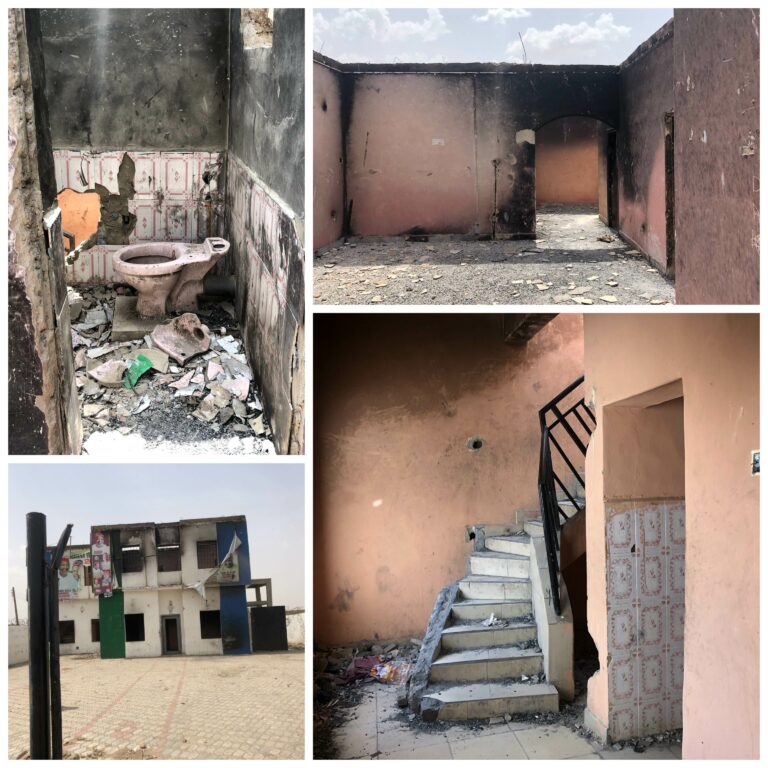
The NNPP office located in Sabon Gari Ward was set ablaze, resulting in multiple fatalities and burns. Some residents were also shot dead, while some luckily escaped.


READ ALSO:


Speaking in the report published by The ICIR, eyewitnesses and survivors of the attack accused Alhassan Doguwa, Majority Leader of the House of Representatives and candidate of the All Progressives Congress (APC) of sponsoring the attack and called on the National Human Rights Commission and relevant authorities to investigate the incident.

Doguwa is the incumbent member representing the Doguwa/Tudun Wada Federal constituency of Kano State.

An eighteen-year-old survivor, Labaran Sule, told The ICIR that he is still angry at the incident and cannot forgive Alhassan Doguwa and the thugs who he accused of attacking him.

Sule escaped death by the whiskers. Aside from being shot in the shoulder, he was also macheted close to his neck. He was in a pool of blood by the roadside when help came his way, and was taken to the hospital.

“It was about 3 p.m. in the afternoon when I came out of the mosque and saw the office of NNPP on fire, and Doguwa had two guns in his hands. The distance between myself and him wasn’t much, and before I knew what happened, he shot me in the shoulder for no reason. I was crawling and trying to escape when he ordered a thug with a machete to cut me or give him the machete to do it.”

Also speaking to The ICIR, Abdul Sarkin-Power (as he is fondly called) said his 25-year-old son Muhammed was in the office of the NNPP, where he got burnt to death.

Sarkin power appealed to human rights organisations, the government and relevant authorities to get justice for his murdered son, who had just obtained his National Certificate in Education (NCE) certificate.

The Kano State Police Command had arrested Doguwa following allegations of murder levelled against him. The police spokesperson Haruna Kiyawa disclosed that the lawmaker was arrested in connection to a suspected case of criminal conspiracy, culpable homicide, causing grievous hurt, mischief by fire and inciting disturbance.

Doguwa was subsequently charged to court, after which a federal high court in Kano granted him bail of N500 million with two sureties. The case was, however, adjourned to April 10 for the continuation of trial but on that date, the matter did not come up as the court didn’t sit.

According to the report, the registrar of Court Two, where Doguwa is being tried, disclosed that the case was subsequently adjourned to May 10.

Speaking in The ICIR report, a coalition of over 140 Civil Society Organisations (CSOs) under the aegis of the Kano Civil Society Forum (KCS) led by Ibrahim Waiya, who is also the chairman of the Kano Peace Committee, raised concerns over the seeming slow pace in Doguwa’s trial.

Waiya, in a public petition signed by 500 members, urged the Kano State Government to accelerate the legal process to establish Doguwa’s role in the murder cases.

The report also disclosed that INEC staff and party agents were attacked during the attack.

The REC, Ambassador Abdul, while speaking at a stakeholders meeting for the conduct of the supplementary polls, described the violence that took place in Tudun Wada as abysmal.

In the same vein, the Deputy Commissioner of Police in the Department of Operations Mu’azu Muhammed, hinted that the police will secure the now-concluded election with armed and unarmed police officers.

Meanwhile, the Independent National Electoral Commission on April 16, announced Doguwa as the winner of the Tudun Wada/Doguwa Constituency election after defeating his closest rival, the candidate of the New Nigeria Peoples Party (NNPP) Yushau Salisu, who polled 34,831 votes.

FCT CP meets traditional rulers after Hausa, Gbagyi youths clash

THE ACTING Commissioner of Police (CP) of the Federal Capital Territory (FCT) Ahmed Musa has met with traditional rulers of Hausa and Gbagyi communities following violent clashes in the Gwarimpa area of Abuja.

The Hausa and Gbagyi youths clashed in the 3rd Avenue axis of Gwarinpa on Saturday, April 22, and Monday, April 24.

The ICIR reported that two persons were confirmed dead in the violent clashes.


READ ALSO:

Gunmen abduct 13 in FCT community

FCT Police arrest 40 suspects over criminal activities

FCT Police Command deploys personnel ahead of Easter

NEMA predicts low rainfall in FCT, Kaduna, Yobe, Jigawa, others


In a statement released on Monday, April 24, the FCT Police Command said it has mobilised and deployed operatives to the affected areas to douse tension and effect necessary arrests.

“The Acting Commissioner of Police for the FCT, DCP Ahmed Musa, has met with Traditional Rulers of both the Hausa and Gbagyi Communities in Gwarinpa at his office in the Command Headquarters to broker peace between both groups, deliberate on possible collaborations necessary to keep the youths in check and oust troubleshooters in the communities.

“The fracas between the two groups which caused the grievous wounding of two (2) youths who were conveyed to the hospital where one was eventually declared dead after attempts to attend to his wounds failed, led to the arrest of one suspect who is currently assisting the Police in their investigations to ascertain the immediate and remote causes of the affray,” the Command said in the statement signed by its spokesperson Josephine Adeh.

The Acting CP charged the traditional rulers to consistently encourage the youths to imbibe peace and pursue grievances through legally approved channels rather than taking laws into their hands. 

Meanwhile, the Acting CP said he has intensified surveillance patrols to monitor the situation and ensure it does not escalate further.

He urged all well-meaning residents of the FCT to go about their lawful businesses and report all suspicious activities, persons, or groups via Command emergency lines.

The ICIR reported that peace has been restored after a violent clash that erupted in the Gwarinpa area of the FCT on Monday, April 24.

The clash, which erupted on Saturday, April 22, lingered till Monday, April 24 and claimed two lives, according to medical officials at the Federal Road Safety Corps (FRSC) Medical Centre in Gwarinpa, where wounded residents were taken for treatment.

Some traders were also attacked in the process, and residents warned other members of the Public to avoid the area via Twitter.

“They are rioting in Gwarinpa. If you live in Gwarinpa, a riot is going on in 3rd Avenue, and it’s very much heated,” a Twitter user, Dr_Youngy, tweeted.

Tinubu returns to Nigeria after The ICIR report

PRESIDENT-Elect Bola Tinubu has returned to Nigeria almost a month after he left the country.

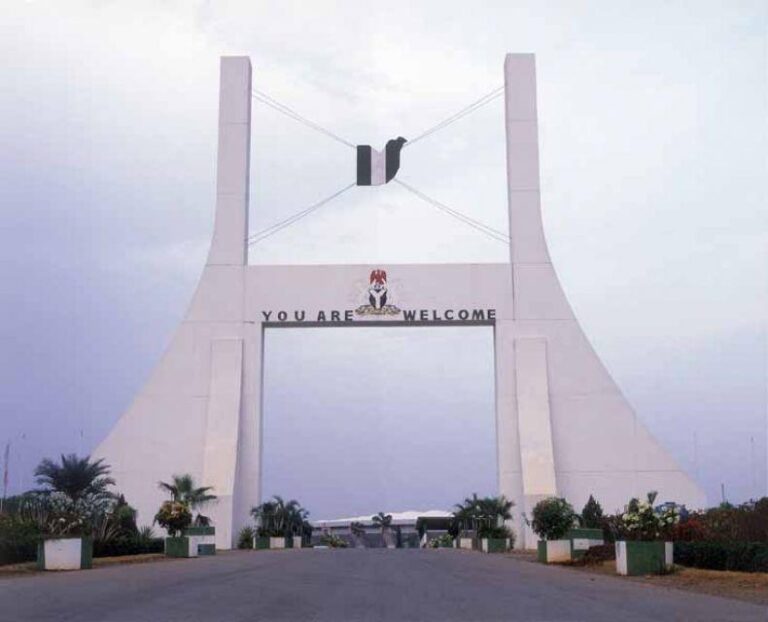
The former Lagos State governor arrived at the Nnamdi Azikiwe International Airport Abuja on Monday, April 24, to the waiting hands of government officials, stalwarts of his party – the All Progressives Congress (APC), and other supporters.

Thunderous shouts of ‘Mr President!’, ‘Welcome, your Excellency!’ rented the air at the airport as everyone sought to catch a glimpse of him.

He was conveyed in a convoy of black SUVs amidst heavy security around 4:58 pm along Bill Clinton Drive, along the Airport Base and Nigerian Correctional Service Headquarters, Airport Road.

Tinubu returned to Nigeria two days after questions were raised over his whereabouts in a report published by The ICIR, five weeks to his inauguration.


READ ALSO:
APC dissolves presidential campaign council ahead of Tinubu’s inauguration

Zelensky invites Nigeria’s President-elect, Tinubu to Ukraine

Adamawa guber poll: Tinubu asks police to conduct full investigation

Security in Nigeria: Bola Tinubu will increase tension in some parts of the country and reduce it in others


The ICIR published the report after some of his party chieftains confided in the organisation that the President-Elect’s ‘prolonged disappearance’ and ‘elusiveness’ had become a source of concern to those who worked for his victory.

Tinubu will be inaugurated as Nigeria’s President on May 29, when the eight-year leadership of President Muhammadu Buhari ends.

Tinubu travelled to Europe in late March after the Independent National Electoral Commission (INEC) declared him the winner of the presidential election conducted on February 25. 

Nothing has since been heard from him, except when he appreciated Nigerians for voting for him, and other statements issued through his social media handles. He also reportedly expanded the Presidential Transitional Council on Thursday, April 20.

Reactions from Tinubu’s media spokesperson, Tunde Rahman, and other aides to the former Lagos State governor appear not to convince those who doubted that all is well with the President-Elect.

While rumours spread that Tinubu jetted out to Europe in late March after the governorship and state houses of assembly election to attend to a medical emergency, Rahman debunked the claims.

But some party stalwarts and other Nigerians remained unconvinced because Tinubu has not been seen since he left Nigeria.

Rahman argued that Tinubu needed rest after touring the 36 states and working hard for his victory at the presidential poll.

He said the President-Elect travelled to France to rest and would proceed to Saudi Arabia during Ramadan for Umrah, the lesser Hajj.

Those who suspected that all is not well with Tinubu had pointed at a picture of Buhari and the former Lagos State governor, purportedly taken when they participated in the lesser Hajj in Saudi Arabia during the just-concluded Ramadan.

Sam Omatseye, one of the heads of Tinubu’s media outfits, tweeted the picture.

The picture, when fact-checked, was found to be misleading, raising suspicion over Tinubu’s whereabouts.

The picture was from a news report published by Premium Times on May 11, 2019. It showed President Buhari breaking Ramadan fast with Tinubu at the Presidential Villa in Abuja.

The image caption on the media report indicated that the photo was shot by Sunday Aghaeze, President Buhari’s Personal Assistant on Photography, on May 10, 2019.

An APC chieftain who was worried over Tinubu’s whereabouts told The ICIR, “A Northern governor reached out to his (Tinubu’s) people so that he could join him to Umrah, but the governor was ignored. That further heightened concerns.”

Tinubu embarked on a similar journey before the elections

Shortly after he won the APC presidential primary in 2022, Tinubu travelled to Europe and was inaccessible to many of his party’s leaders.

He arrived in Nigeria after the election campaigns had started.

Speaking with The ICIR on the telephone on Friday, April 21, Rahman, his media aide, confirmed that Tinubu was not in Saudi Arabia for the lesser Hajj, Umrah, during the just-concluded Ramadan.

Rahman said the former Lagos State governor would return to the country soon.

“He’s not in Saudi Arabia. He should be returning anytime from now. He’s not in Saudi Arabia because there are a lot of people lurking around the corner to see him there. What he is doing is planning for his inauguration, and he needs to reflect on the things he has to do as he plans for his inauguration.”

Speaking on the rumours that the President-elect has been treating an undisclosed ailment since he jetted out of the country, Rahman said, “All I can tell you is that His Excellency is there. He’s okay. He’s in fine spirits, and he’s strong. He’s not taking a break. At the appropriate time, he will talk.”

The ICIR reports that Tinubu’s lawyers are representing him in court after the candidate of the Peoples Democratic Party, Abubakar Atiku and his Labour Party counterpart, Peter Obi, disagreed with the Independent National Electoral Commission (INEC) that Tinubu won the presidential election. Atiku and Obi filed petitions before the Presidential Election Tribunal.

“How will you boast that you have a President-Elect who is elusive to his people and could not be seen to have been visited or discussing with anyone from around the world? Where does that happen? 

“If he had done that in the past, he needs to change. Nigeria needs to see him that he’s alive and doing well,” one of the party leaders told The ICIR.

The APC leader said Nigerians must not have a repeat of how Buhari spent months treating ailments outside the country, without paying any attention to governance.

Order restored after Abuja violent clash

0

NORMALCY has been restored after a violent clash that erupted in the Gwarinpa area of Nigeria’s Federal Capital Territory (FCT).

The clash, which erupted on Saturday, April 22, lingered till Monday, April 24 and claimed two lives, according to medical officials at the Federal Road Safety Corps (FRSC) Medical Centre in Gwarinpa, where wounded residents were taken for treatment.

Some traders were also attacked in the process, and residents warned other members of the public to avoid the area via Twitter.


READ ALSO:
GSM village: Inside Abuja’s thriving gadgets hub

Two die as building under construction collapses in Abuja

INEC summons Adamawa REC to Abuja after Binani governor-elect declaration

Police foil armed robbery operation in Abuja


“They are rioting in Gwarinpa. If you live in Gwarinpa, a riot is going on in 3rd Avenue, and it’s very much heated,” a Twitter user, Dr_Youngy, tweeted.

However, security operatives, including the Nigerian Police Force (NPF), Nigeria Security and Civil Defence Corps (NSCDC) and other members of the FCT Joint Task Force (JTF), were present at the scene to restore order following fresh unrest on Monday.

The ICIR reached out to the FCT Police Command to confirm the death toll and cause of the clash, but Public Relations Officer (PRO) Josephine Adeh said she could not give details of the incident at the time as she was in a meeting.

“Sorry, I’m in a meeting, I will call you when I can talk,” she said.

In 2022, there were violent clashes between traders and commercial motorcycle riders in the Dei-Dei area of the FCT, during which five people died and properties worth million were destroyed.

The crisis began after a motorcycle rider, conveying a female passenger, fell on the road in an attempt to overtake a trailer, leading to her death.

FCT Minister Muhammad Musa Bello ordered the temporary closure of the market following the incident, although it was reopened a week after.

Sudan: FG plans evacuation by road, tells Nigerian students to stay indoors

THE evacuation of Nigerians trapped in Sudan can only be carried out by road as flight operations in the country have been difficult, according to the Nigerian government.

About 10,000 Nigerian students are studying in Sudan, and thousands of others are engaged in businesses. The Federal Government says rescuing those stranded in the country has to be by road.

The Foreign Affairs Minister, Geoffrey Onyeama, said this on Sunday, April 23, while speaking on Channels Television.

He said the citizens would first be evacuated by road to the Egyptian or Ethiopian border before they are flown to Nigeria.

According to him, preparation for this mode of transportation is currently ongoing. He noted that evacuating Nigerians from Sudan has been daunting due to the number of nationals there.

The minister said efforts to coordinate the movement out of Sudan are on, noting that relevant parties have been “working round the clock in the past two days to get Nigerians out of Sudan”.

“First, we have told our embassy there to put up a platform where all the Nigerians in Sudan can log on to and information will be available and to coordinate the process.

”Obviously, in a situation like this, what we need is where everybody can congregate before you start moving them out. And because the airport is unsafe, the only viable way out is by road,” he said.

A vicious power struggle between the Sudanese army and the paramilitary Rapid Support Forces (RSF), has led to violence across Sudan for more than a week.

As the crisis deepens, a growing list of countries are evacuating diplomats and citizens from the country.

The United States and United Kingdom on Sunday, April 23, announced that they had flown diplomats out of the country. France, Germany, Italy and Spain have also been evacuating diplomats and other nationals.

Also, the United Nations has relocated hundreds of staff members and their dependants from Khartoum and other locations in Sudan.

However, Onyeama said Nigeria’s diplomatic staff cannot be evacuated until students in the country are moved out.

He said the diplomatic staff are needed to coordinate the evacuation of students and other Nigerians.

“We cannot evacuate our diplomatic staff at the moment because they also need to coordinate the evacuation of the students, but we are going to evacuate them.

”The option available to us is the Egyptian border, which is close to Port Sudan and the Ethiopian border. There is a border with Chad as well, but the three we are looking at are the Ethiopian border, Port Sudan, and the Egyptian border,” he added.

FG asks students to stay indoors

Meanwhile, the Federal Government has warned Nigerian students in Sudan to remain indoors while arrangements are made for their safe evacuation. The government also advised the students to disregard the notice circulated by the National Association of Nigerian Students (NANS) in Sudan, calling on students to pay $100 or $200 for evacuation.

In a statement issued on Sunday, April 23, and signed by the Charge D’ Affairs of the Nigeria Embassy in Khartoum, H.Y Garko, the government urged students to prioritise their safety and wellbeing.

“As the Embassy had earlier informed students, you are therefore requested to stay calm and remain indoors while the embassy is working on final approval to commence evacuation,” the statement said.

The government warned that it was dangerous to embark on a journey toward the borders of Sudan without security clearance and guarantee from the Sudanese authorities.

According to the World Health Organisation (WHO), at least 400 people have died in the fighting, and almost 3,500 more have been wounded in Khartoum, the western region of Darfur and other states.

The Nigerian embassy has also created WhatsApp and Telegram platforms for the students and other Nigerians in Sudan for proper coordination and regular updates.

Nigerians can contact the embassy on any of the following numbers: +249 90 765 0702, +234 803 698 1824, +249 90 132 5359, +249 92 440 1217.

Wijhat calls for applications for grants program

Wijhat” (Destinations) program, launched by Culture Resource, is accepting applications for grants to support cultural actors in the Arab world.

Each grant is up to EUR 7,000 (US$7,658) to support travel within the Arab region and internationally, allowing grantees to present their works to new audiences and to engage in diverse cultural exchange experiences.

The program supports the following events: artistic and cultural fairs, artistic residencies, forums, conferences, seminars, workshops that promote creative and artistic production, and training and capacity-building workshops.

Journalists, documentary filmmakers, writers and cultural actors across the Arab world can apply for grants.

The deadline for the submission of  applications is May 15, 2023. Interested applicants can apply here.