CATHOLIC Archbishop of Lagos Archdiocese Adewale Martins has asked the Nigerian government to declare a state of emergency on insecurity across the country.
Martins, in a statement signed by the diocesan director of social communications Anthony Godonu, warned that Nigeria was drifting into a state of anarchy.
He cited continuing attacks on police stations and offices of the Independent National Electoral Commission, as well as rising cases of kidnapping, armed robbery and murder to buttress that the country was on the verge of lawlessness.
The archbishop said a state of emergency on insecurity was the only way to arrest the ugly situation.
Corruption has for long been identified as Nigeria’s major problem, but Martins observed that insecurity was becoming a greater challenge.
“It is obvious that insecurity, apart from corruption, has become the single most serious problem that is facing our country today.
“Many innocent persons are being kidnapped for ransom, many are being attacked in their homes and displaced with their property destroyed and normal life disrupted daily.
“Even policemen and their stations are being deliberately attacked with impunity. What this means is that the country is gradually drifting into a state of anarchy. This, no doubt, portends a grave danger for our collective wellbeing,” the archbishop said.
To effectively address insecurity, Martins said the security agencies should engage in dialogue with major stakeholders such as religious leaders, traditional rulers, leaders of ethnic groups, the civil society, and political parties.
He also spoke of the need for a practical action plan with clear timeline on ways to address the problem.
The cleric suggested that the introduction of state police in the proposed amendment of the 1999 Constitution would also help to improve security in the country.
“These would certainly help in restoring peace and security all over the country.
“This is no time to play the blame game or to play politics through sectoral efforts. There must be a collective effort through a robust consultation with all stakeholders.
“We all must come together to fight this hydra-headed monster of insecurity that is making life difficult for our people.”
Martins appealed to various groups agitating for self-determination to shun violence and embrace dialogue.
IN 2015, the President promised to revamp the economy, curb corruption and improve security in Nigeria.
He reiterated the promises, when he sought reelection in 2019.
He specifically highlighted security, especially dealing with the menace of the terrorist organisation, Boko Haram, that had been a torment to the country.
He also promised to improve the economy through a number of schemes and policies.
In addition, he pledged to fight corruption, with emphasis on checking graft at the Nigerian National Petroleum Corporation (NNPC), and the oil sector.
Data from the National Security Tracker (NST) between May 20, 2015 and May 23, 2021 shows a significant decline in Boko Haram casualties from 1,122 deaths in 2015 to 780 in 2021. Within the period, the group had killed a total of 10,451.
And from 112 victims in 2015, the number of kidnap victims rose to 2,276 in 2021. The kidnapping cases have risen to 8,452.
In 2021, the insecurity spread to the southern Nigeria that was previously peaceful, now there is an increase in attacks on security formations, especially the assets of the Nigerian Police Force.
Though civilians deaths has decreased from 3,026 in 2015 to 1,437 in 2021, number of attacks rose from 405 to 1,016.
Unstable economy
Nigeria has seen two recessions in the Buhari administration; one in 2016 and another in 2020.
Buhari’s campaign though prioritise economy, key indices show that the Nigerian economy is still weak.
The Gross Domestic Product (GDP), measured quarterly and annually, dropped from 2.79 percent in 2015 to -1.92 percent in 2020.
Borrowings during Buhari administration have soared with a total debt stock rising from N12.6 trillion to N32.9 trillion, an increase of 161.16 percent from December 2015 to December 2020, according to Debt Management Office (DMO).
Nigeria’s total domestic debt rose from N8.84 trillion in December 2015 to N16.02 trillion in December 2020, representing a percentage increase of about 81.32 percent.
In contrast, Nigeria’s foreign debt increased to $33.35 billion as of December 31, 2021, from $10.72 billion as of December 31, 2015, representing an increase of about 211.12 percent within the last six years.
At the current national debt stock of over N32 .92 trillion, further analysis by The ICIR shows that the over 200 million population currently owes about N156,203 ($410) per inhabitant in terms of per capita debt.
This is where 41 percent of its population (86.8 million) cannot afford two dollars (N762) in a day because they live below that threshold, according to the World Poverty Clock.
A curated data of unemployment rates across the world shows that the Africa’s biggest economy is home to the second-highest unemployment rate (33.3 percent) in the world after the Marshall Islands with an unemployment rate of 36 percent.
The National Bureau of Statistics in its most recent labour force statistics pegged Nigerians unemployed rate at 33 .3 percent
The inflation rate had dropped from 18.17 percent to 18.12 percent in the past month, but the Naira still suffers. Analysts have attributed the increase in prices of goods and commodities to the closure of land borders between August 2019 and October 2020 and also coupled with the effect of the COVID-19 pandemic that shut down the world’s economy.
“The closure of land borders in the country in August 2019 was a major driving force for the upward trend of the inflation rates of the country,” says NBS.
The exchange rate had risen from N197 to one US dollar in 2015 to N381 respectively in 2020. A worsening of the currency’s continued devaluation from 9.55 percent to 15.75 percent, data from the Central Bank of Nigeria (CBN) reveals.
Out of 190 countries ranked by the World Bank for having a better business atmosphere, as of 2020, Nigeria sat at 131, ranking 170 out of 189 countries in 2015.
This is still poor as it means investors, especially (foreign) multinationals, will logically have to consider a long list of countries before Nigeria.
The ICIR had reported on an instance of the challenge of doing business in Nigeria and how some government policies had made the business atmosphere somewhat uncomfortable.
The effect of sitting at the lower levels in the World bank’s ease of doing business list is a reduction in the money from capital importation into Nigeria.
Nigeria’s capital importation money indicates the value realised from investments that are made in the country. In 2015, we had $9.64 billion, and after witnessing some high and low points, it rested at $9.68 billion in 2020.
It was at a record low in the first quarter of 2016, with $710.97 million realised. The sum of $23.99 billion realised in 2019 was the highest point recorded in the Buhari administration.
Solving Nigeria’s corruption
As of 2015, Nigeria ranked 136 among the 180 countries watched by Transparency International (TI), an anti-corruption association.
Corruption Perception Index, a publication of TI, uses a scale of 100 to measure how corrupt countries are annually. Nigeria came behind at number 26 in 2015, tagging Nigeria among the most corrupt countries in the world.
Even though the Buhari administration promised to put up a fight, the index as of 2020 put Nigeria at number 25 on the scale and ranked her 149, a step back from what it was.
Samson Samuels and Isah Abdul-Azeez made additional contributions.
THE Nigerian Air Force (NAF) has defended the pilots who flew the late Chief of Air Staff Ibrahim Attahiru, saying they were experienced.
NAF Director of Public Relations and Information Edward Gabkwet said this on Saturday while reacting to questions raised about the age and experience of the deceased pilots.
The ICIR had reported that Attahiru and 10 other military officers died in an air crash last Friday.
The two pilots in the aircraft Alfred Ayodeji and Taiwo Olufemi Asaniyi were flight lieutenants and only 29 years old before the crash.
Gabkwet said Asaniyi had been flying an aircraft since his time at the Nigeria Defence Academy, noting that he flew more hours than some senior officers.
“As a captain on the Beechcraft, he had flown 2,450 hours, which was in 2019. So he would have flown nothing less than 5,000 hours since his cadet days. He had been flying the COAS and other VVIPs on that same Beechcraft. He was 29 years old. Because he had an accident doesn’t mean he didn’t have experience,” said Gabkwet.
He added that Asaniyi travelled every year for retraining which involved a partnership with the manufacturers of the planes. “It is rigorous; it’s not something taken with levity.”
A retired group captain from the Nigerian Air Force Sadeeq Shehu had raised questions regarding the age of the pilot who flew the late Attahiru.
According to Shehu, it was about their experience and partly about their ranks.
Gabkwet further stated that the Beechcraft aircraft that had recorded two crashes in 2021 was not the cause of the recent incident involving the late COAS.
“The one that crashed in January was given to us by the Nigerian Maritime Administration and Safety Agency. So, the accident wasn’t about the aircraft. Everyone is saying the weather that day was bad. Even in Abuja, it was bad,” Gabkwet said.
SINCE his inauguration in 2015, President Muhammadu Buhari’s appointment has continued to generate controversy among Nigerians who accuse him of marginalisation and disregard for Federal Character policy and those who believe his administration is fair to all.
Though he swore to “belong to everybody” and “belong to nobody, many Nigerians think he has not lived up to his promise.
Nigeria is a diverse country, comprising multi-ethic groups in the North and the South. The framers of the constitution recognised this diversity and enacted Federal Character Commission Act.
The Act seeks to promote, monitor and enforce compliance with the principles of the proportional sharing of all bureaucratic, economic, media and political posts at all levels of government.
The Federal Character clause in Section 14 (3) of the Constitution states as follows: “The composition of the Government of the Federation or any of its agencies and the conduct of its affairs shall be carried out in such a manner as to reflect the federal character of Nigeria and the need to promote national unity, and also to command national loyalty, thereby ensuring that there shall be no predominance of persons from a few states or from a few ethnic or other sectional groups in that Government or in any of its agencies.”
But the Act is observed in breach under Buhari, and with a detached temperament.
According to public records, the Southeast and Southsouth have marginal representation in Buhari government, while the North takes majority appointments.
In June 2020, some Southern leaders dragged President Buhari before the Abuja Division of the Federal High Court over alleged marginalisation in appointments made by his administration since 2015.
According to them, the present composition of the government of the federation, and most of its agencies especially as regards the composition of the security and quasi-security architecture do not reflect the Federal Character of Nigeria but rather there is a predominance of persons from a few states and sectional groups dominating the opportunities and threatening national unity and integration.
Despite public condemnation and request that the president follows laid-down rules regarding appointments, Buhari in 2015 in an interview with BBC Hausa explained the reason behind his appointment, saying he nominates people he could trust, and who had worked with him for years.
He also said the Constitution allows him complete control over his closest officials’ choice and made it clear the appointments also served as a reward for those who remained loyal to him for years, who refused to be lured by power or material wealth.
By this statement, the president confirmed his disregard for Federal Character Act.
A 2017 BusineessDay report entitled: “81 of Buhari’s 100 appointees are Northerners” showed 81 of Buhari’s appointments are either from the northeast, North-west or North Central since he became president.
The Presidency, in its response to the report by Buhari’s senior media adviser, Femi Adesina published a list, which showed that 82 of the 157 appointments made by President Buhari were from the South, and 75 from the North.
The Presidential spokesman said the government’s list “put the lie” to the “mischievous” claims about Buhari’s appointments, adding: “It is, indeed, false for anyone to say that President Buhari’s appointments are lopsided”.
However, a Fact Check by Premium Times on the list released by Adesina, said it contained several omissions and errors.
Appointment into Military, NNPC, Court of Appeal
The President appointment into the country’s security service over the years has been condemned widely.
Top appointment into the country’s security service by President Buhari since 2015 favours officers from the northern part of the country.
Te President appointment into the leadership cadre of the Nigerian security services, between 2015 and 2020, only two of the eight security chiefs were from the South: the chief of defence staff (South West) and the chief of naval staff (South-South).
The remaining six, including the heads of the army, air force, police, national intelligence agency and state security service, were all Northerners.
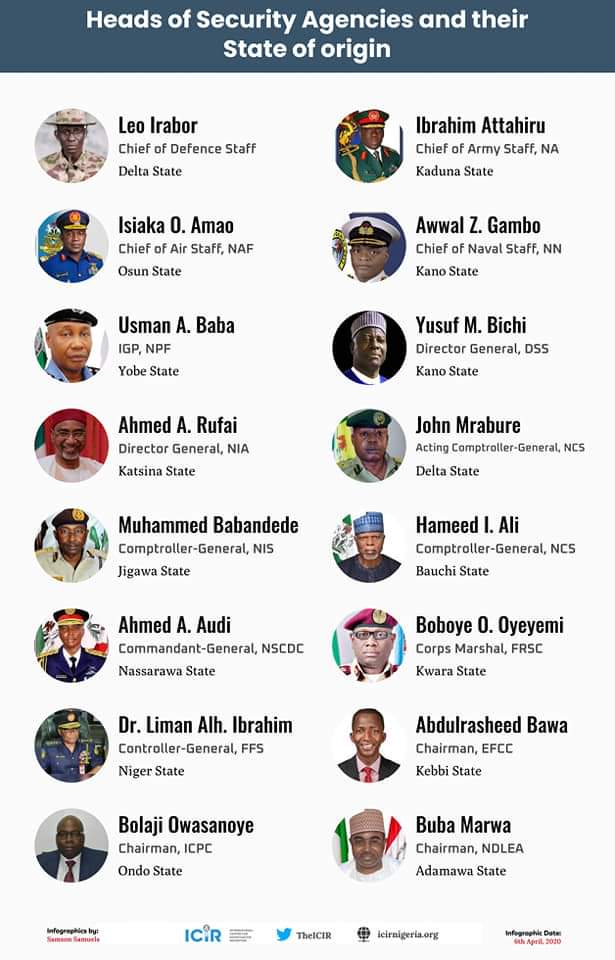
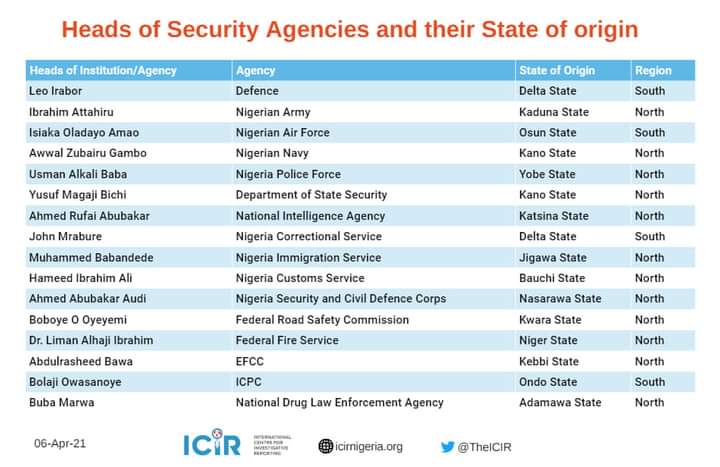
Also, as of April 6, 2021, a regional analysis of the heads of security agencies conducted by The ICIR, including paramilitary and antigraft agencies based on their state of origin shows that 12 out of 16 of them (75 percent) are from the northern part of the country, while just four (25 percent) are from the southern part of the country.
These agencies are Defence, Nigerian Army, Nigerian Airforce, Nigerian Navy, Nigeria Police Force, Department of State Security (DSS), National Intelligence Agency (NIA), Nigeria Correctional Service, Nigeria Immigration Service, and Nigeria Customs Service.
Heads of Security Agencies and their State of Origin
Others are Nigeria Security and Civil Defence Corps (NSCDC), Federal Road Safety Commission (FRSC), Federal Fire Service, Economic and Financial Crimes Commission (EFCC), Independent Corrupt Practices And Other Related Offences Commission (ICPC), and the National Drug Law Enforcement Agency (NDLEA).
Also, the president’s approval of the list of Justices of the Court of Appeal released in 2021 reflects staggering inequality, with 61 per cent of jurists coming from the North versus 39 per cent from the South.
The judicial appointment also once more brought to the fore the issue of his preference of northerners in key government positions.
Buhari’s appointments into the top management of the Nigerian National Petroleum Corporation (NNPC) and its subsidiaries shows an uneven geographical spread of senior appointments.
An analysis carried out by The ICIR, revealed a geographical imbalance within the ranks of the corporation.
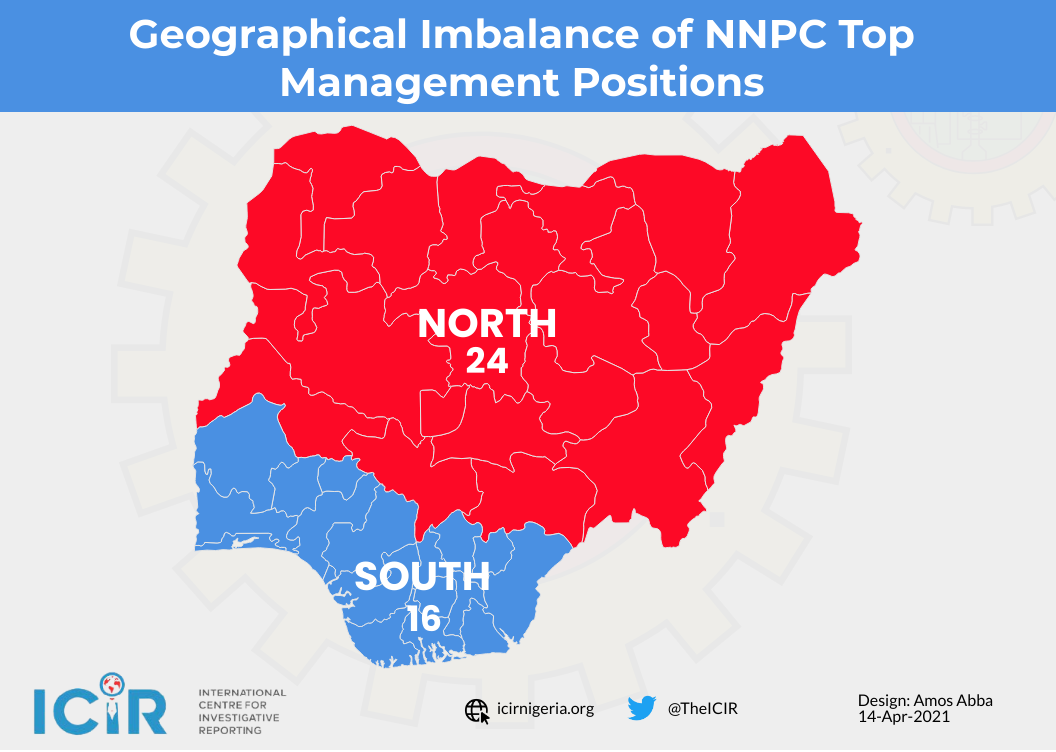
Out of 40 senior management positions within the NNPC ranging from chief operating officers and managing directors of its subsidiaries to general managers’ roles in the corporation, 24 are occupied by Nigerians from the North while those from the South head 16.
The total representation comprises two from North-East, two from North-West, one from North-Central, one from South-South and one from the South-West.
Geographical Imbalance of NNPC Management Positions
The list is as follows: Chief Operating Officer (COO) in charge of refineries Mustapha Yinusa Yakubu (North-Central); Chief Financial Officer in charge of Accounts and Finance Umar Isa Ajiya (North-West); COO, Gas and Power Yusuf Usman (North East); while COO overseeing ventures and investments is Adeyemi Adetunji (South-West).
Others are COO in charge of Upstream Tombomieye Adokiye from South-South; COO, Corporate Services Mohammed Abdulkabir Ahmed (North West), and corporation’s legal adviser Hadiza Coomassie from North-West.
The position of the COO, Downstream, which Ndupu Lawrencia vacated from South-East, who retired early in the year, is yet to be filled.
The South-East has no representation in the internal board of the NNPC, which is saddled with running the day-to-day activities of the corporation. Yet, the region has two oil-producing states -Imo and Abia.
Condemnation of Buhari’s appointment over the years
Late Yoruba activist, Yinka Odumakin, in an interview with BusinessDay on appointment made by Buhari said various agitations to end the entity called Nigeria are directly linked to issues of Buhari’s appointment.
Describing the scenario as unfortunate, Odumakin said Nigeria was fragile because of appointment made by the president
Odumakin also said other regions are marginally represented when discussing national security issues.
Heads of Security Agencies and their State of Origin as of April 6, 2021.
“We have not run an inclusive government in the last two-and-a-half-year or so and that is evident. And when you look at Nigeria, when they hold meeting of the security council today, apart from one or two nominal people, the whole people there are all from a section of the country. If you look at other appointees, every agency that bears arms is headed by people from a country section. This is why Nigeria is so fragile at the moment”, he had said then.”
Also, the Christian Association of Nigeria (CAN) had in 2018 after appointment by the Buhari-led government into different federal agencies in a statement accused the president of unduly favouring Muslims from Northern Nigeria in federal appointments.
CAN President, Samson Ayokunle described the recent appointments as lopsided and against the spirit of a united Nigeria.
The CAN statement had read, “Mr Buhari on September 1 appointed Abbas Umar as the Managing Director of the Nigerian Security Printing and Minting Company, on September 13 he appointed Yusuf Magaji Bichi, from Kano State to replace Matthew Seiyefa from Bayelsa who had been operating in an acting capacity since Lawal Daura was sacked in his absence; and on September 14, he also appointed Zainab Ahmed as the acting Finance Minister to replace Mrs Kemi Adeosun who resigned as a result of her failure to participate in the NYSC programme and for parading a forged NYSC Certificate of Exemption.
“The composition of the Government of the Federation or any of its agencies and the conduct of its affairs shall be carried out in such a manner as to reflect the federal character of Nigeria and the need to promote national unity, and also to command national loyalty, thereby ensuring that there shall be no predominance of persons from a few state or from a few ethnic or other sectional groups in that Government or in any of its agencies.”
Also, in 2018, former President Olusegun Obasanjo wrote an open letter to President Buhari, urging him not to seek re-election, citing, among others, his “nepotistic deployment bordering on clannishness”.
Col (retd) Abubakar Umar, former military governor of Kaduna State in his own open letter said to Buhari that his nepotism could tear Nigeria apart.
The former military governor had said: “Nigeria has become dangerously polarised and risks sliding into crisis on account of your administration’s lopsided appointments, which continue to give undue preference to some sections of the country over others.”
One of Buhari’s staunchest critics, Farooq Kperogi described recruitment into his government as “Arewaization of appointments”, and many Nigerians who follow Kperogi agreed with him.
APEX socio-political body of the Igbo Ohanaeze Ndigbo has demanded ‘internal autonomy for all federating units of a restructured Nigeria’ at the ongoing public hearing on the review of the 1999 Constitution.
The demand was made in a presentation by Ohanaeze Ndigbo President General George Obiozor at a public hearing held by the Senate Committee on the Review of the 1999 Constitution in Owerri on May 27.
“Fundamentally, what Ndigbo really want is some form of internal autonomy based on a restructured Nigeria,” Obiozor, a former Nigerian ambassador to the United States, said in an address at the hearing.
The Igbo leader suggested that, going by the country’s current structure, the federating units were not equal in status.
“That categorically stated we (Ndigbo) are of the view that the federation of Nigeria must be a union of equals and the composite units must have the ability to stand without begging the centre for survival.”
The Igbo, who make up Nigeria’s South-East region, want a federal system of government characterised by decentralisation and devolution of power among the federating units, Obiozor further explained.
He added that in the context of the imperatives and urgency of restructuring Nigeria, the focus should be on “getting the right things done for the right reasons and at the right levels of government.”
The Ohanaeze Ndigbo leader warned that only restructuring could save Nigeria from imminent tragedy.
According to him, Nigeria was ‘born’ with political tragedies waiting to happen.
Igbo leaders believe restructuring Nigeria would address the issues which encourage the agitation for Biafra among the youths, who feel aggrieved over the perceived marginalisation of the South-East.
The pro-Biafra agitation has taken a violent turn in recent times, and the agitators, led by the Indigenous People of Biafra (IPOB), are believed to be responsible for attacks on federal security formations and establishments in the zone.
In addition to Biafra struggle, a movement for the creation of an Oduduwa nation among the Yoruba in the South-West is fast gaining ground.
“Some countries are born with political tragedies waiting to happen and our history shows that Nigeria is one of them.
“All signs of national tragedies foretold are present today in full force in Nigeria. In fact, it would require a restructured Nigeria to contain the present forces and tendencies towards a synchronised national crises and even a possibility of national disintegration.
“Therefore as national leaders, we must learn the lessons of history that in societies where truth comes last, tragedy comes first.”
The perennial problem or dilemma in Nigerian politics has always resolved around the issues of justice, equity and fairness, the Ohanaeze Ndigbo leader further observed.
Making reference to the increasingly violent struggle for Biafra, Obiozor noted that “throughout history those denied justice have had no interest in peace.”
He appealled to the constitution review committee to, at the end of the exercise, “in the interest of the nation, its unity and progress,” conclude with decisions guided by love and not by hatred, and guided by collective hopes and not by fears.
Advancing the need for restructuring, the Igbo leader stressed that many Nigerians and groups felt like caged lions due to their inability to develop at their own pace as a result of inhibitions arising from the 1999 Constitution.
“Therefore, to many of these citizens across the country, states and zones, restructuring Nigeria will be equivalent to releasing the lion from the cage and it can defend itself.”
THE administration of President Muhammadu Buhari met a decaying health sector after his election in 2015. And most Nigerians believed his government would help fix the sector. The emergence of COVID-19 further re-echoed the necessity for prioritising the health sector, but it appears only a little has changed in a country that parades some of the world’s worst health indices, The ICIR reports.
Emergence of COVID-19
In April 2020, Secretary to the Government of the Federation, Boss Mustapha, expressed shock at what he saw in Nigerian public hospitals, having inspected some of the facilities.
As the Chairman, Presidential Taskforce (PTF) on COVID-19, he travelled across the country to monitor the nation’s preparedness for tackling the pandemic.
Mustapha saw hospitals without beds, emergency wards without ambulances, intensive care units without power supply and health facilities in shortage of human resources and infrastructures needed for services.
Boss Mustapha, the Secretary to the Government of the Federation and Chairman of the Presidential Task Force (PTF) on Covid-19. photo credit: FMIC
He saw dilapidated hospital buildings occupied by reptiles and other pests. He would not conceal his feelings, and told the leadership of the National Assembly: “I never knew that our entire healthcare infrastructure was in the state in which it is. Until I was appointed to do this work.”
Mustapha has been in office since October 2017.
His admission is symbolic of the neglect which the country’s health systems have suffered over the years and the hopelessness of many citizens in seeking care in health facilities.
Political office holders like him are fond of seeking healthcare abroad.
But in 2020, coronavirus forced everyone to remain in their countries, at least for some months.
Challenges of Nigeria health sector include underfunding, corruption, poor remuneration, brain drain, inadequate infrastructures, poor leadership, insufficient human resources and poor health insurance coverage that has remained at a single percentage of the population since its launch in 2005.
These challenges promote self-medication, out-of-pocket spending for health; low morale for health professionals; preventable diseases and death.
Fears over failings of Nigeria health systems peaked at the onset of COVID-19 in Nigeria in March 2020.
First, most citizens believed that despite the lack of immediate pharmaceutical solutions to the disease, the country’s health infrastructures would not match the responses given to the virus in other parts of the world.
To prevent the disease from spreading in Nigeria, President Muhammadu Buhari ordered a lockdown in key states on March 30. Some state governors also took similar measures to curb the spread of the virus.
Following the rollout of measures to combat the disease, Nigeria began to have lockdowns in phases, effective May 4, 2020.
According to the Nigerian Centre for Disease Control (NCDC), as of Thursday, May 27, the country had 166,098 cases, 2,071 deaths, and 156,528 recoveries from the virus.
Global cases on that day were 169,093,368, deaths were 3,512,497, while there were 150,835,753 recoveries, as shown by The ICIR dashboard.
Nigeria confirmed its first case of COVID-19 on February 27, 2020. The case involved an Italian who returned from Italy to Lagos on February 25 2020.
Though the index case recovered, the virus infected more people in Nigeria, resulting in deaths.
Late Abba Kyari – Former Chief of Staff to President Muhammadu Buhari Photo: The Guardian
Some of the persons killed by the disease were Chief of Staff to the President, Abba Kyari; immediate past governor of Oyo State, Abiola Ajimobi; Commissioner for Health in Ondo State, Wahab Adegbenro; and spokesperson to Yoruba socio-cultural group, Yinka Odumakin.
Through COVAX Facility, a partnership between CEPI, Gavi, UNICEF and the World Health Organization (WHO), Nigeria received its first shipment of AstraZeneca/Oxford vaccine on March 2 this year.
The shipment contained 3.9 million doses of the vaccine from the Serum Institute of India (SII), the vaccine manufacturer.
Vaccination against the virus has been marred by vaccine apathy, despite the shortage of the vaccine.
Our reporter also observed that the National Primary Health Care Development Agency (NPHCDA) did not contact most people who registered for the vaccine to receive it.
The Federal Government gave priority to political office holders, health workers, security personnel and media practitioners.
On January 27, President Buhari signed the Coronavirus Disease (COVID-19) Health Protection Regulations, making wearing face masks in public place compulsory. The ICIR reports that many Nigerians do not wear it, even while in crowded public places and vehicles.
Similarly, many religious worship centres shun health advisories for the prevention of the virus by health authorities.
Some of the concerns over the pandemic in Nigeria are the nation’s inability to produce its vaccine for the disease and the effectiveness of port authorities to stop people from countries banned by Nigeria from gaining entry into the nation.
The Federal Government had on Sunday, May 23 declared 90 international travellers from Brazil, India, United Arab Emirates and Turkey wanted for violating the provisions of the COVID-19 Health Protection Regulations.
In the same vein, the National Agency for Food, Drug Administration and Control (NAFDAC) has repeatedly given assurances that experts were working to produce local vaccines for the disease. No local vaccine is yet available for public use. The agency has also alerted the country to the possibility of criminals importing fake vaccine into the nation.
COVID-19 financing
Some of the Federal Government expenditures on COVID-19 include N100 billion credit for health infrastructures in the nation by the Central Bank of Nigeria (CBN).
The Bank, which led interventions against the virus in the country, said its stimulus package against the disease would reach 2.7 billion dollars.
The Bank approved N253 million grant to health researcher under its Health Sector Research and Development Intervention Scheme (HSRDIS) as part of its contributions to the fight against the pandemic.
In April 2020, the Federal Government sought the approval of the National Assembly to establish a 500 billion Coronavirus Disease (COVID-19) Crisis Intervention Fund.
In June 2020, the African Development Bank approved a $288.5 million loan for Nigeria to help it tackle the COVID-19 pandemic.
Also, the Federal Government released 10 billion naira to Lagos State, which has the highest cases and fatalities from the virus in the country.
President Buhari receives the COVID-19 vaccine. Source: Guardian newspaper
In January this year, the Federal Government approved a 6.4 billion naira for setting up oxygen production plants in 38 sites across the country to bolster the fight against COVID-19.
In January this year, the Federal Government released 10 billion to support local production of the COVID-19 vaccine.
The government had said in December 2020 that it needed N400 billion naira to vaccinate 70 per cent of Nigerians against the virus.
These amounts are in addition to billions of naira realised through the Nigeria Private Sector Coalition Against COVID-19 (COCAVID).
COVID-19-related corruption cases in Nigeria
The Niger Delta Development Commission (NDDC) led the roll call of agencies accused of mismanaging funds when COVID-19 raged in Nigeria.
The Independent Corrupt Practices and Other Related Offences Commission (ICPC) accused NDDC’s management of diverting over N5 billion meant purchasing personnel protective equipment in the nine oil-producing states for personal use. They were also alleged to have shared N1.6 billion among themselves and their subordinates as palliatives for COVID-19.
Similarly, the House of Representatives on May 24 queried the National Health Insurance Scheme (NHIS) of spending over N152 million on diesel, facemasks and hand sanitisers.
How COVID-19 compounds health care delivery
Meanwhile, the emergence of COVID-19 in Nigeria compounded the affordability and accessibility of healthcare in the country. Many hospitals hiked the costs of their services to discourage patients from crowding their facilities. For instance, the Air Force Base hospital in Abuja charged less than N20,000 for anti-natal registration before the pandemic. It hiked the cost to N40,000 during the pandemic.
Nigeria faced with many disease burdens, poor health outcomes
While Nigeria appears to be doing well in the containment of COVID-19, other diseases in the country do not enjoy similar support.
Patients on queue to see a doctor at a Bauchi General Hospital
For many years, the country has contributed nearly a quarter of the global malaria burden.
According to the WHO, 20 per cent of all global maternal deaths occur in Nigeria.
The 2013National Demographic and Health Survey shows that infant and under-5 mortality rates were 69 and 128 deaths per 1,000 live births, respectively. But, in 2018, the infant mortality rate reduced to 67 deaths per 1,000 live births, while under-5 mortality rose to 132 deaths per 1,000 live births.
25 per cent of children aged 12-23 months were fully vaccinated in 2013 NDHS result. The number grew to 31 per cent in 2018 version of the exercise.
The maternal mortality ratio was 576 maternal deaths per 100,000 live births in 2013. In the NDHS 2018 report, it was estimated at 512 maternal deaths per 100,000 live births.
Some communicable and non-communicable diseases in which Nigeria has a significant lead globally are HIV/AIDS, tuberculosis, cholera, typhoid, Lassa Fever, hypertension, cancer and diabetes.
Health financing during Buhari administration
Health financing has not improved under the Buhari administration. In 2016, the Federal Government had a budget of 6.06 trillion, out of which it earmarked 550 billion to the health sector. The amount represented 4.1 per cent of the budget. The government allocated 221billion naira and N28.6 billion as capital and recurrent expenditure, respectively.
In 2017, the total budget was 7.4 trillion. The health sector got 304.1 billion, representing 4.0 per cent. Capital allocation for the year was N51.3 billion, while recurrent expenditure gulped 252.8 billion.
2018 saw a further decline in the percentage of the health budget to the national budget. The total federal budget was 9.1 trillion that year, from which the sector got 356.4 billion. Recurrent expenditure was 269.9 billion, while the capital budget was 86.4 billion.
In 2020, the government reduced budget allocation to the Basic Health Care Provision Fund by more than 40 per cent, from N44.4 billion to N25.5 billion.
Out of this year budget of 13.6 trillion, recurrent and capital of N380 billion and N134 billion, respectively, were allocated to the health sector, giving a total of 514 billion.
However, international development agencies such as the World Health Organization, United Nations Children Fund, United Nations Population Fund, Bill &Melinda Gates Foundation, Marie Stopes, Pathfinder International, World Bank, among others, play prominent roles in funding health programmes in the country.
Before President Muhammadu Buhari election in 2015, the sector used to experience many industrial actions, resulting from disagreements between the levels of government and workforce in public hospitals.
But, the Nigerian Association of Resident Doctors (NARD) has always embarked on strike, following unmet demands by the government.
Minister of Health, Dr Osagie Ehanire,
The President started his intervention in the health sector with the disbursement of N1.5 million dollars to each state in the country and the FCT for boosting primary health care services. The fund was from the World Bank. The Federal Government rewarded states that delivered good results with the fund with additional funds.
He followed it up with another initiative seeking to rehabilitate 10,000 primary health care centres in the country.
The government also launched the Nigeria Reproductive, Maternal, Newborn, Child, Adolescent and Elderly Health Plus Nutrition (RMNCAEH+N). It is a multi-stakeholder partnership coordination platform that would harmonise the health interventions of the government and health partners to reduce wastage and channel funds to get the desired result to achieve Universal Health Care Coverage.
President’s many medical trips
The ICIR has reported how Buhari overtook former President Umar Yar’Adua in medical trips abroad, spending 172 days outside Nigeria within his two years in office.
He also jetted out of Nigeria to London on March 30, 2021, for a medical check-up, leaving behind a health sector grounded by a doctors’ strike across the country.
At least, the President travelled out of the country seven times for medical treatment in the past six years. The longest he has stayed on a medical trip was 103 days. He embarked on the trip on August 19, 2017.
“DON’T mind the media shout; do the job I command you. If anyone accuses you of human rights violation, the report will come to my table, and you know what I will do. So, take the battle to them wherever they are and kill them all. Don’t wait for an order.”
Those were blood-chilling words spoken by Acting Inspector General of Police Usman Baba while addressing men of the Police Mobile Force and Special Tactical Squad in Enugu on May 18.
The occasion was the launch of ‘Operation Restore Peace’, a campaign ordered by President Muhammadu Buhari in response to growing insecurity in the Southeast, where the age-long agitation for Biafra has taken a violent turn.
Literally giving the security agents a licence to kill, the Acting IGP added, “What other order are you waiting for when Mr President had ordered you to shoot anybody carrying an AK-47 rifle? Quote me, and even a dead police officer can be tried and dismissed from the force and his family will not get his benefits.
“So, don’t sit and wait for them to come; take the attack to them and don’t lose your arms to criminals.”
The directive was clearly contrary to Section 33 (1) of the 1999 Constitution, which guarantees the right to life for all Nigerians.
It also illustrated the disposition of the Buhari administration to human rights – fundamental human rights of citizens are being trampled on and agents of the government who are responsible for the abuses are getting away with it.
Nigeria has been under the civilian rule since 1999 but the manner security agencies, including the army, are deployed to suppress civil liberties is not different from what is obtainable under brutal military dictatorships.
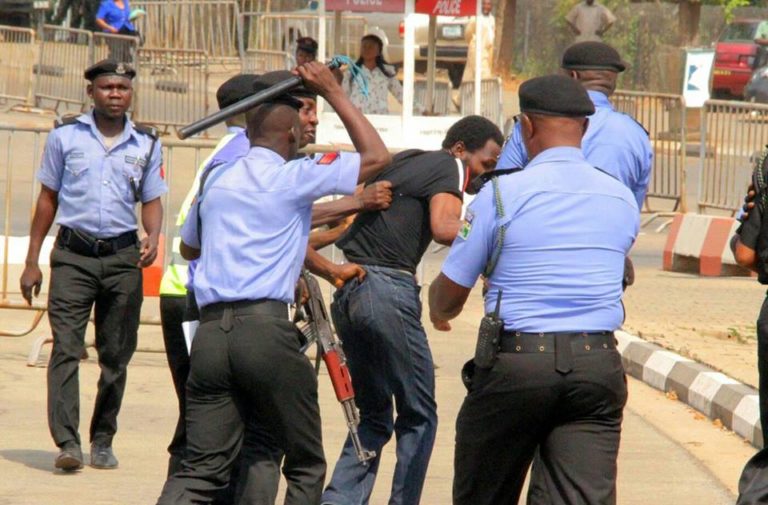
Under President Muhammadu Buhari administration, security agents are regularly deployed to clamp down on protesting citizens.
Minister of Information Lai Mohammed warned that the Nigerian government would not tolerate another #EndSARS protest after some youths scheduled a new protest tagged #OcuppyLekkiTollgate over the handover of the Lekki toll gate to its owners, Lekki Concession Company.
Soldiers had opened fire at protesters who gathered at the plaza during the #EndSARS protests, and the youths were angered that the facility was being returned to the company when a panel of enquiry has not concluded investigations into what actually transpired, more so as the government continues to deny that lives were lost.
When the #OcuppyLekkiTollgate protest went ahead despite Mohammed’s warning, the government made good its threat by deploying the Nigerian police force personnel to arrest the protesters, including a popular comedian, Debo Adebayo, AKA Mr Macaroni. The protesters were maltreated and bundled into a Black Maria, a police vehicle used for transporting prisoners.
#OccupyLekkiTollgate protesters were brutalised, arrested and bundled inside a police van after information minister Lai Mohammed warned that the Nigerian government would not tolerate another protest.
In April, the police arrested two protesters, Larry Emmanuel and Victor Udoka, who demanded Buhari’s resignation. The two youths are still in detention, despite reports that they are sick.
Crackdown on #EndSARS protests highlights disdain for human rights under the Buhari administration
The Nigerian government is still struggling to deny that fatalities were recorded when soldiers opened fire on unarmed peaceful protesters at the Lekki toll plaza in Lagos on October 21, 2020, but testimonies that have emerged from the #EndSARS public hearings had proven that deadly force was indeed unleashed on citizens who were exercising their right to assembly and association, which are guaranteed by Section 40 of the 1999 Constitution.
The number of people who died, and those that were injured, is yet to be determined, but the state-sanctioned brutal crackdown on the #EndSARS protesters stripped the Buhari administration of any pretence of commitment to the human rights of Nigerians.
A blood-stained national flag became the symbol of the ‘Lekki massacre’ when soldiers opened fire on unarmed protesters during the #EndSARS protests.
But the ‘Lekki toll gate massacre’, as the October 21, 2020 incident came to be known, was just another instance whereby security agents were unleashed on defenceless citizens with deadly effect.
The National Human Rights Commission (NHRC) reported that law enforcement agents killed 18 persons while enforcing the first phase of the lockdown ordered by the Nigerian government to curb the spread of the COVID-19 from March 30 to April 13, 2020.
The number of people killed by security agents while enforcing the government’s lockdown order was higher than the number of fatalities recorded from the coronavirus disease during the period.
The 18 cases of extrajudicial killings were part of 105 complaints bordering on rights violations by security agents received by the NHRC during the first phase of the lockdown. Other complaints included violation of the right to freedom of movement, unlawful arrest and detention, and seizure/confiscation of properties.
NBA laments Nigeria’s poor human rights record under Buhari
On the occasion of the 2020 Human Rights Day on December 10, 2020, the Nigerian Bar Association (NBA) had lamented the increasing cases of human rights abuse under the Buhari administration.
NBA National Publicity Secretary Ralph Nduka noted that human rights violations in Nigeria had been taken to a whole new level.
“Human rights violations have been taken to a whole new level, and government officials outdo themselves in explaining away these infractions. In recent times, from the COVID-19 lockdown to the #EndSARS protest, it has been tales of human rights violations. Unfortunately, regardless of the various agitations, it seems the foundation for Respect of Human Rights is still not put in place,” the NBA scribe said.
Nigeria sliding on Freedom in the World annual ranking
The concerns expressed by the NBA is buttressed by Nigeria’s continuing slide on the Freedom in the World ranking, an annual global report on political rights and civil liberties published by Freedom House.
Freedom in the World ranks countries according to scores from an assessment of the application of the Universal Declaration of Human Rights in each country. The Universal Declaration of Human Rights, adopted by the United Nations in 1948, enshrines the rights and freedoms of all human beings.
Although Nigeria had over time been ranked as ‘Partly Free’ in different annual reports of Freedom in the World, the country’s scores for political rights and civil liberties have been dropping in recent years.
In the latest ranking, Freedom in the World 2021, Nigeria scored 45 points out of 100, giving the country a partly free status.
The 45 points scored by Nigeria in 2021 represents a drop from 47 points recorded by the country in the 2020 Freedom in the World report. Going by the Freedom in the World methodology, a drop in points means a decline in the level of political rights and civil liberties enjoyed by citizens of the concerned country.
Beyond the drop in total score from 47 points in 2020 to 45 in 2021, Nigeria also recorded a decline in assessing political rights and civil liberties. Political rights dropped from 22 points out of 40 in 2020 to 21 points out of 40 in 2021, while civil liberties fell from 25 points out of 60 in 2020 to 24 points out of 60 in 2021.
Nigeria recorded 50 points in the Freedom in the World annual reports for 2019, 2018 and 2017.
The development means that going by Freedom House’s assessment, political rights and civil liberties are declining in Nigeria.
According to Freedom House, Freedom in the World report is produced each year by a team of in-house and external analysts and expert advisers from the academic, think tank and human rights communities. The 2021 edition involved over 125 analysts and nearly 40 advisers. The analysts, who prepare the draft reports and scores, use a broad range of sources, including news articles, academic analyses, reports from nongovernmental organisations, individual professional contacts and on-the-ground research. The analysts score countries and territories based on the conditions and events within their borders during the coverage period. The analysts’ proposed scores are discussed and defended at a series of review meetings organised by the region and attended by Freedom House staff and a panel of expert advisers. The end product represents the consensus of the analysts, outside advisers, and Freedom House staff, who are responsible for any final decisions.
Freedom House noted that, although an element of subjectivity is unavoidable in such an enterprise, the rating process emphasises methodological consistency, intellectual rigour and balanced and unbiased judgments.
Reporting on the state of civil liberties in Nigeria, the Freedom in the World 2021 report observed that although freedoms of speech, expression, and the press are constitutionally guaranteed, those rights are limited by sedition, criminal defamation, and “so-called false-news laws”.
“Sharia (Islamic law) statutes in 12 northern states impose severe penalties for alleged press offences. Internet service providers (ISPs) sometimes block websites at the Nigerian Communications Commission (NCC) request, particularly those advocating independence for the secessionist state of Biafra, which collapsed in 1970. The government has accused journalists of undermining national security when reporting on operations against Boko Haram.
“Officials restrict press freedom by publicly criticising, harassing, and arresting journalists, especially when they cover corruption, human rights violations, separatist and communal violence, or other politically sensitive topics.”
The report further noted that many journalists were killed and detained in 2020.
Pointing to the state-sanctioned repression of the Islamic Movement of Nigeria (IMN), a Shiite Muslim group whose leader Ibrahim El-Zakzaky has been in custody since 2015, the 2021 Freedom in the World report noted that, in Nigeria, “Religious freedom is constitutionally protected, but the government has also embarked on crackdowns against religious groups that have questioned its authority.”
Amnesty International, Human Rights Watch, US government detail rights abuses by state actors
In its 2020 report, Amnesty International noted that, under the Buhari administration, Nigerian security forces committed grave human rights violations, including torture and other ill-treatment, and the use of excessive force, which resulted, on some occasions, in unlawful killings.
Armed security agents brutalise a defenceless citizen.
AI also stated that Nigerian authorities repressed human rights, including freedom of expression, peaceful assembly and freedom of movement.
The AI report highlighted the brutal crackdown on a pro-Biafra group, the Indigenous People of Biafra (IPOB).
“On 23 August, security forces opened fire on unarmed members of the separatist group the Indigenous People of Biafra (IPOB), who held a meeting at a school in Emene in Enugu state, killing at least four people. Witnesses said officers of the Department of State Services (DSS), police and military were at the scene, some of whom shot directly at IPOB members carrying stones and sticks. The authorities said two security force officers were also killed in the incident,” the report said.
AI also noted that security agents used excessive force to disperse peaceful protests and assemblies, including the #EndSARS demonstrations, resulting in the deaths of 56 protesters, bystanders and members of the security forces.
Protesters at the Lekki toll gate during the #EndSARS protests.
Human Rights Watch, in its 2020 annual report on Nigeria, noted that security agencies have continued to arrest, detain, and use excessive force against peaceful protesters, particularly pointing to the crackdown on the #EndSARS protests and clampdown on the nationwide ‘Revolution Now’ protests against insecurity and corruption.
The ‘Revolution Now’ protests were led by a former presidential candidate Omoyele Sowore, detained for several months and charged to court for allegedly attempting to overthrow the Buhari government.
Also, the 2020 Country Reports on Human Rights Practices: Nigeria, published by the United States Department of State, highlighted ‘significant’ human rights abuses by government actors, including unlawful and arbitrary killings; forced disappearances; torture and cases of cruel, inhuman, or degrading treatment or punishment; harsh and life-threatening prison conditions; arbitrary detention and citizens being held as political prisoners.
The US also reported ‘serious problems with the independence of the judiciary; arbitrary or unlawful interference with privacy; serious abuses in an internal conflict, including killing and torture of civilians; serious restrictions on free expression, the press and the internet, including the existence of criminal libel laws.
The report noted substantial interference with the rights of peaceful assembly and freedom of association in Nigeria, particularly for lesbian, gay, bisexual, transgender, and intersex persons.
The US Department of State further observed that there are severe restrictions on religious freedom in Nigeria.
DESPITE several reports that 36 persons were massacred in Benue State on Friday, the Nigeria Police Force has said that there were no such killings in the state.
Earlier on Friday, there had been reports on traditional and social media that showed pictures of 36 persons allegedly killed by herders in the state.
The pictures, which trended with over 10,000 posts on Twitter, showed many lifeless bodies surrounded by some residents.
However, the Benue State Police Command has said there were no such killings..
Benue Police Command Spokesperson Anene Catherine denied the reports in a statement seen by The ICIR on Friday evening titled, ‘Alleged massacre in Kastina-Ala: Police action.’
According to the police, following viral reports of the event, the command deployed officers to villages in Michihe Council Ward, Kastina-Ala Local Government Area, to ascertain the authenticity of the reports, but no corpse was found.
“Upon arrival at the Council ward, the detectives observed that they were no corpses or graves to signify any form of burial and no official reports have been made to the police in the area,” the statement read in part.
Anene stated that more police operatives had been deployed to the area for routine patrols and surveillance.
Against the command’s position, The Vanguard had reported that the assailants had attacked the village in the midnight where they shot sporadically and killed some of the residents.
“In their usual manner, the attackers operated for about 15 minutes after which they pulled out and 36 persons were found dead, most of them were butchered like animals which is their usual style of killing their victims,” the source told The Vanguard.
Killings of civilians by herdersmen in the state has been prevalent as more than 100 persons have been killed in one month.
A coalition of civil society organisations had earlier on Friday said no fewer than 130 persons were recently massacred in Benue and Plateau states.
The coalition said President Muhammadu Buhari appeared unwilling to provide leadership to address the insecurity challenges facing the country.
Similarly, Governor of Benue State Samuel Ortom had advised the residents of the state to defend themselves by obtaining licences for dane guns and other unprohibited arms.
NIGERIANS have demanded social justice, a revised fiscal allocation, creation of more states, domestication of the Child Rights Act, among others, in the ongoing public hearing of the 1999 Constitution amendment.
The public hearing, which was organised by the Senate Committee on the Review of the 1999 Constitution, is scheduled to hold in 12 centres across the country.
Although the commencement of the session at the Lagos Centre was disrupted due to disagreement between a Lagos State Senator Remi Tinubu and another participant, others at the centre demanded that the revised 1999 Constitution must accommodate social justice, electoral reforms, local government autonomy as well as the domestication of the Child Rights Act.
Human rights activist Femi Falana said the Child Rights Act enacted in 2003 and the Disability Act should be domesticated and implemented in states in the constitution review.
During the public hearing on Thursday held in Gombe State, groups from north-eastern states like Adamawa and Taraba called for the creation of more states.
The leader of the movement for Amana State, Ahmad Sajoh, said that the group had been calling for the creation of two states from Adamawa and Taraba states for years.
He said some independent areas had existed before they were moved into Nigeria from Cameroon, and the residents wished to have a state of their own.
According to Sajoh, the amended constitution should create Amana and Gongola out of the present Adamawa State and Mambilla from Taraba State.
In Akure Centre, some of the participants called for the specific amendment of sections 91, 112 and 114.
The sections 91, 112 and 124 of the 1999 Constitution speak to the number of House of Assembly members in a state.
The Deputy Speaker of the Osun State House of Assembly, Olufemi Gbogbola, demanded that the number of seats in the State House of Assemblies increase, adding that the country should return to the regional government.
In the South-South public hearing held in Port Harcourt, Governors of Akwa-Ibom and Rivers states Nyesom Wike and Emmanuel Udom called for increased fiscal allocations to oil-producing states.
Wike proposed that the derivation to oil-bearing states should be increased from 13 per cent to 25 per cent, while Udom asked for 100 per cent derivation.
Wike, who Deputy Governor Ipalibo Harry-Banigo represented, said that was the third time the National Assembly would embark on a constitution review without success.
“We, therefore, need a constitution that addresses the lingering issues, including but not limited to the following: devolution of powers from the centre to the state, fiscal federalism, creation of state police, strengthened unilateral system, increasing derivation fund to not less than 25 per cent, allowing states to create and sustain local government councils and reducing the cost of governance at both federal and state levels,” Wike said.
Udom, who was also represented by a director in the Ministry of Justice Aniete Bassey, said the Akwa Ibom State government was of the position that states should be allowed to enjoy 100 per cent of revenue generated in it and pay at least 20 per cent revenue to the Federal Government and 30 per cent to the local governments from what was generated by the state.
“Income generated by the Federal Government from other sources should be shared at the ratio of 50/ 35/15 between the three tiers of government,” Udom said.
THE Independent Corrupt Practices and Other Related Offences Commission (ICPC) is in partnership with the Nigeria Shippers’ Council to enforce the implementation of the recently launched Nigerian Port Sector Manual.
Chairman of ICPC Bolaji Owasanoye, while briefing journalists in Abuja, said the commission would ensure full implementation of the manual, providing step-by-step instructions compiled to help port users carry out routine operations in a simplified format.
Owasanoye, who was represented by the Spokesperson of the Commission Azuka Ogugua, reiterated that there would be consequences for any government official who violated the Standard Operating Procedures at the port.
“We are working with Nigeria Shippers’ Council, Nigerian Ports Authority and the Department of State Security, to fully enforce the port process manual,” he said.
The ICPC boss emphasised that when the staff of all government agencies and ports stakeholders operating at the port adhered to the process manual, it would block corruption loopholes and boost the economy of Nigeria.
He further revealed that a Ports Standing Task Team made up of the collaborating agencies had been deployed at the Lagos ports and would soon be deployed at the Port-Harcourt port to ensure compliance with the manual, noting that the mandate of the task team included monitoring, sting operations based on intelligence, and prosecution of offenders.
He stressed that the project was a collaborative one and called on all hands to be on deck to ensure a cleaner port sector.
The Executive Secretary (ES) and Chief Executive Officer (CEO) of Nigerian Shippers’ Council Hassan Bello decried the lack of coordination between government agencies at the ports which, he said, was fueling corruption.
He said that besides the issues of obsolete equipment which made the ease of doing business policy of the government difficult, the physical/analogue conduct of businesses at the ports by agencies involved was costing Nigeria dearly.
“We have been struggling at the ports. The ports have been riddled with too much corruption, some of the laws governing operations are not transparent. The equipment are relics and we are still doing many things manually. These fall short of the global best practices,” he said.
He opined that the way forward for an economically viable port system was for the country to embrace full use of technology, adding that government agencies operating at the ports should conduct Joint Boarding and Joint Examinations of vessels.
He further stated that the Nigerian Shippers’ Council would ensure the pruning down of agencies boarding vessels on arrival from nine to five, as well as ensuring that the berthing time was reduced to the barest minimum.
According to him, “We want joint boarding and joint examination of vessels. It will cut down sharp practices and corruption. It should be about NIMASA, Immigration, Port Health Services and NDLEA, and not all-comers affairs anymore. The more you clear ships quickly, the more they come and that means more money for the country. The era when people walked leisurely into the ports to carry out examinations of vessels is over.”
Also making contributions at the briefing, the Comptroller-General of the Nigerian Customs Service (NCS) Hammed Ali complained that the ports had been turned into warehouses by importers.
Ali, who was represented by an Assistant Comptroller General H. Gummi, was worried that Nigeria was fast becoming a transit destination for illicit drugs. He said the service was introducing high-end technological devices to curb all forms of illegal activities at the ports.
While stating that over 4000 containers had been abandoned at the ports, thereby causing a nuisance to operators, he added that NCS had bought into the joint boarding and examinations of vessels proposed by the Shippers’ Council.





 The Federal Government had on Sunday, May 23 declared 90 international travellers from Brazil, India, United Arab Emirates and Turkey wanted for violating the provisions of the COVID-19 Health Protection Regulations.

 2018 saw a further decline in the percentage of the health budget to the national budget. The total federal budget was 9.1 trillion that year, from which the sector got 356.4 billion. Recurrent expenditure was 269.9 billion, while the capital budget was 86.4 billion.