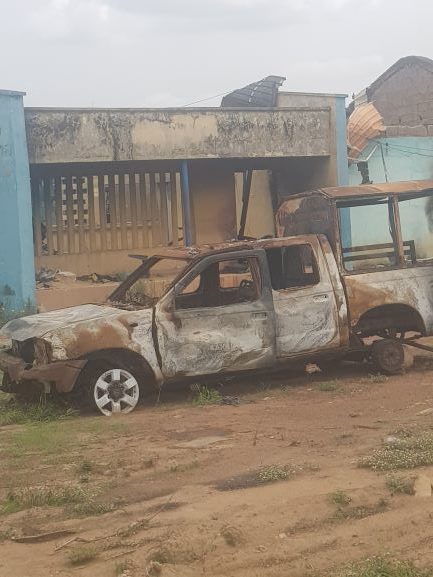
A REPORT by the International Centre for Investigative Reporting (ICIR) has revealed that between October 2020 and April 2021, not fewer than 21 police stations have been attacked by hoodlums in Southeastern Nigeria, while fifteen officers lost their lives during the period.
Of the 21 police stations, seven stations in Imo State were attacked by hoodlums, four in Ebonyi, three in Abia, four in Enugu and three in Anambra.
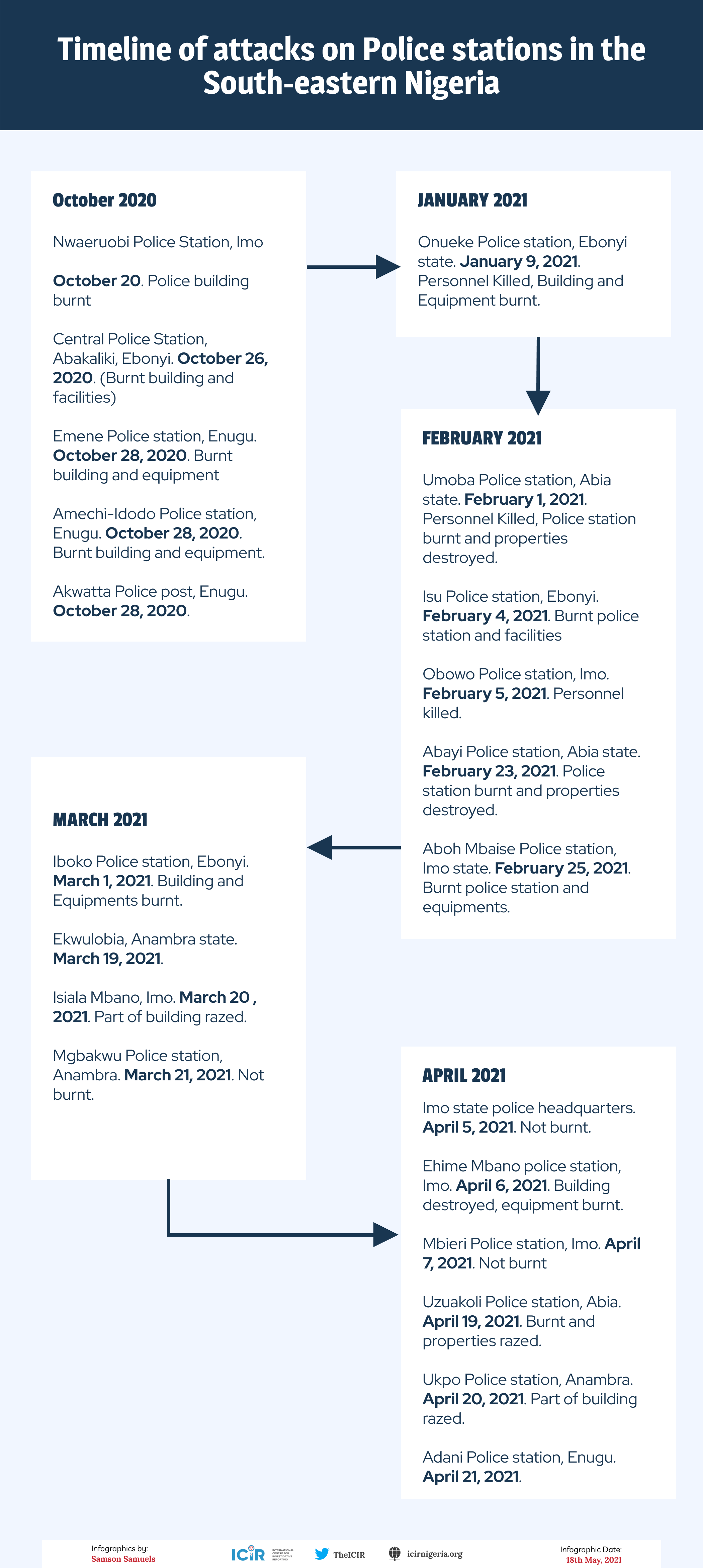
The October attack was triggered by the EndSARS protest organised across states in Southern Nigeria. According to the report, five police stations were attacked in October 2020, one in January 2021, five in February 2021, while four and six stations others were attacked in March and April 2021, respectively.
Due to several attacks, police officers in the Southeast have stopped wearing uniforms to work, and while at work, they hardly venture out to investigate cases.
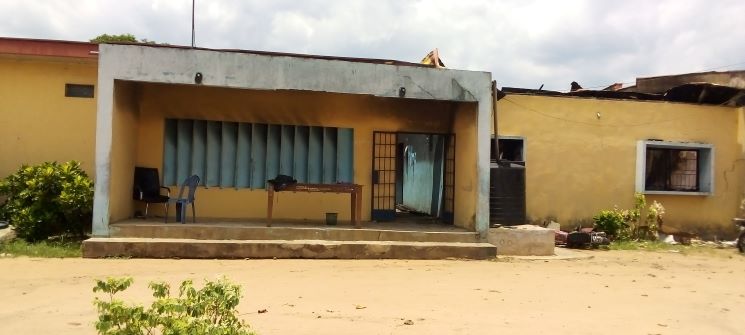
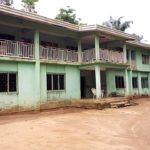
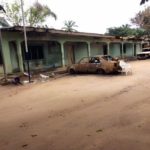
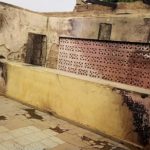
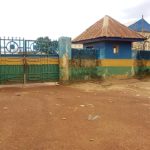
Side view Ehime Mbano police station
A senior police officer (names withheld) serving at Iboko, Izzi Local Government Area of Ebonyi State, lamented about the threat to life experienced by police offers in the region.
“We are being killed like fowls; nobody cares about how we feel again, our colleagues are being killed daily, nobody is talking about that. Are we not human? We are expected to die for the country, but a police inspector collects a paltry sum of N88,000 monthly, and we know how much politicians collect,” he said.
This development has because a source of worry also to the residents.
A farmer in Onicha who identified himself as Chuks told The ICIR he no longer could go to the farm because of insecurity.
“ We are not certain whether we would come back alive; you don’t know what will happen,” he said.
Experts who spoke about the incidents blamed the crisis on the poor justice system, break-down of civil-military relationship and the handling of the EndSARS protests.
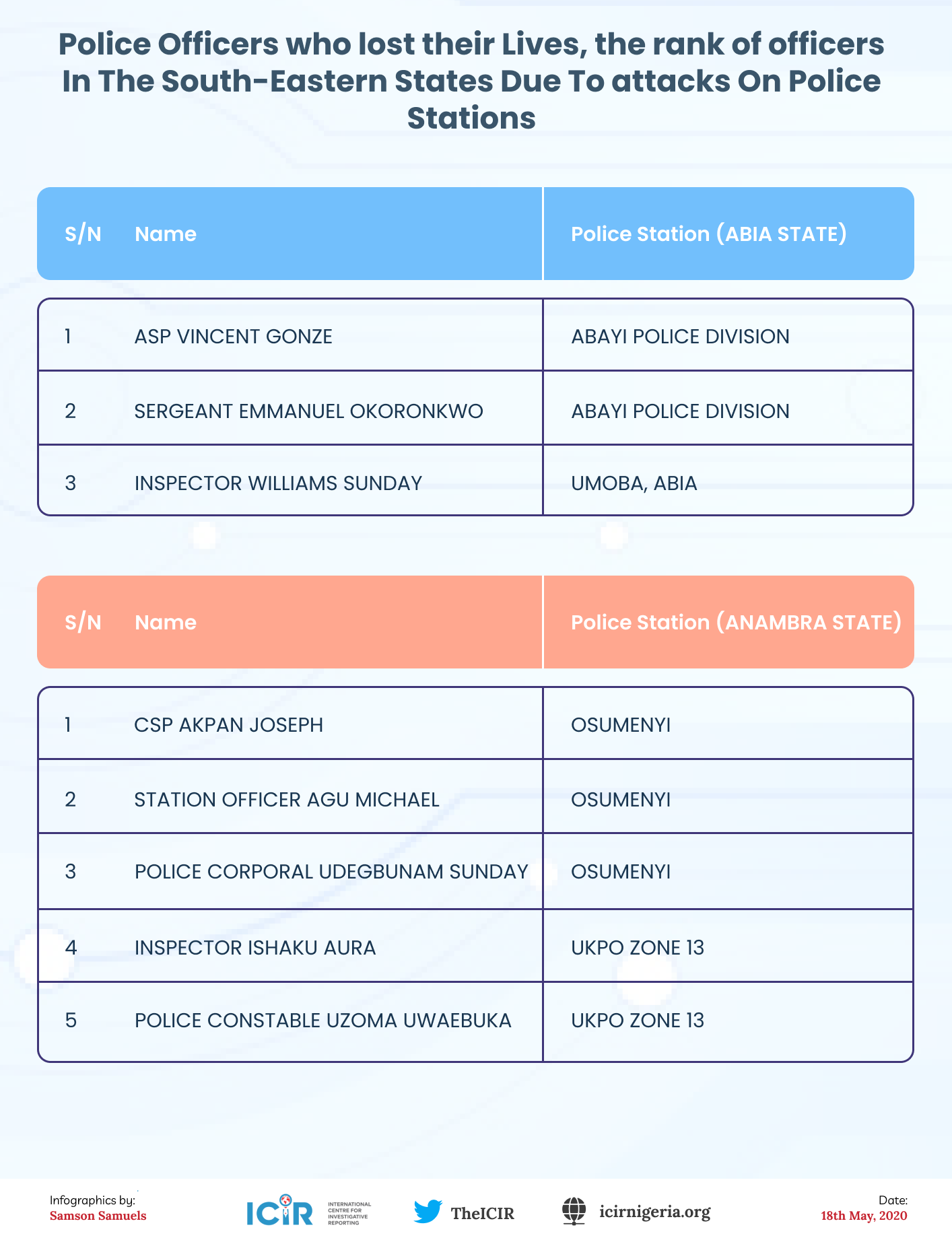
Police Officers who lost their Lives, the rank of officers In The South-Eastern States Due To attacks On Police Stations 1
“These happenings question the level of civil-military relations, and security agents are human too. It shows the breakdown of trust, which may be an extension of the EndSARS issue whereby some people are still aggrieved,” said a security consultant, Senator Iroegbu.
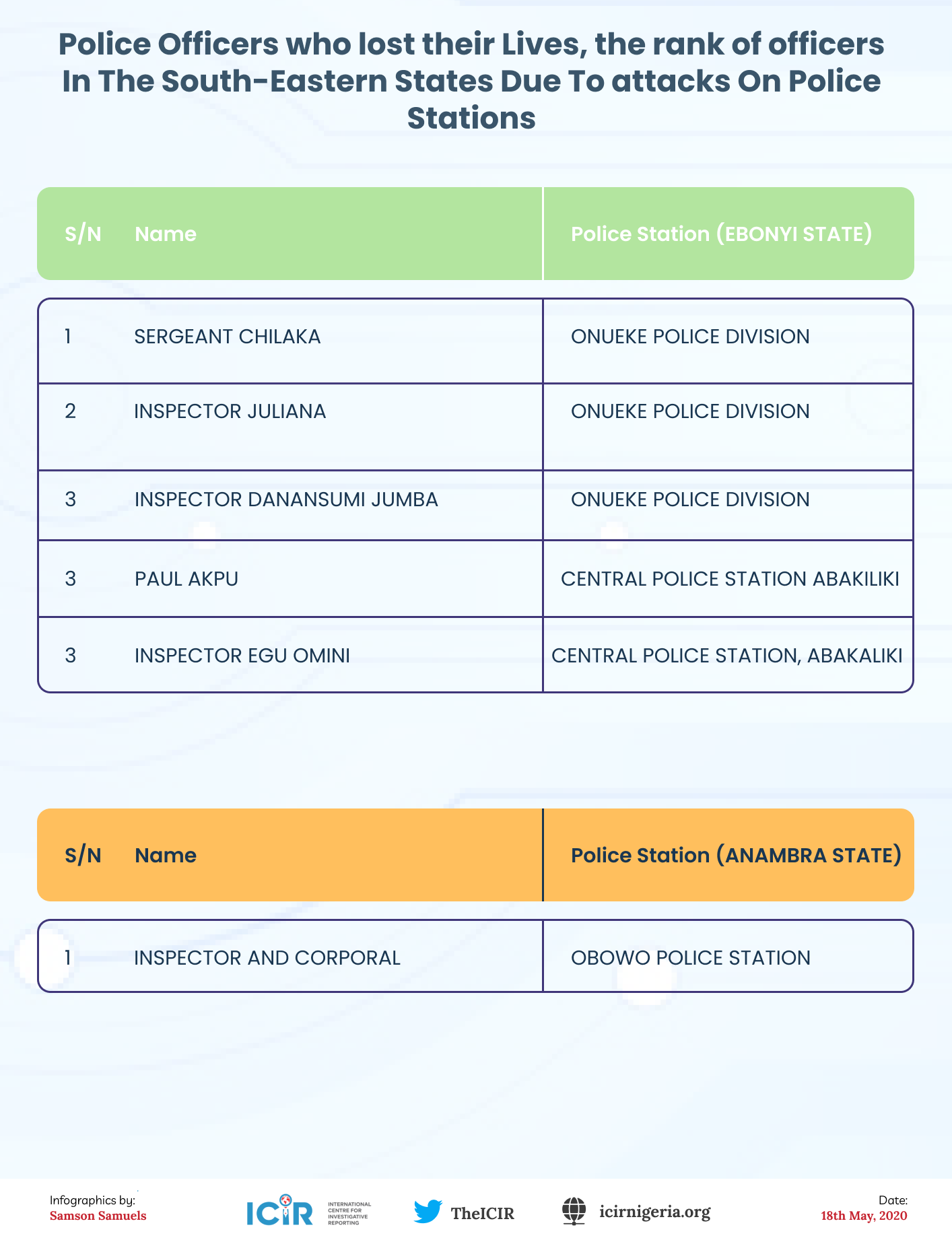
Police Officers who lost their Lives, the rank of officers In The South-Eastern States Due To attacks On Police Stations 2
Also, retired Colonel Ademola Lawal reminded people of the Southeast that policing remains key to maintaining social order. But he also noted that the professional misconduct by the police must stop.
“We must address impunity in the country; we must make sure that the police itself is very professional and properly reformed. “Loss of confidence in the police is the cause. Only the police themselves can restore confidence by ensuring that their personnel perform with the utmost professionalism,” Lawal advised.
The Police Spokesperson Frank Mba did not comment for this report.
THE Zamfara State Police Command says that an attack on the Dansadau district in Maru Local Government Area of the state was foiled by security operatives on Wednesday.
Spokesperson of the Command Mohammed Shehu confirmed this in a telephone conversation with The ICIR, stating that the invasion of Dansadau district by terrorists was repelled by joint efforts of the police and other security agencies.
”The attacks in Dansadau was not successful, because the police in collaboration with other security agencies like the military, had mobilised to engage the bandits and repel the attacks,” he said.
Shehu also confirmed reports of the kidnap of 18 travellers along the Dansadau- Gusau Road on the same day, stating that the Police Tactical Search and Rescue Team, deployed by the commissioner of police, were exploring the surrounding bushes in an attempt to rescue the kidnapped victims.
“We are taking precautions in the rescue operation, so as not to harm or endanger the lives and the safety of the kidnap victims,” he said.
Dansadau district has witnessed rising spate of terrorist attacks in the past few months.
Residents have continued to live in fear of the attacks, which have led to a restriction of movement in some parts of the state.
According to a report, at least 20 people were killed in reprisal attacks between the terrorists and vigilante groups barely a month ago.
The inhabitants had described the efforts of the state government and security agents as inadequate, adding that the attacks and kidnaps in Dansadau area had persisted because security agents seldom responded to distress calls.
THE Federal Bureau of Investigation (FBI) has narrated how Abidemi Rufai, a Senior Special Assistant to Ogun state governor Dapo Abiodun allegedly defrauded American citizens of funds up to $350,000.
In a statement published on the FBI website on Monday, Rufai aka Sandy Tang, 42, was arrested following a criminal complaint that accused him of wire fraud through unemployment benefits from the Washington State Employment Security Department (ESD).
The FBI said the criminal complaint alleges that Rufai used stolen identities of more than 100 Washington residents to file fraudulent claims with ESD for pandemic-related unemployment benefits.
Rufai was also accused of filing such fraud in other states in the US, including Hawaii, Wyoming, Massachusetts, Montana, New York, and Pennsylvania.
The allegation against him notes that Rufai used variations of a single e-mail address intended to evade automatic detection by fraud systems in the US.
The governor’s aid was said to have initiated the alleged fraudulent proceeds to be paid out to online payment accounts such as ‘Green Dot’ accounts or wired to bank accounts controlled by “money mules.”
The statement also read that some of the proceeds acquired from Americans were mailed to the Jamaica, New York address of Rufai’s relative.
FBI also noted that law enforcement in the US determined that more than $288,000 was deposited into an American bank account controlled by Rufai between March and August 2020.
“The FBI and our partners will not stand idly by while individuals attempt to defraud programs meant to assist American workers and families suffering the consequences of the Covid-19 pandemic,” said Donald Voiret, Special Agent in Charge FBI Seattle.
The Bureau noted that Wire fraud is punishable by up to thirty years in prison when it relates to benefits paid in connection with a presidentially declared disaster or emergency, such as the COVID-19 pandemic, adding that the charges contained in the complaint are only allegations.
Rufai has been arrested by the FBI on Monday and is scheduled for a detention hearing Wednesday.
Meanwhile, the Ogun state government has suspended Rufai from office over the allegations levelled against him.
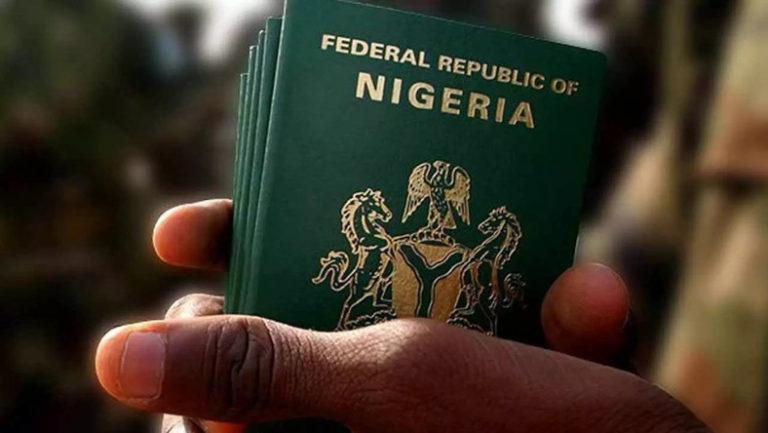
THE Nigeria Immigration Service (NIS) says it has suspended applications for new passports and renewals for two weeks to enable it clear all application backlog, ahead of the commencement of the new passport regime on June 1.
In a statement signed by Deputy Comptroller General Passport and Other Travel Documents A.Y. Yarima, the NIS said the directive, which was given by the Minister of Interior Rauf Aregbesola, was with effect from Monday, May 17.
“Consequent upon the foregoing, all PCOs (Passport Control Officers) are therefore directed to use this period May 17, 2021, to May 31, 2021, to ensure that all backlogs are produced and handed over to Command Comptrollers for collection by members of the public concerned,” the statement read.
It would be recalled that the Service had announced the suspension of passport application from March 23 to April 23, 2020, due to coronavirus pandemic and restriction on international travels.
Comptroller General of the NIS Muhammed Babandede had said at the time that the Service would take advantage of the one-month suspension to process all pending passports.
However, Nigerians at home and abroad have continued to express their frustrations at the delays and inconveniences experienced while attempting to get new passports or secure renewals.
“I have been waiting to get my passport since January 31. No response; nothing,” an applicant Seun Dickson told The ICIR.
Aregbesola, during a media briefing organised by the NIS on April 22, had said that the government was partnering with the private sector to establish special centres in each local government area to speed up passport processing.
He had added that every passport application would have a fixed timeline of six weeks for collection. It remains to be seen how these reforms would translate into improved efficiency for Nigerians.
A tweet claims that Nigerian President Muhammadu Buhari travelled to France to attend a summit that was already postponed.
The tweet has been shared more than 500 times on the social media platform.
The claim was made by Adetutu Balogun with the handle @Tutsy22, and she has over 261,000 followers.
The tweet was posted alongside a screenshot of a news report with a headline, ‘Africa-France Summit postponed due to COVID-19 travel restrictions.’
The tweet read: The President of the Federal Republic of Nigeria @MBuhari travelled for a summit that has been postponed.”
A screenshot of the claim that the President of Nigeria Muhammadu Buhari travelled to France to attend a postponed event.
The Claim
The President of Nigeria Muhammadu Buhari travelled to France to attend a postponed summit.
The Findings
The FactCheckHub findings revealed that the claim was FALSE.
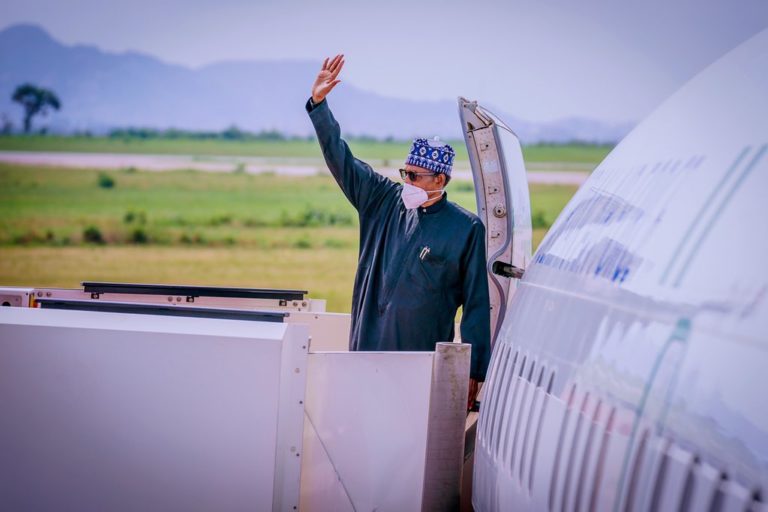
President Muhammadu Buhari had, on May 16, 2021, departed Abuja, Nigeria, for Paris in France to participate in African Finance Summit.
According to Buhari’s Personal Assistant on New Media Bashir Ahmad, the African Finance Summit would be focused on reviewing African economy, following shocks from COVID-19 pandemic, and getting relief, especially due to the increased debt burden on countries.
“President @MBuhari has departed Abuja for Paris, France ahead of the African Finance Summit which will be focused on reviewing African economy, following shocks from COVID-19 pandemic, and getting relief, especially from increased debt burden on countries. #PMBinParispic.twitter.com/Th0nWWuclV.”
Ahmad had also, on Sunday, tweeted that the president had arrived France for the summit.
In addition, the France President Emmanuel Macron, on April 22, tweeted about meeting the African leaders on May 18 to discuss sustainable financing of African economies.
“L’Afrique porte une part des solutions pour la planète. Nous soutenons la Grande muraille verte qui permet d’agir pour le climat tout en renforçant la sécurité alimentaire. Et nous irons plus loin, le 18 mai, lors du sommet sur le financement durable des économies africaines.”
A report had earlier stated that Buhari and some African leaders would be present at the summit in person while other leaders and several international organisations would be joining the summit by video conference.
A look at the news embedded in the claim Balogun made shows that the postponed summit is the ‘Africa-France Summit,’ which is totally different from the ‘African Finance Summit’ the president travelled for.
While the summit Buhari travelled for is billed to commence on May 18, in Paris, France, the Africa-France Summit, another summit entirely, will be held in early July in Montpellier, southern France. This event has been pushed to early October because of travel constraints linked to Covid-19.
The event, planned from July 8 to 10, will now take place from October 7 to 9, 2021, the French presidency confirmed to AFP.
The FactCheckHub had earlier verified three claims made by Balogun, of which two of them were found to be inaccurate.
The Verdict
The claim that the President of Nigeria Muhammadu Buhari travelled for a postponed summit is FALSE. The event Buhari travelled for is African Finance Summit, which is different from the postponed Africa-France Summit.
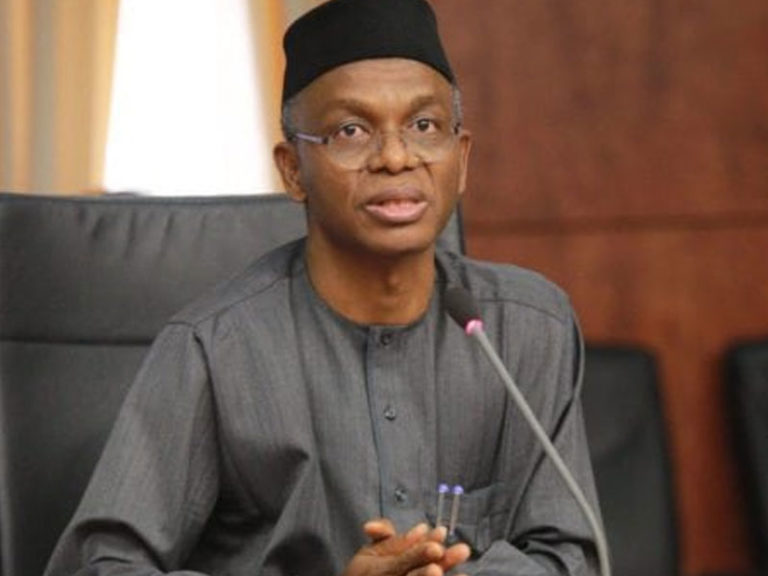
KADUNA State Governor Nasir El-Rufai has ordered the dismissal of KadunaState University (KASU) lecturers who have joined the ongoing industrial action in the state.
The governor made this announcement in a statement released on Tuesday, describing the strike action as “efforts to dress up criminal activity.”
“KDSG considers as unacceptable the serial violations of the Miscellaneous Offences Act that have occurred over the last two days,” it read.
El-Rufai described the actions of the labour union as illegal pressures aimed at disrupting activities in the state.
“The Ministry of Health will dismiss all nurses below GL 14 for going on an unlawful strike. Salaries that could have gone to them are to be given as extraordinary occupational allowances to the health workers who are at their duty posts to fill the gap of those absconding from duty.
“Any academic staff of KASU that does not report for work will be dismissed. The authorities of KASU are to submit a copy of the attendance register for all categories of staff daily to the Secretary to the State Government and the Commissioner of Education,” it read.
He described the actions of the Nigerian Labour Congress (NLC) as equivalent to banditry, adding that the government would not respond differently to them.
According to a report by The ICIR, The NLC had directed all government workers on Tuesday, May 11, to embark on an indefinite strike to protest the sack of over 4,000 workers by the state government.
El-Rufai had attributed the sack to a decline in revenue and stated that he was not elected to pay salaries. He also claimed payment of salaries was taking up almost 90 per cent of the monthly federal allocation accruing to the state.
THE Southeastern part of Nigeria has witnessed many attacks on police stations in recent months. Many of the attacks have led to the loss of lives, destruction of properties and weakening of the security system in the region. In this report, The ICIR tracks the attacks on police facilities in five Southeastern states – Imo, Anambra, Abia, Enugu and Ebonyi. Olanrewaju OYEDEJI who visited the states reports.
ABOH Mbaise in Imo State is no longer a community that anyone can freely visit. Motorists would not dare to take any passengers to the village, nor would the commercial motorcyclists venture that far.
“That place no safe. Going there na risk,” a motorcyclist told this reporter, explaining the tensed atmosphere in the area and how everyone, including police personnel, was avoiding the community.
On arrival, the building serving as the police station was desolate. Only the charred remains of the structure was left standing. Police officers numbering five sat in groups of twos under a tree inside the premises. Another policeman sat inside one of the abandoned vehicles, all of them looking dispirited.
The station was fenced in the front but the other sides were surrounded by tall bushes, trees and abandoned vehicles, which now have been converted to a makeshift office.
The officers were all dressed in mufti. It was part of the safety measure adopted in response to recent attacks. One of the police officers who spoke on the condition of anonymity expressed the frustration of his colleagues.
“As you can see, nothing is happening here; we are just here doing nothing,” he said. To drive home his point, he recounted the experience of a colleague, a policewoman, who was hospitalised for two months after the police station was attacked. His colleagues, who were reticent most of the time, confirmed the account of the attack against their station.
The police officers were not the only victims. The attack also had a telling effect on the residents of Aboh Mbaise, who now live at the mercy of criminals and can no longer sleep with both eyes closed. Police officers have stopped patrolling the streets.
Burnt Police vehicle at Central Police station
A resident of Mbaise, who identified himself as Onyenachi, expressed shock at the burning down of the station that has now left the community vulnerable to attacks.
“The incident was so painful and disappointing because the police are our friend here; they perform the duty of ensuring safety. We are unhappy with the station’s destruction because when the stations are destroyed, our lives and (properties) are not safe,” he said.
Recalling the incident, a local trader, Chibuzor, told The ICIR that they (traders) were all seated in their shops on the day of the attack before gunshots rang out.
“We all started running away in different directions,” he said, adding that since then things have not remained the same again.
Locked up in their own safe space
Another police station located at Umulowo community in Obowo, Imo State, was attacked on February 5. Two police officers died in the attack.
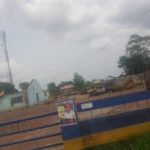
Destroyed Vehicles at Ehime Mbano Imo state
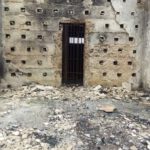
Bullet holes at Ehime Mbano
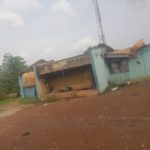
Destroyed DPO office at Ehime Mbano
Current state of Ehime Mbano Police station, Imo 5
Aboh Mbaise building
Burnt Aboh Mbaise
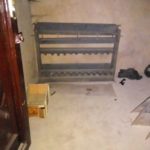
Empty Armory at Ehime Mbano, Imo state
Side view Ehime Mbano police station
When this reporter arrived at the station, located on the highway leading to Umuahia in Abia State, it was deserted. A petrol station and a few buildings could be seen nearby, but there was no sign of human presence. At the gate, the reporter asked to speak with the Divisional Police Officer, DPO, but a policeman in mufti said he was unavailable.
It was later gathered that the man earlier seen in civilian dress at the station was the DPO, but he preferred to remain unidentified. Everyone seemed to have learnt the need to hide identity to prevent an attack, The ICIR found out. One of the officers who died during the shoot-out was the orderly to the DPO, said the Police Spokesman, Ikeokwu Orlando.
Destroyed DPO Quarters Ehime Mbano
“What do you want again, please do not disturb us. The Divisional Police Officer is not always around; visit the police headquarters,” a female officer uncomfortable with the reporter’s inquiry responded.
Her fear is justified.
Barely a day after Nigeria’s Vice President, Yemi Osinbajo, visited Imo State, assuring of governments resolve to stamp out terrorism, Ehime Mbano Police Station, located at Isiala Mbano, came under attack.
A one-storey building with over 10 offices and residential quarters was completely vandalised during the attack; vehicles were also destroyed.
The investigation found that the Ehime Mbano Police Station was built and donated by an indigene of the town. The government’s promise to fully equip the station to deliver quality service has not been fulfilled.
“Different people have been coming, but that is all we see. Will the government claim that they do not know that this place was burnt? Nothing happens, nothing,” one officer, who spoke to The ICIR anonymously said.
This reporter visited the armoury of the station and found it empty. It had been reported in the media that the hoodlums carted away rifles from the armoury. Still, a senior official debunked this claim, stating that the rifles were removed before the attack.
.
Timeline of attacks on Police Station in Southeastern Nigeria
Our reporter counted at least 50 bullet holes on the buildings of the Ehime Mbano station, showing the extent of damage caused by the attack. Three vehicles were razed, while hoodlums allegedly carted away four motorcycles belonging to police officers, two generators and an administrative computer.
Contrary to media reports, the Imo police headquarters building was not set ablaze. And no casualty was recorded. Investigations, however, revealed that the Nigerian Correctional Service headquarters in Imo State was torched, inmates released and vehicles burnt. The ICIR could not verify the number of inmates that escaped.
The Correctional Service headquarters, which is just a minute away from the Police headquarters and the Government House, has now been taken over by soldiers.
A resident of Ehime Mbano named Charles narrated how the attackers shot at themselves to show that no police bullet could penetrate them before starting the operation.
“They came with Highlander vehicle and started shooting themselves to show that guns could not penetrate them. People started running helter-skelter as the hoodlums set the station ablaze,” he recalled.
After the incident, police officers began to take precautions. Many of them have shed their uniforms; they come to work in mufti and stay there till they close for the day.
“After that attack, we have not been seeing police officers in uniforms. The presence of the policeman in uniform scares the hoodlums away but right now, we are living at the mercy of God,” Charles said.
Police Public Relations Officer, Ikeokwu Orlando, declined comments,saying that he could not speak on the situation.
Ebonyi State is not left out in the spate of destruction and disorder that overwhelmed the security apparatus of the Southeast.
The state was hit by multiple incidents of attack between October 2020 to date. Now fear is palpable as many residents are afraid to move freely in their communities. This reporter saw the expression of abandonment, anger, mistrust and failed promises in the eyes of residents interviewed.
Destroyed Onicha Police station, Ebonyi
Burnt vehicles at Onicha Police station, Ebonyi
Central police station, Abakaliki, Ebonyi state
Central Police station, Abakaliki
Emene Police station inner view
Inner Part of Izzi Police station, Ebonyi state
Destroyed Izzi Police Ebonyi state
Destroyed Vehicle at Izzi Ebonyi state1
Burnt motorcycles at one of the Police stations
At the Central Police Station in Abakaliki, the state capital, evidence of the destruction of the police station was still present, six months after the attack. At least five vehicles were burnt including major offices at the station. During the visit, not a single officer was seen near the station, now overgrown with weeds. Opposite the relic of the police station is the police school where 60 children of officers have withdrawn for fear of being targeted. No police officer wants to continue to have their children exposed to danger, especially when the police authorities told the principal to engage the services of local security as the state has a shortage of policemen.
Police Officers who lost their lives, the rank of officers In The South-Eastern States Due To attacks On Police Stations 1
“The way everywhere is, the hoodlums may come around and murder them. Week-in, week-out, we have been attacked by criminals here because there is no security,” she stressed.
The situation is not different at Iboko, Izzi Local Government Area of Ebonyi State, a peaceful settlement where residents are predominantly farmers.
On March 1, gunmen attacked the Iboko Divisional Police Station at about 1.00 am using firebombs that destroyed a part of the building and several vehicles. When this reporter visited the station, the carcass of three police vehicles and four motorcycles were seen in front of the station.
Also, police equipment belonging to the station was destroyed; this contradicts the government’s claim in a press release that minimal damage was done to the facility after attacks.
Police Officers who lost their Lives, the rank of officers In The South-Eastern States Due To attacks On Police Stations 2
A senior police officer (names withheld) serving in one of the police facilities in the state lamented the poor welfare for officers and total neglect by the government.
“We are being killed like fowls; nobody cares about how we feel again, our colleagues are being killed daily, nobody is talking about that. Are we not human? We are expected to die for the country, but a police inspector collects a paltry sum of N88,000 monthly, and we know how much politicians collect,” the officer lamented.
“If we can be posted to our hometowns, it would be better so that when people want to attack a station, they will know that the person they are attacking is the son of the soil, not that we just come here from different places and get killed on a strange land,” he added.
The complaint of the police chief was reinforced by the killing of the police officers at Onueke Police Station.
The ICIR identified the three slain police officers as Inspector Juliana (female), Sergeant Chilaka, and Inspector Danansumi Jumba (on special duty). Operational vehicles were also destroyed.
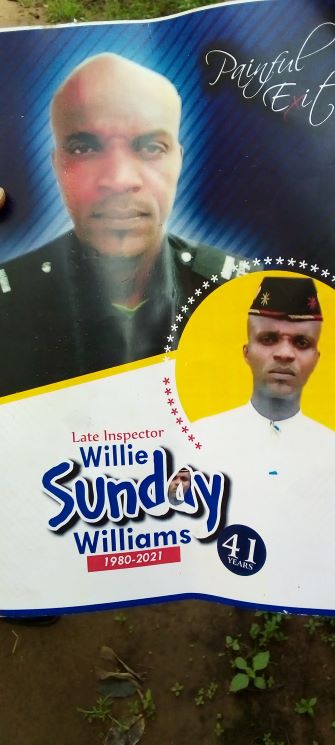
Late Williams Sunday Of Umoba Police station, Abia state
There was also an attack on Onicha Police Station in Isu, which followed the same pattern – part of the building was razed by fire, and about four burnt vehicles were seen at the premises when our reporter visited. Police personnel were seen in mufti sitting under a tree chatting, and there was no official activity going on.
All these have had a telling effect on farming activities in the affected areas. A farmer in Onicha named Chuks told our reporter that, but for the attack on the police station in the area and the heightened state of insecurity, he should have been on his cassava farm.
“We cannot go to farms. As you can see, we are farmers. We are not certain, maybe (whether) we would come back alive, you don’t know what will happen, we do not know what (the) federal government is doing to protect our lives,” he said.
“There is a promise of the government to protect lives and properties, and they are not doing it. The protection of lives and properties is why we voted, but we cannot see anything of such,” he added.
The PRO, Ebonyi State Police Command, Loveth Odah,said that the state was working hard to ensure safety and security despite the unfortunate incidents.
Died in active service
The story of Williams Sunday mirrors the challenges faced by the police officers in the Southeastern. Williams Sunday, 41, was an Inspector before his death. He was attached to the Umoba Police Station in Abia State where he met his tragic end on February 2.
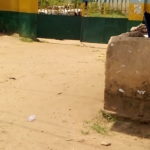
Locked Up Gate, Umoba Police station, Abia state
Front Gate of Uzuakoli Police station, Abia state
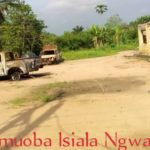
Remains of Umoba Police Station, Abia State
Front Gate of Uzuakoli Police station, Abia state
Destroyed office at Uzuakoli Police station Abia
Burnt Vehicles at Uzuakoli, Abia state
Burnt vehicles at Uzuakoli, Abia state_1
According to various accounts, Sunday, who was promoted to the rank of Inspector in December 2020, was attacked around 3.00 am. By the time he was discovered, his head had been severed from his body. Close associates described him as a committed officer and his tragic death has caused pain and low morale among his colleagues.
The Umoba Police Station in Abia has reportedly been abandoned since the incident and remained locked up when filing this report.
Sunday, left behind three boys (Micheal, Samuel and Praise ) his wife, siblings and an aged father.
When The ICIR contacted the Abia State Police Public Relations Officer, Geoffrey Ogbona, on the incident, he confirmed our findings on the death of Inspector Sunday, but he declined to speak further.
An indigene of Umoba, Ndubuisi Micheal, urged the government to urgently revive the police station to boost security in the area.
“The police station helps a lot in keeping the environment safe. This attack was not carried out by the indigenes, rather strangers (non-indigenes residing in the community). Government should help us get the police station back. I feel bad that this incident happened,” Micheal appealed.
Other police stations attacked in the Southeast region include Uzuakoli Police Station in Abia State; Mgbakwu and Ukpo Zone 13 police stations in Anambra State; and Adani, Emene and Amechi-Idodo police stations in Enugu State. Most of these police stations were unfenced, making it easy for the attackers to gain access.
The total value of damage could not be immediately confirmed, but money estimated at millions of naira has been lost given the level of destruction in the attacks.
Remains of Emene Police station Enugu
Locked Gate of Emene Police station, Enugu
Abandoned Amechi-Idodo Police station Enugu 1
However, the Police Public Relations Officer in Anambra State, Tochukwu Ikenga, said the attacks in the state had been targeted at police personnel and infrastructure.
“The alleged attacks are not on the infrastructure; we have been getting information on attacks. It is an attack on police personnel,” Ikenga declared. He said the police authorities have plan to take care of the officers’ welfare. Speaking about measures taken by the state government, he said the state recently came up with a directive to ban tinted vehicles and covered plate numbers and has supported families of those who lost their lives, with a cash sum of N1 million each, adding that the command was coming up with a package for them too.
The police spokesperson also charged residents and indigenes of the state to collaborate with the government in tackling the crisis, noting that police officers are also important to be safeguarded.
Residents sue for unity, justice.
In an earlier report titled: EndSARS Protest That Left Imo Communities Desolate and Traumatised, The ICIR exclusively reported stories of killings occasioned by the retaliatory attacks on communities in Nwaruebi and Orlu, Imo State by men of the Nigerian security forces. Some of the people who spoke with this reporter blamed the crisis in the Southeast on the way #EndSARS protest was handled.
A resident in Aboh Mbaise, Imo state, who sought anonymity, said: “We have had peace here before the EndSARS protest came. Many persons were killed, but no justice, even the way the police used to operate in the region, used to make us uncomfortable.”
Another resident from Ehime Mbano pleaded with the state governments in the region to unite everyone and doused the anger ravaging the land.
“We want the state governments to do something about the anger in the region; they should work with everyone because we do not have any other place to go to.”
Efforts to reach the Police Headquarters Force Public Relations Officer Frank Mba was unsuccessful. He neither answered his calls nor responded to messages.
Experts speak on negative impact of attacks
Security experts spoke to The ICIR on the impact of the attacks on governance in the country and recommended a reform of the police and justice system in the country.
A retired colonel in the Nigerian Army, Ademola Lawal, reminded the people of the Southeast that policing remains key to maintaining social order. He expressed worry that the attack which shows mistrust between the people and the government may further make life more difficult for the citizenry.
The breakdown of law and order as is currently being witnessed portends grave danger for any society, particularly in a democratic setting, he said, stressing the need to rebuild the people’s trust in the security apparatuses and confidence in the justice system.
“First of all, we must address impunity in the country; we must make sure that the police itself is very professional and properly reformed. “Loss of confidence in the police is the cause. Only the police themselves can restore confidence by ensuring that their personnel perform with the utmost professionalism,” Lawal advised.
He also harped on the need to mop up all arms in the hands of private individuals and ensure good governance at all levels in the country.
Another security expert and editor of Global Sentinel, a security-focused magazine, Senator Iroegbu, also identified mistrust and a broken civil-military relationship as the reason for the unprecedented level of boldface attacks on security facilities and personnel.
“These happenings question the level of civil-military relations, and security agents are human too. It shows a breakdown of trust, which may be an extension of the EndSARS issue whereby some people are still aggrieved. Although it does not justify the crime, it is a call to look inwards on where something went wrong,” Iroegbu said.
According to him, the recent attacks also point to a leadership vacuum both at the federal, state, and local government levels, resulting in a state of anarchy. On what can be done to curb the situation and restore order, he suggested long, middle and Short term approaches to solving the problem. He said effective communication with the citizens is required to understand people’s grievances.
“Community policing, state policing and restructuring; are issues that should be included in the process. There is a need to reach out to agitators even who are not recognised by law because whether they like it or not, they seem to have foot soldiers,” he added.
Iroegbu also said the formation of a new security outfit Ebube Agu would be more effective if groups such as MASSOB and others can also be engaged to prevent rivalry and mistrust.
The Southeastern governors earlier set up a security outfit code named Ebube Agu in a bid to fight insecurity in the region, yet attacks on police formation continue to date.
A bill for the establishment of National Blood Service Commission passed third reading at the Nigerian Senate on Tuesday, May 18.
The bill, which was sponsored by a member of the House of Representatives Abbas Tajudeen, seeks to standardise the practice of blood donation in Nigeria.
The National Blood Service Commission Bill, if passed into law, would grant the National Blood Transfusion Service (NBTS) the autonomy to carry out its mandate according to global best practices. It would also regularise the appointment of core technical members of staff previously engaged in the programme.
The establishment of the Blood Service Commission is expected to further enhance the performance of the NBTS by ensuring that relevant skill-sets are available to optimise service delivery at the blood service.
Recall that in 2017, former Minister of Health Isaac Adewole had said that insufficiency of blood for transfusion had been one of the reasons for the high rate of deaths and delays in attending to victims at health facilities in the country.
Adewole had also stated that passing of the bill into law would be consistent with the campaign to foster collaborations with relevant agencies such as the Nigerian Red Cross Society, the Nigerian Road Safety Corps and the Nigerian Defence Forces so as to develop guidelines for action during emergencies.
THE Nigerian Labour Congress (NLC) has replied Governor of Kaduna State Nasir El Rufai concerning his declaration of its chairman wanted.
Spokesperson of the NLC Benson Upah told The ICIR that El Rufai was overestimating his powers by declaring Wabba wanted.
Upah said the governor did not have the constitutional powers to declare a person wanted because he was neither the police nor the judiciary.
“El Rufai is supposed to be a lawyer, does he have the power to declare anybody wanted? Is he the police, is he the court? Or what authority does he have? Does his executive power extend to legislative or judiciary power? He has no judicial or legislative power or police,” Upah said.
He noted that El Rufai was aware of the whereabouts of Wabba, noting that he should simply go and arrest him.
A lawyer Odinaka Okere also told The ICIR that El Rufai had no such constitutional powers.
“Primarily, it is the job of the police or security agencies to declare anybody wanted. The police can investigate and know who committed a crime and then declare them wanted based on what they did. But it is impossible in law for the governor to declare someone wanted based on organising a strike; workers have a right to go on strike. So, in simple terms, the governor has no such constitutional powers,” he said.
The ICIR had reported that El Rufai declared Wabba and other protesters in the state wanted for ‘economic sabotage.’
According to the Kaduna State government, the industrial actions by the NLC were characterised with unlawful trespass on government facilities, and attempts to prevent officers from signing attendance registers.
The state government also said the protesting union shut down electricity, and healthcare access for several citizens by closing several hospitals and chasing away patients.
The NLC had, on Monday, commenced a five-day warning strike in the state over the sack of thousands of workers and refusal to pay entitlement to retrenched workers in the state.
THE Consumer Price Index (CPI) released on Tuesday by the National Bureau Statistics (NBS) indicated that the country’s inflation rate dropped to 18.12 per cent in April, from 18.17 per cent recorded in March, 2021.
This was 0.05 per cent point lower from the rate recorded in March and the first drop in 21 months.
It is also an indication that the cost of living is not reducing significantly fast in Africa’s most populous nation.
An associate at PwC Seyi Kolawole explained that it was not time to cheer yet.
Kolawole said as an economic analyst, he was surprised with the drop considering the present insecurity and hunger in the country. “This present inflation rate doesn’t reflect the present economic realities the country is faced with. The managers of the economy would have to come and explain to us,” Kolawole said.
The report, published by the National Bureau of Statistics (NBS), also revealed that food for the increasing number of poor Nigerians was not getting cheaper as fast as it should be, as food inflation dropped from 22.95 per cent in March to 22.72 per cent in April.
Inflation rate. Infographics by Samson Samuels
“This rise in the food index was caused by increases in prices of coffee, tea and cocoa, bread and cereals, soft drinks, milk, cheese and egg, vegetable, meat, oils and fats, fish and potatoes, yam and other tubers,” NBS explained.
According to the report, increases were recorded in the 12 Classification of Individual Consumption According by Purpose (COICOP) divisions that yielded the headline index.
The COICOP included food and non-alcoholic beverages; alcoholic, and beverages; tobacco, and kola; clothing and footwear; housing and water; electricity, and gas; as well as furnishings and household equipment.
Others were health, transport, communication, recreation and culture, education, restaurants and hotels, miscellaneous goods and services.
This drop in the inflation rate is the first since the closure of land borders in August 2019. Analysts have said the closure of the country’s land borders was a major driving force for the upward trend of inflation rates in the country in the last 18 months, which, according to the NBS data, started in September 2019.
Amid the drop in inflation, the Nigerian economy is still in a slump. Food is still expensive for the poor, and unemployment at 33.3 per cent means life is tough in Africa’s most populous nation. About 105 million people are in extreme poverty, with misery index high, analysts say.
“The drop in inflation does not mean much at the moment. Nothing has changed and life is still tough,” Ike Ibeabuchi, manufacturer and player in the services sector ,said.
In April, Director-General of the Manufacturing Association of Nigeria (MAN) Segun Ajayi-Kadir said the inflation rate of March was ‘unhealthy and worrisome,’ most especially for the manufacturing sector, which remained in recession even after the technical exit of the country’s economy.
According to Ajayi-Kadir, the sector’s low competitiveness was a significant contributor to the low-export penetration of goods manufactured in the country into the international market. He said there was an urgent need for the government to ensure price stability before the situation became deplorable intentionally.
“This can be achieved by deliberately and sincerely partnering the productive sector to grow non-oil export. The Federal Ministry of Finance and CBN should work more closely when designing policies that affect the real sector of the economy to prevent a situation where policies are working at cross purposes,” Ajayi-Kadir said.
He said, for instance, that while CBN was creating funding windows at a single-digit interest rate to encourage production, the government was raising the Value Added Tax (VAT) from five per cent to 7.5 per cent. Similarly, the government, he said, also increased minimum wage and also allowed an increase in electricity tariff.