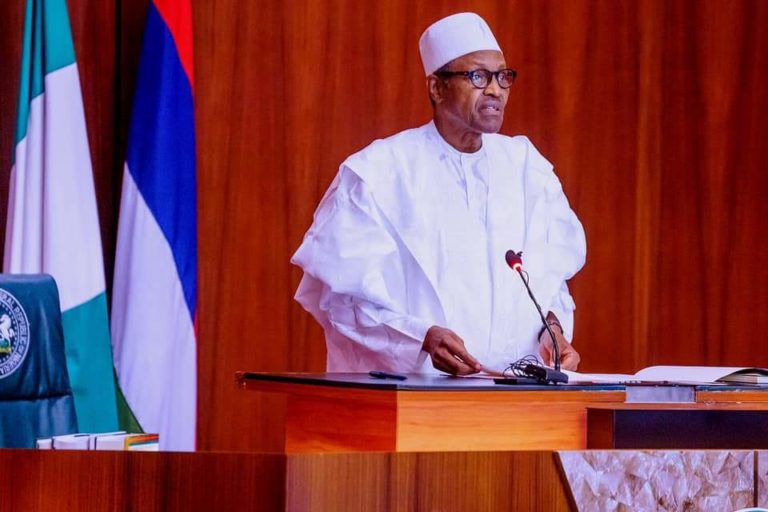
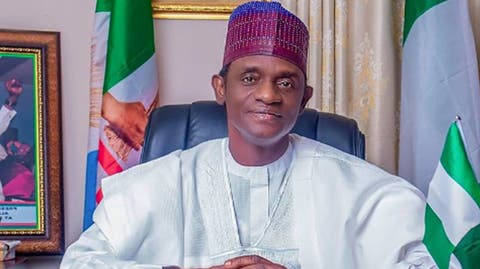
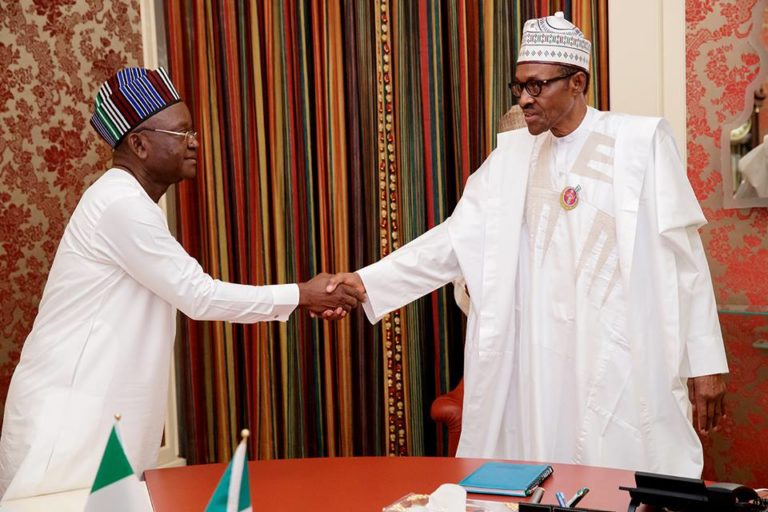
PRESIDENT Muhammadu Buhari has said that Nigeria will overcome security challenges currently facing the country.
National Security Adviser Babangana Monguno made this known in a statement following a National Security Council meeting held on Friday in Abuja over the rising insecurity in the country.
Munguno said the president demanded further briefings from security chiefs after the meeting.
“At today’s meeting, the President made it abundantly clear that while the insurgents, bandits and criminals are still at it, he has no doubt that the Nigerian Security agencies and all of us as a nation will certainly overcome all the current security problems and defeat the forces of evil marauding about in different parts of the country,” the statement read in part.
According to Monguno, Buhari and the Nigerian government were set and determined to decisively end the assault on the nation and would do anything to defeat insecurity.
He added that the president was prepared to take profound measures in the wider interest of the people and the Nigerian nation.
Subsequently, the Security Council meeting was adjourned to Tuesday.
“There shall be no relenting until peace and security is significantly restored in our communities,” Monguno added.
The ICIR had reported that last week, there were 174 kidnap victims and 154 civilian deaths from 71 violent attacks across the country.
Governor of Benue State Samuel Ortom had accused Buhari of aiding the Fulani ethnic group to take over Nigeria.
THE United States Mission in Nigeria announced on Friday that it would prioritise student visa applicants and ensure that Nigerian students got their appointments well ahead of the programme.
The U.S. Mission Country Consular Coordinator Susan Tuller said in a statement sent to The ICIR that the Embassy in Abuja and Consulate General in Lagos would make every effort to assist applicants in a timely fashion while keeping everyone safe.
According to Tuller, processing students’ visas remained of utmost importance to the US Mission in Nigeria, and appointments would be offered to as many students as possible.
“We will increase the number of student visa appointments in May and June to ensure that we can offer appointments to as many students as possible. If your U.S. studies are scheduled to begin this Fall, we encourage you to schedule your appointment as quickly as possible,” she said.
Tuller explained that the student visa appointments must be booked through the U. S. Travel Docs website at www.ustraveldocs.com/ng/. She advised applicants against the use of third- party agents, as they were more interested in profit making, and might not provide accurate information, which could negatively affect an applicant’s chances of qualifying for the visa.
She encouraged applicants to check out EducationUSA Advicing Centers at the American spaces in Abuja, Lagos, Ibadan and Calabar at educationUSA.state.gov to prepare for the US educational opportunity, adding that both Nigeria and the U.S. would benefit when Nigerian students studied at educational institutions in the U. S.
According to records, Nigeria remains one of the largest markets for schools in the U. S. with over 13,000 Nigerians studying in the country in the 2019/2020 academic session.
THE Presidency has said that Spiritual Director of Adoration Ministry Ejike Mbaka is angry with Muhammadu Buhari because the president refused to give him contracts.
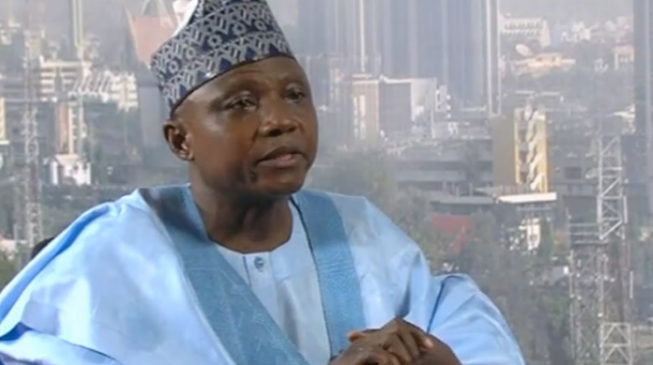
Senior Special Assistant to the President on Media and Publicity Garba Shehu made this claim in a statement issued on Friday.
He said during the clergyman’s visit to the president at the State House, he purportedly came with three individuals, demanding contracts from the president in exchange for his support for him during the 2015 election. However, the president declined, asking him to follow the normal procedures, Shehu said.
“An outsider distilling the avalanche of verbiage, will be surprised that after supporting the President two times to win the Presidency, Father Mbaka has made a complete U-Turn, preposterously asking President Buhari to resign or be impeached,” he said.
“Here is the point of departure: Father Mbaka asked for a meeting and to the shock of Presidential Aides, he came accompanied by three contractors. The President graciously allowed them in, and to everyone’s surprise, Father Mbaka asked for contracts as compensation for his support.
“Anyone familiar with President Buhari knows that he doesn’t break the laid down rules in dealing with contracts or any other government business for that matter. He requested the appropriate authorities to deal with the matter in accordance with laid down rules.”
He noted that it was the discretion of the Presidency that pictures showing evidence of Mbaka’s request should not be made public so that he would not be embarrassed before his teeming followers.
“Inside the Villa, discretion prevailed, that if those pictures and requests were made public, the followers will turn against the religious leader. None of it was released. Now, this is what is eating Father Mbaka.”
This came after the All Progressive Congress (APC) released a statement cautioning Mbaka over his recent call on the National Assembly to impeach President Buhari if he failed to resign due to the rising insecurity in the country.
The party also threatened to expose the clergyman before the Vatican and the Pope if he did not desist from making a statement that could cause instability in the country.
In the run-up to the 2015 presidential election, Mbaka, an Enugu-based Catholic priest, had thrown his weight behind Buhari, urging his teeming followers to cast their votes for him as the solution to the pervading corruption and insecurity in the country.
In 2018, he made a controversial claim that plans were being hatched to murder President Buhari over his uncompromising stand on corruption. He then urged his followers to desist from speaking evil against the president.
The same year, he also declared, in his new year message, that Buhari would be totally disgraced if he took a shot at the presidency after his first tenure. Buhari did not only participate, but also won.
THE General Secretary of the National Union of Electrical Employees Joe Ajaero, has said that the privatisation of electrical distribution companies was responsible for the constant hike in electricity tariff in Nigeria.
Speaking in a video interview held on Friday, Ajaero bemoaned the insensitivity of the Nigerian Electricity Regulatory Commission (NERC) towards the plight of Nigerians, saying that there had been over five occasions of tariff increase with only a constant output of about 4000Watts.
Listing privatisation as the key factor informing tariff increase in electricity, he stated that there has been a decline in the electricity situation of Nigeria since the take-over.
Ajaero described tariff increase as the only business going on in the NERC, adding that the increase in tariff has not been matched by an increase in service.
Analysing the effect of an increase in electricity tariff, Ajaero said increment could cause inflation leading to yet another increase in the rates of electricity tariff.
“Each time they increase tariff, they create inflation. The same people that instigate inflation benefit from it. If there is tariff increase today, inflation will go high. So it continues to go in a cycle,” he said.
Increase in electricity tariff rates would continue if the system doesn’t change, he said, describing certain activities of the NERC such as the Service Reflective Tariff, as issues begging for reconciliation.
On the increase in the prices of inputs required for the production of electricity in Nigeria, he said most of the inputs needed were not imported, and thus shouldn’t be quoted as a reason for the increase.
He noted that a reduction in the price of gas would likely lead to a reduction in the tariff rates, and that other options for the production of electricity such as coal and solar, should be explored, as 40per cent of the power generated all over the world was generated through coal.
Recall that the Nigerian power sector was partly privatised to establish competition, and improve the supply of power across the country. However, the generation capacity of the sector and its revenue has dropped drastically.
Five cases of tariff increase have been recorded, as earlier reported by The ICIR in January. There was a purported 50 per cent increase in electricity tariff, which NERC later denied, claiming that tariff rates had only been adjusted, and not increased.
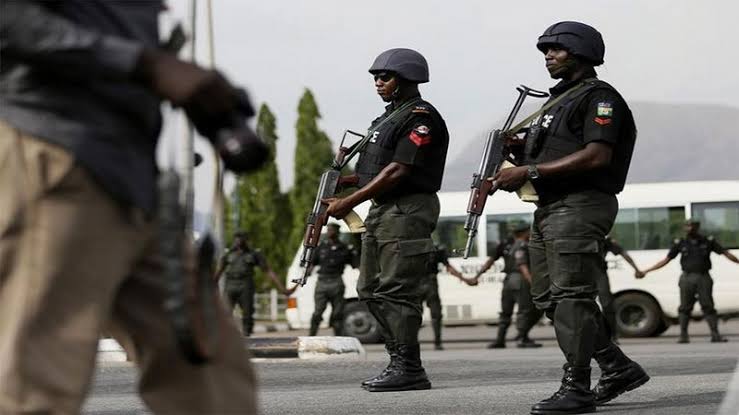
THE Ogun State Police Command has warned organisers of ‘Yoruba nation’ rally on Saturday in the state to shelve their plan.
State Police Spokesperson Abimbola Oyeyemi, in a statement on Thursday, said the rally was not approved by the command due to unpalatable outcomes of previous rallies by the same organisers in the state.
“It will be recalled that the group had on 21/3/2021 staged a public rally at Isara Remo for the actualization of Oduduwa republic, where they blocked highways and made free-flow of traffic very difficult for other road users. The same group staged another rally in Shagamu on 16/4/2021 where they made an attempt to attack Shagamu police station for no reason. Yet, on 25/4/2021, they held another rally at Ajuwon where in the course of stopping them from distributing inciting letters, policemen and other security agents were jeered at and pelted with missiles,” the statement read.
“The same group is again planning to hold another mass rally on 1st May, 2021 at Abeokuta, making it the 4th rally in the State in quick succession.
“The general public should note that the Command had difficulties in preventing hoodlums from infiltrating and hijacking the earlier rallies and preventing what would have been a major breakdown of law and order and disturbance of public peace.”
He noted that the command would no longer stand by and watch public conducts of some citizens hold others to ransom and threaten the corporate existence of the country.
Oyeyemi alleged that the group was being sponsored by some persons outside the state and country to cause chaos and disrupt the state.
“We had also exhibited restraint and absolute calm even in the face of extreme provocations by the organisers of the rallies and their cohorts.
“However, it is important to note that the police will not perpetually stand by and watch public conducts of some citizens hold others to the ransom and threaten the corporate existence of the country. The Command is especially worried that if care is not taken, the pains and agonies that similar agitations and rallies are presently causing in some parts of the country may be repeated in our very peaceful Ogun State.
“It is also instructive to note that available intelligence shows that the organisers of these rallies are being sponsored by certain individuals outside the State and the country to destabilise Ogun State.
“The Command, therefore, wishes to appeal to the leaders of this group to shelve the idea of staging another public rally in any part of the State for now, as such is capable of undermining the relative peace being enjoyed in the entire State. Consequently, the rally slated for Abeokuta on 1st May, 2021, is viewed by the Command as one too many in the State, and therefore not approved.”
A lively, innocent teenager with big dreams was returning from church with his family when a stray bullet from a police officer changed his life.
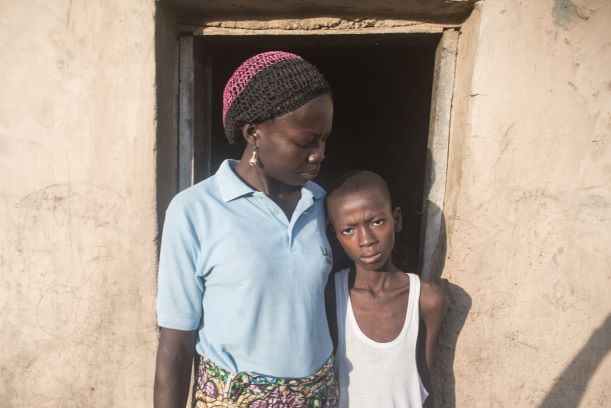
AT 13, Isaac already knows what it means to be poor. His dream is to become a lawyer so he can protect his mother, and “take his family out of poverty.”
Isaac’s law ambition was threatened when he was almost killed by the Nigeria Police Force.
The officer responsible for shooting Isaac in the belly remains unknown.
It was one stray bullet from many targeted at young Nigerians who had poured onto the streets of Ogbomoso in Oyo State, demanding an end to police brutality.
Last October, protests against police brutality began across Nigeria. In Ogbomoso on October 10, 2020, hundreds of youth marched to the palace of the paramount ruler in the town, the Soun of Ogbomoso, Jimoh Oyewumi.
“They were welcomed at the palace,” one source reveals. “They were not causing any trouble. They did not have any weapon. They were singing and carrying placards.¨
“They wanted to visit the police station to talk to the DPO, and that was how the trouble started. The police did not want them to come close, so they started shooting at them.”
20-year-old Jimoh Isiaq was killed during the police assault on peaceful protesters. The next day, the protesters, angered by the death of the innocent young man, marched unto the streets once again. They were however greeted with an even greater show of force by the police. More people were shot, and at least three people were killed.
Isaac, in the company of his mother, Mary, and his two younger brothers, was walking back from church on October 11 when they found their path – the Oke Owode road in Ogbomoso – hijacked. Loud, sporadic gunshots from police officers sent everyone scampering for safety.
The family ran in different directions, with all but one of them coming out of the hailstorm of bullets unscathed.
A bullet struck Isaac’s back and knocked him to the ground. But Isaac got up and continued running until the numbing pain in his stomach overwhelmed him and his knees buckled. He slumped.
“I thought that was all,” his mother remembers. “I became so powerless when I saw him fall. I did not know what to do anymore. I was disoriented. People around quickly helped me carry him, put him on a (motor) bike which took him to the hospital. He was receiving blood when I got to the hospital later. Some people were donating blood for him already.”
Mary says she did not think her son would survive when she saw him slump. He seemed lifeless as people rushed him to Bowen University Teaching Hospital.
Yet when Mary got to the hospital and realised that her greatest fear had not happened, that her son was still alive, her fear did not at all dissipate. The mother knew she would be unable to help her son stay alive due to the challenge of settling expensive surgery and treatment bills. She is extremely poor, lives below one dollar a day, and barely has enough to feed herself and her five children.
“I thought I would lose him eventually,” the mother says in Yoruba. ¨I knew it would cost a lot of money to keep him alive, and I knew I would not be able to afford it. I only had the N500 I had planned to use to cook on me.”
‘It was a miracle’
Mary says her child was a healthy, active young boy before the incident. He loved football, and was fond of kicking plastic bottles around the neighbourhood like many children his age. He was obedient and loved attending church.
“Anytime I told him it was time for church, he would follow me without complaint,” she says.
But Isaac is now a shadow of his old exuberant self. Since getting shot, a lot has changed for the 13-year-old.
He is always tired and never leaves their home except with his mother. He has stopped playing. He now moves slowly, cautious not to aggravate the gunshot wound, which is covered with cotton wool and plaster inches above his waistline. His lips are cracked, his eyes sunken. He looks terribly emaciated.
“I just sleep on the bed now,” he says with quivering lips.
After the shooting, Isaac was unconscious for two days, and on hospital admission for four weeks while doctors and nurses fought to keep him alive. He doesn’t remember being in the surgical theatre or the Intensive Care Unit.
At least four people were shot dead during the protests in Ogbomosho. The doctor who removed the bullet lodged in Isaac’s belly told his mother it was a miracle the teenager survived. There are a number of major organs in the stomach, and had the bullet hit one of them, Isaac could have died.
Apart from God, Mary says she owes the miracle of Isaac’s survival to Sunday Dare, Nigeria’s Minister of Youth and Sport, who paid his hospital bills.
“When the hospital gave me the bill for his operation,” she recounts, “I was scared. I did not have that kind of money, but Sunday Dare came, cleared the bill and gave us a note that exempted Isaac from any payment for further treatment at the hospital.”
Isaac begins to cry as he remembers the life-changing incident. He says he would like to go back to school, ride more bicycles and run around the community– all of the carefree, youthful things he used to do before he became one of the many victims of police brutality.
“I stay inside everytime now,” he says, sobbing. “It saddens my heart that I can’t play with my friends anymore.”
Isaac’s mother took him to the hospital when he recently complained about pains in his back and butt, but his doctor said there was nothing to be worried about.
Seyi Makinde, the Governor of Oyo State, has condoled with the families of victims, even as the police have denied continuously that its men shot at peaceful protests.
“The police did not fire a shot or kill any protester as widely circulated,” the police claim.
Mary has no doubt that it was the police who shot her son, but given the fact that they lack the money and the social status to hold the government to account, both mother and child have resolved to leave them to God.
“Only God can judge the police who shot me,” 13-year-old Isaac says, softly.
This story is part of a multimedia project by Tiger Eye Foundation and media partners across Nigeria, documenting police brutality in Nigeria, and advocating for police reform.
THE ruling party, All Progressives Congress (APC) has cautioned the Spiritual Director of Adoration Ministry Ejike Mbaka over his recent call on the National Assembly to impeach President Muhammadu Buhari if he fails to resign due to the rise of insecurity in the country.
APC Deputy National Publicity Secretary Yekini Nabena also threatened to expose, the clergyman before the Vatican and the Pope if he does not desist from making a statement that could cause instability in the country.
Nabena said it was unfortunate for a man of God “who is supposed to deploy all known spiritual means of averting crisis but rather threatening a democratically elected government for his own personal benefits while pretending to be speaking for the people.”
While making reference to the book of Mark 4: 35-40 where Jesus Christ calmed the storm when a wild storm came up and the waves crashed over the boat, Nabena said Jesus did not blame anyone but prayed and calmed the storm.
“One would wonder who Father Mbaka is emulating because the Lord Jesus Christ did not threaten to bring down the government during his own time, in fact, Jesus Christ obeyed and honoured constituted authority. That’s why he paid his tax.”
He urged Father Mbaka to focus on his spiritual calling and stop acting like a politician, saying “it is better he leaves political message for politicians.”
He described Mbaka’s advice to President Buhari as ‘ungodly’ and warned to report him to the Vatican in Rome if he continues. “Father Mbaka should not, however, take his luck too far because there is a lot to tell the Vatican and the Pope about his person and his sources of inspiration,” Nabena said.
He advised Mbaka to emulate the likes of Pastor Enoch Adejare Adeboye of the Redeemed Christian Church of God RCCG and Pastor WF Kumuyi of the Deeper Life Bible Ministry and “other true men of God who will rather fast and pray to avert a crisis in the country instead of threatening the government of the day”.
TWO Nigerian men have been arrested in Suwon, South Korea, for allegedly swindling South Korean victims, mostly women, of thousands of dollars in romance scams, local police have disclosed.
According to the Gyeonggi Nambu Police Agency, the suspects defrauded four South Koreans, three women and one man of about 120 million won ($107,900) in total after the two befriended the victims online under fake identities.
One of the suspects falsely introduced himself as a U.S. military surgeon based in Yemen to a South Korean woman he met on a social network service in January.
After a month of friendly online exchanges, the Nigerian man allegedly tricked her into sending him a total of 51 million won for his fake project to ship gold bars to South Korea.
The other Nigerian falsely posed as an employee at the U.S. National Aeronautics and Space Administration and a female U.S. soldier to trick one woman and a man, police said.
The police said they were yet to confirm whether the suspects were working together as both men had denied the charges.
The Gyeonggi Nambu Police Agency is currently looking into 57 romance scam cases reported since January and will expand the probe to see if the cases involve any larger fraud organisations.
PRESIDENT Muhammadu Buhari said he was disappointed with the comment of Governor of Benue State Samuel Ortom alleging that he was working for Fulani takeover in Nigeria.
Buhari said this in a statement signed by Senior Special Assistant to the President on Media and Publicity Garba Shehu on Thursday titled, “Governor Ortom Only Sees The Problems Of Others, He Doesn’t See His Own.”
Shehu, however, said the president expressed his condolences to the families of the citizens who lost their lives in an attack in Benue.
“He also states his disappointment and sadness to hear Samuel Ortom, the Governor of Benue State make a litany of accusations against his person and his government following the recent unfortunate incidents in the state,” the statement read in part.
He noted that no responsible government took pleasure in the killing of the military and tminnocent citizens taking refuge in an Internally Displaced Persons (IDP) camps, stressing that he was ‘deeply pained’ by the violent attacks across the country.
The statement further read that the lives of fellow citizens should not be “desecrated by deploying them in political diatribe.”
The Presidency also said that the blames and ‘strings of emotional attacks’ by Ortom were deployed for political reasons.
“Those citizens regardless of their affiliations, who either incite, sponsor or are proven to be abettors of these atrocities will face the law squarely and be answerable for their crimes against our fellow citizens and nation,” Shehu said.
Following the attack and killing of some persons in an IDP camp in Benue, Ortom said it was very clear to him that the president was “working for the Fulanis” to take over the whole country.
“His body language is what is being played out. The body language, the action and inaction of Mr. President shows that he is only the President of Fulani people; I have known this,” Ortom said on April 27, after visiting the scene of the attack.
The governor noted that in about two weeks, over 70 persons had been killed and attacked across three local governments in Benue State.
Shehu’s statement, however, does not reflect the reality on ground as the inaction and sometimes silence of President Buhari after attacks by Fulani herders leave much to be desired.
Ganiyu Ibrahim, highly regarded in school, was in the last year of his teens when bullets from security forces brought down the curtain on his promising, young life.
GANIYU Ibrahim, 19, died from a gunshot wound sustained during the #EndSARS protest in Ogbomosho, Oyo State. Ganiyu was allegedly shot by members of the Nigeria Police Force. He died three days later at Bowen University Teaching Hospital, and was buried according to Islamic tradition on Tuesday, October 13.
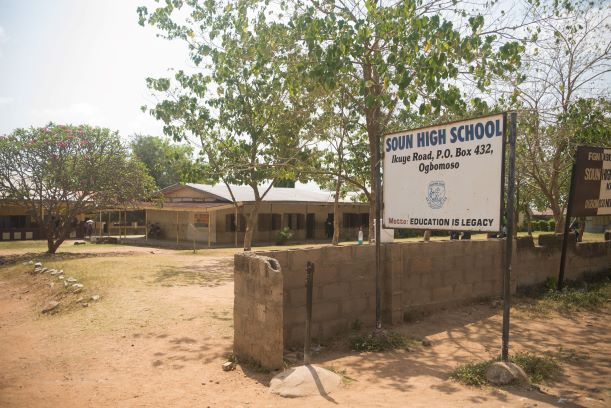
The killing of Ganiyu signaled a sudden end to a decent and meaningful life. Teachers and friends at Soun High School, an Arabic School where Ganiyu attended, say they will never forget the six years he shared with them. Ganiyu, they remember, was a model student, obedient and teachable.
“He was a very obedient student,” his class teacher, Alhaji Bello Hasmiyu, says.
While it is common to find high school students occasionally testing their schools’ rules and regulations, like those that choose to stay out of class beyond their lunch break and those who willfully absent themselves from class, Ganiyi, according to those who knew him in school, was different. He enjoyed playing football with his peers but would not stay a minute longer on the field once break was over.
“He would be the first person to leave the field and return to class,¨ Mr. Hasmiyu says.
Workers at a workshop where Ganiyu learnt how to sew also testify of him as a promising apprentice.
Alabi Mayowa, Ganiyu’s close friend, went to the hospital to check on his friend even though he had been told he had died days ago. He still had not come to terms with the departure of his dear friend. Mayowa had sworn to always be there for Ganiyu, but the former had been away in a different town when the latter was gunned down.
“I could not believe it,” Mr. Mayowa says. “Ibrahim was a kind person. One time, my parents could not give me my feeding allowance so I went to school without food. During breaktime, I was hungry. I told Ibrahim. He told me he did not have money too but he went to borrow money from someone else and gave it to me to buy food. That really touched my heart and I will never forget.”
Months have passed since Ganiyu was buried, but his cousin, Micheal Aremu, says he still feels his presence in the room they shared, and in every other space they shared while he was alive. Michael says Ganiyu was not just a cousin but a friend and a brother too.
“I can’t sleep,” Michael says. “My head swells every time I enter the room. I always feel like he is inside, watching me. I have not been able to close my eyes because I see him.”
Ganiyu’s younger brother, 13-year-old Aliu Ibrahim, says he misses his brother and the afternoon treats he used to get on their way back from school. Since Ganiyu’s death, Aliu Ibrahim says he has had a deep sense of loneliness – that not even the company of other siblings and cousins has succeeded in cheering him up.
Soun High School
“I feel like I have been taken to a new place and left all by myself,” he says.
Ganiyu was born in 2000, in the same town where he was killed.
His father, Salaudeen Ibrahim, is a farmer in his 50s. He lives in an extended family compound with his brothers, Ganiyu’s uncles, as is the tradition in many indigenous households in Nigeria.
“Whoever killed my son inflicted a deep sore in my heart,¨ Salaudeen Ibrahim says.
¨It won’t heal.¨
This story is part of a multimedia project by Tiger Eye Foundation and media partners across Nigeria, documenting police brutality in Nigeria, and advocating for police reform.