AN economist and resident of Imo State Katch Ononuju has said that the recent attacks in the state are due to the decision of the United Kingdom to grant asylum to persecuted members of the Indigenous Peopleof Biafra (IPOB).
Ononuju said this on Monday when he featured on Channels TV programme, Sunrise Daily, to discuss the security situation in the state.
According to him, the attacks were being perpetuated by persons who were out to sabotage the proposed asylum and paint the IPOB in a bad light.
“We are aware that it was due to the British government’s intended decision on Nigeria that we have had this cascade of violence across the South-East, which I believe were primarily sponsored to paint the IPOB as a terrorist organisation,” he said.
Addressing the issue of who was responsible for the attacks, Ononuju claimed that those instigating the unrest in the South-East were people in the government.
He noted that the people who had power to order security operatives to stand down while terrorists were operating were the ones within the government.
Against the position of Ononuju, former Chief Superintendent of Police James Vandeffan, who was also on the programme, disagreed, saying the only sector working effectively in Nigeria was the security.
Vandeffan insisted that the attacks in the South-East were the activities of civilians, stating that the arrested suspects were traced back to the IPOB.
“All those who have been arrested in the past weeks, and those who were attacking the same institution, are those who are civilians. And from the arrests and preliminary investigations that have been conducted, they are all linked to IPOB. There are no two ways about that,” he said.
He also discouraged leaders from supporting those perpetuating violence because it increased their confidence.
Since the recent outbreak of violence in the South East, the IPOB has been accused of being responsible for a series of illegal activities in Imo State.
Former Inspector General of Police (IGP) Adamu Mohammed had accused the secessionist group of attacking the facility of the Nigeria Correctional Service and the Nigeria Police Headquarters in the state.
The governor of Imo State Hope Uzodinma had, however, disagreed with the former IGP regarding the perpetrators of the crime.
Uzodinma said politicians were responsible for the attacks and not the IPOB.
UNKNOWN gunmen have kidnapped three students from the Federal University of Agriculture, Makurdi, Benue State.
Spokesperson for the Benue State Police Command Anene Sewuese confirmed the incident to The ICIR during a telephone interview on Monday.
According to Sewuese, the Police received information that the gunmen kidnapped the three students within the school premises around 10:20 pm on Saturday.
Sewuese said Benue State commissioner of police had ordered a full-scale investigation into the case.
The management of the university said it had reported all incidents to the Police and relevant security agencies.
The university’s Director of Information, Protocol and Public Relations Unit (IPPR) Rosemary Waku, in a statement, said there had not been “any communication from the students or their captors since the unfortunate incidence took place.”
The Nigerian educational system has been under severe attack, most especially in the northern part of the country. A few days ago, three of the 25 students kidnapped from Green Field University in Kaduna state were found dead.
Before the Green Field University abduction, 39 students had been kidnapped from the Federal College of Forestry Mechanization, Afaka, Kaduna State.
The abduction and kidnap of students in Nigeria have expanded from secondary schools to tertiary institutions. In 2021, more than 400 Nigerian students have either been kidnapped or abducted by ‘unknown gunmen.’
While most of them have not been rescued or recovered by security agencies in Nigeria, the state of insecurity in Nigeria has worsened in the past months.
In some parts of Nigeria, security operatives are being attacked, insurgents are taking over communities, civilians are being targeted and attacked as the insecurity lingers.
In November 2020, three organisations and the Enugu State government celebrated the completion of N300 million worth of projects expected to provide water and improve hygiene among the people in local communities in the state. The projects were supposed to expand the access to Water, Sanitation and Hygiene (WASH) services in the affected communities. In the first of this two-part series, ARINZE CHIJIOKE, who toured various communities where the projects are cited, reports that several of them did not work beyond two months after being commissioned.
AT Umuegwu, one of the villages in Isi Uzo Local Government Area of Enugu State, it is common to see adult males having their bath in the middle of the stream, where females also wash their clothes. In February, at about 5:30 pm when the reporter visited, children were swimming and frolicking in the Amanyi stream on one far end.
Residents also defecate around the banks of the stream, making the water unsafe for drinking. Like Esther Nnaji, a mother of four, many of them have no other water source apart from the stream.
Esther Nnaji points towards the direction of the Amanyi stream
Nnaji was seen wheeling two 25-litre gallons of water with her barrow and walking towards Amanyi. To get to the stream, she has to walk for 30 minutes from her home. She grew up drinking, cooking and washing with this polluted stream water.
Nnaji told this reporter that she has had to visit the hospital many times with her children due to the stream water they have been drinking. Sometimes, she said, they had scratchy throats and breathing problems. “It was usually typhoid fever whenever we got to the hospital,” she said.
To deal with this, she had to boil the water before drinking or cooking with it. And it takes us 10-15 minutes to boil the water we use. After we must have added Alum (potassium aluminium sulfate) to purify it, she said.
Hopes renewed
However, in November 2020, three organisations – WaterAid Nigeria, the South Saharan Development Organisation (SSDO), and the Coca-Cola Foundation, together with the Enugu State government, celebrated the completion of N300 million water projects in many of the local government areas of the state. It was meant to ease the pains of Nnaji and the others in the communities affected by the acute scarcity of potable water.
Children trying to get water from one of the streams in Ugwuaji
Children frolicking at the Amanyi stream
While the Coca-Cola Foundation funded the projects through its Replenish Africa Initiative (RAIN), launched in 2009 to respond to the water crises communities across Africa face, they were implemented by WaterAid Nigeria.
Country Director of WaterAid, Evelyn Mere, had said she was happy that the 19-month project had brought sustainable clean water and sanitation to over 10,000 residents in and around Nsukka, Ezeagu, Uzo-Uwani, Isiuzo and Enugu South Local Government Areas in Enugu State.
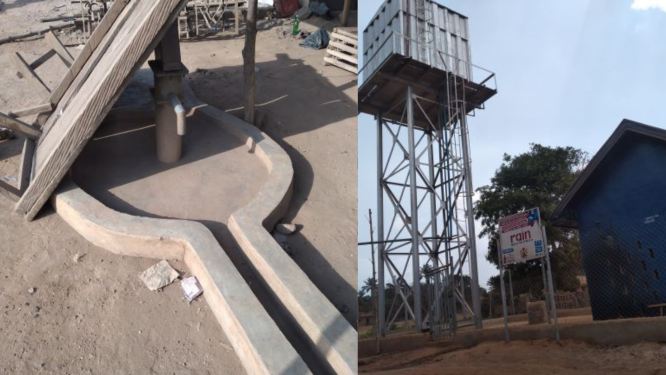
While five new boreholes equipped with hand pumps were constructed in Ugwuaji, one motorised water scheme was built in Umuabor in Nsukka LGA. Two other boreholes with hand pumps were rehabilitated in Uzo-Uwani LGA, and a solar-powered motorised borehole was also rehabilitated in Ezeagu LGA.
In Neke, Nnaji’s community, and other communities across Isi Uzo Local Government Area, the Coca-Cola Foundation and WaterAid rehabilitated a total of nine boreholes with hand pumps. For families like the Nnajis, who could not afford to buy water from tanks, that years of dependence on Amanyi Stream had come to an end, or so she thought.
The solar-powered borehole in Ndiuno
Sadly, that has not been the case, as some of the water projects only worked for two months after the inauguration. As of January, none of the boreholes rehabilitated in Neke, Ikem and other communities in Isi Uzo was working. Nnaji said the water coming out from the boreholes rehabilitated in her community was worse than the one from the Amanyi stream.
It is not clean enough, and so people could only use it to wash their clothes, Nnaji said.
Like in Neke, the borehole in Nkwo, another village in the local government, worked only between November and December 2020. Even at that, it could only fill three 25 – litre gallons daily. Usually, people would come with small buckets to fetch water they could only use for their laundry.
It began to slow down in early January, taking nearly 30 minutes before water could come out from the pipe. Now, it has completely stopped working. Dennis Friday, who owns a provision store just behind the borehole at Umuegwu Town Square, Neke, said it could only fill one bucket of water when it worked in January.
Friday holds a gallon of water from the stream.
Friday said: “After each bucket, it takes one hour for the water to come out again. So, for the whole day, we could get only fetch 10 buckets of water. But now, no water is coming out again. We have complained, but nothing has been done.”
Five constructed, one fully functional.
At Ugwuaji, a community in Enugu South Local Government Area, Ilo Ijeoma walked aimlessly looking for water for drinking and to do her daily chores. It was quite early on that fateful day. She carried an empty 25 litres gallon as she walked towards Ochufu Hall Obeagu, the location for one of the boreholes in her community.
Soon, she got to the spot, fixed her empty gallon and began to push the pump. As she pumped, little droplets of water dropped into her gallon. After 10 minutes, she became tired of pumping. But her gallon was far from filled.
“It took me about 20 minutes to get my gallon filled, and so, the best thing for me at that time was to sit down awhile and gather strength to push again,” she told this reporter, her voice filled with anger.
She added: “The borehole only fills a total of 15 gallons per day. After that, water would stop gushing out. Most times when I come to fetch water, I push for 10 minutes to fill a small bucket. It is slow and not even clean as water should be.”
In Ugwuaji, Ilo’s community, five new boreholes equipped with hand pumps were constructed. The community, like others, had been plagued by perennial water scarcity. The traditional ruler of Ibeagu, Ugwuaji, Ikenga Nyia, said the people were pleased when the projects were inaugurated and had hoped that their suffering and dependence on the stream water had come to an end.
Obinna trying to fill his gallon of water at the Ine stream in Ugwuaji
“Our streams are very dirty, and the water there is not good for drinking. But most of our people who could not afford to buy water from tanks have had to depend on it for survival,” he explained.
Sadly, out of a total of five boreholes installed in November and located at Ochufu Hall Obeagu, Health Centre Obeagu, Last Bus Stop Obeagu, Egbonwigwe Obeagu, and Nwigwe Square Obeagu, only one is serving its purpose – the one located at Last Bus Stop.
The borehole located at Nwigwe Square, Obeagu, has completely stopped working since January. Two others are working but supply dirty water. While the one located at Egbonwigwe is clean, it is not good for consumption because it is malodorous.
When contacted, the Chairman of the WASHcommittee in Ugwuaji, Ani Innocent, said the contractor, Morikem Global Investment, drilled shallow wells used for the boreholes.
“What was drilled was 70ft. Because they said, it was hard to get groundwater in our community. They went to other locations also and did their survey and found out that it would be difficult to get water,” he explained.
At Ine Stream, the last resort for low-income families, a visibly angry Ijeoma Egbo was seen waiting to be helped with her bucket of water. That was her third trip to the stream on that day. When this reporter approached her, she confirmed that the water project in her community had failed to meet the people’s expectations.
She said: “The water gushes out very slowly. Instead of wasting my time, I would rather come here, fetch and buy Alum to purify it. Although not the best, that’s what we are now used to here.”
Allegations of extortion
At one of the few locations with functioning boreholes, community members were seen filling their gallons of water. But it is not for free. In January, for instance, Innocent allegedly pasted a notice on signboards for the boreholes. It reads: “For maintenance of the borehole, payment commences in February, as follows: Painter bucket- N20, and 25 litres gallon- N30. No butters (sic) or baths or big containers will be allowed.”
The decision by the committee to collect money for maintenance did not go down well with members of the communities, who wondered why they would have to pay to fetch water from the boreholes, which were handed over to the community to help deal with water scarcity.
Before this new turn of events, people would gather around the boreholes as early as 6 am, waiting for their turns to fetch water. But now, they hardly come around since they have to pay for it.
Nyia explained that he asked the committee not to collect money from people to service the boreholes and that the community would provide the money since the government had dug it.
But Innocent insisted that the money is meant for maintenance, and that whoever refuses to pay will not be allowed to fetch, the Igwe alleged.
While reacting to the allegation, Innocent said that sometimes he had to add his money to make sure that the boreholes are properly maintained.
“… and people think I want to eat their money. Most of them have stopped coming to fetch water from here because we said they have to pay. That’s fine,” he added.
Although climbing up and down the Ine Stream is stressful,Chinedu Obinna now prefers it to having to wait at the borehole located at Obeagu Health Centre. On this particular day, he had gone to the location and waited for several minutes. But Innocent did not show up with the key.
He had to come to the stream with four empty 25 litres gallons and another 50 litres. Gradually, Obinna filled the gallons with water, and one at a time, he took them up to where he left his barrow.
One of the project signboards carrying the notice in Ugwuaji
None is working in Uzo Uwani
In Oguru, one of the communities in Uzo Uwani LGA, two hand pump boreholes were rehabilitated. When this reporter visited, the two have stopped working.
Members of the community said the boreholes only worked between November when they were inaugurated and December. Even at that, they said the water was not clean enough and could not be used for anything.
The traditional ruler of Ogurugu, Emmanuel Egwuaba, said he was not consulted when the project commenced and when it was completed.
A visibly irked Egwuaba said: “Before you begin any project in a community that has a traditional ruler, you inform him. When you are done, you inform him too. But nobody came here to inform me about the water project.”
He said the government needs to hold the contractor who handled the project responsible because none of the boreholes in his community are working.
“It worked only on the day of the inauguration, and suddenly it stopped. Is that one a good project? I think they just came here to take us for a ride. Or how else can one explain this abracadabra?”
On how his people have been surviving since the projects did not live up to expectation, the traditional ruler said they have had to depend on their streams, Amambara and Isi. At the Isi stream, this reporter noticed both women and some youths washing their clothes on one end while other children were swimming and having fun at the other end.
Women washing their clothes at the Isi stream in Uzo Uwani
The stream is about 20 minutes’ walk from Ogurugu. Families, who cannot afford to dig wells in their homes, have to trek that distance to get water. And it is what they use for cooking and general house chores.
The people seem to be enjoying their potable water at another motorised borehole in Umabor- Ehalumona. Though it comes with a cost also; they are meant to pay N15 for each 25 litres gallon of water. The community is in Nsukka LGA.
Despite the payment, the people said that the water project marked the dawn of a new era for community residents. It was the first time the people were benefitting from a project of that nature.
Kelvin Mama, the traditional ruler of Agu Umabor, said the project has been serving his people well, especially families who could not afford to construct underground tanks, which is commonplace in the community.
Mama said: “For these families, the only source of water was the Agu Stream; it’s located in a far distance. We don’t have them around here. So, they always had to trek for two hours to get there.”
One of the Kiosk managers, Rita Ugwuanyi, is saddled with making sure that the project is taken care of. She explained that the money collected from the community is used to pay the salaries of the three kiosk managers and maintain the generator when needed.
“The organisations that brought the project told us that it was left to us to maintain it and that we needed to ask people to pay if we have any problem. When we began, it wasn’t easy to raise money for Diesel. But now, it’s easy and has become a way of life sort of. We only put on the generator when the water inside the tank finishes to enable us to pump it,” she said.
Ugwuanyi said they were formally collecting N10 but after some time, they discovered that it would not be enough to maintain the project and pay workers. To service the engine in January alone cost N30,000, she added. However, the salary for Ugwuanyi and her fellow kiosk managers is 30 percent of whatever amount that is realised monthly.
This investigative report was supported by MacArthur Foundation and the International Centre for Investigative Reporting (ICIR).
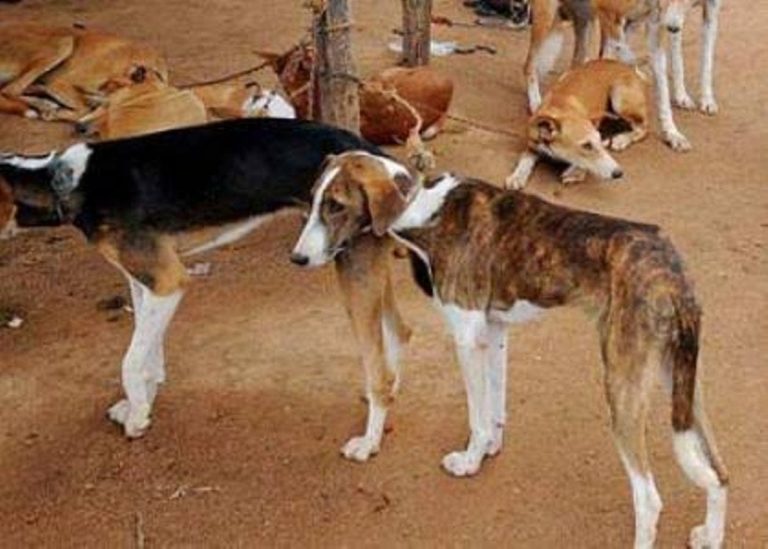
PRESIDENT Muhammadu Buhari’s home state, Katsina, has hired dogs to guard its public schools.
In a video published by CLIQQ TV and seen by The ICIR on Sunday, the state government said the decision was part of local solutions to tackling rising wave of insecurity in the state.
The state Commissioner for Education Badamasi Charanchi said in the video that dogs were capable of differentiating people with good intentions from those with evil plans. He noted that the dogs were capable of achieving the purpose for which the government hired their services.
“By their nature or build-in capacity or mechanism and by their performance worldwide, they can smell far away (more) than humans, especially objects and persons,” he said.
Asked if the dogs were trained for security such as manning school environment where there were people from different backgrounds not known to the dogs, or whether they would be eventually trained, he responded: “What people don’t understand is that when something is in it, you’re born of it, it’s part and parcel of you, that is why we looked at physiology. Whether our dog is trained or not, it has the powers to do what we want it to do. But, if you have particular training for particular thing you want dog to do, you can as well enhance the dog.”
He said what was most important to the government was for the dogs to secure the schools.
Katsina State Governor, Aminu Masari
“We are not saying they should go and fight the bandits. Don’t mistake us that (we send them to be) fighting. No. They are to alert,” he stated.
The ICIR reports that bandits and terrorists in Nigeria use lethal weapons, namely AK-47, rocket-propelled grenade, sub-machine guns, assault rifles, squad automatic weapon, drones, light machines, among others. They have fallen many of the nation’s soldiers, though the nation’s military have neutralised thousands of them.
Dogs are known to bark at every strange object. It is not clear whether they are capable of scaring gun-toting bandits or not.
A public affairs analyst and security expert Danjuma Katsina, however, said in the video that the initiative was dead on arrival.
He said the initiative should not have been exposed to the public.
According to him, the local solution should have been known to only teachers, pupils and other stakeholders within the school setting.
The video shows a couple of dogs barking and guided by some aged men within some of the public schools premises in the state.
Katsina State government shut all its boarding schools in December 2020, following mass abductions in the state.
The ICIR reported how scores of children were abducted at Government Science Secondary School, Kankara, in Kankara Local Government Area of the state in December 2020.
President Muhammadu Buhari
The attack was carried out hours after President Buhari arrived at the state for official visit.
Kaduna, Zamfara, Niger states have been at the mercy of bandits in recent months, as the criminals make fortunes from ransoms of their victims, killing many of them.
The ICIR had reported on April 23 how three of the many students kidnapped at Greenfield University in Kaduna State were killed by their captors.
Efforts by the Nigerian government to arrest insecurity in the nation appears to have been yielding minimal results, with cases of abductions, kidnappings, banditry and other criminalities increasing by the day.
There have been calls on President Buhari to rejig the nation’s security architecture by restructuring the military and sacking heads of the security formations who have overstayed in office.
Despite yielding to pressures after two years, there has been no respite as the situation remains worse, nationwide.
Several attempts have been made by leading private security network, Peace Corps, to be co-opted by the Federal Government to protect public schools and other critical public facilities as well as boost the nation’s security, but the Buhari’s administration in February 2018 declined assent to the bill passed by the National Assembly to this effect, citing inability of the Federal Government to fund the organisation.
AN Irish professor and anti-vaccination advocate Dolores Cahill claimed in a video circulated on WhatsApp, in Nigeria, that the mRNA COVID-19 vaccine could reduce the lifespan of a user and cause severe health challenges like infertility.
The Claim
The mRNA COVID-19 vaccine reduces lifespan.
The Findings
The FactCheckHub findings show that the claim is FALSE. There is no evidence to substantiate it.
In the 57-second video retrieved on April 19, 2021, the professor stated that “anyone who’s over 70 who gets one of these mRNA vaccines will probably be — sadly die within about two to three years.”
She added that, aside reduced lifespan, there could be severe health issues.
“And I would say anyone who gets the mRNA injection, no matter what age you are, your life expectancy will be reduced. You may die if you’re in your thirties within five to ten years, and you probably will have allergy, neuro-cognitive issues, inflammation, and of course infertility is the major one.”
The video clip of Cahill, which was from a longer version, has been repeatedly posted on platforms such as Facebook, Twitter and Blogs and is branded as coming from a group called the ‘World Freedom Alliance,’ which Cahill helped found in 2020.
Cahill is a professor at the School of Medicine in University College, Dublin. She has previously come under criticism for her comments on COVID-19, which were often found to be baseless or misleading.
The claim in the circulated clip is no different, as available information and the global health authority, the World Health Organization (WHO), dismissed it.
More so, the claim that the vaccine causes infertility has been debunked here and here.
The mRNA COVID-19 Vaccine
There are several categories of vaccine for COVID-19, and the mRNA (Nucleic acid vaccine) is one of them.
It works by teaching the cells how to make a protein—or even just a piece of a protein—that triggers an immune response inside the body.
This immune response, which produces antibodies, is what protects the body from getting infected if the real virus enters.
Pfizer-BioNTech, Moderna and Johnson & Johnson’s Janssen are brands of the mRNA vaccine.
The general side effects of the mRNA vaccines, as stated by the U.S. Center for Disease Control and Prevention (CDC), are pain, redness and swelling. while the rest of the body go through tiredness, headache, muscle pain, chills, fever, and nausea. Reduction in lifespan is not part of it.
There were cases of blood clots which led to the suspension of one of the mRNA brands, but even that has been lifted and certified safe with a caveat.
A small number of people also had serious allergic reactions to the vaccine, which led to the CDC’s advice that individuals who had previously experienced anaphylaxis or had any kind of immediate allergic reaction to any vaccine should be monitored for half an hour after getting the shot.
The CDC also advised against vaccination for those with a serious allergic reaction to any of the authorised COVID-19 vaccines or any of their ingredients.
COVID-19 mRNA vaccine infographic.
Similarly, the WHO stated that the side effects of all the COVID-19 vaccines had been mild and moderate so far.
In addition, a professor, who is a WHO Infection, Prevention and Control Expert Adebola Olayinka told The FactCheckHub that mRNA vaccine, like every other certified vaccine, would not change the genetic composition of the body, neither would it reduce the lifespan of a user.
“It is not true that mRNA vaccine or any other vaccine certified by WHO can reduce lifespan or cause any other severe health issues. These vaccines have been tested and certified suitable for human consumption,” the professor stated.
The FactCheckHub had earlier debunked a claim that the COVID-19 vaccination would turn humans to vampires.
The Verdict
The claim that mRNA COVID-19 vaccine reduces lifespan is FALSE; there is no evidence to substantiate it.
THE Nigerian Air Force have launched an investigation into the alleged killing of over 2o soldiers by operatives of the force during an air strike in Maiduguri, Borno State.
NAF said this in a series of tweets released on Monday via the official Twitter handle.
According to the NAF, the visuals and reports being circulated were being investigated and the general public would be duly updated on the alleged incident.
“The attention of @NigAirForce has been drawn to reports alleging ‘How NAF Killed over 20 Nigerian Army Personnel by Accident in Air Strike’ at Mainok which is about 55km to Maiduguri.
“The NAF wishes to state that visuals and reports being circulated are currently being investigated and the general public will be duly updated on the alleged incident,” the tweet read in part.
The attention of the @NigAirForce has been drawn to reports alleging “How NAF Killed over 20 Nigerian Army Personnel by Accident in Air Strike" at Mainok which is about 55km to Maiduguri. The NAF wishes to state that visuals and reports being circulated are currently being -1/2 pic.twitter.com/dUxhL4U8yL
In a viral video shared across social media platforms, a man in an Army camouflage said his colleagues had sustained injuries from an air strike by operatives of the Nigerian Air Force.
Airforce killed our ground soldiers thinking they were Boko Haram.
This is usually the outcome of recruiting or taking soldiers and officers by godfatherism… Killing own troops… pic.twitter.com/I9uMSiHnU0
In April, at least 17 civilians, including women and children, were said to have been killed by a fighter jet belonging to the Nigerian Air Force during an air strike in Sakotoku village in Damboa Local Government Area of Borno State.
Similarly, in 2017, more than 100 persons consisting of camp residents and aid workers were killed when the Nigerian Air Force bombed Rann in Borno State. The military had said the officers fired a bomb into the camp thinking it was a base of the Boko Haram insurgent group.
THE Nigerian government has rejected the recent World Bank report on electricity supply in the country.
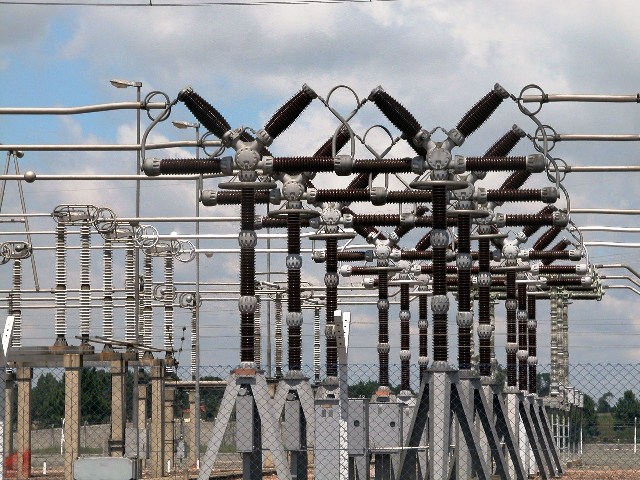
World Bank’s Practice Manager West and Central Africa Energy Ashish Khanna, while presenting the ‘Power Sector Recovery Programme Fact Sheet’ during a virtual meeting with journalists last week had said that Nigeria’s power sector had not kept up with demand or provided reliable supply to existing customers, making businesses in the country lose about $29 billion annually due to unreliable electricity.
The bank said one in 10 people without access to electricity now lived in Nigeria with 78 per cent of power consumers in the country getting fewer than 12 hours of daily supply.
Reacting, Special Adviser to President Muhammadu Buhari on Infrastructure Ahmad Zakari said it was inaccurate for the World Bank to make such unsubstantiated claims.
“It is inaccurate to make a blanket statement that 78 per cent of Nigerians have less than 12 hours daily access. The data from NERC is that 55 per cent of citizens connected to the grid are in tariff bands D and E which are less than 12 hours supply,” Zakari said.
“Those citizens are being fully subsidised to pre-September 2020 tariffs until Discos are able to improve supply.
“There is an N120bn CAPEX (capital expenditure) fund from the Central Bank of Nigeria (CBN) for Discos to improve infrastructure for these tariff classes similar to the metering programme that is ongoing.”
Zakari also dismissed a claim by the bank that 58 per cent of electricity consumers in the country did not have meters to measure electricity use, dismissing the data as unverifiable.
“It is unclear who did this survey and what the timeframe is. All citizens that have got free meters report they are happy about the reform trajectory,” he said.
“To date, more than 600,000 meters have been delivered to DisCos out of the one million in phase 0 with installation ongoing. Meters are sourced locally and are creating jobs in installation and manufacturing/assembly.”
“All consumers have been communicated their bands and bands are published during billing. It is inconceivable that anyone would imply that 4 out of 5 Nigerians are not intelligent enough to understand tariff classes and what they are paying for.”
He added that his office had a good working relationship with the bank but metrics around the Nigerian power sector should come from the Ministry of Power, Nigerian Electricity Regulatory Commission (NERC) while the Central Bank of Nigeria (CBN) also regularly published intervention data.
The Facts
Nigeria generates around 12,522 megawatts (MW) of electricity but distributes about 4,000MW. This means one megawatt is to 50,000 population. On the other hand, Ghana generates 4,000MW and distributes 2,400MW, according to the USAID. This is one MW to 12,675 population. However, while “Nigeria’s new gas-fired capacity is unused because of gas supply problems, Ghana has not been able to absorb all of its new installed capacity,” according to Neil Ford of African Business.
Manufacturers and businesses in Nigeria are hard hit with energy problems. Many manufacturers generate their own power, ignoring electricity distribution companies (DisCos). They self-generate 13,233 MW, according to a survey undertaken by an Economics Professor at the University of Ibadan Adeola Adenikinju, which was funded by the European Union and the government of Germany.
“Average daily power outage has constantly averaged four times per day,” the Manufacturers Association of Nigeria (MAN) said on its 2020 Second Half Economic Review.
AFRICA has always been identified as the ‘centrepiece’ of Nigeria’s foreign policy, but recent developments suggest that the President Muhammadu Buhari administration has specifically bestowed that status on Niger Republic.
The concept, ‘Africa as the centrepiece of Nigeria’s foreign policy’ originated in the First Republic as the Tafawa Balewa government gave Africa a pride of place in the newly independent Nigeria’s foreign policy formulation.
In line with the policy, Nigeria had overwhelmingly given both solicited and unsolicited support to African countries, intervened positively in their internal crises, provided humanitarian services, doled out billions of naira as charity, and sent out Nigerian professionals as technical corps. Nigeria also provided invaluable military support.
Checks by The ICIR show that, since 2015, Niger Republic, a neighbouring West African country, has received more attention from the Nigerian government and enjoyed a more special, closer relationship with Nigeria than other African countries.
The ICIR highlights developments and events which underscore the special relationship between Nigeria and Niger Republic under the Buhari administration.
Nigerian government constructing $2 billion rail line from Kano to Maradi in Niger Republic
Currently, the Nigerian government is constructing a $2 billion railway that will run from Kano State to Maradi in Niger Republic. Maradi, the second-largest city in Niger Republic, is regarded as the centre of the country’s developing oil industry. Buhari performed the ground-breaking ceremony of the new rail line on February 9, 2021.
A Portuguese construction company, Mota-Engil, was awarded the contract to build the 284 kilometres standard-gauge line with 12 stations from Kano in northern Nigeria to Maradi in landlocked Niger Republic.
Speaking at the virtual ground-breaking ceremony, Buhari said the new rail line would generate more revenue for Nigeria while also enabling the people of Niger Republic to enjoy affordable transportation.
About a month after the commencement of the construction of the railway, a member of Buhari’s cabinet, Minister of Transportation Rotimi Amaechi, revealed that he travelled to Niger Republic to beg the government of the West African country to allow Nigeria to build a railway for them.
Minister of Transport Rotimi Amaechi begged the government of Niger Republic to allow Nigeria to build a railway for the country.
“To even get to Maradi, I had to travel to Niger Republic even to beg them. They are not bringing their money. It is our money. But I am begging them to allow me access into Maradi,” Amaechi said.
The minister noted that the railroad would enable Niger Republic to import and export goods through Nigeria. According to him, Niger Republic preferred making imports and exports through Benin Republic, Ivory Coast, Ghana and Togo.
Nigeria sign MoU to import fuel from Niger Republic
Eyebrows were raised when, in November 2020, the Nigerian government, through the Ministry of Petroleum Resources, signed a Memorandum of Understanding (MOU) with the government of Niger Republic for the importation of petroleum products from that country.
Niger Republic only joined the league of oil-producing countries in 2012, after the China National Petroleum Company (CNPC) discovered crude oil in the east of the country, close to the border with Chad, near Agadem, an oasis in the Sahara desert. The country’s production capacity of just 20,000 barrels per day is just a fraction of the output of Nigeria, Africa’s biggest oil producer.
A statement released by the Nigerian Ministry of Petroleum Resources justifying the signing of the MOU noted that the Soraz Refinery in Zinder, Niger Republic, has an installed capacity to produce 20,000 barrels per day while the country’s domestic requirement was just 5000 barrels per day, thereby resulting in a surplus of 15,000 barrels per day.
“This is a major step forward. Niger Republic has excess products which need to be evacuated. Nigeria has the market for these products. Therefore this is going to be a win-win relationship for both countries,” Nigeria’s Minister for Petroleum Resources Timipreye Sylva said at the MOU signing event.
The signing of the MOU was criticised by some Nigerians, particularly oil and gas industry stakeholders, who questioned the sincerity of Buhari’s roadmap on local refining, which involves introducing modular refineries in Nigeria.
Minister of State for Petroleum Resources Timipreye Sylva said Nigerians should be proud of fuel imports from Niger Republic.
Responding to the criticisms, Sylva said Nigerians should be proud that the Nigerian government was about to resume importing fuel from the neighbouring Niger Republic.
Those who criticised the MOU had described plans by Nigeria to import fuel from Niger Republic as an embarrassment. But Sylva argued that, rather than being seen as an embarrassment, the development should be seen as a means of encouraging intra-regional trade.
“Nigerians should be proud that we are doing that to encourage sub-regional trade because we have been talking about sub-regional trade for a long time, and this is how it should be between neighbouring countries. Niger should import from us what we have, and we should import from Niger what they have. Let us encourage intra-regional trade, and this is one good example of trading within West Africa,” the minister said.
Nigeria and Niger Republic signed deal to build $2 billion refinery and pipeline
Earlier in July 2018, the governments of Nigeria and Niger Republic agreed in principle to cooperate on building an oil pipeline and refinery.
The proposed refinery will be located in Katsina State, northern Nigeria, and will receive crude oil through the pipeline from Niger Republic’s oilfields in the Ténéré desert.
The MOU for the two projects, which are expected to cost about $2 billion, was signed by the two countries’ energy ministers and witnessed by Buhari and his counterpart from the Republic of Niger, Mahamadou Issoufou.
It is unclear whether construction work on the proposed refinery has commenced, but it was projected that the facility would be able to process between 100,000 and 150,000 barrels a day, which will make it the third-largest in Nigeria, after the giant, $10 billion, 650,000-barrel per day Dangote refinery, under construction near Lagos, and the 210,000-barrel per day Port Harcourt refinery.
“Nigeria sees this cooperation on crude oil export from the Republic of Niger and construction of refinery facilities in Katsina State as a ‘win–win’ for both nations,” Buhari said at the signing ceremony.
Buhari names Abuja major road after Niger Republic President
Further indications that the Nigerian government was giving special considerations to Niger Republic emerged in March when Buhari named a major expressway in Abuja, Nigeria’s Federal Capital Territory, after the then President of Niger Republic Mahamadou Issoufou.
Minister of the Federal Capital Territory Mohammed Bello, Minister of Foreign Affairs Geoffrey Onyeama and the former Niger Republic, President Mahamadou Issoufou, was named the Outer Southern Expressway in Abuja as ‘Mahamadou Issoufou Expressway.’
The first phase of the ongoing Outer Southern Expressway (OSEX) in Abuja was named ‘Mahamadou Issoufou Expressway’ in honour of the outgoing Niger Republic leader when he visited Nigeria days before handing it over to his successor.
Minister of the Federal Capital Territory Mohammed Bello explained that the road was named after Issoufou as a “mark of deep appreciation for the maintenance of a brotherly relationship between Nigeria and the Republic of Niger and in recognition of the Nigerien President’s significant role in the promotion of peace in Africa.”
Outgoing Niger Republic President visits Buhari just before bowing out, successor calls on Buhari shortly after taking over
Nigeria’s special relationship with Niger Republic was further highlighted by the visits of the country’s immediate past President and his successor to Buhari in an interval of just a few days.
Buhari and the former Niger Republic President Mahamadou Issoufou at the Presidential Villa Abuja shortly before Issoufou handed over to a successor.
Immediate past President Issoufou visited Buhari in March, just before he handed over to newly elected President Mohammed Bazoum. Bazoum, in turn, called on Buhari at the Presidential Villa, Abuja, in April.
Bazoum took over from Issoufou on April 2 and paid a courtesy call on Buhari, as part of a two-day working visit to Nigeria, on April 19. It was the new Niger Republic President’s first official visit.
New Niger Republic President Mohammed Bazoum, sworn in on April 2, was received by Buhari at the Presidential Villa in Abuja on April 19. Bazoum was on a two-day working visit to Nigeria
Interestingly, Buhari had expressed satisfaction with Bazoum’s election in the February 20 run-off presidential election in Niger Republic.
Speaking after he was briefed on the Niger Republic presidential elections by the ECOWAS Head of Mission on the election former Vice-President Namadi Sambo, Buhari had said, “We are concerned about their (Niger Republic) stability, and I am glad the elections went well. I am happy it was transparent, as attested to by most of the observers. I am glad you (Namadi Sambo) came back with good news.”
The governors of Sokoto, Borno, Yobe, Kebbi and Zamfara states were at the Presidential Villa to join Buhari in welcoming Bazoum when he arrived Abuja on April 19. The new Niger Republic President was hosted to a private breaking of fast by Buhari during the visit.
Speaking during a reception at the Presidential Villa in Abuja, Bazoum said he was happy to make Nigeria his first port of call. He observed that Nigeria and Niger Republic have common interests. Bazoum also emphasised the need for both countries to maintain a good relationship and face their challenges together.
Despite Nigeria struggling with daunting security challenges, Buhari vows to defend Niger Republic from Boko Haram
During the reception for Bazoum at the Presidential Villa, Buhari vowed that he would do everything possible to secure Niger Republic from incessant terror attacks by the Boko Haram insurgents. Buhari’s vow to secure the neighbouring country was made despite mounting security challenges in Nigeria. Nigeria is currently experiencing an unprecedented kidnapping level, attacks on security formations, banditry, clashes between herders and farmers, and constant terror campaigns by the Boko Haram insurgents.
However, while assuring Bazoum that his administration will do all it takes to secure the two countries (Nigeria and Niger Republic), Buhari said some Nigerians and Nigeriens are people with similar cultures, languages and ways of life.
“We also share about 1,500 kilometres of land border, so we cannot ignore each other,” Buhari added.
Buhari called Niger Republic President on phone to sympathise with Nigeriens after terror attack
Also, earlier in March, Buhari had called then President, Issoufou, to sympathise with the people of Niger Republic after Boko Haram killed 137 Nigeriens in an attack.
The development was disclosed in a statement by Senior Special Assistant on Media and Publicity Garba Shehu. “Our deepest and heartfelt condolences to the families of victims and people of Niger Republic. Nigeria stands with all her neighbours in the fight against terrorism,” the statement quoted Buhari as saying in the conversation with his Niger Republic counterpart.
According to a separate statement issued by Shehu, Buhari had also personally called Issoufou on the phone to express concerns after an attempted military coup in Niger Republic in March. Buhari condemned the attempted military coup, stressing that Nigeria cannot be indifferent to the dangers posed by the military could in Africa.
Buhari also commiserated with the government and people of Niger Republic after about 20 primary school pupils died in a fire incident in Niamey, the country’s capital, earlier in April.
In a message to President Bazoum, Buhari described the incident as “heart-wrenching and extremely horrific”.
“On behalf of the government and people of Nigeria, we commiserate with our brotherly neighbours on this tragic loss,” parts of the condolence message read.
It has been observed that Buhari hardly comment on similar incidents in Nigeria and other African countries.
Buhari awarded Niger Republic’s highest national honour
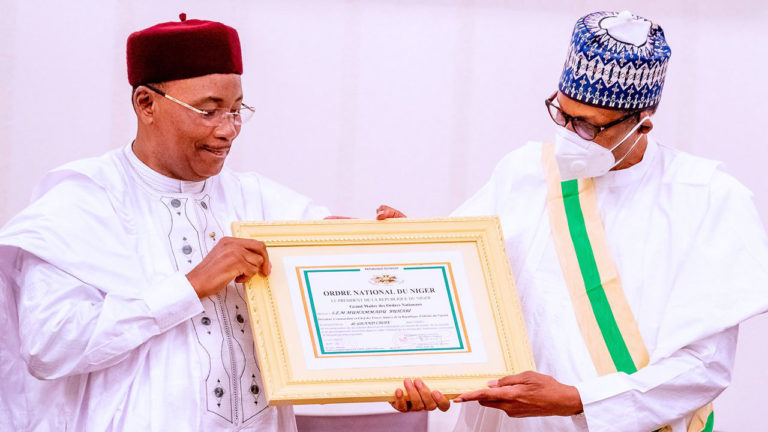
To further underscore the strength of the currently obtainable relationship between Nigeria and Niger Republic, Buhari was in March honoured with Niger Republic’s highest national award, Grande Croix Des Ordre National Du Niger.
Then outgoing Niger Republic President, Issoufou, presented Buhari with the award at the Presidential Villa in Abuja when he visited Nigeria shortly before handing it over to his successor, Bazoum.
While receiving the award, Buhari commended Issoufou for “consolidating” the good relations between Nigeria and Niger Republic. “There is a spirit of good neighbourliness between us,” Buhari said.
Buhari introduces Nigerian officials at a reception for Niger Republic President Mahamadou Issoufou at the Presidential Villa in Abuja.
Issoufou thanked Buhari and Nigerians for his support during his time in office as President of Niger Republic.
He also described Nigeria as a “second home”.
Niger Republic was the first country visited by Buhari after he was sworn-in as President in 2015
Remarkably, Buhari, at the occasion, pointed out that Niger Republic was the first country he visited after he was sworn in as Nigeria’s President on May 29, 2015.
Buhari explained that the decision to make Niger Republic the first country he visited was informed by the value and quality of relations between Nigeria and Niger Republic.
Foreign affairs experts examine Nigeria’s foreign policy and the Buhari administration’s relationship with Niger Republic
Meanwhile, foreign affairs experts analysed Nigeria’s relationship with Niger Republic in separate interviews with The ICIR.
The experts suggested that although Nigeria have had cordial relations with neighbouring countries, personal motives may have informed Buhari’s emphasis on Niger Republic.
Buhari have ‘personal reasons’ but Niger Republic has always been a special country to Nigeria… Former NIIA Director-General
Speaking with The ICIR, a former Director-General of the Nigerian Institute of International Affairs (NIIA) Bola Akinterinwa noted that Buhari has a ‘personal relationship’ with Niger Republic. But he did not explain the nature of the relationship.
Bola Akinterinwa
“Buhari has relationship with them (Niger Republic) but I don’t think that is why he may be giving priority there. If Buhari is trying to give priority to Niger Republic it may be because of his own personal affiliation to them, you can’t rule that one out,” he said.
However, Akinterinwa who is currently President/Director-General of the Bolytag Centre for International Diplomacy and Strategic Studies (BOCIDASS), in the same vein noted that Niger Republic was a “special country to Nigeria” due to the historical relationship between the two countries at the government-to-government and people-to-people levels.
He pointed out that the the Niger Republic/Nigeria Joint Commission, which was set up as far back as 1971, has been driving the relationship between Nigeria and Niger Republic.
Akinterinwa further explained that although Niger Republic was territorially larger than Nigeria, its northern part was more of a desert and as a result, most of its citizens live around the border areas with Nigeria.
“The international frontier between Niger Republic and Nigeria divides the same families right from the Sokoto area down to Borno so what normally happens is that the idea that there is any border that divides the two countries does not exist,” he observed.
Akinterinwa further observed that among neighbouring countries that share borders with Nigeria, Niger Republic was the only one that has never had a land dispute with Nigeria.
“We (Nigeria) used to have land dispute with Cameroon over Bakassi; we used to have with Chad over Lake Chad; we used to have with Benin Republic but we don’t have any with Niger Republic,” he said.
Akinterinwa in the same vein noted that the Buhari administration was trying to develop sub-regionalism, with special emphasis on what he described as the ‘Nigerian sub-region’.
He also explained that, apart from economic considerations, the railway being built by Nigeria in Niger Republic was in line with the integration policy of the Economic Community of West African States (ECOWAS).
It is necessary to maintain cordial relations with neighbouring countries but Nigeria should not ‘over-concentrate’ on Niger Republic… Director Centre for China Studies
Also speaking with The ICIR, Director of the Centre for China Studies in Nigeria Charles Onunaiju observed that the concept of ‘neighbourhood diplomacy’ stipulates that the Nigerian government should maintain cordial relations with all neighbouring countries and not just Niger Republic.
Charles Onunaiju
Onunaiju explained that harmonious relationship with neighbouring countries was critical for trade and security reasons.
“Ordinarily a neighbour should be prioritised – a responsible country should be concerned with what is happening to its neighbour. Neighbourhood diplomacy entails that we should be sensitive to what is happening to them,” he said.
But he noted that a situation whereby Niger Republic was prioritised ahead of other neighbouring countries raises questions.
Onunaiju said it was not proper for the Nigerian government to ‘over-concentrate’ on Niger Republic.
He added, “The entire Sahel region is in turmoil so it is incumbent on Nigeria’s leadership to maintain cordial relations with not just Niger Republic but also Chad and Cameroon but if Niger Republic is becoming too prominent we might question what is the trade coming from Niger Republic? What is the value coming from Niger Republic? Why does it feature more prominently than every other neighbour?
“We can raise that question because it is just a neighbour like others, like Chad, like Cameroon, like Central African Republic. There might be questions if there is anything beyond the ordinary. We might raise issues about that.
“Also it is important not to make Niger Republic a bigger priority among other neighbours because that can arise indignation from the others. We need to keep in touch and watch what is happening in our neighbourhood but that shouldn’t be over-concentrated.”
Africa remains centrepiece of Nigeria’s foreign policy but different Presidents tend to emphasise some neighbouring countries above others… Diplomat
A former Nigerian ambassador to the Scandinavian countries – Sweden, Denmark, Finland and Norway – Godknows Igali, said although Africa remains the centrepiece of Nigeria’s foreign policy, historically, different Nigerian Presidents have tended to emphasise different neighbouring countries above others.
Godknows Igali
“There are nuances and any President can come and decide to emphasise the relationship with any of the neighbouring countries. However, Africa remains the centrepiece of Nigeria’s policy but each President looks at our neighbours from different lenses,” Igali said.
Illustrating the point, Igali observed that during the administration of former President Olusegun Obasanjo, Benin Republic enjoyed a special relationship with Nigeria to the extent that it was said that Benin Republic has become another state in Nigeria.
“Some other Presidents emphasised Ghana as being the most important country to Nigeria while Chad also occupied the position of a favourite during the regime of some Nigerian military heads of state,” he said.
Igali further observed that, at a point during the regime of former military Head of State General Ibrahim Babangida, Equatorial Guinea, Nigeria’s maritime neighbour, assumed the position of the ‘centrepiece’.
According to him, during the period, a military officer, Admiral Festus Porbeni, who was posted to Equatorial Guinea as ambassador, came to be regarded as the ‘alternate President’ of that country.
He also pointed out that Nigeria had a special relationship with Cameroon in the 60s, which resulted in a reciprocal non-visa travel arrangement which allowed Nigerians to travel to Cameroon and spend 90 days without visa, just as Cameroonians were able to visit Nigeria without visa and stay for up to 90 days.
Igali added, “In diplomacy neighbouring countries are usually the first line in foreign policy formulation of any country. Africa remains the centrepiece of Nigeria’s foreign policy. Some people are questioning that fact. They are asking ‘should Africa remain the centrepiece of Nigeria’s foreign policy after 60 years?’.
“But Africa remains the centrepiece of Nigeria’s foreign policy and within Africa our neighbours occupy a special place in our foreign policy but some Presidents tend to emphasise certain neighbours above others.”
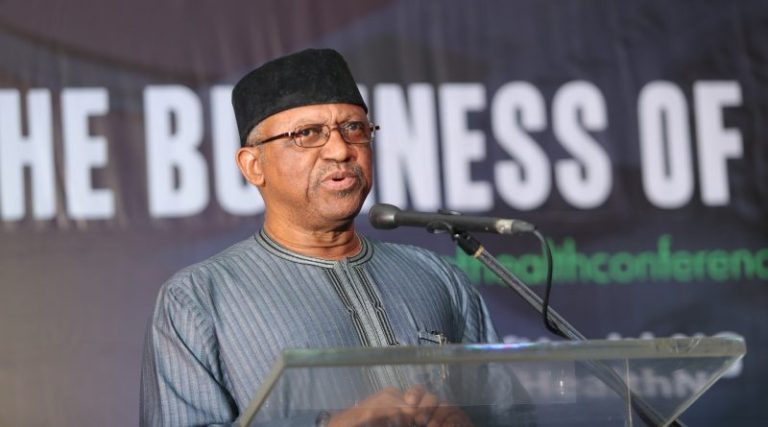
THE Nigerian government has said it needs N1.89 trillion to implement a five-year New Generation Malaria Strategic Plan (NMSP, 2021-2025).
Minister of Health Osagie Ehanire said about N352 billion was needed for this year’s implementation of the programme.
The minister stated these at a press briefing to commemorate this year’s World Malaria Day in Abuja at the weekend.
He, however, said given the prevailing economic situation in the country, the government might not have the required amount.
He then called for support from well-meaning private organisations and individuals to help raise the money.
About 63 per cent of the N1.89 trillion would be used to support chemoprevention, diagnosis and treatment, while about 36 per cent would be used for vector management, he claimed.
Quoting the 2020 World Malaria Report, Osagie said the country contributed 27 per cent of global malaria cases and 23 per cent of global deaths from the disease.
Osagie said the goal of the plan was to achieve a parasite prevalence of less than 10 per cent and reduce mortality attributable to malaria to less than 50 deaths per 1,000 live births by 2025.
He claimed further that despite Nigeria’s high contribution to global cases and deaths from the disease, indicators of interventions by the country showed a positive trend.
According to him, use of insecticide treated nets among under-five children increased from 43.4 per cent in 2015 to 52 per cent in 2018, while pregnant women increased use of the nets from 49 per cent in 2015 in to 58 per cent in 2018.
“Fever testing of under-five children increased from five percent in 2010 to 11 per cent in 2013, 13 per cent in 2015 and 14 per cent in 2018; but is still too low. These measures resulted in reduction of malaria prevalence from 42 per cent in 2010 to 27 per cent in 2015 and 23 per cent in 2018…
“We shall continue to work hard to ensure less than 10 per cent parasite prevalence and reduce malaria mortality to less than 50 deaths per 1,000 live births by 2025, the target set out the National Malaria Strategic Plan of 2021 to 2025,” he said.
While speaking on the roles of the public on malaria prevention, the minister called on people in the country to ensure they kept their environments clean at all times by consistently sleeping inside insecticide treated nets, visiting hospitals or health clinics when feverish for tests, and if positive for malaria, ensure they were treated with Artemisinin-based Combination Therapy (ACT).
The theme of this year’s commemoration is ‘Zero malaria – Draw the line Against Malaria” and the slogan: is “Stand Up – Take Action.’
The ICIR had, last week, reported how Nigeria missed out of pilot testing of malaria vaccine jabs administered in Kenya, Ghana, Malawi.
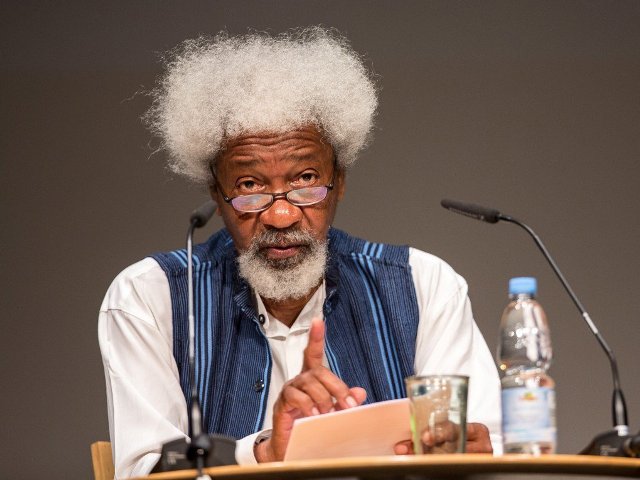
Nobel Laureate and elder statesman Wole Soyinka has advised the administration of President Muhammadu Buhari to seek help.
Soyinka said this in a statement on Saturday titled, “The endless martyrdom of youth,’ saying that the Nigerian government should stop improvising with human lives.
The Nobel Laureate added that the youth of the nation who are its future should not be served as a ritual offering on the altar of a failing state.
“Those who have been proven weak and incapable must learn to swallow their vain pride and seek help. Again, this is no new counselling, but of course the dog that will get lost no longer heeds the hunter’s whistle,” Soyinka said.
Soyinka was reacting to the recent kidnap and killing of some students from Greenfield University, Kaduna state.
He noted that the nation needs to remind itself of hideous precedents of the Chibok and Dapchi student abductions and many others.
According to him, the nation is at war but it continues to pretend that the happenings ‘are mere birth-pangs of a glorious entity’ rather they are ‘death throes’.
“The plague called COVID has met its match on the earth of some nation space once known as Nigeria, I grieve with the bereaved, but mourn even more for our youth so routinely sacrificed, burdened with uncertainty and traumatized beyond youth’s capacity to cope,” he said.
In Northern Nigeria, terrorist groups and bandits alike have been targeting schools and communities; killing and abducting students and other Nigerians.
While the country is yet to recover all the students from its first major student abduction in 2014, other students’ abductions have occurred and the story has not been different.
Apart from the abduction of students, innocent civilians are also being kidnapped, abducted and killed while some villages are being taken over by terrorist groups.
The ICIR has reported that the United States and Canada, had warned and advised their citizens to reconsider travelling to Nigeria as a result of insecurity in some parts of the country.
Stating their reasons, the US in a travel advisory said ‘Violent crime – such as armed robbery, assault, carjacking, kidnapping, hostage-taking, banditry, and rape – is common throughout the country’.
In response to the rising state of insecurity in Nigeria, Buhari had reluctantly let go of the former service chiefs, while decorating the newly appointed ones, he gave them an ultimatum of ‘few weeks’ to make the country secure again, however, the situation persists.
Nigeria is still unsafe. Hundreds of students and residents from various communities have been kidnapped between January and April, according to media reports.