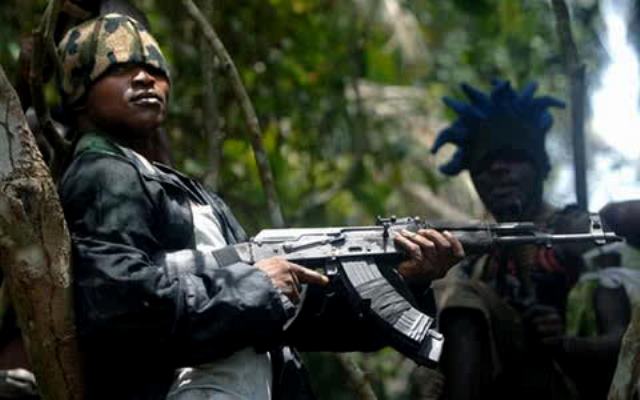
SOME yet-to-be-identified gunmen have, again, attacked another police station in Mbaitoli Local Government Area of Imo State and freed detained suspects.
According to a report, the gunmen attacked the Police station around 1 am on Thursday morning and freed detained suspects in police custody.
During the violent attack, the gunmen were said to have kidnapped one Police officer and injured two others.
Spokesperson for the Imo State Police Command Orlando Ikeokwu confirmed the attack to The ICIR.
He said none of the officers at the Police station was missing and the attack was repelled.
However, according to The Punch, Ikeokwu had acknowledged that one police officer was missing and two others injured during the course of the attack.
He also confirmed that some suspects detained in the Police facility were freed by the attackers.
Recently, there has been a recurrence of violent attacks on Police stations and security operatives in Imo state.
The immediate past Inspector General of Police, Mohammed Adamu had alleged that the Eastern Security Network (ESN) was responsible for the several attacks on security operatives in the state. However, Governor Hope Uzodinma has blamed some ‘aggrieved politicians’ for the attacks.
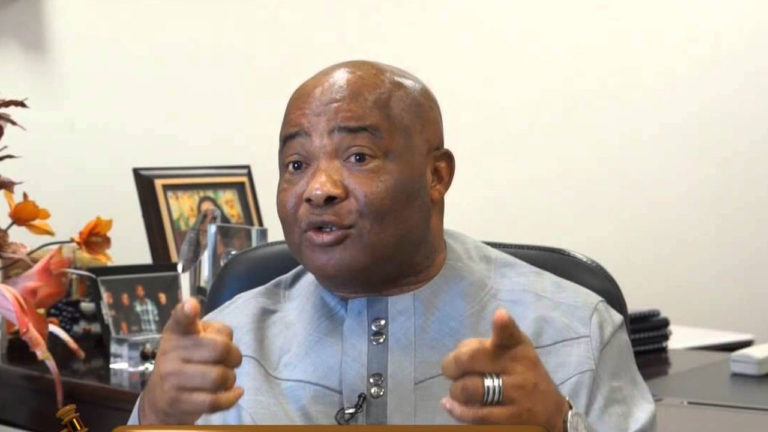
Uzodinma said this when he featured on Channels TV programme, Politics Today, on Wednesday evening.
According to Uzodinma, the aggrieved politicians hired hoodlums from another state to perpetrate the attacks.
He further noted that the attacks were not about the agitation of the Independent People of Biafra (IPOB).
“They try to identify grievances of people in a particular area. They hire hoodlums from outside Imo State. They bring them in pretending to be IPOB and they commit this crime and they go away.
“It is not about IPOB. Yes, we agree, we have aggrieved IPOB members. But I can tell you, those who are doing these destructions, most of them were brought from outside Imo state,” Uzodinma said.
He further said that the state government was working hard to ensure that the sponsors of the attacks were brought to book.
IMO State Governor Hope Uzodimma has blamed aggrieved politicians in the state for Monday’s daring attack on the headquarters of the Police and the Nigeria Correctional facility in Owerri, leading to the escape of more than 1,800 inmates.
The governor, who spoke on Wednesday while appearing on Channels Television’s Politics Today, said the objective of the politicians was to destabilise his administration and the government of President Muhammadu Buhari.
“What happened in Imo State last Monday is unbelievable. A group of hoodlums, of course, sponsored by some known politicians in Imo State, decided to destroy public infrastructure and government facilities, and attacked a correctional centre facility and also attacked a police state headquarters,” he said.
“But what is important to take home is for Nigerians to know of the plot by a group of aggrieved politicians to destablise the government of APC. I have done some thorough investigation and I have a credible lead as to those who are sponsoring these activities of these hoodlums.
“We are working hard to ensure that the sponsors of these dastardly acts are brought to book.”
He argued that though there were aggrieved IPOB members in the state, those behind the attacks were brought from outside the state.
“They (politicians) try to identify grievances of people in a particular area. They hire hoodlums from outside Imo State. They bring them in pretending to be IPOB and they commit this crime and they go away.
“It is not about IPOB. Yes, we agree, we have aggrieved IPOB members. But I can tell you, those who are doing these destructions, most of them were brought from outside Imo State.”
The governor said his administration had trained over 4,000 youths on community policing who would work with vigilantes to support the efforts of security agencies in the state.
The governor’s position was contrary to claims by former Inspector-General of Police Mohammed Adamu that IPOB was behind the attacks.
Adamu had said preliminary investigations revealed members of the Eastern Security Network (ESN), a security outfit of IPOB, attacked the facilities with sophisticated weapons such as general purpose machine guns (GPMGs), sub-machine guns (SMGs), AK49 rifles, rocket propelled grenades (RPGs), and improvised explosive devices (IEDs), an allegation the group had, however, denied.
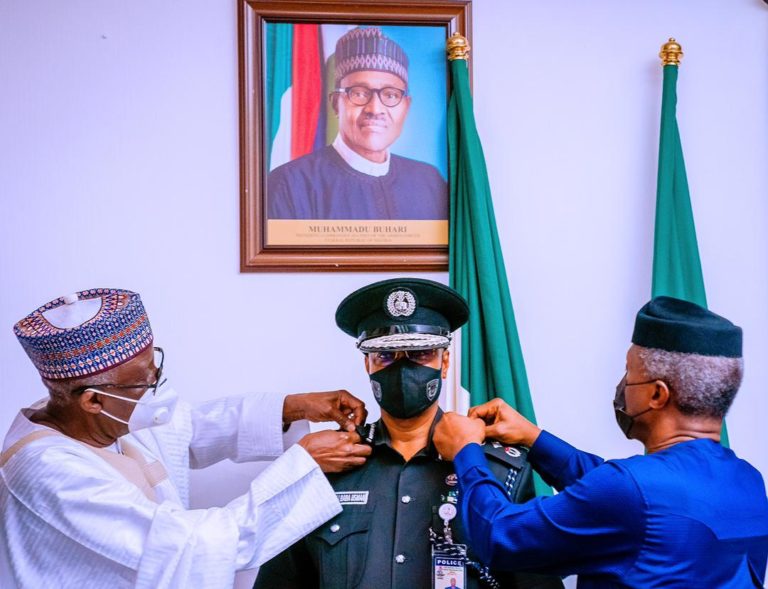
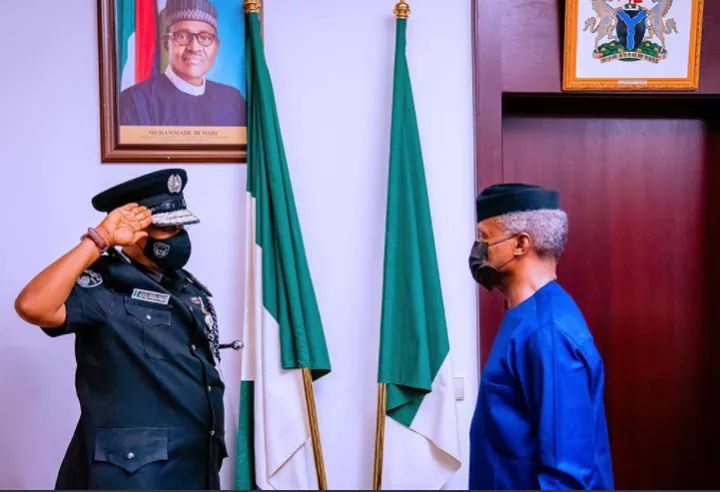
VICE President Yemi Osinbajo, on Wednesday, decorated the new acting Inspector General of Police Usman Alkali Baba amid agitations from lawyers that the appointment was illegal.
Usman was appointed on Tuesday by President Muhammadu Buhari to replace Mohammed Adamu whose tenure was previously unconstitutionally extended.
The decoration was held in Abuja and witnessed by Chief of Staff to the President Ibrahim Gambari and other government officials.
Announcing the decoration on his official Twitter handle @ProfOsinbajo, Osinbajo congratulated the acting IGP, noting that safety and protection of all Nigerians remained a priority of President Buhari’s administration.
The decoration was held despite concerns raised by many Nigerians who accused the president of ethnic and religious bias.
The ICIR had reported that some Nigerians took to the social media to express their grievances over the appointment.
Lawyers and senior advocates of Nigeria say the appointment has no legal backing and is against the Constitution of the Federal Republic of Nigeria.
A Senior Advocate of Nigeria Mike Ozekhome said the appointment was illegal and inconsistent with the provision of the nation’s constitution.
Ezekhome said this in a statement seen by The ICIR on Tuesday, stressing that the president lacked the power to solely appoint a new IGP without due approval.
“He can only do so in conjunction with the Nigeria Police Council comprising Mr President as chairman, all the 36 state governors, the chairman of the Police Service Commission and the IGP.
“That such an appointment has just happened before the new acting IGP is capricious, arbitrary, whimsical, unconscionable, illegal, unlawful, wrongful and unconstitutional,” Ezekhome said.
He argued that his position was according to sections 7(6) and 18(8) of the Nigeria Police Act, 2020, in addition to the clear provisions of sections 214,215 and 216 and paragraph 7 to the 3rd Schedule of the 1999 Constitution.
A Professor of Law and former Executive Chairman of the National Human Rights Commission (NHRC) Chidi Odinkalu has also taken the same position as Ezekhome.
According to Odinkalu, the Nigerian Constitution required Police Council to advise on the appointment of IGP, but they had not met before the appointment was made and approved by the president.
He added that the Police Act, 2020, signed into law by Buhari did not recognise acting inspector general of police.
The professor of law further stated that the police affairs minister had no powers in the process of selecting an IGP in Nigeria.
A 22-year-old security guard Clement Sargwak, who was assaulted by Chairman of the Code of Conduct Tribunal (CCT) Danladi Umar, is in hospital receiving medical attention for injuries sustained in the incident.
A viral video clip of the assault, which occurred at Banex Plaza in Wuse 2, Abuja, on March 29, elicited outrage from many Nigerians with calls from several quarters for Umar to be removed from his position. As Chairman of the CCT, Umar presides over the trial of public officers accused of misconduct.
Sargwak, a personnel of Jul Reliable Security Guards, a private outfit which provides security services at Banex Plaza, was allegedly physically manhandled by Umar when he accosted the judge for parking his vehicle in an inappropriate manner in the plaza’s parking lot.
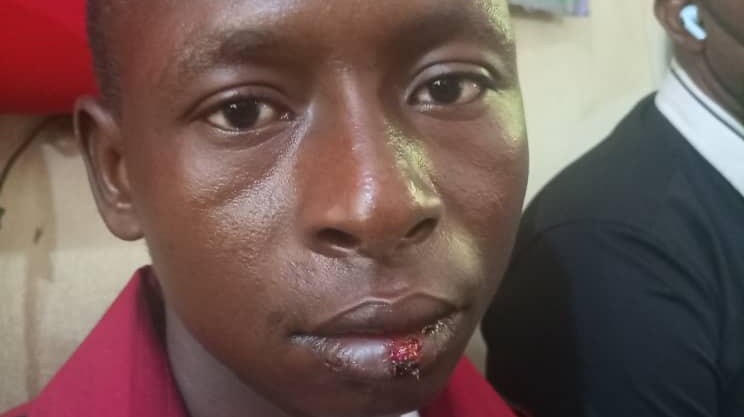
Sargwark’s supervisor Dennis Omala informed The ICIR on April 6 that the security guard was diagnosed with internal injuries. The guard also sustained open wounds on his lips, where Umar kicked him with his shoes, the supervisor said.
Omala, however, did not disclose the identity of the hospital where Sargwak was receiving treatment. He also told The ICIR correspondent, who wanted to speak with the guard, that Sargwak, who was traumatised by the incident, was incommunicado at the moment for ‘security reasons.’
He said the management of the security outfit took the guard to hospital for proper medical attention.
“The boy is still in the hospital, and we can’t allow him to talk now. He is receiving treatment. We are still taking care of him because, due to the injuries he sustained, if we had told him to stay at home we may lose him, and we don’t want to take chances. He is improving now but he was in a very bad shape before. Apart from the lips that were torn, he was diagnosed with an internal injury because the judge also hit him on the chest,” Omala told The ICIR.
The supervisor suggested that Sargwak could have died if he had not received treatment for the injuries.
“Besides, if he had died, the story will be that a judge has killed somebody and it will be a different case. The story will be that the judge hit him and he died. So we had to take him to the hospital to ensure that he was healed first because life is more important.”
*CCT chairman has not reached out to security guard or the company since incident
Omala further disclosed that Umar had not tried to reach out to the security guard or the management of the security outfit since the incident occurred.
“The unfortunate thing is Danladi Umar has not reached out to him (security guard) or shown any interest on how to resolve the problem. I expected that he would try to reach out to us through our lawyer or the management, or even through me, being the supervisor,” Omala said.
Security outfit makes demands, says CCT chairman should settle guard’s medical bills
In calling on the judge to ‘reach out,’ Jul Reliable Security Guards is demanding that the judge should settle Sargwark’s medical bills.
Speaking with The ICIR, Omala added, “Let him reach out – he should call the boy or the company. Let us find a way to resolve this issue. Let him offset the boy’s hospital bills because at the moment the company is bearing the cost alone. Let him start from there. Since the incident happened, the judge has not reached out to the boy or to the company and we are patiently waiting for him to reach out to us so that we find a way to resolve this issue. Let him call and we will tell him what to do. The issue of the medical bills is not the most important matter. He should reach out to us first.”
CCT chairman, in interview with PR Nigeria, claims he was attacked and injured by Biafran mob singing secessionist slogans
In an interview with PRNigeria, Umar had justified his claims that he was assaulted by alleged ‘Biafran boys’ at Banex Plaza on the day of the incident.
“When I was accosted by the plaza guard in a very rude manner on arriving there, I had maintained my accustomed decorum before I was drawn into an unnecessary altercation and subsequently assaulted, with this degenerating into an attack and injury by a mob that was chanting secessionist and sectional slogans,” the judge told PRNigeria, adding that, contrary to insinuations, he had no bodyguard or police escort when he visited the plaza.
The CCT chairman, who also claimed that he visited the hospital to treat injuries he sustained during the ‘assault on him,’ said the video that was shared on the social media captured only an aspect of what ensued and not the beginning where he was molested.
Supervisor says Umar lied, no Biafran-link to incident
Reacting to the CCT chairman’s claims, Omala said the judge lied.
He said, “There was no connection to Biafra in anyway. The boy (Sargwak) was from Plateau, I am from Benue. In this security outfit and in the plaza, we have people from different states – we have Nasarawa people, we have Plateau and others. There was nothing like Biafra in this thing.” He added, “Nobody gathered to shout Biafra slogans. Rather, the tenants and visitors in the plaza, who were around, were angry at the judge’s action and they were saying ‘This boy is a human being you should not treat him like that.”
The security guard’s supervisor further dismissed Umar’s claims that he was assaulted.
Giving an account of the incident, Omala said, “I was there, I even held him (Umar). I told him. ‘Sir, you are more than this thing you are doing’ because at that time, he had already introduced himself as a judge. When the problem started, my boy (Sargwak) called me immediately and I rushed there with my police. They were saying that somebody slapped my boy. So I went there with my Police and when I got there, he (Umar) told me that he is a judge. I told him that ‘Considering your position, you are not supposed to slap the boy. Even if the boy did something wrong, you are supposed to ask of his supervisors and the management of the plaza to report the incident. That is the way to handle the issue in a polite way as an educated person. You can’t fight in the plaza.”
“But even while I spoke to him, he (Umar) was not listening, he just wanted to fight. He was only interested in fighting the security man. If you saw the video, you would notice that people were holding him back. It was shocking and things are not supposed to be done like that. Personally, if I happened to be in such a position (judge) I can’t bring myself down like that.”
CCT chairman’s car allegedly brushed a pregnant woman when he was parking
Omala told The ICIR that that Umar’s car brushed a pregnant woman while he was parking in the plaza.
He said, “I asked the security guard what happened and he said the man (Umar) drove round and in the process, his vehicle hit one pregnant woman. The glass of his car brushed the woman, but the woman said she didn’t want to make trouble because when we were beckoning on the woman to come, she heard that the man was a judge and she became afraid. But the man did not even apologise to the woman.”
“So when my boy (security guard) came to me, he reported that the man parked wrongly and he told him to park well so that parking space would be accessible to other drivers. He said the man now came down from the car and slapped him. His driver also slapped the boy. They now pushed him to the ground and started marching on him. The judge then ran to his car and brought an iron to hit the boy, but one of the tenants in the plaza held his hand and asked ‘Why will you use this iron on the small boy?’ and collected the iron from him,” he added.
Dennis Omala, supervisor of Jul Reliable Security Guards at Banex Plaza, Abuja
CCT chairman boasted that he can jail security guard for 50 years
Continuing, Omala said, “At the point all of us were trying to calm the situation down, he (Umar) was telling us that he is a judge, that he will send the boy away to prison for 50 years and nobody on earth can stop him, that even if God came down, nothing would happen. He now sent his driver to go and bring the DSS and other people that were working under him. When the DSS arrived, they even joined us in appealing to the judge to leave the boy but he refused.”
According to Omala, even though the security guard was the one being victimised, people present during the incident, including the policemen, advised him to kneel down and beg Umar for forgiveness, just to settle the matter.
Sargwak did as advised, but the judge refused to budge and carried on with the assault.
Omala said, “One of the policemen attached to the judge suggested that, to resolve the matter, the security guard should kneel down and beg the judge and render an apology. Ordinarily, the boy was not the one at fault, but the idea was for him to apologise so that the matter would be settled. Moreover, when the man introduced himself as a judge, we felt that he was one of the leaders in the country and as such we should not be having any problems with him. We just wanted to resolve the matter amicably. But as the boy was begging him, he (Umar) asked one of his aides to slap him and the aide now slapped him. We thought the slap was a way of reprimanding the boy before they would leave him, but he (Umar) now came forward and kicked the boy on the face with his shoe and injured his lips. The boy’s lips was torn by the impact of the kick. The boy now fell to the ground and people who were observing started shouting ‘Do you want to kill this boy in the plaza here?”
According to Omala, the CCT chairman later invited the Divisional Police Officer (DPO) of the Maitama Police Station to the plaza. Eventually, all the parties involved went to the Maitama Police Station.
Omala went along with Sargwak.
He added, “When we got there, we narrated what happened and the police said the matter was not a serious issue and should be settled amicably. The DPO asked us to go outside and I don’t know what else he discussed with the judge. We were taken to the Criminal Department where we were asked to write statements. I wrote a statement and the security guard also wrote. After that, our lawyer came and they allowed us to go with our lawyer.”
Omala said had not contacted him again since then.
Technician arrested and detained by police for picking up Umar’s phone while judge was assaulting security guard
However, Omala informed The ICIR that a phone technician, one Peter Onyike from Benue State, was arrested and detained by the Police for picking up the CCT chairman’s phone when it fell down during the incident.
“He is still in the cell. All I know about the matter is when the judge was beating the boy, his phone fell from his hands and the boy picked it up. When things calmed down a bit, we started asking about the phone. The phone number was dialled and the boy now brought the phone and presented it to the judge,” Omala said.
Omala claimed that the boy did not mean to steal the phone.
“He only picked up the phone so that people will not step on it and damage it during the melee. If he had wanted to go away with the phone, he would have left with it before they started looking for it. He was the one that picked it up and he returned it himself. Nobody knew he was with the phone so he could have left with it if he wanted to steal the phone,” the supervisor said.
He explained that the technician was arrested outside the plaza, while he was about to cross the road.
Omala further informed The ICIR that the management of the security outfit was monitoring developments in the matter.
Pressure mounts for CCT chairman’s removal, prosecution
Members of the National Association of Seadogs (NAS), on Tuesday, staged a protest at the headquarters of the CCT to demand Umar’s removal from office.
The ICIRreported that members of the association carried placards with inscriptions such as: ‘We demand Equity and Justice,’ ‘Sack CCT Chairman Now,’ ‘Say No to Elite Oppression,’ ‘Say No to Judicial Tyrants,’ ‘CCT Chairman Must Go,’ ‘Arrest and Prosecute CCT Chairman’ and several others.
Some civil society organisations, including Concerned Nigerians (CN), had earlier demanded Umar’s removal and prosecution. The group said it was shocked that Umar denied perpetrating the assault despite the video evidence.
The Nigerian Bar Association had also said it would investigate the incident.
The association vowed that, depending on its findings, it would ensure that appropriate action was taken to address the matter.
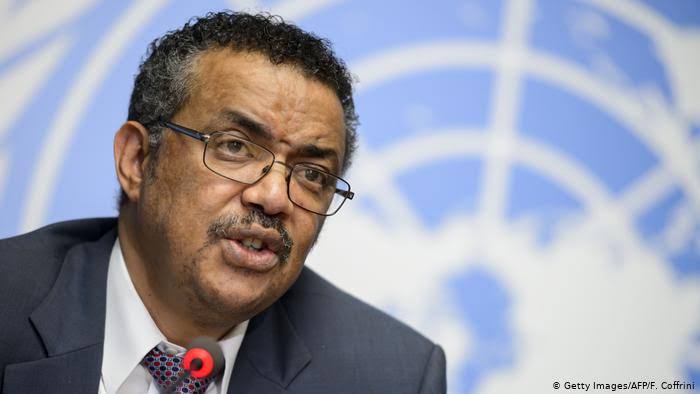
THE World Health Organisation (WHO) has urged countries to prioritise health systems in their budgets as part of ways to recover and rebuild from post COVID-19 and curb health inequalities across the world.
Director-General of the WHO Tedros Adhanom said this on Wednesday during his address in commemoration of the 2021 World Health Day.
He said the COVID-19 pandemic had caused so many sufferings on people, stressing that countries should key into things that would eliminate inequalities in access to health care.
According to Tedros, governments should prioritise stimulus spending and longer-term recovery plans
He noted that countries must commit to equitable access to COVID-19 vaccines, tests, treatments & services, within and between countries.
The DG also stated the governments should ensure that it strengthened health information systems and invest in better data to shine a light on inequalities as well as those that were being left behind.
On the inequality between rural and urban environments in various countries, the DG said governments should deliver equitable access to services and infrastructure to ensure safe, healthy and inclusive neighbourhoods in both areas.
He further stated that all governments should ensure that as they tried to recover and rebuild from the COVID-19, they strengthened primary health care as the foundation of universal health coverage.
He lamented that COVID19 pushed an estimated 120 million people into extreme poverty in 2019 and gender inequalities significantly increased as more women than men left the labour force.
“As we speak, rich countries are vaccinating their populations while the poor watch and wait, health inequalities are not just unfair, they make the Earth globe less safe and less sustainable,” Tedros said.
Nigeria’s post- COVID-19 health budget
The 2021 budget of Nigeria has been passed by the National Assembly. Checks by The ICIR show that the percentage of the health sector budget is only 3.06 of the nation’s total budget.
The total recurrent expenditure as contained in the budget is N415.23 billion while the capital expenditure is N134.59 billion. This means that the total allocation of Nigeria for the health sector in 2021 was N549.83bn out of the N13.58 trillion budget passed by the National Assembly.
The ICIR discovered that the recurrent expenditure of the health budget claimed 75.5 percentage while the remaining 24.50 per cent was meant for the capital expenditure.
In Nigeria, doctors, under the aegis of the National Association of Resident Doctors (NARD), have commenced a nationwide strike action over unmet demands by the government, including payment of salaries for house officers who have been owed for three months and resident doctors who are owed between three and six months.
As the strike action continues, President Muhammadu Buhari has continued to receive medical care in London, United Kingdom, while Nigerians die in hospitals.
VICE President Yemi Osinbajo has tasked the new Inspector General of Police Usman Baba to stamp out culture of abuses and impunity from the police.
“Stamp out the excesses and abuses and the culture of impunity from the police force,” the vice president urged the acting IGP while decorating him on Wednesday at the State House, Abuja.
He also tasked him to restore the dignity of the force by rebuilding the broken bridges of trust with the public.
While stating that Baba was assuming of office in a turbulent time in the life of the country, Osinbajo said his emergence as the IGP followed a thorough and rigorous consideration of other senior officers in the force by President Muhammadu Buhari.
“IG, you are assuming office at a very turbulent time in the life of our people. There are multiple threats to law, order and public safety. The role of law enforcement and particular that of the police force as primary agency charged with maintaining law and order has never been more important. The police is our institution of first resort, the first line of defence against crime and anarchy and the first sign of the strength of the state,” he said.
He urged Baba to use his reign as IGP to implement the ongoing community policing by the Federal Government so as to curb the growing insecurity challenging the sovereignty of the country.
“The challenges before you are indeed onerous and will test your mettle. The organisation you are leading is one that is itself facing several challenges. Your officers work still in extremely difficult conditions. And some face the threat of physical harm by terrorists, hostile non-state actors while in the line of duty but they have lived up to expectations.
“There is no question at all that there is a lot that needs to be done. There is a lot of work that needs to be done. Under your leadership, the Police must now rebuild in some ways also the broken bridges of trust to the public and regain the confidence of the citizenry. This is an ongoing challenge is an ongoing task that the Police Force and all of the senior members of the Police Force must take on as a responsibility, that of the continual process of building trust to the Nigerian people.”
“One of the ways you can do this is by implementing the community policing policy which had already taken off, and reconceptualising policing as a task carried out in partnership with local communities and by officers who are members of these localities.
“Under your leadership, the force must live up to all of the highest standards of professional conduct and compliance with the rule of law. It must significantly improve the welfare and working conditions of its officers.”
AMNESTY International claims that more than 1,531 people died in inter-communal violence mostly between herdsmen and farming communities, as well as in attacks by bandits, in the North-Central and North-Western regions of Nigeria.
This was contained in its 2020 Annual Report released on Wednesday.
The report says more than 420 civilians died in around 45 attacks launched in Nigeria’s Adamawa, Borno and Yobe states, disclosing that Boko Haram continues to recruit child soldiers.
Amnesty International also berates the Nigerian government for failing to “promptly, thoroughly and effectively investigate allegations of human rights violations and abuses” or bring suspected perpetrators to justice.
The report notes that no genuine steps were taken to investigate or prosecute crimes under international law committed by Boko Haram or the Nigerian military in the context of the conflict in the North-East.
“In Nigeria, brutal policing has resulted in security forces killing people for protesting in the streets, demanding their rights and calling for accountability. Both the armed group Boko Haram and Nigerian security forces continued to commit serious crimes in the north-east, including war crimes and likely crimes against humanity,” the report says in part.
“Government forces carried out indiscriminate attacks against villages and continued to detain thousands in inhumane conditions. Everywhere, excessive use of force resulting in unlawful killings, and torture and other ill-treatment were widespread,” it further alleges.
The report notes that such violations were prevalent in the context of enforcing COVID-19 measures and between 30 March and 13 April 2020, saying that least 18 people were killed by the Nigerian Correctional Service, the Police and the military.
In addition, Amnesty International notes a rising number of abductions and other crimes in Nigeria targeted at women and girls. Citing official statistics, it says over 3,600 rape cases were recorded during the COVID-19 lockdown. Barakat Bello, aged 18, and Uwaila Omozuwa, aged 22, were raped and killed in separate incidents in May and June of last year, the report further says.
As for the response to the global Covid-19 pandemic, the report paints a dismal picture of the failures of global leaders whose handling of the pandemic has been marked by opportunism and total contempt for human rights.
Amnesty International says world leaders “ruthlessly exploited the crisis and weaponized COVID-19 to launch fresh attacks on human rights.”
“COVID-19 has brutally exposed and deepened inequality both within and between countries, and highlighted the staggering disregard our leaders have for our shared humanity. Decades of divisive policies, misguided austerity measures, and choices by leaders not to invest in crumbling public infrastructure, have left too many easy prey to this virus,” says Amnesty International’s new Secretary General Agnès Callamard.
Callamard criticises leaders of rich countries, such as former President Donald Trump, for circumventing global cooperation efforts by buying up most of the world’s supply of vaccines, leaving little to none for other countries.
“These rich countries also have failed to push pharmaceutical companies to share their knowledge and technology to expand the supply of global COVID-19 vaccines,” he says.
The report further notes that international institutions such as the International Criminal Court and UN human rights mechanisms set up to hold states and individual perpetrators to account were wrestled into political deadlock by leaders seeking to exploit and undermine collective responses to human rights violations.
The organisation calls for more international cooperation to win the war against the pandemic. It says G20 members and international financial institutions must provide debt relief for the poorest 77 countries to respond and recover from pandemic.
“We are at a crossroads. We must release the shackles that degrade human dignity. We must reset and reboot to build a world grounded in equality, human rights, and humanity. We must learn from the pandemic, and come together to work boldly and creatively so everyone is on an equal footing,” it states.
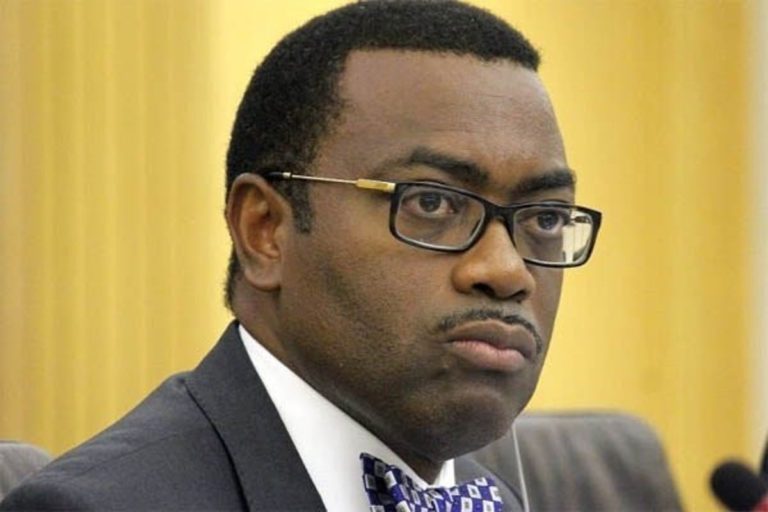
THE African Development Bank (AFDB) says it will allocate $25 billion to climate change adaptation over the next four years. The fund is targeted at addressing Africa’s huge vulnerability to adverse impacts of climate change and other emerging pandemics.
President of the AFDB Akinwumi Adesina made this known on Tuesday when he represented Nigeria’s President Muhammadu Buhari at the Leaders’ Dialogue on Africa’s Covid-19 Climate Emergency virtual meeting attended by at least 30 African Leaders to discuss the challenges of facing the pandemic alongside climate change, and call for scaled-up actions and financing to combat its harmful effects.
Adesina said although Africa was the lowest emitter of carbon, it faced the worst consequences and impacts of climate change, adding that the COVID-19 stimulus packages should not deprive countries on the continent of resources needed for climate change.
“Ten of the top 12 countries most at risk of drought are in Africa. Eight out of the top 12 countries affected by agricultural risks are also in Africa. Yet, Africa does not get the resources it needs to adapt to climate change. Globally, only 10 percent of climate finance goes into adaptation, and Africa has received only three percent of global climate finance,” he noted.
According to him, the combination of COVID-19 and climate impacts had severely devastated African economies, yet countries around the world had collectively allocated over $20 trillion in COVID stimulus packages, thereby reducing the resources available to combat climate change.
“Climate change cannot wait while we address COVID-19. They must be addressed together. With Lake Chad shrinking, the less than 40 percent of the population that has direct access to potable water is expected to further decrease. A rising sea level of one meter by 2100 could lead to a loss of 75 percent of Nigeria’s delta area,” Adesina warned.
The AfDB president said climate change should be mainstreamed into stimulus packages to help African countries to ‘build forward better’ and called on development partners to urgently allocate more resources to adaptation in Africa in general and to the Africa Adaptation Acceleration Program (AAAP) in particular.
The AAAP is an initiative to address regional adaptation gaps and support the transition of countries to low carbon development pathways. It also seeks to mobilise additional $12.5 billion to finance adaptation on the continent.
President of Ethiopia Sahle-Work Zewde, who also spoke on the issue of partnerships, highlighted initiatives undertaken by the Ethiopian government to build a climate resilient society and emphasised the importance of a globally coordinated response against these challenges affecting all nations.
Other Presidents from Congo, Kenya, Senegal and Zimbabwe talked about the need for support to accelerate the effort against climate change, which had affected food security and health on the continent.
The Director-General of the World Trade Organisation Ngozi Okonjo-Iweala said Africa remained a continent with immense opportunities if urgent action was taken to contain the pandemic, deal with the serious debt burdens and work on plans and tools to tackle climate change.
The Secretary General of the United Nations Antonio Guterres also lent his voice to the call by asking G7 members and other developed countries to increase their share of climate finance allocated to adaptation and resilience from 20 to 50 percent of their total climate financing.
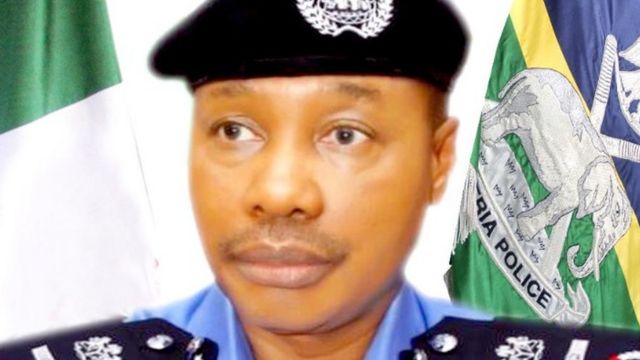
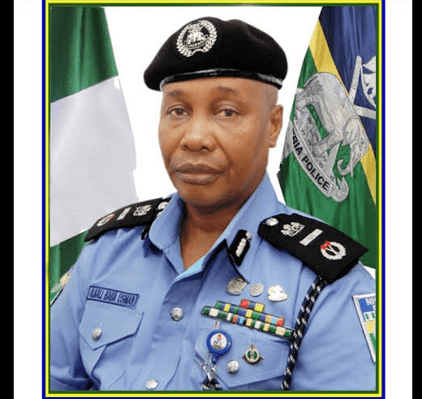
THE newly appointed Inspector-General of Police Usman Alkali Baba has only two years left in the Nigeria Police, The ICIR has found.
Baba was appointed Acting IGP on Tuesday by President Muhammadu Buhari to replace former IGP Mohammed Adamu.
However, he has only two more years to spend as an officer of the Nigerian Police Force.
This is because the Acting IGP admitted in a 2014 interview that he joined the Police Force “sometimes in March 1988.”
He said this during an interview with The Vanguard published on September 24, 2014.
“Alkali Baba Usman was born sometime in 1963. I am an alumnus of Bayero University, Kano, and the University of Maiduguri, UNIMAID.”
In his response in the interview, he had said, “I am married with children. I joined the Nigerian Police Force sometime in March 1988. I rose from the rank of ASP, and thence to the rank of Commissioner of Police, last January 27th.”
This means that he is 33 years in service and 58 years of age. The Police Act prescribes a maximum of 35 years of service and/or 60 years of age for retirement -whichever comes first.
Acting IGP Baba should be 35 years in service and 60 years in 2023, hence due for retirement in the election year.
Part 111 Section 7 (6) of the Police Act, repealed as the Police Act Cap. P19, Laws of the Federation of Nigeria, 2004, prescribed a four-year single tenure for a person appointed to the office of the IGP.
The appointment of an IGP is subject to the provisions of clause 18 (8), which stipulates that every police officer shall, on recruitment or appointment, serve in the Nigeria Police Force for a period of 35 years or until he attains the age of 60 years, whichever is earlier.
If, like former IGP Adamu, his tenure is extended, there could be legal fisticuffs, especially because 2023 is an election year.
Two appointments in three months
In December 2020, Usman was promoted from the rank of Assistant Inspector General of Police {AIG) to Deputy Inspector General of Police (DIG).
After his appointment, he was also appointed as the Head of Force Criminal Investigations Department (FCID).
Just three months after his appointment as the Head of FCID, he was appointed the Acting IGP.
Usman’s Proffessional History
The Yobe-born IGP holds a master’s degree in Public Administration (MPA) and a Bachelor of Arts (ED) in Political Science.
After serving as an Area Commander in Kwara State, he was appointed the Second-in-Command in Ebonyi, before he was made Assistant Commissioner in Kaduna State.
He was the Divisional Police Officer (DPO) in Yola, Gombe, Kaduna, and Jos.
Subsequently, he served as Delta State Commissioner of Police in 2014 before he was transferred to serve as Commissioner of Police in FCT.
He also served as the Assistant Inspector-General of Police in charge of Zone-5 which includes Benin, Zone-4 Makurdi, Zone-7 Abuja.
Before he was appointed Head of FCID, he had been the Acting DIG in charge of finance and administration.
NIGERIANS have criticised the appointment of Usman Alkali Baba as new Inspector General of Police (IGP), saying that another ‘northerner’ has been appointed head of the nation’s security outfit.
Minister of Police Affairs Muhammad Maigari Dingyadi had announced on Tuesday that Usman was appointed the new IGP by President Muhammadu Buhari to replace Mohammed Adamu.
However, the appointment angered many Nigerians on the social media, who said the president had again appointed another head of security from his region.
Cheta Okorafor @Cheta_Okorafor, while reacting to the announcement, askedif there were only northerners in Nigeria and why there could not be an Inspector General of Police from the Igbo tribe in the country.
“Another northerner. Are northerners the only people in Nigeria? Why can’t an Igbo man become IGP?” Okorafor asked.
Taking the same position as Okorafor, African Angel @KelvinpaulX accusedthe president of setting precedence in his appointment by selecting people from his religion and region into important offices in the country.
“Buhari has set a precedent in his appointments of people from his region and religion into important offices in the country thereby ignoring federal character principle,” Angel said.
Voice of Reason @TheVoic61802007 saidas a young boy growing up in the country, appointments by President Buhari had a way of making him think that Nigeria was only for a particular section of this country.
Sylvester @AgihSylvester ironically said the appointment was possible because there was no southerner under the current administration fit to head any of the security outfits in Nigeria.
Olanusi Akintayo @OlanusiAkin accused the president of marginalisation in federal appointments in the country.
“The more you complain about Buhari’s marginalization of other ethnic groups in Federal appointments, the more he displays an I-don’t-care attitude. I think d people fuelling the embers of disunity in this country are the very people at the corridors of power; Aso Rock in particular,” Akintayo said.
Taking a religious outlook at the appointment, Andrew @Andrew70298095 askedwhy appointments were mostly for people answering Muslim names.
“But why, why always a Usman or Ibrahim or Muhammed or Aliu and others on the list each time appointments are made,” he questioned.
Like Andrew, Olu Adenodi @OluAdenodi said the president travelled out of the country before he announced his preference for ‘another Muslim.’
“DIG USMAN ALKALI BABA replaces Adamu whose tenure was extended on February 1 for three months. The President waited until he is far away in the UK to announce his preference of another Muslim to fill the all round table of Nigeria’s security personnel in the hands of Northerners,” Adenodi said.
What the data say
A dive into data of heads of security agencies in Nigeria further justify Nigerians’ agitations against the lopsided appointment of President Muhammadu Buhari.
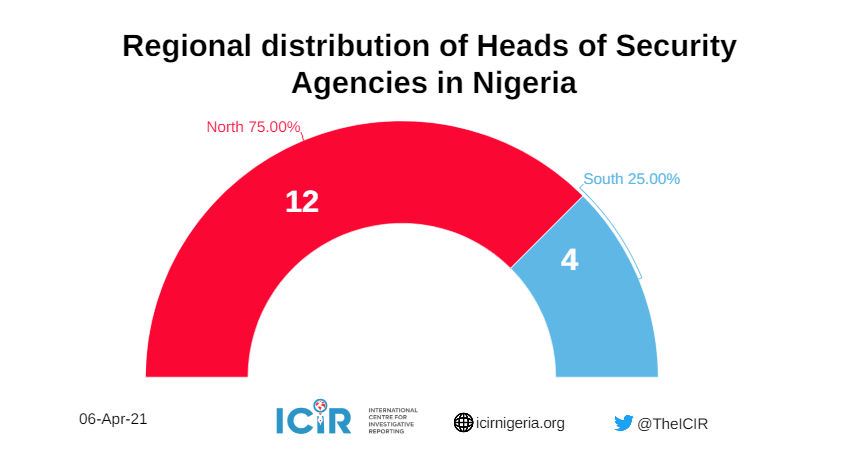
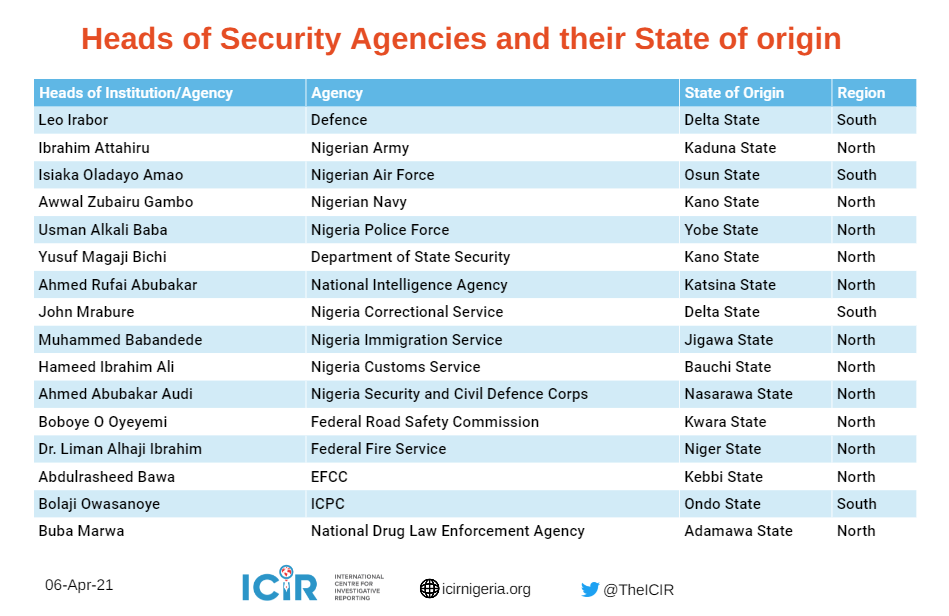
As of April 6, 2021, a regional analysis of the heads of security agencies, including paramilitary and antigraft agencies based on their state of origin shows that 12 out of 16 of them (75 percent) are from the northern part of the country, while just four (25 percent) are from the southern part of the country.
These agencies are Defence, Nigerian Army, Nigerian Airforce, Nigerian Navy, Nigeria Police Force, Department of State Security (DSS), National Intelligence Agency (NIA), Nigeria Correctional Service, Nigeria Immigration Service, and Nigeria Customs Service.
Others are Nigeria Security and Civil Defence Corps (NSCDC), Federal Road Safety Commission (FRSC), Federal Fire Service, Economic and Financial Crimes Commission (EFCC), Independent Corrupt Practices And Other Related Offences Commission (ICPC), and the National Drug Law Enforcement Agency (NDLEA).