THE Management of Deeper Life High School has suspended its principal in Uyo, Akwa Ibom state campus over allegation of sodomy of an 11-year-old schoolboy, Don Davies.
The suspension followed a viral videoposted by the mother of the victim alleging that her child was being molested by senior students of the school.
When contacted by The ICIR, Mrs Solomon Ndidi, the school principal said she has been suspended from the school following the allegation.
She added that the Akwa Ibom State government has taken over the matter and is currently investigating the matter.
“Davies is my student I can’t deny it. What happened in the school is what the outsider cannot understand. The matter is under investigation now because the government has taken over,” Ndidi said.
“I won’t be able to talk much now because I am also under investigation. The School authorities have already suspended me. So, I am going to plead for patience until the government completes its investigation. The police and DSS are involved,” She added.
An official at Deeper Life High School headquarters confirmed to The ICIR that Ndidi has been suspended.
He said the school has also commenced an internal investigation into the matter but would wait for the outcome of the investigation by the Akwa Ibom State government.
“We do not want to preempt the outcome of government investigations,” the official said.
When told that there have been past allegations of molestation in Deeper Life High Schools across the country, he replied that there is no evidence that such criminal conduct had happened before. And whoever makes such a claim should provide evidence.
In the viral video currently trending on Social media platforms, a woman identified as Deborah Okezieh said her 11-year-old child who is a student of Deeper Life high school was severally sodomised by senior students of the school.
According to her, she discovered this when she requested a private meeting with Davies during her visit to the school.
When I met him in that condition, I took my son into the car, he was afraid, he said that if he talks, they would kill him,” Okezieh narrated in the video.
She noted that it took the help of another student in the school to know what was happening with her child.
“I had to beg a boy who talks like a parrot who told me that because he wees, he was taken from JSS 1 to SS1 and when he gets there, senior students in the hostel used hands and legs to penetrate his anus,” She further stated.
Confirming the allegations raised by his mother, Davies said, “When I get there, they would remove my boxers,” the 11-year-old said.
Davies added that the students would tell him that if he reports to the principal or his mum, they would have him killed.
In another video by the mother of the victim, she said the principal of the school, Ndidi pleaded to her not to go public with the matter adding that the school would pay the Child’s hospital bills.
Okezie said the principal did not want her to go public with the issue because of ‘who is involved’ in the case against her child before eventually removing her from the Whatsapp group of parents of children in Deeper Life High School, Uyo Campus.
IN factories owned by Chinese and Indian investors in Nigeria, low-cost labour, hazardous work without protection, breach of minimum wage law, and human rights abuse are the norms. And young Nigerian workers are vulnerable to avoidable bodily harm, physical and emotional injuries. Yet, these companies continue to exploit their workers, taking advantage of the Nigerian weak laws and poor regulatory system. LUKMAN ABOLADE reports.
AT 26, Vincent Enahoro left his hometown of Oah Okpuje Iuleha in Owan Local Government area, Edo State for Ota in Ogun State, in pursuit of greener pastures.
Against his parents’ advice, Enahoro left Okpuje for the industrial town in the southwest state, with s burning desire to make success of his life by dint of hard work. His dream to hit fortune outside his hometown was fired by Michael, his friend who came home from Ota during the yuletide in 2013. Michael had told him of endless opportunities in Ota, a town dotted by many factories. Enahoro did not want to miss such an opportunity. So, weeks later, he left home for Ota together with his friend.
The End Of A Dream
Vincent Enahoro, a former worker whose finger was cut off while working for MINL. Photo Credit: Lukman Abolade
Just as Micheal had told him that securing a job would not be difficult−he got a job factory job, but as a ‘helper’.
In factoryspeak, a ‘helper’ is casual or temporary worker engaged through a recruitment firm to work in the production factory.
Workers in this category are not given the good treatment of staff and can be easily stopped from working as there is no contract between them and the company.
Enahoro got a ‘casual’ job with a company called Manaksia Investment Nigeria Limited (MINL), a steel company sited inside the Ota Industrial Estate.
Late 2013 when he started work at Manaksia, he worked from 6 o’clock am till 7 pm every day and was paid N570 (less than $2) per day.
Helpers’ wages are calculated on a daily basis and the accumulation is paid to them at the end of the month.
In MINL, all helpers are to compulsorily work everyday including Sundays, while their accumulated wages are paid at the end of the month. Enahoro was later employed as a contract staff because he was hardworking, but with no employment letter and no increase in wages.
“When I joined as a helper in 2013, I was paid N570 per day to work from 6 am to 7 pm, Monday to Sunday, no resting day,” Enahoro said as he narrated his ordeal.
For his first three years at the factory, the hardworking young man, now a father of two, earned a total of N17, 100 at the end of every month. For working 365 days in a year, the highest Enahoro could earn in a year was N205, 200 if there were no deductions for late coming and other infractions.
“Sometimes when we come late, they deduct our money, so I mostly have about N13, 000 or less to go home with at the end each month.”
This continued until 2016 when he was considered for a promotion for working with the companyfor three years. His daily wage was increased from N570 to N600 in 2016− a N30 increase.
“In 2016 it was increased to N600 per day. One year later, they increased it to N700 per day but for Saturdays and Sundays, I was paid N750 since I am a contract staff,” Enahoro said.
This was what he earned while working as a machine operator in MINL factory, a role pivotal to the daily production of the company.
Enahoro said he was never trained to use the Cut to Length Machine but it was the only way through which he could get a job as a contract staff with the company.
“They did not train me on how to use the machine but they said if I want them to employ me as a staff, that is the only place they can employ me,” Enahoro said.
For a long period of time, the Cut to Length (CTL) machine developed continuous faults and when he complained, his complaints were disregarded as an excuse for being lazy.
This went on for years until one unforgettable Sunday morning.
He had just finished the night shift from Saturday, and he was made to work overtime on Sunday because ‘production materials just arrived’.
While he was using the machine, a heavy ruler in the machine forcefully held his finger down, and he groaned in excruciating pain as he helplessly watched an iron ruler chop off his left index finger.
A picture of Enahoro’s hand Photo Credit: Lukman Abolade
“I was trying to adjust something from the ruler, then I stopped the machine and raised up the ruler, while I was cleaning the ruler, I didn’t know how the ruler suddenly picked my hand with the hand glove, that was how I lost part of my hand,” Enahoro recalled the horrible experience.
Co-workers quickly took him to Shirish Clinic, a nearby hospital in the town, where he spent six weeks in the intensive care unit.
Another view of Enahoro’s hand after his incident at MINL Photo Credit: Lukman Abolade
During his time at the hospital, MINL continued to pay his wages so that he could give money to his wife and children to feed themselves and take care of the house he
just started building.
Immediately he was discharged, the company called him to resume work or his payment would be stopped; but Enahoro’s hand was not yet healed.
With bandages wrapped around his hand, he had to continue working on the same machine without it being fixed.
He had no option because he has a wife and children to feed.
“I would first go to the hospital for treatment, then go to work because the hand has not healed completely and I don’t want them to stop my salary,” he said.
After seven months of working on the same machine that chopped off his finger, his wife, Sandra and some friends convinced him to resign and demand compensation from MINL
He resigned, but as earlier threatened, his salary was stopped immediately he submitted a resignation letter to the factory.
MINL enrolled Enahoro on the Nigeria Social Insurance Trust Fund (NSITF) where he now receives N1,667 (less than $5) every month.
It took the intervention of rights organisation, Human Rights Initiative for the Downtrodden (HIRD) based in Lagos State before MINL placed him on a monthly arrangement of N18, 000.
For a few months, he received the N18,000 from MINL but when COVID-19 hit Nigeria and the world, the situation changed.
His monthly arrangement was slashed by 50 per cent, Enahoro now receives N9000 from MINL.
“I went there in April to receive the N18,000 then I saw that it was N9,000 that was written on the payslip for me to sign, I asked why and they said it is because of COVID-19,” Enahoro said.
During that April, he had borrowed up to N10, 000 with hopes that he would pay his debt after collecting the monthly stipend until he was told that this payment has been slashed.
“I didn’t have any other choice,” he sighed.
Enahoro said he has been unable to secure a job in another company due to his incomplete fingers.
“I have gone to four companies in this estate and they have refused to employ me because they say it is a partial disability,” he lamented.
He added that since the incident, he has refused to go home to his parents because they had kicked against his decision to go to Ogun State for work.
“I have not been able to go home since then because my father would say he had warned me not to go but I did not listen, I have not seen them since that incident,” Enahoro said as tears rolled down his cheeks.
He wants permanent compensation from MINL through which he can start a business of his own as companies have refused to employ him but MINL has refused to pay him.
MINL refused to reply to questions about Enahoro’s case.
One too many cases
Cases of injuries abound in Nigerian factories where victims of work-related hazards are denied compensation.
In some cases, after completing secondary school education, young Nigerians approach such factories for work in order to raise money for tertiary education.
Rather than realize their life goal, many of them who have opted to fend for themselves at factories owned by foreigner investors especially those owned by Indians and Chinese, often have their lives either cut short due to fatal work-related accident or sustain major injuries that lead to permanent disability.
In some other cases, they work for many years but are never able to save up for education due to poor remuneration from the foreign-owned companies.
Although the Nigerian Government does not have a database of labour incidents, there are several reports of industrial accidents in such factories.
In 2003, the International Labour Organisation (ILO) statisticstates that there are 63, 236 cases of work-related fatality in Nigeria while 16,673 are caused by dangerous chemical substances.
According to UNFPA, Nigerians within the age group of 15-64years are the highest proportion of the over 200 million population.
About 54 per cent of the total population are of working category representing a high rate of the working population.
Many see this population as prospects for a strong workforce for Nigeria. However, while the majority are unemployed, a large number of them are engaged as menial, casual or temporary workers, working more and earning less from factories owned and controlled by foreign investors.
A Day At Gemini Steel – Hazards That Nigerians Face While Working
To have a direct experience of what young Nigerians encounter in foreign-owned factories in Nigeria, the reporter went on to search for a job at some factories in Lagos and Ogun states industrial estates.
On August 26, at about 7:15 am, the reporter arrived at the Ikorodu Industrial estate in Lagos State.
Young men, women and few older ones’ flock around the industrial estate, some resuming work, while others are heading home after their night shift.
The reporter attempted to get a job with many factories in the estate but he was rejected, mostly on the excuse that it is almost the end of the month.
“If you can come on September 1st, I can assure you that you will get a job here but now, the voucher has closed, if you go to any of our contractors, they won’t employ you,” a security officer told the reporter.
After failed attempts at six factories inside the Ikorodu Industrial estate, the reporter eventually got a job with a steel company named Gemini Steel Investment Limited through a friend who introduced him to one of the supervisors in the factory.
The supervisor told the reporter that a section of the factory is in need of a worker.
Immediately, he introduced the reporter to his soon-to-be co-workers in the factory, Tosin and James.
Tosin is a 19-year-old, secondary school graduate of Odogunyan Senior Grammar school in Ikorodu Lagos State.
As he interacts with the reporter, Tosin said he has been changing jobs since he left secondary school with no clear plan of pursuing tertiary education due to his family’s finances.
Tosin lacks the financial means to pursue tertiary education but had learnt fashion designing while he was in secondary school. He had plans to save up to get two sewing machines and a shop to start tailoring business.
However, for three years now, his dream has remained elusive as he has been unable to save enough due to the pittance he earns as wages.
“I spend most of it on food and transportation and how much are they paying me, out of all the places I have worked in this estate, the highest I have ever earned is N700 per day,” Tosin disclosed.
His ‘co-worker’, James said he joined Gemini Steel three months ago. For him, he has no plans, he only wants to live each day as it comes.
As the reporter and the workers discussed, James flipped a rolling paper, mostly called ‘rizler’ out of his bag then a small wrapped Indian hemp in white leather, he lit it up then began to smoke.
Tosin and James; casual workers at Gemini Steel. Photo Credit: Lukman Abolade
As he blew the smoke, he said “bros, you no dey smoke? this our job, you need to get high before you start o’.
Shortly after, they both left the reporter and proceeded to their workplace to commence the day’s work.
After spending several hours waiting for the head of the section to approve the reporter as a worker, he finally appeared.
A full-bearded Indian man, in his late 30s, who eventually told the reporter to resume work the following day.
James had told the reporter that the Indian, whose name is Sassana but mostly called ‘master’ is the head of the section.
Pointing to one of the workers, the master said ‘tell him, tomorrow come’ the worker translated this to the reporter saying the Indian had asked him to resume the following day.
On Thursday, the reporter went back to Gemini Steel, he had already been introduced to the security personnel at the gate who opened the factory gate for the reporter that morning.
Without registration or issuance of an identity card, he was listed as a worker in the factory.
The day’s work began around 8:45 am, the reporter was not given any protective equipment to work with.
When he asked ‘master’ for one, he referred him to his co-workers in the factory. But James said hand gloves are seldom given. He said he had gotten his from a worker that left work a few weeks ago.
In Gemini Steel, irons are melted and reproduced through coke ovens, exposing the workers to very high heat radiation otherwise known as hyperthermia but they are left unprotected.
There are many departments in Gemini Steel, the reporter alongside other Nigerian workers were assigned to work at the heart of the company’s daily production, a section called CCM (Continuous Casting machine).
In the section, the Continuous Casting machine is used to cast the semi-solid metal as it comes directly from a cooling liquid metal machine
To cast the metal to the desired form, the metal needs to bebetween 30 to 65 per cent solid thereby generating high heat radiation.
In the department, some other workers are to lift the semi-solid hot metal with the aid of iron rods to where it would be cooled and eventually turned into a strong iron.
Despite the high risk of an industrial accident in the department, none of the workers including the reporter was equipped with any form of personnel protective equipment (PPE).
A Nigerian worker at Gemini Steel without proper protective equipment. Photo Credit: Lukman Abolade
As the deafening sound generated from the use of heavy machines fills the factory, the reporter was shown how to use some part of the machine.
All this without any form of protection for the reporter or the other workers, the company plays ignorant of the physical risks the workers are being exposed to.
In a steel company where the continuous casting machine is used, the workers are exposed to several dangers including high radiation heat, fire due to grease/hydraulic line leakage, burn injury that could be caused by a hot surface and other hot equipment in use.
Studies have shown that due to the usage of the Continuous Casting Machine, the workers are prone to suffer from Carbon Monoxide (CO) poisoning emitted from the machine.
Carbon monoxide is harmful when excessively inhaled because it displaces oxygen in the blood, the heart, brain and other vital organs the body. Large amounts can overcome the worker’s body system that could lead to loss of consciousness and suffocation.
The workers were not provided with a full-facepiece pressure-demand self-contained breathing apparatus to prevent them from inhaling too much CO as they spend the whole day working on the machines with only an hour break.
Apart from chemical dangers, there are wasted sharp pieces of iron scattered on the floor of the factory.
The reporter only had his palm sandals on all through the day.
One of the workers, Alex, who is in charge of casting the iron from the machine, was seen putting on bathroom flip flops and torn gloves instead of a safety boot and gloves.
Like other workers in the factory, Alex is unprotected and exposed to the dangers that may occur in case of an accident in the factory.
In the case of a fall from a height, injuries sustained could be fatal because none of the workers was provided with a safety helmet.
In fact, most of the worker Gemini Steel factory were seen wearing slippers, no helmet, no safety boot, no safety vest or eye shield.
Section 5.3 (III) of the policy states that employers are to ‘Provide at no cost to the worker, occupational health protection and personal protective clothing and equipment, which are appropriate for the nature of the job’ but Gemini Steel failed to do so and no one is checking.
The lack of provision of safety equipment for workers does not only happen in Gemini Steel but in many other factories too.
Andy Robinson, a former factory worker who worked with Shongai Technologies, a printing outfit in Ogun State-owned by Indians, also told the reporter that all through his span in the company, he was never provided with any safety equipment despite working with heavyweight machines.
Before he left the company, his Indian boss had hit him in the face that made him bleed through his ear before he lost consciousness.
Andy Robinson, bedridden after he was slapped by his Indian boss at Shanghai Technologies. Photo Credit: Lukman Abolade
Robinson was admitted in the hospital for days because of the injury sustained from the incident.
He said many workers in those factories usually suffer a series of human rights violation besides regular work-related accidents.
Used and Condemned
Young Nigerians who have suffered one form of accident and sustained life-threatening injuries while working in factories felt ‘used and condemned’ by their employers.
In the Ota Industrial Estate is Dada Stephen, who used to work for Aarti Steel Investment, a steel company also owned by Indian investors.
Dada Stephen, a former worker at Sonhart Investments. Photo Credit: Lukman Abolade
Stephen, a former worker with Sonhart investment was an assistant operator of a manufacturing machine in the steel factory, he told the reporter that during his stay, no glove, helmet or safety boot was ever provided.
His case is not so different from Enahoro’s, for he also had part of his thumb sliced by a factory machine in Sonhart Investments factory.
Dada Stephen’s hand after an accident while working for Sonhart Investments. Photo Credit: Lukman Abolade
Stephen said after his accident, he was given poor medical attention by his employers and the contracting firm before he was relieved of his job because his ‘hand is not complete’.
According to him, immediately the incident occurred, he was taken to Shirish hospital, where Sonhart staff are treated in case of accidents but he was not treated because he is not a full-time staff then he was taken to the State Hospital, Ota.
Maria Dada, Stephen’s wife, told the reporter that due to the poor medical attention given to her husband, he was made to suffer for many nights as he mostly groaned in pain, and in the middle of the night, he cried like a hungry infant but the company paid little or no attention to him.
Maria said that was the hardest part of her life as she was subjected to nursing her five months baby and injured husband at the same time.
Speaking on his work condition at the factory, Stephen said he was made to buy a safety overall for N2,000 and was not provided with any other protective equipment before he got injured.
Godwin Okoduwa, MINL’s Safety manager denied Stephen’s statement that he wasn’t provided with protective equipment.
However, he did not refute Stephen’s claim that he was made to buy his own safety overall.
Falling to provide safety tools is an act against the National Safety Policy of Nigeria.
Labour officers from the Nigerian Ministry of Labour and Employment are saddled with the responsibility of visiting and checking the factories for proper compliance with protective measures and other stipulated regulations. But this duty is rarely undertaken.
Earning N750 in 12 hours – The modern definition of slavery
Despite the tenacious and drudgery work conditions, as Nigerian workers strive to earn a living, the foreign-owned companies pay them very poorly and below the minimum wage in Nigeria.
For the companies, it is a system of work more, earn less, low-cost labour is a norm, minimum wage law of N30,000 in Nigeria is non-existent to most of them.
21-year-old Micheal, a worker at Merchant Investments, Ota Ogun State. Photo Credit: Lukman Abolade
Every morning, Michael, 21 years old, a worker with Merchant Investment Limited walks an hour to work. His house is far away from his workplace but the wages he earns cannot transport him to and from work. Micheal earns N500 every day.
“I stay in Ijoko, from Ijoko to Sango is N150 from Sango to the Estate gate is another N150 then I would have to walk about another 20 minutes in the estate to get to the factory, go and come I would spend N600,” said Michael as he explained his daily movement.
Spending N600 out of his N500 wage is impossible, staying home is an invitation to hunger, Michael treks from home to work and vice versa every day.
Despite the hurdles of getting to the factory, sometimes he goes to the factory and he is told that he is not needed for the day. There is no guarantee of working every day in Merchant, except for the few full-time staff in the factory.
On one Thursday, when this reporter met Micheal at the gate of the factory, he had just been told there is no work for him.
This caught the reporter’s attention then he joined other workers standing outside of the factory in the guise of also looking for a job.
Merchant Investors Limited has been in existence for more than a decade manufacturing mosquito insecticides, importation of foreign biscuits, bicycles, safety matches, pressure stoves among others.
Job seekers standing at the gate of Merchant Investment. Photo Credit: Lukman Abolade
At the gate of the factory, about ten workers were seen waiting to be granted entrance into the factory while other job seekers stood outside.
The reporter and other applicants waited outside of the gate for more than an hour but nothing happened.
Later, a few left to continue job hunting at other factories, but the reporter waited until the security officer opened the gate asking if the reporter wanted to work.
“Yes sir, ”, the reporter responded eagerly, then the gate was opened.
At the gatehouse was another security officer, a woman in her late 30s and another man who sat in front of a table where many green and red cards with the heading ‘Merchant Investment Limited’ were spread.
A quick inspection revealed that the cards belong to the workers in the factories according to their cadre.
The workers with the green card are the junior cadres who earn N750 every day working from 7 am till 6 pm while the red cards are for the senior workers who earn N850 per day.
For the green-card holders, they earn N19,500 per month while the red-card holders earn N21,450 at the end of each month.
The man in charge of the cards offered the reporter a job as a security officer with the company.
“The only position we have is security, you just have to open the gate for the people coming in and going out, it is not as stressful as working inside the factory but the pay is N15,000 monthly,” the man said.
He added that for the security job, there are no off days, “You will have to work from Monday to Sunday, you will resume by 7 am and close by 8 pm after every other worker has closed,” he added.
In all the factories visited by this reporter, it was discovered that they mostly engage the workers on contract and do not offer them employment thereby avoiding responsibilities.
Lekan Busari, a manager of Divine Identity, a recruitment firm that provides low-cost casual workers for factories in Ogun state. Photo Credit: Lukman Abolade
In another factory close to Merchant, Aarti Steel, the reporter sought employment through a contracting firm in the estate called Divine Identity Nigeria Limited registered with the Corporate Affairs Commission (CAC) in 2010 with registration number 915572.
A source had told the reporter that Divine Identity, owned and managed by one Lekan Busari provides low-cost labour workers to many factories in the company.
The reporter met Lekan inside a blue painted container where he calls his office. He gave a registration form to the reporter. When asked how much the company would pay he said, ‘Aarti steel is one of the companies that pay the most in the estate, you would get N800 per day’.
With N800 per day excluding the four Sundays in the month, the reporter would earn a total of N20,800 at the end of the month.
Lekan also said for the reporter’s first month on the job, he would deduct N800 from the worker’s wage as his own registration fee.
When he was later called over the phone to question him over recruiting workers below minimum wage, he dared the reporter to come to his office to ask the question but the reporter did not go.
In an interview with another executive director of an employment firm in the estate, he lamented that the foreign-owned companies in the estate see Nigerians as the cheapest labour in the world.
“I can tell you that these foreigners see Nigeria as the cheapest labour in the world. That is why they rush here, they don’t pay well and they know nobody would challenge or stop them,” he said.
He added that his employment firm operates in other parts of the country and the tradition is always the same.
“Even some industries owned by Nigerians are starting to imitate them in meting out various injustices to the workers most especially in terms of payment,” he added.
When asked why his firm and others in the estate indulge in contracting workers to the factories knowing they would not be paid up to the minimum wage, he said it has become a tradition in the industrial estate.
“If I refuse, another firm would get the workers and I am a businessman, I also need to survive” he noted.
On the disparity between full time and part-time workers, the director said practically, the latter deserves better pay than the former due to the nature of work they do.
He added that apart from working for more hours, the casual workers are made to do the hard work while the full-time workers are given supervisory roles.
TheNational Minimum Wage Act 2019 exempted workers employed on a part-time basis in the implementation of the new wage of N30,000.
According to the Act, ‘part-time work means work of a duration shorter than those for comparable full-time work in a sector or occupation,’ however, these workers and the full-time workers labour for the same hours.
Obsolete, outdated Labour Law
A study of the Nigerian Labour Act shows that the law is unable to properly address the many issues surrounding the use of casual workers in Nigeria.
Repeated checks of the Act as seen on the official website of the Federal Ministry of Labour and Employment reveal that there is no representation or acknowledgement of casual workers.
Despite the high rate of casual workers in Nigeria, the words ‘casual,’ ‘temporary worker’ and ‘part-time’ do not appear in the whole of the nation’s Labour Act.
Also in the Employee Compensation Act (ECA) of 2010, the word ‘casual’ and ‘part-time’ only appeared once.
However, unlike the Nigerian Labour act, theGhanian Labour Act dedicates a whole section to the casual and part-time workers in their country.
There are six subsections of Act that address issues of casual employment including remuneration on public holidays for part-time or casual workers in the Ghanian labour law.
“Our labour law has become obsolete and ineffective to fit the realities of today, reviewing it has become long overdue,” says David Eyongndi, a lecturer at the College of Law in Bowen University.
Eyongndi, who wrote a paper on casual employment in Nigeria added that he gathered that most companies in Nigeria including banks and other corporate organisations make use of more casual workers than permanent workers in order to avoid proper remuneration and other benefits deserved by the workers.
The Senate, however, seems to be quiet about the labour law but in the House of Representatives, the bill was sponsored by two lawmakers in a year after the other has been stuck.
In 2019, Femi Gbajabiamila, the Speaker of the House of Representatives sponsored a bill that scaled all readings in the green chamber but later got stuck.
In 2020, Tasir Raji, another member of the House Representatives sponsored the same bill which has passed first and second reading but is still lying on the shelf at the lower chamber.
Where is the Nigerian Labour Congress?
On its website, the NLC says the fundamental aims and objectives of the Congress are to protect, defend, and promote the rights, well being and the interests of all workers, pensioners, the trade unions and the working class in general, among others.
So, NLC is the only organisation saddled with the core responsibility to protect Nigerian workers, but the Union appears to have lacked the capacity to often discharge this duty.
Ayuba Wabba, the president of NLC had accused some establishments of forbidding their workers from joining the union in order to suppress their rights.
But there has been no publicly known move by the NLC to unionize casual workers despite making up a larger number of Nigeria’s workforce.
The reporter contacted the leadership of the Union several times to ask questions over this but there was no reply.
Text messages and calls to the secretary of the NLC were ignored.
A visit to the headquarters of the NLC was also futile as he was said to be in a meeting which had no stipulated time to end.
THE people of Ebijaw community and its environs in Odigbo Local Government Area of Ondo State may continue to pass through the proverbial hell whenever they travel out of their communities to urban areas if the road linking these communities, which was approved for construction by the Niger Delta Development Commission (NDDC) since 2017 remains abandoned.
The road, whose Invitation to Tender was published on Vanguard newspaper of March 15, 2017 (page 54) was consequently awarded to EDNAW James Limited on September 22, 2017 in the sum of 199,750, 000 (One hundred and ninety-nine million, seven hundred and fifty thousand naira).
Investigation reveals that ENDAW James Ltd actually commenced work April 2019 as expected but stopped after few months. The contractor was said to have commenced work at a wrong site (Asejire) rather than Obajare as awarded by the NDDC, which led to protest and resistance from the concerned communities. Following this outrage, the contractor abandoned the project in August 2019, and has not returned to site even as at the time of filing this report.
Speaking to this reporter on his trip to the area, Chief Amusa Ojo, Bale of Obajare and its environs said their joy knew no bound when one Engineer Alabi came to meet him and his people and told them he has been awarded the contract to construct road and bridges from Obajare to Ebijaw, adding that he (Alabi) thereafter requested to know the boundary so as to commence work immediately.
The nonagenarian, further speaking on the circumstances surrounding the abandonment of the project through Fatai Olasehinde, a former supervising councilor of Ebijaw ward, added that after supervising the site, Engineer Alabi left with the promise of getting back to them after eleven days to kick start work but later came to commence work at Asejire, a far distance from Obajare, and a different ward from Ebijaw ward. Chief Ojo noted that when he (Alabi) was confronted on the sudden change, the contractor said a politician directed him to commence work at that location.
The irony, however, is that the signpost bearing the contractor’s names and nature of the contract is mounted at the wrong site (Asejire) and still bears ‘construction of access road from Obajare-Edjaw’, even though the name ‘Ebijaw’ was wrongly spelt on the signpost. It must be noted that Asejire is under another ward, Onisere ward, and not Ebijaw ward.
Signpost bearing ‘construction of access road from Obajare-Ebijaw (Ebijaw wrongly spelt as Edijaw)’ yet mounted at Aseijre ( wrong site in another ward)
“One day I was traveling to Ore, I discovered they have brought equipment to commence work but from Asejire. And this was after one month when Engineer Alabi came to visit. Meanwhile, when I saw they were starting work from Asejire, I had to come down from the vehicle and enquired what happened that what the contractor told us was meant for Obajare has been changed to Asejire, and he told me some politicians directed him to commence work from there.
“I told him this was meant for us, so he ought to commence work from our place that was awarded to him. I told him it was given to us and reminded him that he was the one that categorically told us that it’s because of the oil deposit that NDDC enlisted Ebijaw ward under its coverage area.
“But not too long, indigenes of the land (the Ijaw) got very angry and they stopped the contract from progressing. They asked how come that which was meant for them was diverted. They said they were not going to accept that, so they went to stop the work and directed him to go and start work where they awarded the contract, but since then we have not seen the contractor,” he said.
He lamented that due to the oil deposit in the area their cocoa, kolanut and other farm produce are not surviving but dying, just as he added that the only project allocated to them from government has been diverted.
Chief Ojo, a farmer, further lamented: “Our cocoa is dying; our kolanut is dying, all our farm produce is dying, this is the only benefit we want to get from the government and it is being diverted.”
Shedding more light on the abandoned project, Mr. Karinate Odushu, a native of Ebijaw community accused Akinfolarin Mayowa, member representing Ileluji-Okeigbo/Odigbo federal constituency at House of Representatives of diverting the project, stressing that all pleas to him to allow the project commence at the approved site fell on deaf ears.
Tail end of the Eleriko plank-bridge along the Obajare-Ebijaw road.
He added that the lawmaker said ‘if they (Ebijaw people) refuse the project to start at Asejire then they should forget about it.’
He added that several meetings held with Mayowa to plead with him to direct the contractors to move to the approved site were not fruitful; adding that the legislator insisted it should be Asejire or nowhere else.
He said, “No work commenced at proposed site. To our greatest surprise, in 2019, we saw NDDC signpost bearing our community name in a different community (Asejire) along Lagos-Benin expressway, over 100km from project site in Ebijaw. From our investigation, we were told that it was Hon. Mayowa that instructed the diversion of the contract.
“We placed a stop on the work and asked the contractor to move to the approved site but he refused and he demobilized. The contract meant for us the Ijaw speaking people was diverted by Hon. Akinfolarin to his kinsmen,” Odushu lamented.
Efforts made to reach Hon. Akinfolarin were unfruitful, as several calls put across to him
were not picked, likewise sms and WhatsApp messages sent to him were not replied.
Our reporter called Akinfolarin three times on November 9, 2020, but he did not pick.He also did not respond to sms and WhatsApps messages sent to him at the time.
Also, November 29, 2020, calls were put across to the lawmaker several times with no response. This made this our reporter to send sms and WhatsApp messages to him about the same time but no reply. In the messages, the journalist asked him to clarify allegations against him “of masterminding the abandonment of Ebijaw to Obajare road project of the NDDC.
Akinfolarin is not reachable neither is he traceable even in the constituency as efforts to reach him through his constituency office proved abortive. Findings in the major towns of Ore, Odigbo, Okeigbo and Ileoluji, all under his constituency show he has no constituency office in any of the major towns under his constituency,
The contractor handling the road project can be likened to ghost because the firm has no traceable office address either online or offline. It has no website, neither could anyone states where the contractor has office or where his office is located.
deplorable condition of the Oladosa bridge along the Ebijaw-Obajare road.
How Obajere-Ebijaw road project was approved by the NDDC
Narrating how the road project got approval of the House of Representatives and its consequent award by the NDDC, Mr. Odushu said the sudden and untimely death of residents occasioned by lack of healthcare facilities and the bad road linking them to where they could get such healthcare made them to approach Mayowa for assistance.
He further narrated a pathetic story of how a young lady bled to death due to lack of healthcare services and their inability to rush her to a nearby hospital in Ore owing to the bad road.
“On January 1st, 2016, a young lady from one of our communities, Gbenewei to be precise, under Ebijaw ward, bled to death with a baby in the course of giving birth to twins. This pathetic incident prompted some of us in the Ijaw-language speaking communities to approach the member representing our constituency (Ileluji-Okeigbo/Odigbo) at the federal House of Representatives, Hon. Akinfolarin Samuel Mayowa in an appeal for an access road to our area. We believe that had there been an access road, the lady would have been rushed to a nearby hospital at Ore and that could have saved her and the remaining unborn baby from untimely death,” Odushu narrated.
He said Mayowa, while sympathising with them on the demise of their loved one, however, said he was not ready to spend his personal fund on grading of any road or putting any road in shape but promised to present their plights before the House committee chairman on NDDC, Nicholas Ebomo Mutu, who happens to be an Ijaw man.
According to Odushu, who also facilitated the visit to Mayowa, he (Mayowa) told them the NDDC Committee does not believe there are Ijaw people in his constituency; hence he gave Ebijaw people Mutu’s contact so as to facilitate approval of the project, and on December 2016, after speaking with the NDDC committee chairman, an engineer from the NDDC visited the place, taking coordinates of the area.
Consequently, March 15, 2017, invitation to tender for the construction of access road/bridges from Obajare to Ebijaw was published in the newspaper. It is worth noting that these two communities and others are under the same ward: Ebijaw ward.
Odushu’s words, “He sympathised with us and promised to present our case before the House committee chairman on NDDC, Nicholas Ebomo Mutu. He also gave us Mutu’s phone number to contact being an Ijaw man, and that they do not believe him when he told them that there are Ijaw in his constituency. We called and spoke with Mutu, in the Ijaw language, and he promised to have further discussion with Akinfolarin. On December 30, 2016, an Engr. from NDDC came to access the said road, taking coordinates.
“It was approved and was published on page 54 Vanguard newspaper of Wednesday, March 15, 2017 for invitation to tender. Hon. Akinfolarin called me that our road has been approved; he advised that we write a letter of appreciation to Hon. Nicholas Ebomo Mutu. We did that and also sent a copy to Hon. Akinfolarin for pursuing our course. Those letters were written on March 27th, 2017 and dispatched.”
Findings show that, Ebijaw, a riverine community and headquarters of Ebijaw ward 6 with oil deposit (not yet extracted) qualifies Odigbo Local Government to be enlisted in the NDDC franchise area. Ebijaw is an Ijaw community dominated by fishermen and women, peasant farmers and petty traders, while Obajare is dominated by Yoruba from Osun, Oyo and Kwara states who are into peasant farming and petty trading.
The deplorable state of the road
Due to the deplorable condition of the road, it took several efforts and extra charges to convince motorcyclist to convene our reporter to the approved site and other locations. The road, which according to findings, was first opened in 1991, is abandoned by motorcyclists during raining season. Anyone travelling to some of the communities in this area has to follow other routes because of the pitiable state of the road.
For instance, to access Ebijaw and other communities through Ore, the headquarters of Odigbo LGA, one either goes through Irele-Ajagba route under Irele Local Government, very far journey of about 500 km when compared to the Ebijaw-Obajare route, or through waterways by wooden engine boat or canoe, through Edo State.
More so, these people who lack social amenities ranging from drinkable water, electricity, healthcare and schools, have to wake up as early as 1:00am or 2:00am, whenever there is need for them to travel to Ore particularly the Ore market, and join the only waiting Hiace Bus in order to travel.
Oladosa and Eleriko bridges have made Ebijaw and communities under it to be cut off as far as this road is concerned. Any downpour in raining season covers these plank-bridges up making the road impassable.
Speaking to our reporter, Seyi Akinsuyi, a motorcyclist who plies the road said he never ventures that route in rainy season.
“There is no amount offered me that will make me to take the route in raining season,” he said after our reporter had already climbed his bike to take off to Ebijaw. When he was told the route to take was Obajare axis, rather than the alternative Irele-Ajagba, at this point, the motorcyclist discontinued the journey, wondering why the reporter would prefer to take such an abandoned route when there was an alternative. However, Irele-Ajagba to Ebijaw is also a bad road barely passable even in raining season and a much longer stressful route to take.
* This report is done with support from The International Centre for Investigative Reporting (ICIR) and McArthur Foundation.
BILL GATES, the Co-chairman Bill and Melinda Gates Foundation says the world doesn’t have enough data yet to understand why the numbers of coronavirus disease (COVID-19) pandemic deaths in Africa aren’t high as first predicted.
The American philanthropist in his end of the year note also said said he was happy to have been wrong about—”at least, I hope I was wrong—is my fear that COVID-19 would run rampant in low-income countries.”
Cases in Africa have remained relatively low compared to Europe, Asia and the Americas.
According to data obtained from The ICIR COVID-19 Dashboard that tracks cases of virus, 80,281,154 cases have been reported, while 1,759,131 deaths reported as of the time of this report.
Africa has only reported 2,638,562 cases and 62,052 deaths.
While Europe has a total cases of 22,477,627 with 517,332 deaths, Northern America reported 22,065,100 cases, with 493,870 deaths, South America 12,817,926 cases and 355,079 deaths, Asia 20,233,351 cases and 329,731 deaths.
According to him, “So far, this hasn’t been true. In most of sub-Saharan Africa, for example, case rates and death rates remain much lower than in the U.S. or Europe and on par with New Zealand, which has received so much attention for its handling of the virus.”
“The hardest-hit country on the continent is South Africa—but even there, the case rate is 40 percent lower than in the U.S., and the death rate is nearly 50 percent lower.”
“We don’t have enough data yet to understand why the numbers aren’t as high as I worried they would get. It helped that some countries locked down early.”
He further said the reason for low deaths in Africa may be that the population is young compared with the rest of the world’s, and young people are less susceptible to the virus.
“Another reason could be that its large rural population spends a lot of time outside, where it’s harder to spread the virus. It is also possible—though I hope this is not the case—that the true numbers are higher than they look because gaps in poor countries’ health care systems are making it hard to monitor the disease accurately.”
Bill Gates had during the early days of coronavirus outbreak said Africa could be the worse hit by COVID-19, saying the virus would overwhelm health systems in the world’s poorest continent.
Gates during a presentation at the American Association for the Advancement of Science (AAAS) in Seattle said that the virus could hit Africa worse than China.
“This disease, if it’s in Africa … it’s more dramatic than if it’s in China, even though I’m not trying to minimize what’s going on in China in any way,” Gates said, according to a report by The Telegraph. “Will this get into Africa or not and if so, will those health systems be overwhelmed?”
Melinda Gates, also a co-chair at Bill and Melinda Gates Foundation had said her belief is that the coronavirus pandemic will have the worst impact in the developing world.
She said she foresees bodies lying around in the street of African countries.
COVID-19 impact on Africa
On the impact of the pandemic in Africa, Gates said one of his fear, which has proven to be justified is that “COVID-19 is having a ripple effect with other diseases. Last month, I was surprised to learn that it was only the 31st most common cause of death in Africa. By comparison, it has ranked number four around the world, and number one in America.”
“Why does it rank so low in Africa? It’s not just the relatively low incidence of COVID-19 there. It’s also because shifting health workers to focus on the coronavirus disrupted efforts to detect and treat HIV/AIDS, malaria, tuberculosis, and other diseases. As a result, COVID-19 stayed low on the list of health threats, but other problems came roaring back.”
“Another reason is that patients are more reluctant to go to clinics for fear they might become infected—and that means more severe conditions are going undiagnosed. In India, for example, the diagnosis rate for tuberculosis has dropped by roughly a third. With more undetected cases, more people will probably die from the disease.”
“This is another reason why the world’s goal should be to make sure that lifesaving tools reach—and are practical for—every country, not just rich ones.”
FOUR weeks after The ICIR published a special report that exposed the travails of the retired Osun pensioners, the state government has on Friday paid a part of the owed arrears of some primary and secondary school retired teachers in the state.
According to information made available to The ICIR by the leadership of the pensioners union under Contributory Pension Scheme (CPS), workers have started receving credit alerts on their respective mobile phones on Friday morning being a payment of the owed ‘half salary’ of a month out of 29-month backlogs.
The ICIR placed a call to all the zonal chairpersons of the union and confirmed the payment was made to the majority of their members without documentation issues.
However, checks by this paper showed that the retired public school primary and secondary school teachers under CPS in the state are owed 29 months ‘half salary’ arrears excluding a full month salary they received during the heat of Osun 2018 elections, December 2017.
Aside the monthly pension and gratuity, the pensioners are now being owed 28 months ‘half salary’ arrears.
As confirmed by The ICIR, pensioners who retired on level 9 step 8 were paid N32,450.56, Level 12 step 7 were paid N40,224.63, Level 13 step 10 got N40,224.63, Level 14 step 11 received N54,279.26 and Level 15 step 9 got N62,225.50.
Recall that The ICIR recently reported here the death of Pa Amiola Sunday, a 64-year-old retired headmaster who was owed several months in salaries and pension before he died.
According to one of the deceased’s children, Odunayo Amiola, who spoke to The ICIR on Thursday, said aside from chronic Glaucoma which rendered her father sightless, Pa Amiola was suffering from swollen testicles which he could not afford to treat until his death.
He was among the thousands of Osun civil servants affected by the modulated salary scheme introduced in 2015 by former governor Rauf Aregbesola.
LAWAL Yahaya Gumau, senator representing Bauchi South Senatorial District who was fingered for implementing dubious constituency projects has on Wednesday “donated” 27 used Sharon buses to Muslims’ and Christians’ associations drawn from the seven local governments of his constituency.
Senators Lawal Yahaya Gumau and Adamu Bulkkachuwa, all from Bauchi State in an investigative report by WikkiTimes were found to have implemented questionable constituency projects marred by corruption.
The WikkiTimes investigation found that the two lawmakers not only politicised the constituency training, but the beneficiaries were all trained in one day for less than six hours, jam-packed in a single hall for all the trades without the chance to choose which trade they preferred.
The investigation also found that many of the beneficiaries were neither given start-up capital nor did they get working equipment to practice the trades for which they were prematurely trained.
Few days after the investigation was published, Mr Gumau presented 27 vehicles to religious groups in his Gumau town of Toro local government of the state.
Lawal Yahaya Gumau & Adamu Bulkachuwa
The Christians Association of Nigeria, (CAN), Jama’atul Izalatul Bidia Wa Ikamatus Sunnah (JIBWIS), and Jama’atul Nasrul Islam (JNI) were the beneficiaries of Gumau’s used buses.
A representative of the lawmaker who was a former member of the house of representatives Honourable C. Nuhu, was quoted to have said that “the gesture was in recognition of the roles played by the religious leaders in nation-building.”
The representative said the vehicles were distributed to “constituents and party loyalists.”
Reacting over the distribution of the used buses, Mohammed Ciroma Hassan of the Centre for Information Technology and Development, CITAD, described Gumau’s action as “peak of irresponsibility.”
“With N220, 000, 000 (Two Hundred and Twenty Million Naira) budgeted for constituency projects, this senator decided to buy and distribute “Used Buses” to religious groups. Are Buses the priority of your constituents? When and where did you discuss this with your constituents?
This is public fund so; public Must be part of the decision-makers in spending this money. What you have just done connotes nothing but a high sense of irresponsibility”, Hassan said in a Facebook post.
THE Hungarian Parliament in Central Europe on Tuesday, December 15, 2020 made a startling discovery that: “The mother is a woman, the father is a man.”
This is an open secret we in Africa have known for thousands of years. It took 134 Members of the Hungarian Parliament to ratify this despite the determined efforts of five parliamentarians who remain unconvinced.
The victorious parliamentarians say their intention is to protect Hungarian families, children and individuals’ rights to self-identify in accordance with their sex at birth. In giving way to religious intrusion in a secular state, the politicians said under the new law, children will be nurtured and cultured on the basis of the country’s new constitutional identity and Christian values.
A fundamental part of the new law is Paragraph 1(L) which states that: “Hungary protects the institution of marriage as the association between a man and a woman and the family as the basis for the survival of the nation. The foundation of the family is marriage and the parent-child relationship. The mother is a woman, the father is a man.”
This law, in the areas of sexual relations, marriage and definition of the nuclear family, fundamentally, aligns the Hungarians and the Africans in emphasising collective, traditional and cultural rights over individualism in an increasingly globalised but fractured world.
I have come across some Africans who feel alienated in a world that seems confusing. They had been taught by the church that their traditional polygamy is not only sinful, but criminal because it is called bigamy.
Now they are being taught that gayism and lesbianism which they thought were a sin and a crime, are neither sinful nor criminal, but are actually fundamental human rights, sanctioned, for instance, by The Church of England. Now, I ask, if the habitually conservative English gentry can be so radical, where can the traditional radicals seek sanctuary?
In France, a new gender war is imminent as there is an attempt at reversal of roles with women oppressing men. This creeping discrimination against men was evident in Paris with the city appointing almost twice as many women to leadership positions as men. Paris Mayor, Anne Hidalgo revealed that: “In 2018, the city hall employed 11 women and five men for management positions, meaning that 69 per cent of the appointments went to women.” This violates the French quota system which states that representatives of the same gender cannot hold more than 60 per cent of leadership positions.
Consequently, the Paris City Hall was fined 90,000 euros (109,477 dollars). This will serve as a warning to French women that they will not be allowed to ride roughshod over the Emmanuel Macrons and Dominique Strauss-Kahns of this world. It is also necessary to ensure that the gender peace treaty in France is not violated.
The Hungarians and Africans seem light years away from the world of the American, Bruce William Jenner who at 64 in 2015 called his children Kylie, Kendall, Brody, Cassandra, Brandon and Burt to declare that their father was now a woman. Bruce, now calls himself Caitlyn Marie Jenner with all former documents and organs remaining valid.
While the Obama administration had been supportive of the Lesbian, Gay, Bisexual and Transgender, LGBT, community, the Trump administration has not. But don’t worry, help is on the way as President-Elect, Joseph Biden, credited with pushing the Obama administration to support gay marriage, is like a cowboy hero, galloping to the rescue.
He has started on a good footing by appointing former Presidential Aspirant, Pete Buttigieg as Secretary of Transport. Buttigieg who may make history as the first openly gay to make it to a cabinet rank, had in 2019, made world headlines by openly hugging his husband, Chasten Buttigieg after winning the Iowa caucuses. If he had won the American Presidential elections, would he had been referred to as Mr. President, mindful of the fact that he is a wife?
The American President-Elect has also appointed another gay, Carlos Elizondo as White House Social Secretary while Vice-President-Elect, Kamala Harris has named Karine Jean-Pierre, a Lesbian, as Chief of Staff.
In Nigeria, the most famous ‘Jenner’ is Mr. Okuneye Idris Olarenwaju better known as Bobrisky who has amassed some wealth building his image as a woman. But he states quite clearly that ‘Bobrisky’ is a business brand he built to sell his cosmetics and beauty products and that he is no transgender, but merely a cross-dresser.
In sports where marked discrimination exists especially in the prize money of female and male athletes, there are no plans to end the gender war. In fact, when the Williams sisters; Serena and Venus were playing good tennis, some in the international sports establishment concluded that they must be males and subjected them to various tests. At a point, the Head of the Russian Tennis Federation, Shamil Tarpishev said on television that the sisters are the “Williams brothers.”
Caster Semenya, the reigning 800 metres Olympic champion has been subjected to international harassment since 2009 for running quite well and dominating the tracks. The International Association of Athletics Federations, IAAF, made rules specifically to knock her off the tracks. It ruled that female athletes whose bodies produce high testosterone which is a hormone that promotes increased muscle and bone mass, must take drugs to suppress such hormone. As far as the male-dominated body is concerned, no woman should run so fast. In challenging this stereotype, she declared: “I am Mokgadi Caster Semenya. I am a woman and I am fast.”
There have been gender conflicts since evolutionary times when according to the good book, God carried out the first act of genetic engineering when he created the woman from the ribs of Adam who was clearly on anaesthetics. There might be a debate whether the Original Sin which resulted from Eve giving Adam the forbidden apple, might have been avoided had the latter been absent from the Garden of Eden. But what is clear is that there have been the mythical War of The Sexes in which both sexes flex muscles or try to out-play themselves rather than accept that all human beings are equal.
One advantage of the LGBT ascendancy is that the gender lines might be blurred leading to calling a truce in The War of The Sexes. I am not sure United Nations peacekeepers will be needed to maintain a buffer zone. Also, titles like Mr, Mrs, Miss or Ms will become obsolete or undergo transformation as it would be difficult to determine the sex of a husband, wife, boyfriend or girlfriend.
I need to apply the brakes here before I get into trouble. There are three things you do not debate: religion, Zionism and homosexuality.
NIGERIA is one of the countries that have been hit by a second wave of the COVID-19. Currently, the country struggles to curb the spread of the virus as figures of infection rates soar each day.
TOBORE OVUORIE who visited Delta, Lagos, Ogun, Anambra, Sokoto states and the Federal Capital Territory, Abuja reports about COVID-19 survivors’ tales of recoveries and deaths. She discovered that while many Nigerians still believe COVID-19 is a myth, others think the infection no longer exists in the country. She also observed that stigmatisation and discrimination against persons who have contracted the virus are rife.
Nine survivors, all from diverse backgrounds, spoke with her.
Here are their stories.
When gold trusts
December 13th, 2020
Wetlands Hotel, Ughelli North Delta State
We were all dancing; bodies wriggling stylishly in different directions, hands thrown in the air with reckless abandon, but in sync with melodious tunes that rent the air. Mouths and eyes half-opened in momentary ectasy. Some raised their legs well above the ground. Others had their waists to the ground but not out of tune. Even the aged swayed their tired bodies to the rythm of the of the music.
The well-lit palatial hall filled to the brim was on fire!
“The DJ sabi work well o,” the middle-aged man standing to my right sheepishly smiled at me while I was observing and filming activities in the reception hall.
“The guy b-a-a-d mehn! See as he wan make people craze trowey cloth,” I responded in Waffi, a South-South Nigeria variant of Pidgin English.
“Money good o. Akpo!” That sheepish smile and sleepy eyes of his, though!
But honestly, he was right. Only the rich could host such a crowd of wedding guests at an expensive reception hall in Wetlands Hotel, Ughelli North, Delta state.
And, yes, Prince Oghenetejiri Peter Uloho; the groom, was not only the son of Delta state’s All Progressive Congress (APC) Chairman, Ughelli North Constituency II; Chief Austin Uloho – a senior chief of council to the Ughelli Kingdom – Teejay, as he is popularly called, is a Senior Legislative Aide (SLA) to the Deputy Senate President, Senator, Omo Agege.
It certainly explains why heavyweight politicians from the state, and the Federal Capital Territory, Abuja, turned up at the occasion.
In attendance were Chief of Staff to the Delta state governor, Chief David Edevbie; Special Adviser Youth Development to the Delta state governor and Ame 1 of Ughelli Kingdom, Chief Emuoboh Gbagi; Former Delta state House Of Assembly member representing Ughelli Constituency, Hon. Taleb Tebite; Honourable Member representing Ughelli North, Ughelli South and Udu Federal Constituency, Rt. Hon. Rev. Francis Waive; Son of Amori Ighoyota, Onome Amori and SLA to the Deputy Senate President, Hon. Godstime Majemite, all of them in boisterous spirit, with their hairs let down. No facemasks. No social distancing. No observing the COVID-19 safety precautions.
The number of the guests not fewer than 500 was grossly against the COVID-19 safety rules which requires not more than 50 guests at a large gathering.
COVID-19 and wedding rite reality
Although the COVID-19 regulations allow a maximum of 50 attendees at large gatherings such as wedding and funereal ceremonies, many families organising social functions disobey this regulation in Nigeria.
This is against experts’ warning that reckless social gathering could be partly responsible for a wave of new and increased cases of infection in the country.
Health experts say the novel coronavirus also called COVID-19, mostly affects the respiratory systems with catastrophic consequences in various body organs. It is however more severe in the elderly and people with underlining health conditions. Many aspects of the novel virus remain unclear.
Left – Right: Groom, Prince Oghenetejiri Peter Uloho; (Senior Legislative Aide SLA to the Deputy Senate President, Omo Agege) Bride, Mercy Ejaita Saturday and Delta State Chief Of Staff, Chief David Edevbie disobeying the COVID-19 safety precautions. Photo: Tobore Ovuorie
The Nigerian government, like other governments elsewhere has recommended that physical distancing of humans should be observed because it is an effective measure in reducing transmission of viral diseases, such as the COVID-19. But at the gathering of people in Nigeria including those who make the rules, the Covid protocol is often violated, as shown in the photos and videos of the wedding taken at the parties held in December 10 and 13, respectively.
Further investigations in the FCT where I visited for this story revealed that the physical distancing guidelines are not being observed in the cities, hinterlands, rural areas and religious centres.
While on the field for this story, I observed food and water are shared indiscriminately, while people sit and stand very close to each other exchanging pleasantries. I also observed cultural practices being complied fully, such as escorting a bride as tradition demands but at very close proximity by the women in the family, worse still, without using facemasks. But public experts warn this present an opportunity for the virus to be contracted and spread.
Traditional wedding rites of bride escortion without observing the COVID-19 safety precautions aides the spread of the coronavirus. Photo: Tobore Ovuorie
I also observed that covering of the mouth using mask is not being strictly applied, and there are much singing, vigorous dancing and spraying of cash at weddings. Again, available COVID-19 researches indicate these are opportunities for the spread of droplets containing the virus.
To hell with COVID-19?
I moved around the party venue and observed there were no hands sanitizers or hands washing facility at the entrance nor anywhere in the immediate surrounding of the party, as directed by the Federal Government in the fight against the virus in the country.
Again, there was no space between guests as we all sat close to one another. Guests who were trying to make their way to their seats kept hitting my head with their hands and other body parts. I had to resume my photographer duties early to prevent leaving the party with a headache.
Chief Of Staff to the Delta State Governor, Chief David Edevbie speaking with a guest without using facemask and disobeying other COVID-19 safety precautions. Photo: Tobore Ovuorie
The groom who is a psychologist had no facemask on and his pregnant bride Mercy Ejaita Saturday, who is a recent graduate of the Delta State University, Abraka never used a facemask during their traditional wedding which held December 10th, 2020 at Agbarha-Otor, Delta State nor at the church wedding at Christ Apostolic Church, Ughelli, December 13th, 2020.
Prince Oghenetejiri Peter Uloho, Senior Legislative Aide SLA to the Deputy Senate President, Omo Agege and his bride disobeying healthy safety rules during a global pandemic. Photo: Tobore Ovuorie
The bridal train members who ushered the couple into the reception hall with stylish dance steps, had no facemask on, as well.
Both mothers of the couple and their friends who danced into the reception hall with energetic dancing steps also threw the COVID-19 safety precautions to the winds.
COVID-19 is a disease caused by a new strain of coronavirus. CO stands for Corona, VI for Virus and D for Disease, says the World Health Organization. The COVID-19 virus is a new virus transmitted through direct contact with respiratory droplets of an infected person. The global health body says it could be fatal if not detected on time, especially among persons with pre-existing medical conditions.
One of Nigeria’s most brilliant engineers certainly came in contact with these respiratory droplets. Unfortunately, he had pre-existing medical conditions, while the COVID-19 was not detected in him on time.
“Not being able to say goodbye to him physically hurts deeply”
It has been four months since Mr. Bob Osazuwa, aged 76, lost the battle to complications activated by COVID-19, but even persons whose path crossed with his few times while he was alive, are yet to recover from his sudden exit, let alone family members like Ivie Akenzua, a researcher.
Fondly called Uncle Bob, he was an engineer, father of two children who are in their twenties and the younger brother to Ivie’s mother. He was a lover of egusi soup with well-pounded yam or eba. Though not a nerd, he was a very brilliant engineer from Edo state, and worked all over the world; in Nigeria, Russia, United States, amongst other places and was still being paid until his demise to work at different parts of the world.
He is remembered by his family and others who had met him for making them have value for themselves.
“If he related with you or were around you, he will help you appreciate or bring out those things that you didn’t even know that you possessed,” Ivie narrated when I engaged her to talk about him.
For instance, he was a mentor, backbone and someone Ivie looked up to; not just an uncle. “He was a good, decent human being,” she said in a very emotional tone.
Every time Ivie had a new publication, she would share it with him and he would critique it. He encouraged her by giving other dimensions she could have applied in her research.
Crowded gatherings aide contracting and spread of the COVID-19. Photo: Tobore Ovuorie
Last monents
Ivie had phoned him sometime in August this year and he said he had a very bad cold and was recovering from malaria. Later that day, he was admitted at a private hospital in Surulere, Lagos where he subsequently suffered a renal failure band had to undergo dialysis twice before it was discovered the complications were as a result of COVID-19.
Uncle Bob was then transferred to the Infectious Disease Hospital, Yaba, which was used as one of the isolation centres in Lagos. The Osazuwas were limited with what they could do because Uncle Bob’s family lives abroad, while Ivie who lives in the Federal Capital Terriotry, Abuja and Delta state respectively, was recovering from a major surgery at the time and travels were not allowed. However, they ensured he was well cared for. He had the best of medical treatment.
The Osazuwas kept praying and hoping for the best. Ivie always prayed for his healing to be complete and perfect. He looked far younger than 76, so she was very concerned that having prostrate issues, renal failure and COVID could lead him to become dependent on other people to survive. She didn’t want him in a vegetative state.
His driver who was always around him was tested for COVID and his result returned negative. The family is not sure how he contracted the virus because he lived alone and had been working from home since during the lockdown. He was very finnicky about social distancing and use of facemasks.
But he succumbed to the COVID-19 two weeks after being admitted in the hospital and isolation centre.
“I spoke with him the day he was hospitalized and he died two weeks after. It was that period he had a renal failure because he already had an enlarged prostate,” Ivie said when I prodded further about his last moments.
It’s not been easy for the Osazuwas. Ivie now returns to Uncle Bob’s WhatsApp messages sent to her. She has no plans to delete them. She wants to go back to them always.
“It’s something I treasure. I just want it to be me and the messages. It’s my way of connecting with him. Sometimes I cry and you can only imagine what it’s like for his (immediate) family,” she said.
His wife misses him phoning her to prepare egusi soup ahead of his returning home.
This year’s Christmas is already extremely tough for the Osazuwas as it announces his eternal absence.
Cultural funeral rites debate
The extended family members at their hometown in Benin city, wanted Uncle Bob’s corpse to be brought to Edo state, South-South Nigeria. This was despite the cause of death. They claimed tradition demands so.
Ivie says it was explained that even bodies of persons who didn’t die as a result of COVID-19 are not allowed to be moved around the country, how much more that caused by COVID-19.
The extended family wanted the deceased’s wife to return to the country to perform some traditional rites. His corpse, too had to be physically present. Ivie and other relations in the city warned them that if the bickering continued, the government will bury him on their behalf. This hit them hard.
Prince Oghenetejiri Peter Uloho, Senior Legislative Aide SLA to the Deputy Senate President, Omo Agege, his bride and other legislative aides to various senators disobeying healthy safety rules put in place by the Federal Government. Photo: Tobore Ovuorie
Only five persons were physically present at his funeral. It was performed via zoom and was quite emotional. His family preferred not to be a part of the live streaming. They requested for a video recording of it sent to them which they would later watch.
“Not being able to say goodbye to him physically hurts deeply. Everything happened during the peak of the pandemic. But two cousins were at the funeral, alongside staffs from the IDH. He was buried at a private cemetery in Yaba,” says Ivie.
Uncle Bob’s funeral brought closure; healing has started and is still ongoing. It was quite tough debating with the extended family members who reside at the village.
Unfulfilled dreams
Uncle Bob was quite passionate about young people and invested much of his time in them. He was daddy, friend, uncle and paddy to every young person in his life. He mingled with young person easily notwithstanding his age.
Not being able to further impact the lives of young people before he died would be his major regret if such were permitted in the life after.
Not firstCOVID-19case in the family
Uncle Bob was not the first person in the family ro contract the COVID-19. Ivie’s elder sister, Oghogho who is a banker in Lagos State did. And, she was quite outspoken about it. She was tough on everyone who tried to stigmatise her. This sort of prevented any sort of stigma when Uncle Bob’s case came up.
The family has received so much support, love and care from everyone.
“Nigerians should not just sit down and fold their hands and think all is paradise,” she said.
COVID-19: Father and daughter battle for life
Victoria Island, Lagos
“It was a crazy experience. It was scary and I do not wish it for anybody. I could see my dad dying. He was already going. His skin colour had already changed. He was out of breath; could not talk and when he opened his mouth, he couldn’t. Oh Jesus!”
I sat across the table in the palatial office space watching and listening to Abidemi Martins narrating their COVID-19 battles. Yes. Father and daughter contracted the virus same period and battled for their lives.
Two months later after their ordeals, the 28-year-old accountant who also owns a furniture production company in Lagos was still visibly shaken by the experience when I interviewed her.
Their survival battle began September this year. She ignored the fever, headache and slight cough she was having because she was quite busy trying to meet production backlogs caused by the lockdown. Her father too had taken ill that month. She was shuttling between caring for him at home and her factory. But by October first, her father’s condition became critical and he almost died. Abidemi and her siblings ran around in commotion moving him almost unconscious from hospital to hospital. He was then tested for COVID-19 at a private government approved hospital at Ikeja, Lagos. Positive, his result indicated.
Abidemi promptly headed to a private screening centre in Festac, where she got tested for the virus because she had been the primary caregiver. Her result was same as her dad’s.
“When I discovered I had COVID, I was not scared, I was just concerned and worried. I had all the symptoms but I was too busy to take note of them,” she disclosed.
The private screening centre sent her result via WhatsApp messenger and simply recommended she isolated at home. She was responsible for her treatment. She went to the pharmacy by herself to buy the medicines her personal physician prescribed on informing him about her test result. She continued with the malaria medicines she was already started taking. She used the medications meant to treat the COVID-19 for 16 days but was on cough syrups for much longer time because she had a very bad cough. On the 14th day of treatment, she was still feeling very weak with a pounding headache.
No official from any of the government health agencies reached out to Abidemi for contact tracing though her details were forwarded to the NCDC by the centre where she was screened. “Nobody from NCDC called me and I don’t know why,” she said.
“I just got a visitor from Lagos state government who contacted my husband asking him how I was faring and if I was out of breath,” she continued.
Unlike Abidemi, her dad was managed at a private isolation centre in Ikeja. It is an hospital that treats mainly COVID-19 patients. Her dad was there for 10 days, while his treatment and medications were quite expensive. His recovery was not fast. He was on oxygen for six days.
Her family was scared because their father’s condition was critical. Her friends were worried but they all put up a front that she would be alright since she is younger and with no underlining ailment.
Post-recovery changes
Since her recovery, her sense of taste is yet to return fully, while she now has mental health challenges as she now has some weird dreams and has shortness of breath when she walks for long. She never experienced any of these until she contracted COVID. She still has headaches from time to time, while an inhaler was recommended for the shortness of breath.
A lot has changed about her dad. He is still trying to recover because he lost so much weight and still coughs. He also is experiencing shortness of breath and has to wait to recover his breathing while climbing the stairs. He now uses oximeter to check his oxygen level.
Since he survived COVID-19 and returned home, he has been indoors. “He doesn’t believe anything should take him out of the house because he defeated death,” Abidemi said.
“My dad is fine, all thanks to God,” she added.
Abidemi’s friends and family members are still free with her. “But outsiders that know are a bit careful but my friends and family are actually back to normal,” she looked me straight in the eyes for the first time.
William Obubo
He had been on multivitamins long before he contracted the coronavirus. William Obubo, unmarried and a regional manager for a beverage company, on a Wednesday in September this year, thought he had malaria. But by Sunday, the indigene of Bayelsa could not perceive the smell of anything in his apartment in Abuja. He suspected he had contracted the virus.
That day, he visited the websites of the World Health Organization and Nigeria Centre for Disease Control (NCDC) to look up all the symptoms of COVID-19. It dawned on him that all he had been feeling were actually symptoms associated with the virus. He got in touch with his company’s doctor who advised he should get tested for the virus.
William drove to a paid-for private laboratory for his test because he did not want to go to an isolation centre. He preferred to self-isolate in order to be in control of his space and work from home. He had actually been doing that since the commencement of the lockdown.
His suspicion was right.
“I was not afraid initially but I was more anxious,” he said confidently.
Mr. William Obubo, COVID-19 survivor. Photo: Tobore Ovuorie
William routinely using the prescribed medications by his company’s doctor as well as his personal physician self-isolated at home. He religiously followed every directives both doctors recommended. His loss of smell lasted five days, the fever was on for three days while the cough he had been battling with lingered the most. He recovered after 21 days. “I will not say it was fast because the cough lingered on the most,” he said.
He did his own contact tracing himself because he had been very careful since the lockdown started. He could identify everyone he had been in contact with up till the Wednesday he exhibited the first symptoms. The NCDC were never directly involved in the contact tracing.
William’s biggest challenge since recovering from contracting the virus have been his lungs capacity. William who has been actively involved in sport activities almost all his life now feels tired easily, has challenges with breathing, while his cardiovascular endurance has diminished a lot. “That has been the biggest change in my body; that slight loss of breath,” he said.
He has had massive support from his friends and family, while his experience convinced many persons in his circles about the reality of COVID-19 for he was the first person they knew who contracted the virus. He received much prayers from well-wishers his dad had told that he contracted the virus.
Speaking with me during the interview in Abuja, William said he now has a stronger sense of need to be very cautious. The reality of COVID got amplified in his circle as a result of his contracting it. He is glad that his experience has birthed such positive reaction because there is now a deeper sense of alertness amongst his associates and friends to making sure that everyone is safe.
Father and son tested positive to COVID-19, but did not fall ill
He quickly presented himself to be tested for COVID when he learned that two persons, he has had contact with had died as a result of the virus.
Abdallah El-Kurebe, a journalist who works and lives in Sokoto state had no symptoms whatsoever. After a couple of days, a doctor phoned to inform him that he tested positive and needed to be isolated.
Abdallah’s wife drove him to the isolation centre situated within the specialist hospital in the state.
Abdallah was not afraid. When the virus was birthed in Wuhan China, as a science journalist, he started following every detail about. He was prepared. He wasn’t scared but his wife and family members were worried and afraid because it was like any new deadly disease.
They were eight in his ward and were given medicines thrice daily. But there were times when the medications were either incomplete or not available. He had to buy his own vitamin C. There were times when certain medicines were skipped. Their meals, too.
People were allowed to visit but not go beyond a certain point. They were allowed to only leave food items at that point, not see their loved ones.
Abdallah says he’s still the same person before he was admitted in the isolation centre. Nothing has changed. He was asymptomatic with no ailment whatever.
Mr. Abdallah el-Kurebe, COVID-19 survivor.
“I only went there to keep my colleagues, friends and general public from contracting the same from me. I didn’t have any feeling that I had COVID-19.
“I was always speaking confidently, even at the isolation centre. So, other patients took courage from me. They were happy they had me,” he disclosed.
Many of the persons at the centre with him were afraid. The fear increased when two patients died, respectively at different times. This was made worse when the corpses were left in the ward with other patients for over 10 hours. This includes through the night after their demise.
After 10 days of receiving treatment at the centre, his sample was taken for a repeat test. His result was negative.
By the time he was leaving, four patients had been discharged; two from his ward, and two from another male ward.
Since his return home, he has never been treated with disdain by anyone. Rather, his colleagues, family, friends and neighbors have been quite welcoming.
ANOTHERFAMILYMEMBERAFFECTED
Abdallah was not the only person who contracted the virus in his family. His wife and son were tested for COVID-19. While his wife’s result returned negative, his son was positive.
Both father and son were at the isolation centre together but he was discharged before his son. The young El-Kurebe, a final year student at the Uthman Danfodio University, Sokoto, was asymptomatic like his dad.
The El-Kurebe family was not reached for contact tracing until three days after he was discharged from the isolation centre.
He is still in touch with the people he shared the ward with at the isolation centre.
Post-COVID survival belief
William does not believe that COVID-19 is a global propaganda. “I have suffered from it. I also know friends who have suffered from it and unfortunately, I have also lost a former colleague from it,” he said.
He highlighted the fact that many Nigerians do not use the facemasks and hand sanitizers, even in public spaces. “We have dropped our guards; almost as soon as we came out from the lockdown COVID ended. That should not be the case. My advice to Nigerians is to increase efforts to be safe and always ensure that we are adhering to all the COVID protocols,” he stated.
Abidemi now uses the facemask religiously. Many persons around her do tell her to take off the facemask because COVID-19 no more exists in Nigeria. But she tells them outrightly that it is untrue.
“COVID-19 is deadly. It is real and it is killing faster than people even know because we most times tend to overlook it and see it as normal malaria; which it is not.
Mr. Abdallah el-Kurebe, COVID-19 survivor on live radio educating the public about COVID-19 through sharing his experience.
“My advice to Nigerians is: please, wear the facemasks, observe the safety rules. In fact, left to me, I’ll prefer another lockdown. Let everybody be in their house. Having survived this thing, I tell you, it is a 50-50 chance. You actually nearly see death and turn back.
“Having COVID-19 is either two things: you die or you survive,” Abidemi warned.
Abdallah now creates awareness about the COVID-19 as a guest speaker on radio stations.
“I have done a couple of radio programmes to create awareness about the COVID-19,” he says.
He also partners with radio stations to let Nigerians in his state of residence and surroundings, know that COVID-19 is real.
“Many persons across the country don’t believe COVID-19 is real. It’s the belief system in Nigeria that is responsible for such thought. I believe we should take precautions from it because it’s real,” he stated.
Dr. Ebubechukwu Ogbuagu, General Practitioner, Ufor Hospital, Ughelli, Delta state in an exclusive interview said many persons who contract the COVID-19 and recover may develop life-long complications. He said some may fully recover with no complications whatever.
Shedding more light on the life-long complications, he said they are life-long injuries; however, complete and perfect recovery is not impossible.
Addressing the various health challenges the various survivors in this story and the first part said they are experiencing, Dr. Ogbuagu after asking me for each survivors’ date of recovery during the course of the interview said it is too early to know if these are long-term complications. He noted that most people recover from the breathlessness but to know if their various challenges could be long-term effects, he advised they wait for at least six months after the day of recovery but must pay their doctors regular health visits in order for them to be properly monitored and managed.
This report was facilitated by the Wole Soyinka Centre for Investigative Journalism (WSCIJ) under its COVID-19 Reality Check Project.
PA AMIOLA Sunday, a 64-year-old retired primary school headmaster in Osun state, has died and buried on Sunday, December 20, after a protracted illness.
Weeks before his death, The ICIR released a special report on the travails of the retired Osun pensioners where Pa Amiola granted an extensive interview and appealed to the Osun state government to pay arrears of his salaries and pension.
According to one of his children, Odunayo Amiola, who spoke to The ICIR on Thursday, aside from chronic Glaucoma which rendered him sightless, Pa Amiola was suffering from swollen testicles which he could not afford to treat until his death.
He was among the thousands of Osun civil servants affected by the modulated salary scheme introduced in 2015 by former governor Rauf Aregbesola.
He told The ICIR before his death that his situation would not have become worse if Aregbesola government had paid his seven months modulated salary arrears, including gratuity and monthly pension.
The deceased was born on August 4 1956 and joined the Oyo State Universal Basic Education Board on the 1st of September 1981.
He served in numerous capacity as a primary school teacher until he retired as a headmaster Government community Middle/ Elementary school, Omolonde Ikire in 2016.
Before the Covid-19 lockdown, Pa Amiola had resorted to begging for alms on the roads of Ikire town with a 9-year old boy taking him around. Most times, he goes to schools to beg from students and visits churches and mosques on worship days.
The late Pa Amiola Sunday, a retired headmaster, standing in front of his house located around Fatima area of Ikire. Photo Credit: Samad Uthman/The ICIR
For four years, the old man and other retirees have been owed salaries, gratuity and pensions, a total violation of section 210 (2) of the Nigerian Constitution, which states that any benefit to which a person is entitled shall not be withheld or altered to his disadvantage.
Pa Amiola’s case is just one of many of the Contributory Pension Scheme (CPS) beneficiaries in the state who now wallow in abject poverty after long years of service.
Nigeria is one of the countries that have been hit by a second wave of the COVID-19. Currently, the country struggles to curb the spread of the virus as figures of infection rates soar each day.
TOBORE OVUORIE who visited Delta, Lagos, Ogun, Anambra, Sokoto states and the Federal Capital Territory, Abuja reports about COVID-19 survivors’ tales of recoveries and deaths. She discovered that while many Nigerians still believe COVID-19 is a myth, others think the infection no longer exists in the country. She also observed that stigmatisation and discrimination against persons who have contracted the virus are rife.
Nine survivors, all from diverse backgrounds, spoke with her.
Here are their stories.
Of falsehood and misinformation
December 14th, 2020
Ughelli North, Delta State.
5.47AM
“Oga, there is no more coronavirus in Nigeria,” I heard a rather very high-pitched voice from someone nearby. I was shocked by the outright falsehood and misinformation being served with confidence where I was sitting just two meters away from the front desk; scene of a fresh unfolding drama. It had been quite a scene since 5 am when I arrived at Agofure Motors park at Ughelli North, in Delta state. Other dramas did not consist in life-threatening gross misinformation. I stood up, turned around and behold, it was Omoh, a ticketer at the Agofure park.
Some passengers at the Agofure Motors Park, Ughelli North, Delta State, December 14th, 2020. Photo: Tobore Ovuorie
I do not know her surname but everyone at Agofure park in Ughelli, call her Omoh. She also confirmed that to be her name. The strongly-built, not so dark in complexion, young lady, with athletic legs revealed by her knee-length dress, is within the age range of 20 to 30 years and five feet and four inches in height. The recipient of the false news was a dark man of average height, in his sixties. Omoh was not done with misinforming the elderly man about the presence of the COVID-19 in Nigeria.
“Oga, we dey carry full load here for Agofure. Passengers for we bus dey complete because coronavirus no dey Delta state and Nigeria.”
The elderly man argued that there is coronavirus in Nigeria and Agofure is a standard motor park, so shouldn’t be breaching NCDC Covid protocol of carrying full-load in a 14-passenger seater. The old man who all the while had his facemask fastened on, stood some distance away from Omoh.
Later, a middle-aged man – possibly a driver with Agofure park, as he wore a green uniform like others – came to listen to his complaint.
Some passengers at the Agofure Motors Park, Ughelli North, Delta State, December 14th, 2020. Photo: Tobore Ovuorie
The middle-aged man joined Omoh in spreading the gospel of no coronavirus in Delta state and Nigeria. The elderly man then said he wouldn’t board a bus with complete passengers.
“Oga, then make you go Effurun go enter motor. But na charter you go charter o because no park for this Delta wey no dey carry full loading!” she retorted.
The elderly man stared at Omoh and her colleague in sheer disbelief, turned away with hurried steps. I caught up with him to engage him in an interview but he was either in a hurry, angry or too shocked over what had just happened. He ignored me, boarded a motorcycle and left.
Some passengers at the Agofure Motors Park, Ughelli North, Delta State, December 14th, 2020. Photo: Tobore Ovuorie
I was tempted to go tell Omoh and her colleague that the coronavirus is not only present in Nigeria but on the increase. I felt like telling her I actually came to Delta state to speak with some survivors of COVID-19 in the state. I doubted she would believe me except I played my audio recordings of Itiveh Ekpokpobe, Andrew Usen and Onoriode Onosode. All survivors of the COVID-19 in Delta state, South-South, Nigeria.
ONORIODE ONOSODE
“Customers Laugh At Me For Contracting COVID-19”
Onoriode Onosode, 32, work-from-home entrepreneur went down with fever and body weakness first week of July this year, then within four days, her very sensitive nostrils which perceives anything easily, suddenly failed her when she cooked. No more could she taste salt in the food she prepared. The mother of three ran a domestic test by chewing unwashed bitter-leaf, yet tasted nothing. Onos, as she is fondly called by everyone around her, then suspected she had contracted the coronavirus.
Already tensed, she shared her fears with Daniel; her husband, who is a medical doctor with one of the renowned private hospitals at Ughelli North, in Delta state. He requested she got tested for the virus. Four days after being tested, her fears were confirmed. Positive.
Onos was very scared for her kids and herself. She was still breastfeeding at the time, so her fears and worries knew no bounds.
“I was not taken to the isolation centre. I was asked to go home and isolate because one of the doctors said it wasn’t that serious though I was coughing and breathless,” Onos narrated.
Although placed on medications, she took ginger, garlic and other hot spices concoctions alongside. Her medications included vitamin C 1000mg, several ‘strong’ antibiotics among others I cannot mention in this story due to health reporting ethics.
Her treatment regimen was quite long until the symptoms were over. She was down for about three weeks and some days, while recovering was slow and uneasy. Onos still wonders why no contract tracing was done in her case. She wasn’t asked for names of persons she had been with before testing positive to the virus. Only her husband’s elder brother visited her and showered her with care. Other persons disappeared.
“Now that I have survived it, my family and friends are back and free with me. The only person that makes fun of it is my first son.” Giggling while talking, dark-but-shinny-skinned Onos continued “whenever I sneeze or cough, he will say “mummy shift, coronavirus.” My little baby does that. Every other person is okay. Very okay with me.” The little baby is a five year old boy, while Onos says nothing has changed in her body since her recovery.
Though she defeated the coronavirus, Onoriode is still very worried. She says because it is believed out there that the COVID-19 is a government and global propaganda. She also never believed it existed in Nigeria until she contracted it. Ever since her recovery, she now “preaches about the coronavirus” every time she goes to the market.
“I talk about it to my customers but they laugh at me. I preach about it but they tell me to leave it that there is no COVID-19. I told a customer I contracted the virus but she laughed at me that na you dey fear am.”
Her customers in the market make jest of her that she contracted the virus because she is afraid of it. Onos’ customers and many of her friends still believe that COVID-19 is not real but shift away from her when she tells them she contracted it.
“Even as at yesterday (December 8th, 2020) I was sitting in a bus and they (the passengers) were talking about it. I kept quiet and after a while, I said I had contracted it before. The persons sitting by my right and left-shifted away from me.”
Onoriode is now more deliberate about keeping the virus away from her home and space.
ANDREW USEN
I could barely hear him well during the interview. I wondered if he was this very soft-spoken or it was the sore throat, he said he was battling with again, or maybe because I sat quite far away from him in his large living-room. Listening to the audio recording of the interview with him later on proved my first take was correct, possibly the first two because I positioned my recorder quite close to him.
He and his wife were about to have a baby second week of May this year when Andrew Usen, 37, a nurse at a major private hospital in Warri, Delta state, took ill. He had malaria symptoms and was used to ignoring such. But many of his colleagues tested positive for COVID , so he decided to get tested as well. Two days later, his result returned positive and he quickly dashed off to request for his wife’s result which surprisingly was negative.
He was concerned for his wife because of the nature of his job, and moved her out of their home when he had to self-isolate during treatment because there was no available bed space at the isolation centre in Delta state.
A Covid patient receiving treatment
Andrew’s family and friends were initially very scared. “A friend of mine asked ‘Hope you are not going to die?’” . But after the initial fear, they all started to encourage him that he would pull through.
He was treated with several medications but refuses to tell me their names. “It’s unethical for me to tell you,” he explained.
On the eighth day, he was taken for a repeat test which came back negative the next day. And he has moved on with his life though now very cautious of observing all COVID precautionary measures, with patients at the hospital in particular, to ensure he doesn’t contract it a second time.
Itiveh Ekpokpobe
Itiveh Ekpokpobe, six feet and three inches tall, a journalist and management consultant who lives in Delta state was in Lagos February this year when the news hit the country that Nigeria had recorded the first case of COVID-19. Coincidentally, it happened in Lagos where he was meeting with six persons who had just returned to the country; two from the United States, while four from the United Kingdom.
Within four days of his return to Delta state, Itiveh became very ill. He had severe cold and was terribly feverish. He took an overdose of malaria medications – two packets – yet, remained sickly. He consumed over a pack of immune boosters but there was no improvement whatsoever. Then, he resorted to more self-medications: a combination of spicy teas and was relieved eight days later.
A week after he felt better, he learned that two of the persons who were at the meeting experienced exactly what he battled with. Itiveh then went online to study the symptoms of COVID-19 and discovered he exhibited all of them. These include cough, fever, shivering chills, body pain, headache, shortness of breath, diarrhea, abdominal pain, runny nose, catarrh, fatigue or tiredness.
Itiveh has lost no fewer than three friends who were politicians in Delta to the virus. But after recovering, he never bothered to go for a proper test at a government approved centre. He says he didn’t get tested for the virus because at the time he contracted it, there was no test centre in Delta state, while the first two known COVID cases in the state were poorly handled. Itiveh says an investigative story about the Delta state government he worked on for some time was published that period. It had heated up the polity, so feared for his life if he still tested positive and being quarantined at the then makeshift isolation space was recommended.
He says the first two known cases in Delta state were abandoned in the hospital and treated with disdain as if they were lepers. Hence, he didn’t want to expose himself to such ill treatment. A part of his self-treatment included consumption of very hot liquids, ++ fresh foods and fruits to boost his immune system and was always in very warm environment. He never contacted the NCDC for contact tracing because he did not want to expose himself for security reasons. But his girlfriend whose house he went to from Lagos joined him in taking the medicines and home treatments because she exhibited mild symptoms.
Though Itiveh’s father is a medical doctor, he never informed him of his contracting the virus because the dad is 85 years old, while his mother is managing high blood pressure. But when he recovered, he informed only his father but requested his mother must never be told.
Itiveh alleges the Delta state government poorly handled COVID-19 cases in the state during the lockdown, while the isolation centre in the state was completed just when the COVID complete lockdown was lifted July this year.
If my story had been published when Omoh was peddling wrong and quite untrue information about COVID-19 in Nigeria, I would have also shared the survivor stories of Lucy Okechukwu, and Sele Hussein with her.
Lucy Okechukwu
It all started sometime in the middle of May this year. Her husband still had complaints of extreme tiredness and fever after taking all antimalaria medicines he was given at the hospital. This was two weeks before Lucy Okechukwu, 35, and a journalist who lives in Anambra state, South East, Nigeria, took ill and had to go to the same hospital where her husband had been treated for malaria. Hers was consistent pounding headache, slight sore throat, fever, loss of appetite, and extreme body weakness. The hospital conducted a Widal and malaria test which returned positive. Then she was given a dose of injection and antimalaria medications.
But three days into taking the medications, every food Lucy ate were tasteless while her environment too was odorless. She was not getting any better. Just about same period, every food eaten by the husband had no taste while the usual perfumes he had always used were suddenly scentless.
He phoned the medical doctor who attended to his wife at the hospital to complain and was told they should return to the hospital for re-examination. But the doctor phoned her husband back that morning to recommend they undertake test for COVID-19, instead. Lucy sought a second opinion over the phone from Prof. Sunday Omilabu, a virologist at the Lagos University Teaching Hospital, LUTH. After explaining all that had happened, he also advised they test for the COVID-19.
Getting tested was tedious as Lucy’s husband had to call the state’s emergency health lines countless times before his call was answered. And, after a series of questions about their state of health, they were asked to come to their office for the test.
“Inserting that cotton stick into my nose and throat was very irritating. After the test, they asked us to quarantine ourselves while we await the results,” Lucy narrated.
By Saturday night, the couple concluded they were COVID-free after not hearing anything from the hospital since Thursday the test was carried out on them. This changed the following morning.
A certain Dr. Chijioke phoned Lucy’s husband to announce their test results came back positive. Then instructed them to pack their bags because the center will be coming to pick them from their home to the isolation center. They were scheduled to be on treatment for the next 10 to 14 days.
If a needle had dropped on the ground in the Okechukwu’s home, it would have made a deafening noise. The couple didn’t talk to each other. A potpourri of emotions enveloped them. They became angry, quiet, afraid, sad and depressed. Lucy was struck with fear of death. The fever and headache she was battling with became worse. “Really, I became afraid to die,” the health journalist disclosed.
“I did not travel to anywhere and honestly; I still cannot specifically say this is how I got infected. I was working from home most of the time.”
Lucy guesses she possibly contracted the virus from the market as she sometimes didn’t wear the facemask because it made her nauseous. She also thinks possibly her husband may have contracted it because as a civil servant, he went to work regularly and interacted with many people.
The couple phoned the doctor back that Sunday morning to tell him they would meet up with the ambulance at the junction of their street. This was to prevent calling the attention of their neighbours due to rife stigmatization of persons who have contracted the virus.
Quiet but not a lonely ride
When the couple boarded the ambulance, they met two other patients. It was a quiet drive to Onitsha where the Protective Care Centre – as it is called in Anambra state – is located. Four other patients who had arrived earlier were in the 12-bed ward. Two doctors wearing Personal Protective Equipment (PPE) addressed and encouraged them. They kept repeating “COVID-19 is not a death sentence.” It was only then reality hit Lucy that she and her husband indeed had COVID-19. She had been in denial all the while.
‘Compulsory’ while lies
Their siblings, when informed, did not believe them until they made video calls and saw where the couple were. No one else aside their immediate family members were told. They deliberately did not tell their friends and neighbours. Lucy says they kept lying to them that they had traveled to spend some time with her grandma whenever they phoned. Other patients too kept lying on phone about their whereabouts. Lucy’s husband called in sick at his workplace. He said he needed to go take care of himself. Lucy was with her gadgets and did more of telephone calls, zoom and webinars.
Treatment regimen
Every morning and night, medications were passed to the patients through a window by a medical doctor. The treatment pack contained zinc, vitamins D and C respectively and other medications I cannot mention in this story due to health reportorial ethics. The meds were to boost their immune system to fight the virus.
Patients with underlying health issues such as diabetes and hypertension were given more medications to manage their health condition.
After their medications, a doctor came in every morning to check the patients’ vitals and health status, then would leave them all alone for the rest of the day. Everyone in the ward bonded by sharing life experiences and watched television as there was constant power supply. This possibly explains why patients in isolation centres shown on TV looked very healthy, while the public expected to see frail-looking sickly people.
“People need to understand that there are different categories of patients – the asymptomatic, fully symptomatic or patients with severe condition,” Lucy who specializes in health reporting, explained.
“The very severe cases were isolated in the Intensive Care Unit (ICU). We heard some were on drip or either intubated. We could see some of their family members far off the building waiting to see a doctor whom they could ask about the health status of the sick loved ones,” she added.
Lucy’s case was not severe because most of them in her ward were asymptomatic patients. She was actually ill but after three days of treatment and checks, the headache, fever, sore throat and body weakness were all gone. But her loss of senses of smell and taste lingered. Other patients were also responding to treatment.
A cousin to a patient in Lucy’s ward contracted the virus, too. The young man refused to come in for treatment when he tested positive and insulted the health worker who informed him of his test result, as well as the Anambra state commissioner for health who also phoned him and pleaded that he agrees to be picked up for treatment. The young man was later wheeled into the centre when his case had become severe. While being treated for COVID, it was discovered he was diabetic but he never knew all the while. He died three days later.
“Believe it or not, COVID-19 is real! This disease is spreading daily because some people who tested positive refused to present themselves for treatment and some refused to go for test. It is unfortunate that such people are helping to spread the disease and some people they might infect might not have strong immunity to survive the disease,” she lamented.
Five days after being at the protective care centre, Lucy and her husband were re-tested. Their results were negative. They were admitted on June 7th, 2020. A second confirmatory test though was not conducted before they were discharged on the 15th of June
Sele Hussein
Sometime in June 2020, Mr. Sele Hussein, a lawyer-turned -businessman started having headache. He was later in and out of Omotayo hospital, situated in the capital of Lagos state, regularly, treating malaria but never got better.
One day, during what would become his last visit to the hospital, his doctor asked if he had been tested for the COVID-19. Omotayo hospital didn’t have the facility to run a COVID test so gave him a phone number to call. It turned out to be the NCDC centre at Agege, a suburb in Lagos. No one at the centre answered his call.
Sele as he is popularly known amongst his friends, neighbours and colleagues, later saw NCDC Abuja’s phone number on TV that night. He called. It was answered, while the person at the other end of the phone promised to escalate his complaints to the Agege centre. But when Sele woke up the following morning, his sense of smell had vanished.
“I sprayed my perfume but couldn’t perceive its scent. I sprayed insecticide in my room and couldn’t perceive the smell, too.” Six hours later that day, his sense of taste has also disappeared. He put some salt in his mouth but it was tasteless, same with sugar. At that point, he knew he had contracted the virus, and went on self-isolation; never to leave his house anymore until he received proper treatment.
Sele was called Tuesday the following week to be tested at the NCDC Agege centre. Four days later, the test result confirmed his fears.
“I was afraid at that point. It was not funny because I didn’t know how I contracted it. I was using my facemask and living alone, then,” he said.
Sele whose wife and kids live in Abuja had big bottles of hand sanitizers in his office, car and home respectively and used them regularly. Thus, he is still wondering even till this moment about how he contracted the virus.
“It happened at the peak when people were dying, not now that they are not serious about it. I was really afraid that I was going to die,” he added.
But with the counselling from doctors at the centre, he became somewhat hopeful; reason he was able to drive by himself and alone to the isolation centre in Yaba, a commercial part of Lagos state.
During contact tracing the NCDC tested his colleagues at the office but their results were negative. Sele’s home and office were then fumigated.
Sele was given so many medications which he doesn’t know their names because it never dawned on him that a patient can demand to be told what is being administered on him or her from a doctor. He only recognized vitamin C 1000mg.
The father of three girls had his mind fixated on leaving the isolation centre alive. He was scared and traumatized by the fact that he contracted the much talked about coronavirus. But he encouraged himself with the positive news of patients being discharged at the centre. “If these people survived and left here alive, I will,” he kept repeating to himself. The death-rate was lower compared to the survival rate at the Yaba centre.
“I wasn’t particular about the environment. I just wanted to get well and move on,” he replied when I asked about the environment and patients’ comfort at the Yaba isolation centre.
Betrayal and strained relationship
Sele’s immediate family members were supportive and praying for him all through the ordeal. He says his father phoned him 10 times a day while his siblings kept his phone very busy with prayers via phone calls, text and WhatsApp messages. These gave him more hope that he would defeat the virus and leave the centre alive.
However, one of his very close friends bluntly told Sele he would not visit him at the centre, even just to sit at the reception like visitors did, nor at his home after he was discharged. The friend now treats Sele like a leper and told him he can’t be around Sele anymore because he contracted the coronavirus. Tender-hearted and soft-spoken Sele is still deeply hurt by the unkind words and treatments from his close friend whom he believed so much in. Their relationship since then has hit the rocks.
“I cannot do that to him if I were to be in his position. There is no way I would have abandoned him,” he kept repeating with so much emotions.
After 14 days of being managed for COVID-19 at the isolation centre, he was tested again but the result returned positive. A week later, another test was carried out and it was negative.
Since after recovering, Sele noticed he has yellow spots all over his brownish skin but isn’t bothered about them because the doctors told him it is a harmless aftereffect of contracting the virus.
Sele’s family members are still very free with him. Their love, care and treating him kindly keeps him going, while four of his friends who used to say COVID-19 is a government propaganda are now very deliberate about their hand hygiene and using facemasks after he shared his COVID experiences with them.
Covid reality
Nigeria, West Africa’s most populous nation, like countries across the globe, is battling to curb the spread of COVID-19. Daily statistics of confirmed cases by the Nigeria Centre for Disease Control (NCDC) indicate the country is yet to cross to the safe path as many Nigerians are contracting and spreading the coronavirus. Unfortunately, testing remains extremely limited.
Dr. Osagie Ehanire, Nigeria’s Health Minister, had announced to journalists earlier this year that: “We (Nigeria) have passed that era when people used to think that COVID-19 was something for big men and big women who came from abroad.”
The country, he explained, is now in the community transmission phase of the deadly virus.
First detected in Wuhan China, the viral infection has rapidly spread globally, hence declared a pandemic by the World Health Organization (WHO). The medical online publication called Statista, indicates in a research titled ‘Cumulative cases of COVID-19 worldwide from January 22 to December 2020, by day’ and authored by Mr. John Elflein, that over 73 million persons have contracted the virus globally. The disease, the publication reveals has impacted almost every country and territories globally, with the United States confirming no fewer than one-fifth of the global cases.
The Nigeria Centre for Disease Control (NCDC) reveals that Nigeria, as at 10.17am, December 20th, 2020 had tested 874,617 Nigerians, while 77,933 persons tested positive. The agency further indicates on its website that as at this stated date, there were 8,931 active cases in the country while 67,784 of the confirmed cases have been discharged and 1,218 deaths recorded.
The novel coronavirus also called COVID-19, mostly affects the respiratory systems with catastrophic consequences in various body organs. It is however more severe in the elderly and people with underlining health conditions. Many aspects of the novel virus remain unclear; while vaccines critical to preventing infections in humans are not yet readily available.
The Nigerian government, like other global governments and agencies recommend physical distancing of humans being observed because it is an effective measure in reducing transmission of viral diseases, such as the COVID-19.
But investigations so far reveal the physical distancing guidelines are not being observed in many parts of Nigeria.
Life after Covid
Since leaving the COVID treatment centre, Lucy and her husband have been extra cautious. “I’m so married to my face mask and sanitizer,” she revealed.
Lucy has become an advocate by speaking with Nigerians who are living in denial and doubting the presence of COVID-19 in the country. She wants more lives to be saved.
“The truth is, this disease is really killing people every day but our people have a way of covering up the cause of death. My advice is, people should stay safe by adhering to the safety precautions, go for test when you feel the symptoms and present early for treatment,” she concluded.
Itiveh is now more deliberate about not exposing himself to the coronavirus. He advises Nigerians should not joke with their health. “You don’t hear that there is a bomb somewhere and you say because it hasn’t exploded you want to go close to it. What will it cost you to follow the regulations?” he asked.
Andrew Usen ensured a social distance between us when I went to speak with him at his home for this story. “The COVID-19 protocol is meant for our safety; so, it is ideal we practice them to reduce the chances of contracting the coronavirus,” he kept telling me. “Please, pass the message to Nigerians when you write your story,” he requested when I was leaving his home.
Sele Hussein has moved on with life but worries that many Nigerians are asymptomatic but do not know because they are yet to submit themselves to be tested for the virus. He advises that Nigerians should walk into centres to get tested.
“It is better for Nigerians to get tested and get treated if their results turn out positive. The virus is real. It is not a government propaganda. I went through it, survived it and I am out. Anybody that wants to propagate that COVID-19 is not real lives in another planet”.
He advises COVID survivors not to let their guards down by believing they are now immune to the virus. “It is good we adhere to the COVID precautionary measures,” he said.
“My advice to people out there is that COVID-19 is real. I didn’t believe it till I had it. There is no need to panic; you just need to act fast. When it hits you, you may not be financially buoyant to take care of yourself.” These are Onos’ message to Nigerians.
Onos says she spent over N60,000 on medications, alone. These meds and their costs are different from those bought for her kids to prevent them from contracting the virus.
“Imagine someone who doesn’t have the means like those in the villages? That is death.”
Dr. Daniel Onosode – Onos’ husband – a public health practitioner says people with underlining health conditions such as high blood pressure, respiratory issues like asthma, amongst others, are not only more prone to contracting the virus but are at greater risk when they do and don’t recover on time.
He used his wife as an example. According to him, she coughs right from childhood especially during dry season; such as from October of every year, reason her recovery was uneasy.
Dr. Onosode says elderly people contract it easily due to low immunity as a result of old age. “Everybody should keep safe by using their facemasks, wash their hands and use sanitizers regularly. These are cheaper, safer and with no risk, compared to contracting the virus,” he said.
Covid-hiked fares, yet no Covid protocol observed
Agofure Motors, a major transportation company with its headquarters in Delta state had hiked transportation fares by 100 percent when the COVID-19 pandemic began in Nigeria. Employees of the organisation had explained that it is because only eight passengers would travel in each bus in accordance with the World Health Organisation’s social distancing COVID-19 precautionary measures. But when I traveled to and from Delta state through Ughelli December 8th and 14th, 2020 respectively, we were squeezed like loaves of bread in Agofure Motor’s 15-seater bus.
On my return trip to Lagos, sitting with half of my buttock and resting my head and side on sacks of garri which pinned me to so little space in the bus, I spent the over eight-hour road trip adjusting each buttocks on the chair and scrambling for a comfortable space to put my legs in the bus. I was the only passenger in the bus who used a facemask while traveling to Delta state, while only two of us had our facemasks on during the return trip to Lagos.
This report was facilitated by the Wole Soyinka Centre for Investigative Journalism (WSCIJ) under its COVID-19 Reality Check Project.

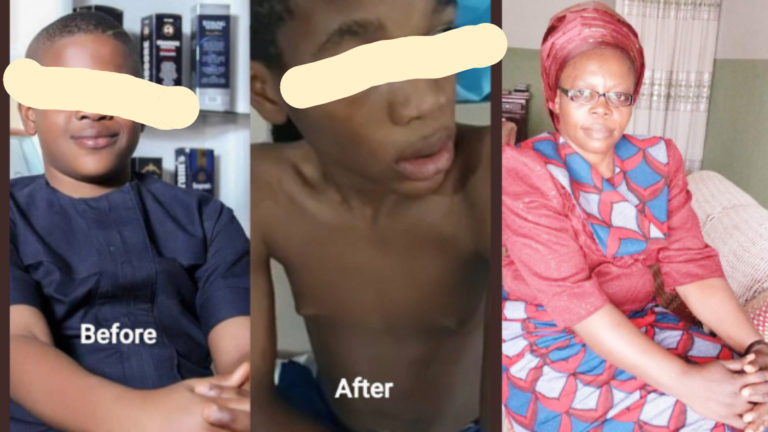


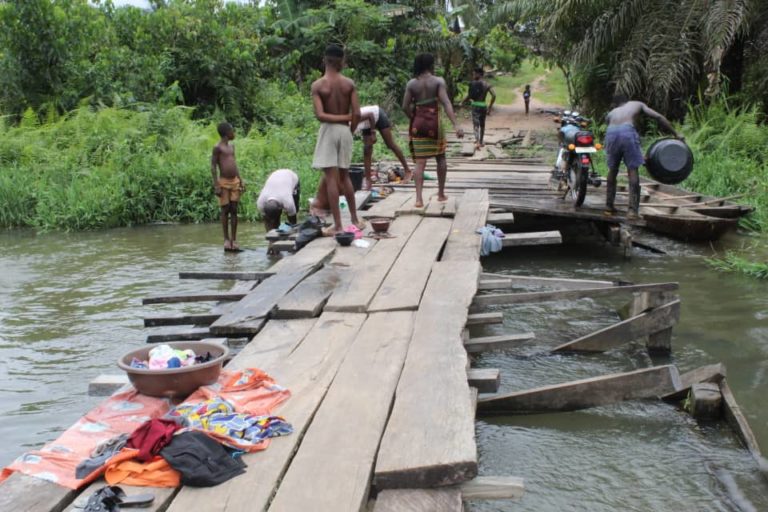

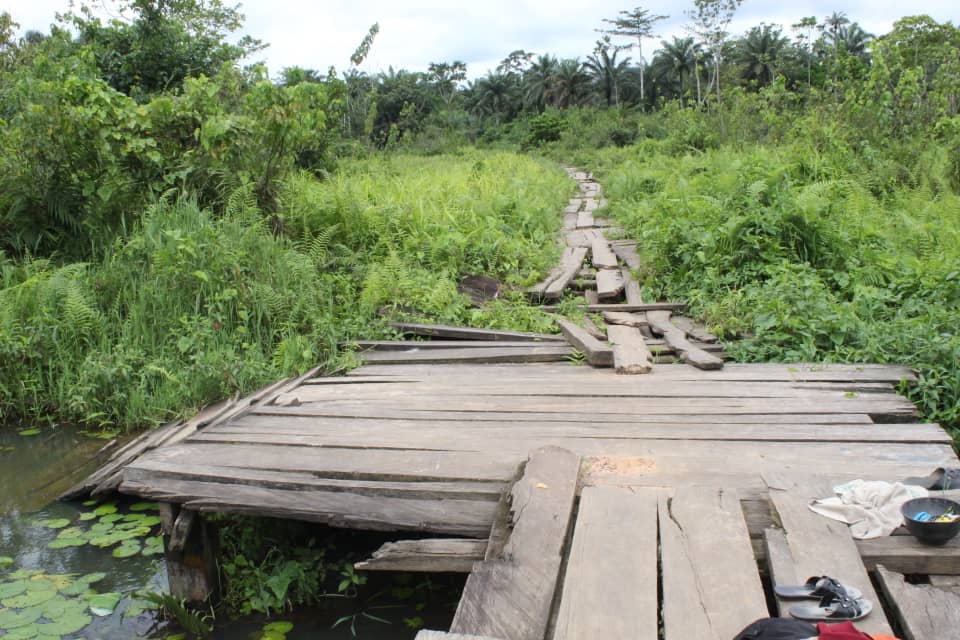


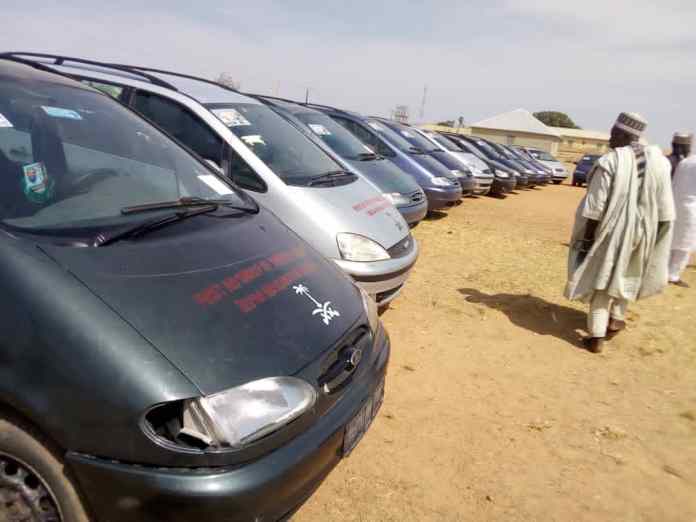
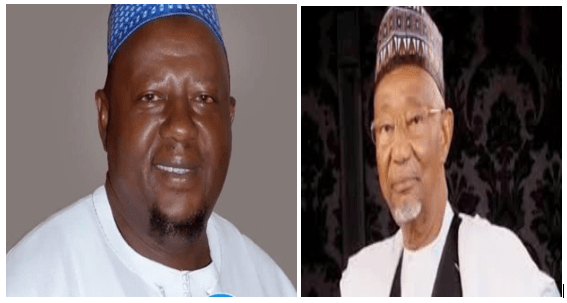

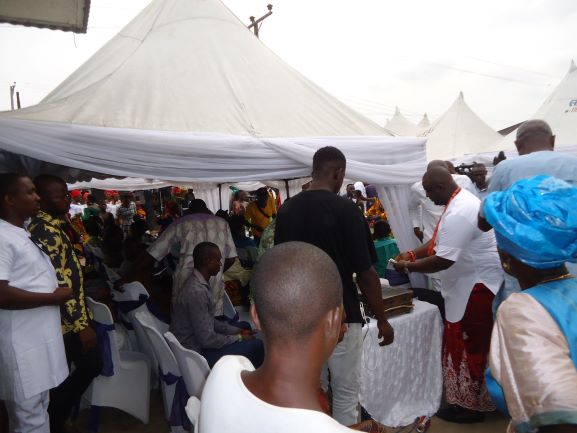
 When gold trusts