Home Blog Page 2049

How Bauchi vigilante defiles 5 year- old girl, threatens to kill her

By Haruna Mohammed SALISU


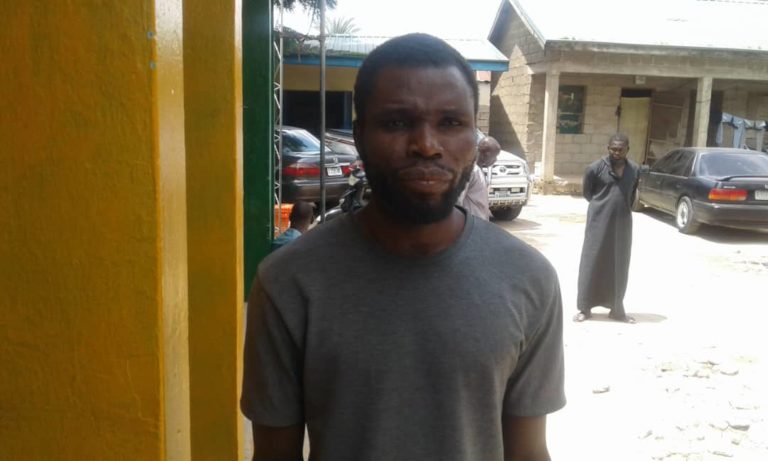
MAMATI, a five-year-old girl, (real name concealed to protect the victim from societal stigma),  was drugged and raped by her 38-year-old neighbor at Paparanda, Anguwar Hardo in Bauchi LGA of Bauchi State.

“On the 16th day of July 2020, I sent my little daughter (Mamati ) to go and buy Spaghetti at about 7:00 am but she didn’t return on time”, her mother told a human rights group, Prison Inmate Development Initiative in Bauchi State.

WikkiTimes reports that the perpetrator is not only a member of the vigilante group; he is also the Chairman of the group at Paparanda, a suburb of Bauchi metropolis.

The mother said the suspect, Saleh Hassan (Shoe Shiner); a vigilante member (popularly called Yan Kwamiti) drugged her daughter, by giving some tablets “on her way home”, from where she was sent for shopping.

The victim’s mother said her daughter drowsy and slept off upon taken the drugs. “So when she woke up, my daughter said he (the culprit) showed her a knife and said if she tells anybody, she will be killed.

“While she was coming, I noticed that she was leaping, I asked her where she has been and what was wrong with her but she said nothing,” added Sureya, the victim’s mother.

She said the terrible experience forced her daughter into dreadful cries because of her inability to walk following the pains inflicted on her by her predator.

“The next day, in the morning, my daughter was crying and couldn’t walk again.”

The victim’s mother said there were several bruises in her private part; “however, when I insisted on knowing the suspect, my daughter said she was raped by one, uncle Saleh.”

The Executive Director of PIDI-Nigeria, Mrs. Cate Rize who facilitated the arrest of the perpetrator in a statement, says, “the victim alleged that she was raped by one, uncle Saleh, saying that ‘when she got the spaghetti, on her way coming home, he called her and asked to take one medicine. “She said it was after she took the medicine that she slept off, so when she woke up, she said he showed her a knife and said if she tells anybody, she will be killed.”

PIDI said a gynaecologist at the Abubakar Tafawa Balewa Teaching Hospital in Bauchi has confirmed “a forceful penetration in her private part.”

“PIDI-Nigeria regretted that the minor has been rendered helpless and hopeless, calling on the Police to immediately prosecute the suspected rapist.

The Bauchi State Police Command through its Public Relations Officer (PPRO), DSP Ahmed Wakili confirmed arresting the suspect “who is now in Police detention pending the completion of the investigation and possible prosecution.”

The ICIR had in an exhaustive investigation revealed that about 300 cases of rapes were reported within just 6 months in Bauchi State; with most of the culprits moving around freely while their victims languished in perpetual pains and misery.

The investigation also documented how the application of western and Islamic laws simultaneously give room for suspected rapists to evade justice, in connivance with a government agency that is supposedly meant to protect the victims.

FG announces plan to sell 216 defunct PHCN asset

THE Nigeria Electricity Liability Management Company (NELMCO) has announced plans to sell 216 non-core assets of the defunct Power Holding Company of Nigeria (PHCN).

The managing director of NELMCO, Adebayo Fagbemi, revealed this on Tuesday during a visit to the Abuja Electricity Distribution Company (AEDC) by the Senate Committee on power.

Fagbemi told the Senate committee led by the Chair, Gabriel Suswam, that the agency would sell the non-core assets in three phases.

According to him, in the first phase, 52 assets would be sold while the second and third phases will include 106 and 58 assets respectively.

Fagbemi said the assets marked for sale include buildings, jetties, lands, golf course, and guesthouses owned by the PHCN.

“The idea is that we do them in phases. You can’t put everything in the market. And the reason is that one of the key requirements in the Procurement Act is that you off-load at the time you have the best of value.

“Also, it is to ensure that you get the value as at the current period, for valuation is actually periodic, so the first phases of asset that we are bringing out for sale are 52 in number.

“There is a second batch that we are working on now of about 106. Then there will be the third batch of about 58. So when you add all these you get the total stock of assets,” Fagbemi said.

The managing director of AEDC, Ernest Mupwaya said the electricity company was indebted to NELMCO in terms of rent payments totalling N40 million monthly since November 2013.

He stated that the AEDC is already communicating with NELMCO on how to settle the debts and acquire some of the non-core assets up for sale.

The AEDC building, one of the legacies of the defunct PHCN, is one of the assets under the management of NELMCO.

The Chairman of the Committee, Suswam said since the AEDC occupies the building, it has the right of first refusal to bid for the property.

Governor Fayemi is COVID-19 positive, to hand over to deputy

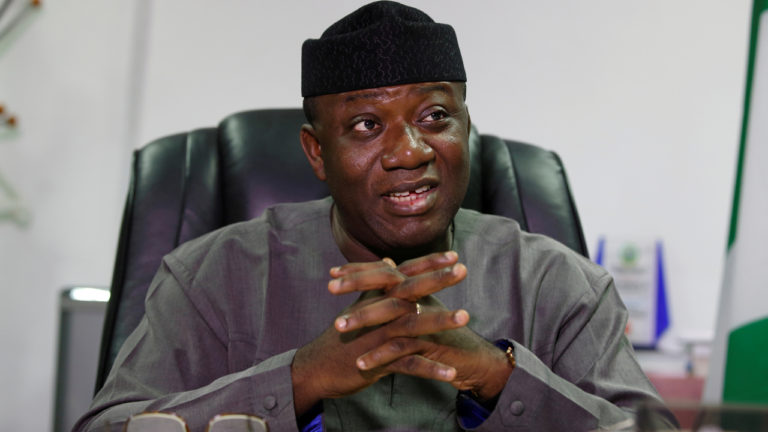
GOVERNOR of Ekiti State, Kayode Fayemi,  has tested positive to COVID-19, making him the sixth Nigerian governor to contract the deadly virus that has infected over fifteen million people globally.

Fayemi confirmed his status on his official Twitter page on Wednesday, where he stated that his test results came back positive on the third trial. He added that he would be handling over critical tasks to his deputy, as he gradually recuperates.

“I took my third Covid-19 test yesterday and it came back positive,” Fayemi tweeted. “I’m generally ok and I’m already self-isolating at home and receiving the best of care from my medical team.

“I’m delegating critical tasks to my Deputy but will continue routine duty from home,” his tweet read in part.

The governor also assured citizens that he is receiving the best possible care while self-isolating and would carry on the daily routine of governance from home.

Since Nigeria got its first index case in February, the country has recorded over 37,801 cases and 805 deaths, according to the Nigeria Centre for Disease Control (NCDC).

The rising number of COVID-19 cases in Nigeria and around the world has contributed to an economic downfall in most parts of the world.


Aviation Minister debunks extending Int’l flight resumption to October

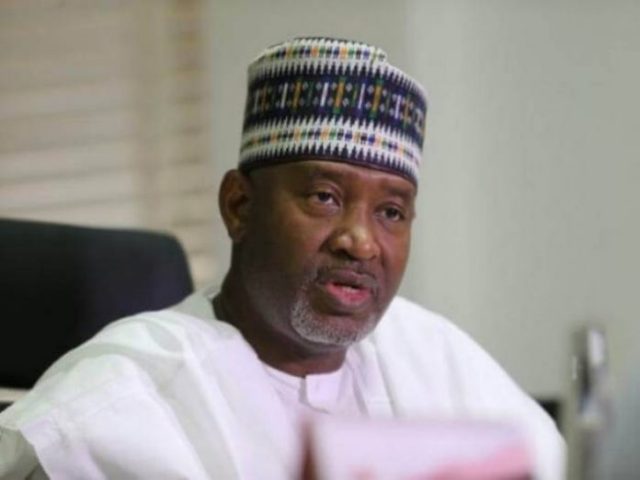
Hadi Sirika, MINISTER of Aviation on Tuesday said International Flight resumption date was not extended to October contrary to information making rounds that the resumption date was extended.

He said that the Nigeria Airspace Management Agency only issued a routine 90-day Notices to Airmen (NOTAM) in preparation for the opening of the international airspace.

Sirika, however, reassured the public that the agreed date for the resumption of international flights will be announced in liaison with Health experts, Foreign Affairs and the Presidential Taskforce on COVID-19, regardless of the ban by Europe, UAE, etc, which he said maybe earlier than October.

Domestic flights had resumed in the country on July 8 after the Federal Government had in March shut down international airports in a bid to contain the spread of COVID-19 but allowed only diplomatic and essential flight operations.

The Minister of Aviation had announced that Abuja and Lagos airports would resume domestic operations on July 8 while Kano, Port Harcourt, Owerri, and Maiduguri would commence operations on July 11.

Speaking earlier last week at the Presidential Task Force (PTF) on COVID-19 press briefing, Sirika said the Federal Government would not rush the restart of international flights in and out of Nigeria.

According to him, the PTF and relevant agencies in the aviation industry are still brainstorming on the best time to allow for the resumption of international flights, adding that when the situation is right, international flights would resume without delay.

COVID-19 cases spike in Madagascar despite discovery of corona ‘cure’

PUBLIC hospitals in Madagascar have reached maximum capacity and may not be able to admit more patients as the country experiences an overwhelming surge in the cases of COVID-19 infection.

According to a report by Bloomberg, only patients with severe complications from the COVID-19 infection will be henceforth admitted into the various hospitals across the country while the government also opened a 400-bed treatment center for people with mild symptoms and is importing about 1,000 oxygen machines.

President Andry Rajoelina had placed another lock-down to last till July 26 after an initial lock-down in March was lifted after four weeks on the country’s central region,  as the five public hospitals in the capital, Antananarivo, declared that they could no longer handle the rise of  COVID-19 patients.

Currently, only one person is allowed from each household to go grocery shopping or get medical supplies as the number of confirmed cases in Madagascar has hit 7,153 on Monday, with a death toll of 62.

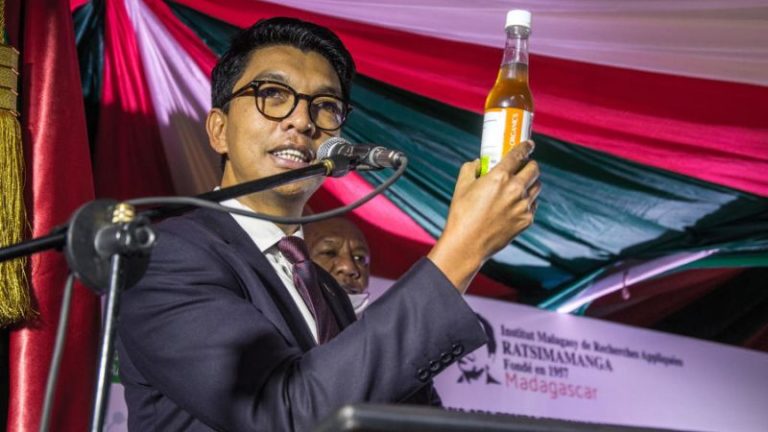
In April the Malagasy government had touted a herbal mixture named COVID-Organic to be a cure for the COVID-19 infection.

Mr. Rajoelina had launched the indigenous herbal remedy developed by the Malagasy Institute of Applied Research, which was produced from Artemisia, a plant with a proven antidote against malaria.

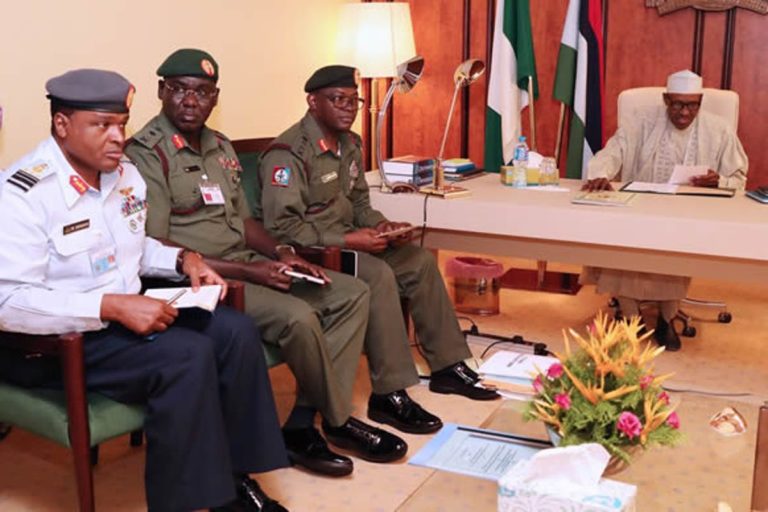
Presidency replies Senate over call for resignation of Service Chiefs

THE Nigerian Presidency has responded to a point of order by the Senate arm calling for the sack of Service Chiefs of the country, saying the power lies with the president.

In a tweet response to the resignation call, the Presidency said the appointment or sack of Service Chiefs remains a power vested in the president.

“The Presidency notes today’s Senate resolution, and reiterates that appointment or sack of Service Chiefs is a Presidential prerogative,” the tweet read.

The Presidency stated that Nigerian President Muhammadu Buhari would do what is in the best interest of the nation.

“President Buhari, in his capacity as Commander-in-Chief of the Armed Forces, will do what is in the best interest of the country at all times,” the Presidency noted.


The ICIR reported how the Senate called for the resignation of the service chiefs over incessant killings in the country particularly the Northeastern part of Nigeria.

While most of the serving chiefs are due for retirement, they are yet to vacate their position.

The Senate, through a motion raised by the Ali Ndume, senator representing Borno south and chairman of the committee on the army had called for the resignation of the service chiefs.

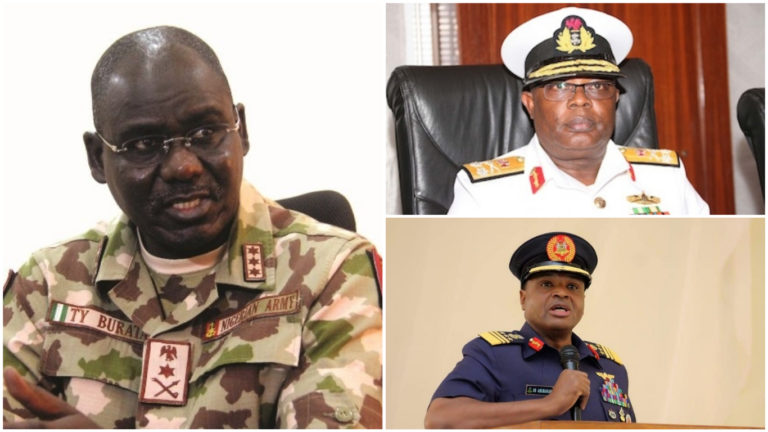
Ndume prayed to the Senate demanding the resignation of Tukur Buratai, chief of army staff; Sadique Abubakar, chief of air staff; Gabriel Olonisakin, chief of defence staff and Ibok-Ete Ekwe Ibas, chief of naval staff.

Ndume demanded that the service chiefs step aside for new appointments to be made.

Ayo Fadahunsi, the vice-chairman of the senate committee on customs, also proposed the stepping aside of the service chiefs, and his prayer was seconded by Senator Betty Apiafi.

Ahmad Lawan, the Senate President, ruled on the prayer and it was largely supported by all the senators in attendance, Punch reports.


Reps commence probe on Immigration documents of Chinese nationals in Nigeria

THE Nigerian House of Representatives has commenced a probe into the Immigration documents of Chinese nationalities living in the country.

The News Agency of Nigeria (NAN) reports that the House said on Tuesday that the probe commenced on Monday, July 20 as part of resolutions reached by the House on Tuesday, April 28.

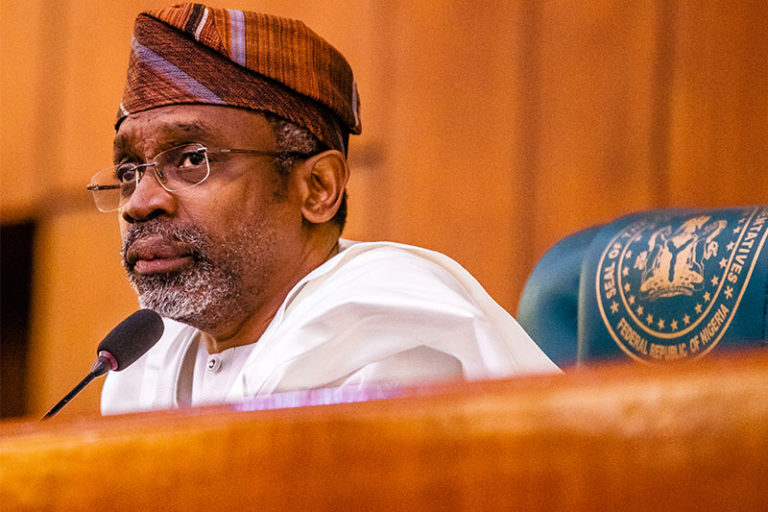
Femi Gbajabiamila, the Speaker of the House said the resolution followed photos and videos that went viral on social media in April concerning the maltreatment of Nigerians living in China.

Gbajabiamila stated that following the allegations, he urged the Ministry of Foreign Affairs and Ministry of Justice to provide financial aid to the affected residents.

“Apart from urging the Ministry of Foreign Affairs and the Attorney-General of the Federation and Minister of Justice to provide financial and other assistance to affected Nigerian citizens in China, the house took a two-pronged approach by constituting two joint committees to undertake two specific assignments towards remedying the ugly situation,” Gbajabiamila said.

The speaker said the house mandated the House Committees on Foreign Affairs, Inter-Parliamentary Relations, Human Rights, and Diaspora to ascertain the extent of violation of rights of Nigerians in China.

He noted that the committees would evaluate the losses to Nigerians living in the country due to the violence.

Gbajabimila said the house also mandated committees to investigate the Nigeria Immigration Service (NIS), Corporate Affairs Commission (CAC), Nigeria Content Development and Monitoring Board, and other relevant ministry or agency to check the validity of all immigration documents of every Chinese in Nigeria.

According to him, the joint committee would look into the documents of all Chinese Nationals in Nigeria to ascertain if it is not above the threshold.

The committees would repatriate the Chinese immigrants back to China if they exceed the quota as stipulated.

“I, therefore, implore all the relevant stakeholders to assist the joint committee in discharging the mandate entrusted to it.

“The joint committee is imbued with legal and statutory powers to conduct this hearing as stipulated in the Standing Orders of the House, Legislative Houses (Powers and Privileges) Act, 2017 and the 1999 Constitution (as amended), Gbajabiamila said.

The ICIR had reported events of how Chinese nationals maltreated their  Nigerian workers during the COVID-19 pandemic.

Issues of human rights violation of Nigerians living in Nigeria and in China by Chinese Nationals have been circulating media space during and before the pandemic.

Apart from human rights violations, there have also been cases of Chinese companies involving in illegal activities in Nigeria.

Meanwhile, Nigerians in Diaspora Commission (NiDCOM) said it has evacuated no fewer than 648 nationals stranded in Saudi Arabia, United Arab Emirates and Europe as a result of the coronavirus pandemic.

The evacuees, according to the Twitter post by NiDCOM arrived at Nnamdi Azikiwe Int’l Airport, Abuja on Sunday via different airlines, namely: Emirate, Azman air, Euro air, and Air Sudan.


Insurgency: Senate calls for resignation of service chiefs

A POINT of order calling for the resignation of service chiefs was raised on the floor of the Senate on Tuesday.

The motion was moved by Ali Ndume, senator representing Borno south and chairman of the committee on the army.

The prayer demanded that Tukur Buratai, chief of army staff; Sadique Abubakar, chief of air staff; Gabriel Olonisakin, chief of defence staff and Ibok-Ete Ekwe Ibas, chief of naval staff, step aside for new appointments to be made.

All the current serving chiefs are due for retirement.

Ayo Fadahunsi, the vice-chairman of the senate committee on customs, also proposed the stepping aside of the service chiefs, and his prayer was seconded by Senator Betty Apiafi.

Ahmad Lawan, the Senate President, ruled on the prayer and it was largely supported by all the senators in attendance, Punch reports.

This is coming shortly after the mass resignation of 365 soldiers from the Nigerian Army, citing ‘loss of interest.’

The Army denied such development, submitting that it was a malicious plot to discredit the Nigerian Army. However, the House of Representatives resolved to investigate the mass resignation.

Meanwhile, not less than 40 soldiers were reportedly killed during two separate attacks that occurred between the Army and the Boko Haram insurgents in Kumala village along Maiduguri – Damboa Highway, Borno State, on Wednesday, The ICIR learnt.

NDDC contracts: Gbajabiamila gives Akpabio 48hrs to publish names of recipient lawmakers

SPEAKER of the House of Representatives, Femi Gbajabiamila, on Tuesday has given Godswill Akpabio, Minister of Niger Delta a forty-eight hours ultimatum to publish names and details of lawmakers who got contracts from the Niger Delta Development Commission as alleged by the minister on Monday.

Akpabio had during an investigative public hearing organised by the committee on the Niger Delta Development Commission to check the activities of the commission said that most of the contracts for which he was been probed were awarded to members of the house.

Gbajabiamila while reacting to the allegation, ordered the minister to give details of those who allegedly took parts in the contracts.

The speaker said the allegation infringes on the integrity and reputation of the House and would be fair to both the people of Niger Delta and the committee for the minister to publish the names of who got the contracts.

During the panel session in Abuja, Akpabio was questioned by the House Committee on NDDC led by the vice-chairman, Thomas Ereyitomi-Tobi after the chairman of the committee, Olubunmi Tunji-Ojo had stepped aside for a fair hearing.

Akpabio was asked to explain the N81.5 billion expenses incurred by the commission but he said so far he had been involved in only three contracts in the commission.

“I have only been involved in three contracts in the NDDC as the supervising minister, first is the forensic audit, second is the purchase of 90 vehicles and the COVID-19 contracts,” he said.

AfDB impacts in Africa endorse Adesina’s second-term bid as president

By Theophilus ABBAH


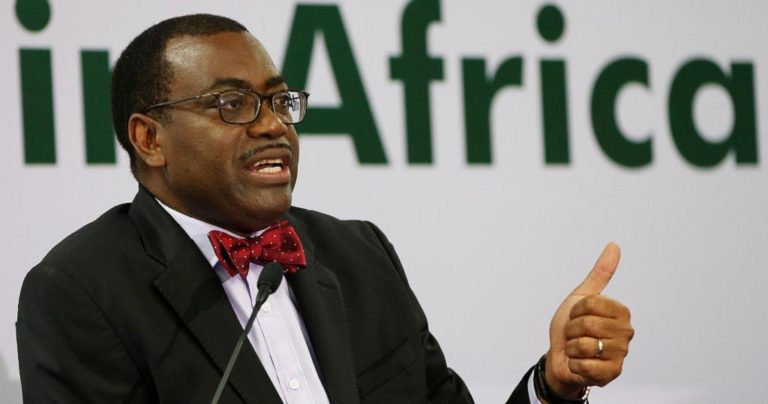
The impact of Dr Akinwumi Adesina’s presidency at the African Development Bank (AfDB) in the last five years could be felt and touched in many parts of Africa. They speak eloquently in favour of his re-election as president of the development bank, in spite of opposition from the United States.

At an ‘African Journalists Hangout’ webinar, coordinated by US-based African journalist Benjamin Tetteh, on June 14, 2020, Adesina’s tenure was reviewed. Surprisingly, journalists from African countries who participated pointed at visible projects sponsored or coordinated by AfDB in their countries.

Apart from panellists Selay Kouassi (Ivory Coast), Alpha Kamara (Sierra Leone), George Wiafe (Accra), and Theophilus Abbah (Nigeria), participants from all over Africa who sent in messages on the social media were united about how Adesina’s first term affected their countries. A review of some of the projects executed by AfDB shows why panellists on the webinar and commentators have expressed support for Adesina.

As it were, AfDB projects in several African countries literally touched specific challenges facing them. For instance, in Burkina Faso, one of the countries affected by desertification in the Sahel region, electricity has been a major challenge, with over 90 per cent of the population without power.

To deal with the situation, the AfDB initiated what it called ‘Desert to Power’ programme in 2017, in order to ‘light up and power’ the Sahel with electricity supply through photovoltaic (PV) solar systems. The project, targeted at countries in the Sahel belt, commenced in Burkina Faso. Called Yeleen Rural Electrification Project, it involved the production of off-grid energy so it could be deployed to end-users without the complexity of routing the energy through the country’s national grid.

The project has been warmly received in the low-income West African country, bedevilled with declining rainfall, rising temperatures, floods and droughts. Agriculture, the mainstay of Burkina Faso’s rural economy, is also the most vulnerable to the impacts of climate change. The ‘desert to power’ initiative of AfDB has given hope to 90 per cent of the population of Burkina Faso, who lives in rural areas, to access electricity at a low cost.

In Cote d’Ivoire, many households have benefitted from AfDB’s ‘Saemaul Undong Model Village’ project, a partnership between the development bank and South Korea. This is a micro-credit scheme under which some $500 is given as loan to women in small households to engage in the cultivation of tomatoes for sale.

An AfDB report on this scheme says that through it, AfDB, the Korea-Africa Economic Cooperation (KOAFEC) Trust Fund and the Government of Cote d’Ivoire have “transformed the economies of two villages and improved the lives of 2,961 inhabitants in Zatta and in N’gbekro, two villages near Yamoussoukro, the country’s capital.”

Beneficiaries of the small grants plough back the profits into their farms and, with a high turnover, they are lifted from abject poverty, as some have changed houses, from mud to brick, and many of them could access medical facility in clinics, instead of depending on local herbs. Similar projects have been launched in Ethiopia and the Democratic Republic of Congo.

The report says, “Saemaul Undong” means the “New Community Movement” or the “New Village Movement” in Korean. It focuses on local community development with diligence, self-help and cooperation as its guiding ethos. The goal: for the Saemaul Undong-inspired development approach to be applied at the country and regional levels and for it to have a domino effect on socio-economic growth.”

Furthermore, the AfDB has executed a clean water project in Somalia, another drought-stricken and war-torn African country. With the lack of potable water and sanitation in both rural and urban communities in Somalia, AfDB’s clean water and sanitation projects have become a conveyor of peace and harmony across social divides in the arid nation in the Horn of Africa.

The objectives of this project included improving access to water and sanitation services in rural areas of Somalia; reducing infant and child mortality caused by water-borne diseases; eradicating water-borne diseases; improving the technical capacity of local administrators to manage water infrastructure; promoting sustainable water management practices, solutions, systems and structures; and building resiliency into water systems/structures so they can withstand future drought and environmental shocks.

Working with the Somali national government, local authorities and the International Organization for Migration (IOM), the UN agency responsible for global migration, the AfDB has brought succour to communities in Somalia. The government acknowledged the impact of the project through Salimo Aloi Ibro, Somalia’s Minister for Energy and Water Resources, who remarked that Somalia would love the project extended to other communities like “Kismayo, Baidoa, Afgoye and Jowhar – places where the needs on the ground far outstretch available resources.”

John Sifuma, a Water and Sanitation Specialist at AfDB, commenting on this project, says: “The project falls under the fifth High 5 priority of the Bank (Improve the quality of life for the people of Africa) and is aligned to Somalia’s National Development Plan. The Bank will continue working closely with the Federal Government of Somalia to support the implementation of the government’s development agenda.”

“The Bank is responding to the challenge of supporting inclusive growth, and the transition to green growth, by scaling up investments and implementation of its ten-year strategy ….” Sifuma further observes.”

According to Dyane Epstein, the IOM Somalia Chief of Mission: “This project endeavours to improve the quality of life for an estimated 175,000 Somalis. As solutions to sustainable water provision and infrastructure are developed, other socio-economic activities will also flourish. This includes the rearing of livestock, which remains the main source of livelihoods for the majority of this project’s beneficiaries.’’

Another country that has benefitted from AfDB intervention in Sudan, where Drought Resilience and Sustainable Livelihoods Programme (DRSLP) has been executed. According to AfDB, the objective of this project is “to enhance drought resilience and improve livelihoods of the pastoral and agro-pastoral population.

The project’s sector goal is to contribute to poverty reduction, food security, and accelerated sustainable economic growth through enhanced rural income.” The project has impacted communities in Sudan in diverse ways as it has improved access to water, enhanced the health of the people since clean drinking water is having positive health impacts on human beings and increasing the productivity of animals.

The project has also made it possible for afforestation and tree seedling production policies to be implemented. These would reduce soil degradation and deterioration and help to maintain the ecosystem.

In Malawi, rural households have received support from AfDB, which has assisted them in adapting to the negative impact of climate change. Though agriculture is the mainstay of the Southern African country, climate change has affected it, as, crops dry up before maturity, lands are damaged due to floods, soil degradation (soil erosion, loss of soil fertility, and siltation of fields) is a constant feature, shortage of water leads to a reduction in farm yield, and leading to food insecurity.

The Climate Adaptation for Rural Livelihoods and Agriculture (CARLA) project, which began in 2011, has made it possible for households in Malawi to savour some relief.

A review report on its impact as at 2016 by AfDB showed that there is “increased household agricultural productivity (maize from one ton per hectare to 4.5 tons per hectare) and reduced food insecurity from nine months of hunger in a year to zero for direct project beneficiaries. A total of 6,665 goats were distributed at the end of the project. Farmers who benefited from the project have testified to the success of this programme.”

Apart from helping them to acquire the knowledge that makes them become resilient to climate change impacts, CARLA has facilitated increased food security among participating households and led to the reduction of the lean period from three months to one month.

The project has also improved access to safe water and reduction of incidence of water-borne diseases through boreholes in Malawi. It has further facilitated the diversification of sources of income for many households through sales of livestock and livestock products. It has enabled the household to take care of their needs, pay fees for children, and acquire building materials.

These are few instances of the impact that AfDB, under Adesina, has made on the lives of ordinary households in some countries in Africa. This is why many African presidents and leaders have supported the re-elected of Dr Adesina for another five-year term.

As a result of America’s opposition to his re-election over allegations of conflict of interest against him, AfDB has set up a three-member committee to review the issues and how the bank had handled it. The panel is headed by former President of Ireland and ex-United Nations Human Right Commissioner, Ms Mary Robinson.

As Africans wait impatiently for the outcome of the panel’s investigation, it is apparent that they will be disappointed if Adesina, whose tenure has impacted them positively, is disqualified from contesting AfDB presidency in order to continue his good works. As of May 2020, Dr Adesina was the only candidate for the position.

Abbah wrote this piece from Abuja.