Home Blog Page 2131

Five statements on coronavirus shared by WHO that turned out to be misleading

THE World Health Organisation (WHO), a specialized agency of the United Nations (UN) responsible for international public health has played a huge role in battling coronavirus pandemic since it first broke out in Wuhan, China, but it has also spread information about the virus that turned out to be inaccurate.

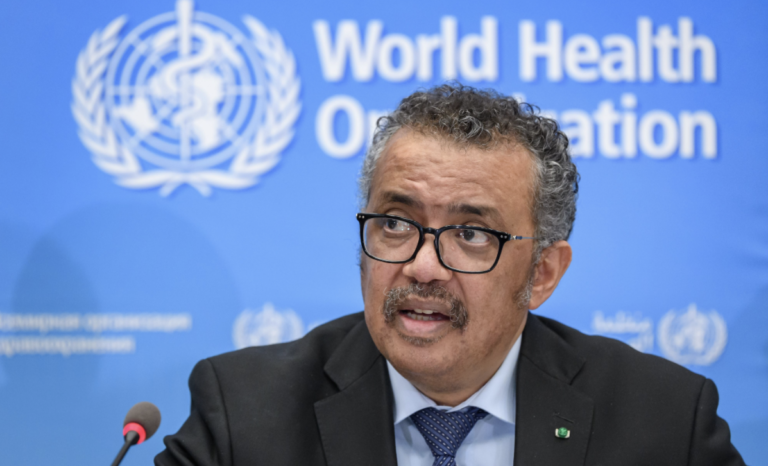
Established in 1948 and currently headed by Tedros Adhanom, WHO has a broad mandate which includes advocating for universal healthcare, monitoring public health risks and coordinating responses to health emergencies. It also sets international health standards and guidelines and collects data on global health issues.

With such primary objective and historical relevance, WHO has earned a reputation for being a trusted source of information, especially during global health crises and has actively engaged in the dissemination of information which helps countries determine their strategy in fighting epidemics and pandemics as in the case of coronavirus, officially known as COVID-19.

Since its first outbreak in December 2019, COVID-19, a respiratory illness, has infected over 1.4 million people globally and killed over 82,000 persons, according to recent statistics published by Worldometer, as at the time of filing this report.

With no known cure or vaccine, the virus has halted global economy and remains a threat to humanity and as such, information on how best to combat it, prevent and curb its spread is a top priority for many nations.

But at a time more than once, WHO has come under scrutiny for its response to the coronavirus pandemic.

Despite the remarkable role played by WHO, it has shared some information on the new coronavirus which it has now doubled down on, or is yet to clarify, all of which point finger at the organisation’s contribution to sharing misleading information that may have negatively impacted the fight against coronavirus in some countries.

1. No human-human transmission

In a tweet shared on January 14, the WHO had stated that Chinese authorities had found no clear evidence of coronavirus human-human transmission.

But it has since reversed its submission on this statement, saying  COVID-19 can indeed spread from human to human.

“People can catch COVID-19 from others who have the virus. The disease can spread from person to person through small droplets from the nose or mouth which are spread when a person with COVID-19 coughs or exhales. These droplets land on objects and surfaces around the person,” WHO now posts on its website.

This is a 360-degree turn from its initial submission which can be classified as misinformation.

Despite evidence showing otherwise, the old tweet which has been debunked remains on the official Twitter page of WHO and has gained over 21,000 likes and 19,000 retweets.

2. Masks should only be worn by those with coronavirus disease

There is a global debate on the use of face masks in the prevention of coronavirus and while agencies are advocating for its use in public, the WHO recommended otherwise until recently.

On Monday, March 30, WHO held a media briefing to update the public on the COVID-19 outbreak and its officials submitted that they do not recommend mask wearing for healthy members of the general population.

It was recommended that masks be worn by those with the disease or those in close contact with those infected.

This was in response to the shortage of face masks available for health workers at the frontline of combating the virus.

However, while the WHO stands by its recommendation, there is evidence that it is considering changing its guideline on whether people should wear face masks in public.

“The WHO is debating that tomorrow to understand if there is evidence that would call for a change in what WHO is recommending,” David Heymann, an infectious disease expert and Professor of Infectious Disease Epidemiology, London School of Hygiene & Tropical Medicine, who led the global response to the SARS outbreak said while speaking at Chatham House on Wednesday, April 1.

According to Heyman, new evidence from Hong Kong has prompted a reconsideration of the role of face masks and it is likely that WHO would reassess its policy.

3. Not a global pandemic

A pandemic is “an epidemic occurring worldwide, or over a very wide area, crossing international boundaries and usually affecting a large number of people,” according to A Dictionary of Epidemiology, the standard reference for epidemiologists.

As at when the virus had infected over 100,000 people and was recorded in over 100 countries, WHO, submitted that COVID-19 was only considered a threat but failed to consider it a global pandemic, explaining that given that a large percentage of people infected were in China, there was no cause for extreme labels.

This was despite the fact that global health experts were referring to the virus as a pandemic and recommending that officials recognise it for what it is.

On March 11, the WHO officially tagged the virus a global pandemic, a direct reversal from its earlier declaration on the threat level of the virus.

4. Coronavirus is not airborne and spreads only through droplets

On March 30, the WHO shared a tweet on its official Twitter page, informing its over seven million followers that COVID-19 is not airborne and can only be transmitted from droplets generated when an infected person coughs, sneezes or speaks.

World Health Organisation (WHO) says COVID19 isn’t airborne
Photo: Twitter

However, new study suggesting that the virus can survive in the air in some settings is raising questions and redirecting the organisations original stance.

According to reports, WHO is considering “airborne precautions” for medical staff. It was gathered that coronavirus can go airborne, staying suspended in the air depending on factors such as heat and humidity, WHO officials said.

“When you do an aerosol-generating procedure like in a medical care facility, you have the possibility to what we call aerosolize these particles, which means they can stay in the air a little bit longer,” Maria Van Kerkhove, head of WHO’s emerging diseases and zoonosis unit, told reporters during a virtual news conference.

5. WHO once said Nigeria has 20 states with functional emergency centres and capacity to respond to coronavirus outbreak

In a tweet shared on it the official WHO Nigeria Twitter page, the organisation claimed that Nigeria has 20 states with functional emergency centres and the capacity to respond to a coronavirus outbreak, however, this statement has been found to be false and highly misleading.

WHO claims Nigeria has capacity to handle a COVID-19 outbreak.
Photo: Twitter

The ICIR reached out to WHO Nigeria via Twitter to clarify its statement and no response was submitted.

And with a record of over 250 cases in the country as at the time of filing this report, it has become evident that many states in Nigeria had and still have no capacity to respond to a coronavirus outbreak.

In an earlier report, The ICIR found that the Federal Capital Territory (FCT) lacked any isolation ward or centre dedicated to treating patients of coronavirus and when the virus finally entered the country, the state resorted to creating makeshift isolation holding areas for patients.

As at the time of filing this report, 17 states out of 36 in the country have recorded at least a single case of COVID-19, and one major challenge remains: The provision of health care facilities for patients as the country struggles to curb the spread of the virus.
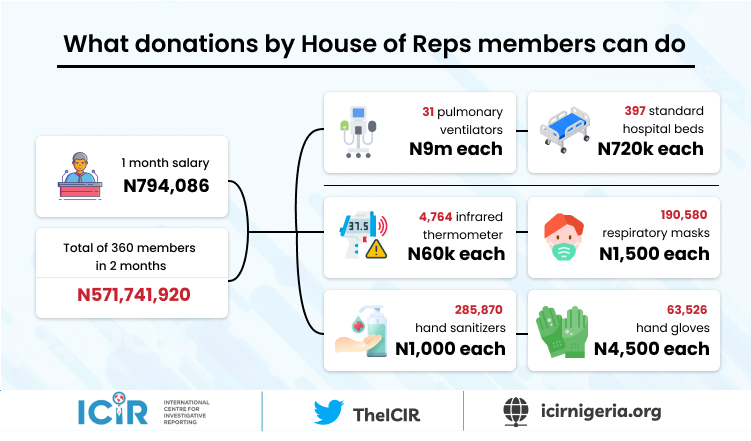
COVID-19: Donations by House of Reps members can pay for 31 ventilators,397 standard hospital beds

BY the end of April 2020, over N571 million  would have been donated by the 360 members of the House of Representatives as relief fund to fight COVID-19.

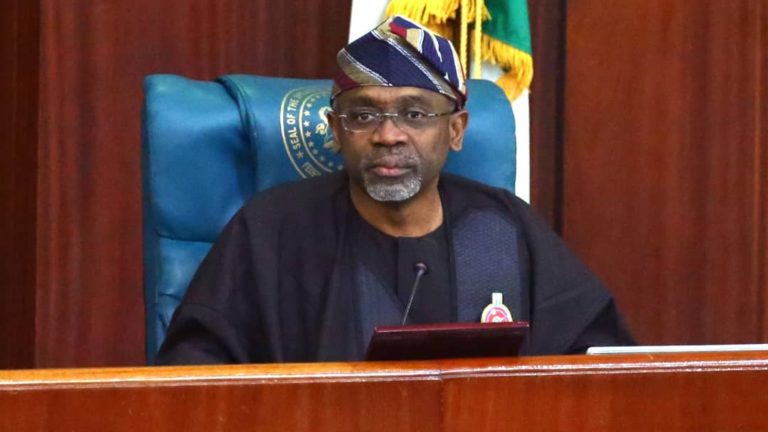
The 360 members of the House of Representatives had donated their two months salary which started in March and ends in April according to the speaker of the House of Representatives, Femi Gbajabiamila.

“Accordingly, I have directed the clerk to the National Assembly to see to it that all members’ salaries are transferred to the National Relief Fund for this month and the next,” Gbajabiamila said.

One month basic salary for each House of Representatives member is N794,086 and a total of 360  members salary for one month would be N285,870,960. This amount will total N571,741,920 in two months.

What N571m can buy to fight Covid-19

The amount can pay for 31 pieces of pulmonary ventilators at N9 million each and 397 standard hospital beds at N720,ooo each.

The donations by the lawmakers also can pay for is 4,764 pieces of infrared non-contact thermometer at N60,000 each, 190, 580 pieces of respiratory masks at a N1,500 each, 285, 870 pieces of antimicrobial hand sanitizers at N1,000 each and 63, 526 pieces of hand gloves at N4,500 each.

These listed items are needed urgently by health personnel and citizens in all 36 states of the Federation and the FCT to help fight this pandemic effectively in Nigeria.

According to Order paper, an online newspaper committed to reporting National Assembly, the prices of the items were researched as at March 31, 2020.

The ICIR earlier reported that the Ministry of Budget and National Planning went on twitter requesting for 100-500 ventilators from the South African billionaire and  CEO of Tesla,  Elon Musk to fight the COVID-19 pandemic in Nigeria.

Also, recall that the private sector and individual monetary contributions to the account set up at the Central Bank of Nigeria (CBN) under the auspices of the Private Sector Coalition Against COVID-19 (CACOVID) have hit N15 billion.


SA healthcare workers sue government over shortage of equipment to protect them from the coronavirus

MEDICS in South Africa on Tuesday sued the government over a lack of personal protective equipment, for frontline staff as the country braced for a surge in new coronavirus cases. Tens of thousands of health workers say shortages are putting them at risk.

Under a strict 21-day lockdown imposed from March 27 in a bid to contain the outbreak, South Africa has 1,686 confirmed cases, the highest number in Africa, and 12 deaths.

“The risk of employees being infected with the COVID-19 virus is real,” Zola Saphetha, general secretary of the National Education, Health and Allied Workers Union (NEHAWU), said in court papers.


READ ALSO:

According to reports by Reuters Health Minister Zweli Mkhize said last week that government had held talks with NEHAWU and was working with both foreign and local manufacturers to ensure supplies.

Many health workers are buying their own protective gear in a desperate bid to ward off transmission.

Officials in the worst hit Gauteng province appealed over the weekend for public donations of ventilators and vital masks and gloves.

The union wants the ministers of health and labour, among others, to establish rules on treatment in the absence of appropriate protective equipment.

Some of its members in KwaZulu-Natal have been infected, it says.

“The failure to provide guidelines to mitigate the risk to employees in the circumstances unjustifiably and without valid reason places employees at great risk and violates their right to work in a safe environment,” the affidavit said.

Unions exert great power in South Africa. NEHAWU’s quarter of a million members are part of a group of unions that are in a alliance with President Cyril Ramaphosa’s ruling African National Congress (ANC) party.

“We don’t have an unlimited reserve of doctors and nurses, and we know the case numbers are going to rise,” Angelique Coetzee, chairwoman of the South African Medical Association, which represents some 16,000 doctors.

A global scarcity of personal protective equipment, such as masks and gloves, for nurses, doctors, porters and other health workers is a big obstacle to attempts to curb death tolls, elsewhere in Africa and on other continents.

In Zimbabwe, where health workers had been striking over pay and working conditions before COVID-19 arrived, doctors have also gone to court to force the government to provide equipment, Zimbabwe Lawyers for Human Rights said on Monday.

The court has not yet set a date for a hearing

Kudos to protesters across Africa despite repression, human rights violations—Amnesty International

THE Amnesty International has commended the bravery demonstrated by protesters across Africa in the last one year despite repression and human rights violations by agents of government.

“Protesters across sub-Saharan Africa have braved bullets and beatings to defend their rights in the face of continuing conflict and state repression,” Amnesty International said  as it published its annual review of human rights in the region. 

In the report, the organisation highlighted the bravery and defiance of people who took to the streets to demand change, but warned that they are being let down by governments who continue to perpetrate human rights violations across the region. 


READ ALSO:

The report analysed major developments from the past year including the deposition of Sudanese President Omar al-Bashir, the Zimbabwean government’s response to mass protests, and increasing attacks on civilians in Mozambique and Mali.

“In 2019 we saw incredible people power in mass protests which swept across sub-Saharan Africa. From Sudan to Zimbabwe, and Democratic Republic of Congo to Guinea, people braved brutal crackdowns to stand up for their rights,” said Deprose Muchena, Amnesty International’s East and Southern Africa Director.

In some cases, these protests led to major changes, following the toppling of Sudan’s long-time leader Omar al-Bashir, the new authorities promised human rights friendly reforms and following protest a raft package of human rights reforms was introduced by the Ethiopian government. Sadly, other changes needed are being blocked by repressive governments, who continue to carry out violations with impunity.”

 Conflict and crisis

The organisation lamented in the report that across sub-Saharan Africa, civilians bore the brunt of deadly conflicts and violent crises. 

In citing the example of Sudan’s Darfur region, it said government forces continued to commit possible war crimes and other serious human rights violations, including unlawful killings, sexual violence, systematic looting and forced displacement.

In DRC, dozens of local and foreign armed groups together with the country’s security forces continued to carry out human rights abuses resulting in more than 2000 civilian deaths and at least 1 million were forcibly displaced in the course of 2019.

In Somalia, civilians continued to live with attacks from the armed group Al-Shabaab, while government and allied international forces failed to take sufficient precautions to spare civilians from their attacks targeted at Al-Shabaab.  

Armed groups carried out attacks directed against civilians in Cameroon, Central African Republic and Burkina Faso, while governments failed to protect civilians. 

Security deteriorated significantly in the centre of Mali, with widespread killings of civilians by armed groups and self-proclaimed ‘self-defence groups’. In response, Malian security forces committed multiple violations including extrajudicial executions and torture.

In Mozambique, armed groups continued to carry out attacks against the general population in Cabo Delgado, and security forces were alleged to have committed serious human rights violations in their response to the violence.

In Ethiopia clashes between ethnic communities were met with a disproportionate response by security forces.

In Cameroon’s Anglophone regions, armed separatist groups continued to commit abuses including killings, mutilations and abductions. Several healthcare facilities were also destroyed by armed separatists. In response the military committed extrajudicial executions and burned homes. 

“Access to healthcare remains a major concern for people across the region, with underfunded health budgets leading to shortages of beds and drugs in hospitals. Governments from Angola to Zimbabwe, Burundi to Cameroon have failed to respect the right to health, and conflicts have exacerbated the situation,” said Samira Daoud, Amnesty International’s West and Central Africa Regional Director.

“With the COVID-19 pandemic looming, there is no time to waste in addressing the inequalities and human rights violations which make healthcare inaccessible for so many.”

Violent state repression

Amnesty International noted also that across the region, human rights defenders were persecuted and harassed for standing up and speaking out against governments. Burundi, Malawi, Mozambique, Eswatini, Zambia and Equatorial Guinea all saw surging crackdowns on activism in 2019.

For example, in Malawi activists who organized and led demonstrations against alleged electoral fraud after the May elections were attacked and intimidated by ruling party youth cadres and targeted for prosecution by the authorities. The vote was later annulled by the courts and the country is preparing for another election later this year.

In Zimbabwe, at least 22 human rights defenders, activists, civil society and opposition leaders were charged for their suspected role in organizing protests against the January 2019 fuel price hikes. Security forces unleashed a violent crackdown, killing at least 15 people and wounding dozens of others.

In Guinea where the authorities banned over 20 protests on vague and overly broad grounds, security forces continued to fuel violence during demonstrations and at least 17 people were killed last year.

In 17 countries across sub-Saharan Africa, journalists were arbitrarily arrested and detained in 2019. In Nigeria for example, 19 cases of assault, arbitrary arrest, and detention of journalists were recorded, with many facing trumped up charges.

In Burundi, authorities continued to crack down on the work of human rights defenders and civil society organizations including by subjecting them to prosecution and lengthy prison terms.

 Displacement

It said persistent human rights violations forced hundreds of thousands of people in the region to flee their homes in search of protection. There were about 600,000 internally displaced people in CAR; more than 222,000 people in Chad, and over half a million in Burkina Faso. 

In South Africa, deadly systematic xenophobic violence continued against refugees, asylum seekers and migrants, partly driven by years of impunity for past attacks and criminal justice failures. Twelve people, including South Africans and foreigners were killed after violence erupted between August and September.

Human rights wins 

 It however pointed out that, despite the bleak background, some notable human rights wins emerged last year.

In the report, it cited that mass protests in Sudan brought an end to the repressive rule of Omar al-Bashir in April 2019 and the new authorities promised wide ranging reforms to improve enjoyment of human rights; and the Ethiopian government overturned the civil society legislation which had curtailed the right to freedoms of association and expression and introduced a new law before Parliament replacing draconian anti-terror legislation. I

n the DRC, authorities announced the release of 700 prisoners, including several prisoners of conscience. 

There were also victories for individuals. In Mauritania, blogger and prisoner of conscience Mohamed Mkhaïtir was released after more than five years in arbitrary detention. 

Although impunity for human rights violations largely continued, there were some small steps forward in 2019.

There was a glimmer of hope for some of the families of victims of US airstrikes in Somalia when the US military Africa Command (AFRICOM) for the first time in April 2019 admitted killing two civilians in an airstrike in 2018, however neither US diplomatic staff nor AFRICOM had reached out to the family to offer reparation.

There has also been some progress in CAR’s ordinary courts examining some cases of abuses by armed groups. The Special Criminal Court received 27 complaints and started investigations last year.

“Activists and young people challenged the establishment in 2019.  In 2020 leaders must listen to their demands and work towards urgently needed reforms that respect the rights of everyone,” said Samira Daoud.

FACT CHECK: Does 5G pose a health risk to the human body?

THE media space in Nigeria has been inundated with claims that the 5G technology which is a fifth-generation mobile network is dangerous to the human body and to plants close to where a 5G mast is installed.

Shared both online and off-line, some conspiracy theories also claimed that it was the cause of the novel coronavirus pandemic.

 Pastor Chris Oyakhilome and former Senator Dino Melaye are among those  who propagate this view loudly.

Pastor Oyakhilome is the founder and president of LoveWorld Incorporated, also known as Christ Embassy, based in Lagos, while Dino Melaye is the immediate past Senator representing Kogi West Senatorial district.

Oyakhilome claimed that the 5G technology was dangerous to human cells and Dino also echoed the same sentiment in a video he shared on his Twitter handle.

Melaye said the 5G technology is evil, a killer that is being used to mobilise flu that has come in the form of coronavirus and also helping to kill the human body’s immune system and those with underlying health conditions.

Both made the claims without providing verifiable evidence.

What is the 5G network?

Launched in late 2018, 5G is a fifth-generation mobile network that is an upgrade of 4G LTE mobile network that relies on signals carried by radio waves – part of the electromagnetic spectrum – transmitted between an antenna or mast and your phone.

It is expected to deliver greater technological benefits to human beings.

A great leap from the 4G network, that will deliver data rates that are 10 to 100 times faster than current 4G networks. 

Consumers with a 5G network are expected to see speed on all activities unlike what was obtainable with 3G and 4G, a gigabits per second (Gb/s), much greater than the tens of megabits per second (Mb/s) speeds of 4G.

It uses higher frequency waves than earlier mobile networks, allowing more devices to have access to the internet at the same time and at faster speeds.

All mobile phones use radiowaves which are part of the electromagnetic spectrum, but those released by phones are non-ionising.

Though we have ionising radiation, but the radiation emission limits set by the International Commission for Non-ionizing Radiation Protection (ICNIRP) are below which the radiation is considered safe for humans.

Mobile phones communicate by transmitting radio waves through a network of fixed antennas called base stations. Radiofrequency waves are electromagnetic fields, and unlike ionizing radiation such as X-rays or gamma rays, can neither break chemical bonds nor cause ionization in the human body.

The World Health Organisation (WHO) in a study published in 2014 titled “electromagnetic fields and public health: mobile”, to look at the effect radiation has on the human body, said no adverse health effects have been established as being caused by mobile phone use.

It said, “Mobile phones are low-powered radiofrequency transmitters, operating at frequencies between 450 and 2700 MHz with peak powers in the range of 0.1 to 2 watts.

The handset only transmits power when it is turned on. The power (and hence the radiofrequency exposure to a user) falls off rapidly with increasing distance from the handset. A person using a mobile phone 30–40 cm away from their body – for example when text messaging, accessing the Internet, or using a “hands free” device – will therefore have a much lower exposure to radiofrequency fields than someone holding the handset against their head.”

While Dino and Pastor Chris talked about 5G affecting the human body, evidence points to the fact the radiation released can’t penetrate skin, or allow a virus to penetrate skin.

The Nigeria Communication Commission (NCC) in replying to the claims made by the former senator and pastor said all the radiowaves are well below the set limits and have been regularly conducting measurements of radiation emissions from base stations across the country.

It said there is no correlation between 5G Technology and COVID-19.

5G is an advancement on today’s 4G technology, designed to transform the world positively and said the 5G is a fifth generation of mobile technology which is an improvement on today’s 4G technology with enhanced capabilities. 

No 5G network in Nigeria

Senator Melaye and Pastor Oyakhilome also claimed that the 5G technology has been deployed in Nigeria, but statements released in reaction from the Federal Government and the NCC disputed their claims.

The FG through the Minister of Communications and Digital Economy Isa Pantami said the government has not deliberated on or released any bulk frequency spectrum for the deployment of 5G; No license has been issued for the deployment of 5G in the country.”

He also said the Fifth Generation Mobile Networks demonstration trials conducted in the country by MTN Nigeria in November 2019 which Senator Dino alluded to were carried out with 4G spectrum as 5G was not available in Nigeria.

Also, the NCC said it has not issued any licence for 5G in Nigeria. 

“NCC is technology neutral as such we don’t license technology but assigns spectrum to operators for deployment of any service when allocated by National Frequency Management Council (NFMC).”

It also disclosed that Nigeria has a spectrum (millimetre wave spectrum from 24GHz and above are available) for 5G which has not been auctioned.

On why there has been scene of some operators rolling out fibre during the lockdown period, the NCC said as a result of the lockdown, the amount of voice and data usage has increased by huge amounts and there was need to expand the network to provide optimum quality of service to users sitting at home. Telecom is also critical for information dissemination during the lockdown.

Verdict: It is most certainly inaccurate and untrue that the fifth-generation mobile network has anything to do with the spread of the coronavirus. 

While evidence shows that mobile phones release some percentage of radiowaves, there is no evidence to show that it has an effect on the human body, plants or causes coronavirus.

‘’ The world needs more nurses and midwives’’ says WHO as it celebrates anniversary

THE WORLD Health Organization on Tuesday celebrated its 72nd birthday while highlighting the roles and importance of nurses to the society.

WHO was established in 7 April 1948, which is commemorated as World Health Day, having its focus on support for nurses and midwives in its 2020 celebration.

In a tweeted statement WHO said ‘’Today, we celebrate the work of nurses and midwives by showing our appreciation for their bravery, courage and resolve in the global COVID19 response.

“All over the world nurses, midwives and all health workers are fighting day and night to keep us safe from the coronavirus.”

The director of the world health Tedros Adhanom in his speech said ‘’Nurses are doing the unthinkable, because critical covid19 patients are isolated, the last human touch they may feel is that of a nurse’s hand, the kindness of caring strangers has never been more important.”

He further added that, “the World Health Organization is committed to working with all countries to ensure that nurses and midwives receive: the training they need; recognition they deserve and the decent conditions and salaries for their work.”

The covid19 pandemic underscores the urgent need to strengthen the global health workforce, of which more than 50 percent are nurses.

On this World Health Day, WHO; the International Council of Nurses and the Nursing Now organization launched the first ever State of the World’s Nursing Report

According to the Report: Governments must invest in the massive acceleration of nursing education, 6 million new nursing jobs must be created by 2030; and Investments made in nurse leadership

The Report reveals a global shortage of 5.9 million nurses with the greatest gaps found in Africa, Southeast Asia, Arab States and parts of Latin America.

‘’Countries need to upwards arrow 0f nursing graduates by 8 percent per year, along with improved ability to employ and retain them in the health system,’’ WHO said.

They are critical health workers, investment in their education and training is vital to ensuring Health for all, and this would only cost heavy dollar sign 10 per capita, per year.

One in 8 nurses works in a country other than where they were born or trained; 80 percent of the world’s nurses work in countries that are home to 50 percent of the world’s population; 90 percent of all nurses are female and Nurses are at the frontline of battling pandemics like covid19.

‘’On World Health Day and every day, let us show our gratitude by doing our part and following public health advice from WHO and national health authorities,’’ WHO added.

The statement further disclosed that the Covid-19 pandemic underscores the critical and often unmet need for protective equipment for nurses and midwives, which enables them to safely provide care and reduce the rate of infection in emergency settings.

Nurses and midwives are already advocates and innovators in their communities, clinics, hospitals and health care system but they must be properly valued & represented in health leadership roles.

Investing in nursing leadership is vital for strengthening the workforce as a whole. Without this, countries cannot win the battle against pandemics, or achieve the Global Goals and universal health coverage by 2030.

Take a minute today to say; #ThanksHealthHeroes!

Ayade’s Olimpotic Mask Theory is a recipe for confusion

Jonathan ABANG-UGBAL


As the SARS – CoV-2 pandemic ravages every nation of the world, you can think of the Governor of Cross River state in southern Nigeria, Benedict Ayade who has drawn up the perfect recipe for confusion amidst the crisis the world is grappling with.

If you do not know Governor Ayade, here is a summary.

He is an intellectual cocktail of wits, smartness, humor, extreme and divergent views that range from the most hilarious to, somewhat critically insane.

Continental Africa has had her fair share of despots wearing the garb of  democratic leaders, and the advent of COVID-19 has further exposed these pretenders in power.

Whilst, the pandemic has dominated public discourse, turning attention from nauseating propaganda of governments at all levels, Mr. Ayade, through his spokesman, Christian Ita, on the night of Wednesday, April 1, 2020 (yes, the fools day) grabbed attention again when he directed that the almost four million people resident in that state would be required to wear face masks before stepping out of their houses from April 3rd.

“No citizen or resident of the state will be allowed to leave home without a face mask from Friday 3rd, April 2020,” read that statement.

The reason was attributed to “the proliferation of new cases in neighboring states.”

Cross River is bordered to the north by Benue state which has one confirmed case; to the west by Ebonyi and Abia states with no confirmed cases and to the South, by Akwa Ibom which infamously attempted to rubbish reports that it has five confirmed cases. The state is bordered to the east by the Cameroon republic which has over 600 confirmed cases.

The fears are founded. But, the logic is insane. The World Health Organisation has consistently said only care givers and those showing symptoms are expected to wear masks.

Ayade had in that statement directed his pet project, the garment factory to produce masks for all residents and when by Thursday it became clear this was another tall dream he won’t achieve, directed that the restriction be shifted till Monday, April 6th.

“His Excellency, Professor Ben Ayade has rescheduled the take off date for the no mask no movement order to Monday, April 6, 2020,” read the statement issued by Mr. Ita on Thursday night which further explained that the policy, “is geared towards shielding Cross Riverians from the ravaging coronavirus pandemic.”

Now, that factory has fewer than 250 sewing machines and operates on a nine to five basis with two four-hour shifts. If the average production rate for each tailor in an hour is 10 masks, multiply by eight hours, you will get 80 masks. When multiplied by 250, you will get 20,000 masks produced a day.

This means the factory has to work for 80 days consecutively to ensure at least each Cross Riverian has one of the “nose masks” as Ayade called it. But, the new head of the factory who was appointed less than 48 hours ago says they aim to produce 100,000 masks per week. That means it will take 40 weeks or 10 months for the masks to go round. However, since they began production last week, less than 5,000 masks have been produced – meaning less than a percentage of the population have gotten masks yet, Ayade is chasing Nigerians whose fundamental rights have already been breached by draconian directives that are not backed by any law.

Louts and touts who eke out a living shouting at passengers and earn less than two dollars a day are now struggling to sew pieces of clothes together in order to escape law enforcement officers. Civil servants and even those said to be on essential duty wear rags around their faces – pieces of clothes that research has showed cannot stop the virus from penetrating.

Some remove the cups in brassieres and tie a rope on them to use as face masks – as a matter of fact, the streets of Cross River are a reminiscent of the annual Carnival Calabar and Festivals except, these costumes are sold for between NGN300 and NGN500 and are raggedy. A lot of these brassieres are used brassieres popularly called ‘Okirika’ shipped from overseas. The medical risks involved and whether they will stop any harmful micro particle can only be best imagined.

Meanwhile, the size of the novel coronavirus is said to range between 0.06 to 0.14 micrometer. This means that at the largest size, the virus is about 0.00014 millimeter. Now, the cotton material used by the garment factory has a pore size of over 15 micrometer. This means, if the virus is 0.15 micrometer in size, 100 coronaviruses can fit into one pore of the masks produced by Mr. Ayade. Imagine if there are 1,000 pores in that mask, that means 100,000 novel corona viruses can enter. Even if it is triple layered, if we assume but not concede that will cut down the chances of penetration by three, you still have over 33,000 novel corona viruses going through!

Clearly, the cotton material is useless especially as it has no filter in it! Unfortunately, most filters available have a pore size of 1 micrometer which can allow about 6 novel coronaviruses to enter at once. Could it be possible that a Professor of microbiology would not know this or is this an attempt to market the garment factory?

The governor does not joke with his industries, especially the garment factory and seizes every opportunity to sell it.

Here is what he told the press last weekend: “We have decided also to use masks that are wholly customized by the Cross River garment factory and we are ready to buy off nose masks from all tailors in Cross River state. Whatever quantity of nose masks that you can produce, once they meet our technical specifications, in triple layer fold, stitched very properly without any pains to the neck and to the ears and made sure that it is completely airtight, so you don’t have escape off your esophagus when you are sneezing, then we are ready to buy off from you.”

It is a known fact that the method for the production of masks is established and follows certain conditions. Throwing caution to the wind and making exciting statements that will make tailors elated and burn capital to produce face masks that will not meet the standard of the state which in turn does not meet the standard for masks, will definitely be counterproductive.

Cross River state has no power to change the standard on masks production and the state has not carried a test on the masks produced at the factory either! Only some concerned parties have done that and the results are worse than the figures used above.

The worse twist is the directive to the task force to impound vehicles when the occupants are not wearing masks. These are to be released after the payment of a NGN300,000 (approx USD780) fine. This is criminal in nature. There is no law backing that act and is a means to take food off the mouths of Cross Riverians whom the Governor has sworn would never go to bed hungry – a promise which the fulfillment ratio remains unknown due to the dearth in statistical data.

The saddest part is the one where you drive in a vehicle alone with the air condition system turned on and you are still asked to wear a mask! What about the hands? Mr. Ayade and his advisers are not bothered about that? Or is it the about 3,000 bottles of 100ML alcohol based hand rub that will cater for the millions of residents?

In a photograph shared on Monday by his aides, Mr. Ayade was seen shaking hands with the head of the Davandy group, Mr. Asuquo Ekpenyong, who is the father to his finance commissioner, Asuquo Ekpenyong jr after the former presented him with a cheque of NGN25 million.

Has the professor and lawyer forgotten that the virus can be spread via handshakes hence the call for social distance? Is this being Kobo wise and Naira confused?

And on Tuesday afternoon, in another poorly thought event, the Governor, according to one of his spokesmen went to “flagged off” the “no mask no movement campaign” and behind him were over 20 aides clustered in one small space despite the ban on gatherings of more than five people. Who is deceiving the other?

Besides, some of the vehicles used to commute passengers are not worth up to NGN300,000. And, the distribution of the mask is yet to get to even the thousands of aides appointed by the Governor, what more do you expect of the average Cross Riverian when the upper class has bought almost every surgical mask left in the state at prices over 500 percent of the actual?

What about those trekking? Will their feet be impounded too? The endless debates on the roads, vehicular traffic and fights that will definitely arise from this directive will be the perfect recipe of confusion and will defeat the aim of social distancing. God forbid that a law enforcement officer gets infected and is asymptomatic, then steps into the road without gloves as is usually the case, the rest is better imagined.

Asides this, the ill conceived idea of giving almost forty cars to commissioners who already have cars to enforce the so called campaign is counter productive. It shows a process driven by politicians while law enforcement officials squeeze into rickety vehicles to enforce the directive. One complained bitterly that when they drove one vehicle to the lot, he had to trek back to join his colleagues.

This Olimpotic directive that Ayade believes will quabalistically densify his aim of preventing the novel coronavirus from entering Cross River state, may at the end, kinetically crystallize this meristematic pandemic and woe betide those who think their cotton clothing would prevent its spread.

The state had always said it was ready to contain the virus. The narrative later changed to measures being put in place to prevent COVID-19 from entering the state after the dearth in equipment and manpower at medical facilities owned by the state and the four bed isolation center became public knowledge.

There is no art in knowing Mr. Ayade’s intentions. But, this latest drama no matter the rhetoric, was poorly thought out and is being poorly implemented as well.

Jonathan Abang-Ugbal is a journalist and writes in from Calabar. He tweets via @NaijaJonathan

Covid-19: Kwara begins contact tracing of 75 persons

KWARA State Government on Tuesday announced that it has traced no fewer than 75 persons that had contact with the COVID-19 cases in the state as well as the suspected case at the University of Ilorin Teaching Hospital (UITH).

AbdulRaman AbdulRazaq, Governor of Kwara State said at a press conference in Ilorin which was also shared in a series of tweets on his official Twitter handle that Covid-19 is a global pandemic and  contracting it is neither a death sentence nor an indication of guilt.

He said, “Yesterday evening , April 6, 2020, we received the official report from the Nigeria Centre for Disease Control (NCDC) of samples earlier taken to the Ibadan test centre. The test confirmed that Kwara State now has two cases of COVID-19. The first is the wife of a man who recently returned from the United Kingdom (UK).

“The second case is a diabetic patient who also had a travel history to the UK. He came into the country on March 18. He has since gone into self isolation with his wife. Following reasonable suspicion, sample was taken from him and he has now been confirmed positive.”

“COVID-19 is a global pandemic. Contracting it is neither a death sentence nor or an indication of guilt. We urge Kwarans to avoid crowded space, isolate themselves, and call our helplines if they have just returned from places of interest in the last three weeks,” he added.

The governor explained that the state government is extending the ongoing fumigation exercise to all places of interest, including the relevant locations in Offa and Ilorin, where contamination may have occurred as a result of this infectious disease.

“Notwithstanding our preparation, we are not ashamed to say that Kwara State will be glad to get all the help it can receive at this moment. We commend everyone who has been doing so much in this regard and we call for more,” he said.

The governor disclosed that he has signed the newly prepared Kwara State Infectious Diseases (Emergency Prevention) Regulation 2020 on Monday April 6 to provide legal backings for the local management of the global health situation.

This, he explained  is an emergency and the regulation, built around some enabling laws like the Quarantine Act of 2004, which he said empowers the state government to invoke various drastic measures in the days ahead, if occasion calls for it.

“Highlights of the regulation include sanctions for anyone caught endangering public safety in whatever form or seeking to unfairly profit from our collective vulnerability and need for essential commodities at this time.

“The government is doubling down in the ongoing sensitisation of the public across all media platforms on the danger of this virus. We need everyone to join this public advocacy in their various localities without exposing themselves or others to danger,” AbdulRasaq said.

“The government is utterly disappointed at the breach of trust that played out in the UITH case. Without prejudice to the internal investigation by UITH, we demand immediate suspension of Prof Alakija Kazeem Salami and every other official of UITH whose professional misconducts brought us down this path pending the outcome of the ongoing probe.”

He urged the people to stay at home, maintain proper hygiene and also keep social distancing that the government will do everything to keep them safe.

Cyber-criminals take advantage of COVID-19 pandemic to defraud Nigerians —CBN

THE Central Bank of Nigeria (CBN) has warned Nigerians to be careful of cyber-criminals taking advantage of COVID-19 pandemic to defraud, steal sensitive information or gain unauthorised access to computers or mobile devices using various techniques.

According to the apex bank,  there have been a COVID-19 related cyber – criminal activities all over the world, calling on Nigerian banking customers to be aware of this ongoing trend and not fall victim of cybercrimes.

In a statement issued by Isaac Okorafor, CBN  Director Corporate Communications sighted by The ICIR, the bank explained that  cyber-criminals send out emails claiming to be from health organisations such as Nigerian Center for Disease Control (NCDC) or World Health Organisation (WHO), noting that such email may contain a link which if clicked on steals login credentials or other confidential information from the victim’s computer or mobile device.

It added that cyber-criminals have also been sending messages via social media or emails asking people to click on links to register in order to get their COVID-19 relief from the government or other organisations.

This, the apex bank warned is another method to export confidential information from unsuspecting victims, adding that the relief package scams also come in the form of phone calls asking people to provide their banking details to receive relief packages.

The CBN showed in the statement how cyber-criminals place phone calls to individuals claiming to be bank staffs asking them to download mobile applications that would help them get through the pandemic period.


Aid organisation seeks to raise $100m in urgent race to help save millions of lives amid covid-19 crisis

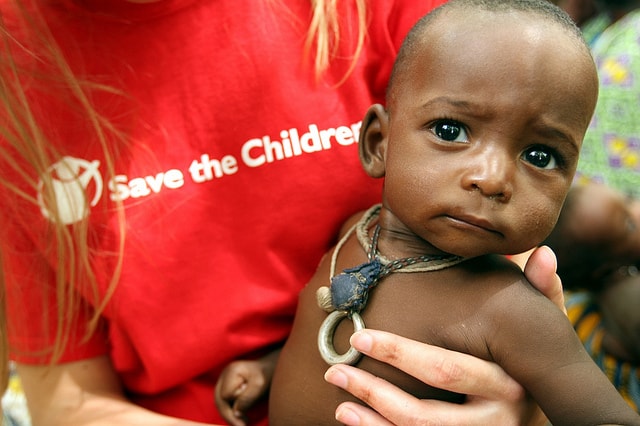
SAVE the Children has launched an appeal to raise $100 million to urgently keep children and their families safe during the global COVID-19 outbreak, the most serious threat to global health and security in modern times.

The humanitarian agency warned that the global coronavirus pandemic threatens to devastate children’s health and education, and cause unprecedented protection needs.

The $100million appeal is the largest appeal in its 100-year-history.

Since the start of the outbreak, Save the Children said it has continued to respond to the needs of communities in countries impacted by the COVID-19 outbreak, including in China, the US and across Europe.

As the Coronavirus pandemic now accelerates across lower income countries, with new cases expected to reach 10,000 across Africa this week, the agency is warning that failure to act now in countries across South Asia and sub-Saharan Africa could result in the loss of three million people’s lives, sais Rik Goverde, Senior Global Media Manager, Save the Children International.

Also, Inger Ashing, CEO of Save the Children international, said: “We have all watched in horror as the COVID-19 outbreak has turned lives at home and overseas upside down.”

Ashing noted that the pandemic is now spreading across the world’s poorest countries, further crippling fragile health systems where children are already missing out on life saving treatment for malaria, pneumonia and malnutrition.

“It will leave many children without caregivers, out of school and in danger. We only have a matter of weeks to take swift action, that will determine how many lives we can save,” she said.

According to her, Save the Children will strengthen programmes with the raised funds so they can withstand the impact of the virus and protect the most vulnerable children in countries hardest hit by the virus, especially children living in poverty, refugees, displaced families, communities in conflict and crisis areas and girls.

“This includes increasing support for national health systems, standing by families facing loss of earnings caused by isolation measures, supporting unaccompanied children, and ensuring children can continue to get an education,” she said.

With confirmed cases in Syria and Afghanistan and looming outbreaks in Yemen and the Rohingya refugee camps in Bangladesh, concerns are growing over the spread of the virus across fragile communities which are ill prepared to manage an outbreak because of weaker health systems, food and economic insecurity or conflict.

Save the Children warned the youngest generation would be deeply impacted by the outbreak.

Already, an estimated 1.5 billion children and students are out of school with their chances of return diminishing each day closures continue.

In many of the world’s poorest communities, as poverty deepens, children may be forced to work and adolescent girls forced into early marriage. Unsupervised children are at increased protection risks and, children who face domestic violence and abuse now face prolonged periods at home, whilst access to support services are reduced.

Over the past weeks, Ashing  said Save the Children has started ramping up its existing programmes worldwide.

In the Rohingya refugee camps,  host communities and other districts in Bangladesh for example, the agency is delivering critical supplies to health workers, restoring hygiene facilities, providing cash support to low income households, and providing families with information on how to protect themselves from the virus.

In Yemen, Save the Children is working in communities to raise awareness on prevention measures such as handwashing and hygiene. The agency has recently trained over 80 volunteers and 20 health workers to disseminate information locally into communities and health facilities.

Worldwide, Save the Children works with half a million community health workers in 44 countries to deliver vital health services – the agency aims to support them in recognising symptoms and preventing COVID-19, and to train another 100,000 in the coming six months. It will work with local communities to deliver training and protective equipment so that prevention measures can be ramped up, and cases can be identified early, referred for treatment and where possible, isolated.

 Ashing continued: “This crisis will test us like we have not been tested before. As the world shuts down borders and fragile healthcare systems buckle under the pressure of the pandemic, preparedness and efforts to slow the infection rate will mean the difference between life and death.

“Families may not have access to healthcare, clean water, and may suffer language or literacy barriers. We must ensure they have the support and information they need to protect themselves.

“Children in the most deprived and marginalised communities play a more vital role than ever in reducing the rate of transmission. In the poorest communities, they may be caring for younger children, or adults, or be the only one in the family that can read or access information. This is vital for all, because no one is safe until everyone is safe.”