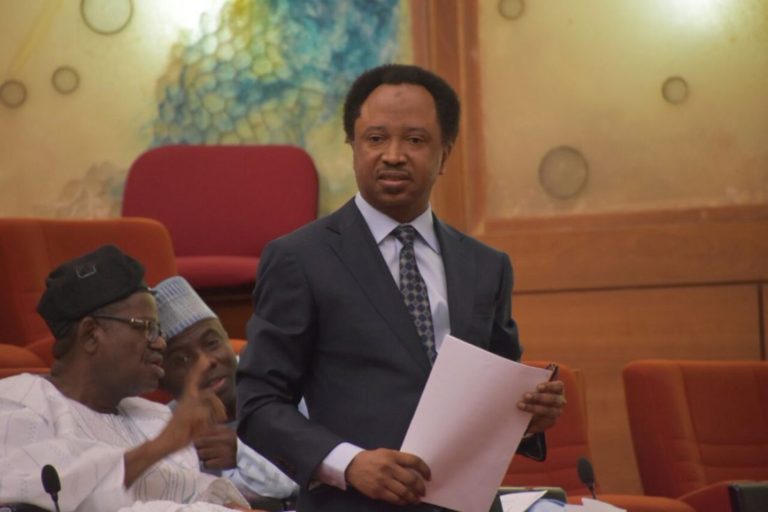
Shehu Sani, outspoken Kaduna State senator, says the lack of transparency in the handling of several high corruption cases has made Nigerians start questioning the sincerity, or lack of it, of the Muhammadu Buhari administration.
Sani said many Nigerians worry that there is a bipolar approach to anti-corruption in Nigeria and Buhari appears to be weak when it comes to “dealing with friends and friends of friends in corridors of power who are found to be corrupt”.
“Three things have raised issues here: the Babachir report that is still lying dusty in the Villa and is now part of the upholstery of the Villa. The second has to do with the issue of Kachikwu-Baru, which has now been resolved with Kachikwu and Baru shaking hands and saying that there personal differences are over. And the third is the Maina-Gate that is now a major issue in the National discourse and debate,” Sani said on AIT’s Focus Nigeria.
“The President needs to be very conscious of that, and I believe that if those who have access to go and him tell him to contest for 2019 election will spare part of the time they have in the Villa to tell him the truth about how his image and integrity is progressively being corroded by issues like this, I think they will be doing a great service to him.”
Sani stressed that the anti-corruption campaign could not be focused only on members of the opposition political parties while members of the ruling APC and the so-cabals are seen to be doing whatever they wish.
He said: “Nigerians are questioning the sainthood and the angelic posturing of this administration because the government came in with a lot of promises and pledges to clean the system and unfold a new agenda and spirit for the country.
“It is not good for the image of the President to see him being very fierce, vigorous and macho when it comes to tackling corruption perpetrated by elements and friends of the defunct Jonathan administration.
“He should be seen to be active, proactive and very much involve, with the same ferocity, virility and potency, to attack corruption when it applies to people from his own cabinet or from the ruling party.
“I would like to see all persons who are corrupt, not just people who are from the umbrella side, but also from the broom side and also from the cabal side.
“But right now, you see most of the persons who are paraded in court are people from the last administration. It is creating a very bad image when issues are being raised about this.
“Recently, the President’s Special Adviser on Prosecution (Okoi Obono-Obla) raised issues and said my committee (Senate Ad-hoc Committee on the North East) has no right to investigate the SGF (Secretary to the Government of the Federation, Babachir Lawal).
“But what you can see is that the special adviser is part of those who believe that if you are pro-Buhari, you should have some shield or immunity or be above questioning.
“He believes that if you are pro-Buhari, you should also be like Buhari, but Buhari is alone in this fight against corruption. I can tell you this.”
Sani said the APC has its work cut out for it come 2019 general election if it intends to remain the ruling party.
“The APC is a party that responsible, reasonable and conscious Nigerians will agree with me that all is not all well with,” Sani said.
“In Kaduna, we have our problem with the tyrant [el-Rufai] who is always after Shehu Sani, in Kano there is Kwankwanso/Ganduje feud, in Kogi you have Dino [Melaye] and Yahaya Bello.
“These are few of the states that I just mentioned, but in most of the states today, there are crises; that is one.
“Secondly, you have people who have worked hard to bring this party to power, later they were being either marginalised or being categorised as corrupt.
“Bukola Saraki was not known to be corrupt when they needed his support and he mobilised five governors to win election. It is when he wants to be Senate President that they said ‘ah, this person is corrupt’.
“The likes of Atiku, who is speaking out today, is marginalised out of the system.
“Bola Tinubu of all people, for all that he has done to bring the South West and garner support and resources, today has maintained a position of silence which is clear that things are not moving fine.
“Why the party (APC) still remains a viable option is the fact that the opposition PDP is still very timid in its opposition.
“They have still not been able to prove a potent opposition force, in terms of holding government to account, because they are being dragged down by either fear of being hunted or arrested or framed or fear of the EFCC.
“And when you have an opposition that has such moral burden and fears, I can tell you in every possible way that it is going to be difficult for it to be able to dislodge the APC out of power.”
President Muhammadu Buhari has sacked Babachir Lawal, the suspended Secretary to the Government of the Federation (SGF), and Ayo Oke, the suspended Director General of National Intelligence Agency (NIA).
Boss Mustapha, a chieftain of All Progressives Congress (APC), has been appointed to replace Lawal.
According to a statement issued by Femi Adesina, Senior Special Adviser to the President on Media and Publicity, on Monday, Buhari took the decision after studying the report of the investigative panel set up to probe allegations of corruption and abuse of office made against Lawal and Oke.
The three-man committee was chaired by Vice President Yemi Osinbajo, and its members were Abubakar Malami, Attorney General of the Federation and Minister of Justice, and Babagana Monguno, National Security Adviser.
“President Muhammadu Buhari has studied the report of the panel headed by the Vice President, Prof Yemi Osinbajo, SAN, which investigated allegations against the suspended Secretary to the Government of the Federation, Mr Babachir David Lawal, and the Director General, National Intelligence Agency (NIA), Ambassador Ayo Oke,” Adesina stated.
“The President accepted the recommendation of the panel to terminate the appointment of Mr Lawal, and has appointed Mr Boss Mustapha as the new Secretary to the Government of the Federation. The appointment takes immediate effect.
“President Buhari also approved the recommendation to terminate the appointment of Ambassador Oke, and has further approved the setting-up of a three-member panel to, among other things, look into the operational, technical and administrative structure of the Agency and make appropriate recommendations.”
PMB terminates appointments of Babachir Lawal, suspended SGF, and Amb Ayo Oke, former DG, NIA. Mr Boss Mustapha is new SGF.
Adesina’s statement did not say whether the sacked public officers would be prosecuted by the appropriate authorities.
Lawal was suspended following an allegationby the Senate ad-hoc committee on the North East that he awarded contracts worth hundreds of millions of naira to a company he owns.
The contract, according to the senate committee, was to “remove invasive plant species” from the Yobe State water Channels.
Oke, on the other hand, was shown the exit door after the EFCC found dizzying sums of moneystashed in hidden fire-proof cabinets at a luxurious residential building in Ikoyi, Lagos.
Following the discovery, Oke said that the money belongs to the NIA and was approved by for the agency by former President Goodluck Jonathan for some “covet security operations”.
Shehu Sani, member representing Kaduna Central Senatorial District at the National Assembly, says Nasir el-Rufai, Governor of Kaduna State, wants to borrow more money in 2017 than the entire debt profile of the state since Nigeria gained independence in 1960.
Sani, who is also Chairman of the Senate Committee on Local and Foreign Debts, said this on Monday on AIT’s Focus Nigeria.
He said that it would be tantamount to mortgaging the future of Kaduna citizens if he should approve such borrowing figure for el-Rufai, especially given that the repayment plan for the loan stretches to over 50 years.
“Kaduna State debt profile from 1960 till now is $200 million; what el-Rufai is asking for is $350 million,” Sani said.
“What if you look at it from this point of view, the very fact that in a state where the government is struggling to pay salaries, struggling to pay the monies which we previously borrowed… and now we are having $350 million that will be paid for 50 years.
“As far as I am concerned, as the Chairman of this committee (Senate Committee on Local and Foreign Debts), if I append my signature to approve such a loan for Kaduna State, such a heavy amount of money, the name of the Governor will not be seen by the next generation, the contractor who is going to benefit from that money will not be seen by the next generation, it will be Shehu Sani’s name that will be there.”
Sani said politics should be separated from the committee’s refusal to approve the loan being sought for by the Kaduna state government.
He also accused el-Rufai of maligning his reputation by telling the people of Kaduna State that he (Sani) was preventing the state from accessing necessary funds for development in the state.
“It’s like now, you have written an examination and you are waiting for the results, and you now organise some miscreants outside to say the teacher must declare that you have passed the exams,” Shehu said.
“I have a duty, coming from Kaduna State, I cannot in any way overburden the state with debt. It is okay that you want to access a $350 million loan and unleash all sorts of projects which he said he wants to unleash.
“But he should know that the payment for this money stretches to 50 years. I think he is 57, and I am 50. So if you add 50 years to our age, how old are we going to be?”
Sani stressed that there was no mention of any particular project which the loan was intended for, rather all that was stated was that the loan would be used for “institutional reforms”.
“The basis for the loan presented to me was that World Bank was giving $350 million loan to Nasir for institutional reform,” Sani said.
“It is not about hospitals or roads or schools, they said reform. What are you going to reform? Now, what he is telling the public is that he want to do roads, he wants to do hospitals.
“Other governors that applied would say, ‘I need $390 million and I’m going to use it for irrigation’, and it is there clearly stated.
“But his own has no clear definition or purpose of what he is going to do. You want to do reform, what are you reforming with $350 million? That is why we have to be very careful.
“I have a duty as the Chairman of the Senate Committee on Local and Foreign Debts, to make sure that your children, my children and our grandchildren, are not overburdened.
“Oil price today is $60 per barrel (and) states are still going to borrow. Many of these borrowing ends up in the pockets of politicians.
“And when people are desperate to borrow in 2017, you will know what the money will be used for, it’s for 2019. I have to be very careful.
“He can say whatever he wants to say, but let him have other reasons. The $350 million loan, even Saraki will not give him and I’m saying it clearly. Saraki has confidence in me and I will do my job.”
Yunusa Tanko, National Chairman, National Conscience Party (NCP), says the integrity of those working with President Muhammadu Buhari needs to be checked.
“The integrity of those working with Mr. President needs to be checked,” said Tanko, a former Chairman of Inter-Party Advisory Council (IPAC), said while appearing on Channels TV’ Sunrise Daily on Monday.
He lamented that the President seems to be the only one fighting the anti-corruption war.
He was speaking on the reinstatement of Abdulrasheed Maina, ex- Chairman, Pension Reforms Task Team (PRTT) into the civil service.
Tanko analysed Maina’s recall as “a classic case of system decay,” adding that the “case is a dent on the anti-corruption war”.
“The perception people are having is that Mr. President is probably condoning this particular situation. People need to see a decisive decision being taken on the people involved and almost immediately,” he added.
“The slowness in nature of the action being taken by the Presidency is affecting the corruption fight. The Presidency needs to have a good committee set up and they must give a quick decision.”
According to the report, “none of Nigeria’s investigative agencies, the EFCC, Department of State Services, and Nigeria Immigration Service, had made a formal request to the National Central Bureau (NCB) of INTERPOL to issue an arrest warrant for the fleeing Maina”.
It is only when a formal request is made to INTERPOL by the Nigerian government that Maina’s case can be forwarded to the organisation’s headquarters in Lyon, France.
“As of Saturday, the INTERPOL General Secretariat had not received any request from either the EFCC or DSS to arrest Maina. So, as far as we are concerned, Maina is not a fugitive,” Punch quoted a highly-placed source as saying.
There had been an INTERPOL arrest warrant against Maina when he first fled the country in 2013. The warrant was issued at the at the prompting of the EFCC.
However, there was a court judgement to the effect that the arrest warrant be revoked, and subsequently, the EFCC did not challenge that court ruling.
“So, for the arrest warrant to be renewed, the EFCC would need to make [a] fresh request to the NCB which would be processed and the necessary action taken,” the source further explained.
The source further explained that before an arrest warrant can be issued against anyone by INTERPOL, a formal request must be sent from a national investigative agency to the INTERPOL headquarters, which would consider the request and, if found credible, mandate member states to issue notices on the suspect.
The country requesting for such a warrant must show proof that the fugitive has committed a crime. Also, it must tender a warrant of arrest issued against the person by any law enforcement agency and the court within the jurisdiction where the said offence was committed.
When Austin Ugochukwu, Managing Director of Circleflow Management Nigeria Ltd, was approached by Kunle Adesuyi, one of his longstanding business partners, and Chinwe Ofolue, Regional Head, Heritage Bank, Marina Branch, Lagos, for foreign exchange transaction, he didn’t have any doubt that the N1million dollar business was “doomed to succeed”.
To him, it was just like every other successful transaction he had been involved in.
The settings and the personalities involved looked too formal and convincing for him to think otherwise, but the whole arrangement, as he later realised, was a mere ruse, and indeed an organised fraud.
“Due to my longstanding relationship with Kunle, I decided to move with him to Madam Chinwe and I confirm truly that she is a Regional Head with the bank and that gave me some level of comfort that made me think I could work with this set of people,” said Ugochukwu, who is currently battling the influence of the fraudsters within the security operatives and anti-corruption agency to get justice after he was duped.
He was later to find out that the fraud syndicates were headed by Tony Akala Bakare and Otunba Lanre, both Lagos politicians, whom he accused of trying to use their political connections within the Nigeria Police Headquarters and Economic and Financial Crimes Commission (EFCC) to frustrate investigation by the police.
Lanre is currently in police custody while Bakare is yet to be apprehended. Both are said to be very powerful and connected.
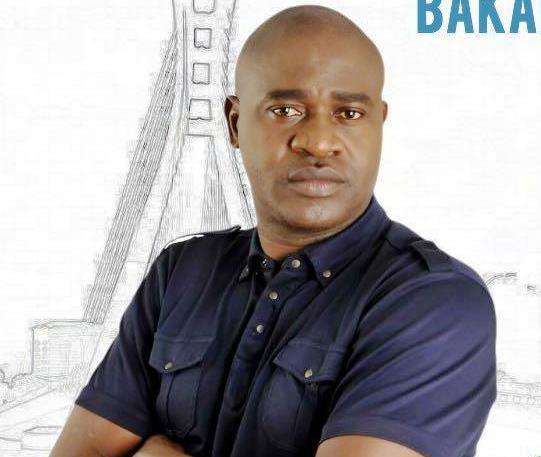
Bakare, alleged kingpin of the syndicates
According to a petition written on his behalf by Nicholas Eku, his lawyer, to Ibrahim Idris, Inspector General of Police, on the matter, both Bakare and Lanre have issued death threats to him to abandon the case and forget about the money. In the petition, Eku pleaded with the IGP to use his office to ensure that the investigation is not truncated but pursued to the logical conclusion.
He also alleged that since the transfer of the case from Area J Police Station, Ajah, to AIG Zone 2 Police Headquarters, the investigation has been tainted. This, he argued, is because of the influence of the suspects.
he said that the suspects’ accounts 3021621013 and 3781685016 with FCMB, which were hitherto frozen by the Area Command, were lifted by the AIG Zone 2, thereby allowing them to move N66million and N35million away from them.
THE GRAND PLAN
His ordeal started when he was introduced to one Dr. Cyriacus Anyanwu who invited him and Kunle to an exquisitely furnished office at No 5B Audu Epkekha Street, Lekki, Lagos, on June 14, 2017. The office belongs to one Alhaji Umar Ali.
“Dr Anyanwu introduced himself as a partner to Alhaji Umar’s Company (Grantland Investment Ltd) and stated that they had been doing business for a long time.” Ugochukwu told the ICIR.
“He then said Alhaji Umar has $1,000,000 cash to sell through a said ‘General’. We agreed to purchase the dollars at N360/$.
“Meanwhile, during the whole negotiation process, Alhaji Umar Ali could not speak English, he said in Hausa ‘ba turenchi’ (meaning I don’t understand English) and so his personal assistant Bashir Mohammed was interpreting for him.”
After sourcing funds from his partners who needed dollars for their businesses, Ugochukwu, whose company specializes in sourcing FOREX for partners, said he was able to raise the N360million required for the transaction.
“I sourced the funds from my clients who needed the foreign exchange to service their businesses: Yahaya Abubakar, Sethwealth Ventures, Energy Fountain Oil and Gas Ltd, Sought After Synergy Nig Ltd,” he disclosed.
As negotiation progressed, Mohammed, who was interpreting for Alhaji Umar, advised him to make payment of N350, 000,000 into their FCMB corporate account, Grantland Investment Ltd with the account number 0785971017.’
Umar Ali and Mohammed presented themselves to be signatories to the account. The account was later discovered to belong to one Alhaji Agboola Rasheed, who was also part of the syndicate.
For his efforts as the go-between, Anyanwu took N10million from the transaction.
But he didn’t take it in cash — it was paid into different accounts which should have given Austin impression of the deal he was involved. He never suspected any foul play, however.
“Dr. Anyawu advised that his commission be paid into the following accounts NAD Foundation 1020188396 UBA (N6,500,000), Tri Chris Pet Services Ltd 101411797 Zenith Bank (N2,500,000) and I was to give him cash of N1,000,000 to make a total sum of N360,000,000 for USD1,000,000,” he said.
With the conviction that the deal was real and genuine, Ugochukwu said he initiated the transfer of the money the next day, June 15, 2017.
He said: “The transfers were initiated as instructed by Bashir and Dr. Anyanwu from our FCMB account Circle Flow Mgt Nig Ltd, with the account number 4308278023 on the next day June 15, 2017.”
THE APPREHENSIVE WAITING GAME
The transfer was smooth; he was told to make provision to pick the cash. So, he thought the delivery of the dollars was going to be smooth as the transfer of the naira equivalent, but it turned out to be a long wait and of course, a hide and seek.
He disclosed that he became apprehensive when he didn’t receive the dollars equivalent of N350million he transferred to Grantland account several hours after he transferred the money.
“Basir called the ‘General’ informing him that they have received the naira and he said they can come to pick up the cash. Bashir left while others remained with us in the office.”
But after an hour when they had not arrived and there was no information about them, Ugochukwu said he called his bank to place a restraint on the money he transferred to Grantland’s account.
“I immediately called my account officer to place a lien on the N350, 000,000 in their account when I became uncomfortable after about one hour,” he said.
While waiting for dollars to arrive, he said Yahaya Abubakar and his brothers, whose money was part of the N360million, were already putting him under intense pressure after about three hours of not seeing or receiving the dollars.
But while he insisted that the dollars be brought before he instructed his bank to lift the restraint on the account, the General, on the other hand, confirmed the receipt of the money in his account but said he needed to transfer some funds to his personal account before he would release the dollars.
He was said to be upset when he learnt Ugochukwu had placed a lien on the funds in Grantland Investment ltd account.
“We requested that the dollars be brought before we lift the lien but he insisted that the General will not allow him leave with the dollars he had already counted without confirming the Naira in his personal account,” he said
He, however, lifted the lien on the account after intervention by a lady called Nkechi. Rather than getting the $1million as agreed Bashir came back with just $130,000 at about 9pm that day, arguing that the General had already taken the dollars back to his safe when “we took time in lifting the lien and he just had to bring the $130,000 meant for another customer to pacify us”.
Mohammed promised to bring the balance the next day before 10a.m and wrote an agreement on Grantland Investment Ltd for the $130, 000 received and signed off as the owner.
The following morning, Mohammed, who had gone to bring the balance $870,000, stopped picking his calls after 12pm.
“We were tensed and Alhaji placed his hand on a Quran and swore we will get our money in Hausa to pacify us, we waited till 5pm, still no Bashir. We then turned the heat on Alhaji Umar Ali and he started fidgeting, suddenly we got a text from Bashir claiming EFCC had invited him and the seller, at this point all hell broke loose.
“Alhaji became very visibly apprehensive and he turned to me and said he will make sure I get my money back in fluent English, I was shocked knowing he could speak English and was only pretending all along; it then became apparent to us that it was all a scam.”
EFCC’s CONNECTION… THE CONFESSIONS
Ugochukwu fainted several times and even attempted suicide after learning that one Kamal had eloped with the $870,000 meant to pay his balance. But he soon found out that Kamal was a non-existing character in the whole arrangement.
It was at the office of Economic and Financial Crimes Commission (EFCC) at Okoti Eboh, Lagos, that he wrote a petition against Kamal using Grantland Investment Ltd letterhead claiming Kamal had eloped with the cash dollar he collected from the General.
The petition, it was gathered, was sent to Abuja and approved the same day. That made him a complainant in whatever imminent charge that could be pressed against them
According to Ugochukwu, the Commission requested him to file a petition with them for the handling of the case. But his business partners who made the cash available would not have any of that, as they got him arrested.
While it looked that he might never be able to recover all his money, the businessman said he has so far recovered $350,000 out of the $1million paid to the fraud syndicates.
This was not until the principal characters in the crime confessed their roles to the police.
The ICIR gathered that the duo of Bashir and Umar confessed to the police that they were not the owners of Grantland Investment Ltd, the company with the account that Ugochukwu paid the money to.
They had forged those letter head papers and impersonated one Alhaji Agboola, the original signatory to Grantland Investment Ltd. But Agboola was also part of the fraud; upon interrogation at Area J Police Station, Ajah, Lagos, he confessed that the whole transaction was a scam.
He got $198,000 as his share of the fraud, while $150,000 was recovered from him in his house.
Bashir claimed that his share from the spoils is $55,000 while $35,000 was recovered from his house, and Umar claimed his share is $25,000 while $20,000 was recovered from him.
The police recovered a total of $205,000 from them. Ugochukwu revealed that the suspects also affirmed that the remaining $670, 000 is with two politicians: one Otunba and Tony Akala who later turned out to be the ‘General’ earlier referred to as the owner of the $1million.
The case is currently being investigated by the Force Intelligence Bureau (FIB), Area 10 Abuja.
This piece is laden with unsolicited advice. It ordinarily should not have been written, but for recent evidence that the quality of advice available to President Muhammadu Buhari is questionable. Friends of people in power often speak in hushed tones about how the President never listens, about how difficult it is to approach him much less sell an argument to him once his mind is made up. However, anyone who watched Okoi Obono-Obla, Special Assistant to the President on Prosecution, on Channels TV on Monday will agree that we can’t leave Buhari to his advisers.
This list is inconclusive; it only profiles five or so Federal Government appointees who, with an ideal President in charge, would have already lost their jobs last week. As occasion demands, it will be torn à la Olusegun Obasanjo’s PDP membership card and replaced with new names. It took Buhari himself six months to assemble his ministers; therefore, it would be impossible for a journalist to gather the bad eggs in one fell swoop.
All names on the list earned a spot either by virtue of their role in or their analysis of the botched civil service recall of Abdulrasheed Maina, former Chairman of the Pension Reform Task Team (PRTT), who is wanted by the Nigerian Police, the Economic and Financial Crimes Commission (EFCC) and the INTERPOL for multibillion-naira pension fraud.
OKOI OBONO-OBLA
Nigerians were still trying to make sense of Maina’s reinstatement when Obono-Obla appeared on Channels TV’s Sunrise Daily to defend the indefensible, arguing that since Maina “had not been found guilty of any offence”, he did “not see why some people are outraged”.
Obono-Obla even substituted himself for Maina. “If the EFCC declares me wanted, that does not mean that I have been adjudged guilty,” he said. “It is only a court of competent jurisdiction that can adjudge anybody guilty.”
Obono-Obla must have been red-faced a few hours later when Buhari ordered Maina’s disengagement from the civil service. Being a lawyer and the presidential adviser on prosecutions, Obono-Obla should have known that the court could not have declared guilty, a man who fled from trial.
Had Buhari sought Obono-Obla’s advice before acting, he would have been encouraged to keep the fugitive in service until conviction by the courts that he was running away from. People like Obono-Obla do not belong in Buhari’s government; people like him are enemies of the people — enemies of poor, aged pensioners who have been denied the fruit of their labour by the greed of a few people among whom, according to the EFCC, is Maina.
ABUBAKAR MALAMI
Abubakar Malami is still the Attorney General of the Federation? Shocking but not so shocking — because this is Nigeria. As has now been made public, it was an April 2017 letter from Malami that triggered a string of processes that culminated in Maina’s secret reinstatement. In that letter, Malami urged the Federal Civil Service Commission (FCSC) to “give consequential effect to the judgement that voided the warrant of arrest issued against A.A. Maina, which formed the basis for the query and his eventual dismissal”.
Malami’s letter is misleading. Contrary to the AGF’s letter, the arrest warrant was not the basis of Maina’s dismissal from service in 2013. Rather, it was his abscondment from duty. The undercurrents of Malami’s action are not all public yet, but there is scant truth in his claim that he was guided by “law and public interest”. Malami’s interests are private.
Unfortunately for the ‘change’ regime Buhari professes to be running, a figure like Malami, sympathetic to the course of persons of questionable character, will constitute an albatross to the anti-graft cause. Since Malami could not advise Maina to first clear his name in court as precondition for his reinstatement, the AGF should follow the fugitive through the exit door.
ABDULRAHMAN DAMBAZAU
Bravery is one of the hallmarks of the Nigerian soldier. Maybe because this virtue is limited to the battlefield, or perhaps because he has since retired (as a Lieutenant-General), Abdulrahman Dambazzau didn’t have the courage to own up to this involvement in Maina’s recall. Once the secret affair was blown open, Dambazzau rushed to the media in an attempt to pass the buck to the Head of Service (HoS) and the FCSC. Not only did he pass the buck, he pretended as though he was merely a distant observer in the matter.
“The office of the Head of Service and the Federal Civil Service Commission are the two bodies responsible for issues relating to discipline, employment, re-engagement, posting, promotion and retirements of Federal Civil Servants,” Ehisienmen Osaigbovo, his media aide, said. “It is understood that Maina’s last posting was with the Ministry of Interior, and that is probably why he was re-posted to the ministry.”
After Malami’s letter, the FSCS forwarded the matter to the Ministry of Interior, which decided, at its Senior Staff Committee (SSC) meeting of June, 22, that Maina should be reinstated. Dambazzau was fully in the know.
Buhari might be wondering by now if it would have been best to have altogether left Dambazzau out of his cabinet. After his removal and premature retirement by Godluck Jonathan in 2010, Dambazzau resurfaced with Buhari in the lead-up to the 2015 election. Having headed the security committee of the APC campaign organisation — and given his long-standing relationship with Buhari — Damnazzau was early favourite for appointment as Buhari’s National Security Adviser (NSA) — until questions about his past stewardship resulted in his movement to the less prominent interior ministry.
Maina’s recall isn’t his first flirtation with controversy. It is still a mystery how he wasn’t implicated in the arms deal probe of the current government, having been Chief of Staff for two of the five Jonathan years when the military served as conduit for diverting public funds to private pockets. There are allegations that the probe report was doctored to shield him. But there can be no shielding for the Maina case; Dambazzau’s friendship with Maina should be allowed to continue blossoming — but only outside the government.
LAWAL DAURA
On whose orders has the Department of States Service (DSS) been providing security for Maina since his covert return to the country? Unless Daura can satisfactorily answer the simple question, this will be one mess too many for the DSS, bearing in mind the flimsy report on which it advised the legislature against Ibrahim Magu’s confirmation as substantive EFCC Chairman.
And even if he explained that away, how would he, the role of the DSS in how Maina managed to evade airport alerts each time he sneaked into the country in the past? All these events can’t be mere coincidences; it is either Daura has not been doing his job or he hasn’t been doing it well. Can Buhari ever dismiss his friend from Daura, in favour of a more responsible DSS? A real test!
GARBA SHEHU
After two years in office, Garba Shehu, one of Buhari’s two spokesmen, is still obsessed with Jonathan. To Shehu, “some influential officials loyal to the previous government may have been the invisible hand in the latest scandal that saw the return of Maina to the public service, despite being on the EFCC’s wanted list”.
Shehu views Maina as “one of the monsters created by the former PDP government, and which are still rearing their ugly heads long after the Party was soundly defeated in the 2015 elections”.
We thought Shehu’s announcement of rat infestation at Buhari’s office was the worst we would get, but this?
MUHAMMADU BUHARI?
President Muhammadu Buhari will himself deserve a place on this list if more than one of these men retain their office by the time the Maina probe is done and dusted. It is one thing for a President to have the wrong hands in government; it is another for him to possess the balls to replace them.
By ordering Abdulrasheed Maina’s dismissal from civil service, Buhari merely played to the gallery. If he is genuinely interested in fighting corruption, the facilitators of Maina’s reinstatement should be sacked as well. Unless the masterminds of Maina’s backdoor recall have been dealt with, Buhari is just glossing over the matter.
And this is not too hard to do. Even Jonathan, the one widely believed to be weak, fired (albeit reluctantly) Stella Oduah as Minister of Aviation, following her indictment by two panels that probed the purchase of two bullet-proof cars for N255m and the approval of N643m for the purchase. If a weak civilian did this, it can’t be too much to expect from a stone-cold retired Major-General. If he can’t dismiss his under-performing appointees, then Buhari is the number-one enemy of his own government.
Former President Olusegun Obasanjo says the nation’s anti-corruption institutions, Economic and Financial Crimes Commission (EFCC) and Independent Corrupt Practices and Other Related Offences Commission (ICPC), were politicised and weakened when he left office.
“When I was elected President in 1999, my administration took the issue of corruption very seriously and we established Independent Corrupt Practices and other Related Offences Commission as well as Economic and Financial Crimes Commission, among other anti-corruption initiatives. These institutions were provided the political support needed to fight corruption and they did their best,” Obasanjo said at the 14th anniversary of Dorcas Oke Hope Alive Initiative held at the University College Hospital (UCH), Ibadan, Oyo State.
“But once we left office, they (EFCC and ICPC) became very politicised and weakened to the point that they were unable to discharge their duties.
“In fact, one of the governors, who had been labelled and gone to jail for corruption, was to look for replacement for Nuhu Ribadu [the pioneer EFCC chairman], and you know the type of replacement he would get.
“There is need to support and strengthen these institutions, especially in the area of prosecution. The law enforcement agencies or the government alone cannot fight corruption. They must be supported by a judiciary that is upright and transparent.
“It is very demoralising to law enforcement officers when they painstakingly investigate a case and the culprit finds his way around the judiciary to escape. We cannot continue to celebrate criminals, who enrich themselves from our commonwealth, and think that corruption will disappear.”
He also said that the massive corrupt tendencies of the nation’s educated leaders gave birth to the dreaded terrorist organisation, Boko Haram.
Obasanjo, who spoke on the theme, ‘Corruption and the Challenges of the African Child’, said: “One of the reasons that members of the extremist group Boko Haram, gave for their insurrection is that they became disillusioned when they saw how corrupt the western-educated leaders were.
“According to them, if those who occupied government offices by their western education would corruptly enrich themselves and deprive others of the basic things of life, then that education is ‘haram’, which means forbidden.
“I am told that when Mohammed Yusuf, the original leader of Boko Haram and his early followers first started, they all gathered and tore their certificates because they said a certificate that could not fetch them a source of livelihood was useless to them. Similarly, they saw western education as corrupting the individuals.
“We may not agree with their position, but the disappointment and disillusionment of citizens over the inadequacy or poor performance of their leaders is real. Add rising corruption to other inadequacies in leadership and we will see the instability and insecurity which we have witnessed in the North East in recent years.”
Although Obasanjo admitted that Africa’s most populous country was still confronted with challenges ranging from massive unemployment, agitations, crime among others being carried out by the youthful population, he maintained that such would continue unless the issue of corruption is seriously dealt with.
“There is, therefore, a direct correlation between corruption and youth; youth healthy development, growth and progress,” he said.
“The manifestation of corruption in various forms, such as instability, unemployment and our mentality will continue to plague our nation unless urgent steps are taken to fight corruption.
“No society in the world can claim to have completely eradicated corruption, but many countries have successfully reduced corruption to its barest minimum. Many countries have not made corruption a way of life. There are some examples of countries from Asia and Africa, we can emulate if we are serious about the fight against corruption as we should be.”
Sule Lamido, former Governor of Jigawa State and the People’s Democratic Party (PDP) presidential aspirant, says the thieves in the ruling All Progressives Congress are bigger than the ones in the opposition Peoples Democratic Party (PDP).
“When they say we’re thieves, it is the smaller thieves that remained in the PDP; the bigger thieves are in the APC,” said Lamido, who described the ruling party as a rented house whose roof is about to collapse.
He advised all APC members to run back to their former parties because no sane person would stay in a house about to collapse.
“Anybody who is sane should leave the APC because it is a contraption,” Lamido told Daily Trust in an interview. “They are all coming from their own homes into a rented house and it is collapsing.
“So, run away before the house falls on your heads. Those who came from the AC, PDP and even Buhari who came from the CPC should move out and go back to their homes, because this house is caving in. Nobody is safe in that house.”
Lamido, who has written a letter to PDP to announce his 2019 presidential ambition, said the APC had failed to deliver good governance two years after it used propaganda to win an election.
“Two years after we were blackmailed, terrorized, harassed, demonized out of power with these lies upon lies upon lies by people who are least qualified to be in government, I said, ‘look, what’s Nigeria today?’
“I mean a party of propagandists has taken over and today in Nigeria, the way we’re being fought, the way we’re being demonized, the way we’re being harassed and maligned is simply beyond what you imagine because this is a party.
“Here’s a government in Nigeria which is fond of mocking its own citizens. Anything you say, they mock you. They call you wailing-wailer. But government should give me comfort; government should inspire me; it should motivate me so that if I’m wailing, it should say, ‘look, what’s your problem?’ And then cure my problems; you don’t mock me.
“There was a time I came to Abuja in the night and throughout there was no light. I mean it was in total darkness like we are in the Stone Age and if I’d talked, they would say, ‘Sule Lamido is wailing, wailing-wailer’. I’m wailing because I want something called a civilized environment.”
Lamido said it was an irony that APC demonised PDP but majority of the party members were once in PDP. He said the big thieves left the PDP to APC, leaving only the small thieves in PDP.
“Look, the APC is a creation of the PDP. When [Chief John Odigie] Oyegun calls us evil, when Lai Mohammed call us shameless, it’s because they don’t know what is called evil or shame because their government is a creation of evil and shame, because it was fertilized by the PDP.
“The APC government is our own daughter, our son because the PDP made them. Minus the PDP, there would be no APC,” he said.
“Come on! Where would they be? So people like Oyegun, who were out of circulation before coming to government, are now talking because they found the evil in the PDP, simply because it made them. All of them today are the creation of the PDP.”
Lamido is hopeful that PDP would win the 2019 presidential election even if Buhari seeks re-election.
“The Buhari of today is not the Buhari of 2015. One, he is fatigued. Two, he is faced with what you call political party management under democracy.
“It is not where you give orders; here you have to build some consensus. You can see he cannot even relate well with the Senate President of his own party. So, the Buhari of today is not the Buhari of 2015.”
Mike Okiro, Chairman of the Police Service Commission (PSC) and former Inspector General of Police, says the promotion granted some police officers by Ibrahim Idris, the current IGP, were “special promotions”, not illegal as alleged by Isah Misau.
Misau, the senator representing Bauchi Central in the National Assembly, had, among many allegations, claimed that Idris granted illegal, accelerated promotions to officers from his Kanuri ethnic group.
But Okiro said it was the prerogative of the IGP to grant special promotion to officers who have “done very well”.
“There was no illegal promotion. Rather, what the IG brought to us was special promotion, which we looked at and found out that some officers were skipped,” Okiro said during an interview with The Punch.
“When a list of policemen for promotion is sent to us, the police service commission will look at whether a policeman has a disciplinary matter. Is it according to seniority?
“You cannot leave number one and promote number 10. When the IG brought the list, we asked him to explain why they should be given special promotion.
“Special promotion is an incentive if you have done very well. Sometimes when someone is given special promotion, you find his colleagues clapping and congratulating him that he had done well.
“But you must give sufficient reasons why someone should be given special promotion, it is not illegal. We asked him to explain why those he recommended should be given the privilege.”
Okiro, however, added that according to the Act establishing the PSC, the commission has no oversight or disciplinary powers over the office of the IGP.
“There is a lacuna in the Act establishing the commission and in the constitution where the commission is saddled with the responsibility of recruitment, discipline and promotion of police officers. It is put there in brackets, except IG,” Okiro said.
“They say power corrupts and absolutely power corrupts absolutely: it depends on the individual.
“An IG may feel he is not under the commission and decide to behave as he likes. Others may feel the job needs to be done, and relate well with the commission, but some may say, “I don’t need them (commission), there is nothing they can do to me.
“It depends on the IG, and that is why I said there is a lacuna in the Act because if the commission feels strongly about an issue in the police and the IG refuses to implement it, there is nothing the commission can do about it.”
Okiro also said that the PSC was no longer looking into the allegations raised by Misau against Idris, because Misau refused to come to clarify his claims and besides, the matter had been taken to court.
“We asked him [Misau] to come and substantiate the allegations. We invited him, but he didn’t come.
“Who gave money, how much and to who? But he didn’t come. So, we just let the matter die because he couldn’t substantiate the allegations.
“The matter is in court; so, it is sub judice to comment on it.”