Home Blog Page 2678

Toilet papers do not remove faeces from the anus, doctors, celebs warn

0

Doctors have warned that toilet papers do little to remove faeces, and have therefore advocated the use of wet wipes or toilet bidets.

Doctors also say apart from cleanliness, excessive wiping could cause health problems such as anal fissures and urinary tract infections.

Daily Mail reports that celebrities such as will.i.am, Will Smith and Terrence Howard have been vouching for baby wipes instead of tissue for years — with Smith even hailing the habit as “special and incredible”.

Countries like Italy, Spain and Greece have implemented the use of toilet bidets instead of tissue but many other countries, including US and Nigeria, still rely on the toilet paper to wipe the anus.

The toilet bidet squirts water into the area to make cleaning with toilet paper easier.

Rose George, author of ‘The Big Necessity: The Unmentionable World of Human Waste and Why It Matters’, explained why using toilet paper doesn’t remove faeces like it should.

“I find it rather baffling that millions of people are walking around with dirty anuses while thinking they are clean,” George said. “Toilet paper moves sh*t, but it doesn’t remove it.”

Will.i.am said baby wipes are what most people should consider using in terms of wiping.

“Here’s proof on why people should have baby wipes. Get some chocolate, wipe it on a wooden floor, and then try to get it up with some dry towels. You’re going to get chocolate in the cracks. That’s why you gotta get them baby wipes,” will.i.am said.

Actor Terrence Howard went as far as to say he didn’t trust women who used toilet paper.

“If they’re using dry paper, they aren’t washing all of themselves. It’s just unclean. So if I go in a woman’s house and see the toilet paper there, I’ll explain this,” Howard said.

Actor and director Will Smith echoed a similar appreciation for baby wipes. “I’m the type of person that it’s important for me to share. When I experience something that’s special and incredible, I like to share it with people. Anyone who’s using dry toilet paper, you’re really not doing yourself the true service,” Smith said.

Cleanliness is not the only reason people should consider bidets or baby wipes instead.

Aggressive wiping has been known to cause health problems such as anal fissures and haemorrhoids.

An anal fissure is a tear in the lining of the rectum and can cause bleeding or pain for the person when they are pooping.

Most fissures heal at home after eight to 12 weeks, but it is important to be careful when wiping because it can irritate the area.

Haemorrhoids are swollen veins and tissue in the lower rectum and anus. They are more serious than fissures and sometimes can be harder to treat.

External haemorrhoids happen around the rim and are the ones that are typically irritated from excessive wiping, but they can be treated with cream or medication.

Also, bidets can prevent people from developing a urinary tract infection.

If people wipe from back-to-front, they are pulling bacteria from the anus towards the front of the body.

This can impact women especially and cause them to develop at UTI from the bacteria getting into the urethra.

By using a bidet or wet wipe instead, it kills the bacteria and prevents it from infecting the urinary tract.
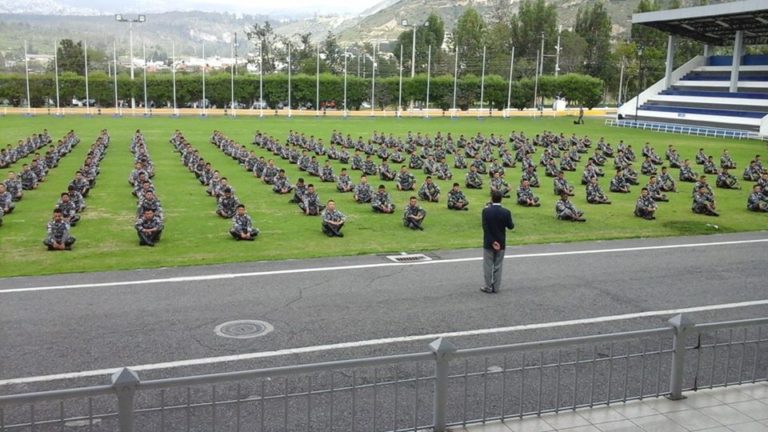
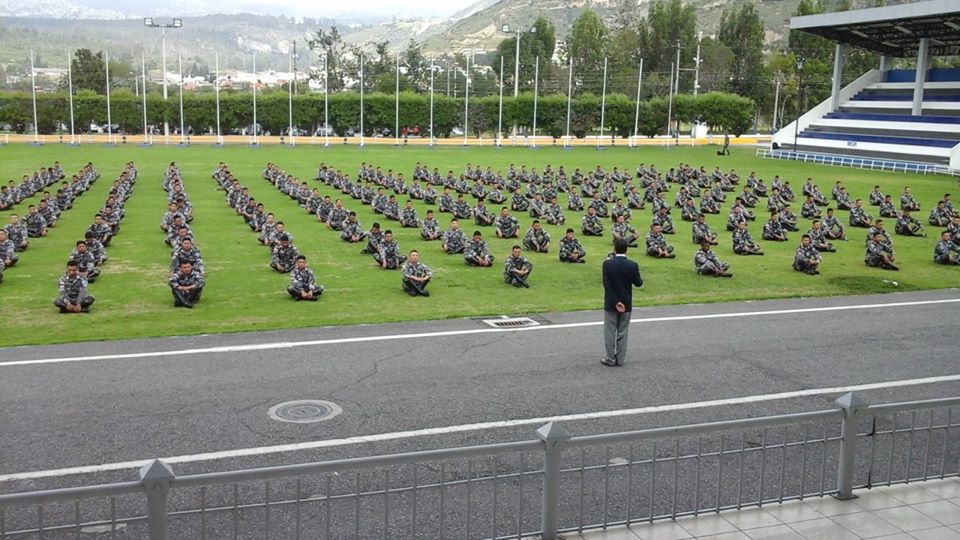
 

New approach for Somali security forces to prevent terrorism

By David Leffler

During these dangerous times of high tensions in Somalia, terrorism could quickly end if Somali security forces were trained to form what is known in Latin American military circles as Prevention Wings of the Military. These units would be comprised of Invincible Defense Technology (IDT) experts. The purpose of these IDT groups would be to practice the non-religious Transcendental Meditation (TM) and the advanced TM-Sidhi program in group twice a day.

Extensive peer-reviewed research and military field-tests worldwide show that proper application of these specific programs bring about measurable decreases in crime, terrorism and war, and improvements in quality of life, which are thought to be tangible signs of the reduction of societal stress. These changes are measurable from such statistics as reduced terrorism and conflict, crime rates, accidents, hospital admissions and infant mortality.

In highly stressed areas of the globe, establishment of large groups of IDT experts have also increased economic incentives and growth of prosperity. Entrepreneurship and creativity increase as well. Also, on a global scale when large groups of civilian experts gathered from 1983 to 1985, terrorism-related casualties decreased 72 per cent and international conflict decreased 32 per cent. Moreover, such positive changes in social trends take place within a few days or weeks after IDT is introduced.

The IDT approach has been used during wartime, resulting in reduction of fighting, reduced war deaths and casualties, and improved progress toward resolving the conflict through peaceful means. IDT is totally unlike any other defense technology in that it does not use violence to quell violence.

It is the high collective stress levels in Somalia that ultimately fuel terrorism and warfare. If dangerous levels of collective stress and frustration are reduced by applying IDT, then Somalia’s governmental leaders and citizens will be more capable of finding constructive and orderly solutions to the irresolute issues plagueing the nation.

With greater civic calm, citizens’ aspirations will rise, and a more productive and balanced society will emerge. Then violence as a means for change and/or as an expression of discontent will naturally subside.

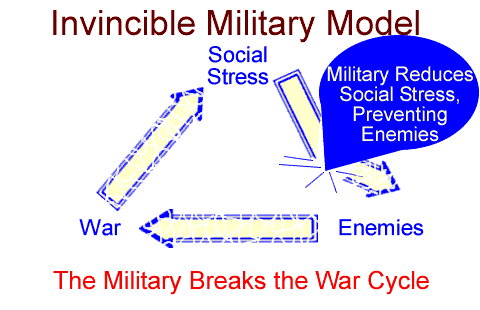
The powerful IDT human-resource-based defense technology disallows negative trends and prevents enemies from arising.

No enemies means no war or terrorism and full security, as well as a happy, productive and normal life for everyone.

invincible-IDT- Military Model

For these reasons, the IDT approach is advocated by the Global Union of Scientists for Peace (GUSP). This non-profit organization hosted an international conference in Kiev, Ukraine (see: https://www.gusp.org/global-peace-summit/).

Renowned Ukrainian leaders Lt. General (Ret.) Vasyl Krutov, former chief of the Ukraine Anti-Terrorism Center as well as Academician Dr. Sergiy Maksymenko, a distinguished Ukrainian research scientist are among the impressive list of participants who spoke at or voiced their support for the conference.

Others included: President Joachim Chissano of Mozambique, who applied innovative IDT programs to end that nation’s civil war; retired Ecuadorian Lt. General José Villamil, who also applied IDT to end war between Ecuador and Peru; and Dr. Rajendra Pachauri, former chair of the Intergovernmental Panel on Climate Change (IPCC), winner of the 2007 Nobel Peace Prize.

IDT is a way for the Somali security forces to prevent conflict and terrorism by deploying a proven, simple human resource-based technology, with minimal training and costs needed to implement it. It would cost about as much as one modern fighter jet.

Recent events show that IDT is desperately needed. There is truly no other solution. Somali leaders would be wise to read the proceedings of the GUSP conference and learn how to best rapidly establish perpetual peace.

Dr. David  Leffler has a Ph.D. in Consciousness-Based Military Defense and served as an Associate of the Proteus Management Group at the Center for Strategic Leadership, US Army War College. Currently, he serves as the Executive Director at the Center for Advanced Military Science (http://www.strongmilitary.org) and lectures and writes worldwide about IDT.

I warned Buhari against Maina’s reinstatement, says Head of Service

Winifred Oyo-Ita, Head of Service of the Federation, says she told President Muhammadu Buhari about the plot to reinstate Abdulrasheed Maina, former Chairman of the Pension Reform Task Team (PRTT).

This was contained in the memo submitted by Oyo-Ita to Abba Kyari, Chief of Staff, in response to a query from the President demanding an explanation into the circumstances that led to Maina’s reinstatement.

According to The Punch, the memo, dated October 23, and with reference number HSCSF/HCSF/LU/COR/FCSC/750/T, was titled: ‘Re: Abdulrasheed Abdullahi Maina’.

Oyo-Ita maintained that the move to recall Maina was kick-started by the office of the Attorney General of the Federation, and that her office was never in support of it, neither did it approve Maina’s subsequent posting to the Ministry of Interior.

“Please, note that the OHCSF was never in agreement with the reinstatement and consequently never conveyed the approval of the FCSC to Mr. A. A. Maina, nor approved his posting to the Ministry of Interior or any other MDA,” Punch quoted Oyo-Ita as writing in the memo.

“Rather, I sought audience with His Excellency, Mr. President, on Wednesday, 11th October, 2017 after the FEC meeting where I briefed His Excellency verbally on the wide-ranging implications of the reinstatement of Mr. A. A. Maina, especially the damaging impact on the anti-corruption stance of this administration.

“The move to recall Mr. A. A. Maina was at the instance of a series of letters from the Attorney General of the Federation to the Federal Civil Service Commission requesting the commission to give consequential effect to the judgement that voided the warrant of arrest issued against Mr. A. A. Maina which formed the basis for the query and his eventual dismissal.

“The FCSC thereafter requested that the Head of the Civil Service of the Federation should advise the Permanent Secretary, Ministry of Interior to consider the AGF’s letter and make appropriate recommendations to the commission and this was so communicated to the Ministry of Interior.

“The Ministry of Interior took the matter to the Senior Staff Committee of the ministry and recommended the reinstatement of Mr. A. A. Maina into the service as Deputy Director.

“The OHCSF forwarded the recommendation to the FCSC, which has the constitutional responsibility for appointments, promotion and discipline for further action.

“The FCSC in consideration of the letter from the AGF and the recommendations of the SSC of the Ministry of Interior consequently approved and conveyed the reinstatement of Mr. A. A. Maina with effect from 21st February, 2013 vide letter herewith attached as Annex IV.

“The letter of reinstatement, as communicated to HCSF Ref. FC. 4029.82/Vol. III/179 dated  18th September, 2017 attached herewith as Annex IV, ostensibly also copied the Ministry of Interior which is the one erroneously used to document Mr. A. A. Maina on a claim that he has resumed work since 28th September, 2017.

“The Ministry of Interior informed the OHCSF of this development vide letter Ref. MI/1436/II/24 dated 16th October, 2017 from Ministry of Interior stating that Mr. A. A. Maina has resumed with effect from 28th September, 2017 is attached as Annex V.

“However, I have requested the Permanent Secretary, Ministry of Interior, to provide any documentary evidence to support the claim of reinstatement and posting of Mr. A. A. Maina by OHCSF, since after his dismissal.

“The letter to the Permanent Secretary, Ministry of Interior is attached as Annex VI. The foregoing is accordingly submitted for your information and further consideration.”

Maina was accused of spearheading massive corruption in the pension reforms task team which he headed between 2010 and 2013.

He was declared wanted by the EFCC and the Nigeria Police after he refused to honour several summons by the Senate to appear before it and clear himself.

He fled to the United Arab Emirates where he remained until his surreptitious reinstatement into the civil service.

However, Buhari, who was in Turkey when the news of Maina’s reinstatement broke, ordered his immediate dismissal from service.

Buhari never said Babachir Lawal was innocent, says Femi Adesina

Femi Adesina, Special Assistant to the President on Media and Publicity, says the President never said Babachir Lawal, former Secretary to the Government of the Federation, was innocent of the allegations against him.

Adesina said this during an interview on Channels Television’s Politics Today, when he was asked why Buhari decided to sack him all of a sudden after clearing him earlier.

“You didn’t get it right, you didn’t get it right,” Adesina said. “The President at no time said anybody was not guilty.

“What the President said then was that he [Lawal] was not given the right to defend himself. He said the procedure adopted for the indictment that came from the National Assembly, was not proper.

“The President did not give him a clean bill of health, he only faulted the procedure. So get it right. Don’t ascribe what the President did not say to him.”

After the Senate Ad-hoc Committee on the North East had indicted Lawal of corruption, it made recommendations to Buhari, asking him to drop Lawal from his cabinet.

But Buhari replied that he could not act on the Senate’s recommendation due to some reasons.

First, he noted that the recommendation was contained in “an interim report as against a final report which ought to have been presented to the Senate in a Plenary for adoption as a binding and final report”.

Buhari also noted that out of the nine members that made up the ad-hoc committee, only three signed the report, thereby making it “a minority report” and “presenting a challenge for the Presidency to determine the weight to attach to the report”.

Also, Buhari said that the report did not establish that “Babachir Lawal was ever given an opportunity to appear before the committee and defend himself”, neither was the company linked to him [Rholavision Engineering Limited].

“In the light of the foregoing, I am not able to approve the recommendation to remove and prosecute Engineer Lawal on the basis of the Senate ad-hoc committee report dated 15th December, 2016,” Buhari had said.

CLOSE-UP: Boss, practising Christian, full gospel businessman, ex-SDP member… the new boss at the OSGF

The name, Boss Gida Mustapha, was relatively unknown in Nigeria until Monday, when he was announced as the new Secretary to the Government of the Federation, to replace Babachir Lawal, a.k.a ‘The Grasscutter’.

Also, not many people know that President Muhammadu Buhari had already approved the appointment of Mustapha as Managing Director of the National Inland Waterways Authority (NIWA).

EDUCATION AND CAREER

Having graduated from Ahmadu Bello University (ABU), Zaria, and the Nigerian Law School, Lagos in 1979 and 1980 respectively, Mustapha’s first professional work experience was as a Youth Corps Member at the Directorate of Legal Services of the Army Headquarters.

He later joined Messrs Onagoruwa & Co in 1983, after a brief stint with Sotesa Nigeria Limited, an Italian firm.

In 1984, Mustapha was appointed a principal counsel at Messrs Mustapha and Associates, where he worked until 2000.

ASSOCIATIONS

Mustapha is a member of the Nigerian Bar Association (NBA), the African Bar Association (ABA), Commonwealth Lawyers Association, International Bar Association and the Human rights Institute.

He was Chairman of the Yola Chapter of the NBA between 1986 and 1988.

Mustapha is also a practising Christian and was once the National Coordinator of Full Gospel Business Men’s Fellowship International.

POLITICS

Mustapha was a member of the Peoples Solidarity Party in old Gongola State before joining the Social Democratic Party (SDP) where he rose to become State Chairman from 1989 to 1990.

In 1991, following the creation of Adamawa State, Mustapha ran for the governorship position of the state under the SDP.

However, after the return to democracy in 1999, he joined the Peoples Democratic Party where he became zonal coordinator during the 2003 general election.

Between 2010 and 2013, Mustapha served as the Deputy National Chairman of the defunct Action Congress of Nigeria (ACN), which later metamorphosed into the present-day All Progressives Congress (APC).

Mustapha was drafted in as a member of APC Presidential Campaign Organization Mobilization during the run-up to the 2015 general election, having lost the Adamawa governorship primaries of the party.

After the APC was declared victorious, Mustapha was also co-opted into the transition committee preparatory to the takeover of Buhari from the PDP.

He is also a member of the APC Board of Trustees.

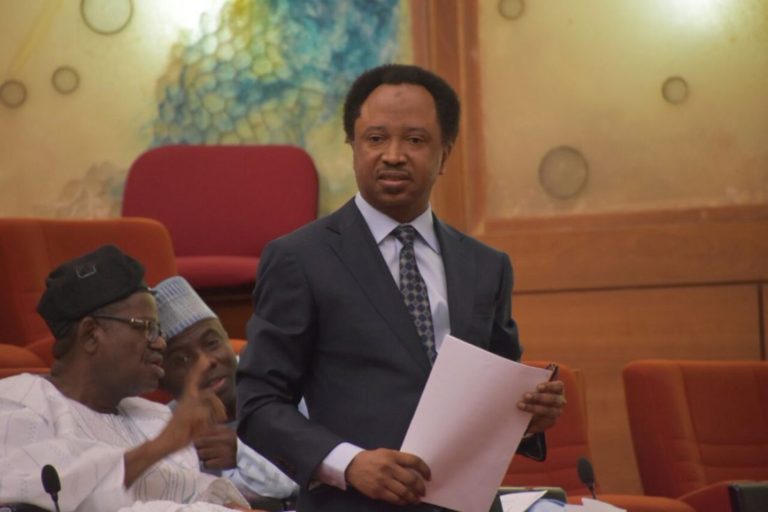
Shehu Sani: Nigerians are questioning the sainthood and angelic posturing of this govt

Shehu Sani, outspoken Kaduna State senator, says the lack of transparency in the handling of several high corruption cases has made Nigerians start questioning the sincerity, or lack of it, of the Muhammadu Buhari administration.

Sani said many Nigerians worry that there is a bipolar approach to anti-corruption in Nigeria and Buhari appears to be weak when it comes to “dealing with friends and friends of friends in corridors of power who are found to be corrupt”.

“Three things have raised issues here: the Babachir report that is still lying dusty in the Villa and is now part of the upholstery of the Villa. The second has to do with the issue of Kachikwu-Baru, which has now been resolved with Kachikwu and Baru shaking hands and saying that there personal differences are over. And the third is the Maina-Gate that is now a major issue in the National discourse and debate,” Sani said on AIT’s Focus Nigeria.

“The President needs to be very conscious of that, and I believe that if those who have access to go and him tell him to contest for 2019 election will spare part of the time they have in the Villa to tell him the truth about how his image and integrity is progressively being corroded by issues like this, I think they will be  doing a great service to him.”

Sani stressed that the anti-corruption campaign could not be focused only on members of the opposition political parties while members of the ruling APC and the so-cabals are seen to be doing whatever they wish.

He said: “Nigerians are questioning the sainthood and the angelic posturing of this administration because the government came in with a lot of promises and pledges to clean the system and unfold a new agenda and spirit for the country.

“It is not good for the image of the President to see him being very fierce, vigorous and macho when it comes to tackling corruption perpetrated by elements and friends of the defunct Jonathan administration.

“He should be seen to be active, proactive and very much involve, with the same ferocity, virility and potency, to attack corruption when it applies to people from his own cabinet or from the ruling party.

“I would like to see all persons who are corrupt, not just people who are from the umbrella side, but also from the broom side and also from the cabal side.

“But right now, you see most of the persons who are paraded in court are people from the last administration. It is creating a very bad image when issues are being raised about this.

“Recently, the President’s Special Adviser on Prosecution (Okoi Obono-Obla) raised issues and said my committee (Senate Ad-hoc Committee on the North East) has no right to investigate the SGF (Secretary to the Government of the Federation, Babachir Lawal).

“But what you can see is that the special adviser is part of those who believe that if you are pro-Buhari, you should have some shield or immunity or be above questioning.

“He believes that if you are pro-Buhari, you should also be like Buhari, but Buhari is alone in this fight against corruption. I can tell you this.”

Sani said the APC has its work cut out for it come 2019 general election if it intends to remain the ruling party.

“The APC is a party that responsible, reasonable and conscious Nigerians will agree with me that all is not all well with,” Sani said.

“In Kaduna, we have our problem with the tyrant [el-Rufai] who is always after Shehu Sani, in Kano there is Kwankwanso/Ganduje feud, in Kogi you have Dino [Melaye] and Yahaya Bello.

“These are few of the states that I just mentioned, but in most of the states today, there are crises; that is one.

“Secondly, you have people who have worked hard to bring this party to power, later they were being either marginalised or being categorised as corrupt.

“Bukola Saraki was not known to be corrupt when they needed his support and he mobilised five governors to win election. It is when he wants to be Senate President that they said ‘ah, this person is corrupt’.

“The likes of Atiku, who is speaking out today, is marginalised out of the system.

“Bola Tinubu of all people, for all that he has done to bring the South West and garner support and resources, today has maintained a position of silence which is clear that things are not moving fine.

“Why the party (APC) still remains a viable option is the fact that the opposition PDP is still very timid in its opposition.

“They have still not been able to prove a potent opposition force, in terms of holding government to account, because they are being dragged down by either fear of being hunted or arrested or framed or fear of the EFCC.

“And when you have an opposition that has such moral burden and fears, I can tell you in every possible way that it is going to be difficult for it to be able to dislodge the APC out of power.”

UPDATED: Buhari sacks Babachir Lawal, Ayo Oke

President Muhammadu Buhari has sacked Babachir Lawal, the suspended Secretary to the Government of the Federation (SGF), and Ayo Oke, the suspended Director General of National Intelligence Agency (NIA).

Boss Mustapha, a chieftain of All Progressives Congress (APC), has been appointed to replace Lawal.

According to a statement issued by Femi Adesina, Senior Special Adviser to the President on Media and Publicity, on Monday, Buhari took the decision after studying the report of the investigative panel set up to probe allegations of corruption and abuse of office made against Lawal and Oke.

The three-man committee was chaired by Vice President Yemi Osinbajo, and its members were Abubakar Malami, Attorney General of the Federation and Minister of Justice, and Babagana Monguno, National Security Adviser.

“President Muhammadu Buhari has studied the report of the panel headed by the Vice President, Prof Yemi Osinbajo, SAN, which investigated allegations against the suspended Secretary to the Government of the Federation, Mr Babachir David Lawal, and the Director General, National Intelligence Agency (NIA), Ambassador Ayo Oke,” Adesina stated.

“The President accepted the recommendation of the panel to terminate the appointment of Mr Lawal, and has appointed Mr Boss Mustapha as the new Secretary to the Government of the Federation. The appointment takes immediate effect.

“President Buhari also approved the recommendation to terminate the appointment of Ambassador Oke, and has further approved the setting-up of a three-member panel to, among other things, look into the operational, technical and administrative structure of the Agency and make appropriate recommendations.”

Adesina’s statement did not say whether the sacked public officers would be prosecuted by the appropriate authorities.

Lawal was suspended following an allegation by the Senate ad-hoc committee on the North East that he awarded contracts worth hundreds of millions of naira to a company he owns.

The contract, according to the senate committee, was to “remove invasive plant species” from the Yobe State water Channels.

Oke, on the other hand, was shown the exit door after the EFCC found dizzying sums of money stashed in hidden fire-proof cabinets at a luxurious residential building in Ikoyi, Lagos.

Following the discovery, Oke said that the money belongs to the NIA and was approved by for the agency by former President Goodluck Jonathan for some “covet security operations”.

Shehu Sani: Kaduna owes $200m from 1960 till date but el-Rufai wants to borrow $350m


Shehu Sani, member representing Kaduna Central Senatorial District at the National Assembly, says Nasir el-Rufai, Governor of Kaduna State, wants to borrow more money in 2017 than the entire debt profile of the state since Nigeria gained independence in 1960.

Sani, who is also Chairman of the Senate Committee on Local and Foreign Debts, said this on Monday on AIT’s Focus Nigeria.

He said that it would be tantamount to mortgaging the future of Kaduna citizens if he should approve such borrowing figure for el-Rufai, especially given that the repayment plan for the loan stretches to over 50 years.

“Kaduna State debt profile from 1960 till now is $200 million; what el-Rufai is asking for is $350 million,” Sani said.

“What if you look at it from this point of view, the very fact that in a state where the government is struggling to pay salaries, struggling to pay the monies which we previously borrowed… and now we are having $350 million that will be paid for 50 years.

“As far as I am concerned, as the Chairman of this committee (Senate Committee on Local and Foreign Debts), if I append my signature to approve such a loan for Kaduna State, such a heavy amount of money, the name of the Governor will not be seen by the next generation, the contractor who is going to benefit from that money will not be seen by the next generation, it will be Shehu Sani’s name that will be there.”

Sani said politics should be separated from the committee’s refusal to approve the loan being sought for by the Kaduna state government.

He also accused el-Rufai of maligning his reputation by telling the people of Kaduna State that he (Sani) was preventing the state from accessing necessary funds for development in the state.

“It’s like now, you have written an examination and you are waiting for the results, and you now organise some miscreants outside to say the teacher must declare that you have passed the exams,” Shehu said.

“I have a duty, coming from Kaduna State, I cannot in any way overburden the state with debt. It is okay that you want to access a $350 million loan and unleash all sorts of projects which he said he wants to unleash.

“But he should know that the payment for this money stretches to 50 years. I think he is 57, and I am 50. So if you add 50 years to our age, how old are we going to be?”

Sani stressed that there was no mention of any particular project which the loan was intended for, rather all that was stated was that the loan would be used for “institutional reforms”.

“The basis for the loan presented to me was that World Bank was giving $350 million loan to Nasir for institutional reform,” Sani said.

“It is not about hospitals or roads or schools, they said reform. What are you going to reform? Now, what he is telling the public is that he want to do roads, he wants to do hospitals.

“Other governors that applied would say, ‘I need $390 million and I’m going to use it for irrigation’, and it is there clearly stated.

“But his own has no clear definition or purpose of what he is going to do. You want to do reform, what are you reforming with $350 million? That is why we have to be very careful.

“I have a duty as the Chairman of the Senate Committee on Local and Foreign Debts, to make sure that your children, my children and our grandchildren, are not overburdened.

“Oil price today is $60 per barrel (and) states are still going to borrow. Many of these borrowing ends up in the pockets of politicians.

“And when people are desperate to borrow in 2017, you will know what the money will be used for, it’s for 2019. I have to be very careful.

“He can say whatever he wants to say, but let him have other reasons. The $350 million loan, even Saraki will not give him and I’m saying it clearly. Saraki has confidence in me and I will do my job.”

The integrity of those working with Buhari must be checked, says NCP chairman

Yunusa Tanko, National Chairman, National Conscience Party (NCP), says the integrity of those working with President Muhammadu Buhari needs to be checked.

“The integrity of those working with Mr. President needs to be checked,” said Tanko, a former Chairman of Inter-Party Advisory Council (IPAC), said while appearing on Channels TV’ Sunrise Daily on Monday.

He lamented that the President seems to be the only one fighting the anti-corruption war.

He was speaking on the reinstatement of Abdulrasheed Maina, ex- Chairman, Pension Reforms Task Team (PRTT) into the civil service.

Tanko analysed Maina’s recall as “a classic case of system decay,” adding that the “case is a dent on the anti-corruption war”.

“The perception people are having is that Mr. President is probably condoning this particular situation. People need to see a decisive decision being taken on the people involved and almost immediately,” he added.

“The slowness in nature of the action being taken by the Presidency is affecting the corruption fight. The Presidency needs to have a good committee set up and they must give a quick decision.”


READ ALSO:

INTERPOL ‘counters’ Garba Shehu, ‘says’ no request from Nigeria for Maina’s arrest

The International Police Organisation (INTERPOL) says it has not received a request from the Nigerian government for the arrest of Abdulrasheed Maina.

This is contrary to claims made by Garba Shehu, Senior Special Assistant on Media and Publicity to President Muhammadu Buhari.

“Maina’s investigation has been expanded. This is beyond reinstatement. It has gone beyond that,” Shehu said.

“You know that the INTERPOL has just issued an international warrant on him. A Nigerian court has also issued yet another warrant of arrest.

But an investigation by The Punch revealed that Shehu’s comments may not be a statement of fact.

According to the report, “none of Nigeria’s investigative agencies, the EFCC, Department of State Services, and Nigeria Immigration Service, had made a formal request to the National Central Bureau (NCB) of INTERPOL to issue an arrest warrant for the fleeing Maina”.

It is only when a formal request is made to INTERPOL by the Nigerian government that Maina’s case can be forwarded to the organisation’s headquarters in Lyon, France.

“As of Saturday, the INTERPOL General Secretariat had not received any request from either the EFCC or DSS to arrest Maina. So, as far as we are concerned, Maina is not a fugitive,” Punch quoted a highly-placed source as saying.

There had been an INTERPOL arrest warrant against Maina when he first fled the country in 2013. The warrant was issued at the at the prompting of the EFCC.

However, there was a court judgement to the effect that the arrest warrant be revoked, and subsequently, the EFCC did not challenge that court ruling.

“So, for the arrest warrant to be renewed, the EFCC would need to make [a] fresh request to the NCB which would be processed and the necessary action taken,” the source further explained.

The source further explained that before an arrest warrant can be issued against anyone by INTERPOL, a formal request must be sent from a national investigative agency to the INTERPOL headquarters, which would consider the request and, if found credible,  mandate member states to issue notices on the suspect.

The country requesting for such a warrant must show proof that the fugitive has committed a crime. Also, it must tender a warrant of arrest issued against the person by any law enforcement agency and the court within the jurisdiction where the said offence was committed.