The federal government’s Growth Enhancement Support (GES) scheme, which seeks to bypass fraudulent middlemen in distributing subsidised fertiliser to farmers, has largely eliminated the brazen fraud of the past but created new forms of corruption and is far from being efficient.
By Dayo Aiyetan & Habeeb Pindiga
Abubakar Jibrin is a young farmer in Kumo town of Gombe State in Northern Nigeria. During the last Ramadan season in July-August, while other Muslim faithful fasted and prayed, and rested from the scorching sun, he pedalled his bicycle to Kembu, six kilometres away to receive two bags of fertiliser which government allocated to him at a subsidised rate.
Jibrin has about two hectres of farmland where he plants rice, maize, millet and groundnuts, and requires between about six bags of fertiliser to nourish it. At the market price of N6,000 per bag, he would need N36,000 to purchase the volume of fertiliser he requires.
Early in the year, when he heard about a new federal government fertiliser subsidy scheme which would enable him buy two bags at N2,750 each, Jibrin quickly joined the queue to register.
Months later, he got a text message telling him his subsidised fertiliser was ready. But he had to travel 6 kilometres to redeem it. Even though he was fasting, religiously, he rode his bicycle to Kembu.
But he got no fertiliser even after undertaking the journey three times.
“I went there thrice, from here to Kembu about 6 kilometers, on bicycle. But whenever we got there, we discovered that the workers had not arrived,” he said.
“Even when they come to distribute, they don’t follow the queue. They will just be giving the fertiliser to people outside the queue….even if they are not registered farmers.”
Frustrated, Jibrin stopped going to Kembu for fertiliser and was forced to buy a few bags at the market price of N6,000 each.
Babajide Awoyelu, a farmer in Kajola Ijesha in Atakumosa West local government area of Osun State in Southwest Nigeria, had a similar experience. In February, he registered under the Growth Enhancement Support (GES) scheme.
He received an SMS alert in May to go to Osu to collect two bags of fertiliser for N5,500. Awoyelu went to the redemption centre several times but always went home empty handed.
“They promised to give us two bags of fertiliser, vegetables seedlings and chemicals but they kept on saying the items have not been brought to them. I stopped going because I saw they were deceiving us,” he said.
Jibrin and Awoyelu are just two of many Nigerian farmers who registered for the GES scheme but got no fertiliser during this year’s farming season.
The scheme was introduced in 2012 by the Federal Ministry of Agriculture and Rural Development to provide subsidised inputs, including fertiliser and improved seeds, to farmers.
Under the scheme, the federal government subsidised fertiliser by 25 per cent and the state governments are expected to add another 25 per cent subsidy so that farmers could purchase at N2,750 per bag instead of between N5,000 and N6,000, which is the market price. Each farmer is to get two bags of fertiliser at the subsidised rate, along with a free bag of either improved maize or rice.
In launching the programme in 2011, Agriculture Minister Akinwumi Adesina said it was to reform the fertiliser distribution system which was riddled with corruption. He said only about 11 per cent of farmers ever got the subsidised fertiliser in the past. The rest of it was diverted by officials and shared to well-connected politicians or sold to marketers, leading to a loss of about N776 billion government funds between 1980 and 2010.
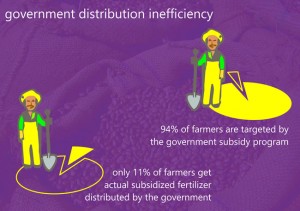 In theory, the GES scheme aims to cut off middle men, bypass fraudulent officials and sell fertiliser directly to farmers through a private sector-driven process under which government-licensed agro dealers sell input to the registered farmers.
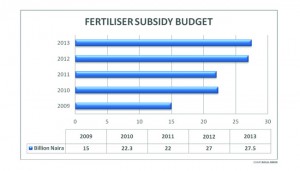
For this year, the government is targeting 10 million farmers and therefore budgeted about N27.5 billion as fertiliser subsidy, to be paid by both federal and state governments.
The director in charge of GES in the Federal Ministry of Agriculture and Rural Development, Mr. Osho Akinbolawa, thumped his chest in an interview with our reporters that the scheme achieved more than 80 per cent success.
“I am definitely sure that we have crossed even over 80 percent, in terms of reaching our target; in terms of saying X is meant to get this thing and X has gotten it, we have crossed over eighty percent,” Mr. Akinbolawa said.
However, the reality on ground in the states flies in the face of this assertion. Reports from a team of journalists that worked in 10 states across the country indicate that although the GES scheme has drastically reduced the brazen corruption and massive fertiliser diversion of the past, the process of distributing subsidised fertiliser to farmers is still riddled with corruption.
Also, the process is still largely inefficient such that the targeted millions of farmers do not get the subsidised fertiliser or have to cut corners to get their share, in the end paying more than the pegged price. Fertiliser subsidised by government continues to be diverted and end up in the market to be sold to farmers at exorbitant prices.
This happens through collusion between government officials, agro dealers and the farmers themselves who conspired to subvert the process, according to a joint investigation between the Daily Trust newspaper and the International Centre for Investigative Reporting.
The investigation covered ten states, namely Bauchi, Gombe, Osun, Zamfara, Kano, Anambra, Kaduna, Benue, Edo and Niger.
In the 10 states, our reporters found that though farmers are expected to pay N5,500 for two bags of subsidised fertiliser, no redemption centre sells it to them at that price. Everywhere, they were asked to pay at least N6,000, with officials telling them that the additional amount is to take care of transport and storage of the fertiliser.
Ticked off
The first problem farmers have faced is systemic with the fault lying with the Federal Ministry of Agriculture. Several millions of farmers who were registered in 2012 and 2013 have not been captured in the national farmers’ database and so could not have benefitted from the programme.
GES director Akinbolawa admitted this much, saying that in 2012, of the 4.2 million farmers that registered only about 1.3 million farmers were captured and were able to receive subsidised inputs. Of the 5 million farmers registered in 2013, the system has captured only 3.6 and so only this number could have received fertiliser.
But the problem is that of those farmers who are deemed to have received the inputs, not all of them actually physically got them and used them on their farms. A lot of it ended up in the open market, sold at about N6,000 per bag.
This comes about in many ways, courtesy of the ingenious but fraudulent officials, middlemen and farmers themselves who are so poor that they would readily give up their bags of fertiliser for a profit of as low as N500.
In some states, farmers were shortchanged by corrupt officials and agro dealers who sold subsidised inputs meant for them to traders and then ticked off their names in the register as having taken their allocation.
“You got registered. Before you come to redeem your allocation, your name has been ticked by officials in connivance with businessmen thereby denying you your allocation,” said Saidu Garba Umaru, spokesman for the All Farmers Association of Nigeria (AFAN) in the state.
But Adamu Kaka, an agro dealer at Boltongo centre of Yamaltu-Deba local government, said there was no deliberate effort to deny any farmer their allocated fertiliser. He said two things happened in Gombe State that caused many registered farmers to lose out. The first reason, he said, was many of them were not captured in the database, while the other was that the state government only paid subsidy for just over half of the total registered farmers.
“Like at my distribution centre, there are 10,000 registered farmers but what was sent (captured) was 6,000 and even that allocation was slashed to 5,000, so you can see where the allegation came in,” he said.
Ministry officials and agro-dealers, it was discovered, also deny farmers their inputs by bringing non-farmers on the queue either to create a chaotic situation or destabilise the distribution process all in order to frustrate farmers.
This was the situation at a redemption centre in Bauchi metropolis as farmers queued to redeem their inputs. Hundreds of people stood in the queue under the scorching sun, many of them allegedly impostors.
“If you look at the queue here, a good number of people are not farmers. Some of the people you are seeing queuing with us are civil servants who have nothing to do with farming. Some are traders and their cohorts taking it to the markets to sell,” said Danladi Daniel, a farmer.
Soon, the scene got so rowdy that the distribution was forced to a halt and the farmers were asked to disperse and return another day. However, after the farmers left, the officials and dealers started selling the inputs again, this time mostly to traders who went to sell in the market.
The corruption of the GES scheme is done with such impunity in Bauchi State that the government subsidised fertiliser so flooded the markets in August that it was selling even cheaper than the official company price. Traders bought from agro-dealers at redemption centres for N3,100 and sold at N3,200 compared to the N5,500 being sold by the company that imports the product.
Barau Sanda, a trader at Railway Market in Bauchi, told our reporter: “We are buying it from individuals; I don’t know how they get them…. but what I know is that some of the people that brought the fertiliser are farmers but others are not.”
Another trader at the same market, Abubakar Sadiq, said: “We don’t ask the people that supply us of their source of supply… All I know is that they are within the (GES) system.”
At one of the GES redemption centers at Leventis store in Bauchi, our reporter saw bulk traders interacting with farmers and alleged impostors, as well officials and agro dealers who distributed the fertiliser. People were seen queuing up and receiving more than the two bags they were entitled to. Many of them were also seen re-selling their allocations outside the premises to the bulk traders.
But the agro-dealer in Gidan-Gona at the Leventis store, Zaharadeen Ibrahim Sabo, told our reporter that they only attended to registered farmer who came with their ID cards, text messages as well as the approved funds.
“We only give more than two bags to a person who comes with his family members’ GES cards and we also verify the cards before we collect the money and release the products to him,” he said.
Sabo also denied the allegation that they were siphoning fertiliser to resell to bulk traders. “The reason why some people are accusing us of siphoning the products to traders is because we are using the company’s premises where both the state and the company are doing their own transactions. That is why you can see hundreds of trucks coming in and out with the same products.”
An official of GES who works with Sabo, Mr. Ibrahim Wali, said his work was to verify GES cards and text messages of farmers before handing them a slip to take to the agro-dealer for collection of the fertiliser.
“I don’t inflate figures or add anything to the beneficiaries. I am also not aware of any wrongdoing in the system…and I don’t know anything about those that are selling to traders,” he said.
The state coordinator of the GES, Abdullahi Toro, also denied any shady dealings. “We monitored the exercise closely and we did it together to ensure sanity and fairness,” he added.
But Bauchi State Commissioner of Agriculture Tasiu Mohammed said he was aware of the situation where farmers re-sell their allocations, but he contended that there was no organised racket.
“As far as the government is concerned we have registered you and we have given. You pay, you take the fertiliser. How you use it is your own problem,” he said.
Willing buyer, willing seller
Further investigations showed that some of the agro dealers sell the products to traders because many farmers who come to redeem their input do not have the required amounts.
For example, in Niger State, agro dealers do not even waste time explaining anything to farmers who come without the prescribed amounts. They just sell the products to others, farmers and traders, who are willing to buy.
This is how Yakubu Sani, a farmer in Bazuko in Bosso local government of Niger State, got eight bags of subsidised fertiliser instead of two.
He went to collect his two bags but was asked by the agro-dealer if he wanted more bags. He ended up buying eight bags because he could pay for that.
“As long as you have the money, you can buy as many bags as you want,” Sani said. “Even if you are not a farmer and you are not registered, their own is to sell, they will give you and you can sell it too.”
This way, the agro-dealer has recorded many sales and can claim his subsidy money from the government, rather than having to keep unsold fertiliser in his storehouse.
With this knowledge, traders also troop to redemption centres knowing that they will find farmers who would re-sell their inputs.
Another way by which farmers are deprived of the subsidised inputs is that officials frustrate them by telling them repeatedly to come to the redemption centre.
“It is a frustrating experience. And it is deliberately so. Most farmers decided to go and buy in the market rather than wait for the government. Some even spent five days waiting,” said Donatus Ishola, district head of Mbayo in Nkam local government area of Benue State.
That was the same fate suffered by Sulaiman Anifowose in Kajola, Atakumosa local government of Osun State.
“Although we got the alert and went to meet the officials at the local government council headquarters in Osu, they told us that the fertiliser was not available yet. We were told to come back several times until we stopped going out of frustration,” he said.
Jonah Dakum, 55, a farmer in Bomo village in Zaria, Kaduna State has a big farm and needed 15 bags of fertiliser. In 2012, after a lot of hassles, he got two subsidised bags.
This year, even though he got an SMS alert to collect two bags, he did not even bother to go to redeem them.
“You will get the fertilisers but it comes by delay tactics. It is not worth it. I need 15 bags and I go and queue for days for just two bags. What is the point? I didn’t go this year because of the delay in the process, because they will tell you to wait or come back and your crop will get spoiled,” he said.
Systemic challenges
Apart from the apparent manipulation of the system by corrupt officials, the GES scheme is also bedevilled by systemic challenges and lapses. For a programme that targets about 10 million farmers this year, the number of redemption centres is ridiculously low.
In the whole of Nigeria’s 36 states and the Federal Capital Territory, there are only 1,466 redemption centres, according to official records.
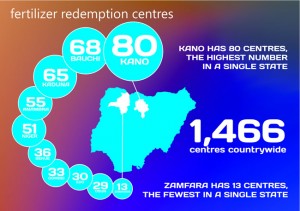 Kano, the nation’s most populous state, with a land mass spanning 20,131 square kilometers and 390,876 registered farmers, has only 80 redemption centres. Some states like Adamawa and Yobe have as few as 17 centres.
Our investigations revealed that the federal government actually registered more agro dealers to set up far more than the 1,466 redemption centres it ended up with. However, many of them refused to go to remote areas because of bad terrain, logistic problems and the cost of transporting inputs to those areas.
This created two scenarios – the redemption centres were either too far apart or non-existent.
Many farmers who spoke to our reporters in the states complained that they either could not go to redeem their inputs because of distance or they incurred huge transport costs to do so.
Grace Igbabon of Benue State said: “I got a text message that I should go to Katsina-Ala and collect my fertiliser and I reside in Makurdi here. My farms are in this place. So, it’s difficult for me to get the fertiliser and I had to spend extra N1,500 on transport.”
This is a problem the Niger State Agriculture Commissioner Alhaji Ahmed Mataneacknowledges is a big one and a disincentive for farmers.
“There are not enough redemption centres. When I came, we had just 32 redemption centres in the whole of Niger State,” he said. “A farmer may not have the resources to spend N500 to get to a redemption centre to collect just about a bag or two and he’s not even sure.”
In other places, the problem is not the far too few redemption centres but the fact that they exist only on paper.
That was the major complaint in many farming communities in Edo and Anambra states.
The chairman of Arable Crops Farmers in Edo State and chairman of farmers’ association AFAN in Etsako West, Alhaji A.O. Mohammed, said in 2012 and 2013, many farmers were directed to redemption centres that did not exist.
“All those centers that were redemption centers, only one functioned and that was the one in Auchi. The one at Okpela did not operate at all. The one at Eperi, nothing. Even the one at Agbede, nothing,” he said.
In the remote village of Masaga in Gbako local government area of Niger State, about 100 farmers registered for the GES scheme. Of this number, only five were captured in the database and eventually received SMS alerts to collect fertiliser. Only one of the five ever succeeded in getting any fertiliser. The others could not locate their redemption centres.
Illegal fees
Another obvious corrupt practice perpetrated by officials and agro dealers is the collection of illegal fees from farmers. Although farmers were expected to pay N5,500 for two 50kg bags of fertiliser and get one 50kg bag of seeds free, the dealers either charged fees ranging from N100 to N1,100 illegally for sundry reasons or collected money for the free seeds.
 Mohammed Ahmed, a 51-year-old farmer of over 30 years in Hayin Dogo, Samaru Zaria, Kaduna State complained bitterly about the illegal fees he had to pay to redeem his fertiliser.
“The text they send to us says we are to pay N5,500 for two bags, and 10 kg of seeds, but when we come to collect the fertiliser they were collecting the sum of N6,600 including labour fees,” he said.
“Those that are bringing out the fertiliser from the store to where you are going to pick it, you are to give them N100. The price of the fertiliser N5,500 total. But even if they are going to include the labour money it should be N5,600.
“We tried to ask them why they are selling it at that price, they said what the federal government has sent through text is different from the order they received from their superior officer.”
Sharp practices were also widespread in many parts of Benue State, particularly the Northeast senatorial zone, where farmers paid up to N6,800 for two bags of fertiliser instead of N5,500 and still got no seeds.
Michael Ezeokocha of Amansi in Awka North local government of Anambra State said he had to pay N500 which the dealer said he was charging for the cost of transporting the inputs to the town from Awka, the state capital. He said the dealer complained that the government did not factor in the cost of transportation for him and he could not run at a loss.
But the blame for the corruption and inefficiency in the GES system does not rest with government officials and agro dealers alone. Apart from the problem of farmers who sell their inputs to traders who then resell in the market, the farmers also employ dubious means to exploit the system.
For example, in Kaduna State, some farmers were discovered to be duplicating the SMS alerts sent to them by forwarding the text message to friends who then attempt to redeem fertiliser.
Dele Tologbonse, deputy director, National Agriculture Extension and Research Liaison Services (NAERLS), Zaria who is also the coordinator of GES in the city, said this behavior by some farmers distort the distribution process.
“Some farmers who receive text messages forward them to others farmers, even multiple farmers who also queue to redeem inputs. We just found out some weeks ago, so we are working out ways to curtail that which I will not tell you now,” Tologbonse said.
By far, the biggest problem that has plagued the voucher scheme is the problem of poor communication network. The government’s consultant, Cellulant, which manages the project, relies on erratic network platforms of GSM telephone service providers which created enormous problems both for the government and individual farmers.
Because of these problems, government says this year a farmer is not necessarily required to present a text message before he gets his fertiliser. But his name has to be on the register at the redemption centre and he would have to be properly identified.
Politics of fertiliser subsidy
Another big problem that has beset the GES scheme is politics. As in many parts of the African continent, fertiliser, like land, is a highly political issue.
“Fertiliser has now become such a big political tool where politicians promise to provide the product during their campaigns. Farmers may not have potable water, healthcare facility among others but you can win their votes if you give them fertiliser,” said Ishaku Amapu, a professor of soil fertility at the Ahmadu Bello University, Zaria.
In Nigeria, the politics of fertiliser manifests in different forms.
In Zamfara State, the All Progressives Congress (APC) party government does not want to have anything to do with the GES scheme because it is the initiative of the People’s Democratic Party-led federal government.
So the Zamfara state government instead initiated its own heavily subsidised fertiliser programme under which each farmer gets only one bag of fertiliser at N1,000 instead of the N6,000 market price. But the consensus among farmers is that the one bag is grossly insufficient to meet their needs.
Osun State, also run by the APC party, is part of the GES scheme but Governor Rauf Aregbesola has also played politics with the programme. At a conference in Abuja weeks ago, he said the GES fertiliser did not get to his state, and he therefore came up with a parallel programme. “I have to commit close to N1billion procuring fertiliser when the one arranged through the agents you put together failed woefully, and that is the truth,” he said.
Contrary to his claim, however, our checks indicate that farmers in many parts of Osun did benefit from the federal government fertiliser subsidy scheme. Farmers complained more about the one run by Aregbesola, saying it was more fraught with corruption and inefficiency than the GES.
“The fertiliser distributed by Osun was to be sold for N2,200 per bag, but the officials gave it to a third party and instructed him to be selling to us at N3,500 per bag. At the collection centre, we were made to part with additional levies up to N400 for GSM card, bagging and handling charges,” farmer Idris Azeez said.
A break with the past
In spite of the challenges the GES scheme has faced, however, farmers say the new system is far better than the previous method of fertiliser distribution as it is far more efficient and less riddled with corruption.
A physically challenged farmer from Bauchi State who benefitted from the GES scheme, Abdullahi Sule, was full of praise for the federal government for introducing it.
“I am extremely happy to get this support, and we thank the government for subsidising fertiliser for us to use. I came all the way from our village to get these fertilisers after receiving a text message from the official,” he told our reporter at a redemption centre along Jos Road in Bauchi.
Onwe Ernest Atoji, a graduate of Agriculture from the University of Agriculture, Makurdi and a youth farmers’ leader in Benue South Senatorial District, said: “Where I come from, most of the people there are farmers and fertiliser, over the years, has been a big challenge. But with the GES, fertilisers have become as popular as Coca-Cola.”
For Matane, the Niger State Agriculture commissioner, in spite of the challenges inherent in the new system, there is cause to rejoice for farmers.
“I must commend the drive of the (agriculture) minister…. He’s looking at every angle – private sector initiative, commercialisation of agriculture. Agriculture is no longer a project, it’s a business and you must have to see it as a business because people can make profit and it’s from there people can evolve to actually become commercial farmers,” he said.
For the federal government, the GES scheme is already a success story and a revolution in President Goodluck Jonathan’s transformation agenda.
GES director Akinbolawa said: “Moving from 1.2 million (farmers who redeemed inputs) in the first year to 2 million – 3 million in the second year, I think that is a great achievement,” he said.
However, Akinbolawa admitted that the programme has faced serious challenges although he tried to explain the reasons for some of the problems. For example, he said of the funds budgeted for the GES scheme in 2013, only 29 per cent has been released to the ministry.
Jide Adebanwo, a management consultant and expert in Agricultural Economics who has followed the progress of the GES scheme, said it is not yet time for the federal government to thump its chest in celebration.
“There is still so much work to be done,” he said.
Part of what the government needs to do, Adebanwo said, is to embark on countrywide public enlightenment of farmers.
“If you ask AFAN, they will tell you that most farmers in the rural and remotest parts of the country do not know about this scheme and they are the main target,” he said.
He spoke the mind of many farmers, including Blessing Elisha of Toro in Bauchi, who said she never knew a registration of farmers was going on and therefore she lost out in the allocation of subsidised fertiliser.
(For more interviews, videos and photos, and to report fertiliser distribution abuses, go to www.naijafertiliser.com)
(Additional reports by Shehu Abubakar, Ronald Mutum, Abdulwasiu Hassan, Hassan Ibrahim, Wale Olayemi, Ismail Mudashir and Joshua Odeyemi)
This report was produced with the support of The African Story Challenge, an initiative of the African Media Initiative.