Home Blog Page 371

Dangote shows petroleum market dominance with jet fuel sale to Saudi Aramco

0

THE Dangote Petrochemical refinery company is currently showing market dominance in Nigeria’s petroleum industries with the latest sales of two cargoes of aviation fuel to Saudi Aramco-the national oil company of Saudi Arabia.

The chairman of the Dangote Group, Aliko Dangote confirmed the development on Wednesday, February 5, when the Nigerian Economic Summit Group (NESG) visited the Dangote Fertiliser Limited and the Dangote Petroleum Refinery and Petrochemicals in Ibeju Lekki, Lagos State.

“We are reaching the ambitious goals we set for ourselves, and I’m pleased to announce that we’ve just sold two cargoes of jet fuel to Saudi Aramco,” the billionaire and wealthiest African businessman said.

The ICIR had earlier reported that the ramping up of production at the Dangote refinery is seen to be pushing some European refineries which hitherto serviced the Nigerian market out of business.

Nigeria largely imports most of its petroleum products from Belgium, the Netherlands, Norway, India, and the Korean Republic.

The Dangote refinery, which began operations in January last year, started producing Premium Motor Spirit (PMS) in September, years after the country had relied solely on importation for its fuel needs with the Nigerian National Petroleum Company Limited (NNPCL) superintending the import over the years.

Since then the refinery has exported petrol, diesel, and aviation fuel to other countries within and outside Africa.

In its monthly report for January 2025, the Organisation of Petroleum Exporting Countries (OPEC) stated that the emergence of Dangote refinery has reduced the importation of petroleum products from Europe to Nigeria.

“The ongoing operational ramp-up efforts at Nigeria’s new Dangote refinery and its gasoline (petrol) exports to the international market will likely weigh further on the European gasoline market.

“Continued gasoline production in Nigeria, a country that has relied heavily on imports to meet its domestic fuel needs in the past, will most likely continue to free up gasoline volumes in international markets which will call for new destinations and flow adjustments for the extra volumes going forward,” OPEC stated.

An energy analyst, Adeola Adenikinju, had also told The ICIR that several European refineries which are used to refining Nigeria’s crude may have to seek alternatives with the emergence of Dangote Refinery.

Saudi Aramco is the world’s largest oil producer and a leading integrated oil and gas company globally.

According to Dangote, since the commencement of production in 2024, the refinery has steadily increased its output, reaching 550,000 barrels per day.

Stakeholders have been lamenting how Nigeria has become a dumping ground for foreign products, calling for support for entrepreneurs to become global players.

Nigeria, with over 200 million people, is still dependent on imports to feed its citizens but the Dangote refinery boss believes the private sector is important to national development.

He is optimistic that the country’s challenges can largely be overcome by providing gainful employment to its people.

He also believes in the free market concept, which should not be used as a pretext for continued import dependence, stating that developed and developing nations, including the USA and China, actively protect their domestic industries to safeguard jobs and promote self-sufficiency.

He is worried about the significant challenges involved in setting up industries in Nigeria, particularly the substantial capital investment required due to the lack of infrastructure.

He noted that investors are often forced to take on responsibilities for essential services such as power, roads, and ports – services that should be provided by the government.

Dangote added that his refinery’s world-class standards and advanced technologies have enabled it to export products to global markets as he’s keen on openining more global frontiers for his petroleum market.

CBN restricts BDCs’ $25,000 FX weekly purchase to single dealer

THE Central Bank of Nigeria (CBN) has directed Bureau de Change (BDCs) operators to purchase up to $25,000 weekly from a single authorised dealer bank (ADBs) to prevent speculative activity and ensure better oversight of the retail end of the market.

The directive is contained in a circular dated February 5 and signed by its acting director of the Trade and Exchange Department, W. J. Kanya.

It said the new guidelines aimed at ensuring transparency and curbing potential forex misuse. It vowed to sanction violators of the rule appropriately.

“Any authorised dealer and BDC that diverts funds or violates the provision of these guidelines shall attract appropriate sanction, including suspension of its dealership licences,” CBN warned.

The apex bank also directed authorised dealers to sell FX to BDCs at the prevailing rate in the Nigerian Foreign Exchange Market (NFEM) window to ensure consistency in pricing.

The CBN imposed a one per cent cap on the margin at which the BDCs could charge end-users above their purchase price.

It explained that the one per cent margin applied to all forex sold by BDCs, irrespective of its source.

To enhance market transparency, the CBN has made reporting requirements mandatory for both authorised dealer banks and BDCs.

“Authorised dealers must submit weekly reports of their forex sales to BDCs in a specified Excel format to the CBN Trade and Exchange Department via teddmo@cbn.gov.ng.

“BDCs must render daily returns on forex purchases and sales (utilisation) through the Financial Institutions Forex Reporting System (FIFX). These measures will help the CBN track forex flows and prevent illicit activities in the currency market,” the CBN stated.

The apex bank also specified that BDCs could only disburse purchased FX for specific transactions, with a maximum of $5,000 per transaction quarterly.

The transaction includes business travel allowance (BTA), personal travel allowance (PTA), overseas school fees, and overseas medical fees.

The ICIR reports that CBN had, in an earlier circular on Monday, February 3, extended the temporary access it granted to BDC operators to purchase $25,000 weekly from the Nigerian Foreign Exchange Market till May 30.

The apex bank had set the expiring date to January 31 but said the extension would allow the BDCs to continue purchasing forex from authorised dealers under existing conditions.

The ICIR also reports that the continued shoving of FX at the retail end of the market could impact the country’s external reserves.

A cursory look at the reserves management chart of the apex bank showed that  Nigeria’s external reserves declined significantly by $1.16 billion in January 2025.

It depleted the gross reserves by $592.58 million from the margin it was at the end of December 2024.

It showed that reserves fell from $40.88 billion at the end of December to $39.72 billion as of January 31.

Harold McGraw Center opens applications for business journalism fellowship

THE Harold McGraw Center for Business Journalism at the Craig Newmark School of Journalism, City University of New York, is accepting applications for its fellowship programme, which supports in-depth reporting on business and the global economy.

The fellowship offers editorial and financial assistance to journalists working on complex, time-intensive stories.

Experienced journalists with at least five years in the field can apply for the remote programme.

Fellows will receive grants of up to $15,000 to produce investigative or enterprise stories in text, video, or audio formats.

Staff journalists, editors, and freelancers are eligible, including international reporters, provided their work is in English and intended for a U.S. audience. 

The application is twice a year. The deadline to apply for Spring 2025 Fellowships is March 31, 2025. 

Applications for the Fall 2025 Fellowships will be due October 6, 2025


Applicants can apply here

Tinubu approves 65 years retirement age for doctors, other healthcare workers

0

PRESIDENT Bola Tinubu has approved an extension of the retirement age for doctors and other healthcare workers from 60 to 65 years.

The national publicity secretary of the Nigerian Medical Association (NMA), Mannir Bature, announced the development in a statement on Wednesday, February 5, in Lagos, according to News Agency of Nigeria.

The decision followed the Nigerian Medical Association’s (NMA) continued threat to embark on industrial action over the federal government’s failure to fully implement the Consolidated Medical Salary Structure (CONMESS) and address other outstanding demands. 

Doctors and healthcare workers have repeatedly decried poor remuneration, delays in salary adjustments, and unresolved welfare concerns, which have contributed to the mass exodus of professionals from the country.

Just two weeks ago, the Medical and Dental Consultants Association (MDCAN) raised the alarm over the exodus of medical consultants from Nigeria.

The group said over 1,300 medical consultants migrated from the nation in five years, leaving the country with only 6,000 consultants, serving nearly 220 million people.

Meanwhile, the NMA publicity secretary, stated that the coordinating minister of health and social welfare, Muhammad Pate, had been directed to formally present the approval to the Council on Establishment through the Office of the Head of Service for finalisation.

Bature explained that Pate disclosed the decision during a high-level meeting with the NMA president, Bala Audu, alongside key stakeholders in the health sector.

He said discussions at the meeting focused on improvements in the welfare of healthcare professionals in Nigeria, including financial benefits.

According to him, the coordinating minister confirmed that funds for the payment of arrears from the adjustment of the Consolidated Medical Salary Structure had been secured, with disbursement set to commence soon.

Bature quoted the minister as saying that Tinubu had approved the correction of consequential adjustments for both CONMESS and the Consolidated Health Salary Structure, following the implementation of the new minimum wage.

“The process to effect this correction is at an advanced stage, providing much-needed relief to doctors and other healthcare workers,” he said.

Beyond salary adjustments, Bature stated that a review initiated by the NMA had led to the approval of new tariffs for healthcare service providers.

“This will particularly benefit members of the Association of Nigerian Private Medical Practitioners and Nurses (ANPMPN), ensuring better financial remuneration and sustainability for healthcare services nationwide,” he said.

This latest development was also coming two days after the Federal Executive Council (FEC) approved $1 billion to strengthen primary healthcare services across the country.

The approval, aimed at boosting the government’s Human Capital Opportunities for Prosperity and Equity (HOPE) programme, was announced by the finance and coordinating minister of the economy, Wale Edun, after the FEC meeting.

Edun said the International Development Association (IDA) provided two concessional loans of $500 million each, with an additional $70 million in grants from other international bodies.

“This programme is very much in line with the direction of this administration – to focus on investing in the human capital of Nigerians. People are at the centre of the Renewed Hope Agenda,” the minister said.

IWMF seeks nominations for Courage in Journalism Awards

INTERNATIONAL Women’s Media Foundation seeks nominations to award courageous female journalists who report important stories or work in hostile- sexist environments.  

The Courage in Journalism Awards highlight the resilience of women journalists, demonstrating that they will not back down, and cannot be silenced. These women deserve recognition for their strength in overcoming adversity.

The awards celebrate fearless journalists who cover taboo subjects, navigate hostile work environments, and bring important but challenging truths to light.

All female journalists from around the globe can be nominated for the 2025 Courage in Journalism Awards.

Nominations are open until March 30, 2025.

Candidates for the Courage in Journalism Awards must be full-time staff or freelance women, nonbinary reporters, writers, editors, photographers or producers working in any country and of any nationality can all be nominated.

Nominations can be made in three languages English, Spanish or French in the links below:

Tinubu raises proposed 2025 budget by N4.5trn

0

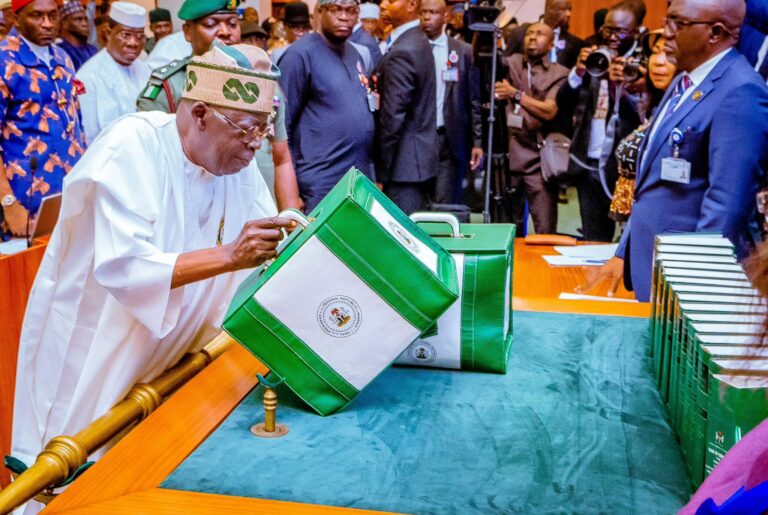
PRESIDENT Bola Tinubu has increased the proposed 2025 national budget by an additional N4.5 trillion, raising it from ₦49.7 trillion to N54.2 trillion. 

The adjustment was contained in separate letters sent to the Senate and the House of Representatives and read during plenary on Wednesday, February 5, by Senate President Godswill Akpabio.

Tinubu said the budget increase was driven by extra revenue streams from federal agencies.

He noted that the Federal Inland Revenue Service (FIRS) contributed an additional N1.4 trillion, while the Nigeria Customs Service (NCS) added N1.2 trillion. 

He stressed that other government-owned agencies contributed N1.8 trillion to the national coffers.

Consequently, Akpabio referred the request to the Senate Committee on Appropriations for urgent consideration. 

He further assured that the budget would be finalised and passed before the end of February.

The ICIR on Wednesday, December 18, reported that Tinubu presented Nigeria’s 2025 budget to a joint session of the National Assembly with key highlights, adjusting the exchange rate benchmark to N1,500 per dollar.

Christened ‘Budget of Restoration: Securing Peace, Rebuilding Prosperity,’ Tinubu presented a budget size of N47.9 trillion to the lawmakers.

He said the budget sought to consolidate the key policies his administration had instituted to restructure the nation’s economy and boost human capital development, increase the volume of trade and investments, and bolster oil and gas production, among others.

Criticism over fiscal discipline, debt burden

The budget increase came amid concerns over Nigeria’s rising debt and fiscal sustainability. 

Former Vice President Atiku Abubakar had in December 2024, criticised the 2025 budget, arguing that it lacked structural reforms and fiscal discipline. 

Atiku, in a statement, described the budget as a continuation of flawed fiscal policies that had deepened the country’s economic vulnerabilities.

He noted that the projected revenue of N35 trillion left a deficit of over N13 trillion, which the government planned to finance through new borrowings. 

According to him, the plan to secure more than N13 trillion in loans, including N9 trillion in direct borrowings and N4 trillion in project-specific financing, mirrors past practices under the All Progressives Congress (APC) administration that have significantly increased Nigeria’s public debt burden.

Atiku further criticised the government’s recurrent expenditure, which stands at over N14 trillion (30 per cent of the budget), saying it reflected inefficiencies and wasteful spending. 

He also faulted the decision to allocate N15.8 trillion to debt servicing, arguing that it nearly matched the N16 trillion earmarked for capital expenditure.

Ogun monarch remanded for allegedly assaulting 73-year-old

0

THE traditional ruler of Orile Ifo, Abdulsemiu Ogunjobi, has been remanded at the Ilaro Correctional Centre in Ogun State after failing to meet his bail conditions.

According to Yinka Odukoya, the correctional facility’s spokesperson, the monarch is being held in custody because he has not yet met the conditions for his bail, he told PUNCH on Wednesday, February 5.

The ICIR reported on Tuesday, February 4, that the embattled monarch was arraigned before a court in Ogun State on a three-count charge bordering on conspiracy, assault, and conduct likely to cause a breach of peace following his public assault on a 73-year-old man, Areola Abraham.

The Nigeria Police Force (NPF) said in a statement by its public relations officer, Muyiwa Adejobi, on Tuesday that the monarch was granted bail, and the case adjourned to March 6.

The attack, captured in a viral video, sparked outrage on social media.  In the video, some men could be seen with Ogunjobi, said to be a former police officer, slapping Abraham and forcing him to kneel and prostrate.

Following the viral video and public outcry, the NPF, on Sunday, February 2, said the Ogun State Police Command had interrogated the accused and assured the public that the matter would be justly handled.

“The Oba has been invited and interrogated today by the command. The matter is being looked into for justice to prevail. Nobody can claim to be controlling the NPF. Justice must be served by all means,Adejobi said.

Meanwhile, in a statement on Tuesday, Adejobi stated that thepolice will continue to uphold the rule of law and the core values of the noble profession.

The ICIR reports that Ogunjobi’s assault on Abraham, which reportedly took place on January 21, triggered a swift response from the Ogun State Government, which suspended the monarch for six months. 

The suspension was announced on Monday, February 3, by the special adviser to the governor on communication and strategy, Kayode Akinmade.

 The government’s decision, according to Akinmade, followed an interrogation by the commissioner for local government and chieftaincy affairs, Ganiyu Hamzat, who summoned both the monarch and the victim. 

Akinmade stated that the suspension was necessary due to the monarch’sreckless utterances and public misconduct,” which he said violated public expectation from a traditional ruler.  

Meanwhile, speaking during a press conference by the Committee for the Defence of Human Rights (CDHR),  the victim, Areola Abraham, recounted that he was on his way to buy food when the Olorile of Ifo called him over, only to slap him and order his men to attack him.

FG unveils national broadband initiative to improve internet access

0

THE Federal Government of Nigeria has officially launched the National Broadband Alliance for Nigeria (NBAN), a policy initiative to expand internet access nationwide and meet the 70 per cent broadband penetration target for 2025.

The Minister of Communications, Innovation, and Digital Economy, Bosun Tijani, unveiled the initiative on Tuesday, February 4 in Lagos State.

Tijani was represented by the executive vice chairman of the Nigerian Communications Commission (NCC), Aminu Maida, at the launch.

He said the new policy would enhance broadband penetration in the country.

The NBAN aligns with Nigeria’s National Broadband Plan (2020-2025) and the Strategic Blueprint from the Ministry of Communications, Innovation, and Digital Economy.

It is aimed to expand broadband penetration currently at 44 per cent as of December 2024 and which had grown from six per cent in 2015.

The initiative targets key sectors, including schools, healthcare facilities, religious centres, and markets, in a bid to create a sustainable model for widespread broadband adoption.

At the unveiling on Tuesday, Tijani said the broadband expansion would not only improve access to reliable broadband but also empower Nigerians, particularly in rural areas.

“While the progress made in broadband penetration is commendable, we recognise that much more needs to be done to ensure every Nigerian can enjoy the benefits of reliable, high-speed internet,” the minister said.

He noted the need for strategic partnerships with donors, investors, and other key stakeholders in achieving the goals set out in the National Broadband Plan (2020–2025).

He maintained that collaborations would be essential in overcoming infrastructure development challenges and making broadband affordable and accessible for all Nigerians.

“These targets reflect our unwavering commitment to ensuring that broadband is accessible, affordable, and inclusive for all Nigerians. However, we are also aware of the challenges ahead,” Tijani pointed out.

He maintains that achieving the government’s targets—70 per cent broadband penetration by 2025, a minimum internet speed of 25 Mbps in urban areas, and broadband access for 80 per cent of the population by 2027—will require sustained efforts.

“Achieving these goals will require more than just the efforts of the private sector. It will require a holistic approach that includes strategic partnerships with donors, investors, and other key stakeholders in accelerating the rollout of critical infrastructure,” he added.

Fire kills 17 Islamic schoolchildren in Zamfara

1

ABOUT 17 pupils of an Islamic school have reportedly lost their lives in an inferno that engulfed their school in Kauran Namoda, Zamfara State.

The fire was said to have raged for nearly three hours before it was brought under control,  on the night of Tuesday, February 4.

It spread rapidly through the school premises, trapping many young pupils.

Apart from those killed, several other pupils sustained injuries from the inferno and are currently receiving medical treatment at local hospitals.

An X user who majors in insecurity in the north, Zagazola Makama, confirmed the incident on his X handle on Wednesday, stating that eyewitnesses described the fire as devastating and extremely intense, making it difficult to contain.

He reported that local authorities and emergency responders arrived at the scene, but unfortunately, their efforts came too late, and the fire had already caused significant loss of life.

A resident, Abdulrasaq Bello Kaura, told Channels Television that the fire was allegedly caused by stored sticks, known as ‘kara,’ after catching fire.

The source reported that the incident occurred at Makaranta Mallam Ghali, in the study hall.

He added that there were approximately 100 students in the hall.

Remains of the casualties were recovered after the fire was put out.

The Chairman of Kaura-Namoda Local Government, Mannir Muazu Haidara, also confirmed the tragedy.

Fire incidents are not new in Zamfara. In December 2024, a fire gutted a motorcycle market in Yar-Dole Gusau, the state capital.

Eyewitnesses said the fire spread quickly through the market, a key hub for motorcycles and spare parts.


Thousands of staff sent on leave over planned USAID dismantling

1

THE United States Agency for International Development (USAID) has announced that it would be placing its staff on administrative leave, both in the US and abroad, following President Trump’s plan to dismantle the organisation.

This move, seen as controversial by many, has sparked widespread criticisms from Democrats and human rights organisations, who argued that it would have a devastating impact on global humanitarian efforts.

USAID supports health and emergency programmes in over 120 countries, including some of the world’s poorest regions.

Trump’s decision to dismantle the agency is part of a long-standing narrative among hard-line conservatives and libertarians, who believe that US taxpayer money should be spent on domestic priorities rather than foreign aid.

The agency, in a statement on its website on Tuesday, said that the staff leave would begin before midnight on February 7, 2024.

“Essential personnel expected to continue working will be informed by agency leadership by Thursday, February 6, at 3:00 pm (EST),the statement read.

According to the statement, USAID is planning to repatriate its personnel from overseas posts within 30 days and terminate non-essential contracts, in collaboration with the Department of State, and in accordance with applicable laws and regulations.

The agency said it would consider case-by-case exceptions and return travel extensions based on personal or family hardship, mobility or safety concerns, or other reasons.

The decision to restrict USAID’s activities is led by billionaire Elon Musk.

Musk, considered a “special government employee,” by the White House, heads the Department of Government Efficiency (DOGE)

He has been vocal in his criticism of USAID, describing it as a hub ofradical-left Marxistswho are anti-American.

The billionaire alleged that USAID was involved in illicit activities, includingrogue CIA workand funding bioweapon research, such as COVID-19, which he claimed resulted in millions of deaths.

Established in 1961, USAID has a budget exceeding $40 billion, representing a relatively small proportion of the US government’s total annual expenditure of approximately $7 trillion.

Most of Trump’s decisions since he resumed on January 20 have been termed controversial by many.

In another controversial development, Trump announced that the US would take over the war-shattered Gaza Strip.

He vowed to relocate the original inhabitants – the Palestinians – to neighbouring countries and develop the area.

According to Aljazeera, Trump unveiled the plan during a news conference with Israeli Prime Minister Benjamin Netanyahu, who visited the White House on Tuesday, February 4 for a bilateral meeting.

Trump’s comments about Palestinians leaving Gaza have sparked a lot of outrage, with many fearing it could lead to an ethnic cleansing.

Hamas has strongly condemned the plan, saying it would only worsen chaos and tension in the region. He vowed that the people of Gaza would resist the decision.

The ICIR reports that Israel’s war on Gaza has killed more than 61,700 people, according to an adjusted toll by the Gaza Government Media Office, which said thousands of missing people had been considered dead.

The ICIR reported these latest decisions by the Trump administration are part of his broader plans for the US and the rest of the world.

He signed 42 executive orders on his inauguration day on Monday, January 20, reversing several policies of his predecessor, Joe Biden.

Some of the orders include pulling out the US from the World Health Organisation (WHO), the  Paris Climate Agreement, ending birthright citizenship for children of illegal immigrants, and recognising only two genders – male and female.

The list includes defending women from gender ideology extremism, reinstating the ban on transgender military service, and renaming the Gulf of Mexico to the Gulf of America, among others.