Home Blog Page 388

NGX: Northern Nigeria flour mills leads gains amid investors’ N1trn Tuesday loss

NORTHERN Nigeria Flour Mills led the gainers’ table at Tuesday, January 14 trading session on the floor of the Nigerian Exchange Limited (NGX) despite a sustained bearish sentiment that saw investors lose approximately N1. 06 trillìon at the close of the market.

The day’s trading activities saw the market capitalisation drop by 1.66 per cent to N63.19 trillion; from N64.25 trillion, it opened trading on the floor of the Nigerian Exchange Limited (NGX).

It also saw the All‐Share Index decline by 1.66 per cent to close at 103,622.09 basis points.

The share prices of 23 companies appreciated as against 41 companies’ stock prices that fell.

The Northern Nigeria Flour Mills led the gainers table with a share price rise of N4.10 to close at N45.10.

On the contrary, Dangote Cement led the losers’ table as its share price declined by N47.80 to N431.00.

While Julius Berger Nigeria’s share price shed N15.50 to close at N139.80, Honeywell Flour Mill lost N1.06 to close at N9.54.

On Monday, January 13, the Nigerian stock market opened the week in a negative territory.

Monday’s trading session saw investors lose over N51 billion as the market capitalisation dropped to N64.251 trillion from N64.303 trillion.

“The market extended its losing streak for the third session, with over a trillion naira profited off in market capitalisation.

“The equities markets started the week on a downbeat note, with stocks across various sectors experiencing losses due to prevailing market uncertainties,” GTI research analysts noted.

The analysts anticipate a rebound of trading activities within the remaining days of the week but urged investors to remain cautious, evaluating earnings forecasts and macroeconomic trends.

‘She was always cheating, I have no regret,’ says suspected killer of Abuja corps member

0

FOLLOWING his arrest by the Nasarawa Police Command, a gospel singer, Timileyin Ajayi, 32, has admitted to killing 24-year-old Salome Adaidu, a corps member serving in Abuja.

Ajayi, arrested on Sunday, January 12, while conveying Adaidu’s severed head to an unknown location, claimed jealousy and infidelity pushed him to commit the crime when the deceased visited his residence in New Karshi, Karu Local Government Area (LGA) of Nasarawa State.

According to a video shared by Channels TV, Ajayi while speaking during his parade at the Nasarawa State Police Command headquarters in Lafia, confessed to dismembering the deceased body after the murder.

The ICIR reported how Ajayi, who lives in the Pablana area, was caught around Angwan Bako near the Kaja Estate in the New Karu LGA when conveying the severed head of Salomey to an undisclosed destination on a commercial motorcycle, popularly known as ‘okada’. 

“Consequently, an angry mob descended on the suspect, and upon receipt of the information, the Commissioner of Police directed police personnel to move to the scene immediately. 

“They raced to the scene and rescued the suspect from being lynched. The suspect was then taken to an undisclosed hospital for treatment. A follow-up investigation led to the execution of a search warrant at the suspect’s residence, where the remains of the lady who was later identified as Eliojo Salomey, 24 years old of Yanyan, FCT, Abuja, and a serving corp member, were recovered,” the Nasarawa police spokesperson Nansel Ramhan, said in a statement sent to The ICIR in the evening of Monday, January 13.

According to the police report, Ajayi used a knife and machetes to kill and dismember her body, placing the parts in multiple polythene bags.

He was subsequently paraded at the Nasarawa State Police Command headquarters.

“I killed her because we don’t have each other all the time. It’s not something I planned. It happened on that day and it happened. Not that I had the plan in mind, she was cheating. 

“She hides most of the things from me most times. I got to know from her phone. I saw her chats with other guys on the phone, that was why I decided (to kill her),” he said.

When asked if he regretted his actions, he said he had no regret as he explained that the victim must reap the consequence of her infidelity.

“I don’t have any regrets because life is reciprocal that is what I thought. If you must do something to someone, you have to be reciprocal with that person (sic). 

“You have to understand what that person is going through so that you can actually put yourself in the position that the person is going through. That is why I don’t have any regrets because we were actually compatible,” he replied.

Meanwhile, the confession has sparked outrage, as Ajayi tried to justify his actions by blaming the victim.

Many Nigerians who reacted to his confession urged the Nigerian police to investigate further as they alleged that the suspect must be hiding something.

LA fires: Why fast wildfires and those started by human activities are more destructive and harder to contain

By Virginia IGLESIAS, University of Colorado Boulder

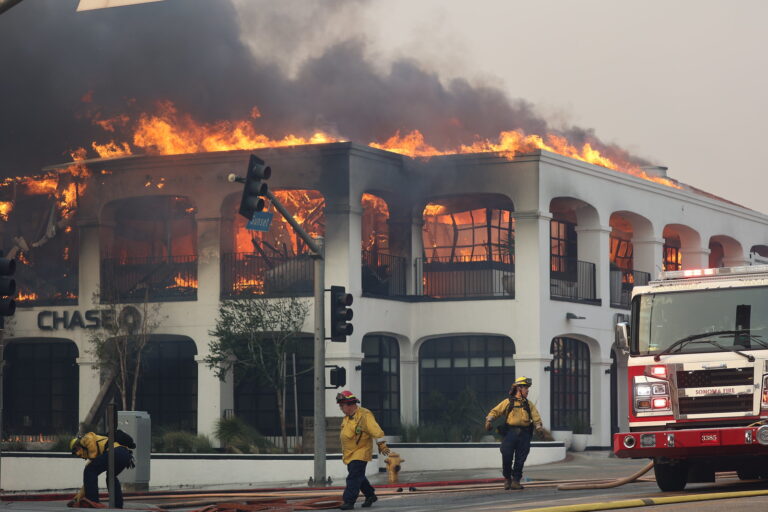
INVESTIGATORS are trying to determine what caused several wind-driven wildfires that have destroyed thousands of homes across the Los Angeles area in January 2025. Given the fires’ locations, and lack of lightning at the time, it’s likely that utility infrastructure, other equipment or human activities were involved.

California’s wildfires have become increasingly destructive in recent years. Research my colleagues and I have conducted shows U.S. wildfires are up to four times larger and three times more frequent than they were in the 1980s and ’90s. Fast-moving fires have been particularly destructive, accounting for 78 per cent of structures destroyed and 61% of suppression costs between 2001 and 2020.

Lightning strikes are a common cause of U.S. wildfires, but the majority of wildfires that threaten communities are started by human activities.

A broken power line started the deadly 2023 Maui fire that destroyed the town of Lahaina, Hawaii. Metal from cars or mowers dragging on the ground can spark fires. California’s largest fire in 2024 started when a man pushed a burning car into a ravine near Chico. The fire destroyed more than 700 homes and buildings.

What makes these wildfires so destructive and difficult to contain?

The answer lies in a mix of wind speed, changing climate, the legacy of past land-management practices, and current human activities that are reshaping fire behavior and increasing the risk they pose.

Fire’s perfect storm

Wildfires rely on three key elements to spread: conducive weather, dry fuel and an ignition source. Each of these factors has undergone pronounced changes in recent decades. While climate change sets the stage for larger and more intense fires, humans are actively fanning the flames.

Climate and weather

Extreme temperatures play a dangerous role in wildfires. Heat dries out vegetation, making it more flammable. Under these conditions, wildfires ignite more easily, spread faster and burn with greater intensity. In the western U.S., aridity attributed to climate change has doubled the amount of forestland that has burned since 1984.

Compounding the problem is the rapid rise in nighttime temperatures, now increasing faster than daytime temperatures. Nights, which used to offer a reprieve with cooler conditions and higher humidity, do so less often, allowing fires to continue raging without pause.

Finally, winds contribute to the rapid expansion, increased intensity and erratic behavior of wildfires. Wind gusts push heat and embers ahead of the fire front and can cause it to rapidly expand. They can also create spot fires in new locations. Additionally, winds enhance combustion by supplying more oxygen, which can make the fire more unpredictable and challenging to control. Usually driven by high winds, fast-moving fires have become more frequent in recent decades.

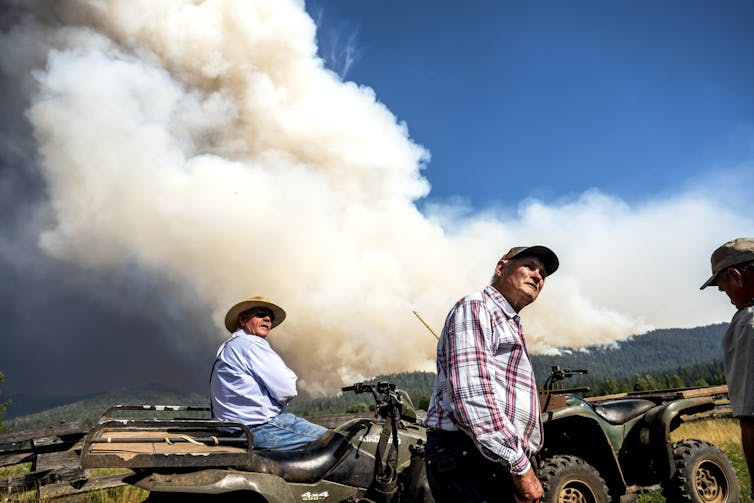
Two older men on ATVs watch the sky as a cloud of smoke rises behind them.
Ranchers watch as firefighting planes battle the Park Fire, which was fueled by extremely hot, dry conditions in Butte County, Calif., in July 2024.
AP Photo/Noah Berger

Fuel

Fire is a natural process that has shaped ecosystems for over 420 million years. Indigenous people historically used controlled burns to manage landscapes and reduce fuel buildup. However, a century of fire suppression has allowed vast areas to accumulate dense fuels, priming them for larger and more intense wildfires.

Invasive species, such as certain grasses, have exacerbated the issue by creating continuous fuel beds that accelerate fire spread, often doubling or tripling fire activity.

Additionally, human development in fire-prone regions, especially in the wildland-urban interface, where neighborhoods intermingle with forest and grassland vegetation, has introduced new, highly flammable fuels. Buildings, vehicles and infrastructure often ignite easily and burn hotter and faster than natural vegetation. These changes have significantly altered fuel patterns, creating conditions conducive to more severe and harder-to-control wildfires.

Ignition

Lightning can ignite wildfires, but humans are responsible for an increasing share. From unattended campfires to arson or sparks from power lines, over 84% of the wildfires affecting communities are human-ignited.

Human activities have not only tripled the length of the fire season, but they also have resulted in fires that pose a higher risk to people.

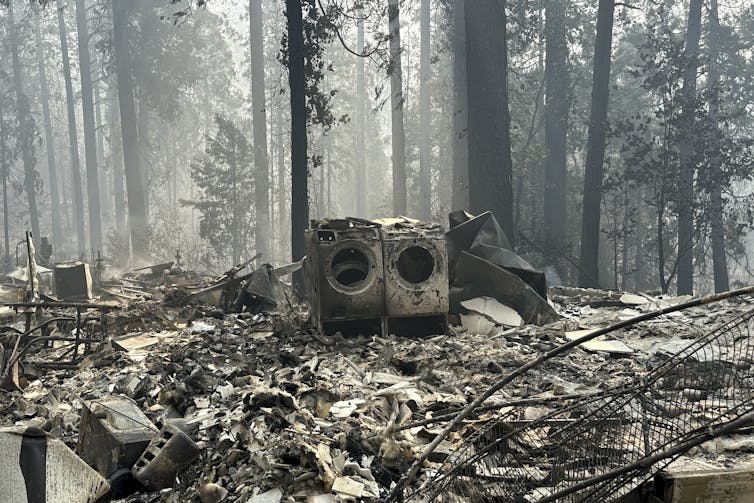
A burned-out washer and dryer are all that remain recognizable in the debris of what was once a home. Burned tree trunks are in the background.
More than 600 homes and buildings burned in the Park Fire, one of California’s largest fires on record. Officials say the fire was started by a man pushing a burning car into a ravine near Chico.
AP Photo/Eugene Garcia

Lightning-started fires often coincide with storms that carry rain or higher humidity, which slows fires’ spread. Human-started fires, however, typically ignite under more extreme conditions – hotter temperatures, lower humidity and stronger winds. This leads to greater flame heights, faster spread in the critical early days before crews can respond, and more severe ecosystem effects, such as killing more trees and degrading the soil.

Human-ignited fires often occur in or near populated areas, where flammable structures and vegetation create even more hazardous conditions. Homes and the materials around them, such as wooden fences and porches, can burn quickly and send burning embers airborne, further spreading the flames.

As urban development expands into wildlands, the probability of human-started fires and the property potentially exposed to fire increase, creating a feedback loop of escalating wildfire risk.

Whiplash weather

A phenomenon known as whiplash weather, marked by unusually wet winters and springs followed by extreme summer heat, was especially pronounced in Southern California in recent years.

A wet spring in 2024 fostered vegetation growth, which then dried out under scorching summer temperatures, turning into highly combustible fuel. This cycle fueled some of the biggest fires of the 2024 season, several of which were started by humans.

That dryness continued in Southern California through the fall and into early winter, with very little rainfall. Soil moisture in the Los Angeles region was about 2% of historical levels for that time of year when the fires began on Jan. 7, 2025.

As the factors that can drive wildfires converge, the potential for increasingly severe wildfires looms ever larger. Severe fires also release large amounts of carbon from trees, vegetation and soils into the atmosphere, increasing greenhouse gas emissions and exacerbating climate change, contributing to more extreme fire seasons.

This is an update to an article originally published Oct. 8, 2024.The Conversation

Virginia Iglesias, Interim Earth Lab Director, University of Colorado Boulder

This article is republished from The Conversation under a Creative Commons license. Read the original article.

CBN fines Fidelity, Union, First Bank, others for failing to dispense cash

FIDELITY, First Bank, Keystone Bank, and Union Bank Plc have been sanctioned by the Central Bank of Nigeria (CBN) for failing to make naira notes available through automated teller machines (ATMs), during the last Yuletide season.

Others sanctioned for similar violations include: Globus Bank, Providus Bank, Zenith Bank, United Bank for Africa, and Sterling Bank Plc.

The acting director of corporate communications at the CBN, Hakama Sidi Ali, confirmed the development in a statement on Tuesday, January 14, noting that “ensuring seamless cash flow is paramount to maintaining public trust and economic stability.

Banks fined by CBN
Banks fined by CBN

“The CBN will not hesitate to impose further sanctions on any institution found violating its cash circulation guidelines,” she stated.

She stressed that the apex bank’s investigations and monitoring would continue to scrutinise cash hoarding and rationing, both at bank branches and by point-of-sale (POS) operators.

She also disclosed that the  CBN was working with security agencies to crack down on illegal cash sales and operational violations, including enforcing POS operators’ daily cumulative withdrawal limit of N1.2 million.

According to the spokesperson, each bank was fined ₦150 million for non-compliance, in line with the CBN’s cash distribution guidelines, following spot checks on their branches.

The enforcement action followed repeated warnings from the CBN to financial institutions to guarantee seamless cash availability, particularly during periods of high demand, she noted.

“Communication with the banks revealed that the fines would be debited directly from their accounts with the apex bank,” she added.

The CBN, governor, Olayemi Cardoso, in his address at the annual bankers’ dinner of the Chartered Institute of Bankers of Nigeria (CIBN) in November 2024, warned banks to strictly adhere to cash distribution policies or face severe penalties.

He underscored the CBN’s commitment to maintaining a robust cash buffer to meet Nigerians’ needs. “Our focus remains on fostering trust, ensuring stability, and guaranteeing seamless cash circulation across the financial system,” Cardoso.

The CBN further urged all financial institutions to comply with its guidelines, warning that further violations would attract swift and decisive sanctions.

The ICIR in December 2024 reported that the apex bank had been largely silent over the cash scarcity that hit businesses and households in the 2024 Yuletide season across the country.

The scarcity prompted PoS operators to adjust their charges to almost 100 per cent higher.

Nigerians were left at the mercy of the PoS merchants as commercial banks rationed cash dispensing to consumers.

Most automated teller machines (ATM) dispensing spots in Abuja Federal Capital Territory (FCT) did not dispense, forcing most businesses to rely on PoS merchants for their transactions.


Beggars, others sue Wike, demands N500m over alleged rights violation

0

SCAVENGERS, beggars and other vulnerables in Abuja have sued the Federal Capital Territory (FCT) Minister, Nyesom Wike, and demanded N500 million in damages for alleged breaches of their fundamental rights.

The lawsuit, filed at the Federal High Court in Abuja, challenges the treatment of vulnerable citizens in the nation’s capital, citing arbitrary arrests, illegal detentions, and extortion.

This followed Wike’s ban on street begging in the city, which has sparked controversy and criticism from human rights advocates.

Besides the street begging ban, the Federal Capital Territory Administration had also banned scavenging in the city centre.

In the suit marked: FHC/ABJ/CS/1749/3024, the lawyer to the plaintiffs, Abba Hikima, on behalf of the vulnerable residents in the originating motion dated Nov. 19, 2024, but filed Nov. 20, 2024, said he was suing in the public interest for the protection of vulnerable Nigerians.

Listed as first to fourth respondents.defendant in the originating motion are Wike; inspector-general of police; director-general, State Security Services; and Nigeria Security and Civil Defence Corps (NSCDC)

In the case filed before Justice James Omotosho of the Federal High Court in Abuja, the lawyer also joined the attorney-general of the federation and the Federal Government of Nigeria as the fifth and sixth respondents, respectively.

The plaintiffs’ lawyer is seeking a court order to compensate the affected citizens with N500 million in damages, citing the government’s alleged infringement on their fundamental rights.

The lawyer argued that the way homeless people, scavengers, petty traders, beggars, and other vulnerable Nigerians in the FCT were being treated was a clear violation of their fundamental rights.

He claimed that arresting them without a reason, detaining them without charges, and harassing them violated their rights.

He said their rights were guaranteed under Sections 34, 35, 41, and 42 of the Constitution of Nigeria 1999 (as altered).

Hikima, in his affidavit, said he witnessed a disturbing scene on November 12, 2024, around 11 pm, while he was passing through Ahmadu Bello Way in Abuja.

According to him, he saw a joint task force, made up of security operatives and enforcement officers, including military and police personnel, arresting a group of people who appeared to be homeless, scavengers, and beggars.

He said it was troubling because the people they arrested weren’t just those who were begging or scavenging and sellers who looked for daily bread.

He argued that being homeless, begging, or doing petty trading was not a crime in Nigeria.

Hikima declared that the government failed to provide vulnerable Nigerians with basic security and a decent life, which was the reason they were struggling.

When the case was brought up in court, Usman Chamo, the applicant’s lawyer, said everything was ready for a hearing and that all the respondents had been notified.

The lawyer for the SSS, A.P. Korobo-Tamono also mentioned that his organisation had filed a counter affidavit and handed it to the applicant’s lawyer.

However, no lawyers showed up to represent the minister, the inspector-general of police, the NSCDC, the AGF, or the Federal Government.

Thereafter the judge sent out a hearing notice to the respondents who weren’t in court and postponed the case until February 4 for a hearing.

Recall that in October 2024, Wike declared war on beggars and accused them of desecrating Abuja city and posing a security risk.

Wike made the declaration during the official commencement of the access road construction from Nnamdi Azikiwe Expressway by N16 to Judges Quarters in Katampe District.

The minister said the move was necessary over concerns that Abuja was turning into a beggars’ city.

The minister on Monday, January 13, also banned used items markets, popularly known as ‘Panteka,’ in the FCT for two weeks.

Wike said the ban on Panteka markets in the FCT took effect from Tuesday, 14th January 2025.

He announced the ban during the FCT Security Council meeting.

According to his media aide, Lere Olayinka, scavenging has been restricted only to dump sites.

Otedola-Obiagbena face-off over $225.8m loan dispute unsettle investors

THE ongoing battle between the owner of General Hydrocarbons Limited (GHL), Nduka Obaigbena, and the chairman of FBN Holdings Plc-the parent company of First Bank of Nigeria Limited, Femi Otedola, over a $225.8 million loan facility has unsettled the generality of investors’ confidence stakeholders told The ICIR.

Obaigbena, who chairs GHL, owners and operators of OML 120, deep offshore in Nigeria, and Otedola have resorted to a face-off over the loan facility.

This has got stakeholders and concerned Nigerians expressing their views and insights on the matter.

In a recent statement, Otedola assured of his commitment to protecting the integrity of the Nigerian oldest financial institution.

He spoke against the backdrop of the recent face-off with Obaigbena.

He accused Obaigbena of resorting to tactics simply because his company had been asked to repay the $225.8 million loan.

“This loan, facilitated with the help of the former Central Bank of Nigeria Governor, Mr Godwin Emefiele, was purportedly for the operation of an oil block, which he obtained without competitive bidding.

“However, the funds were diverted for personal use-funding Mr Emefiele’s presidential aspirations,  acquisition of luxury properties abroad, the operation of a private jet, and an extravagant $68 million spent on jet rentals in just four years,” Otedola asserted.

But Obaigbena defended his oil firm, confirming that the matter has been taken to court for the parties to resolve the differences.

He hinted that GHL has obtained a court order securing its operations pending the court’s determination.

“We hope for a favourable outcome under our system of justice. Unfortunately, First Bank continues to disregard and disobey a subsisting court judgment in favour of GHL and instead has chosen to mislead the public,” Obaigbena said.

The recent face-off between the known individuals followed a recent court injunction restraining all commercial banks in Nigeria from releasing funds or handling assets belonging to GHL.

The oil firm had denied being indebted to FirstBank to the tune of $225.8 million.

According to GHL, it entered into a legally binding, enforceable Subrogation Agreement with First Bank on May 29, 2021.

The bank agreed to fund its exploration, production and development of OML 120 in exchange for sharing profit from oil proceeds from the OML in a 50:50 ratio after statutory payments and taxes over eight years.

The FirstBank’s 50 per cent share was to be used to pay down the bank’s non-performing loans of about $718 million, which was discounted to $600 million to resolve its solvency issues, the GHL disclosed.

It said, “The FBN non-performing loan arose from FBN’s unsecured and reckless lending to Atlantic Energy under separate Strategic Alliance arrangements, in which GHL had no nexus to or connection with.

“The agreements made it clear that the Non-Performing Loan had nothing to do with GHL beyond the fact that 50 per cent of profits from OML 120 due to FBN under the Subrogation Agreement will be used by FBN  to settle the hole created in its books by the Non-Performing Loan (NPL).

“For clarity, Atlantic Energy operated OMLs 26, 30, 34 and 42 – very different from GHL’s OML 120.”

Court injunction

FirstBank had, through a Federal High Court in Lagos, issued a Mareva injunction on December 30, 2024, freezing GHL’s assets linked to the $225.8 million loan owed to the bank.

The court order comes amid arbitration proceedings initiated by GHL against FBN’s alleged breach of their agreements.

According to GHL, a subsisting court order had restrained FirstBank from taking any step against its OML operations and loan requests.

The ICIR had earlier reported how some minority shareholders have demanded an Extraordinary General Meeting (EGM) to oust FBN Holdings’ chairman, Otedola, and a non-executive/deputy chief executive of Geregu Power Plc, Julius Omodayo-Owotuga.

The relationship between Obaigbena, who is deeply involved in the GHL-FBN dispute, and Otedola, who chairs FBN Holding, has added an intriguing dimension to the unfolding drama.

Amid the drama, the bank issued a statement assuring investors of taking all necessary steps to safeguard the interests of the company and its subsidiaries.

“This matter does not in any way impact the operations of the company, and all the businesses within the Group continue to provide uninterrupted services to its customers,” FBN said in a statement on Thursday, January 9.

Amid the escalating dispute, the Central Bank of Nigeria (CBN) has remained silent on the matter, despite the high stakes and potential systemic risks it might cause to the banking sector.

Stakeholders’ take on the matter

According to the national chairman of the Progressive Shareholders Association of Nigeria (PSAN), Boniface Oke, it was expected for such a huge loan facility, the apex bank would be in the know of the agreement between both parties.

“CBN must come out to clear the air because it cannot claim ignorance of such transactions, including NDIC. They must be aware of it.

He expressed that the banking business is built on trust and carried out on proper documentation.

He, therefore, urged other banks to learn lessons from what is happening between FirstBank and GHL.

“There must be total documentation. The CBN must be put on the known. This denial is harmful as all the shareholders will be made to bear the brunts. It is not good for the economy and banking system.

“The Banks must attach more security checks on all the customers they deal with, very important, no matter how big they are,” Okezie said.

He asserted that only the common man who gets loans and refuses to pay them back gets punished for it and jailed, but big men go scot-free.

The executive vice chairman of Highcap Securities Limited, David Adonri, said the law should be allowed to take its course on the matter.

He noted that financial disputes have been very rampant between banks and their customers in the course of business, pointing out that there are adequate legal and regulatory frameworks in the banking industry to get justice.

“CBN regulates banks and not customers. Any dispute between banks and customers that cannot be resolved internally goes to court for redress.

“The case between GHL and FBNH is just one of the numerous delinquent loan cases in the industry that banks grapple with daily,” he said.

Adonri also pointed out that the bank’s prudential guidelines stipulate how to provide for such disputes.

“I don’t think that this matter is material enough to cause panic among investors,” he added.

The national president of New Dimension Shareholders, Patrick Ajudua, corroborated that the matter is purely a business transaction between both parties.

“I believe it should be settled legally within the context of the agreement signed. Hence, it has not much effect on us as shareholders of the bank.

“I want you to realise that dispute can arise at any time in the normal course of dealings. Hence that is why it should be settled amicably or, in alternative, resort to the court for arbitration,” he urged.

Police threaten legal action against Amnesty International over #EndBadGovernance report

0

THE Nigeria Police Force (NPF) has issued a seven-day ultimatum to Amnesty International (AI), demanding a retraction and public apology over its report on the #EndBadGovernance protest in the country in August 2024.

The NPF accused the AI of making unsubstantiated allegations of police brutality, human rights violations, and excessive violence in its report titled “Bloody August: Nigeria Government’s Violent Crackdown on End Bad Governance Protests.”

In a statement on Tuesday, January 14, signed by the Force spokesperson, Olumuyiwa Adejobi, the police described the report as “misleading and entirely baseless.” 

According to the statement, the police acted with professionalism and restraint during the protests, even under severe provocation and attacks by criminal elements.

“Evidence, including national media coverage, demonstrates the police’s efforts to maintain law and order while safeguarding peaceful protesters. Criminal elements attempting to exploit the protests were, however, arrested and dealt with according to law,” Adejobi stated.

These claims, however, contrast with several evidence-based reports of police attacks on Nigerians during the protest. The ICIR in several reports documented how the security operatives including the Nigeria police violated the human rights of protesters, Nigerians and journalists during the demonstration.

While The ICIR can’t confirm the number of deaths during the protest, this organisation reported a series of police brutality, harassment and arbitrary arrests during the protest in FCT, Kano and Sokoto.

Among those arrested were minors and individuals who claimed not to be involved in the protests. Most of these individuals were kept incommunicado without trial for days, against the Nigerian Constitution.

Recall that between August 1 and 10, 2024, Nigerians took to the streets to protest against the country’s rising cost of living and widespread corruption.

The latest rebuttal is the third in a series of rejection of the AI’s report by the police.

At a press briefing on Sunday, December 22, 2024, the police described the claims as false, misleading, and harmful to the police’s image.

The ICIR reported that AI had in a report on November 28, stated that at least 24 people were killed and over 1,200 others, including minors, were detained during the protest.

The report accused the police authorities of using “excessive force” against demonstrators during the protest.

The organisation said the police used extreme force against protesters nationwide during the protest leading to fatalities in states namely Borno, Kaduna, Kano, Katsina, Jigawa and Niger.

The AI said in all cases, the victims were shot by the police, firing live ammunition at close range, often at the head or torso, suggesting that officers were shooting to kill. 

But Adejobi said a report from a special investigative panel constituted to verify the claims, highlighted inaccuracies in AI’s report.

The NPF, in its latest statement,  further criticised the report for undermining public trust and demoralising officers who risk their lives to protect citizens. “This publication harms the reputation of the organisation and undermines years of diligent efforts to build trust with Nigerian citizens,” the statement read.

The police warned that if AI failed to retract the report and issue a public apology within seven days, they would consider legal action.

Police reveal identity of corps member butchered by gospel singer near Abuja

1

THE Nasarawa State Police Command has revealed the identity of a lady butchered by her boyfriend, a gospel singer, Timileyin Ajayi, in Nasarawa State.

The police in a message sent to The ICIR on Monday, January 13, identified the victim as Eliojo Salomey, a 24-year-old serving National Youth Service Corp (NYSC) member based in Mararaba, a fast-growing community near Abuja.

According to the Nasawara Police Command spokesperson, Nansel Ramhan, the incident happened on Sunday, January 12, 2025, at about 8:30 pm.

Confirming an earlier report by The ICIR, Ramhan said Ajayi, who lives in the Pablana area, was caught around Angwan Bako near the Kaja Estate in the New Karu Local Government Area of Nasarawa State when conveying the severed head of Salomey to an undisclosed destination on a commercial motorcycle, popularly known as ‘okada’. 

“He (the motorcyclist) discovered blood droplets from his passenger (Ajayi’s) luggage and immediately raised the alarm.

“Consequently, an angry mob descended on the suspect and upon receipt of the information, the Commissioner of Police directed police personnel to immediately move to the scene.

“They raced to the scene and rescued the suspect from being lynched. The suspect was then taken to an undisclosed hospital for treatment. A follow-up investigation led to the execution of a search warrant at the suspect’s residence, where the remains of the lady who was later identified as Eliojo Salomey, 24 years old of Yanyan, FCT, Abuja, and a serving Corp member, were recovered,” he stated.

The police spokesperson added that the police commissioner in the state had ordered an investigation into the matter.

The ICIR gathered that the suspect, Ajayi, is a gospel singer based in Abuja.

The ICIR revealed on Monday from a resident of the area where the incident occurred (names withheld for security reasons) that the suspect, when caught, confessed that the victim was his girlfriend and he had killed her for an undisclosed reason.

He also confirmed that the suspect was almost lynched at the scene.

“People beat him to 95 per cent death. I cannot show you the video and photos,” the source posted on his Facebook page.

The ICIR further revealed that the bike man fled the scene with his motorcycle, fearing he could be implicated in the crime.

Information provided by a source who spoke with The ICIR tallied with the police’s statement on the incident.

The source had said that police officers led the suspect to his house, where they met the butchered body of the lady. The suspect planned to wrap the parts in nylon and dispose of them.

He didn’t state why he killed the lady but previous experiences in Nigeria suggest that such killings are mostly for rituals.

The incident has continued to attract condemnation among Nigerians on social media.

The FCT has had its fair share of killings for rituals and other purposes in Nigeria.

A disturbing incident occurred in a hotel in the Wuse area of Abuja in 2024, where a man was apprehended for allegedly attempting to use a girl for ritual purposes.

The man had reportedly tied the girl’s hands and legs but was caught and forced to release her by onlookers.

A video of the incident shows the man being ordered to untie the girl.

He was eventually paraded by the FCT Police Command and charged in court.

In July 2024, a young man, Nuhu Ezra, was arrested by the FCT Police Command for being in possession of a human skull and bones.

According to the command, he had picked up the human skull and bones in a bush to sell them for N600,000.


Los Angeles faces more wildfire threats after dozens reportedly killed

0

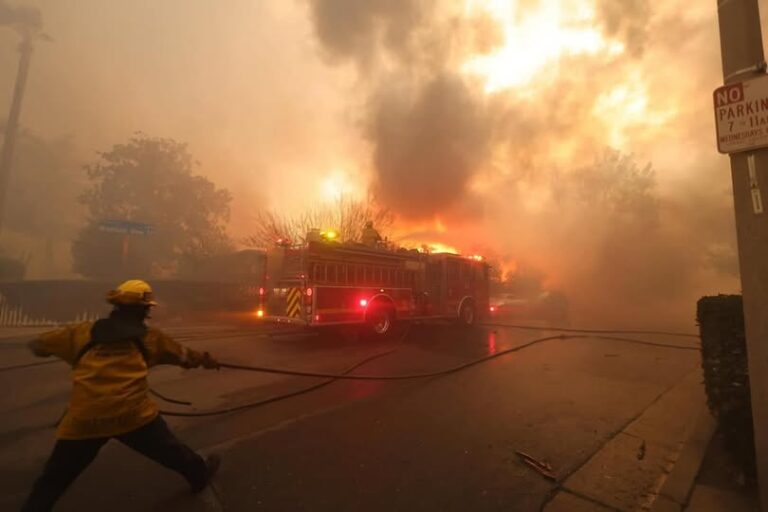
OFFICIALS continue to scramble to contain the blazes in Los Angeles, United States, on Monday, January 13, as fear grows ahead of high winds threatening to undo the progress made in the fight against the fires.

AT least 24 people have been killed by the conflagrations that have raged for nearly a week.

According to AP, no less than 16 people are missing, and the city’s authorities said the number of casualties and people missing could rise.

The wildfires, which have been described as one of the deadliest in California’s history, have left a trail of destruction in its wake, with several neighbourhoods reduced to rubbles.

The scale of the destruction is staggering, with over 1,000 homes and businesses destroyed and tens of thousands of hectares of land burnt. 

Balls of fire and smoke billowed across the city, defying efforts by overwhelmed firefighters and other citizens the contain the tragedy.

Los Angeles’ most affluent neighbourhoods affected

The fires have raged through the city, leaving behind a destruction of monumental proportions. Affected areas include Los Angeles’ most affluent neighbourhoods and luxury homes now left in ruins.

The conflagrations have caused immense destruction to the environment. As the fires rage on, firefighters are struggling to contain them but high winds and dry weather make the task even more challenging.

Among the victims are high-profile celebrities who lost their homes and belongings to the disaster. They include popular reality TV star Kim Kardashian, singer Katy Perry, actor Neil Young, and Orlando Bloom.

Perry’s mansion in the Hollywood Hills was destroyed, while Bloom’s home in the same area was severely damaged. Kardashian, who lives in the nearby Calabasas neighbourhood, was forced to evacuate her home with her family. Fire also destroyed the homes of several other celebrities, including musician Robin Thicke.   

Cause of fire unknown

Relevant officials are investigating the cause of the infernos. However, preliminary findings show that they could have been sparked by a combination of dry weather, strong winds, and human activities.

The magnitude of the fire is unprecedented, with some experts comparing it to the devastating wildfires that swept through California in 2018. However, the current misfortune is believed to be even more calamitous, with the potential to cause billions of dollars in losses, in additional to human toll.

No end in sight to crisis

Los Angeles County Fire Chief Anthony C. Marrone warned on Sunday, January 12, that the danger from the wildfires persisted and urged residents to be patient with intentional power outages aimed at preventing further blazes.

Marrone said the combination of strong winds and low humidity, among others made the threat of further fires “extremely high”. 

He urged residents in fire-prone areas to understand that intentional power outages were crucial for public safety.

Trading blames

As the people of Los Angeles struggle to come to terms with the disaster, many are asking who is to blame for the tragedy.

While some fingered the city’s power company, others criticised the government for not doing enough to prevent the fire or to respond to it quickly enough. 

California Governor Gavin Newsom declared a state of emergency and deployed the National Guard to assist with relief efforts.

Newsom, who has been serving in this role since 2019, on Friday ordered a “full independent review” of the city’s utilities.

He expressed concern over the lack of water supplies shortly after the crisis began, which he described as “deeply troubling.” He promised to take a closer look at the systems in place to ensure they’re working effectively.

The president-elect, Donald Trump, however, blamed Newsom for the disaster.

Responding to the catastrophe, the Joe Biden-led Federal Government pledged to provide support for the city as it declared the area a “war scene.” 

Similarly, the United Nations has pledged to provide humanitarian aid, while the European Union has offered to send firefighters and equipment to help contain the blaze.

Fire sparks climate change debates

The fire has sparked a global debate about climate change and the need for urgent action to prevent similar disasters in the future.

As the people of Los Angeles await the long process of rebuilding and recovery, there have been widespread calls for greater investment in fire prevention and mitigation measures, as well as for more robust emergency response systems.

The city has announced plans to conduct a thorough review of its emergency response procedures, with a view to identifying areas for improvement and implementing changes to prevent similar disasters in the future.

Pope Francis expresses sadness over disaster

Pope Francis has expressed sadness over the blaze.

The Pope conveyed his sympathy with the victims and city in a message to the archbishop of Los Angeles.

The Pope expressed grief over the havoc wreaked by the wildfires.


Edo police arrest woman for burning house help’s genitals with hot iron

0

THE Edo State Police Command has arrested a 31-year-old woman, Abigail Oluwarotimi, for allegedly assaulting her 15-year-old house help, Jude Joseph, by burning his genitals and laps with a hot metal object.  

According to a statement on Monday, January 13, via the Command’s X handle the suspect accused the teenager of molesting her children, which prompted the violent act. 

The incident, which took place in Uromi, led to the intervention of operatives from the Uromi Police Division, who apprehended the woman.  

“Operatives of the Uromi Division had arrested 31-year-old Abigail Oluwarotimi for violent assault on her house help, 15-year-old, Jude Joseph. 

“She used a hot metal object to inflict burn injuries on his laps and genitals, on allegation that he molested her children,” the statement read.

The Commissioner of Police, Umoru P. Ozigi, in the statement described the act as barbaric and unacceptable, ordering the immediate transfer of the case to the State Criminal Investigation Department (CID) for a thorough investigation.  

“Miffed by this development, the Commissioner of Police, CP Umoru P. Ozigi psc, mnips has ordered the transfer of the case to the State CID for thorough investigation,” the statement added.

Other details into the incident are unclear, with the condition of the teenager not also disclosed to the public. 

The ICIR reports tha the abuse and molestation of house helps have remained a disturbing trend in Nigeria, often exposing deep-seated issues of lack of regulation, and weak government intervention 

Many domestic workers, particularly children and teenagers, have been reportedly subjected to physical, emotional, and psychological abuse at the hands of their employers.

In 2022, the Police Command in Plateau State confirmed the arrest and detention of a female suspect for allegedly torturing and killing her 11-year-old maid identified as Margaret Joshua.

The command’s spokesperson, Alfred Alabo, stated that the suspect, a microbiologist at a research institute in Vom, Jos South Local Government Area, forced the minor into hot water, causing severe burns to her buttocks.

Also, another woman was arrested on October 22, after she beat her maid to death and then dumped the body in a bush in Anambra state.

The National Agency for the Prohibition of Trafficking in Persons (NAPTIP), Anambra Command, arrested the woman after which she confessed to the crime.

The woman took NAPTIP officials to the bush where she buried the child.

Similarly, An Anambra lawyer, Adachukwu Okafor was alleged to have used various objects like a broken bottle, knife, and electric iron to harm her house help, identified as Happiness Nwafor, in response to an incident involving her daughter.

The lawyer was subsequently arraigned on February 2024, on two-count borders mainly on wilfully inflicting physical injuries on the body of the victim, an offence punishable under Section 4(1) of the Violence Against Persons (Prohibition and Protection) Laws of Anambra State of Nigeria 2017.