NIGERIA could face further cash-scarcity as the Central Bank of Nigeria (CBN) has warned that rise in cash held outside bank vaults has risen to N1.59 trillion year-on-year rise now totalling N4.29 trillion.
According to the apex bank’s money and credit statistics, over 90 per cent of the currency in circulation has remained outside formal financial institutions in 2024.
The data showed that by October 2024, currency outside banks had reached N4.29 trillion, making up 94.3 per cent of the total N4.55 trillion in circulation.
This marks a notable year-on-year increase of 59 per cent or N1.59 trillion, rising from N2.70 trillion in October 2023, when 89.6per cent of the total currency was outside banks.
Month-on-month, the amount of currency outside banks rose by 6.8per cent or N270billion, from N4.02 trillion in September 2024.
In September, currency outside banks accounted for 93.1 per cent of the total N4.31 trillion in circulation. This represented a 66.3 per cent year-on-year increase from N2.42trillion in September 2023, when 87.5 per cent of the total currency was outside banks. The month-on-month rise was 3.8per cent.
This marked a 73.9per cent year-on-year increase from N2.22trillion in August 2023, when 83.6per cent of the total currency was held outside banks.
The trend continued in July 2024, with N3.67trillion outside banks, representing 90.5per cent of the total N4.05 trillion in circulation.
Despite efforts to encourage cashless transactions, the data highlights that Nigerians remain heavily dependent on cash, which may hinder the country’s move toward a more modern financial system.
Commenting on the development, the President of the Association of Senior Staff of Banks, Insurance, and Financial Institutions, Olusoji Oluwole, attributed the growing cash shortage across the country to the CBN’s failure to meet commercial banks’ cash demands.
The ICIRreported that the CBN imposed a fine of N150m per branch on Deposit Money Banks found guilty of enabling the illegal distribution of newly minted naira notes to currency hawkers and unscrupulous agents.
To ensure compliance, the apex bank stated that it would increase periodic spot checks in banking halls and ATMs while deploying mystery shoppers to uncover illicit cash hawking spots across the country.
The ICIR earlier reported CBN’s silence over the cash scarcity that has hit businesses in this 2024 yuletide season, across the country.
This has prompted the Point-of-Sales (PoS) transaction operators to adjust their charges to almost 100 per cent higher.
Last year, Nigerians suffered the same fate as cash scarcity and high cost as commercial banks continue to ration cash dispensing to consumers
Ikechi Agbugba is a senior lecturer/researcher and an agricultural economist at the Faculty of Agriculture, Rivers State University, Nigeria. He is a co-founder of the Africa Organisation of Technology of Agriculture (AOTA) and serves on the advisory board of the Saudi Education and Technology Collective Alliance (SETCA). In this interview, he addresses issues of agricultural production and proffers solutions to the food supply shortage in Nigeria.
The ICIR: In assessing Nigeria’s agricultural production, in which aspect do you think the country failed to prioritise efforts in 2024?
Agbugba: The high cost of inputs has continued to pose a major challenge for both livestock and crop farmers. The cost of farm inputs especially feeds for livestock has continued to escalate. This is even more saddening that up till now, Nigeria’s food security situation is interlinked to a plethora of factors. Truly, agricultural production is inseparable from the conduct of other economic agents, as well as the structure of the food markets. This year, the adverse effect of fuel scarcity and outrageous hikes in price has affected virtually all the sectors of Nigeria’s economy and agriculture still stands tall.
The majority of Nigerian farmers (majorly smallholder-based) lack access to affordable capital. Over time, literature tells us that the agriculture sector employs over 70 per cent of Nigeria’s rural population, but what is more depressing is that farmers’ lack of affordable capital has no doubt stemmed and stifled by high interest rates.
The Central Bank of Nigeria raised its benchmark interest rate on 26th November 2024 by 25 basis points to a new record high of 27.5 per cent for the sixth time since this year. These exorbitant rates make it nearly impossible for farmers who are typically smallholders to secure the needed finance to scale up or expand operations or even adopt modern farming techniques. Truly, this is a major thread among other aspects in this seemingly tangled fabric of Nigeria’s food insecurity situation.
Ikechi Agbugba, senior lecturer, Department of Agriculture and Applied Economics, Rivers State University, Port Harcourt
The ICIR: A recent survey by the United Nations projects that at least 33.1 million people in 26 states and the FCT will face a food and nutrition crisis in 2025. What is your take on this report?
Agbugba: The report corroborates with reality. You do not need expert analysis to understand the gravity of food insecurity in Nigeria. You can easily make contact with this reality in the streets, in markets, in religious centres and hospitals, among other centres. I am dispirited that the governments are not striving enough to tackle this issue with the right strategy. All I hear is lip service even in the face of alarming figures from the CBN on interest rates coupled with the widening gap of underemployed citizens, closure of companies, and hike in food prices.
The deposit interest rate in Nigeria is projected to be around 12.83per cent in 2025 and 10.83per cent in 2026. According to the Trading Economics Report, Nigeria’s inflation rate accelerated for the second straight month in October 2024, climbing to a four-month high of 33.9per cent.
Meanwhile, the economy grew 3.46 per cent annually in the third quarter, its fastest pace in three quarters, driven by the services sector. The naira has depreciated by around 46 per cent against the dollar this year, partly due to efforts to allow it to float after being pegged at an artificially strong rate for years. It has also been affected by poor liquidity, despite CBN’s attempts to alleviate pressure by supplying dollars to meet domestic demand.
There is a relationship between poverty, food insecurity and malnutrition and if something real quick is not done, it will still play out badly on the economy.
There is a relationship between poverty, food insecurity and malnutrition and if something real quick is not done, it will still play out badly on the economy. The majority of the Nigerian population is poor, in fact, in recent times, a lot of people have been plunged into severe cases of poverty. The report from the survey is timely. Any responsible government will put measures on the ground immediately to avert any disastrous humanitarian crisis by 2025.
The ICIR: The aftermath of devastating floods and insurgency is negatively impacting the food supply in the country. What should be done differently to change the tide?
Agbugba: First, the government must tackle insecurity head-on. This must not be by kinetic means alone. The government needs to be genuinely honest about dialoguing with these non-state actors to bring about lasting peace in Nigeria. Some of these insurgents may have germane reasons, such as negligence on the part of the government in delivering the goods of democracy, unemployment, inequality, and economic hardship.
Second, actions must be taken by governments at all levels to embank rivers in farming communities and dredge water channels where necessary.
Third, farmers should be encouraged to adopt the principle of insurance.
Fourth, the government should work more with agencies like the National Emergency Management Agency and Nigerian Maritime Administration and Safety Agency in leveraging the merits of early warning notice periods to curtail the impact of flooding on farmers.
Actions must be taken by governments at all levels to embank rivers in farming communities and dredge water channels where necessary.
Fifth, stakeholders in research and development should develop drought-resistant crops and venture into areas to build and restructure food and agricultural systems as that would encourage partnerships and collaborations between and among educational institutions in Nigeria and that of the global north as highlighted by SDG 17 – ‘strengthening global partnerships for sustainable development.’
Ikechi Agbugba, an agric economist/researcher
I must underscore that collaborations, initiating some memorandum of understanding (MoU) or some joint project and grant funding opportunity, could be leveraged in bridging the gaps between research and industry. Interestingly, I am leading the collaboration between Rivers State University and the University of Rwanda, and the agriculture programmes of both institutions are at the fulcrum of the understanding. At the moment, we are working assiduously with partners to empower staff and students and inspire innovation as captured in the MoU.
The ICIR: Do you belong to the school of thought that believes climate change is not yet a major challenge to crop production in Nigeria? Why?
Agbugba: No, I do not belong to such a faction. If climate change is not real, why are people complaining about extreme hotness at some times and extreme coldness at other times?
For many Nigerians, the climate crisis is a harsh reality. In 2024 alone, a scorching heat wave swept across the country and the Northern region was hit particularly hard by extreme flooding. Heavy rains have led to flooding in many areas, destroying lives, and infrastructure, and submerging hectares of farmland. Truly, seasons are shifting and we now have more of the rains (rainy season) than the dry seasons in Southern Nigeria (especially in Rivers State which is at the heart of the South-South geopolitical zone). Some crop farmers wait longer after sowing their crops for the first rain to hit their farmlands at the end of the dry season.
Farmers are experiencing unpredictable rainfall, which affects the growth of crops like maize, okra, vegetables, cucumber, and garden eggs. They are also battling with new diseases, such as moulds, nematodes, and scabs, appearing on vegetables, hence, the increasingly high cost of those food items. Farmers are finding it difficult to meet the food demand of the state’s population. These drastic changes in weather patterns cannot be overlooked.
The ICIR: How likely is climate change becoming a major concern in Nigeria’s crop production in the next five years?
Agbugba: Majority of the Nigerian farmers are smallholders and totally depend upon the cultural ways of growing crops. Some are adverse to modern technologies and resistance to GMCs (genetically modified crops). Thus, with little or no technology to buffer the effect of climate change on the part of our large subsistence farmers, it will lead to food shortages, acute hunger, and cost-push inflation.
Majority of the Nigerian farmers are smallholders and totally depend upon the cultural ways of growing crops
It is quite saddening that some forecasts are projecting that temperatures will keep rising, and flood cases will keep heightening. Farmers should expect to see heavy rainfall and rising sea levels and of course, this would result in making coastal communities vulnerable to flooding. Also, more intense storms could cause more frequent combined sewer overflows which are combined wastewater and sewage from multiple drains and buildings. Also, increased water temperatures are bound to occur. The most immediate impact of climate change on rivers and lakes is expected to be an increase in water temperatures.
Other issues that could affect agriculture and farming in the next 5 years include: increased nutrient loads, among other droughts and more water-related disasters. Please I am not a prophet of doom but I know climate change issues can be excessively deep and entrenching.
The ICIR: How can the government make farming attractive for its teeming population whose thoughts of leaving the country remain convincing amid the frustration in finding a job?
Agbugba: I wish to reckon that the previous government made great efforts in proposing policies to advance agriculture. However, along the line, they failed to prioritise favourable policies that would advance the economy through the sector. I wish to recommend the following approaches which align with the Brain Re-engineering initiative I developed for rebranding agriculture for the youth to regain their interest in agriculture.
Provide a well-structured plan, program and agenda on youth capacity development and training on modern farming techniques and agribusiness management.
Create awareness and further promote agricultural technology options for youths to support their knowledge, as well as build their skills on digital solutions for farming, such as drone technology and mobile apps.
Provide financial options and support for youths in the form of low-interest loans, grants, and crowdfunding platforms.
Provide access to land that would enhance land policy implementation that promises affordable leasing options or long-term land rights for young farmers.
Establish partnerships to foster collaborations with private sector and international agencies to create opportunities for the youth.
Improve security nets to ensure the safety of farmers’ lives and properties. This will not just enhance adequate farmers’ security but will guarantee an effective and peaceful cultivation of farms by the farmers.
Stimulate cooperative farming and would nonetheless, offer farmers the opportunity to enjoy the pros of cooperation such as sharing the cost of machinery and marketing their produce.
Establish government-reserved farmer states for a while
Indeed, the Brain Re-engineering Model (BRM) revolves around 5 pillars which are: change of perception, ideation and entrepreneurship, technology amalgamation, sustainability and circular economy; and social equity in public policy. Adapting the BRM implies that the Federal Government of Nigeria would enforce policies that would favour farmers in such a way that the youths would be attracted to farming as it promises to improve their quality of life to achieve self-sustained growth in the sector. In so doing, the agriculture sector’s potential to contribute to her GDP (gross domestic product) would be somewhat significant.
The ICIR: You mentioned that policies of pass governments could be leveraged to advance agricultural production. What policies do you speak of, and what impacts could they have?
Agbugba: I am of the view that the present government should revisit the Agricultural Development Projects (ADP) of 1974, Operation Feed the Nation (OFN) of 1976, Green Revolution (GR) of1980, Farm Settlement Scheme (FSS) of 1959, and National Economic Empowerment Development Strategy (NEEDS) of 1999 ìf they want to advance agricultural production. They should appraise these policies to see the ones that align with the trending needs and challenges in the agriculture sector. I wish to recommend that the government should seize every opportunity to provide a platform to appraise past or antiquated policies. I am confident that this will go a long way to identifying the bottlenecks, developing strategies that would enhance the production of food, ensuring food security for all Nigerians, improving policy performances, and reducing brain drain or turnover among the youths, among other gains. The Federal Government of Nigeria has pledged to increase agricultural input supply to boost food production; and this is supposed to be part of a broader strategy to revamp the sector, address food insufficiency, and empower farmers.
The present agriculture promotion policy hinges upon past national food and agricultural policies which are founded on the following guiding principles: agriculture as a business; agriculture as a key to long-term economic growth and security; food as a human right; value chain development; market orientation, to mention a few. Undoubtedly, the Federal Government of Nigeria should work together with stakeholders such as the Federal Ministry of Agriculture, Non-Governmental Organisations and private investors to encourage policies that would foster the incorporation of some technological options. Hence, the critical role that youths play in reshaping and advancing the agriculture sector, especially in the age of the fourth industrial revolution (4IR) cannot be overstated. And that is the core of the Brain Re-engineering Initiative.
THE Ohanaeze Ndigbo Worldwide has picked Nze Fidelis Chukwu from Imo State as the new President-General of the association.
Chuckwu will be replacing the late Emmanuel Iwuanyanwu, who died recently.
This is contained in a communique issued at the end of the Ohanaeze Ndigbo Worldwide Imeobi and General Assembly meeting held on Saturday, December 14, in Enugu state and signed by the Secretary-General, Okey Emuchay.
Chukwu’s tenure as President-General of Ohanaeze Ndigbo Worldwide will be short-lived, lasting only 27 days, until January 10, 2025, to complete Imo state’s tenure.
Chukwu’s emergence is a result of a series of unfortunate events, including the passing of George Obiozor, a professor, in 2022 and Emmanuel Iwuanyanwu in July 2024.
In application of a doctrine of necessity, Iwuanyanwu was sworn in on April 30, 2023, as a replacement for Obiozor but unfortunately died on July 25, 2024, and was buried on November 1.
Emuchay said that by the doctrine of necessity, Chukwu was presented by the Imo Chapter of Ohanaeze to fill the remaining tenure.
The motion for his adoption was moved by Eze Cletus Ilomuanya and seconded by Simon Okeke.
“The State Presidents of Ohanaeze Ndigbo of Abia, Anambra, Delta, Ebonyi, Enugu, and Rivers expressed delight over the nomination of Chukwu as the new President-General until January 10, 2025,” Emuchay added.
Emuchay further stated that Chukwu was sworn in as the President-General of Ohanaeze Ndigbo Worldwide by the National Legal Adviser, Joseph Ojobu, and the Assistant Legal Adviser, Peter Aneke.
During the ceremony, the governor of Enugu state, Peter Mbah, representing the Southeast Governors’ Forum, emphasised the importance of ensuring that the upcoming Ohanaeze election is transparent and credible.
Recall that the former President-general of Ohanaeze Ndigbo Worldwide, Iwuanyanwu, died on Thursday, July 25, 2024, after a brief illness, aged 82.
Before his death, he clamoured vigorously for the release of the leader of the Indigenous People of Biafra (IPOB), Nnamdi Kanu.
According to Iwuanyanwu, Kanu’s release will help to address security concerns in the South-East.
According to him, the federal government and leaders of the zone cannot negotiate peace while Kanu is still being held in custody.
Kanu has been in custody since his arrest and repatriation to Nigeria from Kenya in 2022.
He’s being held on charges related to terrorism and treasonable felony, specifically for his agitations for the secession of the Southeast states to form Biafra.
Kanu was initially arrested in 2015 and arraigned on an 11-count charge. However, he jumped bail in 2017 and left the country. His re-arrest and repatriation from Kenya in 2022 led to his re-arraignment at the Federal High Court in Abuja.
BRITISH Conservative Party leader Kemi Badenoch, known for her controversial comments about Nigeria, recently recounted her unpleasant encounters with the Nigerian police.
In an interview with The Free Press, which has been circulating since Saturday, December 14 2024, Badenoch was asked whether she trusted the British police.
In response to the question, Badenoch stated that her experience with the Nigerian police was very negative, contrasting it with her first positive encounter with the police in the United Kingdom (UK).
She claimed that the police in Nigeria would rob them.
“I do. My experience with the police in Nigeria was very negative, and coming to the UK, my first experience with the police was very positive. The police in Nigeria would rob us.
Narrating an experience of the her younger brother with the Nigerian police, she said: “I remember the police stealing my brother’s shoes and his watch. It’s a very poor country, so people do all sorts of things and giving people a gun is a license to intimidate.” Badenoch stated.
Badenoch, also contrasted her experiences with the UK police, and recounted how they responded efficiently when her home was burgled in 2004, ultimately apprehending the culprit.
She recalled, at the time, the police were effective in catching criminals but added they appear now overburdened with responsibilities.
It would be recalled that during the 10th Annual Migration Dialogue, Vice President, Kashim Shettima had criticised Badenoch for disparaging Nigeria after becoming the UK Conservative Party leader, suggesting she “remove the Kemi from her name” if she lacked pride in her origins, while Badenoch defended her stance, asserting he was not a PR representative for Nigeria.
Conversely, in a document making rounds online, during her 2010 campaign for a seat in the British parliament, Kemi Badenoch appealed to the Nigerian community in the UK, emphasising her Nigerian heritage and pledging to enhance the country’s image through her role in British politics.
But during her 2022 bid to succeed former British Prime Minister Boris Johnson, she backtracked and criticised Nigerian politicians for misusing public funds for personal gain.
Speaking at the Conservative Party conference, she described her upbringing in Nigeria as marked by fear and insecurity in a nation plagued by corruption.
In a subsequent interview with British media after becoming the Conservative Party leader, Badenoch stated that she wanted to prevent the UK from facing the challenges that drove her to leave Nigeria.
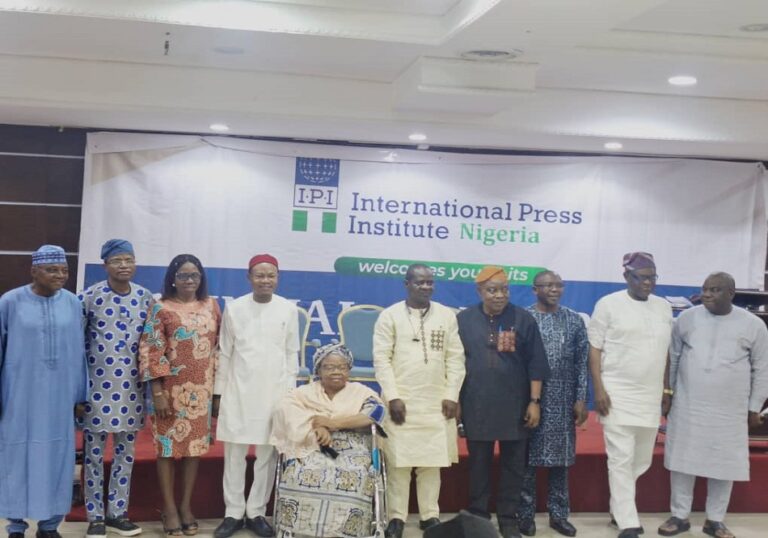
THE Editor-in-Chief of Premium Times, Musikilu Mojeed, and the Chief Executive Officer (CEO) of the Media Trust Group, Ahmed Shekarau, have been re-elected President and Secretary of the Nigerian chapter of the International Press Institute (IPI), respectively.
Mojeed, Shekarau, and four other officials who were elected unopposed and sworn in on Thursday, December 12, will direct the affairs of the Nigerian affiliate of the global media body for the next three years.
In a statement issued by a member of the global executive board of the IPI, Raheem Adedoyin, other new executive committee members include Fidelis Mbah of Al Jazeera Television as deputy president, Rafatu Salami of Voice of Nigeria as treasurer, Yomi Adeboye of Herald Newspaper as assistant secretary, and Tobi Soniyi of Arise News as legal adviser.
In his inaugural speech, the newly reelected president, Mojeed, promised an inclusive administration and sought the support of members to achieve the organisation’s goals of enhancing the Nigerian media environment.
The election was preceded by the organisation’s annual general meeting (AGM), where the Mojeed-led executives presented their three-year report and updated members on the organisation’s financial state. The AGM also saw the amendment of some sections of the group’s constitution.
A highlight of the event was the attendance of former Ogun state governor Segun Osoba, who commended IPI Nigeria members for their commitment to press freedom and independent journalism. He also praised the group’s leadership for a successful conference.
Muskilu Mojeed, flanked by the minister of Information and other dignitaries
Apart from Osoba, some other prominent journalists who attended the AGM include a former editor-in-chief of Tribune Newspapers (who chaired the forum), Folu Olamiti; former presidential spokesperson and ex-president of the Nigerian Guild of Editors, Garba Shehu; chairman of the Editorial Board of the Herald and member of the global board of the IPI, Adedoyin; chairman of the Board of Trustees of the International Centre for Investigative Reporting (ICIR), Oluwafisan Bankale; and the executive director of the organisation, Dayo Aiyetan.
Notable dignitaries in attendance at the congress included Abigail Ogwezzy-Ndisika, a professor from the University of Lagos; Kunle Babs of Feature Story News; and Danlami Nmodu, publisher of Newsdiary Online.
Other prominent figures present were Fabian Benjamin, editor-in-chief of JAMB Bulletin; Sule Yau Sule of Bayero University, Kano; and Dotun Oladipo, publisher of The Eagle Online.
Former President of the Nigerian Guild of Editors, Funke Egbemode, was also in attendance, along with Ochiaka Ugwu, an editor with Peoples Daily; Ken Ugbechie, publisher of Political Economist; and Lawal Sabo Ibrahim, former managing director of The Triumph newspapers.
Mohammed Danjuma, publisher of Katsina Times; Christopher Isiguzo, former president of the Nigerian Union of Journalists; Lanre Arogundade, executive director of the International Press Centre; Zainab Suleiman Okino, chair of the editorial board of Blueprint Newspapers; and Hameed Bello, chief operating officer of Peoples Daily newspapers, were also present.
IPI Nigeria recently hosted a well-attended conference in Abuja, focusing on “Democracy, Media Freedom, and the Imperative of Protecting the Nigerian Civic Space.”
The Minister of Information and National Orientation, Mohammed Idris, chaired the opening session and asserted that press freedom exists in Nigeria.
However, Tony Iredia, who delivered the keynote address, strongly disagreed, arguing that press freedom is nonexistent in Nigeria.
Other notable presentations included Adeola Oluwatosin Ajayi’s discussion on the relationship between the Nigerian media and security agencies and EFCC chair, Ola Olukoyede’s talk on partnering with anti-corruption agencies.
Former Minister of Information and Culture Lai Mohammed also spoke on reducing tension between the government and media.
The three-part event concluded with a dinner for members, partners, and supporters.
As a global network of media executives and journalists, the IPI has consistently advocated for journalists’ rights and media freedom worldwide since its establishment in 1950.
THE Central Bank of Nigeria (CBN) said it will impose a N150 million fine per branch on deposit money banks (DBM) found guilty of illegally supplying mint naira notes to currency hawkers and unauthorised agents.
The apex bank disclosed this in a circular issued on Friday, December 13, 2024, signed by the acting director of the Currency Operations Department, Mohammed Olayemi.
The circular expressed the CBN’s worry over the growing trend of hawkers trading mint naira notes, which the bank stated disrupts efficient cash distribution to customers and the public.
Referring to an earlier directive issued on November 13, 2024, the apex bank reaffirmed its commitment to tackling the commercialisation of the naira.
“Any financial institution branch found guilty will incur a N150 million fine for the first offense,” the directive noted.
The apex bank further cautioned that repeat violations will result in harsher penalties under the Banks and Other Financial Institutions Act (BOFIA) 2020.
To enforce compliance, the apex bank announced plans to increase random spot checks in banking halls and automated teller machines (ATMs), as well as using mystery shoppers to identify illegal cash hawking locations nationwide.
“The CBN has noted with dismay the prevalence of illicit flow of mint banknotes to currency hawkers and other unscrupulous economic agents that commodify naira banknotes, thus impeding efficient and effective cash distribution to banks’ customers and the general public,”it said.
“CBN will continue to intensify the periodic spot checks to the banking halls/ATMs to review cash payouts to banks’ customers, as well as mystery shopping to all identified cash hawking spots across the country,” the apex bank added.
It further stressed that any erring deposit money banks or financial institutions that are culpable of facilitating, aiding, or abetting, by direct actions or inactions, the illicit flow of mint banknotes to currency hawkers and unscrupulous economic agents that commodify Naira banknotes shall be penalised at first instance N150,000,000.00 (One hundred and fifty million Naira) only, per erring branch, and at later instances, apply the full weight of relevant provisions of BOFIA 2020.
The CBN also called on deposit money banks (DMBs) to improve controls, processes, and procedures within their Cash Management Centres, branches, and teller operations to safeguard against exploitation for illegal transactions.
Additionally, the CBN reminded banks about its ongoing mystery shopping activities and spot checks, which are designed to prevent the misuse of naira notes and ensure proper cash distribution, particularly as the festive season draws near.
The apex bank noted that the policy directive is geared towards preventing the flow of newly minted banknotes to hawkers and ensure efficient cash distribution to the public.
It further disclosed that banks found guilty of seizing cash from unauthorised hawkers will face fines, with repeat offenders subject to additional penalties, and any actions hindering cash flow will lead to sanctions for violating the Clean Note Policy.
The ICIR had reported that the CBN had announced from December 1, customers facing challenges withdrawing cash from bank branches or ATMs should report the issues directly to the apex bank.
THE Independent National Electoral Commission (INEC) has refuted claims about the death of its chairman, Mahmood Yakubu.
The reports, which surfaced on Monday, December 9, 2024, claimed that Yakubu died in a London hospital.
In a statement on Saturday, December 14, 2024, the Chief Press Secretary to the INEC Chairman, Rotimi Oyekanmi, urged the public to dismiss the rumours, affirming that Mahmood Yakubu is alive, well, and in good health.
“Our attention has been drawn to a fake news narrative circulated by a section of the social media claiming the purported death of the INEC Chairman, Prof. Mahmood Yakubu at a London hospital. The story first appeared on Monday, 9th December 2024.
We hereby appeal to the public to disregard the rumour. Prof. Yakubu is alive, hale and hearty,” Oyekanmi noted.
The commission further clarified that the INEC chairman has not travelled to London in the past two years and was actively engaged in official duties during the week. It noted that Yakubu attended an interactive session with the House of Representatives Committee on Electoral Matters on Wednesday, December 11, 2024, and chaired a meeting with Resident Electoral Commissioners on Thursday, December 12, 2024.
Both events, the statement emphasized, were extensively covered by television and featured on the front pages of major newspapers on Friday, December 13, 2024.
INEC noted that a similar false report had circulated in 2021, with the same baseless claims resurfacing three years later.
Similarly in 2023, during the heat of the general elections, The ICIRfact-checked a claim being circulated by a former Nigerian lawmaker, Dino Melaye about Yakubu’s life being at risk.
The commission condemned the spread of such misinformation, emphasizing the damage it inflicts on individuals and society. It also urged those responsible for creating and sharing such rumors to consider the consequences of their actions.
INEC reaffirmed its dedication to collaborating with reputable media professionals to tackle the increasing challenge of fake news.
OCTOGENARIAN wife of Paul Ogbebor, a late retired colonel, Rita Lori has stated that the Federal Capital Territory (FCT) Minister Nyesom Wike was a teenager when her husband contributed to building the capital city years ago.
84-year-old Rita Lori-Ogbebor, joined by her sons Osaruonanen Ogbebor and Ikponmwosa Paul-Ogbebor, said this in Abuja on Friday, December 13, at a press conference following a clash with Wike over land supposedly belonging to an estate management company known as Paulosa Nigeria Ltd owned by her late husband.
Issues surrounding the seizure of properties have generated a lot of controversy in the past few days. Ogbebor has accused the FCT minister of forcefully taking the land from her family.
Ogbebor reiterated at the press conference that she’d rather die than appeal to President Bola Tinubu to intervene in the land dispute between Paulosa and the FCT authorities.
She emphasised that her late husband was a key contributor to Abuja’sdevelopment and expects those close to the president to recognize her and bring the matter to his attention.
The Octogenarian noted that she doesn’t expect the Presidentto personally know her, but rather the leaders and advisors surrounding him should be aware of individuals like herself who have contributed significantly to the country’s progress.
She emphasised that when issues arise, these leaders should interveneand, if necessary, escalate the matter to the president.
“My husband was one of those who built Abuja; they gave him a piece of land to work as an engineer. He brought people from all over the world to work with him. Now, after 42 years, they want to demolish it and give it to Chinda. Who is Chinda?‘ she asked.
The ICIR reportedthat following accusations of land grabbing against the FCT Minister, he has insisted on the continuous demolition of properties in the nation’s capital, stating that he will not be swayed by ‘blackmail.’.
In his remarks, at the distribution of operational vehicles to security agencies at the Federal Capital Territory Administration (FCTA) Secretariat in Abuja on Thursday, December 12, Wike said he would not be deterred by blackmail or public outcry.
He described the actions taken by the Federal Capital Development Authority (FCDA) as necessary to reclaim land unlawfully occupied.
According to him, the structures being demolished by the FCDA are illegal buildings constructed on government land.
“Let me use this opportunity to tell Nigerians and residents of Abuja, we are not afraid of blackmail,” Wike stated.
The minister added that the properties being demolished not only posed security risks but had been constructed on lands that rightfully belonged to the government.
Recently, residents of Life Camp, a community in the city, protested against attempts to demolish Paulosa Homes, which they claimed was being carried out under Wike’s directive.
The event was followed by a video of Martins Vincent Otse, popularly known as VeryDarkMan, during his visit to the community, accusing the FCT Minister of wrongfully revoking people’s ownership rights.
Meanwhile, the minister’s comments came as the Senate has ordered a probe into the demolitions as the matter has dominated discussions in most media outlets across the country.
THE Nigerian Navy has successfully trained and certified its first female pilot, Changfe Maigari, a navy lieutenant.
Maigari was decorated at the Nigerian Navy Sunset and Awards Night at the Naval Headquarters Training Command at Ebubu-Eleme, Rivers State, on Friday, December 14.
Speaking during the event, the Chief of Naval Staff, Emmanuel Ogala, a vice admiral, said the event is to celebrate the milestone achieved by the Navy and an opportunity for the Navy to reflect on its accomplishments, foster camaraderie, and recognise the hard work of its officers and ratings, particularly those who have distinguished themselves.
Ogala said throughout 2024, the Navy undertook various operations to combat oil theft and strengthen security in Nigeria’s territorial waters and the Gulf of Guinea.
He added that the Navy achieved fleet recapitalization, infrastructure development, and enhanced personnel welfare, all in line with its strategic plan for 2021-2030.
He recalled that in January 2024, the Navy launched Operation ‘Delta Sanity’ and incorporated aerial surveillance into their operations using helicopters and unmanned aerial vehicles to improve Nigeria’s maritime domain awareness in order to combat the issue of oil theft and other maritime crimes.
“The operation recorded tremendous successes, which led to the arrest of numerous vessels and suspects involved in oil theft and other crimes and increased Nigeria’s daily crude oil production, as many oil companies have reported about 100 per cent terminal factor in the past few months,” the naval boss stated.
During the occasion, Maigari, the first female pilot, thanked the Nigerian Navy for providing her with the opportunity to achieve her career goals.
Maigari hails from Langtang North Local Government Area of Plateau but was born in Kaduna.
She had am impressive career which kicked off in 2016 when she graduated from the Nigerian Defence Academy (NDA) and was commissioned as a sub-lieutenant.
After that, she served on the Nigerian Navy Ship Unity, gaining valuable experience that would eventually lead her to make history as Nigeria’s first female naval pilot.
Meanwhile, Rivers State Governor Siminalayi Fubara congratulated the Navy on a successful year and expressed his administration’s readiness to collaborate with the Navy, particularly in combating oil theft.
He noted that the Navy is usually tasked with the challenging responsibility of protecting oil lines, 90 per cent of which are located in the Niger Delta region’s swamps.
Fubara praised the Navy’s efforts, stating that they have done well for the nation. He also reiterated his government’s commitment to supporting the Navy in its operations.
THE Federation Accounts Allocation Committee (FAAC) has shared N1.727 trillion among the Federal Government, states, and local government areas for November.
This is contained in a communiqué issued after the FAAC meeting held on Thursday, December 12 in Abuja.
According to the communiqué, the N1.727 trillion total distributable revenue comprised statutory revenue of N455.354 billion.
It also comprised distributable Value Added Tax (VAT) revenue of N585.700 billion, Electronic Money Transfer Levy (EMTL) revenue of N15.046 billion and Exchange Difference revenue of N671.392 billion.
The communiqué indicated that total gross revenue of N3.143 trillion was available in the month of November.
“Total deduction for cost of collection was N103.307 billion, while total transfers, interventions, and refunds was N1.312 trillion,” it said.
It said that gross statutory revenue of N1.827 trillion was received for the month of November.
“This is higher than the sum of N1.336 trillion received in the month of October 2024 by N490.339 billion.
“Gross revenue of N628.972 billion was available from the VAT in November. This was lower than the N668.291 billion available in the month of October by N39.318 billion ” it said.
The communiqué said that from the N1.727 trillion total distributable revenue, the Federal Government received the total sum of N581.856 billion, and the state governments received N549.792 billion.
“The LGCs received the sum of N402.553 billion, and a total sum of N193.291 billion (13 per cent of mineral revenue) was shared to the benefiting states as derivation revenue,” it said.
On the N455.354 billion statutory revenue, the communiqué said that the Federal Government received N175.690 billion, and the state governments received N89.113 billion.
It said that the LGCs received N68.702 billion, and the sum of N121.849 billion (13 per cent of mineral revenue) was shared to the benefiting States as derivation revenue.
“From the N585.700 billion VAT revenue, the Federal Government received N87.855 billion, the state governments received N292.850 billion, and the LGCs received N204.995 billion.
“A total sum of N2.257 billion was received by the Federal Government from the N15.046 billion EMTL. The state governments received N7.523 billion, and the LGCs received N5.266 billion,” it said.
It said that in November, Oil and Gas Royalty and CET Levies recorded significant increases, while Excise Duty, VAT, Import Duty, Petroleum Profit Tax, Companies Income Tax, and EMTL decreased considerably.
Since the total removal of fuel subsidy by the Bola-Tinubu led administration, federation allocation has improved hugely with some economic watchers calling on citizens to advocate for priority spendings in health and public infrastructure by public officers.
“Nigerians must begin to ask questions over spendings by public office holders, they need to question every spending. This is not the time for more flambuoyant spendings by the politicians, it’s time for work since Nigerians have made the sacrifice of going without petrol subsidy, we need to see more good road networks across the country, good public schools and health infrastructure across the country,” a development economist, Celestine Okeke told The ICIR.
The ICIRreported that the Gross revenue of N668.291 billion was available and distributed from the Value Added Tax (VAT) in October 2024. This was higher than the N583.675 billion available in the month of September 2024 by N84.616 billion.