OPERATIVES of the Force Intelligence Department’s Intelligence Response Team (FID-IRT) have arrested 33 suspected members of a criminal network believed to be behind terrorism, kidnapping, and armed robbery in Kwara and neighbouring states.
The police recovered an anti-aircraft launcher and other sophisticated weapons in the process.
The Force Public Relations Officer, Anthony Placid, a deputy commissioner of police, made this known on Monday while addressing journalists at the FID-IRT headquarters in Abuja.
He explained that the arrests followed a series of coordinated operations carried out across Kwara and Kogi states, stemming from investigations into the November 20, 2025 attack on a Christ Apostolic Church in Eruku, Kwara State.
The ICIRreported that the incident, saw armed bandits storm the church during an evening service. At least three worshippers were killed, while 38 others, including the pastor, were abducted. The attack, which was broadcast live, drew widespread outrage across the country. All the victims were later rescued through a joint security operation.
According to Placid, early findings from the investigation indicate that the suspects were involved in a range of serious crimes, including criminal conspiracy, armed robbery, kidnapping, cattle rustling, culpable homicide, illegal possession of firearms, arms trafficking, and terrorism.
Items recovered from the suspects include seven AK-47 rifles, seven magazines, one anti-aircraft launcher, 32 rounds of 7.62mm live ammunition, five walkie-talkie communication devices, and a camouflage hydration backpack.
Providing more details, Placid said: “Following the attack on the C.A.C in Eruku Town, Ekiti LGA of Kwara State on 20th November 2025, operatives of the IRT, acting on credible human and technical intelligence, conducted coordinated operations across Kwara and Kogi states.
“Preliminary investigation revealed that the gang was involved in criminal conspiracy, armed robbery, kidnapping, cattle rustling, culpable homicide, unlawful possession of firearms, arms dealing, and acts of terrorism, for which a prima facie case has been established.
“The gang members were arrested at multiple locations, including Gbugbu, Ora-Ago, Baballa, Kaiama, Awi, Charagi, Patigi, and Okeode. During operations, the suspects abandoned an anti-aircraft rifle and three AK-47 rifles, which were subsequently recovered by the police. Investigation is ongoing to apprehend any fleeing members of the gang to recover additional operational weapons.”
The police also released the names of the 33 suspects arrested in connection with the case. They include: Abubakar Usman, also known as Siddi, 26; Ibrahim Sa’idu, alias Idi Soho, 35; Adamu Mohammad, aka Baushe/Dogo, 58; Abdullahi Abubakar, aka Bature, 35; Abubakar Abdullahi, aka Turke, 35; Yusufa Isah, aka Munyaye, 50; Zubairu Abubakar, 35; Shaibu Usman, 35; Mohammed Lawai, aka Jalel, 40; Dahiru Adamu Mohammedu, 50; and Mohammadu Audu, aka Alti, 40.
The 33 suspects are part of a larger group of 50 individuals paraded by the police on Monday as part of ongoing nationwide efforts to dismantle criminal networks.
In a separate statement issued on Tuesday, Placid said the arrests were made during what he described as a “strategic offensive against syndicates that have long threatened the peace of the nation” since January.
He added that key suspects were being prepared for prosecution, while security operatives were still tracking other fleeing members of the group and working to recover more illegal weapons.
Days after the incident, President Bola Tinubu announced via a post on X that all those abducted from the church had been rescued.
THE World Bank’s petrol imports advisory to Nigeria is attracting more condemnations as Nigeria’s local refineries continue to meet demands and have excess for export.
The World Bank, in its Nigeria Development Update released on April 7, recommended that Nigeria should prioritise petroleum imports.
According to the World Bank, imported fuel is cheaper than the domestically refined version, with Dangote Refinery already registering its footprint in petroleum export worldwide.
Days later, the World Bank deleted from its website the Nigerian Development Updates report and clarified that its recommendation was not a blanket stamp on fuel importation but a broader one on energy security.
“In the case of Nigeria, the focus should be to provide targeted support to support the vulnerable people through their functioning social safety net system, and the World Bank Group stands ready to step up its existing support,” the Bank had said.
The importation advisory has continued to draw criticism from several industry stakeholders put the World Bank’s suggestions under intense scrutiny.
“The submission by CPPE is that instead of talking about increasing importation, we should focus on domestic production, energy security, self-reliance and conservation of foreign exchange. Focus should be on supporting private refineries to cover importation gaps, not the World Bank’s model of importation,” former Director General of Lagos Chamber of Commerce, Muda Yusuf, told The ICIR.
He stressed that countries that are affected by the blockade of Strait of Hormuz are currently going through crises.
“Dangote and other modular refineries must be supported for energy security, and not importation. There’s a need to protect domestic production and the domestic economy. As we speak now, many farmers haven’t recovered from temporary importations that were done years ago,” he added.
He noted that the World Bank’s focus should be to give technical and technological support to Nigeria to increase local production.
Already, Dangote Petroleum Refinery & Petrochemicals has recorded a major milestone in Nigeria’s energy history. It exported 44,000 barrels per day (b/d) of gasoline in March 2026.
This record has positioned the country as a net exporter of petrol for the first time, with a surplus of about 3,000 b/d.
The landmark development marks a decisive turnaround for Nigeria, Africa’s largest oil producer, which for decades depended heavily on imported refined petroleum products.
Industry analysts say the export surge, driven by rising refinery output, is expected to generate significant foreign exchange inflows, easing pressure on the forex market and supporting macroeconomic stability.
“This is a good development for the deregulated market in Nigeria as local demands are almost being met without complete reliance on imports,” a professor of energy economics, Adeola Adenikinju, told TheICIR.
In a notable expansion of its international footprint, the refinery also exported gasoline to East Africa for the first time, shipping a 317,000-barrel cargo to Mozambique.
The move reflects growing regional demand as buyers diversify supply sources away from the Middle East amid ongoing disruptions. Another gasoline cargo is scheduled for delivery to Beira, Mozambique, in April, informed sources at the refinery told The ICIR.
Data from market intelligence firm Kpler showed that Nigeria’s gasoline imports dropped sharply to 41,000 b/d in March—the lowest level on record.
Meanwhile, crude supply to the refinery rose to about 565,000 b/d, the second-highest intake since the 650,000 b/d-capacity facility began operations in late 2023.
The figures indicate strong processing rates and improving product yields.
Analysts say Nigeria’s transition from a major petrol importer to an exporter is set to reshape regional trade flows and intensify competition in global fuel markets.
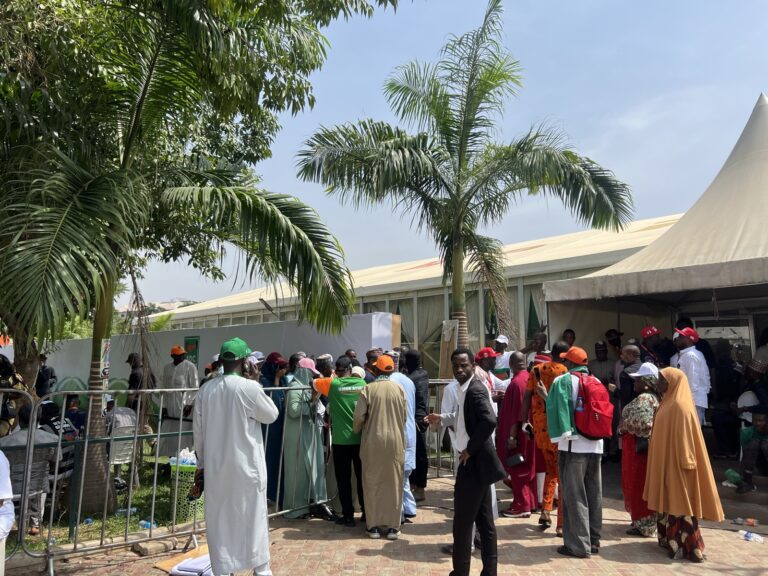
THE African Democratic Congress (ADC) convention was thrown into disarray on Tuesday after intense heat inside the event hall forced delegates and dignitaries to step outside intermittently.
Despite the presence of air conditioning units, attendees said the systems were either not working, leaving the packed hall stifling and uncomfortable.
As of 1:30 p.m., proceedings had yet to fully commence, with many dignitaries still being awaited.
Several delegates were seen fanning themselves and rushing out for fresh air, while others poured water on their heads to cope with the heat. Among them was a former Kogi governorship candidate and senator, Dino Melaye, who emerged visibly drenched in sweat and was observed cooling off outside the venue.
The situation disrupted sittings, with constant movement in and out of the hall as participants struggled to endure the conditions.
The disruption adds to the controversy trailing the convention, which had earlier been hit by a last-minute venue crisis.
The ICIR reports that the discomfort arose largely from the Federal Capital Territory Administration’s (FCTA) alleged refusal to approve the venues requested by the party for the convention.
Venues including the Eagle Square and the Velodrome at the Moshood Abiola National Stadium were allegedly denied the party.
Consequently, the ADC, which had at least 3,000 delegates for the convention had to make do with the Rainbow Event Centre at Area 8, which organisers said was not conducive for the convention.
The party had raised the alarm, Thursday night, less than 20 hours to the convention, that the FCTA was threatening to revoke the licence of the venue should the event hold on the premises.
However, the party vowed it would go ahead with the convention, arguing that it had a contract with the facility and had made all payments to use the venue.
NOTE: This report was updated to show that the discomfort suffered at the convention by delegates was largely caused by the party’s failure to get a conducive venue for the event.
THE Supreme Court of Nigeria has fixed April 22, 2026, to hear appeals arising from the protracted leadership crisis within the Peoples Democratic Party (PDP).
The appeals were filed by a faction led by former Minister of Special Duties, Kabiru Tanimu Turaki, contesting the March 9 judgment of the Court of Appeal, which upheld earlier rulings barring the party from proceeding with its controversial national convention outcomes.
A five-member panel of the apex court, headed by Mohammed Garba, granted an application for accelerated hearing on Tuesday, April 14.
The presiding judge ordered a shortened timeline for filings, directing respondents to submit their briefs within five days, while the appellants are to respond within two days.
Backstory
On March 9, 2026, the Court of Appeal in Abuja dismissed the Turaki’s PDP attempt to overturn a Federal High Court judgment that restrained the Independent National Electoral Commission (INEC) from recognising the outcome of its Ibadan convention.
Delivering judgment, a three-member panel of the appellate court unanimously resolved all four issues raised by the appellants against them, ruling that the appeal lacked merit and affirmed that the lower court acted within its jurisdiction.
According to the appellate court, the plaintiffs had the legal standing to institute the suit as part of efforts to protect their democratic rights.
The court further rejected the PDP’s claim that it was denied fair hearing during the proceedings at the trial court.
As part of its ruling, the appellate court ordered the Turaki-led PDP to pay N2 million as costs, describing the appeal as frivolous.
Earlier, the Federal High Court had held that the party must comply with the Electoral Act and its internal regulations before any convention outcome could be recognised.
On December 22, 2025, INEC also declined to recognise the new leadership, citing existing court orders and ongoing legal disputes. The commission maintained that pending appeals did not invalidate subsisting judgments, reinforcing its refusal to update the party’s National Working Committee list.
The INEC referenced two Federal High Court rulings in Abuja in October and November 2025, which restrained it from giving effect to the outcome of the Ibadan convention.
The electoral commission noted that pending appeals did not automatically stay the execution of these judgments and emphasised that it remained bound by the law. A letter signed by INEC Secretary, Rose Oriaran-Anthony, explained that, in light of the suits, the commission could not update or recognise the list of national officers elected at the Ibadan convention.
In January 2026, another ruling nullified the convention and barred officials who emerged from it, including Turaki, from acting as national officers.
Roots of dispute
The PDP’s internal crisis predates the Ibadan convention. The crisis in the party traces back to the build-up to the 2023 general elections when a rift emerged between supporters of former Vice President Atiku Abubakar and a group of governors led by the Minister of the Federal Capital Territory, Nyesom Wike, who was Rivers State governor at the time.
During the party’s presidential primary, a powerful bloc of governors led by Wike, known as G5, demanded that the party’s presidential ticket be zoned to the South following the eight-year administration of former President Muhammadu Buhari, who was from the North.
Abubakar and several stalwarts of the party in the North disagreed with the proposal, leading to protracted rift among party members. The former vice president eventually secured the PDP presidential ticket after defeating other aspirants, including Wike, at the party’s primary.
The outcome deepened divisions within the party. Wike and some of his allies withheld their support for Abubakar during the 2023 presidential election.
The election was eventually won by Bola Tinubu of the All Progressives Congress (APC), after defeating Atiku and Peter Obi of the Labour Party.
After the election, Tinubu appointed Wike as Minister of the Federal Capital Territory, a move that further intensified internal disagreements within the PDP. Although Wike accepted the ministerial position in an APC-led administration, he retained his membership in the PDP.
Some party leaders, including Oyo State governor Seyi Makinde, Bauchi State governor Bala Mohammed, and PDP chieftain Bode George, have publicly criticised Wike’s role in the party and accused him of engaging in anti-party activities.
The Wike faction of the PDP recently held a parallel convention in Abuja and now reportedly occupies the party’s headquarters after it was sealed for weeks by the Nigeria Police Force.
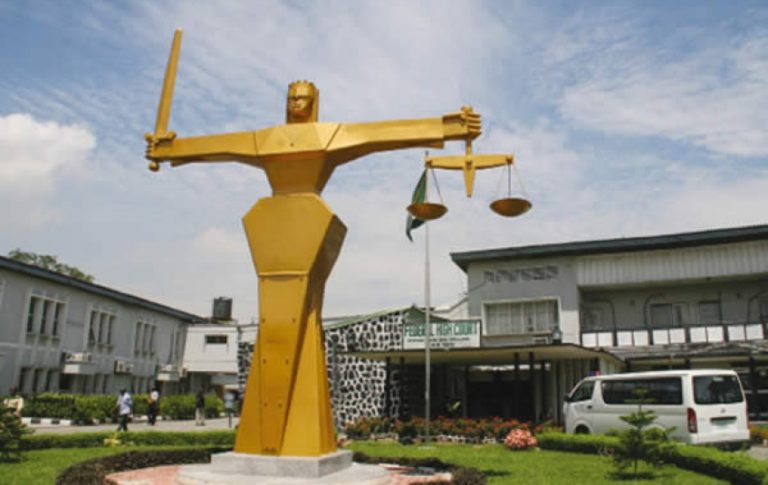
THE FEDERAL High court in Kaduna has granted bail to former Kaduna State governor, Nasir El-Rufai, following his arraignment on charges brought against him by the Independent Corrupt Practices and Other Related Offences Commission (ICPC).
El-Rufai was taken into custody after a court session earlier in April 2026, as the court fixed a later date to rule on his bail application. The court had adjourned the matter to April 14, 2026, for a decision on whether he should be granted bail or not.
According to reports, during earlier proceedings, journalists were not allowed into the courtroom. This development raised concerns about how the trial was being handled. The case also faced delays after the prosecution introduced an amended nine-count charge against El-Rufai.
The amended charge made changes to the earlier case, removing Amadu Sule, who was initially listed as a co-defendant, and leaving El-Rufai as the only accused facing trial. His lawyer, Ubong Akpan, a senior advocate, said the defence team was not informed ahead of time about the new charges.
“The charges are entirely new to us. They were given to us this morning while we were already in court. That is why the matter could not proceed,” Akpan had said.
Following this development, the judge, Darius Khobo, adjourned the matter to April 14, for the hearing of the bail application.
During the bail hearing, El-Rufai’s legal team asked the court to grant him bail, stating that he is willing to comply with any conditions set by the court. The prosecution opposed the application, arguing that he could interfere with witnesses.
After hearing both sides, the court granted bail to the former governor. The court granted him bail in the sum of N100 million with sureties, including conditions that he must provide responsible guarantors. Details of the full bail conditions were not immediately made public at the time of reporting.
El-Rufai is facing charges filed by the ICPC, including allegations that he approved the release of about N11 billion from Kaduna State funds to an unregistered company for a light rail project that was not carried out. He is also accused of approving and receiving about N289.8 million as severance allowance beyond what is allowed by law.
Further allegations include the handling of more than $1.08 million from a World Bank loan, the award of a N4.6 billion CCTV contract in Kaduna in violation of procurement rules, and involvement in an alleged plan to bribe federal investigators.
The former governorhas denied all the allegations and pleaded not guilty in court.
The ICIR reports that he is also facing a separate 10-count charge before a Federal High Court, where he was earlier arraigned before a judge, Rilwan M. Aikawa, on allegations related to money laundering and unlawful handling of public funds.
THE African Democratic Congress (ADC) has alleged that its planned national convention venue in Abuja is under threat, claiming that the Federal Capital Development Authority, FCDA, is mounting pressure on the facility’s owner to withdraw hosting rights less than 24 hours to the event.
The party’s National Publicity Secretary, Bolaji Abdullahi, raised the alarm in a statement Monday night.
He stated that the owner of the Rainbow Event Center in Garki Area 8 had been warned against allowing the party to use the facility.
According to him, the venue owner was allegedly told that his licence could be revoked by the Federal Capital Development Authority (FCDA) and the Minister of the Federal Capital Territory, Nyesom Wike, if he proceeds with hosting the convention.
Abdullahi said the party had already fulfilled all financial obligations and signed a contract with the venue before the development.
“After paying all the fees required, setting up for our convention tomorrow, the owner of Rainbow Event centre has just informed us that he has come under pressure from the FCDA and Minister of FCT, Nyesom Wike that if he allows the ADC the use of his facilities, his licence will be revoked,” he said.
Despite the alleged threat, the ADC insisted that its convention would go ahead as scheduled at the venue.
“We have already signed the contract with him. We will hold our convention tomorrow as planned at the Rainbow event centre. We will not bow to this creeping tyranny. And definitely not to this petty tyrant,” Abdullahi added.
The latest development comes amid mounting challenges facing the party ahead of its convention.
The ADC had earlier fixed the Rainbow Event Center, located at Plot 1193A, off Southern Parkway in Garki Area 8, as the venue for the convention scheduled for Tuesday, April 14, 2026.
The location, behind the FCDA/AGIS building and near the NTA headquarters in Area 11, was announced after the party raised concerns over its inability to secure a venue in Abuja.
Chairman of the party’s media sub-committee for the convention, Kola Ologbondiyan, had disclosed that the ADC initially applied to use Eagle Square but received no response, despite submitting a request to the FCT Minister’s office.
He added that efforts to secure an alternative venue at the Moshood Abiola National Stadium were unsuccessful, while some private event centres allegedly declined the party’s requests over fear of repercussions.
However, Wike dismissed the claims, stating that no political party would be denied access to public facilities if due process was followed, and maintained that he was unaware of any formal application by the ADC.
Atiku described development as “shameful” “cowardly abuse of public office”
Reacting to the development, former Vice President, and one of the leaders of the ADC, Atiku Abubakar, described the development as a “shameful and cowardly abuse of public office.”
Atiku said attempts to coerce a private business owner into denying an opposition party access to a venue amounted to an attack on democratic principles and the right to free assembly.
“The ADC has paid every fee. The ADC has signed every contract. The ADC has broken no law. Our only offence is that we are organising, we are growing, and we are preparing to retire this failed government at the ballot box in 2027,” he said.
He warned that such actions could undermine Nigeria’s democracy, alleging that they reflect a broader pattern of suppressing opposition voices.
“This is how democracies are strangled, not in a single dramatic blow, but in a thousand petty, vindictive acts against opposition parties, against free assembly, and against the sacred right of citizens to choose their own leaders. To the international community, and every democratic partner of Nigeria: take note of what is being done here tonight, and in whose name,” Abubakar added.
RETIRED officers of the Nigeria Police Force on Monday April 13, trooped to the Force Headquarters in Abuja to protest the handling of their pension.
They called for an immediate exit from the Contributory Pension Scheme (CPS) and a comprehensive review of their retirement benefits.
The protesters expressed dissatisfaction with the CPS, which they said had failed to meet their financial needs since they left active service.
According to them, pension payments under the scheme are often delayed and too small to cope with the country’s rising cost of living. The retirees insisted that after years of service to the nation, they deserve a more reliable and adequate pension system.
This demonstration is not an isolated incident. For several years, retired officers, particularly under the Association of Retired Police Officers under CPS, have repeatedly called for reforms. Their demands have largely centered on the need to either restructure the current scheme or remove police personnel from it entirely.
Tension rose during the protest when a senior police officer, Alonyenu F. I., addressed the group. His remarks were met with visible frustration from the retirees, who felt their concerns were not being taken seriously. In a heated response, one of the protesters said: “We are fighting for our rights, and you say you will deal with people? You cannot intimidate us.”
Despite the confrontation, the protesters remained at the headquarters, maintaining their demand for immediate government action.
Efforts to address the issue have been made at the legislative level. On October 22, 2025, the House of Representatives passed a bill seeking to remove the police from the CPS. The Nigerian Senate subsequently adopted the bill, raising hopes among retirees. However, the proposed law is yet to be signed by President Bola Tinubu, leaving the matter unresolved.
Although the federal government has announced the clearance of ₦97 billion in pension arrears, there are concerns among retired officers that this has not significantly improved their wellbeing. They continue to press for a system that ensures timely and adequate payments.
THE African Democratic Congress (ADC) has fixed the Rainbow Event Center in Garki Area 8, Abuja, as the venue for its national convention scheduled for Tuesday, April 14, despite ongoing controversies surrounding its leadership.
A statement on Monday, April 13, by the party on its social media noted that the proposed venue, located at Plot 1193A, off Southern Parkway, is behind the FCDA/AGIS building and close to the NTA headquarters in Area 11.
The announcement was made by the David Mark’s faction of the ADC, and came hours after some members of the party raised alarm over its inability to secure a venue in the Federal Capital Territory.
Chairman of the party’s media and publicity sub-committee for the convention, Kola Ologbondiyan, had said earlier on Monday that the ADC was yet to receive approval for a venue despite applying to use Eagle Square.
He noted that a letter was submitted to the office of the FCT Minister, Nyesom Wike, but no response was received.
He added that efforts to use the Moshood Abiola National Stadium also failed, with the party allegedly denied access to the Velodrome, while some private event centres reportedly declined requests over fear of repercussions.
“As the bromide has shown, a letter was presented to the Office of Federal Capital Territory (FCT) Minister, Chief Nyesom Wike, for a permit to use the Eagles Square. The letter was acknowledged but no response.
“The ADC team paid several visits to the Ministry of Sports officials at the MKO Stadium. At the end, ADC was refused the use of the Valedrom. To make matters worse, privately owned event centres in Abuja are turning down the @ADCNig requests for fears of harassments in various forms from the government,” he wrote.
However, they FCT minister Nyesom Wike has dismissed the allegations, stating that no political party would be denied access to public facilities if due process was followed.
He said he was unaware of any formal application by the ADC to use Eagle Square and described the claims as unfounded.
Backstory
The ICIR reports that the development came amid a deepening leadership crisis within the party, following a decision by the Independent National Electoral Commission (INEC) to stop recognising its leadership led by David Mark.
INEC had cited an Appeal Court ruling to justify removing the party’s leadership from its portal, pending the determination of a suit before a Federal High Court in Abuja.
Reacting, the ADC accused the electoral body of interference and bias, insisting it had complied with all legal requirements, including notifying INEC ahead of its congresses and convention.
The party’s National Publicity Secretary, Bolaji Abdullahi, maintained that the ADC would proceed with its planned activities regardless of INEC’s stance, describing the commission’s interpretation of the court ruling as flawed and politically motivated.
According to him, the party’s internal processes, including its leadership transition, were conducted in line with due process and should not be subjected to external influence.
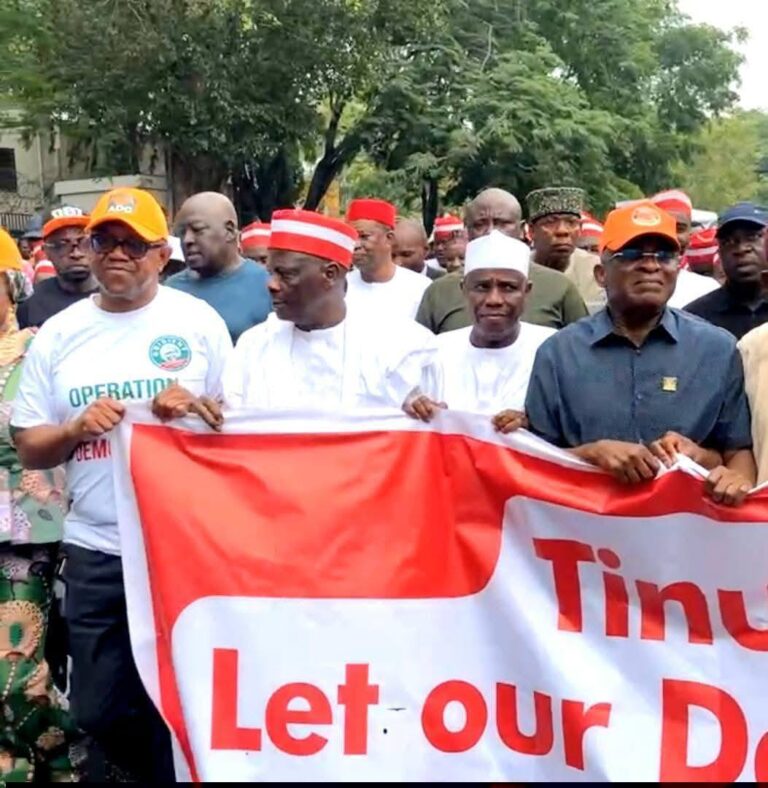
The leadership of Mark’s ADC faction on April 8, protested against the electoral body and its chairman asking him to vacate office.
The rally featured Mark, former vice president Atiku Abubakar, former governors Rauf Aregbesola, Peter Obi, Aminu Tambuwal among other dignitaries.
The ADC has continued to position itself as a major opposition platform ahead of the 2027 general elections.
GUNMEN attack in Angwan Rukuba, Jos North, on March 29 triggered a chain of reprisals that has left several people dead and many others injured. In this report, The ICIR examines how the attack unfolded and its impact on already tense communities.
Nusaiba Iliyasu sat curled into herself, her hijab pulled over her face as if to shield the world from her grief. Her shoulders shook as she cried relentlessly, her voice faint and broken. She could barely bring herself to look at the dozen people gathered in her parlour to console her, let alone speak to them.
Nusaiba Iliyasu, mourning the death of her husband. PC: Mustapha Usman/ICIR
Nusaiba had just lost her husband, Abubakar Yusuf, in a reprisal attack that followed the Sunday, May 29 attack in Plateau state. The father of her children had left home on Sunday evening, telling her he was going to see a man identified as Ali to deliver money related to their tomato business in Flamingo.
Hours later, Nusaiba said his husband called to inform he was on his way back. But he did not make it home that night. The mother of three was confused and could only pray that his husband make it home the next day. By the next day, she received a call from an unknown person that her husband had been killed around Angwa Rukuba, in Jos North LGA.
Although Yusuf did not survive, his friend Abdullahi Abubakar, who had ridden the motorcycle alongside him, made it out alive. Abubakar said it was around 7 p.m. that evening and they were heading back from Flamingo after settling the tomato deal with Ali.
Hours earlier, they had passed through the same route without any sign of unrest. By the time they were heading back, Angwan Rukuba was already reeling from killings of their people. They pushed forward, oblivious of the danger lurking ahead.
Abubakar said they sighted a crowd gathered around a vehicle. “We didn’t know what was happening,” Abubakar said, explaining that as they pushed forward, they were suddenly intercepted.
Yusuf, who was sitting behind him, was immediately hit on the head, dragged off the motorcycle, and beaten. He was not spared either. He was dragged alongside “more than ten people,” whom he said were already lying on the ground.
Abubakar showing one of the several injuries he suffered during the attack
Before he could make sense of the situation, a blow landed on his head and he collapsed. From that moment, everything became blurred. He could not tell what was being done to Yusuf. For over 20 minutes, he said, the beating continued relentlessly, without pause.
He was then labelled a “Hausa.” Although he tried to deny this and insisted he was an indigene of Anaguta, one of the attackers poured petrol on him and declared that he must die after they concluded he could not communicate properly in Anaguta’s local language, Iguta. In Plateau State, such attacks are often quickly framed along communal or religious lines, with Christian or Muslim dominated communities often interpreting such incidents as part of wider clashes when they are attacked by masked or unidentified group.
For decades, Jos North had sat on fragile fault lines shaped by questions of identity, land, and political control. Once celebrated as part of Plateau’s “Home of Peace and Tourism” identity, the area has gradually become a flashpoint. Many trace this shift to 1991, when the creation of Jos North Local Government under the military government of Ibrahim Babangida was seen by indigenous groups, particularly the Berom, Anaguta and Afizere, as tilting power toward Hausa-Fulani settlers. The decision deepened divisions that would soon turn violent, with early clashes in the 1990s laying the groundwork for recurring cycles of unrest, often tied to religion and ethnicity.
Meanwhile, in a desperate attempt to escape, Abubakar was able to slip into a nearby bush. He was chased, and eventually dragged out. He said he was beaten until he fell repeatedly and eventually lay still that would make his attacker believe he was dead.
That moment saved his life. When he later regained some strength, he removed his kaftan and remained hidden in the bush until he was fully conscious to finally step out of the forest.
Nusaiba’s husband was one of the several people killed by the irate youths in Angwan Rukuba in a reprisal attack that followed the Sunday attack in the town. It led to the killing of 26 persons from the town, which later rose to 33.
Videos of the reprisal attack and independent findings by The ICIR indicate that no fewer than three people were killed that night.
Angwan Rukuba bleeds on Palm Sunday night
It was supposed to be a great and trouble-free Sunday that evening on March 29, in Angwan Rukuba Jos North, Plateau State, but yet-to-be identified gunmen quickly spiralled the town into one of the deadliest nights the town has ever experienced.
Here is the exact location residents said the shooting started
Around 7:45 p.m., the attackers, who operated in groups of about six to seven, stepped out of a white vehicle at the Angwan Rukuba–New Jerusalem junction and opened fire on residents who had come out to trade and purchase provisions. Angwan Rukuba, a predominantly Christian community, is a diverse and vibrant settlement, with different ethnic backgrounds coexisting and engaging in trade.
Witnesses said confusion quickly set in, as residents initially mistook the gunfire for routine operations by the National Drug Law Enforcement Agency. But before they knew what was going on, the violence spread rapidly across multiple points.
Best Patent Medicine shop, where about three people were shot dead
At Nico Best Patent Medicine shop, three people were immediately shot dead. At George’s Provision shop, another four were killed, while one person was killed at Abdulsalam POS shop. Both George and Abdulsalam POS shop was one of the several shops close to the Angwan Rukuba-New Jerusalem junction where the assailants had come down from the car.
In another account, about five more people were shot in front of George shop, as the attackers continued firing at anyone caught in their path. The attackers moved through Angwan Rukuba Gari Awaye after the initial shootings. They retreated and repositioned along that side, killing people along their way before disappearing into the mountain.
Four people were killed in this shop manned by George
A community youth leader, Christopher Sani Kachura, told The ICIR that he and his team were on a routine community sanitation and anti-drug patrol when they first heard gunshots. Like many residents, who spoke with The ICIR, Kachura said they initially mistook the armed men for operatives of the NDLEA, who sometimes operate in the area and fire warning shots during operations.
According to him, the situation escalated when civilians realised the men were not security personnel but unidentified attackers dressed in camouflage.
Angwan-Rukuba youth leader, Christopher Kachura
“They began to shoot randomly… people started running everywhere,” he said, adding that several persons were hit before they could take cover.
By the time the attackers moved out through adjoining routes into the mountain, at least 26 people had been killed, according to Kachura, with additional victims later dying in hospital, pushing the death toll higher in subsequent reports.
Recent reports from sources indicate that at least 33 people have now been confirmed dead from the Sunday attack while several others are still being attended to in different hospitals.
Deaths, near deaths and more deaths
Mary Sunday did not immediately realise the gunshots they were hearing from the main road was coming from the ravaging gunmen who had killed dozens of people at the junction. That evening, she stood outside with two others, including Longwa Buba Lawrence, a 45-year-old father of three, when a man in camouflage approached and stopped just a few steps from them.
The gunmen were passing through Gari Awaye street, retreating into the forest. Gari Awaye was the street that houses Sunday’s family house.
Mary Sunday, one of the survivors of the Angwan Rukuba attack
Sunday said after seeing the man in security operative dress, they assumed it was routine. But Lawrence would soon ask whether the man was part of the NDLEA operatives that often patrolled the area but the man did not respond. Instead, he pulled out a gun and shot him twice at close range.
For a brief moment, Sunday said she was confused and did not know what to do. She then ran through a narrow corner that led to another house in the area. The third man, sitting alongside Sunday and Lawrence was chased down and shot at, but was fortunate to survive.
Lawrence was left on the ground as he struggled to breathe. He died before reaching the hospital.
Just a few steps away was Rhoda Ayuba who was still reeling from the pain of losing his only son during Sunday’s attack. She freaked out at the mention of the incident and was still trying to make sense of the loss.
Rhoda Ayuba. PC: Mustapha Usman/ICIR
She was inside her shop with her other children when she heard shouting and the sound of people running. She hurried her children indoors, but one of her daughters was left outside and had to take cover inside the shop.
“Then two of the attackers came. One stood downstairs while the other climbed the stairs toward the shop after seeing her go inside.
“At that point, one of my neighbours came out and asked them, thinking they were security operatives. He said, “Officer, is it drugs? I am talking to you, is it drugs?” The gunmen she said responded in Fulfude, before killing the neighbour.
“After they went down, they shot my neighbour and killed him. Immediately after that, they left the scene,” he narrated.
Mary’s son Promise Ayuba, killed by gunmen
It was only after they left that she was told her son had also been shot. Her son had gone out earlier to buy a recharge card when he was caught up in the attack. He was 23 years old and her only male child among four children.
Sunday and Ayuba were not alone. Elsewhere, Suleiman Abdulsalam was in his POS shop when the gunshots began. From his position, he saw one victim collapse but before he could close the shop, he said people began rushing towards his shop to seek refuge.
Abdulsalam’s shop has an exit door, which he quickly opened to allow them escape but not everyone made it.
Suleiman said the last man trying to get through was shot. However, he could hide behind the exit door before the assailant retreatd.
Shot in the ribs
Chinedu David, a 37-year-old pharmacy owner was shot in the abdomen when he was trying to close his shop that evening.
David was standing in front of his shop near the Angwan Rukuba police station when he first heard gunshots. After peeping outside and seeing people running for safety, he realised he needed to quickly close his shop.
Another survivor Chinedu David showing gunshot injury sustained during the attack
In a split-second decision, he tried to pull down his shop door to secure himself and the people inside, including his mother who was with him at the time. But before the door could be fully shut, bullet struck him close to the ribs.
Despite being injured from the gunshot, Chinedu said he managed to escape as the attackers continued shooting nearby. He applied pressure to his wound to control the bleeding and made his way down the road while the shooting continued behind him.
He was later helped by a commercial motorcyclist who took him first to Ola Hospital. But when they found no doctor on duty, he was rushed again to Bingham Teaching Hospital, where he eventually received treatment.
The reprisal and the uproar in Jos north
The ICIR reports that following the attack and the Sunday night reprisal that led to the killing of at least three people, the state government swiftly imposed a 48-hour curfew in the state. The curfew was later relaxed on Tuesday March 31, from between 8am to 3pm. This allowed irate youths on both sides to attack each other on Wednesday, April 1.
While several attacks were reported in different part of Jos North on Wednesday, there are different accounts of how the unrest started in Angwan Rukuba, and its bordering communities Nasarawwa Gwom and Duala, which are basically Muslim communities.
Accounts from residents of the Angwan Rukuba showed that the unrest started after a commercial bike man, with passengers, was forced out of the community in their attempt to gain access. Other residents also said they saw a bike man around their ECWA church with local guns on that morning, which made them stand up against them.
But residents of Duala and Nasarawwa Gwom communities claimed otherwise. Several residents who spoke with The ICIR said they moved to the Duala junction, which borders the two communities after seeing one of their vigilantes (local security) being chased by Angwan Rukuba youths, with blood all over his body. In another account of residents living at the Nasarawa Gwom, some water vendors who had also pushed water into the community were also harassed.
The ICIR could not independently verify which of the competing accounts from both parties is accurate. However, at least one person, identified as Alkasim Umar Hussaini, was killed at Duala Junction, while 15 residents, including bystanders in the area, were said to have suffered severe injuries, including gunshot.
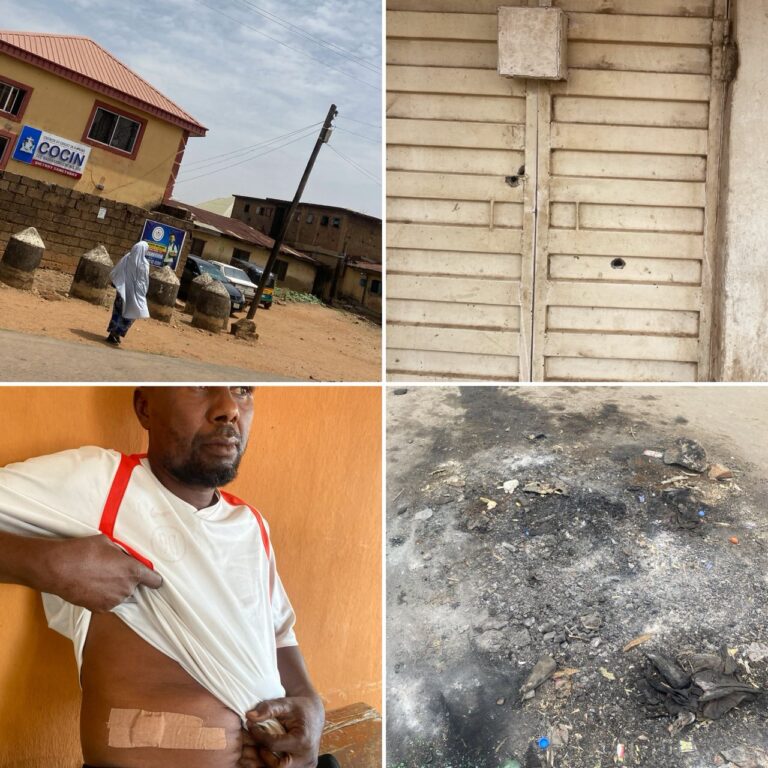
COCIN church damaged by irate youths of Duala and Nasarawa Gwom.
Sources from Angwan Rukubu said no death was recorded on their side, except for the Church of Christ in Nations (COCIN) at Duala Junction, which was attacked, and several members living in the church quarters who were beaten by Duala youths.
The ICIR made several attempts to speak with the affected staff, including visits to the host community, but those efforts were unsuccessful. Church members who promised to link the reporter with the victims said the affected persons had not yet returned to the quarters and could not be reached at the time of filing this report.
Beyond Angwa Rukuba, The ICIR identified two Christians – Stephen Joshua Dako and Adeyemo Temitope – who were attacked and killed along Bauchi road and opposite the University of Jos permanent site gate respectfully.
Father, son shot multiple times defending their home
For Abas Aliyu, the memory of a previous attack on his home was still fresh when gunfire erupted again in Angwa Rukuba junction on Wednesday, April. This time, he and his son would both leave with bullet wounds. He said they were lucky the bullets were shot from a local gun.
Abas Aliyu, with a hospital scan showing a bullet lodged in his ribs
Aliyu said he was inside his house at the junction, very close to Angwan Rukuba but falls within Duala, when he began to hear shouting from outside. The noise immediately reminded him of an earlier crisis during which part of his home was burned. Fearing a repeat, Aliyu stepped out to see what was happening.
Outside, he met his first son, Huwaiz, and a few others. Together, they moved across the road and stood in front of the house, trying to understand the situation and, as they would later explain, protect their property from being attacked again.
They were still standing guard when the shooting started.
“We were just standing there when the shooting started,” Aliyu said. “They shot me in my stomach and they shot my son in three places.”
Huwaiz Abas, said he was asleep when he heard the commotion. “I stepped out and stood in front of the house to defend it from being burned like last time,” he said, explaining that their home sits at a central point linking Angwa Rukuba and Duala junction.
While standing alongside his father, Abas said he heard a sharp pain in his hand, then leg. “I heard a gunshot and felt a sharp pain on my hand, then my leg, and then my thigh. I was shot three times,” he said.
Abas with three gunshots injury
Aliyu said the scene quickly turned chaotic as blood poured from his son’s wounds. “Blood was coming out from his mouth… everywhere,” he said. With no time to process what had happened, they fled the area in search of help.
They were eventually taken to Ola Hospital for initial treatment before being referred to Bingham hospital for further care. Days after the attack, Abas said he is still living with the pain.
While Aliyu and Abas might just have been unfortunate to have lived close to the area, some other victims participated in the unrest on that day.
Umar Yahaya said he was sitting at the junction when he saw a vigilante member being chased by Angwa Rukuba youths, who were beating, and stoning him. He said residents rushed in to rescue the victim and others caught in the violence.
Yahaya said the confrontation quickly turned chaotic, with multiple people sustaining injuries during the unrest. He added that he did not immediately realise he had been hit by a bullet until soldiers arrived and he was taken to the hospital, where he saw blood from his wound.
Youth corper killed by mob as violence spread
The Wednesday violence flared up as hoodlums attacked motorists and passers-by in other parts of the state capital. During the attacks, The ICIR confirmed that dozens of people were injured while a few were killed from both sides. Independent findings showed that the violence spilled into Bauchi Road, Gada Biu, and the University of Jos permanent site axis.
Youths were seen throwing stones at security personnel, who responded by firing into the air to disperse the crowd and restore calm. Reinforcement teams were later deployed to douse the tension. The most affected areas included the University of Jos axis, Bauchi Road, Farin Gada, Tina Junction, Chobe, and Farin Gada Junction.
As the unrest spread across these flashpoints, many residents found themselves trapped in sudden waves of violence that disrupted movement and forced people to flee for safety. It was within this wider chaos that a National Youth Service Corps (NYSC) member, Stephen Joshua Dakup, was caught while travelling through Jos on his way to Bauchi State.
Dakup’s obituary image
A family representative Julius Joshua told The ICIR that Stephen Joshua Dako, 29, was serving in Toro Local Government Area of Bauchi State and had been trying to return to his place of assignment, when he was caught up in the violence along Bauchi Road in Jos North.
According to him, Dakop was inside a commercial vehicle when it was intercepted by irate youths during the violence. The family source said another corps member in the same vehicle was also attacked as passengers were targeted indiscriminately. “He was crying, saying he is a corps member, but they did not listen,” the source said.
The family would later learn about his demise later that evening after an NYSC staff member contacted them. Subsequent checks at the Jos General Hospital and its mortuary indicated that bodies had been brought in from the unrest, including Stephen’s, though the total number of casualties from the specific attack remained unclear.
Father mourns 25-year-old son killed in Gada-Biu
Ahmed Mohammed, a 60-year-old father of seven, sat with his kinsmen against a sun-baked wall on Friday, April 3, when The ICIR met him at his home in Kwanan Shagari. His eyes were swollen from hours of crying after losing his son, AbdulBasi on Wednesday, April 1.
At several points, he paused, wiping his tears with the edge of his garment, but the tears did not stop. The pain was too much for Mohammed to bear, and he could only ask what his boy’s fault was to be killed in such a cold-blooded manner.
Ahmed Mohammed mourning his late son among in front of his house
Abdul Basi had set out on Wednesday like any other day to carry on with his transport business. He rode his tricycle and conveyed passengers along the route toward Duala. But he never made it past Gada Biyu.
According to his father, the attack happened in Gada Biyu where they attacked and hit him with an axe. “The ladies jumped from the motorcycle when they saw what was happening.” He said police officers later arrived at the scene and rushed his son to a hospital.
Ahmed said before his people got to the hospital, his son was already dead. AbdulBasi’s tricycle was also burnt after his killing.
He added that despite reporting the incident and submitting details to the police, no authority has reached out to the family.
Authorities say investigation ongoing
The Nigeria authorities have said that investigations into the killings are ongoing, with the Federal Government directing security agencies to identify and apprehend those responsible for the Angwan Rukuba attack.
On Tuesday, April 1, the Minister of Information and National Orientation Mohammed Idris, described the attack as “tragic” and said there would be no safe haven for those behind it.
According to him, ongoing security operations in Plateau State are already generating actionable intelligence, with assurances that perpetrators would be brought to justice.
The government said troops had been deployed under Operation Enduring Peace, with security forces conducting search-and-clearance operations, securing key routes, and intensifying surveillance across affected areas.
MTN Group, in partnership with the University of Johannesburg (UJ) and the African Editors Forum (TAEF), seek entries to the Pan-African Media Innovation Programme (MIP), a continental initiative to equip journalists with the skills, tools, and networks required to navigate a rapidly changing information environment.
Launched by MTN Group in partnership with the University of Johannesburg (UJ) and the African Editors Forum (TAEF), the programme builds on the success of the MTN Nigeria MIP and expands it across MTN’s footprint.
MIP will offer a certified 12‑week curriculum that blends online academic learning with immersive, in‑person engagement in Johannesburg. Fellows explore digital transformation, media sustainability, ethics and law, entrepreneurship, and the influence of emerging technologies on Africa’s information ecosystems.
Applications are open to mid- to senior-level journalists, editors and media practitioners from MTN markets.
The deadline for applications is April 30, 2026. Interested applicants can apply here.