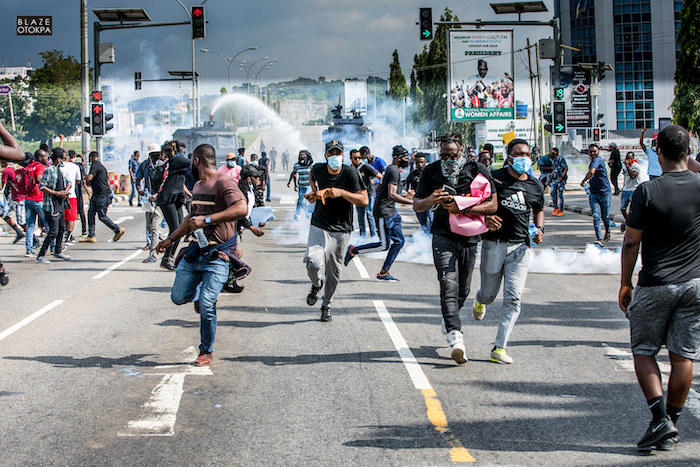
THE United Nations (UN) says preliminary data indicates that 950 human rights defenders, journalists and trade unionists were killed or forcibly disappeared worldwide in 2025.
This was contained in the latest global dataset documenting attacks on rights defenders titled, “Human Rights Count”, published by the Office of the High Commissioner for Human Rights (OHCHR).
According to the data, one human rights defender, journalist or trade unionist is killed or disappears every 10 hours.
Projected totals for 2025 indicate that at least 743 defenders were killed and 202 disappeared, with no sign of reversal in the upward trend.
OHCHR said civilian deaths in armed conflict documented by UN Human Rights continued at alarming levels.
At least 37,163 civilians lost their lives in 2025, from a record high of 48,011 in the preceding year.
OHCHR lamented that violence against human rights defenders had reached record levels, with at least 5,995 killed since 2015.
The UN human rights office said the number of human rights defenders who were murdered or disappeared in 2025 was more than double the number a decade ago.
OHCHR regretted a surge in attacks on defenders, civilian deaths in conflicts, patterns of discrimination worldwide and the state of institutions tasked with protecting universal human rights.
According to the UN High Commissioner for Human Rights Volker Türk, behind every data point is a real life lived — or lost”.
“These new global human rights data show that discrimination, violence and exclusion are systemic and continue to affect those already at the margins.”
In January this year, The ICIRreported the Media Rights Agenda warning against persistent attack on journalists in Nigeria. The organisation described the menace as one of the biggest threats to media freedom.
The organisation said the failure to punish attacks on journalists and citizens emboldened perpetrators and pushed many journalists into fear and self-censorship.
In addition to journalists, activists and labour unionists have persistently come under attacks, orchestrated by state actors in Nigeria.
THE killing of senior Nigerian military officers on the frontlines of the country’s counter-insurgency war highlights the risks borne by troops battling Boko Haram and the Islamic State West Africa Province (ISWAP). Despite over a decade of sustained military operations, these terrorist groups continue to exact a heavy toll, claiming not only the lives of rank-and-file soldiers but also the nation’s most decorated commanders
For over a decade, insurgency and terrorism in various parts of Nigeria have claimed the lives of some of the military’s most experienced commanders. Many were killed in ambushes while leading soldiers to repel attacks in the North-East.
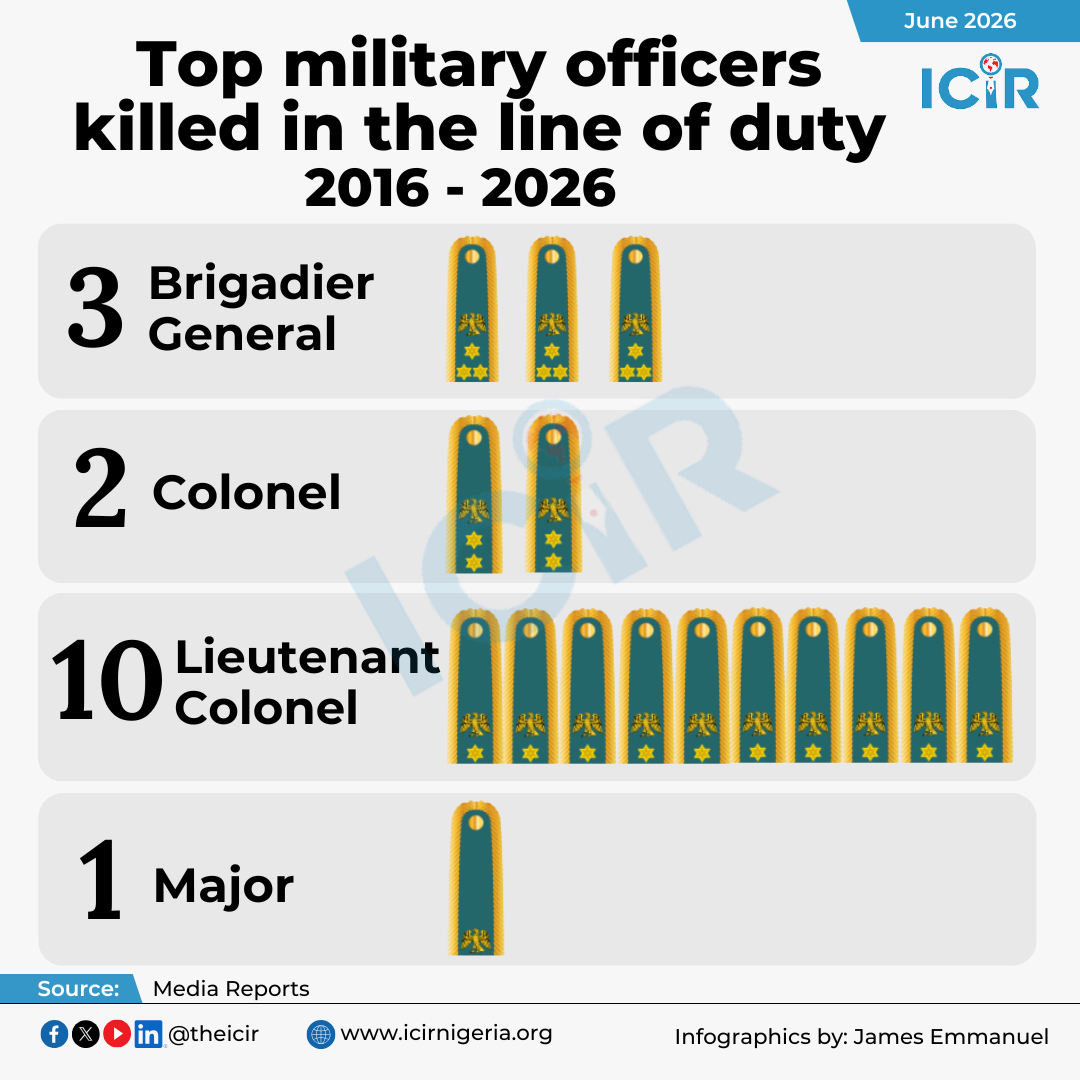
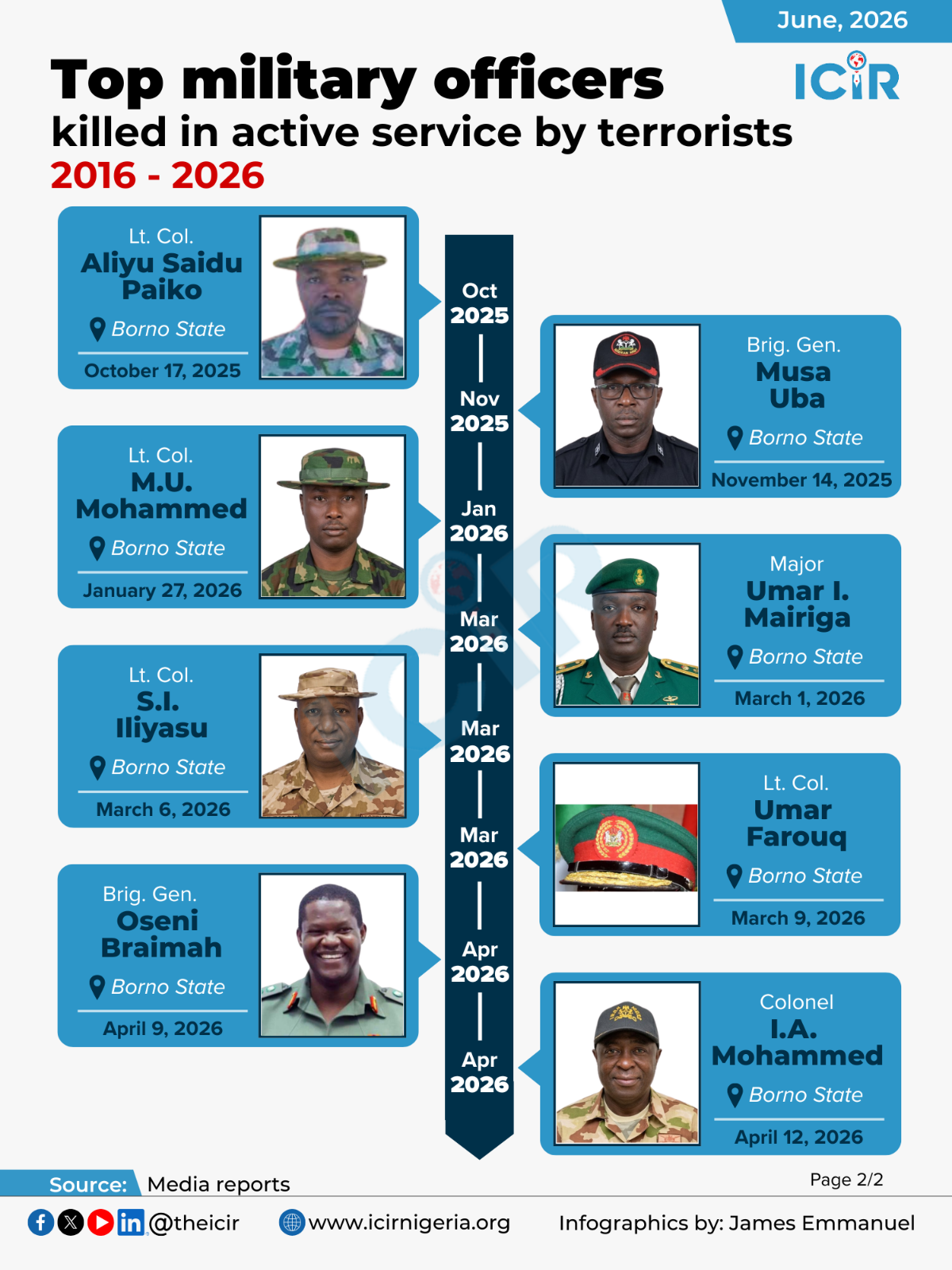
Between October 2016 and April 2026, at least 16 senior officers, including three brigadier generals, two colonels, 10 lieutenant colonels and a major, have been killed in the line of duty. Most of these killings occurred in Borno State, where troops continue to confront recurring attacks on military bases and formations.
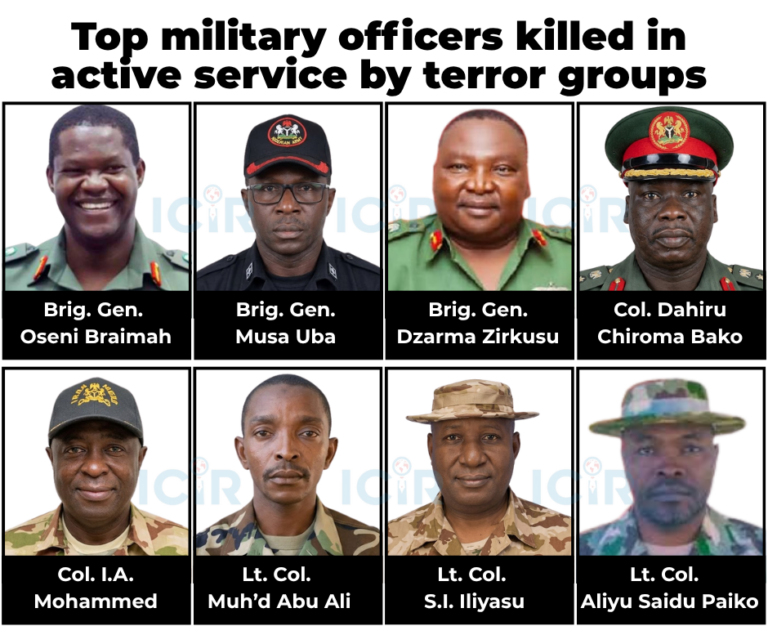
The recent killings of Oseni Braimah, Brigadier General and I.A. Mohammed, a Colonel in April, once again drew attention to the heavy toll of the conflict on the military’s leadership.
Top Military Officers killed in the line of duty by their ranks.
An analysis of the killings show that Borno State accounted for almost all the deaths, cementing the state’s position as the centre of Nigeria’s counter-insurgency operations.
Of the 16 officers listed, 15 were killed in Borno, while only M.Z. Manu, Lieutenant Colonel, was killed outside the North-East, in Katsina State.
By April 10 2026, The ICIR reported that Boko Haram factions have attacked at least eight Nigerian military bases since the beginning of the year. A data analysis of confirmed incidents between January and early April 2026 revealed the attacks as part of ISWAP’s so-called “Burning of the Camps” campaign; an ongoing offensive that began in February 2025 and has focused on military bases across the Lake Chad Basin.
Since its launch, the campaign has reportedly extended beyond Nigeria, with military formations in Niger and Cameroon also coming under attack.
Beyond that, a recent review by The ICIR documented how in the past eight years, 10 retired senior military officers including a former Chief of Defence Staff, major generals, brigadier generals, colonels and an air vice marshal have been abducted or killed in violent attacks linked to these broader insecurity crisis.
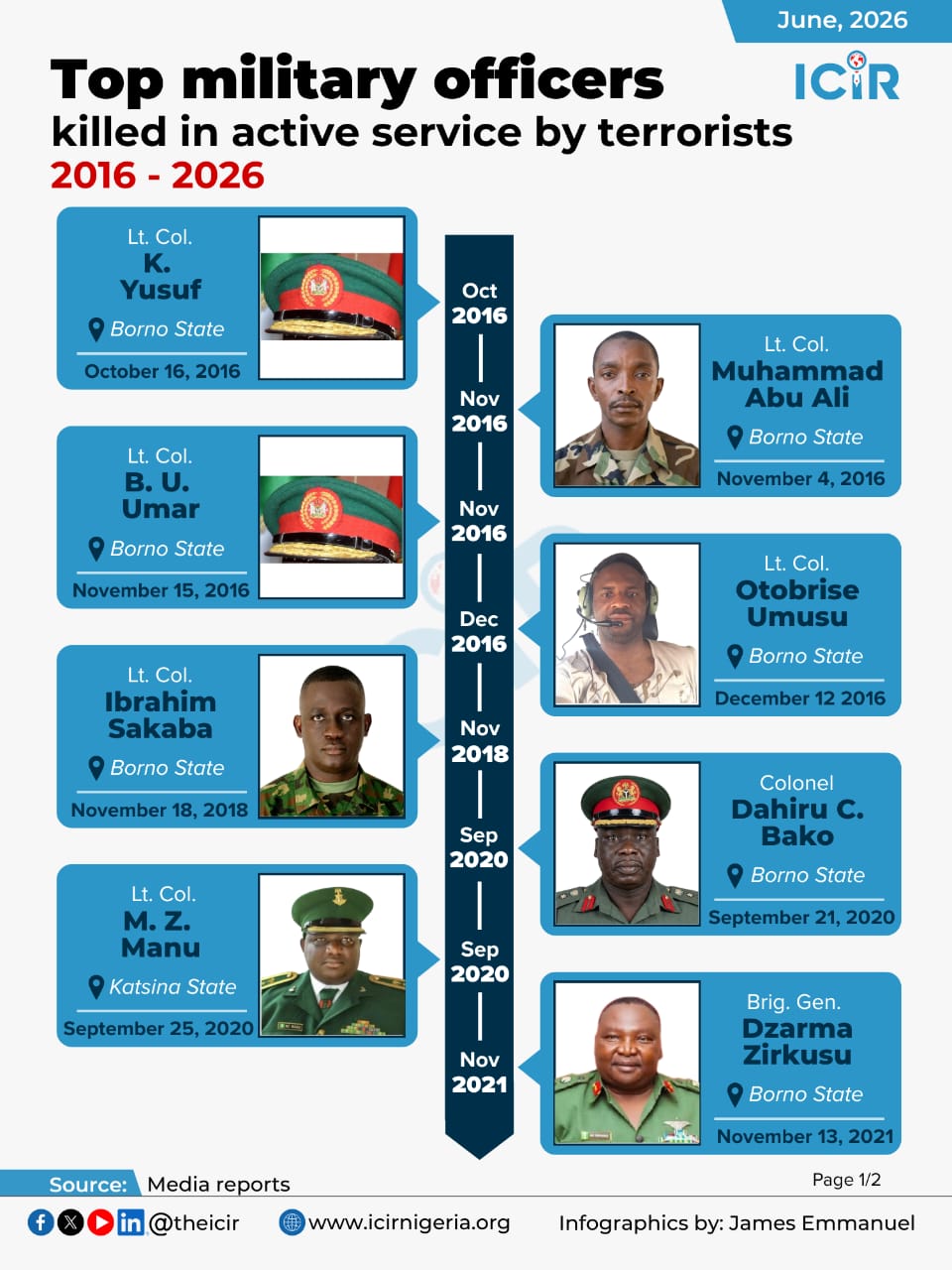
Meanwhile, below is a timeline of some of the most notable cases of active military officers killed by terrorists.
October 16, 2016: Lieutenant Colonel K. Yusuf
Lieutenant Colonel K. Yusuf was among the earliest senior military officers killed during the intensified phase of the war against Boko Haram.
Yusuf and his 15 foot soldiers were declared missing in action on October 16, 2016 after Boko Haram fighters dislodged them from their station in Gashiga.
It was unclear when the soldiers were killed but their bodies were recovered three months later after troops conducted clearance operations and dislodged some Boko Haram elements at Asaga village along Kamadugou river line in Borno State.
November 4, 2016: Lieutenant Colonel Muhammad Abu Ali
On November 4, 2016, the military again suffered one of its most painful losses with the death of Muhammad Abu Ali, a Lieutenant Colonel.
Abu Ali, commander of the 272 Task Force Battalion, was killed during an ambush by Boko Haram fighters around Mallam Fatori, close to Nigeria’s border with Niger Republic. Five soldiers were also killed in the attack.
Widely regarded as one of the army’s most courageous field commanders, Abu Ali had led several successful operations against Boko Haram.
infographic on top Military Officers killed since 2016
November 15, 2016: Lieutenant Colonel B.U. Umar
Eleven days after Abu Ali’s death, another senior officer, B.U. Umar, Lieutenant Colonel, was killed in an insurgent ambush in Borno State.
Reports have it that the commanding officer of 114 TF battalion of the Nigerian Army was ambushed alongside his troops on a Monday morning between Bita and Piridang.
According to the reports, the army officer’s vehicle stepped on an improvised explosive device, IED, but he was not hurt. However, as he came out of the vehicle to assess the level of damage, the terrorists fired and killed him in the process.
December 12, 2016: Lieutenant Colonel Otobrise Umusu
The military suffered yet another loss when Lieutenant Colonel Otobrise Umusu was killedby an Improvised Explosive Device (IED) in an ambush on Monday, December 12, 2016 on his way to Baga in Borno State.
Umusu, a Lieutenant Colonel and Commanding Officer, 118 Task Force Battalion in Borno State, was killed alongside his security details
His death meant that four lieutenant colonels had been killed within two months.
November 18, 2018: Lieutenant Colonel Ibrahim Sakaba
Two years later, Ibrahim Sakaba, a Lieutenant Colonel and Commanding Officer of the 145 Battalion, was killed during the notorious attack on the military base in Metele, Borno State.
The assault, carried out by Boko Haram fighters, was one of the deadliest attacks against the Nigerian military during the insurgency. Scores of soldiers were killed, military equipment were destroyed and surviving troops were forced to retreat.
According to reports, Sakaba died alongside at least 117 of his soldiers following a catastrophic invasion of their base on November 18.
September 21, 2020: Colonel Dahiru Chiroma Bako
Dahiru Bako, Colonel and commander of the 25 Task Force Brigade in Damboa, died from injuries sustained during a fierce battle with Boko Haram fighters.
Bako died 24 hours after sustaining injury in an ambush by Boko Haram in Wajirko village of Damboa Local Government Area of Borno State.His death was widely mourned within military circles because of his reputation as an experienced and fearless commander.
According to reports, Bako led his troops to liberate communities such as Damaturu, Gujba, Alagarno, Gulani, as well as Dulsa, Buk, Mainyakare Dambo. He also liberated Mina, Gulumba, Gana, and Kumshe in Borno. He reportedly rescued thousands of women and children.
September 25, 2020: Lieutenant Colonel M.Z. Manu
Just four days after Bako’s death, M.Z. Manu, Lieutenant Colonel, was killed following an ambush by armed bandits in Katsina State.
Unlike most of the other officers, Manu lost his life in Nigeria’s North-West, where security forces were battling armed bandits and criminal gangs.
His death reflected the growing security crisis spreading beyond the North-East to other parts of the country.
November 13, 2021: Brigadier General Dzarma Zirkusu
One of the highest-ranking officers killed during the counter-insurgency was Brigadier General Dzarma Zirkusu.
The commander of the 28 Task Force Brigade died alongside three soldiers after insurgents attacked troops in Askira-Uba Local Government Area of Borno State.
Reports indicated that he was responding to a distress call from troops when his convoy was ambushed.
Infographic of top of Military Officers killed since 2016
October 17, 2025: Lieutenant Colonel Aliyu Saidu Paiko
In 2025, the military again suffered a major loss when Aliyu Saidu Paiko, a Lieutenant Colonel, was killed in an ambush in Kashimri area of Bama Local Government Area of Borno State.
Paiko, commanding officer of the 202 Tank Battalion, was leading troops on an operational patrol when insurgents attacked. Several soldiers were also killed during the encounter.
November 14, 2025: Brigadier General Musa Uba
Less than a month later, Musa Uba, Brigadier General, was killed in another insurgent attack in Borno State. Uba was the commander of the 25 Task Force Brigade in Damboa local government area of Borno State.
Uba was captured and then killed during active engagement with the insurgents.
January 27, 2026: Lieutenant Colonel Mohammed
Lieutenant Colonel I.A. Mohammed, who was then recently promoted, was killed alongside several soldiers after an Improvised Explosive Device (IED), suspected to have been planted by insurgents, detonated in Monguno Local Government Area of Borno State.
He was said to be leading a reinforcement mission to support troops who had come under attack the previous night when the explosion occurred.
March 1, 2026: Major Umar Ibrahim Mairiga
Umar Ibrahim Mairiga, a Major, was killed during military operations in Borno State.
He was killed alongside three soldiers and a hunter when terrorists carried out a deadly attack on the Forward Operations Base, a military position in Mayanti, Bama LGA, Borno State.
His death came amid a surge in attacks on military positions across several parts of northern Borno.
March 6, 2026: Lieutenant Colonel S.I. Iliyasu
Five days after Mairiga’s death, S.I. Iliyasu, Lieutenant Colonel and the Commanding Officer of the 222 Battalion in Konduga was killed while participating in operations against insurgents.
According to the Army, the attacks occurred when remnants of Boko Haram terrorists, previously dislodged from the Sambisa Forest during sustained military offensives, regrouped and launched coordinated night assaults from multiple directions.
March 9, 2026: Lieutenant Colonel Umar Farouq
The string of losses continued when Umar Farouq, Lieutenant Colonel, was killed during operation on March 9, 2026 in Borno.
He succumbed to wounds sustained during an early-morning attack on a military base in Kukawa Local Government Area in Borno State.
His death brought to three the number of senior officers lost within just nine days.
April 9, 2026: Brigadier General Oseni Braimah
The military suffered another major blow when Oseni Omoh Braimah, a Brigadier General and Commander of the 29 Task Force Brigade in Benisheikh, Borno State was killed.
Reports indicated that heavily armed insurgents had launched a coordinated attack on a military base, forcing troops into intense combat.
Braimah was among the casualties recorded during the battle. His death made him the second brigadier general killed by insurgents within five months and the third in the counter-insurgency war between 2016 to date.
April 12, 2026: Colonel I.A. Mohammed
Just days after Braimah’s death, I.A. Mohammed, a Colonel and Commanding Officer of the 242 Battalion, was killed while leading reinforcement troops to an embattled military base in the Monguno area of Borno State.
According to military reports, insurgents ambushed the reinforcement convoy using improvised explosive devices and heavy gunfire. The attack killed the colonel and six soldiers.
Former Nigerian Minister of Petroleum Resources, Diezani Alison-Madueke, has been acquitted of all six bribery charges by a London jury, bringing to an end one of the United Kingdom’s most high-profile foreign corruption trials after more than a decade of investigations.
According to Reuters, the verdict, delivered on Wednesday at Southwark Crown Court, marks a significant setback for British prosecutors and the National Crime Agency (NCA), which launched its investigation into the former minister over allegations that she accepted lavish benefits from oil and gas executives seeking lucrative contracts in Nigeria.
Alison-Madueke, 65, who served as Nigeria’s petroleum minister from 2010 to 2015 under former President Goodluck Jonathan, had been charged with five counts of accepting bribes and one count of conspiracy to commit bribery.
Prosecutors alleged that the former minister enjoyed a life of luxury in London, with private jet flights, luxury accommodation, expensive gifts and other benefits allegedly funded by businessmen hoping to secure favourable treatment in Nigeria’s oil sector.
However, Alison-Madueke consistently denied any wrongdoing, maintaining that she never accepted bribes and did not exercise direct control over the award of oil contracts.
During the months-long trial, her defence argued that many of the expenses highlighted by prosecutors were either reimbursed by the Nigerian government for official duties or personally repaid by Alison-Madueke.
She also described herself in court as “Madame Due Process,” insisting that she was known for promoting transparency in Nigeria’s petroleum industry.
After more than 46 hours of deliberation, the jury returned unanimous not guilty verdicts on all counts.
The ICIR reports that the allegations she was cleared of in the UK court differed from those previously made by the United State Department of Justice, which in a 2017 civil forfeiture case alleged that she used her official influence to steer valuable oil contracts to executives who allegedly paid her bribes and laundered proceeds through the United States.
Those allegations were not part of the criminal proceedings heard in the UK.
In a statement following the judgment, Alison-Madueke’s legal team said the former minister was grateful to the jury after enduring the ordeal of being separated from her family for over 11 years.
“She is finally allowed to resume her private and public life with her reputation restored and enhanced,” the statement read in part.
The London jury also cleared 54-year-old oil industry executive, Olatimbo Ayinde, Alison-Madueke’s co-defendant who faced one count of bribery and another count of bribing a foreign public official.
Her 69-year-old brother, Doye Agama, who had been charged with conspiracy to commit bribery over payments allegedly made to his church, was likewise acquitted.
Both men had denied all allegations throughout the trial.
Alison-Madueke has remained one of Nigeria’s most controversial public officials since leaving office in 2015 following the defeat of President Goodluck Jonathan’s administration.
During and after her tenure, she faced numerous investigations in Nigeria, the United Kingdom and the United States over allegations of corruption linked to the management of Nigeria’s oil industry.
The former minister also served briefly as president of the Organization of the Petroleum Exporting Countries (OPEC), becoming the first woman to lead the influential oil producers’ group.
According to Reuters, the acquittal represents a significant legal victory for Alison-Madueke and a notable setback for British authorities, whose investigation had become one of the UK’s most prominent international anti-corruption cases.
The verdict, however, does not erase years of corruption allegations that have surrounded the former minister in multiple jurisdictions, nor does it affect separate civil asset recovery efforts pursued by authorities outside the United Kingdom.
A DUTSE Magistrates’ Court in Abuja on Wednesday ordered that a 28-year-old National Youth Service Corps (NYSC) member, Akintade David, should be remanded in police custody for allegedly assaulting his neighbour.
The police charged David who lives in FHA, Kubwa, Abuja with criminal force, assault and theft.
The defendant however pleaded not guilty to the charge. Senior Magisterate Maryam Alhaji adjourned the matter until July 21 for further hearing.
Earlier, the prosecution counsel, Babajide Olanipekun, told the court that on September 30, 2025, one Hauwa Isah reported the matter at the Kubwa police station Abuja.
Olanipekun said on June 11,2025, an altercation ensued between Isah and David who are both tenants in the same compound over the removal of a public tap.
He said that the defendant called a plumber to remove the tap, saying stagnant water from the tap was causing an offensive odour in his bathroom.
Babajide explained that during the altercation, David allegedly threatened to harm Isah.
The police alleged that the defendant also assaulted Isah and her baby on September 30, 2025, after another altercation.
He said that during the assault, a gold necklace worth N1.5 million belonging to Isah was allegedly yanked off from her neck and stolen by the defendant.
Babajide said that prior to this incident, the police had been called over other altercations between the defendant and Isah.
According to the prosecutor, the defendant was once asked to sign a letter of undertaking by the police promising never to come close to the claimant.
The prosecutor also said that during police investigation and interrogation, the defendant could not give a satisfactory account of his actions.
He stated that the offence contravened the provisions of sections 265 and 288 of the Penal code. (NAN)
THE Kwara Government has instituted a criminal defamation suit at the state High Court against former Senate President, Bukola Saraki.
The former Senate president, a doctor and former governor of the state, is charged with making defamatory statements against Governor AbdulRahman AbdulRazaq.
The charge was filed by the Attorney-General and Commissioner for Justice, Ibrahim Sulyman, the Director of Public Prosecutions (DPP), Ayoola Akande, and Assistant Chief State Counsel, B.L. Abdulsalam.
According to the charge sheet, Saraki was accused of publishing and sharing a statement on social media platforms including Facebook, X and in newspapers on or about April 17, 2026, alleging that AbdulRazaq did not possess secondary school education qualifications.
The government alleged that the statement was false and was intentionally published using insulting, derogatory and abusive language aimed at provoking the governor and the state government.
The prosecution further stated that the publication was capable of causing a breakdown of public peace, contrary to Section 399 of the Penal Code, Cap. P4, Laws of Kwara 2006.
At the court sitting on Wednesday, prosecution counsel, R.O. Balogun, informed the court that the matter was scheduled for arraignment and urged the court to issue a bench warrant against Saraki for failing to appear in court.
Balogun said that the defendant had been duly served and that his counsel’s presence in court indicated his awareness of the proceedings.
“The defendant’s counsel is in court appearing for him and he should be here. We are the prosecution and should be allowed to proceed. There is no valid reason given for his absence.
“We therefore pray the court to issue a bench warrant against him in line with Section 138,” he submitted.
However, counsel to the defendant, Jimoh Mumini, a senior advocate, challenged the jurisdiction of the court, arguing that the matter fell within the jurisdiction of the Federal High Court rather than the State High Court.
He also questioned the service of the charge on his client, insisting that Saraki had not been properly served.
Following a two-hour recess to consider the submissions of both parties on the preliminary objection and request for adjournment, the trial judge, M.O. Folorunso, ruled that the defendant was entitled to seek an adjournment.
The court subsequently adjourned the matter until July 3, for hearing of the preliminary objection and possible arraignment of the defendant. (NAN)
THE Court of Appeal in Abuja has struck out a fresh appeal by the National Broadcasting Commission (NBC) seeking to overturn a Federal High Court judgment restraining it from imposing fines on broadcast stations.
The decision, delivered by a three-member panel of the appellate court, also aligns with an earlier ruling reported on April 3, 2026, in which the Court of Appeal dismissed a similar NBC appeal and affirmed that regulatory agencies could not impose punitive fines on broadcasters.
A statement by the Media Rights Agenda on the ruling noted that the court, in the latest judgment, held that NBC’s Notice of Appeal was “fundamentally defective.” It further described the notice as incompetent, stripping the court of jurisdiction to hear the case.
The appeal arose from a January 17, 2024, judgment of the Federal High Court in Abuja, delivered by a judge, Rita Ofili-Ajumogobia. The court had declared as unlawful the NBC’s imposition of ₦5 million fines each on several broadcast stations over documentaries on banditry and insecurity in Zamfara State.
The affected media organisations included Multichoice Nigeria Limited (DSTV), TelCom Satellite Limited (TSTV), Trust-TV Network Limited, and NTA-Startimes Limited. The court had held that the sanctions violated constitutional guarantees of freedom of expression, particularly the right to receive and impart information under Section 39 of the 1999 Constitution and Article 9 of the African Charter on Human and Peoples’ Rights.
“In her judgment, Justice Ofili-Ajumogobia held that the NBC’s act of imposing fines of ₦5 million each on Multichoice Nigeria Limited, owners of DSTV; TelCom Satellite Limited (TSTV); Trust-TV Network Limited; and NTA Startimes Limited, was unlawful and unconstitutional, and constituted a violation of the rights of MRA, its members, and other citizens of Nigeria to freedom of expression, particularly their rights to receive ideas and information without interference, as guaranteed by Section 39 of the Constitution and Article 9 of the African Charter on Human and People’s Rights,” a statement by the MRA read in part.
It therefore struck out the appeal, holding that there was “no appeal in fact and in law before this court.”
The ICIR reports that the ruling followed an earlier judgment in a separate case, where the Court of Appeal upheld a May 2023 Federal High Court judgment delivered by James Omotosho.
In that decision, the court, on April 3, 2026, held that only courts of law, not regulatory agencies, have the authority to impose fines for alleged criminal offences.
Omotosho had set aside fines previously imposed by the NBC on 45 broadcast stations for alleged breaches of the Nigeria Broadcasting Code, ruling that the Commission “is neither a court nor a judicial tribunal” and therefore could not determine criminal liability.
Dissatisfied with those rulings, the NBC pursued appeals at the appellate court. However, delivering the lead judgment, Oyejoju Oyewumi, a judge, upheld MRA’s arguments, ruling that the NBC’s appeal lacked merit.
She held that having failed to challenge the case at the Federal High Court, the commission could not raise issues at the appellate stage.
The ICIR reports that with the latest ruling MRA has secured victory in the two separate appeals involving the NBC over similar judgments of the Federal High Court restraining the commission from imposing fines on broadcast stations.
AN investigation by the International Centre for Investigative Reporting (ICIR) and FactCheckHub has been named a finalist in the Gold Standard category of the 2026 Global Fact-Checking Awards organised by the International Fact-Checking Network (IFCN).
The investigation, titled “AI-assisted Ponzi schemes: How Meta, YouTube’s regulatory lapses enable scammers smile to banks,” was selected among the top three entries globally in the category, which recognises fact-checking journalism that demonstrates the highest standards of research, verification, transparency, fairness, and public service.
Announcing the finalists on June 11, the IFCN described the Nigerian investigation as a report that exposed AI-assisted Ponzi schemes that caused direct financial harm to vulnerable audiences while revealing enforcement failures by major technology platforms.
“Some scams promised a 100 per cent return on investment in just 30 days. The research uncovered scam funnels, fake endorsements, platform gaps and real-world consequences,” the IFCN stated.
The investigation was produced by The ICIR in collaboration with FactCheckHub, an IFCN signatory, with support from the Pulitzer Center.
Conducted by fact-checker and investigative journalist Nurudeen Akewushola, the report examined how fraudsters are increasingly exploiting artificial intelligence to rebrand traditional Ponzi schemes and lure unsuspecting Nigerians with promises of automated wealth and AI-powered trading profits.
Using undercover reporting, open-source intelligence (OSINT), and digital forensic techniques, the investigation uncovered how operators behind platforms such as CBEX, Quantum AI, SquaredOptions, and Modmount Limited used AI-generated videos, deepfake endorsements, cloned voices, fabricated identities, and aggressive social media advertising to create false credibility.
The investigation also revealed that many of the platforms were not licensed by regulators and that scam advertisements continued to circulate on major social media platforms despite policies prohibiting deceptive financial promotions and manipulated media.
Following the publication, Meta removed several fraudulent pages, accounts, and advertisements identified in the report.
ICIR/FactCheckHub will compete for the Gold Standard award alongside investigations by ARIJ of Jordan and Faktisk.no of Norway.
ARIJ’s shortlisted investigation examined social media disinformation campaigns promoting climate change conspiracy theories and linked them to oil interests in Gulf countries. Similarly, Faktisk.no’s investigation uncovered a network of fake Facebook profiles, far-right actors, and pro-Russian accounts that manipulated public debate around school closures in Norway.
The winners of the 2026 Global Fact-Checking Awards will be announced during GlobalFact 2026, the IFCN’s annual conference, taking place in Vilnius, Lithuania, from June 17 to June 19.
The Global Fact-Checking Awards recognise outstanding factchecking and misinformation journalism from around the world, honouring work that advances accountability, verification, innovation, collaboration, and public trust.
JOURNALISTS worldwide can now apply for funding from the Tarbell Center for AI Journalism, offering grants of $1,000 to $20,000 to support original reporting projects focused on artificial intelligence and its societal impacts.
The grants are open to both freelancers and staff journalists, with funding available for written journalism as well as other reporting formats.
The programme aims to strengthen independent journalism that scrutinises AI companies, explores the technology’s effects on society, and helps the public understand the rapid developments shaping the future of artificial intelligence.
For the current funding round, the Tarbell Center is seeking proposals in six key areas namely accountability reporting on frontier AI companies, AI policy and politics, AI explainers and analysis, AI use in governments and militaries, AI’s impact on labour and employment, and AI developments in China.
Applicants do not need to have an outlet secured before applying, although projects intended for established and influential publications are preferred. J
ournalists with investigative reporting experience are particularly encouraged to apply. A background in AI or technology reporting is desirable but not mandatory.
Applications for the current grant round close on July 12, 2026. The Tarbell Center says it aims to evaluate submissions within four weeks of the deadline.
Interested journalists can learn more and submit their applications here.
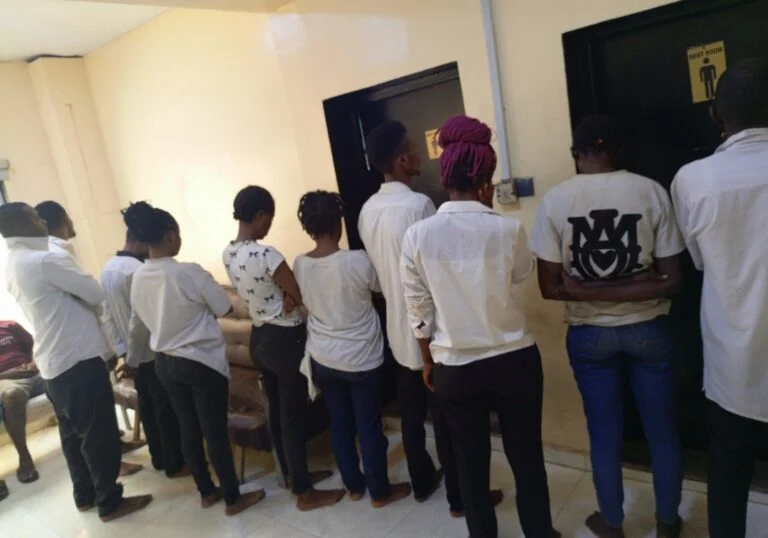
THE Lagos State Police Command has apprehended 10 members of a syndicate for allegedly defrauding unsuspecting victims of millions of naira.
The News Agency of Nigeria (NAN) gathered that the suspects allegedly lured fellow Cameroonians to Nigeria with promises of securing visas, work permits and residency documents for destinations such as Mauritius, Canada, the United Kingdom and the United States.
Victims were made to pay huge sums of money for the purported travel arrangements, which never materialised.
NAN further gathered that several of the suspects lacked valid passports and visas, raising questions about how they entered Nigeria.
The state Commissioner of Police, Fatai Tijani, directed that the case be transferred from the Egbeda Tactical Unit to the State Criminal Investigation Department (SCID), Yaba, for further investigation.
The investigation into the allegations of conspiracy, fraud and human trafficking is being handled by the Human Rights Unit of the SCID under the supervision of the Deputy Commissioner of Police in charge of the department, Dayo Akinbisehin.
A police source told NAN on Wednesday that the syndicate, comprising five males and five females, operated under the guise of a networking business, but investigations suggest that their real ‘product’ was recruiting and exploiting people.
“The suspects allegedly used social media to deceive prospective victims by staging photographs and videos in luxurious environments, including airports, to create the false impression that members had successfully relocated abroad.
“Victims were coached on what to tell their families and friends in order to recruit more people into the scheme,” the source said.
One of the victims told NAN that she was lured by a friend who claimed to be living and working in Mauritius and paid 800,000 CFA francs (about N2 million) for travel documents and relocation.
She alleged that upon arriving in Lagos, she discovered that instead of processing her travel documents, she had been recruited into a networking scheme at a resident in Epe area of the state.
The victim further alleged that members’ phones and documents were confiscated, while they were taken to airports and tourist sites to take photographs and videos that falsely portrayed them as living abroad.
She said members were monitored while communicating with their families and coached on what to say to convince others to join the scheme.
According to her, she was denied a refund when she requested to return home and was asked to recruit another person before she could recover her money.
She added that her cousin was later convinced to pay another 800,000 CFA francs after being led to believe she had successfully relocated overseas.
Similarly, another victim said she paid about 1.5 million CFA francs, equivalent to about N3.5 million, for travel documents.
Upon arriving in Lagos, she discovered that instead of processing her travel documents, the suspects introduced her to the networking business and trained participants on strategies for recruiting more people.
The police source said the suspects would be charged in court upon the conclusion of investigations. (NAN)
THE Joint Admissions and Matriculation Board (JAMB) says the 2026 Unified Tertiary Matriculation Examination (UTME) Original Result Slip will be available for printing on Wednesday.
JAMB’s Public Communication Adviser, Dr Fabian Benjamin, disclosed this in a statement in Abuja.
Benjamin explained that the original result slip contained candidates’ photographs, national rankings and other security features designed to enhance its authenticity and acceptance for official purposes.
According to him, the document is among the official requirements for post-UTME screening and admission consideration by tertiary institutions.
He advised candidates to print the slip from any internet-enabled device or accredited business centre.
The spokesman also urged candidates to verify all details on the slip immediately after printing and keep a copy for future admission-related purposes.
The ICIR reports that a 16-year-old candidate, Owoeye Jesudunsin, emerged as the overall top scorer in the 2026 UTME, scoring 372 marks.
The result was in a list of top-performing candidates announced by JAMB during the 2026 Policy Meeting on Admissions to Tertiary Institutions in Abuja in May.
Owoeye, who sat for the examination in Ogun State but hails from Ekiti State, chose the University of Lagos (University of Lagos) to study Medicine and Surgery (MBBS).
The ICIR reports that 2,243,816 candidates registered for the 2026 UTME, representing a 10.5 per cent increase when compared with those who registered to write the examination in 2025.
Lagos State recorded the highest number of registrations for the 2026 edition with 381,814 candidates, followed by Ogun (137,156), Oyo (122,662), Kaduna (103,498), and the Federal Capital Territory (102,961).
Outside Nigeria, candidates also registered from Côte d’Ivoire, Equatorial Guinea, Burkina Faso, the United Kingdom, Ghana, Gambia, and South Africa, though in small numbers.
The 2026 UTME was conducted across about 966 Computer-Based Test centres nationwide, with examinations split into four daily sessions to ease congestion and improve monitoring.