Home Blog Page 508

NNPCL’s forward sales hit N3.89trn amid local refineries’ crude lack

THE Nigerian National Petroleum Company Limited’s (NNPCL) contract liabilities for crude oil supply to foreign creditors currently rose to N3.89 trillion amid the struggles by domestic refineries to access feedstock.

The Dangote Refinery has been making efforts to start getting crude oil supply locally but that has yet to materialise, despite the federal government’s directives.

The struggle has seen the management of the Dangote Refinery raising outbursts against the regulatory authorities in the oil and gas sector and accusing the international oil companies of frustrating their effort to start lifting crude to serve the company’s 650,000-capacity nameplate refinery.

Although President Bola Tinubu had intervened, the indigenous refinery’s hope of getting crude oil from the home-soul has been shifted till October.

While the Dangote Refinery and others keep hope alive, the NNPCL 2023 audited financial statements released on Tuesday, August 20, show that the state-owned oil company currently owes N3.89 trillion in crude oil forward sale agreements to foreign creditors.

The contract liabilities surged by 34.44 per cent compared to N2.89 trillion it was in December 2022.

Analysis of the financial statements by The ICIR shows that the contract obligation arose from forward sale agreements, the sale of natural gas, and other contract liabilities.

The report indicated that forward sale agreements stood at N3.37 trillion, the sale of natural gas at N17.30 billion, and other contract liabilities at N498.32 billion.

It further reveals that N3.24 trillion represents non-current contract liabilities and N648.61 billion current contract liabilities.

The above were the “contract liabilities that the group currently has,” NNPCL stated.

A contract liability arises when an entity (in this case, NNPCL) has invoiced a customer or customers and received payment in advance but has not yet supplied the crude for which it invoiced the customers.

Also, non-current liabilities are the debts a business owes but are to be paid after  12 months, while current liabilities are debts expected to be paid within a financial year.

Over the years, there have been concerns about the NNPCL’s quest for continued crude-oil-backed loans amid the country’s struggles to meet the Organisation of Petroleum Producing Company of Nigeria’ (OPEC) quota.

A recent conversation was the $2 billion loan, backed by crude oil, the NNPCL was negotiating to enhance its finances and support production.

The deal puts the NNPCL to commit between 30,000 to 35,000 barrels per day repayment option.

Already, the NNPCL has a $3.3 billion oil-backed loan through the African Export-Import Bank (Afreximbank), which it secured on August 16, 2023.

The emergency crude repayment loan was to support the naira and stabilise the country’s foreign exchange market.

To repay the loan, the NNPCL is to carry out a forward sale of 90,000 barrels per day of Nigeria’s share of offshore crude oil under the production sharing contract (PSCs) with the oil companies.

However, since the deal was signed, experts have been worried over some pitfalls in the agreement.

For instance, despite the crude-for-cash arrangement, the naira has continued on a downward spiral against the dollar.

It has peaked at about N1,900 to a dollar since the beginning of this year and currently hovers around N1,600 to a dollar as against below N1,000 it was last year.

The naira had been under pressure despite the arrangements as the deal “will not solve the problem of the naira,” according to a renowned economist and the chief executive officer of Financial Derivatives Company Limited, Bismarck Rewane.

The chief executive officer of the CFG Advisory, Tilewa Adabajo, who spoke on the financial statement said the national oil company needs high level of corporate governance to attract the high level of investment needed.

“If you take a look at the balance sheets, the current liabilities exceed assets. They have liquidity issues despite saying they have cash of over N7 trillion. The problem with NNPCL balance sheet is that they’ve not optimised debts or equity. There’s a serious corporate governance issues with the NNPCL. The Ministry of Finance incorporated and the Central Bank of Nigeria need serious oversight on the NNPCL, “he added.

There have also been questions about the long-term implications of the swap deal in the nation’s economy amid the country’s growing debt profile.

Nigeria’s total public debt portfolio had surged by 24.99 per cent in a space of three months to N121.67 trillion as of March 31, 2024, according to the Debt Management Office.

Many industry experts are equally worried about the NNPCL’s delay in listing on the Nigerian stock exchange despite having transited to a limited liability company with the signing of the Petroleum Industry Act (PIA).

The company has been shifting the goalpost on getting enlisted in Nigeria’s stock exchange, which could have offered it a platform to source funds.

A cursory at the company’s financial position shows that NNPCL’s capital base (share capital) stood at N200 billion at a time when the bank sector had raised the capital base to a minimum of N500 billion.

At the unveiling of the NNPCL as a commercial entity in July 2022, the group chief executive officer, Mele Kyari, gave the word that the company would be ready to list its shares on the stock exchange by the middle of 2023.

In July 2023, at the Nigeria Oil and Gas Energy Conference and Exhibition held in Abuja, Kyari re-echoed the NNPCL plans to issue its Initial Public Offer(IPO) to investors.

In March this year, at the international oil and gas players meeting at the 2024 CERAWEEK in Houston, United States, he also reiterated that NNPCL would be listed soon in the PIA.

Another gag on press freedom as Nigerian varsity suspends press club over publication

0

AMIDST the continued attacks on press freedom in Nigeria, the management of Usmanu Danfodiyo University, Sokoto (UDUS), has suspended the activities of Pen Press, the university’s press club over a report “UDUS students face wrath of poor drainage,” published by the platform on its Facebook page.

In a notice of suspension posted by Pen Press on its Facebook page, the university’s Student Affairs Division announced the suspension in a letter addressed to the editor-in-chief of Pen Press, citing concerns over “factual inaccuracies or misleading information” and “potential harm to the university’s reputation.”

The letter, dated August 14 and signed by the administrative secretary of the student affairs division, Mahmud Muhammad Isah, directed that Pen Press cease all activities, including publication and interviews, until further notice.

The press club in a now-deleted publication, on August 2, highlighted issues related to the poor drainage system in Zamfara Hostel, one of the university’s female hostels.

The report also detailed the hardships faced by students due to the defective drainage, including health risks and discomfort, citing accounts from different students, who reside in the hostel.

The hostel is believed to be one of the largest female halls of residence in the university, housing over 500 occupants.

The hostel, said to be jointly constructed by Zamfara State and the university management and inaugurated in 2016, has reportedly been plagued by poor drainage, particularly affecting the students living in Block A.

Responding to the report, the management noted that “While the intention behind the article may have been to address important issues, the manner in which it was presented has raised significant concerns within the university administration.

“The concerns include factual inaccuracies or misleading information, potential harm to the university’s reputation, and failure to adhere to journalistic standards and university policies.

“In view of the above, Pen Press’s activities are hereby suspended until further notice. During this suspension period, Pen Press is required to cease all publications and distribution of content and to refrain from conducting interviews or gathering news,” the letter read in part.

The letter suspending Pen Press activities

When contacted over the matter, the Dean of the Students’ Affairs Division, Umar Aliyu, for whom the letter was written on his behalf, said he was not aware of any suspension, asking The ICIR, if it saw his signature in the report.

When told the letter bears the signature of the admin secretary of the Students’ Affairs, he further said “I am not aware of it… That’s the students’ affairs officers, not me.’

He, however, noted that he’s aware of a report “pertaining to one news outlet. I don’t know whether it’s Pen Press or… that the hostel’s drainages are blocked and other things which were not true.”

He further stressed that the pictures attached to the said report were pictures of ‘verandah’ not drainages.

“In fact the pictures they posted there were not even pictures of drainages but pictures of verandah and other places, which I now asked them to invite the reporter and the editor so that we sit and interact with them but I don’t know what happened there.”

“What we will do is that when I get to the school tomorrow, I will speak to a copy of that letter and also summon both the reporter and the editor,” he added.

However, the deputy dean of Students’ Affairs, Mukhtar Tukur, who manages the school hostel, questioned The ICIR’s reporter when contacted over the development.

“Let me ask you, what’s your connection with that press club?”

When told he’s a journalist, he said ‘No,’ adding that ‘whatever it is, write it officially. Put in writing.’

Meanwhile, the university’s move has further fueled concerns over press freedom in Nigeria, with many Nigerians, particularly on social media, expressing their displeasure over the decision.

The UDUS management’s action further shows how attacks on journalists in Nigeria could ironically take their roots from the institutions of learning, where journalists under training are supposed to be well-groomed for the tasks waiting ahead.

The ICIR reports that over the years, there have been efforts to suppress media and the civic space in Nigeria. The 2024 data by Reporters Without Borders (RSF) placed Nigeria as one of West Africa’s most dangerous and difficult countries for journalists.

By this, Nigeria ranks 112th out of 180 countries where journalists are regularly monitored, attacked and arbitrarily arrested. In 2020, The ICIR reported that 160 journalists were attacked in two years, as the country was ranked 115th out of 180 countries on the Global Press Freedom Index.

Also, The ICIR reported that 63 journalists and three media houses experienced various attacks in 2022.

According to The ICIR findings, at least 39 Nigerian journalists were harassed across the country by state and non-state actors in 2023.  

Nigeria gradually turning to Tinubu’s private business – Atiku Abubakar

NIGERIA’S former Vice President (VP), Atiku Abubakar, has alleged that President Bola Tinubu is gradually turning Nigeria into his private property.

Abubakar who ran against Tinubu in the 2023 election on the Peoples Democratic Party’s (PDP) platform said the future of Nigerians had been effectively mortgaged to the President, his family, and associates.

Atiku disclosed this in a statement released by his media adviser, Paul Ibe on Wednesday, August 21.

In the message with the theme,Nigeria is rapidly transforming into a government of Tinubu, by Tinubu, and for Tinubu, Abubakar said even after Tinubu leaves office, it would be nearly impossible to break these restraints.

He drew a parallel between Tinubu’s blending of his business ventures with government entities in Lagos and his attempts to merge his business interests with federal government institutions.

“Just as Alpha Beta, Primero, and others act as Tinubu’s proxies in Lagos, managing critical sectors and generating revenue for him and his family, he has begun to replicate this at the federal level,Abubakar stated.

He said he was shocked to discover that the Nigerian National Petroleum Corporation (NNPC) had placed its retail operations under the management of OVH, a company of which Oando has 49 per cent) stake. Oando is led by Wale Tinubu, the President’s younger brother, highlighting a potential conflict of interest.

Abubakar expressed sadness that the unlawful takeover of the NNPC by corporate cabals around Tinubu had overshadowed his plans to privatise the organisation and bring more transparency to it.

“The NNPC did not disclose the purchase price of OVH or the terms of the acquisition. A Freedom of Information request by Premium Times was also rejected by the NNPC, which claimed to be a private company despite still being government-owned.

“Following this dubious deal, Mele Kyari was controversially retained as NNPC GMD despite his incompetence.

“Tinubu then appointed his former boss at Mobil, turned ally, Pius Akinyelure, as NNPC Chairman, while he took on the role of Minister of Petroleum,the former VP stated.

Abubakar reportedly criticised Tinubu’s handling of NNPC Retail, stating that it defied economic logic for OVH, formerly owned by NNPC Retail, to acquire its former parent company, making Oando to own 49 per cent of NNPC Retail.

He further alleged that Nigeria paid a substantial amount to facilitate the Tinubu family’s acquisition, describing it as an illogical business transaction and an abuse of office by Tinubu, whom he said failed to convert NNPC into a public liability company as required by the Petroleum Industry Act (PIA)

Abubakar recognised that the NNPC and its leadership were under investigation by the legislature, but questioned the integrity of the process.

He said, Opeyemi Bamidele, a senator, who is heading the National Assembly panel, is a known supporter of Tinubu and served as a commissioner under him in Lagos State and publicly calls him his godfather.

He also expressed doubts about the likelihood of a thorough investigation by Bamidele, given his close relationship with Tinubu, which may lead to a biased or watered-down inquiry that avoids implicating his master.

The former VP also highlighted the recent disclosure that the Lagos-Calabar Coastal Highway project is embroiled in a legal dispute, as reported by the Organized Crime and Corruption Reporting Project (OCCRP).

According to him, the investigation revealed that the project’s contract was awarded to Gilbert Chagoury without a competitive bidding process and that Chagoury has close ties to Seyi Tinubu, the President’s son, raising concerns about potential favouritism and corruption.

In an earlier post on his X handle on Monday, August 19, Abubakar stated that the latest revelations circulating through media outlets regarding the federal government’scovertcontinuation of the subsidy on Premium Motor Spirit (PMS) represented another chapter in the opaque governance under Tinubu’s administration.

This development, according to him, contradicts Tinubu’s firm assertions in a national broadcast, compelled by public protests, where he declared the subsidy regime concluded.

He added that it was important that the Tinubu administration urgently clarify the mysteries surrounding the subsidy policy and the refining of PMS.


Concerns as Nigerian government hikes passport fees

0

NIGERIANS on social media have expressed concerns over the federal government’s decision to increase the fees for passport registration, effective from September 1, 2024. 

With the new rates, the 32-page passport now costs N50,000, up from N35,000, and the 64-page passport rises from N70,000 to N100,000.

The Nigeria Immigration Service (NIS), in a statement on Thursday, August 21, via its X handle, announced the changes, justifying it as necessary to maintain the passport’s quality and integrity. 

According to the statement, the passport fees for Nigerians in the diaspora will remain unchanged.

The Nigeria Immigration Service expressed regret over the inconvenience but reassured that the increase was important to ensure the Nigerian passport remains a secure and trusted travel document globally. 

“Based on the review, 32-page passport booklet with five year validity previously charged at thirty-five thousand naira (N35,000.00) will now be fifty thousand naira (N50,000.00) only; while 64-page passport booklet with 10 year validity which was seventy thousand naira (N70,000.00) will be one hundred thousand naira (N100,000.00) only. However, the fees remain unchanged in diaspora.

“While the Nigeria Immigration Service regrets any inconvenience this increase might cause prospective applicants; it assures Nigerians of unwavering commitment to transparency and quality service delivery at all times,” the statement read.

However, the move has generated reactions among netizens, many of who worried about the financial strain the new fees might impose.

Some also questioned the 10-day notice given, noting that the notice duration was too short.

A social media user, Oludotun Adana wrote “Everything is just adding price. Do these guys running this country actually know what they’re doing?”

Another user, Chukwuma Onyekwelu demanded that the federal government shift the implementation date to next January, 2025.

“Minister @BTOofficial, a reasonable approach to this increase in fees is to give the public a notice to prepare for it within a reasonable time. Please, you may shift the commencing date to 1st January 2025.

“Don’t wait for the citizens to protest before you do the right thing!,” he said. 


READ ALSO:


Also, Tee, an X user, wrote: “In this hardship, you people are still increasing the fee. Why are you people this evil and wicked?”

“Let’s overlook the excuse of the unavailability of 64 pages booklets by your officials who go ahead to print five years booklets for same price.

“Just last year, 32 pages was 25,000 on your website, this year it became 35,000 and the year is not even over, 50,000,” @ThxOCA wrote.

Kano anti-graft agency invites Kwankwaso’s nephew, arrest 6 others over alleged fraud

0

THE Kano State Public Complaints and Anti-Corruption Commission, (PCACC) has invited Musa Garba, the nephew of a former governor of the state, Rabiu Musa Kwankwaso, in connection with an allegation of corruption relating to the procurement of drugs and medical equipment.

Garba is the managing director of Novomed Pharmaceuticals, a company fingered in the investigation.

The agency has also arrested the permanent secretary of Kano State Ministry of Local Government and Chieftaincy Affairs, Ibrahim Muhammad Kabara, and the state’s Association of Local Government of Nigeria (ALGON) chairman, Abdullahi Ibrahim Bashir,

Bashir, also the interim council chairman of Tarauni Local Government was arrested alongside four others.

The anti-graft agency questioned the detained officials at the commission’s office on Tuesday, August 20.

A source close to the commission told the ICIR that the ALGON chairman confessed to having illegally directed the payment of N402.6 million for the procurement of drugs and medical equipment out of which N347.7 was paid by 38 local governments of the state before the commencement of the commission’s investigation.

The spokesperson of the PCACC, Kabiru Kabiru, confirmed the invitation to The ICIR in a chat on Wednesday.

“It is true, the investigation is still ongoing. We will brief you later. We are committed to ensuring that all those involved in this illegal act are held accountable,” Kabiru stated.

The arrested officials are suspected of breaching the Public Complaints and Anti-Corruption Commission Law, the Public Procurement Law, and the Financial Management Law regarding their actions in awarding the contract for the supply of drugs and medical equipment to the 44 LGAs of the state without obtaining approval from the state Governor Kabir Abba Yusuf.

Recall that Yusuf denied knowledge of the contract and directed the chairman of PCACC, Muhuyi Rimingado, to launch an investigation into the allegation and report the outcomes for further necessary actions.

Kwankwanso, the presidential candidate of the New Nigeria Peoples Party (NNPP) in the 2023 general election, is widely believed as Governor Yufus political godfather.


Abuja residents block highway, protest Nigerian Navy’s destruction of their farms

0

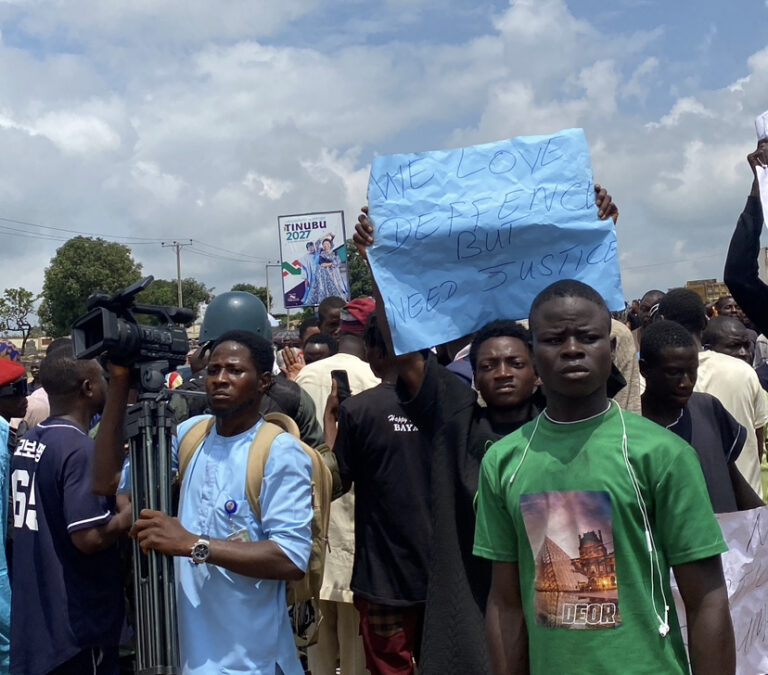
MANY commuters were on Wednesday, August 21, stranded for hours as residents of Iddo Sarki took to the Airport-Giri Expressway to protest against the Nigerian Navy, which they accused of encroaching on their land and destroying valuable farm produce.

The residents claimed that Navy personnel forcefully occupied their farmlands despite ‘directives’ from the National Assembly and the FCT minister, Nyesom Wike, against such an act.

The ICIR reports that the Iddo community is one of the closest communities to the University of Abuja. It accommodates a large number of the university’s students.

The demonstrators also noted that the officers arrived with heavy machinery, cleared vast areas of their farmland, and threatened to shoot at any farmer who moved close to them.

According to the protesters, consisting of farmers and other residents, they rely on the crops being destroyed for their survival and have now seen most of the farms destroyed by the military.

Just as they alleged, The ICIR observed no fewer than five military vehicles and several heavily armed officers moving in and out of the community.

Protesters were seen carrying placards with different inscriptions like “Stop Destroying Our Lands,” “We Need Justice,” and “We Are Peace Lovers,” demanding that the government intervene to stop the Navy.

The ICIR reports that the community and the Nigerian Navy have been at loggerheads over land ownership, with the military authorities ordering the community residents to vacate the area to enable them to pull down hundreds of houses built on part of the land.

In January 2024, the military served a notice on the residents and mounted no fewer than two signposts, claiming the land belonged to it.

This is our land’

Addressing the Abuja Municipal Area Council chairman, Christopher Maikalangu, the police and the media, the community representative, Jethro Iliya, said that the military personnel were found clearing their crops using heavy machinery in the early hours of Wednesday, August 21.

Jethro Iliya, addressing the media and AMAC chairman

“The Navy was found on our farmland clearing our crops that we have suffered to cultivate. Our crops that our fathers, our mothers, brothers and uncles, have spent months in cultivating, only for them, the Nigerian Navy this morning, to just go and start removing them with trucks and caterpillars, bulldozing our crops,” Iliya added.

He noted that despite the National Assembly and the FCT minister’s ‘directive’ to the Navy to hold on with its activities in the past, the Navy had continued to encroach on the community’s lands.

‘We are not illegal occupants of this land. This is our land, our ancestors gave it to us,” he stated, adding that there were due processes to be followed if the Navy wanted to acquire the land.

“Be it as it may, anybody who lives in the FCT knows the processes of acquiring a property in any part of this country. There are procedures laid on the ground, when you need land.

“But unfortunately the Nigerian Navy and other agencies have refused to follow these processes. Instead, when our fathers and our mothers, uncles and brothers approached their farmlands, the Navy threatened to shoot them with their guns,” he added.

Demands made

The protesters demanded that the Navy immediately vacate their lands and compensate them for the crops destroyed. 

Protesters on the highway leading to UniAbuja, blocking roads to protest against the Navy on Wednesday, August 21. PC: The ICIR/Mustapha Usman

The community vowed to continue its protest, insisting that it would not clear the roads or end the demonstration until its demands are met.

“If they want us to clear this road, we want them to leave our land that they are clearing currently. We have suffered to cultivate these crops, and we want them to leave that place immediately.

“Our second demand is that the crops they have destroyed must be paid for because our efforts cannot go in vain because we are not illegal occupants of this land. This is our land, our ancestors gave it to us,” Iliya, added.

“It’s Unfortunate” AMAC Chairman appeals for calm

The Abuja Municipal Area Council AMAC Chairman Christopher Maikalangu addressed Iddo residents who trooped out to protest the occupation of their land by the Nigerian Navy on Wednesday, August 21. PC: The ICIR/Mustapha Usman

Meanwhile, the Chairman of the Abuja Municipal Area Council, under whose council the community falls, expressed deep concern over the Navy’s operations in the community.

“I understand your pains,” he told the demonstrators. “What’s happening here today is very unfortunate. It’s unfortunate because I am very much aware that this matter is before the National Assembly and the National Assembly has put a stop to any exercise carried out by the military.”

Maikalangu further noted that his office and the community had previously engaged with the FCT Minister, whom he said had instructed the military to stop its activities pending further deliberations. 

While appealing for peace, the council chairman urged the military to remove its machinery and allow the government to address the issue.

“On that reason, I am here to say that please, the military, for peace to reign, remove your machines in this community for now, let the government itself handle this matter,” he said.

He also proposed that the military and the youths follow him to the commissioner of police’s office to resolve the matter amicably, stressing that peaceful dialogue was essential to avoid loss of life.

He further assured the residents that actions were being taken to protect their crops and livelihoods. 

“If you’re interested in their land, come and give them what they want, they have reported two items, you have to pay them an economic fee and you have to resettle them amicably. Follow the due process to resettle our people, not by removing their crops. We are not in support of this movement,” the chairman added.

Nigerian Navy's warning mounted in January 2024, demanding that the residents quit the community for demolition
Nigerian Navy’s warning mounted in January 2024, demanding that the residents quit the community for demolition

On his part, the deputy commissioner of police (operations), Ishiaku Ishiaku, asked the community to send its representatives to the CP’s office, adding the chairman and the military would be involved in the settlement.

He further appealed to the residents to allow vehicular movement. The community accepted his pleas and cleared the highway for vehicles to move. 

Double tragedy for many residents

The ICIR reports that the community is facing a third demolition in nearly ten years.

The community, having hundreds of houses, saw a demolition in 2011 and another in 2022 by the Federal Capital Territory Administration (FCTA).

Its surrounding area from the Airport Junction to Giri community has been taken over by the military. The Air Force owns the land before it, from the Airport axis, while the Nigeria Army has already built its headquarters on the vast land after it, opposite the university and Giri community, towards Anagada Village along Zuba Road.

The planned demolition of the Iddo community followed a similar exercise by the Air Force on Nuwalege community, behind Air Force Base, along Airport Road in January.

Nuwalege was pulled down without prior notice by the Air Force, as only a section of the community was marked three weeks before the exercise.

The Air Force promptly fenced the community’s land with its Base.

Many of the community’s residents moved to Iddo town to resettle, and they are now faced with another demolition threat.

The ICIR, however, learnt that Nigerians who claimed to be rightful owners of the Nuwalege land are challenging the Air Force in court, forcing the military to leave the land undeveloped since then.

This organisation further reports that the destruction of farmlands in Iddo by the Navy is coming when most Nigerians are facing acute hunger and food inflation is at its highest rate since 1996.


Fidelity Bank fined over N550m for customers’ data violation

THE National Data Protection Commission (NDPC) said it had levied a fine of N555.8 million against Fidelity Bank Plc for breaching customers’ data privacy.

The national commissioner of NDPC, Vincent Olatunji, disclosed this at the validation workshop on the Nigeria Data Protection Act General Application and Implementation Directive on Wednesday, August 21, in Abuja.

He said the fine was issued on Tuesday and the bank was mandated to pay the penalty sum within 14 days upon the receipt of the notice.

According to Olatunji, the lender violated the NDP Act, 2023, and the NDPR, 2019, regarding a data breach.

The fine equals 0.1 per cent of Fidelity Bank’s annual gross revenue in 2023.

A check on Fidelity Bank’s 2023 audited financial statements shows the bank posted gross earnings of N555.83 billion.

“Data protection compliance is important and we have stated that non-compliance will be punished.

Olatunji said the commission’s penalties range from N10 million and up to two per cent of the prior year’s earnings of offenders.

“Since we started, the major penalty we issued on fidelity bank was yesterday (Tuesday). For the violation of the NDP Act, 2023, and the NDPR, 2019. We issued a fine of N555.8m and they have to pay.

“We have observed serious breaches and we have been working with them, investigating the issue since April 2023. But by the time we finalised our findings, they became arrogant, and we decided to issue a full penalty on them, which is about 0.1 per cent of their earnings for 2023,” Olatunji was quoted to have said.

In its 2023 financial year records, Fidelity Bank reported a penalty payment of N42.96 million, The ICIR can report.

A breakdown of the penalties showed that the bank got N26.26 million fine from the Nigeria Electricity Market Stabilisation Facility (NEMSF) infraction; N4 million for late returns; and N10 million for anti-money laundering, combating the financing of terrorism and countering proliferation financing (AML/CFT/CPT) imposed on the bank by the Central Bank of Nigeria.

The Nigerian Exchange Limited also levied an N2.7 million fine on the bank for report filing violation.

“The Directors think that the financial statements of the Bank comply with the Bank and Other Financial Institutions Act, 2020 and all relevant CBN circulars, except for the contraventions below which attracted penalties during the year ended 31 December 2023,” the bank stated.

UNICEF accuses Sokoto communities of selling nutrition supplements

0

THE United Nations Children Fund’s (UNICEF) has condemned the sales of nutrition supplements in Sokoto State.

The UNICEF’s chief of field office in charge of Sokoto, Kebbi and Zamfara states, Micheal Juma, made the remark during the quarterly policymakers’ meeting of the organisation on Wednesday, August 21, in the state.

The News Agency of Nigeria (NAN) reported that the state deputy governor, Idris Gobir, and the commissioner for Budget and Economic Planning, Balarabe Kadadi, were among the government officials who attended the meeting.

Represented by Abraham Mahama, the UNICEF chief stated that the nutrition supplements were provided by donors and distributed to healthcare centres in different communities aimed at enhancing the lives of malnourished children.

He said the supplements were sold openly in markets while an investigation by UNICEF revealed that some personnel stocked cartons of supplements with stones and other items to conceal the act.

He regretted that the products failed to get to the people who needed them but were hijacked by unscrupulous persons who diverted them for pecuniary gains.

He further urged the Sokoto State government to appoint a statistician-general who would ensure that data collection is fast-tracked, preserved and disseminated in line with modern trends.

While highlighting some of the state’s key health indicators including, antenatal care, immunisation, mortality rates, healthcare-seeking behaviours, and social behavioural change, Juma noted that they recorded very poor performances.

He added: “The indices on healthcare infrastructure, power and water supply, competent healthcare workers, and client-untrusting service providers were not encouraging in the state”.

Also, UNICEF social protection specialist, Isa Ibrahim, in his presentation listed areas that needed alignment in the state while analysing the state’s 2024 budget performance. He stated that the nutrition sector recorded zero allocation and mentioned areas that recorded high capital expenditure with less impact on the citizens.

He also concurred with the chief of field’s call for the appointment of a substantive statistician-general in the state to harness and keep data.

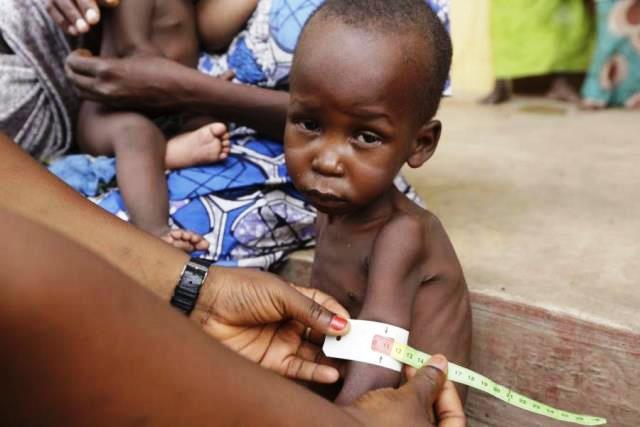
Sokoto is one of the seven northern states with severely malnourished children, according to the Médecins Sans Frontières (MSF), also known as Doctors without Borders.

According to a report, the global humanitarian organisation indicated that the MSF in-patient facilities in northern Nigeria recently recorded an “extraordinary increase in admissions of severely malnourished children with life-threatening complications,” surpassing last year’s figures by over 100 per cent in some locations.

I will remain in PDP – FCT minister, Wike boasts

0

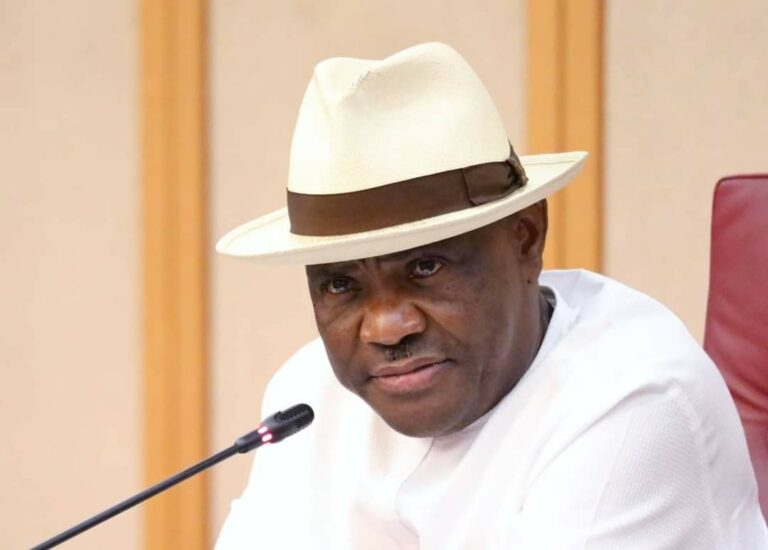
THE Minister of the Federal Capital Territory (FCT), Nyesom Wike, has boasted that he will not quit the Peoples Democratic Party (PDP) despite pressure from some members.

He claimed that all those who wanted him out of the party did not bring anything to the party.

The minister disclosed this while addressing select journalists in his office on Wednesday, August 21.

According to him, he will stay within the party and fight all the wrongs through the court of law.

“What I am saying which we can’t run away from is that we follow the law. No matter how you want me out, follow the law,” Wike said.

He also said any change in the chairmanship position of the party must be through the law.

“You don’t appoint a national chairman, it’s not a caretaker committee. You cannot appoint somebody to preside over those who are elected,” Wike stated.

He advised the party to conduct a national convention to effect any change in any position and threatened to go to court if due process is not followed.

On the lingering rift between him and his successor, Siminalayi Fubara, Wike blamed the governor for listening to people who did not support him when he was contesting for governor.

“All those who have ganged up are those who swore that over their dead body will this governor be governor.

“I did my part. In politics, you can’t say this is how it’s going to be. You are not ready to be in our political family again, no problem,” he stated.

On Infrastructure development in the state, Wike praised President Bola Tinubu for providing all the necessary atmosphere and support for him to thrive in the FCT.

He confirmed that when he assumed office as the FCT minister, the nation’s capital was in a very bad state.

“You can see yourself what is going on, the revolution in the FCT. I have said before that it required strong leadership to be able to implement so many things we are doing in the FCT and that is what the president has shown.

He also praised Tinubu for allowing the FCT to stay out of the Treasury Single Account (TSA) which he claimed had helped the FCT to develop its infrastructure.

“I don’t have any excuse or excuses not to perform because everything required as a tool, to do your work has been given. Luckily for me, the President has never interfered in my work or anything concerning FCT.

Concerning complaints over the poor infrastructure at the Katampe axis of the city, Wike said major projects were going through the procurement process and work would soon commence.

“In the next year, what you will see in Abuja, you will beat your chest concerning road infrastructure.”

On the housing deficit in the nation’s capital, the minister said the President’s renewed Hope City, which was recently commissioned in Kasana, would also be replicated in other parts of the city.

He added that his administration was providing adequate transportation via the mass transit terminals and boasted that the security situation had improved in the FCT.

Though a PDP member, Wike currently serves in the All Progressive Party (APC) government as a minister.


[DATA SPEAK] Only 5 of Kaduna’s 23 LGAs were safe during El-rufai tenure

ON May 29, 2015, the inauguration ceremony of Governor Nasir El-rufai in Kaduna State was disrupted by some aggrieved youths who were reported to have pelted dignitaries with objects at the pavilion of Murtala Square, Kaduna.

The chaos erupted as El-rufai, who had just concluded his speech, was about to inspect a police parade, prompting security forces to deploy tear gas to disperse the crowd

Fast-forward to eight years later, on May 25, 2023, a few days to the end of his second tenure, terrorists fleeing from neighbouring Zamfara State abducted an unspecified number of residents in Birnin-Gwari LGA of Kaduna, within the time frame of these two incidents, El-rufai had administrated as the governor of the northwest state where violent killings and kidnapping had become a plague in many communities.

The ICIR gathered that more than 4,800 people had been killed in various insecurity crises that persisted in the state. 

According to filtered data from the Armed Conflict Location and Event Data (ACLED), between May 29, 2015, and May 29, 2023, when El-rufai governed the state for eight years a total of 1,660 insecurity incidents were reported in the state that led to the death of 4,876 people.

To put this into better perspective, if the number of deaths was divided by the number of days El-rufai spent as governor of the state, it means approximately two persons were killed daily during his tenure. 

A look through the data gathered showed that insecurity crisis and related killings were more predominant in El-Rufai’s second tenure as governor than in the first four years.

While giving his inauguration speech after his re-election in 2019, he said, “This government has spent much on internal security operations, supporting the security agencies with equipment, vehicles with other logistics and funding.

“The huge resources that are expended on these internal security operations and containing conflict can be better directed towards improving lives in peaceful communities. 

“We have also established the Kaduna State Peace Commission, chaired by Reverend Dr. Josiah Idowu-Fearon, Secretary-General of the Anglican Communion Worldwide and former Archbishop of Kaduna. Beyond boots on the ground, the most sustainable guarantee of peace is the willingness of communities to live in harmony.”

However, according to the ACLED data, between May 29, 2015 and the end of 2019, a total of 1,432 people were reportedly killed. Note that the first tenure of the governor ended on May 29, 2019. 

However, between 2020 and when El-rufai handed over governance to Uba Sani, on May 29, 2023, the death reported rose to 3,444. This is twice the fatality rate recorded in the first four years of his administration.

In 2021, El-rufai, while explaining what the state government had done to combat insecurity, lamented that the failure to sustain cooperation among northern states contributed largely to insecurity in the region.

At this time, the fatality rate recorded in Kaduna had consistently increased from 2019 to 2022. 

The former governor later came out in October 2022 to confess that despite the effort of the state government to end the crises, the federal government which should be in charge of security seems to have abdicated its duties.

“I can tell you that we have done our best to tackle insecurity in Kaduna State but we are being hampered by the structure which lies with the federal government. You may call this resignation, you may call it surrender but it is not abdication,” he said in an interview. 

Only 5 local governments were safe

Further to analysis of the insecurity data across the 23 local government areas in the state showed that only five local governments were safe during the administration of El-rufai for eight years.

These are: Jaba, Kubau, Kudan, Makarfi and Soba. While Kudan and Soba recorded no deaths for the eight years, Makarfi and Kubau had two deaths recorded each and Jaba had only one reported case. 

Hotspots

On the other hand, local governments like Birnin Gwari, Kajuru, Chikun, Giwa and Zangon Kataf were hotspots for insecurity recording a death rate between 400 to 800 cases within the former governor’s tenure. 

Total LGA Total deaths
Birnin Gwari 818
Chikun 568
Giwa 495
Igabi 366
Ikara 17
Jaba 1
Jema’a 212
Kachia 147
Kaduna North 205
Kaduna South 17
Kagarko 100
Kajuru 591
Kauru 118
Kaura 264
Kubau 2
Kudan 0
Makarfi 2
Lere 23
Sabon Gari 354
Sanga 108
Soba 0
Zangon Kataf 446
Zaria 22
Total 4,876

Deaths recorded under El-rufai administration during eight years in office. Source: ACLED

This simply means that for every one person who died in Kubau or Makarfi, at least 409 people had been killed in Birnin Gwari LGA 

Recall that The ICIR documented how multiple kidnappings that led to the abduction of school children were reported in the state in 2021. By our collation, a sum of 212 school children were abducted in the state from March to July 2021. 

Expert lists factors

A professor of political science at the University of Nigeria, Nsukka, Freedom Onuoha, who spoke to The ICIR, said “I feel that his policy of appeasing armed herdsmen with financial settlement rather than prosecuting them was one of the factors that exacerbated ethno-religious disputes and by extension the circle of extreme violence in the state.

“In addition, his official posture is often brash and divisive rather than accommodating and conciliatory. This inflamed passion in a state known for longstanding ethnoreligious tension.”

Are there changes now?

El-rufai handed over the administration to Uba Sani on May 29, 2023.  The ICIR reported that Sani promised to work with other governors in Nigeria to make state police a reality as part of an effort to stem the tide of insecurity in the state.

Although insecurity crises persisted, especially bandit attacks in communities including kidnappings, The ICIR gathered that the data for death cases reported under the new governor after spending one year in office was more than the rate recorded under the former governor in his first two years in office.

LGs
Sum of fatalities
Birnin Gwari 237
Chikun 38
Giwa 28
Igabi 121
Ikara 7
Jema’a 1
Kachia 41
Kaduna North 7
Kaduna South 0
Kagarko 17
Kajuru 53
Kaura 1
Kauru 24
Kudan 6
Lere 0
Makarfi 1
Sabon Gari 2
Sanga 11
Soba 0
Zangon Kataf 24
Zaria 11
Grand Total 630

Death cases recorded under one year of Uba Sani as governor of Kaduna Source: ACLED

From the data gathered, between May 29 2023 and May 29, 2024, one year of Sani as governor of the state, a total of 630 insecurity-related deaths have been recorded. Within one year, Birnin Gwari, Igabi and Kajuru had the highest death rate recorded.

The ICIR investigated how over 100 students were kidnapped in Kuriga town in Kaduna state in March 2024.

Sani has bemoaned how the insecurity crises affect education in the state saying that state policing is the only way to address the crises.