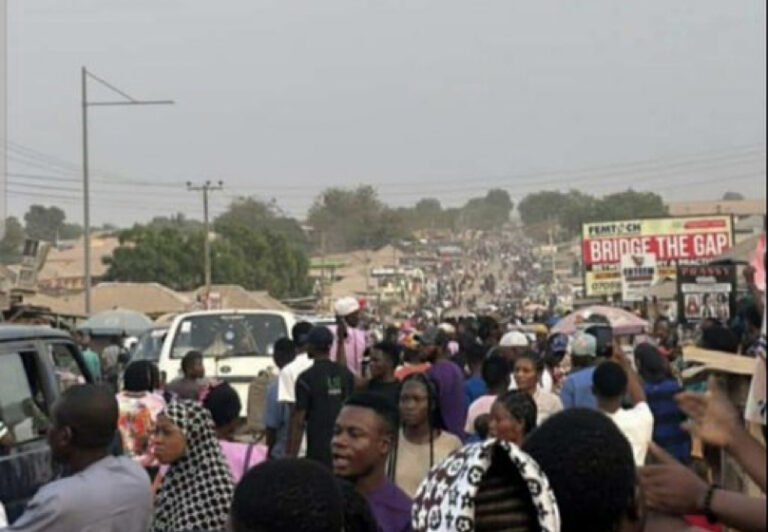
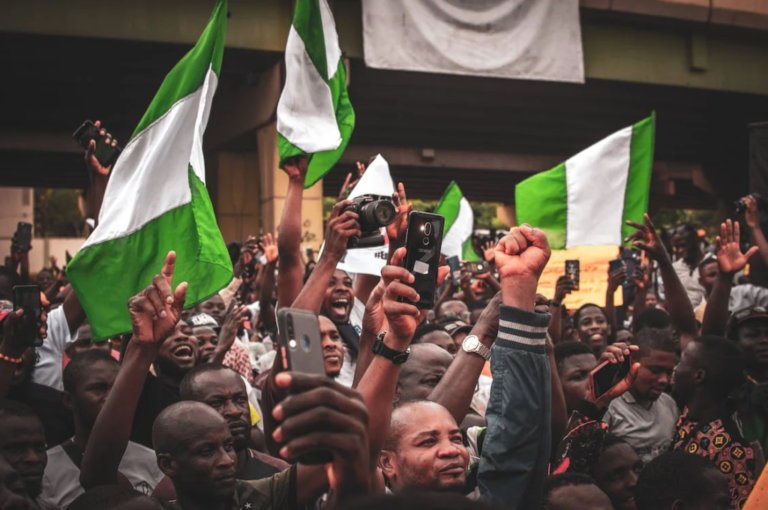
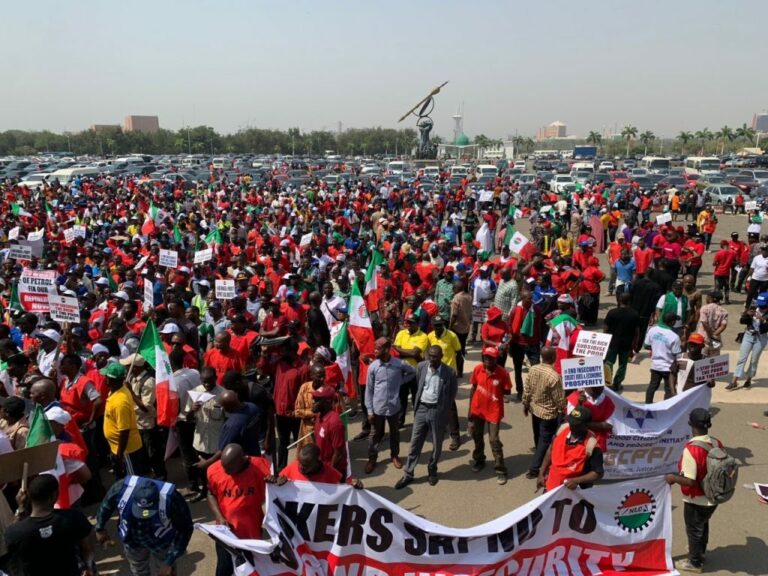
THE Federal Capital Territory High Court in Abuja has restricted protesters against hunger and poor governance in Nigeria, kicking-off on August 1, to the MKO Abiola Stadium in the nation’s capital.
The presiding judge, Sylvanus Oriji, gave the order on Wednesday, July 31, while delivering a ruling in an ex-parte application filed by the Minister of the Federal Capital Territory (FCT), Nyesom Wike.
The FCT Minister had applied for an order of interim injunction restraining the five leaders of the protesting groups from gathering or parading themselves along any roadway, streets, offices, and public premises within the FCT between August 1 to August 10, or any other day thereafter, pending the hearing and determination of the motion on notice.
The five leaders of the protest listed among the defendants in the suit are Omoyele Sowore, Damilare Adenola, Adama Ukpabi, Tosin Harsogba, and Persons Unknown.
Other respondents are the Inspector-General of Police, Commissioner of Police, Director-General of the State Security Service, Director-General, Nigeria Security and Civil Defence Corps, Chief of Army Staff, Chief of Air Staff, Chief of Naval Staff as 1st to 12th respondents.
The ICIR reports that a human rights group, Take It Back movement on Friday, July 26, requested the FCT Minister to grant them the use of Eagle Square for the demonstration, known as #EndBadGovernance protest.
The group made the request through a letter signed by its Director of Mobilisation, Damilare Adenola.
The group highlighted demands, including the provision of a 24-hour power supply, toilet facilities, water, and security for the convenience of Nigerian citizens who would be camped out at the Eagles Square.
However, in the exparte application by his counsel, Ogwu Onoja, a senior advocate, Wike sought for order of interim injunction mandating the security agencies to prevent the protesting leaders from gathering or parading themselves along any roadway, offices, or public premises within the FCT between August 1 and 10, pending the hearing of his motion on notice.
The minister stated that while the federal government was not opposed to the protest, intelligence and security reports suggested that certain elements within the protest leadership planned to use the demonstration to cause havoc, irreparable damage to public facilities, block roadways, and disrupt public peace.
Meanwhile, the judge in his ruling restricted the protesters to the stadium given the fears expressed by the minister.
“In the light of the above, the court considers it appropriate and expedient to grant an order under the omnibus or general prayer to ensure that the rights of the protesters are guaranteed and that the protest does not negatively or adversely affect the rights of other citizens to move about and to ensure that properties and other public facilities are not destroyed,” the judge held.
The judge, therefore, ordered the 1st to 5th respondents to “use the Moshood Abiola Stadium” only for the protest.
This latest development comes few hours before the protest for which some Nigerians, along with a group led by former presidential candidate Omoyele Sowore, have been mobilising for.
The posts and tweets on the protest carry different hashtags, ranging from #RevolutionNow, #EndBadGovernanceInNigeria, #TakeItBack, #DaysofRage and #TinubuMustGo.
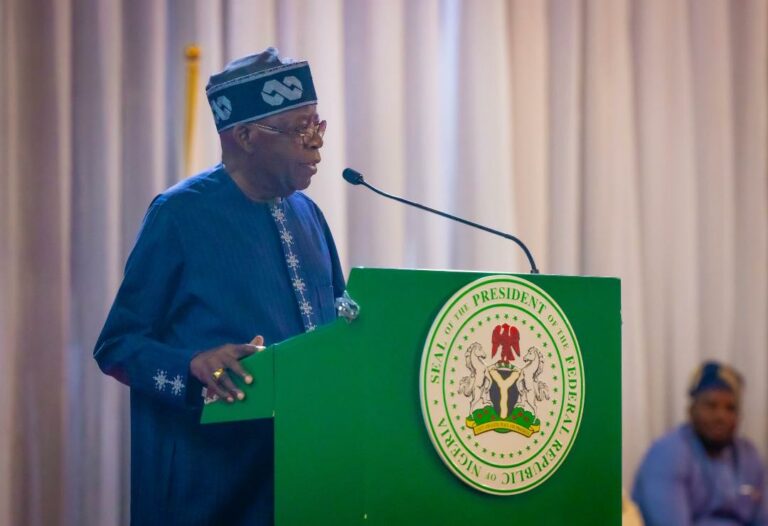
Since the emergence of President Bola Tinubu, there has been unprecedented inflation, with the market prices of food snowballing and more citizens pushed into poverty.
The ICIR reported that the president held closed-door meetings with the traditional rulers and governors over the demonstration. Similarly, political actors including former presidential candidates, political parties and other stakeholders have issued various statements about the planned protest.
GROUPS of protesters, comprising nine different organisations, have accused the President Bola Ahmed Tinubu-led administration of implementing anti-poor policies supported by the International Monetary Fund(IMF) which has impoverished Nigerians more.
The groups, which comprised a coalition of youths, civil societies, and socialists on the planned ‘EndBadGovernanceinNigeriaprotest’ made their position known in a communique issued on Wednesday, July 31.
They insist that despite intimidation by the current administration, the protest will go on as scheduled on August 1, while it accused the Nigerian authorities of neglecting issues that led to the protest.
The organisations in the group are the Joint Action Front(JAF), PRP Vanguard, Yoruba Revolutionary Movement(YOREM), Amilcar Cabral Ideological School Movement(ACIS-M), Youth Rights Campaign(YRC), Movement for African Emancipation(MAE), Education Rights Campaign(ERC), Precision, Electrical, and Related Equipment Senior Staff Association(PRERESSA) and Campaign for Democratic Workers Rights(CDWR).
“Since May 29 last year when President Tinubu announced without any democratic consultation debate with the Nigerian people, his ill-thought, wicked and anti-poor International Monetary Fund (IMF)-inspired policy of fuel subsidy removal, our lives as we know have been transformed for the worse.
“Inflation has gone sky-high and with it prices of food, energy, medicine, and other essentials,” the communique said.
The group also criticised the government for devaluing the national currency twice, stressing that it has crashed the value of income and living standards.
Commenting further on the negative downturn being expressed by Nigerians on the economy, the communique estimated that over 26 million Nigerians are at risk of starvation this year.
The group also registered disapproval of how the government is implementing palliative distributions, accusing it of targeting political proxies.
“So-called palliatives have not gone to the real needy as they have been hijacked by ruling party politicians. Also, support for rural farmers has ended up in the hands of political farmers,” it stated further.
The group also accused the government of not making the necessary sacrifices, despite effecting policies that have inflicted pain on the people.
“In the midst of all these and while we are being told to tighten our belt, official corruption has turned to a pastime as President Tinubu, the first family, lawmakers, and the government officials continue to feed fat on our treasury by buying themselves luxurious jets, yacht, bulletproof vehicles and renovating residences and offices.
The group insists that despite the threat and intimidation, it supports the #EndBadGovernanceinNigeria protest will take place in Lagos states and every other part of the country.
Notably, the key policies of the Bola Tinubu-administration which focused on the total removal of subsidy on premium motor spirit (PMS) and floating of the naira have been considered largely as an IMF-inspired policy.
Tinubu had, immediately after replacing his predecessor, Muhammadu Buhari, eliminated the fuel subsidy regime, a decision that instantly triggered a 200 per cent increase in the pump price of petrol, a strategic commodity that influences pricing and cost in other sectors of the economy.
The administration also floated the naira which led to currency problems and uncontrollable prices of commodities in the market alongside volatile exchange rat
The ICIR has reported that the country’s National Bureau of Statistics (NBS) released the July inflation figures, reporting that headline inflation rose to 34.19 per cent in June from 33.95 per cent in May.
Food inflation, the major driver of the pressure, increased to 40.80 per cent in June from 40.33 per cent in May. This development has seen Nigerians go through the edge to feed, a situation that is worrisome with 133 million people in different categories of poverty.
BARRING any change of plans, aggrieved Nigerians under the umbrella of #EndBadGovernance, would hit the streets on August 1, 2024 to protest the economic hardship facing the country since President Bola Tinubu assumed office in May 2023.
The protest seems to model the 2020 EndSARS protest under ex-president Muhammadu Buhari’s administration as there are no principal organisers.
The “Hunger Protest”, as it is referred to, has generated mixed reactions from the government and prominent personalities within the administration as well as opposition parties, security agencies and civil societies.
#EndBadGovernanceProtest is expected to start on August 1 in Nigeria. This scheduled protest which has faced many anti-protest, protest is expected to last for 10 days. The last major protest which lasted for several days was the #EndSarsNow , but that’s not the only one.
For almost two weeks, several meetings and press statements have been issued to cushion the planned protest. The ICIR reports that the president held closed-door meetings with, several stakeholders, among them traditional rulers and governors over the planned demonstration.
The Nigerian military also accused the organisers of the planned protest of intending to replicate the recent demonstration in Kenya, which led to deaths, destruction and drastic actions from the country’s president.
On social media, the posts and tweets on the protest carry different hashtags, ranging from #RevolutionNow, #EndBadGovernanceInNigeria, #TakeItBack, #DaysofRage and #TinubuMustGo.
A recurring decimal
However, this is not the first time Nigerians have taken to the streets to revolt against the government. Findings by The ICIR showed that between 1929 and 2024, at least seven major mass protests have been held that sparked outrage and discontent among the populace.
Timelines
Some of the major protests reviewed by The ICIR are:
Aba Women’s protest:
In November 1929, a group of women in Aba, located, now, in Abia State staged a protest against the British colonial government over taxation and economic grievances. The protest turned violent when the women were met with force by British colonial authorities, leading to the destruction of property and deaths of several women.
The riot spread to other parts of the region, involving thousands of women and resulting in the deaths of at least 50 women and several British officials. Despite the casualties, the riot marked a significant turning point in the struggle for Nigerian independence and women’s rights.
Abeokuta women’s revolt:
The protest in 1947 was organised in Abeokuta, Ogun State, by the Egba women against the imposition of taxes on women by the British colonial authorities and the Alake (king) of Egbaland. It was famously led by Funmilayo Ransome-Kuti, a prominent women’s rights activist, involving thousands of women who marched through the streets, demanding the repeal of the tax.
Ali Must Go:
In 1978, under the military regime of Murtala/Obasanjo, university students, nationwide, protested against the military government over the increment of fees by the government. According to the Nigerian University Commission (NUC), while the tuition fees remained free, the hostel accommodation was increased and essentially, the cost of meal tickets was increased from ₦1.50 to ₦2.00, which led to the uproar.
Anti-SAP riot:
Between May and June 1989, a series of student-led anti-government protests were organised as a result of the effects of the International Monetary Fund (IMF)-imposed Structural Adjustment Program (SAP) introduced by the Ibrahim Babangida-led government. The programme was introduced as a government policy in 1986 to stop the effects of falling oil prices and foster the development of local industries, a measure that made Nigeria qualify for IMF-issued loans.
However, the policy increased the prices of petroleum, food prices and living expenses of people. The protest later escalated from being a student-led one to a nationwide event.
June 12 protest:
Following the annulment of the presidential elections which was held on 12 June 1993, the first since the 1983 military coup ended the country’s Second Republic, Nigerians took to the streets to protest against military ruler, Ibrahim Babangida.
The election was believed to have been won by Moshood Abiola of the Social Democratic Party (SDP). The annulment led to strife and political unrest.
Occupy Nigeria:
The rebellion which began on January 2, 2012, was referred to as a socio-political protest against former president Goodluck Johnathan after he announced the removal of fuel subsidies on January 1 that year. Protesters had shut down petrol stations, forming human barriers along the road. Several trade unions also announced indefinite strike and mass demonstrations unless the removal of a fuel subsidy was reversed.
EndSARS protest:
The #EndSARS movement was a series of mass movements calling for the disbandment of the Special Anti-Robbery Squad (SARS), an arm under the Nigerian Police notorious for its abuse against Nigerian citizens.
The protests which started as a campaign on Twitter (now X) in 2017, became a movement that experienced a resurgence in October 2020, during the global pandemic. The aftermath of the protest led to the killing of people, mass demolition, looting and public disorder following the intervention of the security operatives.
The protest gathered a lot of attention on social media and international bodies.
A coalition of youths, civil societies and other groups have said that the planned nationwide protest set to commence tomorrow, August 1, would hold.
In a joint statement, the groups listed out the protesters’ demands which include the reversal of fuel prices and electricity tariffs, an end to hardship and hunger, and placing all political office holders on minimum wage.
They asked the government to release all victimised activists of the #EndSARS protest, reverse all anti-poor and neo-liberal capitalist policies, fix public refineries and build new ones, reverse all privatisation of public enterprises and place them under democratic control and management.
Besides, they sought an end to insecurity, police brutality, kidnapping and illegal demolition/forced eviction of people from their homes.
Part of their statement reads, “You are all witnesses to how over the past three weeks, the President Tinubu government, his aides, security agencies and the ruling All Progressive Congress (APC) have all been trying hard to disparage, calumniate and demonise the #EndBadGovernanceInNigeria protest.
“They have called us all kinds of unprintable names. They have threatened all sorts of violence and personal harm against us. Their paid agents have threatened to attack us and kill us if we dare come out including the threat to deploy the ‘oro cult’ against protesters in Lagos. They have accused us of several crimes including treason and of being sponsored. They have floated fake groups to pull out of a protest they were never part of in the first place.
“All that this government has done so far to try to ameliorate the situation has not worked. So-called palliatives have not gone to the real needy as they have been hijacked by ruling politicians while support for rural farmers to enhance food productivity has ended up in the hands of political farmers. It is based on the foregoing that we believe that this protest must go on regardless of the threat and intimidation.”
The group claimed that under Tinubu’s administration, several excessive allocations had been approved for political office holders, some of which included buying luxurious jets, yacht, bulletproof vehicles, and renovating residences and offices, while, the economic crises of the country had taken a toll on the citizens.
The coalition said that the protest would commence at Ikeja under Bridge, Lagos State, by 7 am, adding that it would be a peaceful parade. The group further urged security agencies not to deploy its officers to infiltrate the protest.
“For us in this coalition, we consider that the fundamental reason Nigeria is in this mess is capitalism – a socio-economic system that makes a few people rich at the expense of the mass majority. This is why this coalition calls for system change – that is a new Nigeria where the wealth of the country will be used primarily to make life better for its people instead of enriching a few.”
DESPITE prior ‘agreements’ with the Kwara State Internal Revenue Service (KWIRS) outlining expected tax contributions based on the value of goods in their possession and evidence of payment, recent tax enforcement efforts target mostly Igbo traders, sparking controversy in the state. Many traders have received letters demanding payment of arrears tax dating back to 2018, The ICIR’s Mustapha Usman reports.
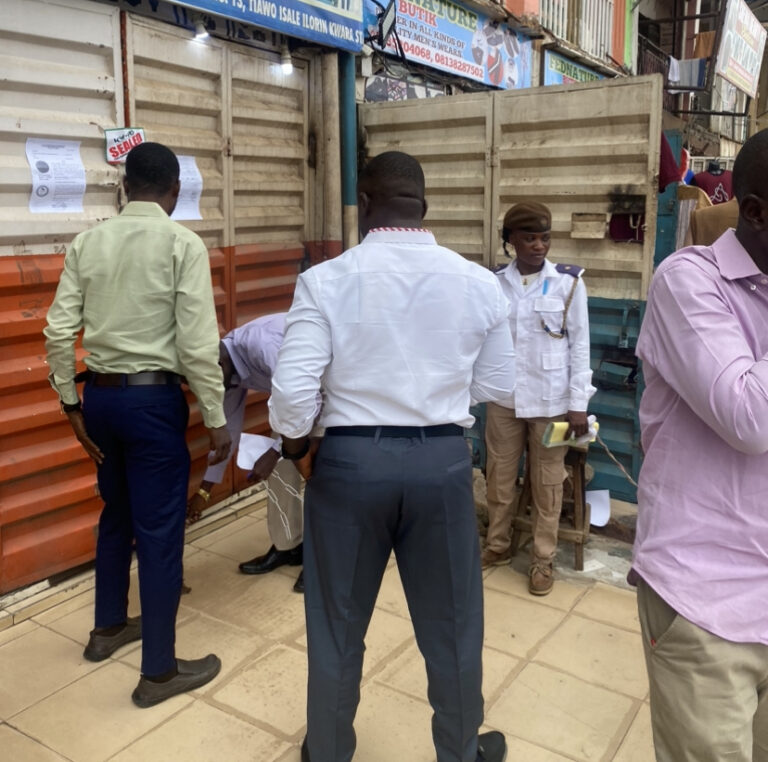
With his arms folded across his chest, God First stood afar and watched helplessly as officials of the Kwara State Inland Revenue Service ( KWIRS), forcefully locked up his boutique in the Taiwo Isale area of Ilorin, the state capital. He looked pale and unwell, with his eyes bearing an unexplainable brunt.
It was only 11.00 am on July 2024, and God First had hoped for a productive day. However, the arrival of about six KWIRS officials alongside two police officers, shattered his expectations as they stormed his boutique, chased out his staff, and roughly dragged all the mannequins holding onto menswear back into the shop.
“They are forcefully closing my shop. Do they even have such rights? What did I do to them? Without any warning, they just said I owed some tax arrears and locked up my shop,” he laments.
God First’s shop on Taiwo Isale Road in Ilorin, Kwara State, shut down by KWIRS officials. Photo: Mustapha Usman/The ICIR
Apparently feeling the weight of the situation, he told The ICIR that he had been paying his taxes promptly through his union and owed the state no money but recently they brought him a letter to pay N20,000 for 2022.
“They first brought N20,000 for the previous year in May and came this morning with another letter stating that I will pay arrears of N188,000,” he says, noting that he had paid N12,000 for 2022 through his union with receipt of payment issued to him.
“So when they brought that N20,000, I already paid through my association, I tried to explain to them, but they shut me down. This morning again, they used their hands to pack my market and lock my shops.”
Tax obligations
Like other states, Kwara has different tax obligations that individuals and corporate entities are expected to meet. This includes the personal income tax, which falls under pay as you earn (PAYE), and can be done through direct/self-assessment.
This personal income tax is mostly levied on traders, who fall under the non-corporates, based on either the profit or gains they make in a year, according to the law stipulated by the FIRS. The law allows for 11 percent to be deducted on the first N300,000 chargeable income, 15 per cent from the second N300,000 and 19 per cent in N500,000 chargeable income.
This can be determined after the trader either files their annual return or the state revenue office conducts a direct assessment and levies an amount based on their on-field assessment.
An order passed by the Kwara State Revenue Court. Photo: Mustapha Usman/The ICIR
Court order against ‘offenders’
Appparently, the KWIRS officials came to enforce a court order based on a motion filed under Section 38 (1) of the Kwara State Revenue Administration Law (2005) (as amended). The motion, dated February 6, 2024, and filed on February 8, 2024, sought for the right to shut down shops belonging to tax offenders.
Although God First was not aware of any court hearing and was not invited over the allegations brought against him, the court ordered that the “applicant’s chairman or any other authorised officer assigned to distrain the respondents’ goods and premises bonds to enforce the liability for personal income tax rate for the period covering the year 2014 to 2023” in the sum of N188,140.00.
God First’s business was shut down even though he claims to have paid all the fees required from him as taxes from 2018 to 2023.
Receipts of payment of tax issued by the KWIRS to God First.
His taxes amounted to about N84,000 after an arrangement between the association and the government, which occurred in 2015 and was subsequently renewed in 2018.
Igbo traders succumb to pressure
The ICIR gathered that the Kwara State Association of Igbo Traders (KWAITA) had first rejected the offer by the state to collect taxes in groups, but the government continued to appeal until the agency conceded.
“They appealed to us to help them collect tax from our people knowing very well that we know our people more than they do, that they can’t be able to access up to 15 per cent of our traders,” Aloysius Nwora, the coordinating chairman of KWAITA on tax matter, said.
Nwora added that the state revenue service offered a 10 per cent bonus for any amount the union collected, starting with N3,000, N4,500, N6,000, and N9,000 in 2015. Meanwhile, these amounts keep increasing over the years, with both the association and the state renewing their agreement over time.
In 2023, the KWIRS decided to change this arrangement, opting to engage with individual traders directly without involving the association. Although there was a rejection by KWAITA, it was gathered that it later gave in to this change. Yet, the situation took a drastic turn when KWIRS began issuing new tax assessments, claiming that the traders owed arrears dating back to 2015.
The matters escalated on March 1, 2024, when KWIRS conducted trials and sealed the shops of two KWAITA members, Chuppet and Top Biz.
Now, the government has gone back on its offer, and traders like Chupet, Top Biz, and God First are left to bear the brunt.
God First’s shop, a relatively medium-scale business, is now expected to pay N188,140, despite having evidence of payment and paying duly as initially agreed by the KWIRS. In contrast, an indigenous trader whose shop is of similar size as God First’s own still pays as low as N3,000 annually and has received no order increasing his taxes. This has led Igbo traders to believe that they are being deliberately targeted by the state government.
The enforcement team has also been accused of targeting mostly traders of Igbo origin, and findings by The ICIR show that these allegations were true, as a survey showed that most indigenous traders have not been instructed to pay new tax or pay arrears despite paying through unions and not filing their tax return every year.
Through visitation to 20 shops -10 Yoruba (Indigenous) and 10 Igbo traders shops – of varying capacity and sizes, The ICIR gathered that while most of the Igbo traders were slammed with exorbitant tax demands, all the indigenous ( or Yoruba) traders visited by without exception seemed to have settled their taxes with relative ease.
Backstory: 2015-2023
Given the huge potential in the informal sector, according to findings, one of the strategies that the KWIRS adopted to administer revenue in the informal sector was the establishment of the “Informal Sector Tax Directorate,” which is responsible for the collection of Personal Income Taxes (PITs) from taxpayers.
The directorate was divided into three PIT collecting units—Markets, Micro Business, and Artisans, with each supported and coordinated by an administrative unit.
The assessment of tax liabilities, particularly of those taxpayers classified under micro businesses is carried out by the tax assessment directorate of the service, it was gathered.
The assessment, unlike “Pay-As-You-Earn” (PAYE), is based on the Presumptive Tax Schedule, provided in Presumptive Tax Regulation (PTR) Act, 2014 or ‘best of judgment’.
However, the collection of PITs from artisans and traders was done through union/association executives, reducing the cost and stress of collecting taxes but having its own risk.
This system involved the association helping to remit taxes on behalf of individual traders, a process that was mutually agreed upon and had functioned till 2023, without recourse to the FIRS law and the state-specified amount for personal income tax on the consolidated revenue codes rates.
In this, ‘Kwara State Consolidated Revenue Codes,” the state government had already categorised some businesses into small, medium, and large and specified the amount expected to be filed as personal income tax every year.
Businesses with amounts expected to be paid as PIT as listed in the Kwara state Consolidated Revenue and Codes
According to the code, the highest to be paid for the large-scale businesses in this category is N49,000, with the lowest at 1500.
Meanwhile, not only KWAITA was saddled with the responsibility of collecting taxes of its members. The ICIR gathered that other unions, including the pharmaceutical traders associations, Okada, and Keke Napep riders were asked to coordinate the collection of tax for the service.
But with the tax enforcement officials now showing up at the market and shutting down businesses in a bid to enforce personal income taxes for the years between 2023 and 201, the Igbo traders staged a protest, resulting in the closure of shops and business centres owned by Igbo businessmen in Ilorin, the state capital.
Award for the Most Responsive in Tax Collection and Payment to KWAITA by KWIRS in 2018. Photo: Nwora
“We were still in discussions with them when they arrived with a mobile court one March morning. They set up tables at Chuppet and Top Biz shops. Before they finished, they dismantled the tables and sealed the shops, even locking staff inside,” Nwora says, adding that the union approached the chief of staff to the state governor, Abdulkadir Aliyu Mahe, who called upon the revenue office to open the shops.
“But both of them were still billed to pay N500,000 (N250,000 each) to reopen the shops, which was paid,” Nwora stated..
However, barely a week later, Nwora noted that the service returned without a court order and sealed the shops again early in the morning. This time the shops were closed down for almost a week.
Asked how the shops were reopened, he said:“They threatened to lock the owners up if they tried to challenge the government. They used the government to threaten to revoke their properties and jail them if they took legal action.
“The condition given was that they must pay 50 percent of the money immediately, with some time allowed to pay the remaining 50 percent. Chupet and Top Biz were forced under duress to pay over a million each, with an undertaking to pay the balance over a specified time.
Since then, many other Igbo traders have been served letters to pay arrears, accumulating to millions for some, while their Yoruba and indigenous counterparts in several areas of the state were not addressed despite most of them paying through a similar method for years.
Behind a flawed system
A memo by the KWIRS addressed to KWAITA on its approval of specified amounts for traders for Personal Income Tax.
Based on documents and memos obtained by The ICIR, along with an interview with officials of the KWIRS and KWAITA, one thing could be confirmed: the responsibility to collect taxes for the state was shifted to the union in 2015 by the state government.
Although the aggrieved traders described this method as an agreement reached, the KWIRS legal director, Shehu Mogaji, claimed it was a correspondence to expedite and aid tax collection by the service.
Another memo confirming the arrangement of tax payment through the Igbo union by the KWIRS
He said this was because the agency was still new and needed time to establish efficient tax collection processes. While noting that the partnership with the union was a temporary measure aimed at improving tax compliance and collection rates, Mogaji said the service still reserved the right to review the tax amount as stated in the memo.
However, contrary to Magaji’s claim that only KWAITA, one pharmaceutical union, and riders and keke associations were saddled with the responsibility, The ICIR through interviews conducted with a few other business associations, confirmed that others outside the listed ones, devised such means to pay taxes of their members.
For instance, in Ita Amodu, where the indigenous, Yoruba and Igbo traders compete for customers, Ifesowapo Trading Union’s chairman and members confirmed that they are still paying through the same method as of the time of this investigation.
In the case of the Challenge Market, all the traders, including Yoruba and Igbo interviewed by The ICIR, claimed none of their members had been asked to pay arrears, except two Igbo traders.
This is despite some of them having relatively the same shop and market size as those in the Taiwo area of the city.
The chairman of the Challenge Association of Traders Telecommunications and Allied Traders, Garba Ibrahim, confirmed to The ICIR that they had no issue with the state government and have not received any letters asking their members, including Igbo traders who pay through their Union, to pay arrears since 2018.
Challenge Association of Traders Telecommunications and Allied Traders Association‘s Chairman Garba Ibrahim
Ibrahim, however, confirmed that the tax office did not bill them arrears for years they paid under the association and had not stopped them from paying through the union, as they are currently billing most Igbo shops in Ilorin.
Discriminatory sanction
Despite evidence indicating that some Igbo traders being asked to pay arrears tax have comparable levels of goods to their indigenous counterparts, investigations show that they are mostly being targeted.
Uchechukwu Nnamani, a footwear vendor in Taiwo, Ilorin, Kwara state
Like God First, Uchechukwu Nnamani, a footwear and shoe retailer, was caught in the chaos as he is now owing over N1 million.
Uchechukwu felt light-headed, a little shaky in his hand as he picked up the letter from the aluminum shelve where he kept it. His voice became strained when he read out the amount he’s been charged.
His shop, tucked in Taiwo Ilorin, opposite Phone Mart, is half-empty, with just a few shoes on display. It had been like this for the last 12 months, with only a handful of sales made, he said, adding: “I am looking at venturing into another business, I want to start a food business because that’s where money is now. The country is hard and you can’t expect people who haven’t eaten since morning to buy shoes.”
Receipts of payments of tax by Uchechukwu Nnamani
Uchechukwu, like a few other Igbo traders interviewed in the axis, has evidence of payment since 2014. He paid N7,000 in 2023 for the 2022 tax based on the amount given to him by his association, which had been conferred the mandate to collect the tax.
However, with the new policy, he is expected to pay arrears of N1.3m, amounting to about N216,000 every year, despite having a not-too-big shop, which he said is being run by loans from banks and cooperatives.
Letter of demand by the KWIRS, requesting Uchechukwu Nnamani, to pay N1.3 million arrears
“I’ve spent over 40 years here, studied, built a house, and married and raised my family in Kwara. We consider this place our home, so I don’t understand why we’re being treated differently. If I’m going to the east, I won’t take my building along,” Uchechukwu lamented.
This is a similar story by Geoffrey Oruche, the chairman of the KWAITA, Taiwo zone.
Receipt of payment by the KWIRS to Oruche
Oruche’s shop is relatively small and nearly empty, but he’s now being charged N2.4 million despite having paid for the past eight years.
Letter of demand from the KWIRS, requesting Geoffrey Oruche payment of over N2 million
During The ICIR visitation to the areas, most of the Yoruba traders declined to speak on the tax payment, but Sharafdeen Yunus, who tagged himself as the chairman of the indigenous traders in the complex where both Uchechukwu and Geofrey operate, said he does not have problems with the state government.
He noted that he had been paying N3,000 every year until recently when the KWIRS came with N5,000. Yunus’ shop was observed to be very well stocked compared to Geofrey’s own at the time of visitation.
Same story in Surulere, Ita Amodu, Sawmil axis
Meanwhile, the story is not limited to shops in Taiwo area as many other Igbo shops in Surulere, Ita Amodu, and Sawmill/Gerin Alimi/ Odota/ Asa dam/ Olohun Sogo are facing the same issue.
Igbo traders in these areas noted similar experiences of tax discrepancies, with many of them also being charged arrears, amounting to millions of naira.
Ikechukwu Anieze, a building materials trader in Ita Amodu, Ilorin, Kwara
Ikechukwu Anieze could not believe he would ever be paying up to N1.3 million, even if he were to pay individually every year, until late last year when the KWIRS presented him with a letter detailing his accumulated debt.
Anieze, like most other Igbo traders in Ita Amodu, sells building and furniture materials in a shop that could be categorised as a medium-scale business.
Receipts of tax payment issued to Ikechukwu Anieze by the KWIRS
“I started having issues with them last year after they served us papers, just months after we had paid for the preceding year,” he says with anger in his voice. “They asked us to pay to avoid having our shops closed down, even though we had already paid.”
“They then asked us to bring receipts, which we provided, but even after that, they still served another paper stating that we were owing. The amount they brought last year was N1.2 million, and this year it’s N1.3 million.”
Letter of arrears demand addressed to Anieze by the KWIRS
In February 2024, Okechukwu Marcus, who owns Danbest Hydroremedy, alongside Sawmill Road, where he sells pure water accessories, was shocked when he learned he now has to pay N1.2 million arrears to the KWIRS.
For the last eight years, Marcus has been paying through his association based on the amounts agreed upon with the government.
Marcus, and a few others in his axis who The ICIR spoke with, and who have paid their taxes through their associations, are now being asked to pay large sums in arrears, causing widespread confusion and distress.
Speaking on the number of people who have been asked to pay arrears in his axis, the chairman of KWAITA Sawmil axis, Godwin Okoro, said about 14 of his members were asked to pay, amounting to millions of naira without assessing their shops.
However, some of the Indigenous or Yoruba counterparts visited in these arrears noted they had not received such treatment from the government. Their shops were not assessed and some paid as low as N3000.
‘No on-field assessments before charging’
Beyond that, the traders accused KWIRS of failing to conduct proper best-of-judgment assessments and on-field assessments, as required by law before charging some of them.
Traders like Ugochukwu Chukwudi argued that even if the traders were to pay additional fees, the failure to conduct on-field assessments on his market to audit his tax payment has led to arbitrary and inflated tax assessments.
“No, they didn’t do that one (come to assess my shop). They just sent a letter demanding a huge sum,” he said.
Ugochukwu Chukwudi’s Tax clearance, showing his estimated return. The clearance also shows his tax outstanding to be zero within the review years
When asked if he had been filing his annual tax return, he noted that he has always made his payment based on the money prescribed by his union and agreed by the KWIRs and has his tax clearance.
“We started paying this tax right from the beginning. I have my tax clearance and through it they are supposed to know how much I am supposed to pay based on what I paid in the previous years,” he added.
Godwin Okoro, the chairman of the Kwara Igbo Traders Sawmill/Asadam axis, said the KWIRS has done no such thing but has instead randomly raided their shops since the incident that led to the closure of their colleagues’ shops in Taiwo.
“All the receipts received from them, there was nowhere they wrote that we are owing them so so amount. But they brought receipts that we were owing some arrears from four to five years back.”
By speaking with a tax expert and reviewing tax documents, The ICIR gathered that when a taxpayer fails to file their annual return, the tax authority has the right to issue what is called a best-of-judgment assessment, which is often a high estimate of what the taxpayer is expected to pay.
In such cases, the tax authority does not need to conduct a field assessment. This practice applies specifically when a taxpayer fails to file returns. But in a scenario when taxpayers have paid their taxes and filed annual returns, the tax authority may issue a reassessment and then conduct a field assessment or audit.
A tax audit is a process whereby tax returns filed by taxpayers are assessed in accordance with the provisions of the law. It involves an examination of a taxpayer’s (an organisation or individual) tax returns to establish that the financial information at the base of the tax returns is reported correctly and completely.
However, the traders noted that the tax authority did not come for the on-field assessment or tax audit in case there were any suspicions with their tax payment.
‘They hold our business to ransom’
Describing the level of intimidation faced by Igbo traders, Alloysious, the chairman of the building materials unit zones in Kwara State and the coordinating chairman of the 22 zones under the KWIRTA on tax matters, noted that officials have continued to lock shops without proper processes that will allow the affected parties to prepare for a legal battle.
The chairman of the building materials unit zones in Kwara State
“The money they brought according to them accrued debt while we have the proof and receipts of payment all these years,” he says, noting that some of their members have now been mandated to pay up despite not owing money and the economic hardship.
He noted that since then, they have continued to threaten their people, forcing many to pay sums like N7 million, N500,000, N3 million, and N2 million.
“They have effectively held our business hostage,” he says, adding that those who have not complied receive letters with arbitrary amounts.
Asked why they were being targeted, he said: “I can’t point out anything specifically. Being one of the leaders in this state, I can tell you that the Igbos are in a very good term with the people. W don’t have issues; we relate well with our landlords, neighbours and the government as well.”
True to his words, The ICIR confirmed from five indigenous traders in Oja Tuntun, who have varying degrees of the market, on how much they pay to KWIRS every year, and they all noted that they are paying around N2000 to N3000 every year. Some of the Igbo traders who operate in the same area also pay within that amount.
Paying through unions strategy to draw people to tax net but not anymore – KWIRS
The KWIRS Director of Legal Shehu Mogaji
In its defence, the KWIRS director of legal, Shehu Mogaji, said the state government does not discriminate against any group, noting that the initial method of payment was a strategy to draw people to the tax net.
While he conceded to that the KWIRS, through its then chairman after it was created in 2015, accepted some payment method, he stated that it was not an agreement but rather a correspondence on the amount expected of the unions, including Igbo, pharmaceutical and Okada riders to pay.
He noted that the core issue involves personal income tax, which he said is governed by federal law, not state law.
“Personal income tax is based on individual income. For example, if you are twins and you have a different set of incomes, the law does not expect you to be taxed equally, because your income cannot be equal,” Mogaji said.
“But on what Igbo traders did, I will commend them initially. Because if you are a pioneer chairman or if you are pioneering any organisation, you tend to use of strategies that will work for you,” he explained.
When asked why should the Igbo traders be punished for a failed strategy by pioneer chairman, he said the approach was deemed legally unsound as personal income tax should be based on individual assessments, not flat rates collected by associations, noting that the law allows them to review some of the taxes paid some years back.
“When we came in, we said this strategy worked for the then chairman, but going forward, we will follow the law. And what does the law say? The law says each person should be given an assessment. We will assess you based on what you have,” he stated, adding that: “Under this law for the first 300,000, it says you pay 7% of that amount. Any additional 300,000 is another percentage. So it is based on percentage.”
The KWIRS official also highlighted that many issues arise from a knowledge gap, noting that businesses must file tax returns annually irrespective, with failure to do so leading to estimated assessments and penalties.
“So once you file that returns, the agency will now give you notice of assessment. They will assess you based on the return you file, but 80% of businesses don’t file their returns and it is even illegal.
According to him, it is a criminal act not to file a return with its failure to file returns itself earning one a three months imprisonment or a fine.
When asked about the Kwara State Consolidated Revenue Code and Rates, Magaji explained that the idea of presumptive tax in the revenue codes, under which the personal income tax falls, is intended for petty traders like Iya Elelubo and Iya Alata who don’t have records of their businesses.
“For example, people selling pomo in Mandate market or Owode market, we can’t be giving them 10 per cent of something or that they should pay 7 per cent of their income. They don’t even have a record of their sales. They don’t have a record of their transactions. Those are the people that are affected by the presumptive tax regime. Not the Igbo traders or any organised traders.”
His response was despite the revenue codes including some of the affected businesses and categorised as small-scale, medium, and large-scale businesses.
For instance, Adult Wears-Bortique was expected to pay a minimum of N2,500, a medium of N9,750, and a maximum of N28,000. Also, aluminum doors and windows with a minimum of N7,500, a medium of N8,250, and a maximum goes for N48,500. Building materials trade was listed to pay N4000 for minimum, N18,500, and N32,500 for maximum.
KWIRS violating its own law?
Speaking on The ICIR’s findings, a tax expert/head, of Compliance, Goldstone Attorneys, Obare Princess Musa, noted that the KWIRS might have violated its own agreement and law, regarding their recent taxation practices towards the informal sector.
The expert stated that although the KWIRS has a legal framework that allows for the taxation of the informal sector, according to the general personal income tax rate, their correspondence and state revenue cdes already allow for a lower tax rate than the general personal income tax rate.
Musa explained: “Really I can say that the Kwara Internal Revenue Service is at fault here because they already have a law that allows them to tax the informal sector in a way that is lesser than the general personal income tax rate. So, the informal sector rate is not really applied to them because they have a specific rate for them.
“If the traders already made the payment and are now given a retroactive assessment after a period of six years has elapsed, contrary to the law, it’s an issue.
“The law only allows retroactive assessments if there’s fraud, willful neglect, or default to pay the amount given to them. If none of these factors existed, the tax authorities do not have the power to go back,” the Musa added.
When told that the traders, with evidence of payment claimed to have paid the expected amounts as stipulated in ‘correspondence’, the expert said: “Yes, the traders are not defaulting.” However, the expert highlighted a caveat in the last paragraph of the memo, which includes a disclaimer allowing tax authorities to issue reassessments on traders who might have violated the agreed terms.
“They have agreed on the tax rate for the members of the association. However, if a member expected to pay N5,000 instead pays N3,000 and claims that N3,000 is the correct amount, without filing any returns for the tax authority to verify, the tax authority has the right to demand more tax from that person,” the expert explained.
She, however, pointed out that the correspondence was an agreement, according to the record on its website, which noted that the Service “came to an agreement with various organisation and marketers, which finally led to the conclusion of a minimum rate of N1500 for PIT.”
This report was made possible with support from the International Budget Partnership (IBP) and the International Centre for Investigative Reporting (ICIR) under the Tax Justice, Equity and Transparency project.
MTN Nigeria Communications (MTN) reopened operations 24 hours after a major shutdown of its offices and service centres across the states in Nigeria on Tuesday, July 30.
The nationwide shutdown operations followed customers’ reaction and attack on the telecom giant’s outlets over the barring of their SIM lines.
The ICIRreported that the South African telecoms giant announced the closure of its offices nationwide in a notification posted on its X handle on Tuesday.
At the weekend, MTN disconnected millions of subscribers whose identities did not correspond with their National Identification Numbers (NIN).
In its X handle on Wednesday, July 31, MTN announced it had reopened operations, stating that its physical shops would be open to customers from 8:00 am to 3:00 pm.
“Y’ello customer, please note that our shops nationwide will be open today, 31 July. Operating hours: 8.00 am-3:00 pm.
“We are also available 24/7 to support you via digital channels,” MTN said.
The ICIR observed that one of MTN’s outlets at the Ojodu-Berger area in Lagos state was opened on Wednesday.
In Abuja, checks at the MTN Kubwa office-a satellite town in the Federal Capital Territory (FCT) showed it was re-opened for operations with subscribers accessing the services of the workers on duty.
Following the attack on MTN outlets, the Nigerian Communications Commission (NCC) on Monday directed the telecom companies in Nigeria to immediately restore all the telephone lines of subscribers that were blocked.
The NCC Director of Media and Public Affairs, Reuben Muoka, in a statement on Monday, July 29, explained that the directive to restore the blocked telephone lines was in response to the widespread disruption and subscriber outrage caused by the blockages.
“The consumer is our priority; therefore, considering the challenges the blockages have caused, the commission has directed all operators to reactivate all lines that were disconnected over the weekend, because of the short time available for consumers to undertake the verification of their NINs with their SIMs,” he said.
THE Catholic Bishops of Ibadan Ecclesiastical Province have declared that the federal government’s palliatives would not address the contemporary challenges facing Nigerians.
The clergy posited that if past governments in Nigeria had responded more promptly and effectively to citizens’ pains, the hunger protest scheduled for August 1 to 10 would not have been conceived.
Besides, they urged security operatives to show restraint and civility in discharging their duties during the protest to avoid violence, accidental discharges and killings, which had characterised similar demonstrations in the past.
The clergy made the call in a communique signed by their chairman, Gabriel Abegunrin, and Secretary, John Oyejola, at the end of their meeting in Ibadan, Oyo State, on Tuesday, July 30.
“Nigerians have cried out about dire hunger in the land, persistent insecurity, failed promises, dashed hopes, the outrageous cost of living and governance, and ineffectiveness of the rule of law in curbing criminality among public officials not to talk of many public officers’ ineptitude with serious national issues.
“We strongly urge the federal, state and local governments to promptly attend to the distress call of the Nigerian people and turn a new leaf by responding promptly and effectively henceforth to the problems and distress of Nigerians. As we have said in the recent past, governance by palliatives, by intimidation or by hide and seek methods cannot provide a permanent solution to the challenges faced by the country.”
The clergy called on all citizens to unite and rescue the nation. According to the group, the nation’s current situation of hunger and deprivation is not a result of economic poverty, the challenges are caused by greed, corruption lack of accountability, lawlessness, indiscipline, selfishness and poor attitude to work.
They pleaded with the protest organisers and participants not to intimidate any Nigerian who chose not to partake in the demonstration.
“The protesters should exercise restraint and not disturb or intimidate those who may choose not to participate in the exercise knowing that it is their inalienable right not to do so.
“Such people should be allowed to go about their lawful business unhindered. The organisers of the protest have therefore a responsibility to ensure all these or call off the protest.”
The Bishops reminded the governments at all levels to take urgent steps towards providing solutions to the nation’s current challenges and challenged citizens to back government initiatives aimed at raising their living standards.
“If we work together, we shall overcome. We urge all Nigerians to show their true, indomitable, sterling, character in order to salvage this nation, we have no other country,” they added.
The ICIR reported that some Nigerians have mobilised for a nationwide protest tagged #EndBadGovernanceInNigeria.
The citizens seek to use the opportunity to express their anger over the hardships President Bola Tinubu’s administration has inflicted on them.
TARABA state, located in North-East Nigeria, has recently witnessed a growing tax rebellion that brewed in the markets of Ardo Kola and Gassol communities.
Consequently, residents and business owners in the affected areas protested against multiple taxation perceived as excessive and unjust.
This has also triggered accusations of mismanagement and corruption on the part of government officials.
Many swore that they would not pay tax again, and vowed to resist any attempt to force them.
Amid escalating tensions, the community demanded transparency, accountability and fairness in the tax regime .
This report explores the root of the conflict, its impact on local businesses and, and the government’s role.
THE Academic Staff Union of Universities (ASUU) and the Academic Staff Union of Polytechnics (ASUP), have distanced themselves from the planned nationwide #EndBadGovernance protest, commencing tomorrow, August 1.
Both unions told The ICIR in separate interviews that lectures would continue in their respective institutions and would not be involved in the protest.
The ICIRreports that some Nigerians, along with a group led by former presidential candidate, Omoyele Sowore, have been mobilising for nationwide protests scheduled for August 1 to 10.
The posts and tweets on the protest carry different hashtags, ranging from #RevolutionNow, #EndBadGovernanceInNigeria, #TakeItBack, #DaysofRage and #TinubuMustGo.
The organisers are planning to protest for various reasons including poor governance and economic hardships.
Since the emergence of President Bola Tinubu, there has been unprecedented inflation, with the market prices of food snowballing and more citizens pushed into poverty.
On Monday, July 15, the country’s National Bureau of Statistics (NBS) released the July inflation figures, reporting that headline inflation rose to 34.19 per cent in June from 33.95 per cent in May.
Food inflation, the major driver of the pressure, increased to 40.80 per cent in June from 40.33 per cent in May.
This sustained hardship has led many citizens planning to take to the streets, to demand immediate action from the government to address the crises, which include insecurity in several parts of the nation.
Meanwhile, some state actors, including the presidency, military, SSS, and police, have pressured the protest organisers to suspend the plan.
Speaking on the protest, the chairman of ASUU, Emmanuel Osodeke, a professor, said while the union was aware of the protest, it would not participate in it.
“As a union, nobody has consulted us, so we are not involved in any protest process because we are not consulted or informed. When we get there, we will know. We don’t control the students, students have their union,” Osodeke said.
Similarly, the ASUP chairman, Shammah S. Kpanja, distanced the union from the protest.
He emphasised that ASUP was not organising or supporting the protest and had no intention of joining it.
“ASUP has nothing to do with the protest. We are not organising any protest and we have not organised a protest. We don’t intend to organise any protests. We don’t even know who is organising the protest. As far as we are concerned, we are not part of that. We have not directed anybody to go on protest, anybody going protest is going on their own,” the chairman said.
Kpanja, however, appealed to Nigerians to shun the protest, as according to him, it would worsen the already economic hardship Nigerians are going through.
“Protest is a fundamental human right, but if there is going to be a protest, it is supposed to be organised. We supposed to know who are the organisers of the protest. Some people were supposed to take ownership of the protest.
“As far as I am concerned, I know that everybody is facing untold hardships, we are suffering the means of end but I believe protest for now, I don’t see it as a way of solving the problem rather than a way of worsening the problem. Some people may hijack this situation to unleash a lot of terror on some people,” he added.
NANS distance from protest
Earlier, the National Association of Nigerian Students (NANS) had pledged to shun the protest.
NANS National President, Lucky Emonefe, in a statement on Wednesday, July 24, called on all of its members across the country to reject any enticement to join the groups it described as economic saboteurs to inflict more hardships on the citizens.
He said: “We found it necessary to address the pressing concerns and burning contemporary issues affecting our beloved country and, most importantly, the students community.
“Firstly, NANS acknowledges the significant hardship being experienced by citizens across Nigeria due to the implementation of recent reforms and policies by the government.
“These measures, though aimed at steering our nation towards sustainable development, have undoubtedly brought about economic challenges that have impacted every Nigerian household. We understand the frustrations and difficulties the citizens are facing, and we are deeply empathetic to the plight of all Nigerians.