Home Blog Page 592

Tinubu spent N90bn on 2024 hajj subsidy– Shettima

0

VICE President Kashim Shettima has revealed that President Bola Tinubu spent N90 billion to subsidise the costs for Nigerians participating in the 2024 Hajj pilgrimage. 

Shettima disclosed this, on Wednesday, May 15, at the inauguration of the 2024 National Hajj operation, held at the Sir Ahmadu Bello International Airport, Birnin Kebbi, Kebbi State capital.

Hajj is one of the five pillars of Islam. It involves Muslims pilgrimaging to Mecca to worship their God.

The spiritual exercise is only obligatory for all Muslims who are physically, mentally and financially capable of undertaking the act of worship, provided their absence does not cause hardship for their family.

The ICIR gathered that the National Hajj Commission of Nigeria (NAHCON) recently increased the fare for the 2024 Hajj due to the devaluation of the naira.

Initially stated as N4.5 million, the fee was adjusted to N4.6 million for pilgrims from the northern region and N4.8 million for those from the southern region.

Speaking on Tinubu’s impact on the pilgrimage, Shettima said: “President Bola Tinubu also works round the clock to control the downwards spiral of our local currency to bring relief to our pilgrims and other Nigerians, a move that eventually succeeded in lowering the fare. The President approved the release of N90 billion to subsidise the pilgrimage cost for this year’s hajj.”

According to him, the President attached immense importance to religious pilgrimage due to its role in transforming the behavioural and other spheres of lives of believers beyond performing the pilgrimage

“Due to this high regard, the government took time to carefully select men of integrity with administrative acumen and records of selfless dedication to manage the affairs of the National Hajj Commission of Nigeria in the interest of Nigerian pilgrims.

“Government at the highest level monitors all arrangements meant for the wellbeing of our pilgrims in Saudi Arabia and within the country before embarking on the journey.

“We are aware of the provision put in place for the safety, security and comfort of the Nigerian contingent to the 2024 hajj of our pilgrims.”

The vice president also called on the pilgrims not to relent in praying for the success of the Tinubu administration and the progress of the country.

Earlier in his remark, the Sultan of Sokoto, Sa’ad Abubakar III, charged Nigerian pilgrims with discipline to project the image of Nigeria positively.

He also applauded the Tinubu-led federal government for its effort to ensure that the 2024 hajj takes place.


Biden administration to approve new $1 billion arms deal for Israel

THE United States of America’s president, Joe Biden’s administration has told the Congress on Tuesday, May 14 of its plan to move ahead with a new $1 billion arms deal for Israel, a week after pausing arms shipment to Israel over assault on the city of Rafah.

On Tuesday, May 8, Biden declared that he would prevent the transfer of weapons including bombs and missiles that may be fired into the densely populated area where more than a million Palestinians are seeking refuge.

The notification about the sale was sent informally on Tuesday, May 14 after the State Department opened discussions with the House Foreign Affairs and Senate Foreign Relations without setting a timeline for when the Congress would officially be notified of the sale.

The Biden administration’s decision to halt the delivery of 500-pound bombs and 2,000-pound bombs to Israel, claiming opposition to the weapons being deployed in the densely populated sections of Rafah, coincides with the decision to move forward with this new weapons transaction.

According to one of the congressional sources, the potential new $1 billion arms deal would involve the possible transfer of $700 million in tank ammunition, $500 million in tactical vehicles, and $60 million in mortar rounds.

The arms in discussion would not be sent to Israel anytime soon as Congress would still need to be formally informed of the sale and must approve it of which might be a prolonged process that takes a while if there are objections from Congress.

While US officials have said that other cases of weapons shipments to Israel would be under review, they have also said that the US will continue to make sure that Israel has the military capacity to defend itself, indicating that longer-term weapons deals are not going to be halted at this time.

US authorities have stated that they will investigate additional cases of arms shipments to Israel but will continue to ensure Israel has the military capabilities to defend itself. Long-term weapons purchases are not expected to be blocked at this time.

“We are continuing to send military assistance, and we will ensure that Israel receives the full amount provided…

“We have paused a shipment of 2,000-pound bombs because we do not believe they should be dropped in densely populated cities. We are talking to the Israeli government about this,” Biden’s national security adviser, Jake Sullivan said.

The ICIR reports that Israel’s attack on Gaza started after Hamas carried out a surprise attack in October 2023, during a major Jewish holiday, leaving about 250 Israelis dead and about 1,500 injured.

According to the Head of the Qassam Brigades, Hamas’ military wing Mohammed Deif, the attack was a reaction to Israel’s 16-year blockade of Gaza, raids inside West Bank cities over the past year, violence at Al Aqsa, increasing attacks by settlers on Palestinians and the growth of settlements.

A report by the CNN, quoting the United Nations data, said no less than 35,000 people have died from the attack in Gaza alone.

Atiku, economist oppose FG’s planned withdrawal of N20trn from pension

FORMER Vice President Atiku Abubakar has raised concerns over the federal government’s planned withdrawal of N20 trillion from the pension fund for infrastructural development.

The presidential candidate of the Peoples Democratic Party (PDP) in the 2023 election, described the move as “another attempt to perpetrate illegality by the federal government.”

He accused the government of not providing details of how the funds would be deployed and the total percentage of funds to be withdrawn from the pension fund.

His reaction followed the disclosure by the coordinating minister for the economy and minister of finance, Wale Edun, on Tuesday, May 14, at the end of the Federal Executive Council (FEC) meeting, chaired by President Bola Tinubu, that the government was set to draw the fund,

Edun, was, however, silent on the specific projects for which the N20 trillion would be expended.

He, however, said there was a strategic plan that would support the effective implementation of the project.


Read Also:


Despite the concerns about rising borrowing in the country, Edun said the government was focused on tapping into domestic financial resources, particularly pension and life insurance funds, to leverage local funds for national growth.

In his reaction, Atiku said, “It is a misguided initiative that could lead to disastrous consequences on the lives of Nigeria’s hardworking men and women who toiled and saved and who now survive on their pensions having retired from service.

“The government must be cautioned to act strictly within the provisions of the Pension Reform Act of 2014 (PRA 2014), along with the revised Regulation on Investment of Pension Assets issued by the National Pension Commission (PenCom).

“In particular, the federal government must not act contrary to the provisions of the extant regulation on investment limits to wit: pension funds can invest no more than five per cent of total pension funds’ assets in infrastructure investments, “he further said.

He warned that there was no free pension fund for Tinubu’s government to fiddle with.

Similarly, a development economist, Celestine Okeke, said the development was risky considering how much Nigeria paid on debt servicing.

“The country spends over 90 per cent of its revenue in debt servicing. How can these funds be accounted for, amidst dwindling revenue resources and rising borrowing on the part of the government? This is people’s lifeline and we must be circumspect over our decisions,” he said.

Meanwhile, Edun said the government would channel the over N20 trillion into vital sectors such as housing and long-term mortgage provision.

The minister said the move was part of the government’s efforts to bridge Nigeria’s estimated 20 million housing deficits and to provide massive housing and mortgage loans at 12 per cent interest rates, with 25-year repayment plans.

“And the fact is that even before we start looking to foreign investors, we start looking to foreign funding, there is available in Nigeria, long term funds to fund infrastructure projects, and it’s within the pension, the life insurance and investment fund industry generally,” he said.


River’s crisis: Another commissioner quits Fabara’s government

RIVERS State commissioner for education, Chinedu Mmom, who was reappointed following his earlier resignation from the office, has again quit the cabinet of Governor Siminalayi Fubara.

Mmom tendered his resignation letter on Wednesday, May 15, citing a toxic workspace as the reason for his leaving, and stating that his resignation would be effective immediately.

“It is a truism that a calm and friendly environment would stimulate efficient service delivery and enhanced productivity. It is however unfortunate to note that my current work space has become toxic and no longer guarantees a favourable environment to enable me (to) realise my set targets for the education sector in the state.

“There is (a) loss of trust, animosity and sharp division among colleagues in the same cabinet, which is unhealthy and very unfortunate. I want to thank Your Excellency for the opportunity to serve in your cabinet and wish you well in your administration,” the letter read.

Mmom was one of many commissioners who resigned in December 2023, following a rift between the state’s immediate past governor, Nyesom Wike, and Fubara.

The commissioners, believed to be loyal to Wike, the current Minister of the Federal Capital Territory (FCT), resigned en masse, but were reinstated after President Bola Tinubu waded into the crisis and brokered a truce between the parties.

Reinstating the commissioners who had earlier quit their jobs was one of the conditions for peace given by the President during the resolution, and they were invited for screening by the State House of Assembly in January 2024.

Coincidentally, 27 out of the 32 members of the state House of Assembly are believed to be loyal to Wike.

On Monday, December 11, the 27 Assembly members defected from the ruling People’s Democratic Party (PDP) in the state to the opposition All Progressives Congress (APC), the party ruling at the federal level in which Wike serves as a minister.

Since the defection, the executive and legislature in the state have operated government like a cat and rat, rubbishing the President’s peace deal.

Fubara reinstated the commissioners and other aides who quit his government, following the truce, but the deal only helped the war masquerade as a momentary peace.

On several occasions this year, the lawmakers have overridden the governor on state policies and laws as the crisis gained strength and ballooned again.

The feud was so palpable in Fubara’s cabinet that the governor openly confessed his commissioners were working against him.

On May 11, the governor ordered the relocation of the state House of Assembly, hours after the state High Court directed 27 lawmakers who defected to the APC to stop parading themselves as lawmakers.

The court’s decision came days after the governor vowed he could stop recognising the lawmakers and their offices if he so wished.

He issued the threat after the defected lawmakers had again initiated impeachment proceedings against him.

The ICIR reports that three commissioners including Mmom, have resigned from the Fubara’s government in the past few days as Nigerians await the end of the dramas in the state governance.

The first two aggrieved appointees who left the government recently include Zaccheaus Adangor, the commissioner for justice and Isaac Kamalu, former commissioner for finance.

Nigeria’s inflation rises to 33.69% in April

NIGERIA’S headline inflation rate increased to 33.69 per cent in April, the 11th consecutive rise under President Bola Tinubu, since he assumed office in May 2023. 

The inflation rate is 0.49 per cent higher than in March when the rate surpassed the highest record since 1999. 

ICIR can, however, report that this is the first time the inflation rate would increase consecutively for 11 months after a President assumed office. 

Further findings showed that this is the fourth-highest inflation rate recorded in Nigeria since the first quarter of 1996. 

According to the NBS report, “On a year-on-year basis, the headline inflation rate was 11.47 per cent higher compared to the rate recorded in April 2023, which was 22.22 per cent. This shows that the headline inflation rate (year-on-year basis) increased in April 2024 when compared to the same month in the preceding year (i.e., April 2023).”

Also, on a month-on-month basis, the headline inflation rate in April 2024 was 2.29 per cent, which was 0.73 per cent lower than the rate recorded in March 2024 (3.02 per cent).

The April inflation was majorly driven by food and non-alcoholic beverages, the cost of housing, water, electricity, gas and other fuel, as well as the prices of clothes and transportation. 

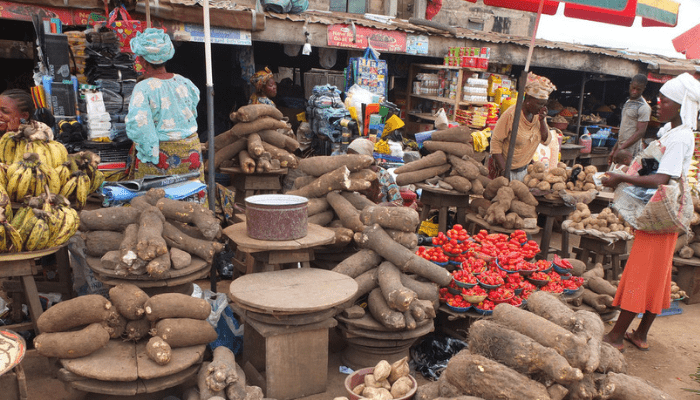
Meanwhile, the food inflation rate for the month under review in March 2024 was 40.53 per cent. This was driven by increases in prices of the following items: garri, millet, akpu uncooked fermented (which are under the bread and cereals class), yam tuber, water yam (under the potatoes, yam, and other tubers class), dried fish sardine, mudfish dried (under fish class), palm oil, vegetable oil (under oil and fat), beef feet, beef head, liver (under meat class), coconut, watermelon (under fruit class), Lipton tea, bournvita, milo (under coffee, tea and cocoa class).

The food inflation was highest in Kogi (48.62 per cent), Kwara (46.73 per cent), Ondo (45.87 per cent), while Nasarawa (34.03 per cent), Adamawa (33.61 per cent), and Bauchi (33.85 per cent) recorded the slowest rise.

Meanwhile, for April 2024, the urban inflation rate was 36.00 per cent, and the rural inflation rate in April 2024 was 31.64 per cent.

Cassava Republic accepts entries from Black women writers

Cassava Republic Press is accepting entries for its Global Black Women’s Non-Fiction Manuscript Prize.

This prize seeks to amplify the long tradition of Black women writers as knowledge-makers and critical thinkers. 

The contest will publish and champion global Black women writers who bridge the gap between ‘creativity’ and ‘theory,’ with their works adjudged to be rigorous, beautiful, creative and thoughtful.


Read Also:

Application opens for Daphne Caruana Galizia Prize for Journalism

Media Monitoring Africa accepts application for Isu Elihle awards

African Fact-Checking Awards open application 


Applicants must submit manuscripts that incorporate theory with personal essays or experiences.

The winner will receive a US$20,000 advance and a publishing contract with Cassava Republic Press. Two runner-up writers will each receive a US$5,000 advance and publication by Cassava Republic Press.

The deadline is June 30.

To apply click here.

BUA to finance Lokoja-Benin road under tax credit scheme – FEC

0

THE Federal Executive Council (FEC) has approved the dualisation of the Okpella section of the Lokoja-Benin road a the cost of N120 billion.

The project, FEC noted, would be financed by BUA Cement Plc under the tax credit scheme.

The Special Adviser to the President on information and strategy, Bayo Onanuga confirmed this development on his official X handle after the FEC meeting on Tuesday, May 14.

He said, “On day 2 of the FEC meeting, approval was given for the award of contract for the equalisation of Lokoja-Benin Road, Okpela Section, Lokoja-Benin, Dualised Auchi Section -Uromi Link Road and Lokoja-Benin Road, Ekpoma Section.”


Read Also:


Ononuga remarked that on the Lokoja-Okpella road, a fuel tanker fell into a river recently and was visible on social media with villagers having to swim to rescue the occupants of the tanker.

Onanuga disclosed the award of contracts for other road projects across the country which includes Kaima-Tesse, Kwara State, Benin-Agbor, Benin Byepass, and Ngaski-Wara in Kebbi State which were estimated to cost around N546 billion.

Furthermore, N230 billion was approved as a contract to Messrs CCECC to build a Bypass in Kano. The project was estimated to be completed within 36 months.

The ICIR reported that the tax credit scheme commenced through Executive Order 7 of 2019 by former President Muhammadu Buhari which established the Road Infrastructure Development and Refurbishment Tax Credit Scheme Order to last 10 years from implementation.

The order seeks to foster public-private partnerships for road construction and maintenance. It authorises private companies to finance road projects, thereby reducing the financial load on the federal government.

In return, these companies will receive tax credits equal to their total expenditure on the roads.


Tinubu officially suspends cybersecurity levy

NIGERIAN President Bola Tinubu has officially suspended the 0.5 per cent cybersecurity levy on electronic banking transactions.

The Minister of Information and National Orientation, Mohammed Idris, disclosed this on Tuesday, May 14, after the Federal Executive Council (FEC) meeting that lasted for two days.

He told journalists that the cybersecurity levy was discussed at the FEC meeting and after critical deliberation it was resolved the levy be suspended for now pending a review.

He expressed that the President was not insensitive to the feelings of Nigerians.

The cybersecurity levy is part of the Cybercrime (Prohibition, Prevention, etc) (Amendment) Act 2024, which approved that a levy amounting to 0.5 per cent of the value of all electronic transactions will be collected and remitted to the National Cybersecurity Fund, overseen by the Office of the National Security Adviser.

However, the government gave 16 forms of transactions that would be exempted from the charge.

“The matter was discussed at the meeting of FEC” adding that “ the President is not insensitive to the feelings of Nigerians and it was agreed that the policy be suspended while we work out a review of modalities for its implementation,” Idris added.

The ICIR reported on May 8 that the Central Bank of Nigeria (CBN) directed banks and other financial institutions to implement a 0.5 per cent cybersecurity levy on all electronic transfers.

The order was contained in a circular signed by Chibuzor Efobi, director of payments system management and director of financial policy and regulation, Haruna Mustafa, on Monday, May 6.

However, the controversial levy has sparked criticism among stakeholders as enforcing it would have worsened the hardships on Nigerians who are already overburdened by various taxes.

At its plenary session on Thursday, May 9, the House of Representatives disagreed with the apex bank on the levy and asked it to withdraw its order.

Other concerned Nigerians including BudgIT and the Socio-Economic Rights and Accountability Project (SERAP) had sued the apex bank over the planned implementation of the levy.

If the proposed cybersecurity levy had scaled through, an analysis by The ICIR shows that Nigerians would have been charge ₦5 on every ₦1,000 transferred; ₦50 on every ₦10,000; ₦500 on every ₦100,000; ₦5,000 on every ₦1,000,000; ₦50,000 on every ₦10,000,000; and ₦500,000 on every ₦100,000,000, and in would continue in that regard.

ASUU gives Tinubu 2-week ultimatum FG to meet its demands

THE Academic Staff Union of Universities (ASUU) threatened to embark on a nationwide strike over the federal government’s failure to meet its demands.

The nnion president  Emmanuel Osodeke, at a press conference held at the ASUU national secretariat in Abuja, on Tuesday, May 14, charged the government to act within two weeks to address all outstanding demands, including constituting a governing council for the universities.

The ICIR reports that in June, the National Universities Commission (NUC) dissolved the governing councils of all federal universities after a directive from President Bola Tinubu.

However, months later, ASUU argued that the dissolution is ‘illegal,’ noting that it has paved the way for various illegalities in the Nigerian university system.

While criticising the President Bola Tinubu-led Federal Government’s approach towards academic matters in Nigerian Federal Universities, it also objected to the recent salary increments of 35 per cent for professors and 25 per cent for other academics.

ASUU emphasised that salary awards could not replace a negotiated agreement, highlighting that the federal government/ASUU 2009 agreement encompassed comprehensive measures for a competitive university system.

Citing the ILO’s Convention No. 98 on collective bargaining, Osodeke noted the renegotiation efforts since 2017, which led to a draft agreement in 2021 under Nimi Briggs, and not approved by the former President Muhammadu Buhari administration.

According to Osodeke, available reports to its national executive council indicated that an increasing number of Nigerian academics died while thousands of others are nursing life-threatening ailments occasioned by work-related stress, pauperisation, and multidimensional insecurity.

The union said the press conference was prompted to inform Nigerians about the ongoing crisis in universities, “which began when former Minister of Labour Chris Ngige and his collaborators halted a negotiated agreement in 2021 after over five years of government engagement with ASUU.”

He further decried the erosion of public universities’ autonomy due to the “illegal dissolution of governing councils by the Tinubu and various state governments.”

The union chairman noted the development had led to unauthorised actions by university administrations, such as appointing vice-chancellors and managing finances without proper oversight.

Osodeke listed ASUU’s demands to include maintaining the sanctity of legally constituted governing councils for universities, renegotiating the 2009 federal government and ASUU agreement, providing revitalisation funds for public universities, paying all earned academic allowances and withheld salaries, and addressing promotion arrears.

Other issues are the proliferation of public universities, the non-payment of arrears of earned academic allowances and non-release of owed salaries, “creeping fascism” in some Nigerian universities and core curriculum minimum academic standard.

The ASUU chairman warned that failure to address the demands could lead to an industrial crisis.

He added that the union would reconvene after two weeks to review the situation and take decisive action.

Meanwhile, if the strike proceeds, it will be the first industrial action under the Tinubu administration since it assumed power on May 29, 2023.

The union went on strike five times in five years under Buhari.

The group was on strike in 2016, 2017, 2018, 2020, and 2022. However, a hitch-free academic year was recorded in 2023.

Police arrest singer Portable over alleged refusal to pay debt

POPULAR Nigerian singer, Habeeb Okikiola, widely known as Portable, has been arrested by the Lagos State Police Command.

He was arrested on Tuesday, May 14, for refusing to pay the debt he allegedly owed a car dealer in Lagos State from whom he bought a G-Wagon vehicle.

The singer had allegedly purchased a G-wagon worth 27 million naira, paid 13 million naira and refused to pay the 14 million naira balance, claiming the car was bad.

The car dealer reported the case to the police after all his efforts to get the balance from the singer failed.

Portable was arrested after the expiration of the 72-hour ultimatum given to him to turn himself in.

According to reports, the state police public relations officer, Benjamin Hundeyin, confirmed the arrest.

“Yes, Portable has been arrested. He bought G-Wagon for N27 million, paid N13 million and refused to pay the rest, claiming the vehicle was bad. We arrested him today,” Hundeyin said.

The singer is well known for making headlines for controversial reasons.

In March 2023, The ICIR reported how Portable resisted arrest and hurled insults at the men of the Nigeria Police Force.

He eventually presented himself to the police and was charged in court.

The court granted him N300,000 bail.

He became famous in 2021 after his hit song “ZaZoo Zehh” featuring Nigerian rapper, Olamide went viral.

He has also produced hit tracks including ‘All Eyes On Me’, ‘Clear Azaman’, ‘Neighbour’, ‘Ogo Forever’, among others.
He had his first international collaboration earlier this year with British rapper Skepta for the song, ‘Tony Montana’.