Home Blog Page 65

Iran won’t participate in 2026 World Cup – Minister

0

IRAN has announced it would not participate in the 2026 World Cup after the United States, co-hosting the tournament, carried out airstrikes on the country alongside Israel, Sports Minister Ahmad Donyamali said on Wednesday, March 11.

On Saturday, February 28, the US President Donald Trump confirmed that targeted operations were carried out, before reports later confirmed that Iran’s Supreme Leader, Ayatollah Ali Khamenei, was killed in strikes. 

Since the attacks began, Iran has reported that US and Israeli forces had bombed nearly 10,000 civilian sites, resulting in more than 1,300 civilian deaths since the war began on February 28.

Iran has since launched retaliatory attacks across parts of the Gulf region and Israel, escalating tensions. Several casualties have also been reported in these countries. 

The 48-team tournament is scheduled to take place in the United States, Mexico, and Canada from June 11 to July 19.

Considering that this corrupt regime has assassinated our leader, under no circumstances ​can we participate in the World Cup,” the minister reportedly told state television.

He added that the safety of Iranian children could not be guaranteed and that the current conditions would make participation impossible. 

“Given the malicious actions they have carried out against Iran, they have forced two wars on us over eight or nine months and have killed and martyred thousands of our people. Therefore, we certainly cannot have such a presence,” he said.

Iran had already secured a place in the tournament and was drawn in Group G with Belgium, Egypt, and New Zealand. All three matches are scheduled in the US – two in Los Angeles and one in Seattle. 

However, the president of Iran’s football federation, Mehdi Taj, has reportedly said it was unlikely the team would participate, although no formal withdrawal has been communicated.

“We cannot be expected to look forward to the World Cup with hope,” he said, noting that “sports chiefs” would soon convene their final decisions.

FIFA confirmed it was closely monitoring the situation, noting that “it’s premature to comment in detail, but we will track developments worldwide.”

What happens if Iran withdraws

If Iran pulls out, FIFA will decide on a replacement, potentially reshaping Group G. Article 6 of FIFA’s 2026 World Cup regulations gives the organisation broad authority. 

Regulation 6.5 states that if a team withdraws or a match cannot take place due to force majeure, FIFA can take any necessary action. Regulation 6.7 allows FIFA to replace a withdrawing team with another association at its discretion.

Potential replacements include Iraq and the United Arab Emirates. Iraq is set to play a continental play-off against Bolivia or Suriname for a World Cup spot. If Iran withdraws, Iraq could automatically advance, with the UAE taking Iraq’s play-off slot.

Iran welcome at 2026 World Cup, Trump says

Earlier, FIFA President Gianni Infantino said the US President had assured him that he welcomed Iran’s participation in the tournament. 

Infantino, who said he met with Trump, stated: “We also spoke about the current situation in Iran, ​and the fact that the Iranian team has qualified to participate in the FIFA ​World Cup 2026.”

“During the discussions, President Trump reiterated that the Iranian team is, of ​course, welcome to compete in the tournament in the United States.

“We all need ​an event like the FIFA World Cup to bring people together now more than ever, and ‌I ⁠sincerely thank the President of the United States for his support, as it shows once again that Football Unites the World.”

Follow the Money seeks investigative pitches

FOLLOW the Money is seeking investigative pitches from freelance journalists or reporters working with media outlets that are open to collaboration.

The organisation is looking for investigations that shed light on individuals, corporations, or institutions that abuse their power to the detriment of European society – whether in politics, finance, media, or beyond.

“We take our role as watchdog journalists seriously. That’s why we are always on the hunt for investigative stories that expose wrongdoing and corruption and hold the powerful to account”.

“We value well-crafted, hard-hitting journalism – and we pay for stories that are insightful, impactful, and deserve a wider audience”.

Selected investigative story pitches will be supported.

Interested applicants can apply here.

India, others may reject Tinubu’s ambassadors – Report

0

BARELY days after President Bola Tinubu approved the deployment of dozens of ambassadors to foreign missions, Nigeria’s diplomatic push is already running into turbulence.

India and several other countries are quietly signalling reluctance to accept some of the envoys, an emerging diplomatic hurdle tied to the shrinking timeline of the current administration, according to reports.

Punch reported that multiple senior officials in the Presidency and Nigeria’s foreign service revealed that New Delhi invoked a long-standing diplomatic practice: declining to receive ambassadors from governments with less than two years remaining in office.

At the centre of the standoff is career diplomat Muhammad Dahiru, whom Tinubu nominated as Nigeria’s envoy to India.

Sources familiar with the negotiations said the government of Narendra Modi had begun sending subtle signals that it might not grant the mandatory diplomatic clearance known as agrément for Dahiru’s posting.

“They don’t accept an ambassador from an administration that has less than two years in office. So, they are giving us that body language already. Some countries are reluctant to accept some people, not because of the individuals but because of time. They are already seeing the Tinubu government as an outgoing government.

“Their concern is that he has just one year left. What if he doesn’t win the election? Another government may come and remove them. We also understand that some countries have this policy. Any ambassador from an administration that has less than a year or two in office will not get accepted. And one of such countries is India,” Punch quoted a Presidency official as saying.

A second source who spoke with Punch, a senior official in the foreign service, corroborated India’s stance but suggested that Nigeria might still rely on its diplomatic ties with New Delhi to seek an exception.

According to the official, India’s position is guided by a longstanding practice that makes it difficult for ambassadors to be accepted when the sending government is approaching the end of its tenure.

The official added that political calculations within the host country could also influence the decision.

“Some of them may look at the political climate and try to read the direction things are going. They may conclude that the current administration could win the next election,” the source said. “They may even think the race may not be very competitive, especially with many political figures aligning with the ruling party. That could be one of the arguments the Nigerian government may advance.”

The official stressed that India remained the only country whose policy on short-tenure ambassadors had been clearly confirmed so far. Nevertheless, other countries might quietly adopt similar diplomatic conventions when deciding whether to grant agrément to Nigeria’s nominees, the official argued further.

The ICIR reported that under the rules of the Vienna Convention on Diplomatic Relations, no ambassador can assume duty in a foreign country without the receiving state formally approving the appointment.

Ironically, the diplomatic friction comes at a time when relations between Nigeria and India appear stronger than they have been in years.

Tinubu attended the 2023 G20 summit in New Delhi as a guest of the Indian government, where he held talks with Modi on defence cooperation, trade and investment.

In November 2024, Modi made his first visit to Nigeria, the first by an Indian prime minister since 2007. During the visit, both countries signed several agreements aimed at strengthening the India-Nigeria Strategic Partnership established in 2007.

Tinubu also conferred Nigeria’s second-highest national honour, the Grand Commander of the Order of the Niger, on Modi, an award previously given to only one foreign leader, Queen Elizabeth II.

Yet even strong diplomatic ties may not override established protocol.

Tinubu administration announced the deployment of 65 ambassadors last week.

For now, only two of Nigeria’s 65 nominees have received approval from host governments which are High Commissioner-designate Aminu Dalhatu for the United Kingdom and Ambassador Ayodele Oke for France. The fate of the remaining 63 envoys remains uncertain.

Among the high-profile nominees awaiting diplomatic clearance are former aviation minister Femi Fani‑Kayode, posted to Germany; commentator Reno Omokri, assigned to Mexico; former Katsina governor Abdulrahman Bello Dambazau, nominated for China; and Jimoh Ibrahim, a serving senator, tapped as Nigeria’s permanent representative to the United Nations.

Diplomatic sources said even if approvals eventually arrive, the timeline is tight, noting that some host countries could take months to complete background checks before granting agrément. In some cases, requests are simply ignored or quietly declined.

The ICIR reported that the delay traces back to a controversial decision taken early in Tinubu’s presidency. In September 2023, the government recalled all 83 ambassadors serving abroad, leaving Nigeria’s 109 diplomatic missions without substantive heads for more than two years. It took Tinubu more than two years to appoint replacements. 

Diplomats said that the proximity to the 2027 presidential elections often triggers caution among receiving states.

Nigeria’s next presidential election, scheduled by the Independent National Electoral Commission for January 16, 2027, casts a shadow over the appointments. Tinubu’s first term ends just four months after the poll, in May 2027.

Some officials cautioned that delays in the approval process could mean that a number of the envoys might not assume their posts until August 2026, leaving them with less than a year, about nine months before the next general election.

Earth Journalism Network offers 2026 media grants

INTERNEWS’ Earth Journalism Network (EJN) is offering grants to three or four media organisations in low and middle-income countries to support projects that strengthen media reporting on biodiversity issues.

This opportunity is open to journalist networks, media organisations, civil society organisations or academic institutions.

Although we will consider applications by NGOs or environmental groups looking to build the capacity of journalists to cover conservation issues, preference will be given to applications from or affiliated with professional journalists, media organisations and journalism schools.

Organiser says, “Projects funded by this grant should build public awareness of the threats to biodiversity and highlight conservation solutions by spreading quality news and information, with a focus on audiences in lower and middle-income countries”.

Projects can, but are not required to, build the capacity of journalists and communicators to report on threats to biodiversity and on conservation solutions, by building their skills, knowledge and networks.

For organisations proposing content production only, these activities must result in robust and in-depth outputs (for example, a series of podcasts, or a multi-part investigation). Applications that propose less than 10 stories will not be considered competitive, unless they also propose to include capacity-building activities as part of the project.

The deadline for applications is March 28, 2026. Interested applicants can apply here.

Nigerian footballer bags six-month jail in Norway, vows to appeal ruling

0

A NORWEGIAN court has sentenced Nigerian footballer Daniel Daga to six months in prison after finding him guilty of engaging in a sexual act without the other person’s consent.

The judgement was delivered on Tuesday by the Nordmøre og Romsdal District Court. Daga, who plays as a midfielder for Molde FK, was also asked to pay 10,000 Norwegian kroner in legal costs, which is about ₦1.45 million.

According to reports by TV 2 Norway, the court’s decision matched the punishment sought by prosecutors.

The 19-year-old footballer denied the accusation. His lawyer, Astrid Bolstad, said the player was unhappy with the outcome and would challenge the judgement.

“He is very upset about the verdict. He believes he is innocent and that everything happened with consent,” Bolstad told TV 2.

She added that the ruling was not final and that Daga planned to appeal the decision.

“The verdict is not legally binding yet. He should be treated like anyone else until the case is finalised,” Bolstad said, adding that the player had continued to train in recent weeks.

Following the judgement, Molde said the matter was serious and affected everyone involved. The club confirmed that Daga would not be part of its matchday squad for now while the legal process continues.

“This is a very difficult case for everyone involved. Molde Football Club has a responsibility as an employer to take care of our employees in a responsible manner; while also having great respect for the seriousness of the case and the burden it places on all affected parties,” the club said.

“In light of the situation and the ongoing legal process, the club has decided that the player will not be part of the matchday squad until further notice.”

Daga joined Molde in 2025 and has made several appearances for the Norwegian side, scoring three goals. Before his move to Europe, he played in Nigeria’s domestic league for Enyimba FC after earlier stints with FC One Rocket and Dakkada FC.

At the international level, Daga has represented Nigeria with the Nigeria U‑20 national football team and was the youngest player named in the country’s squad for the 2023 FIFA U‑20 World Cup.

He played in all of Nigeria’s matches before the team was knocked out in the quarterfinals by South Korea U‑20 national football team.

With the appeal expected to begin soon, the final outcome of the case will depend on the decision of the higher court.

Rising fuel prices push transport fares up across Abuja

0

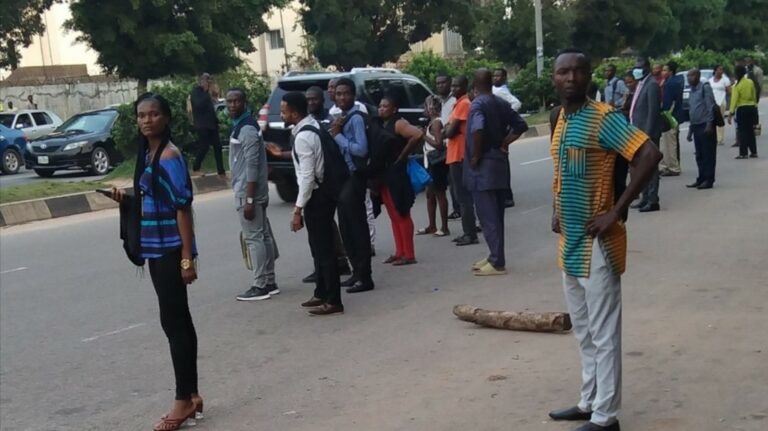
RESIDENTS of Abuja are facing fresh pressure on transportation costs as the pump price of petrol fluctuates between N1,270 and N1,330 per litre in parts of nation’s capital on Tuesday, March 10.

The hike in petrol price has attracted commensurate leap in transportation fares, as transport operators adjusted fares across major routes.

A survey conducted by The ICIR on Tuesday in Kuje Area Council shows varying pump prices across filling stations in the satellite community. At Bovas Filling Station, petrol was sold for N1,270 per litre, while AA Rano dispensed the product at N1,330 per litre.

At Kuje Oil and Gas, the product sold for N1,300 per litre as motorists scrambled to fill their tanks amid fears of further increases. The NNPC station in the town did not operate in the early hours when this survey was conducted.

Along the Airport Road, AYM Ashafa by City Gate dispensed the product for N1,330; Rainoil filling station in Dutse along Bwari road sold it for N1, 300 per litre: Nusynegy in Jikoyi sold at N1,090: while Fyne Field in Apo Resettlement dispensed at N1,350.

The new impact is already visible in the daily commute of residents across the capital city.

The ICIR reports that from Kuje to Lugbe which was previously N700, is now between N800 to N900 depending on the time of day and availability of vehicles.

From Kubwa to Berger, previously N800, is now N1,000. Commuting from New Yanya to Ministry of Finance which was until now N800 is currently N1,000.  Apo Resettlement to Gudu which was previously N400 is now N500. Meanwhile, the fare from Gudu to Lugbe which was usually N500 jumped to N800 Tuesday morning due to unavailability of vehicles.

According to reports, commercial drivers said that the fare adjustment was unavoidable because of the fuel hike, noting that they would run at a loss if they failed to do so.

In addition to transport fare hike, it is expected that the increase in petrol price will affect the cost of food and other necessities, further worsening the conditions of millions of poor Nigerians.

The current fuel price hike is linked to the ongoing conflict involving Iran, the United States and Israel, which has disrupted global energy supply chains.

Attacks on oil facilities and shipping routes in the Gulf region have forced partial shutdowns of major energy infrastructure and disrupted transport through the Strait of Hormuz, a route responsible for about 20 per cent of the world’s oil supply.

These disruptions have triggered spikes in global oil prices, with crude briefly climbing above $100 per barrel during the escalation of the conflict.

The volatility in crude prices quickly affected petrol markets globally, including Nigeria, where domestic pump prices depend heavily on international benchmarks and refinery’s running costs.

On Tuesday, US President Donald Trump attempted to calm global markets, saying the war with Iran could end “very soon,” a remark that temporarily pushed oil prices lower after earlier spikes.

Trump’s comment triggered a reduction in global oil prices, with crude briefly reducing to $90 per barrel.

Trump had defended the surge in energy prices as a temporary consequence of the conflict, arguing that short-term economic pain was necessary for security and stability.

Despite the reassurance, analysts warn that the market remained volatile, especially with attacks on oil facilities and disruptions to shipping routes in the Middle East.

Energy experts said Nigeria was particularly vulnerable to global oil price shocks despite being an oil-producing country.

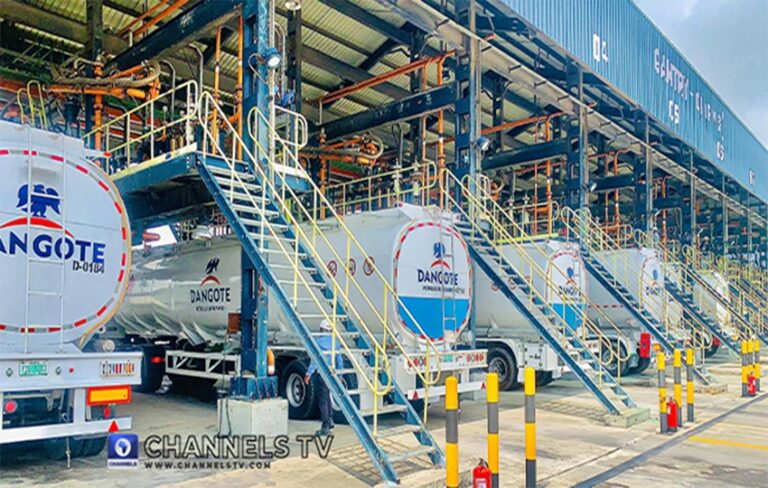
On Monday, March 9, The ICIR reported that a litre price of petrol might soon hit N1,500 in Nigeria after the Dangote Petroleum Refinery raised its ex-depot (gantry) price of petrol to N1,175 per litre.

The hike, the third recorded in a week, came shortly after reports indicated that another rise in petrol prices was likely, especially after the refinery briefly stopped petrol sales on Sunday.

This development has pushed retail prices upward across the country with industry experts warning that if the global crisis continues, petrol could climb even higher, potentially pushing transport fares and the general cost of living upward.

2027: NAF to support INEC with drones, other logistics

0

THE NIGERIAN Air Force (NAF) has pledged to support the Independent National Electoral Commission (INEC) with drones, unmanned aerial vehicles, and other intelligence tools to monitor the 2027 general elections and help spot security threats.

The Chief of the Air Staff, Sunday Aneke, an Air Marshal, said the Air Force was “fully mobilising its aircraft, surveillance drones and intelligence assets to support the commission” and was ready to provide “massive logistical, intelligence and aerial security support to the INEC to guarantee credible, safe and well-coordinated polls in 2027.

“The world has changed. Drones and UAVs are game changers. Some of these assets can remain airborne for two to three days, monitoring areas of interest and providing intelligence that can help security agencies respond quickly,” Aneke explained.

He added that with proper coordination between INEC and security agencies, aerial monitoring could detect threats early and prevent election violence.

The Air Chief said his organisation was also preparing its aircraft to quickly move election materials and personnel across the country. “We know how large Nigeria is and the logistical challenges involved in moving materials across difficult terrain. That is why we are preparing our aircraft so that when INEC calls, we will be ready.”

“Some of the Air Force’s C-130 aircraft are undergoing maintenance abroad, but arrangements are being made to deploy other available aircraft to ensure timely delivery of both sensitive and non-sensitive election materials,” he stated.

Aneke emphasised that logistics planning remained the backbone of both military operations and electoral success.

He also proposed joint rehearsals and simulation exercises with INEC ahead of the elections, noting that “in the military, anything you rehearse before execution performs ten times better. Simulation helps you detect faults early so you can fix them before the real operation begins.”

The INEC Chairman, Joash Amupitan, a professor, described the Air Force’s support as a “major relief” for the commission, highlighting the need for effective logistics and security arrangements. He said upcoming off-cycle elections in Ekiti and Osun states would serve as tests ahead of the 2027 polls.

“We are happy that the Air Force has stepped forward with its capabilities, especially in reaching difficult terrain and providing aerial monitoring,” Amupitan said.

He added that “an election can only be as good as its logistics” and confirmed that INEC will set up a joint committee with the Air Force to strengthen planning and coordination for the elections.

Relief as Dangote cuts fuel prices

0

Dangote Refinery has lowered petrol and diesel prices by N100 as costs are expected to decrease further with oil prices falling below $90 on Tuesday, March 10.

The slash is not unconnected with President Donald Trump’s latest signals confirming the de-escalation of the United States-Iran conflict.

In the latest pricing template issued by Dangote Refinery on March 10, the price of petrol at the gantry was reduced by ₦100, bringing it down to ₦1,075 per litre from the earlier price of ₦1,175 per litre.

The refinery said petrol price for coastal supply would be set at ₦1,050 per litre, due to maritime distribution expenses.

Similarly, the cost of diesel has been lowered to ₦1,430 per litre at the gantry. This marks a reduction of ₦190 from the previous price of ₦1,620 per litre.

The refinery pointed out that the prices at the gantry did not include fees from the Nigerian Midstream and Downstream Petroleum Regulatory Authority (NMDPRA).

Earlier on Monday, Trump signalled the conflict with Iran could end “very soon.”

Despite selling over $100 on Monday, oil prices plunged as much as 10 per cent on Tuesday before paring losses, as investors assessed comments from Trump on the conflict in the Middle East and on oil flows through the critical Strait of Hormuz.

Initial price hike had pushed petrol price above N1,300 at retail outlets in several parts of the country while diesel sold for N1,700.

Nigerians have had to endure intermittent price surges of fuel which triggered higher transportation fares across the country.

However, the drop below $90 per barrel of Brent crude on Tuesday could signal lower gasoline prices in several parts of Nigeria.

“There’s the trading and distribution aspect of the refining, and if the war de-escalates, it will impact pricing,” the President of Petroleum Retail Owners Association of Nigeria (PETROAN), Billy Gillis-Harry, told The ICIR.

He stressed that increased local refining could have also helped to cushion the pricing effects on Nigerians.

The Chief Executive Officer (CEO) of Financial Derivatives, Bismarck Rewane, also said that the slump in the global oil price should reflect on the local pricing.

“We expect the prices to gradually begin to go down further with the same push that the prices were raised over the past few days to lessen the burden on the people,” he said.

Meanwhile, Trump, who had signalled on Monday that the conflict with Iran could end soon warned later in the day that Tehran would be hit “twenty times harder” if it attempted to halt oil flows through the Strait of Hormuz.

Located between Oman and Iran, the Strait is a vital transit route for global energy markets.

Roughly 13 million barrels passed through the waterway in 2025, accounting for about 31 per cent of global seaborne oil flows, according to Kpler.

It connects major Gulf producers, including Saudi Arabia, Iran, Iraq and the United Arab Emirates, to the Gulf of Oman and the Arabian Sea.

“This is a gift from the United States of America to China, and all of those nations that heavily use the Hormuz Strait. Hopefully, it is a gesture that will be greatly appreciated,” Trump said in his post.

The comments come as a spokesperson for Iran’s Ministry of Foreign Affairs warned on Monday that oil tankers transiting the Strait of Hormuz “must be very careful.”


Nursing students protest after school hiked tuition by over 500%

0

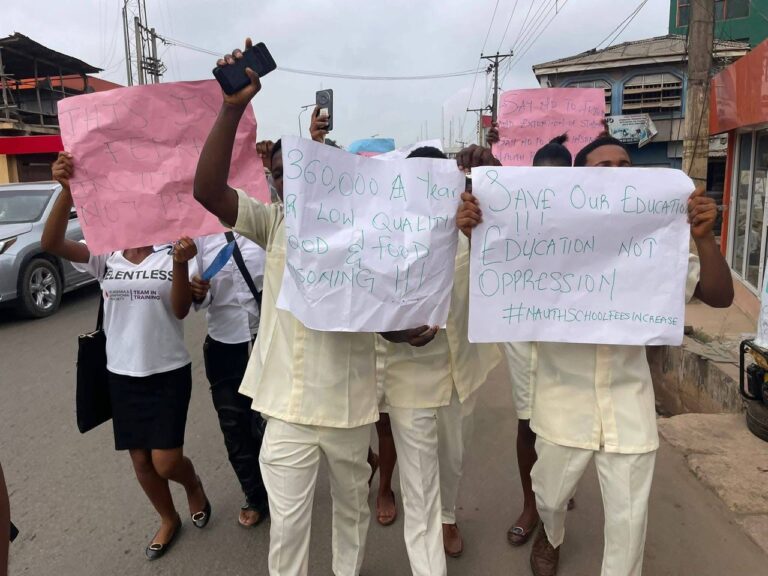
STUDENTS at the College of Nursing Sciences, Nnamdi Azikiwe University Teaching Hospital (NAUTH), Nnewi, Anambra State, on Tuesday, March 10, staged a peaceful protest over a sharp increase in tuition fees.

Videos circulating on social media showed how the students marched through parts of the town, chanting and carrying placards while calling on the school management to reverse the increment.

“Save our education. Education is not oppression,” some of the inscriptions on their placards read, while others had “No to fraud and extortion of students.” 

The students alleged in one of the placards that the school fee was increased from about ₦90,000 to ₦580,000, placing a heavy burden on them and their families.

Internal memo confirms fee increment

The protest followed an internal memo issued by the management announcing the hike in school fees across all levels of the College of Nursing Sciences.

The hike, reported by Daily Sun on January 23, 2026, showed that the adjustment was part of efforts to upgrade the institution.

“The hospital management and the Board of College of Nursing, in an ongoing effort towards upgrading the institution to a reputable monotechnic, has approved an upward review of students’ school fees across all levels in the college,” the memo, signed by the Chairman of the Board of the college, O. I. Ezejiofor, read.

Memo, announcing the upward review of school fees
Memo, announcing the upward review of school fees for NAUTH students, Credit: Daily SUn

It added that the new fee structure would take effect immediately for the 2025/2026 academic session.

According to Daily Sun, previously, a 100-level student’s total fees amounted to N250,000, which included a N100,000 tuition fee, combined maintenance and caution fees of N30,000, a N10,000 library fee, and N60,000 for medical exams and services. Other costs under the old structure included an examination fee of N20,000, and a portal fee of N10,000, as well as a N10,000 hostel maintenance fee.

However, under the new “annual regular fee” structure, the total has risen to N580,000.

The new breakdown consists of a N250,000 tuition fee, a N50,000 maintenance/caution fee, and a N50,000 library fee. Examination fees have tripled to N60,000, while the portal fee has doubled to N20,000. 

Breakdown of the annual regular fee. Credit: Daily SUn

Additionally, the school adjusted charges including a N30,000 medical fee, a N30,000 transport fee, a N50,000 accreditation fee, and N40,000 accommodation maintenance fee.

However, students argued that the revised fees are unaffordable and come amid existing financial pressures.

US warns citizens in Nigeria of terror threat

0

THE United States Government has warned its citizens in Nigeria of a possible terrorist threat targeting US diplomatic facilities and American-affiliated schools, as tensions continue to soar amid ongoing Middle East crisis.

In a security alert issued late Monday, the US Embassy in Abuja advised American nationals to exercise heightened caution when visiting US facilities, including the embassy in Abuja and the US Consulate General in Lagos, as well as schools and institutions associated with the US.

“Threat to US facilities and schools: The US Embassy in Abuja informs US citizens of a possible terrorist threat against US facilities and US affiliated schools in Nigeria.  The Embassy recommends that US citizens take additional precautions when traveling to the US Embassy, the US Consulate General in Lagos, and US affiliated schools, to include varying times and routes.

“Increasing awareness of your surroundings, avoiding predictable routines, and reviewing general security precautions with your family can help reduce your risk,” the statement read.

The embassy said the warning was prompted by intelligence indicating a potential terrorist threat against US interests, though officials did not disclose specific details about the nature of the risk. It urged American citizens to remain vigilant, limit unnecessary movements near US government facilities and monitor local media for updates as the situation evolves.

“Be aware of your surroundings, keep a low profile, review your personal security plans, vary your regular routes, keep your cell phone charged in case of emergency, stay alert in public places, avoid crowds and demonstrations, familiarize yourself with emergency exits when entering buildings. For additional information about threats and risks to travelers in Nigeria, please visit the Nigeria Country Information page   on travel.state.gov,” it added.

This alert comes amid heightened global tensions following coordinated strikes by the US and Israel against Iran, which have raised fears of retaliation or unrest in several countries.

Diplomatic missions in Nigeria have been on increased alert since the escalation of hostilities, with security officials monitoring possible demonstrations and threats that could target Western interests.

The warning also follows a series of pro-Iran demonstrations in parts of Nigeria, particularly in the northern region where there is a sizable Shi’ite Muslim population with ideological ties to Iran.

On Tuesday, March 3, members of the Islamic Movement in Nigeria, commonly referred to as Shi’ites, staged a peaceful protest in Potiskum and Nguru Local Government Areas of Yobe State. The protesters condemned the reported killing of Ayatollah Khamenei, describing him as a revered spiritual leader.

The group also protested in Niger, Sokoto, Kaduna, Bauchi, Gombe and Lagos states, condemning what it described as joint US–Israel aggression against Iran. During a procession in Niger State on Sunday, led by IMN leader Ibrahim El-Zakzaky, demonstrators waved Iranian flags and chanted solidarity slogans, vowing continued resistance.

The ICIR reported on March 4 that security was tight across Nigeria’s capital following a planned protest by Shi’ite members. The IMN had announced plans to stage demonstrations in Abuja in solidarity with Iran following coordinated US–Israel strikes that Iranian media confirmed led to Khamenei’s death.