Home Blog Page 792

Grid electricity set to return to Ekiti LGAs eight years after

THE Benin Electricity Distribution Company (BEDC) is on the verge of restoring grid electricity to Ekiti East and Aiyekire (formerly Gbonyin) Local Government Areas (LGAs) in Ekiti State after eight years.

Communities in the two neighbouring LGAs, including Araromi-Ugbesi, Ahan, Omuo-Oke, Araromi-Oba, Ikun-Araromi, Ilasa, Eda-Ile, Omuo, and Isinbode, have been in total darkness since 2014.

Senator who represented Ekiti South in the Eighth and Ninth Senate, Biodun Olujimi and Olufemi Bamisile, representing Emure/Gbonyin/Ekiti East in the House of Representatives, are some prominent citizens from the LGAs.

In May 2022, The ICIR reported how the area had been in a total blackout despite efforts by the two lawmakers (Olujimi and Bamisile) to ensure the LGAs returned to grid electricity.  

The outage has crippled socio-economic activities, pushed many youths out of the area and slowed growth and development. 

Many residents with the means use solar power, but most solar power devices cannot service some electrical appliances.

The ICIR reporter visited the LGAs recently and noted that the Benin Electricity Distribution Company (BEDC) has restored power to the high-tension cable to connect homes and offices.

But there is much work to be done on transformers and several wires taking the light into homes as many dangled in places where they are kept after falling off from electricity poles.

Besides, the Olomuo of Omuo Kingdom, Oba Adejuwon Omonigbehin (Okinbaloye II), told the reporter in his palace on Saturday, August 26, that the BEDC was asking for the payment of N95 million allegedly owed by his community.

He said the demand for the payment was one of the reasons the restoration could be delayed.

“BEDC has not added any value to electricity in Omuo, but you see them bringing outrageous bills. For the past eight years, there has been no electricity in Omuo, and they continued to bill us. As the last count, they said we owed N95 million. This is the problem. BEDC has that penchant for billing for the light they didn’t supply. 

“No sane person can pay that kind of money. We didn’t use any light, and they are billing us. We recollect that some consumers still receive bills at the end of the month even when there has been no light for the past eight years in Omuo. That is the situation.”

He noted that discussions were ongoing to resolve the issue.

 He also confirmed there was light on the high-tension wire.

He said work needed to be done on transformers because thieves had stolen some while others had been damaged. 

“There is a need to look at the transformers and do the necessary things to prevent any danger to the people,” he stated.

The ICIR contacted BEDC spokesperson Kayode Brown over the allegation that the company issued bills without supplying light. He stated that the allegation was not true.

“Please get a copy of the bill they got when there was no light. Every bill is dated, and we know when their light was severed. That will assist you in making an informed decision,” he said.

The reporter spoke with many residents in the two LGAs who said BEDC had issued the bills before stopping the power supply to the LGAs.

This transformer was overgrown with a thick bush in Omuo in 2022 but the bush has now been cleared in preparation for the restoration of power supply in town. See picture below. Photo credit: The ICIR/Marcus Fatunmole
Here is the above transformer overgrown with weeds in Omuo in 2022. The weeds have now been cleared in preparation for power restoration to the community. Photo credit: The ICIR/Marcus Fatunmole

According to them, the company supplied them with a very low voltage that could not power anything for several years and issued bills for those years, which they vowed not to pay.

In the earlier report, Brown confirmed the residents’ claim in his conversation with The ICIR.

He had said, “There was nothing like AEDC or BEDC when the issue occurred. What we had then was PHCN (Power Holding Company of Nigeria). The only thing was that we were feeding them from the Okenne Transmission Station. They happened to be at the end of that particular feeder. Anytime there was a problem with the feeder, they opened them (they wouldn’t have light). 

“The second thing is that it was usually very low before the power got to them. They claimed that it was not useful to them, so they refused to pay. We were now incurring too much debt at the Okenne Transmission Station. At that point, we had to cut off. We said there was no need to give them what was not useful to them. We had to disconnect.”

Brown’s claims are the reasons the LGAs have been without a power supply for eight years.

Speaking with The ICIR in the earlier report, the Commissioner for Infrastructure and Utilities in Ekiti State during the administration of former Governor Kayode Fayemi, Bolaji Aluko, a professor, averred with the LGAs’ position on low power voltage.

He explained that BEDC, which distributes electricity in Ondo, Delta, Edo, and Ekiti State, got nine per cent of the power sent to the national grid.


READ ALSO:


According to Aluko, who hails from Aiyekire, one of the affected LGAs, the allocation was not bad because 11 discos shared the power generated in the country.

“Of that nine per cent, only 22 per cent is given to Ondo and Ekiti states, while Edo and Delta states share the remaining 78 per cent. Of the 22 per cent sent to Ondo and Ekiti States, only 10 per cent comes to Ekiti State.”

He explained that Ekiti State was not on the national grid because the state did not have any 330 KV line, adding that all the 133 KV lines in the state came from Ondo. 


Sexual abuse: Health concerns stall arraignment of UNILAG lecturer

0

A LECTURER at the University of Lagos (UNILAG), Kadiri Akeem Babalola, accused of raping a 20-year-old female student, has yet to be arraigned due to health concerns.

Public Relations Officer (PRO) of the Lagos State Police Command Benjamin Hundeyin disclosed this to The ICIR on Thursday, September 14.

“He has not been arraigned yet due to his deteriorating health. He will be arraigned once the doctor certifies him fit for a court trial,” Hundeyin told The ICIR.

Babalola, an Associate Professor at the University, was accused by the student of raping her on August 16, 2023, when she visited his office to sort out academic issues.

A social media user, Deji Lambo, disclosed via X on Wednesday, September 6, that the case was being followed up by a Non-Governmental Organisation (NGO), Inclusive Social Welfare and Empowerment Foundation (ISWEF), and Babalola confessed to perpetrating the crime.

“InclusiveSWEF reported the case to the Gender Unit of the state police command, and through the OC Gender, the state CP, Idowu Owohunwa, issued a warrant of arrest for Babalola through the state High Court and involved the Vice Chancellor, UNILAG.

“The VC was given seven days to produce Babalola, and when the VC invited the randy lecturer for questioning, InclusiveSWEF said he admitted to committing the crime. The VC informed the Police through the school’s Chief Security Officer, and Babalola was arrested,” Lambo posted.

Hundeyin confirmed the incident by sharing Lambo’s post, noting that the accused would “appear in court in the coming days.”

Babalola is one of many male lecturers in Nigerian universities accused of rape or sexual harassment in 2023 alone.

On Monday, August 15, female University of Calabar Law faculty students staged a protest within the school premises against sexual harassment and intimidation by Dean Cyril Ndifon.

The students carried placards that read, “Law students are not bonanza; Prof. Ndifon should stop grabbing us. The Faculty of Law is not a brothel,” “Ndifon must go for our sanity,” among other inscriptions.

The University suspended Ndifon on August 17, his second suspension for sexual harassment since 2015, when he was accused of raping a final-year student.

Students, including Frank Enor, Otora Agbor, Elvis Okorn, and Okoi, also named some lecturers in other departments within the school.

At the Nnamdi Azikiwe University, Awka, Anambra state, two lecturers were also accused of sexual harassment by an anonymous student.

Similarly, two lecturers at the University of Abuja (UNIABUJA) were dismissed in July over issues of sexual harassment.

In 2015, a part-time lecturer of UNILAG, Afeez Baruwa, was arraigned for raping an 18-year-old girl seeking admission into the school.

Another lecturer at the institution, Boniface Ighenghu, was also accused of sexually harassing a reporter disguised as a 17-year-old student seeking admission into the university in 2019.

A 2018 World Bank Report stated that 70 per cent of female graduates of Nigerian universities said they had been sexually harassed by lecturers and male students while in school.

Tinubu appoints 45-year-old Adedeji as FIRS chairman

0

PRESIDENT Bola Ahmed Tinubu has approved the appointment of Zaccheus Adedeji as the new Acting Executive Chairman of the Federal Inland Revenue Service (FIRS).

A statement by the president’s spokesman, Ajuri Ngelale, on Thursday, September 14, directed the erstwhile chairman of the Service, Muhammad Nami, to proceed on three months of pre-retirement leave, as contained in the Public Service Rule (PSR) 120243, with immediate effect.

This three-month leave will culminate in Nami’s retirement from service on December 8, 2023.

Part of the statement read: “Hon. Zaccheus Adedeji is hereby appointed in acting capacity for 90 days before his subsequent confirmation as the substantive Executive Chairman of the Federal Inland Revenue Service for a term of four years in the first instance,” read Ngelale’s statement.”

According to the President’s directive, the new appointment takes immediate effect.

Adedeji, 45, is a native of Oyo State and a first-class graduate in accounting from the Obafemi Awolowo University.

He had served in different capacities, including being a former Executive Secretary/CEO of the National Sugar Development Council (NSDC).

Also, in 2011, Adedeji was appointed the Commissioner for Finance by the late Oyo State Governor Abiola Ajimobi, making him the youngest person ever to assume such a position in the state’s history.

Following his service terms as the Oyo State Commissioner of Finance and the Executive Secretary/CEO of the National Sugar Development Council, he served as the Special Adviser to the President on Revenue.

LP reclaims Reps’ seat in Delta, as Appeal Court sacks PDP’s Elumelu

0

LABOUR Party (LP) has reclaimed the Aniocha/Oshimili Federal Constituency seat in Delta State. 

On Thursday, September 14, the Court of Appeal in Abuja sacked Ndudi Elumelu of the People’s Democratic Party (PDP) as the winner of the 2023 election for the constituency and declared LP’s candidate, Ngozi Okolie the winner.

The Appeal Court, in its judgement, set aside the decision of the National and State Houses of Assembly Election Tribunal in Asaba that declared Elumelu the constituency seat winner.

The ICIR reported in July that the tribunal declared Elumelu, the former minority leader of the House of Representatives, winner of the constituency seat and nullified the election of the LP’s Ngozi Okolie. 

Okolie had been inaugurated as the member representing the constituency.

In a petition referenced EPT/DL/HR/06/2023, Elumelu had asked the tribunal to disqualify Okolie for not being adequately sponsored by the LP. 

He added that Okolie did not resign as a public office holder before contesting the election.

In the judgment, the three-member tribunal panel headed by A.Z. Mussa nullified the declaration of Okolie as the election winner by the Independent National Electoral Commission (INEC).

The Tribunal held that the LP did not duly sponsor Okolie and that he was not a party member as of May 28, 2022, when the primary that made her fly the party’s ticket at the election was held.

After the tribunal’s judgement, Okolie approached the Appeal Court to challenge the decision.

In the election, Elumelu polled 33,456 votes, while the LP candidate got 53,879 votes to emerge the winner, as announced by INEC returning officer, Kenneth Ibe, a professor.

1

Nigeria’s PMS price hikes raise product smuggled into Benin by 60%

0

RECENT hikes in premium motor spirit (PMS) prices in Nigeria have translated into significant increases in the price of smuggled gasoline in Benin by about 60 per cent, exerting pressure on the country’s inflation, the International Monetary Fund (IMF) disclosed in a report.

The report contains the findings of the IMF officials who visited the country from September 6 to 12 to assess recent economic developments and gauge progress in commitments under Benin’s Fund-supported programme.

Nigeria recently raised the pump price of petrol from about N184 per litre to about N550 and later to over N600.

PMS pump price had an equivalent of N381 in Benin compared to Nigeria’s N189 before the fuel subsidy removal, according to KPMG in its ‘Removing Fuel Subsidies in Nigeria’ report, released in June.

“Indeed, in response to the PMS subsidy removal by President Bola Tinubu, pump prices in the Republic of Benin almost doubled from 450 CFA to 800 CFA, underscoring the widespread belief that significant quantities of subsidised PMS were smuggled out of Nigeria into neighbouring countries,” it added.

A check by The ICIR shows 800 CFA to naira approximates N969.

The porous Nigerian borders, spanning over 17,000 kilometres, allow petroleum products to be smuggled into Benin and other neighbouring countries.

A Daily Trust report showed that black marketers always have a field day along the various unmarked routes where smugglers operate across towns in Adamawa, Katsina, Oyo, Ogun, and others.

According to the report, smugglers deploy various strategies to fleece Nigeria of its scarce petrol while flooding neighbouring countries with the product for a huge profit.

TheCable on June 4 reported that petroleum product from Nigeria was regularly smuggled into neighbouring countries, including Cameroon, Ghana, Benin Republic and Sudan.

The federal government of Nigeria’s e-border surveillance project has remained incomplete four years after the last Federal Executive Council (FEC) approved N52 billion to purchase e-border surveillance systems for the country, The ICIR reported.

According to the IMF team, its Executive Board had on July 8, 2022, approved “a blended arrangement under the Extended Fund Facility (EFF) and Extended Credit Facility (ECF) for Benin for US$638 million, the equivalent of 391 per cent of quota to help meet pressing financing needs and support the country’s progress towards the Sustainable Development Goals.”

The country’s gross domestic product was 6.3 per cent in the first half of the year; however, the Beninese economy faced headwinds from Niger border closure amidst regional sanctions after the recent coup and higher gasoline prices following pump price hikes in Nigeria.

Budget support to Benin from development partners is expected to be larger than planned, which could unlock the room for additional spending in these challenging times.

“The authorities are preparing a draft 2024 budget in line with their broad objective of converging to the West African Economic and Monetary Union (WAEMU) deficit norm of 3 per cent of GDP by 2025.

“They are also developing a medium-term revenue mobilisation strategy to support fiscal consolidation while meeting Benin’s large development needs,” IMF said.

Ministry honours dPRC for empowering women

0

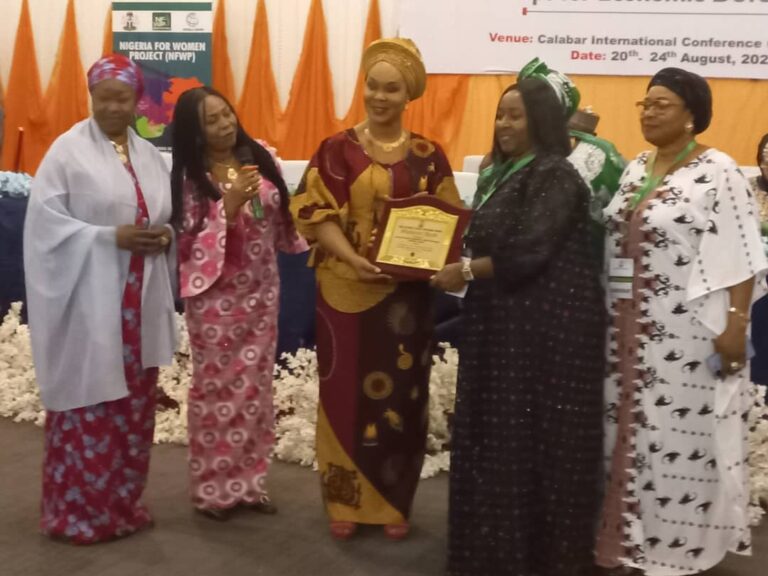
THE Federal Ministry of Women Affairs (FMWA) has honoured the development Research and Projects Centre (dRPC) for supporting Women Economic Empowerment (WEE) policy.

The award was based on dPRC’s Partnership for Advancing Women in Economic Development (PAWED) project, which aims at building sustainable advocacy around WEE interventions, said the Minister of Women Affairs, Uju Kennedy-Ohanenye, while awarding a national medal of recognition on dRPC in Abuja recently.

“The recognition bestowed upon the dRPC-PAWED by the National Council on Women’s Affairs is a testament to their exceptional dedication and impact. It highlights the pivotal role of civil society organisations in driving positive change and transforming women’s lives in Nigeria.

“This recognition will undoubtedly inspire other organisations and stakeholders to support women’s economic empowerment initiatives nationwide,” the minister said.

The Federal Government approved the WEE policy in May to improve women’s inclusion in economic development.

The policy was introduced due to gaps in previous efforts by the government to address a lack of gender inclusion.

“The Federal Government has identified the lack of a cohesive WEE policy and action plan as one of the most glaring policy gaps in its efforts to empower women. Despite initiating several multisectoral policies and plans targeting a wide range of issues, including WEE, Nigeria has never developed a stand-alone WEE policy document.

“Several studies have shown the need for a WEE policy to serve as a blueprint for all women’s economic interventions in diverse areas, including finance, entrepreneurship, climate change, agriculture, technology and education, to chart a course for completely transitioning women from having limited economic power, voice, and choice to having the skills, resources, and opportunities required to access and compete equitably in markets, as well as the agency to control and benefit from economic activities,” the WEE policy document read.

The World Bank 2018 Women Economic Empowerment Study shows that the non-inclusion of females can limit a nation’s development.

DisCo confirms national grid collapse as total blackout hits Nigeria

0

THE Enugu Electricity Distribution Company Plc (EEDC) has confirmed that Nigeria’s electricity grid collapsed in the early hours of Thursday, September 14, at about 6:41 a.m.

The EEDC, one of the distribution companies (DisCos), confirmed this in a tweet, “Notice of Total System Collapse’ shared on its handle and signed by its head of corporate communications, Emeka Ezeh.

According to Ezeh, the grid was restored to around 273 megawatts at about 4 a.m. and went up to 598:50 megawatts before crashing again to 1.60MW at 7 a.m.

“A total system collapse occurred at 12:40 a.m. today, September 14 2023. This has resulted in the loss of supply currently being experienced across the network.

“Due to this development, all our interface TCN stations are out of supply, and we are unable to provide service to our customers in Abia, Anambra, Ebonyi, Enugu and Imo States,” he said.

Ezeh added that the EEDC awaited detailed information on the collapse and supply restoration from the National Control Centre (NCC), Osogbo.

With the collapse, many Nigerians will further be without grid electricity as the electricity supply in the country has been epileptic, and the grid is collapsing month after month.

The ICIR reports that the Nigerian power sector has been going through numerous challenges despite privatisation, with its value chain of generation, transmission and distribution accessing many interventions from the World Bank.

The federal government has spent more than N1.6 trillion intervening in the power sector, post-privatisation, due to illiquidity in the industry, The ICIR reported.

Amidst the perennial collapse of the national grid, many households and businesses are still faced with estimated billing, paying for the bills they did not consume.

Calls by stakeholders in the industry to have every household and business metered in a privatised electricity market have continued to hit the rock.

Data obtained from the Nigeria Electricity System Operator, the semi-autonomous arm of the Transmission Company of Nigeria (TCN), showed that Afam VI, Dadinkowa, Ibom Power, Jebba, Olorunsogo generated 0.70MW, 0.00MW, 32.90MW, 240MW and zero respectively, the Vanguard reported.

While the system, managed by TCN, initially collapsed at 12:40 a.m. midnight and was in the restoration process, the grid operated from Osogbo in Osun State went down again at 6:41 a.m., crashing to 1.60 megawatts, the Guardian also reported.

Meanwhile, the minister of Power, Adebayo Adelabu, promised Nigerians an improved power supply nationwide soon.

The minister was quoted to have said, “Within the next six months, there would be a major addition to the national grid, in terms of the hydropower plant, that is, the Zungeru 700mw in Niger State that is about to be completed. This will be the biggest one in sub-Saharan Africa when completed.

“The Kainji Dam that we all grew up to know supplies about 460mw, Shiroro Dam supplies about 520mw. I will do everything to ensure that the Zungeru Power Plant is inaugurated and adds 700mw to the national grid.”

Oyo reacts to ICIR’s report on road project awarded to a two-month-old company 

0

OYO State Government has reacted to The ICIR-funded report exposing how it awarded the construction of the Ibadan Circular Road project to a company with no prior road construction experience.

The report titled ‘Intriguing tale of Oyo’s N138 billion Circular Road contract award to a two-month-old company’ revealed sleaze in the procurement process, including covert ties between the parties.

The report also captures how the project awarded through the state agency, the Oyo State Investment, Public, and Private Partnership Agency, was mired in controversy, with allegations of irregularities in the procurement process and the contractors’ qualification and competence.

The project was designed as a public-private partnership (PPP) under a build, operate, and transfer model between the state government and contractor SEL-Vydra, with each party contributing a ratio of 20 to 80 per cent, respectively.

The first 32km phase of the 110km road project comprises a four-lane, dual-carriage motorway that links the Lagos-Ibadan expressway to the Ibadan-Ife highway, incorporating diverse features such as bridges, interchanges, streetlights, security posts, and other essential road infrastructure.

Reacting to this, the State Government averred that it awarded the contract at the said sum (N138.2 billion) to SEL-Vydra to construct the entire 110km stretch of Ibadan Circular Road.

However, it noted that it later revoked the contract.

In a statement on Wednesday, September 13 via X, the government revealed that the contract was revoked after recognising the contractor, SEL-Vydra, couldn’t “reach the milestones agreed.”

It wrote: “Thank you for bringing this to our attention @bigcullinan. @TheICIR, the Oyo State Government responded to this allegation in 2021. SEL-Vydra was a consortium of companies registered as a special purpose vehicle (SPV) for the purpose of the construction of the Ibadan Circular Road. The contract was awarded but the milestones agreed were not reached, so the OYSG revoked the contract and re-awarded it to Craneburg, which is currently constructing the road.”

Four banks rake in N774.46bn FX gains as CBN’s policy triggers manufacturers’ loss

0

FOUR commercial banks posted N774.46 billion in foreign exchange (FX) revaluation gains in the first six months of the year due to the Central Bank of Nigeria’s (CBN) exchange rate unification policy.

This sharply contrasted with the manufacturing sector, where most firms reported losses.

The CBN  floated the naira on June 14 and ended the multiple exchange rate regime to check illegal economic activities like arbitrage, round-tripping, and rent-seeking.

On August 1, The ICIR reported that most manufacturing companies with foreign currency-denominated obligations posted negative performances, which stemmed from their inability to hedge against revaluation losses.

The companies were Nestle Nigeria, Dangote Sugar Refinery, International Breweries, Nigerian Breweries, and Cadbury Nigeria.

According to The ICIR findings, the companies incurred N339.29 billion in net finance costs (a difference between finance income and finance expense), impacting their operational performance to suffer N224.299 billion pre-tax loss.

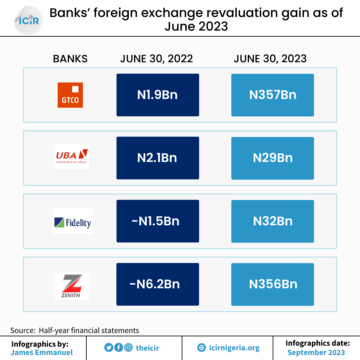
On the contrary, checks by The ICIR show that most banks, including Guaranty Trust Holding Company (GTCO) Zenith Bank, United Bank for Africa (UBA) and Fidelity Bank, declared significant FX revaluation gains in the review period.

The ICIR analysis of the four banks’ financial statements for six months ended June 30 showed that the banks made massive profits from FX revaluation gains.

In the six months under review, GTCO gained N357.47 billion from FX revaluation compared to N1.87 billion reported in June 2022.

“This relates to unrealised gain,” GTCO stated in its financial statement, not clarifying what made up that sum.

Zenith Bank also declared a massive FX revaluation gain of N355.59 billion from N6.25 billion loss in June 2022.

According to the bank, “Foreign currency revaluation gain represents net gain on the revaluation of foreign currency-denominated assets and liabilities held in the non-trading books.

“This also includes the effective portion of the gains on the derivatives designated in the fair value hedge of the foreign currency risk.”

It revealed that its closing and average dollar rate, as of June 30, was N756.24/$1 and N511.3/$1, respectively.

The UBA posted N29.24 billion FX revaluation from N2.08 billion in June 2022.

The bank noted, “Foreign exchange income comprises trading income on foreign currencies and gains and losses from revaluation of trading position,” UBA stated in its financial statements.”

From a net foreign exchange loss of N1.51 billion in June 2022, Filedity Bank reported a gain of N32.16 billion in June 2023.

It said, “Net foreign exchange gains represent unrealised gains from the revaluation of foreign currency-denominated assets and liabilities held in the non-trading books.”

Four banks' FX revaluation gain, comparing half-year June 2022 to June 2023
Four banks’ FX revaluation gain, comparing half-year June 2022 to June 2023

Simply put, FX revaluation gains refer to the increase in the value of the banks’ assets and liabilities denominated in foreign currency when there is a change in the exchange rate between the foreign and local currencies.

CBN directs banks to stop spending foreign exchange revaluation gains

Concerned over the gains made by the banks, CBN has directed commercial banks to stop using FX revaluation gains for operational expenses or dividend payments and use the gains as buffers to safeguard against potential adverse exchange rate fluctuations.

The directive was conveyed in a September 11 letter signed by the Director of the Banking Division Department, Haruna Mustafa, Punch reported on Tuesday, September 12.

The directive, CBN said, should be implemented with immediate effect.

The apex bank said it had assessed the consequences of the recent foreign exchange rate change on the banking system and identified its potential to substantially impact the naira values of banks’ foreign currency (FCY) assets and liabilities.

The CBN posited that foreign exchange revaluation gains must serve as a “counter-cyclical buffer” to safeguard against potential adverse exchange rate fluctuations.

It noted that banks should utilise the revaluation gains to reinforce their capital reserves, thus enhancing the banking sector’s capacity to endure volatility and economic shocks.

According to the report, the letter reads that the CBN approved the following prudential guidance and directives for immediate implementation by banks.

Treatment of FX Revaluation Gains:

Banks must exercise utmost prudence and set aside the FCY revaluation gains as a counter-cyclical buffer to cushion any future adverse movements in the FX rate. In this regard, banks shall not utilise such FX revaluation gains to pay dividends or meet operating expenses.

Single Obligor Limit (SOL):

Banks that inadvertently breach the Single Obligor Limit (SOL) due to the FX policy will be granted forbearance upon application to the CBN. The forbearance shall apply only to existing facilities as of the effective date of this policy. Such banks shall be exempted from the regulatory deductions on the excess above the SOL limit in their CAR computation.

Net Open Position (NOP) Limit:

Banks that exceed the NOP prudential limits due to the FX revaluation shall be granted forbearance for the breach upon application.

Existing prudential regulations on capital adequacy, dividend payments, and FCY borrowing limits shall continue to apply.

SERAP issues UNILAG 48-hour ultimatum to reverse fee hike

0

THE Socio-Economic Rights and Accountability Project (SERAP) has issued the University of Lagos (UNILAG) a 48-hour ultimatum to reverse the recent hike in tuition fees for students of the institution.

SERAP disclosed this in a statement via its official X handle on Wednesday, September 13, and threatened to file a lawsuit if the university failed to comply.

“The management of the University of Lagos (UNILAG) must immediately reverse the unlawful increase in tuition fees for students, reportedly from N19,000 to over N190,000. We’ll see in court if the fees are not reversed within 48 hours,” SERAP posted.

In July, UNILAG increased tuition fees, citing harsh economic conditions, and some students are now required to pay about N190,000 following the hike.

In a statement on Friday, July 21, the management noted that the hike was to help the university meet its obligations to staff and students.

Fresh students whose courses do not require laboratories and studios are to pay N126,325, while those who use the facilities are to pay N176,325.

In addition, they are expected to pay N10,000 and N20,000 for the toxicology test and utility charges.

The fee hike comes amid hardship resulting from several economic reforms by President Bola Ahmed Tinubu’s government, including the removal of fuel subsidy and the floating of the naira, which have caused a surge in the cost of transport, food and other essential commodities.

The new fees took effect in September and led to a series of protests by the students.

During one of the protests, policemen arrested two of the students and dispersed others using tear gas.

Despite the current hardships, several other universities have hiked school fees, with some students paying over N200,000, including the University of Jos (UNIJOS) and University of Abuja (UNIABUJA), where a student Cyprian Igwe was rusticated in May for urging students to meet and discuss the hike.