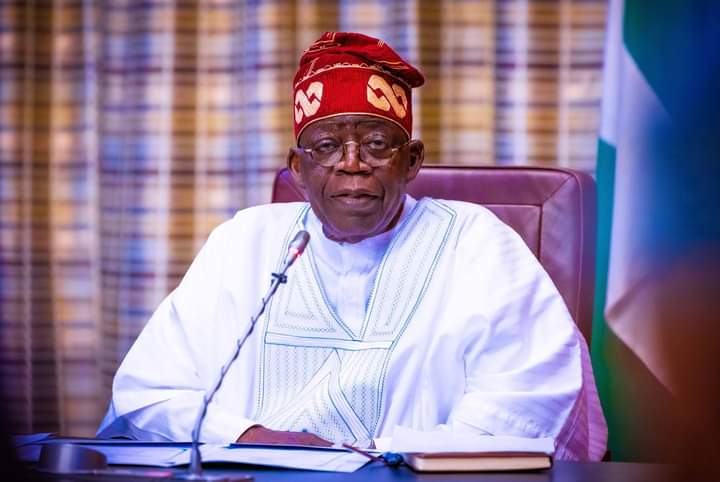
SOCIO-ECONOMIC Rights and Accountability Project (SERAP) has sued Nigerian President Bola Ahmed Tinubu over the failure to disclose spending details of about N400 billion saved from the removal of subsidy on Premium Motor Spirit (PMS), commonly known as petrol.
The organisation disclosed this via its Twitter handle on Sunday, August 6.
In the suit filed at the Federal High Court in Lagos, SERAP prayed the court to compel the President to provide a detailed account of how the funds will be used and allocated.
“SERAP is also seeking ‘an order of mandamus to compel President Tinubu to provide details of the mechanisms that have been put in place to ensure that the savings from the removal of subsidy on petrol are not diverted into private pockets’ “ the statement partly read.
The organisation also said publishing the spending details will promote public trust and hold responsible individuals accountable for their actions, adding that the Nigerian Constitution, Freedom of Information Act, and the country’s anti-corruption and human rights obligations all support citizens’ right to access information about the government’s activities.
“The Tinubu government has a legal obligation to ensure that the savings from the removal of subsidy on petrol are spent solely for the benefit of the 137 million poor Nigerians who are bearing the brunt of the removal.
“SERAP is also arguing that, opacity in the spending of the savings from subsidy removal would have negative impacts on the fundamental interests of the citizens and the public interest,” the statement read.
In July, SERAP demanded Tinubu publishes spending details of the N400 billion saved as a result of the removal of fuel subsidy.
SERAP had given Tinubu 7 days to comply with their demands or face legal action.
Tinubu announced the removal of petrol subsidy on May 29, while delivering his inaugural speech, after which fuel prices surged by about 200 per cent.
The surge in fuel costs resulted in some hardship for Nigerians, as transport costs and other businesses have been affected by the hike.
On Friday, June 30, oil marketers said that the Federal Government had saved N400 billion as a result of the removal, based on calculations by Chief Executive Officer (CEO) of the Nigerian National Petroleum Company Limited (NNPCL) Mele Kyari on Nigerians monthly subsidy expenditure.
Tinubu also said in an address to the nation on Monday, July 31, that the sum of N1 trillion had been saved since the removal of the fuel subsidy.
“In a little over two months, we have saved over a trillion Naira that would have been squandered on the unproductive fuel subsidy, which only benefitted smugglers and fraudsters. That money will now be used more directly and more beneficially for you and your families,” Tinubu said.
However, it is not clear where the saved funds are being channelled to.
President of the National Labour Congress Joe Ajaero, during a protest by Organised Labour in the country, said that according to federal government officials involved in the negotiation process, the country had not saved any money despite the subsidy removal.
“Mr President talked about N1trillion saved. The committee where we meet, they told us that no one kobo has been saved so far; therefore, we have not agreed on what to pay anywhere,” Ajaero said.
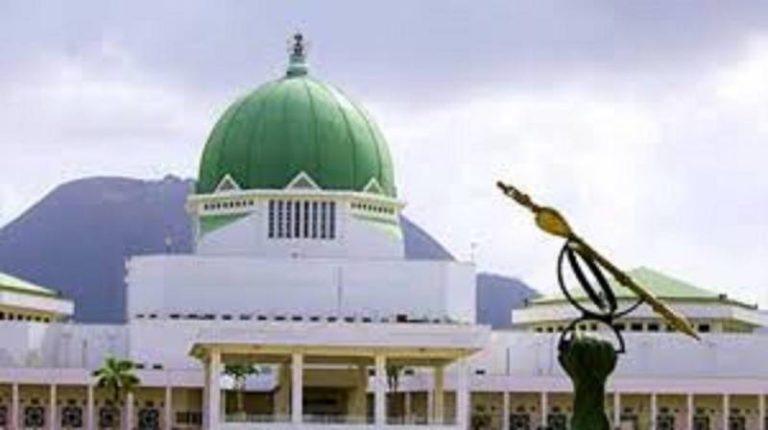
WHILE scores of Nigerians grapple with the cost-of-living crisis caused by abolishing fuel subsidies and the unification of naira – two measures experts describe as inflationary but necessary – the federal government plans to spend N110 billion as palliative allocation to the National Assembly (NASS).
The NASS approved N70 billion from the N819.5 billion 2022 supplementary budget to support the working condition of the new lawmakers and earmarked an extra N40 billion for the acquisition of 465 Sports Utility Vehicles (SUVs), bulletproof cars for principal officials and members.
The senate committee on Media and Public Affairs called criticism against the bogus amount a misguided attempt to describe the appropriated sum as a gift. Yemi Adaramodu, chairman of the committee, said, “Passage of the Supplementary Appropriation Act was part of the constitutional duties of the Senate to accommodate funding for the Federal Government’s Palliative for the Nigerian public, among other National demands.”
However, N110 billion shared among the 469 NASS members leaves each legislator with N234.5 million, as opposed to the N8,000 for 12 million poor households for six months that was earlier approved.
What N110 billion lawmakers palliative can do for Nigeria
Although the federal government retracted on this, it had planned to share N500 billion among poor households by distributing N8000 each month.
An analysis by The ICIR showed beneficiaries can only afford one meal with the cash palliative.
Policies made in the last few months by the new administration have elicited Public backlash, but the 110bn allocated to NASS as palliative stoked outrage. To contextualise this issue, The ICIR evaluated how this sum can improve the condition of some major sectors in Nigeria.
How many PHCS can N110 billion build?
Nigeria has one of the fastest-growingpopulations globally at 2.4 per cent annually. Still, the healthcare system is underfunded and inefficient, falling short of multiple international indices.
For instance, the nation’s budgetary allocation to healthcare has consistently fallen below the global and International thresholds for years. The N1.08 trillion allocated for health is 5.57 per cent of the 2023 budget. It is beneath the 15 per cent of annual spending as agreed by African Union leaders.
This low funding for the health sector has affected the quality of community health care. Primary Health Care centres nationwide are in poor conditions and cannot provide essential healthcare services. They struggle with a shortage of water supply, insufficient power supply, inadequate equipment and poor distribution of health workers.
According to the Ministry of Health, only one-third of the 30,000 primary healthcare centres in the country are functional. However, funds allocated for PHCs are abysmal.
Examining the 2023 budget, The ICIR found that the money allocated to NASS as palliative is four times higher than the 2023 budget for PHCs, pegged at N22.77 billion.
If the 110bn allocated to lawmakers is diverted to improve community health care, Nigeria’s health system will be revamped.
For the construction of a PHC, N30 million was budgeted for the construction of one PHC in the national budget. Using this metric, the N110 billion palliative fund would construct no less than 3600 PHC in different communities.
How many classrooms can N110 billion build?
This sum can also be used to build 1,360 blocks of 11 standard classrooms across a country where overcrowded classroom continues to affect the quality of education provided.
A report by the Data Centre of the United Nations Educational, Scientific and Cultural Organisation’s (UNESCO) Institute for Statistics listed Nigeria as one with the highest number of overcrowded classrooms in its secondary schools.
Congested classrooms affect both learning and teaching conditions. Research has shown that it reduces the quality of academic life and disturbs physical and psychological well-being. Many available classrooms are also unsuitable for learning because they are in poor conditions.
In the 2023 Budget, the Ministry of Education budgeted N80.5 million to construct one block of 11 classrooms. If this is used as a metric, N110 billion can be used to build nothing less than 1,360 blocks of 11 classrooms. That is a total of 14,960 classrooms.
It means 586 of the 774 local governments in Nigeria will get two blocks of 11 classrooms, while 188 will get a block of 11 classrooms.
The allocation of such amounts to lawmakers as palliatives is unfair to poor Nigerians, according to Iyanu Bolarinwa, assistant manager of international growth for BudgIT foundation.
Bolarinwa said the new administration had made many adjustments, and nothing has been done to reduce the suffering it induced or fix existing problems in the country.
“The plan for citizens was that N8000 would be given to ten million households for six months. When you calculate that, you realise that when it comes to the macro level, the amount does not translate to seeing the result that you will want to see.
“I think there should be a level of priority to come to place for citizens. Lawmakers do not really represent the interest of the people but their self-interest, from what we have all seen. I’ll like to see citizens ask more questions and follow up with their lawmakers to see how life can be made more easier for them and also how this government can put into place measures to counter the hardship that the removal of subsidies has caused,” he said.
In this investigation, Yerwa Express News reveals how the Borno State Rural Water and Sanitation Agency violated the state’s procurement law in the execution of a water project, to the detriment of the people.
WHEN Hauwa Ali lost her husband four years ago and was left to fend for eight children, she knew life would be tough, but she didn’t envisage trekking at least a kilometre to fetch water for her family’s use.
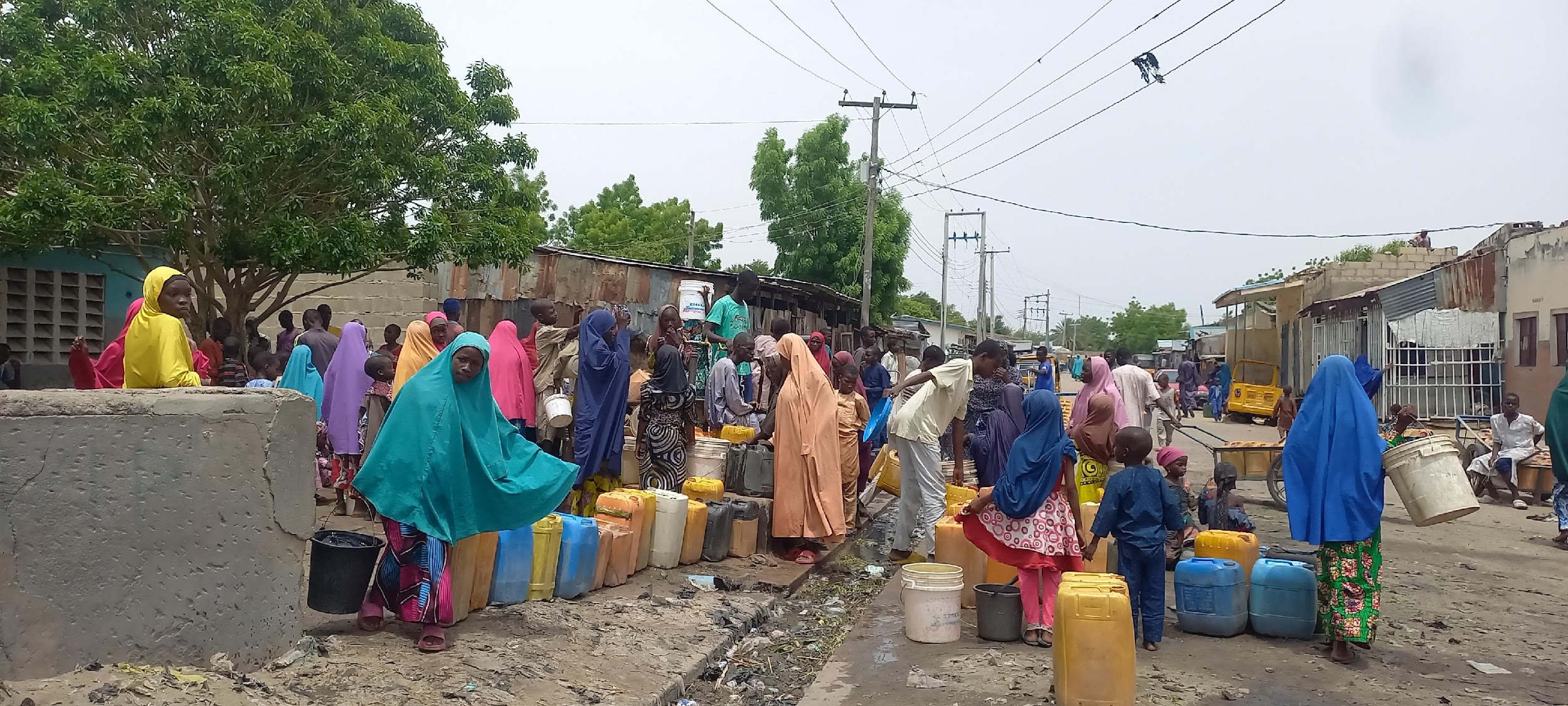
The widow, who lives in Umarari Bulamari area of Maiduguri Metropolitan Council in Borno state, said residents sometimes rely on local water vendors who sell 240 litres of water at the cost of N350.
Water vendors at a private borehole in Umarari Bulama
When there is no water, Hauwa Ali, 40, who is solely dependent on a N50,000 capital selling local perfume, treks at least a kilometre with her children to fetch water.
“I sometimes buy four trips of water, each at the cost of N350 weekly. However, the worst happens when we are out of money. In some intervals, a good Samaritan offers some help with water but it is not always the case,” she said.
“My legs are all aching now because anytime there is a need to fetch water and my children are in school, I have to do it myself,” the widow added.
Hauwa’s story is not so different from that of many other residents of Umarari Bulamari, a predominantly trading community of about 20,000 residents, according to community leaders.
Epicentre of Umarari Bulamari
The community has two boreholes: the Umarari Bulamari new borehole, located close to the house of Bulama (the community head) and the ‘Umarari Bulamari old borehole, about a kilometre away from the first one.
The boreholes are powered by diesel. However, they operate at interval days, sometimes after a week, because the supply of the diesel by government is insufficient. Though the community is connected to electricity, the boreholes are not. Residents of the community say solar-powered boreholes could ease their sufferings.
The new borehole was constructed in 2016 by the present Vice President of Nigeria, Kashim Shettima when he was governor between 2011 and 2019. According to community leaders, the old borehole was constructed by the then administration of the Late Muhammad Goni between 1979–1983.
At the time of this reporter’s visit to the community, schools in the state were in session, but many children were seen fetching water when the new borehole came on. A Primary 3 student in one of the community government schools, who spoke with the consent of her mother, said, “Any day the borehole comes on, I go to school at 9 a.m. because I need to fetch water, and the borehole will stop working by 2 p.m.”
Residents Stationed at Umarari Bulamari New Borehole
“The Umarari Bulamari new borehole gets an allocation of 100 litres of diesel for two weeks, which isn’t enough to operate the borehole every day,” a resident of the community and a civil servant working with the Borno State Ministry of Water Resources stated this in an anonymous capacity.
The residents complained that the insufficient supply of diesel is sometimes forcing them to search elsewhere for water.
“Sometimes the Umarari Bulamari new borehole will not work for about a week simply because there is no supply of diesel from the government. It is really frustrating,” Hassan Bukar, a 30-year-old resident of the community, said.
“I was here since morning with my children, but due to long queues, I could not fetch two buckets of water,” said Hannatu Ibrahim, a 35-year-old community resident.
“The borehole will stop work by 2 p.m.,” the mother of 10 lamented and explained that the borehole is not guaranteed to work daily.
The Community Head, Bulama Mala Ali, said they had made efforts to rescue the situation but to no avail.
Picture of Bulama Mala Ali, the Community Leader
“We have been to the Ministry of Water Resources many times, and they promised us that they will find a solution to our problems. Just recently, we suggested that since electricity has returned to Maiduguri, they should connect the boreholes to electricity, but we are yet to see them,” Bulama Mala said.
He urged the government to use the transformer stationed close to the borehole to connect it to electricity.
Government intervention not implemented
While the people of Umarari Bulamari have continued to wait for government intervention, investigations reveal that the state government had awarded contracts in 2021 for the installation of solar panels and the construction of a 40,000-overhead tank for the Umarari Bulamari new borehole to improve water supply in the community. These two projects were, however, not implemented according to government contractual terms.
Records from the Borno State Bureau for Public Procurement show that the contracts were completed on January 6, 2021. However, on-site investigations reveal otherwise, as there were no traces of such intervention in the Umarari Bulamari community.
The 2021 2nd Quarter SME Contract Information for the Borno State Bureau of Public Procurement shows that the project for the purchase of solar panel inverters and other accessories was awarded at the cost of N1,480, 000 while the construction of a 40,000-litre overhead tank was put at the cost N2,000,000. The document shows that both projects for the newly drilled borehole at Umarari Bulamari have been completed.
The document stated that the two contracts were awarded on “5/1/2021 and completed on 6/1/2021.” It named IK Chumax Global as the contractor for the purchase of the solar panel equipment while Abba Tor and Sons Nig Ltd is listed as the contractor for the construction of the 40,000-litre overhead tank.
However, when this reporter visited the site of Umarari Bulamari new borehole on May 9, 2023, there was no trace of solar panel, inverter or any accessories.
Hannatu’s daughter, taking her first trip home after Umarari Bulamari new borehole came on
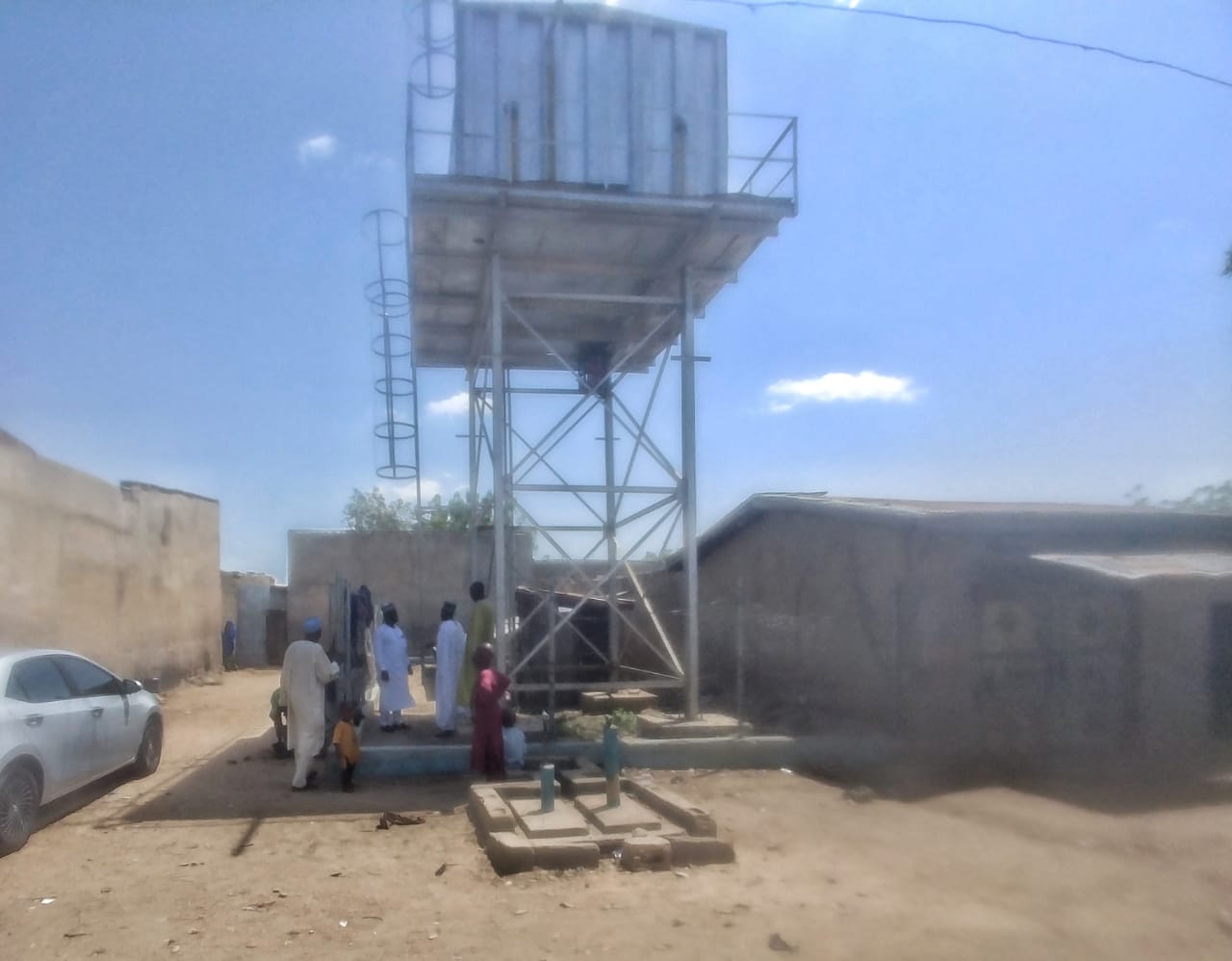
“What happened was the rehabilitation of an existing overhead,” a resident and civil servant in the community told our reporter in confidence.
Community leaders also said there was no such intervention as spelled out by the project document, within the community in 2021.
“The Umarari Bulamari new borehole gets an allocation of 100 litres of diesel for two weeks which isn’t enough to operate the borehole every day,” the civil servant stated and explained that no solar panel project has been sited in the community.
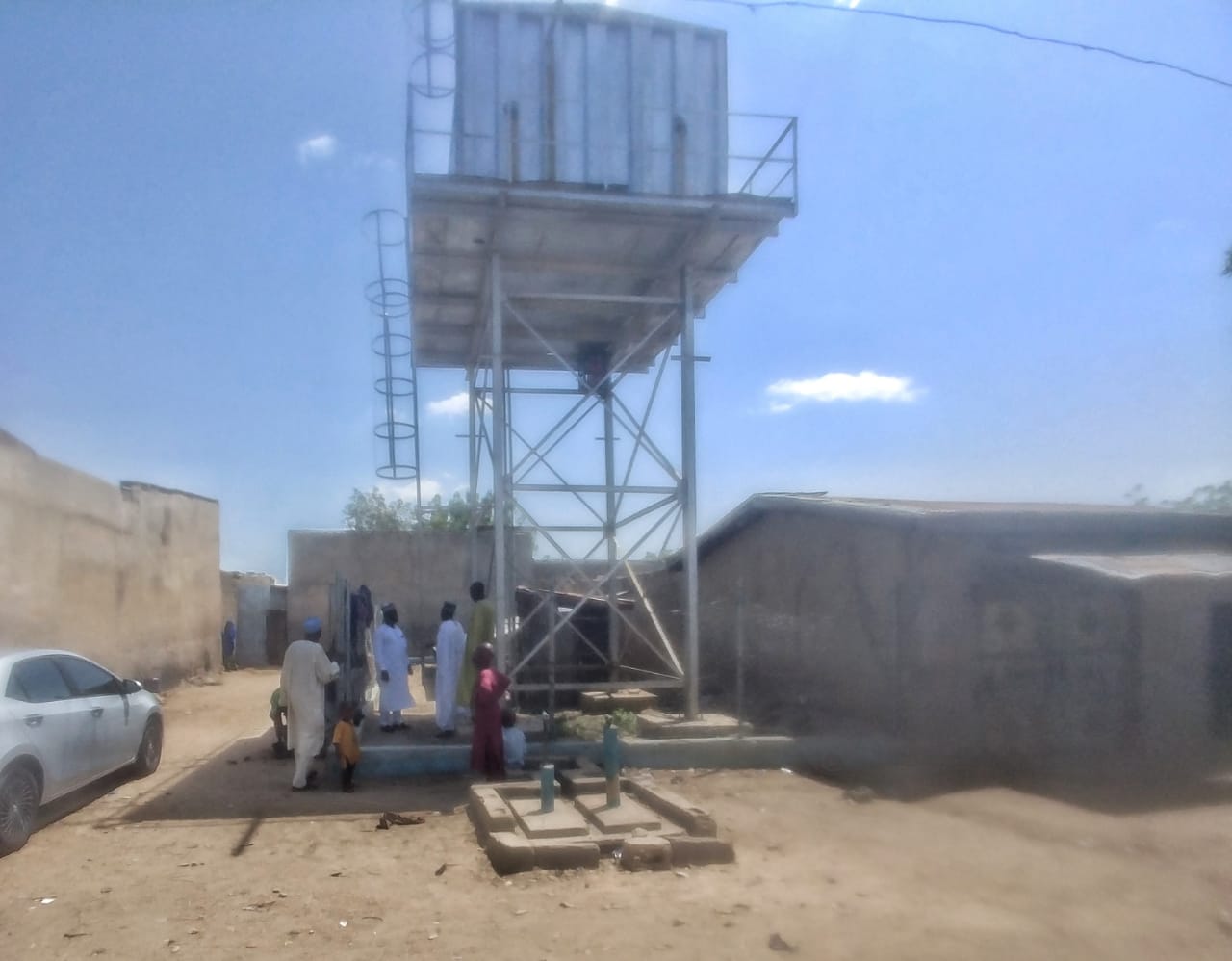
The rehabilitated overhead tank of Umarari Bulamari New Borehole
This was also confirmed by Modu Jarturma, another community leader who said, “No solar was installed on the Umarari Bulamari new borehole in 2021, and no construction of tanks was made either.”
We have done our part – Contractors this reporter contacted IK Chumark Global Nig Ltd, the contractor responsible for the supply of solar panel equipment for the project. The CEO of the company, Ikechukwu Nwanbo, however, told this reporter that he had done his part by supplying the solar panels to the Borno State Rural Water and Sanitation Agency.
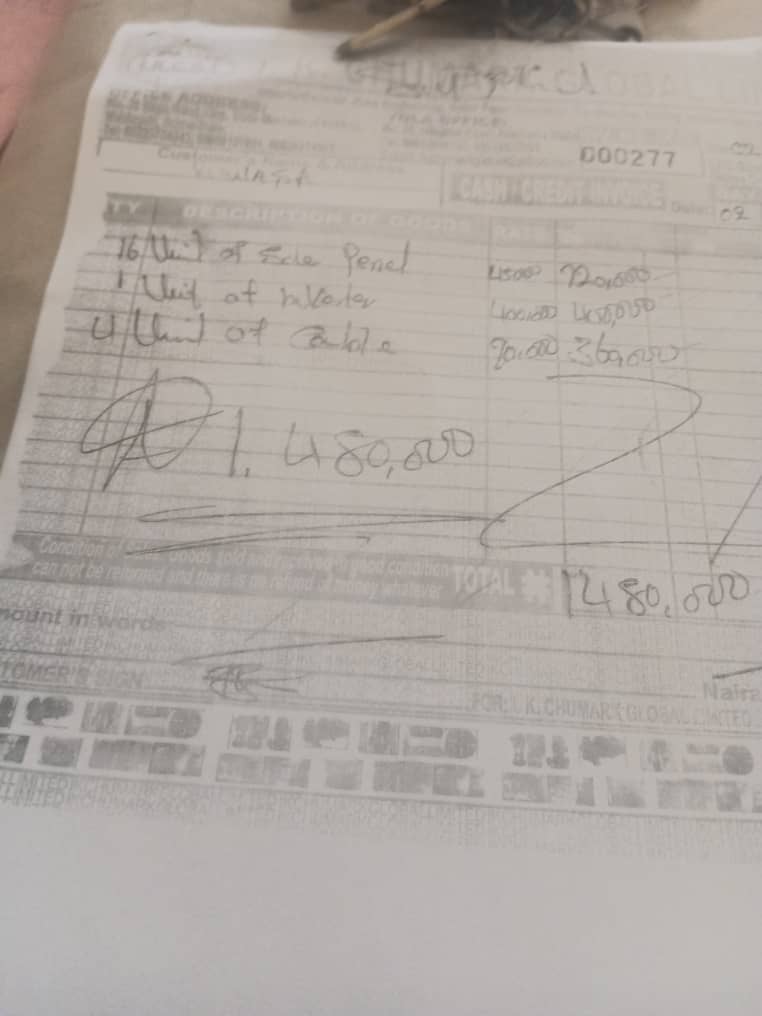
When pressed by this reporter, Nwanbo showed invoices and receipts endorsed by the agency.
The invoice and receipt read: “16 units of panel (each at N45,000) N720, 000, a unit of inverter at cost of N400,000, 4 units of cable (each at N90, 000) at the cost of N360,000). Total: N1,480,000.”
Invoice presented by Nwambo
There was, however, no certificate of contract completion or any other related document to justify Nwanbo’s claim.
According to Nwambo, his contact person within the Borno State Rural Water and Sanitation Agency is one Engineer Babagana Sa’ad which this reporter later discovered is the current Director of Operation at the water agency.
“I am only a supplier and I have done my part. The items were taken from my shop by Engineer Sa’ad and Engineer Gujja. This is the invoice receipt they acknowledged. I don’t know how they used the materials,” Nwanbo said. Abdullahi Alhaji Gujja is an Assistant Technical Officer at the Borno State Rural Water and Sanitation Agency.
For the 40, 000-litre water tank, our correspondent reached out to Usman Tar, the CEO of Abba Tor and Sons Nig Ltd, by phone which was provided in the procurement record. The contractor also claimed to have done his part.
“We constructed the overhead tank. It was 40, 000 litres. We received our payment. I will check the receipt and show you,” Tar said in a phone conversation with this reporter.
Usman Tar also promised to take this reporter to the project site but he did not keep to any of these promises. This reporter followed up on him with calls but he neither answered nor returned them.
Section 18 (16) of the Borno State Procurement Law (2019 as amended) states that in a situation of controversy over execution of contracts, “the burden of proving fulfillment of the requirement for participation in any procurement proceedings shall lie on the supplier or contractor.”
However, neither Nwambo nor Tar could provide any evidence to prove their claims.
Abuse of procurement procedures, discrepancies in contract execution
The 2021 2nd Quarter SME contract records show that both contracts were awarded on 5th January 2021 and completed January 6, 2021. However, when asked whether the contracts could have been completed in a day, Abubakar Habib, a civil engineer with AA Construction Company in Borno State, said “it is not possible,” and described it as “a big contradiction.”
Habib explained that there are several processes to follow before constructing an overhead tank. “Even when you have the tank constructed already, you need to cast a flow for the tank. And that also will take some days,” he said.
The procurement record also shows that the contracts were awarded by way of selective tendering. Selective tendering (sometimes known as restricted tendering) is a bidding process where only certain vendors can bid for the project. Specifically, these will be vendors that the buyer has personally invited to vie for the contract.
The contract for the supply of solar equipment showed three companies bidded for the project. They are IK Chumax Global, Kilme Metine Company Nig Ltd, and Discovery Concepts Interlinks.
In the contract for the construction of 40, 000 overhead water tank, records show only Abba Tar and Sons Nig Ltd bidded for the contract.
IK Chumax Global, however, confirmed that his company did not participate in any bidding process, despite what is stated in the procurement records. Nwambo also admitted that he does not do contracts, but admitted that the agency buys supplies from him.
“Anytime the agency wants something, they come to my shop and take it. This one was Engineer Sa’ad and Engineer Gujja that came to my shop and took it,” Nwambo said after this reporter showed him a report of the Bureau where his company was mentioned as a contractor.
Section 18 (5), of the Borno State Procurement Law (2019 as amended) states that, “subject to the prior review threshold, as may be set by the Bureau, any procurement purported to be awarded without a “Certificate of No Objection to contract award” duly issued by the Bureau shall be null and void.”
Yet, neither Nwambo nor Tar could provide a certificate of no objection for their contracts award.
Controversy over status of companies Section 18(6b) of the Borno State Procurement Law 2019 (amended) states that “all bidders, in addition to the requirements contained in any solicitation documents, shall; possess the legal capacity to enter into the procurement contract.”
However, a search through the Corporate Affairs Commission, CAC, portal revealed that all three companies that bidded for the suppoly of solar equipment; IK Chumax Global, Kilme Metine Company Nig Ltd, and Discovery Concepts Interlinks were not registered.
When this reporter contacted Nwambo of IK Chumax Global, whose company presumably won the contract award, at his shop, opposite Borno State Mechanical Workshop, he said the name of his company is IK Chumark Global Nig Ltd not IK Chumax Global as stated in the contract document. Yet, a similar CAC search of IK Chumark Global Nig Ltd showed no results.
When asked again whether he knew his company was not registered, he insisted that his company had been registered and said he has a certificate for incorporation. When asked to show this reporter the certificate, Nwambo declined, instead, he asked the reporter to go to the CAC to get the certificate or go to the Borno State Rural Water and Sanitation Agency to confirm the status of his company.
“How can you ask me this question? The company I am paying taxes for every year and you are asking whether it is registered. Stop disturbing me,” Nwambo said.
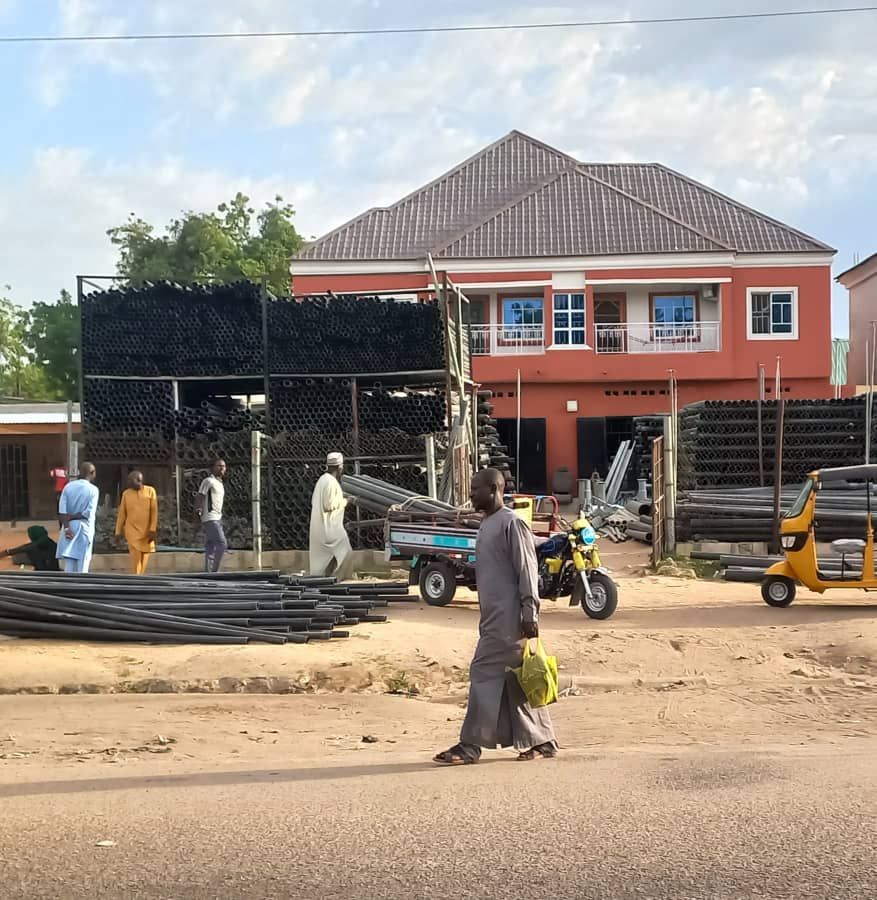
Ikechukwu Nwambo’s shop opposite Borno State Mechanical Workshop
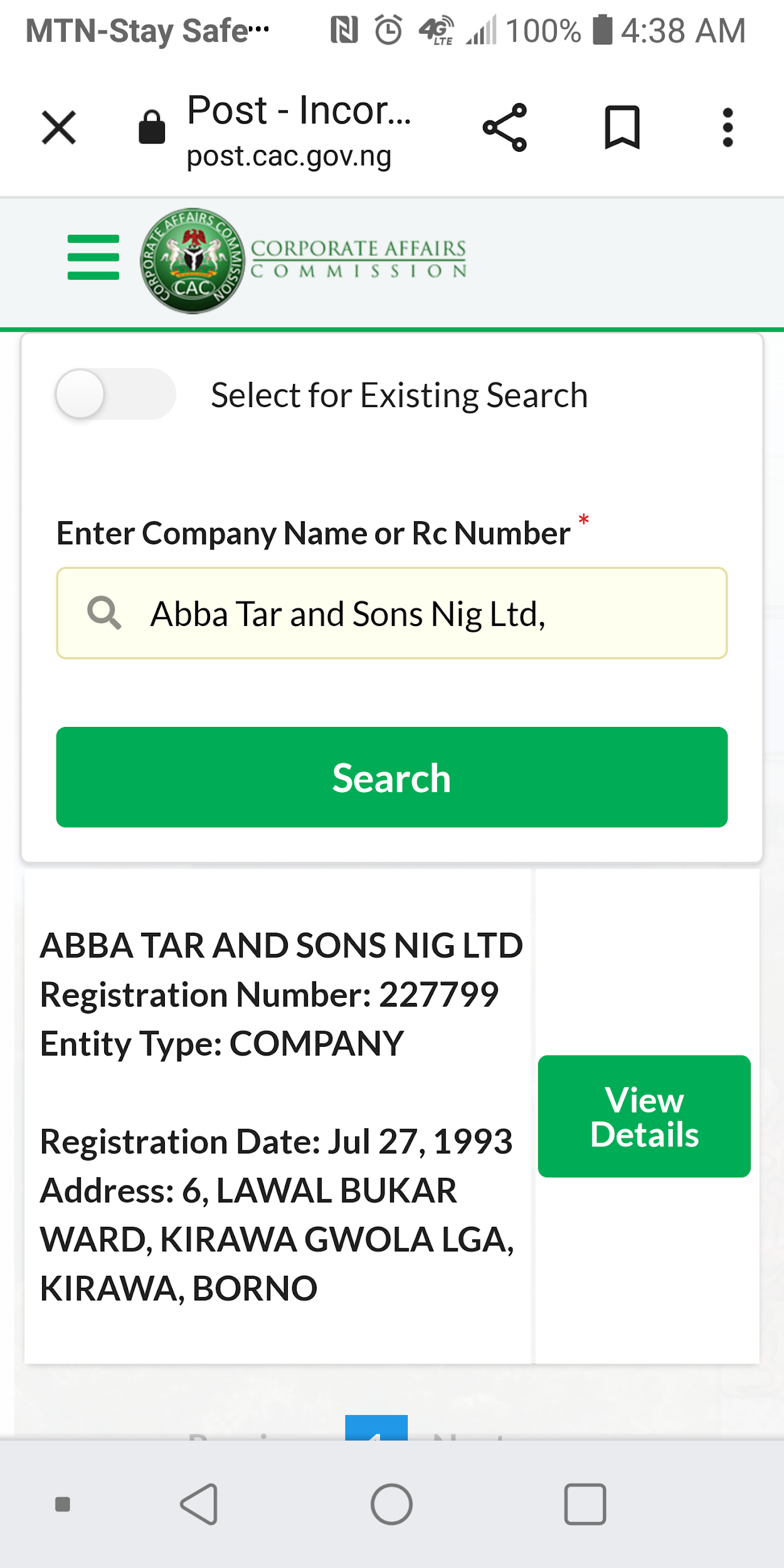
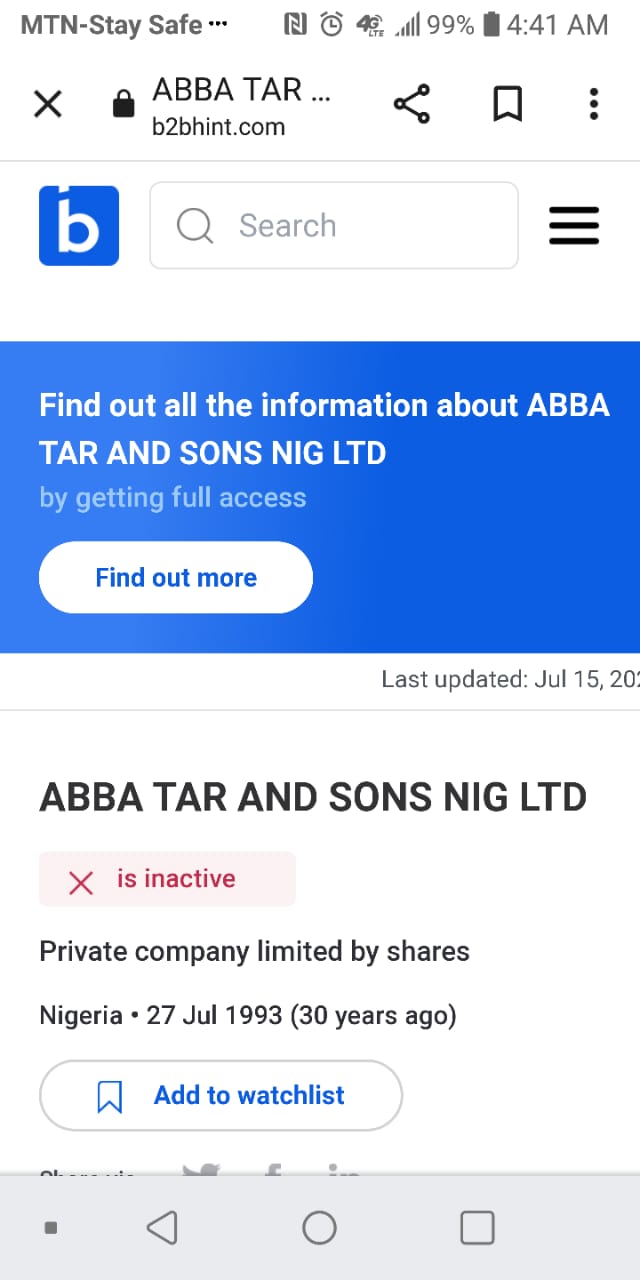
Abba Tor and Sons Nig Ltd, the contractor for the 40,000-litre water tank was, however, found to be registered with the Nigerian CAC. But the status of the company was given as inactive.
This reporter made several attempt to reach Tar through calls to ask whether he knew his company was inactive, but he did not respond to calls.
CAC search on Tar’s company nameB2bhint search indicating Tar’s company as inactive
Borno Agency says project located in another community
The Borno State Rural Water and Sanitation Agency, the procuring entity, when contacted, claimed it executed the contracts but not in Umarari Bulamari community.
The agency said the contracts were executed in a community known as Umarari Bulamari Kangale, not Umarari Bulamari as stated in procurement records. Engineer Babagana Sa’ad, the agency’s Director of Operations, who spoke to this reporter, insisted that Umarari Bulamari was not the targeted community.
He argued that it was not the habit of the agency to divert contracts but explained that the agency only “forgot” to add Kangale to the name of the community on the project documents.
“It was the locals that told us the location is Umarari Bulamari and we wrote it like that. What was omitted was only Gangale,” Engineer Sa’ad said.
This reporter found that the distance between Umarari Bulamari Gangale and Umarari Bulamari is about a half kilometer walk. The two communities, however, have two separate community leaders (Bulama). When Engineer Abdullahi Alhaji Gujja, the Assistant Technical Officer at the Borno State Rural Water and Sanitation Agency took this reporter to a solar powered borehole in Umarari Bulamari Gangale, the reporter observed that the facility fits the contract description.
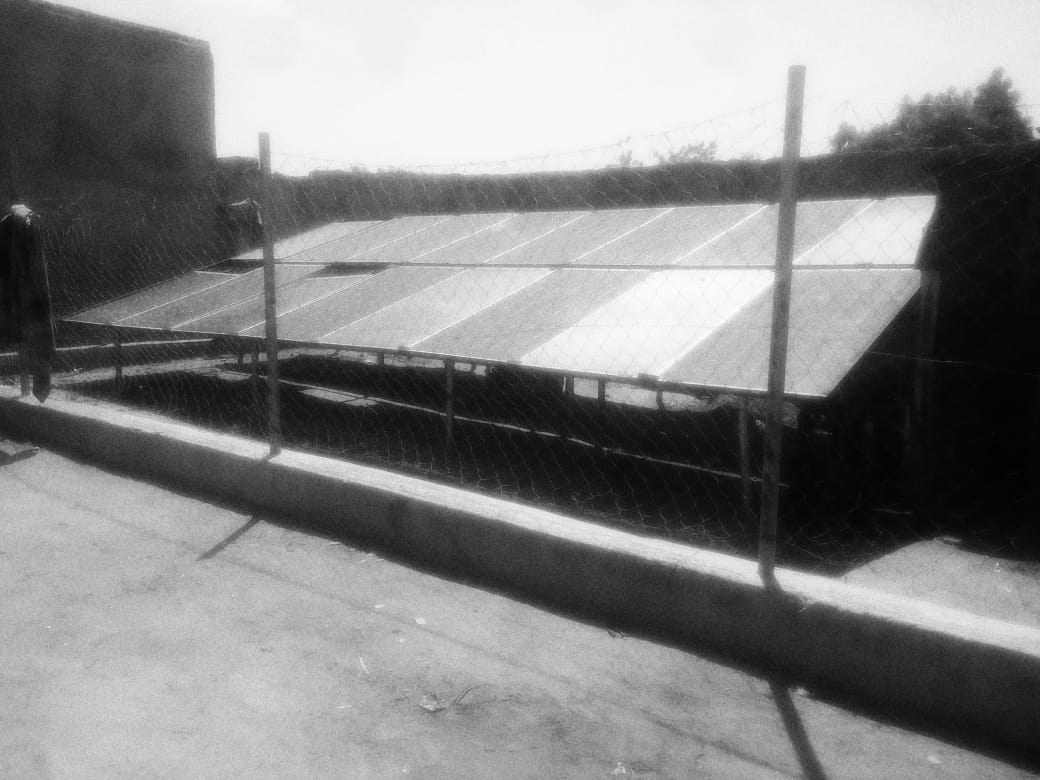
Image of Umarari Bulamari Gangale BoreholeSolar component of Umarari Bulamari Gangale Borehole
However, there was no sign-board to confirm that it was the project described in the procurement record. “We put up a sign-board. I think it was stolen,” Engineer Gujja said.
Some residents of the community said the project was executed in 2021. Others said it was just a year ago.
“It was constructed in 2021. It is not even commissioned but we have started using it already,” Ahmed Bukar, a 35 years old whose house is close to the project site, said.
“I cannot tell exactly when this project was carried out but I know it is up to a year now,” Bashir Musa, who said he has lived in the community since 2015, said.
However, when this reporter asked the Bulama of the Umarari Bulamari Kangale community, Bulama Abba Modu, when the project was executed, he was not specific, even though he confirmed that the borehole and solar system were constructed under the administration of Governor Babagana Umara Zulum.
Some of the elders of the community who accompanied this reporter to the community leader were also not specific. They also claimed the project was executed two years ago.
From the project site, this reporter, along with Engineer Gujja, went back to the agency to meet Engineer Sa’ad, the agency’s director of operations where this reporter requested to inspect the project file in order to clarify the issue of location and contracts award procedure, but he declined.
“It is Umarari Bulamari that is written in the records,” he confessed adding that “It was the locals that told us the name of the location is Umarari Bulamari and we wrote it like that. What was omitted was only Gangale,” Sa’ad insisted.
Section 18(12,14) of the Borno State Procurement Law 2019 as amended states that “every procurement entity shall maintain both file and electronic records of all procurement proceedings made within each financial year and the procurement records shall be maintained for a period of ten years from the date of this award.”
The law also states that “All unclassified procurement records shall be open to inspection by the public at the cost of copying and certifying the documents plus an administrative charge as may be prescribed from time to time by the Bureau.”
The agency, however, denied the inspection of the files in gross violation of the procurement law.
Offenses and punishment
Even though on paper, the Borno State Rural Water and Sanitation Agency claimed to have followed all the state’s procurement procedures in execution of the contract, in reality, it did not. There was no assessment of problems and competitive bidding as provided by the state’s procurement law, 2019 as amended. The staff of the agency expected to monitor the execution of the contracts to ensure compliance to these procedures failed to do so.
This violation is frowned out by section 59 (5) of the state procurement law 2019 as amended which states: “Any person whilst carrying out his duties as an officer of the Bureau. Or Any procuring entity who contravenes any provision of the Law commits an offence and is liable on conviction to cumulative punishment of:- (a) a term of imprisonment of two years with an option of fine and restitution; (b) summary dismissal from government service.
This report republished from Yerwa News Express is supported by the John D. and Catherine T. MacArthur Foundation and the International Centre for Investigative Reporting (ICIR).
BARELY two weeks after it embarked on an indefinite industrial action, the Nigerian Association of Residents Doctors (NARD) said it will proceed on peaceful protests from Wednesday, August 9, 2023, if the Federal Government does not meet its demands.
The NARD declared an indefinite strike on Wednesday, July 26, after the expiration of a two-week ultimatum earlier issued to the government. The association will now be picketing the Federal Ministry of Health, the Office of the Head of Civil Service of the Federation, and the federal and state tertiary health institutions to communicate their grievances and concerns.
This was contained in a circular titled, ‘Notice of nationwide mass protests and picketing by NARD,’ and addressed to the Permanent Secretary of the Federal Ministry of Health, Olufunso Adebiyi. The circular was signed by the President of the association, Emeka Orji, and the Secretary General of the association, Dr Kelechi Chikezie.
The Federal Government had, on July 28, approved the payment of N25,000 peculiar allowance for the medical and dental doctors in hospitals, medical centres and clinics in the federal public service.
“The Federal Government has approved the payment of an accoutrement allowance of N25,000 per quarter to medical and dental doctors in hospitals, medical centres, and clinics in the federal public service. The allowance is to be paid from the overhead budget.
“The approval takes effect from June 1, 2023. All inquiries relating to this circular should be directed to the commission.”
This development was, however, rejected by the striking lecturer, insisting that their earlier demand was for full restoration of the Consolidated Medical Salary Structure (CMSS) to its right value at the time of the approval of the structure in 2009.
The NARD made its position known in a communique issued on Saturday, July 29, after the association’s National Executive Council (NEC) meeting in Lagos.
Reacting to this, the Federal Government threatened ‘no work, no pay’ for the doctors. The Director of Hospital Services, FMOH, listed some of NARD’s key demands in a letter titled “Re: Incessant Strike Action” as immediate payment of the 2023 Medical Residency Training Fund, a minimum 200% increment in Consolidated Medical Salary Structure, and an upward review of associated allowances.
Meanwhile, NARD, in a circular released today, said despite repeated ultimatums, its ‘parent’ ministry and the Federal Government have chosen to demonise Nigerian resident doctors.
The circular read in part, “We wish to bring to your notice the decision of the National Executive Council of NARD to embark on daily peaceful protests and picketing of the Federal Ministry of Health, Office of the Head of Civil Service of the Federation, as well as all federal and state tertiary health institutions nationwide, with effect from Wednesday, August 9, 2023, by 10 am.
“This has become necessary to press home our demands which have been largely neglected by our parent ministry and the Federal Government. We are pained that rather than make genuine and concerted efforts to resolve the challenges that led to the industrial action despite repeated ultimatums, our parent ministry and the Federal Government have chosen to demonise Nigerian resident doctors instead, after all, their sacrifices and patriotism.
“We, therefore, resolved that it is time the whole world hears our side of the story – the decay and corruption in the health sector, as well as the neglect the public health institutions have suffered all these years that led to repeated industrial actions.
“We believe that the government still has time to genuinely address the issues at stake before Wednesday, 9th August 2023, or leave us with no other option.”
NARD Demands
The doctors are demanding immediate payment of the 2023 Medical Residency Training Fund (MRTF), release of the circular on one-for-one replacement, payment of skipping arrears, and upward review of Consolidated Medical Salary Structure (CONMESS) in line with full salary restoration to the 2014 value of CONMESS.
The doctors also want immediate massive recruitment of clinical staff in the hospitals and abolishment of the bureaucratic limitations to the immediate replacement of doctors and nurses who leave the system.
Other demands are payment of the arrears of consequential adjustment of the minimum wage to the omitted doctors, reversal of the downgrading of the membership certificate by the Medical and Dental Council of Nigeria (MDCN), payment of new hazard allowance, skipping and implementation of corrected CONMESS in State Tertiary Health Institutions, and payment of omitted hazard allowance arrears.
THREE individuals have been arrested by the Lagos State Police Command in connection with the tragic death of a medical doctor, Vwaere Diaso at General Hospital, Odan, Lagos-Island.
The Lagos state police command’s public relations officer Benjamin Hundeyin, confirmed to The ICIR that three suspects are currently in the police custody of the command.
The Police spokesperson, however, did not reveal the identities of the suspects.
“Three persons in our custody for now,” Hundeyin replied to our inquiry regarding the investigation.
Diaso lost her life on Tuesday, August 1, when the hospital’s elevator abruptly malfunctioned, plummeting from the ninth floor to the ground level. The hospital was, according to sources, devoid of the necessary blood for her resuscitation.
Vwaere was said to be on her way to meet a dispatch rider, who had come to deliver her food when the incident happened.
The ICIRreports that the Lagos state chapter of the Nigerian Medical Association (NMA) declared a strike over the death, calling for a comprehensive investigation into the incident. The Association directed doctors working in the three government hospitals on Lagos Island to only attend to emergency medical services during that period.
The Lagos Island Maternity Hospital, the Lagos General Hospital, and the Lagos Massey Street Children’s Hospital are all expected to go on an indefinite strike.
The NMA also proclaimed five days of national mourning in the state and asked medical staff at other government-run institutions to curtail their regular schedules in remembrance of the deceased colleague.
Lagos gov’t hands elevator installer to Police
The Lagos State Government, on Friday, August 4, said the installer of a faulty elevator that claimed the life of the doctor has been handed over to the police for interrogation.
A statement by the Permanent Secretary of the Ministry of Information and Strategy in the state, Olumide Sogunle, confirmed that an inquiry has commenced into the accident, adding that the investigation panel will submit a report of its initial findings on Saturday.
Sogunle explained that the panel invited a lift expert to the accident scene to look at the lift and give a professional opinion.
He added that other experts would take the elevator out for a thorough mechanical and electrical examination.
He said: “As part of the panel’s activities from the first day when they interviewed the lift installer, they handed him over to the Police for questioning and further interrogation. This is to ensure that the installer will always be available if the panel needs him for further questions.
“Six house officers and representatives of the medical associations were appointed as witnesses. Representatives of the House Officers and medical associations were allowed to be part of the panel.
“The panel was given 48 hours to conclude action and so it will be submitting a report of their initial findings on Saturday. And any other steps to be taken after that would be done by the appropriate authorities.”
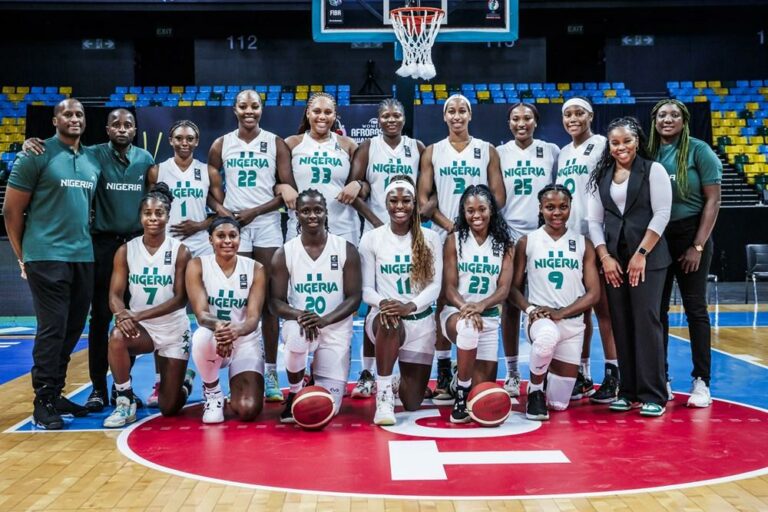
NIGERIA Senior Women’s Basketball team D’Tigress won the FIBA Afrobasketball Championship for the fourth time in a row after they defeated Senegal in Kigali.
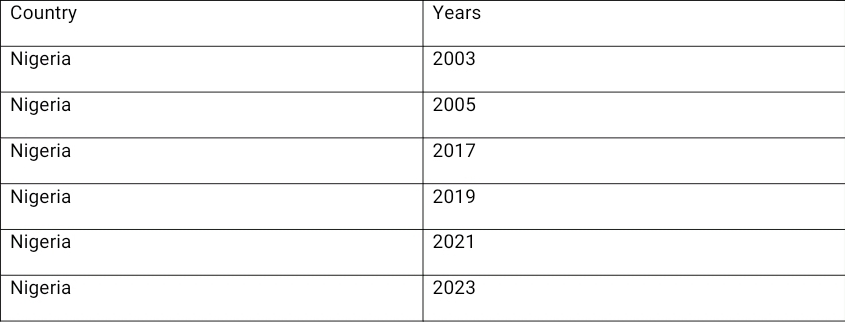
The D’Tigres’s triumph against Senegal in the final makes them the second African side to win four straight titles. They won the title in 2017, 2019, 2021 and 2023, matching Senegal’s winning title records of 1974,1977,1979 and 1981.
The first quarter was a stroll in the pack for the D’Tigress after they won 19-10 points, but the tempo of the game increased in the second quarter, finishing 47-43 in favour of the D’Tigress.
The D’Tigress won the third quarter with 62-57 points and finished the fourth quarter with 84-74.
This is the 6th title overall for Nigeria.
The record of the six titles won by Nigeria at the Afrobasket championship.
THE screening of the Bosun Tijani by the National Assembly on Saturday, August 5, has been eliciting reactions from Nigerians, with many anxiously waiting for the outcome of the screening exercise.
Some Nigerian senators grappled with Bosun’s past comments on Nigeria, the Buhari’s administration, and other influential political figures. In one of his previous tweets, which is now circulating on social media, he tagged the former president as a ‘sick and disconnected’ man.
“The honest men and women around Buhari should help us understand why they will give their lives for a sick and disconnected man to rule Nigeria. At all cost. Please explain how Buhari is qualified to lead a nation like Nigeria. Please help us understand.
“Doing everything possible to keep Buhari in power is nothing but a disservice, in my opinion and that makes you a dishonest person. Too many people are in pain and can use urgent leadership in Nigeria. If you get in the way of them trying credible options, you are an enemy!” he wrote.
Bosun Tijani, who’s the chief executive officer (CEO) and co-founder of CcHub, was among the second batch of ministerial nominees unveiled for screening by President Tinubu on Wednesday, August 2. The ICIR reports that the senate president, Godwin Akpabio, unveiled nineteen more ministerial nominees.
Subsequently, on August 4, the president withdrew Maryam Shetti, who was part of the second batch of nominees and replaced her with Mairiga Mahmud, while also adding former minister of state for Labour, Festus Keyamo, to bring the total nominees to 48.
During the questioning session, the senators probed Bosun’s views on Nigeria. Senator Abdulfatai Buhari, who represents Oyo North Senatorial District, specifically asked Bosun to clarify a tweet he posted four years ago, in which he said: “he does not appreciate the Nigerian passport and Nigeria as a nation.”
However, while addressing the Senate, Tijani said he is very passionate about Nigeria, and he is committed to the country’s development.
He also explained that he tweeted as a result of a frustrating experience he had with the Chinese Embassy. He said: “I tweeted in anger,” the ministerial nominee from Ogun State admitted.
Also, Senator Solomon Adeola from Ogun West Senatorial District defended the nominee from his state, saying his “youthful exuberance” and “shortcoming” should be forgiven.
After the intense discussion, Bosun subsequently apologised, to which the Senate President Godswill Akpabio also pleaded on his behalf.
“We are all fathers, and we cannot throw the baby away with the bath water…On behalf of the Senate, I want to accept your apology,”
Akpabio, therefore, asked the nominee to take a bow and leave.
Nigerians React
Some concerned Nigerians have taken to social media to share their concerns and reactions following the screening of the nominee. While some believed the nominee should be forgiven, some faulted the senators, who they noted enjoyed quizzing the tech expert’s past tweets.
Few other people also believed Bosun was ‘shameless’ to have welcomed a public office from a country he has despised and mocked.
One of the many Nigerians who reacted to his nomination was the digital communication aide to former president Buhari, Bashir Ahmad.
Ahmad tweeted: “Congratulations and welcome onboard the Healthiest, Connected, and Qualified One. I hope the President will assign at least 2/3 of the ministries for you since you already know the button that needs to be pressed to get everything fixed in this country. I am optimistic that all our lingering challenges will be addressed the minute you are inaugurated as the Minister of the Federal Republic of Nigeria.
Also, another Twitter user, iSlimfit appreciated Bosun’s courage in addressing some of the issues raised by the senate during the screening.
“I love how Bosun Tijani held those politicians captive while articulating his defence. It’s the way they were all nodding in agreement for me. You’d know someone who has real value to offer, as opposed to just vibes and political connections,” he tweeted.
Arise television’s journalist, Oseni Rufai, said the senate was so excited about questioning Bosun’s tweet but refused to review petitions against El-Rufai.
“Same senate that refused to review petitions against El-Rufai are so excited about Bosun Tijani’s tweet. Rather than ask the man questions on how to develop technology and give us substance,it was about how to make him apologize for his convictions!”
Another user, UG, wrote: “Those senators were so pained **** putting more pressure on Bosun than on people that were accused of actual money laundering just cos the young man criticised the conduct of the Chambers in the past; they should rest.”
“I am glad Bosun Tijani listened to wise counsel and prepared to – and ultimately- apologised for some of his comments. There is too much good that could come out of his nomination for him and Nigeria to fall for the temptation to grandstand & dig in,” Babanla tweeted.
John Abiola has a different opinion as he said Bosun is shameless for taking the appointment.
“Bosun’s own was not about opposition; it’s about hatred towards PMB. He was never constructive in his criticism. He mocks PMB’s health. He abused those working with the APC govt. Bosun is shameless for taking this appointment from the same APC.”
Also, Aina Dipo tweeted: “I’m happy our leaders are listening to Bosun; the traitor must not be confirmed. He should go and become a minister in the country that he loves and not the one he hates. If Eventually he gets nominated, he better get ready to withstand four years of extreme criticism.”
IN a small room with faded paint and worn-out chairs, a diverse group of people with mental health conditions gathered, their stories etched upon their faces.
They seemed visibly relieved to have a respite from the chaotic and overcrowded environment of the psychiatric wards. This gathering marked the beginning of narratives coming from a place of pain and the thoughts of improving the quality of care for people with mental health conditions in psychiatric hospitals.
In four focus group discussions, 30 patients in two psychiatric hospitals in Nigeria discussed their perceptions and experiences of coercive practices within the hospitals. Strikingly, the expressions of abuse and hopelessness were the same across the hospitals. It seemed to be a parallel universe where people seeking healthcare got harmed by the very hospitals they had turned to for help.
Talking about mental health issues is no longer taboo these days because almost everyone has either experienced or knows someone who has experienced a common mental health problem like anxiety or depression. Society is, however, still uncomfortable talking about serious problems like schizophrenia or other psychotic disorders.
Society is, however, still uncomfortable talking about serious problems like schizophrenia or other psychotic disorders.
When people read about the cruel treatment faced by individuals with mental health conditions in the media or reports from human rights organisations, they are often filled with shock and horror. It is easy to assume that the mistreatment and human rights violations happen mainly in traditional healing centres and prayer homes.
We think to ourselves; if only these patients could afford proper psychiatric care in hospitals, they would be treated with the respect and dignity they deserve.
Our study findings have shed light on the harsh reality that even when these people pay exorbitant fees for psychiatric care, they are still not spared from the horrors of human rights violations.
Experiences and ordeals narrated by those that are affected
The participants of the focus group discussions perceived coercion in mental health care to be a necessary evil in severe cases. Still, they recognised that it was anti-therapeutic to their recovery.
They knew that coercive measures were an extension of the stigma they experienced due to their mental health condition and, interestingly, also highlighted that it was a vicious cycle of abuse.
Using coercive measures made them frustrated and agitated (as would any other person), and this reaction is met with even stiffer coercive measures evoking more frustration and agitation, thereby perpetuating a cycle of aggression and coercion.
The study participants narrated their experience of involuntary admission, which revolved mainly around deception, maltreatment, and disdain. They were either deceived into going to the psychiatric hospital or tied in chains which often caused injuries. They were flogged for refusing to accept medications, some of which caused intolerable side effects.
They were flogged for refusing to accept medications, some of which caused intolerable side effects.
Mechanical restraint with chains was a common experience for reasons including refusing medications, preventing absconding, and in other cases, punitively. The use of chains was viewed by participants as dehumanising and excruciatingly painful. They could not understand why mental health workers who were supposedly knowledgeable about mental health would cause them additional trauma by using inhumane devices such as chains.
Although the common assumption is that ‘their head is not correct’, meaning that they lack the ability to think reasonably, and these coercive measures were done for their good.
The study participants unanimously reported that they had clear memories of these negative experiences and that it was traumatic for them and aggravated their conditions. In the words of one of the study participants, “Nobody is supposed to be treated as an animal. For you to be forced to have a chemical, to be injected, or to be chained is not normal.”
Nobody is supposed to be treated as an animal. For you to be forced to have a chemical, to be injected, or to be chained is not normal.
What must Nigeria do going forward to protect patients in psychiatric hospitals?
At the time the study was conducted, the existing mental health law was the obsolete colonial Lunacy Act of 1958, which was not only derogatory but did not recognise the rights of people with mental health conditions. This meant that being diagnosed with a mental health condition automatically stripped one of many fundamental human rights.
Thankfully, Nigeria’s National Mental Health Act 2021 has been passed, but this is just the first step among several steps the government and society need to take in protecting the rights of this vulnerable population.
Although frequently criticised, mechanical restraints are a typical feature in many psychiatric facilities around the world, yet they are usually soft, flexible belts rather than chains.
The hospitals had a limited supply of belts and occasionally made do with chains. With less than 300 psychiatrists for its enormous population of over 200 million, Nigeria has very low levels of human resources and infrastructure for mental health care which severely worsens this issue.
Another crucial aspect that cannot be overlooked is the stigma surrounding mental health conditions which is a major barrier to early help-seeking for mental health conditions. Addressing this stigma is not solely the responsibility of governments; each of us has a vital role in ending discrimination toward people with mental health conditions.
Deborah is a PhD student researching the contextual factors influencing the use of coercion in mental health services at the Lisbon Institute of Global Mental Health. She is also a staff of the Department of Clinical Pharmacy and Pharmacy Management, University of Nigeria Nsukka. Nigeria. Sh can be reached via Twitter: @debbilici0uss
This article is republished from Health Policy Research Group (HPRG), University of Nigeria; you can read the original here.
THE Zamfara state police command says it has thwarted an attempted attack by bandits on a Divisional Police Station in Zurmi Local Government Area of the state while arresting a 35-year-old suspected informant, Umaru Zubairu, in connection to the attack.
Addressing the press, the command’s Public Relations Officer Yazid Abubakar, on Friday, August 4, said police operatives attached to the police station acted on credible intelligence that a group of armed bandits were planning to carry out the attack. The operative subsequently engaged the bandits in a gun battle which lasted for unspecified hours.
According to Abubakar, one of the bandits was killed while others escaped to the bushes after sustaining gunshot injuries.
“Police investigation that followed the incident resulted in the arrest of a 35-year-old female suspected to be an informant from Rukudawa village.”
Abubakar revealed that the suspect, Zubairu, admitted to working as an informant for the bandit kingpin, Dankarami Gwaska by monitoring activities at police stations.
“Two handsets containing bandits’ telephone numbers were recovered from her.”
Similarly, the Police Tactical Operatives attached to 34 PMF, on July 28, repelled an attack on some Muslim faithfuls during Jumma’at prayers at Kwarta village of Magarya district, adding that the terrorists escaped into the bush during the encounter.
The operatives, who were deployed to the Magarya community, said it acted on an intelligence report.
Items recovered include: “Two AK47 rifles, four rounds of 7.62mm ammunition and Bajaj motorcycle were recovered at the scene while the command is still pursuing the suspects with a view to arresting and prosecuting them.
The Command also apprehended a notorious kidnapper, Lawali Danhajiya, known for abducting people in Gusau town, the capital of Zamfara state. Abubakar said that the suspected kidnapper had been terrorising the Saminaka area in Gusau town.
He added: “In the course of the investigation, one Mika’ilu Ibrahim “M” of Saminaka clearly identified the suspect as one of the bandits that kidnapped him sometime in March 2023 at his residence in Saminaka area.
“Another victim named Aina’u Aliyu “F” of Saminaka area also identified the suspect as the one who kidnapped her on 22nd June 2023”.
He stressed that the suspect will be charged to court once the investigation is completed.
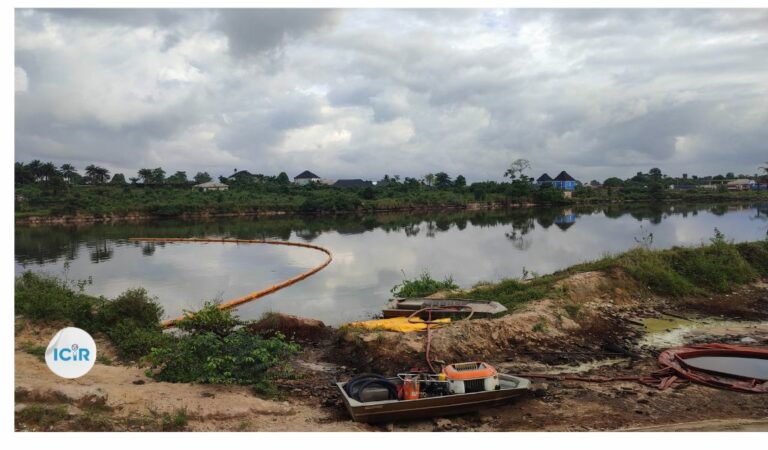
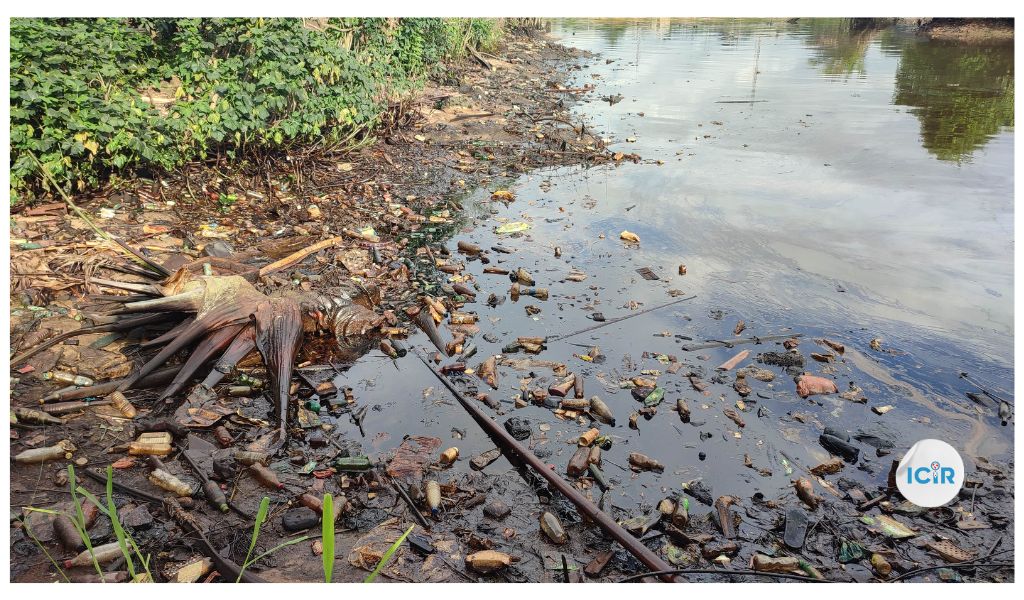
ON June 11, a Trans-Niger Pipeline (TNP) operated by Shell Petroleum Development Company (SPDC) of Nigeria Limited burst open, spilling crude oil into the environment in Aleto, a community in Eleme Local government in Rivers state. The spill also contaminated Okulu River, the only source of drinking water for five communities, threatening residents’ health and affected farms. Arinze Chijioke who was in Aleto reports.
A typical day in Aleto and other surrounding communities in Eleme, which occupies the Western end of Ogoniland land in Rivers state, begins with residents working on their farmlands and young men casting their nets into the Okulu River.
Farming and fishing have been the predominant sources of livelihood for residents of these communities for decades. The river-which extends to over five communities, is always a beehive of activities.
Families living along its banks always come out to relax in the evening. Apart from fishing, residents of the communities also drink from the river.
But that was just before a Trans-Niger Pipeline operated by Shell Petroleum Development Company (SPDC) of Nigeria Limited, operator of the NNPC/SPDC/Total Energies/NAOC Joint Venture burst open, spilling oil into the environment and the Okulu River.
Now, nobody gets close to the river; it is almost like a ghost town. Many households living close to the river are relocating to avoid the health risks arising from inhaling crude. Some residents have fallen sick as a result. Fishermen have lost their livelihoods. Crops damaged.
In 1993, Shell ceased active exploration and production in the areas covered by Oil Mining License 11, following the unresolved issues between the government and the host communities of Ogoni, which fuelled resistance and restiveness among the people. The Movement for the Survival of the Ogoni People (MOSOP), led by environmental rights activist Ken Saro-Wiwa organised protests against the company.
However, pipelines are still active, including the Trans-Niger Pipeline, which traverses Ogoniland and is used to transport crude from oil fields in other areas through the communities to export terminals.
As it happened – the oil spill
It happened on a Sunday morning in June, Gomba Oluka, a resident, recalled. He had woken up and perceived the smell of crude, and when he came out, he saw that the river was gradually being covered by oil sheens, dead fishes, and other sea creatures mired in sticky crude.
“I could not draw close because of the heat. My eyes started hurting me,” he said. “I returned home and thought we could manage, but it became worse, and my wife and children could not breath well”.
The next day, Oluka and his family ran to Aleto town, where they spent three weeks.
Oluka says the spill destroyed his farmland
“By the time we returned, my sources of livelihood were gone because I fish and feed from the river, “a distraught Oluka said. “My cassava and plantain farms close to the river have also been damaged as a result of the spill, even the economic trees”.
At least five communities through which the river runs, including Aleto, Ogale, Agbonchia, Onne, and Akpajo, have been impacted as a result of the spill and more than a month (since June) after the incident occurred, the acrid smell of crude is still fresh in the air, the water surfaces still covered by oil sheens.
The point from where the spill Started.
Till now, the volume of oil spills has not been determined. Communities’ members say this is not the first time Aleto is experiencing an oil spill. However, it is the biggest in terms of impact.
An environmentalist whose non-profit, Youths and Environmental Advocacy Centre (YEAC Nigeria), monitors spills in the Delta region, Fyneface Dumnamene described it as the worse in Ogoniland in the last 16 years after the 2007 crude oil spill in Bodo community.
“Nobody from the company has come to find out how we are surviving following the spill,” Oluka, the fisherman earlier mentioned, said. “I now buy bags of water because our water source is gone, and our boreholes are not even working due to years of exploration. I also buy fish, all of these things we used to have”.
Nobody has accepted responsibility for the latest spill. But community members say its equipment failure as the pipeline is hardly maintained or renewed by the company. Every year, several hundred oil spills are recorded in Nigeria, causing significant harm to the environment and putting human lives at risk, but oil companies operating in the region often blame pipeline vandalism by oil thieves or aggrieved young people in affected communities for spills, which could allow the companies to avoid liability.
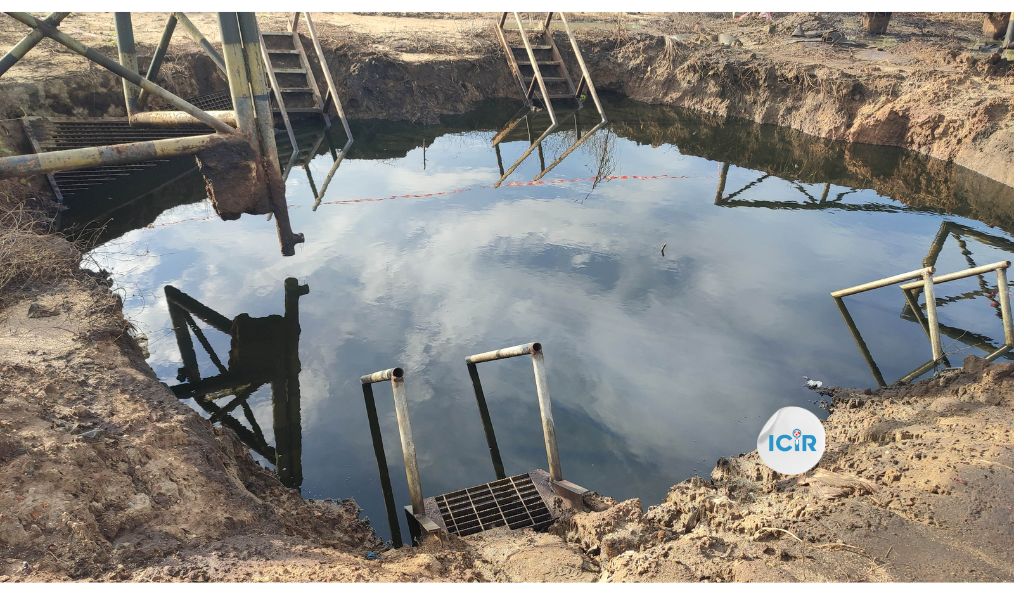
Point from where the pipeline burst open
While there are currently no legally binding regulatory penalties or fines for oil spills in Nigeria, the oil company whose facilities have been compromised are always responsible for the clean-up, regardless of the cause. The company is also required (by law) to close off/stop the spill within 24 hours of being notified of an oil spill in its jurisdiction.
Preventing spills
On its website, the Shell Petroleum Development Company (SPDC) claims that it demonstrates a commitment to improving the quality of life for all those who live and work in the Niger Delta by listening and responding to issues and concerns of host communities of the joint venture operations and facilities and cleaning up all spills from its facilities, irrespective of the cause.
It also claims that it continues to undertake initiatives to prevent and minimise spills caused by theft and sabotage of its facilities in the Niger Delta. In 2017, it reported sustained on-ground surveillance efforts on SPDC JV’s areas of operations, including its pipeline network, to prevent incidences of third-party interference and ensure that spills are detected and responded to as quickly as possible.
Spills in the Niger Delta
“We continue to sustain our regime of daily over-flights of the pipeline network areas to identify any new spill incidents or activities,” it said. “We have also installed state-of-the-art high-definition cameras to a specialised helicopter that greatly improves the surveillance of our assets and have implemented anti-theft protection mechanisms on key infrastructure”.
But an environmental activist, Johnson Frank, told The ICIR that while the company tried to stop the spill days after it occurred, no clean-up has been undertaken so far.
“We are really angry because the spill has cost the community a lot, and the environment has been damaged,”.
Shell spokesperson Michael Adande had said the Joint Venture and other stakeholders have commenced an investigation to unravel the cause of the incident.
However, Frank does not think any ongoing investigation or negotiation is yielding results because the spills are still visible more than a month later. He says it shows a high level of irresponsibility and disregard for the people and their environment by the company.
“What is most worrying is that the company has not provided water for the people, and they are destroying the one we are using to survive, “he said. “They are only exploiting us and do not have regard for our wellbeing”.
Oil spill impact on health and livelihood
Martha Egbe, a resident of the community, has been stooling and vomiting ever since she ate a fish she bought from the local market to prepare soup for her family.
“After using it to cook, I felt crude in the soup and had to pour everything away, “But it had already got into my system and destabilised me, “she recalled. “Now, I am taking some drugs so I can regain my health”.
Crude oil debris from the river.
Egbe, who also suffered shortness of breath, lost her cassava farm as a result of the spill. She said that the community has recorded several illnesses and even deaths in the past due to oil spills.
“When I dig the ground, I discover that my cassava tubers are rotten. It is the same thing for households who have farmlands close to the river”, said Egbe, who was part of those who protested, demanding immediate action from the company.
She spoke of how she noticed the spill that Sunday morning on her way to Port Harcourt for a meeting and quickly called some young men in the community who mobilised to the location where the pipeline burst open.
“Now, our young men are without jobs because their source of livelihood, which is fishing, has been destroyed.
“We cannot even go to our farms again because there is nothing to harvest” she explained.
Another resident, Joy Sunday, owns mini provisions store close to the river, and her customers are usually those who come to relax and others who used to sell fish caught from the river.
“That is what I have been using to survive and train my children. But the spill has sent many of them away from the community, and that is affecting my income. Some days, I don’t make sales” Sunday told The ICIR.
Ogoni, a land still waiting for clean up
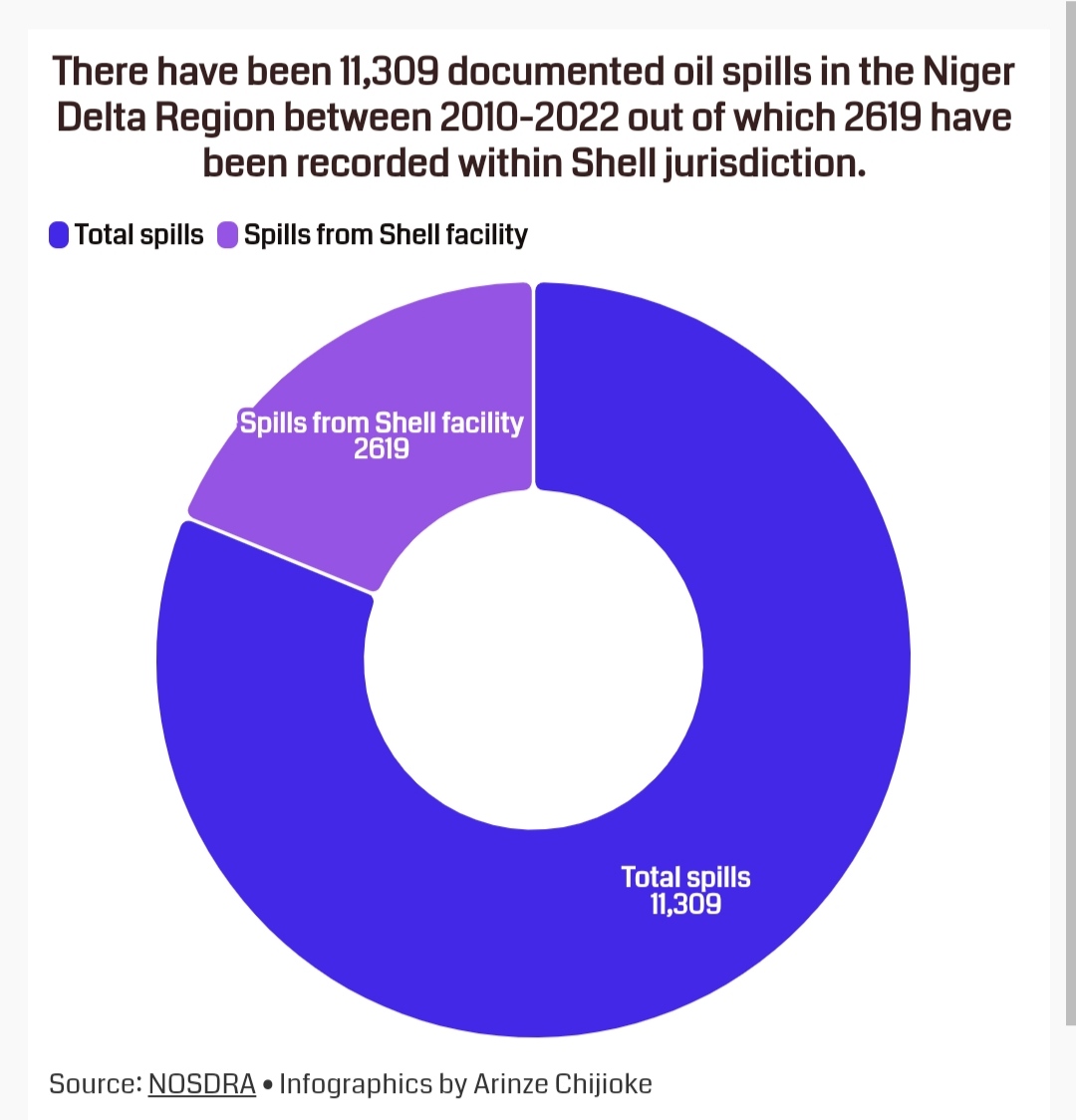
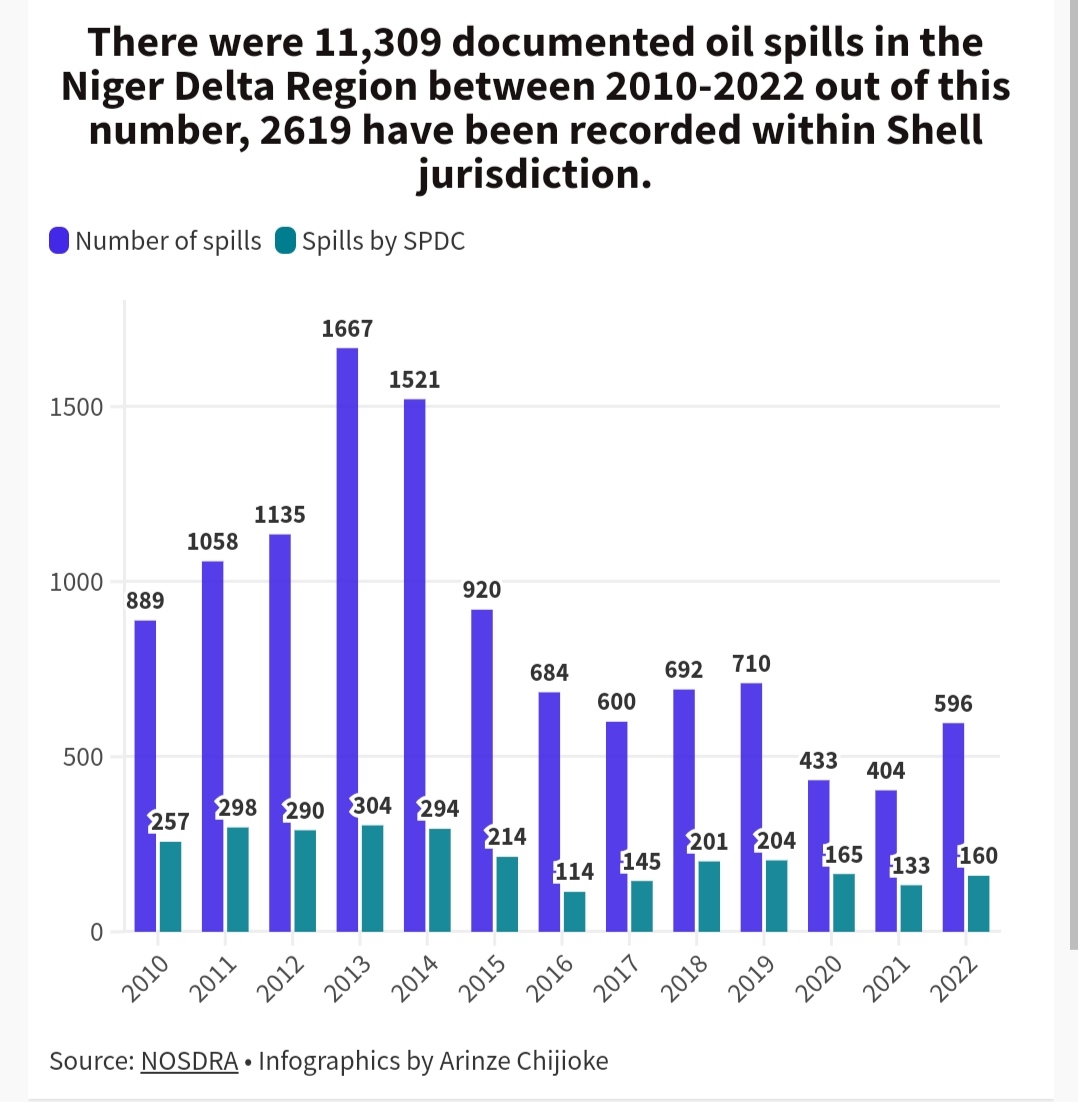
Since 2010, there have been 11,309 documented oil spills in the Niger Delta Region. Out of this number, 2619 have been recorded within Shell’s jurisdiction, according to data from the website of the National Oil Spill Detection and Response Agency (NOSDRA).
Further breakdown of oil spills in the Niger Delta
In 2022, the agency recorded a total of 596 oil spills, resulting in 18,855 barrels spewing into the environment. Shell alone had 160 spills and 1186 barrels.
In 2006, the Nigerian government commissioned the United Nations Environment Programme (UNEP) to conduct an environmental assessment of Ogoniland, the epicentre of spills with over 261 communities. Its report released in 2011 criticised Shell and the Nigerian government for 50 years of pollution, recommending the creation of a US$1 billion Environmental Restoration Fund for clean-up.
The government announced a clean-up in 2016 after the Hydrocarbon Pollution Restoration Project (HYPREP) relaunch. But activists like Morris Alagoa, head of field operations, Environmental Rights Action/Friends of Earth Nigeria (ERA/FoEN), say that both clean-up and remediation have been very slow.
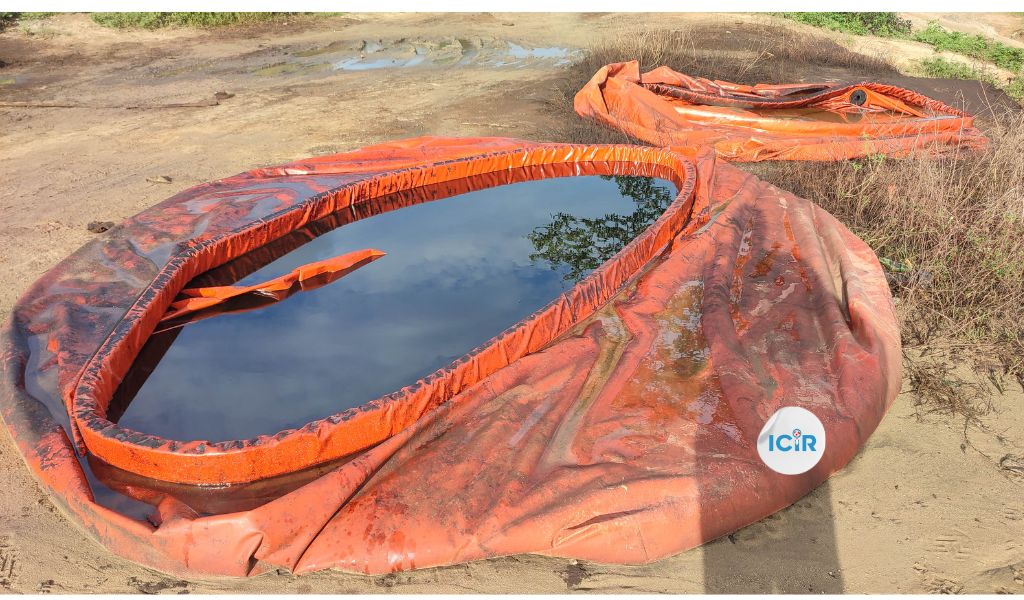
Bags used to pack crude oil after the spill.
In 2020, an international coalition of civil society organisations (CSO) consisting of Amnesty International, ERA/FoEN Europe and Milieudefensie/Friends of the Earth Netherlands released a report detailing the extent to which the government and the Anglo-Dutch oil giant have implemented UNEP’s recommendations.
Titled No Clean-Up, No Justice: An Evaluation of the Implementation of UNEP’s environmental assessment of Ogoniland, nine years on, the report also confirmed that progress has been slow, lacking transparency and accountability as HYPREP has only focused on a fraction of the total area-67 sites, covering a surface area of 943 hectares-identified by UNEP as needing clean-up and remediation, with only a few sites appearing to follow the required remediation procedures.
This is even when the Ogoni Trust Fund received the first payment of US$10 million from the oil industry in 2017 and further payments in 2018 and 2019, bringing the total to US$360 million.
Alagoa adds that the community entry issues and stakeholders’ disagreements also affect the pace of work in Ogoni. He said there were distrust and misunderstanding regarding the scope of work and what needed to be done.
“Some community stakeholders were seeking explanations, especially as to how it affected their communities,” he said. “They were either trying to ensure they were not shortchanged or for their benefits as per the entire project”.
The programme manager, Portharcourt Office of ERA/FoEN, Kentebe Ebiaridor says that the latest spill has a significant impact on the ongoing clean-up efforts in Ogoniland because there ought to be a decommissioning which is the strategic approach to deactivating a project or facility from service as required by the UNEP report while the clean-up is ongoing.
“Sadly, they have boycotted that process, and that is why we have spill almost every week in the region, which continues to increase the poverty rate of the people and reduce the economy of the communities and also threaten their health”.
Ebiaridor said that the Nigerian government must start thinking about alternative sources of income and energy outside of oil which should remain in the soil, especially since it has impacted lands, water, air and livelihoods.
NOSDRA accused of deliberately delaying report of the spill
Members of the affected communities and environmental activists are accusing the NOSDRA of deliberately refusing to conclude and release its Joint Investigative Visit (JIV) report from the community more than a month ago.
On its website, the agency states that a JIV must (by law) be carried out as soon as possible after a spill has been identified and containment measures are taken. The JIV involves oil company representatives, community representatives, and appropriate government agencies visiting the oil spill site to agree on the spill’s cause, impact and scale.
After the visit, the resulting JIV document is signed by all parties present and forms the basis of any legal proceedings or compensation claims. But it has been more than a month since the spill was reported. Yet, NOSDRA has not concluded its JIV.
When contacted, Zonal Director of NOSDRA, Ime Ekanem said, “We are yet to conclude the JIV, as at Friday, July 14 and Saturday, July 15, what we were doing was the delineation and mapping of the impact areas”.
Reacting, Fyneface of the YEAC said that NOSDRA’s prolonged silence on the oil spill calls to question the agency’s capacity to still be trusted with the responsibility of oil spill detecting and response.
“It is worrisome and unacceptable that till now, NOSDRA has not been able to synergise with community people, Shell and other stakeholders and agree on the cause of the devastating crude oil spill in Eleme,” he told The ICIR.
He also said that the Eleme spill portends what is to come for host communities in the Niger Delta because obsolete pipelines would continue to burst and spill crude into the environment. This, according to him, is despite the coming into force of the Petroleum Industry Act (2021).
“The Indigenous companies buying the divested facilities of the International Oil Companies are inheriting liabilities with meagre resources, technology and manpower to manage the facilities and address incidences of oil spills when they occur,” he said.
Shell’s reaction
In order to get Shell to respond to questions regarding the spill, this reporter contacted three workers at the company, including Osilaollor Dabor, Sunny Abuede and Babalola Akinpelumi. But all of them refused to speak on the matter, insisting that they were not in the position to respond.
However, Shell’s spokesperson, Adande was quoted as saying that they were working closely with a multi-stakeholder Joint Investigation Visit team led by NOSDRA, in collaboration with Rivers state Ministry of Environment and community representatives, as the investigation into the cause and impact of the incident progresses.