Home Blog Page 865

Highway extortion by security agents in Borno gulping millions yearly, affecting lives

By Ijasini IJANI

DRIVING from one town to another in the northeastern Nigerian state comes at a price. Asides risking their lives, road users are also frequently levied by security agents on the highways — and because of the Boko Haram insurgency, there are so many of them.

The whirring from a vulcaniser at the Bama motor park in Maiduguri, Northeast Nigeria, could hardly be ignored. Passengers gradually filled the minibus, and at quarter past eight in the morning, we set out on the three-hour journey to Gwoza. I had asked the transport workers union officials to allow me to sit at the front of the vehicle, which gave me two advantages. One was being able to hear as the driver, 52-year-old Musa Gwoza, shared fact after fact about the history of Nigeria’s military rule. Second, seeing first-hand how people like him are routinely extorted by security personnel along the road.

Vehicles were first screened and numbered at the Alou checkpoint. About an hour later, we continued on the journey that Wednesday, March 29.

Between the park and the final stop in Gwoza, there were 34 security checkpoints: 27 manned by soldiers, two manned by officials of the Joint Task Force, two manned by vigilantes, two by police officers, and the last one by officials of the Nigeria Immigration Service (NIS).

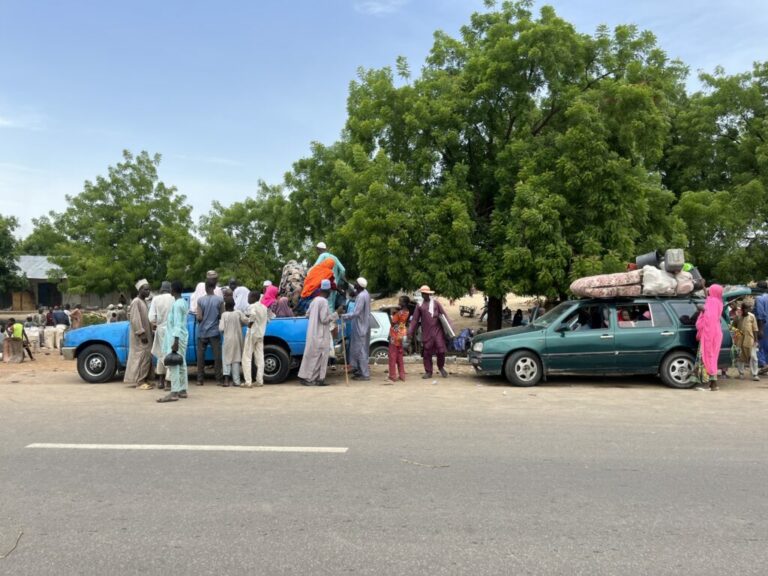
At each of those checkpoints, the security personnel habitually collected ₦50 or ₦100 from the driver, more or less serving as his ticket to move from one point to the next. Only the vigilantes were not so entitled, but they also asked for money. Soldiers oftentimes collected more than their counterparts in the police force or other agencies. They would wave their hands as the vehicle approached, signalling to the driver to slow down and squeeze some money into their palms. It has become a silent agreement between the parties. Sometimes, drivers bring more than cash with them. They also give bread, groundnuts, and fara (fried grasshoppers) to the security agents.

Musa, the driver, has plied the Maiduguri-Gwoza road for more than 15 years and has supported two of his children to get university degrees from his earnings.

“Extortion by the security personnel has been a long-time ritual,” he complained. “Just that it got worse during the insurgency, especially after the closure of the road in 2015.”

Extortion of road users is a widespread problem in many parts of Nigeria, particularly on highways. Exploiting their positions of power, the corrupt security officials use intimidation and threats to get money from truck drivers, transport companies, and other travellers. They may demand payment for safe passage through certain areas, for permission to load or unload goods, or for protection from crime along the route. This is despite the fact that they are paid by the federal government to safeguard lives and properties.
Maiduguri’s city gate along the Mafa-Maiduguri road in Borno, Nigeria. Photo: Ijasini Ijani/HumAngle

Violence broke out in northeastern Nigeria in 2009 with the rise of Boko Haram, a terror group whose attacks have since led to the death of tens of thousands of people and the displacement of millions.

The activity of the armed group along major roads in the region led to the establishment of prominent checkpoints with the hope of protecting civilians and preventing the insurgents from moving freely from one place to another. These checkpoints later created an opportunity for security personnel to extort road users.

Corruption in Nigeria’s security sector has existed for decades. A 2019 survey by Afrobarometer found that the police were considered the most corrupt public officials in the country, and two in five Nigerians thought the government was doing a bad job in tackling the problem. Much of the problem can be seen on roads across the country where police officers are stationed to prevent crime.

HumAngle gathered from interviews with multiple drivers and stakeholders in Borno that highway extortions by various security agencies often lead to delays, increased costs of fares and goods, and reduced efficiency in the transport system. Drivers are left with no option but to increase the transport fare so they can still make a reasonable profit, therefore passing the burden down to passengers. The practice can also lead to decreased safety on the roads as drivers are pushed to take risks or engage in dangerous behaviour in order to avoid paying illegal fees.
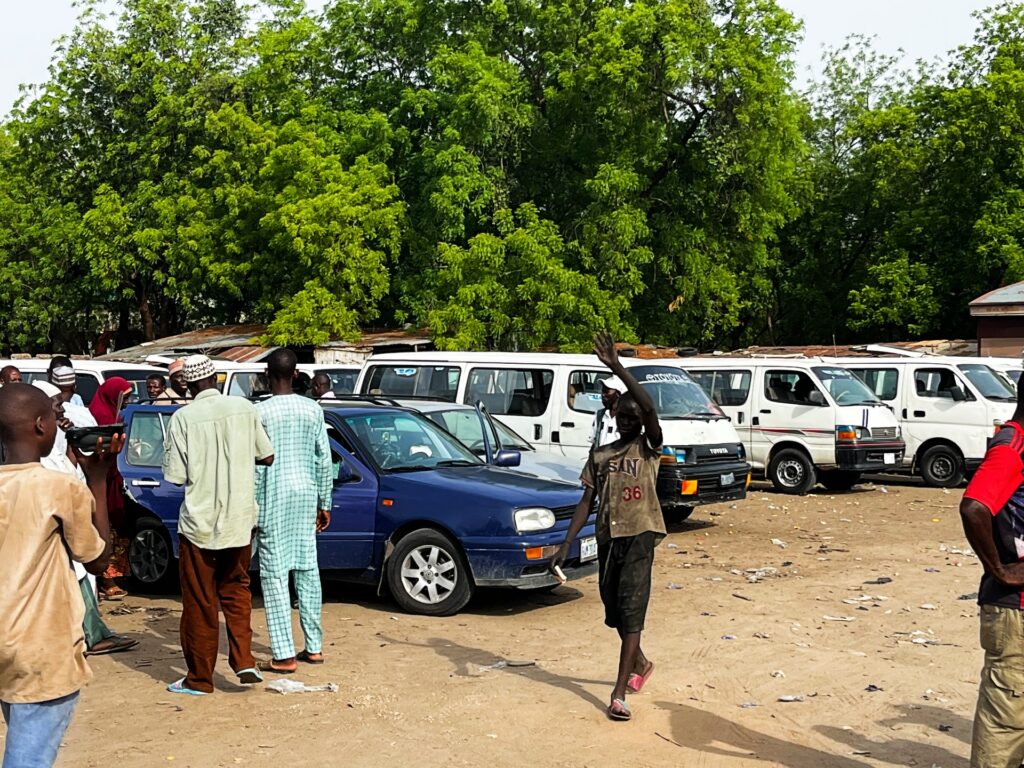
Drivers and passengers at the Bama Motor Park in Maiduguri, Nigeria. Photo: Ijasini Ijani/HumAngle.

Checkpoint robbery

Samaila Usman, 43, says he gives at least ₦1,200 every day to security personnel as he drives from Bama Park to Gwoza and back. There are 15 to 16 major checkpoints on the route where drivers believe they are mandated to give the ‘what do you have for the boys’ money.

“I always give the cash when crossing through each checkpoint just to avoid being delayed, even though I’m not pleased with it. But I won’t delay my passengers just because of ₦50 or ₦100. I will just charge my passengers additional costs to meet up with the checkpoint demands along the road.”

Samaila sometimes gets away with only giving the soldiers sachet water or not even paying at all because of the rapport he has built with them over a long period. But when a new set of soldiers are deployed to a checkpoint, he would be left with no choice but to stick to the ritual.
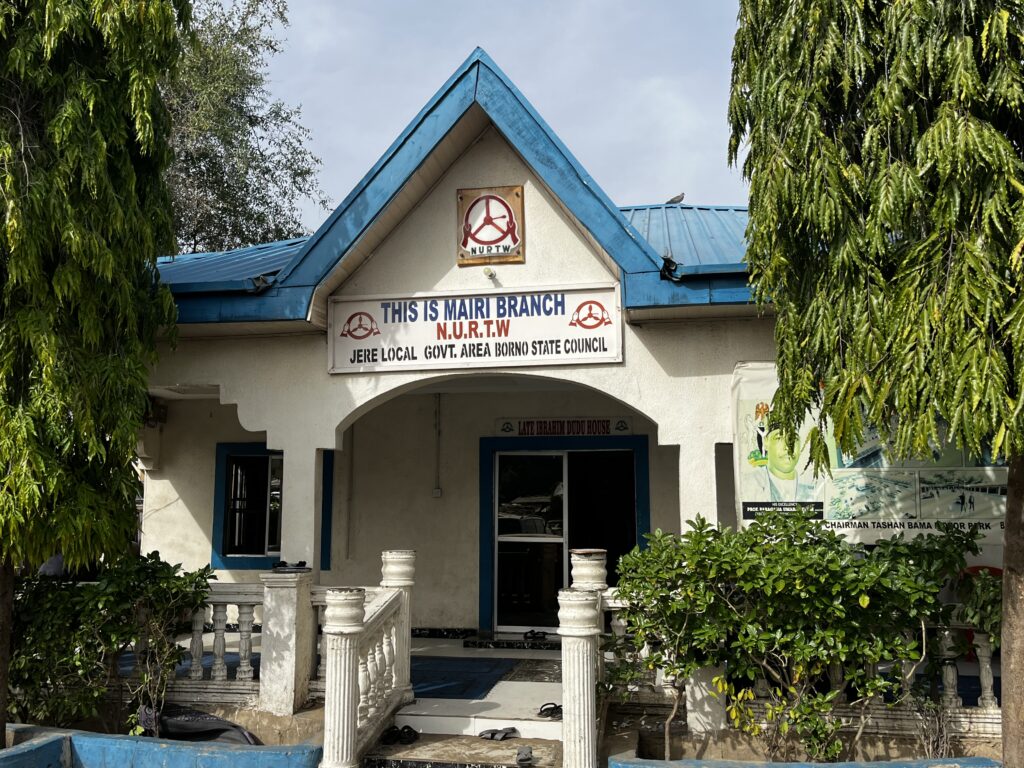
Tashan Bama Office of the National Union of Road Transport Workers (NURTW), Mairi Branch. Photo: Ijasini Ijani/HumAngle.

Taxi drivers at the Bama motor park in Maiduguri, known locally as Tashan Bama, convey passengers to Gwoza through Konduga and Bama. People also board vehicles going to Mubi and Yola, cities in the neighbouring Adamawa state, at the park. Drivers plied the major roads in Borno with ease before the insurgency escalated in 2010.

In Sept. 2014, the park was closed because of Boko Haram activities along the Maiduguri-Gwoza road, a strategic route that leads to the Far North region of Cameroon. The Nigerian military also stopped movements on the road. Because of the closure, the travelling distance between Maiduguri and Gwoza quadrupled from 127 km to 485 km as drivers were forced to move through Damaturu in Yobe state, Biu in Borno, Mubi in Adamawa, before finally arriving in Gwoza. This other network has much fewer checkpoints, and people who ply them have no fear of being attacked or extorted by security personnel.

Over three years after the closure, the military reopened the Maiduguri-Bama highway in March 2018, lifting the spirits of businessmen and travellers, including people who had not visited their home communities in a long time. “We implore the commercial road users to kindly abide by the code of conduct that we have given them so that we can ply the road with some level of safety,” said  Nicholas Roger, a Major General and the Theatre Commander of the counterinsurgency military operations in the Northeast.

The reopening made travelling easier, but it also came with the many checkpoints that have been abused by security personnel.

“The police, road safety corps, NDLEA, immigration officers, and the Nigerian Army all collect cash from us,” said Ismail Buba, a truck driver who conveys goods from Maiduguri-Banki down to Gwoza town.

“They make it look like it is obligatory to give the abnormal ₦50 or ₦100 at each checkpoint. Sometimes, they make it look like they are doing us a favour by collecting money from us. We don’t refuse because it serves as our ticket to the next checkpoint towards our destination.”
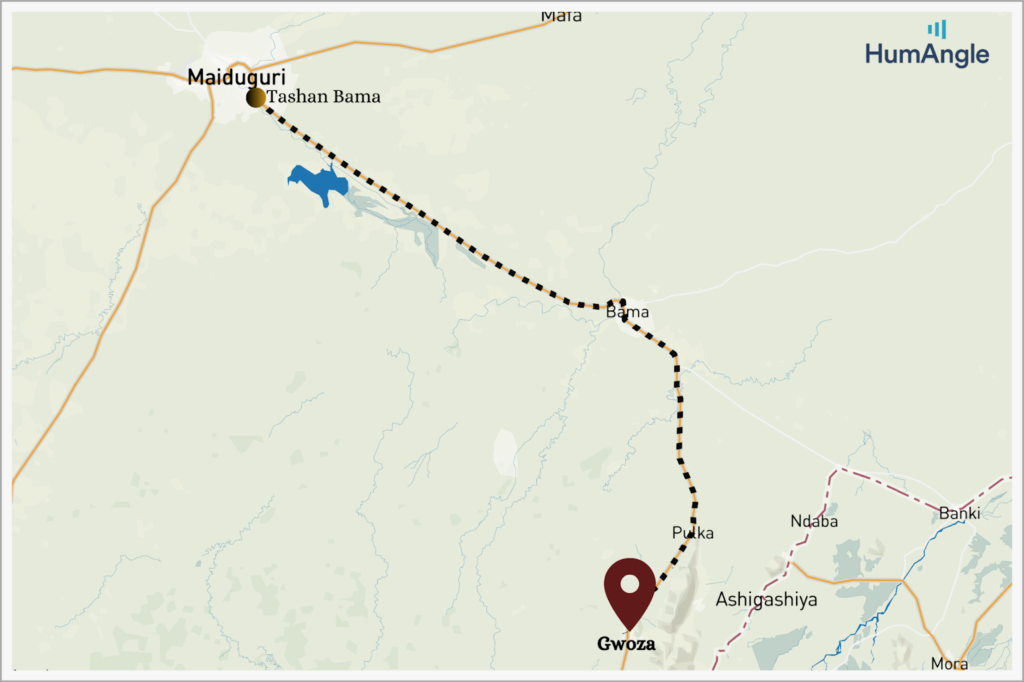
Map illustration: The 127 km route from Maiduguri to Gwoza/Mansir Muhammed/HumAngle

Extortion is not only a daily routine on the Maiduguri-Gwoza road. The practice is common along many other major roads in Borno state, and we observed the same trend along the Maiduguri-Mafa road, Maiduguri-Gubio road, and Maiduguri-Monguno road.

There are about 18 checkpoints between Muna Park in Maiduguri and Mafa town: 14 manned by the Nigerian Army, two by the police, one by the road safety corps, and one by customs officers. Drivers regularly smuggle goods, such as rice, cement bags and petrol, out of Nigeria through the Ngala border area using this route.

The first checkpoint after the Maiduguri city gate is guarded by FRSC officials, who often receive bribes from drivers without licences. At the next one, which had police personnel, our driver gave ₦50 to the officer, who immediately tucked it in his combat wear.

“The road to Mafa is our daily route,” said Fannami Abor, who has been plying the road for over five years. “I travel to and fro twice a day along this road. I always give money whenever I load goods, but when it is just the passengers, I only give to a few checkpoints that I know I can’t escape.”

He claimed that all the checkpoints along the Mafa road collect money from all commercial vehicles all the time when they have goods with them. Soldiers receive more money and customs officers are only given bribes when the drivers are smuggling rice across the border.

By the end of the journey, the driver had given out ₦50 at 13 checkpoints and managed to sweet-talk his way out of paying at five others. This sums up to ₦650.

Usman Dibal, 41, a commercial driver also plying the Maiduguri-Mafa road down to Dikwa, told HumAngle this practice doesn’t sit right with him.

“I have never given this money willingly. I have no option but to pass through the checkpoints, and that is the one reason I am giving the normal ritual. I always charge security officials who board my taxi along the route because they also extort from us the drivers, and so they must pay me fully without any leniency,” he lamented.

Truck drivers are charged even more on the road. Abba Pele, who drives one, said he has to pay ₦500 per checkpoint every time he is transporting cargo between Maiduguri and Dikwa, and this applies to about 16 of them.
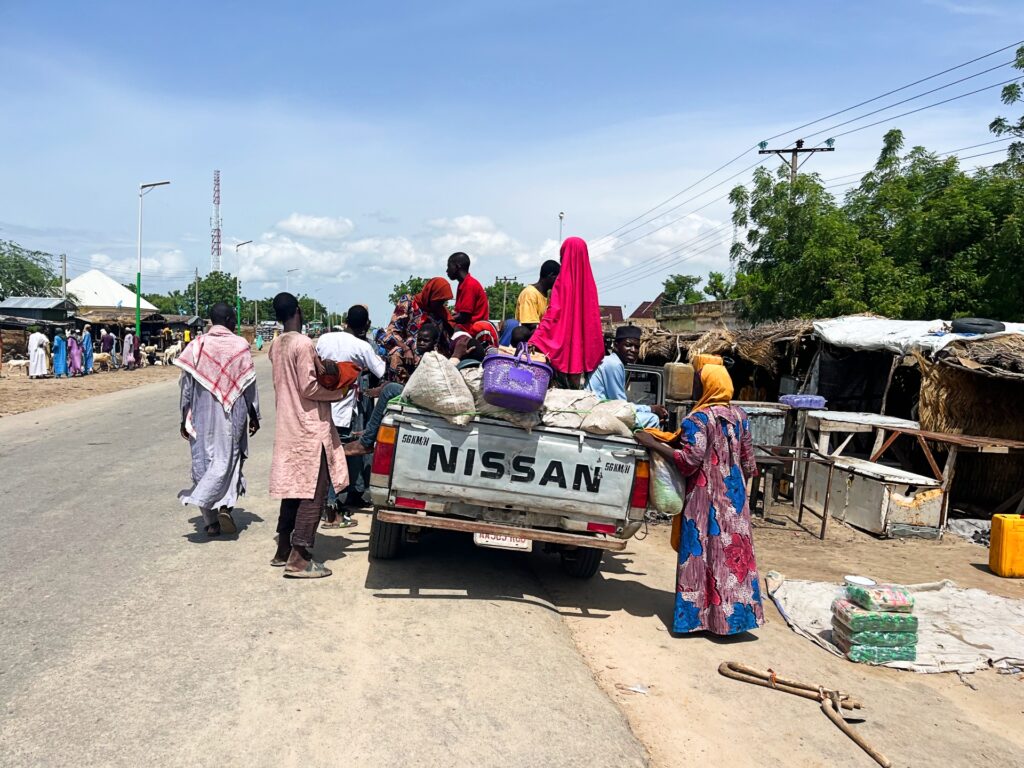
A Nissan 1988 model loaded with farmers in Mafa. Photo: Ijasini Ijani/HumAngle

Let’s take a look at the Maiduguri-Gubio road too. It has about 25 checkpoints: 15 manned by soldiers, three by police officers, two by CJTF, one by the FRSC, one by Customs, one by the NSCDC, one by NIS, and the last one by the NDLEA. But extortion rates are lower compared to the other major roads. This is likely due to the reduced traffic here because of frequent terror attacks – especially during the rainy season.

“I have been stopped several times along the Magumeri to Gubio road by the armed group, mostly during the raining season,” said Mallam Bukartima. “The soldiers are extorting the little we have gotten and whenever the armed group stops us, they also extort from us, taking away our phones, money and goods with them.”

About nine of the security checkpoints on the road extort drivers, seven of those having Nigerian Army personnel and the other two manned by NDLEA and NIS officers.

Ali Gubio, 32, says he gives ₦450 every day as bribes along the road.

“₦50 Naira to five checkpoints of the soldiers, ₦50 to the Immigration officer, ₦100 to the police officers at the Magumeri checkpoint, and ₦50 to the NSCDC agents at the Maiduguri city gate.”

Most of the vehicles on the route are owned by non-governmental organisations that have security agents attached to them. They have a pass to convey goods to their destinations, often including Magumeri, Gubio, and Damasak.

NURTW officials at the Gubio Park told HumAngle that between 25 and 35 commercial vehicles pass through the route daily. This number goes up on some days, especially during food distribution exercises at displacement camps.

The Maiduguri-Monguno road is another notorious route, starting from Baga Park and winding up at the entrance gate in Monguno. The Baga River and Lake Chad province along the road have attracted armed groups over the years. There are 22 checkpoints here: 18 manned by soldiers, two by the police, one by the NDLEA, and one by Customs.

Soldiers often extort truck drivers, collecting nothing less than ₦300 per loaded truck.

Sheriff Isah, who drives a truck, says he gives ₦500 per checkpoint from Gajiganna up to Nganze. There are about five of them between those places. Then he gives ₦200 per checkpoint to the remaining 12 up to Monguno. “They only collect money from me when I am carrying goods in my truck,” he said. “We have at least 10 trucks plying this route every day with goods.”

Mallam BK, a commercial driver, also confirmed that he gives ₦50 at most of the checkpoints starting from the one in Maimalari down to Monguno town, costing him at least ₦500 to ₦600 daily.
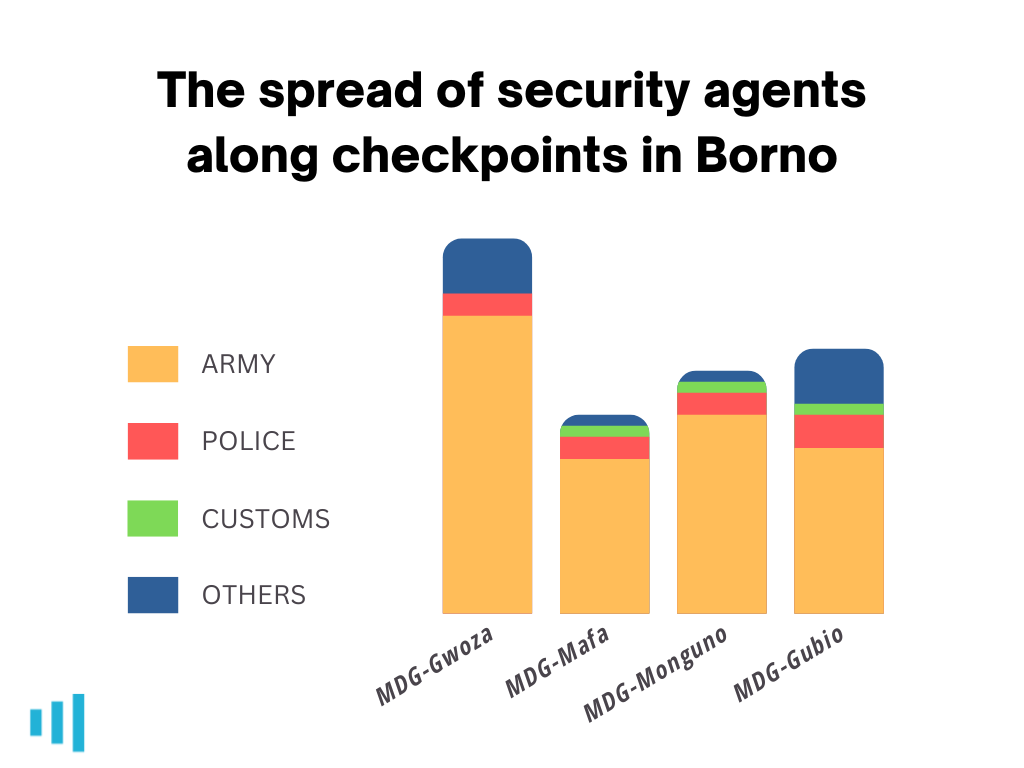
Infographic by: ‘Kunle Adebajo/HumAngle

Businessmen, IDPs bear the brunt

As much as the practice has affected drivers, they are not the only victims. People conducting businesses who need to move their commodities between locations have their grievances too.

“I don’t travel with plenty of goods anymore,” said merchant Felicia Philemon.

“The drivers complain that the security personnel always charge them more than the normal fee ₦50 or ₦100 at most of the checkpoints [because of the extra cargo]. I prefer to board a car that has no goods and chattels loaded so as to avoid heavy checking along the road. This has affected my little business in Gwoza town. I need to split my goods into different vehicles and need to pay more to make sure my goods reach my destination.”

Also, many of the passengers moving around these towns are internally displaced people from Bama, Banki, Pulka, and Gwoza who are trying to get by. The higher the illegal fees drivers pay on the road, the more they would, in turn, charge the passengers, many of whom are struggling to survive.

“The extortion of money from us drivers was what hiked the transport fare from the normal ₦1,500 to ₦2,000 per passenger when travelling from Maiduguri to Gwoza,” observed Musa Dauda, 32, a taxi driver.

HumAngle learnt that in Pulka, officers at the NIS checkpoint are notorious for asking to see the travellers’ national identity cards. Those without one are then told to pay ₦200, after which they are allowed to pass. Foreigners without the local ID card are sometimes extorted as well, and this has been going on since 2018.

Maryam Madube, a 21-year-old IDP from Gwoza said she had to pay this amount at the NIS checkpoint anytime she travelled from Maiduguri to Gwoza after she lost her identity card.

“It doesn’t matter how much I explained to them. Nothing helped until I paid,” she said angrily.

“This happened to me for almost a year before I was able to retrieve my national identification number. This is daylight pocketing by those that need to protect us after knowing how insecurity has affected our livelihood, but they still extract from the little we have for our survival.”

The state government has confirmed that these incidents happen. In Jan. 2020, the governor, Babagana Zulum, accused police officers and soldiers of collecting bribes from travellers without national identity cards along the Maiduguri-Damaturu highway, describing it as unacceptable.

“How can you subject people to this kind of torture all in the name of National ID card? And you are all here collecting ₦500 and ₦1,000 from poor travellers who don’t have national ID cards,” he said.

Borno is the state hardest hit by the humanitarian crisis that has trailed the Boko Haram insurgency. Of the 2.4 million internally displaced people documented in the Northeast as of March, about 77 per cent were in Borno state. About 8.3 million people need humanitarian assistance in the region. In Borno alone, 1.9 million people are estimated to need food support between June and September, and 65 per cent of households surveyed by the United Nations experienced crisis levels of hunger.
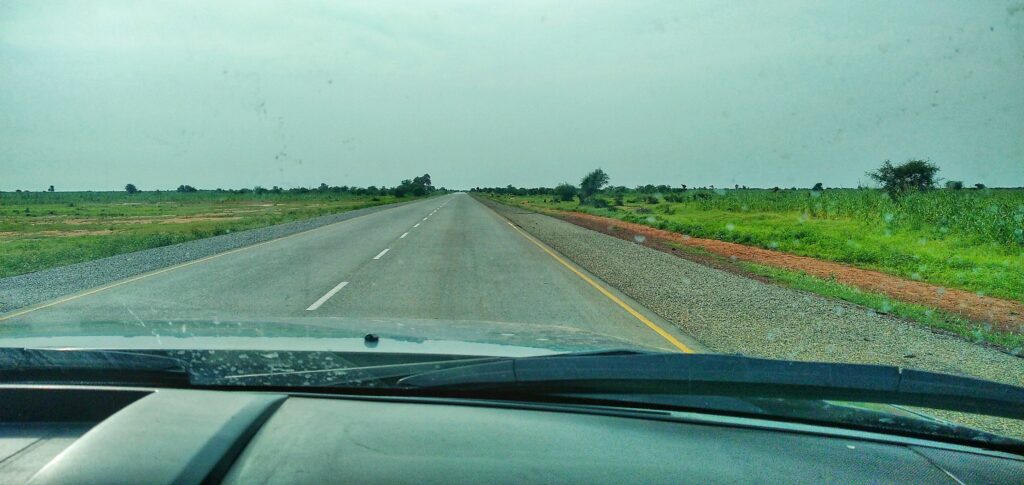
Dashboard view of the Bama-Pulka road, Borno state. Photo: HumAngle.

Meanwhile, many drivers have gotten used to the tradition of parting with some money at these stops. Adamu Adamu, a taxi driver who constantly gives ₦100 at each of the eight checkpoints between Bama and Gwoza, says he doesn’t see anything wrong with giving “the normal” fee.

“The security agents are responsible for our protection along the road,” he explained. “Without their protection, both the commuters and we, the drivers, can’t use the road.”

Millions every year

According to Bamai Mustapha, chairman of the NURTW branch in Mairi, 50 to 70 commercial vehicles depart from the Bama motor park in Maiduguri every day, and “each driver gives nothing less than ₦500 from the Kawuri checkpoint down to the last checkpoint in Gwoza”.

One driver along the route, who asked to be anonymous, confirmed this estimate.

“I give ₦50 habitually at most of the checkpoints because I don’t carry overloaded goods from travellers. It always costs me ₦500 per trip from Maiduguri to Gwoza and another ₦500 when travelling back.”

The implication of this is that at least ₦25,000 is extorted from 50 drivers every day along the Maiduguri-Gwoza road, summing up to at least ₦9.1 million annually. Since the practice has been ongoing for over five years, we can estimate that over ₦45.5 million has been illegally collected from drivers by security agents on this route alone since it was reopened in 2018.

A similar calculation for other routes shows that millions are extorted yearly from each one.

HumAngle gathered from an NURTW official at Muna Park that vehicles leaving for Mafa from Maiduguri daily include about 40 Volkswagen Golf cars, 25 Nissan Desert Runner 1988 model cars, and 15 trucks.

An estimated amount of ₦42,250 is extorted from 65 drivers using smaller vehicles every day, while at least ₦120,000 is extorted from 15 truck drivers, both totalling about ₦59.2 million annually.

For the Maiduguri-Monguno road, NURTW official Isa Nganze said over 40 vehicles depart from Baga Park every day, excluding trucks. An estimated sum of ₦24,000 is extorted from the vehicles daily, plus ₦49,000 extorted from 10 truck drivers, which totals about ₦26.6 million yearly. Nganze says it used to be considerably worse.

Along the Maiduguri-Gubio road, about ₦15,750 is extorted from 35 drivers daily, running into about ₦5.7 million annually.
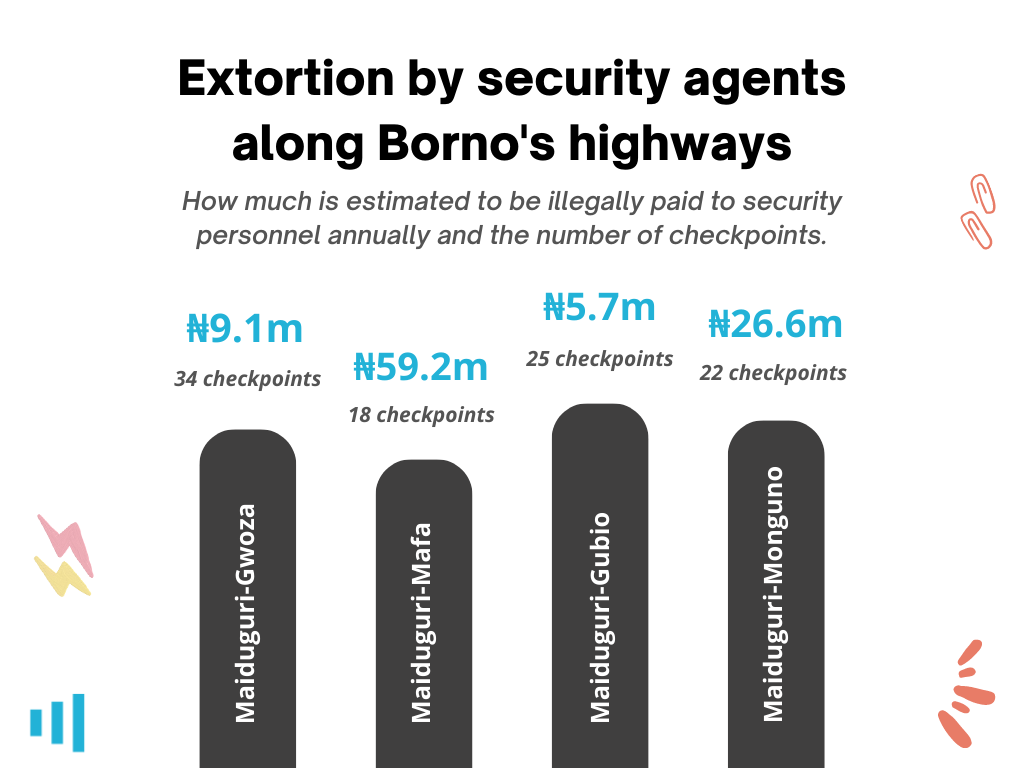
Infographic by: ‘Kunle Adebajo/HumAngle

HumAngle reached out to the various security agencies whose officials have been sighted at these checkpoints.

Deputy public relations officer for Borno state police command, an ASP, Nahum Daso Kenneth, replied that the force is not a revenue-generating organisation and the officers’ actions are not “in conformity with the Police’ structural operation procedures and its mandate”.

“No police officer is posted on the road to collect money or extort money. The Police authority will deal with any officer found wanting,” he assured. “Majority of Gwoza people are very vulnerable and with less privilege. They feed from hand to mouth. They deserve special attention and treatment to reintegrate into a livelihood and not to be extorted.”

At first, spokesperson of the state NSCDC command Bulus James said the agency does not man checkpoints at the Maiduguri-Gwoza route. When we provided information on the exact location of the personnel, he replied that he was hearing about the development for the first time. He suggested contacting the divisional officer for Bama, CSC Abdulmalik, who did not respond to our enquiries.

Spokespersons of the Nigerian Army, NIS, and NDLEA did not answer calls from HumAngle and have not replied to texts sent to their phones.

Budget allocations for defence and security increased significantly under the Muhammadu Buhari-led administration, which handed over power in May. The country budgeted ₦1.4 trillion ($3 billion) for defence in 2023, a 135 per cent increase compared to the 2019 budget. The policing budget has similarly increased, with a lot of the money going into salaries and recurrent expenditures.

So why do officers still engage in corrupt practices? James Barnett, a conflict expert and research fellow at Hudson Institute based in Lagos, says some of it can be blamed on the war economy that has emerged because of the protracted conflict.

“When a soldier sees the guy above him taking part in some form of corruption or extortion in a significant manner, he’s liable to want to get in on the action as well and believe that it is an acceptable part of the institutional culture,” he explained.

“Relatedly, many soldiers complain that they don’t get paid on time or in full, or that the supplies and equipment they receive is inadequate or non-functional—both downstream effects of institutionalised corruption—although these complaints seem to have decreased somewhat in recent years compared to at the peak of the insurgency. Anytime soldiers are not receiving what they need, they are liable to use the power of their status and their gun to forcefully make up for that, even if it means extorting innocent civilians.”

There have been repeated complaints from police officers serving in the Northeast about unpaid allowances and poor welfare conditions. In July 2018, officers blocked a Maiduguri highway in protest. “For over six months now, we have no allowances, no decent accommodation; we sleep on corridors of officers and sometimes in the open air,” one of them told Premium Times.

The solution, according to Vincent Foucher,  a researcher with the French National Centre for Science Research who specialises in Islamist extremism, is to sanction the offenders.

“Nigeria has an old history of civil war and military dictatorship, and a number of persons in the security forces seem to have a sense of impunity. Many cases of abuse, be it corruption or violent abuses, including at senior ranks, have led to little or no investigations and punishments. This authorises misbehaviour,” he observed.

“The visible, legal and public punishment of corruption and abuse, all the way from the top to the bottom, is essential to bring about change. There are military courts, which is good, but there is next to no information about the cases and the decisions taken. This does not help.”

Delays, security risks

There are 15 to 20 heavy checkpoints and over 15 subtle checkpoints between Maiduguri and Gwoza. It starts with the first checkpoint at Kawuri village, where all commercial and private vehicles are screened before they are allowed to proceed to Konduga. The final checkpoint is a few kilometres from Tashan Mararaba in Gwoza town.

Each checkpoint has some security personnel attached to it, ranging from officers of the Federal Road Safety Corps (FRSC), National Drug Law Enforcement Agency (NDLEA),  Nigerian Army, Nigeria Immigration Service (NIS), Nigeria Police, and Nigeria Security and Civil Defence Corps (NSCDC).

Passing through the checkpoints appears hassle-free once the fee is paid to the officers. If a driver does not cooperate, the trip can easily become frustrating. The car would be checked thoroughly and each passenger would be searched. Everyone could be delayed for hours before they are passed to continue their journey.

Musa was a victim of this. Once, he was delayed for two hours in Bama by officers of the Nigeria Police and the FRSC after refusing to give them ₦100. “I had to sleep over in Bama and couldn’t get to Pulka before they closed the gate, making a trip of one day to last two days,” he recalled. Since then, he has cooperated with the security personnel.

Observers believe the corrupt practice encourages security agents to abandon their duties as they tend to pay lesser attention to vehicles that offer them bribes. This gives travellers room to smuggle illegal goods and could give insurgents opportunities to move arms and explosives along the routes.

“I don’t hesitate to follow the normal tradition of giving cash to the security personnel because no matter how encumbered your vehicle is, they will never search the carriage or delay your movement once you give them that normal doings at the checkpoints,” Musa said.

Transparency International observes that one way Boko Haram has gotten the support of locals is by pointing out violations by security forces “as proof that only a constitution based on a strict interpretation of Islam could guarantee a just and fair society”.

Rampant corruption, the group said in a 2021 report, “has weakened defence and security forces, fuelled resentment against states’ representatives and enabled non-state armed actors to fill the vacuum”. It noted that some of the least peaceful countries in the world are also ranked very low on the corruption perception index.

Barnett agrees with this assessment.

“Corruption and extortion undermine the armed forces’ efforts to build trust with the communities that they need to be winning the support of if they hope to deliver sustainable gains against the insurgents,” he explained.

“Counterinsurgency is largely a contest of governance, and the insurgents, particularly ISWAP [Islamic State West Africa Province], thrive on exploiting the grievances of vulnerable individuals and communities.”

Barnett believes corruption creates opportunities that insurgents can exploit, such as bribing their way through checkpoints to purchase supplies and conduct attacks. The trend could also “create a system of skewed incentives” that discourages soldiers from actively engaging the terrorists since it comes with far more risks and fewer rewards.

Foucher similarly states that when people perceive security personnel as corrupt, it weakens their legitimacy. This complicates military operations and “can create tensions within the security forces themselves”.
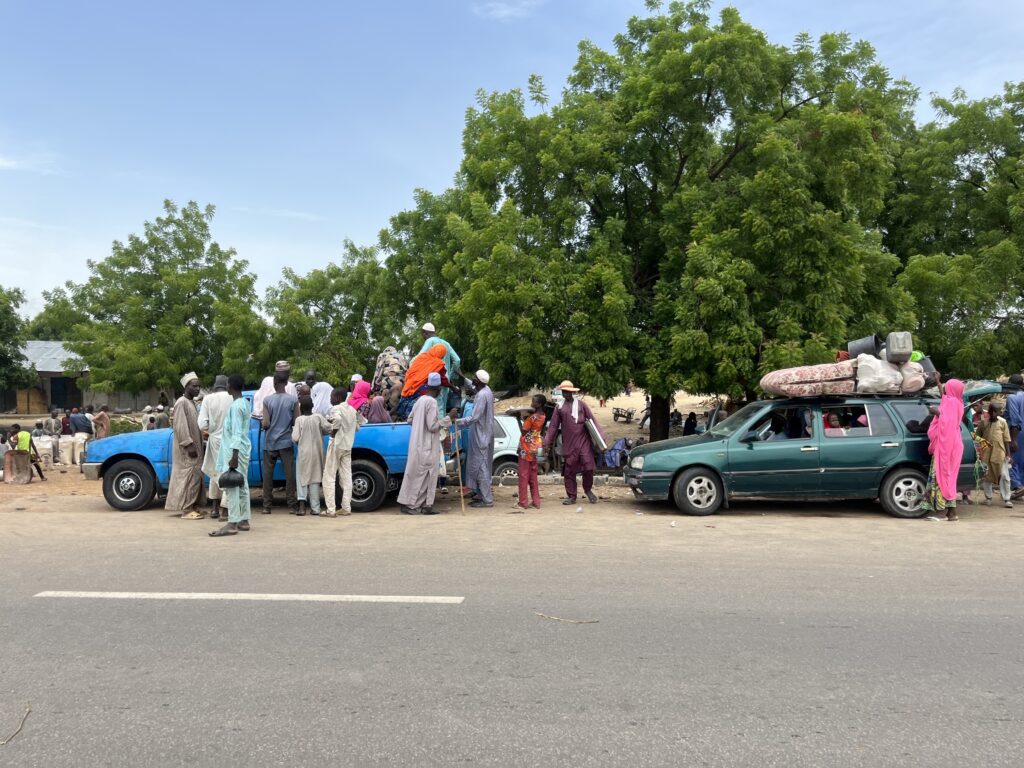
Passengers boarding at the Muna Motor Park Maiduguri to Mafa. Photo: Ijasini Ijani/HumAngle.

Passengers boarding at the Muna Motor Park Maiduguri to Mafa. Photo: Ijasini Ijani/HumAngle.

A galaxy of corruption

Extortion along the roads in Borno wasn’t always this widespread. Adamu Mustapha, 31, said he did not have to pay to transport goods worth over ₦1 million from Maiduguri to Mafa, Dikwa, and Gamboru Ngala before the insurgency.

“But transporting food supplies to Mafa is hectic now. You need to pass 15 checkpoints, all manned by the soldiers, and you must give nothing less than ₦300 per checkpoint. For my goods to reach Mafa local government area successfully, I always keep ₦10,000 per truck and ₦4,500 per small vehicle.”

He explains that the extortionary practice has triggered a spike in the price of goods in Mafa, Dikwa, and Gamboru Ngala.

“Many of my friends have withdrawn from this business because of how security personnel have made the route unfavourable,” he added bitterly. “I am still into this business because of my people. I know how they are suffering with getting some basic goods in Mafa. I have no choice but to help out by bringing in the needed goods for their consumption.”

The level of corruption sometimes goes beyond paltry payments. This was the experience of Alhaji Garba Ali, 45, who has moved fish between Monguno and Maiduguri for over 20 years. His father introduced him to the business when he was still enrolled in secondary school. The fish business brought impressive profits before the Boko Haram crisis. Traders came all the way from southern Nigeria to buy fish from the Monguno market. But that is no longer the case.

Military personnel also took advantage of the restrictions on movement to make a killing from the business.

“The soldiers along this route stopped us from transporting the fish to Maiduguri, and the fishing business became dominated by the Nigerian Army officials,” Garba recalled.

“I myself have bought fish from a sergeant in Monguno for more than ₦10 million. Over ₦1 million has been extorted from me for my fish to reach Maiduguri during the peak of the insurgency.”

According to fish trader Zakariah Ngubdo, after transporting fish from Monguno to Maiduguri was disallowed, businessmen had to bribe security personnel ₦1,500 per carton of fish. This meant suppliers had to raise the price from between ₦2,500 and ₦4,500 to ₦6,000 when selling to local traders, who then resold them for about ₦9,500.
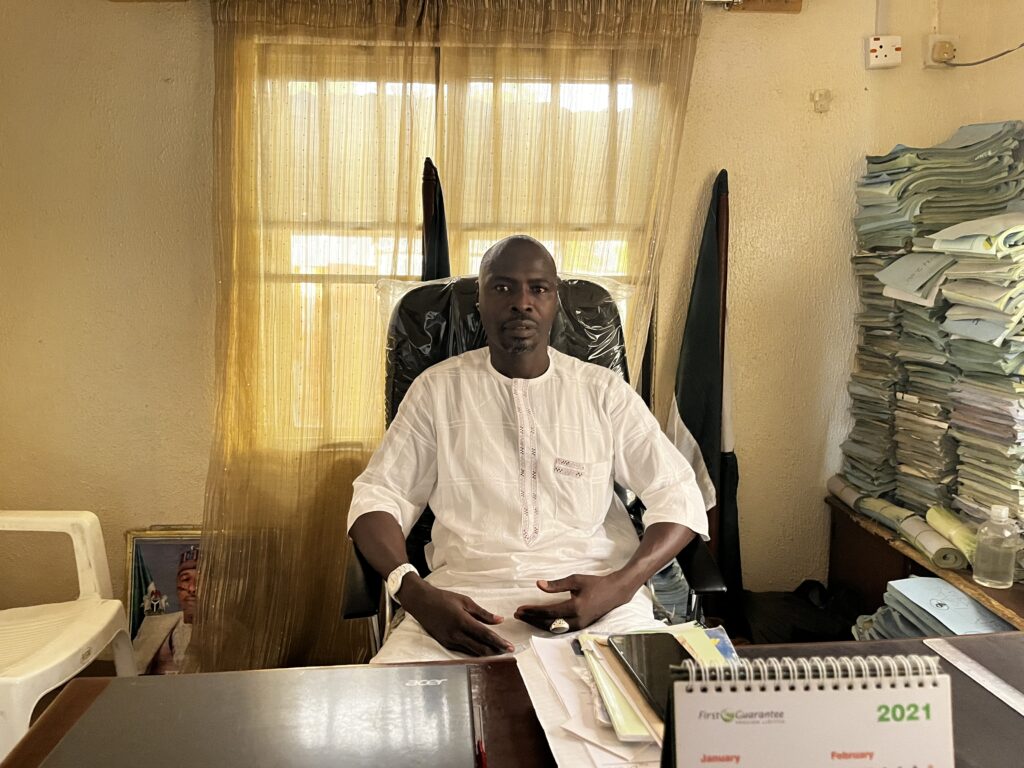
Bamai Mustapha, NURTW chairman, Mairi branch. Photo: Ijasini Ijani/HumAngle.

Before he became a top official of the NURTW, Bamai was also a driver along the Maiduguri-Gwoza route. He drove passengers to Yola as well, and he saw first-hand the challenges on the road. But he says the situation has improved. The roads are in better shape and there is more security, developments that have significantly shortened the travelling time.

“We have been suffering along this route for over a long period of time, but now the situation is very favourable to our drivers and commuters. Three years back, the security personnel used to open the road linking Maiduguri to Bama at about 9 a.m. daily and closed it at about 4 p.m. But now they open the road by 7 a.m. and close it by 6 p.m.,” he observed.

Also, there are officials of several security agencies now supporting the Nigerian Army to protect travellers.

While he acknowledged that drivers give money to these officers, he insisted that they do so voluntarily. “Many drivers do give money along this road by their wish and not compulsorily,” he said. “We feel this is the only way to support the security personnel along the way, even though we know giving money to them is totally wrong and unacceptable.”


This report republished from  Humangle was produced in partnership with the MacArthur Foundation under the ‘Promoting Transparency in Insurgency-Related Funding in Northeast Nigeria’ Project.
Flooding: We have re-channelled water, constructed dykes in Niger — HYPPADEC

0

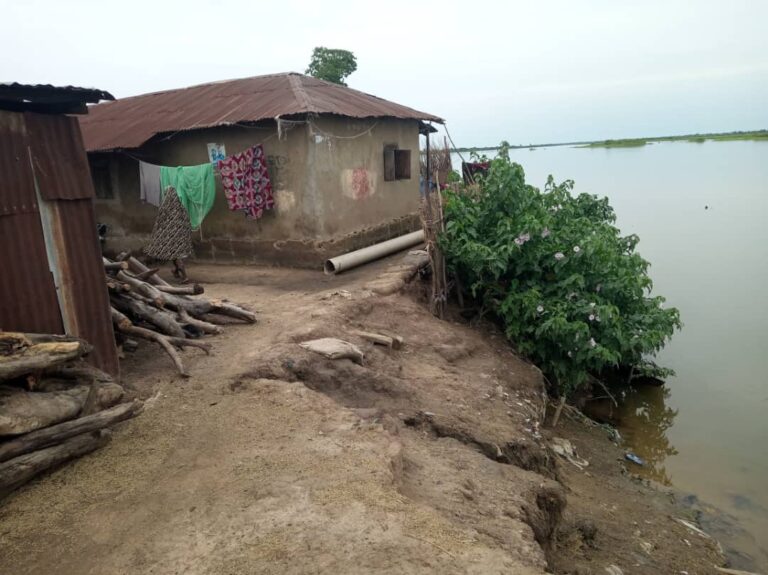
THE Hydro Power Producing Area Development Commission (HYPPADEC) said it has re-channelled water flowing through some flood prone regions and constructed dykes to mitigate future disaster. 

The Commission explained that it prioritised the most hit communities and also planned relocating the affected residents to higher land.

The ICIR in an investigation published on June 26, detailed some of the challenges faced by residents of the flood prone communities in Niger State and how the state government was reacting to it.

According to the investigation, residents of the affected communities were forced to abandon their homes due to the onslaught of heavy floods and had to seek refuge in internally displaced persons (IDPs) camps and makeshift houses.

Despite the warning by the Nigeria Meteorological Agency (NiMET), some survivors in these communities have returned to their homes and vowed not to relocate even if there is a repeat of last year flooding, while some hoped to vacate to high land if necessary.

They cited hunger, government neglect and lack of basic amenities in their camps as reasons for not wanting to return to the camps.

Findings by The ICIR show that should the forecast become a reality, some of these communities, like Kusogi and Ketso are at risk of losing lives and property as no flood preventive measures and control have been launched in the villages – either by the government or the residents.

Reacting to the findings, HYPPADEC spokesperson Nura Tanko, said the Commission and the state government are addressing the concerns of residents by building resettlement camps for residents in the flood prone communities.

He also assured that the state won’t experience a severe flooding this year no matter the amount of torrential rainfall.

He said: “As you know, this problem has accumulated for over five decades, and these communities are dealing with socio-economic and ecological challenges. Addressing it to the satisfaction of the people going by their expectations is not a day or two days job. We are just two years old,” he said.

“Resources also matter in addressing this issue. I can tell you we have actually done our best, and where people are not satisfied with what we are doing, all they need to do is to exercise patience. We can’t rise up in one day and address all the issues.

“We are sure that what we experienced last year, no matter the amount of torrential flood, we aren’t going to experience it again. We have re-channelled the water, and we constructed dykes to prevent it from cutting off the road.”

When asked about Ketso and Muregi, he said, “For Ketso and Muregi communities, our plan is not to provide ecological intervention within the existing community, our plan is to relocate these people to where the state government has provided for their relocation and as I speak with you, construction of houses for their relocation has started in a place identified by the state government where the government constructed a clinic and palace for the district heads.”

“For Mariga, as we address these things in batches, it will get to them. We can’t address all these problems overnight because of resources and the number of communities we operate in in the six states.”

Speaking on the Hydro Electric Dam project in Shiroro LGA, Tanko said communities in that area have enjoyed the Commission’s intervention, which is in contrast to what The ICIR reporter gathered on the field. 

But he explained that the idea of dredging River Niger was not an easy task, adding that the Federal Government cannot undertake the project at the moment.

The managing director of HYPPADEC, Abubakar Yelwa, had earlier noted that to dredge River Niger, River Benue, and River Kaduna, the Federal Government will have to spend over $20 billion.

The HYPPADEC boss however stated that the process will be difficult for the Federal Government to handle without intervention from international donor agencies.

Max Air dumps Lagos passengers in Abuja, shifts Kano trip several times

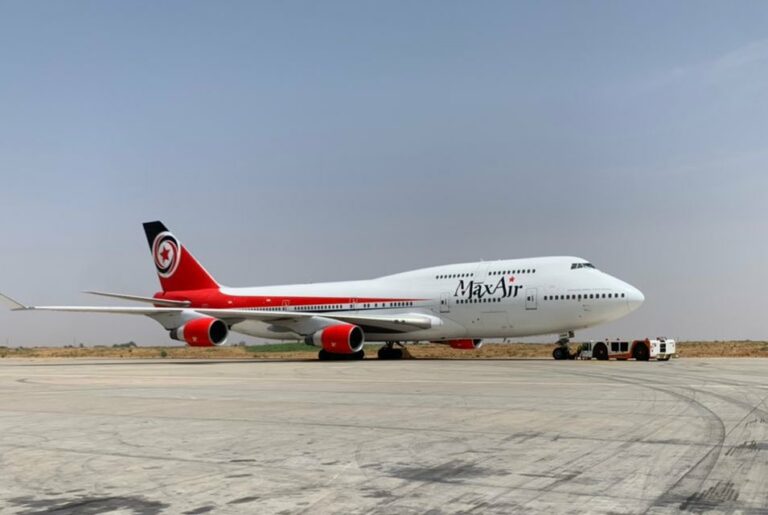
ON Wednesday, June 28, one of Nigeria’s airlines, Max Air, dumped its passengers travelling from Kano to Lagos in Abuja for hours without any explanation.

The flight took off from the Aminu Kano International Airport, Kano, around 5:25 pm and arrived at the Nnamdi Azikiwe International Airport, Abuja, at about 6:10 pm.

The airline’s crew allegedly asked the passengers to disembark and promised to put them on another aircraft some minutes later.

The passengers remained at the airport till 2:09 am the following morning before a flight flew them to the Lagos airport by 2:56 am.

Similarly, another aircraft by the operator from Abuja to Kano was scheduled for 8:20 pm that day, which was the first day of Eid-el-Kabir festivity. Some passengers (including this reporter) got to the airport and found that the aircraft will not take off as scheduled.

The staff on duty said they had rescheduled the flight for 9:40 pm.

Between 9:40 pm and 11:00 pm, there was no communication from the airline, either verbally or through the airport’s public address system. 

The ICIR discovered that the public address system and all air conditioning system at the departure hall were not working. There was much heat as passengers sweated profusely.

Lagos and Kano passengers travelling with Max Air were about two-thirds of all passengers waiting at the airport’s departure hall. They were apprehensive and angry. Some protested and walked down to the airline’s check-in counter on the ground floor to confront the staff. Others formed groups at the departure hall discussing how the airline is notorious for delaying passengers and shifting flights with impunity.

At precisely 11: 00 pm, one of the airline’s workers verbally called Kano passengers to proceed to board.

The passengers queued at the aircraft’s door on the tarmac, but a pilot from the plane addressed them and explained that the airline could not fly allegedly because of poor weather in Kano. The pilot’s claim could be untrue, as subsequent findings later revealed.

All passengers returned to the departure hall, this time more enraged.

At 11:28 pm, another announcement came verbally through a Max Air employee that the Kano passengers should proceed for boarding, leaving Lagos passengers behind.

The aircraft eventually touched down in Kano about 12:20 am.

Meanwhile, The ICIR reporter observed that the leather on the aircraft’s seats was peeling off, suggesting the aircraft might be old. Because the aircraft did not have many passengers, the reporter checked and observed that about 10 per cent of the seats were affected.

One of the seats on the Max Air flight VM1601 on Wednesday, June 28.
Photo credit: The ICIR/Marcus Fatunmole

Reasons for delay – Max Air

Meanwhile, the Kano manager for Max Air, Bello Ramallan, said the pilot who was to fly the Abuja aircraft to Kano became sick suddenly on his way to the airport, forcing the airline to look for another pilot “who lives in Nyanya,” 52 kilometres from the airport.

Ramallan’s explanation contradicts what the pilot told passengers on the tarmac in Abuja.

His claim also becomes more suspicious because the airline also blamed its failure to take its passengers from Lagos to Kano on a sick pilot in April 2022, after reportedly delaying for seven hours.

However, Ramallan said the Nigerian Civil Aviation Authority (NCAA) allows a pilot to fly an aircraft to a maximum of seven different destinations in one day within Nigeria. “Four is the minimum, and seven is the maximum,” he stated, stressing that “the number of routes was reduced from 10 to seven because it overburdened the pilots”.

He apologised for the flight delays. “I want to apologise for what happened. It had been happening not just yesterday or the day before, especially in terms of delay and keeping quiet without (giving passengers) any information. It’s not deliberate. We are not happy with delaying people and keeping quiet, especially in Abuja and Lagos. We are unhappy with the habit of keeping quiet without informing the passengers. On behalf of Max Air everywhere, I want to apologise. 

“The delay came because the operating pilot was sick and unconscious; we had to look for someone to operate that flight. So, the flight was delayed for about two to three hours. The fault was that our staff in Abuja could have made the announcement, not to open up on what happened. People have had about a 30-minute delay and did not complain.”

The ICIR reports that Max Air has its head office in Kano.

Passengers react

A passenger on the flight, Muhammed Sumani Musel, a Canadian, said: “It is unfortunate that the biggest economy in Africa doesn’t have its domestic flight. It is really unfortunate that this is happening. I’m just speechless. I have nothing to say. Initially, they postponed our flight from Kano to 4:50 pm, Then we left by 5:50 pm. We came here and arrived at 6:30 pm. They told us it would be an hour’s delay. Then, we spent another hour. Now, it’s 11:00 pm; we are still here.”

Musel would like to sue the airline but would not because of the time and resources he said he would waste. “Ultimately, it is not economically feasible when you want to sort things out (in the court). It’s a lot of consumption of time and money.”

Another passenger, Benjamin Justice, said, “It is very embarrassing that we paid for Kano to Lagos, and they brought us to Abuja and dumped us as if we don’t have anything we are doing or we are just slaves.”

He said because of the delay he encountered earlier, he missed the first flight he was supposed to fly with to Lagos and had to pay extra funds to join the second airline that took him to Abuja instead of Lagos. 

He explained that he would not consider litigation because of his work which would not give him time.

Boye Odunayo, another passenger, said, “We’ve not been challenging them. That is the truth. We have a country where nothing is working. No sector is working. Nigeria is reaping what I can call a catastrophe of ineptitude, the catastrophe of celebrating merit on the altar of favouritism. Most of the people who handle sensitive offices in Nigeria are incompetent.”

He added: “It is a systemic thing. It is a systemic inefficiency. It has accumulated over time.

Some of Max Air’s flights at the Aminu Kano International Airport, Kano, on Wednesday, June 28.
Photo credit: The ICIR/Marcus Fatunmole

The ICIR contacted the Nigerian Civil Aviation Authority (NCAA) to seek the organisations’ reaction to the delays.

The official in charge of complaints, Uloh Ikwo, urged this organisation to detail the incidents as a complaint and submit to a mail she provided.

She promised the NCAA would conduct an urgent probe into the complaint. 

History of Max Air’s flight delays and cancellations

Checks by The ICIR revealed that multiple reports in recent times show how Max Air, established in 2008 by the late business mogul Dahiru Barau Mangal, has delayed or flagrantly cancelled flights, leaving its passengers stranded.

In September 2022, this organisation reported how the airline and two others topped delayed flights in the first quarter of that year.

Another report that month showed how the operator cancelled a flight at midnight and left passengers stranded after five hours delay.

In April 2022, one of Max Air’s pilots reportedly held passengers hostage for four hours in Abuja.

The ICIR further reports that the airline rescheduled its flight from Kano to Abuja on Saturday, July 1. The flight was supposed to take off at 5:25 pm but was rescheduled for 2:00 pm.


Davido in the eye of the storm

IN the past week, afrobeat superstar, David Adeleke, popularly known as Davido, has been embroiled in scandals as different women have come out to allege that he impregnated them.

The singer, widely regarded as one of Nigeria’s top three artists, is not new to controversy but this one is threatening to tarnish his reputation.

On Tuesday, June 27, a United States-based lady identified as Anita Brown accused Davido of impregnating her. Brown made the allegation via an Instagram live session. Following attacks from Davido’s fans, Brown claimed that she had been in a relationship with the singer since 2017, until the pandemic in 2020.

“We met in Dubai, 2017, let’s be clear! This is not no one . Don’t ever play with my name. Off and on up until the pandemic in which I was in a long relationship”, she stated.

Amidst the intense scrutiny faced by the artist following Brown’s claims, a woman named Ivanna Bay from Paris, France, came forward, asserting that she too is expecting a child with Davido.

Taking to her Instagram story, she shared screenshots of her conversations with the singer, along with a pregnancy test result.

Adding to the unfolding saga, a Kenyan woman named Pendo Stacy boldly asserted in a live video that she had also engaged in intimate relations with the singer. To support her claim, she proudly displayed a boxer brief that she alleged belonged to the artist.

“I got a souvenir that day. His boxer has colours , orange, yellow and black. I love Davido that much”, she said.

Anita Brown utilised her social media accounts to hurl a barrage of disparaging remarks on the artist, his spouse, and even Nigerians as a whole.

“Evil ass Nigerians. Sacrificing babies and shit. I would never want part in no demonic culture! @Davido WICKED”, she said in a tweet.

Following these developments, several celebrities and Nigerians at large have taken to social media to react to the derogatory remarks, expressing their anger and displeasure.

A journalist, David Hundeyin replied Anita Brown in a tweet.

“Not sure if you got the memo, but we aren’t exactly dying to claim you either. And since you hate Nigerians and our “demonic culture” so much, you should be disgusted at the thought of giving birth to the Nigerian baby you claim is growing inside you. You can do us all a favour,” he tweeted.

Some Nigerian Twitter users also responded to her tweet.

“Nigeria if you all do not report her account and get her account suspended today then we have all enabled this Moriah Mills clout chasing maniac insulting an entire country. There’s one thing calling a man out for impregnating you and there’s another insulting his dead child, his wife and an entire country. It’s quite obvious you’re now chasing clout from Nigerians. Since Nigerians are so evil, close your square headed legs next time and also stop begging them for money. You cannot mess with Nigerians and get away with it, especially on Twitter. You say you’re pregnant but you’re insulting someone else’s child and for the fact you’re insulting a dead child, for heavens sake don’t you have any morals or even shame”, @TheSerahIbrahim tweeted.

“A Nigerian is allegedly growing inside you and it’s been your biggest achievement. You are tripping”, @FS_Yusuf_ said.

Some celebrities including Tonto Dike, Bobrisky among others also responded via their Instagram stories.

Reactions from celebrities

The musician has become the hottest topic on the social media in recent days, with Nigerians discussing his alleged escapades.

Davido keeps mum

Davido is yet to issue a statement to either accept or refute the claims made by these women.

However, he shared a screenshot of one of his popular tracks, “Unavailable,” from his latest album on his Instagram story. This gesture was widely interpreted as his response to the numerous accusations being levelled against him.

Elon Musk introduces daily reading limits on Twitter

0

DAILY reading limits have been introduced on Twitter in a bid to address extreme levels of data scraping and system manipulation on the social media platform.

This was disclosed by the Chief Executive Officer, Elon Musk shortly after the app began to display a message which read: ‘Rate limit exceeded. Please wait a few moments then try again’.

Verified accounts are limited to reading 6,000 posts per day, while unverified accounts are restricted to 600 posts per day. New unverified accounts are limited to 300 per day. 


Read Also:

The development was met with outrage from Twitter users as many found it difficult to access latest information. 

The ICIR also gathered that unverified accounts who have probably read more than 600 posts in a day couldn’t refresh news platforms and other social media handles as they all displayed the ‘Rate limit exceeded’ message.

Reacting to this, Elon Musk explained that the decision was to address levels of data scraping and system manipulation.

He tweeted: “To address extreme levels of data scraping & system manipulation, we’ve applied the following temporary limits: – Verified accounts are limited to reading 6000 posts/day – Unverified accounts to 600 posts/day – New unverified accounts to 300/day.”

Meanwhile, the Twitter billionaire owner in another tweet promised that the rate limit will soon increase.

He tweeted: “Rate limits increasing soon to 8,000 for verified, 800 for unverified & 400 for new unverified.”

Users react


Some twitter users have expressed their dissatisfaction at the development, stating that there should be no imposition of limit to access to information by someone who promised ‘free speech’ while purchasing the app.

Popular Nigerian critic, Daniel Regha bemoaned the situation, noting that it will affect a lot of people who can’t afford a verification badge.

“Verified accounts are limited to reading 6,000 posts a day but unverified accounts to are limited to just 600? This will affect a lot of people who can’t afford it. Twitter is one social media platform where millions of people get news, this should’ve been considered. So sad.”

Another Nigerian, Dípò Awójídé said Twitter didn’t give the condition when he was subscribing for Twitter Blue.

“Elon, hire professionals and pay them for the job they do. There should be no limit to the number of tweets I read daily. You didn’t give me this condition when I subscribed to Twitter Blue.”

John Junyszek said the new development may negatively impact people who use the platform most as part of their job.

“I may be overestimating, but it feels like I usually see more than 6,000 posts a day as part of my job. It feels like it could negatively impact people who use this platform the most. If this does end up causing issues for folks, would you be open to increasing the view limit?”

Kano demolitions: I am reclaiming public assets stolen by Ganduje — Yusuf

KANO State governor, Abba Yusuf, says he embarked on the demolition of structures across the state in order to recover public properties ‘stolen’ by the administration of his predecessor Abdullahi Ganduje.

He said this while receiving the Emir of Kano, Aminu Ado Bayero, district heads and members of the Emirate Council, at the government house on Friday, June 30. 

According to a statement by his spokesperson, Hisham Habib, the visit was part of the Eid Kabir celebrations.

Since the governor assumed office on May 29, several buildings across different parts of the state have been pulled down. One of the first structures demolished was the government house roundabout.

The state government said the structure was too tall to be placed in front of the Government House as it blocks the view for security surveillance.

Following this, the governor Yusuf has continued to carry out demolition of structures.

The ICIR reported that the first of such buildings to be demolished, a three-storey structure, is located on the Race Course Playground in the Nasarawa GRA area of the state.

The governor also promised to demolish more illegal structures erected on plots of land reserved for schools, graveyards, markets and hospitals.

“I am announcing, today, that all these public places and assets that were immorally plundered and sold by the Ganduje administration should be taken over by law enforcement agencies, led by the police, the DSS, Civil Defence, and Hisbah pending the final decision of government,” he said.

The demolition of these structures across thr state has drawn criticism from Nigerians across the country.

Last Monday, residents hit the streets to protest the ongoing demolition exercise.

However, addressing the Emir and his entourage, Yusuf argued that It is essential to reclaim public properties that individuals and cronies acquired illegally from the previous administration.

He said structures belonging to the state government illegally sold to private entities during Ganduje’s administration would be recovered.

“Your Highness, it is important for the Emirate Council to note that we embarked on the demolition exercise to reclaim public properties that were illegally acquired, and we will ensure that all such properties are restored for the benefit of the good people of Kano,” he said.

Yusuf, of the New Nigeria Peoples Party (NNPP), defeated Yusuf Gawuna of the All Progressives Congress (APC), Ganduje’s anointed candidate, to win the governorship election in Kano State.

Flooding: Residents of Trademore Estate count losses

OVER a hundred families were affected by a flash flood in Trademore estate in the Lugbe area of the Federal Capital Territory (FCT) on Friday, June 23, after an intense rainfall that lasted for about 3 hours.

Water surged into homes and businesses, forcing the residents to abandon their belongings and scamper for safety.

This is the fifth flood incident in the estate since 2014 and, according to some residents, the worst of them all.

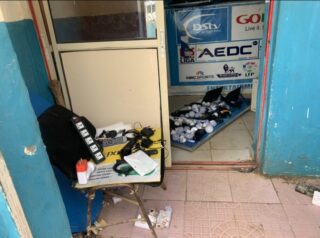
“The water got very close to the ceiling of my store,” a resident, Nafisat Abutu said, pointing at the brown lines over the window level. 

Nafisat is a 24-year-old salesperson at an electrical gadget store on Lugard Street, Phase 1. She said she was alone and terrified when the flood came.

“If one of estate security had not come to rescue me, I might have drowned in the water,” she says. “Because of the level of the water, there was nowhere I could go, nothing I could do. I was so terrified that, at some point, I started crying. 

“We lost goods that cost millions as a result of the incident. It’s a devastating experience.”

Some of the goods left in Nafisat’s store.

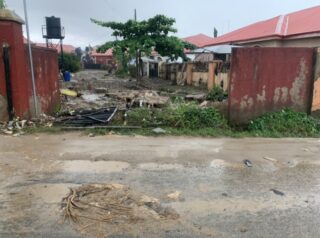
When The ICIR visited the estate, the water had receded, but the ground was still wet. There were cracked buildings and broken walls, with debris scattered everywhere. And the residents are still dealing with the devastating impact of the flood. 

Building broken by flood in Trademore

Residents who spoke to The ICIR said about three persons died in the flood – one man and two women.

Jacob Sule, a resident in Phase 2, said he is still occupied with sorting his properties and cleaning his apartment. He had recently moved into the estate, unaware that it was prone to flooding or had experienced flooding in the past.

He explained that his entire property was affected by the water. His clothes, shoes, home appliances and gadgets. “I lost so much that I can’t count them all,” he said.

“I just learnt that this is a recurring crisis.The authorities need to contain this problem. It was a very nasty and bad experience. Psychologically, it is disturbing. I hope it never rains again.”

One of the residents The ICIR reached out to was devastated by the experience and unwilling to speak as a result. 

His flat was submerged by the flood. The ICIR observed that his sitting room had been emptied out as most of his properties were wrecked in the flood. 

“I can’t talk now. Maybe later. There is nothing to talk about. I have three cars that I cannot drive, and three cameras that I can’t work with. What is there to say? Ma, please just leave,” he said angrily. 

Why flooding in Trademore

Residents who spoke to The ICIR say the flooding is due to a poor drainage system present in the estate. 

According to Victor, a resident who has lived in the estate for over a decade, the flood is not totally a natural crisis but a result of the sub-standard drainage system. 

“Because of the slope in Trademore and there’s a subpar drainage system that is blocked around the area, the slope area gets easily flooded. The drainage is blocked too,” he said.

“This is not the first flood in Trademore but this is worse because the water flowing from several estates in Abuja, get to this point and cannot flow properly.”

Harold Idemudia, a member of the estate board of trustees, also affirmed this, noting that the challenge is beyond the capacity of the developer. 

According to him, water from nine different districts is channelled through the small bridge by the gate of the estate. And flows down to the airport road, then to Gurara estate.  

He pointed out that should the flow be disrupted, the bridge in Trademore will be affected. 

“We have only three cells here for water passage which is too small for the quantity of water channeled here. In 2014, government agencies came together, and certain issues were identified. 

“They were categorised under internal issues and external issues. All the internal issues that were asked to be done by the developer was done such as extending the bridge, erecting retaining walls and dredging of the waterway but the external things are the responsibility of the government.”

‘We are paying mortgage’

The Trademore Estate chairman, Phase 2, Stella Okuteh, has kicked against the demolition of houses in the estate.

Earlier in the year, 30 of the houses marked for demolition were pulled down by the Federal Capital Territory Emergency Management Agency (FEMA). The Agency said this was to reduce the risk of flooding and prevent loss of lives and damage to property, especially during the rainy season.

However, Okuteh rejected the Agency’s position, stating that demolishing the area is an ineffective way to resolve the problem. 

“Demolition will not solve the problem. If they demolish this place, other houses will still get flooded,” she said. 

“Trademoore is not the only estate affected. The government should fix the problem. Trace the water, build better drainages.”

Okuteh disclosed that houses in the estate were built by the Federal Mortgage Bank (FMB) through Platinum Mortgage Bank, and many of the estate residents are civil servants who have been paying back the mortgage loan for years. 

“The houses here own by the Federal Mortgage Bank through Platinum that built this house. Many residents here are civil servants who are still paying mortgages to the government.

“Are you saying the government body did not inspect this place before building? If they don’t fix the problem, the people in the estate should stop paying the mortgage. They are paying back the loan and you want to demolish their house?

“We won’t allow any demolition here,” she said.

FCTA declares Trademore disaster zone

Meanwhile, the Federal Capital Territory Administration (FCTA) has declared the estate a disaster zone.

The FCTA promised to take urgent action to stop further damages, loss of lives and properties.

The permanent secretary of the FCTA,Olusade Adesola, disclosed this while assessing the area.

Adesola stated that a task force on flood mitigation, consisting of heads of relevant agencies in the FCT, would evaluate the situation and suggest remedial actions.

“Having seen the extent of the flooding, we declare the Trademore area a disaster zone that needs immediate action to remedy further damages and loss of lives and properties.

“This is part of steps to address the incessant flooding at the Trademore Estate. I want to assure residents that adequate steps will be taken to forestall further damages to properties and loss of lives to flooding at the estate.”

Falana urges DSS to speed up investigations on Emefiele, Bawa

0

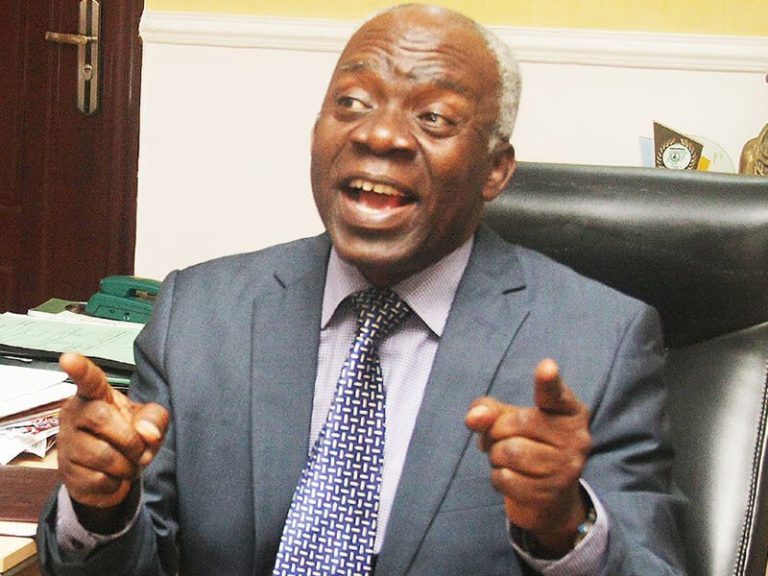
A HUMAN rights lawyer Femi Falana has urged the Department of State Services (DSS) to hasten investigations into cases involving the suspended Governor of the Central Bank of Nigeria (CBN) Godwin Emefiele and Chairman of the Economic and Financial Crimes Commission (EFCC), Abdulrasheed Bawa.

The Senior Advocate of Nigeria (SAN) made the appeal during an interview on Channels Television’s Politics Today, on Friday, June 30. 

He urged the DSS to arraign the two in court if there is evidence of wrongdoing against them, stressing that the continued detention of Emefiele and Bawa undermined the implementation of the Administration of Criminal Justice Act.

The Department of State Services (DSS) on June 10 confirmed the arrest of Emefiele, who was suspended by President Bola Tinubu as CBN governor.

Tinubu having suspended Emefiele, directed him to hand over the affairs of his office to the deputy governor, operations directorate, Folashodun Shonubi.

The DSS did not state or give any specific reason why Emefiele was arrested. However, the arrest may not be unconnected with the allegations the DSS had placed against him.

DSS had last year attempted to arrest Emefiele, accusing him of financing terrorism, aiding and abetting terrorism, and committing economic crimes.

Similarly, on June 15, the suspended EFCC boss, Bawa was invited by the secret police immediately after Tinubu suspended him indefinitely to allow proper investigation into his conduct while in office.

“This follows weighty allegations of abuse of office levelled against him. Mr Bawa has been directed to immediately handover the affairs of his office to the Director, Operations in the Commission, who will oversee the affairs of the Office of the Chairman of the Commission pending the conclusion of the investigation,” parts of a statement by the spokesperson of the Office of the Secretary to the Government of the Federation, Willie Bassey, read.

Reacting to the continuous detainment of the duo, Falana called on the Nigerian government to follow due process.

He said: “Investigations should be speedily conducted, more so where allegations are made. I do not expect any delay in the investigation of the very serious allegation that has been made.

“In the case of Emefiele, the State Security Services last year alleged his involvement in terrorism financing. Please, quickly do something about that. With respect to money laundering and other offences, take them to the appropriate agencies of government.

“In the case of Mr Bawa, we haven’t been told the offences he committed. I cannot speak very confidently with respect to the gentleman except to ask the government or the agencies involved to speed up an investigation and have them arraigned if they are indicted.”

No plan to increase fuel price to N700 per litre — IPMAN

THE Independent Petroleum Marketers Association of Nigeria (IPMAN) has urged Nigerians to disregard reports that its members are planning to increase the price of a litre of premium motor spirit (PMS), otherwise known as petrol, to N700.00.

IPMAN made the clarification in response to speculations and concerns that foreign exchange unification could spike importation price of petrol.

A media outlet (not The ICIR) had reported that the pump price of petrol could rise above N700 per litre in Northern Nigeria starting from July.

Reacting to the development, IPMAN urged Nigerians not to engage in panic buying as the the price of petrol would not be more that what is being sold presently nationwide.

Chairman of IPMAN South-West Zone, Dele Tajudeen, who dismissed reports of the planned hike in petrol pump price in Ibadan on June 30, noted that the slight hike in the price of the commodity was due to transportation cost.

He stressed that Nigerians should be at rest as the commodity will not be out of reach of the masses.

“I want to disabuse the mind of the people that they should not panic about it; there is no cause for alarm, we are in control and there is nothing like that.

“So, people should be rest assured that there is no way they can buy petrol more than the price it is being sold now.”

He further said that the price from NNPC retail limited, which is an integral part of NNPC limited, have more advantages than other independent and major marketers.

“However, I have read what somebody put into the paper. It is just speculation, it is not a reality. Nothing like that I want to assure the masses.

“There is no how the price can go to N700 as we speak, because even if the foreign exchange is N700 or N800 that has nothing to take the price of petroleum from N500 to N700,” Tajudeen said.

He noted that the product had been deregulated, hence the differential in prices was due to transportation as it is related to location.

”If you are moving products within Lagos the price may not be more than N300,000 but if you are moving up to Ibadan or thereabout it could be as much as N500,000.

”And if you are going to Ilorin, it could be as high as N700,000 that would account for differential in prices.”

He further said that members have the luxury of sourcing their products from private depots besides NNPCLtd depots.

”Though NNPC has given us the price but the reality of it is that what we buy from the market; because NNPC limited is not the only source for our product, we get from private depots.

“So, whatever we buy is what we put our own margin and sell.

”But as of today, the highest you can get anywhere should be around N550; Lagos N510 per litre; Ogun State between N500 and N520,” Tajudeen added.

Tajudeen also said IPMAN is in total support of the removal of petrol subsidy by President Bola Tinubu.

“Even in the Petroleum Industry Act, it has been clearly stated that the subsidy must be removed.

”So, I want to commend him for removing the subsidy and I want to say that we are in support totally. This is because the subsidy was a scam.”

Army arrests 12 rail track vandals in Nasarawa

0

TWELVE suspected rail track vandals have been arrested by the troops of 4 Special Forces, Doma, of the Nigerian Army, in Nasarawa State.

The Command’s acting Deputy Director, Army Public Relations Major Joseph Afolasade disclosed this on Friday, June 30 at a press briefing in Doma.

“On June 15, 2023, troops of the Command, during a routine patrol, intercepted five suspected rail track vandals at an abandoned railway station between Angwan Yara and Agyaragu communities in Keana Local Council.

“The suspects were arrested with large quantity of rail track loaded in two trucks fully loaded.

“In the course of investigation, the troops arrested additional seven suspects on June 18, who made confessional statements,” he said.

The suspects, according to Afolasade, have admitted to have played various roles in rail track theft and also mentioned the names of prominent persons in Nasarawa and Plateau states as being part of the syndicate.

The spokesman, however, didn’t give the names of the prominent persons involved in the crime, noting that the suspects claimed that they were deceived by their sponsors.

“They offered our personnel N5 million to allow them go with the vandalised rail track equipment, but our men rejected the money and arrested them,” he added.


READ ALSO:


Afolasade further stressed that the Commander of the Special Forces, Maj. Gen. Owyinka Soyele, approved that the suspects be handed over to  Nigeria Security and Civil Defence Corps (NSCDC) for further investigations.

Receiving the suspects, the Deputy Commandant of Nasarawa NSCDC,  Afere Joseph, commended the Army for the synergy to tackle insecurity and advised the residents to shun crime.

Joseph, however, assured that the suspects would be charged to court immediately after investigation.