ABIA State Peoples Democratic Party (PDP) governorship candidate, Uche Ikonne, a professor, is dead.
Ikonne’s death was announced in a statement by his son, Chikezie Uche-Ikonne, on Wednesday.
The younger Ikonne said his father died after a brief illness at the National Hospital, Abuja, on Wednesday, January 25.
“I regret to announce the death of my dear father, Prof Eleazar Uchenna Ikonne, who died at the National Hospital Abuja today January 2023, 25, by 4 am after a brief illness,” he said.
“He was recovering after taking proper treatment in the United Kingdom but relapsed a few days ago leading to multiple cardiac arrests from which he didn’t recover from.”
He noted that further details and arrangements for his burial would be made known to the public after deliberations and meetings are made within the family.
Until his death, Ikonne was a optometrist and politician. He was the the 7th Substantive Vice- Chancellor of the Abia State University and the former Rector, Abia State Polytechnic, Aba.
He was born on August 15, 1956, in Agburuike, Nsulu in Isiala Ngwa North, Abia State.
He attended Ngwa High School in Aba of Abia State. He proceeded to study Optometry at the Manila Central University, Philippines. He obtained a Master’s degree in Hospital Administration at St. Jude College, Philippines.
He later obtained a Doctor of Philosophy degree in Environmental Health Science from Abia State University.
He started his career as a consulting optometrist at the Park Lane General Hospital, Enugu in 1985.
In 1993, Prof. Ikonne became a member of the Optometrists and Dispensing Opticians Registration Board of Nigeria and the Chairman of the Education Committee.
He later joined Abia State University, Uturu as a lecturer.
During his career at Abia State University, Uchenna Ikonne held some key positions in the University including, Head, Department of Optometry, Director, Institute for Distance Education, acting Dean, Faculty of Health Sciences, Deputy Provost, College of Medicine & Health Sciences of the institution.
Ikonne was the Chairman, Disciplinary Committee and Vice-Chairman, Optometrists and Dispensing Opticians Registration Board of Nigeria in 2007 and 2009 respectively.
He won the African Optometric Educator Award of the year and the the distinguished merit Award of the Nigerian Optometric Association in 2003 and 2006 respectively.
CPJ’s data of journalists who died last year almost tally with those of the International Press Institute (IPI), which logged 66 on December 29, 2022.
The deceased were victims of their work – exposing sleazes, covering gang violence, other dangerous activities and the environment.
Deaths of journalists and other media workers in the past year grew because of the high casualties of the professionals from the Russia/Ukraine war and the hostile media working environment in Latin America, especially Mexico.
Of the 67 killed, 41 died in direct connection to their work. The circumstances behind the killings of others have yet to be known. CPJ said it will continue to probe their death.
More than half of the murders occurred in just three countries–Ukraine (15), Mexico (13), and Haiti (seven), the highest yearly numbers CPJ has ever recorded for the countries.
CPJ’s report does not include journalists who died of illness or were killed in a car or plane crash unless the crash was caused by hostile action.
In addition to Mexico, Russia and Ukraine, journalists and media workers died in Colombia, the Philippines, Chad, Chile, Israel, Myanmar, Brazil, Haiti, Turkey, Occupied Palestinian Territory and the United States.
The deaths underline the extent of threats faced by the press around the world, including in countries with democratically elected governments, the CPJ noted.
“CPJ tracks three types of journalists’ deaths in relation to their work: targeted murders in reprisal for reporting–by far the largest category; deaths in combat or crossfire; and deaths on other dangerous assignments. CPJ also tracks the killings of media support workers, such as translators, drivers, and security guards; there was one such killing in 2022 in Kazakhstan.”
Other highlights of the report show that the Russian/Ukraine war caused the death of 13 of the 15 journalists who died in Ukraine, and more could die as the war persists.
Nearly half of the global total (30) died in Latin America in 2022 – “a reflection of the outsize risk journalists in the region face”.
In October, two gunmen fatally shot and killed Rafael Emiro Moreno Garavito, a veteran journalist in Colombia. In May, Palestinian-American journalist Shireen Abu Akleh was shot and killed while reporting an Israeli military raid in the Palestinian West Bank city of Jenin.
CPJ specifically accused Israel of condoning impunity for crimes against the press.
It said Akleh’s killing came one year after Israeli forces bombed several buildings in the Gaza Strip housing media offices, including The Associated Press and Al-Jazeera.
In the Philippines, all four of the murdered journalists were radio journalists “covering local politics, highlighting the dangers faced by the press in the country”.
The ICIR reports that the CPJ did not record that any journalist died in Nigeria in 2022; there were reports of attacks on the practitioners and other workers in the industry.
The International Press Centre (IPC) condemned some of those attacks in a report in June of that year.
There are several reports of the government’s intolerance of journalists’ work in Nigeria, resulting in their unlawful arrest, shoddy arraignment and incarceration, including a 2019 report which showed that the country recorded the worst attacks on journalists in 34 years under President Muhammadu Buhari.
THE Minister of Agriculture and Rural Development, Mohammed Abubakar, has revealed that the Federal Government is to generate $500 million from cashew nut exports in 2023.
The minister, who was represented by the Permanent Secretary of the Ministry, Dr Ernest Umakhihe, disclosed this on Tuesday, January 24, during an event held to mark the Nigerian Cashew Day and commencement of the cashew farming season, in Abuja.
Speaking on ‘Industrialising the Nigeria Cashew Sector through Inclusive Policies’, Abubakar said that Nigeria generated over $250 million from cashew exports in 2022, adding that the product could fetch Nigerian farmers about $500 million in 2023.
He pointed the revenue from cashew export is estimated to represent over 10 per cent of the Gross Domestic Product (GDP) based on export data of 2022.
”It is estimated to represent over 10 per cent of GDP based on export data of 2022 and it is becoming a commercial crop in Nigeria and is cultivated in 27 states including the FCT,” he stressed.
“In realisation of the importance of cashew, the Federal Government through the Federal Ministry of Agriculture and Rural Development listed cashew as a priority crop. It is being promoted under the Import Substitution Strategy of the present administration led by President Muhammadu Buhari.”
The minister noted that cashew is one of the crops being promoted under the Value Chain Programme of the ministry.
He stressed that the Ministry had carried out a number of activities over the years to promote the growth of the value chain, including the distribution of improved seeds/seedlings to cashew farmers free of charge.
Abubakar added that the Ministry had financed the establishment of cashew cottage industries in some states, distribution of agrochemicals/growth enhancers, carbon-free jute bags and knapsack sprayers.
”Others were the provision of water pumps to cashew farmers, conducting capacity building/training for cashew farmers and sensitisation exercises,” he added.
MANY residents, including vigilantes, are feared dead following multiple explosions that rocked the Galkogo community in Shiroro Local Government Area of Niger State.
Explosions reportedly rocked the community on Tuesday, January 24.
The cause of the explosion has not been confirmed.
However, a resident, Tanko Erena, told Punch that the explosions were caused by air strikes by Nigeria Air Force. He added that the explosions occurred when men of the Joint Security Task Force were patrolling the area.
“I believe the occupants of the fighter jet thought that the JTF members were bandits because there is really no reason to justify bombing them like that.
“I can’t tell you how many bodies were removed from where the incident occurred, but I saw two vehicles that carried bodies from the scene,” he said.
The State Police Public Relations Officer, Wasiu Abiodun, when contacted by the ICIR, directed our reporter to the State Commissioner for Internal Security and Humanitarian Affairs, Emmanuel Umar.
However, calls made to the Commissioner were not answered as of the time of filing this report.
CULTURAL Survival is accepting applications for the Indigenous Community Media Fund which provides opportunities for Indigenous community radio stations and media outlets to strengthen their broadcast infrastructure and systems while providing training opportunities for their journalists through a participatory and dynamic grants program.
Indigenous community radio stations and other community media outlets and groups may apply for a grant of up to $6,000.
Radio network proposals presented by three or more Indigenous radio stations can apply for funding up to $12,000
All countries in Latin America, the Caribbean, and Africa, Canada and the United States; India, Philippines, Indonesia, Nepal, Bangladesh, Vietnam, and Malaysia are eligible to apply.
The initiative enhances community efforts to establish and ensure the sustainability of Indigenous community-controlled media.
The organiser says past projects that were funded included improvements to internal organisation infrastructure, capacity building, systematization of radio and other community media management experiences, advocacy in national legislation and policies to advocate for access to Indigenous community media, and other innovative strategies that increase political and community impact.
The initiative will highly value the participation and inclusion of women, other genders, and youth as a funding priority for the projects.
The deadline for the submission of the application is February 15, 2023. Interested applicants can apply here.
CHIEF Press Secretary (CPS) to the Governor of Anambra State, Christian Aburime, has said Governor Chukwuma Soludo’s appeal for the release of the detained leader of the Indigenous People of Biafra (IPOB), Mazi Nnamdi Kanu, was not politically motivated.
The ICIR had earlier reported that Soludo appealed to the Federal Government to release the leader of the Indigenous People of Biafra (IPOB), Nnamdi Kanu, in order to resolve security challenges bedeviling the South-East.
Soludo specifically urged the Federal Government to release Kanu to him, saying he was willing to stand as surety for the IPOB leader.
However, IPOB had faulted the governor’s gesture. The group said it rejected Soludo’s offer to stand as surety for Kanu.
The governor has also come under attack over the offer, with many describing his gesture as politically motivated.
Reacting to the development, Aburime stated that Soludo’s call for Kanu’s release was borne out of a genuine desire to restore peace to the South-East.
Aburime added that the governor understood the need for the IPOB leader to speak to the people of the South-East in order to address the high level of insecurity in the region.
The Press Secretary expressed regrets that some people had attached wrong motives and political meaning to the “genuine” appeal made by the governor.
He stressed that Soludo neither consulted other South-East governors nor spoke on their behalf “but spoke in his capacity as the governor of Anambra State”.
According to him, the governor observed that insecurity in the region has continued to surge since the detention of the IPOB leader.
Although Information and Communication Technology (ICT) has become a relevant part of human life, availability and access to ICT education is a challenge to many pupils and students in the FCT. In some government-owned schools, shortage or absence of devices, dilapidated computer labs and teachers with inadequate ICT training limit the quality of education acquired by students and pupils, IJEOMA OPARA reports.
Maryam Ibrahim had always hoped that her first son, Kareem, would pursue a career in technology when he grew up.
She had heard about young people doing innovative things in technology, which sparked her interest in having one of her children explore the sector.
“One of my boss’ children lives in Europe. The last time he came to Nigeria, he told me he was into tech. I think that is what the world is focused on now, and I want my own son to be a part of it,” she said.
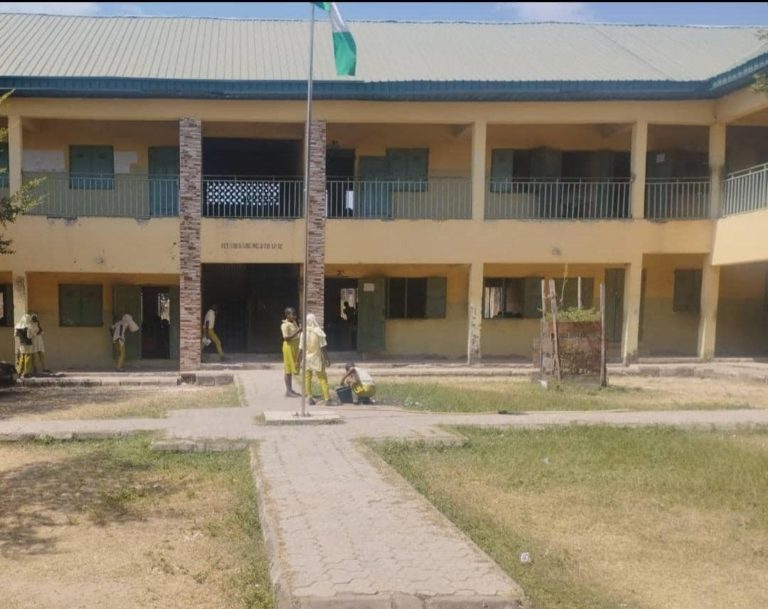
However, her dreams hang in the balance because her son’s school, LEA Nomadic Primary School, Wassa in the FCT, does not have a computer laboratory.
LEA Nomadic School, Wassa. Photo: The ICIR.
She told The ICIR that when she realised her son’s school did not properly teach him computer studies, she attempted to find a special class for computer studies but could not afford it.
“I asked one man around my place if he could teach him computer studies, but I could not afford his fees because I also have to pay for the school fees of my other children,” Ibrahim said.
Her son is one of the many pupils and students in the FCT that are denied quality access to computer studies.
Beyond the opportunities that ICT offer as a career path, computer studies have also been found to improve learning for children.
A United Nations Children’s Fund (UNICEF) report stated that the learning process, especially for children, could be enhanced by technology, even in pre-schools, to improve learning skills.
“One of the critical areas where technology has highly improved understanding is critical thinking, as students are empowered to approach and exploit opportunities with courage and potential. Further, digitisation has enabled students to move into an era of digital learning, spearheaded by ICT’s adoption as an interconnected environment.
“ICT has helped institutions make more informed decisions that have led to the adoption of measures responsible for upholding the economy and environment’s integrity. Through this, a transformative, comprehensive, and higher quality education system is brought forward,” the report read in part. However, this is not the reality in government-owned primary schools within the FCT.
To ascertain the state of ICT education in the FCT, The ICIR visited some government-owned primary schools in the FCT, including the LEA Primary School, Karon-Majigi.
Like Kareem’s school, it was also observed that pupils had no access to computer education.
No practical computer studies in secondary schools
While ICT is rarely taught in government-owned primary schools, it is often not treated as a practical subject in junior secondary schools.
In some junior secondary schools visited by The ICIR, it was observed that students are only taught the theoretical part of computer studies with minimal practice.
The ICIR visited the Junior Secondary School, Life Camp, where it was observed that computer studies are mainly limited to theory.
One of the teachers at the Junior Secondary School, Life Camp, who refused to disclose their identity for lack of authorisation to speak, confirmed to The ICIR that Computer Science was being taught mostly as a theory than a practical subject.
“We have a lab. But if you want the child to be all that literate, maybe you will enrol them in extra classes. What we really do here is more of theory at their level. But when they go to the senior level, they start practical theory,” the teacher said.
When confronted with possible difficulties with understanding, the teacher said that was the training required at their level.
“All those private schools teaching practicals in junior secondary and primary levels are just stressing the children’s brains. There is a procedure to education, and there is what you give to a child at a particular age. If you read education very well, you will know what you are supposed to give to a child.
“We are not in the western world. We teach according to the scheme. That is the problem that private schools have. They know the practicals but they don’t know the theory. But if they learn the theory well, when they see the practical, they can perform it. For junior schools, it is alternative-to-practical,” the teacher said.
A student of the school who spoke to The ICIR said although she had basic computer skills, she mostly learnt from her brother.
“They teach us computer in school, but most of what I know, I learnt from my brother at home. He teaches me with his laptop. Our teachers teach us on the board, and we do a bit of practical. But my brother teaches me more with his laptop,” she said.
The National Policy on Education (NPE), as revised in 1988 and again in 2004, requires teaching computer science as a discipline and integrating the same into school administration and instruction.
The NPE further states that at every level of the educational system, modern education techniques shall be increasingly used and would be improved on. However, this is not the reality in some FCT schools.
According to a report by the Universal Basic Education Commission (UBEC) titled “2018 National Personnel Audit Report on Public and Private Basic Education Schools In Nigeria,” released in October 2019, only about 3,609 computers are available to pupils in 63,798 public primary schools.
A visit to the Junior Secondary School, Gwagwalada, showed that the situation was similar.
The ICIR was restricted from accessing the computer lab, but some staff members noted that the subject was being taught at the school.
Students also confirmed that there were occasional practical classes on the subject, but many admitted to having limited ICT skills.
Junior Secondary School, Gwagwalda.
Speaking to The ICIR, a director at the FCT Universal Basic Education Board (FCT-UBEB) Bashir Abubakar said concerted efforts were being made by the government and some Non-Governmental Organisations (NGOs) to train both teachers and students in ICT.
He noted that a lack of funds was making results relatively slow.
“Concerning computer education for students, we have collaborations with some NGOs. And training is ongoing on a termly basis and in different subjects too. In fact, at the beginning of this month, we, the management, were invited for a one-day training in Nassarawa by one of our collaborators that handle computer issues with the primary section.
“JSS Gwarinpa Estate, the last point I served, I was privileged to get a centre, Digital awareness centre, built by the NCC. They provided computers, generators, and everything in total for that school on ICT. This is besides what the FCT-UBEB does. We have a professional training department headed by a director. As I speak to you, quality education evaluators are attending training at JSS Jabi 2 right now.” he said.
The National Coordinator of Education Rights Campaign, an organisation focused on improved education advocacy, Hassan Soweto, told The ICIR that ICT studies must be effectively integrated into education for Nigerian schools from the primary level.
“Primary school is the foundation of learning. If you look at other economies where ICT has become a major factor in their economic development, you will see that teaching ICT starts in primary and secondary schools.
“If Nigeria is to harness the potential of ICT with regards to the fast-changing nature of the economy, it must ensure that it funds ICT education right from the primary and secondary schools,” he said.
Soweto added that a lack of funding and commitment contributed significantly to the poor state of ICT education in Nigeria.
He also said education in Nigeria did not match the changing realities of the country’s economy.
“This only goes to show that the Nigerian education system is not in any way linked to Nigeria’s economic goals. The syllabi of Nigerian schools are completely outdated.
“The crisis of education underfunding is responsible for the problem that we are facing now. Without developing the capacity of the teachers, establishing the infrastructure like the computer labs, you are not going to be able to achieve the reforms. So, funding is an extra factor at the level of primary, secondary and tertiary education,” he noted.
Until education is properly funded, ICT practically taught, and infrastructure adequately provided, children like Kareem may not be able to achieve their dreams.
*This report is a part of Youth Hub Africa’s Basic Education Media Fellowship 2022 with support from the Malala Fund and Rise Up.
THE Centre for Journalism Innovation and Development (CJID), in collaboration with the Canadian Funds For local Initiative (CFLI), will on January 31 hold a conference on ‘Media Freedom Symposium: Elections 2023 Security, Media and Safety’ to commemorate the International Day to End Impunity for Crimes against Journalists.
According to a statement released by the CJID on Tuesday, January 24, the conference is in response to the continued threats to the safety of journalists and fear of what could emerge in the wake of the 2023 elections.
The event will bring together a range of experts in media policy, the media industry, judicial/legislative sectors, security personnel, frontline actors, and relevant international and local non -governmental organisations to reflect and proffer insights on how to protect journalists and media workers ahead of, during and post-2023 general elections.
Deputy Manager of the Media Freedom Project, Ms Stephanie Adams-Douglas said, “The question of safety is central to journalists’ performance of their duties without fear or interference, yet more and more democratic governments and elected officials resort to authoritarian tendencies in the resolution of media-state conflicts.
“Additionally, election periods are typically notorious for attacks on journalists and for stifling the media ecosystem in the hope of constraining the spaces of democratic accountability, human freedom, and citizens’ liberties.”
The Centre added that the symposium aims to push an agenda for engaging security personnel and political parties regarding the protection of the Nigerian Press.
The security agencies and political parties will hopefully join in drafting and adhering to a pact to protect journalists and the press ahead of and during the elections, according to the CJID.
THE Coalition for Whistleblower Protection and Press Freedom (CWPPF) has condemned the recent attack on the Lagos office of the Media Rights Agenda (MRA) by unknown persons.
In a statement released on Tuesday, January 25, the Coalition described the attack as one of many repressive practices in the coordinated onslaught against media and press freedom in Nigeria.
Parts of the statement read: “Over the years, the MRA has remained a critical pillar advancing the protection of digital rights and press freedom in Nigeria – two defining components of our nascent democracy. We are deeply concerned by the carting away of laptops, hard drives and other devices worth millions of naira, containing sensitive information from years of diligent and impactful work.
“This attack is one of many repressive practices in the coordinated onslaught against the media and press freedom in Nigeria. However, like other ones in the past, it will not dampen our spirit, affect our capacity to carry out our work of promoting and defending media freedom, freedom of expression and access to information in Nigeria.”
The Coalition called on the police and other security agencies to intensify investigations to arrest the attackers, unravel the motive behind the act and recover the items that were carted away.
CEWPF further reiterated the unwavering commitment of the MRA and its partners in supporting and entrenching the ideals of democracy in Nigeria.
THE Central Bank of Nigeria (CBN) maintains there is no going back on its January 31 deadline for the old N200, N500 and N1,000 notes to expire as legal tender.
The CBN Governor, Godwin Emefiele, reiterated the apex bank’s stance after the Monetary Policy Committee meeting, today.
Emefiele, seemingly unbothered about wide concern on unavailability of the redesigned naira notes, argued that the apex bank had given the people enough time to swap their old naira notes for new ones.
To him, kidnapping and ransom-taking had reduced since the three bank notes were redesigned.
Many Nigerians have been lamenting unavailability and scarcity of the new notes, saying banks were still giving out the old naira notes to customers, with the deadline barely a week away.
Some automated teller machines our correspondent visited today were not even dispensing any note. At the Stanbic IBTC on Ijaye Road, Ogba, and the Zenith Bank at Ogba Aguda, both in Lagos, the machines had no money in them. There were five empty machines at the Zenith Bank branch and three at the Stanbic IBTC.
Also, there was no naira note in the two ATMs at the Zenith Bank branch on Acme Road, Ikeja-Ogba.
Meanwhile, the Senate at plenary today urged the CBN to extend the withdrawal date of the old naira notes from January 31 to July 31.
Moving the motion, Sadiq Suleiman, (APC Kwara), recalled that the Senate had resolved on December 28, 2022 to urge the CBN to extend the use of the old notes from January 31 to June 30, 2023.
Suleiman said there should be worry the apex bank had insisted on terminating the use of the old naira notes by the end of January.
He said there were not enough of the new naira notes in circulation and as such, moved a motion that the date should be extended to July 31.
He said, “Experiences around the world have shown that such abrupt decision, if not controlled, usually created chaos.”
Supporting the motion, Senator Ibrahim Hadejia (APC-Jigawa) said that the call for extension was for their constituents, and not for their (lawmakers) personal benefits.
Hadeija said, “In my constituency, no Automated Teller Machine (ATM) is dispensing the new notes.”
Similarly, Senator Adamu Aliero (PDP-Kebbi) said that the policy would inflict untold hardship on people living in the rural areas.
“The CBN governor should be invited,” Aliero said.
Senator Adamu Bulkachuwa (PDP-Bauchi) said that the extension was necessary otherwise there would be chaos.
Senator Biodun Olujimi (PDP-Ekiti), who said about 90 per cent of people in her local government area had not seen a glimpse of the new naira notes, called on the apex bank to “look away from the elections.”
Olujimi said that if the date was not extended, it would lead to collateral damage, which she believed would not augur well for the economy.
Senator Ali Ndume (APC-Borno) called on the Senate to use its oversight responsibility on the CBN to “order the CBN governor to extend the date.”
Saying that the power of the senate should not be played down, he called on the senators to stand firm on the call for extension.
Senator Sam Egwu (PDP-Ebonyi) was, however, the only senator who opposed the motion.
“Nigerians do not have the culture of keeping their money in the bank,” Egwu said.
“It is in Nigeria where cash is used arbitrarily; other countries use electronic means,” he added.
In his remarks, the Senate president, Ahmad Lawan, said that most of the senatorial districts did not have banks.
He said, “In rural Nigeria, there are no banks and people transact businesses with cash more often. There is no doubt that we must have a window for exchange. We must have policies by the CBN to have bank branches established in rural areas.
“We need this extension for the most ordinary Nigerians,” Lawan said.